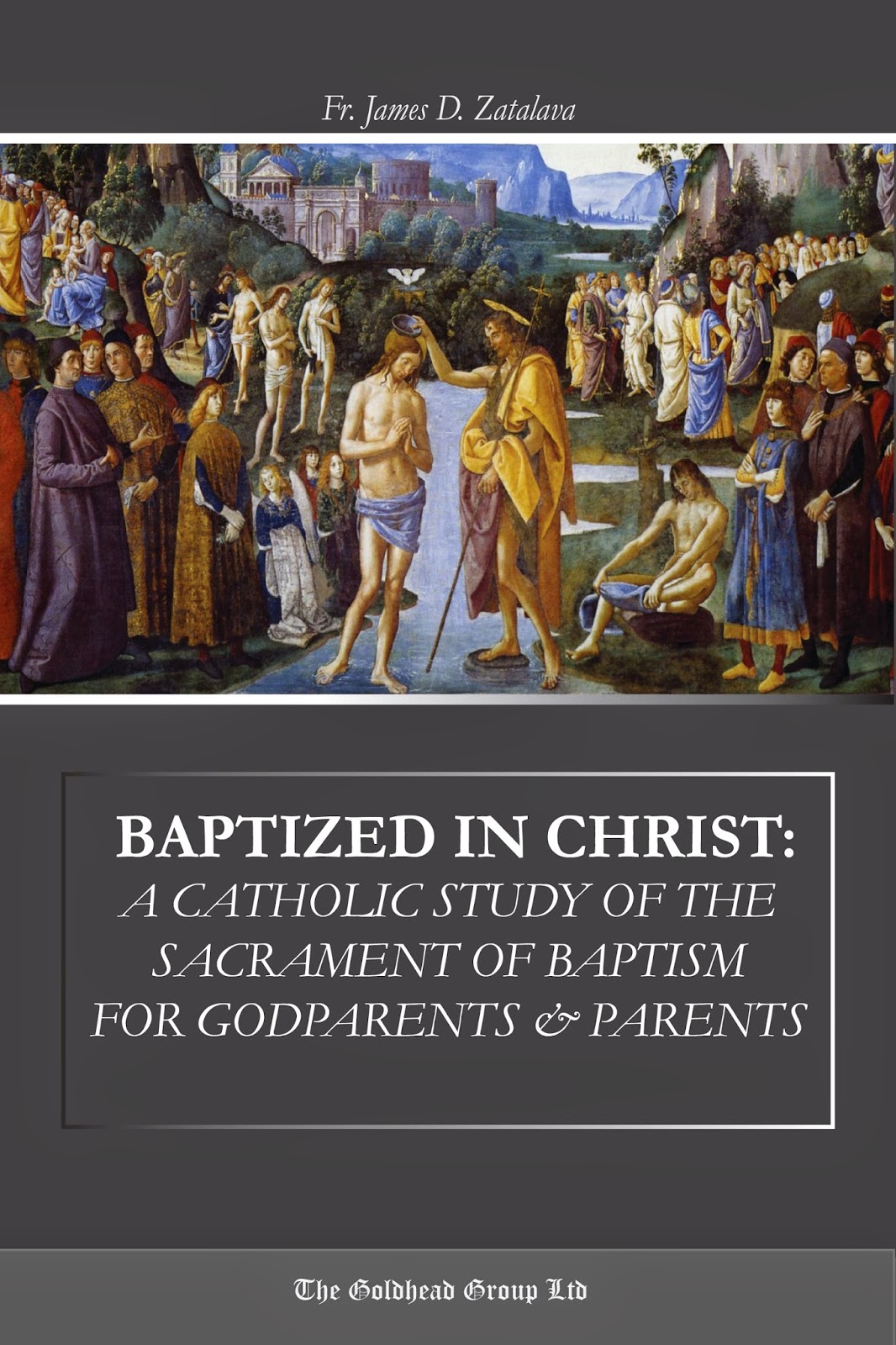
In this short book we will discuss the necessity for, Scriptures relating to, the history of, and the Rite for the Sacrament of Baptism. Baptism is the first Sacrament of the Faith, and it is the Sacrament by which a person becomes a Christian. It is truly a life-giving Sacrament since it is necessary for our salvation to receive it. Baptism was given to the Church as the Sacrament of initiation into the Faith and for the forgiveness of sins, both Original Sin and all personal sins. Through Baptism we are made sons and daughters of God, and God’s very life comes to dwell within us. It is through the graces of Baptism that we are given the foundations of virtue and the gifts of the Holy Spirit, and it is through the graces of Baptism that we live as Christians at all.For anyone studying for a child's Baptism as either a parent or a godparent, see the best-selling and convenient online course by CatechismClass.com: Baptism Preparation Program (For Either Godparents or Parents)
Friday, March 27, 2015
Commemoration (1962 Calendar): Friday before Palm Sunday
Today, the Friday after Passion Sunday is dedicated to the honor of the Seven Sorrows of the Blessed Virgin Mary in the Traditional Roman Catholic Calendar. This day is in addition to the honor given to our Lady and her Seven Sorrows in September's Feast day by this same name.
Dom Gueranger writes in The Liturgical Year:
This Friday of Passion-week is consecrated in a special manner, to the sufferings which the holy Mother of God endured at the foot of the cross. The whole of next week is fully taken up with the celebration of the mysteries of Jesus’ Passion; and although the remembrance of Mary’s share in those sufferings is often brought before the faithful during Holy Week, yet, the thought of what her Son, our divine Redeemer, goes through for our salvation, so absorbs our attention and love, that it is not then possible to honour, as it deserves, the sublime mystery of the Mother’s com-passion.
It was but fitting, therefore, that one day in the year should be set apart for this sacred duty: and what day could be more appropriate than the Friday of this week, which, though sacred to the Passion, admits the celebration of saints’ feasts, as we have already noticed? As far back as the fifteenth century (that is, in the year 1423), we find the pious archbishop of Cologne, Theodoric, prescribing this feast to be kept by his people. It was gradually introduced, and with the knowledge of the holy See, into several other countries; and at length, in the last century, Pope Benedict XIII, by a decree dated August 22, 1727, ordered it to be kept in the whole Church under the name of the Feast of the Seven Dolours of the Blessed Virgin Mary, for, up to this time, it had gone under various names. We will explain the title thus given to it, as also the first origin of the devotion of the Seven Dolours, when our Liturgical Year brings us to the third Sunday of September, the second feast of Mary’s Dolours. What the Church proposes to her children’s devotion for this Friday of Passion-week, is that one special dolour of Mary—her standing at the foot of the cross. Among the various titles given to this feast before it was extended by the holy See to the whole Church, we may mention, Our Lady of Pity, the Compassion of our Lady, and the one that was so popular throughout France, Notre Dame de la Pamoison. These few historical observations prove that this feast was dear to the devotion of the people, even before it received the solemn sanction of the Church.
That we may clearly understand the object of this feast, and spend it, as the Church would have us do, in paying due honour to the Mother of God and of men, we must recall to our minds this great truth: that God, in the designs of His infinite wisdom, has willed that Mary should have a share in the work of the world’s redemption. The mystery of the present feast is one of the applications of this divine law, a law which reveals to us the whole magnificence of God’s plan; it is, also, one of the many realizations of the prophecy, that satan’s pride was to be crushed by a woman. In the work of our redemption there are three interventions of Mary; that is, she was thrice called upon to take part in what God Himself did. The first of these was in the Incarnation of the Word, who would not take flesh in her virginal womb until she had given her consent to become His Mother; and this she gave by that solemn Fiat which blessed the world with a Saviour. The second was in the sacrifice which Jesus consummated on Calvary, where she was present that she might take part in the expiatory offering. The third was on the day of Pentecost, when she received the Holy Ghost, as did the apostles, in order that she might effectively labour in the establishment of the Church. We have already explained, on the feast of the Annunciation, the share Mary had in that wonderful mystery of the Incarnation, which God wrought for His own glory and for man’s redemption and sanctification. On the feast of Pentecost we shall speak of the Church commencing and progressing under the active influence of the Mother of God. To-day we must show what part she took in the mystery of her Son’s Passion; we must tell the sufferings, the Dolours, she endured at the foot of the cross, and the claims she thereby won to our filial gratitude.
O God, in Your passion, the prophecy of Simeon was fulfilled that a sword of sorrow should pierce the sweet soul of Your glorious Virgin-Mother Mary. We reverently recall her sufferings and sorrow; mercifully grant us the fruits of the redemption that was paid for by Your own sufferings, through the merits and prayers of all the saints watching beside the cross; who lives and rules with God the Father...
Friday, March 20, 2015
An ordinary Catholic will no doubt be familiar with genuflecting. After all, everyone is supposed to genuflect towards to Real Presence of our Lord in the Eucharist while in the Church. As the Eucharist should always be in the Tabernacle which rests in the center of the Altar, we will genuflect towards the Tabernacle before entering the pews and taking our seats. If we ever cross the aisle, we genuflect toward the tabernacle again as we walk before the Presence of God.
In the context of the Tridentine Latin Mass, anytime the priest walks past the Tabernacle, he will genuflect. The priests genuflect every single time he approaches the altar, removes the pall, replaces the pall, opens the tabernacle and opens the ciboria. This is done out of respect, reverence, and awe of the presence of the Triune God who is present in the Holy Eucharist.
SCOPE
Yet, the scope of this article is not to mention any of the above practices. Rather, it is to comment on the sublime realities expressed during the Tridentine Mass when, several times through the year, the priest and people will genuflect together as certain words are read whether in the Epistle, Sequence, Tract, Gospel, or other place. These special occurrences are worthy of meditation and consideration.
This article also is not to discuss the aspects of genuflection that occur often in the Tridentine Mass. But for the benefit of those who are not not familiar, they include:
What follows are the truly unique and special occasions when the Faithful will genuflect during the Readings of the Mass. Most of these occasions do not occur on Holy Days of Obligation (whether they be on a Sunday Mass or another day of required Mass attendance). As a result, many Catholics - even those who attend the Tridentine Liturgy each Sunday - may not be aware of these.
GOSPEL OF THE EPIPHANY
GOSPEL OF WEDNESDAY IN 4TH WEEK OF LENT
In the Lenten Feria Mass for Wednesday in the 4th Week of Lent, there is a beautiful epistle in which a healing is recounted by one of the Old Testament Prophets. Then the Gospel shares a similarly beautiful episode from the life of our Lord. May we too fall down and adore the Lord:
TRACT OF ASH WEDNESDAY
Throughout the Lenten Feria's there is often repeated the Tract of Ash Wednesday. Again for those unfamiliar, this prayer is said right before the Gospel in place of the Alleluia. Starting with Septuagesima Sunday (which is 3 Sundays before the First Sunday of Lent) and until Easter, the Alleluia is not permitted to be prayed.
This tract should also cause us to repent of our actions:
ALLELUIA OF PENTECOST
Yet, not all of these instances of genuflections during the Readings occur during the somber time of Lent. There is a point in the Pentecost Pascal Alleluia where genuflection occurs:
EXALTATION OF THE CROSS
Even during the September 14th Feast of the Exaltation of the Cross, you will find a genuflection occurring during the readings. Like the aforementioned example occurring during Wednesday in the 4th Week of Lent, this occurs during the Readings. We too should feel moved as to fall down and adore the Lord's Holy Name. A reading from the Epistle of the Mass:
EPISTLE ON PALM SUNDAY
The Epistle of Palm Sunday is the very same one as for the Exaltation of the Cross. Thus, during this day, all genuflect as well.
GOSPEL ON PALM SUNDAY, HOLY TUESDAY, HOLY WEDNESDAY, & GOOD FRIDAY
In a most somber manner, on these days in which the 4 Gospel accounts of our Lord's Death are read, all genuflect when during the readings after His death occurs. As we read in part on Good Friday:
GOOD FRIDAY LITURGY
Many times on Good Friday the Faithful and the priest all genuflect. This is not only during the Great Intercessions but also during the veneration of the Cross where at three times, all fall down and adore the Holy Cross of our Lord.
CARRYING OF THE PASCAL CALENDAR AT THE EASTER VIGIL
And in yet another example, all genuflect as the Pascal Candle is carried from the Holy Fire into the Sanctuary, when the Exultet will be chanted.
SUMMARY
The Sacred Liturgy offers a number of occasions of great meditation when we pray not only with our words but with our actions. Man should not hate his body but rather should use it and embrace it. We are a creation of God composed of both body and soul; and as such, we pray with our whole person. It is therefore fitting we should embrace these moments in the Liturgy when we fall down and adore the mysteries of our God. Such occasions are worth great meditation.
Read more >>
In the context of the Tridentine Latin Mass, anytime the priest walks past the Tabernacle, he will genuflect. The priests genuflect every single time he approaches the altar, removes the pall, replaces the pall, opens the tabernacle and opens the ciboria. This is done out of respect, reverence, and awe of the presence of the Triune God who is present in the Holy Eucharist.
SCOPE
Yet, the scope of this article is not to mention any of the above practices. Rather, it is to comment on the sublime realities expressed during the Tridentine Mass when, several times through the year, the priest and people will genuflect together as certain words are read whether in the Epistle, Sequence, Tract, Gospel, or other place. These special occurrences are worthy of meditation and consideration.
This article also is not to discuss the aspects of genuflection that occur often in the Tridentine Mass. But for the benefit of those who are not not familiar, they include:
- During the Nicene Creed, all will kneel during the words "...and was incarnate by the Holy Spirit of the Virgin Mary, and was made man"
- During the Last Gospel of the Mass, all genuflect at the words "...and the Word became flesh"
What follows are the truly unique and special occasions when the Faithful will genuflect during the Readings of the Mass. Most of these occasions do not occur on Holy Days of Obligation (whether they be on a Sunday Mass or another day of required Mass attendance). As a result, many Catholics - even those who attend the Tridentine Liturgy each Sunday - may not be aware of these.
GOSPEL OF THE THIRD MASS OF CHRISTMAS
The Mass During the Day of Christmas is the reading traditionally said for the Last Gospel, and the faithful genuflect as they would do during the Last Gospel:
In the beginning was the Word, and the Word was in God's presence, and the Word was God. The same was in the beginning with God. All things were made by Him, and without Him was made nothing that was made: in Him was life, and the life was the Light of men; and the Light shineth in darkness, and the darkness did not comprehend it. There was a man sent from God, whose name was John. This man came for a witness, to testify concerning the Light, that all might believe through Him. He was not the Light, but he was to testify concerning the Light. That was the true Light, which enlighteneth every man that cometh into this world. He was in the world, and the world was made by Him, and the world knew Him not. He came unto His own, and His own received Him not. But as many as received Him to them He gave power to become sons of God, to them that believe in His Name, who are born not of blood, nor of the will of the flesh, nor of the will of man, but of God, [here genuflect] and the Word was made flesh, and dwelt among us: and we saw His glory, the glory as of the Only begotten of the Father, full of grace and truth.
GOSPEL OF THE EPIPHANY
When Jesus was born in Bethlehem of Juda in the days of King Herod, behold there came wise men from the East to Jerusalem, saying: Where is He that is born King of the Jews? For we have seen His star in the East, and are come to adore Him. And king Herod hearing this was troubled, and all Jerusalem with him.
And assembling together all the chief priests and the scribes of the people, he inquired of them where Christ should be born. But they said to him: In Bethlehem of Juda. For so it is written by the Prophet: And thou Bethlehem, the land of Juda, art not the least among the princes of Juda: for out of thee shall come forth the Captain that shall rule My people Israel. Then Herod, privately calling the wise men, learned diligently of them the time of the star which appeared to them: and sending them into Bethlehem said: Go and diligently inquire after the Child, and when you have found Him, bring me word again that I also may come and adore Him. Who having heard the king went their way.
And behold the star, which they had seen in the East, went before them until it came and stood over where the Child was. And seeing the star, they rejoiced with exceeding great joy. And entering into the house, they found the Child with Mary His mother, [here genuflect] and falling down they adored Him. And opening their treasures, they offered Him gifts, gold, frankincense, and myrrh. And having received an answer in sleep that they should not return to Herod, they went back another way into their country.
GOSPEL OF WEDNESDAY IN 4TH WEEK OF LENT
In the Lenten Feria Mass for Wednesday in the 4th Week of Lent, there is a beautiful epistle in which a healing is recounted by one of the Old Testament Prophets. Then the Gospel shares a similarly beautiful episode from the life of our Lord. May we too fall down and adore the Lord:
John 9:1-38
At that time Jesus, passing by, saw a man who was blind from his birth. And his disciples asked him: "Rabbi, who hath sinned, this man or his parents, that he should be born blind?" Jesus answered: "Neither hath this man sinned, nor his parents; but that the works of God should be made manifest in him. I must work the works of him that sent me, whilst it is day: the night cometh, when no man can work. As long as I am in the world, I am the light of the world."
When he had said these things, he spat on the ground and made clay of the spittle and spread the clay upon his eyes, And said to him: "Go, wash in the pool of Siloe," which is interpreted, 'Sent.' He went therefore and washed: and he came seeing.
The neighbours, therefore, and they who had seen him before that he was a beggar, said: "Is not this he that sat and begged?" Some said: "This is he." But others said: "No, but he is like him." But he said: "I am he." They said therefore to him: "How were thy eyes opened?" He answered: "That man that is called Jesus made clay and anointed my eyes and said to me: 'Go to the pool of Siloe and wash.' And I went: I washed: and I see." And they said to him: "Where is he?" He saith: "I know not."
They bring him that had been blind to the Pharisees. Now it was the sabbath, when Jesus made the clay and opened his eyes. Again therefore the Pharisees asked him how he had received his sight. But he said to them: "He put clay upon my eyes: and I washed: and I see." Some therefore of the Pharisees said: "This man is not of God, who keepeth not the sabbath." But others said: "How can a man that is a sinner do such miracles?" And there was a division among them. They say therefore to the blind man again: "What sayest thou of him that hath opened thy eyes?" And he said: "He is a prophet."
The Jews then did not believe concerning him, that he had been blind and had received his sight, until they called the parents of him that had received his sight, And asked them, saying: "Is this your son, who you say was born blind? How then doth he now see?" His parents answered them and said: "We know that this is our son and that he was born blind: But how he now seeth, we know not: or who hath opened his eyes, we know not. Ask himself: he is of age: Let him speak for himself."
These things his parents said, because they feared the Jews: for the Jews had already agreed among themselves that if any man should confess him to be Christ, he should be put out of the synagogue. Therefore did his parents say: "He is of age. Ask himself."
They therefore called the man again that had been blind and said to him: "Give glory to God. We know that this man is a sinner." He said therefore to them: "If he be a sinner, I know not. One thing I know, that whereas I was blind. now I see." They said then to him:
"What did he to thee? How did he open thy eyes?" He answered them: "I have told you already, and you have heard. Why would you hear it again? Will you also become his disciples?" They reviled him therefore and said: "Be thou his disciple; but we are the disciples of Moses. We know that God spoke to Moses: but as to this man, we know not from whence he is." The man answered and said to them: "why, herein is a wonderful thing, that you know not from whence he is, and he hath opened my eyes. Now we know that God doth not hear sinners: but if a man be a server of God and doth his, will, him he heareth. From the beginning of the world it hath not been heard, that any man hath opened the eyes of one born blind. Unless this man were of God, he could not do anything." They answered and said to him: "Thou wast wholly born in sins; and dost thou teach us?" And they cast him out.
Jesus heard that they had cast him out. And when he had found him, he said to him: "Dost thou believe in the Son of God?" He answered, and said: "Who is he, Lord, that I may believe in him?" And Jesus said to him: "Thou hast both seen him; and it is he that talketh with thee." And he said: "I believe, Lord." [here genuflect] And falling down, he adored him.This is a powerful passage. The words that we hear during the Gospel are not merely a story. We too are called to have them transform us. And like the man who was healed, we are also to be so moved by our Lord's miracles and teachings and all His virtues that we fall down and adore Him.
TRACT OF ASH WEDNESDAY
Throughout the Lenten Feria's there is often repeated the Tract of Ash Wednesday. Again for those unfamiliar, this prayer is said right before the Gospel in place of the Alleluia. Starting with Septuagesima Sunday (which is 3 Sundays before the First Sunday of Lent) and until Easter, the Alleluia is not permitted to be prayed.
This tract should also cause us to repent of our actions:
Ps. 102:10; 78:8-9
O Lord, repay us not according to the sins we have committed, nor according to our iniquities. V. O Lord, remember not our iniquities of the past; let Your mercy come quickly to us, for we are being brought very low. (All kneel.) V. Help us, O God our Savior, and for the glory of Your name, O Lord, deliver us; and pardon us our sins for Your names sake.
ALLELUIA OF PENTECOST
Yet, not all of these instances of genuflections during the Readings occur during the somber time of Lent. There is a point in the Pentecost Pascal Alleluia where genuflection occurs:
Alleluia, alleluia! V. Ps. 103:30. Send forth Your Spirit and they shall be created, and You shall renew the face of the earth. Alleluia! (Here all kneel.) V. Come, Holy Spirit, fill the hearts of Your faithful, and kindle in them the fire of Your love.There is often a connection with kneeling when one implores the Gifts of the Holy Ghost, the 3rd Person of the Most Holy Trinity.
EXALTATION OF THE CROSS
Even during the September 14th Feast of the Exaltation of the Cross, you will find a genuflection occurring during the readings. Like the aforementioned example occurring during Wednesday in the 4th Week of Lent, this occurs during the Readings. We too should feel moved as to fall down and adore the Lord's Holy Name. A reading from the Epistle of the Mass:
Philipp. 2:5-11
Brethren: For let this mind be in you, which was also in Christ Jesus: Who being in the form of God, thought it not robbery to be equal with God: But emptied himself, taking the form of a servant, being made in the likeness of men, and in habit found as a man. He humbled himself, becoming obedient unto death, even to the death of the cross. For which cause, God also hath exalted him and hath given him a name which is above all names: [here all genuflect] That in the name of Jesus every knee should bow, of those that are in heaven, on earth, and under the earth: And that every tongue should confess that the Lord Jesus Christ is in the glory of God the Father.
EPISTLE ON PALM SUNDAY
The Epistle of Palm Sunday is the very same one as for the Exaltation of the Cross. Thus, during this day, all genuflect as well.
GOSPEL ON PALM SUNDAY, HOLY TUESDAY, HOLY WEDNESDAY, & GOOD FRIDAY
In a most somber manner, on these days in which the 4 Gospel accounts of our Lord's Death are read, all genuflect when during the readings after His death occurs. As we read in part on Good Friday:
...Now there stood by the cross of Jesus His Mother, and His Mother's sister, Mary of Cleophas, and Mary Magdalen. When Jesus therefore had seen His Mother and the disciple standing whom He loved, He saith to His Mother: J. Woman, behold thy son. C. After that, He saith to the disciple: J. Behold thy mother. C.And from that hour, the disciple took her to his own. Afterwards, Jesus, knowing that all things were now accomplished, that the Scripture might be fulfilled, said: J. I thirst. C. Now there was a vessel set there, full of vinegar. And they, putting a sponge full of vinegar about hyssop, put it to His mouth. Jesus therefore, when He had taken the vinegar, said: J. It is consummated. C.And bowing His head, He gave up the ghost.
Here all kneel and pause a few moments.
Then the Jews because it was the Parasceve, that the bodies might not remain upon the cross on the Sabbath day for that was a great Sabbath day, besought Pilate that their legs might be broken and that they might be taken away. The soldiers therefore came, and they broke the legs of the first, and of the other that was crucified with Him. But after they were come to Jesus, when they saw that He was already dead, they did not break His legs. But one of the soldiers with a spear opened His side, and immediately there came out blood and water. And he that saw it hath given testimony: and his testimony is true. And he knoweth that he saith true: that you also may believe. For these things were done that the Scripture might be fulfilled: you shall not break a bone of Him...
GOOD FRIDAY LITURGY
Many times on Good Friday the Faithful and the priest all genuflect. This is not only during the Great Intercessions but also during the veneration of the Cross where at three times, all fall down and adore the Holy Cross of our Lord.
CARRYING OF THE PASCAL CALENDAR AT THE EASTER VIGIL
And in yet another example, all genuflect as the Pascal Candle is carried from the Holy Fire into the Sanctuary, when the Exultet will be chanted.
SUMMARY
The Sacred Liturgy offers a number of occasions of great meditation when we pray not only with our words but with our actions. Man should not hate his body but rather should use it and embrace it. We are a creation of God composed of both body and soul; and as such, we pray with our whole person. It is therefore fitting we should embrace these moments in the Liturgy when we fall down and adore the mysteries of our God. Such occasions are worth great meditation.
Traditional Catholics will be familiar with the fact that the Feast of the Body of Christ (Corpus Christi) is kept on a separate date than the Feast of the Precious Blood. The Feast of the Precious Blood is kept on July 1st. The monthly is July is also especially dedicated to the Precious Blood Devotions.
However, there is also a Lenten Votive Mass that may be said on Friday after the 4th Sunday of Lent. This was one of the Mass in Some Places that was part of the traditional Missal.
Read more >>
However, there is also a Lenten Votive Mass that may be said on Friday after the 4th Sunday of Lent. This was one of the Mass in Some Places that was part of the traditional Missal.
FEAST OF THE MOST PRECIOUS BLOOD.—For many dioceses there are two days to which the Office of the Precious Blood has been assigned, the office being in both cases the same. The reason is this: the office was at first granted to the Fathers of the Most Precious Blood only. Later, as one of the offices of the Fridays of Lent, it was assigned to the Friday after the fourth Sunday in Lent. In many dioceses these offices were adopted also by the fourth Provincial Council of Baltimore (1840). When Pius IX went into exile at Gaeta (1849) he had as his companion the saintly Don Giovanni Merlini, third superior general of the Fathers of the Most Precious Blood. Arrived at Gaeta, Merlini suggested that His Holiness make a vow to extend the feast of the Precious Blood to the entire Church, if he would again obtain possession of the papal dominions. The pope took the matter under consideration, but a few days later sent his domestic prelate Jos. Stella to Merlini with the message: "The pope does not deem it expedient to bind himself by a vow; instead His Holiness is pleased to extend the feast immediately to all Christendom". This was June 30, 1849, the day the French conquered Rome and the republicans capitulated. The thirtieth of June had been a Saturday before the first Sunday of July, wherefore the pope decreed (August 10, 1849) that henceforth every first Sunday of July should be dedicated to the Most Precious Blood.
ULRICH F. MUELLER
July
1st:
The Precious Blood of Our Lord 1st Class
| ||||||||||||||||||||||||||||||||||||||||||||||||
Friday, March 13, 2015
Regarding this Feast in some places, which is taken from the Missae pro Aliquibus Locis of the Roman Missal, the Catholic Encyclopedia explains:
"The earliest evidence of a feast in honour of the Wounds of Christ comes from the monastery of Fritzlar, Thuringia, where in the fourteenth century a feast was kept on the Friday after the octave of Corpus Christi. The Office was rhythmical (Dreves, "Anal. hymnica", XXIV, 20; Grotefend, "Zeitrechnung", II, 1, 115). In the fifteenth century it had spread to different countries, to Salisbury (England), Huesca and Jaca (Spain), Vienna, and Tours, and was included in the Breviaries of the Carmelites, Franciscans, Dominicans, and other orders (Dreves, op. cit., XXIV, XL, XLII).
"The Feast of the Five Wounds, celebrated since the Middle Ages at Evora and elsewhere in Portugal on 6 February (at Lisbon on the Friday after Ash-Wednesday) is of historical interest. It commemorates the founding of the Portuguese kingdom in 1139, when, before the battle on the plains of Ourique, Christ appeared to Alfonso Henriquez, promising victory over the Moors and commanding him to insert into the coat of arms of the new kingdom the emblem of the Five Wounds ("Propr. Portugalliae" in Weiss, "Weltgeschichte", III, 251). This feast is celebrated today in all Portuguese-speaking countries.
"The Proprium of Venice of 1766, which contains perhaps the earliest series of movable feasts in honour of Christ's Passion, has the Feast of the Five Wounds on the second Sunday in March; it was granted in 1809 to Leghorn for the Friday after Ash-Wednesday, on which day it is still kept in many dioceses of Tuscany, and elsewhere (Mexico).
"Since 1831, when the feasts in honour of the Passion were adopted at Rome by the Passionists and the city, this feast was assigned to the Friday after the third Sunday in Lent. The Office is one of those bequeathed to us by the Middle Ages. As this feast is not celebrated in the entire Church the Office and Mass are placed in the appendix of the Breviary and the Missal."
Today is also an ideal day to pray the Indulged Prayer to the Cross for Fridays in Lent.
The Five Holy Wounds of Our Lord Jesus Christ
Friday after the Third Sunday of Lent
Introit: Philippians ii: 8-9
Our Lord Jesus Christ humbled Himself
unto death, even unto death upon the Cross: Therefore God has also exalted Him,
and given Him a name which is above all names. [Ps. lxxxviii: 2] I will sing the
mercies of the Lord for all eternity: for generation after generation His truth
will be in my mouth. Glory be.... Our Lord Jesus Christ....
Collect
O God, who through the passion of Your only begotten Son, and the pouring out of His blood through the five Wounds,
hast restored to human nature what was lost through sin: grant, we beseech Thee,
that we who venerate the same Wounds and precious blood on earth may gain their
fruit in heaven. Through the same....
A Reading From The Prophet Zacharia
Thus saith the Lord: And I will pour
out upon the house of David, and upon the inhabitants of Jerusalem, the spirit
of grace, and of prayers: and they shall look upon me, whom they have pierced:
and they shall mourn for him as one mourneth for an only son, and they shall
grieve over him, as the manner is to grieve for the death of the firstborn. In
that day there shall be a great lamentation in Jerusalem. And they shall say to
him: What are these wounds in the midst of thy hands? And he shall say: With
these I was wounded in the house of them that loved me. Awake, O sword, against
my shepherd, and against the man that cleaveth to me, saith the Lord of hosts:
strike the shepherd, and the sheep shall be scattered: and I will turn my hand
to the little ones: saith the Lord almighty.xii: 10-11; xiii: 6-7
Gradual: Ps. lxviii: 21-22
Insult has broken my heart, and I am
weak, I looked for sympathy, but there was none; for comforters, and I found
none. Rather they put gall in my food, and in my thirst they gave me vinegar to
drink.
Tract: Isaias: liii: 4-5
Surely He hath borne our infirmities
and carried our sorrows: and we have thought Him, as it were, a leper, and as
one struck by God and afflicted. But He was wounded for our iniquities, He was
bruised for our sins: the chastisement of our peace was upon Him, and by His
bruises we were healed.
Gospel: John xix: 28-35
+
The continuation of the holy Gospel according to John:
Jesus knowing that all things were now
accomplished, that the scripture might be fulfilled, said: "I thirst."
Now there was a vessel set there, full of vinegar. And they, putting a sponge
full of vinegar and hyssop, put it to his mouth. Jesus therefore, when he had
taken the vinegar, said: "It is consummated." And bowing his head, he
gave up the ghost. Then the Jews (because it was the parasceve), that the bodies
might not remain upon the cross on the sabbath day (for that was a great sabbath
day), besought Pilate that their legs might be broken: and that they might be
taken away. The soldiers therefore came: and they broke the legs of the first,
and of the other that was crucified with him. But after they were come to Jesus,
when they saw that he was already dead, they did not break his legs. But one of
the soldiers with a spear opened his side: and immediately there came out blood
and water. And he that saw it hath given testimony: and his testimony is true.Credo
Offertory
Evil men rose up against Me: without
mercy they sought to kill Me: they did not hesitate to spit in My face: with
their lances they wounded Me, and they have struck all My bones.
Secret
May Thy majesty, we beseech Thee, O
Lord, accept these gifts: in which we offer the Wounds of Thine Only-begotten,
the price of our liberty. Through the same....
Preface of the Holy Cross
It is truly meet and just, right and availing unto salvation, that we should
in all times and in all places give thanks unto Thee, O holy Lord, Father
almighty and everlasting God. Who didst set the salvation of mankind upon the
tree of the Cross, so that whence came death, thence also life might rise again,
and that he who overcame by the tree might also be overcome on the tree; through
Christ our Lord. Through whom the angels praise Thy majesty, the dominations
adore, the powers are in awe, the virtues of highest heaven and the blessed
seraphim unite in blissful exultation. With them we praise Thee; grant that our
voices too may blend, saying in adoring praise:
Communion:
They looked upon Him whom they had
transfixed, even as the earth was shaken to its foundations.
Postcommunion:
Refreshed by these life-giving
nourishments, we beseech Thee, O Lord, God: that the wounds of our Lord Jesus
Christ which we honor today; may impress themselves upon our hearts, so that
dying to sin we will have life. Through the same.... |
Monday, March 9, 2015
St. Frances of Rome (1384 - 1440) was born to wealthy parents, her mother a pious woman and her father, a strong-willed man. At the young age of 11, she wished to join religious life but her father had promised her in marriage and forced her to obey. In those times, a father could sell his child into slavery or even order them killed (all legally).
The parties and raucous life caused Frances to collapse. In fact, she was unable to move, walk, or speak for some time and appeared close to death. It was through a miraculous vision that St. Alexis, who underwent a similar marriage trial appeared to her. The saint asked Frances if she wished to die or leave. Frances replied, "God's will is mine." St. Alexis then replied to her, "Then you will live to glorify His Name." At that moment she was healed.
She spent a life in piety and charity. Even with the ridicule of some of her family and admin wars and turbulent times, she remained steadfast in her Faith and charitable resolutions. While her husband was still living, she founded an order of Oblates affiliated with the Benedictines; and when she became a widow she was elected superior of those religious women.
She died in 1440 after a holy life.
The parties and raucous life caused Frances to collapse. In fact, she was unable to move, walk, or speak for some time and appeared close to death. It was through a miraculous vision that St. Alexis, who underwent a similar marriage trial appeared to her. The saint asked Frances if she wished to die or leave. Frances replied, "God's will is mine." St. Alexis then replied to her, "Then you will live to glorify His Name." At that moment she was healed.
She spent a life in piety and charity. Even with the ridicule of some of her family and admin wars and turbulent times, she remained steadfast in her Faith and charitable resolutions. While her husband was still living, she founded an order of Oblates affiliated with the Benedictines; and when she became a widow she was elected superior of those religious women.
She died in 1440 after a holy life.
Traditional Matins Reading:
Frances, a noble lady of Rome, led a most virtuous life, even in her earliest years. She despised all childish amusements, and worldly pleasures, her only delight being solitude and prayer. When eleven years old, she resolved on consecrating her virginity to God, and seeking admission into a monastery. But she humbly yielded to the wishes of her parents, and married a young and rich nobleman, by name Lorenzo Ponziani. As far as it was possible, she observed, in the married state, the austerities of the most perfect life to which she had aspired. She carefully shunned theatrical entertainments, banquets, and other such amusements. Her dress was of serge, and extremely plain. Whatever time remained after she had fulfilled her domestic duties was spent in prayer and works of charity. But her zeal was mainly exercised in endeavouring to persuade the ladies of Rome, to shun the world, and vanity in dress. It was with a view to this that she founded during her husband’s life, the house of Oblates of the Congregation of Monte Oliveto, under the rule of Saint Benedict. She bore her husband’s banishment, the loss of all her goods, and the trouble which befell her whole family, not only with heroic patience, but was frequently heard to give thanks, saying with holy Job: 'The Lord hath given, and the Lord hath taken away: blessed be the name of the Lord.’
At the death of her husband, she fled to the aforesaid house of Oblates, and there, barefooted, with a rope tied round her neck, and prostrate on the ground, she humbly, and with many tears, begged admission. Her petition being granted, she, though mother o the whole community, gloried in calling herself everyone’s servant, and a worthless woman, and a vessel of dishonour. She evinced the contempt she had for herself by her conduct, as well as by her expressions. Thus, when returning from a vineyard in the suburbs, she would go through the city, sometimes carrying faggots on her head, sometimes driving an ass laden with them. She looked after, and bestowed abundant alms upon the poor. She visited the sick in the hospitals, and consoled them, not only with corporal food, but with spiritual advice. She was untiring in her endeavours to bring her body into subjection, by watchings, fasting, wearing a hair-shirt and an iron girdle, and by frequent disciplines. Her food, which she took but once in the day, consisted of herbs and pulse, and her only drink was water. But she would somewhat relent in these corporal austerities, as often as she was requested to do so by her confessor, whom she obeyed with the utmost exactitude.
Her contemplation of the divine mysteries, and especially of the Passion, was made with such intense fervour and abundance of tears, that she seemed as though she would die with grief. Frequently, too, when she was praying, and above all after holy Communion, she would remain motionless, with her soul fixed on God, and rapt in heavenly contemplation. The enemy of mankind seeing this, endeavoured to frighten her out of so holy a life, by insults and blows; but she feared him not, invariably baffled his attempts, and, by the assistance of her angel guardian, whose visible presence was granted to her, she gained a glorious victory. God favoured her with the gift of healing the sick, as also with that of prophecy, whereby she foretold future events, and could read the secrets of hearts. More than once, when she was intent on prayer, either in the bed of a torrent, or during a storm of rain, she was not touched by the water. On one occasion, when all the bread they had was scarcely enough to provide a meal for three of the sisters, she besought our Lord, and he multiplied the bread; so that after fifteen persons had eaten as much as they needed, there was sufficient left to fill a basket. At another time, when the sisters were gathering wood outside the city walls, in the month of January, she amply quenched their thirst by offering them bunches of fresh grapes, which she miraculously obtained from a vine hanging on a tree. Her virtues and miracles procured for her the greatest veneration from all. Our Lord called her to himself in the fifty-sixth year of her age, and she was canonized by Pope Paul the fifth.
Prayer:
O God, among the many gifts of grace You bestowed on Your blessed servant Frances, You granted her an intimate friendship with an angel. May we be worthy of fellowship with the angels through her intercession. Through Our Lord . . .
Prayer Source: 1962 Roman Catholic Daily Missal
Friday, March 6, 2015
After several months of work, CatechismClass.com is pleased
to announce the launch of their latest course: Understanding the Precepts of the Church. I am pleased to have written this course.
This 7 part course will explain
the Precepts of the Church as well as other responsibilities of Catholics,
informally called Precepts too, such as “Working for the Evangelization of
Souls.”
Catholics are bound to observe the laws of the Church, in
addition to the Ten Commandments. Many
of these additional laws have been long established and observed by the
Faithful for centuries. All together,
the Deposit of Faith, that which a Catholic must believe in order to truly be a
Catholic, requires Catholics to observe the Precepts of the Church.
While there are many courses and books on the Ten
Commandments (The Commandments of God), there are very few resources on the
Commandments of the Church, known as the Precepts of the Church.
In this course I will cover:
1. Why must we attend Mass on Holy Days?
2. How have the Holy Days of Obligation changed over the centuries?
3. Why do Holy Days differ country to country?
4. What are fast and abstinence days and how have they changed over time?
5. How is the Byzantine Fasting different from Roman Catholic Fasting?
6. What are the traditional days of Rogation Days, Ember Days, and Vigils all about?
7. Why must we received Holy Communion during Eastertide?
8. What is meant by “The Easter Duty”?
9. What period of time is this really since it is more than just the 50 Days of Easter?
10. Why must we confess our sins once a year?
11. What are the requirements for marriage in the Church?
12. Why is Invitro-Fertilization an attack on the marriage laws of the Church?
13. What must we do to evangelize souls?
14. And much, much more!
This course is
available for only $19.95. Click here to preview the lessons!
The Shroud of Turin has been subjected to a variety of scientific examinations to confirm its authenticity using scientific methods, despite the rather obvious conclusion that the intricacy and detail on the Shroud could not have been merely created by antiquated Medieval technology. In fact, the Turin Center of Colorado has demonstrated that the fold marks found on the Shroud indicate it once resided in Constantinople in the 10th-11th centuries, in contrast to those who claim that the shroud was a 14th-century forgery. Such a claim corroborates historians who maintain that the Lord's burial cloth was in the possession of Byzantine emperors before the Sack of Constantinople in 1204 AD.
The Holy See remained silent on the Shroud until the middle of the 20th century when, in 1940, Sister Maria Pierina De Micheli obtained authorization from Archdiocese of Milan to produce the Holy Face Medal with the image of the Holy Shroud. And Pope Pius XII subsequently approved the image in 1958 in connection with devotion to the Holy Face and the Feast of the Holy Face which he instituted to be said on Shrove Tuesday of each year in reparation for the offenses of Mardi Gras.
Closer to our times, Pope Benedict XVI further expressed his own belief in the authenticity of the Shroud of Turin as the Lord’s own burial cloth by calling it "a truly mysterious image, which no human artistry was capable of producing. In some inexplicable way, it appeared imprinted upon cloth and claimed to show the true face of Christ, the crucified and risen Lord.” Yet while the Church has officially not decreed that the Shroud of Turin is the actual burial cloth of the Lord, the scientific evidence of the Turin Center of Colorado points to this reality. As Holy Mother Church affirms in her actions, whether or not the cloth is authentic has no bearing on the validity of what our Lord taught or on the saving power of His death and resurrection.
The Catholic Encyclopedia, Vol. 15, 1913 states: "In 1206 one of the (supposed) Winding Sheets used at the burial of Christ was brought to Besançon by Otto de La Roche, and the feast of its arrival (Susceptio) was ordered to be kept on 11 July. At present, it is a double of the first class in the cathedral, and of the second class in the diocese. The Office is very beautiful. Another feast originated about 1495 at Chambéry, in Savoy, to honour the so-called sudario of Christ which came there in 1432 from Lirey in Burgundy, and which since 1578 is venerated in the royal chapel of the cathedral of Turin. This feast is celebrated on 4 May, the day after the Invention of the Cross, and was approved in 1506 by Julius II; it is now kept in Savoy, Piedmont, and Sardinia as the patronal feast of the royal House of Savoy (4 May, double of the first class, with octave). A third feast, the Fourth Sunday in Lent (translation to a new shrine in 1092), was during the Middle Ages kept at Compiègne in France, in honour of a winding sheet brought there from Aachen in 877. The feast which since 1831 is contained in the appendix of the Breviary, on the Friday after the Second Sunday in Lent, is independent of any particular relic, but before 1831 it was rarely found on the diocesan calendars. It has not yet found its way into the Baltimore Ordo. The office is taken from the Proprium of Turin."
The Most Holy Shroud of Our Lord Jesus Christ
Friday after the Second Sunday of Lent
Mass in Some Places
From the pre-1955 Missal
Introit: Philippians ii: 8-9
Our Lord Jesus Christ humbled Himself unto
death, even unto death upon the Cross: Therefore God has also exalted Him, and
given Him a name which is above all names. [Ps. lxxxviii: 2] I will sing the
mercies of the Lord for all eternity: for generation after generation His truth
will be in my mouth. Glory be.... Our Lord Jesus Christ....
Collect
O God, who hast left us a relic of Thy passion
in the holy shroud in which Thy body, taken down from the Cross, was wrapped by
Joseph [of Arimathea]: grant, we beseech Thee; that through Thy death and
burial, we may be brought to the glory of resurrection. Thou who livest and
reignest.....A Reading From The Prophet Isaias lxii: 11; lxiii: 1-7
Gradual: Ps. lxviii: 21-22
Insult has broken my heart, and I am weak, I
looked for sympathy, but there was none; for comforters, and I found none.
Rather they put gall in my food, and in my thirst they gave me vinegar to drink.
Tract: Isaias: liii: 4-5
Surely He hath borne our infirmities and carried
our sorrows: and we have thought Him, as it were, a leper, and as one struck by
God and afflicted. But He was wounded for our iniquities, He was bruised for our
sins: the chastisement of our peace was upon Him, and by His bruises we were
healed.
In Masses outside of Lent the tract is
omitted and replaced by:
Alleluia, Alleluia. Hail, our King: Thou alone
art merciful in spite of our errors: Obedient to the Father Thou wert led to be
crucified, as a humble lamb to the slaughter. Alleluia
During Paschaltide:
Alleluia, Alleluia. Hail, our King: Thou alone
art merciful in spite of our errors: Obedient to the Father Thou wert led to be
crucified, as a humble lamb to the slaughter. Alleluia To Thee be glory,
hosanna: to Thee be triumph and victory: to Thee be the highest praise and the
crown of honor. Alleluia.
Mass said in front of the Shroud of Turin
Gospel: Mark xv: 42-46
At that time, when evening was now come (because
it was the Parasceve, that is, the day before the sabbath), Joseph of Arimathea,
a noble counselor, who was also himself looking for the kingdom of God, came and
went in boldly to Pilate and begged the body of Jesus. But Pilate wondered that
he should be already dead. And sending for the centurion, he asked him if he
were already dead. And when he had understood it by the centurion, he gave the
body to Joseph. And Joseph, buying fine linen and taking him down, wrapped him
up in the fine linen and laid him in a sepulchre which was hewed out of a rock.
And he rolled a stone to the door of the sepulchre.The continuation of the holy Gospel according to Mark: Credo
Offertory: Leviticus xvi: 2 et 5
Aaron entered into the tabernacle in
order to offer a holocaust upon the altar for the sins of the sons of Israel,
clothed in a linen tunic..
Secret
May these offerings be acceptable to Thee, O
lord.: Whose Son didst graciously stand forth in His glorious passion for the
salvation of the world. Thou who livest and reignest....
Preface of the Holy Cross
It is truly meet and just, right and availing unto salvation, that we should
in all times and in all places give thanks unto Thee, O holy Lord, Father
almighty and everlasting God. Who didst set the salvation of mankind upon the
tree of the Cross, so that whence came death, thence also life might rise again,
and that he who overcame by the tree might also be overcome on the tree; through
Christ our Lord. Through whom the angels praise Thy majesty, the dominations
adore, the powers are in awe, the virtues of highest heaven and the blessed
seraphim unite in blissful exultation. With them we praise Thee; grant that our
voices too may blend, saying in adoring praise:
Communion Hymn: Mark xv: 46
Joseph, buying fine linen and taking him down,
wrapped him up in the fine linen shroud.
Postcommunion:
Be satisfied, O Lord, with the holy offerings of
Thy servant: we ask Thee; that the death of Thy Son in time, which mystery we
venerate, may give us confident assurance of perpetual life. Thou who livest and
reignest with the same God the Father.... |
Subscribe to:
Comments (Atom)
Copyright Notice: Unless otherwise stated, all items are copyrighted under a Attribution-NonCommercial-NoDerivatives 4.0 International License. If you quote from this blog, cite a link to the post on this blog in your article.
Disclosure of Material Connection: Some of the links on this blog are “affiliate links.” This means if you click on the link and purchase the item, I will receive an affiliate commission. As an Amazon Associate, for instance, I earn a small commission from qualifying purchases made by those who click on the Amazon affiliate links included on this website. I am disclosing this in accordance with the Federal Trade Commission’s 16 CFR, Part 255: “Guides Concerning the Use of Endorsements and Testimonials in Advertising.”
Support A Catholic Life. Your Patronage Helps Keep Us Updated and Online!
Become a Patron! Support Me On Patreon And Get Access to Exclusive Content, Free Catholic Books, Access to Discounts, and Much More!


.jpg)