Showing posts with label Rituale Romanum Blessings. Show all posts
Sunday, January 13, 2019
The Forgotten Sacramental: Blessed Salt
edit_button

Holy Water, Rosaries, Scapulars, Crucifixes, but... salt?  Yes, surprisingly to many, a powerful yet forgotten sacramental exists which is none other than Blessed Salt.

A few weeks ago I visited a parish that actually had containers of salt near the front door that were blessed. They asked for a very minimal donation of only 40 cents per 26 oz Iodized Salt container like you would find at the grocery store.  They noted on the top of the salt containers that they were all blessed by the priest with the special blessing reserved for salt.  I happily picked up one, made a donation, and parceled it out to several people in small containers.

Blessed Salt is a Sacramental that needs to make a comeback in the Church. In fact, I see very few traditional Catholic parishes that even make it available.

Blessed Salt is a powerful Sacramental.  The Rituale Romanum blessing of Holy Water, in fact, required exorcized salt.  How was salt exorcized and why?  Let's hear the prayer from the Rituale:
God's creature, salt, I cast out the demon from you by the living + God, by the true + God, by the holy + God, by God who ordered you to be thrown into the water- spring by Eliseus to heal it of its barrenness. May you be a purified salt, a means of health for those who believe, a medicine for body and soul for all who make use of you. May all evil fancies of the foul fiend, his malice and cunning, be driven afar from the place where you are sprinkled. And let every unclean spirit be repulsed by Him who is coming to judge both the living and the dead and the world by fire. 
All: Amen. 
Let us pray. 
Almighty everlasting God, we humbly appeal to your mercy and goodness to graciously bless + this creature, salt, which you have given for mankind's use. May all who use it find in it a remedy for body and mind. And may everything that it touches or sprinkles be freed from uncleanness and any influence of the evil spirit; through Christ our Lord. 
All: Amen.
Why was it done?  The practice of putting salt into the water comes no doubt from the incident of the miraculous cure of the poisonous well (see 4 Kings 2.19-21), where the prophet Eliseus used salt to purify the water of the well.


Later on, in the blessing of Holy Water, the priest will pour the salt into the water and pray:
God, source of irresistible might and king of an invincible realm, the ever-glorious conqueror; who restrain the force of the adversary, silencing the uproar of his rage, and valiantly subduing his wickedness; in awe and humility we beg you, Lord, to regard with favor this creature thing of salt and water, to let the light of your kindness shine upon it, and to hallow it with the dew of your mercy; so that wherever it is sprinkled and your holy name is invoked, every assault of the unclean spirit may be baffled, and all dread of the serpent's venom be cast out. To us who entreat your mercy grant that the Holy Spirit may be with us wherever we may be; through Christ our Lord. All: Amen.
So the blessing of salt is more than a blessing - it is an exorcism.  But unlike what most people think when they hear the word "exorcism", it is a minor and not a major exorcism. The USCCB's website provides information on the distinction:
While both forms of exorcism are directed against the power of the devil, the Rite of Major Exorcism is employed only when there is a case of genuine demonic possession, namely, when it is determined that the presence of the devil is in the body of the possessed and the devil is able to exercise dominion over that body. 
Minor exorcisms are prayers used to break the influence of evil and sin in a person's life, whether as a catechumen preparing for Baptism or as one of the Baptized faithful striving to overcome the influence of evil and sin in his or her life.
While unlike Sacraments, the number of Sacramentals can be increased or decreased by the Church. And unlike Sacraments which give actual grace, the Sacramentals do not give grace in and of themselves. As the Baltimore Catechism explained: "The Sacramentals of themselves do not remit venial sins, but they move us to truer devotion, to greater love for God and greater sorrow for our sins, and this devotion, love, and sorrow bring us grace, and the grace remits venial sins."  And furthermore, the Catechism states, "The difference between the Sacraments and the Sacramentals is: 1. The Sacraments were instituted by Jesus Christ and the Sacramentals were instituted by the Church; 2. The Sacraments give grace of themselves when we place no obstacle in the way; 3. The Sacramentals excite in us pious dispositions, by means of which we may obtain grace."

The laity are certainly permitted to use exorcized salt or any other sacramental that the Church has for their disposition. To those who have blessed salt, it is recommended to keep it in a separate container marked as "Blessed Salt" so as not to mix it up with the other salt in the home.  And when it is used, it is not a magic weapon - it should be used with reverence and while saying a short prayer to ask for grace from Almighty God. The laity can sprinkle the blessed salt in small amounts on their property, throughout their neighbor, at the threshold of their door praying against the threat of burglary, or use it in their cooking too - all while doing so in a prayerful manner.

So ask your priest to pick up a copy of the Rituale Romanum and provide for you and your parish this treasure - the forgotten sacramental of Blessed Salt.
Read more >>
Monday, December 24, 2018
Traditional Blessing of a Christmas Tree Pre-Vatican II
edit_button

The Christmas tree represents the Tree of Life in the Garden of Paradise. But that tree was but a figure of the true Tree of Life which it foreshadowed--the Tree of the Cross upon which Our Lord Jesus Christ Redeemed us by His Death, and obtained for us the life of supernatural grace. Thus, our Christmas tree is also a symbol of Christ Himself, Who hung upon the Cross for love of us. The ornaments and decorations which we place upon the tree represent our acts of love, prayer, and sacrifice, by which our souls are adorned with the beauties of Divine Grace, merited for us by Our Divine Lord upon the Cross. The bright lights shining upon the tree represent Christ as the Light and Life of the whole world. Finally, the gleaming star on top of the tree is a reminder of the Star of Bethlehem, guiding the Three Holy Kings to the stable cave. This radiant star is also a symbol of the Blessed Virgin Mary, who as the Mother given to us from the Cross--the Tree of Life--by our Savior Himself, guides weary mankind to the foot of the manger, wherein lies her Divine Son, the Light of the World, and the Lord and Savior of all mankind.

Traditional Blessing of a Christmas Tree Pre-Vatican II (1955):

Sometime during the evening of December 24th, the Father or other head of the family [Leader:] blesses the Christmas Tree after it has been decorated.  It will be lit during the Blessing.  The others [All:] make the responses.

[Leader:]  O God, come to my assistance.

[All:] O Lord, make haste to help me. Glory be to the Father and to the Son and to the Holy Ghost. As it was in the beginning, is now, and ever shall be, world without end. Amen.

[Leader:] Then shall all the trees of the forest exult before the Lord, for He comes.

Psalm 95
"Cantáte Dómino cánticum novum"

1. Sing to the Lord a new song; * sing to the Lord, all you lands.

2. Sing to the Lord; bless His name; * announce His salvation, day after day.

1. Tell His glory among the nations; * among all peoples, His wondrous deeds.

2. For great is the Lord, and highly to be praised; * awesome is He beyond all gods.

1. For all the gods of the nations are things of nought, * but the Lord made the heavens.

2. Splendor and majesty go before Him; * praise and grandeur are in His sanctuary.

1. Give to the Lord, you families of nations, give to the Lord glory and praise; * give to the Lord the glory due His name!

2. Bring gifts, and enter His courts; * worship the Lord in holy attire.

1. Tremble before Him, all the earth; * say among the nations: The Lord is king.

2. He has made the world firm, not to be moved; * He governs the peoples with equity.

1. Let the heavens be glad and the earth rejoice; let the sea and what fills it resound; * let the plains be joyful, and all that is in them!

2. Then shall all the trees of the forest exult before the Lord, for He comes; * for He comes to rule the earth.

1. He shall rule the world with justice * and the peoples with His constancy.

2. Glory be to the Father and to the Son * and to the Holy Ghost.

1. As it was in the beginning, is now, and ever shall be, * world without end. Amen.

[Leader:] Then shall all the trees of the forest exult before the Lord, for He comes.

[Reader:] A Reading from the Prophet Isaiah:
Thus saith the Lord: The land that was desolate and impassable shall be glad, and the wilderness shall rejoice and shall flourish like the lily. It shall bud forth and blossom, and shall rejoice with joy and praise: the glory of Libanus is given to it: the beauty of Carmel and Saron, they shall see the glory of the Lord and the beauty of our God. Now, O Lord, on us have mercy.

[All:] Thanks be to God.

[Leader:] And there shall come forth a rod out of the root of Jesse.

[All:] And a flower shall rise up out of his root.

[Leader:] O Lord, hear my prayer.

[All:] And let my cry come to Thee.

[Leader:] Let us pray. O God, who hast made this most holy night to shine forth with the brightness of the True Light, deign to bless this tree (the tree is sprinkled with holy water) which we adorn with lights in honor of Him who has come to enlighten us who sit in darkness and in the shadow of death. (The tree is lit.) And grant that we upon whom is poured the new light of Thy Word made flesh may show forth in our actions that which by faith shines in our minds. Through Christ our Lord.

[All:] Amen. 

Adapted from Elsa Chaney, The Twelve Days of Christmas (Collegeville: Liturgical Press, 1955) pp. 43-45, Imprimatur: +Peter W. Bartholome, DD, Archbishop of Saint Cloud.
Read more >>
Tuesday, January 5, 2016
Blessing of Epiphany Water for the Vigil of Epiphany
edit_button


Today, January 5th, is traditionally kept as the Vigil of the Epiphany and it is common in the traditional Roman Rite - in addition to the Byzantine Rite - to bless Epiphany water at this time.

By way of background, this is taken from Rorate Caeli:
This rite was inserted into the Roman Ritual in 1890, arguably making it the most recent example of the influence of Greek ceremonial on the Roman Rite prior to the liturgical reforms of the 20th century.

There was apparently a botched attempt to abolish this ritual in the early 20th century, as the following passage from a well-known rubrical guide shows: “(t)he solemn Blessing of Water which had been introduced in some places, and which owes its origin to the Greek Church, as is shown in the Decree of the Sacred Congregation of Rites, 3730 … is to be struck out as abrogated, according to the Decree of the same Congregation, 3792, ad XV, and therefore it is not permitted to use it in the future. It is, nevertheless, retained in the revised edition of the Rituale Romanum (Vatican, typical, 1925), p. 705 ” (No. 547 of Matters Liturgical, 1938 edition, by Joseph Wuest C.SS.R and Thomas Mullaney C.SS.R.). At any rate, the blessing has continued to be used in some communities down to our own day, and is being rediscovered by others.

It should be noted that prior to 1890, the solemn Blessing of Water was already to be found in some diocesan rituals (especially in Germany). There was also a particularly elaborate form of this blessing that was used at least until 1890 in Sant' Andrea della Valle and some other churches in Rome. It's text -- which is far longer than the 1890 text, with a Lesson and a Gospel reading, responsories and antiphons, a Preface, a Sanctus, and very long blessings.
The Blessing of Epiphany Water

The celebrant, vested in white cope, comes before the altar, preceded by acolytes bearing the processional cross and lighted candles. A vessel of water and a container of salt are prepared.

The Litany of the Saints is sung, during which time all kneel. After the invocation "That Thou wouldst grant eternal rest, etc.," the celebrant rises and sings the following two invocations:

℣. That Thou wouldst bless + this water.
℟. We beseech Thee hear us.
℣. That Thou wouldst bless + and sanctify + this water.
℟. We beseech Thee hear us.

The cantors continue the litany. The celebrant then says the Pater Noster silently until:

℣. And lead us not into temptation.
℟. But deliver us from evil.

Psalm 28


Sacrifice to the Lord, ye sons of God; * bring to the Lord the offspring of rams.

Offer to the Lord praise and honor, offer glory to His name; * worship the Lord in His holy court.

The voice of the Lord booms over the waters, the God of majesty hath thundered, * the Lord rules over tempestuous waters.

The voice of the Lord hath power, * the voice of the Lord hath splendor.

The voice of the Lord breaketh the cedars, * the Lord doth shatter the cedars of Lebanon.

And scattereth them to skip like a calf, * while His beloved gambol like the young of bison.

The voice of the Lord spreadeth flame into lightning; the voice of the Lord maketh the desert to tremble; * and the Lord shall shake the wilderness of Cades.

The voice of the Lord frighteneth deer to calve untimely, and strippeth bare the forests, * and in His heavens all sing: “Glory!”

The Lord is enthroned upon the flood, * the Lord shall reign as King forever.

The Lord will give strength to His people, * the Lord will bless His people with peace.

Glory be to the Father. * As it was in the beginning.

Psalm 45

Our God is refuge and strength, * a Helper in sorrows which often beset us.

Hence we fear not, though the earth be shaken * and the mountains sink in the midst of the sea;

Though the waters thereof should roar and foam, * and the mountains quake from its breakers.

Gay billows of the river gladden the city of God; * the Most High hath sanctified His dwelling.

God is in the midst of the city, it shall not be disturbed; * God will help it at earliest dawn.

The heathen were afflicted, and kingdoms brought low; * God spoke, and their land was dissolved.

The Lord of hosts is with us, * the God of Jacob is our protector.

Come ye and behold the works of the Lord, what desolation He hath wrought on their land! * He endeth wars through the boundaries of the earth.

He breaketh the bow and destroyeth weapons, * and shields He burneth in fire.

And He spoke: “Be still, and see that I am God! * I will be exalted by the heathen, I will be exalted by my own.”

The Lord of hosts is with us; * the God of Jacob is our protector.

Glory be to the Father. * As it was in the beginning.

Psalm 146

Praise ye the Lord, for it is good to laud Him; * joyful and worthy praise becometh our God.

The Lord rebuildeth Jerusalem, * and will gather the exiles of Israel.

He healeth the heart-broken, * and bindeth up their wounds.

He knoweth the number of stars, * and calleth all by name.

Great is our Lord and great His power, * His wisdom infinite.

The Lord raiseth up the meek, but the wicked He humbleth to the dust.

Sing ye to the Lord in thanksgiving; * praise our God on the harp;

Who covereth the heavens with clouds, * and prepareth rain for the earth.

Who maketh grass to grow on the hills * and herbs for lower creatures.

Who giveth to beasts their food, * and to little ravens that cry unto Him.

He placeth no trust in the strength of a steed, * nor doth man’s fleetness please Him.

The Lord taketh pleasure in them that fear Him * and in them that trust in His mercy.

Glory be to the Father. * As it was in the beginning.

Exorcism Against Satan and the Apostate Angels
We cast thee out, every unclean spirit, every devilish power, every assault of the infernal adversary, every legion, every diabolical group and sect, by the Name and power of our Lord Jesus + Christ, and command thee to fly far from the Church of God and from all who are made to the image of God and redeemed by the Precious Blood of the Divine Lamb +. Presume never again, thou cunning serpent, to deceive the human race, to persecute the Church of God, nor to strike the chosen of God and sift them as wheat +. For the Most High commands thee, + He to Whom thou didst hitherto in thy great pride presume thyself equal; He Who desireth that all men might be saved, and come to the knowledge of truth. God the Father + commandeth thee! God the Son + commandeth thee! God the Holy + Spirit commandeth thee! The majesty of Christ commands thee, the Eternal Word of God made flesh, + Who for the salvation of our race, lost through thy envy, humbled Himself and was made obedient even unto death; Who built His Church upon a solid rock, and proclaimed that the gates of hell should never prevail against her, and that He would remain with her all days, even to the end of the world! The Sacred Mystery of the Cross + commands thee, as well as the power of all Mysteries of Christian faith! + The most excellent Virgin Mary, Mother of God + commands thee, who in her lowliness crushed thy proud head from the first moment of her Immaculate Conception! The faith of the holy Apostles Peter and Paul and the other apostles + commands thee! The blood of the martyrs commands thee, as well as the pious intercession + of holy men and women!

Therefore, accursed dragon and every diabolical legion, we adjure thee by the living + God, by the true + God, by the holy + God, by the God Who so loved the world that He gave His Sole-Begotten Son, that whosoever believeth in Him shall not perish, but shall have life everlasting – cease thy deception of men and thy giving them to drink of the poison of eternal damnation; desist from harming the Church and fettering her freedom! Get thee gone, Satan, founder and master of all falsity, enemy of mankind! Give place to Christ in Whom thou didst find none of thy works; give place to the one, holy, catholic, and apostolic Church which Christ Himself bought with His Blood! Be thou brought low under God’s mighty hand; tremble and flee as we call upon the holy and awesome name of Jesus, before Whom hell trembles, and to Whom the Virtues, Powers, and Dominations are subject; Whom the Cherubim and Seraphim praise with unfailing voices, saying: Holy, Holy, Holy, the Lord God of Hosts!
The cantors sing the following Antiphon and Canticle:
Antiphon
Today the Church is espoused to the heavenly Bridegroom, for in the Jordan Christ washes her sins: the Magi hasten with gifts to the regal nuptials, and the guests are gladdened with water become wine, alleluia.

Canticle of Zachary Luke 1.68-79
Blessed be the Lord God of Israel, * for He hath visited and redeemed His people,

And hath raised up the Abundance of salvation for us * in the lineage of David His servant.

Thus He foretold by the mouth of His holy prophets * who have been from times ancient;

That we might be saved from our enemies – * from the hand of all that hate us.

Now is granted the mercy promised to our fathers, * remembering His holy covenant;

And the oath which He swore to Abraham our father * that He would extend to us;

That we, delivered from the hand of our enemies, * might serve Him without fear,

Living in holiness and righteousness * before Him all our days.

And thou, child, shalt be called the prophet of the Highest, * for thou shalt go before the face of the Lord to prepare His ways;

To give knowledge of salvation to His people – * the remission of their sins,

Through the bounteous mercy of our God * in which the Orient from on high hath visited us,

To give light to them that sit in darkness and in the shadow of death, * to direct our feet into the way of peace.

Glory be to the Father. * As it was in the beginning.
Or instead of the above, the “Magníficat” (Luke 1. 46-55) may be chosen. At the end of either, the Antiphon given above is repeated. Then the celebrant sings:
℣. The Lord be with you.
℟. And with thy spirit.

Let us pray.
O God, Who by the guidance of a star didst this day reveal thy Sole-Begotten Son to the Gentiles, grant that we who now know Thee by faith may be brought to the contemplation of Thy heavenly majesty. Through the same Jesus Christ, our Lord, Who liveth and reigneth with Thee in the unity of the Holy Spirit, God, eternally.
℟. Amen.

The Blessing of the Water
℣. Our help is in the name of the Lord.
℟. Who made heaven and earth.
From here on the Exorcism of Salt and the prayer that follows it; the Exorcism of Water and the two prayers that follow it; the Mixing of the Salt and Water; and the Concluding Prayer are the same texts as the standard Blessing of Holy Water that was printed in the October 5, 2008 edition of this column.

The celebrant then sprinkles the people with the blessed water. Lastly, the “Te Deum” is sung.

The blessed water is then given to the faithful who will use it to bless the sick and their homes.

The Following Printable Blessing is formatted for printing and use: 
Read more >>
Monday, August 10, 2015
Sacramentals of the Assumption of our Lady: Herbs, Fruits, and Flowers
edit_button

This Saturday is August 15th which is the Holy Day of Obligation in honor of our Lady's Assumption into Heaven.  Be sure to put it on your calendar to attend Mass in honor of our Lady's Assumption that morning.

The Church prepares us for the Feast of our Lady's Assumption with the ancient penitential Vigil Mass on August 14th.  Thereafter, traditionally according to the pre-1955 Calendar, we will continue the celebration of our Lady's Assumption for a full eight days throughout the Octave, closing with the feast of Mary’s Immaculate Heart on August 22nd.

At this time of year there is a lesser known tradition that is certainly worth cultivating.  Did you know that there is an ancient blessing and a very powerful sacramental associated with the Assumption? Herbs, first fruits and flowers are traditionally blessed in Our Lady’s honor before the High Mass, “adding to their natural power, the grace of Thy new blessing… to ward off disease and adversity from men and beasts.”

And there are still more graces obtained “through the merits of the Blessed Virgin Mary whose Assumption we celebrate.” These blessed objects “wherever they are kept or carried, act as a protection against diabolical mockeries, cunnings and deceptions.”

So be sure to ask your priest if he will offer this Tradition blessing in Latin this Saturday in honor of our Lady's Assumption.

Taken from the Rituale Romanum:

17. BLESSING OF HERBS  on the Assumption of the Blessed Virgin Mary

{This blessing comes from Germany, and formulas for it are found as early as the tenth century. The blessing of herbs was reserved only to the feast of the Assumption. Herbs had not our restricted English meaning but included all kinds of cultivated and wild flowers, especially those which in some way had a symbolic relation to our Lady. The people brought herbs to church on her feast not only to secure for themselves another blessed object, but also to make of the occasion a harvest festival of thanksgiving to God for His great bounty manifested in the abundant fruits of the earth. The herbs were placed on the altar, and even beneath the altar-cloths, so that from this close contact with the Eucharist they might receive a special consecration, over and above the ordinary sacramental blessing of the Church.}

After the Asperges if it is a Sunday, otherwise immediately before Mass, the priest, standing before the altar and facing the people who hold the herbs and fruits in their hands, says in a clear voice:

P: Our help is in the name of the Lord. 
All: Who made heaven and earth.

Psalm 64


P: To you we owe our hymn of praise, O God, in Sion; to you must vows be fulfilled, you who hear prayers.
All: To you all flesh must come* because of wicked deeds.
P: We are overcome by our sins; * it is you who pardon them.
All: Happy the man you choose, * and bring to dwell in your courts.
P: May we be filled with the good things of your house, * the holy things of your temple.
All: With awe-inspiring deeds of justice you answer us, * O God our Savior,
P: The hope of all the ends of the earth * and of the distant seas.
All: You set the mountains in place by your power, * you who are girt with might;
P: You still the roaring of the seas, * the roaring of their waves and the tumult of the peoples.
All: And the dwellers at the earth's ends are in fear at your marvels; * the farthest east and west you make resound with joy.
P: You have visited the land and watered it; * greatly have you enriched it.
All: God's watercourses are filled; you have prepared the grain. * Thus have you prepared the land:
P: Drenching its furrows, * breaking up its clods,
All: Softening it with showers, * blessing its yield.
P: You have crowned the year with your bounty, * and your paths overflow with a rich harvest;
All: The untilled meadows overflow with it, * and rejoicing clothes the hills.
P: The fields are garmented with flocks and the valleys blanketed with grain. * They shout and sing for joy.
All: Glory be to the Father.
P: As it was in the beginning.
P: The Lord will be gracious.
All: And our land will bring forth its fruit.
P: You water the mountains from the clouds.
All: The earth is replenished from your rains.
P: Giving grass for cattle.
All: And plants for the benefit of man.
P: You bring wheat from the earth.
All: And wine to cheer man's heart.
P: Oil to make his face lustrous.
All: And bread to strengthen his heart.
P: He utters a command and heals their suffering.
All: And snatches them from distressing want.
P: Lord, heed my prayer.
All: And let my cry be heard by you.
P: The Lord be with you.
All: May He also be with you.

Let us pray.


Almighty everlasting God, who by your word alone brought into being the heavens, earth, sea, things seen and things unseen, and garnished the earth with plants and trees for the use of man and beast; who appointed each species to bring forth fruit in its kind, not only for the food of living creatures, but for the healing of sick bodies as well; with mind and word we urgently call on you in your great kindness to bless + these various herbs and fruits, thus increasing their natural powers with the newly given grace of your blessing. May they keep away disease and adversity from men and beasts who use them in your name; through Christ our Lord.

All: Amen.

Let us pray.


God, who through Moses, your servant, directed the children of Israel to carry their sheaves of new grain to the priests for a blessing, to pluck the finest fruits of the orchard, and to make merry before you, the Lord their God; hear our supplications, and shower blessings + in abundance upon us and upon these bundles of new grain, new herbs, and this assortment of produce which we gratefully present to you on this festival, blessing + them in your name. Grant that men, cattle, flocks, and beasts of burden find in them a remedy against sickness, pestilence, sores, injuries, spells, against the fangs of serpents or poisonous creatures. May these blessed objects be a protection against diabolical mockery, cunning, and deception wherever they are kept, carried, or otherwise used. Lastly, through the merits of the blessed Virgin Mary, whose Assumption we are celebrating, may we all, laden with the sheaves of good works, deserve to be taken up to heaven; through Christ our Lord.

All: Amen.

Let us pray.


God, who on this day raised up to highest heaven the rod of Jesse, the Mother of your Son, our Lord Jesus Christ, that by her prayers and patronage you might communicate to our mortal nature the fruit of her womb, your very Son; we humbly implore you to help us use these fruits of the soil for our temporal and everlasting welfare, aided by the power of your Son and the prayers of His glorious Mother; through Christ our Lord.

All: Amen.


And may the blessing of almighty God, Father, Son, + and Holy Spirit, come upon these creatures and remain always.

All: Amen.


They are sprinkled with holy water and incensed.
Read more >>
Saturday, December 27, 2014
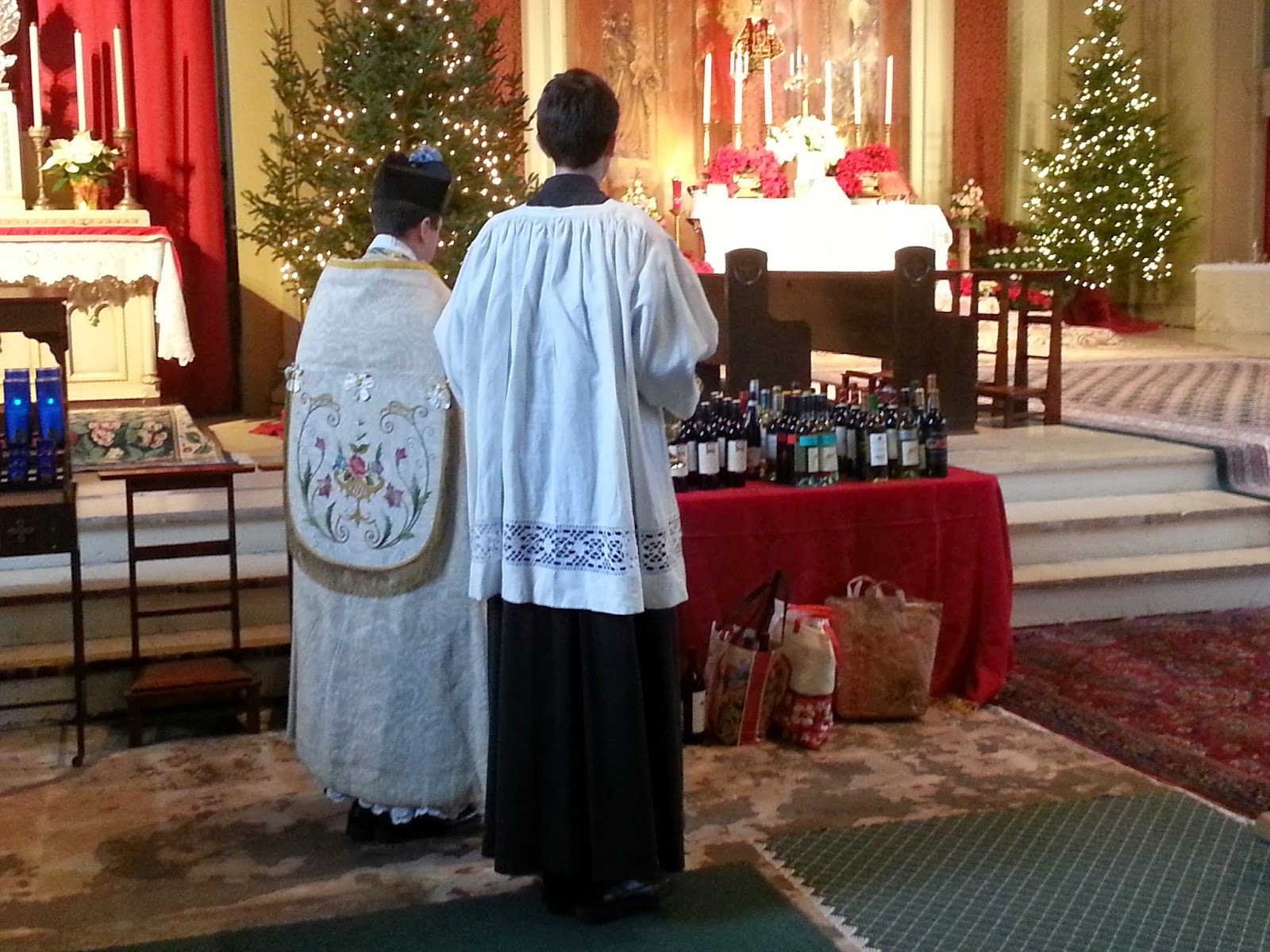
Photos: Blessing of Wine on the Feast of St. John
edit_button

Today is the annual Blessing of Wine for the Feast of St. JohnRead more here.  Photos were taken this morning at the Shrine of Christ the King in Chicago.

Blessing of Wine for Feast of St. John

Blessing of Wine for Feast of St. John

Blessing of Wine for Feast of St. John

Blessing of Wine for Feast of St. John

Read more >>
Monday, March 11, 2013
Agnus Dei Sacramental
edit_button


Agnus Dei Sacramental
  
The name Agnus Dei has been given to certain discs of wax impressed with the figure of a lamb and blessed at stated seasons by the Pope. They are sometimes round, sometimes oval in diameter. The lamb usually bears a cross or flag, while figures of saints or the name and arms of the Pope are also commonly impressed on the reverse. These Agnus Dei’s may be worn suspended round the neck, or they may be preserved as objects of devotion. In virtue of the consecration they receive, they are regarded, like holy water, blessed palms, etc., as "Sacramentals". 
Origin
    
The origin of Agnus Deis is a matter of much obscurity. Recent authorities lay stress upon the lack of evidence for their existence before the ninth century. But it seems probable that they had their beginning in some pagan usage of charms or amulets, from which the ruder populace were weaned by the enjoyment of this Christian substitute blessed by prayer. The early history of Catholic ceremonial affords numerous parallels for this Christianizing of pagan rites. It is not disputed that the Agnus Deis originated in Rome. If so, we may probably trace the custom back to the final overthrow of Paganism in that city, say the fifth century. We know that when we first hear of them (c. 820) they were made of the remnants of the preceding year's paschal candle. We also know from Ennoldius (c. 510) that fragments of the paschal candles were used as a protection against tempests and blight (Migne, P.L., LXIII, pp. 259, 262). It is also possible that a mention of the blessing of wax under Pope Zosimus (418) in the "Liber Pontificalis" (first edition) should be interpreted, with Mgr. Duchesne, of the Agnus Dei, though it more probably refers to the paschal candle. It was at this period and before the Trullan Council of 691 that the symbolism of the Lamb most flourished; see the Sarcophagus of Junius Bassus. The alleged examples of early Agnus Deis, e.g. one of Gregory the Great in the treasury of Monza (see Kraus, "Real-Encyclopadie," s.v.) cannot be trusted. The earliest certain specimen now in existence seems to belong to the time of Gregory XI (1370).

History
   
From the time of Amalarius (c. 820) onwards we find frequent mention of the use of Agnus Deis. At a later period they were often sent by the Popes as presents to sovereigns and distinguished personages. A famous letter in verse accompanied the Agnus Dei despatched by Urban V to the Emperor John Palaeologus in 1366. In the penal laws of Queen Elizabeth Agnus Deis are frequently mentioned among other "popish trumperies" the importation of which into England was rigorously forbidden.
Blessing and Distribution
  
We learn from an "Ordo Romanus" printed by Muratori ("Lit. Rom", II, p. 1,004) that in the ninth century the archdeacon manufactured the Agnus Deis early on Holy Saturday morning out of clean wax mixed with chrism, and that they were distributed by him to the people on the Saturday following (Sabbato in Albis). At a later date the Pope himself generally assisted at both the blessing and the distribution. The great consecration of Agnus Deis took place only in the first year of each pontificate and every seventh year afterwards, which rule is still followed. The discs of wax are now prepared beforehand by certain monks, and without the use of chrism. On the Wednesday of Easter week these discs are brought to the Pope, who dips them into a vessel of water mixed with chrism and balsam, adding various consecratory prayers. The distribution takes place with solemnity on the Saturday following, when the Pope, after the "Agnus Dei" of the Mass, puts a packet of Agnus Dies into the inverted mitre of each cardinal and bishop who comes up to receive them.
Symbolism and Use
   
The symbolism of the Agnus Dei’s is best gathered from the prayers used at various epochs in blessing them. As in the paschal candle, the wax typifies the virgin flesh of Christ, the cross associated with the lamb suggests the idea of a victim offered in sacrifice, and as the blood of the paschal lamb of old protected each household from the destroying angel, so the purpose of these consecrated medallions is to protect those who wear or possess them from all malign influences. In the prayers of blessing, special mention is made of the perils from storm and pestilence, from fire and flood, and also of the dangers to which women are exposed in childbirth. It was formerly the custom in Rome to accompany the gift of an Agnus Dei with a printed leaflet describing its many virtues. Miraculous effects have been believed to follow the use of these objects of piety. Fires are said to have been extinguished, and floods stayed. The manufacture of counterfeits, and even the painting and ornamentation of genuine Agnus Deis, has been strictly prohibited by various papal bulls.

Martyrs’ Paste
   
There are also Agnus Deis of a grey colour, made from wax mingled with the dust which is believed to be that of the bones of martyrs. These, which are called "Paste de' SS. Martiri", are held to need no special consecration and are treated as relics.
A sacramental is a sacred object, or action, which the church uses for the purpose of obtaining spiritual favors through the Church’s intercession.  One such sacramental, and one of the Church’s most ancient, is the Agnus Dei.
 
Agnus Dei means Lamb of God, and is eh name given to certain wax discs upon which are impressed the figure of a lamb, and the blessing of which, actually a consecration, is reserved to the reigning Supreme Pontiff.
 
The Agnus Dei dates from before the eighth century, and the matter, from, and prayers for the consecration ceremony are duly described in the Roman Ritual.
 
In the making of the Agnus Dei, pure white unadulterated wax must be used, and is mixed with Holy Water, Balsam, and Chrism.  The wax must be pure since it is designed to typify human nature as being absolutely free from imperfection, when, in virtue of His Own Divine Power, it was assumed by our Saviour in the Immaculate Womb of the Blessed Virgin Mary.
 
The figure of a lamb is impressed on these discs as it is symbolic of the Lamb of god, without blemish, immolated on the alter of the Cross in atonement for man’s sins.  Holy water is also used because it was chosen by god, both in the Old and New Testaments, for the institution of the Great Sacraments.  Balsam is mixed with the Holy Water to signify the sweet perfume of the virtues of Christ, which should be eminently characteristic of His followers.  Chrism is added to show that things so consecrated, such as churches, alters, and the priests themselves, have been specially set apart for the divine service, the perfection of Christian charity being likewise set forth.
 
The waxen Agnus Deis are, accordingly, immersed in the water already blessed and mingled with Balsam and Chrism; while before and after this action the Pope utters the most solemn invocations, beseeching God to bless, sanctify, and consecrate these discs, imparting to them such power that whosoever should revere them with true faith and sincere piety might as indicated by the writings of Popes Urban V, Paul II, Julius III, Sixtus V, and Benedict XIV, participate in the following benefits and graces:
-They foster piety, banish tepidity, preserve from face and dispose to virtue.
-That at sight or touch of the Lamb impressed on these waxen discs, the faithful should be inspired to dwell on the Mysteries of our Redemption recalled by this symbol; and be moved to praise, venerate, and extol God’s goodness to us, hoping to obtain pardon for their sins, and to be cleansed form all stain.
-They are a protection from sudden and unprovided death.
-They are a protection in combat, and have power to ensure victory.
-They cause evil spirits to tremble and flee; that hailstones should case; tempests subside, and whirlwinds, lightning, and hurricanes should be dispelled.
-They deliver from poison and, through Divine Intervention, the snares, wiles, and frauds of Satan should not prevail.
-They are excellent preventatives against sickness, and are also an efficacious remedy –especially in cases of epilepsy.
-They dissipate hurricanes, clam whirlwinds, and keep away tempests.
-They save from shipwreck and the danger of lightning and floods.
-They preserve mothers and babies from peril and provide for a safe and easy delivery.

It is a matter of firm belief, confirmed by striking miracles, which these graces and favors are wont to be vouchsafed to the faithful by Divine munificence in virtue of the blessings and prayers of Christ’s Vicar, the Pope, consecrating those waxen discs as Head of the Catholic Church.  If, however, the desired result is not always obtained, this should not be attributed to want of efficacy on the part of the Sacramental, but rather to the luke-warmness of suppliants, or to some hidden cause in meet accordance with the counsels of the Most High.

 
Many Favors
  
Throughout the life of the Church favors too numerous to count have been granted by God through the intercession of one of the Church’s most treasured Sacramentals, the Agnus Dei.  It is, however, worth of not that in the Cause for Canonization of Bl. Innocent XI, tow first-class miracles were accepted, both involving the use of Agnus Dei’s.
 
In times past, the reigning Pope would consecrate the Agnus Dei’s during Holy Week in the first year of his pontificate, and then every seventh year during his reign.  Inexplicably, the practice of consecrating the Agnus Dei Sacramental was abandoned following the Second Vatican Council.

Daily Prayer
  
O my Lord Iesus, Christ, the true Lamb Who takest away the sins of the world; by Thy Mercy, which is infinite, pardon my iniquities, and by Thy Sacred Passion preserve me this day from all sin and evil. I carry about me this holy Agnus Dei in Thy honor, as a preservative against my own weakness, and as an incentive to the practice of that meekness, humility, and innocence which Thou has taught us.  I offer up to Thee as an entire oblation, and in memory of that Sacrifice of Love which Thou didst offer for me on the Cross, and in satisfaction for my sins.  Accept this oblation, I beseech Thee, O my God, and may it be acceptable to Thee in the odour of sweetness.  Amen. 

 Pope Pius XII immerses the Agnus Dei Wax

(For those who carry or wear an Agnus Dei)
 
Jesus, my Savior, true Lamb of God, Who takest away the sins of the world, by Thine infinite mercy, I beseech Thee to pardon my iniquities. By Thy sacred Passion, I beseech Thee preserve me this day from sin and shield me from all evil.  To Thine honor and glory I carry about with me this blessed Agnus Dei as a protection to my soul and body,  and as an incentive to practice the virtues which Thou hast inculcated, especially meekness, humility, purity and charity. In memory of that sacrifice of love which Thou didst offer for me and all mankind on Calvary,  I consecrate my whole being to Thee.  Thou didst die on the cross for love of me; let me die to self for love of Thee!  Keep me in Thy love and Thy grace to the end of my life, that I may bless Thee forever with the Saints to heaven. Amen.

The last pope to consecrate the wax and make it available was Pope Pius XII.
Read more >>
Thursday, January 31, 2013
Blessing of Candles for Candlemas (February 2)
edit_button

With Candlemass (Feast of the Purification of our Lady) just days away, it is important to reflect upon this upcoming great Feast in the Church.

The Feast of Candlmas, exactly 40 days after Christmas, commemorates Mary's obedience to the Mosaic law by submitting herself to the Temple for the ritual purification, as commanded in Leviticus.

The Feast of the Purification, is called Candlemas for the traditional blessing and distribution of candles on that day.  It is customary to bring candles from home to be blessed -- at least 51% beeswax candles that one uses for devotional purposes (candles for the family altar, Advent candles, etc.) -- so they can be lit after dusk on All Saints' Day (1 November), during the Sacrament of Unction, and during storms and times of trouble.  Nowadays, though, for those few parishes continuing this ancient observance, the parish will provide the candles.


Mass on Candlemas is typically preceded by a procession with the lighted candles and the singing of anthems. The lighted candles are held during the reading of the Gospel and from the beginning of the Canon of the Mass to Communion.


THE BLESSING OF THE CANDLES AND THE PROCESSION 
1. the blessing 
The Priest, vested in a violet cope, blesses the candles, which are placed near the altar

V. Dominus Vobiscum.
R. Et cum spiritu tuo.
V. The Lord be with you.
R. And with thy Spirit.
First Prayer
Oremus. -- Domine sancte, Pater omnipotens, aeterne Deus, qui omnia ex nihilo creasti, ut jussu tuo per opera apum, hunc liquorem ad perfectionem cereri venire fecisti: et qui hodierna die petitionem justi Simeonis implesti: te humiliter deprecamur; ut has candelas as usushominum, et sanitatem coporum et animarum, sive, in acquis, per invocationem tui sanctisimi nominis, et per intercessionem beatae Mariae semper Virgnis, cujus hodie festa devote celebrantur, et per preces omnium Sanctorum tuorum, bene†dicere, et sanci†ficare digneris: et hujus plebis tuae, quae illas honorifice in manibus desiderat portare, teque cantando laudare, exaudias voces de coelo sancto tuo, et de sede majestatis tuae: et propitius sis omnibus clamantibus ad te, quos redemisti pretioso sanguine Filii tui: Qui tecum vivit et regnat. Let us Pray -- O holy Lord, Father almighty, everlasting God, who hast created all things out of nothing, and by Thy command hast caused this liquid to become perfect wax by the labor of bees: and who, on this day didst fulfill the petition of the righteous man Simeon: we humbly entreat Thee, that by the invocation of Thy most holy Name and through the intercession of Blessed Mary ever Virgin whose feast is today devoutly observed, and by the prayers of all Thy Saints, Thou wouldst vouchsafe to bless † and sanctify † these candles for the service of men and for the health of their bodies and souls, whether on land or on sea: and that Thou wouldst hear from Thy holy heaven, and from the throne of Thy Majesty the voices of this Thy people, who desire to carry them in their hands with honor, and to praise Thee with hymns; and wouldst be propitious to all that call upon Thee, Whom Thou hast redeemed with the precious Blood of Thy Son.
Second prayer 
Oremus. -- Omnipotens sempiterne Deus, qui hodierna die Unigenitum tuum ulnis sancti Simeonis in templo sancto tuo suscipiendum praesentasti: tuam supplices deprecamur clementiam; ut has candelas, quas nos famuli tui, in tui nominis magnificentiam sucipientes, gestare cupimus luce accensas, bene†dicere et sancti†ficare, atque lumine supernae benedictionis accendere digneris: quatenus eas tibi Domino Deo nostro offerendo digni, et sancto igne dulcissimae caritatis tuae succensi, in templo sancto gloriae tuae repraesentari mereamur Per eumdem Dominum nostrum. O almighty and everlasting God, who on this day didst present Thine only-begotten Son in Thy holy temple to be received in the arms of holy Simeon: we humbly entreat Thy clemency, that Thou wouldst vouchsafe to bless † and sanctify † and to kindle with the light of Thy heavenly benediction these candles, which we, Thy servants, desire to receive and to bear lighted in the honor of Thy Name: that, by offering them to Thee our Lord God, being worthily inflamed with the holy fire of Thy most sweet charity, we may deserve to be presented in the holy temple of Thy glory. Through the same our Lord Jesus Christ, Thy Son, who liveth and reigneth with Thee in the unity of the Holy Ghost, God, world without end.
Third prayer
Oremus. -- Domine Jesu Christe, lux vera, quae illuminas omnem hominem venientem in hunc mundum: effunde bene†dictionem tuam super hos cereos, et sancti†fica eos lumine gratiae tuae, et concede propitiusl ut, sicut haec luminaria igne visibili accensa nocturnas depellunt tenebras; ita corda nostra invisibili igne, id est Sancti Spiritus splendore illustrata, omnium vitorum caecitate careant: ut, purgato mentis oculo, ea cernere possimus quae tibi sunt placita, et nostrae saluti utilia; quatenus post hujus saeculi caliginosa discrimina, ad lucem indeficientem pervenire mereamur. Per te, Christe Jesu Salvator mundi, qui in Trinitate perfecta vivis et regnas Deus, per omnia saecula saeculorum. O Lord Jesus Christ, the true Light who enlightenest every man that cometh into this world: pour forth Thy blessing † upon these candles, and sanctify † them with the light of Thy grace, and mercifully grant, that as these lights enkindled with visible fire dispel the darkness of night, so our hearts illumined by invisible fire, that is, by the splendor of the Holy Spirit, may be free from the blindness of all vice, that the eye of our mind being cleansed, we may be able to discern what is pleasing to Thee and profitable to our salvation; so that after the perilous darkness of this life we may deserve to attain to neverfailing light: through Thee, O Christ Jesus, Savior of the world, who in the perfect Trinity, livest and reignest, God, world without end.
Fourth prayer
Oremus. -- Omnipotens sempiterne Deus, qui per Moysen famulum tuum purissimum oleo liquorem ad luminaria ante conspectum tuum jugiter concinnanda praeparari jussisti bene†dictionis tuae gratiam super hos cereos benignus infunde; quatenus sic administrent lumen exterius, ut te donante, lumen Spiritus tui nostris non desit mentibus interius. Per Dominum...in unitate ejusdem Spiritus Sancti. O almighty and everlasting God, who by Thy servant Moses didst command the purest oil to be prepared for lamps to burn continuously before Thee: vouchsafe to pour forth the grace of Thy blessing † upon these candles: that they may so afford us light outwardly that by Thy gift, the gift of Thy Spirit may never be wanting inwardly to our minds. Through our Lord Jesus Christ, Thy Son, who liveth and reigneth with Thee in the unity of the same Holy Ghost, God, world without end.
Fifth prayer
Oremus. -- Domine Jesu Christe, qui hodierna die in nostrae carnis substantia inter homines apparents, a parentibus in templo es praesentatus: quem Simeon venerabilis senex, lumine Spirtus tui irradiatus, agnovit, suscepit, et benedixit: praesta propitius; ut ejusdem Spiritus Sancti gratia illiminati, atque edocti, te veraciter agnoscamus et fideliter diligamus: Qui cum Deo Patre in unitate ejusdem Spiritus Sancti vivis et regnas Deus, per omnia saecula saeculorum. O Lord Jesus Christ, who appearing on this day among men in the substance of our flesh, wast presented by Thy parents in the temple: whom the venerable and aged Simeon, illuminated by the light of Thy Spirit, recognized, received into his arms, and blessed: mercifully grant that, enlightened and taught by the grace of the same Holy Ghost, we may truly acknowledge Thee and faithfully love Thee; Who with God the Father in the unity of the same Holy Ghost livest and reignest, God, world without end.

 
The Priest sprinkles the candles three times with holy water, saying the Antiphon Asperges me, and also incenses them thrice. 

Source: 1962 Missal
Read more >>
Thursday, May 10, 2012
Holy Cross Weather Blessing
edit_button

The Finding of the Holy Cross

Double of the 2nd Class (1955 Calendar): May 3

May 3rd is the often forgotten traditional Feast of the Finding of the True Cross by St. Helena. It is also called the "Invention of the Holy Cross." The second nocturn of Matins today in the pre-1955 Breviary recounts how St. Helena used a sick person to discern which of several candidates was indeed the True Cross of our Lord. The sick was was healed instantly upon touching the True Cross. Despite the liturgical changes of the 1950s and 1960s that saw this feastday dropped even in the 1962 Missal, the Latin rite Catholics in the Church of the Holy Sepulchre in Jerusalem still observe this feast.

The following is taken from the Brighton Oratory:
The Cross on which Our Blessed Lord suffered for us was, following Jewish usage, buried on Mount Calvary after the Crucifixion. The precise spot was revealed in a vision to the Empress Helena, mother of Constantine, the first Christian Emperor. This date commemorates the recovery of the True Cross in the reign of the Emperor Heraclius and its delivery by him about the year 629 into the hands of the Patriarch Zacharias of Jerusalem, from which city it had been carried away some years previously by the Persians with the object of transporting it to their own country. God has been pleased to give so much power to the Cross that at its sign alone the demons fly; by it the priest blesses the faithful, the devout receive abundant graces. The early Christians had so much devotion to it that, according to the ancient Fathers, they never began any action without first making the sign of the cross upon themselves. In the Middle Ages no public deed, inscription, law etc., was begun to be written without first tracing upon it the sign of the cross. This sign was accepted as the signature of the uneducated; it often preceded that of ecclesiastics, and in many country districts even the dough and the bread were marked with a cross before they were baked. 
In the Epistle the triumph of the Redeemer of the world, Our Lord Jesus Christ, must be preceded by "His humiliation unto death, even the death of the Cross." In the Gospel Christ reveals His mission in His discourse with Nicodemus: "The Son of Man must be lifted up" on the Cross for the salvation of mankind. 
The Feast of the Exaltation of the Holy Cross on September 14th commemorates the day after the consecration of the church (September 13th 335) built by Macarius and Helena when the good bishop was prevailed upon to elevate the True Cross publicly for the faithful to venerate. It also commemorates the recovery of the True Cross from the Persians by Heraclius in the seventh century.

From May 3rd, the Feast of the Finding of the Cross, until September 14th, the Feast of the Exaltation of the Holy Cross, a special blessing beseeching God’s protection against violent and damaging storms may be given with a relic of the True Cross of Our Lord Jesus Christ.

In light of this, I wanted to share this beautiful prayer from the Rituale Romanum.  Share with your priests and encourage them to say this blessing during this time of year from May 3rd through September 14th on Fridays.

Holy Cross Weather Blessing

V. A fúlgure, grádine et tempestáte.
R. Líbera nos, Dómine Jesu Christe.
V. Osténde nobis, Dómine, misericórdiam tuam.
R. Et salutáre tuum da nobis.
V. Dómine exáudi oratiónem meam.
R. Et clamor meus ad te véniat.
V. Dóminus vobíscum.
R. Et cum spíritu tuo.
Orémus.  Quaesumus, omnípotens Deus, ut, intercessióne Sanctae Dei Genetrícis Maríae, sanctórum Angelórum, Patriarchárum, Prophetárum, Apostolórum, Mártyrum, Confessórum, Vírginum, Viduárum, et ómnium Sanctórum tuórum, contínuum nobis praestes subsídium, tranquíllam auram permíttas, atque contra fúlgura et tempestátes désuper nobis indígnis tuam salútem effúndas de caelis, et géneri húmano semper aemulas, déxtera poténtiae tuae, aéreas cónteras potestátes.  Per eúndem Christum Dóminum nostrum.
R. Amen.

V. Sit nomen Dómini benedíctum.
R. Ex hoc nunc et usque in saeculum.

V. Adjutórium nostrum in nómine Dómini.
R. Qui fecit caelum et terram.
V. Benedíctio Dei omnipoténtis, Patris + et Fílii, et Spíritus Sancti, descéndat super vos, locum istum et fructus terrae et máneat semper.
R. Amen.
____________________________

V. From lightning strikes, hail, and violent storms.
R. Deliver us, O Lord Jesus Christ.
V. Show us, O Lord, Thy mercy.
R. And grant us Thy salvation.
V. O Lord, hear my prayer.
R. And let my cry come unto Thee.
V. The Lord be with you.
R. And with thy spirit.
Let us pray.  We beseech Thee, O Almighty God, through the intercession of Holy Mary, the Mother of God, of the holy angels, patriarchs, prophets, apostles, martyrs, confessors, virgins, widows, and of all Thy saints, that Thou show us Thy continuing protection, permit tranquil winds, and also pour out to us, Thy unworthy servants, Thy safety from heaven above against lightning strikes and violent storms, and that Thou remain always protective of the human race and crush down the aerial powers by the right hand of Thy power.  Through the same Christ our Lord.

R. Amen
V. Blessed be the Name of the Lord.
R. Now and forever.
V. Our help is in the Name of the Lord.
R. Who made heaven and earth.
V. May the blessing of Almighty God, the Father, + the Son, and the Holy Ghost, descend upon you, this place, and the fruits of the earth and remain forever.
R. Amen.
Read more >>
Wednesday, February 22, 2012
Ash Wednesday Traditional Mass Propers
edit_button

Today's Mass embodies the spirit of Lent. All are reminded to be sorry for sin and to do penance, but not in a spirit of showy sadness or of inward despair. Rather, let the sincere and humble prepare with inner joy to celebrate their baptism in Christ. By living their baptismal promises, they enter more deeply into Christ's suffering. Knowing God's desire to forgive, to heal, and to share with all men His own divine life, we discipline our passions gladly and with confidence in victory. God gives the grace for every Lenten restraint. Therefore everyone should receive the blessed ashes, both as a means of grace and as a reminder to do penance unobtrusively, for personal sins and for the sins of all mankind.

Remember that today is a day of required fast and abstinence from meat.

Before the Mass, the celebrant vested in alb, purple stole, and cope, goes up to the altar for the blessing of the ashes.


THE DISTRIBUTION OF THE ASHES

The celebrant stands and receives ashes on his head; he then distributes them to the clergy and the congregation, who kneel before him. He admonishes each one as he places ashes on his head:

Remember, man, that you are dust, and into dust you shall return.

THE MASS

INTROIT (Sap. 11:24, 25, 27)
You are merciful to all, O Lord, and hate none of the things that You have made. When men repent, You overlook their sins and pardon them; for You are the Lord our God.
Ps. 56:2. Have pity on me, O God, have pity on me, for my soul trusts in You.
V. Glory be . . .

COLLECT

O Lord, may the faithful begin the solemn season of fast with fitting piety, and may they continue through to its end with unwavering devotion. Through our Lord . . .

LESSON (Joel 2:12-19)

Now, therefore, saith the Lord. Be converted to me with all your heart, in fasting, and in weeping, and mourning. And rend your hearts, and not your garments and turn to the Lord your God: for he is gracious and merciful, patient and rich in mercy, and ready to repent of the evil. Who knoweth but he will return, and forgive, and leave a blessing behind him, sacrifice and libation to the Lord your God? Blow the trumpet in Sion, sanctify a fast, call a solemn assembly, Gather together the people, sanctify the church, assemble the ancients, gather together the little ones, and them that suck at the breasts: let the bridegroom go forth from his bed, and the bride out of her bridal chamber. Between the porch and the altar the priests, the Lord's ministers, shall weep, and shall say: Spare, O Lord, spare thy people: and give not thy inheritance to reproach, that the heathens should rule over them. Why should they say among the nations: Where is their God? The Lord hath been zealous for his land, and hath spared his people. And the Lord answered, and said to his people: Behold I will send you corn, and wine, and oil, and you shall be filled with them: and I will no more make you a reproach among the nations.

GRADUAL (Ps. 56:2, 4)

Have pity on me, O God, have pity on me, for my soul trusts in You. V. He has sent from heaven, and saved me; He has made them a reproach who trample upon me.

TRACT (Ps. 102:10; 78:8-9)

O Lord, repay us not according to the sins we have committed, nor according to our iniquities. V. O Lord, remember not our iniquities of the past; let Your mercy come quickly to us, for we are being brought very low. (All Kneel.) V. Help us, O God our Savior, and for the glory of Your name, O Lord, deliver us; and pardon us our sins for Your name's sake.

GOSPEL (Matt. 6:16-21)

At that time, Jesus said to His disciples, "And when you fast, be not as the hypocrites, sad. For they disfigure their faces, that they may appear unto men to fast. Amen I say to you, they have received their reward. But thou, when thou fastest anoint thy head, and wash thy face; That thou appear not to men to fast, but to thy Father who is in secret: and thy Father who seeth in secret, will repay thee.
"Lay not up to yourselves treasures on earth: where the rust, and moth consume, and where thieves break through, and steal. But lay up to yourselves treasures in heaven: where neither the rust nor moth doth consume, and where thieves do not break through, nor steal. For where thy treasure is, there is thy heart also."

OFFERTORY ANTIPHON (Ps. 29:2-3)

I will extol You, O Lord, for You have upheld me, and have not let my enemies rejoice over me. O Lord, I cried out to You and You have healed me.

SECRET

O Lord, make us truly fit to offer these gifts with which we commemorate the institution of this blessed Sacrament. Through our Lord . . .

COMMUNION ANTIPHON (Ps. 1:2-3)

He who meditates on the law of the Lord day and night shall bring forth his fruit in due season.

POSTCOMMUNION

O Lord, may this Sacrament which we have received make our fasting an acceptable offering to You and a healthful remedy to our souls. Through our Lord . . .

PRAYER OVER THE PEOPLE

O Lord, look with mercy upon those who worship before Your majesty. May Your heavenly aid always strengthen those who have feasted upon Your divine Sacrament. Through our Lord Jesus Christ, Your Son, who lives and rules with You in the unity of the Holy Spirit, one God forever and ever.

Read more >>
Thursday, February 2, 2012
Video: Traditional Blessing of Throats on the Feast of St. Blaise
edit_button


BLESSING OF CANDLES
on the Feast of St. Blaise, Bishop and Martyr

P: Our help is in the name of the Lord.
All: Who made heaven and earth.
P: The Lord be with you.
All: May He also be with you.

Let us pray.

God, almighty and all-mild, by your Word alone you created the manifold things in the world, and willed that that same Word by whom all things were made take flesh in order to redeem mankind; you are great and immeasurable, awesome and praiseworthy, a worker of marvels. Hence in professing his faith in you the glorious martyr and bishop, Blaise, did not fear any manner of torment but gladly accepted the palm of martyrdom. In virtue of which you bestowed on him, among other gifts, the power to heal all ailments of the throat. And now we implore your majesty that, overlooking our guilt and considering only his merits and intercession, it may please you to bless + and sanctify + and impart your grace to these candles. Let all men of faith whose necks are touched with them be healed of every malady of the throat, and being restored in health and good spirits let them return thanks to you in your holy Church, and praise your glorious name which is blessed forever; through Christ our Lord.
Read more >>
Wednesday, January 4, 2012
Blessing of Epiphany Chalk
edit_button

Note: You can download the below blessing in Microsoft Word .doc format here: Blessing of the Home on the Feast of the Epiphany (1 page). Also check out the Solemn Blessing for Epiphany Water

20+G+M+B+12
(20+Gaspar+Melchior+Balthazar+12)

Note: If you don't have blessed chalk, buy an inexpensive pack of chalk and ask your priest to properly bless it.

Information on the Blessing and Simple Blessing
 
Chalk is customarily blessed on January 6, the feast of the Epiphany (though nowadays typically only done by more traditional parishes). The chalk is a sacramental, intended for the blessings of homes. If a priest is unable to visit your home at this season, a simple blessing may be given by the father of the family. He should mark the year and the initials of the three Magi (Gaspar, Melchoir and Balthasar) on the lintel of the main door. The prayer for blessing a home is recommended at this time, as printed below.

Write with blessed chalk above the door like so:

20 + G + M + B + 12

O Lord, almighty God, bless this house that it may become a shelter of health, chastity, self-conquest, humility. goodness, mildness, obedience to the Commandments, and thanksgiving to God, Father, Son and Holy Ghost. Upon this house and those who dwell herein may Thy blessing remain forever. Through Christ our Lord. Amen.


Fr. Z from WDTPRS

The Ceremony of the Blessing

Epiphany Chalk is used to write the inscription over all the doors of one’s house. Soft classroom chalk of any color is best for writing on varnished or painted surfaces. A priest should bless the chalk on Epiphany Day, before the celebration of the main Mass of the day, using the following Blessing, which is taken from the Roman Ritual:

V. Our help is in the Name of the Lord.

R. Who made heaven and earth.

V. The Lord be with you.

R. And with thy spirit.

Let Us Pray:

O Lord God, bless + this chalk which Thou hast created, that it may be helpful to mankind; and grant that through the invocation of Thy most holy Name all those who use this chalk or with it write over the doors of their houses the names of Thy Saints, Gasper, Melchior, and Balthazar, may by their merits and intercession receive health of body and protection of soul. Through Christ Our Lord. Amen. (Priest now sprinkles chalk with Holy Water.)

Later that day – or any day within the Octave of the Feast of the Epiphany – at home, the ceremony is completed by a priest, or the father, or senior member, of the family. The following prayer is said once and at the main entrance of the house. All the family as he or she goes from door to door – everyone keeping a respectful silence, or better yet, reciting the Joyful Mysteries of the Rosary.

Let Us Pray:

Hear us, O Holy Lord, Father Almighty, Eternal God, and send Thy Holy Angel from Heaven to watch over, cherish, protect, be with, and defend all who live in my house. I call upon Your Saints, Gasper, Melchior, and Balthazar, to protect my family and my home from every harm and danger, and I place the marks of their holy names over the doors of my home to remain there as a constant reminder to us and to all who enter here that my house is truly a house of the Lord.

O God, make the door of my house wide enough to receive all who need human love and companionship; narrow enough to shut out all envy, pride, and strife. Make its threshold smooth enough to be no stumbling clock to children, nor to straying feet, but rugged and strong enough to turn back the temper’s power.

O God, make the door of my house the gateway to Thy eternal Kingdom. I ask these things in the Name of Jesus Christ Thy Son. Amen.

Note: Another version of this blessing, as well as a Blessing of Gold, Incense, and Myrrh (the gifts given by the wisemen) can be found in the Rituale Romanum online version.
Read more >>
Sunday, December 25, 2011
Blessing of Children (Rituale Romanum)
edit_button


P: Our help is in the name of the Lord.

All: Who made heaven and earth.

P: The Lord be with you.

All: May He also be with you.

Let us pray.


We implore you, almighty God, to bless + these children, and we ask that you keep them in your love. Strengthen their hearts by the power of the Holy Spirit, sanctify their lives, foster their innocence. Keep their minds intent on good, help them to prosper, give them peace, health, and charity. By your might and protection shield them always from every temptation of men or demons. And in your mercy may they finally attain the happiness and rest of Paradise; through Christ our Lord.

All: Amen.

Let us pray.


Lord Jesus Christ, who embraced the little children when they came or were brought to you (here the priest extends his hands over them), and laying your hands on them blessed them and said: "Let the little children come to me, and do not stop them. The kingdom of heaven belongs to such as these; and their angels ever see the face of my Father;" we beg you to look with favor on the devotion of these boys and girls here present, and let your blessing come on them in fullest measure. Let them ever advance in your grace and goodness, the better to know you, love you, fear you, and serve you, and happily reach their blessed destiny. We ask this of you, Savior of the world, who live and reign with the Father and the Holy Spirit, God, forever and ever.

All: Amen.


May the blessing of almighty God, Father, Son, + and Holy Spirit, come upon you, keep and direct you, and remain with you forever.

All: Amen.


They are sprinkled with holy water.


Images: From the Institute of Christ the King Sovereign Priest Shrine in Chicago, Illinois from the Blessing of Children according to the Rituale Romanum in Latin (1962) following the 10 AM Solemn High Mass of Christmas Day.  The children and then the remaining faithful then came forward to venerate a relic of the Crib of Bethlehem (pictured in the third image in the reliquary).
Read more >>
Thursday, August 27, 2009
The Consecration of a Paten and Chalice in the Traditional Rite of 1962
edit_button

CONSECRATION OF A PATEN AND A CHALICE

(From the new Roman Pontifical of 1962)

{The consecration of a paten and of a chalice may be delegated to a priest, who follows the same rite given here for a bishop, omitting, however, the directions that do not pertain to a priest.

The consecration of a paten and chalice may take place on any day and at any convenient place.

The following are prepared: holy chrism and whatever materials are necessary for cleansing and wiping the chalice and paten as well as the bishop's hands. The chalice and paten should be placed on a table covered with a white-linen cloth or on the altar.

If several chalices and patens are to be consecrated the bishop performs the anointings successively on each of them, but he says the orations only once and in the plural form.

The bishop, standing and wearing the rochet, white stole, and gold-embroidered mitre, says:

Celebrant: Our help is in the name of the Lord.

All: Who made heaven and earth.

C: Let us pray, my dear brethren, that by the help of God's grace this paten (these patens) may be consecrated and hallowed for the purpose of breaking over it (them) the body of our Lord Jesus Christ, who suffered death on the cross for the salvation of us all.

Then, removing the mitre, he says:

C: The Lord be with you.

All: May He also be with you.

Let us pray.

Almighty everlasting God, who instituted the laws of sacrifice, and ordered among other things that the sprinkled wheaten flour should be carried to the altar on plates of gold and silver; be pleased to bless, hallow, + and consecrate this paten (these patens), destined for the administration of the Eucharist of Jesus Christ, your Son, who for our salvation and that of all mankind chose to immolate Himself on the gibbet of the cross to you, God the Father, with whom He lives and reigns, forever and ever.

All: Amen.


Having put on the mitre, he dips the thumb of his right hand into the holy chrism, anoints the paten from rim to rim in the form of a cross, and then rubs the holy chrism all over the upper side of the paten, while saying the following formula:

Lord God, may you deign to consecrate and to hallow this paten by this anointing and our blessing, + in Christ Jesus our Lord, who lives and reigns with you forever and ever.

All: Amen.

Then (still standing and wearing the mitre) he proceeds to the blessing of the chalice, saying:

Let us pray, my dear brethren, that our Lord and God, by His heavenly grace and inspiration, may hallow this chalice (these chalices), about to be consecrated for use in His ministry, and that He may add the fulness of His divine favor to the consecration performed by us; through Christ our Lord.

All: Amen.

Then, removing the mitre, he says:

C: The Lord be with you.

All: May He also be with you.

Let us pray.


O Lord our God, be pleased to bless + this chalice (these chalices), made by your devout people for your holy service. Bestow that same blessing which you bestowed on the hallowed chalice of your servant, Melchisedech. And what we cannot make worthy of your altars by our craft and metals, do you nonetheless make worthy by your blessing; through Christ our Lord.

All: Amen.


Having put on the mitre, he dips the thumb of his right hand into the holy chrism and anoints each chalice on the inside from rim to rim In the form of a cross, while saying the following formula: Lord God, may it please you to consecrate and to hallow this chalice by this anointing and our blessing, + in Christ Jesus our Lord, who lives and reigns with you forever and ever.

All: Amen.

Then, removing the mitre, he says the following over the chalice and paten (chalices and patens):

C: The Lord be with you.

All: May He also be with you.

Let us pray.

Almighty everlasting God, we beg you to impart to our hands the virtue of your blessing, so that by our blessing + this vessel and paten (these vessels and patens) may be hallowed and become, by the grace of the Holy Spirit, a new sepulchre for the body and blood of our Lord Jesus Christ; through Christ our Lord.

All: Amen.

When the consecration is over a priest cleans the chalice and paten with crumbs of bread and purifies them thoroughly. These cleansing materials are put into the sacrarium.


Special Notice to Servers:

An altar server should never touch anything that is Consecrated such as the Body and Blood of Our Lord in the Eucharist (no one except a priest should touch the Eucharist). However, a server should also never touch a consecrated Chalice, Paten, or the altar itself as these three items were all consecrated in the traditional form.

I highly encourage all servers and those aspiring to serve at the Altar of God, to see my post on the History and Graces from Altar Serving for more information.

Blessings vs. Consecrations

Fr. Z from WDTPRS has a good piece on this particular matter:
We speak about the consecration of certain places, things and people. People to be consecrated, for example, include bishops and some women who are virgins. An abbot, however, is blessed. A corner-stone of a church is blessed, but the stone of an altar is consecrated. Priests can bless, but generally only bishops consecrate.

A distinction can be made about church buildings which are consecrated in a very special way called a "dedication". Also, while confirmation and ordination are also consecrations, in a sense, they are really separate sacraments. There is a lot of debate about just what the consecration of a bishop really does, since they are already priests and priests, by their priesthood, can pretty much everything bishops can do. Once upon a time, priests were permitted to ordain! Some theologians think episcopal consecration really just extends the sacramental character already present, etc. But I digress.

By constitutive blessings (blessings which make something a blessed thing) and by consecrations objects and people are, as it were, removed from the secular, temporal realm and given over instead to God exclusively. It is as if they are extracted from the world under the domination of its diabolical "prince" and given exclusively to the King. Before, they were "profane". After, they are "sacred". Thus, a consecration is a once for all time act. Once something is consecrated, it is forever consecrated. Blessings can be repeated. Thus, harming or doing wrong to or with something or someone who is consecrated is thus its own kind of sin: sacrilege.

....

When considered from the older, pre-Conciliar rites, which we happily can use today, it is usually a bishop who consecrates chalices and patens. It was/is possible to delegate a priest to consecrate these things. The consecration makes these things suitable for the worship of God and being vessels for the Most Holy.

In the old days, chalices and patens (as well as ciboria for Hosts and monstrances or ostensoria for Exposition) had to be consecrated before they could be used at the altar. In the new way of doing things, vessels can be consecrated (though I think in the new rites they just bless them in a sort of vague and good natured way) or they become consecrated automatically the first time they are used. That is a real loss of a teaching moment, I think, but there it is.

....

Back to work… once vessels are consecrated they stay consecrated until something major is done to alter them. For example, if the chalice and paten are worn and sent off to be regilded or repaired, they have to be consecrated again.

The consecration of these vessels also calls to mind the extremely ancient practice going back to the time of Pope Sixtus I (+c. 127) that only priests, whose hands were also anointed with chrism, could handle chalices and patens. Remember also the good custom of kissing the priests hand, which is anointed and is raised in blessing and in absolution and which hold the Eucharist.

Constitutive blessings and consecrations are very important. Blessing and consecrating solemnly could help people understand better the distinction of profane and sacred and how blessed and consecrated things can help us in our spiritual lives and our constant fight against the enemy of the soul.
Sources:

Image Sources for Images of the Ceremony: His Excellency Bishop Williamson/True Restoration Photos
Blessing Source: Sancta Missa - Rituale Romanum
Fr. Z Source: Consecration of a Paten and a Chalice
Read more >>

Subscribe to Future Posts on A Catholic Life

Enter email address:


Copyright / Disclaimer

Copyright Notice: Unless otherwise stated, all items are copyrighted under a Attribution-NonCommercial-NoDerivatives 4.0 International License. If you quote from this blog, cite a link to the post on this blog in your article.

Disclosure of Material Connection: Some of the links on this blog are “affiliate links.” This means if you click on the link and purchase the item, I will receive an affiliate commission. Regardless, I only recommend products or services I use personally and/or believe will add value to my readers. I am disclosing this in accordance with the Federal Trade Commission’s 16 CFR, Part 255: “Guides Concerning the Use of Endorsements and Testimonials in Advertising.”