Showing posts with label Lent. Show all posts
Thursday, March 28, 2019
Mid-Lent Thursday Exhortation from the Mozarabic Rite
edit_button

Cathedral in Seville, Spain

Today, Thursday in the Third Week of Lent, is the happy mid-point of our Lenten observance. For those of us who are observing the time-honored custom of fasting, today is the 20th day of the Great Fast. We have 20 more days to persevere in penance to prepare ourselves for Holy Easter.

Have you grown lax? Have you not made as much spiritual progress as you hoped? Have you not done enough fasting, enough abstinence, enough penance, enough spiritual reading, enough extra praying, enough extra Masses, or enough almsgiving?

There is no reason to fret if you have grown lax. Now is the time for us to renew our vigor and march forward to Easter with greater resolve to make reparation for sins.

The Mozarabic Liturgy offers for us this day a beautiful exhortation that Dom Gueranger in his "Liturgical Year" shares in the Volume on Lent, Page 290:
Looking forward, dearly beloved brethren, to the hope of the Passion and Resurrection of the Son of God, as also to the manifestation of the glory of our blessed Lord and Saviour Jesus Christ: resume your strength and courage. Be not daunted by the labour you have to go through, but remember the solemnity of the holy Pasch, for which you are so ardently longing. One half of holy Lent is over: you have gone through the difficulties of the past, why should you not be courageous about the future fast? Jesus who deigned to suffer fatigue for our sake, will give strength to them that are fatigued. He that granted us to begin the past, will enable us to complete the future. Children! He will be with us to assist us, who wishes us to hope for the glory of His Passion. Amen.
In the same spirit, please consider reading Pope Francis's tips for Lent.
Read more >>
Monday, February 19, 2018
Reparation to the Holy Face for the Offenses of Mardi Gras
edit_button

For those Catholics who wish to more closely follow the ancient customs of the Church, Lent is a time of austere penance undertaken to make reparation to God for sin (our own sins and others), to grow in virtue and good works, and to comfort the heart of our Savior much offended by the barrage of sin and filth increasing by the day.

Yet, there are very few Catholics who undertake the true discipline of prayer, fasting, and almsgiving.

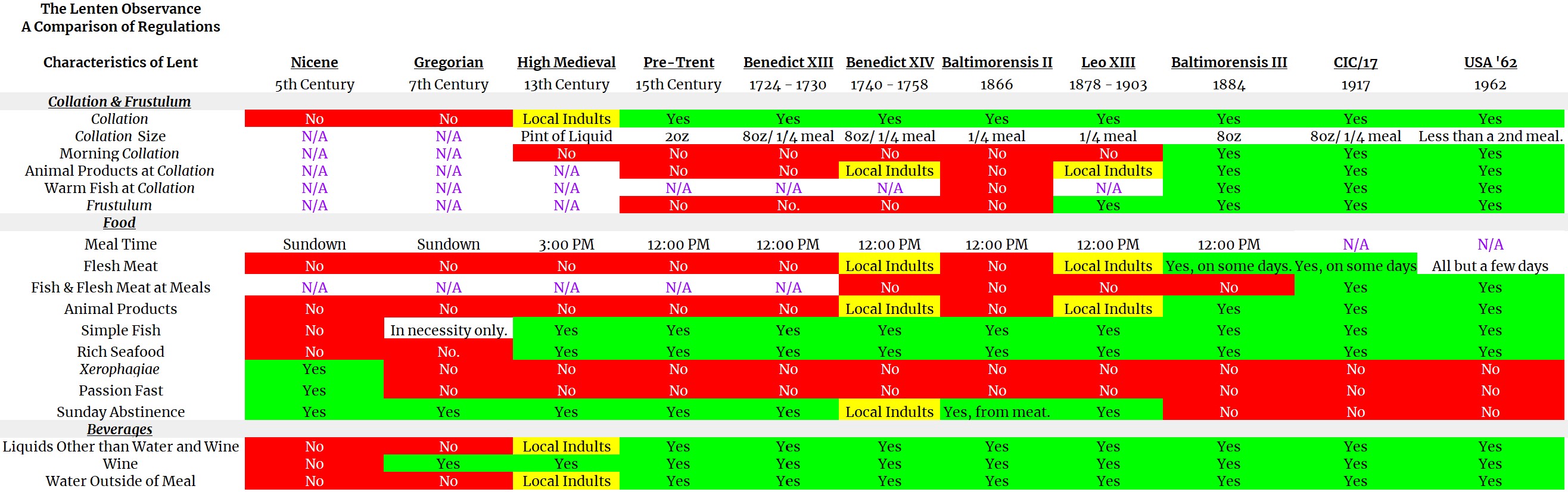
How many of us are observing all 40 days as true fast days and not just Ash Wednesday and Good Friday?  Yet our ancestors did.  In fact, it was forbidden to eat meat or any animal products (e.g. eggs, dairy, cheese, butter, etc) through all of Lent.  How many of us are making this kind of intense sacrifice?  How many of us are finding the time this Lent to pray the Rosary every day or go to Daily Mass more often or at least pray the Stations of the Cross each Friday?

We live in sad, pitiful times where few souls even care to observe Lent.  The prophetic words of Pope Benedict XIV are coming true when he said:
“The observance of Lent is the very badge of Christian warfare. By it we prove ourselves not to be enemies of Christ. By it we avert the scourges of divine justice. By it we gain strength against the princes of darkness, for it shields us with heavenly help. Should men grow remiss in their observance of Lent, it would be a detriment to God’s glory, a disgrace to the Catholic religion, and a danger to Christian souls. Neither can it be doubted that such negligence would become the source of misery to the world, of public calamity, and of private woe.” 
And yet, how many people indulge in public sin, lust, and gluttony on Fat Tuesday in a mockery of our ancestors?  Nowadays, no one - or at least few of us - fast for all forty days.  Yet, people are engaging in eating on Shrove Tuesday like they were.  It is a mockery of the Faith!  How many people are fasting by "light eating" on Ash Wednesday and then indulging on cheeseburgers on the Thursday after Ash Wednesday on a Lenten feria day!

Even the great liturgist Dom Guaranger wrote of the excesses and sinfulness of Mardi Gras in his own time.  And how much worse it is in our own times than his, who lived from 1805 to 1875!
How far from being true children of Abraham are those so-called Christians who spend Quinquagesima and the two following days in intemperance and dissipation, because Lent is soon to be upon us! We can easily understand how the simple manners of our Catholic forefathers could keep a leave-taking of the ordinary way of living, which Lent was to interrupt, and reconcile their innocent carnival with Christian gravity; just as we can understand how their rigorous observance of the laws of the Church for Lent would inspire certain festive customs at Easter. Even in our times, a joyous carnival is not to be altogether reprobated, provided the Christian sentiment of the approaching holy season of Lent be strong enough to check the evil tendency of corrupt nature; otherwise the original intention of an innocent custom would be perverted, and the forethought of penance could in no sense be considered as the prompter of our joyous farewell to ease and comforts. While admitting all this, we would ask, what right or title have they to share in these carnival rejoicings, whose Lent will pass and find them out of the Church? And they, too, who claim dispensations from fasting during Lent and, for one reason or another, evade every penitential exercise during the solemn forty days of penance, and will find themselves at Easter as weighed down by the guilt and debt of their sins as they were on Ash Wednesday ‒ what meaning, we would ask, can there possibly be in their feasting at "Mardi Gras."

In our modern world, when sinful indulgence is the rule all year long, it is especially sad to see the annual repetitions of the most decadent carnival celebrations taking place in formerly Catholic cities. But even long ago the need for reparation for such scandalous debauchery was recognized. The Church offered a substitute for frivolous amusements and dangerous pleasures; and those of Her children upon whom faith has not lost its influence, found a feast surpassing all earthly enjoyments, and a means whereby to make amends to God for the insults offered to His Divine Majesty during the days of carnival. The Lamb Who taketh away the sins of the world was exposed upon the altar. Here, on His throne of mercy, He received the homage of them who came to adore Him, and acknowledge Him for their King; He accepted the repentance of those who came to tell Him how grieved they were at having ever followed any other Master but Him; He offered Himself to His Eternal Father for poor sinners, who not only treated His favors with indifference, but seemed to have made a resolution to offend Him during these days more than at any other period of the year.
It is a shame.   It is a public scandal.  And our Lord Himself has asked for reparation.

In an apparition of our Lord to Mother Pierina in 1938, the Lord said: 
“See how I suffer. Nevertheless, I am understood by so few. What gratitude on the part of those who say they love me. I have given My Heart as a sensible object of My great love for man and I give My Face as a sensible object of My Sorrow for the sins of man. I desire that it be honoured by a special feast on Tuesday in Quinquagesima (Shrove Tuesday – the Tuesday before Ash Wednesday). The feast will be preceded by novena in which the faithful make reparation with Me uniting themselves with my sorrow.”

And even though we are now after the Tuesday in Quinquagesima, I am asking everyone reading this article to take a few minutes and comfort the heart of our Savior, who is much offended, by praying the Golden Arrow in honor of His adorable Face.


May God be pleased with our Lent.  And may we be undertaking penance (abstinence, fasting, prayer, and almsgiving) to make reparation to God for our sins and those of others. 
Read more >>
Monday, May 8, 2017
What is the earliest and latest date that Lent or Easter can start?
edit_button

For those looking to plan ahead, here is a list of all of the upcoming dates for movable major Catholic feastdays and seasons until the year 2050.


Lent starts on Ash Wednesday, 46 days before Easter. Since Sundays are not fast days, there are 40 days of traditional fasting and penance in Lent that leads up to Easter.

The earliest Easter can be is March 22 as it was last in 1818 and will be next in 2285. Ash Wednesday would be on February 4 in that case.

The latest Easter can be is April 25 as it was last in 1943 and will be next in 2038. Ash Wednesday would be on March 10. 


Therefore, the earliest Lent can start is February 4 and the latest it can start is March 10.
Read more >>
Tuesday, February 14, 2017
Feast of The Prayer of Christ (Masses in Some Places)
edit_button

Each year on the Tuesday after Septuagesima there was celebrated a "Mass in Some Places," according to the 1955 Missal. This special Mass is for The Prayer of Christ and has been around for several hundred years.  The Catholic Encyclopedia summarizes this special feastday that is worthy of our meditation:
This feast occurs on the Tuesday after Septuagesima (double major). Its object is to commemorate the prolonged prayer which Christ offered in Gethsemane in our behalf in preparation for His Sacred Passion. 
The Office insists on the great importance of prayer. The feast is placed at the beginning of Lent to remind us that the penitential season is above all a time of prayer. The Office probably was composed by Bishop Struzzieri of Todi, at the suggestion of St. Paul of the Cross (d. 1775), and, together with the other six offices by which the mysteries of Christ's Passion are celebrated (see FEAST OF THE PASSION OF CHRIST), was approved by Pius VI. 
The hymns were composed by Fatati (Schulte, "Hymnen des röm. Brev."). Outside the Congregation of St. Paul this feast was adopted later than any of the other feasts of the Passion. It is not found in the proprium of Salerno (1793) nor in that of Livorno (1809). Other dioceses took it up only after the city of Rome had adopted it (1831). It has not yet been inserted in the Baltimore Ordo.
Read more >>
Wednesday, March 16, 2016
Canticle of the Passion (Canticum de Passione)
edit_button


The Canticle of the Passion is a Dominican tradition with a long history.  The following passage recounts how after the first time St. Catherine experienced her mysterious ecstasy (which she did for a number of years on each Friday) that united her so closely to Jesus Crucified, Our Lady  appeared to her and revealed to her what have come to be called the Verses of  the Passion, a series of Scripture passages that refer to Our Lord’s sufferings.

These verses are solemnly chanted in the Dominican Order every Friday during Lent : may  they help you to foster in your soul this devotion so dear to our Order and so extremely important for the whole Church and the whole world.


 From the Life of Saint Catherine de Ricci  

Père Hyacinthe Bayonne, O.P., Vie de Sainte Catherine de Ricci de Florence, religieuse du Tiers Ordre régulier de saint Dominique au monastère de Saint Vincent de Prato, en Toscane, (1522=1590), Paris, 1873, p. 163-167.

The Blessed Virgin herself wished to consecrate all these testimonies of the authenticity of this grace by a singular favor which would henceforth serve to nourish the piety of the faithful. Immediately after the first ecstasy of the Passion, she appeared to Catherine in order to congratulate her on the perfect resemblance she now had to herself in the mystery of the Compassion at the foot of the cross of her Son. Content to meet, after sixteen centuries, a worthy imitator in this magnanimous path, she was pleased to encourage her with her sympathy and to increases the holy ardors of her love. She taught her to celebrate this mystery in a form that is fitting for the great emotions of the heart, in the form of a sacred canticle. This canticle, composed exclusively with words from Holy Scripture, she had no doubt composed originally for herself, after the death of her divine Son, as a sustenance for her dolor, a bouquet for her love, during the remainder of her life. And now that Catherine had taken her place at the foot of the cross, the divine Mary made it pass from her heart into the heart of the saint, so that she, in her turn, might make it the object of her meditations and the sustenance of her love. Who wouldn’t love to hear the Mother of dolors reciting the dolors of the Bridegroom to the new bride crucified with Him, and singing in her virginal voice the nuptial-song of the heroic wedding of Calvary ?

This canticle is composed of two parts. In the first part, the divine Redeemer Himself passes in review the principal phases of the Passion, taking all His words from the prophets and the Evangelists. This representation of the holy victim by Himself has about it something profoundly moving. While we hear the plaintive cries of His love, we embrace, in thought, the whole bloody drama in each of its acts, counting all His wounds, one by one. The heart, softened, is penetrated by vivid compunction and gives itself up to the feelings inspired by gratitude and love for a God who so loved us first. Let everyone judge for himself :

1.    My friends and my neighbors, have drawn near and stood against me.
2.    I was delivered up and came not forth, my eyes languished through poverty.
3.    And my sweat became as drops of blood, trickling down upon the ground.
4.    For many dogs have encompassed me, the council of the malignant hath besieged me.
5.    I have given my body to the strikers; and my cheeks to them that plucked them.
6.    I have not turned away my face from them that rebuked me, and spat upon me.
7.    For I am ready for scourges, and my sorrow is continually before me.
8.    The soldiers plaiting a crown of thorns, placed it upon my head.
9.    They have pierced my hands and my feet, they have numbered all my bones.
10.    And they gave gall for my food, and in my thirst they gave me vinegar to drink.
11.    All they that saw me laughed me to scorn; they have spoken with their lips, and wagged their heads.
12.    They have looked and stared upon me, they parted my garments amongst them, and upon my vesture they cast lots.
13.    Into thy hands I commend my spirit; thou hast redeemed me, O God of truth.

Here the soul that has meditated on the words of the divine Savior, seeing Him about to expire, addresses to Him, in the name of all the faithful, the prayer of the Good Thief :

14.    Be mindful, O Lord, of Thy servants; when Thou shalt come into Thy kingdom.

Then this first part concludes with this final word of His account of His Passion :

15.    Be mindful, O Lord, of Thy servants; when Thou shalt come into Thy kingdom.

The second part is consecrated entirely to the reflections this great mystery inspires in the soul, always in the beautiful language of Scripture, which says so much in so few words. It is first of all a cry of gratitude for the mercies of the Lord that rings out even into eternity. It is followed by a regretful look back on all that we have cost our sweet liberator. Then, after a clamorous call of alarm to His goodness for us and an act of unlimited confidence in Him who called Himself our Savior, the canticle concludes with a humble prayer to Jesus Christ that the merits of His blood be applied to us.

16.    The mercies of the Lord, I will sing for all eternity.
17.    Surely He hath borne our infirmities, and carried our sorrows.
18.    He was wounded for our iniquities; He was bruised for our sins.
19.    All we like sheep have gone astray, every one hath turned aside into his own way.
20.    For the Lord hath placed upon him the iniquities of us all.
21.    Arise, why sleepest Thou, O Lord? arise, and cast us not off forever.
22.    Behold, God is my Saviour, I will deal confidently, and will not fear.
23.    We beseech Thee, O Lord, help Thy servants, whom thou hast redeemed with Thy precious blood.

On transmitting this canticle to Catherine, the Blessed Virgin ordered her to propagate it in the monastery, as a form of contemplation and prayer sovereignly pleasing to her divine Son. (Her confessor) submitted it to the approval of the Order. The Master-General, who at that time was Father Francesco Romeo de Castiglione, did not just permit its usage in the monastery of Saint Vincent. By a circular letter to all the Provinces, he inscribed it among the devotional practices of the Order of Saint Dominic. It has become known as the Canticle of the Passion, as a monument to the piety of Saint Catherine de Ricci for her Jesus Crucified. It is still today the general custom in our churches to sing it publicly on certain occasions, and especially all the Fridays of Lent. It always produces a profound impression of piety in recollected souls.

Read more >>
Sunday, March 13, 2016
Thoughts On The Passion by Father Louis Bourdaloue, S.J.
edit_button

“JESUS IS STRUCK BY THE HIGH-PRIEST’S SERVANT”
 TRANSLATION OF A SERMON BY BOURDALOUE

 Accessed via Servants of the Holy Family

“And when He had said these things, one of the servants standing by gave Jesus a blow, saying: ‘Answerest Thou the High Priest so?’ (Jn. 18, 22).

WHAT, pray, had Our Savior answered when questioned by the High Priest? What did He do to deserve such prompt chastisement? What was there in His reply to call for such an outrage?

Annas had asked Him for an account of His teaching, and in reply Jesus had referred him to His disciples whose testimony should be sought on this point. Does this constitute an offence? Is this sufficient cause for insulting Him, for striking Him on the face? But we cannot argue here according to the laws of equity, they are all transgressed; we cannot expect justice in a trial where passion dominates, and that one of the most violent of passions—envy. The only object of our consideration, of our admiration, of our imitation, must be the imperturbable calm of the Son of God under circumstances which would upset any man no matter how strong, no matter how much master of himself. Long ago had the Lord said by the mouth of His Prophet: “I have not turned away my face from them that rebuked Me, and spit upon Me.” (Isaias 50, 6). It is in this way that He would teach us to receive injuries, a lesson which is of practical importance in daily life—to receive injuries as Jesus did, that is, to bear and even to welcome them: to bear them by accepting them patiently, and even to welcome them by accepting them with joy: far from breaking forth into anger or seeking revenge, to go so far as to expose ourselves to them and even to love them.

PART I. FORGIVENESS OF INJURIES

What a test it must have been for Our Lord’s patience to receive a blow in the presence of a large assembly; to receive a blow as a punishment, as a correction; to receive a blow from a common servant. This is an unpardonable insult if offered to an ordinary man, but what an enormous crime it must be when we consider that it is offered, not to an ordinary man, but to the Son of God, to God-made-Man? Our Savior could have exacted terrible vengeance for this insult: He had only to say the word and fire would have come down from heaven to destroy the insolent aggressor: He had only to ask His Father for legions of angels to assist Him: He had but to make use of His own miraculous power in His defense. Not only had He the power to avenge Himself for the insult, but it would even seem to have been incumbent on Him to do so. For there is here a question of scandal. He is struck on the ground that he had shown disrespect to the High Priest. If He accepts it, He would seem to admit the charge of disrespect of authority; it would leave a stain on His character whose purity they had sought in vain to tarnish. Nevertheless, He would not exact the justice, because His action would be capable of being interpreted as springing from a spirit of resentment or a desire for revenge, and this is just what He desires to banish from men’s hearts, namely, all trace of that spirit of resentment and that desire for revenge.

It is not as if vengeance does not belong to Him since He is God: “Revenge is Mine” (Rom. 12. 19). But if it belongs to Him as God, it does not belong to Him as man; and since He is man as well as God, and what He did as God might be attributed to Him as man, He would not avenge Himself, in order to teach men not to seek revenge, and in order not to provide them with even an apparent precedent to which to appeal.

He had indeed worked a miracle in the garden, when, at His single word, the soldiers, sent to seize Him, had fallen backwards on the ground. But that was before they had attacked and laid hands on Him, when such a miracle could not be regarded as an act of revenge. But now that He has been outraged He does nothing. If He worked a new miracle His enemies would fear Him; but He prefers to appear helpless, rather than appear to act under the influence of passion, Therefore He answers, not haughtily, not insisting on His rights, but with unutterable gentleness: “If I have spoken evil, give testimony of the evil; but if well, why strikest thou Me?” (Jn. 18, 23). This is His only answer. He does not vindicate His rights: He does not punish the evil-doer with a punishment that would be an example for all time. For no matter how well-merited this chastisement might be, it could not but be taken for an act of revenge springing from natural resentment.

Our divine Lord avoids even appearing to take vengeance, for He has come to destroy among men the spirit of revenge. And since in this matter the appearance and the reality are hardly distinguishable, in order to destroy the reality, which is sinful, the slightest appearance must be avoided. As the giver of the New Law, He had already given His commandment, and had taught forgiveness of injuries to His disciples; but, St. John Chrysostom says, that was not enough. He must safeguard this precept and put it outside the reach of all the stratagems and subtleties to which men descend, when under the influence of passion, in order to avoid its obligation and practice. For, the holy Doctor adds, how inventive we become when our self-love is aroused: we persuade ourselves that we are insulted when the injury is only imaginary; or if we have indeed received some slight injury, we magnify it out of all proportion. In order to justify ourselves, we put on a mask of righteousness, of zeal for the laws of equity: we draw up arguments and call in authorities to prove that we are doing only what is reasonable, what is expected of us, and seek a thousand and one reasons for justifying our action. It was necessary to put an end to all this; and in order to achieve this purpose, man could be left no room for argument; because there is nothing so subtle and so full of guile as the reasoning of a mind under the influence of passion, for then it is really the heart that reasons.

So our Divine Savior had to strengthen this precept by putting it outside reason; and this He did by His example—by example in allowing this outrage to go unpunished, with even demanding reparation. For even if He did not wish to punish this insult offered so publicly, even if He did not wish to make use of His divine power by which He could overwhelm evil-doers and make them feel the severity of His chastisements, could He not appeal to the judge, could He not appeal to His own outraged innocence and to the High Priest’s dignity which was injured by this act of violence committed before his tribunal, before his very eyes? Instead, He renounces all His rights, He forgets all His interests, He sacrifices all His glory, and is concerned only in giving us an example of the most heroic patience.

This is an example so striking that it leases us no room for hedging. Now you will have difficulty in arguing, in justifying your action. After this example of our divine Savior you can only remain silent and give in. There is now no other rule to be followed, no other principle on which to act. It is a principle that is clear-cut and compromising; we cannot escape from it, inasmuch as it is so well within our powers of grasping. It is according to this principle that we must judge all others. It is the only principle that can repress the outbursts of a heart carried away by passion, be it ever so little Christian in outlook. In a word, from this principle there follows this great counsel put by our Divine Savior among the most important articles of that heavenly doctrine He came to teach us: “But I say to you not to resist evil, but if one strike thee on thy right cheek, turn to him also the other.” (Mt. 5, 39).

If our divine Lord had merely spoken as Master and Teacher, we should always have received His word with reverence as coming from the source of all holiness and wisdom, but we could still say that it was too severe, that its practice was too difficult: “This word is hard,” using the words spoken by the people of Capharnaum in another context. The Son of God foresaw this possibility, and we see the measures He took to prevent it. “Well,” He says to us, “if I must temper the apparent rigor of My teaching, I shall do so, I shall make it easy, and how shall I do so? By My example, for I do not want it to become a stumbling-block for you; I do not want My word, which is the word of life, to be the occasion of your leaving Me, to be the occasion of your loss by estranging you from Me. Is there anything more insulting than a blow on the face? Well, I shall expose Myself to this outrage, and My patience will temper the harshness of My precept which you find so difficult, and so impracticable.”

Indeed, it is impossible not to relish this teaching of our divine Savior, bitter though it may seem, when we see Him putting it into practice Himself. We cannot say that He demands too much of us in wishing us to follow His example. Should we not regulate our lives according to His? Does He not wish to reform the world as much by His example as by His preaching? It was for this very reason that He became like unto us, that He assumed our human nature, that we might become like unto Him, that we might follow His example. It is just this example of God bearing patiently a most grievous insult that is the greatest condemnation of our countless susceptibilities and extreme sensitiveness in all that concerns the false honor of the world, of our impatience and irritation so difficult to moderate or satisfy.

This is a vice that is very prevalent in our time, and is always on the increase. This is a vice which preachers of the Gospel with all their zeal and eloquence have not been able to correct. This is the last of all the vices of which we strive to rid ourselves, of which we believe we ought to rid ourselves. There are good people in the world who lead a fairly orderly life: their lives are characterized by nothing underhand, by no vicious habits or scandalous excesses; they are rather the soul of uprightness and honor in all things. There are pious and devout souls who give themselves to pious practices, who visit churches, listen to the word of God, practice mental prayer, frequent the sacraments, and exercise charity towards the poor. There are religious souls who go yet further: with a view to arriving at the most sublime perfection, they give up all this world’s goods, renounce pleasures of sense, shut themselves up in a cloister, and there pass their days in poverty and obscurity, in a state of subjection and dependence, in works of penance and mortification. All these things are due to the Grace of God, and for them we cannot thank Him too much. But,—can I venture to say it? among all these good Christians, among all those souls who are virtuous, or who at least strive after virtue, among all these souls who are perfect, or who at least wish to be perfect, and for that reason have retired from the world, among all these there is perhaps hardly a single one who can overlook an insult, who can forgive and forget. We learn all other things, we train ourselves in all other accomplishments, we practice all other virtues; we discipline ourselves to fasting, to watching, to prayer; we learn to chastise the flesh and to mortify it. However, we hardly learned silence, patience, charity, moderation, self-control (especially when we believe ourselves to be offended).  We hardly want to learn these things.  We make a point not to be so good, not to be so forbearing; we do not want to pass for a person who can be attacked with impunity, who cannot defend himself.  We would rather pride ourselves on the fact that we have rendered ourselves invulnerable—that we have taught others to respect us, not to take liberties with us. For all this we have a thousand and one reasons of prudence, of dignity, of justice:  but reasons that, when examined and sifted, reduce to this sole reason—we do not want to suffer.

Nevertheless, we claim to live in accordance with the highest standards of morality, we spend long hours before the Tabernacle; we belong to a circle that sets itself up as a model of virtue; we experience raptures and ecstasies: of a truth, we are like those mountains mentioned in Scripture, which a single touch causes to emit thick clouds of smoke and blazing names: “Touch the mountains, and they shall smoke” (Ps. 143, 5). Such mountains are those souls so pure and holy, or at least that pass for such. They are high mountains, mountains that reach almost to the third heaven by the sublimity of their views and aspirations. But just cross them even in the slightest way; just let slip one word, one gesture of disparagement; just contradict them in any way, ah! then they become volcanoes in eruption, belching forth smoke and fiery lava: or if, perchance, they restrain themselves and show no signs of annoyance, it is only to nourish a secret grudge, which, like a hidden poison, acts slowly indeed, but only to produce its effects the more surely and the more malignantly at the opportune moment. This is a fatal obstacle to the virtue of so many souls that are otherwise irreproachable. It is an obstacle that can cause their ruin, from which they can never escape because it follows them everywhere; and besides, it is often in the most regular communities that it is most to be feared.

Whatever be your position in life, the example of Jesus Christ is meant for you. For the words of the Prophet addressed to Almighty God can easily he applied to you, you can say to yourself: “Look on the face of Thy Christ” (Ps. 83, 10). Have you been offended by word or deed? Have you difficulty in holding yourself in check and putting up with the offence? There are many considerations which would help to control your anger and to sweeten the bitterness of your heart, but the most potent of all is to look upon the face of your Christ. See this face before which the angels prostrate themselves in adoration, this adorable face struck by a servant?  Look on the face of Thy Christ—your Christ, because He was anointed for you.  You’re Christ, because He has delivered Himself into the hands of His enemies for you. You’re Christ, because He was immolated on Calvary for you.  Your Christ—He is more than that, He is your God. Now compare person with person, insult with insult—the sacred person of the God-Man, and your miserable little self; a blow on the face, and an offence, perhaps in itself altogether insignificant, which you nevertheless make such a fuss about. It is a stain on your honor, do you say? Is your honor more precious than that of the Son of God? It is against your interests? Is your interest more important than that of our holy religion which is attacked in the person of its head and author? You have been insulted or your person, your name, your rank, your birth, has been disregarded? Is the insult offered to you greater than the insult offered to the sovereign majesty of God? No matter what you say, the answer is always the same: Look on the face of Thy Christ. Look on your Christ and learn of Him, not only to accept injuries patiently, but even joyfully, and, if needs be, to expose yourself to them, to love them. This is the point to be treated next.

BEARING INJURIES JOYFULLY.

It is not enough for the example of the Son of God to extinguish in our hearts all desire for revenge. It should result in something more. It should make us ready to receive insult and contempt and any attack on our honor, about which we are so very sensitive. What does this mean? Does it mean that we must be ready to accept generously any aspersions on our honor? No, that is too little to expect. Does it mean accepting it all willingly as coming from the hand of God? Even this is not enough. Does it mean that we must welcome it, love it, glory in it and seek after it? Yes, that is what we must strive after, and this, I venture to say, is something essential and often indispensable. Perfection, it would seem, cannot be raised to a higher degree; and yet this perfection, which appears to be so elevated, becomes, on many occasions in our daily lives, a precept which obliges us strictly in conscience. Let us develop this important point and make it as clear as possible.

For instance, what means must I take if I am to forgive injuries generously, as I ought, and not to desire revenge? What must I do if I am to be prepared on every occasion to uphold the cause of God, and to defend it; to oppose scandals which I see arising at every instant in the world about me, scandals which, in virtue of my office, it is my duty to suppress as far as I can; to disregard all those considerations which might deter me when the honor of religion and its interests are at stake? In a word, what must I do if I am to have an unshakeable resolution to behave as a Christian, and not bring dishonor on this glorious name, regardless of the cost, regardless of what may be said about me? In all these eases, and in countless others, what contradiction, what false judgments, what sharp words, reproaches, and calumnious talk, and even insults must be faced? How can we undergo all these evils with resolute firmness unless we are ready to love them for God’s sake, to welcome them for God’s sake, to honor them and even to glory in them for God’s sake? The faith which we profess demands of us the same sentiments which the Apostles expressed when they were calumniated and ill-treated by the Sanhedrin. They considered themselves happy to suffer all kinds of opprobrium for the name of Jesus Christ. “They were rejoicing that they were accounted worthy to suffer reproach for the name of Jesus.” (Acts 5, 41).

It is quite true, and beyond any possible doubt, that this requires great purity and generosity of heart; but it is a necessary virtue. And if our holy religion imposes on us a law that is so difficult and contrary to the tendencies of our nature, it also gives us the aids we need to practice it, and of these is there any more potent and more capable of consoling and strengthening us in the humiliations of this life than the contemplation of Our Divine Savior, God-made-Man receiving a blow on the face, and not merely receiving it, but even desiring and seeking it? Be quite sure of this, He received it only because He willed to receive it, for He could have prevented it. But not only did He not wish to prevent it, He desired it, He exposed Himself to it: He made it the object of His most ardent desires and, as it were, the object of His delight. The Prophet Jeremias, when speaking of the sufferings of Our Divine Savior, used an expression which is very apt and very forceful, namely, that He would be sated with opprobrium: “Saturabitur opprobriis.” We do not partake of a dish which is distasteful to us; or if we must, only the bare minimum. But if it is a dish we like, we eat of it with relish, even with avidity; we eat our fill of it, even to satiety. Our divine Master made humiliation His food. He took His fill of it. If the Son of God made humiliation His food and the object of His desires, in order to procure the Glory of His Father and the salvation of men, should it not become for us an object of respect, of veneration, even of love, especially since by it the same Glory of God and the salvation of men are obtained?

This explains why the saints have rejoiced at being the objects of persecution and the contempt of the world. It is for this reason that St. Paul, who was as proud as any man and knew what real honor was, since he was of noble blood and enjoyed the privileges of Roman citizenship, nevertheless found pleasure in even the most humiliating outrages, as he so emphatically declared on several occasions: “I place myself in my infirmities, in reproaches, in necessities, in persecutions, in distresses for Christ.” (II Cor. 12, 10). He did not say merely: “I console myself”, “I am resigned”, “I strengthen myself to face these outrages,” but “I take pleasure in them” And why does he say this? “Because my Savior has made them holy, and they have become precious in my estimation.”

It is for this reason that David, though he was King, seeing this mystery of God being violently outraged, instead of fleeing from insults, awaited them, asked for them, and received them with thanks as if he received favors. “My heart hath expected reproach.” (Ps. 68, 21). Semei, one of his subjects, poured out maledictions and reproaches upon him, but the King blessed God for them. His whole court, righteously indignant, wished to punish the audacity and presumption of the insolent fellow, but the King forbade them. “Let him be,” he said, “God has sent me this humiliation: it is a gift from God. Do not take it away from me.” Who could have inspired David with a sentiment so unusual in a King, and even so much opposed to all principles of policy? It could be nothing else than the consideration of His God and Savior, undergoing the ignominious sufferings of His Passion, revealed to him in vision. He saw the God of all glory, the sovereign majesty, insulted by a blow on the face, and filled with a holy indignation at this spectacle, he cried out: “Ah, Lord, who fear after this all the outrages in the world; who would not long for them, since You take them for yourself and make them ornaments of Your Sacred Humanity? Therefore, My Lord, I accept them, no longer simply as a proof of my patience, for I have no longer any need of this virtue, but as the fulfillment of the desires of my soul which waits for them and longs for them. My heart hath expected reproaches.” Note well the reason he gives, for it contains a short formula for the whole of the gospel teaching: “For the reproaches of them that reproached Thee are fallen upon me.” (Ps. 68, 10). Because, My God, all the outrages heaped upon You in Your dolorous Passion, have fallen in anticipation on me: because, having considered them carefully and in thinking upon them, I have had most lively experience of them myself: because they have filled my heart with a supernatural desire, with a supernatural love of them, with a love of them not in You, Lord, but in myself. For even though I am attacked personally and these outrages are offered to me, I regard them as Yours, and considering them in that light, how can I not love them? Yes, Lord, they are Yours, since You have made them pass from Yourself to me, and after first experiencing them You have made them fall back on me. “Because the reproaches of them that attacked Thee, have fallen upon me.” (Cf. St. Augustine: Commentary on Ps. 60).

Only the Grace of God can establish a soul in this disposition and this is not surprising, for only by the Grace of God can we do homage to the humiliations of the God-Man. Flesh and blood cannot teach us these grand maxims or those exalted moral principles; only the Father Who is in heaven can reveal them to us, only the Son Who came down on earth, only the Holy Ghost Who abides in our soul. And this work is, as it were, the masterpiece of God’s all-powerful Grace. But let us be fully convinced of this fundamental truth, that without it we cannot be Christian at all. This is what Scripture teaches, and this is what we must take to heart. For this is a point that must be insisted on, a point that we cannot meditate on too much: that it is impossible to be a Christian, even a simple Christian, if we are not prepared for insults of all kinds; for there are countless occasions in our lives on which we are bound, under pain of damnation, to expose ourselves to humiliations in order to satisfy our conscience and for the salvation of our soul. Furthermore, it is impossible to be really prepared for humiliations as long as we retain a voluntary aversion for them; and finally, we must inevitably have the same horror of them, unless we have a just estimation for them and love them for God’s sake. These propositions follow necessarily one from the other, because we cannot love what we do not value, and we must value what we consider wretched and contemptible. We must therefore begin with the intellect in order to form in our hearts those real tendencies which God requires of us. In proportion as we learn to value insults and outrages, as the world calls them, we shall reverence and welcome them.

But how can we value and love what lowers us in the eyes of men, what humiliates us and takes away from us our honor? As long as we regard them in themselves, and do not look beyond them, we cannot value them; but we must not consider them in themselves, we must view them in Jesus Christ, in relation to Jesus Christ. That is, we must look upon them as a portion of the reproaches offered to Our Lord, as making us like Our Lord; as something to offer to Our Lord, as an opportunity of showing our love for Him. When viewed in this light there is nothing so humiliating, nothing so degrading in the eyes of the world, which does not become glorious to the eye of Faith, which we do not embrace as a benefit, as a favor.

This lesson is so much beyond ordinary human views, that it is impossible to make it too clear, and to point out exactly what is expected of us in practice. Such expressions as to esteem insults, to love insults and rejoice in them, to receive insults willingly and even with pleasure, are so strange and so much above our feeble nature, that we wonder what it all means. It does not mean that we must stifle all feelings of repugnance. It does not mean that we most become so entirely callous that we do not experience those movements of self – love or displeasure which are really inseparable from our human nature. It does not mean that we must feel pleasure in them or that they should appeal to our sensitive nature. It is true that some saints have reached the stage where they had so far repressed their lower nature that no insult or outrage could disturb in any way their peace of soul; they sought them as eagerly as ambitious men seek vain distinctions and worldly honors. Numerous examples can be given, but they are all extraordinary graces, miracles of Christian humility which are in no way indispensable to the practice of this virtue. It means that in spite of what worldly prudence tells us, in spite of even the most violent revolt of our sensitive nature, we consider ourselves happy to share the ignominy of the Son of God, especially when it is for the Glory of God or in defense of the Faith. It means that we must prefer to be despised, to be ridiculed, to be condemned and even persecuted for justice’ sake, rather than by compromising, to be applauded and praised and honored. It means that we must have an inviolable resolution never to deviate from the path of virtue, whether in the hope of worldly distinction or through disgust for a hidden and a lowly condition.

Sometimes we may be greatly agitated, we may be moved to the very depths of our being, we may be tempted to burst out in reproaches and angry recriminations. At critical moments we may feel helpless, unable to bear any more. But amid this storm of our senses from which our reason and our will stand aloof, we remain immovably fixed in our adherence to the same principles, which are the principles of the Gospel. We hold firmly that it is a good, the greatest good in this life, to be able to prove our fidelity to God when we feel most desperate. We find strength in Our Lord’s words to the Apostles: “They will accuse you, they will calumniate you, they will speak all kind of evil against you. But do not you relax in the exercise of your ministry, do not worry. On the contrary, you ought to glorify it, and rejoice. Be glad and rejoice.” (Mt. 5;12). We are sustained by these consoling thoughts: that the greatest glory of a Christian is to make to God the sacrifice of his own glory; that if it is the most difficult sacrifice, it is also the most meritorious of eternal life; that a humiliation received in such a good cause is a deposit which receives hundredfold profit; that there is no better way of showing Him our inviolable devotedness; that if at first it is bitter to the taste, this bitterness soon changes into a sweetness that is real and sometimes even overflows into the senses, if we use the eye of Faith in judging an insult which is offered to us. All such considerations give the soul, not the blind prudence of this world, but a truly divine wisdom; they strengthen it; they restore its calm, and give it peace in the midst of circumstances which give rise to so many disturbances and wars among men.

Almighty God is never outdone in generosity; He never abandons a faithful soul; but pours out His Grace in abundance, so that there is nothing, no matter how distasteful, no matter how repellent, which His Grace cannot make sweet. With the help of His Grace we are in a position, if I may so speak, to face for the honor of God, for the defense of Holy Church, for the good of religion, for the fulfillment of our duty, any insult and outrage. In fact, the more we are loaded with insult, the more do we cry out with the Royal Prophet: “It is good for me that Thou hast humiliated me. (Ps. 118, 71). Blessed art Thou, O Lord, for allowing me to be thus humiliated, since it is all for You.” We repeat the words of the Apostle: “Maledictions are heaped upon us, but we cannot answer but in benediction and thanksgiving. Blasphemies are hurled against us, but we reply by praying for those who speak evil of us. We are regarded as the least among men, and far from being grieved, we rejoice in it. (I, Cor. 4, 12). For we know why we are treated in this manner. It is because we belong to God and wish to belong to Him always; it is because we never wish to depart from the obedience due to the commandments of God nor to turn away from His Law; it is because we use the authority which we have received from God to maintain order, to uphold the law of equity, and know no compromise in these matters; it is because we use the gifts God has given us and the zeal with which His Grace has inspired us to attack vice, to combat error, to unmask falsehood. If for these reasons we are decried, if our characters are painted in the blackest colors, if we are the object of hatred and spite, it ought to be a source of consolation for us, it is a sign of our triumph, it is something for which we cannot sufficiently thank the Lord, Who is testing us, and we cannot repeat often enough the words of the Psalmist: “We have rejoiced for the days in which Thou hast humbled us, for the years in which we have seen evils.’ (Ps. 8. 151.)”


II.

May it please God to animate you with this spirit. If He does not raise you to the point of rejoicing in insult, He will at least strengthen you against one failing which is very common among Christians—namely, human respect, which is an obstacle to so many good works, and is the cause of many disorders and evils. Because we are afraid of ridicule or mockery we often neglect most important obligations and even allow ourselves to be led on to excesses and crimes which are abhorrent to us; because we have not the strength to overcome a false sense of shame, how often do we experience its disastrous results. If we wish to free ourselves from this slavery, let us follow the advice of the Apostle, and keep before our minds the example of Our Blessed Lord: “Looking on Jesus, the Author and Finisher of Faith.” (Heb. 12, 2).

He is its Author by His wisdom and its Finisher by His love: He is its Author by His all-holy doctrine, and its Finisher by His divine example. He did not wish to be the Author of our Faith without also perfecting it; not only lest we should think that it was quite easy for Him to order things thus without having to observe them Himself, but above all because its perfection seemed to Him as glorious and as worthy of Him as its authorship. While wishing us to be faithful observers of His Law, He reserved to Himself the glory of being the perfect model of its observance, the Finisher of our Faith. St. Paul tells in very explicit terms how He did this: “Who having joy set before Him, endured the cross, despising the shame.” (Heb. 12, 2). It was by despising the shame, by rising above it and bearing it with courage and constancy. But I venture to add something to these words of the great Apostle without altering their meaning; it was not only by despising the shame but by loving it.

Hence I can never hope to have a really strong faith nor a truly solid piety, as long as I am dominated by human respect, by the fear of not being the subject of conversation, by the fear that man will turn against me, that they will attack me. But as soon as I am freed from this slavery, as soon as I am no longer ashamed of my God and of my duty, then I begin to be a Christian. Going, if necessary along the way of humiliation, which is so contrary to the false ideas of this world, I shall arrive at that true glory, which is the eternal glory.
Read more >>
Thursday, March 3, 2016
Read One Spiritual Book This Lent
edit_button

"During the days of Lent let each one receive a book from the library, and read it through to the end" (Rule of St. Benedict CH. XLVIII)

The monks of the order of St. Benedict have long required spiritual reading by all of their members during Lent.  Spiritual reading helps us turn to the Lord and become deeper in our prayer life.  In the words of St. Thomas Aquinas, "Union with God consists in knowing God perfectly. For the better one is known, the more perfectly one is loved."  

Back in 2007 I wrote the short post Book Recommendations for Lent and I would encourage you to look at the video on that post.  

But it's important to note that you do not have to spend money to read a good book for Lent.  If you are reading this post now, Lent is nearly half over.  But fear not!  There is still plenty of time to read a truly uplifting and spiritual enriching book this Lent.

Please spend a few minutes today and browse these websites:
You don't need to pick a long book.  This is not a challenge.  It's a chance to to grow intellectually while also participating in Lenten prayer, fasting, and almsgiving.  Pick a book and read it through from now til Easter.  And see the spiritual fruit in your life.

As for me, to hold me accountable, I will say that I am reading Sister Saint-Pierre and the Work of Reparation and if anyone is interested, it is an easy read and very enriching.
Read more >>
Tuesday, February 23, 2016
Pray for the Dead this Lent
edit_button

As we embrace the spirit of Lent and reflect upon the Passion of our Lord, I can not help but feel drawn to visit local Catholic cemeteries and pray for the souls of the dead.  For that reason, I'm asking you to join me.  Take the Pledge to visit a local Catholic cemetery near you this holy season and pray for the repose of the souls of the deceased.

Our Lord's Passion wrought about our redemption.  But we must cooperate with that Passion.  As St. Thomas Aquinas explains:
By the Passion of Christ we are freed from the liability to be punished for sin with the punishment that sin calls for, in two ways, directly and indirectly. We are freed directly inasmuch as the Passion of Christ made sufficient and more than sufficient satisfaction for the sins of the whole human race. Now once sufficient satisfaction has been made, the liability to the punishment mentioned is destroyed. We are freed indirectly inasmuch as the Passion of Christ causes the sin to be remitted, and it is from the sin that the liability to the punishment mentioned derives.
Souls in hell, however, are not freed by the Passion of Christ, because the Passion of Christ shares its effect with those to whom it is applied by faith and by charity and by the sacraments of faith. Therefore the souls in hell, who are not linked up with the Passion of Christ in the way just mentioned, cannot receive its effects. Now although we are freed from liability to the precise penalty that sin deserves, there is, nevertheless, enjoined on the repentant sinner a penalty or penance of satisfaction. For in order that the effect of the Passion of Christ be fully worked out in us, it is necessary for us to be made of like form with Christ. Now we are made of like form with Christ in baptism by the sacrament, as is said by St. Paul, We are buried together with him by baptism into death (Rom. vi. 4). Whence it is that no penalty of satisfaction is imposed on those who are baptised. Through the satisfaction made by Christ they are wholly set free. But since Christ died once for our sins (i Pet. iii. 18), once only, man cannot a second time be made of like form with the death of Christ through the sacrament of baptism. Therefore those who, after baptism, sin again, must be made like to Christ in his suffering, through some kind of penalty or suffering which they endure in their own persons.

If death, which is a penalty due to sin, continues to subsist, the reason is this : The satisfaction made by Christ produces its effect in us in so far as we are made of one body with him, in the way limbs are one body with the head. Now it is necessary that the limbs be made to conform to the head. Wherefore since Christ at first had, together with the grace in his soul, a liability to suffer in his body, and came to His glorious immortality through the Passion, so also should it be with us, who are his limbs. By the Passion we are indeed delivered from any punishment as a thing fixed on us, but we are delivered in such a way that it is in the soul we first receive the spirit of the adoption of sons, by which we are put on the list for the inheritance of eternal glory, while we still retain a body that can suffer and die. It is only afterwards, when we have been fashioned to the likeness of Christ in his sufferings and death, that we are brought into the glory of immortality. St. Paul teaches this when he says, If sons, heirs also ; heirs indeed of God, and joint heirs with Christ : jet so, if ire suffer n ith him, that n>e may be also glorified with him (Rom. viii. 17).

As we know by Faith, the souls of the suffering in Purgatory can benefit from the prayers and sacrifices of the souls on Earth who pray and make reparation while in the state of grace.  During this Lent, what have you done for the souls of our brothers and sisters in purgatory who suffer because of their sins?  They can not pray for themselves but you can free them from their sorrows by making reparation for their sins!

Note: Those unfamiliar with this dogma should see my post on purgatory.

Join me this week by visiting a cemetery near you and praying the Rosary while walking through the cemetery and looking at each and every name on the stones.  Or, join me in praying the Office of the Dead at the entrance to a cemetery and then reciting prayers while walking through the cemetery.

Please also see my post which details the many Catholic Devotions for the Dead.

Please make your pledge in the comments box anonymously. 
Read more >>
Friday, March 27, 2015
Feast of our Lady of Sorrows in Lent
edit_button

Today, the Friday after Passion Sunday, is dedicated to the honor of the Seven Sorrows of the Blessed Virgin Mary (in the Traditional Roman Catholic Calendar from before Vatican II).  This day is in addition to the honor given to our Lady and her Seven Sorrows in September's Feastday by this same name.


Today, the Friday after Passion Sunday (old calendar), Holy Mother Church asks us to recall the principle sorrows of Mary, our Sorrowful Mother. Rightly is our Blessed Mother called the Sorrowful Mother. She is indeed the Mother of Sorrows. She is the Queen of Martyrs. In fact, Her whole life was a martyrdom. The sufferings of the poor, for instance, She had to bear all through Her life. Mary was poor, as poor, perhaps poorer, than the poorest of us.

A thread of sorrow ran through all Her years in that She could see ahead to the time when Her only Son, now an Infant, now a little curly-headed Boy, now an obedient and respectful young Man, would have to die a most painful and disgraceful death.

And oh, Her sufferings during the Passion of Jesus, Her anguish as He carried His cruel cross, Her agony as She stood beneath that cross watching Him die. Who could ever measure Her grief or count Her tears?

It was most fitting that the woman whom God gave us for our heavenly Mother should be a Mother of Sorrows, a woman who had to suffer. As we all know, suffering is the lot of every human being. There is not, nor was there ever, a man, a woman, or a child but had to suffer. No person ever living that had not at least one sword in his or her heart, at least one sorrow, at least one affliction.

Sometimes we judge other people saying, "But so and so has no trials in his or her life?" How do we know that? Can we see into their interior? Most often we only see one side of the story. The fact is: Every human being has some sort of sorrow. Is it not consoling then that we children of Mary have for a Mother one who has borne a many-sworded sorrow? As children of Mary, we are all glad that we have such a Mother who suffered too; because only one who has suffered can rightly console, can satisfactorily comfort the sufferings of others. As Scripture says, '[God] comforts us in all our afflictions and thus enables us to comfort those who are in trouble, with the same consolation we have received from Him. As we have shared much in the sufferings of Christ, so through Christ do we share abundantly in His consolation.' (2 Corinthians 1:3-5). Certainly Mother Mary shared in Christ's sufferings!

Yes, everyone has a cross. Bitter indeed are some of our crosses--death of dear ones, sickness, poverty, misunderstanding, difficulties in our home and in our work.

What is your cross? Thank God for it. Ask Our Lady to show you how to carry it. Our Blessed and Sorrowful Mother, She who sits at the side of Her divine Son, with whom She suffered here on earth, Mary is now in Heaven waiting to help you, waiting to console you, waiting to be a sympathetic Mother to you.

Next Friday (Good Friday) we will recall Her principle sorrows. She had many more, but Mother Church centers our attention on the seven swords that pierced Her tender Heart:

1. The prophecy of Simeon that a sword of sorrow would pierce Her Heart, was a bitter pain.
2. The flight into Egypt made Her experience the sadness of exile and the loss of Her home.
3. The three-day loss of Jesus made Her Heart ache with anxiety.
4. What anguish when She met Jesus on the way of the cross.
5. One would think Her Heart would break as She stood beneath the cross at Christ's death.
6. Only a mother who holds a dead child in her arms can know anything of Mary's grief as She held Jesus taken down from the cross.
7. Only a mother who puts a child to bed in a grave can understand at all how Mary felt at the burial of Jesus.

Mary, our Sorrowful Queen, reaches out Her sympathy and help to everyone who suffers. She, more than any other woman, knew the pang and pain of sorrow. We can go to Her and take others to Her also. We can then be Our Lady's consolers!

Sorrowful and Immaculate Heart of Mary, pray for us!
[Adapted from a homily by Rev. Arthur Tonne, O.F.M. accessed via here]
Read more >>
Friday, March 20, 2015
The Precious Blood (Friday after the Fourth Sunday in Lent)
edit_button

Traditional Catholics will be familiar with the fact that the Feast of the Body of Christ (Corpus Christi) is kept on a separate date than the Feast of the Precious Blood.  The Feast of the Precious Blood is kept on July 1st.  The monthly is July is also especially dedicated to the Precious Blood Devotions.

However, there is also a Lenten Votive Mass that may be said on Friday after the 4th Sunday of Lent.  This was one of the Mass in Some Places that was part of the traditional Missal.

FEAST OF THE MOST PRECIOUS BLOOD.—For many dioceses there are two days to which the Office of the Precious Blood has been assigned, the office being in both cases the same. The reason is this: the office was at first granted to the Fathers of the Most Precious Blood only. Later, as one of the offices of the Fridays of Lent, it was assigned to the Friday after the fourth Sunday in Lent. In many dioceses these offices were adopted also by the fourth Provincial Council of Baltimore (1840). When Pius IX went into exile at Gaeta (1849) he had as his companion the saintly Don Giovanni Merlini, third superior general of the Fathers of the Most Precious Blood. Arrived at Gaeta, Merlini suggested that His Holiness make a vow to extend the feast of the Precious Blood to the entire Church, if he would again obtain possession of the papal dominions. The pope took the matter under consideration, but a few days later sent his domestic prelate Jos. Stella to Merlini with the message: "The pope does not deem it expedient to bind himself by a vow; instead His Holiness is pleased to extend the feast immediately to all Christendom". This was June 30, 1849, the day the French conquered Rome and the republicans capitulated. The thirtieth of June had been a Saturday before the first Sunday of July, wherefore the pope decreed (August 10, 1849) that henceforth every first Sunday of July should be dedicated to the Most Precious Blood.

ULRICH F. MUELLER


July 1st:
The Precious Blood of Our Lord
1st Class
Introit: Apocalypse v: 9-10
Redemisti nos, Dómine, in sánguine tuo, ex omni tribu, et lingua, et pópulo, et natióne: et fecísti nos Deo nostro regnum. [Ps. lxxxviii] Misericórdias Dómini in ætérnum cantábo: in generatiónem et generatiónem annuntiábo veritátem tuam in ore meo. Gloria Patri. Redemísti nos. Thou hast redeemed us, O Lord, in Thy blood, out of every tribe and tongue, and people and nation, and hast made us to our God a kingdom. [Ps. lxxxviii] The mercies of the Lord I will sing forever. I will show forth Thy truth with my mouth to generation and generation. Glory be.... Thou hast redeemed....
Collect:
Omnípotens sempitérne Deus, qui unigénitum Fílium tuum mundi Redemptórem constituísti, ac ejus Sánguine placári voluisti: concéde quæsumus, salútis nostræ prétium (solémni cultu) ita venerári atque a præséntis vitæ malis ejus virtúte deféndi in terris; ut fructu perpétuo lætémur in cælis. Per eúmdem Dóminum. O almighty and everlasting God, who didst appoint Thine only-begotten Son the Redeemer of the world, and hast willed to be appeased by His blood; grant unto us, we beseech Thee, so to venerate (with solemn worship) the price of our redemption, and by its power be so defended against the evils of this life, that we may enjoy the fruit thereof for evermore in heaven. Through the same our Lord.
Epistle: Hebrews ix: 11-15
Léctio Epístolæ beáti Pauli Apóstoli ad Hebræos:
Fratres: Christus assístens póntifex futurórum bonórum, per ámplius et perféctius tabernáculum non manufác­tum, id est, non hujus creatió­nis neque per sánguinem hir­córum, aut vitulórum, sed per próprium sánguinem introívit semel in Sancta, ætérna re­demptióne invénta. Si enim sanguis hircórum et taurórum, et cinis vitulæ aspérsus, in­quinátos sanctíficat ad emun­datiónem carnis: quanto magis sanguis Christi, qui per Spíritum Sanctum semetípsum óbtulit immaculátum Deo, emmundábit consciéntiam nostram ab opéribus mórtuis, ad serviéndum Deo vivénti? Et ideo novi testiménti mediátor est: ut morte inter­cedénte, in redemptiónem eárum prævaricatiónem, quæ erant sub prióri testaménto, repromissiónem accípiant, qui vocáti sunt ætérnæ hereditátis: in Christo Jesu Dómino nostro.
A reading from the Epistle of blessed Paul the Apostle to the Hebrews:
Brethren: When Christ ap­peared as High Priest of the good things to come, He en­tered once for all through the greater and more perfect tabernacle, not made with hands, that is, not of this cre­ation, nor again by virtue of the blood of goats and calves, but by virtue of His own blood, into the Holies, having obtained eternal redemption. For if the blood of goats and bulls, and the sprinkled ashes of a heifer sanctify the unclean unto the cleansing of the flesh, how much more will the Blood of Christ, who through the Holy Ghost offered Him­self unblemished unto God, cleanse your conscience from dead works to serve the living God? And that is why He is mediator of a new covenant; that whereas a death has taken place for redemption from the transgressions committed un­der the former covenant, they who have been called may have eternal inheritance according to the promise, in Christ Jesus our Lord.
Gradual: 1 John v: 6,7-8
Hic est qui venit per aquam et sánguinem, Jesus Christus: non in aqua solum, sed in aqua et sánguine. Tres sunt, qui testimónium dant in cælo: Pater, Verbum, et Spíritus sanctus; et hi tres unum sunt. Et tres sunt, qui testimónium dant in terra: Spíritus. aqua, et sanguis; et he tres unum sunt. This is he that came by water and blood, Jesus Christ; not by water only, but by water and blood. There are three in heaven who give testimony: the Father, the Word, and the Holy Ghost; and these three are one. And there are three that give testimony on earth: the Spirit, the water and the blood; and these three are one.
Alleluia, Allelúja. Si testimónium hóminum accípimus, testimónium Dei majus est. Allelúja. Alleluia, Allelúja. If we receive the testimony of men, the testimony of God is greater. Allelúja.
In votive Masses, after Septuagesima, the Allelúja verse is replaced by the Tract, as given below:
Tract: Ephesians i: 6-8 & Romans iii: 24-25
Gratificávit nos Deus in dilécto Fílio suo, in quo habémus redemptiónem per sánguinem ejus. Remissiónem peccatórum, secúndum divítas grátiæ ejus quæ superabundávit in nobis. Justificáti gratis per grátiam ipsíus, per redemptiónem, quæ est in Christo Jesu. Quem propósuit Deus propitiatiónem per fidem in sánguine ipsíus. God hath graced us in His beloved Son, in whom we have redemption through His blood. The remission of sins, according to the riches of His grace, which hath superabounded in us. Being freely justified by His grace, through the redemption, which is in Christ Jesus. Whom God hath set forth to be a propitiation, through faith in His Blood.
In Paschaltide, both Gradual and Tract are replaced by the Allelúja Verse:
Apocalypse v:9 & Exodus xii: 13
Alleluia, Allelúja. Dignus est Dómine, accípere librum et aperíre signácula ejus: quoniam occísus est, et redemísti nos, Deo in sánguine tuo.  Allelúja. Erit autem sanguis vobis in signum; et vidébo sánguinem, et transíbo vos: nec erit in vobis plaga dispérdens. Allelúja. Alleluia, Allelúja. Worthy art Thou, O Lord, to take the book, and to open the seals thereof: because Thou wast slain, and hast redeemed us to God in Thy Blood.  Allelúja. And the Blood shall be to you a sign: and I shall see the blood and pass over you; and the plague shall not be on you to destroy you. Allelúja.
Gospel: John xix: 30-35
+ Sequéntia sancti Evan­gélii secúndum Joánnem.
In illo tempore: Cum accepísset Jesus acétum, dixit: «Consummátum est.»  Et inclináto cápite trádidit spíritum. Judæi ergo (quóniam Paracéve erat) ut non remanérent in cruce córpora sábbato (erat enim magnus dies ille sábbati), rogavérunt Pilátum, ut frangeréntur eórum crura, et tolleréntur. Venérunt ergo mílites: et primi quidem fregérunt crura, et altérius, qui crucifíxus est cum eo.  Ad Jesum autem cum veníssent, ut vidérunt eum jam mórtuum, non fregérunt ejus crura, sed unus mílitum láncea latus ejus apéruit, et contínuo exívit sanguis et aqua. Et qui vidit, testimónium perhibuit: et verum est testimónium ejus.

Credo.
+ The continuation of the Holy Gospel according to John.
At that time, Jesus, when He had taken the vinegar, said: "It is consummated!" And bowing His head, he gave up the ghost. The Jews, therefore, since it was the Passover, in order that the bodies might not remain upon the cross on the sabbath day, besought Pilate that the legs of those crucified might be broken, and that they might be taken away. The soldiers, therefore came, and they broke the legs of the first, and of the other that was crucified with him. But when they came to Jesus; when they saw that He was already dead, they did not break His legs. But one of the soldiers opened His side with a lance, and immediately there came out blood and water. And he who saw it has borne witness, and his witness is true.

Credo.
Offertory: 1 Corinthians x: 16
Calix benedictionis, cui benedícimus, none communicátio sánguinis Christi est? Et panis, quem frángimus, nonne participátio córporis Dómini est? The chalice of benediction which we bless, is it not the communion of the blood of Christ? And the bread which we break, is it not the partaking of the Body of the Lord?
Secret:
Per hæc divína mystéria ad novi, quæsumus, testaménti mediatórem Jesum accedámus: et super altária tua, Dómine virtútum, aspersiónem sánguinis mélius loquéntem quam Abel, innovémus. Per eúmdem Dóminum. We pray that through these divine mysteries, we may draw near to Jesus, the mediator of the New Testament: and upon Thine altars, O Lord of Hosts, may we renew the sprinkling of that blood which pleadeth better than that of Abel. Through the same Lord Jesus Christ....
Vere dignum et iustum est, æquum et salutáre, nos tibi semper et ubíque grátias ágere: Dómine, sancte Pater, omnípotens ætérne Deus: Qui salútem humáni géneris in ligno Crucis constituísti: ut unde mors oriebátur, inde vita resúrgeret: in quo ligno vincébat, in ligno quoque vincerétur: per Christum Dóminum nostrum. Per quem majestátem tuam laudant Angeli, adórant Dominatiónes, tremunt Potestátes. Cæli cælorúmque Virtútes, ac beáta Séraphim, sócia exsultatióne concélebrant. Cum quibus et nostras voces, ut admítti júbeas deprecámur, súpplici confessióne dicéntes: Preface of the Holy Cross It is truly meet and just, right and availing unto salvation, that we should in all times and in all places give thanks unto Thee, O holy Lord, Father almighty and everlasting God. Who didst set the salvation of mankind upon the tree of the Cross, so that whence came death, thence also life might rise again, and that he who overcame by the tree might also be overcome on the tree; through Christ our Lord. Through whom the angels praise Thy majesty, the dominations adore, the powers are in awe, the virtues of highest heaven and the blessed seraphim unite in blissful exultation. With them we praise Thee; grant that our voices too may blend, saying in adoring praise:
Communion: Hebrews ix: 28
Christus semel oblátus est ad multórum exhauriénda peccáta: secundo sine peccáto apparébit exspectántibus se in salútem. Christ was offered once to exhaust the sins of many; the second time He shall appear without sin to them that expect Him, unto salvation.
Postcommunion:
Omnípotens sempitérne Deus, qui unigénitum Fílium tuum mundi Redemptórem constituísti, ac ejus Sánguine placári voluísti: concéde quaésumus, salútis nostræ prétium solémni cultu ita venerári, atquae a præséntis vitæ malus ejus virtúte deféndi in terris; ut fructu perpétuo lætémur in cælis. Per eúmdem Dóminum. We who have been admitted to the holy table, have drawn waters with joy from the fountains of the Savior. May His Blood, we beseech Thee, be within us as a fountain of water springing up unto eternal life; Thou who livest and reignest with God the Father in the unity of the Holy Ghost, one God, World without end. Amen.
  
Read more >>
Friday, March 13, 2015
The Five Holy Wounds (Friday after the Third Sunday in Lent)
edit_button


The Five Holy Wounds of Our Lord Jesus Christ
Friday after the Third Sunday of Lent

Introit: Philippians ii: 8-9
Our Lord Jesus Christ humbled Himself unto death, even unto death upon the Cross: Therefore God has also exalted Him, and given Him a name which is above all names. [Ps. lxxxviii: 2] I will sing the mercies of the Lord for all eternity: for generation after generation His truth will be in my mouth. Glory be.... Our Lord Jesus Christ....

Collect
O God, who through the passion of His only begotten Son, and the pouring out of His blood through the five Wounds, hast restored to human nature what was lost through sin: grant, we beseech Thee, that we who venerate the same Wounds and precious blood on earth may gain their fruit in heaven. Through the same....

A Reading From The Prophet Zacharia
xii: 10-11; xiii: 6-7
Thus saith the Lord: And I will pour out upon the house of David, and upon the inhabitants of Jerusalem, the spirit of grace, and of prayers: and they shall look upon me, whom they have pierced: and they shall mourn for him as one mourneth for an only son, and they shall grieve over him, as the manner is to grieve for the death of the firstborn. In that day there shall be a great lamentation in Jerusalem. And they shall say to him: What are these wounds in the midst of thy hands? And he shall say: With these I was wounded in the house of them that loved me. Awake, O sword, against my shepherd, and against the man that cleaveth to me, saith the Lord of hosts: strike the shepherd, and the sheep shall be scattered: and I will turn my hand to the little ones: saith the Lord almighty.

Gradual: Ps. lxviii: 21-22
Insult has broken my heart, and I am weak, I looked for sympathy, but there was none; for comforters, and I found none. Rather they put gall in my food, and in my thirst they gave me vinegar to drink.

Tract: Isaias: liii: 4-5
Surely He hath borne our infirmities and carried our sorrows: and we have thought Him, as it were, a leper, and as one struck by God and afflicted. But He was wounded for our iniquities, He was bruised for our sins: the chastisement of our peace was upon Him, and by His bruises we were healed.

 Gospel: John xix: 28-35
+
 The continuation of the holy Gospel according to John:
Jesus knowing that all things were now accomplished, that the scripture might be fulfilled, said: "I thirst." Now there was a vessel set there, full of vinegar. And they, putting a sponge full of vinegar and hyssop, put it to his mouth. Jesus therefore, when he had taken the vinegar, said: "It is consummated." And bowing his head, he gave up the ghost. Then the Jews (because it was the parasceve), that the bodies might not remain upon the cross on the sabbath day (for that was a great sabbath day), besought Pilate that their legs might be broken: and that they might be taken away. The soldiers therefore came: and they broke the legs of the first, and of the other that was crucified with him. But after they were come to Jesus, when they saw that he was already dead, they did not break his legs. But one of the soldiers with a spear opened his side: and immediately there came out blood and water. And he that saw it hath given testimony: and his testimony is true.

Credo

Offertory
Evil men rose up against Me: without mercy they sought to kill Me: they did not hesitate to spit in My face: with their lances they wounded Me, and they have struck all My bones.

Secret
May Thy majesty, we beseech Thee, O Lord, accept these gifts: in which we offer the Wounds of Thine Only-begotten, the price of our liberty. Through the same....

Preface of the Holy Cross
It is truly meet and just, right and availing unto salvation, that we should in all times and in all places give thanks unto Thee, O holy Lord, Father almighty and everlasting God. Who didst set the salvation of mankind upon the tree of the Cross, so that whence came death, thence also life might rise again, and that he who overcame by the tree might also be overcome on the tree; through Christ our Lord. Through whom the angels praise Thy majesty, the dominations adore, the powers are in awe, the virtues of highest heaven and the blessed seraphim unite in blissful exultation. With them we praise Thee; grant that our voices too may blend, saying in adoring praise:

Communion:
They looked upon Him whom they had transfixed, even as the earth was shaken to its foundations.

Postcommunion:
Refreshed by these life-giving nourishments, we beseech Thee, O Lord, God: that the wounds of our Lord Jesus Christ which we honor today; may impress themselves upon our hearts, so that dying to sin we will have life. Through the same....
 
Read more >>
Friday, March 6, 2015
Feast of the The Holy Shroud (Friday after the Second Sunday in Lent)
edit_button


The Most Holy Shroud of Our Lord Jesus Christ
Friday after the Second Sunday of Lent
Mass in Some Places
From the pre-1955 Missal 

Introit: Philippians ii: 8-9
Our Lord Jesus Christ humbled Himself unto death, even unto death upon the Cross: Therefore God has also exalted Him, and given Him a name which is above all names. [Ps. lxxxviii: 2] I will sing the mercies of the Lord for all eternity: for generation after generation His truth will be in my mouth. Glory be.... Our Lord Jesus Christ....

Collect
O God, who hast left us a relic of Thy passion in the holy shroud in which Thy body, taken down from the Cross, was wrapped by Joseph [of Arimathea]: grant, we beseech Thee; that through Thy death and burial, we may be brought to the glory of resurrection. Thou who livest and reignest.....

A Reading From The Prophet Isaias
lxii: 11; lxiii: 1-7
Thus says the Lord God: Say to the children of Sion: Behold the Lord hath made it to be heard in the ends of the earth, tell the daughter of Sion: Behold thy Savior cometh: behold his reward is with him, and his work before him. Who is this that cometh from Edom, with dyed garments from Bosra, this beautiful one in his robe, walking in the greatness of his strength. I, that speak justice, and am a defender to save. Why then is thy apparel red, and thy garments like theirs that tread in the winepress? I have trodden the winepress alone, and of the Gentiles there is not a man with me: I have trampled on them in my indignation, and have trodden them down in my wrath, and their blood is sprinkled upon my garments, and I have stained all my apparel. For the day of vengeance is in my heart, the year of my redemption is come. I looked about, and there was none to help: I sought, and there was none to give aid: and my own arm hath saved for me, and my indignation itself hath helped me. And I have trodden down the people in my wrath, and have made them drunk in my indignation, and have brought down their strength to the earth. I will remember the tender mercies of the Lord, the praise of the Lord for all the things that the Lord hath bestowed upon us.

Gradual: Ps. lxviii: 21-22
Insult has broken my heart, and I am weak, I looked for sympathy, but there was none; for comforters, and I found none. Rather they put gall in my food, and in my thirst they gave me vinegar to drink.

Tract: Isaias: liii: 4-5
Surely He hath borne our infirmities and carried our sorrows: and we have thought Him, as it were, a leper, and as one struck by God and afflicted. But He was wounded for our iniquities, He was bruised for our sins: the chastisement of our peace was upon Him, and by His bruises we were healed.

In Masses outside of Lent the tract is omitted and replaced by:
Alleluia, Alleluia. Hail, our King: Thou alone art merciful in spite of our errors: Obedient to the Father Thou wert led to be crucified, as a humble lamb to the slaughter. Alleluia

During Paschaltide:
Alleluia, Alleluia. Hail, our King: Thou alone art merciful in spite of our errors: Obedient to the Father Thou wert led to be crucified, as a humble lamb to the slaughter. Alleluia To Thee be glory, hosanna: to Thee be triumph and victory: to Thee be the highest praise and the crown of honor. Alleluia.
Gospel: Mark xv: 42-46
 The continuation of the holy Gospel according to Mark:
At that time, when evening was now come (because it was the Parasceve, that is, the day before the sabbath), Joseph of Arimathea, a noble counselor, who was also himself looking for the kingdom of God, came and went in boldly to Pilate and begged the body of Jesus. But Pilate wondered that he should be already dead. And sending for the centurion, he asked him if he were already dead. And when he had understood it by the centurion, he gave the body to Joseph. And Joseph, buying fine linen and taking him down, wrapped him up in the fine linen and laid him in a sepulchre which was hewed out of a rock. And he rolled a stone to the door of the sepulchre.
Credo
Offertory: Leviticus xvi: 2 et 5
Aaron entered into the tabernacle in order to offer a holocaust upon the altar for the sins of the sons of Israel, clothed in a linen tunic..
Secret
May these offerings be acceptable to Thee, O lord.: Whose Son didst graciously stand forth in His glorious passion for the salvation of the world. Thou who livest and reignest....

Preface of the Holy Cross
It is truly meet and just, right and availing unto salvation, that we should in all times and in all places give thanks unto Thee, O holy Lord, Father almighty and everlasting God. Who didst set the salvation of mankind upon the tree of the Cross, so that whence came death, thence also life might rise again, and that he who overcame by the tree might also be overcome on the tree; through Christ our Lord. Through whom the angels praise Thy majesty, the dominations adore, the powers are in awe, the virtues of highest heaven and the blessed seraphim unite in blissful exultation. With them we praise Thee; grant that our voices too may blend, saying in adoring praise:

Communion Hymn: Mark xv: 46
Joseph, buying fine linen and taking him down, wrapped him up in the fine linen shroud.

Postcommunion:
Be satisfied, O Lord, with the holy offerings of Thy servant: we ask Thee; that the death of Thy Son in time, which mystery we venerate, may give us confident assurance of perpetual life. Thou who livest and reignest with the same God the Father....
 

Read more >>

Subscribe to Future Posts on A Catholic Life

Enter email address:


Copyright / Disclaimer

Copyright Notice: Unless otherwise stated, all items are copyrighted under a Attribution-NonCommercial-NoDerivatives 4.0 International License. If you quote from this blog, cite a link to the post on this blog in your article.

Disclosure of Material Connection: Some of the links on this blog are “affiliate links.” This means if you click on the link and purchase the item, I will receive an affiliate commission. Regardless, I only recommend products or services I use personally and/or believe will add value to my readers. I am disclosing this in accordance with the Federal Trade Commission’s 16 CFR, Part 255: “Guides Concerning the Use of Endorsements and Testimonials in Advertising.”