Showing posts sorted by date for query Holy Thursday fast. Sort by relevance Show all posts
Tuesday, August 12, 2025
Is Friday Abstinence Required When Assumption Day Falls on a Friday?

Assumption by Martin Knoller

Assumption Day As A Holy Day of Obligation

The first catalog of Holy Days comes from the Decree of Gratian in c. 1150 AD, which shortly thereafter gave way to Decretals of Pope Gregory IX in 1234, which listed 45 Holy Days.

In 1642, His Holiness Pope Urban VIII issued the papal bull Universa Per Orbem which mandated the required Holy Days of Obligation for the Universal Church to consist of 34 days as well as the principal patrons of one's one locality (e.g. city and country). Those days were the Nativity of Our Lord, the Circumcision of Our Lord, the Epiphany of Our Lord, Monday within the Octave of the Resurrection, Tuesday within the Octave of the Resurrection, Ascension Thursday, Monday within the Octave of Pentecost, Tuesday within the Octave of Pentecost, Most Holy Trinity, Corpus Christi, the Finding of the Holy Cross, the Purification of the Blessed Virgin Mary, the Annunciation of the Blessed Virgin Mary, the Assumption of the Blessed Virgin Mary, the Nativity of the Blessed Virgin Mary, the Dedication of St. Michael, the Nativity of St. John the Baptist, SS. Peter and Paul, St. Andrew, St. James, St. John (the December feast day), St. Thomas, SS. Philip and James, St. Bartholomew, St. Matthew, SS. Simon and Jude, St. Matthias, St. Stephen the First Martyr (the December feast day), the Holy Innocents, St. Lawrence, St. Sylvester, St. Joseph, St. Anne, and All Saints.  

Hence, Assumption Day was a Holy Day of Obligation long before the dogma of the Assumption was dogmatically defined.

Is Friday Abstinence Required When Assumption Day (August 15) Falls on a Friday?

Since August 15 this year falls on a Friday and is a Holy Day of Obligation, a question arises on whether abstinence is obligatory this Friday. The answer, as clearly stated in the 1917 Code, is as follows:

"On [Sundays] or feasts of precept, the law of abstinence or of abstinence and fast or of fast only ceases, except during Lent, nor is the vigil anticipated; likewise it ceases on Holy [Saturday] afternoon" (1917 Code, Canon 1252 § 4). [Translation taken from THE 1917 OR PIO-BENEDICTINE CODE OF CANON LAW in English Translation by Dr. Edward Peters]

As Assumption Day falls outside of Lent, this Friday is not a day of mandatory abstinence. However, this was actually a change from the practice observed for well over 1,000 years.

Dispensations From Abstinence Were Previously Required Even for Holy Days of Obligation Outside of Lent

Even Christmas would in and of itself not dispense Friday abstinence in the Medieval Church, as Dom Gueranger writes in the Liturgical Year published in 1886:

"To encourage her children in their Christmas joy, the Church has dispensed with the law of abstinence, if this Feast fall on a Friday. This dispensation was granted by Pope Honorius III, who ascended the Papal Throne in 1216. It is true that we find it mentioned by Pope St Nicholas I, in the ninth century; but the dispensation was not universal; for the Pontiff is replying to the consultations of the Bulgarians, to whom he concedes this indulgence, in order to encourage them to celebrate these Feasts with solemnity and joy: Christmas Day, St Stephen, St John the Evangelist, the Epiphany, the Assumption of our Lady, St John the Baptist, and SS Peter and Paul. When the dispensation for Christmas Day was extended to the whole Church, these other Feasts were not mentioned."

Previously, a dispensation was required by the Holy Father even on Holy Days of Obligation that fell outside of Lent. Two examples indicating this are Pope Leo XIII's 1890 dispensation for Assumption Day and a 1907 dispensation issued for Canada for All Saints Day. All Saints Day was, at that time, a Holy Day of Obligation in Canada.

The Catholic Encyclopedia on St. Pius X's Supremi disciplinæ indicates that fasting was abolished eo ipso only starting in 1911 for all Holy Days of Obligation outside of Lent (which were at the same time reduced to only 8): "The present Motu Proprio institutes another important change in legislation. As feasting and fasting are incompatible, Pius X has abolished the obligation of fasting as well as that of abstinence for the Universal Church, should such obligation coincide with any of the eight feasts, as above." 

Thus, while eating meat this Friday is not a sin, it would be meritorious to continue to observe Friday abstinence in honor of the nearly 1,800 year-old tradition that preceded the 1917 Code. If we choose to do so, let us offer it up through our Lady's intercession for the conversion of sinners who violate the laws of the Church and do not attend Holy Mass on days of precept like Assumption Day.

Want to learn more about the history of fasting and abstinence? Check out the Definitive Guide to Catholic Fasting and Abstinence.
Read more >>
Friday, April 18, 2025
The 40 Hour Passion Fast and the Black Fast


The Strictness of Holy Week

The Passion Fast is a term which refers to the fast which began for some as early as sunset on Holy Thursday and as late as 8 AM on Good Friday. No one was allowed to eat any food during that time until sunset on Holy Saturday, which – since most fasted for Communion – extended until the morning on Easter Sunday. It was often called a “40 Hours Fast” and represents the original Lenten fast. For those who were too weak to follow this fast the minimum fast at this time was that of xerophagiae.

Xerophagiae is a diet of simple, dry, uncooked food, such as raw nuts, bread, fruits, and vegetables. Fish and oil are not part of it and neither are flesh nor animal products. It was a precept to fast on these only during Holy Week by custom and/or decree until approximately the time of Pope St. Gregory the Great (reigned 590 – 604 AD), who mentions nothing of it. It may still have been a custom at that time but no mention of it is made in the Decretals of Gregory IX published in 1234.

The Black Fast

A commonly misunderstood aspect of fasting is the “black fast.” Is the Passion Fast a Black Fast? Is it the only Black Fast? What is the true definition of a black fast? And what is it not? The Catholic Encyclopedia from 1907 answers as follows:

This form of fasting, the most rigorous in the history of church legislation, was marked by austerity regarding the quantity and quality of food permitted on fasting days as well as the time wherein such food might be legitimately taken. 

This is based in practice on the fasting done by the Early Church and the Apostles. In practice, there are three criteria that make a fast a “black fast” as the Encyclopedia identifies:

In the first place more than one meal was strictly prohibited. At this meal flesh meat, eggs, butter, cheese, and milk were interdicted (Gregory I, Decretals IV, cap. vi; Trullan Synod, Canon 56). Besides these restrictions, abstinence from wine, especially during Lent, was enjoined (Thomassin, Traité des jeûnes de l'Église, II, vii). Furthermore, during Holy Week the fare consisted of bread, salt, herbs, and water (Laymann, Theologia Moralis, Tr. VIII; De observatione jejuniorum, i). Finally, this meal was not allowed until sunset. St. Ambrose (De Elia et jejunio, sermo vii, in Psalm CXVIII), St. Chrysostom (Homil. iv in Genesim), St. Basil (Oratio i, De jejunio) furnish unequivocal testimony concerning the three characteristics of the black fast. 

Hence a black fast is one that meets these criteria:

1. Only one meal a day

2. Complete abstinence from all meat and animal products

3. The one meal may only be consumed after sunset.

Consequently, it is not a total abstinence from all food and drink whatsoever that makes a fast a “black fast”. And it also does not mean that one eats only bread. Vegetables are certainly allowed at the meal. And the Passion Fast is one such Black Fast

Want to learn more about the history of fasting and abstinence? Check out the Definitive Guide to Catholic Fasting and Abstinence.

Read more >>
Wednesday, October 30, 2024
Is Friday Abstinence Required When All Saints Day Falls on a Friday?


All Saints As A Holy Day of Obligation

The first catalog of Holy Days comes from the Decree of Gratian in c. 1150 AD, which shortly thereafter gave way to Decretals of Pope Gregory IX in 1234, which listed 45 Holy Days.

In 1642, His Holiness Pope Urban VIII issued the papal bull Universa Per Orbem which mandated the required Holy Days of Obligation for the Universal Church to consist of 34 days as well as the principal patrons of one's one locality (e.g. city and country). Those days were the Nativity of Our Lord, the Circumcision of Our Lord, the Epiphany of Our Lord, Monday within the Octave of the Resurrection, Tuesday within the Octave of the Resurrection, Ascension Thursday, Monday within the Octave of Pentecost, Tuesday within the Octave of Pentecost, Most Holy Trinity, Corpus Christi, the Finding of the Holy Cross, the Purification of the Blessed Virgin Mary, the Annunciation of the Blessed Virgin Mary, the Assumption of the Blessed Virgin Mary, the Nativity of the Blessed Virgin Mary, the Dedication of St. Michael, the Nativity of St. John the Baptist, SS. Peter and Paul, St. Andrew, St. James, St. John (the December feast day), St. Thomas, SS. Philip and James, St. Bartholomew, St. Matthew, SS. Simon and Jude, St. Matthias, St. Stephen the First Martyr (the December feast day), the Holy Innocents, St. Lawrence, St. Sylvester, St. Joseph, St. Anne, and All Saints.  

The Catholic Encyclopedia provides a short account of the history of All Saints Day:

In the early days the Christians were accustomed to solemnize the anniversary of a martyr's death for Christ at the place of martyrdom. In the fourth century, neighbouring dioceses began to interchange feasts, to transfer relics, to divide them, and to join in a common feast; as is shown by the invitation of St. Basil of Caesarea (379) to the bishops of the province of Pontus. Frequently groups of martyrs suffered on the same day, which naturally led to a joint commemoration. In the persecution of Diocletian the number of martyrs became so great that a separate day could not be assigned to each. But the Church, feeling that every martyr should be venerated, appointed a common day for all. The first trace of this we find in Antioch on the Sunday after Pentecost. We also find mention of a common day in a sermon of St. Ephrem the Syrian (373), and in the 74th homily of St. John Chrysostom (407). At first only martyrs and St. John the Baptist were honoured by a special day. Other saints were added gradually, and increased in number when a regular process of canonization was established; still, as early as 411 there is in the Chaldean Calendar a "Commemoratio Confessorum" for the Friday after Easter. In the West Boniface IV, 13 May, 609, or 610, consecrated the Pantheon in Rome to the Blessed Virgin and all the martyrs, ordering an anniversary. Gregory III (731-741) consecrated a chapel in the Basilica of St. Peter to all the saints and fixed the anniversary for 1 November. A basilica of the Apostles already existed in Rome, and its dedication was annually remembered on 1 May. Gregory IV (827-844) extended the celebration on 1 November to the entire Church. The vigil seems to have been held as early as the feast itself. The octave was added by Sixtus IV (1471-84).

Is Friday Abstinence Required When the All Saints Falls on a Friday?

Since November 1st this year falls on a Friday and is a Holy Day of Obligation, a question arises on whether abstinence is obligatory this Friday. The answer, as clearly stated in the 1917 Code, is as follows:

"On [Sundays] or feasts of precept, the law of abstinence or of abstinence and fast or of fast only ceases, except during Lent, nor is the vigil anticipated; likewise it ceases on Holy [Saturday] afternoon" (1917 Code, Canon 1252 § 4). [Translation taken from THE 1917 OR PIO-BENEDICTINE CODE OF CANON LAW in English Translation by Dr. Edward Peters]

As All Saints Day falls outside of Lent, tomorrow is not a day of mandatory abstinence. However, this was actually a change from the practice observed for well over 1,000 years.

Dispensations From Abstinence Were Previously Required Even for Holy Days of Obligation Outside of Lent

Even Christmas would in and of itself not dispense Friday abstinence in the Medieval Church, as Dom Gueranger writes in the Liturgical Year published in 1886:

"To encourage her children in their Christmas joy, the Church has dispensed with the law of abstinence, if this Feast fall on a Friday. This dispensation was granted by Pope Honorius III, who ascended the Papal Throne in 1216. It is true that we find it mentioned by Pope St Nicholas I, in the ninth century; but the dispensation was not universal; for the Pontiff is replying to the consultations of the Bulgarians, to whom he concedes this indulgence, in order to encourage them to celebrate these Feasts with solemnity and joy: Christmas Day, St Stephen, St John the Evangelist, the Epiphany, the Assumption of our Lady, St John the Baptist, and SS Peter and Paul. When the dispensation for Christmas Day was extended to the whole Church, these other Feasts were not mentioned."

Previously, a dispensation was required by the Holy Father even on Holy Days of Obligation that fell outside of Lent. Two examples indicating this are Pope Leo XIII's 1890 dispensation for Assumption Day and a 1907 dispensation issued for Canada for All Saints Day. All Saints Day was, at that time, a Holy Day of Obligation in Canada.

The Catholic Encyclopedia on St. Pius X's Supremi disciplinæ indicates that fasting was abolished eo ipso only starting in 1911 for all Holy Days of Obligation outside of Lent (which were at the same time reduced to only 8): "The present Motu Proprio institutes another important change in legislation. As feasting and fasting are incompatible, Pius X has abolished the obligation of fasting as well as that of abstinence for the Universal Church, should such obligation coincide with any of the eight feasts, as above." 

Thus, while eating meat this Friday is not a sin, it would be meritorious to continue to observe Friday abstinence in honor of the nearly 1,800 year-old tradition that preceded the 1917 Code. If we choose to do so, let us offer it up through our Lady's intercession for the conversion of sinners who violate the laws of the Church and do not attend Holy Mass on days of precept like All Saints Day.

Want to learn more about the history of fasting and abstinence? Check out the Definitive Guide to Catholic Fasting and Abstinence.
Read more >>
Saturday, March 16, 2024
Is St. Patrick's Day Traditionally Still A Fasting Day?

Definition of Fasting vs. Abstinence

Fasting refers to how much food we eat and, historically, when we eat it. It means taking only one meal during a calendar day. The meal should be an average-sized meal as overeating at the one meal is against the spirit of the fast. Fasting generally means that the meal is to be taken later in the day. Along with the one meal, up to two snacks (technically called either a collation or frustulum) are permitted. These are optional, not required. Added up together, they may not equal the size of the one meal. No other snacking throughout the day is permitted. 

Abstinence in this context refers to not eating meat. Meat refers to the fleshmeat of mammals or fowl. Beef, poultry, lamb, etc are all forbidden on days of abstinence. Abstinence does not currently prohibit animal byproducts like dairy (e.g. cheese, butter, milk) or eggs, but in times past they were prohibited. Fish is currently permitted along with shellfish and other cold-blooded animals like alligators. In times past, days of fast were always days of abstinence as well; however, not all days of abstinence were days of mandatory fasting.

The Church's Law in 1917

The days of obligatory fasting as listed in the 1917 Code of Canon Law were the forty days of Lent (including Ash Wednesday, Good Friday, and Holy Saturday until noon); the Ember Days; and the Vigils of Pentecost, the Assumption of the Blessed Virgin Mary, All Saints, and Christmas. Partial abstinence, the eating of meat only at the principal meal, was obligatory on all weeks of Lent (Monday through Thursday). And of course, complete abstinence was required on all Fridays, including Fridays of Lent, except when a holy day of obligation fell on a Friday outside of Lent. Saturdays in Lent were likewise days of complete abstinence.

The Church's Law in 1962

By 1962, the laws of fasting and abstinence were as follows as described in "Moral Theology" by Rev. Heribert Jone and adapted by Rev. Urban Adelman for the "laws and customs of the United States of America" copyright 1961: "Complete abstinence is to be observed on all Fridays of the year, Ash Wednesday, the Vigils of Immaculate Conception and Christmas. Partial abstinence is to be observed on Ember Wednesdays and Saturdays and on the Vigil of Pentecost. Days of fast are all the weekdays of Lent, Ember Days, and the Vigil of Pentecost." If a vigil falls on a Sunday, the law of abstinence and fasting is dispensed that year and is not transferred to the preceding day. Father Jone adds additional guidance for the Vigil of the Nativity fast: "General custom allows one who is fasting to take a double portion of food at the collation on Christmas Eve (jejunium gaudiosum)."

History of St. Patrick's Day in Lent
    
For the Irish (and for Irish Americans), St. Patrick's Day is both a cultural milestone and, traditionally, a very significant spiritual day. Even traditional Catholics are not sure, due to conflicting information, if St. Patrick's Day was a day of fasting and abstinence during Lent on non-Fridays. Can I Eat Meat on St. Patrick's Day on a Friday in Lent is a different topic as Friday abstinence is universally mandatory and binding under pain of mortal sin.

The first record of dispensation from Lenten fast and/or abstinence on St. Patrick's Day was early in America's history at a time when all of Lent, aside from Sundays, were days of mandatory fasting for those between the ages of 21 and 60 (health exceptions aside). With the growing number of Irish immigrants to America in the early 1800s, special attention was given to dispense from fasting when St. Patrick's Day fell on a Friday. This was done for the members of the Charitable Irish Society of Boston in 1837 and would become customary in the United States. The dispensation in 1837 "was granted on the proviso that all diners gave a small sum to charity." But this was in Boston, which was an epi-center of Irish Americans.

Back in Ireland, St. Patrick's Day was a Holy Day of Obligation and still, without special dispensation, a day of mandatory fasting and abstinence. Interestingly, "The Catholic's Pocket Prayer-Book," published by Henri Proost & Co. in 1924, notes that for Australia and New Zealand, all days in Lent were days of fasting "except Sundays and St. Patrick's Day." The same pocket guide lists the days of fasting and abstinence for Ireland and lists no such exception. Yet even for Australia and New Zealand, no exception for abstinence existed on St. Patrick's Day in 1924.

Conclusion

Hence, except for Australian and New Zealand Catholics, Catholics in other countries were to still fast and abstain on St. Patrick's Day. It was only not a fasting day when it fell on a Sunday in Lent, since there is no fasting on Sundays. However, it is still possible to celebrate with Irish Soda Bread and other vegan foods.

For a separate discussion of Can I Eat Meat on St. Patrick's Day on a Friday in Lent, see that article.

Want to learn more about the history of fasting and abstinence? Check out the Definitive Guide to Catholic Fasting and Abstinence.
Read more >>
Thursday, December 7, 2023
Is Friday Abstinence Required When the Immaculate Conception Falls on a Friday?

Pope Pius IX Proclaims the Immaculate Conception

The Immaculate Conception As A Holy Day of Obligation

The first catalog of Holy Days comes from the Decree of Gratian in c. 1150 AD, which shortly thereafter gave way to Decretals of Pope Gregory IX in 1234, which listed 45 Holy Days.

In 1642, His Holiness Pope Urban VIII issued the papal bull Universa Per Orbem which mandated the required Holy Days of Obligation for the Universal Church to consist of 34 days as well as the principal patrons of one's one locality (e.g. city and country). Those days were the Nativity of Our Lord, the Circumcision of Our Lord, the Epiphany of Our Lord, Monday within the Octave of the Resurrection, Tuesday within the Octave of the Resurrection, Ascension Thursday, Monday within the Octave of Pentecost, Tuesday within the Octave of Pentecost, Most Holy Trinity, Corpus Christi, the Finding of the Holy Cross, the Purification of the Blessed Virgin Mary, the Annunciation of the Blessed Virgin Mary, the Assumption of the Blessed Virgin Mary, the Nativity of the Blessed Virgin Mary, the Dedication of St. Michael, the Nativity of St. John the Baptist, SS. Peter and Paul, St. Andrew, St. James, St. John (the December feast day), St. Thomas, SS. Philip and James, St. Bartholomew, St. Matthew, SS. Simon and Jude, St. Matthias, St. Stephen the First Martyr (the December feast day), the Holy Innocents, St. Lawrence, St. Sylvester, St. Joseph, St. Anne, and All Saints.  

Originally referred to as the "Conception of the Blessed Virgin Mary," the Feast of the Immaculate Conception became a Holy Day of Obligation in 1708 under Pope Clement XI, nearly 150 years before Pope Pius IX dogmatically and infallibly defined the dogma of the Immaculate Conception. This day thus joined the list of Universal Days from 1642, although no places observed all such days. In fact, most places observed far fewer days.

Is Friday Abstinence Required When the Immaculate Conception Falls on a Friday?

Since tomorrow is a Friday and is a Holy Day of Obligation in honor of Our Lady's Immaculate Conception, a question arises on whether abstinence is obligatory tomorrow. The answer, as clearly stated in the 1917 Code, is as follows:

"On [Sundays] or feasts of precept, the law of abstinence or of abstinence and fast or of fast only ceases, except during Lent, nor is the vigil anticipated; likewise it ceases on Holy [Saturday] afternoon" (1917 Code, Canon 1252 § 4). [Translation taken from THE 1917 OR PIO-BENEDICTINE CODE OF CANON LAW in English Translation by Dr. Edward Peters]

As the Immaculate Conception falls outside of Lent, tomorrow is not a day of mandatory abstinence. However, this was actually a change from the practice observed for well over 1,000 years.

Dispensations From Abstinence Were Previously Required Even for Holy Days of Obligation Outside of Lent

Even Christmas would in and of itself not dispense Friday abstinence in the Medieval Church as Dom Gueranger writes in the Liturgical Year published in 1886:

"To encourage her children in their Christmas joy, the Church has dispensed with the law of abstinence, if this Feast fall on a Friday. This dispensation was granted by Pope Honorius III, who ascended the Papal Throne in 1216. It is true that we find it mentioned by Pope St Nicholas I, in the ninth century; but the dispensation was not universal; for the Pontiff is replying to the consultations of the Bulgarians, to whom he concedes this indulgence, in order to encourage them to celebrate these Feasts with solemnity and joy: Christmas Day, St Stephen, St John the Evangelist, the Epiphany, the Assumption of our Lady, St John the Baptist, and SS Peter and Paul. When the dispensation for Christmas Day was extended to the whole Church, these other Feasts were not mentioned."

Previously, a dispensation was required by the Holy Father even on Holy Days of Obligation that fell outside of Lent. Two examples indicating this are Pope Leo XIII's 1890 dispensation for Assumption Day and a 1907 dispensation issued for Canada for All Saints Day. All Saints Day was, at that time, a Holy Day of Obligation in Canada.

The Catholic Encyclopedia on St. Pius X's Supremi disciplinæ indicates that fasting was abolished eo ipso only starting in 1911 for all Holy Days of Obligation outside of Lent (which were at the same time reduced to only 8): "The present Motu Proprio institutes another important change in legislation. As feasting and fasting are incompatible Pius X has abolished the obligation of fasting as well as that of abstinence for the Universal Church, should such obligation coincide with any of the eight feasts, as above." 

We are also still in the midst of St. Martin's Lent, the ancient Nativity Fast, which is observed to prepare for Christmas. Thus, while eating meat tomorrow is not a sin, it would be meritorious to continue to observe Friday abstinence in honor of the nearly 1,800 tradition that preceded the 1917 Code and in observance of St. Martin's Lent. If we choose to do so, let us offer it up through our Lady's intercession for the conversion of sinners who violate the laws of the Church and do not attend Holy Mass on days of precept like the Immaculate Conception.

Want to learn more about the history of fasting and abstinence? Check out the Definitive Guide to Catholic Fasting and Abstinence.
Read more >>
Saturday, September 23, 2023
The Importance and History of Ember Days


The Ancient Institution of Ember Days

Ember days are categorized by three elements: prayers for both thanksgiving and petition, penance in the form of fasting and abstinence, and ordinations. Like Rogation Days, Ember Days developed early in these times, taking the form that would continue for centuries. The Catholic Encyclopedia explains:

“At first the Church in Rome had fasts in June, September, and December; the exact days were not fixed but were announced by the priests. The Liber Pontificalis ascribes to Pope Callistus (217-222) a law ordering the fast, but probably it is older. Leo the Great (440-461) considers it an Apostolic institution.” 

By the time of Pope Gregory I, who died in 601 AD, they were observed for all four seasons though the date of each of them could vary. In the Roman Synod of 1078 under Pope Gregory VII, they were uniformly established for the Wednesday, Friday, and Saturday after December 13th (St. Lucia), after Ash Wednesday, after Pentecost Sunday, and after September 14th (Exaltation of the Cross).

While they were initially observed only in Rome, their observance quickly spread as the Catholic Encyclopedia further adds:

“Before Gelasius the ember days were known only in Rome, but after his time their observance spread. They were brought into England by St. Augustine; into Gaul and Germany by the Carlovingians. Spain adopted them with the Roman Liturgy in the eleventh century. They were introduced by St. Charles Borromeo into Milan. The Eastern Church does not know them. The present Roman Missal, in the formulary for the Ember days, retains in part the old practice of lessons from Scripture in addition to the ordinary two: for the Wednesdays three, for the Saturdays six, and seven for the Saturday in December. Some of these lessons contain promises of a bountiful harvest for those that serve God.” 

Dom Prosper Guéranger adds that the institution of the Ember Days is further based on the fast ordered by God for the changing of the seasons in the Old Testament. Thus, the Church hallowed that fast and adopted it for the worship of the True God thus fulfilling the Lord’s words that He came not to abolish but to complete (cf. Matthew 5:17) what was instituted in the Old Testament:

“We may consider it as one of those practices which the Church took from the Synagogue; for the prophet Zacharias speaks of the fasts of the fourth, fifth, seventh, and tenth months. Its introduction into the Christian Church would seem to have been made in the apostolic times; such, at least, is the opinion of St. Leo, of St. Isidore of Seville, of Rabanus Maurus, and of several other ancient Christian writers. It is remarkable, on the other hand, that the orientals do not observe this fast.” 

Spirituality of the Ember Days

The purpose of Ember Days is, in the words of the Catholic Encyclopedia, to “thank God for the gifts of nature, to teach men to make use of them in moderation, and to assist the needy.” As a result, their focus differs from the focus of the Rogation Days to which they are often compared. An article on Liturgies.net explains the separate, specific focus of Rogation Days as such:

“Rogation Days are the four days set apart to bless the fields and invoke God's mercy on all of creation. The 4 days are April 25, which is called the Major Rogation (and is only coincidentally the same day as the Feast of St. Mark); and the three days preceding Ascension Thursday, which are called the Minor Rogations. Traditionally, on these days, the congregation marches the boundaries of the parish, blessing every tree and stone, while chanting or reciting a Litany of Mercy, usually a Litany of the Saints.” 

In addition to the general purpose of thanking God and invoking His blessings, the author of Barefoot Abbey provides specific intentions for each of the Ember Days by season so that we can render thanks to Almighty God for the fruits of the earth which specifically become instruments of His grace through the Sacraments:

Winter or Advent Ember Days are after the Feast of St. Lucy (December 13th): Give thanks for the olives that make holy oils for Unction. Spring or Lenten Ember Days are after Ash Wednesday: Give thanks for the flowers and bees that make blessed candles as in for Baptism and upon the alter. Summer or Whit Ember Days are after the Solemnity of Pentecost: Give thanks for the wheat used to make the Eucharist hosts. Autumn or Michaelmas Ember Days are after the Feast of Exaltation of the Holy Cross (September 14): Give thanks for the grapes that make wine for the Precious Blood of Christ.  

By writing these down and recalling them for the Ember Days of each season, we can be more intentional in what we are thanking God for in any given season. In this respect, the Ember Days further distinguish themselves from the Rogation Days.

The Cultural Impact of the Ember Days to Japan

Ember Days would remain obligatory for the faithful until the changes immediately after Vatican II in the mid-1960s. In fact, their observance has led to several long-term cultural implications. For instance, Ember Days are the reason we have “tempura” dishes in Asian cuisine. For instance, shrimp tempura is based on Ember Days, which are known as quatuor tempora in Latin.

Portuguese (and Spanish) missionaries to the Far East would invite the converted Japanese to fast during the quator tempora by eating a dish that consisted of battered and deep-fried seafood and vegetables called “Peixinhos da Horta” in Portuguese which literally translated to “little fishes from the garden.” It is a dish consisting of bell peppers, squash, and green beans that is fried into a flour-based batter. The term steadily gained popularity in southern Japan and became widely used to refer to any sort of food prepared using hot oil, battered or not. This term would persist even after Catholicism was outlawed by the Japanese and the Church’s missionaries were executed or exiled in the late 1500s. It was not until the 1870s that Christianity legally returned to Japan. But the faithful of Japan continued to keep the Faith alive in their families, including through the keeping of fast and abstinence days.

Ember Days Are Always on Wednesdays, Fridays, and Saturdays

Ember Days are observed on Wednesdays, Fridays, and Saturdays in keeping with the ancient weekly devotional fast that originated with the Apostles. On the rationale for fasting on these days, St. Peter of Alexandria, Patriarch of Alexandria until his death in 311 AD, explains: “On Wednesday because on this day the council of the Jews was gathered to betray our Lord; on Friday because on this day He suffered death for our salvation.” Likewise, the 1875 Catechism of Father Michael Müller adds: “This practice began with Christianity itself, as we learn from St. Epiphanius, who says: ‘It is ordained, by the law of the Apostles, to fast two days of the week.’” Some places added Saturday fasting as well, as noted by St. Francis de Sales who writes, “The early Christians selected Wednesday, Friday and Saturday as days of abstinence.” 

Father Slater notes in “A Short History of Moral Theology” published in 1909 how these weekly devotional fasts gradually ended but were retained for the Ember Days:

“The obligation of fasting on all Wednesdays and Fridays ceased almost entirely about the tenth century, but the fixing of those days by ecclesiastical authority for fasting, and the desire to substitute a Christian observance at Rome for certain pagan rites celebrated in connection with the seasons of the year, seem to have given rise to our Ember Days… About the tenth century the obligation of the Friday fast was reduced to one of abstinence from flesh meat, and the Wednesday fast after being similarly mitigated gradually disappeared altogether.” 

Ember Days in the Early 1900s

The days of obligatory fasting as listed in the 1917 Code of Canon Law were the forty days of Lent (including Ash Wednesday, Good Friday, and Holy Saturday until noon); the Ember Days; and the Vigils of Pentecost, the Assumption of the Blessed Virgin Mary, All Saints, and Christmas. Partial abstinence, the eating of meat only at the principal meal, was obligatory on all weekdays of Lent (Monday through Thursday). And of course, complete abstinence was required on all Fridays, including Fridays of Lent, except when a holy day of obligation fell on a Friday outside of Lent. Saturdays in Lent were likewise days of complete abstinence. Fasting and abstinence were not observed should a vigil fall on a Sunday as stated in the code: “If a vigil that is a fast day falls on a Sunday the fast is not to be anticipated on Saturday but is dropped altogether that year.”

Canon 1006 of the 1917 Code further stated men were to be ordained only on Ember Saturdays, Holy Saturday and the Saturday before Passion Sunday, but the Code added “if a serious cause intervenes, the bishop can have them even on any Sunday or feast day of the order.” Episcopal consecration was reserved for Sundays and for Feasts of the Apostles. Thus, even the 1917 Code kept the ancient practice of holding Ember Days as privileged days for ordinations. 

Many changes though would continue through the 20th century. In one such change, on January 28, 1949, the United States bishops issued modified regulations on abstinence in America again after receiving a ruling from the Sacred Congregation of the Council. Partial abstinence replaced complete abstinence for Ember Wednesdays, Ember Saturdays, and the Vigil of Pentecost. Previously, all Ember Days were days of complete abstinence.

Changes to Ember Days in the Early 1960s

By 1962, the laws of fasting and abstinence were as follows as described in Moral Theology by Father Heribert Jone and adapted by Father Urban Adelman for the “laws and customs of the United States of America” copyright 1961: 

“Complete abstinence is to be observed on all Fridays of the year, Ash Wednesday, the Vigils of Immaculate Conception and Christmas. Partial abstinence is to be observed on Ember Wednesdays and Saturdays and on the Vigil of Pentecost. Days of fast are all the weekdays of Lent, Ember Days, and the Vigil of Pentecost. If a vigil falls on a Sunday, the law of abstinence and fasting is dispensed that year and is not transferred to the preceding day.” 

1960 also saw a change to the calculation of how the autumnal Ember Days can follow as the Barefoot Abbey website explains:

“Autumn Ember Days are unique in their scheduling. With the 1960 revisions to the breviary rubrics and the newly instituted system of counting Sundays from August to December, Pope John XXIII added that the September Ember Days should not only follow the Feast of the Exaltation of the Cross as they had historically done, but also fall after the 3rd Sunday of September.” 

Gregory DiPippo explains in more detail how the counting of Sundays changed at this time:

“The first Sunday of each of these months is the day on which the Church begins to read a new set of scriptural books at Matins, with their accompanying antiphons and responsories; these readings are part of a system which goes back to the sixth century...The 'first Sunday' of each of these months is traditionally that which occurs closest to the first calendar day of the month, even if that day occurs within the end of the previous month… In the 1960 revision, however, the first Sunday of the months from August to November is always that which occurs first within the calendar month.” 

Thus, not only did fasting change before Vatican II but the possible dates of the Ember Days were changed as well.

The Abandonment of Our Heritage

Shortly after the close of the Second Vatican Council, Pope Paul VI issued an apostolic constitution on fasting and abstaining on February 17, 1966, called Paenitemini, whose principles were later incorporated into the 1983 Code of Canon Law. Paenitemini allowed the commutation of the Friday abstinence to an act of penance at the discretion of the local ordinaries and gave authority to the episcopal conferences on how the universal rules would be applied in their region. Abstinence which previously began at age seven was modified to begin at age fourteen. Additionally, the obligation of fasting on the Ember Days and on the remaining vigils was abolished.

Father Lew, commenting on the post-conciliar changes, admonishes priests accordingly:

“True, modern canon law is silent about the Ember Days. But tucked away in an obscure corner of the 1970 missal is a reference to ‘the Four Times, in which the Church is accustomed to pray to our Lord for the various needs of men, especially for the fruits of the earth and human labours, and to give him public thanks’ (Normæ Universales de Anno Liturgico, 45). The same words remain in the 3rd editio typica of this missal, published in 2002. However, the ‘adaptation’ of these days is left to Bishops’ Conferences: they can decide how many are to be observed, and when, and with what prayers. A couple of ‘fast days’ are duly marked on each year’s Ordo for the church in England and Wales, one in Lent and one in October, with the suggestion of celebrating a votive Mass of a suitable kind. Surely so ancient a tradition as the Ember Days must not be allowed to fade away.” 

May we all return to the practice and observance of the Ember Days for the glory of God and for reparation for sin. Offering up our fasts for vocations and for the priests who are ordained on – or around the Ember Days – would be a meritorious and charitable work we can do. And we can spend more time learning about this part of our heritage. Like Ember Days, so much of our history of fasting and abstinence has been forgotten.

Want to learn more about the history of fasting and abstinence? Check out the Definitive Guide to Catholic Fasting and Abstinence.

Read more >>
Thursday, June 15, 2023
The Forgotten History of Dispensation from Fasting from the Spanish Crusade Bulls

The Spanish Crusade Bulls

In 1089 Pope Urban II granted a dispensation to Spain from abstinence on Fridays, in virtue of the Spanish efforts in the Crusades as part of the Crusade Bulls. After the Battle of Lepanto in 1571, Pope St. Pius V expanded that privilege to all Spanish colonies. That dispensation remained in place in some places as late as 1951 when the Archdiocese of Santa Fe in New Mexico, the last territory to invoke it, rescinded the privilege.

Known as the “Bula de Cruzada” (Spanish for Crusade Bulls), they were actually a series of papal bulls issued as far back as 1089 but which continued throughout the centuries with bulls issued in 1118, 1197, 1478, 1479, 1481, 1482, 1485, 1494, 1503 and 1505. One such provision of these bulls served to dispense the faithful from fasting and abstinence during Lent. The first bull of meat at the state level was delivered by Pope Julius II to the Catholic Monarchs in 1509 so that the Spanish were permitted to eat meat, eggs, and dairy on prohibited days. The town of Meco, Spain, obtained a bull from Pope Innocent VIII in the late 15th century exempting its 14,000 inhabitants from fast and abstinence, even on Good Friday, owing to their alleged large distance from the sea.

The one who originally obtained this dispensation was Íñigo López de Mendoza y Quiñones, the second Count of Tendilla and Lord of Meco. He requested the papal bull, and many say that the Vatican's favorable decision was granted in recognition of the services López de Mendoza had rendered to Innocent VIII and the Roman Court since Meco is not the farthest Spanish town from the sea. 

All of these bulls stemmed from the contributions which the Spanish made to advance the Faith against the Church's enemies through the Crusades. As such, some Spanish missals will list reduced days of fasting and abstinence with the notation “con Bula de Cruzada.”

The Bull of the Crusade was ultimately extinguished on December 31, 1914, by Pope Benedict XV, who replaced it with the Pontifical Indults, whose proceeds were used for the founding and maintenance of seminaries. The fasting and abstinence pardons were later extinguished in 1966 with the issuance of Poenitemini.

This is just another example of our forgotten fasting and abstinence heritage. Want to learn more about the history of fasting and abstinence? Check out the Definitive Guide to Catholic Fasting and Abstinence.

"Misal Diario y Vesperal" by Dom Gasper Lefebvre and translated by P. German Prado (c) 1962

This is seen in some Missals published in the mid-1950s. For instance, a Spanish Missal from the mid-1950s notes: By virtue of the decree of the Sacred Congregation of the Council, given in the 28th day of January 1949, combined with the Privilege of the Bull of the Holy Crusade, the law of fast and abstinence is modified in the following manner:

Spain

  • Days of fast only, Ash Wednesday 
  • Days of abstinence-only, all Fridays of Lent 
  • Days of fasting with abstinence, Good Friday, and the Vigils of the Immaculate Conception and the Nativity of Our Lord. 
  • Fast and abstinence for the Vigil of the Nativity is anticipated in Ember Saturday.

Note: It is supposed that all faithful enjoy the privilege of the Bull, and the bishops make use of the faculty that was granted to them.

Latin America and the Philippine Islands

By virtue of the pontifical indult, it is only obligatory:

Days of abstinence-only, without fast: the four vigils:

  1. Vigil of Christmas 
  2. Vigil of Pentecost 
  3. Vigil of the Holy Apostles Peter and Paul 
  4. Vigil of the Assumption 

Days of fasting and abstinence: Ash Wednesday and all Fridays of Lent

Days of fasting only without abstinence: all other Wednesdays of Lent, Holy Thursday, and Ember Friday during Advent

Want to learn more about the history of fasting and abstinence? Check out the Definitive Guide to Catholic Fasting and Abstinence.

Read more >>
Thursday, March 30, 2023
The History of the Holy Saturday Fast

Eugene Burnand. Holy Saturday. 1907-1908. Musee des Beaux Arts, La Chaux de Finds, France.

The observance of Lent stretches back as far as Apostolic times. Lent was for centuries observed as forty days of fasting in the Roman Church with Sundays excluded from fasting but not from abstinence. That is, Ash Wednesday (since its institution) through Holy Saturday were days of fasting. I have separately cataloged the history of Lenten fasting in "History of Lenten Fasting: How to Observe the Traditional Lenten Fast."

The Lenten fast began under the Apostles themselves and was practiced in various forms in the Early Church. As time went on, the fast became uniformly observed under the pain of sin. As with all Lenten practices, changes occurred over time regarding the fast, abstinence, and hearing of Holy Mass on Holy Saturday. 

Holy Saturday Fasting Was Practiced in Apostolic Times

In the Early Church, Holy Saturday was part of the apostolic practice of abstaining from all food completely from Holy Thursday evening (or Good Friday morning) until sunset on Holy Saturday (or later). This was known as the "Passion Fast," and in practice, the aim was to fast 40 hours in honor of the 40 hours our Blessed Lord’s body lay in the tomb. Holy Saturday's fast was also practiced like the rest of Holy Week as xerophagiae: “The strictest Christian fast which is observed chiefly in the Eastern churches during Lent or especially Holy Week and in which only bread, salt, water, and vegetables may be eaten” (Webster’s Dictionary). In practice, bread, herbs, raw nuts, or raw vegetables and fruit without oil or dressing may be consumed for those who seek to keep this strict and who are unable to fast from all food whatsoever for two whole days in a row.

Heortology: A History of the Christian Festivals from their Origin to the Present Day by Dr. K.A. Heinrich Kellner states the following regarding the Lenten fast in the ancient Church:

"Among Catholics also abstinence was pushed to great lengths. The canons of Hippolytus prescribe for Holy Week only bread and salt. The Apostolic Constitutions will only permit bread, vegetables, salt and water, in Lent, flesh and wine being forbidden; and, on the last two days of Holy Week, nothing whatsoever is to be eaten. The ascetics, whose acquaintance the Gallic pilgrim made in Jerusalem, never touched bread in Lent, but lived on flour and water. Only a few could keep so strict a fast, and generally speaking people were satisfied with abstaining from flesh and wine. But this lasted throughout the entire Lent, and Chrysostom tells us that in Antioch no flesh was eaten during the whole of Lent. Abstinence from milk and eggs (the so-called lacticinia) was also the general rule."

Regarding Holy Saturday's fast, in particular, Canon 89 of the Council in Trullo in 692 AD provides an account of the piety and devotion of the faithful of that time: 

“The faithful, spending the days of the Salutatory Passion in fasting, praying and compunction of heart, ought to fast until the midnight of the Great Sabbath: since the divine Evangelists, Matthew and Luke, have shewn us how late at night it was [that the resurrection took place].” 

That tradition of fasting on Holy Saturday until midnight would last for centuries. Dom Gueranger writes in the Liturgical Year:

Such, we repeat, was the discipline of the Latin Church for nearly a thousand years: but about the 11th century, an important change began to be introduced with regard to the celebration of Mass on Holy Saturday. The Mass which, hitherto, had been celebrated during the Night preceding Easter Sunday, then began to be anticipated on the Saturday; but it was always considered as the Mass of the hour of our Lord’s Resurrection, and not as the Mass of Holy Saturday. The relaxations that had been introduced with regard to Fasting were the occasion of this change in the Liturgy.

Holy Saturday Was A Holy Day of Obligation in the Middle Ages

Holy Saturday also used to be a Holy Day of Obligation. The first catalog of Holy Days comes from the Decretals of Gregory IX in 1234, which listed 45 Holy Days. In 1642, His Holiness Pope Urban VIII issued the papal bull "Universa Per Orbem" which altered the required Holy Days of Obligation for the Universal Church to consist of 35 such days as well as the principal patrons of one's locality. 

Some of the Holy Days of Obligation removed between 1234 and 1642 included Holy Monday through Holy Saturday in addition to Easter Wednesday through Easter Saturday. Hence by 1642, Holy Saturday was no longer a Holy Day of Obligation.

Holy Saturday Fasting Remained Practiced for Centuries

In my series outlining the changes to fasting and abstinence in the colonies—and through the modern-day United States—I pointed out that Holy Saturday often remained a day of obligatory fasting even when mitigations were issued due to the change in the time of the Vigil that happened back in the 11th century.

For instance, the papal bull "Altitudo Divini Concilii" of Pope Paul III in 1537 reduced the days of penance and those of hearing Mass for the Indians out of pastoral concern due to the physically demanding lifestyle that they lived and also largely due to the fact that they fasted so much already. As a result, the natives were required to only hear Mass on a much smaller number of days: Sundays, Christmas, Circumcision, Epiphany, Candlemas, Annunciation, Sts Peter and Paul, Ascension, Corpus Christi, the Assumption, and the Nativity of the Blessed Virgin. And the only fasting days were the Fridays in Lent, Holy Saturday, and Christmas Eve. Holy Saturday remained.

Centuries later, when Pope Leo XIII issued further changes allowing animal products throughout Lent, he explicitly excluded Holy Saturday from those mitigations:

“In 1886 Leo XIII allowed meat, eggs, and milk products on Sundays of Lent and at the main meal on every weekday [of Lent] except Wednesday and Friday in the [United States]. Holy Saturday was not included in the dispensation. A small piece of bread was permitted in the morning with coffee, tea, chocolate, or a similar beverage.”

By the time of the 1917 Code of Canon Law, the days of obligatory fasting as listed in the 1917 Code of Canon Law were the forty days of Lent, including Ash Wednesday, Good Friday, and Holy Saturday until noon. The Deharbe Catechism in the 1800s refers to the fast ending at Noon, so it does predate the 1917 Code. Why did Holy Saturday fasting only last until noon? It likely dates to when the Vigil Mass for Easter was moved from the night of Holy Saturday into Easter Sunday back to the morning of Holy Saturday. By the High medieval period, the celebration in the morning of the Easter Vigil (and other Triduum services) was almost the universal custom, in large part due to the fasting regulations requiring the fast to last until after Vespers. As a result, sometime after 692 AD, the fast on Holy Saturday was modified to end at noon.

Holy Saturday Fasting Wanes Along With All Other Fasting in the 1900s

Before 1951, Bishops were able to dispense laborers and their family members from the laws of abstinence, if necessary, under the workingmen's privilege that was introduced in 1895. This privilege of eating meat, though, excluded Fridays, Ash Wednesday, Holy Week, and the Vigil of Christmas. In 1951, the abstinence laws in America were again revised as Father Ruff summarizes:

"In 1951 the U.S. bishops standardized regulations calling for complete abstinence from meat on Fridays, Ash Wednesday, the vigils of Assumption and Christmas, and Holy Saturday morning for everyone over age seven. On the vigils of Pentecost and All Saints, meat could be taken at just one meal. Fast days, applying to everyone between 21 and 59, were the weekdays of Lent, Ember days, and the vigils of Pentecost, Assumption, All Saints, and Christmas. On these fast days only one full meal was allowed, with two other meatless meals permitted which together did not make up one full meal. Eating between meals was not permitted, with milk and fruit juice permitted. Health or ability to work exempted one." 

In 1956 under Pope Pius XII, the fast, which previously ended at noon, was extended to the midnight between Holy Saturday and Easter Sunday, on account of the Holy Week changes enacted which made the Vigil Mass obligatory in the evening of Holy Saturday:

"The abstinence and fast prescribed for Lent, which hitherto has ceased on Holy Saturday after noon, according to canon 1252, §4 [1917 Code], will cease in the future at midnight of the same Holy Saturday."

Maxima Redemptionis Nostrae Mysteria (Nov. 16, 1955) AAS 47 (1955)

Fr. Frederick McManus, an American Canon Lawyer, commented on this change:

The Decree on the revised Holy Week changes the law of canon 1252, §4, concerning fast and abstinence on Holy Saturday. According to the canon, the Lenten fast ended after noon on Holy Saturday. This is now abrogated, the obligation is extended until midnight of Holy Saturday, and the entire day becomes one of abstinence and fast. Local Ordinaries at present possess the faculty to dispense all their subjects, including religious (even exempt), from the law of fast and abstinence on Holy Saturday.Thus they may dispense from fast or from abstinence or from both fast and abstinence on this day. 

The Rites of Holy Week (Bruce 1956), pgs 22 and 23.

In 1966, Paul VI's Paenitemini eliminated Holy Saturday and all other days of fasting except for Good Friday and Ash Wednesday in a radical departure from the past. Sadly, those changes were incorporated in the 1983 Code of Canon Law, which largely took Paenitemini while modifying the age of fasting.

A Traditional Holy Saturday Fast (Summary and Application)

  • Early Church: All of Holy Saturday was a strict fast with abstinence
  • 11th Century: The Vigil, which had taken place at night between Holy Saturday and Easter Sunday, is moved to the daytime of Holy Saturday. This change would cause mitigations with the strict fast that had previously always been obligatory on Holy Saturday.
  • 1917 Code: For at least 100+ years before the 1917 Code, the fast, which previously ended at midnight into Sunday, ended at Noon on Holy Saturday. This is largely due to the Vigil Mass taking place in the morning of Holy Saturday.
  • 1956: Pope Pius XII, in changing the Vigil Mass to start only after sunset on Holy Saturday, extends the fast to midnight.

For those seeking more traditional fasting for the final days of Lent - and in preparation for the Lord's Resurrection - a return not to the 1950s or 1917 is in order. Rather, a return to treating all of Holy Saturday as a day of fasting and abstinence in the form of the Passion Fast practiced with the principles of Xerophagiae is the ideal. If we do attend a pre-1955 Easter Vigil Mass in the morning or daytime of Holy Saturday, we can eat after that Mass but I would encourage souls to keep abstinence until after attending Easter Sunday Mass.

While this is not obligatory under penalty of sin, it is a worthwhile end to our fasting as we present to Almighty God the final day of Lenten fasting for His honor and glory and in reparation for our sins. Let us all seek greater perfection and never the minimum of the law.

Want to learn more about the history of fasting and abstinence? Check out the Definitive Guide to Catholic Fasting and Abstinence.

Read more >>
Wednesday, March 8, 2023
Can I Eat Meat on St. Patrick's Day on a Friday in Lent?

Lent is the most solemn of all fasting times in the Church. From Apostolic times until 1741, meat was never allowed in Lent. Even after it was permitted at some meals, Fridays and Saturdays remained mandatory days of complete abstinence in Lent into the early 1900s. Friday in particular, the most solemn of all days on account of our Lord's death on the Cross on Friday, was a mandatory day of abstinence all year round (and it still is!) Up until the 1917 Code of Canon Law, meat was not even allowed on Holy Days of Obligation which fell on a Friday outside of Lent. The Friday fast, like Sunday Mass, is integral to Catholic life. This post is based heavily on the research which is incorporated in "The Definitive Guide to Catholic Fasting and Abstinence." Read the full book for much more information relevant to this topic.

Definition of Fasting vs. Abstinence

Fasting refers to how much food we eat and, historically, when we eat it. It means taking only one meal during a calendar day. The meal should be an average-sized meal as overeating at the one meal is against the spirit of the fast. Fasting generally means that the meal is to be taken later in the day. Along with the one meal, up to two snacks (technically called either a collation or frustulum) are permitted. These are optional, not required. Added up together, they may not equal the size of the one meal. No other snacking throughout the day is permitted. 

Abstinence in this context refers to not eating meat. Meat refers to the fleshmeat of mammals or fowl. Beef, poultry, lamb, etc are all forbidden on days of abstinence. Abstinence does not currently prohibit animal byproducts like dairy (e.g. cheese, butter, milk) or eggs, but in times past they were prohibited. Fish is currently permitted along with shellfish and other cold-blooded animals like alligators. In times past, days of fast were always days of abstinence as well; however, not all days of abstinence were days of mandatory fasting.

The Church's Law in 1917

The days of obligatory fasting as listed in the 1917 Code of Canon Law were the forty days of Lent (including Ash Wednesday, Good Friday, and Holy Saturday until noon); the Ember Days; and the Vigils of Pentecost, the Assumption of the Blessed Virgin Mary, All Saints, and Christmas. Partial abstinence, the eating of meat only at the principal meal, was obligatory on all weeks of Lent (Monday through Thursday). And of course, complete abstinence was required on all Fridays, including Fridays of Lent, except when a holy day of obligation fell on a Friday outside of Lent. Saturdays in Lent were likewise days of complete abstinence.

The Church's Law in 1962

By 1962, the laws of fasting and abstinence were as follows as described in "Moral Theology" by Rev. Heribert Jone and adapted by Rev. Urban Adelman for the "laws and customs of the United States of America" copyright 1961: "Complete abstinence is to be observed on all Fridays of the year, Ash Wednesday, the Vigils of Immaculate Conception and Christmas. Partial abstinence is to be observed on Ember Wednesdays and Saturdays and on the Vigil of Pentecost. Days of fast are all the weekdays of Lent, Ember Days, and the Vigil of Pentecost." If a vigil falls on a Sunday, the law of abstinence and fasting is dispensed that year and is not transferred to the preceding day. Father Jone adds additional guidance for the Vigil of the Nativity fast: "General custom allows one who is fasting to take a double portion of food at the collation on Christmas Eve (jejunium gaudiosum)."

The Modern Church Law

The National Conference of Catholic Bishops issued a statement on November 18, 1966. Abstinence was kept obligatory on all Fridays of Lent, except Solemnities (i.e. First Class Feasts), on Ash Wednesday, and on Good Friday. Abstinence on all Fridays throughout the year was "especially recommended," and the faithful who did choose to eat meat were directed to perform an alternative penance on those Fridays outside of Lent, even though the US Bishops removed the long-establish precept of requiring Friday penance. The document stated in part: "Even though we hereby terminate the traditional law of abstinence binding under pain of sin, as the sole prescribed means of observing Friday, we ... hope that the Catholic community will ordinarily continue to abstain from meat by free choice as formerly we did in obedience to church law." And finally, fasting on all weekdays of Lent was "strongly recommended" but not made obligatory under penalty of sin.

The 1983 Code of Canon Law largely took Paul VI's apostolic constitution aside from the modification of the age at which fasting binds. Per the 1983 Code of Canon Law, the age of fast was changed to begin at 18 - previously it was 21 - and to still conclude at midnight when an individual completes his 59th birthday. Friday penance is required per these laws on all Fridays of the year except on Solemnities, a dramatic change from the previous exception being only on Holy Days of Obligation.

Per the 1983 Code of Canon Law, fasting and complete abstinence per these rules are required only on Ash Wednesday and Good Friday. The notion of "partial abstinence," introduced under Pope Benedict XIV in 1741, was also removed. By this point, the days of obligatory fast had been reduced to merely two days. And most Catholics only abstained from meat on the 7 Fridays in Lent.

Fridays in Lent

Thus, even as the fast and abstinence requirements deteriorated, Friday abstinence remained mandatory on Fridays in Lent. To intentionally violate Friday abstinence is a mortal sin - it is not a small matter. In fact, in former times, Catholic nations made the sale of meat a crime as The Definitive Guide to Catholic Fasting and Abstinence discusses in the context of 16th century England.

History of St. Patrick's Day in Lent
    
For the Irish (and for Irish Americans), St. Patrick's Day is both a cultural milestone and, traditionally, a very significant spiritual day. Sadly, this element has also been lost, which is ultimately why so many feel it necessary to seek out dispensations from Friday abstinence on the feastday of a saint who, ironically, was a fearless champion of fasting!

The first record of dispensation from Lenten fast and/or abstinence on St. Patrick's Day was early in America's history at a time when all of Lent, aside from Sundays, were days of mandatory fasting for those between the ages of 21 and 60 (health exceptions aside). With the growing number of Irish immigrants to America in the early 1800s, special attention was given to dispense from fasting when St. Patrick's Day fell on a Friday. This was done for the members of the Charitable Irish Society of Boston in 1837 and would become customary in the United States. The dispensation granted in 1837 "was granted on the proviso that all diners gave a small sum to charity." But this was in Boston, which was an epi-center of Irish Americans.

Back in Ireland, St. Patrick's Day was a Holy Day of Obligation and still, without special dispensation, a day of mandatory fasting and abstinence. Interestingly, "The Catholic's Pocket Prayer-Book," published by Henri Proost & Co. in 1924, notes that for Australia and New Zealand, all days in Lent were days of fasting "except Sundays and St. Patrick's Day." The same pocket guide lists the days of fasting and abstinence for Ireland and lists no such exception. Yet even for Australia and New Zealand, no exception for abstinence existed on St. Patrick's Day in 1924.

The Dispensations for St. Patrick's Day in 2023


As St. Patrick's Day falls on a Friday this year, dioceses have already been granting dispensations or statements declining to do so. The responses so far, illustrated in an interactive graphic via the Catholic News Agency fall into the categories of: dispensation granted, dispensation granted only in certain situations (otherwise abstinence is binding under pain of mortal sin), or no dispensation. Follow the link for more detailed information as changes are happening on a daily basis.

Conclusion: The True Celebration of a Catholic, St. Patrick's Day

Despite the changes he introduced to Lenten fasting in 1741, Pope Benedict XIV implored:

"The observance of Lent is the very badge of the Christian warfare. By it we prove ourselves not to be enemies of the cross of Christ. By it we avert the scourges of divine justice. By it we gain strength against the princes of darkness, for it shields us with heavenly help. Should mankind grow remiss in their observance of Lent, it would be a detriment to God's glory, a disgrace to the Catholic religion, and a danger to Christian souls. Neither can it be doubted that such negligence would become the source of misery to the world, of public calamity, and of private woe."

Modern Lent is no longer a 40 day fast. The days of abstinence for the average Catholic are appallingly few (it used to be roughly 1/3 of the year!) We would be violating the entire spirit of Lent by availing ourselves even of a valid dispensation from Lenten abstinence. Dom Gueranger accordingly writes:

But it will be asked: “Are there, then, no lawful dispensations?” We answer that there are; and that they are more needed now than in former ages, owing to the general weakness of our constitutions. Still, there is great danger of our deceiving ourselves. If we have strength to go through great fatigues when our own self-love is gratified by them, how is it we are too weak to observe abstinence? If a slight inconvenience deters us from doing this penance, how shall we ever make expiation for our sins? For expiation is essential painful to nature.

It must be clearly stated there is no incompatibility between fasting and abstaining and celebrating the saints. Even Sundays of Lent used to be required days of abstinence (but not fast). Let us fast and abstain always on St. Joseph's Day, Annunciation Day, and St. Patrick's Day each year during Lent. Our adherence to and preservation of the Traditional Catholic Faith requires this. Even with the fast, it is possible to honor St. Patrick’s Day with a loaf of traditional Irish soda bread. Check your local bakery or grocery store and get a loaf to have at dinner.

As Catholics, we abstain on Fridays in Lent, just as we go to Mass on Sundays. As traditional Catholics, we must maintain Friday abstinence and should encourage everyone else to do so for the honor of God and for the glory of St. Patrick. Let us offer up additional prayers and penances this year on St. Patrick's Day for the many who will mortally sin against our Lord and mock His sacrifice on the Cross by eating meat. While it may seem to be a small offense, it was the eating of a forbidden fruit that brought about original sin and the loss of paradise in the Garden of Eden. If we love God, surely we can say no to flesh meat on at least Friday in Lent. Right?
Read more >>
Monday, February 13, 2023
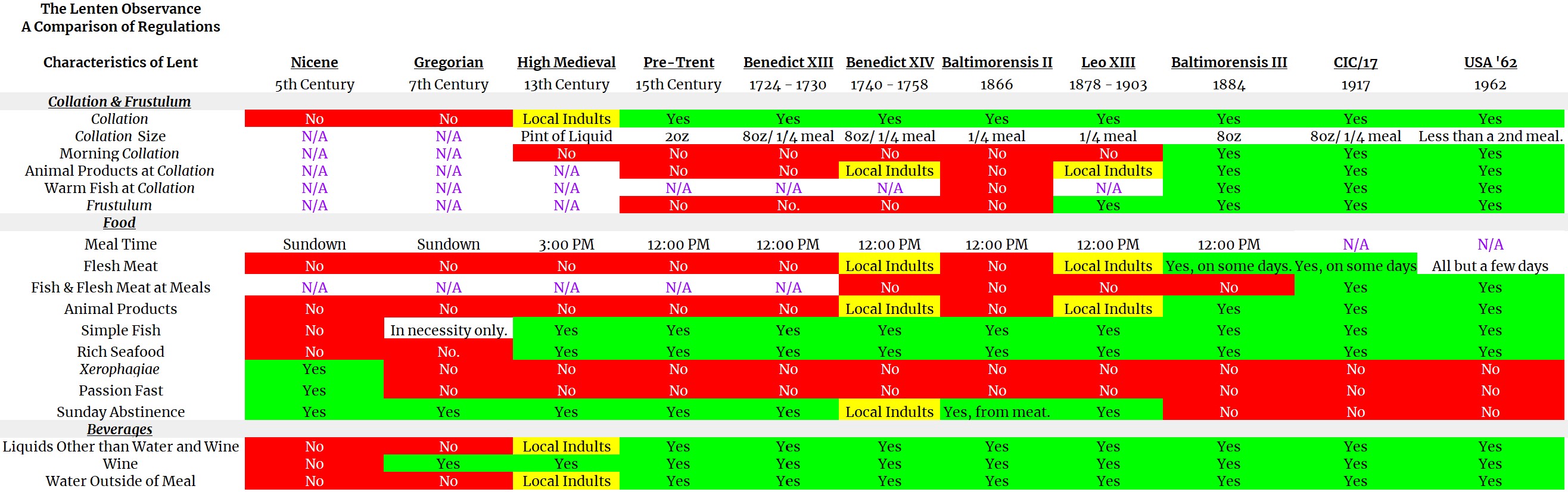
Lenten Observance Over Time: A Comparison of Regulations Over the Centuries

Click for the Full Image

As we prepare for another holy season of Lent, I wish to share this chart developed by Tyler Gonzalez showing the changes over time to the Lenten fast. His contributions to this chart and the subsequent annotations were invaluable. I am not aware of any such comparison ever having been created. We would do well to see in this image the great discipline of our forefathers and to rekindle some of these practices this Lent in our fasting.

Key of Terms and Annotated Citations: 

A collation is a small repast allowed originally only in the evenings of fast days. 

A frustulum is a small repast allowed originally only in the mornings on fast days. 

Xerophagiae is a diet of simple, dry, uncooked food, such as raw nuts, bread, fruits and vegetables. Fish and oil are not part of it neither are flesh and animal products. It was a precept to fast on these only during Holy Week by custom and/or decree until the time of Gregory the Great who mentions nothing of it. It may still have been a custom at that time but no mention of it is made in the decretals. 

The Passion Fast is a term which refers to the fast which began for some as early as sunset on Holy Thursday and as late as 8am on Good Friday. No one was allowed to eat any food during that time until sunset on Holy Saturday, which since most fasted for Communion extended until morning on Easter Sunday. It was often called a “40hrs Fast” and represents the original Lenten fast. For those who were to weak to follow this fast the minimum fast at this time was that of xerophagiae. 

1. Water is not allowed during the day outside of sunset repast. (Butler, Moveable Feasts, Fasts…, 1839, p.155) (C.f. AP. S. Prudentius, hymn, vi, p.188) 

2. On the Sunset Repast. (Butler, p.149) (Tertullian, De Jejun, c.x., p.549); (Weiser, Handbook of Christian Feasts and Customs…, 1958, p.170)

3. When the collation was allowed by indult. (Butler, p. 149) 

4. When the collation was allowed to the laity. (Butler, p. 152) 

5. The original size of the collation. (Butler, p.152) 

6. When the collation became ¼ of a meal/8 ounces. It became ¼ of a meal in the 16th century. (Laymann, Theologia Moralis, Lib. IV, Tract. VIII, Ch. I, pp.186-187, 1630) 

7. The origin of the frustulum originated around the time of St. Alphonsus Liguori c. 18th century (The Jurist, 1952, p.188) The more common opinion is that St. Alphonsus speaks of electuaries and not a frustulum which were popular in his time. That the origins of the frustulum can be traced to his time is true as a kind of proto-frustulum. However, the greater proof lies in the claim that the frustulum was not explicitly allowed until the end of the 19th century. (Catholic Encyclopedia, Lent) 

8. Fish in Lent permitted in its simple “less dainty” form in the 7th Century. The allowance of shellfish permitted around the 10th century (Butler, Moveable Feasts, Fasts…, 1839, p.146)

9. That animal products were not had on days of abstinence. (Weiser, p.170) (Cf. Decretals of Gratian, Letter of Pope St. Gregory the Great to Saint Augustine of Canterbury, 604 AD).

10. That Sundays were days of abstinence. (Thurston, Herbert. "Lent." The Catholic Encyclopedia. Vol. 9, 1910.) 

11. The Passion Fast. (Weiser, Handbook of Christian Feasts and Customs…, 1958, p.201) (Cf. The writings of Saint Irenaeus in 202 AD as quoted in The Church History of Eusebius V 24, 12; PG, 20, 502f)

12. Xerophagiae in Lent. (Butler, p.203-204) 

13. On wine in Lent. (Dom Prosper Guéranger, The Liturgical Year: Lent, 1887, p. 5) (Cf. St. Cyril of Jerusalem [Catech. iv]) 

14. On when liquids other than wine and water allowed. (St. Thomas Aquinas, Summa Theologiae, IIa IIae,qu.cxlvii,art.vi,ad eum.) (Rev. Antoine Villien, "A History of the Commandments of the Church", p. 315). Since liquids do not break the fast the kind of liquid and/or when it can be taken is now a non-matter. This discourse by St. Thomas was the beginning of this radical change which would not become a general custom until around the 15th century when food became allowed at the collation. Until then liquid was strictly speaking only allowed twice a day.

15. When the time of the meal changed to 3pm. (Butler, p.149) (St. Thomas, Summa Theologiae, Second Part of the Second Part, q.147, a.7) 

16. When the time of the meal changed to 12pm. (Butler, p.150) (Durandus a S. Porciano, in 4 dist., 15 quaest., 9., art. 7) 

17. When the time of the meal became a defunct matter. (CIC/17, c.1252) 

18. Not less than a second meal for collation size. (Jone, p. 263) (McHugh and Callan, pp. 3118-3119). As of 1951 the United States Conference of Bishops adopted the relative norm as the law for the US and as such now allows the collation to be more than 8 ounces. 

19. The quality of food at the collation-Fish, warm fish, animal products. (Butler, p. 153) (Metropolitan Catholic Almanac and Laity’s Directory, 1839, Baltimore.) (Villien, p. 312)

20. The consumption of both fish and flesh meat at the same meal. (Butler, p.163) 

Want to learn more about the history of fasting and abstinence? Check out the Definitive Guide to Catholic Fasting and Abstinence.

Read more >>
Tuesday, June 14, 2022
Vigil of Corpus Christi Fasting

Corpus Domini Basilica, Turin, Italy

The Church has enriched the celebration of Corpus Christi – as well as devotions to the Blessed Sacrament at other times – with a number of indulgences. For instance, the Raccolta, listing the traditional indulgences in place before the changes after Vatican II, stated for the Feast of Corpus Christi and its Octave:

Pope Urban IV… being desirous that all the faithful should give God due thanks for this inestimable benefit and be excited to meet their Lord's love in this most holy Sacrament with grateful hearts, granted in the said Constitution several Indulgences to the faithful, which were again augmented by Pope Martin V in his Constitution Ineffabile, of May 26, 1429. Afterwards Pope Eugenius IV, in his Constitution Excellentissimum, of May 20, 1433, confirmed the Indulgences of Martin V, and added others, as follows:

i. An indulgence of 200 days, on the vigil of the Feast of Corpus Christi to all who, being truly contrite and having confessed, shall fast, or do some other good work enjoined them by their confessor.

ii. An indulgence of 400 days, on the feast itself, to all who, being contrite and having Confessed, shall devoutly assist at or be present at any of the following functions: First or Second Vespers, Matins, and Mass. An indulgence of 160 days for each of the Little hours, Prime, Terce, Sext, None, and Compline.

iii. An indulgence of 200 days, during the octave, for each Vespers, Matins, and Mass. An indulgence of 80 days for each of the Little Hours.

iv. An indulgence of 200 days for accompanying the procession of the Blessed Sacrament, which takes place on the Feast or during the Octave, to every priest who has said Mass, and to every layman who has gone to Communion on any one of these days, and who shall pray for the Holy Church.

v. An indulgence of 200 days for accompanying the procession made by the Confraternity of the Blessed Sacrament on the third Sunday of the month, and on Holy Thursday.

Practices such as a voluntary fast on the day before Corpus Christi is virtually forgotten by all. This practice is however still kept by some traditional Carmelites. We would do well to engage in some voluntary fasting and abstinence on the day before Corpus Christi in the spirit of and for the intention of making reparation to the Blessed Sacrament.

Read more >>
Sunday, February 27, 2022
How the Traditional Latin Mass Reinforces Lent as a Fast

It is lamentable that so few Catholics keep the Traditional Lenten fast as practiced by our forefathers in the Faith for centuries. The Traditional Lenten fast - which was greatly watered down since the 1700s - generally constituted the following:

  • Fasting applies for those age 18 or older (but not obligatory for those 60 years of age or older)
  • Ash Wednesday and Good Friday: If possible, no solid food. Only black coffee, tea, or water.
  • Mondays through Saturdays: Only one meal preferably after sunset or at least until not before 3 PM. A morning frustulum and evening collation (i.e. the two "snacks") are permitted but not required. No meat or animal products are allowed for anyone, regardless of age - that included even fish in the Early Church.
  • Sundays: No meat or animal products allowed. Abstinence remained on Sundays even when fasting did not.
  • Holy Week (except Good Friday which is covered above): Only Bread, Salt, and Herbs are permitted for the main meal. Frustulum and collation permitted (of bread, herbs, and salt) but omitted if possible.
  • Holy Saturday: No food until Noon. Abstinence including from all animal products continues until Easter begins.

While we have happily seen an increase in the number of Traditional Latin Masses offered over the past decade, few Catholics have promoted a return to the fasting that our ancestors knew and practiced religiously. In fact, even the rules in place as of 1962 are substantially harder than what the average Catholic observes today. The laws of fasting and abstinence were as follows, as described in Moral Theology (copyright 1961) by Rev. Heribert Jone and adapted by Rev. Urban Adelman, for the “laws and customs of the United States of America”:

“Complete abstinence is to be observed on all Fridays of the year, Ash Wednesday, the Vigils of Immaculate Conception and Christmas. Partial abstinence is to be observed on Ember Wednesdays and Saturdays and on the Vigil of Pentecost. Days of fast are all the weekdays of Lent, Ember Days, and the Vigil of Pentecost.”

One highly interesting liturgical facet particular to the season of Lent is that every Lenten feria has its own propers. That is, each day of Lent has its own Introit, Collect, Epistle reading, Gospel reading, Offertory verse, Communion verse, and Post Communion Prayer. Lent further adds a prayer over the people immediately after the Post Communion. Dom Gueranger notes:

"Each feria of Lent has a proper Mass; whereas, in Advent, the Mass of the preceding Sunday is repeated during the week. This richness of the lenten liturgy is a powerful means for our entering into the Church's spirit, since she hereby brings before us, under so many forms, the sentiments suited to this holy time... All this will provide us with most solid instruction; and as the selections from the Bible, which are each day brought before us, are not only some of the finest of the sacred volume, but are, moreover, singularly appropriate to Lent, their attentive perusal will be productive of a twofold advantage."

Now the actual text of the Lenten Masses underscores the importance of the Lenten fast and repeatedly refers to the fasting done by the Faithful at this time. The Church in Her liturgy assumes and expects the Faithful in attendance at the Traditional Latin Mass to at least be keeping the fasting rules in place as of 1962 - if not the more robust fasting practiced before the mitigations of the preceding centuries.

The Preface for instance not only underscores the ongoing 40-day bodily fast but also mentions some of the benefits of this healing remedy:

It is truly meet and just, right and for our salvation, that we should at all times and in all places give thanks to Thee, holy Lord, Father almighty, eternal God: Who by this bodily fast dost curb our vices, lift our minds, strength and rewards bestow; through Christ our Lord. Through Whom Angels praise Thy Majesty, Dominations worship, Powers stand in awe. The Heavens and the hosts of heaven with blessed Seraphim unite, exult, and celebrate. And we entreat that Thou wouldst bid our voices too be heard with theirs, singing with lowly praise...

The collect for Ash Wednesday also highlights that day as the beginning of the fast of Lent and not a mere one day fast:

Grant, O Lord, to Thy faithful people, that they may undertake with fitting piety this period of fasting, and complete it with steadfast devotion.

The collect for Friday after Ash Wednesday for instance continues the reference to the Lenten fast:

Further with Thy gracious favor, we beseech Thee, O Lord, the fasts which we have begun: that the bodily observance which we keep, we may be able also to practice with sincere intention. 

And likewise with the collect for Saturday after Ash Wednesday:

O Lord, hearken to our supplications: and grant that we may celebrate with devout service this solemn fast, which Thou hast ordained for the healing both of soul and of body.

In the Mass Propers for the First Sunday of Lent, fasting is referenced in the Epistle while the Gospel reading recounts our Lord's forty days of fasting in the desert. And the collect, while not mentioning fasting, does mention abstinence, as our ancestors regularly kept abstinence even the Sundays of Lent up until the 1800s:

O God, Who dost purify Thy Church by the yearly observance of Lent: grant to Thy household, that what we strive to obtain from Thee by abstinence, we may achieve by good works.

Likewise, in the Divine Office, the ordinary of Lent refers to the bodily fast of Lent. It is a known peculiarity to the traditional Breviary that the ordinary of the Lenten season only begins with First Vespers for the First Sunday in Lent. The first four weekdays of Lent use the ordinary for time throughout the year, a holdover from ancient times before Ash Wednesday was established as the beginning of Lent. 

Starting therefore on the First Sunday of Lent, the prayers of the Breviary further underscore the traditional Lenten fast. In the hymn for Matins for this time, the hymn implores us to keep the Lenten fast. This hymn begins as follows:

The fast, as taught by holy lore, We keep in solemn course once more: The fast to all men known, and bound In forty days of yearly round. 

The law and seers that were of old In diverse ways this Lent foretold, Which Christ, all seasons’ King and Guide, In after ages sanctified. 

More sparing therefore let us make The words we speak, the food we take, Our sleep and mirth, —and closer barred Be every sense in holy guard. 

Avoid the evil thoughts that roll Like waters o’er the heedless soul; Nor let the foe occasion find Our souls in slavery to bind.

The little chapter of Terce taken from Joel 2:12-13 refers to fasting as does the antiphon of Sext: "With the armor of justice let us give ourselves to much patience and fasting." And the same can be seen in the hymn of Vespers which begins as follows:

O kind Creator, bow thine ear 

To mark the cry, to know the tear 

Before thy throne of mercy spent 

In this thy holy fast of Lent.

Turning again to the propers for the Mass, the references to fasting continue repeatedly and include the collect of Monday in the First Week of Lent; the Lesson, Collect, and Gospel for Ember Wednesday in Lent; the collect for Monday, Wednesday, Thursday, Friday, and Saturday in the Second Week of Lent; the secret prayer for Thursday in the Second Week of Lent; and more. The collect for Friday in the Second Week of Lent for instance prays:

Grant, we beseech Thee, O Almighty God, that cleansed by this holy fast, we may arrive in the right dispositions at the holy feast which is to come.

By the third week of Lent the references continue to refer to the ongoing fast of Lent as expressed for instance in the collect for Monday in the Third Week of Lent:

Pour forth in Thy mercy, O Lord, we beseech Thee, Thy grace into our hearts: that as we abstain from bodily food, so we may also restrain our senses from hurtful excesses.  

The collect two days later on Wednesday asks pardon from God for those who are undertaking "wholesome fasting" who also "abstain from harmful vices."

Abstinence is explicitly mentioned in the collect for Thursday in the First Week of Lent. And temperance - which is strengthened by both fasting and abstinence - is mentioned by name in the collect on Tuesday of the Third Week of Lent. 

The Gradual on Thursday in the Third Week of Lent, which is the exact middle of the Lenten fast, is taken from Psalm 144 and references God providing "meat in due season," which is certainly a reference to the upcoming celebration of the Lord's Resurrection on Easter Sunday when abstinence ends. Hence, by the time Lent reaches its midpoint, the faithful have heard either exhortations or references to fasting in the collects over a dozen times. And it does not end there as the next day's collect on Friday in the Third Week of Lent asks God to "bless our fasts" with His gracious favor as "in body we abstain from food, so we may fast from sin in mind." Similar words occur in the collect for Saturday in the Third Week of Lent.

This is a mere sampling. References to fasting continue. In one more example, the collect for Wednesday in the Fourth Week of Lent prays:

O God, who through fasting grantest to the just the reward of their merits and to sinners forgiveness: have mercy on Thy clients, that confession of our guilt may enable us to obtain pardon for ours sins.

When Passiontide begins on the Fifth Sunday in Lent, the focus in the Breviary and the Mass shifts from the corporal punishment we bear for our sins to an awareness of the suffering we cause our Lord. But even with this focus change, fasting references do not end as seen in the collect for Monday of Passion Week:

Hallow our fasts, we beseech Thee, O Lord: and mercifully grant us the forgiveness of all our faults.

Consequently, the Church in Her Liturgy through both the propers of the Mass and through the Breviary references and expects the Christian faithful to be observing Lenten fasting and abstinence. These repeated references to the Lenten fast unequivocally illustrate how the Lenten fast should be kept by every one of fasting and/or abstinence age who attends the Tridentine Mass. To attend the Traditional Mass and to keep the watered-down, virtually non-existent fast prescribed in the 1983 Code of Canon Law would be schizophrenic. Keep the Traditional Lenten fast and all traditional fasts. 

And for those looking for ideas on what to make to eat on fasting days, the Lenten Cookbook produced by Sophia Institute Press has a section on vegan recipes that is worth checking out.

Read more >>


Copyright Notice: Unless otherwise stated, all items are copyrighted under a Attribution-NonCommercial-NoDerivatives 4.0 International License. If you quote from this blog, cite a link to the post on this blog in your article.

Disclosure of Material Connection: Some of the links on this blog are “affiliate links.” This means if you click on the link and purchase the item, I will receive an affiliate commission. As an Amazon Associate, for instance, I earn a small commission from qualifying purchases made by those who click on the Amazon affiliate links included on this website. I am disclosing this in accordance with the Federal Trade Commission’s 16 CFR, Part 255: “Guides Concerning the Use of Endorsements and Testimonials in Advertising.”