Showing posts sorted by date for query March first Saturday. Sort by relevance Show all posts
Monday, June 9, 2025
Honor the Forgotten (Former) 36 Holy Days of Obligation

The Land Without Holy Days

“…So also, from the earliest ages, the Christian Church instituted and religiously solemnized various feasts, differing in different countries, and varying according to times and circumstances, principally intended to keep in grateful and loving memory the chief mysteries of our Blessed Saviour's life, the glories and prerogatives of His Immaculate Mother, the example and heroic sanctity of the saints. . . . Blessed festivals, they are green, refreshing oases in the desert of our dreary, plodding life, and not a doubt, but they tend materially to keep alive the spirit of piety." 

With these words, Bishop Stephen Ryan of Buffalo addressed the bishops and theologians who had crowded into the former Cathedral in Baltimore. The occasion was the Third Plenary Council of Baltimore, which began in late 1884. The Council Fathers set to address a number of issues affecting Catholic life in the United States which had reached its then-disjointed arrangement through the acquisition of various terrorities each with their own customs and ecceslestical laws. Unbeknowst to many, days of fasting and abstinence in addition to holy days of obligation varied widely in what constituted the United States of America due to these historical differences. Could uniformity be obtained even though prior attempts to do so had failed? And in hindsight, should uniformity – at least in the manner sought – have even been attempted?

The history of America’s holy days of obligation highlights a complex network of unique customs, varied cultural traditions, and an overarching lack of fervor over time. In an era with so few Holy Days of Obligation, what have we lost? And should this be remedied? And what can this teach modern Catholics?

Holy Days of Obligation Over Time

In 1911, Pope St. Pius X reduced the number of Holy Days of Obligation from 36 to 8, although which places observed the holy days were not uniform at all beforehand.  Shortly thereafter, the 1917 Code of Canon Law increased the number to 10 by adding back Corpus Christi and Ss. Joseph. Those ten on the Universal Calendar have remained the same ever since.

However, the Holy Days up until 1911 reveal something quite interesting as all of the feasts of the Apostles were Holy Days of Obligation on the Universal Calendar as were many other days like St. Anne, the May 3rd Feast of the Finding of the Holy Cross, and so many other days which are now forgotten. The feasts of the Apostles were raised to public holidays back in 932 AD as Father Weiser relates (p. 279), for instance.

The 36 Holy Days of Obligation on the Universal Calendar back in 1642 under Pope Urban VIII included:

1. Nativity of our Lord
2. Circumcision of our Lord
3. Epiphany of the Lord
4. Monday within the Octave of the Resurrection
5. Tuesday within the Octave of the Resurrection
6. Ascension
7. Monday within the Octave of Pentecost
8. Tuesday within the Octave of Pentecost
9. Most Holy Trinity
10. Most Holy Body of Christ
11. Finding of the Holy Cross
12. Purification of the Blessed Virgin Mary
13. Annunciation of the Blessed Virgin Mary
14. Assumption of the Blessed Virgin Mary
15. Nativity of the Blessed Virgin Mary
16. Dedication of St. Michael
17. Nativity of St. John Baptist
18. Ss. Peter and Paul
19. St. Andrew
20. St. James
21. St. John (the December feastday)
22. St. Thomas
23. Ss. Philip and James
24. St. Bartholomew
25. St. Matthew
26. Ss. Simon and Jude
27. St. Matthias
28. St. Stephen (the December feastday)
29. The Holy Innocents
30. St. Lawrence
31. St. Sylvester
32. St. Joseph
33. St. Anne
34. All Saints Day
35. The Principle Patrons of One’s Country, City, etc.

The Immaculate Conception of the Blessed Virgin Mary was added in 1708 so it not on 1642 list.

In times past there was also a distinction made of days of double versus single precept. Days of double precept required both hearing Mass and refraining from servile works, whereas days of single precept were working holy days permitting work but still requiring Mass attendance.

Consequently, the number of Holy Days of Obligation in the United States as of the Second Vatican Council had already been significantly reduced from their previous state. Holy Days of Obligation, which had remained the same in the United States since 1917, were further modified in the latter part of the 20th century.  On December 13, 1991, the United States Bishops issued a directive further abrogating New Years Day (the Circumcision of our Lord), the Assumption, or All Saints in years when the feast falls on a Saturday or a Monday. And on March 23, 1992, in another reduction, the Bishop of Honolulu obtained an indult from the Holy See and approval from the United States episcopal conference to reduce the Holy Days of Obligation to only Christmas and the Immaculate Conception. 

Holy Days of Obligation Before 1900

Published in 1886, the eleventh volume of the American Catholic Quarterly Review offers an insightful series of reflections on Holy Days with a call for us to observe these as our forefathers in the Faith gladly did:

"The Church by one of her positive commandments requires the faithful to sanctify certain holydays in the year by taking part in the offering of the great sacrifice of the Mass and by abstaining from servile works... In the days of faith and fervor not only were the great festivals prescribed by the Church, those associated with the life of our Lord and His Blessed Mother, those intimately connected with the work of redemption, and the feasts of the holy apostles by whose ministry the Church was established and the channels of grace led through the world - not only were these kept reverently but the patronal feast of each country, diocese, and church, the days of the most famous local saints were similarly honored. The devotion was general, and whoso refused to lay aside his implements of trade or traffic on their days was so condemned by public opinion that custom made the law.” 

Interestingly, because the Church enjoined on the Faithful both the obligation to hear Mass and the necessity to refrain from servile work, the number of holy days, which included Sundays, was significant. Some people began to revolt against the Church claiming that these practices only increased poverty. But as the Journal notes, an interesting phenomenon occurred:

"Protestantism therefore at once swept away all the holydays and Christmas remained almost alone to represent the Church calendar, and the Puritans even punished those who kept Christmas. With men working all the year round except on Sunday, wealth was to be general, the poor would thrive and prosper and be happy and contented, no longer lured from great and ennobling labor by being called away every week to idle some days in church and prayer. It was again unfortunate that this excellent theory did not work well. The poor seemed to grow actually poorer with all these days of labor than they had been before." 

The first catalog of Holy Days comes from the Decree of Gratian in c. 1150 AD, which shortly thereafter gave way to Decretals of Pope Gregory IX in 1234, which listed 45 Holy Days. As the Catholic Encyclopedia summarizes regarding this period:

“The Decree of Gratian (about 1150) mentions forty-one feasts besides the diocesan patronal celebrations; the Decretals of Gregory IX (about 1233) mention forty-five public feasts and Holy Days, which means eighty-five days when no work could be done and ninety-five days when no court sessions could be held. In many provinces eight days after Easter, in some also the week after Pentecost (or at least four days), had the sabbath rest. From the thirteenth to the eighteenth century there were dioceses in which the Holy Days and Sundays amounted to over one hundred, not counting the feasts of particular monasteries and churches. In the Byzantine empire there were sixty-six entire Holy Days (Constitution of Manuel Comnenus, in 1166), exclusive of Sundays, and twenty-seven half Holy Days. In the fifteenth century, Gerson, Nicolas de ClĂ©manges and others protested against the multiplication of feasts, as an oppression of the poor, and proximate occasions of excesses. The long needed reduction of feast days was made by Urban VIII (Universa per orbem, 13 Sept., 1642).” 

In 1642, His Holiness Pope Urban VIII issued the papal bull Universa Per Orbem which mandated the required Holy Days of Obligation for the Universal Church to consist of 34 days as well as the principal patrons of one's one locality (e.g. city and country). Ultimately Universa Per Orbem helped bring more uniformity to the Church since some parts of the Catholic world observed even more holy days of double precept (i.e. mandatory attendance at Mass and rest from servile work). The previous list of Holy Days of Obligation found in the Decretals also included Holy Monday through Holy Saturday in addition to Easter Wednesday through Easter Saturday.  These days had ceased being Holy Days by 1642. 

Holy Days in Young America

After the American Revolution, the Catholics in the 13 colonies that constituted the new United States of America were under the jurisdiction of the Apostolic Vicariate of the London District until the Diocese of Baltimore was established on November 6, 1789. This included the area of Maine that previously had been part of Quebec.

The first major change to the holy days of Americans came about through the lands purchased in 1803 from France in the Louisiana Purchase. Owing to the persecution of Catholics in France after the French Revolution, Pope Pius VII on April 5, 1802, reduced the holy days of obligation for Catholics in France to only Christmas, Ascension, Assumption, and the Feast of All Saints. Spain, which was in possession of the Louisiana territory since 1763, agreed in 1801 to cede it back to Napoleon. Before even getting possession of the territory, he sold it to the United States in 1803. What is particularly interesting is that the Catholics of Louisiana – whose territory includes areas in modern-day Arkansas, Missouri, Iowa, Minnesota, Kansas, and Nebraska – adopted the reduced holy days granted to France in 1802.

A Divergence of Holy Days in the 1800s

As America expanded, there was a divergence in the days of precept. When Florida was purchased by the United States in 1821, its old holy days were maintained. And the same likewise occurred in the Texas territory when it was acquired by the United States in 1845. And this trend continued as America expanded westward as the American Catholic Quarterly Review observes:

"In the Second Plenary Council [of Baltimore] in 1866 the feast of the Immaculate Conception was made of obligation as it had been in Oregon, where the feast of St Peter and St Paul had retained its place with the Monday after Easter and Whit Sunday, St John the Baptist, Candlemas, and St Stephen. Pope Gregory XVI in 1837 dispensed all the dioceses then in the United States from the obligation as to Easter Monday and Whitsun Monday and in 1840 from that of the feast of St Peter and St Paul..." 

Uniformity of American Holy Days Established in 1885 

By the time of the Civil War, considerable changes had occurred to these holy days. It was not until the Third Plenary Council that uniformly was achieved, though at the cost of reducing the holy days observed by many Catholics in the New World as the Review laments:

"The effort to induce faithful to a more exact observance of holydays of obligation or least so far as hearing mass was concerned had not been successful. A general indifference prevailed. When zealous priests, to give servants and mechanics every opportunity to fulfil the obligation, had Mass celebrated at an early hour to permit them to attend it proceeding to their usual work, it was found that almost the persons to avail themselves of the opportunity would be a pious old women, while those of the very class for whose the Mass was thus offered were scarcely represented by a straggling individuals.

"The Fathers of the Council renewed their petition to the See and His Holiness Pope Leo XIII on the 31st of December 1885 transferred the solemnization of Corpus Christi to the Sunday following the feast and made the holydays of obligation in all of the United States to be thenceforward: The Immaculate Conception of the Blessed Virgin, Christmas Day, the feast of Circumcision, Ascension Day, the Assumption of the Blessed Virgin, and the feast of All Saints. ” 

The Epiphany and Annunciation were no longer a Holy Day of Obligation in the United States – joining Easter Monday, Pentecost Monday, and St. Peter and Paul as working days. For even more history on how Holy Days of Obligation - and fasting days - changed in the New World before and after America's Foundation, see A History of Holy Days of Obligation & Fasting for American Catholics.


How Should Sundays and Holy Days of Obligation be Sanctified?

The Third Commandment commands us to “Remember the Sabbath day, to keep it holy.” In its fulfillment under the New Law, this commandment obliges Catholics to sanctify Sundays and Holy Days of Obligation by participating in the Holy Sacrifice of the Mass and by refraining from servile work. The Catechism of the Council of Trent affirms that this is not merely a recommendation—it is a divine precept.

The Church further clarifies that all Sundays and all current Holy Days of Obligation are binding under pain of mortal sin. To deliberately skip Mass on such a day without a grave reason—such as serious illness or the inability to reasonably travel to Mass—is a mortal sin. And if a Catholic is unable to attend Mass for a legitimate reason, they should still sanctify the day as best they can: by reading the Missal, meditating on the day’s readings and prayers, and uniting themselves spiritually to the liturgy.

Sunday, moreover, is not only a day of rest and obligatory worship but a day for deeper immersion in the Faith. Traditionally, Catholics observed Sunday by attending Vespers or Benediction, praying the Rosary communally, engaging in spiritual reading, and avoiding unnecessary commerce or entertainment. It is a day to spend in quiet joy, family togetherness, and devotion. The faithful should use Sunday to read Catholic books, periodicals, and Scripture, to practice works of mercy, and to grow in virtue. See the article Top 10 Sunday Activities for Catholics for more.

Make a special effort to attend Mass on all of the former Holy Days of Obligation, if possible. While the current Holy Days of Obligation must still be observed under pain of sin, we should cultivate a desire to attend Mass frequently — even daily. The former Holy Days, though no longer obligatory, remain excellent occasions to rearrange your schedule and give special honor to God through the Holy Sacrifice of the Mass.

With so many holy days reduced, and with priests largely not preaching on the necessity of attending Mass and of abstaining from servile works on them, the faithful have lost the sense of the sacred. Yet, as more Catholic seek to rediscover the Traditional Latin Mass and traditional fasting, voluntarily attending the Holy Sacrifice of the Mass and abstaining from servile works on the former Holy Days of Obligation can help us sanctify time and hold dear to what our forefathers saw, in the words of Bishop Stephen Ryan, as “refreshing oases in the desert of our dreary, plodding life.”


Read more >>
Tuesday, February 18, 2025
Traditional Maronite Catholic Fasting

While many people use the term “Roman Catholic” and “Catholic” as synonymous, they are not actually the same. Unbeknownst to many, there are more than 20 different Catholic Rites and several Churches which are all in Communion with and under obedience to Rome. All these Catholics are fully Catholic in the complete sense. All Catholics must believe the same dogmas of the Faith, have valid Sacraments, and maintain apostolic succession; even though they may differ in some Rites of worship, in popular devotions, and in various disciplinary matters which are governed by human law. This is entirely different from Protestantism, which is foreign to the religion founded by Jesus Christ since Protestants reject many necessary teachings, have placed themselves outside of the authority of the Catholic Church, and also do not have all valid Sacraments.

One of these Catholic rites is the Maronite Rite. The liturgical language is Aramaic. The 3 million Maronites are found in Lebanon (origin), Cyprus, Egypt, Syria, Israel, Canada, US, Mexico, Brazil, Argentina and Australia. Unfortunately, among the Eastern Rites, the Maronite one has been heavily modernized in the past 60 years.

While fasting and abstinence after Vatican II were all but eliminated in the Roman Catholic Church, fasting and abstinence are still practiced – though not always under penalty of sin – by Eastern Rite Catholics. 

For instance, the following guidelines were issued in 2023 by the Maronite Patriarch, His Eminence and Beatitude Mar Bechara Boutros Cardinal Rai, for Maronite Catholics:

  • Fasting from midnight to midday on all weekdays from Ash Monday to the Saturday of Light (8 April [this year]): no food or drink is to be consumed, with the exception of water. 
  • Abstaining from consuming meat and dairy on the Fridays of Lent; and throughout the first and last week of Lent (Holy Week).
  • Fasting and Abstinence on Saturdays and Sundays are not an obligation, with the exception of the Saturday of Light (Easter Saturday), where fasting and abstinence are to be observed.
  • In 2023, the following feast days fall within the Lenten Season: St John Maroun (2 March), The Forty Martyrs (9 March), St Joseph (19 March), St Rafqa (23 March), The Annunciation (25 March). We do not fast or abstain on these feast days. 

Even with these guidelines, food and water are permitted when needed to take medicine, for those sick or elderly, and for school children. The guidelines end with the note: “A person who cannot fast or abstain may choose another form of penance.”

In comparison, the Maronite Synod of 1736 stipulated the following regulations that were kept at least until the 1920s:

  • Great Lent from Quinquagesima to Easter: Abstinence every day; fasting every day except on Sundays and Saturdays (with the exception of Holy Saturday)
  • Apostles Lent: Abstinence four days from 25th - 28th June
  • Assumption Lent: Abstinence eight days 7th - 14th August
  • Christmas Lent: Abstinence twelve days 13th - 24th December
  • Abstinence every Wednesday and Friday except: from Christmas to Epiphany, the Friday before Great Lent, from Easter to Pentecost, June 24th and 29th; August 6th and 15th
  • Forbidden foods: Like most oriental Christians, the Maronites kept the Mosaic ban on eating blood, suffocated animals and certain animals considered impure; and which Oriental Church Councils have many times renewed. 

In this context, fasting forbids the consumption of food or drink until midday. And for abstinence, eating any meat, oil, wine, and animal products (e.g., eggs, milk, and cheese) was forbidden. Hence, even the Maronites saw a reduction in their fasting by the 20th century.

The Ukrainian Catholic Church also encourages its members to keep these traditional fasting periods: Great Lent, the Apostles’ Fast, the Nativity Fast, and the Dormition Fast. To these, they also add “the Eve of Theophany, the Exaltation of the Cross and the Beheading of John the Baptist”  as fasting days, with wine and oil allowed.

Want to learn more about the history of fasting and abstinence? Check out the Definitive Guide to Catholic Fasting and Abstinence.

Read more >>
Monday, October 14, 2024
2025 Traditional Catholic Fasting and Abstinence Calendar

Click for Larger Size

As a follow-up to my significant research on Traditional (Roman and Eastern) Catholic fasting and abstinence, I have put together a 2025 fasting and abstinence calendar for my devotional purposes. This is a follow-up to similar ones I created over the past several years.

Traditional Catholic Fasting Rules:

Fasting: Fasting refers to how much food we eat. It means taking only one meal during a calendar day. The meal should be an average-sized meal as overeating at the one meal is against the spirit of the fast. Fasting generally means that the meal is to be taken later in the day. Along with the one meal, up to two snacks (technically called either a collation or frustulum) are permitted. These are optional, not required. Added up together, they may not equal the size of the one meal. No other snacking throughout the day is permitted. Fasting does not affect liquids, aside from the Eucharistic Fast which is a separate matter.

Abstinence: Abstinence in this context refers to not eating meat. Meat refers to the fleshmeat of mammals or fowl. Beef, poultry, lamb, etc are all forbidden on days of abstinence. Abstinence does not currently prohibit animal byproducts like dairy (e.g. cheese, butter, milk) or eggs, but in times past they were prohibited. Fish is permitted along with shellfish and other cold-blooded animals like alligators. In times past, days of fast were always days of abstinence as well; however, not all days of abstinence were days of mandatory fasting.

Partial Abstinence: Partial Abstinence refers to eating meat only at the principal meal of the day. Days of partial abstinence do not permit meat to be eaten as part of the collation or the frustulum. Partial abstinence started only in 1741 under Pope Benedict XIV as a concession and as part of a gradual weakening of discipline. Beforehand, days of abstinence were days of complete abstinence.

Fasting, therefore, refers to the quantity of food and the frequency of eating. Abstinence refers to what may or may not be eaten.

Calendar Notes:

1. While Partial abstinence is allowed in the rubrics in place as of 1962, it is a a modern invention and is not part of this calendar. Abstinence is always full, never partial. 

2. All Days of Lent, aside from Sundays, are days of fasting and abstinence. Sundays are days only of abstinence.

3. For Lent only, abstinence refers to all animal products (e.g., dairy, butter, eggs) in addition to meat. This includes Sundays.

4. January 22nd is in the USA only an obligatory day of penance for offenses against the dignity of human life.

5. This calendar keeps the 1954 Roman Catholic Calendar and the pre-1917 practice of anticipating Vigils on Saturday that fall on Sunday in a given year.

6. Major Fasts: Great Lent (March 2 - April 16), Apostles Fast (June 16 - June 28)Dormition Fast (Aug 1 - Aug 14)St. Martin's Lent (Nov 13 - Dec 24).

7. Dominican Specific Fasting Days: April 29, August 3, and October 6 are not on the calendar but will be observed by Dominican Tertiaries per the 1923 Rule (the last one before Vatican II). Same with all Fridays of the year, which Dominicans are asked to keep as days of fasting.

8. Days of fasting generally include all of the Major Fasts as noted above, in addition to the following days when they fall outside those periods: Ember Days, Vigils of the Apostles, and Vigils for Major Feasts. Rogation Days were often days of abstinence but not fast.

9. Before the 1830s, all Saturdays were days of abstinence except during Christmastide (in some places) and on major holidays.

10. Voluntary Saturday abstinence is omitted on current (e.g., Nov 1st) or former Holy Days of Obligation (e.g., May 3rd). Saturday Abstinence used to be obligatory year-round with some exceptions for days "as often as no major solemnity (e.g., Christmas) occurs on Saturday, or no infirmity serves to cancel the obligation.” One exception granted in some places was for all Saturdays of the Christmas Season to be exempted.

11. Year Round Wednesdays as days of abstinence are recommended based on the Early Church's practice of Wednesday penance (and based on the wishes of Our Lady of Mount Carmel). Abstinence year-round on Wednesdays would be commendable on all Wednesdays of the year outside of Pascaltide except for those when either a Holy Day of Obligation, Former Holy Day of Obligation, or First Class Feast falls.

12. While part of the Apostles Fast, both the Vigil of Corpus Christi and the Vigil of the Nativity of St. John the Baptist are recommended days of fasting and abstinence

13. Above all, this calendar goes far beyond the mere "minimums," which are virtually non-existent, and attempts to present concrete ways for Catholics to actually fast in the manner our forefathers did.

Want to learn more about the history of fasting and abstinence? Check out the Definitive Guide to Catholic Fasting and Abstinence.

Digital Version:

To order a digital .ics file of the above calendar that can be easily imported into your calendar application (e.g., Outlook, Google, Apple, etc.), order below. 

The file is only $5.95. Please order it by clicking here.

After you complete the order, you will have a ZIP file. You MUST unzip that file to extract the ICS file. That ICS file can be added to the calendar application of your choice. Check out details for how easy it is to add an ICS file (after you unzip it) online.

Note that the file is a free benefit to all my Patreon members. So, if you become a patron, you will get that and many other benefits.

Read more >>
Tuesday, January 30, 2024
Rejecting the Filioque Is A Heresy

It is evident with the crisis in the Catholic Church concerning not only the sexual abuse crisis but also the crisis in the Liturgy after Vatican II that some Catholics have become disillusioned with the current Catholic hierarchy. From an outside perspective, some might ask why they should remain Catholic and not convert to Eastern Orthodoxy, which is known for reverent, ancient liturgies under the name of the Divine Liturgy of St. John Chrysostom (or St. Basil the Great at some times). But on a deeper analysis, there is no refuge in Orthodoxy. While we often think of the Orthodox as schismatics and not as heretics, the doctrinal crisis has also affected them. In fact, the Orthodox are also heretics from the true Christian Faith in more than half a dozen ways as enumerated in the article "Should A Catholic Convert to Eastern Orthodoxy?"

"I am the Father are One" (John 10:30)

The Baltimore Catechism succinctly states, “In God there are three Divine persons, really distinct, and equal in all things – the Father, the Son, and the Holy Ghost.” The Roman Catechism, the most authoritative catechism ever written, expresses the reality that Almighty God – the one and only God – is in fact a Trinity of Persons. The Catechism explains the role of the three Divine Persons in the Incarnation:

"It is a principle of Christian faith that whatever God does outside Himself in creation is common to the Three Persons, and that one neither does more than, nor acts without another. But that one emanates from another, this only cannot be common to all; for the Son is begotten of the Father only, and the Holy Ghost proceeds from the Father and the Son. Anything, however, which proceeds from them extrinsically is the work of the Three Persons without difference of any sort, and of this latter description is the Incarnation of the Son of God.

"Of those things, nevertheless, that are common to all, the Sacred Scriptures often attribute some to one Person, some to another. Thus, to the Father they attribute power over all things; to the Son, wisdom; to the Holy Ghost, love. Hence, as the mystery of the Incarnation manifests the singular and boundless love of God towards us, it is therefore in some sort peculiarly attributed to the Holy Ghost."

We do not believe in three gods but in one God. The Athanasian Creed, one of the earliest professions of faith, confessed since at least the fifth century, declares:

“Thus the Father is God, the Son is God, and the Holy Ghost is God. But there are not three gods, but one God. The Father is Lord, the Son is Lord, and the Holy Ghost is Lord. There are not three lords, but one Lord. For according to Christian truth, we must profess that each of the Persons individually is God; and according to Christian religion, we are forbidden to say that there are three gods or three lords.”

How is it, then, that there is a God the Father, a God the Son, and a God the Holy Ghost, but only one God? There is one divine substance, and three divine Persons. You and I are each only one substance and one person, but God is one substance and three Persons. Each of the Persons is fully divine and wholly possesses the divine substance. As Jesus Himself said, “I and the Father are one” (John 10:30).

The Trinity is One. We do not confess three gods, but one God in three Persons, the “consubstantial Trinity.” The divine Persons do not share the one divinity among Themselves but each of Them is God whole and entire: “The Father is that which the Son is, the Son that which the Father is, the Father and the Son that which the Holy Ghost is, i.e., by nature one God.” In the words of the Fourth Lateran Council (1215): “Each of the persons is that supreme reality, viz., the divine substance, essence or nature.”

What is the Filioque Controversy?

The Great Schism, also known as the East-West Schism, refers to the split between the Eastern Orthodox Churches and the Catholic Church, which culminated in 1054 AD. The Patriarch of Constantinople, Michael Cerularius, and the legates of Pope Leo IX excommunicated each other. This formal declaration of excommunication marked the official schism between the Eastern Orthodox Churches and the Roman Catholic Church. Papal authority, the Filioque controversy, and even the practice of Saturday fasting, among other differences, brought about this schism.

The Filioque controversy is the theological dispute that centers around the phrase "and the Son" (Latin: for Filioque) in the Nicene Creed, which originally stated that the Holy Ghost proceeds from the Father. The controversy arose between the Western and Eastern Christian churches.

In the early centuries of Christianity, the Nicene Creed was widely accepted in both the Eastern (Greek-speaking) and Western (Latin-speaking) parts of the Christian world. The original version of the Nicene Creed, as established at the First Council of Nicaea in 325 AD, declared that the Holy Ghost proceeds from the Father. However, the Western Church later added the phrase "and the Son" (Filioque) to affirm the double procession of the Holy Spirit from both the Father and the Son.

The Roman Catholic Church had first introduced the phrase “and the Son” (Filioque in Latin) at the Third Council of Toledo in 589. The Lyons Council II stated the doctrine firmly:

We profess faithfully and devotedly that the Holy Ghost proceeds eternally from the Father and the Son, not as from two principles, but as from one principle; not by two spirations, but by one single spiration. This the holy Roman church, mother and mistress of all the faithful, has till now professed, preached and taught; this she firmly holds, preaches, professes and teaches; this is the unchangeable and true belief of the orthodox fathers and doctors, Latin and Greek alike. But because some, on account of ignorance of the said indisputable truth, have fallen into various errors, we, wishing to close the way to such errors, with the approval of the sacred council, condemn and reprove all who presume to deny that the Holy Ghost proceeds eternally from the Father and the Son, or rashly to assert that the Holy Ghost proceeds from the Father and the Son as from two principles and not as from one.

The Filioque Defended at the Ecumenical Councils

The Second Council of Lyons began on May 7, 1274, in the Cathedral of St. John. The Pope gave a sermon outlining his threefold plan for the Council — to unite the Roman Catholic and Greek Orthodox Churches, to send a Crusade to the Holy Land and to reform the morals of the clergy. On June 29th, the feast of Saints Peter and Paul, the entire Council and the Greek ambassadors took part in a High Mass sung by the Pope. The Credo (Nicene Creed) was sung in Latin and then again in Greek with the phrase “Qui a Patre Filioque procedit” (who proceeds from the Father and the Son) sung three times. The Greek acceptance of this doctrine was an important step towards the reunion of the two Churches. 

Yet, debate continued for centuries as this was again a point of disagreement at the Council of Florence in 1438. The Emperor and Patriarch agreed that the debates should begin, and on October 8, 1438, the delegates discussed the addition of “From the Son” (Filioque) to the Nicene Creed by the Roman Catholic Church. This was discussed in fourteen public sessions until December 13, 1438. Mark Eugenicus, the Metropolitan of Ephesus, claimed that the addition of the Filioque clause to the Nicene Creed had been against the Council of Ephesus in 431. While Mark Eugenicus was the main speaker for the Greeks, the Western Church answered through several speakers. The sessions were lively but the Latin speakers were unable to change Mark’s position.

March 1439 saw eight sessions between the 2nd and 24th where the procession of the Holy Ghost was debated. The Western Church argued that the Holy Ghost proceeded from the Father and the Son while the Greek Church through Mark Eugenicus insisted that the Holy Spirit proceeded from the Father only. Giovanni da Montenero, a Dominican provincial of Lombardy proved the Latin Church’s assertion through the use of Scripture, the writings of the Western and Eastern Fathers and the Councils. Da Montenero’s presentation convinced some of his hearers but not all. The Greeks were not used to metaphysical arguments or syllogisms in their theological discussions but they were very impressed by da Montenero’s quotes from the Eastern and Western Fathers.

Through this, a glimmer of light appeared. The Eastern Saints had stated that the Holy Ghost was produced “from both” and “through the Son” while the Western Saints wrote that the Holy Spirit came “from the Father and the Son.” Now it is axiomatic that Saints, whether East or West, cannot err in matters of faith for they are inspired by the same Holy Spirit. Therefore the words of both the Eastern and Western Saints must be true even though they expressed themselves differently. Bessarion, the Metropolitan of Nicaea and Greek delegate, phrased it this way: "The western and eastern Saints do not disagree, for the same Spirit spoke in all the Saints. Compare their works and they will be found harmonious."

The majority of the Greek delegates voted in favor of the Filioque doctrine. There were further debates about other points of contention. It was decided that both unleaven and leaven bread would be allowed for the Eucharist. Purgatory was defined and the primacy of the Pope was affirmed. None of these questions were answered without lengthy debate and it was not until July 5, 1439, that first the Greeks and then the Latin delegates signed the decree of union. (Parts of the decree are included in the Documents section beginning “Let the heavens rejoice…”) Mark Eugenicus refused to sign the decree even after discussions with the Pope. On Monday, July 6, there was a procession to the Cathedral in Florence followed by a Pontifical Mass. Cesarini read out the decree in Latin, asking the Pope and Latin prelates if they agreed. They all proclaimed Placet (it is agreed upon). Bessarion read out the decree in Greek then requested the Emperor and the Greek prelates to acknowledge the truth of the decree. They also stated their agreement. A Te Deum was sung and the delegates left the Cathedral praising God with psalms. The Council continued and reunited the Roman Church with other Eastern Churches — the Armenians (1439), the Copts (1442), the Syrians (1444), the Chaldeans (Nestorians) and the Maronites of Cyprus (1445). In 1443, the Council left Florence to continue at the Lateran Palace in Rome.

The Greeks left for home on October 19, 1439, and arrived in Constantinople in February 1440. Sad news awaited the Emperor — his wife had died. This may explain why he failed to act promptly when some of the Eastern prelates who had remained behind in Constantinople refused to have anything to do with those who had agreed to a union with the Roman Church in Florence. There were soon more overt acts against the union of the Churches. Anthony, Metropolitan of Heraclea, made a public repudiation of his signature to the document in Florence. Mark Eugenicus wrote and spoke against the union. Early in 1441, a group of prelates who had signed the decree in Florence disavowed the union.

The new Patriarch of Constantinople, Metrophanes, (Patriarch Joseph had died at the end of the Council of Florence) declared in favor of the union and wrote an encyclical proclaiming it. However, his voice was not enough to overpower the flair and common touch of Mark Eugenicus’ writings. In 1444 the Papal fleet and army joined with Venice and Hungary to fight the Ottoman Turks. The Turkish army of about 60,000 men attacked the Christian armies of about 20,000 to 30,000 men at Varna on November 10, 1444. A brave effort to capture Murad II, the leader of the Ottomans, by the young King of Hungary and his 500 horsemen failed and the Christians were defeated. Many Christians were killed and the way to Constantinople was open to the Turks who did indeed capture the city in 1453. In the years 1450 to 1451, the Eastern Orthodox Church convened a Council in Constantinople and rejected the decree from the Council of Florence. The pro-union Patriarch was dismissed and the Orthodox Athanasius was appointed to take his place.

So what was the point of those years of arguments, of careful research, of endless discussions? Even though the union did not last, several points of doctrine were discussed and defined. Giovanni da Montenero’s masterful examination of the procession of the Holy Spirit through Scripture, the writings of the ancient Fathers and the Councils is just one example of the intricate and intense work that went into these definitions. For those years in Ferrara, Florence, and Rome, hundreds of men gathered to understand difficult theological concepts with the sincere wish to reunite. Perhaps in some hearts, this wish was joined with the hope for help in defeating the Turks or other less than purely selfless motives. Still, they continued — the illness of the elderly Patriarch and the Emperor, the monetary difficulties of the Pope, the homesickness and worry over their homeland, the frustrations between two different cultures — and all of these pressures delivered arguments that give us a deeper understanding of our faith. For more on the Councils, see the book "Nicea to Now."

The Church Fathers Defended the Filioque

Church Fathers in the West, such as St. Augustine of Hippo (354–430), supported the Filioque clause. St. Augustine emphasized the unity of the Trinity and argued that the Holy Ghost's procession from both the Father and the Son was consistent with the shared divine essence of the Trinity.

The Orthodox churches - and there are several that are not in communion even with one another - deny that the Holy Ghost, the Third Person of the Most Blessed Trinity, proceeds from the Father and the Son. Those interested in the Church's treatment of this should look into Father Henry Chadwick's "The Early Church" or "Fr. John Meyendorff's "Byzantine Theology," which address this well. The Church Fathers all believed in the Filioque as well as shown in a powerful video debunking the errors of the Orthodox churches. All those who want to learn the truth should be compelled to watch that video.

Read more >>
Monday, October 9, 2023
2024 Traditional Catholic Fasting and Abstinence Calendar

Click for Larger Size

As a follow-up to the significant research I have done regarding Traditional (Roman and Eastern) Catholic fasting and abstinence, I have put together a 2024 fasting and abstinence calendar for my devotional purposes. This is a follow-up to a similar one I did in 2022 and 2023.

Traditional Catholic Fasting Rules:

Fasting: Fasting refers to how much food we eat. It means taking only one meal during a calendar day. The meal should be an average-sized meal as overeating at the one meal is against the spirit of the fast. Fasting generally means that the meal is to be taken later in the day. Along with the one meal, up to two snacks (technically called either a collation or frustulum) are permitted. These are optional, not required. Added up together, they may not equal the size of the one meal. No other snacking throughout the day is permitted. Fasting does not affect liquids, aside from the Eucharistic Fast which is a separate matter.

Abstinence: Abstinence in this context refers to not eating meat. Meat refers to the fleshmeat of mammals or fowl. Beef, poultry, lamb, etc are all forbidden on days of abstinence. Abstinence does not currently prohibit animal byproducts like dairy (e.g. cheese, butter, milk) or eggs, but in times past they were prohibited. Fish is permitted along with shellfish and other cold-blooded animals like alligators. In times past, days of fast were always days of abstinence as well; however, not all days of abstinence were days of mandatory fasting.

Partial Abstinence: Partial Abstinence refers to eating meat only at the principal meal of the day. Days of partial abstinence do not permit meat to be eaten as part of the collation or the frustulum. Partial abstinence started only in 1741 under Pope Benedict XIV as a concession and as part of a gradual weakening of discipline. Beforehand, days of abstinence were days of complete abstinence.

Fasting, therefore, refers to the quantity of food and the frequency of eating. Abstinence refers to what may or may not be eaten.

Calendar Notes:

1. Partial Abstinence is a modern invention and is not part of this calendar. Abstinence is always full, never partial. 

2. All Days of Lent, aside from Sundays, are days of fasting and abstinence. Sundays are days only of abstinence.

3. For Lent only, abstinence refers to all animal products (e.g., dairy, butter, eggs) in addition to meat. This includes Sundays.

4. January 22nd is in the USA only an obligatory day of penance for offenses against the dignity of human life.

5. This calendar keeps the 1954 Roman Catholic Calendar and the pre-1917 practice of anticipating Vigils on Saturday that fall on Sunday in a given year.

6. Major Fasts: Great Lent (March 2 - April 16), Apostles Fast (June 3 - June 28)Dormition Fast (Aug 1 - Aug 14)St. Martin's Lent (Nov 14 - Dec 24).

7. Dominican Specific Fasting Days: April 29, August 3, and October 6 are not on the calendar but will be observed by Dominican Tertiary per the 1923 Rule (the last one before Vatican II). Same with all Fridays of the year, which Dominicans are asked to keep as days of fasting.

8. Days of fasting generally include all of the Major Fasts as noted above, in addition to the following days when they fall outside those periods: Ember Days, Vigils of the Apostles, and Vigils for Major Feasts. Rogation Days were often days of abstinence but not fast.

9. Saturday Abstinence used to be obligatory year-round with some exceptions for days "as often as no major solemnity (e.g., Christmas) occurs on Saturday, or no infirmity serves to cancel the obligation.” One exception granted in some places was for all Saturdays of the Christmas Season to be exempted.

10. Above all, this calendar goes far beyond the mere "minimums," which are virtually non-existent, and attempts to present concrete ways for Catholics to actually fast in the manner our forefathers did.

Not listed but certainly recommendable based on the Early Church's practice of Wednesday penance (and based on the wishes of Our Lady of Mount Carmel), would be to also observe abstinence year-round on Wednesdays (beyond the dates noted on the calendar). Such a practice would be commendable on all additional Wednesdays of the year with exceptions whenever either a Holy Day of Obligation, Former Holy Day of Obligation, or First Class Feast falls on Wednesday.

Want to learn more about the history of fasting and abstinence? Check out the Definitive Guide to Catholic Fasting and Abstinence.

Digital Version:

To order a digital .ics file of the above calendar that can be easily imported into your calendar application (e.g., Outlook, Google, Apple, etc), order below. The file is only $3.95. I will email you the relevant .ics file within 24 hours of your order. The file will have relevant details and links with more information to help you live out the recommended traditional Catholic fasts.

The file is only $3.95. Please order it by clicking here.

After you complete the order, you will have a ZIP file. You MUST unzip that file to extract the ICS file. That ICS file can be added to the calendar application of your choice. Check out details for how easy it is to add an ICS file (after you unzip it) online.

Note that the file is a free benefit to all Patreon members. So, if you become a patron, you will get that and many other benefits.

Read more >>
Monday, September 12, 2022
2023 Traditional Catholic Fasting and Abstinence Calendar


Click for Larger Size

As a follow-up to the significant research I have done in regard to Traditional (both Roman and Eastern) Catholic fasting and abstinence, I have put together a 2023 fasting and abstinence calendar for my own devotional purposes. This is a follow-up to a similar one I did in 2022.

To see the calendars for other years, including more recent ones, click here

Traditional Catholic Fasting Rules:

Fasting: Fasting refers to how much food we eat. It means taking only one meal during a calendar day. The meal should be an average-sized meal as overeating at the one meal is against the spirit of the fast. Fasting generally means that the meal is to be taken later in the day. Along with the one meal, up to two snacks (technically called either a collation or frustulum) are permitted. These are optional, not required. Added up together, they may not equal the size of the one meal. No other snacking throughout the day is permitted. Fasting does not affect liquids, aside from the Eucharistic Fast which is a separate matter.

Abstinence: Abstinence in this context refers to not eating meat. Meat refers to the fleshmeat of mammals or fowl. Beef, poultry, lamb, etc are all forbidden on days of abstinence. Abstinence does not currently prohibit animal byproducts like dairy (e.g. cheese, butter, milk) or eggs, but in times past they were prohibited. Fish is permitted along with shellfish and other cold-blooded animals like alligators. In times past, days of fast were always days of abstinence as well; however, not all days of abstinence were days of mandatory fasting.

Partial Abstinence: Partial Abstinence refers to eating meat only at the principal meal of the day. Days of partial abstinence do not permit meat to be eaten as part of the collation or the frustulum. Partial abstinence started only in 1741 under Pope Benedict XIV as a concession and as part of a gradual weakening of discipline. Beforehand, days of abstinence were days of complete abstinence.

Fasting, therefore, refers to the quantity of food and the frequency of eating. Abstinence refers to what may or may not be eaten.

Calendar Notes:

1. Partial Abstinence is a modern invention and is not part of this calendar. Abstinence is always full, never partial. 

2. All Days of Lent, aside from Sundays, are days of fasting and abstinence. Sundays are days only of abstinence.

3. For Lent only abstinence refers to all animal products (e.g. dairy, butter, eggs) in addition to meat. This includes Sundays.

4. January 22nd is in the USA only an obligatory day of penance for offenses against the dignity of human life.

5. This calendar keeps the 1954 Roman Catholic Calendar and the pre-1917 practice of anticipating Vigils on Saturday that fall on Sunday in a given year.

6. Major Fasts: Great Lent (March 2 - April 16), Apostles Fast (June 13 - June 28)Dormition Fast (Aug 1 - Aug 14)St. Martin's Lent (Nov 14 - Dec 24).

7. Dominican Specific Fasting Days: April 29, August 3, and October 6 are not on the calendar but will be observed by Dominican Tertiary per the 1923 Rule (the last one before Vatican II). Same with all Fridays of the year, which Dominicans are asked to keep as days of fasting.

8. Days of fasting generally include all of the Major Fasts as noted above in addition to the following days when they fall outside of those periods: Ember Days, Vigils of the Apostles, and Vigils for Major Feasts. Rogation Days were often days of abstinence but not fast.

9. Saturday Abstinence used to be obligatory year-round with some exceptions for days "as often as no major solemnity (e.g., Christmas) occurs on Saturday, or no infirmity serves to cancel the obligation.” One exception granted in some places was for all Saturdays of the Christmas Season to be exempted.

10. Above all, this calendar goes far beyond the mere "minimums," which are virtually non-existent, and attempts to present concrete ways for Catholics to actually fast in the manner our forefathers did.

Not listed but certainly recommendable based on the Early Church's practice of Wednesday penance (and based on the wishes of Our Lady of Mount Carmel), would be to also observe abstinence year-round on Wednesdays (beyond the dates noted on the calendar). Such a practice would be commendable on all additional Wednesdays of the year with exceptions whenever either a Holy Day of Obligation, Former Holy Day of Obligation, or First Class Feast falls on Wednesday.

For those interested in understanding the various ways fasting and abstinence have changed over time, please explore the archives regarding fasting and abstinence. And for those looking for ideas on what to make to eat on fasting days, the Lenten Cookbook produced by Sophia Institute Press has a section on vegan recipes that is worth checking out.

Want to learn more about the history of fasting and abstinence? Check out the Definitive Guide to Catholic Fasting and Abstinence.

Digital Version:

To order a digital .ics file of the above calendar that can be easily imported into your calendar application (e.g., Outlook, Google, Apple, etc.), order below. 

The file is only $3.95. Please order it by clicking here.

After you complete the order, you will have a ZIP file. You MUST unzip that file to extract the ICS file. That ICS file can be added to the calendar application of your choice. Check out details for how easy it is to add an ICS file (after you unzip it) online.

Note that the file is a free benefit to all my Patreon members. So, if you become a patron, you will get that and many other benefits.

Read more >>
Sunday, February 13, 2022
History of Lenten Fasting: How to Observe the Traditional Lenten Fast

The Purpose of Fasting

In principio, in the beginning, the very first Commandment of God  to Adam and Eve was one of fasting from the fruit of the tree of the knowledge of good and evil (cf. Genesis 2:16-17), and their failure to fast brought sin and disorder to all of creation. The second sin of mankind was gluttony. Both are intricately tied to fasting.

Both Elijah and Moses fasted for forty days in the Old Testament before seeing God. Until the Great Flood, man abstained entirely from the flesh meat of animals (cf. Genesis 9:2-3). Likewise, in the New Testament, St. John the Baptist, the greatest prophet (cf. Luke 7:28) fasted and his followers were characterized by their fasting. And our Blessed Lord also fasted for forty days (cf. Matthew 4:1-11) not for His own needs but to serve as an example for us. Our Redeemer said, “Unless you shall do penance, you shall all likewise perish” (Luke 13:3). Fasting and abstinence from certain foods characterized the lives of man since the foundation of the world.

The Church has hallowed the practice of fasting, encourages it, and mandates it at certain times. Why? The Angelic Doctor writes that fasting is practiced for a threefold purpose: 

“First, in order to bridle the lusts of the flesh…Secondly, we have recourse to fasting in order that the mind may arise more freely to the contemplation of heavenly things: hence it is related of Daniel that he received a revelation from God after fasting for three weeks. Thirdly, in order to satisfy for sins: wherefore it is written: ‘Be converted to Me with all your heart, in fasting and in weeping and in mourning.’ The same is declared by Augustine in a sermon: ‘Fasting cleanses the soul, raises the mind, subjects one's flesh to the spirit, renders the heart contrite and humble, scatters the clouds of concupiscence, quenches the fire of lust, kindles the true light of chastity.’”  

St. Basil the Great also affirmed the importance of fasting for protection against demonic forces: “The fast is the weapon of protection against demons. Our Guardian Angels more really stay with those who have cleansed our souls through fasting.”

The Baltimore Catechism echoes these sentiments: “The Church commands us to fast and abstain, in order that we may mortify our passions and satisfy for our sins” (Baltimore Catechism #2 Q. 395). Concerning this rationale, Fr. Thomas Kinkead in “An Explanation Of The Baltimore Catechism of Christian Doctrine” published in 1891 writes, “Remember it is our bodies that generally lead us into sin; if therefore we punish the body by fasting and mortification, we atone for the sin, and thus God wipes out a part of the temporal punishment due to it.” 

Pope St. Leo the Great in 461 wisely counseled that fasting is a means and not an end in itself. For those who could not observe the strictness of fasting, he sensibly said, "What we forego by fasting is to be given as alms to the poor.”  To simply forgo fasting completely, even when for legitimate health reasons, does not excuse a person from the universal command to do penance (cf. Luke 13:3).

The Lenten Fast in the Early Church

The great liturgical Dom Gueranger writes that the fast which precedes Easter originated with the Apostles themselves:

“The forty days' fast, which we call Lent, is the Church's preparation for Easter, and was instituted at the very commencement of Christianity. Our blessed Lord Himself sanctioned it by fasting forty days and forty nights in the desert; and though He would not impose it on the world by an express commandment (which, in that case, could not have been open to the power of dispensation), yet He showed plainly enough, by His own example, that fasting, which God had so frequently ordered in the old Law, was to be also practiced by the children of the new…The apostles, therefore, legislated for our weakness, by instituting, at the very commencement of the Christian Church, that the solemnity of Easter should be preceded by a universal fast...”

The Catechism of the Liturgy by a Religious of the Sacred Heart published by The Paulist Press, New York, 1919 affirms the apostolic origin of the Lenten fast: “The Lenten fast dates back to Apostolic times as is attested by Saint Jerome, Saint Leo the Great, Saint Cyril of Alexandria and others.” In the 2nd century, St. Irenaeus wrote to Pope St. Victor I inquiring on how Easter should be celebrated, while mentioning the practice of fasting leading up to Easter.

Initially, the Lenten fast was practiced by catechumens preparing for their Baptism with a universal fast for all the faithful observed only during Holy Week, in addition to the weekly fasts that were devotionally practiced. But early on, the baptized Christians began to join the catechumens in fasting on the days immediately preceding Easter.  The duration of the fast varied with some churches observing one day, others several days, and yet others observing intensive 40-hour fasting, in honor of the forty hours that the Lord spent in the sepulcher. By the third and fourth centuries, the fast became forty days in most places. St. Athanasius, in 339 AD, referred to the Lenten fast as a forty-day fast that “the whole world” observed. 

Heortology: A History of the Christian Festivals from their Origin to the Present Day by Dr. K.A. Heinrich Kellner states the following regarding the Lenten fast in the ancient Church, noting the strictness that intensified in Holy Week and even more so on Good Friday and Holy Saturday:

"Among Catholics also abstinence was pushed to great lengths. The canons of Hippolytus prescribe for Holy Week only bread and salt. The Apostolic Constitutions will only permit bread, vegetables, salt and water, in Lent, flesh and wine being forbidden; and, on the last two days of Holy Week, nothing whatsoever is to be eaten. The ascetics, whose acquaintance the Gallic pilgrim made in Jerusalem, never touched bread in Lent, but lived on flour and water. Only a few could keep so strict a fast, and generally speaking people were satisfied with abstaining from flesh and wine. But this lasted throughout the entire Lent, and Chrysostom tells us that in Antioch no flesh was eaten during the whole of Lent. Abstinence from milk and eggs (the so-called lacticinia) was also the general rule."

Shortly after the legislation of Christianity in the Roman Empire, the bishops at the Council of Nicea in 325 AD fixed the date of Easter as the first Sunday after the first full moon after the vernal equinox. The canons emerging from that council also referenced a 40-day Lenten season of fasting.

To the Early Christians, fasting was performed until sundown, in imitation of the previous Jewish tradition. Dom Gueranger’s writings affirm, “It was the custom with the Jews, in the Old Law, not to take the one meal, allowed on fasting days, till sun-set. The Christian Church adopted the same custom. It was scrupulously practiced, for many centuries, even in our Western countries. But, about the 9th century, some relaxation began to be introduced in the Latin Church.”

And notably in the early Church, fasting also included abstinence from wine, taking man back to the same diet that mankind practiced before God permitted Noah to eat meat and drink wine. As such, in apostolic times, the main meal was a small one, mainly of bread and vegetables. Fish, but not shellfish, became permitted on days of abstinence around the 6th century. Hence, some Eastern Rite Catholics will abstain from meat, animal products, wine, oil, and fish on fasting days which harkens back to these ancient times.

Remarkably, even water was forbidden during fasting times in the very ancient church. Fr. Alban Butler, in Moveable Feasts and Fasts, provides testimony of this when he writes: "St. Fructuosus, the holy bishop of Tarragon in Spain, in the persecution of Valerian in 259, being led to martyrdom on a Friday at ten o'clock in the morning, refused to drink, because it was not the hour to break the fast of the day, though fatigued with imprisonment, and standing in need of strength to sustain the conflict of his last agony. 'It is a fast,' said he: 'I refuse to drink; it is not yet the ninth hour; death itself shall not oblige me to abridge my fast.'"

The Lenten Fast in the Early Middle Ages

The Lenten fast began under the Apostles themselves and was practiced in various forms in the Early Church. As time went on, the fast became uniformly observed under pain of sin. 

St. Augustine in the fourth century remarked, “Our fast at any other time is voluntary; but during Lent, we sin if we do not fast.” At the time of St. Gregory the Great at the beginning of the 7th century, the fast was universally established to begin on what we know as Ash Wednesday. While the name "Ash Wednesday" was not given to the day until Pope Urban II in 1099, the day was known as the “Beginning of the Fast.” 

In 604, in a letter to St. Augustine of Canterbury, Pope St. Gregory the Great announced the form that abstinence would take on fast days. This form would last for almost a thousand years: "We abstain from flesh meat and from all things that come from flesh, as milk, cheese, and eggs."  When fasting was observed, abstinence was likewise always observed.

Regarding Holy Saturday's fast in particular, Canon 89 of the Council in Trullo in 692 AD provides an account of the piety and devotion of the faithful of that time: “The faithful, spending the days of the Salutatory Passion in fasting, praying and compunction of heart, ought to fast until the midnight of the Great Sabbath: since the divine Evangelists, Matthew and Luke, have shewn us how late at night it was [that the resurrection took place].” That tradition of fasting on Holy Saturday until midnight would last for centuries.

Historical records further indicate that Lent was not a merely regional practice observed only in Rome. It was part of the universality of the Church. Lenten fasting began in England, for instance, sometime during the reign of Earconberht, the king of Kent, who was converted by the missionary work of St. Augustine of Canterbury in England. During the Middle Ages, fasting in England, and many other then-Catholic nations, was required both by Church law and the civil law. Catholic missionaries brought fasting, which is an integral part of the Faith, to every land they visited.

The Lenten fast included fasting from all lacticinia (Latin for milk products) which included butter, cheese, eggs, and animal products. And this abstinence was practiced even on the Sundays of Lent. From this tradition, Easter Eggs were introduced, and therefore the Tuesday before Ash Wednesday is when pancakes are traditionally eaten to use leftover lacticinia. And similarly, Fat Tuesday is known as Carnival, coming from the Latin words carne levare – literally the farewell to meat.


Collations Are Introduced on Fasting Days in the 8th Century

The rules on fasting remained largely the same for hundreds of years. Food was to be taken once a day after sunset. After the meal, the fast resumed and was terminated only after the sun had once again set on the horizon. But relaxations were to soon begin. 

By the eighth century, the time for the daily meal was moved to the time that the monks would pray the Office of None in the Divine Office. This office takes place around 3 o'clock in the afternoon. As a consequence of moving the meal up in the day, the practice of a collation was introduced. The well-researched Father Francis Xavier Weiser summarizes this major change with fasting:

"It was not until the ninth century, however, that less rigid laws of fasting were introduced. It came about in 817 when the monks of the Benedictine order, who did much labor in the fields and on the farms, were allowed to take a little drink with a morsel of bread in the evening...Eventually the Church extended the new laws to the laity as well, and by the end of the medieval times they had become universal practice; everybody ate a little evening meal in addition to the main meal at noon." 

The Lenten Fast in the High Middle Ages

Through the writings of St. Thomas Aquinas, we can learn how Lent was practiced in his own time and attempt to willingly observe such practices in our own lives. The Lenten fast as mentioned by St. Thomas Aquinas constituted of the following: 
  • Monday through Saturday were days of fasting. The meal was taken at 3 PM and a collation was allowed at night.
  • All meat or animal products were prohibited throughout Lent.
  • Abstinence from these foods remained even on Sundays of Lent, though fasting was not practiced on Sundays. 
  • No food was to be eaten at all on either Ash Wednesday or Good Friday, if possible.
  • Holy Week was a more intense fast that consisted only of bread, salt, water, and herbs. 
The Lenten Fast in the Renissance

By the fourteenth century, the meal had begun to move up steadily until it began to take place even at 12 o’clock. The change became so common it became part of the Church’s discipline. In one interesting but often unknown fact, because the monks would pray the liturgical hour of None before they would eat their meal, the custom of called midday by the name “noon” entered into our vocabulary as a result of the fast. With the meal moved up, the evening collation remained.

In the Middle Ages, abstinence from meat on Fridays and during Lent was not only Church law – it was civil law as well. And people gladly obeyed these laws out of respect for the teaching authority of the Church. Yet after the Protestant revolt which began in 1517 and continued through the middle of the 1600s, this was to change.

English Royalty proclamations, even after Henry VIII's illegal separation from the Church, supporting abstinence of meat continued to occur in England in 1563, 1619, 1625, 1627, and 1631. The same likewise occurred in 1687 under King James II. After the Revolution in 1688 and the overthrow of Catholicism by William III and Mary II, the laws were no longer enforced and officially removed from the law books by the Statue Law Revision Act in 1863. Similar changes occurred throughout Europe as Protestants reviled the fast. 

But changes continued even in Catholic nations. St. Epiphanius (367 - 403 AD), the bishop of Salamis at the end of the 4th century, wrote that "Wednesday and Friday are days of fasting up to the ninth hour because, as Wednesday began the Lord was arrested and on Friday he was crucified." Wednesday abstinence persisted for centuries. In Ireland for instance the use of meat on all Wednesdays of the year was prohibited until around the middle of the 17th century. This harkened back to the vestige of those earlier times when Wednesdays were days of weekly fasting as Father Slater notes in “A Short History of Moral Theology” published in 1909:

"The obligation of fasting on all Wednesdays and Fridays ceased almost entirely about the tenth century, but the fixing of those days by ecclesiastical authority for fasting, and the desire to substitute a Christian observance at Rome for certain pagan rites celebrated in connection with the seasons of the year, seem to have given rise to our Ember Days…About the tenth century the obligation of the Friday fast was reduced to one of abstinence from flesh meat, and the Wednesday fast after being similarly mitigated gradually disappeared altogether."

The Lenten Fast Begins Deteriorating in the 1700s

Some of the most significant changes to fasting would occur under the reign of Pope Benedict XIV who reigned from 1740 – 1758. 

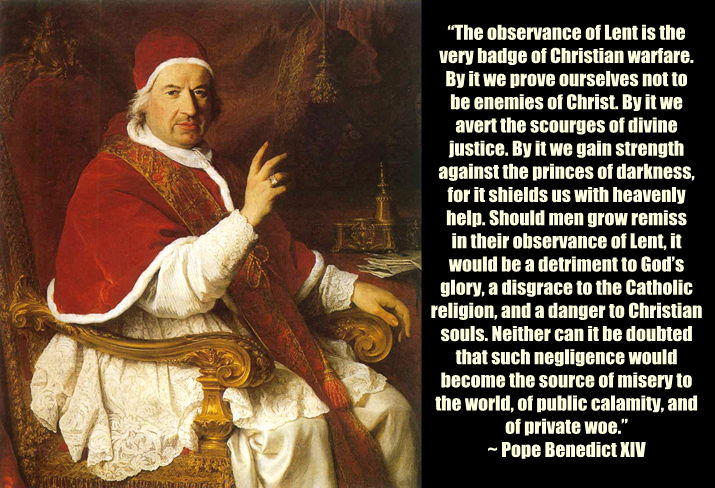
On May 31, 1741, Pope Benedict XIV issued Non Ambiginius which granted permission to eat meat on fasting days while explicitly forbidding the consumption of both fish and flesh meat at the same meal on all fasting days during the year in addition to the Sundays during Lent. Beforehand, the forty days of Lent were held as days of complete abstinence from meat. The concept of partial abstinence was born even though the term would not appear until the 1917 Code of Canon Law. Yet even with these changes, Pope Benedict XIV implored the faithful to return to the devotion of earlier eras:

"The observance of Lent is the very badge of the Christian warfare. By it we prove ourselves not to be enemies of the cross of Christ. By it we avert the scourges of divine justice. By it we gain strength against the princes of darkness, for it shields us with heavenly help. Should mankind grow remiss in their observance of Lent, it would be a detriment to God's glory, a disgrace to the Catholic religion, and a danger to Christian souls. Neither can it be doubted that such negligence would become the source of misery to the world, of public calamity, and of private woe." 

Yet changes continued during the 18th and 19th centuries as Antoine Villien's "History of the Commandments" from 1915 documents:

The use of meat on Sundays [of Lent] was at first tolerated, then expressly permitted, for the greater part of Lent. Old people still remember the time when its use was completely forbidden in France from the Friday of Passion week to Easter. Later, new dispensations allowed the gradual extension of the Sunday privilege to Tuesday and Thursday of each week, up to Thursday before Palm Sunday. About the beginning of the pontification of Pius IX [c. 1846], Monday was added to the days on which abstinence need not be observed; a few years later the use of meat on those four days began to be permitted up to Wednesday of Holy Week. Lastly the Saturdays, expect Ember Saturday and Holy Saturday, were included in the dispensations."

Mitigations to fasting also began to accelerate for other periods in the 18th and 19th centuries and this is seen strikingly in the series of changes to occur to fasting in the American Colonies which can be read in detail in the two-part series: A History of Holy Days of Obligation & Fasting for American Catholics.

Father Anthony Ruff relates in his article "Fasting and Abstinence: The Story" the changes made by Pope Leo XIII in the document entitled Indultum quadragesimale:

"In 1886 Leo XIII allowed meat, eggs, and milk products on Sundays of Lent and at the main meal on every weekday [of Lent] except Wednesday and Friday in the [United States]. Holy Saturday was not included in the dispensation. A small piece of bread was permitted in the morning with coffee, tea, chocolate, or a similar beverage."

While the evening collation had been widespread since the 14th century, the practice of an additional morning snack (i.e. a frustulum) was introduced only around the 18th century as part of the gradual relaxation of discipline. Volume 12 of The Jurist, published by the Catholic University of America in 1952, writes, "It is stated that the two-ounce breakfast arose at the time of St. Alphonsus, since which time the usage of the popular two and eight-ounce standards for the breakfast and the collation, respectively, has been extant." 

Mara Morrow in Sin in the Sixties elaborates on the concessions given by Pope Leo XIII which in the late 19th century expanded the practice of the frustulum and further reduced strict abstinence:

"It also allowed for the use of eggs and milk products at the evening collation daily during Lent and at the principal meal when meat was not allowed. [It] further allowed a small piece of bread in the morning with a beverage, the possibility of taking the principal meal at noon or in the evening, and the use of lard and meat drippings in the preparation of foods. Those exempt from the law of fasting were permitted to eat meat, eggs, and milk more than once a day." 

Consequently, the Baltimore Manual published by the Third Plenary Council of Baltimore in 1884 states: "Only one full meal is allowed, to be taken about noon or later. Besides this full meal, a collation of eight ounces is allowed. If the full meal is taken about the middle of the day, the collation will naturally be taken in the evening; if the full meal is taken late in the day, the collation may be taken at noon. Besides the full meal and collation, the general custom has made it lawful to take up to two ounces of bread (without butter) and a cup of some warm liquid - as coffee or tea - in the morning. This is important to observe, for by means of this many persons are enabled - and therefore obliged - the keep the fast who could not otherwise do so."

The Catechism of Father Patrick Powers published in Ireland in 1905 mentions that abstinence includes flesh meat and "anything produced from animals, as milk, butter, cheese, eggs." However, Father Patrick notes, "In some countries, however, milk is allowed at collation." The United States was one of those nations whereas Ireland and others were not granted such dispensations. The use of eggs and milk during Lent was to drastically change in a few years with the 1917 Code of Canon Law.

In 1895, the workingmen's privilege gave bishops in the United States the ability to permit meat in some circumstances. Mara Morrow summarizes that these circumstances occurred when there was "difficulty in observing the common law of abstinence, excluding Fridays, Ash Wednesday, Holy Week, and the Vigil of Christmas. This workingmen's privilege (or indult) allowed only for meat once a day during Lent, taken at the principal meal, and never taken in conjunction with fish. This particular indult was extended not only to the laborer but to his family, as well. The motivation of such an indult was no doubt to allow for enough sustenance such that the many Catholic immigrants to the United States who worked as manual laborers could perform their difficult, energy-demanding physical work without danger to their health" (Sin in the Sixties).


The Remnant of the Lenten Fast Left by the 20th Century

The Catholic Encyclopedia from 1909 in describing that fast immediately before the changes to occur under St. Pius X enumerates them as follows: "In the United States of America all the days of Lent; the Fridays of Advent (generally); the Ember Days; the vigils of Christmas and Pentecost, as well as those (14 Aug.) of the Assumption; (31 Oct.) of All Saints, are now fasting days. In Great Britain, Ireland, Australia, and Canada, the days just indicated, together with the Wednesdays of Advent and (28 June) the vigil of Saints Peter and Paul, are fasting days." 

The days of obligatory fasting as listed in the 1917 Code of Canon Law were the forty days of Lent (including Ash Wednesday, Good Friday, and Holy Saturday until noon); the Ember Days; and the Vigils of Pentecost, the Assumption of the Blessed Virgin Mary, All Saints, and Christmas. Partial abstinence, the eating of meat only at the principal meal, was obligatory on all weeks of Lent (Monday through Thursday). And of course, complete abstinence was required on all Fridays, including Fridays of Lent, except when a holy day of obligation fell on a Friday outside of Lent. Saturdays in Lent were likewise days of complete abstinence. Fasting and abstinence were not observed should a vigil fall on a Sunday as stated in the code: "If a vigil that is a fast day falls on a Sunday the fast is not to be anticipated on Saturday, but is dropped altogether that year." Eggs and milk (i.e. lacticinia) became universally permitted.

But additional changes quickly ensued. Mara Morrow, writing on the fasting days around this time, states, "In 1917 Pope Benedict XV granted the faithful of countries in World War I the privilege of transferring Saturday Lenten abstinence to any other day of the week, excepting Friday and Ash Wednesday. In 1919 Cardinal Gibbons was granted his request of transferring Saturday Lenten abstinence to Wednesday for all bishops’ dioceses in the U.S. This permission, as well as the workingmen’s privilege, were frequently renewed, but, after 1931, this permission was only on the basis of personal requests from individual bishops."

Pope Pius XII accelerated the changes to fasting and abstinence as Father Ruff relates: "In 1941 Pope Pius XII allowed bishops worldwide to dispense entirely from fast and abstinence except on Ash Wednesday and Good Friday, provided that there was abstinence from meat every Friday, and fast and abstinence on these two days and the vigil of the Assumption and Christmas. Eggs and milk products were permitted at breakfast and in the evening." And effective in 1956 per the decree in Maxima Redemptionis Nostrae Mysteria, Holy Saturday's fast and abstinence were extended from noon to midnight.

By 1962, the laws of fasting and abstinence were as follows as described in "Moral Theology" by Rev. Heribert Jone and adapted by Rev. Urban Adelman for the "laws and customs of the United States of America" copyright 1961: 

"Complete abstinence is to be observed on all Fridays of the year, Ash Wednesday, the Vigils of Immaculate Conception and Christmas. Partial abstinence is to be observed on Ember Wednesdays and Saturdays and on the Vigil of Pentecost. Days of fast are all the weekdays of Lent, Ember Days, and the Vigil of Pentecost." If a vigil falls on a Sunday, the law of abstinence and fasting is dispensed that year and is not transferred to the preceding day. 

Thus, even before the Second Vatican Council opened, the fasting customs were drastically reduced within only a few hundred years. 


The Lenten Fast Virtually Eliminated Post Vatican II

Shortly after the close of the Second Vatican Council, Paul VI an apostolic constitution on fasting and abstaining on February 17, 1966, called Paenitemini, whose principles were later incorporated into the 1983 Code of Canon Law. Paenitemini allowed the commutation of the Friday abstinence to an act of penance at the discretion of the local ordinaries and gave authority to the episcopal conferences on how the universal rules would be applied in their region. Abstinence which previously began at age 7 was modified to begin at age 14. Additionally, the obligation of fasting on the Ember Days and on the remaining Vigils was abolished. Paenitemini maintained the traditional practice that "abstinence is to be observed on every Friday which does not fall on a day of obligation."

The NCCB issued a statement on November 18, 1966. Abstinence was made obligatory on all Fridays of Lent, except Solemnities (i.e. First Class Feasts), on Ash Wednesday, and on Good Friday. Abstinence on all Fridays throughout the year was "especially recommended," and the faithful who did choose to eat meat were directed to perform an alternative penance on those Fridays outside of Lent, even though the US Bishops removed the long-establish precept of requiring Friday penance. The document stated in part: "Even though we hereby terminate the traditional law of abstinence binding under pain of sin, as the sole prescribed means of observing Friday, we ... hope that the Catholic community will ordinarily continue to abstain from meat by free choice as formerly we did in obedience to church law." And finally, fasting on all weekdays of Lent was "strongly recommended" but not made obligatory under penalty of sin.

The 1983 Code of Canon Law largely took Paul VI's apostolic constitution aside from the modification of the age at which fasting binds. Per the 1983 Code of Canon Law, the age of fast was changed to begin at 18 - previously it was 21 - and to still conclude at midnight when an individual completes his 59th birthday. Friday penance is required per these laws on all Fridays of the year except on Solemnities, a dramatic change from the previous exception being only on Holy Days of Obligation.

Per the 1983 Code of Canon Law, fasting and complete abstinence per these rules are required only on Ash Wednesday and Good Friday. The notion of "partial abstinence," introduced under Pope Benedict XIV in 1741, was also removed along with nearly all fast days. 

So What Should Traditional Catholics Do To Restore the Lenten Fast?

While no authority in the Church may change or alter any established dogmas of the Faith, the discipline of both Holy Days of Obligation and fast days may change. The days of obligation and the days of penance are matters of discipline, not matters of dogma. Lawful authorities in the Church do have the power to change these practices.

In the observance of the two precepts, namely attending Holy Mass on prescribed days and fasting and abstaining on commanded days, we obey them because the Church has the power by Christ to command such things. We do not abstain from meat on Fridays for instance because the meat is unclean or evil. It is the act of disobedience that is evil. As Fr. Michael MĂĽller remarks in his Familiar Explanation of Christian Doctrine from 1874: "It is not the food, but the disobedience that defiles a man." To eat meat on a forbidden day unintentionally, for instance, is no sin. As the Scriptures affirm it is not what goes into one's mouth that defiles a man but that disobedience which comes from the soul (cf. Matthew 15:11).

Yet, even with such a distinction, the Church has historically been wise to change disciplines only very slowly and carefully. As Archbishop Fulton J. Sheen once remarked, "It is a long-established principle of the Church never to completely drop from her public worship any ceremony, object or prayer which once occupied a place in that worship." The same may be said for matters concerning either Holy Days of Obligation or fast days. What our forefathers held sacred should remain sacred to us in an effort to preserve our catholicity not only with ourselves but with our ancestors who see God now in Heaven.

St. Francis de Sales remarked in the 16th / early 17th century, “If you’re able to fast, you will do well to observe some days beyond what are ordered by the Church.” 

This Lent, I propose for Traditional Catholics the following Lenten fasting plan:
  • Fasting applies for those age 18 or older (but not obligatory for those 60 years of age or older)
  • Ash Wednesday and Good Friday: No solid food. Only black coffee, tea, or water.
  • Mondays through Saturdays: Only one meal preferably after sunset. A morning frustulum and evening collation are permitted but not required. No meat or animal products are allowed for anyone, regardless of age - that includes fish. No olive oil.
  • Sundays: No meat or animal products allowed except on Laetare Sunday. Exceptions for Palm Sunday are mentioned below.
  • Annunciation Day (March 25) and Palm Sunday: Fish and olive oil permitted.
  • Holy Week (except Good Friday): Only Bread, Salt, and Herbs are permitted for the main meal. Frustulum and collation permitted (of bread, herbs, and salt) but omitted if possible
  • Holy Saturday: No food until Noon. Abstinence including from all animal products continues until Easter begins.
And for those looking for ideas on what to make to eat on fasting days, the Lenten Cookbook produced by Sophia Institute Press has a section on vegan recipes that is worth checking out.

Want to learn more about the history of fasting and abstinence? Check out the Definitive Guide to Catholic Fasting and Abstinence.
Read more >>


Copyright Notice: Unless otherwise stated, all items are copyrighted under a Attribution-NonCommercial-NoDerivatives 4.0 International License. If you quote from this blog, cite a link to the post on this blog in your article.

Disclosure of Material Connection: Some of the links on this blog are “affiliate links.” This means if you click on the link and purchase the item, I will receive an affiliate commission. As an Amazon Associate, for instance, I earn a small commission from qualifying purchases made by those who click on the Amazon affiliate links included on this website. I am disclosing this in accordance with the Federal Trade Commission’s 16 CFR, Part 255: “Guides Concerning the Use of Endorsements and Testimonials in Advertising.”