Showing posts sorted by date for query Obligation. Sort by relevance Show all posts
Tuesday, October 14, 2025
2026 Traditional Catholic Fasting and Abstinence Calendar

Click for Larger Size

As a follow-up to my significant research on Traditional (Roman and Eastern) Catholic fasting and abstinence, I have put together a 2026 fasting and abstinence calendar for my devotional purposes. This is a follow-up to similar ones I created over the past several years.

Traditional Catholic Fasting Rules:

Fasting: Fasting refers to how much food we eat. It means taking only one meal during a calendar day. The meal should be an average-sized meal as overeating at the one meal is against the spirit of the fast. Fasting generally means that the meal is to be taken later in the day. Along with the one meal, up to two snacks (technically called either a collation or frustulum) are permitted. These are optional, not required. Added up together, they may not equal the size of the one meal. No other snacking throughout the day is permitted. Fasting does not affect liquids, aside from the Eucharistic Fast which is a separate matter.

Abstinence: Abstinence in this context refers to not eating meat. Meat refers to the fleshmeat of mammals or fowl. Beef, poultry, lamb, etc are all forbidden on days of abstinence. Abstinence does not currently prohibit animal byproducts like dairy (e.g. cheese, butter, milk) or eggs, but in times past they were prohibited. Fish is permitted along with shellfish and other cold-blooded animals like alligators. In times past, days of fast were always days of abstinence as well; however, not all days of abstinence were days of mandatory fasting.

Partial Abstinence: Partial Abstinence refers to eating meat only at the principal meal of the day. Days of partial abstinence do not permit meat to be eaten as part of the collation or the frustulum. Partial abstinence started only in 1741 under Pope Benedict XIV as a concession and as part of a gradual weakening of discipline. Beforehand, days of abstinence were days of complete abstinence.

Fasting, therefore, refers to the quantity of food and the frequency of eating. Abstinence refers to what may or may not be eaten.

Calendar Notes:

1. While Partial abstinence is allowed in the rubrics in place as of 1962, it is a a modern invention and is not part of this calendar. Abstinence is always full, never partial. 

2. All Days of Lent, aside from Sundays, are days of fasting and abstinence. Sundays are days only of abstinence.

3. For Lent only, abstinence refers to all animal products (e.g., dairy, butter, eggs) in addition to meat. This includes Sundays.

4. January 22nd is in the USA only an obligatory day of penance for offenses against the dignity of human life.

5. This calendar keeps the 1954 Roman Catholic Calendar and the pre-1917 practice of anticipating Vigils on Saturday that fall on Sunday in a given year.

6. Major Fasts: Great Lent (February 18 - April 4), Apostles Fast (June 1 - June 27)Dormition Fast (Aug 1 - Aug 14)St. Martin's Lent (Nov 12 - Dec 24).

7. Dominican Specific Fasting Days: April 29, August 3, and October 6 are not on the calendar but will be observed by Dominican Tertiaries per the 1923 Rule (the last one before Vatican II). Same with all Fridays of the year, which Dominicans are asked to keep as days of fasting.

8. Days of fasting generally include all of the Major Fasts as noted above, in addition to the following days when they fall outside those periods: Ember Days, Vigils of the Apostles, and Vigils for Major Feasts. Rogation Days were often days of abstinence but not fast.

9. Before the 1830s, all Saturdays were days of abstinence except during Christmastide (in some places) and on major holidays.

10. Voluntary Saturday abstinence is omitted on current or former Holy Days of Obligation. Saturday Abstinence used to be obligatory year-round with some exceptions for days "as often as no major solemnity (e.g., Christmas) occurs on Saturday, or no infirmity serves to cancel the obligation.” One exception granted in some places was for all Saturdays of the Christmas Season to be exempted.

11. Year Round Wednesdays as days of abstinence are recommended based on the Early Church's practice of Wednesday penance (and based on the wishes of Our Lady of Mount Carmel). Abstinence year-round on Wednesdays would be commendable on all Wednesdays of the year outside of Pascaltide except for those when either a Holy Day of Obligation, Former Holy Day of Obligation, or First Class Feast falls.

12. While part of the Apostles Fast, both the Vigil of Corpus Christi and the Vigil of the Nativity of St. John the Baptist are recommended days of fasting and abstinence.

13. Exceptions for the Apostles Fast reflect both Corpus Christi and the Nativity of St. John the Baptist.

14. December 25th falling on a Friday was exempt from mandatory abstinence starting in the Middle Ages but beforehand it remained a day of mandatory abstinence.

15. Above all, this calendar goes far beyond the mere "minimums," which are virtually non-existent, and attempts to present concrete ways for Catholics to actually fast in the manner our forefathers did.

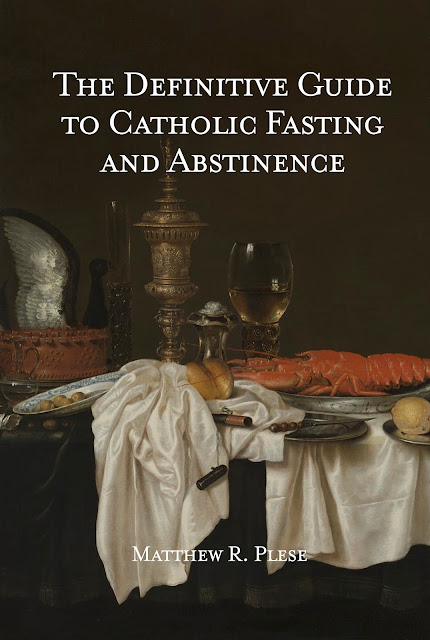
Want to learn more about the history of fasting and abstinence? Check out the Definitive Guide to Catholic Fasting and Abstinence.

Digital Version:

To order a digital .ics file of the above calendar that can be easily imported into your calendar application (e.g., Outlook, Google, Apple, etc.), order below. 

The file is only $5.95. Please order it by clicking here.

After you complete the order, you will have a ZIP file. You MUST unzip that file to extract the ICS file. That ICS file can be added to the calendar application of your choice. Check out details for how easy it is to add an ICS file (after you unzip it) online.

Note that the file is a free benefit to all my Patreon members. So, if you become a patron, you will get that and many other benefits.

Read more >>
Tuesday, August 12, 2025
Is Friday Abstinence Required When Assumption Day Falls on a Friday?

Assumption by Martin Knoller

Assumption Day As A Holy Day of Obligation

The first catalog of Holy Days comes from the Decree of Gratian in c. 1150 AD, which shortly thereafter gave way to Decretals of Pope Gregory IX in 1234, which listed 45 Holy Days.

In 1642, His Holiness Pope Urban VIII issued the papal bull Universa Per Orbem which mandated the required Holy Days of Obligation for the Universal Church to consist of 34 days as well as the principal patrons of one's one locality (e.g. city and country). Those days were the Nativity of Our Lord, the Circumcision of Our Lord, the Epiphany of Our Lord, Monday within the Octave of the Resurrection, Tuesday within the Octave of the Resurrection, Ascension Thursday, Monday within the Octave of Pentecost, Tuesday within the Octave of Pentecost, Most Holy Trinity, Corpus Christi, the Finding of the Holy Cross, the Purification of the Blessed Virgin Mary, the Annunciation of the Blessed Virgin Mary, the Assumption of the Blessed Virgin Mary, the Nativity of the Blessed Virgin Mary, the Dedication of St. Michael, the Nativity of St. John the Baptist, SS. Peter and Paul, St. Andrew, St. James, St. John (the December feast day), St. Thomas, SS. Philip and James, St. Bartholomew, St. Matthew, SS. Simon and Jude, St. Matthias, St. Stephen the First Martyr (the December feast day), the Holy Innocents, St. Lawrence, St. Sylvester, St. Joseph, St. Anne, and All Saints.  

Hence, Assumption Day was a Holy Day of Obligation long before the dogma of the Assumption was dogmatically defined.

Is Friday Abstinence Required When Assumption Day (August 15) Falls on a Friday?

Since August 15 this year falls on a Friday and is a Holy Day of Obligation, a question arises on whether abstinence is obligatory this Friday. The answer, as clearly stated in the 1917 Code, is as follows:

"On [Sundays] or feasts of precept, the law of abstinence or of abstinence and fast or of fast only ceases, except during Lent, nor is the vigil anticipated; likewise it ceases on Holy [Saturday] afternoon" (1917 Code, Canon 1252 § 4). [Translation taken from THE 1917 OR PIO-BENEDICTINE CODE OF CANON LAW in English Translation by Dr. Edward Peters]

As Assumption Day falls outside of Lent, this Friday is not a day of mandatory abstinence. However, this was actually a change from the practice observed for well over 1,000 years.

Dispensations From Abstinence Were Previously Required Even for Holy Days of Obligation Outside of Lent

Even Christmas would in and of itself not dispense Friday abstinence in the Medieval Church, as Dom Gueranger writes in the Liturgical Year published in 1886:

"To encourage her children in their Christmas joy, the Church has dispensed with the law of abstinence, if this Feast fall on a Friday. This dispensation was granted by Pope Honorius III, who ascended the Papal Throne in 1216. It is true that we find it mentioned by Pope St Nicholas I, in the ninth century; but the dispensation was not universal; for the Pontiff is replying to the consultations of the Bulgarians, to whom he concedes this indulgence, in order to encourage them to celebrate these Feasts with solemnity and joy: Christmas Day, St Stephen, St John the Evangelist, the Epiphany, the Assumption of our Lady, St John the Baptist, and SS Peter and Paul. When the dispensation for Christmas Day was extended to the whole Church, these other Feasts were not mentioned."

Previously, a dispensation was required by the Holy Father even on Holy Days of Obligation that fell outside of Lent. Two examples indicating this are Pope Leo XIII's 1890 dispensation for Assumption Day and a 1907 dispensation issued for Canada for All Saints Day. All Saints Day was, at that time, a Holy Day of Obligation in Canada.

The Catholic Encyclopedia on St. Pius X's Supremi disciplinæ indicates that fasting was abolished eo ipso only starting in 1911 for all Holy Days of Obligation outside of Lent (which were at the same time reduced to only 8): "The present Motu Proprio institutes another important change in legislation. As feasting and fasting are incompatible, Pius X has abolished the obligation of fasting as well as that of abstinence for the Universal Church, should such obligation coincide with any of the eight feasts, as above." 

Thus, while eating meat this Friday is not a sin, it would be meritorious to continue to observe Friday abstinence in honor of the nearly 1,800 year-old tradition that preceded the 1917 Code. If we choose to do so, let us offer it up through our Lady's intercession for the conversion of sinners who violate the laws of the Church and do not attend Holy Mass on days of precept like Assumption Day.

Want to learn more about the history of fasting and abstinence? Check out the Definitive Guide to Catholic Fasting and Abstinence.
Read more >>
Sunday, June 29, 2025
A Catholic Life Podcast: Episode 119

In today’s episode, I am diving into an important question that many traditional Catholics are asking this year: "Does Friday, July 4th, 2025, require abstinence from meat?" But we will also cover the importance of Ss. Peter and Paul’s Day as well.

  1. Is Abstinence Required on Civil Holidays?
  2. The Solemnity of Ss. Peter and Paul’s History as a Holy Day of Obligation
  3. Devotions in Honor of the Precious Blood for July
  4. Customs in Honor of the Feast of the Most Precious Blood
  5. Within the Octave of Ss. Peter and Paul

This episode of A Catholic Life is brought to you by the Sanctifica app — and if you’re passionate about living the liturgical year, this is the tool you’ve been waiting for. Feast days, saints, traditional devotions, indulgences — Sanctifica weaves it all into one beautifully crafted app. No fluff. No trends. Just timeless Catholic tradition — right at your fingertips. Personally, I’ve found it incredibly helpful in staying rooted in the Church’s rhythm — from  reminders for feast days and ember days, to novenas and spiritual treasures that otherwise may be easily missed. If you’re looking to bring structure, beauty, and deeper meaning to your daily spiritual life — Sanctifica makes it simple. Download it for free today on the App Store or Google Play. It’s a powerful companion for anyone striving to truly live a Catholic life.

Subscribe to the podcast on Buzzsprout, Apple Podcasts, Spotify, I-tunes, and many other platforms!

Read more >>
Wednesday, June 25, 2025
Is Abstinence Required on Civil Holidays?


For Traditional Catholics seeking to preserve the venerable customs of penance and prayer, the question naturally arises in 2025: Since July 4th falls on a Friday this year, are we still obligated to abstain from meat?

In today’s Church, the answer would be no—abstinence on Fridays outside of Lent is only “especially recommended,” not required. But for those who strive to maintain the immemorial practices of the Church, the answer lies in a deeper look at history, law, and the exceptions once granted for civil holidays like Independence Day.

Traditional Law: Friday Abstinence Is the Norm

From the earliest centuries, Friday abstinence was a universal precept. As a weekly commemoration of the Passion of Our Lord, it was required throughout the year. This obligation continued with few interruptions until modern times. Even into the 20th century, the 1917 Code of Canon Law mandated abstinence from meat on all Fridays of the year unless a Holy Day of Obligation occurred on that day outside of Lent. Before, even Fridays that were Holy Days of Olbligation still required abstinence, Christmas Day being the only exception.

Importantly, July 4th—the United States' Independence Day—has never been a Holy Day of Obligation. Thus, under traditional law, it remained a day of required abstinence whenever it fell on a Friday.

The 1931 Indult for Civil Holidays

However, a notable exception was introduced in 1931. Cardinal Fumasoni Biondi, Apostolic Delegate to the United States, communicated a special indult from Pope Pius XI allowing American bishops, ad quinquennium (for five years), to dispense from the laws of fasting and abstinence on civil holidays. As he wrote:

“The Sacred Congregation of the Council, in a letter dated 15 Oct 1931, informs me that, in view of the difficulties experienced by the faithful in observing the laws of fast and abstinence on civil holidays, His Holiness, Pius XI... granted to all the Ordinaries of the United States... the faculty to dispense their subjects from the laws in question whenever any of the civil holidays now observed occurs on a day of fast and abstinence, or of abstinence.”

This privilege, while notable, was:

  • Temporary: It lasted only five years unless renewed.
  • Discretionary: Bishops could exercise this faculty but were not required to.
  • Not self-executing: The faithful could not assume they were dispensed unless their bishop officially declared it.

Even into the 1950s and early 1960s, bishops selectively used this privilege. Some issued formal dispensations when a civil holiday fell on a Friday (e.g., the day after Thanksgiving), but others did not.

Independence Day: No Permanent Dispensation

There was never a permanent, universal dispensation from Friday abstinence for the Fourth of July.

Unlike myths surrounding the so-called “turkey indult” for the day after Thanksgiving, there is no documented perpetual exemption for meat consumption on Independence Day—even under Pope Pius XII or John XXIII. Any dispensation from Friday abstinence on July 4th had to be granted explicitly by the local bishop and typically appeared in diocesan announcements or parish bulletins.

Furthermore, by 1962—the benchmark year for many traditional Catholics—the universal law was still clear: unless July 4th was a Holy Day of Obligation (which it was not), or unless a specific diocesan dispensation was announced, the law of abstinence applied.

What Changed After Vatican II?

With Paenitemini in 1966, Paul VI allowed bishops’ conferences to substitute other forms of penance for Friday abstinence. The U.S. bishops followed suit, and Friday abstinence became “especially recommended,” but no longer binding under pain of sin outside of Lent.

This relaxation, coupled with the dramatic reduction in fasting days, has contributed to a massive weakening of Catholic penitential identity. But for those attached to the Traditional Latin Mass and the older calendar, fidelity to the traditional norms remains a vital part of living the liturgical life.

So, What Should a Traditional Catholic Do on Friday, July 4, 2025?

Unless a competent traditional priest or bishop explicitly dispenses the faithful from abstinence, the traditional law remains binding. Independence Day—though a civic holiday—is not a feast of the Church, and it has never been granted a permanent exception. Thus, traditional Catholics should abstain from meat on Friday, July 4th, 2025.

This act of penance is not a rejection of patriotism but a higher form of devotion: honoring the sacred customs of the Church above the shifting preferences of modernity.

Recovering a Lost Rhythm

Throughout the past two centuries, Catholic discipline in America has steadily waned. From a time of over 30 Holy Days of Obligation, year-round Saturday abstinence, and strict fasting regulations, we now find ourselves with a minimal observance required under current law.

But as St. Francis de Sales wisely said, “If you’re able to fast, you will do well to observe some days beyond what are ordered by the Church.”

For those who long to recover the rhythm of Catholic life, the solution lies not in waiting for mandates, but in choosing to voluntarily embrace tradition. This July 4th, let us abstain from meat, pray for our nation, and offer up our penance for the conversion of America and the restoration of Catholic order.

Want to learn more about the history of fasting and abstinence? Check out the Definitive Guide to Catholic Fasting and Abstinence.

Read more >>
Sunday, June 15, 2025
A Catholic Life Podcast: Episode 117

In today’s episode for the A Catholic Life Podcast I cover the fascinating, complicated, and often forgotten history of Holy Days of Obligation in the United States.

  1. Honor the Forgotten (Former) 36 Holy Days of Obligation
  2. A History of Holy Days of Obligation & Fasting for American Catholics: Part 1
  3. A History of Holy Days of Obligation & Fasting for American Catholics: Part 2

This episode of A Catholic Life is brought to you by the Sanctifica app — and if you’re passionate about living the liturgical year, this is the tool you’ve been waiting for. Feast days, saints, traditional devotions, indulgences — Sanctifica weaves it all into one beautifully crafted app. No fluff. No trends. Just timeless Catholic tradition — right at your fingertips. Personally, I’ve found it incredibly helpful in staying rooted in the Church’s rhythm — from  reminders for feast days and ember days, to novenas and spiritual treasures that otherwise may be easily missed. If you’re looking to bring structure, beauty, and deeper meaning to your daily spiritual life — Sanctifica makes it simple. Download it for free today on the App Store or Google Play. It’s a powerful companion for anyone striving to truly live a Catholic life.

Subscribe to the podcast on Buzzsprout, Apple Podcasts, Spotify, I-tunes, and many other platforms!

Read more >>
Monday, June 9, 2025
Honor the Forgotten (Former) 36 Holy Days of Obligation

The Land Without Holy Days

“…So also, from the earliest ages, the Christian Church instituted and religiously solemnized various feasts, differing in different countries, and varying according to times and circumstances, principally intended to keep in grateful and loving memory the chief mysteries of our Blessed Saviour's life, the glories and prerogatives of His Immaculate Mother, the example and heroic sanctity of the saints. . . . Blessed festivals, they are green, refreshing oases in the desert of our dreary, plodding life, and not a doubt, but they tend materially to keep alive the spirit of piety." 

With these words, Bishop Stephen Ryan of Buffalo addressed the bishops and theologians who had crowded into the former Cathedral in Baltimore. The occasion was the Third Plenary Council of Baltimore, which began in late 1884. The Council Fathers set to address a number of issues affecting Catholic life in the United States which had reached its then-disjointed arrangement through the acquisition of various terrorities each with their own customs and ecceslestical laws. Unbeknowst to many, days of fasting and abstinence in addition to holy days of obligation varied widely in what constituted the United States of America due to these historical differences. Could uniformity be obtained even though prior attempts to do so had failed? And in hindsight, should uniformity – at least in the manner sought – have even been attempted?

The history of America’s holy days of obligation highlights a complex network of unique customs, varied cultural traditions, and an overarching lack of fervor over time. In an era with so few Holy Days of Obligation, what have we lost? And should this be remedied? And what can this teach modern Catholics?

Holy Days of Obligation Over Time

In 1911, Pope St. Pius X reduced the number of Holy Days of Obligation from 36 to 8, although which places observed the holy days were not uniform at all beforehand.  Shortly thereafter, the 1917 Code of Canon Law increased the number to 10 by adding back Corpus Christi and Ss. Joseph. Those ten on the Universal Calendar have remained the same ever since.

However, the Holy Days up until 1911 reveal something quite interesting as all of the feasts of the Apostles were Holy Days of Obligation on the Universal Calendar as were many other days like St. Anne, the May 3rd Feast of the Finding of the Holy Cross, and so many other days which are now forgotten. The feasts of the Apostles were raised to public holidays back in 932 AD as Father Weiser relates (p. 279), for instance.

The 36 Holy Days of Obligation on the Universal Calendar back in 1642 under Pope Urban VIII included:

1. Nativity of our Lord
2. Circumcision of our Lord
3. Epiphany of the Lord
4. Monday within the Octave of the Resurrection
5. Tuesday within the Octave of the Resurrection
6. Ascension
7. Monday within the Octave of Pentecost
8. Tuesday within the Octave of Pentecost
9. Most Holy Trinity
10. Most Holy Body of Christ
11. Finding of the Holy Cross
12. Purification of the Blessed Virgin Mary
13. Annunciation of the Blessed Virgin Mary
14. Assumption of the Blessed Virgin Mary
15. Nativity of the Blessed Virgin Mary
16. Dedication of St. Michael
17. Nativity of St. John Baptist
18. Ss. Peter and Paul
19. St. Andrew
20. St. James
21. St. John (the December feastday)
22. St. Thomas
23. Ss. Philip and James
24. St. Bartholomew
25. St. Matthew
26. Ss. Simon and Jude
27. St. Matthias
28. St. Stephen (the December feastday)
29. The Holy Innocents
30. St. Lawrence
31. St. Sylvester
32. St. Joseph
33. St. Anne
34. All Saints Day
35. The Principle Patrons of One’s Country, City, etc.

The Immaculate Conception of the Blessed Virgin Mary was added in 1708 so it not on 1642 list.

In times past there was also a distinction made of days of double versus single precept. Days of double precept required both hearing Mass and refraining from servile works, whereas days of single precept were working holy days permitting work but still requiring Mass attendance.

Consequently, the number of Holy Days of Obligation in the United States as of the Second Vatican Council had already been significantly reduced from their previous state. Holy Days of Obligation, which had remained the same in the United States since 1917, were further modified in the latter part of the 20th century.  On December 13, 1991, the United States Bishops issued a directive further abrogating New Years Day (the Circumcision of our Lord), the Assumption, or All Saints in years when the feast falls on a Saturday or a Monday. And on March 23, 1992, in another reduction, the Bishop of Honolulu obtained an indult from the Holy See and approval from the United States episcopal conference to reduce the Holy Days of Obligation to only Christmas and the Immaculate Conception. 

Holy Days of Obligation Before 1900

Published in 1886, the eleventh volume of the American Catholic Quarterly Review offers an insightful series of reflections on Holy Days with a call for us to observe these as our forefathers in the Faith gladly did:

"The Church by one of her positive commandments requires the faithful to sanctify certain holydays in the year by taking part in the offering of the great sacrifice of the Mass and by abstaining from servile works... In the days of faith and fervor not only were the great festivals prescribed by the Church, those associated with the life of our Lord and His Blessed Mother, those intimately connected with the work of redemption, and the feasts of the holy apostles by whose ministry the Church was established and the channels of grace led through the world - not only were these kept reverently but the patronal feast of each country, diocese, and church, the days of the most famous local saints were similarly honored. The devotion was general, and whoso refused to lay aside his implements of trade or traffic on their days was so condemned by public opinion that custom made the law.” 

Interestingly, because the Church enjoined on the Faithful both the obligation to hear Mass and the necessity to refrain from servile work, the number of holy days, which included Sundays, was significant. Some people began to revolt against the Church claiming that these practices only increased poverty. But as the Journal notes, an interesting phenomenon occurred:

"Protestantism therefore at once swept away all the holydays and Christmas remained almost alone to represent the Church calendar, and the Puritans even punished those who kept Christmas. With men working all the year round except on Sunday, wealth was to be general, the poor would thrive and prosper and be happy and contented, no longer lured from great and ennobling labor by being called away every week to idle some days in church and prayer. It was again unfortunate that this excellent theory did not work well. The poor seemed to grow actually poorer with all these days of labor than they had been before." 

The first catalog of Holy Days comes from the Decree of Gratian in c. 1150 AD, which shortly thereafter gave way to Decretals of Pope Gregory IX in 1234, which listed 45 Holy Days. As the Catholic Encyclopedia summarizes regarding this period:

“The Decree of Gratian (about 1150) mentions forty-one feasts besides the diocesan patronal celebrations; the Decretals of Gregory IX (about 1233) mention forty-five public feasts and Holy Days, which means eighty-five days when no work could be done and ninety-five days when no court sessions could be held. In many provinces eight days after Easter, in some also the week after Pentecost (or at least four days), had the sabbath rest. From the thirteenth to the eighteenth century there were dioceses in which the Holy Days and Sundays amounted to over one hundred, not counting the feasts of particular monasteries and churches. In the Byzantine empire there were sixty-six entire Holy Days (Constitution of Manuel Comnenus, in 1166), exclusive of Sundays, and twenty-seven half Holy Days. In the fifteenth century, Gerson, Nicolas de Clémanges and others protested against the multiplication of feasts, as an oppression of the poor, and proximate occasions of excesses. The long needed reduction of feast days was made by Urban VIII (Universa per orbem, 13 Sept., 1642).” 

In 1642, His Holiness Pope Urban VIII issued the papal bull Universa Per Orbem which mandated the required Holy Days of Obligation for the Universal Church to consist of 34 days as well as the principal patrons of one's one locality (e.g. city and country). Ultimately Universa Per Orbem helped bring more uniformity to the Church since some parts of the Catholic world observed even more holy days of double precept (i.e. mandatory attendance at Mass and rest from servile work). The previous list of Holy Days of Obligation found in the Decretals also included Holy Monday through Holy Saturday in addition to Easter Wednesday through Easter Saturday.  These days had ceased being Holy Days by 1642. 

Holy Days in Young America

After the American Revolution, the Catholics in the 13 colonies that constituted the new United States of America were under the jurisdiction of the Apostolic Vicariate of the London District until the Diocese of Baltimore was established on November 6, 1789. This included the area of Maine that previously had been part of Quebec.

The first major change to the holy days of Americans came about through the lands purchased in 1803 from France in the Louisiana Purchase. Owing to the persecution of Catholics in France after the French Revolution, Pope Pius VII on April 5, 1802, reduced the holy days of obligation for Catholics in France to only Christmas, Ascension, Assumption, and the Feast of All Saints. Spain, which was in possession of the Louisiana territory since 1763, agreed in 1801 to cede it back to Napoleon. Before even getting possession of the territory, he sold it to the United States in 1803. What is particularly interesting is that the Catholics of Louisiana – whose territory includes areas in modern-day Arkansas, Missouri, Iowa, Minnesota, Kansas, and Nebraska – adopted the reduced holy days granted to France in 1802.

A Divergence of Holy Days in the 1800s

As America expanded, there was a divergence in the days of precept. When Florida was purchased by the United States in 1821, its old holy days were maintained. And the same likewise occurred in the Texas territory when it was acquired by the United States in 1845. And this trend continued as America expanded westward as the American Catholic Quarterly Review observes:

"In the Second Plenary Council [of Baltimore] in 1866 the feast of the Immaculate Conception was made of obligation as it had been in Oregon, where the feast of St Peter and St Paul had retained its place with the Monday after Easter and Whit Sunday, St John the Baptist, Candlemas, and St Stephen. Pope Gregory XVI in 1837 dispensed all the dioceses then in the United States from the obligation as to Easter Monday and Whitsun Monday and in 1840 from that of the feast of St Peter and St Paul..." 

Uniformity of American Holy Days Established in 1885 

By the time of the Civil War, considerable changes had occurred to these holy days. It was not until the Third Plenary Council that uniformly was achieved, though at the cost of reducing the holy days observed by many Catholics in the New World as the Review laments:

"The effort to induce faithful to a more exact observance of holydays of obligation or least so far as hearing mass was concerned had not been successful. A general indifference prevailed. When zealous priests, to give servants and mechanics every opportunity to fulfil the obligation, had Mass celebrated at an early hour to permit them to attend it proceeding to their usual work, it was found that almost the persons to avail themselves of the opportunity would be a pious old women, while those of the very class for whose the Mass was thus offered were scarcely represented by a straggling individuals.

"The Fathers of the Council renewed their petition to the See and His Holiness Pope Leo XIII on the 31st of December 1885 transferred the solemnization of Corpus Christi to the Sunday following the feast and made the holydays of obligation in all of the United States to be thenceforward: The Immaculate Conception of the Blessed Virgin, Christmas Day, the feast of Circumcision, Ascension Day, the Assumption of the Blessed Virgin, and the feast of All Saints. ” 

The Epiphany and Annunciation were no longer a Holy Day of Obligation in the United States – joining Easter Monday, Pentecost Monday, and St. Peter and Paul as working days. For even more history on how Holy Days of Obligation - and fasting days - changed in the New World before and after America's Foundation, see A History of Holy Days of Obligation & Fasting for American Catholics.


How Should Sundays and Holy Days of Obligation be Sanctified?

The Third Commandment commands us to “Remember the Sabbath day, to keep it holy.” In its fulfillment under the New Law, this commandment obliges Catholics to sanctify Sundays and Holy Days of Obligation by participating in the Holy Sacrifice of the Mass and by refraining from servile work. The Catechism of the Council of Trent affirms that this is not merely a recommendation—it is a divine precept.

The Church further clarifies that all Sundays and all current Holy Days of Obligation are binding under pain of mortal sin. To deliberately skip Mass on such a day without a grave reason—such as serious illness or the inability to reasonably travel to Mass—is a mortal sin. And if a Catholic is unable to attend Mass for a legitimate reason, they should still sanctify the day as best they can: by reading the Missal, meditating on the day’s readings and prayers, and uniting themselves spiritually to the liturgy.

Sunday, moreover, is not only a day of rest and obligatory worship but a day for deeper immersion in the Faith. Traditionally, Catholics observed Sunday by attending Vespers or Benediction, praying the Rosary communally, engaging in spiritual reading, and avoiding unnecessary commerce or entertainment. It is a day to spend in quiet joy, family togetherness, and devotion. The faithful should use Sunday to read Catholic books, periodicals, and Scripture, to practice works of mercy, and to grow in virtue. See the article Top 10 Sunday Activities for Catholics for more.

Make a special effort to attend Mass on all of the former Holy Days of Obligation, if possible. While the current Holy Days of Obligation must still be observed under pain of sin, we should cultivate a desire to attend Mass frequently — even daily. The former Holy Days, though no longer obligatory, remain excellent occasions to rearrange your schedule and give special honor to God through the Holy Sacrifice of the Mass.

With so many holy days reduced, and with priests largely not preaching on the necessity of attending Mass and of abstaining from servile works on them, the faithful have lost the sense of the sacred. Yet, as more Catholic seek to rediscover the Traditional Latin Mass and traditional fasting, voluntarily attending the Holy Sacrifice of the Mass and abstaining from servile works on the former Holy Days of Obligation can help us sanctify time and hold dear to what our forefathers saw, in the words of Bishop Stephen Ryan, as “refreshing oases in the desert of our dreary, plodding life.”


Read more >>
Friday, March 7, 2025
Eating Meat on a Friday is a Mortal Sin

Laws of Fast and Abstinence Bind Mortally

To ignore the law of fasting or abstinence from meat is a grave sin. Why? Because it is an act of disobedience to God's Church. We do not abstain from meat on Fridays for instance because the meat is unclean or evil. It is the act of disobedience that is evil. As Fr. Michael Müller remarks in his Familiar Explanation of Christian Doctrine from 1874: "It is not the food, but the disobedience that defiles a man."

To eat meat on a forbidden day unintentionally, for instance, is no sin. As the Scriptures affirm it is not what goes into one's mouth that defiles a man but that disobedience which comes from the soul (cf. Matthew 15:11). But to eat meat on a Friday or to refuse the law of fasting on required days is a serious sin because of disobedience.

To ignore the law of Friday abstinence is a mortal sin and not merely a venial sin. This was made clear by both Pope Innocent III in the 13th century and Pope Alexander VII in the 17th century who both assert that to violate the law of abstinence on a required day is a mortal sin. The Catholic Encyclopedia explains this rationale:

The Church enjoins the ways and means whereby her subjects must satisfy the obligation of doing penance inculcated by natural law. Many of the Fathers allude to the exercise of ecclesiastical authority in reference to the obligation of abstinence. The disciplinary canons of various councils bear witness to the actual exercise of authority in the same direction. Texts of theology and catechisms of Christian doctrine indicate that the obligation of abstaining forms an element in one of the Commandments of the Church. Satisfaction for sin is an item of primary importance in the moral order. Naturally enough, abstinence contributes no small share towards the realization of this end. As a consequence, the law of abstinence embodies a serious obligation whose transgression, objectively considered, ordinarily involves a mortal sin. The unanimous verdict of theologians, the constant practice of the faithful, and the mind of the Church place this point beyond cavil. They who would fain minimize the character of this obligation so as to relegate all transgressions, save such as originate in contempt, to the category of venial sin are anathematized by Alexander VII [Cf. Prop. 23, ap. Bucceroni, Enchiridion Morale, 145 (Rome, 1905)]. 

In fine, the Trullan synod (can. 58, ap. Hefele, ‘History of the Councils of the Church’, V, 231, Edinburgh, 1896) inflicts deposition on clerics and excommunication on laymen who violate this law. Furthermore, theologians claim that a grievous sin is committed as often as flesh meat is consumed in any quantity on abstinence days (Sporer, Theologia Moralis super Decalogum, I, De observ. jejunii, # 2, assert. II), because the law is negative, and binds semper et pro semper. 

If you cannot resist having meat on Friday, how can you possibly resist more insidious assaults from the devil? The same can be said for a day of fasting – if you cannot refuse food for a short time, how can you reject serious temptations against purity, humility, or pride?

Want to learn more about the history of fasting and abstinence? Check out the Definitive Guide to Catholic Fasting and Abstinence.
Read more >>
Monday, February 24, 2025
Rediscover the Power of Traditional Catholic Fasting

For centuries, fasting and abstinence were essential pillars of Catholic life. Saints, clergy, and lay faithful alike observed rigorous fasting disciplines—not out of mere obligation, but as a means of penance, spiritual purification, and reparation for sin. Sadly, these practices have been largely forgotten or dramatically reduced in modern times.

But what if we could reclaim them?

What if Catholics everywhere once again embraced fasting—not just as a personal devotion, but as a movement for the restoration of Christendom?

That’s exactly what we seek to do.

Step 1: Learn the Tradition

📖 The Definitive Guide to Catholic Fasting and Abstinence by Matthew Plese provides everything you need to know about the traditional discipline of fasting—what it was, how it changed, and how you can restore it in your own life.

This book traces the history of Catholic fasting back to the early Church, when Christians observed rigorous Lenten fasts, abstained from all meat and animal products, and kept strict Ember Days and vigils. It covers how the discipline gradually eroded, especially after the 1917 Code of Canon Law, and how Vatican II’s reforms nearly erased fasting altogether.

If you’ve ever wondered why Catholics today fast so little compared to past centuries—or if you feel called to do more but don’t know where to begin—this book is your guide.

Step 2: Live the Tradition

💪 Learning about fasting is one thing. Living it is another. That’s why we invite you to join the Fellowship of St. Nicholas—a traditional Catholic sodality dedicated to restoring penance and fasting.

Under the patronage of St. Nicholas—who was known not just for his charity but for his lifelong fasting—the Fellowship calls Catholics to band together in prayer, penance, and reparation.

St. Nicholas’s own life exemplifies the ancient fasting tradition. As the Roman Breviary recounts, even as an infant, he fasted from his mother’s milk twice a week, only nursing after sunset on Wednesdays and Fridays. He kept this discipline for his entire life, modeling for us a path of self-denial and holiness.

Inspired by this, the Fellowship of St. Nicholas commits to structured fasting and abstinence based on the traditional rules of the Church.

Tier 1 follows the 1917 Code of Canon Law as a minimum, while eliminating the compromise of partial abstinence. This includes:

  • No meat on any Friday of the year
  • No meat for the entirety of Lent, including Sundays
  • Abstinence on Ember Days and major vigils
  • A strict fast (one meal a day, preferably after 3 PM) on traditional fasting days

Tier 2 expands upon this, restoring the ancient Lenten fast as a fully vegan discipline—no meat, dairy, or eggs. It also extends fasting into Advent, bringing back the observance of St. Martin’s Lent, and observes abstinence on Rogation Days.

Tier 3 goes even further, reintroducing fasting periods such as the Apostles’ Fast in June and the Assumption Fast in August, along with additional vigils and Ember Days.

This is not about personal asceticism—it is about restoring the Catholic way of life. As St. Leo the Great reminds us:

“The exercise of self-restraint which an individual Christian practices by his own will is for the advantage of that single member; but a fast undertaken by the Church at large includes everyone in the general purification. God’s people never is so powerful as when the hearts of all the faithful join together in the unity of holy obedience.”

For too long, Catholics have been told that fasting is optional, that penance is just a personal devotion, and that we need only do the bare minimum. But the saints did not think this way. Christ Himself fasted. The Apostles fasted. Entire Catholic civilizations observed rigorous fasting as a standard practice.

Now is the time to take it back.

Step 3: Join the Movement

If you feel called to more than just the modern minimal requirements—if you want to fast as Catholics always did—then join us.

👉 Join the Fellowship today! Connect with us on Telegram: https://t.me/+aXEK-WgNzL42NmJh

📚 Get the book and arm yourself with knowledge – Order The Definitive Guide to Catholic Fasting and Abstinence and learn what true Catholic fasting is.

🔥 This Lent, don’t settle for the bare minimum. Reclaim fasting. Restore penance. Help bring back the traditions that sanctified generations before us.

Read more >>
Tuesday, February 18, 2025
Traditional Maronite Catholic Fasting

While many people use the term “Roman Catholic” and “Catholic” as synonymous, they are not actually the same. Unbeknownst to many, there are more than 20 different Catholic Rites and several Churches which are all in Communion with and under obedience to Rome. All these Catholics are fully Catholic in the complete sense. All Catholics must believe the same dogmas of the Faith, have valid Sacraments, and maintain apostolic succession; even though they may differ in some Rites of worship, in popular devotions, and in various disciplinary matters which are governed by human law. This is entirely different from Protestantism, which is foreign to the religion founded by Jesus Christ since Protestants reject many necessary teachings, have placed themselves outside of the authority of the Catholic Church, and also do not have all valid Sacraments.

One of these Catholic rites is the Maronite Rite. The liturgical language is Aramaic. The 3 million Maronites are found in Lebanon (origin), Cyprus, Egypt, Syria, Israel, Canada, US, Mexico, Brazil, Argentina and Australia. Unfortunately, among the Eastern Rites, the Maronite one has been heavily modernized in the past 60 years.

While fasting and abstinence after Vatican II were all but eliminated in the Roman Catholic Church, fasting and abstinence are still practiced – though not always under penalty of sin – by Eastern Rite Catholics. 

For instance, the following guidelines were issued in 2023 by the Maronite Patriarch, His Eminence and Beatitude Mar Bechara Boutros Cardinal Rai, for Maronite Catholics:

  • Fasting from midnight to midday on all weekdays from Ash Monday to the Saturday of Light (8 April [this year]): no food or drink is to be consumed, with the exception of water. 
  • Abstaining from consuming meat and dairy on the Fridays of Lent; and throughout the first and last week of Lent (Holy Week).
  • Fasting and Abstinence on Saturdays and Sundays are not an obligation, with the exception of the Saturday of Light (Easter Saturday), where fasting and abstinence are to be observed.
  • In 2023, the following feast days fall within the Lenten Season: St John Maroun (2 March), The Forty Martyrs (9 March), St Joseph (19 March), St Rafqa (23 March), The Annunciation (25 March). We do not fast or abstain on these feast days. 

Even with these guidelines, food and water are permitted when needed to take medicine, for those sick or elderly, and for school children. The guidelines end with the note: “A person who cannot fast or abstain may choose another form of penance.”

In comparison, the Maronite Synod of 1736 stipulated the following regulations that were kept at least until the 1920s:

  • Great Lent from Quinquagesima to Easter: Abstinence every day; fasting every day except on Sundays and Saturdays (with the exception of Holy Saturday)
  • Apostles Lent: Abstinence four days from 25th - 28th June
  • Assumption Lent: Abstinence eight days 7th - 14th August
  • Christmas Lent: Abstinence twelve days 13th - 24th December
  • Abstinence every Wednesday and Friday except: from Christmas to Epiphany, the Friday before Great Lent, from Easter to Pentecost, June 24th and 29th; August 6th and 15th
  • Forbidden foods: Like most oriental Christians, the Maronites kept the Mosaic ban on eating blood, suffocated animals and certain animals considered impure; and which Oriental Church Councils have many times renewed. 

In this context, fasting forbids the consumption of food or drink until midday. And for abstinence, eating any meat, oil, wine, and animal products (e.g., eggs, milk, and cheese) was forbidden. Hence, even the Maronites saw a reduction in their fasting by the 20th century.

The Ukrainian Catholic Church also encourages its members to keep these traditional fasting periods: Great Lent, the Apostles’ Fast, the Nativity Fast, and the Dormition Fast. To these, they also add “the Eve of Theophany, the Exaltation of the Cross and the Beheading of John the Baptist”  as fasting days, with wine and oil allowed.

Want to learn more about the history of fasting and abstinence? Check out the Definitive Guide to Catholic Fasting and Abstinence.

Read more >>
Tuesday, January 21, 2025
Why Catholics Must Adhere to the 1917 Code of Canon Law and Reject the Novelties of the 1983 Code

1917 vs 1983 Code of Canon Law

Principle 1: Authority and Validity of Law

Law Must Originate from a Valid Lawgiver

A fundamental principle in both civil and ecclesiastical law is that a law must be issued by a legitimate authority. In civil society, this requires that laws are passed in accordance with constitutional procedures and by recognized governmental bodies. Similarly, within the Church, a valid lawgiver is required to issue binding ecclesiastical laws.

In the Church, the Pope generally holds this authority. However, this authority is contingent upon his continued legitimacy as Pope. According to established Church teaching, if a Pope falls into heresy, he loses his office and thus his authority to promulgate laws. This concept is supported by notable canonists and theologians:

X. Wernz and P. Vidal (1943): "Through notorious and openly divulged heresy, the Roman Pontiff, should he fall into heresy, by that very fact [ipso facto] is deemed to be deprived of the power of jurisdiction even before any declaratory judgement by the Church. A pope who falls into public heresy would cease ipso facto to be a member of the Church; therefore, he would also cease to be head of the Church." (Ius Canonicum, 2:453)

Udalricus Beste (1946): "Not a few canonists teach that, outside of death and abdication, the pontifical dignity can also be lost by falling into certain insanity, which is legally equivalent to death, as well as through manifest and notorious heresy. In the latter case, a pope would automatically fall from his power, and this indeed without the issuance of any sentence, for the first See [i.e., the See of Peter] is judged by no one. The reason is that, by falling into heresy, the pope ceases to be a member of the Church. He who is not a member of a society, obviously, cannot be its head." (Introductio in Codicem, 3rd ed., Canon 221)

Thus, any laws or documents issued by a Pope who has lost his authority due to heresy are invalid and not binding. This principle calls into question the legitimacy of the 1983 Code of Canon Law if issued under such circumstances, especially considering the actions of John Paul II who promulgated the 1983 Code.

Principle 2: The Salvation of Souls as Supreme Law

Laws Must Not Harm Souls

Even if a law is issued by a legitimate authority, it must be rejected if it is harmful to souls or promotes sin. The maxim salus animarum, suprema lex (the salvation of souls is the supreme law) underscores this obligation. In 1984, Archbishop Lefebvre called the new code another grave problem undermining the Church and stated that the new Canon Law is very serious for it goes much further [i.e. promoting errors] than the Council itself in a October 29, 1984 conference at Stuttgart, Germany. 

The 1983 Code of Canon Law introduces a novel conception of the Church that undermines traditional ecclesiology and instead embraces the ecclesiology of Vatican II, which erases the distinction between clergy and laity. Canon 204 exemplifies this by defining all the faithful, clergy and laity alike, as partaking in Christ's priestly, prophetic, and royal functions. This new understanding dissolves the unique roles of the clergy, leading to the laicization of the Church. Such a shift is detrimental, as it aligns with Protestant reforms that laicized the priesthood, diminishing the sacred character of the clergy.

Archbishop Bugnini's reforms in the Liturgy further illustrate this harmful trend. The liturgical changes aimed to transform the Mass into an action of the entire "people of God," minimizing the role of the priest and the mystical nature of the Mass. This shift from God-centered worship to man-centered activity undermines the sanctity of the Eucharist and the priesthood.

The new Code even permits practices such as giving Communion to Protestants, a clear rupture from traditional Catholic teaching. This "eucharistic hospitality" contradicts the sacrament's role as a sign of unity in the Faith, thereby compromising the Church's doctrinal integrity. The 1983 Code is a codification of the errors of Vatican II, which are dangerous to souls as they undermine true doctrine, piety, and holiness. We see this reflected in the unmistakable collapse of Catholic praxis after Vatican II.

Conclusion

Catholics are bound by these two principles: the necessity of a valid lawgiver and the imperative to reject laws harmful to souls. Given either the questionable legitimacy of the authority behind the 1983 Code of Canon Law or its harmful spiritual consequences, Catholics are obliged to adhere to the strictness of the 1917 Code and reject the novelties introduced by the 1983 Code. While even the 1917 Code lessened discipline for Catholics in many regards, it nevertheless was a valid Code. The same unwaveringly statement of validity can not apply to the 1983 Code.

Salus animarum, suprema lex. Long live Tradition. Long live the True Catholic Church. Down with the counterfeit Church of the Modernists.

Read more >>
Sunday, December 22, 2024
A Catholic Life Podcast: Episode 99

In today’s episode, on the 4th Sunday of Advent, I address the following: 

  1. Midnight Mass & the Traditional Eucharistic Fast
  2. Indulgences for Praying the Divine Office on Christmas Day
  3. The Companions of Christ (Dec 26, 27, and 28) as Holy Days of Obligation
  4. Christmas Compilation of Articles, Sermons, and Prayers
  5. Friday in the Octave of Christmas Is Still Required Abstinence

I would like to thank MyCatholicWill.com for sponsoring this episode. My Catholic Will provides simple and effective tools to pass on the heritage of faith and positively impact future generations of Catholics across the country. Ensure your legacy and family are protected while also leaving behind a way to support the Church. Use discount code catholiclife20 to save on your order.

Subscribe to the podcast on Buzzsprout, Apple Podcasts, Spotify, I-tunes, and many other platforms!


Read more >>
Wednesday, October 30, 2024
Is Friday Abstinence Required When All Saints Day Falls on a Friday?


All Saints As A Holy Day of Obligation

The first catalog of Holy Days comes from the Decree of Gratian in c. 1150 AD, which shortly thereafter gave way to Decretals of Pope Gregory IX in 1234, which listed 45 Holy Days.

In 1642, His Holiness Pope Urban VIII issued the papal bull Universa Per Orbem which mandated the required Holy Days of Obligation for the Universal Church to consist of 34 days as well as the principal patrons of one's one locality (e.g. city and country). Those days were the Nativity of Our Lord, the Circumcision of Our Lord, the Epiphany of Our Lord, Monday within the Octave of the Resurrection, Tuesday within the Octave of the Resurrection, Ascension Thursday, Monday within the Octave of Pentecost, Tuesday within the Octave of Pentecost, Most Holy Trinity, Corpus Christi, the Finding of the Holy Cross, the Purification of the Blessed Virgin Mary, the Annunciation of the Blessed Virgin Mary, the Assumption of the Blessed Virgin Mary, the Nativity of the Blessed Virgin Mary, the Dedication of St. Michael, the Nativity of St. John the Baptist, SS. Peter and Paul, St. Andrew, St. James, St. John (the December feast day), St. Thomas, SS. Philip and James, St. Bartholomew, St. Matthew, SS. Simon and Jude, St. Matthias, St. Stephen the First Martyr (the December feast day), the Holy Innocents, St. Lawrence, St. Sylvester, St. Joseph, St. Anne, and All Saints.  

The Catholic Encyclopedia provides a short account of the history of All Saints Day:

In the early days the Christians were accustomed to solemnize the anniversary of a martyr's death for Christ at the place of martyrdom. In the fourth century, neighbouring dioceses began to interchange feasts, to transfer relics, to divide them, and to join in a common feast; as is shown by the invitation of St. Basil of Caesarea (379) to the bishops of the province of Pontus. Frequently groups of martyrs suffered on the same day, which naturally led to a joint commemoration. In the persecution of Diocletian the number of martyrs became so great that a separate day could not be assigned to each. But the Church, feeling that every martyr should be venerated, appointed a common day for all. The first trace of this we find in Antioch on the Sunday after Pentecost. We also find mention of a common day in a sermon of St. Ephrem the Syrian (373), and in the 74th homily of St. John Chrysostom (407). At first only martyrs and St. John the Baptist were honoured by a special day. Other saints were added gradually, and increased in number when a regular process of canonization was established; still, as early as 411 there is in the Chaldean Calendar a "Commemoratio Confessorum" for the Friday after Easter. In the West Boniface IV, 13 May, 609, or 610, consecrated the Pantheon in Rome to the Blessed Virgin and all the martyrs, ordering an anniversary. Gregory III (731-741) consecrated a chapel in the Basilica of St. Peter to all the saints and fixed the anniversary for 1 November. A basilica of the Apostles already existed in Rome, and its dedication was annually remembered on 1 May. Gregory IV (827-844) extended the celebration on 1 November to the entire Church. The vigil seems to have been held as early as the feast itself. The octave was added by Sixtus IV (1471-84).

Is Friday Abstinence Required When the All Saints Falls on a Friday?

Since November 1st this year falls on a Friday and is a Holy Day of Obligation, a question arises on whether abstinence is obligatory this Friday. The answer, as clearly stated in the 1917 Code, is as follows:

"On [Sundays] or feasts of precept, the law of abstinence or of abstinence and fast or of fast only ceases, except during Lent, nor is the vigil anticipated; likewise it ceases on Holy [Saturday] afternoon" (1917 Code, Canon 1252 § 4). [Translation taken from THE 1917 OR PIO-BENEDICTINE CODE OF CANON LAW in English Translation by Dr. Edward Peters]

As All Saints Day falls outside of Lent, tomorrow is not a day of mandatory abstinence. However, this was actually a change from the practice observed for well over 1,000 years.

Dispensations From Abstinence Were Previously Required Even for Holy Days of Obligation Outside of Lent

Even Christmas would in and of itself not dispense Friday abstinence in the Medieval Church, as Dom Gueranger writes in the Liturgical Year published in 1886:

"To encourage her children in their Christmas joy, the Church has dispensed with the law of abstinence, if this Feast fall on a Friday. This dispensation was granted by Pope Honorius III, who ascended the Papal Throne in 1216. It is true that we find it mentioned by Pope St Nicholas I, in the ninth century; but the dispensation was not universal; for the Pontiff is replying to the consultations of the Bulgarians, to whom he concedes this indulgence, in order to encourage them to celebrate these Feasts with solemnity and joy: Christmas Day, St Stephen, St John the Evangelist, the Epiphany, the Assumption of our Lady, St John the Baptist, and SS Peter and Paul. When the dispensation for Christmas Day was extended to the whole Church, these other Feasts were not mentioned."

Previously, a dispensation was required by the Holy Father even on Holy Days of Obligation that fell outside of Lent. Two examples indicating this are Pope Leo XIII's 1890 dispensation for Assumption Day and a 1907 dispensation issued for Canada for All Saints Day. All Saints Day was, at that time, a Holy Day of Obligation in Canada.

The Catholic Encyclopedia on St. Pius X's Supremi disciplinæ indicates that fasting was abolished eo ipso only starting in 1911 for all Holy Days of Obligation outside of Lent (which were at the same time reduced to only 8): "The present Motu Proprio institutes another important change in legislation. As feasting and fasting are incompatible, Pius X has abolished the obligation of fasting as well as that of abstinence for the Universal Church, should such obligation coincide with any of the eight feasts, as above." 

Thus, while eating meat this Friday is not a sin, it would be meritorious to continue to observe Friday abstinence in honor of the nearly 1,800 year-old tradition that preceded the 1917 Code. If we choose to do so, let us offer it up through our Lady's intercession for the conversion of sinners who violate the laws of the Church and do not attend Holy Mass on days of precept like All Saints Day.

Want to learn more about the history of fasting and abstinence? Check out the Definitive Guide to Catholic Fasting and Abstinence.
Read more >>
Tuesday, October 29, 2024
2024 Catholic Voting Principles


With only a week before election day in the United States, it's important to understand the importance of voting and the Church's teaching on how Catholics are to exercise their right to vote in democratic countries.

Here are some of the key points worth repeating on Catholics and voting:

• Catholics are obliged to participate in politics by voting.

• Legislators are elected to serve and protect the common good, human dignity, and rights of human persons.

• Voters should have a clear understanding of the principles of Catholic moral and social teaching.

• The life issues are dominant in the hierarchy of issues for the Catholic voter.

• Abortion is the dominant political issue. The souls of aborted children can not go to Heaven. This is the paramount issue.

• Being pro-abortion disqualifies a candidate from a Catholic vote.

• The ban against euthanasia and assisted suicide admits of no exception.

• Science must respect the inherent dignity of the human person.

• Unused and unwanted embryos must be treated with the respect afforded to other human beings.

• Ending human life cannot be justified in the name of therapeutic (i.e., medical) benefits to other persons.

• Marriage was instituted prior to the state and should be recognized by the state as something inviolate and necessary to the common good.

• Prudential judgments about law and public policy should always seek to strengthen marriage and families.

• So-called same-sex marriages cannot be recognized by the Catholic Church, and civil unions are likely to undermine marriage and damage its foundational role in society.

• Catholic health-care organizations must be free to perform their work with clear consciences.

• Abstinence and fidelity should be the foundation of sexually transmitted disease—education and prevention.

As a result, a Catholic must vote for the best candidate that will advance the common good. A Catholic may not vote for a candidate that advocates, supports, encourages, funds, promotes, or advances abortion, embryonic stem cell research, or euthanasia. 

Must A Candidate Be Perfect To Earn Your Vote?

Tanquerey (traditional moral theologian): "If the vote is between two evil persons, one may vote for the less evil and most profitable to the cause of good" (Tomus Tertius, De Variis Statuum Obligationibus, Caput I, De officiis laicorum, n. 999).  Father Dominic Prummer concurs.

Merkelbach (traditional moral theologian): "When given a choice between two candidates who aren’t perfect, it is licit to elect the better candidate to prevent a more unworthy candidate from coming into power if there is no hope that a perfect candidate will be elected."

“Voters who, through grave fault by abstaining from voting do not stop an evil decision, election, or law from coming to pass, if they are bound by a specific duty to stop a foreseen harm which follows, are cooperators in evil.” (Summa Theologiae Moralis, Tomus Secundus, Tractatus De Virtute Cardinali Justitiae, Tertia Pars, Sectio A, De Justitia Commutativa, n. 316)

State Amendments to Advance Abortion or Attacks on Life

There are 10 pro-abortion amendments. Vote NO!

  1. Arizona: Prop 139
  2. Colorado: Amendment 79
  3. Florida: Amendment 4
  4. Maryland: Question 1
  5. Missouri: Amendment 3
  6. Montana: CI-128 Ballot Issue #14
  7. Nebraska: Initiative 439
  8. Nevada: Question 6
  9. New York: Prop 1
  10. South Dakota: Amendment G

US Presidential Race:

Where each candidate stands on the issues: https://www.procon.org/debate-topics/

President Trump's pro-life record: http://www.nrlc.org/uploads/records/trumprecord.pdf

Kamala Harris is the most pro-abortion candidate to ever run: https://www.texasrighttolifepac.com/kamala-harris-pro-abortion-record/ 

Kamala Harris is also vehemently an anti-Catholic bigot.

The choice is clear for the US Presidential Race. A Catholic may not vote for Kamal Harris without committing a grave sin. Using the rationale above, all Catholics are obliged to vote for Donald Trump to prevent the most evil, anti-Catholic candidate from winning.

Other Races:

Since many national, state, and local races are ongoing, consult a voting guide. Since abortion is the preeminent issue for Catholics - as affirmed by the United States Conference of Catholic Bishops - referencing this guide from the National Right to Life is useful: https://www.nrlvictoryfund.org/endorsements/ 

Check out each state's Right to Light Voting Guides. For instance, the IL Voting Guide is published for all elections.

Anyone for abortion being legal or funded by taxpayer dollars is disqualified from your vote.

As a final reminder, voting is a grave obligation. Do so for the good of souls. You are obliged to prevent the most evil person from winning. You do not have to like the personality or the person you are voting for. But to vote for someone who will advance evil against the human person or the Church is unworthy of a vote. And to vote for such a person would be mortally sinful.

Read more >>
Monday, October 14, 2024
2025 Traditional Catholic Fasting and Abstinence Calendar

Click for Larger Size

As a follow-up to my significant research on Traditional (Roman and Eastern) Catholic fasting and abstinence, I have put together a 2025 fasting and abstinence calendar for my devotional purposes. This is a follow-up to similar ones I created over the past several years.

Traditional Catholic Fasting Rules:

Fasting: Fasting refers to how much food we eat. It means taking only one meal during a calendar day. The meal should be an average-sized meal as overeating at the one meal is against the spirit of the fast. Fasting generally means that the meal is to be taken later in the day. Along with the one meal, up to two snacks (technically called either a collation or frustulum) are permitted. These are optional, not required. Added up together, they may not equal the size of the one meal. No other snacking throughout the day is permitted. Fasting does not affect liquids, aside from the Eucharistic Fast which is a separate matter.

Abstinence: Abstinence in this context refers to not eating meat. Meat refers to the fleshmeat of mammals or fowl. Beef, poultry, lamb, etc are all forbidden on days of abstinence. Abstinence does not currently prohibit animal byproducts like dairy (e.g. cheese, butter, milk) or eggs, but in times past they were prohibited. Fish is permitted along with shellfish and other cold-blooded animals like alligators. In times past, days of fast were always days of abstinence as well; however, not all days of abstinence were days of mandatory fasting.

Partial Abstinence: Partial Abstinence refers to eating meat only at the principal meal of the day. Days of partial abstinence do not permit meat to be eaten as part of the collation or the frustulum. Partial abstinence started only in 1741 under Pope Benedict XIV as a concession and as part of a gradual weakening of discipline. Beforehand, days of abstinence were days of complete abstinence.

Fasting, therefore, refers to the quantity of food and the frequency of eating. Abstinence refers to what may or may not be eaten.

Calendar Notes:

1. While Partial abstinence is allowed in the rubrics in place as of 1962, it is a a modern invention and is not part of this calendar. Abstinence is always full, never partial. 

2. All Days of Lent, aside from Sundays, are days of fasting and abstinence. Sundays are days only of abstinence.

3. For Lent only, abstinence refers to all animal products (e.g., dairy, butter, eggs) in addition to meat. This includes Sundays.

4. January 22nd is in the USA only an obligatory day of penance for offenses against the dignity of human life.

5. This calendar keeps the 1954 Roman Catholic Calendar and the pre-1917 practice of anticipating Vigils on Saturday that fall on Sunday in a given year.

6. Major Fasts: Great Lent (March 2 - April 16), Apostles Fast (June 16 - June 28)Dormition Fast (Aug 1 - Aug 14)St. Martin's Lent (Nov 13 - Dec 24).

7. Dominican Specific Fasting Days: April 29, August 3, and October 6 are not on the calendar but will be observed by Dominican Tertiaries per the 1923 Rule (the last one before Vatican II). Same with all Fridays of the year, which Dominicans are asked to keep as days of fasting.

8. Days of fasting generally include all of the Major Fasts as noted above, in addition to the following days when they fall outside those periods: Ember Days, Vigils of the Apostles, and Vigils for Major Feasts. Rogation Days were often days of abstinence but not fast.

9. Before the 1830s, all Saturdays were days of abstinence except during Christmastide (in some places) and on major holidays.

10. Voluntary Saturday abstinence is omitted on current (e.g., Nov 1st) or former Holy Days of Obligation (e.g., May 3rd). Saturday Abstinence used to be obligatory year-round with some exceptions for days "as often as no major solemnity (e.g., Christmas) occurs on Saturday, or no infirmity serves to cancel the obligation.” One exception granted in some places was for all Saturdays of the Christmas Season to be exempted.

11. Year Round Wednesdays as days of abstinence are recommended based on the Early Church's practice of Wednesday penance (and based on the wishes of Our Lady of Mount Carmel). Abstinence year-round on Wednesdays would be commendable on all Wednesdays of the year outside of Pascaltide except for those when either a Holy Day of Obligation, Former Holy Day of Obligation, or First Class Feast falls.

12. While part of the Apostles Fast, both the Vigil of Corpus Christi and the Vigil of the Nativity of St. John the Baptist are recommended days of fasting and abstinence

13. Above all, this calendar goes far beyond the mere "minimums," which are virtually non-existent, and attempts to present concrete ways for Catholics to actually fast in the manner our forefathers did.

Want to learn more about the history of fasting and abstinence? Check out the Definitive Guide to Catholic Fasting and Abstinence.

Digital Version:

To order a digital .ics file of the above calendar that can be easily imported into your calendar application (e.g., Outlook, Google, Apple, etc.), order below. 

The file is only $5.95. Please order it by clicking here.

After you complete the order, you will have a ZIP file. You MUST unzip that file to extract the ICS file. That ICS file can be added to the calendar application of your choice. Check out details for how easy it is to add an ICS file (after you unzip it) online.

Note that the file is a free benefit to all my Patreon members. So, if you become a patron, you will get that and many other benefits.

Read more >>


Copyright Notice: Unless otherwise stated, all items are copyrighted under a Attribution-NonCommercial-NoDerivatives 4.0 International License. If you quote from this blog, cite a link to the post on this blog in your article.

Disclosure of Material Connection: Some of the links on this blog are “affiliate links.” This means if you click on the link and purchase the item, I will receive an affiliate commission. As an Amazon Associate, for instance, I earn a small commission from qualifying purchases made by those who click on the Amazon affiliate links included on this website. I am disclosing this in accordance with the Federal Trade Commission’s 16 CFR, Part 255: “Guides Concerning the Use of Endorsements and Testimonials in Advertising.”