Showing posts sorted by date for query Penance. Sort by relevance Show all posts
Friday, December 12, 2025
Spanish, Hispanic, and Filipino Advent Traditions

Living a Truly Catholic Advent — Even Now

In much of the modern world, Advent has been reduced to little more than a vague countdown to Christmas, eclipsed by commercial excess, premature celebration, and a loss of spiritual preparation. Yet this was not always so. For centuries, Advent was understood as a penitential season, a time of watchfulness, restraint, and expectant prayer — a lesser Lent oriented toward the mystery of the Incarnation.

Even now, in the midst of Advent, it is not too late to reclaim its true character. Remarkably, while Advent’s traditional discipline weakened or disappeared in much of the West, it was preserved with striking fidelity in Spanish, Hispanic, and Filipino Catholic cultures. These traditions are not cultural curiosities. They are living witnesses to the Church’s historic understanding of Advent and offer concrete guidance for Catholics who wish to live the remainder of the season more faithfully.

Advent as a Penitential Season

Historically, Advent was penitential in character, though distinct from Lent. This is not a romantic reconstruction but a documented reality.

The Council of Tours (567) required monks to fast during Advent, and the Council of Macon (581) mandated fasting from St. Martin’s Day (November 11) until Christmas. Medieval liturgists such as Durandus of Mende, in his Rationale Divinorum Officiorum, explicitly refer to this period as St. Martin’s Lent.

The Roman liturgy itself reflects this penitential spirit even today: violet vestments, the suppression of the Gloria, restrained music, and an emphasis on preparation rather than celebration. While Advent fasting was never as universally codified as Lenten fasting, its penitential intent was widely recognized, especially in Catholic Europe and the missionary lands that inherited its faith intact.

It is precisely these missionary cultures — Spain, Latin America, and the Philippines — that preserved Advent most faithfully.

Las Posadas: Advent Catechesis Lived Nightly

One of the richest and most misunderstood Advent devotions is Las Posadas. Far from being a festive pageant, Las Posadas is a deeply catechetical practice rooted in Scripture, tradition, and liturgical theology — and it is still unfolding right now in many Catholic communities.

Las Posadas developed from Spanish Catholic devotional life and was systematized in the late 16th century by Augustinian missionaries in New Spain. In 1587, Pope Sixtus V granted indulgences to those who participated devoutly in the nine-day observance, formally recognizing it as an authentic Catholic devotion. Liturgical historians such as Fr. Francis Weiser, S.J., document this approval in Handbook of Christian Feasts and Customs.

Celebrated from December 16 through December 24, Las Posadas intentionally follows the structure of a novena — nine days of prayer in preparation for Christmas. Each night reenacts Our Lady and St. Joseph’s search for lodging in Bethlehem, as recounted in Luke 2:1–7.

Participants traditionally divide into two groups: one representing Mary and Joseph, often processing from house to house, and another representing the innkeepers, who repeatedly refuse them entry. This refusal is not theatrical embellishment but deliberate catechesis, dramatizing John 1:11: “He came unto His own, and His own received Him not.”

Only after repeated refusals are Mary and Joseph finally welcomed, symbolizing the soul that, after resistance, opens itself to grace. Even midway through Advent, this devotion reminds us that Christ still seeks entry — not into homes on a street, but into hearts.

Latin American Advent Discipline and Sobriety

Alongside Las Posadas, much of Latin America preserved Advent’s penitential discipline well into the 20th century — and in many places, remnants of it remain today.

Traditional moral theology manuals, such as Fr. Dominic Prümmer’s Manuale Theologiae Moralis, emphasize that penitential seasons shape not only law but custom. As a result, Advent in Hispanic Catholic cultures often included simplified meals, reduced alcohol consumption, avoidance of weddings and major celebrations, and increased participation in prayer and weekday Masses.

As St. Alphonsus Liguori teaches, voluntary penance is especially fitting during seasons of preparation, even when not strictly required by law. Liturgical scholars such as Fr. Francis X. Weiser note that these practices endured because Catholicism remained integrated into daily life rather than confined to Sunday worship.

Even now, midway through Advent, these practices can still be taken up — not perfectly, but sincerely.

The Nativity Scene and Sacred Time

Spanish and Hispanic Catholic cultures also preserved the theological structure of the Nativity scene, which continues to teach even today.

While St. Francis of Assisi popularized the crèche in 1223, these cultures maintained its liturgical logic: Mary and Joseph appear early in Advent; the Christ Child is added only at Midnight Mass; shepherds arrive gradually; and the Magi appear at Epiphany, not Christmas.

This slow unfolding reflects the Church’s understanding of sacred time, articulated by Dom Prosper Guéranger in The Liturgical Year: “The Church does not anticipate her joy. She waits.”

If Advent has already felt rushed, this practice offers a quiet correction.

Simbang Gabi: Advent Still Lived Fully

Perhaps nowhere has Advent been preserved more fully than in the Philippines, through the practice of Simbang Gabi, meaning “Night Mass.”

Simbang Gabi consists of nine consecutive early-morning Masses, traditionally celebrated between 4:00 and 5:00 a.m., from December 16 through December 24 — meaning that, right now, this devotion is actively being lived.

Developed during the Spanish missionary period as a pastoral accommodation for agricultural workers, Simbang Gabi asks the faithful to sacrifice sleep and comfort in order to worship. This mirrors ancient Christian practice, as pre-Christmas vigils are attested in Roman and Gallican sources as early as the 5th and 6th centuries.

Our Lord Himself commands this posture in Matthew 25:13: “Watch therefore, for you know neither the day nor the hour.” Simbang Gabi functions as a living Advent retreat, reminding Catholics everywhere that it is not too late to watch, pray, and prepare.

What These Traditions Still Teach Us

Las Posadas, Hispanic Advent discipline, and Simbang Gabi share three essential truths that remain valid even now:

  1. Christ truly comes, not symbolically but really
  2. Souls must be prepared, even at the eleventh hour
  3. Joy follows sacrifice, not indulgence

As Dom Guéranger warned, when liturgical seasons lose their character, the Faith itself weakens. These traditions show that restoration is possible — even midstream.

Living the Rest of Advent Well

Even in the middle of Advent, Catholics can still respond:

  • Simplify meals and entertainment
  • Reclaim moments of silence
  • Delay unnecessary celebration
  • Pray the O Antiphons attentively
  • Treat Christmas as something to be awaited, not rushed
  • These acts are not about perfection. They are about conversion.

Conclusion

Spanish, Hispanic, and Filipino Advent traditions are not relics of the past. They are Catholic memory preserved, still speaking to the Church today. Even now, Advent has not passed us by. Christ still comes quietly. The door can still be opened.

May Our Lady, who waited in silence and humility for the birth of her Son, teach us how to wait again.

For much more on Advent customs, see the book "Restoring Lost Customs of Christendom."

Read more >>
Tuesday, October 14, 2025
2026 Traditional Catholic Fasting and Abstinence Calendar

Click for Larger Size

As a follow-up to my significant research on Traditional (Roman and Eastern) Catholic fasting and abstinence, I have put together a 2026 fasting and abstinence calendar for my devotional purposes. This is a follow-up to similar ones I created over the past several years.

Traditional Catholic Fasting Rules:

Fasting: Fasting refers to how much food we eat. It means taking only one meal during a calendar day. The meal should be an average-sized meal as overeating at the one meal is against the spirit of the fast. Fasting generally means that the meal is to be taken later in the day. Along with the one meal, up to two snacks (technically called either a collation or frustulum) are permitted. These are optional, not required. Added up together, they may not equal the size of the one meal. No other snacking throughout the day is permitted. Fasting does not affect liquids, aside from the Eucharistic Fast which is a separate matter.

Abstinence: Abstinence in this context refers to not eating meat. Meat refers to the fleshmeat of mammals or fowl. Beef, poultry, lamb, etc are all forbidden on days of abstinence. Abstinence does not currently prohibit animal byproducts like dairy (e.g. cheese, butter, milk) or eggs, but in times past they were prohibited. Fish is permitted along with shellfish and other cold-blooded animals like alligators. In times past, days of fast were always days of abstinence as well; however, not all days of abstinence were days of mandatory fasting.

Partial Abstinence: Partial Abstinence refers to eating meat only at the principal meal of the day. Days of partial abstinence do not permit meat to be eaten as part of the collation or the frustulum. Partial abstinence started only in 1741 under Pope Benedict XIV as a concession and as part of a gradual weakening of discipline. Beforehand, days of abstinence were days of complete abstinence.

Fasting, therefore, refers to the quantity of food and the frequency of eating. Abstinence refers to what may or may not be eaten.

Calendar Notes:

1. While Partial abstinence is allowed in the rubrics in place as of 1962, it is a a modern invention and is not part of this calendar. Abstinence is always full, never partial. 

2. All Days of Lent, aside from Sundays, are days of fasting and abstinence. Sundays are days only of abstinence.

3. For Lent only, abstinence refers to all animal products (e.g., dairy, butter, eggs) in addition to meat. This includes Sundays.

4. January 22nd is in the USA only an obligatory day of penance for offenses against the dignity of human life.

5. This calendar keeps the 1954 Roman Catholic Calendar and the pre-1917 practice of anticipating Vigils on Saturday that fall on Sunday in a given year.

6. Major Fasts: Great Lent (February 18 - April 4), Apostles Fast (June 1 - June 27)Dormition Fast (Aug 1 - Aug 14)St. Martin's Lent (Nov 12 - Dec 24).

7. Dominican Specific Fasting Days: April 29, August 3, and October 6 are not on the calendar but will be observed by Dominican Tertiaries per the 1923 Rule (the last one before Vatican II). Same with all Fridays of the year, which Dominicans are asked to keep as days of fasting.

8. Days of fasting generally include all of the Major Fasts as noted above, in addition to the following days when they fall outside those periods: Ember Days, Vigils of the Apostles, and Vigils for Major Feasts. Rogation Days were often days of abstinence but not fast.

9. Before the 1830s, all Saturdays were days of abstinence except during Christmastide (in some places) and on major holidays.

10. Voluntary Saturday abstinence is omitted on current or former Holy Days of Obligation. Saturday Abstinence used to be obligatory year-round with some exceptions for days "as often as no major solemnity (e.g., Christmas) occurs on Saturday, or no infirmity serves to cancel the obligation.” One exception granted in some places was for all Saturdays of the Christmas Season to be exempted.

11. Year Round Wednesdays as days of abstinence are recommended based on the Early Church's practice of Wednesday penance (and based on the wishes of Our Lady of Mount Carmel). Abstinence year-round on Wednesdays would be commendable on all Wednesdays of the year outside of Pascaltide except for those when either a Holy Day of Obligation, Former Holy Day of Obligation, or First Class Feast falls.

12. While part of the Apostles Fast, both the Vigil of Corpus Christi and the Vigil of the Nativity of St. John the Baptist are recommended days of fasting and abstinence.

13. Exceptions for the Apostles Fast reflect both Corpus Christi and the Nativity of St. John the Baptist.

14. December 25th falling on a Friday was exempt from mandatory abstinence starting in the Middle Ages but beforehand it remained a day of mandatory abstinence.

15. Above all, this calendar goes far beyond the mere "minimums," which are virtually non-existent, and attempts to present concrete ways for Catholics to actually fast in the manner our forefathers did.

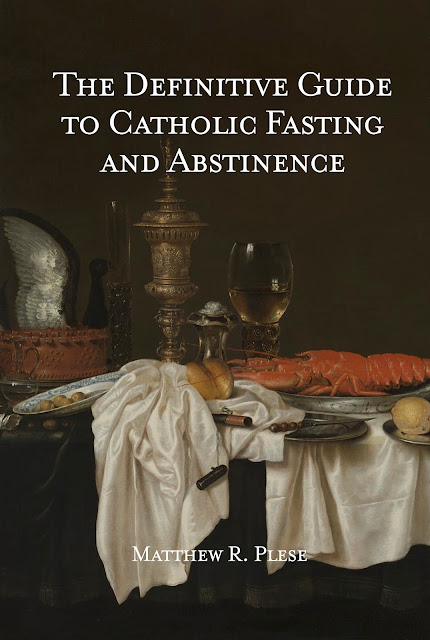
Want to learn more about the history of fasting and abstinence? Check out the Definitive Guide to Catholic Fasting and Abstinence.

Digital Version:

To order a digital .ics file of the above calendar that can be easily imported into your calendar application (e.g., Outlook, Google, Apple, etc.), order below. 

The file is only $5.95. Please order it by clicking here.

After you complete the order, you will have a ZIP file. You MUST unzip that file to extract the ICS file. That ICS file can be added to the calendar application of your choice. Check out details for how easy it is to add an ICS file (after you unzip it) online.

Note that the file is a free benefit to all my Patreon members. So, if you become a patron, you will get that and many other benefits.

Read more >>
Monday, September 15, 2025
Eggs in the History of Catholic Fasting and Abstinence

Of all the changes in Catholic fasting and abstinence across the centuries, few are as striking as the regulation of eggs. Today, Catholics rarely think of eggs as a “penitential food,” but for well over a millennium they were strictly forbidden during Lent, alongside dairy and animal fat. Understanding the history of these rules helps us appreciate both the rigor of earlier generations and the cultural traditions that flowed from them as detailed in The Definite Guide to Catholic Fasting and Abstinence.

1. The Ancient and Patristic Church

Early Christian fasting was extraordinarily strict.

Dr. K.A. Heinrich Kellner records that in the ancient Church, especially in Holy Week, food was reduced to bread, salt, and water. The Apostolic Constitutions forbade flesh and wine for all of Lent and prescribed total abstinence on Good Friday and Holy Saturday. St. John Chrysostom testifies that in Antioch, no flesh was eaten during the whole of Lent. Crucially, milk and eggs (lacticinia) were also excluded as a general rule.

The Council of Trullo (692) confirmed this universality, forbidding the eating of eggs and cheese in Lent, even on Sundays, under penalty of deposition for clerics and excommunication for laymen (Canon 56).

Thus, from the earliest centuries, Lenten fasting meant abstaining not only from meat but also from dairy, eggs, and animal products.

2. Pope St. Gregory the Great and the Medieval Consensus

In 604, Pope St. Gregory the Great summarized the law succinctly: “We abstain from flesh meat and from all things that come from flesh, as milk, cheese, and eggs.”

This form endured for nearly a thousand years. Whenever fasting was observed, abstinence was also observed. Thus: Lent = no meat, no eggs, no dairy, no animal products.

By the time of St. Thomas Aquinas, the Lenten fast still forbade lacticinia, while Fridays and other non-Lenten abstinence days had already relaxed to permit dairy and eggs. This distinction became fixed: Lent retained the stricter prohibition, while non-Lenten abstinence was milder.

3. Culture and Custom

From this tradition arose beloved customs:

  • Shrove Tuesday pancakes used up eggs and butter before Lent.
  • Easter eggs became a festive symbol of the Resurrection precisely because they were absent for 46 days.

In some countries, exceptions were made. As Fr. Francis Weiser notes, Scandinavia was never bound to strict lacticinia abstinence because substitutes were scarce; dispensations were common, often accompanied by pious almsgiving.

Even so, the general discipline remained firm until the modern era.

4. 19th-Century Relaxations

By the 19th century, the Church had begun granting wider concessions.

In 1886, Pope Leo XIII permitted meat, eggs, and dairy on Sundays of Lent and at the main meal on every weekday except Wednesday and Friday in the United States. Holy Saturday was excluded. This marked a decisive relaxation.

Mara Morrow notes that Leo XIII also allowed eggs and dairy at the evening collation daily during Lent and permitted bread with coffee or chocolate in the morning. These mitigations were part of a broader trend: the use of lard and meat drippings was allowed, and those exempt from fasting could eat eggs and milk more than once a day.

A 1905 Irish catechism by Fr. Patrick Power still listed milk, butter, cheese, and eggs as forbidden in Lent, though he acknowledged that some countries allowed milk at collation. Dispensation varied widely by nation.

5. The 1917 Code of Canon Law

The 1917 Code decisively ended the universal prohibition of lacticinia during Lent. 

  • Canon 1250: abstinence forbids meat and soups made with meat, “but not eggs, milk, and other condiments, even if taken from animals.”
  • Canon 1251: mixing meat and fish in the same meal was permitted.

From this point, eggs and dairy were no longer excluded by law, even during Lent. The ancient and medieval practice was officially abrogated.

6. Mid-20th Century Clarifications

By the 1950s, theologians such as Fr. Dominic Prümmer explained the law clearly: abstinence forbade flesh meat and broth, but not eggs, dairy, or animal fats. In case of doubt, one was free to eat, since the law did not bind in uncertainty.

Thus, by mid-century, eggs were firmly reclassified as a permitted food on both fasting and abstinence days.

7. Today’s Law

Under the 1983 Code of Canon Law:

  • Fasting (Ash Wednesday and Good Friday): one full meal and two smaller meals, no restriction on eggs.
  • Abstinence (Fridays of Lent): no meat, but eggs fully permitted.
  • Year-round Friday penance remains binding, but abstinence from eggs is nowhere in view.

8. Conclusion

For more than a millennium, the Catholic Church’s Lenten discipline excluded not only meat but also eggs and dairy. This practice, deeply rooted in the patristic and medieval Church, gave rise to traditions such as Easter eggs and Shrove Tuesday pancakes. Outside Lent, however, abstinence days rarely included eggs after the early Middle Ages.

From Pope St. Gregory the Great through St. Thomas Aquinas, lacticinia abstinence was normative in Lent. Dispensations and mitigations appeared over time, culminating in Pope Leo XIII’s late-19th-century relaxations and the 1917 Code’s universal allowance of eggs and dairy. Today, the Church’s law requires only abstinence from meat, leaving eggs entirely permitted.

Still, some Catholics voluntarily restore the older discipline of giving up eggs and dairy during Lent, rediscovering a penitential practice that once united Christendom and sanctified the approach to Easter.

Want to learn more about the history of fasting and abstinence? Check out the Definitive Guide to Catholic Fasting and Abstinence.

Read more >>
Thursday, September 4, 2025
Walking Through the Holy Doors: My Pilgrimage During the 2025 Jubilee Year

Scriptural Basis for Jubilee Years

One aspect of being Catholic that is often not discussed, as it comes up usually a few times in a person’s lifetime, is the observation of Holy Years of Jubilee. Beyond the weekly, monthly, and annual cycle that we know well as Catholics, there is the Jubilee cycle that comes less frequently. The website FishEaters does a good job introducing the origin of Jubilee Years:

In the Old Covenant, God set aside certain times to be honored as sacred. As recorded by Moses in Exodus 20:8-11, there was to be a weekly "Sabbath" -- which means "cease" or "rest." In Deuteronomy 16:16-17, Moses records God's commands to our spiritual ancestors to keep the yearly Passover, the Feast of Weeks, and the Feast of Tabernacles. In addition to these weekly and yearly cycles of time, God also ordered periodic year-long sabbaths. These "sabbatical years" were of two types: the regular sabbatical year which was to take place every 7th year, and the special year of Jubilee, which took place after "seven weeks of seven years," or after 49 years -- that is, in every 50th year. All told, then, every 7th, 14th, 21st, 28th, 35th, 42nd, 49th, and 50th years would be sabbath years, with two years in a row -- the 49th year and the 50th year of jubilee -- being such. The word "jubilee" is a Hebrew word which etymologically indicates the ram's horn -- "jobel" (also "shofar") -- that God ordained should announce these special sabbatical years in Leviticus 25:1-13

The Church has accordingly adopted this practice and continued it, since our Lord Himself said He came not to abolish the Old Law but to perfect it. We see this in many different aspects of the Old Testament such as the ritualistic observances in worship and even the vestments.

The Holy Years

Writing for the National Catholic Register, Father Raymond de Souza writes:

There will be a holy year in 2025, keeping the tradition of holy years every quarter-century. The last holy year was the extraordinary Jubilee of Mercy in 2015-2016; before that there was the “ordinary” holy year of 2000, styled the “Great Jubilee.” The previous ordinary Holy Year was in 1975.

But in the last century we have seen more Holy Years, in addition to Jubilee Years, as Father De Souza notes:

In 1933, Pope Pius XI called an extraordinary jubilee year for the 1,900th anniversary of the redemption…The idea of “special years” has become a key pastoral tool in the last century. The tradition of holy years began in 1300, with invitations for Catholics to make a pilgrimage to Rome. Eventually the interval between holy years was shortened from 100 to 25 years, so that everyone might (theoretically) have a chance to complete a holy year pilgrimage during his lifetime.

Special holy years were issued in 1954 (Marian Year), 1967 (Year of Faith), 1983 (Jubilee of Redemption), 1988 (2,000th Anniversary of the Blessed Virgin Mary's Birth), 2002 (Year of the Rosary), and 2004 (Year of the Eucharist). Closer to our own time Pope Benedict XVI observed three such years throughout his pontificate: The Year of St. Paul, the Year for Priests, and the Year of Faith. In 2015 Pope Francis called an extraordinary Jubilee of Mercy and followed in 2019 with the Year of Our Lady of Loretto and in 2020 with the Year of St. Joseph.

The Holy Doors (Portae Sanctae)

Jubilee Years in particular are special as they are opportunities for us to invoke the mercy of God in a special way and come to Rome on pilgrimage to enter the Holy Doors which are only ever open in Jubilee Years. FishEaters elaborates on that:

The Sacrament of Confession can be likened to God's granting to us what He commanded to Moses: "remission to all the inhabitants of thy land: for it is the year of jubilee." In these holy years, penance is key (a General Confession in Jubilee Years is recommended by Pope Benedict XIV). 

In addition to the special emphasis on the alleviation of the eternal effects of sin through the Sacrament of Confession, the temporal effects of sin are a focus of Jubilee Years, too. A plenary indulgence can be gained, under the usual conditions, by making a pilgrimage to the four primary patriarchal churches in Rome and walking through their Holy Doors (portae sanctae), which are symbolic of Christ. This is the standard requirement for the Jubilee indulgence, but the exact requirements (published when the Jubilee is announced) may vary from Jubilee to Jubilee and usually include provisions for visiting local churches, doing charitable works, or fasting, etc.

The Holy Doors are present in the four major Basilicas of Rome. In the past few years, some additional Holy Doors were established by the Holy See. To see the opening of the Doors, or to walk through them during the Holy Year, is an experience that one will not forget. The Holy Jubilee of 1950 was documented by Life Magazine and with the advent of television, most Catholics had their first opportunity to ever see the ceremony of their opening.


My Experience of the Jubilee Pilgrimage

This year I had the privilege of personally taking part in the Jubilee. A Jubilee Year is not just a theological concept or a historical tradition, but a lived reality for those who make the journey. Walking through the Holy Doors of the four major basilicas of Rome was a moment of profound grace and awe. The prayers, confessions, and indulgences connected with the Jubilee all came alive when I was physically present in the Eternal City, following the same path that countless pilgrims have walked for centuries.

During this Jubilee pilgrimage, I was blessed to walk through all the Holy Doors of the four Major Basilicas, each one a profound reminder of Christ as the true gate of salvation. I prayed at the tomb of St. Lawrence, venerated the relics of the saints—including the foot of St. Mary Magdalene, the True Cross, and even the Crib of Bethlehem—and gazed upon the breathtaking Ecstasy of St. Teresa. Each day I was able to assist at the Traditional Latin Mass, uniting my prayers with countless pilgrims across the centuries. On a lighter note, I even mailed a letter to the Holy Father, savored the incomparable cuisine of Rome, and managed to log over 30,000 steps daily in the sweltering summer heat—a reminder that pilgrimage is both a spiritual and physical journey.

The Church reminds us that these years are not meant simply as a commemoration, but as a true call to conversion and renewal. That truth was something I felt tangibly as I entered each basilica, joined the faithful from every nation, and reflected on the mercy of God poured out so abundantly in these extraordinary times.

In this article, I have included several of my own photographs from the pilgrimage. They capture not only the grandeur of the basilicas and the Holy Doors but also the spirit of joy and prayer that filled the streets of Rome. These images, I hope, convey some of the sense of sacredness and unity that a Jubilee offers to the universal Church.
Read more >>
Wednesday, June 25, 2025
Is Abstinence Required on Civil Holidays?


For Traditional Catholics seeking to preserve the venerable customs of penance and prayer, the question naturally arises in 2025: Since July 4th falls on a Friday this year, are we still obligated to abstain from meat?

In today’s Church, the answer would be no—abstinence on Fridays outside of Lent is only “especially recommended,” not required. But for those who strive to maintain the immemorial practices of the Church, the answer lies in a deeper look at history, law, and the exceptions once granted for civil holidays like Independence Day.

Traditional Law: Friday Abstinence Is the Norm

From the earliest centuries, Friday abstinence was a universal precept. As a weekly commemoration of the Passion of Our Lord, it was required throughout the year. This obligation continued with few interruptions until modern times. Even into the 20th century, the 1917 Code of Canon Law mandated abstinence from meat on all Fridays of the year unless a Holy Day of Obligation occurred on that day outside of Lent. Before, even Fridays that were Holy Days of Olbligation still required abstinence, Christmas Day being the only exception.

Importantly, July 4th—the United States' Independence Day—has never been a Holy Day of Obligation. Thus, under traditional law, it remained a day of required abstinence whenever it fell on a Friday.

The 1931 Indult for Civil Holidays

However, a notable exception was introduced in 1931. Cardinal Fumasoni Biondi, Apostolic Delegate to the United States, communicated a special indult from Pope Pius XI allowing American bishops, ad quinquennium (for five years), to dispense from the laws of fasting and abstinence on civil holidays. As he wrote:

“The Sacred Congregation of the Council, in a letter dated 15 Oct 1931, informs me that, in view of the difficulties experienced by the faithful in observing the laws of fast and abstinence on civil holidays, His Holiness, Pius XI... granted to all the Ordinaries of the United States... the faculty to dispense their subjects from the laws in question whenever any of the civil holidays now observed occurs on a day of fast and abstinence, or of abstinence.”

This privilege, while notable, was:

  • Temporary: It lasted only five years unless renewed.
  • Discretionary: Bishops could exercise this faculty but were not required to.
  • Not self-executing: The faithful could not assume they were dispensed unless their bishop officially declared it.

Even into the 1950s and early 1960s, bishops selectively used this privilege. Some issued formal dispensations when a civil holiday fell on a Friday (e.g., the day after Thanksgiving), but others did not.

Independence Day: No Permanent Dispensation

There was never a permanent, universal dispensation from Friday abstinence for the Fourth of July.

Unlike myths surrounding the so-called “turkey indult” for the day after Thanksgiving, there is no documented perpetual exemption for meat consumption on Independence Day—even under Pope Pius XII or John XXIII. Any dispensation from Friday abstinence on July 4th had to be granted explicitly by the local bishop and typically appeared in diocesan announcements or parish bulletins.

Furthermore, by 1962—the benchmark year for many traditional Catholics—the universal law was still clear: unless July 4th was a Holy Day of Obligation (which it was not), or unless a specific diocesan dispensation was announced, the law of abstinence applied.

What Changed After Vatican II?

With Paenitemini in 1966, Paul VI allowed bishops’ conferences to substitute other forms of penance for Friday abstinence. The U.S. bishops followed suit, and Friday abstinence became “especially recommended,” but no longer binding under pain of sin outside of Lent.

This relaxation, coupled with the dramatic reduction in fasting days, has contributed to a massive weakening of Catholic penitential identity. But for those attached to the Traditional Latin Mass and the older calendar, fidelity to the traditional norms remains a vital part of living the liturgical life.

So, What Should a Traditional Catholic Do on Friday, July 4, 2025?

Unless a competent traditional priest or bishop explicitly dispenses the faithful from abstinence, the traditional law remains binding. Independence Day—though a civic holiday—is not a feast of the Church, and it has never been granted a permanent exception. Thus, traditional Catholics should abstain from meat on Friday, July 4th, 2025.

This act of penance is not a rejection of patriotism but a higher form of devotion: honoring the sacred customs of the Church above the shifting preferences of modernity.

Recovering a Lost Rhythm

Throughout the past two centuries, Catholic discipline in America has steadily waned. From a time of over 30 Holy Days of Obligation, year-round Saturday abstinence, and strict fasting regulations, we now find ourselves with a minimal observance required under current law.

But as St. Francis de Sales wisely said, “If you’re able to fast, you will do well to observe some days beyond what are ordered by the Church.”

For those who long to recover the rhythm of Catholic life, the solution lies not in waiting for mandates, but in choosing to voluntarily embrace tradition. This July 4th, let us abstain from meat, pray for our nation, and offer up our penance for the conversion of America and the restoration of Catholic order.

Want to learn more about the history of fasting and abstinence? Check out the Definitive Guide to Catholic Fasting and Abstinence.

Read more >>
Sunday, March 23, 2025
A Catholic Life Podcast: Episode 107

In today’s episode, on the Third Sunday of Lent, I address the 4 Types of Penance, the importance of offering up all actions of our life for souls, and provide 20+ examples of ways to live out penance both during and after Lent.

  1. What is Penance: Offering It Up
  2. The 4 Types of Penance
  3. 20+ Options for Penance Now and Beyond Lent

This episode is sponsored by PrayLatin.comPrayLatin.com offers Latin prayer cards to learn and share prayers in the sacred language. Learn your basic prayers in Latin conveniently on the go. Practice your pronunciation with easy-to-follow English phonetic renderings of Latin words. PrayLatin.com offers prayer cards in various formats, including Latin-English rosary pamphlets with the traditional 15 mysteries. Shop for additional Latin resources like missal booklets, server response cards, and more. Visit PrayLatin.com today.

Subscribe to the podcast on Buzzsprout, Apple Podcasts, Spotify, I-tunes, and many other platforms!

Read more >>
Friday, March 7, 2025
Eating Meat on a Friday is a Mortal Sin

Laws of Fast and Abstinence Bind Mortally

To ignore the law of fasting or abstinence from meat is a grave sin. Why? Because it is an act of disobedience to God's Church. We do not abstain from meat on Fridays for instance because the meat is unclean or evil. It is the act of disobedience that is evil. As Fr. Michael Müller remarks in his Familiar Explanation of Christian Doctrine from 1874: "It is not the food, but the disobedience that defiles a man."

To eat meat on a forbidden day unintentionally, for instance, is no sin. As the Scriptures affirm it is not what goes into one's mouth that defiles a man but that disobedience which comes from the soul (cf. Matthew 15:11). But to eat meat on a Friday or to refuse the law of fasting on required days is a serious sin because of disobedience.

To ignore the law of Friday abstinence is a mortal sin and not merely a venial sin. This was made clear by both Pope Innocent III in the 13th century and Pope Alexander VII in the 17th century who both assert that to violate the law of abstinence on a required day is a mortal sin. The Catholic Encyclopedia explains this rationale:

The Church enjoins the ways and means whereby her subjects must satisfy the obligation of doing penance inculcated by natural law. Many of the Fathers allude to the exercise of ecclesiastical authority in reference to the obligation of abstinence. The disciplinary canons of various councils bear witness to the actual exercise of authority in the same direction. Texts of theology and catechisms of Christian doctrine indicate that the obligation of abstaining forms an element in one of the Commandments of the Church. Satisfaction for sin is an item of primary importance in the moral order. Naturally enough, abstinence contributes no small share towards the realization of this end. As a consequence, the law of abstinence embodies a serious obligation whose transgression, objectively considered, ordinarily involves a mortal sin. The unanimous verdict of theologians, the constant practice of the faithful, and the mind of the Church place this point beyond cavil. They who would fain minimize the character of this obligation so as to relegate all transgressions, save such as originate in contempt, to the category of venial sin are anathematized by Alexander VII [Cf. Prop. 23, ap. Bucceroni, Enchiridion Morale, 145 (Rome, 1905)]. 

In fine, the Trullan synod (can. 58, ap. Hefele, ‘History of the Councils of the Church’, V, 231, Edinburgh, 1896) inflicts deposition on clerics and excommunication on laymen who violate this law. Furthermore, theologians claim that a grievous sin is committed as often as flesh meat is consumed in any quantity on abstinence days (Sporer, Theologia Moralis super Decalogum, I, De observ. jejunii, # 2, assert. II), because the law is negative, and binds semper et pro semper. 

If you cannot resist having meat on Friday, how can you possibly resist more insidious assaults from the devil? The same can be said for a day of fasting – if you cannot refuse food for a short time, how can you reject serious temptations against purity, humility, or pride?

Want to learn more about the history of fasting and abstinence? Check out the Definitive Guide to Catholic Fasting and Abstinence.
Read more >>
Monday, February 24, 2025
Rediscover the Power of Traditional Catholic Fasting

For centuries, fasting and abstinence were essential pillars of Catholic life. Saints, clergy, and lay faithful alike observed rigorous fasting disciplines—not out of mere obligation, but as a means of penance, spiritual purification, and reparation for sin. Sadly, these practices have been largely forgotten or dramatically reduced in modern times.

But what if we could reclaim them?

What if Catholics everywhere once again embraced fasting—not just as a personal devotion, but as a movement for the restoration of Christendom?

That’s exactly what we seek to do.

Step 1: Learn the Tradition

📖 The Definitive Guide to Catholic Fasting and Abstinence by Matthew Plese provides everything you need to know about the traditional discipline of fasting—what it was, how it changed, and how you can restore it in your own life.

This book traces the history of Catholic fasting back to the early Church, when Christians observed rigorous Lenten fasts, abstained from all meat and animal products, and kept strict Ember Days and vigils. It covers how the discipline gradually eroded, especially after the 1917 Code of Canon Law, and how Vatican II’s reforms nearly erased fasting altogether.

If you’ve ever wondered why Catholics today fast so little compared to past centuries—or if you feel called to do more but don’t know where to begin—this book is your guide.

Step 2: Live the Tradition

💪 Learning about fasting is one thing. Living it is another. That’s why we invite you to join the Fellowship of St. Nicholas—a traditional Catholic sodality dedicated to restoring penance and fasting.

Under the patronage of St. Nicholas—who was known not just for his charity but for his lifelong fasting—the Fellowship calls Catholics to band together in prayer, penance, and reparation.

St. Nicholas’s own life exemplifies the ancient fasting tradition. As the Roman Breviary recounts, even as an infant, he fasted from his mother’s milk twice a week, only nursing after sunset on Wednesdays and Fridays. He kept this discipline for his entire life, modeling for us a path of self-denial and holiness.

Inspired by this, the Fellowship of St. Nicholas commits to structured fasting and abstinence based on the traditional rules of the Church.

Tier 1 follows the 1917 Code of Canon Law as a minimum, while eliminating the compromise of partial abstinence. This includes:

  • No meat on any Friday of the year
  • No meat for the entirety of Lent, including Sundays
  • Abstinence on Ember Days and major vigils
  • A strict fast (one meal a day, preferably after 3 PM) on traditional fasting days

Tier 2 expands upon this, restoring the ancient Lenten fast as a fully vegan discipline—no meat, dairy, or eggs. It also extends fasting into Advent, bringing back the observance of St. Martin’s Lent, and observes abstinence on Rogation Days.

Tier 3 goes even further, reintroducing fasting periods such as the Apostles’ Fast in June and the Assumption Fast in August, along with additional vigils and Ember Days.

This is not about personal asceticism—it is about restoring the Catholic way of life. As St. Leo the Great reminds us:

“The exercise of self-restraint which an individual Christian practices by his own will is for the advantage of that single member; but a fast undertaken by the Church at large includes everyone in the general purification. God’s people never is so powerful as when the hearts of all the faithful join together in the unity of holy obedience.”

For too long, Catholics have been told that fasting is optional, that penance is just a personal devotion, and that we need only do the bare minimum. But the saints did not think this way. Christ Himself fasted. The Apostles fasted. Entire Catholic civilizations observed rigorous fasting as a standard practice.

Now is the time to take it back.

Step 3: Join the Movement

If you feel called to more than just the modern minimal requirements—if you want to fast as Catholics always did—then join us.

👉 Join the Fellowship today! Connect with us on Telegram: https://t.me/+aXEK-WgNzL42NmJh

📚 Get the book and arm yourself with knowledge – Order The Definitive Guide to Catholic Fasting and Abstinence and learn what true Catholic fasting is.

🔥 This Lent, don’t settle for the bare minimum. Reclaim fasting. Restore penance. Help bring back the traditions that sanctified generations before us.

Read more >>
Tuesday, February 18, 2025
Traditional Maronite Catholic Fasting

While many people use the term “Roman Catholic” and “Catholic” as synonymous, they are not actually the same. Unbeknownst to many, there are more than 20 different Catholic Rites and several Churches which are all in Communion with and under obedience to Rome. All these Catholics are fully Catholic in the complete sense. All Catholics must believe the same dogmas of the Faith, have valid Sacraments, and maintain apostolic succession; even though they may differ in some Rites of worship, in popular devotions, and in various disciplinary matters which are governed by human law. This is entirely different from Protestantism, which is foreign to the religion founded by Jesus Christ since Protestants reject many necessary teachings, have placed themselves outside of the authority of the Catholic Church, and also do not have all valid Sacraments.

One of these Catholic rites is the Maronite Rite. The liturgical language is Aramaic. The 3 million Maronites are found in Lebanon (origin), Cyprus, Egypt, Syria, Israel, Canada, US, Mexico, Brazil, Argentina and Australia. Unfortunately, among the Eastern Rites, the Maronite one has been heavily modernized in the past 60 years.

While fasting and abstinence after Vatican II were all but eliminated in the Roman Catholic Church, fasting and abstinence are still practiced – though not always under penalty of sin – by Eastern Rite Catholics. 

For instance, the following guidelines were issued in 2023 by the Maronite Patriarch, His Eminence and Beatitude Mar Bechara Boutros Cardinal Rai, for Maronite Catholics:

  • Fasting from midnight to midday on all weekdays from Ash Monday to the Saturday of Light (8 April [this year]): no food or drink is to be consumed, with the exception of water. 
  • Abstaining from consuming meat and dairy on the Fridays of Lent; and throughout the first and last week of Lent (Holy Week).
  • Fasting and Abstinence on Saturdays and Sundays are not an obligation, with the exception of the Saturday of Light (Easter Saturday), where fasting and abstinence are to be observed.
  • In 2023, the following feast days fall within the Lenten Season: St John Maroun (2 March), The Forty Martyrs (9 March), St Joseph (19 March), St Rafqa (23 March), The Annunciation (25 March). We do not fast or abstain on these feast days. 

Even with these guidelines, food and water are permitted when needed to take medicine, for those sick or elderly, and for school children. The guidelines end with the note: “A person who cannot fast or abstain may choose another form of penance.”

In comparison, the Maronite Synod of 1736 stipulated the following regulations that were kept at least until the 1920s:

  • Great Lent from Quinquagesima to Easter: Abstinence every day; fasting every day except on Sundays and Saturdays (with the exception of Holy Saturday)
  • Apostles Lent: Abstinence four days from 25th - 28th June
  • Assumption Lent: Abstinence eight days 7th - 14th August
  • Christmas Lent: Abstinence twelve days 13th - 24th December
  • Abstinence every Wednesday and Friday except: from Christmas to Epiphany, the Friday before Great Lent, from Easter to Pentecost, June 24th and 29th; August 6th and 15th
  • Forbidden foods: Like most oriental Christians, the Maronites kept the Mosaic ban on eating blood, suffocated animals and certain animals considered impure; and which Oriental Church Councils have many times renewed. 

In this context, fasting forbids the consumption of food or drink until midday. And for abstinence, eating any meat, oil, wine, and animal products (e.g., eggs, milk, and cheese) was forbidden. Hence, even the Maronites saw a reduction in their fasting by the 20th century.

The Ukrainian Catholic Church also encourages its members to keep these traditional fasting periods: Great Lent, the Apostles’ Fast, the Nativity Fast, and the Dormition Fast. To these, they also add “the Eve of Theophany, the Exaltation of the Cross and the Beheading of John the Baptist”  as fasting days, with wine and oil allowed.

Want to learn more about the history of fasting and abstinence? Check out the Definitive Guide to Catholic Fasting and Abstinence.

Read more >>
Friday, December 27, 2024
2nd Edition of "Restoring Lost Customs of Christendom" Now Available

"The best advice that I can give you is this: Church traditions - especially when they do not run counter to the faith - are to be observed in the form in which previous generations have handed them down...the traditions which have been handed down should be regarded as apostolic laws" (St. Jerome in Letter 71)

I'm honored to announce the publication of the slightly expanded 2nd edition of the book by Our Lady of Victory Press entitled "Restoring Lost Customs of Christendom." The 2nd edition includes three new chapters not featured in the first edition (i.e. Customs for St. Joseph's Day, St. Anne's Day Customs, The Customs for the Vigil, and Feast of St. John the Baptist) along with a much expanded catch-all chapter on various saint day customs throughout the liturgical year.

Preface

Under the Old Testament laws, God’s people observed annual ceremonies commemorating important events in salvation history which prefigured the completion of the Old Law through Christ. Similarly, Holy Church commemorates important mysteries, events, and persons, using an annual cycle of prayers, Scriptures, hymns, and various spiritual disciplines. In the same way, each of the twelve months has a unique focus, and each day of the week has a unique focus as well. Even in the day, the hours of the day are divided up into canonical hours. In so doing, all time is, in a manner of speaking, consecrated to God since He alone created all time and redeemed all of time.

Unlike the pagan religions which often view time as an endless cycle of death and rebirth, the Christian view of time is linear. While God alone has always existed and has no beginning, time had a beginning. There was a first day on earth. And there will be a last day. There will be a day ultimately when the sun will rise for the last time and when it will set for the last time. Time will end. And God Himself will end it as time belongs to Him. It is our duty to honor God in time. And we can do so by sanctifying the days, weeks, months, and seasons of the year.

The Church’s Liturgical Year is a harmonious interplay of feasts and fasts interwoven in both the temporal and sanctoral cycles that define the rhythm and rhyme of Catholic life. While there are many customs associated with the seasons of the liturgical year and high ranking feast days, the entire year is replete with opportunities to live out our Catholic heritage through the customs our forefathers instituted.

The Church’s annual liturgical calendar is comprised of two different, concurrent annual cycles. First, the Proper of the Seasons, or Temporal Cycle, traces the earthly life of Our Lord Jesus Christ. In the Roman Catholic Church, it consists mainly of Sundays related to the various liturgical seasons – that is, the seven liturgical seasons contained in two cycles of its own: the Christmas Cycle and the Easter Cycle. It starts with Advent then goes through Christmas, Epiphany, Septuagesima, Lent, Easter, and Time after Pentecost. The determination of the date of Easter dictates nearly all the other dates in this cycle. But there is a second cycle: the Proper of the Saints, called the Sanctoral Cycle, which is the annual cycle of feast days not necessarily connected with the seasons.

It’s also important to realize that each rite in the Catholic Church (e.g., Roman, Maronite, Chaldean, etc.) has its own liturgical calendar, and some have multiple uses or forms of the calendar. Even within the same use or form, there are variations according to local customs. For instance, the patron saint of a church or of the cathedral would be ranked higher in the liturgical calendar of that local jurisdiction. Even in the Roman Rite itself, different dioceses, countries, and religious orders would keep some different feastdays. These were listed in the Mass in Some Places (pro aliquibus locis) supplement to the Missal. Beyond the Roman Rite, the Ambrosian, Mozarabic, Lyon, and Bragan Rites are also all part of the Western liturgical tradition. So too are the various Rites for religious orders (e.g., the Carmelite Rite, the Carthusian Rite, the Dominican Rite). These are also part of the Roman Catholic Church.  No one has ever doubted the legitimacy of this liturgical diversity. 

Those who try to discredit the Traditional Latin Mass may try to falsely claim that all Catholics must observe the same calendar of saints. But this is not the case as seen in the liturgical calendar diversity in the different Rites of the Church and in the Roman Rite itself. Even Summorum Pontificium affirmed that the continued use of the older Roman calendar in the traditional Mass and Breviary is permissible. 

Beyond assisting at Mass and praying the Divine Office, we can and should observe the forgotten customs that further underscored authentic Catholic culture. Catholic culture is more than just going to Mass – much more. Catholic culture is built on fasting periods, assisting at Processions, having various items blessed at different parts of the year (e.g. herbs on August 15, grapes on September 8th, wine on December 27th). It features days of festivity like during Martinmas and promotes family time and charitable works like visits to grandparents on Easter Monday. It is replete with food customs to celebrate the end of fasting periods and filled with special devotions during periods of penance. It is our heritage. These traditions are our birthright. They are ours as much as they were our ancestors. We must reclaim them. We must spread them. We must love them and observe them. And this book will show today’s Catholic how.

Ordering Information:

PDF: https://www.patreon.com/acatholiclife/shop/restoring-lost-customs-of-christendom-81175

Kindle: https://amzn.to/41zYx8d

Paperback: https://amzn.to/3TjPqpN

The PDF is free for Patreon supporters at the All-Star Level.

Sample of Endorsements Received:

"In past ages, the lives of Catholics were studded with joyful celebrations of saints and somber calls to penance. The ebb and flow of feasting and fasting gave the Christian religion a distinctive 'thickness' and 'texture': it wasn't a bunch of ideas floating in the clouds but a daily planner filled with concrete actions. In the heady rationalism and hearty optimism that gripped modern reformers, nearly all of this holistic ecosystem was overthrown, and the loss of it meant far more than the loss of parties or Lenten recipes; it meant, for too many, the loss of any relevance of faith to everyday life. What is a Catholic to do in this desert of deprivation? Simple: follow a knowledgeable guide out of it. In this informative book, Matthew Plese, who has devoted himself to studying and living the traditional calendar, takes us step by step through some of the most important 'lost customs of Christendom.' Restoring them, here and there, one by one, we restore ourselves and our families to all that Catholic life can be." 

– Dr. Peter A. Kwasniewski, author of The Once and Future Roman Rite

“Catholics who want to integrate the Catholic customs of ages past will deeply appreciate Restoring Lost Customs of Christendom. Beginning with Advent and continuing through the feasts and seasons of the liturgical year, this complete compendium of Catholic traditions by Matthew Plese will help integrate the ancient traditions of our faith in our families and homes. This treasured volume presents the fasts and feasts, the indulgences and blessings which are the patrimony of our Catholic people.” 

 – Fr. Scott A. Haynes of https://www.mysticaltheologyofthemass.com/

“This compendium is a much-needed help for the family (the domestic church) and parishes and dioceses (the local church) to reclaim Catholic culture. As Catholics, especially those in the United States, we are losing that sense of what set us apart from the world. There should be no difference between our daily calendars and our liturgical calendar. Our lives must daily revolve around the liturgy and this handy book is an excellent guide to reclaim our Catholic ethos.” 

– Fr. John P. Lovell of https://x.com/Fr_Lovell 

Read more >>
Monday, October 14, 2024
2025 Traditional Catholic Fasting and Abstinence Calendar

Click for Larger Size

As a follow-up to my significant research on Traditional (Roman and Eastern) Catholic fasting and abstinence, I have put together a 2025 fasting and abstinence calendar for my devotional purposes. This is a follow-up to similar ones I created over the past several years.

Traditional Catholic Fasting Rules:

Fasting: Fasting refers to how much food we eat. It means taking only one meal during a calendar day. The meal should be an average-sized meal as overeating at the one meal is against the spirit of the fast. Fasting generally means that the meal is to be taken later in the day. Along with the one meal, up to two snacks (technically called either a collation or frustulum) are permitted. These are optional, not required. Added up together, they may not equal the size of the one meal. No other snacking throughout the day is permitted. Fasting does not affect liquids, aside from the Eucharistic Fast which is a separate matter.

Abstinence: Abstinence in this context refers to not eating meat. Meat refers to the fleshmeat of mammals or fowl. Beef, poultry, lamb, etc are all forbidden on days of abstinence. Abstinence does not currently prohibit animal byproducts like dairy (e.g. cheese, butter, milk) or eggs, but in times past they were prohibited. Fish is permitted along with shellfish and other cold-blooded animals like alligators. In times past, days of fast were always days of abstinence as well; however, not all days of abstinence were days of mandatory fasting.

Partial Abstinence: Partial Abstinence refers to eating meat only at the principal meal of the day. Days of partial abstinence do not permit meat to be eaten as part of the collation or the frustulum. Partial abstinence started only in 1741 under Pope Benedict XIV as a concession and as part of a gradual weakening of discipline. Beforehand, days of abstinence were days of complete abstinence.

Fasting, therefore, refers to the quantity of food and the frequency of eating. Abstinence refers to what may or may not be eaten.

Calendar Notes:

1. While Partial abstinence is allowed in the rubrics in place as of 1962, it is a a modern invention and is not part of this calendar. Abstinence is always full, never partial. 

2. All Days of Lent, aside from Sundays, are days of fasting and abstinence. Sundays are days only of abstinence.

3. For Lent only, abstinence refers to all animal products (e.g., dairy, butter, eggs) in addition to meat. This includes Sundays.

4. January 22nd is in the USA only an obligatory day of penance for offenses against the dignity of human life.

5. This calendar keeps the 1954 Roman Catholic Calendar and the pre-1917 practice of anticipating Vigils on Saturday that fall on Sunday in a given year.

6. Major Fasts: Great Lent (March 2 - April 16), Apostles Fast (June 16 - June 28)Dormition Fast (Aug 1 - Aug 14)St. Martin's Lent (Nov 13 - Dec 24).

7. Dominican Specific Fasting Days: April 29, August 3, and October 6 are not on the calendar but will be observed by Dominican Tertiaries per the 1923 Rule (the last one before Vatican II). Same with all Fridays of the year, which Dominicans are asked to keep as days of fasting.

8. Days of fasting generally include all of the Major Fasts as noted above, in addition to the following days when they fall outside those periods: Ember Days, Vigils of the Apostles, and Vigils for Major Feasts. Rogation Days were often days of abstinence but not fast.

9. Before the 1830s, all Saturdays were days of abstinence except during Christmastide (in some places) and on major holidays.

10. Voluntary Saturday abstinence is omitted on current (e.g., Nov 1st) or former Holy Days of Obligation (e.g., May 3rd). Saturday Abstinence used to be obligatory year-round with some exceptions for days "as often as no major solemnity (e.g., Christmas) occurs on Saturday, or no infirmity serves to cancel the obligation.” One exception granted in some places was for all Saturdays of the Christmas Season to be exempted.

11. Year Round Wednesdays as days of abstinence are recommended based on the Early Church's practice of Wednesday penance (and based on the wishes of Our Lady of Mount Carmel). Abstinence year-round on Wednesdays would be commendable on all Wednesdays of the year outside of Pascaltide except for those when either a Holy Day of Obligation, Former Holy Day of Obligation, or First Class Feast falls.

12. While part of the Apostles Fast, both the Vigil of Corpus Christi and the Vigil of the Nativity of St. John the Baptist are recommended days of fasting and abstinence

13. Above all, this calendar goes far beyond the mere "minimums," which are virtually non-existent, and attempts to present concrete ways for Catholics to actually fast in the manner our forefathers did.

Want to learn more about the history of fasting and abstinence? Check out the Definitive Guide to Catholic Fasting and Abstinence.

Digital Version:

To order a digital .ics file of the above calendar that can be easily imported into your calendar application (e.g., Outlook, Google, Apple, etc.), order below. 

The file is only $5.95. Please order it by clicking here.

After you complete the order, you will have a ZIP file. You MUST unzip that file to extract the ICS file. That ICS file can be added to the calendar application of your choice. Check out details for how easy it is to add an ICS file (after you unzip it) online.

Note that the file is a free benefit to all my Patreon members. So, if you become a patron, you will get that and many other benefits.

Read more >>
Wednesday, September 18, 2024
The Forgotten History of Catholic Fasting & Abstinence

In today’s special episode published on Ember Wednesday, I address the forgotten history of Catholic fasting and abstinence based on a talk I gave to the Young Adults of St. John Cantius Church in Chicago, IL

For more information, pick up a copy of "The Definitive Guide to Catholic Fasting and Abstinence," of which even many Catholic priests said that 95% of it was new to them. 

Fasting is one of the chief means of penance we can perform to make satisfaction for sin, as our Lady of Fatima repeatedly called for. However, in a modern Church that legislates fasting only two days a year, we find a woefully lacking answer to Heaven’s incessant calls for penance and reparation. Understanding the decline of fasting over time in the Church should inspire us to observe these older customs and to encourage other Catholics to do so for the purpose of making satisfaction for sin.

While the purpose of fasting has remained the same, how fasting is observed has changed. As more Catholics seek to rediscover the traditions of earlier centuries and piously observe these traditions, they are often confused by the changing disciplines and exceptions for certain times, places, and circumstances. St. Francis de Sales remarked, “If you’re able to fast, you will do well to observe some days beyond what are ordered by the Church.”

“The Definitive Guide to Catholic Fasting and Abstinence fills a great lacuna in the life of the Church. Matthew’s articulate and cogent account of an integral Catholic way of life is one which gives rightful place to the body and its healthy, holistic, and holy subordination to the soul and spirit. Matthew’s book is not only a call to arms, but a call to the recovery of the vital narrative memories of the saints of yesterday, who in their fundamental anthropology, struggles, and strivings are no different from us, the saints of today. With sobriety, intelligence, and authentic piety, The Definitive Guide to Catholic Fasting and Abstinence serves as a point of reference, understanding, and motivation so that the strength and the joy of our forefathers may be ours in the here and now.” (Father Cassian DiRocco)

Read more >>
Tuesday, September 17, 2024
Why & How to Make a Family Necrology

What Is Necrology

A necrology refers to a list or record of individuals who have died, especially within a specific community, organization, or during a particular time period. In the context of the Church, religious orders will keep necrologies to record the anniversary of the death of the members of the Order. This gives the community the opportunity to remember to pray for the repose of the soul of its members – even members who died long before the current members were alive. In so doing, we are performing a spiritual work of mercy for souls.

Why Make A Necrology

While we often think of praying for the dead in the month of November, all year we have ample opportunities to pray for the souls of the departed. Through almsgiving, penance, and fasting done with the intention of freeing souls in Purgatory, we can directly help the souls in the Church Suffering. And these souls, when freed from their purgation, shall certainly pray without ceasing for our salvation. 

As we know by Faith, the souls of the suffering in Purgatory can benefit from the prayers and sacrifices of the souls on earth who pray and make reparation while in the state of grace. What have you done for the souls of our brothers and sisters in purgatory who suffer because of their sins?  They cannot pray for themselves but you can free them from their sorrows by making reparation for their sins!

How to Make A Family Necrology

Many people enjoy making family trees and researching their genealogy. And while it may be interesting to learn where your forefathers lived, we should not stop at merely researching their names and dates. These were real people. Their souls are still alive. They are still family members even if centuries separate us from them. We have a familial obligation to pray for their souls. When all who knew them on earth have long since died, we can still pray for their souls each and every year on the anniversary of their death and their birthdays. 

Step 1: Start with the family members who have died that you personally knew on earth. List the names, birthdays, and anniversary of death for everyone in your family tree that you know of. 

Step 2: Next, you can use resources like Ancestry.com or other websites to find the names and dates of other, more distant family members. When you find them, add them to your list.

Step 3: After you have a list, add a recurring reminder to your digital calendars so you can pray for the repose of the soul of each person on the anniversary of their death. If you do not use a digital calendar, make a list ideally in date order (i.e. January through December) and print it out. Keep it near your home altar or prayer corner. Refer to it often so you are not only living liturgically by commemorating the saints of each day but also by recalling the death of your family members and recommending their souls to God.

Step 4: As part of our daily prayers, we should also pray for all our forefathers and ancestors whose names we do not know. To this end, the following prayer for the forgotten dead can be one we print out and say each day:

O merciful God, take pity on those souls who have no particular friends and intercessors to recommend them to Thee, who, either through the negligence of those who are alive, or through length of time are forgotten by their friends and by all. Spare them, O Lord, and remember Thine own mercy, when others forget to appeal to it. Let not the souls which Thou hast created be parted from thee, their Creator. May the souls of all the faithful departed, through the mercy of God, rest in peace. Amen.

May the Lord, in His loving compassion, have mercy on all of our ancestors. May any in Purgatory be soon released and enjoy eternal beatitude in Heaven.

Read more >>
Friday, June 7, 2024
Is Abstinence Obligatory on the Solemnity of the Sacred Heart?

As a reminder, the Feast of the Most Sacred Heart of Jesus, which always falls on a Friday, is still an obligatory day of abstinence. As Catholics, we are still bound to abstain from meat each Friday of the entire year, not just in Lent. We are still bound to abstain from meat each Friday of the entire year, not just in Lent. 

Abstinence Traditionally Required on All Fridays

The 1917 Code of Canon Law stipulated that the requirement to abstain from meat (i.e., Friday penance) was required each and every Friday of the year unless that particular Friday was a Holy Day of Obligation:

"On [Sundays] or feasts of precept, the law of abstinence or of abstinence and fast or of fast only ceases, except during Lent, nor is the vigil anticipated; likewise it ceases on Holy [Saturday] afternoon" (1917 Code, Canon 1252 § 4). [Translation taken from THE 1917 OR PIO-BENEDICTINE CODE OF CANON LAW in English Translation by Dr. Edward Peters]

The 1917 Code introduced the radical notion that a Holy Day of Obligation would eo ipso overrule the requirement of Friday abstinence for any Holy Days of Obligation outside of Lent. Previously, the only day that would automatically abrogate the requirement of Friday abstinence was Christmas Day (December 25th), the exception of which went back to 1216 AD. Before the time of St. Pius X, the Holy Father required a dispensation from Friday abstinence on any other Holy Day of Obligation. The Feast of the Sacred Heart, which was established on the Universal Calendar in 1856, is not a feast of precept (i.e., a Holy Day of Obligation).

The Solemnity of the Sacred Heart Focuses on The Need for Reparation 

Let us never forget that the purpose of the Feast of the Sacred Heart is one focused on penance and reparation. When so many use the modernist 1983 Code to excuse themselves from Friday abstinence, let us, faithful to Tradition, keep today as one of abstinence in reparation to the Sacred Heart as the collect prayer for this feastday urges:

O God, through Your mercy we possess the treasures of Your love in the Sacred Heart of Your Son, the same Sacred Heart which we wounded by our sins. May our honor, devotion, and love make reparation to Him for our faults. Through the same Jesus Christ, our Lord...

Want to learn more about the history of fasting and abstinence? Check out the Definitive Guide to Catholic Fasting and Abstinence.
Read more >>
Monday, June 3, 2024
List of Traditional Catholic Third Orders

The Church is comprised of many members, such as the Mystical Body of Christ. It is composed of priests, nuns, religious or ordered men and women, and lay people. Each person has a unique vocation from God. Let’s learn about many of the positions and roles in the Catholic Church hierarchy.

There are four major religious Orders in the Church, as well as many other branches. One is the Benedictines, who follow the Benedictine Rule. Their mission is “ora et labora” or work and pray. They can be either contemplative or active. Another Order is the Carmelites. They refer to themselves as the “Order of Our Lady of Mount Carmel.” They wear the brown scapular given by Our Lady to St. Simon Stock. They have the spirit of hermits and prefer silence and solitude. Another major Order is the Franciscans. The women’s branch is called the Poor Clares. Both are dedicated to “living the Gospel” and emphasize poverty and simplicity. Then, there are the Dominicans. They are very committed to learning and study whose mission is to share the fruit of their contemplation.

A Third Order is connected to a major Order, such as Third Order Franciscans. These individuals remain members of the laity, but they live by a rule of life (e.g., the Franciscans, Dominicans, Benedictines, etc). They may marry and have a family. But they make special promises to live in a holy way but do not make vows. They do not wear any specific clothing and go about life looking externally like an average Catholic in the pews.

During this period of crisis in the Church, committed Catholics who wish to join a Third Order that is in conformity with the Traditional Catholic Faith and not with Modernism thankfully have options. Here are some of those options:

Traditional Dominicans

There are two traditional Dominican Third Orders (i.e., The Third Order of Penance). There is a group loosely affiliated with the SSPX under Fr. Albert, which is the one that I'm a member of.  Fr. Albert, even though he has left the now-dissolved community in Belgium, still leads the SSPX-affiliated Third Order. The Third Order is very much still active with tertiaries around the country and in other non-US locations. More information can be found online.

The Resistance (i.e., SSPX-SO) has its own Third Order out of France as well. It is still very much active and going strong with tertiaries in the United States and abroad. More information can be found online. More information can be found online.

Traditional Benedictines

Since Benedict of Nursia (AD 480-547) began his monastic quest for God, ordinary Christians have sought guidance from his spiritual teachings. This led to the formation of a communal life where laypeople and secular clergy became affiliated with his communities, a tradition that persists to this day. The term 'oblate' derives from the Latin "oblatus," meaning "one who is offered." Oblates are Christians who affiliate themselves with a Benedictine community, dedicating themselves to God by striving to apply the Rule of St. Benedict to their lives as much as their circumstances allow.

The Monks of Nursia have a very active number of Oblates spread throughout the world. More information can be found online.

Traditional Franciscans

The Franciscan Third Order was established by St. Francis in 1221 to accommodate many married men, women, and diocesan clergy who wished to adopt his way of life but could not join the first or second orders. Within the Third Order of St. Francis, there is a distinction between the Third Order Regular and the Third Order Secular.

Some of these tertiaries eventually began living in communities, which evolved into a religious order that professes vows of poverty, chastity, and obedience. This order is now known as the Third Order Regular (TOR). Members of these communities, whether male or female, live together according to their gender. This branch of the Franciscan Family was officially founded in 1447 by a papal decree that united several groups.

The Third Order Secular (Ordo Franciscanus Saecularis, in Latin), known as the Secular Franciscans, includes devout men and women who do not live in a religious community but lead their everyday lives in the world. Nevertheless, they regularly gather in community and profess vows, committing to live the Gospel following the example of Francis.

The Marian Friars Minor Third Order offers a traditional Catholic Franciscan option. There is also a Franciscan Third Order affiliated with the SSPX.

Traditional Carmelites

The Third Order of Our Lady of Mount Carmel, also known as the Lay Carmelites, is a third order of the Carmelite Order of the Ancient Observance, established in 1476 by a bull from Pope Sixtus IV. It is a community of individuals who choose to live the Gospel in the spirit of the Carmelite Order and under its guidance.

The Traditional Lay Carmelites of Fatima are one option

Other Traditional Options

Besides the aforementioned religious orders, the SSPX has an active Third Order, as does the Priestly Fraternity of St. Peter, which is known as the Confraternity of St. Peter, and the Institute of Christ the King Sovereign Priest has its own Lay Society, which is not strictly the same as a Third Order.

Do you know of any others? Share the details below in the comments box!

Read more >>


Copyright Notice: Unless otherwise stated, all items are copyrighted under a Attribution-NonCommercial-NoDerivatives 4.0 International License. If you quote from this blog, cite a link to the post on this blog in your article.

Disclosure of Material Connection: Some of the links on this blog are “affiliate links.” This means if you click on the link and purchase the item, I will receive an affiliate commission. As an Amazon Associate, for instance, I earn a small commission from qualifying purchases made by those who click on the Amazon affiliate links included on this website. I am disclosing this in accordance with the Federal Trade Commission’s 16 CFR, Part 255: “Guides Concerning the Use of Endorsements and Testimonials in Advertising.”