Showing posts sorted by relevance for query John paul ii. Sort by date Show all posts
Friday, April 4, 2008
Pope Benedict XVI: Celebrates Mass on Third Anniversary of John Paul II's Death

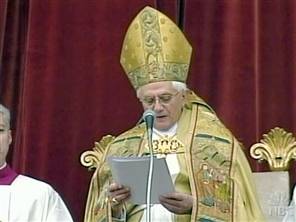
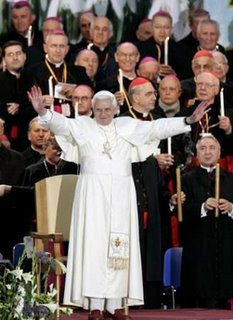
On April 2, 2008, Pope Benedict XVI, still using a new beautiful pastoral staff (ferula), celebrated the Holy Sacrifice of the Mass on the Third Anniversary of the Death of Pope John Paul ll. Below is a copy of his homily along with photographs from the event:

Homily:

Dear brothers and sisters,

The date of April 2 has been imprinted in the Church's memory as the day the Servant of God Pope John Paul II [said] good-bye to this world. Let us again live with emotion the hours of that Saturday afternoon, when the news of his passing away was received by a great multitude of people in prayer who filled St. Peter's Square. For a few days, the Vatican Basilica and this Square truly became the heart of the world. An uninterrupted river of pilgrims paid homage to the remains of the venerated Pontiff and his funeral was a last testament of the esteem and the affection that he had won in the spirit of so many believers and people from all the corners of the earth.

Just like three years ago, today as well, just a short time has passed since Easter. The heart of the Church finds itself still submerged in the mystery of the resurrection of the Lord. In truth, we can interpret the entire life of my beloved predecessor, particularly his Petrine ministry, according to the sign of Christ resurrected. He felt an extraordinary faith in Him, and with Him, he maintained an intimate, unique, uninterrupted conversation. Among his many human and supernatural qualities, he had an exceptional spiritual and mystical sensitivity.

It was enough to see him praying: He literally submerged himself in God and it seemed that everything else during those moments was left outside. During the liturgical celebrations, he was attentive to the mystery being carried out, with a keen capacity to perceive the eloquence of God's word in the development of history, penetrating deeply into God's plan. Holy Mass, as he often repeated, was for him the center of the day and all his existence -- the "living and holy" reality of the Eucharist that gave him spiritual energy to guide the people of God on the path of history.

John Paul II died on the vigil of the Second Sunday of Easter, "the day the Lord made." The throes of death happened on this "day," in the new time-space that is the "eighth day," desired by the Holy Trinity through the work of the incarnate Word, dead and risen. Pope John Paul II showed on various occasions that already from before, during his life, and especially in the fulfilling of his mission as Supreme Pontiff, he was in some way submerged in this spiritual dimension

His pontificate, taken together and in many specific moments, presents itself to us as a sign and testimony of the resurrection of Christ. This paschal dynamism, which made of John Paul II's existence a total responding to the call of the Lord, could not be expressed except without a participation in the sufferings and the death of the divine Master and Redeemer. "This saying is trustworthy," the Apostle Paul says, "If we have died with him we shall also live with him; if we persevere we shall also reign with him" (2 Timothy 2:11-12).

Since childhood, Karol Wojtyla had experienced the truth of these words, finding the cross on his path, in his family, with his people. Very soon he decided to carry it beside Jesus, following in his footsteps. He wanted to be his faithful servant to the point of welcoming the call to the priesthood as a gift and a commitment for all of his life. With Him, he lived, and with Him, he wanted to die. And all of this by way of the unique mediation of most holy Mary, mother of the Church, mother of the Redeemer, intimately and truly associated with the salvific mystery of his death and resurrection.

In this evocative reflection, the biblical readings just proclaimed guide us: "Be not afraid!" (Matthew 28:5). The words of the angel of the Resurrection, addressed to the women before the empty tomb, which we just heard, became a type of motto on the lips of Pope John Paul II, since the solemn beginnings of his Petrine ministry. He repeated them on various occasions to the Church and to the world on the journey toward the year 2000, and after having passed that historical time, as well as afterward, in the dawn of the third millennium. He always pronounced them with inflexible firmness, first raising up [his] crosier predominated by the cross, and later, when his physical energies were weakening, nearly clinging to it, until that last Good Friday, in which he participated in the Way of the Cross from his private chapel, embracing within his arms the cross.

We cannot forget that last and silent testimony of love for Jesus. That eloquent scene of human suffering and faith, in that last Good Friday, also indicated to believers and to the world the secret of every Christian life. That "be not afraid" was not based on human strength, nor on successes accomplished, but rather, only on the word of God, on the cross and resurrection of Christ. In the degree in which he was being stripped of everything, at the end, even of his very words, this total surrender to Christ manifested itself with increasing clarity. As it happened to Jesus, also in the case of John Paul II, words gave way at the end to the ultimate sacrifice, to the gift of self. And death was the seal of an existence totally given to Christ, conformed to him even physically with the traits of suffering and trusting abandonment to the arms of the heavenly Father. "Let me go to the house of the Father," these words -- report those who were at his side -- were his last words, the fulfillment of a life totally oriented to knowing and contemplating the face of the Lord.

Venerated and dear brothers: I give thanks to all of you for having united yourselves to me in this Mass for the soul of the beloved John Paul II. I address a particular thought to the participants in the first world congress on Divine Mercy, which begins precisely today, and which aims to go deeper in his rich magisterium on this theme. The mercy of God, he himself said, is a privileged key for interpreting his pontificate. He wanted the message of the merciful love of God to reach all men and women and he exhorted the faithful to be its witnesses. (Cf. Homily at the dedication of the Shrine of Divine Mercy, Aug. 17, 2002.)

For this reason, he wanted to elevate to the altars Sister Faustina Kowalska, a humble religious converted by the mysterious divine design into the prophetic messenger of divine mercy. The Servant of God John Paul II had known and personally lived the terrible tragedies of the 20th century, and he asked himself during a long time what could stop the advance of evil. The answer could only be found in the love of God. Only divine mercy, in fact, is capable of putting limits on evil; only the omnipotent love of God can topple the dominance of the evil ones and the destructive power of egotism and hate. For this reason, during his last visit to Poland, upon returning to his native land, he said, "Apart from the mercy of God there is no other source of hope for mankind."

Let us give thanks to God because he has given the Church this faithful and courageous servant. Let us praise and bless the Virgin Mary for having ceaselessly watched over his person and his ministry for the benefit of the Christian people and all of humanity. And while we are offering for his chosen soul the redeeming Sacrifice, we ask him to continue interceding from heaven for each one of us, for me in a special way, who Providence has called to take up his inestimable spiritual heritage. May the Church, following his teaching and example, faithfully continue its evangelizing mission without compromises, spreading tirelessly the merciful love of Christ, fount of true peace for the entire world.

[Translated by Kathleen Naab]

Photos:

(AP Photo/Plinio Lepri)


(Reuters/Alessandro Bianchi)

Notice in the above image Pope Benedict XVI is using a papal asteriscus, an item that, in addition to practical applications, symbolizes the Star of Bethlehem. For more information on this rarely used liturgical item, visit The New Liturgical Movement.
Read more >>
Thursday, July 11, 2013
Conciliar Canonization of John XXIII and John Paul II?


The following is taken from Traditional Catholic Remnant.
So it has been recently confirmed that two of the revolutionary Vatican II popes – John XXIII and John Paul II – will be “canonized” by Francis I this December. This news, especially the “canonization” of JPII, comes as no surprise, given the “saint factory” the conciliar church is. Of course two of the worst men to sit in the Chair of Peter are going to be given an honorary “seal of approval” by their modernist successors.

John XXIII reigned from 1958 to 1963. The first of the revolutionary popes, John XXIII was the one who called for a Second Vatican Council, which began in 1962. He died before its completion. There are rumors that he shouted on his deathbed “Stop the Council! Stop the Council!”. This theory leads some Traditionalists to believe that he wasn’t all that bad compared to his successors. However, while I would certainly hope that John XXIII repented of his wicked ways, this claim has never been proven. Thus, our opinion of him should remain that he was a horrible leader for the Church, and was likely a Masonic infiltrator. His successor, Paul VI (who is expected to be “beatified” by the conciliar church soon), who was even more diabolical than his predecessor, was likely an infiltrator as well.

John Paul II reigned from 1978 to 2005, making his reigns one of the longest in Church history. It was also one of the worst, and perhaps THE worst behind only Paul VI. His papacy included a covering up of a plethora of sex abuse cases, two blasphemous inter-religious meetings at Assisi, a phony so-called “third secret” of Fatima released in 2000, and of course, the “excommunication” of Archbishop Lefebvre and the SSPX. Despite his shameful reign, he’s on the way to “sainthood” nevertheless.

Given that Francis is simply another John XXIII or JPII himself, it’s not surprising that he’s cleared these two liberals to be “canonized”. And Paul VI will likely be next. These modernists need to be excommunicated, not “canonized”! How about Canonizing Archbishop Lefebvre instead? But no, instead he’s considered “excommunicated” while these conciliarists are on the way to so-called “sainthood”.

And while these two are on the way to “sainthood”, Popes who are TRULY worthy of Canonization – such as Pope Pius IX and Pope Leo XIII – are ignored. Of course, these Popes had the true Catholic Faith, their Doctrine was undeniably Catholic and contrary to what these conciliarists teach. So to Canonize them would be contrary to their own beliefs, thus why they’re likely being snubbed.

What did Archbishop Lefebvre have to say about these conciliar Popes?

“We must not be afraid to affirm that the current Roman authorities, since John XXIII and Paul VI, have made themselves active collaborators of international Jewish Freemasonry and of world socialism. John Paul II is above all a communist-loving politician at the service of a world communism retaining a hint of religion. He openly attacks all of the anti-communist governments and does not bring, by his travels, any Catholic revival.” (Archbishop Lefebvre, “Marcel Lefebvre: The Biography” by Bishop Tissier, pp. 602-603)

The Archbishop’s words, as usual, are spot-on. Let us not be deceived by these conciliar popes, who are simply wolves in sheep’s clothing. I will conclude with the words of a Pope who was truly worthy of Canonization, the great Pope St. Pius X:

“They [modernists] want to be treated with oil, soap and caresses. But they should be beaten with fists. In a duel, you don’t count or measure the blows, you strike as you can.”
Read more >>
Monday, April 19, 2010
5th Anniversary of the Election of Pope Benedict XVI


V. Oremus pro pontifice nostro Benedicto.

R. Dominus conservet eum, et vivificet eum, et beatum faciat eum in terra, et non tradat eum in animam inimicorum eius.

Deus, omnium fidelium pastor et rector, famulum tuum Benedictum, quem pastorem Ecclesiae tuae praeesse voluisti, propitius respice: da ei, quaesumus, verbo et exemplo, quibus praeest, proficere: ut ad vitam, una cum grege sibi credito, perveniat sempiternam. Per Christum, Dominum nostrum. Amen.

V. Let us pray for Benedict our pope.

R. The Lord preserve him, and give him life, and make him blessed upon the earth, and deliver him not up to the will of his enemies.

O God, Shepherd and Ruler of all Thy faithful people, look mercifully upon Thy servant Benedict, whom Thou hast chosen as shepherd to preside over Thy Church. Grant him, we beseech Thee, that by his word and example, he may edify those over whom he hath charge, so that together with the flock committed to him, may he attain everlasting life. Through Christ our Lord. Amen.

[Prayer is from the Roman Missal.  Attached to the versicle and response is a partial indulgence.]


Today we recall the fifth anniversary of the election of His Holiness Pope Benedict XVI to the Seat of the Vicar of Christ.

Our Holy Father has shown us that through his pontificate, the Sacred Traditions of our Holy Faith are being rightfully restored to their former glory. Let's look at some example of restoration by Pope Benedict XVI.

In August 2006, Pope Benedict XVI abolished the Christmas concert featuring "pop" music established by Pope John Paul II. In January 2007, he called on the Vatican Courts to tighten up the annulment criteria, as annulments have exponentially increased following Vatican II.

Pope Benedict XVI has further restored the use of the Pascal Mozetta in the Octave of Easter 2008.

Examine the vestments used by the Holy Father at the 3rd Anniversary Mass of John Paul II's death in 2008 (below). At this Mass the Holy Father has discontinued using the staff of Pope John Paul II featured a bent Christ on the Cross, aesthetically unpleasant, and replaced it with a new beautiful pastoral staff (ferula).

(Reuters/Alessandro Bianchi)

Notice in the above image Pope Benedict XVI is using a papal asteriscus, an item that, in addition to practical applications, symbolizes the Star of Bethlehem. He has restored it to use in the Papal Liturgy at times.

On the Feast of Sts Peter and Paul 2008, Pope Benedict XVI introduced a different Papal Pallium, establishing better continuity with the past than with the Pallium that became used during the pontificate of John Paul II. "This is the development of the Latin form of the pallium used up to John Paul II," explains the Master of Papal Liturgical Celebrations, Monsignor Guido Marini.

Former Pallium


Restored Pallium

In 2009, the mosaic depicting Pope Benedict XVI in the line of papal portraits in the Basilica of St. Paul Outside the Walls has been changed to reflect this shift in the Papal Pallium.(Above Images from St. Paul Outside the Walls by Pope Benedict Forum user "Benodette".)

And remember that in January 2008, His Holiness Pope Benedict XVI celebrated the Baptism of the Lord ad orientem in the Sistine Chapel.

Believed to be Associated Press (AP)

In January 2009, His Holiness wore a fiddleback chausible on the Feast of the Epiphany. This was another return back to prior Traditions. Pope Benedict XVI again shows his desire for a restoration of the Sacred Liturgy. And while vestments may seem unimportant, continuity with the past and symbolism is highly important. Each vestment has its own vesting prayer, and each particular garment holds symbolic importance (e.g. the maniple symbolizes Christ at the Pillar of Flagellation, the cincture symbols the rope by which Our Lord was bound and dragged in the streets, et cetera).

Therefore, the exteriors again are an expression of the interior. And, in the past 40 years we have lost not only the interior aspects of the Faith (e.g. lack of knowledge of integral Catholic beliefs such as Transubstantiation, etc) and a decrease in devotion but also exterior aspects of the Faith (e.g. vestments, proper Sacred Liturgy, Rosaries, etc). Coincidence or has the loss of exteriors contributed to the loss of interior Faith?


Image Sources: Franco Origlia/Getty Images

And of substantial importance, Holy Communion is to be given only to those kneeling henceforth, when Pope Benedict XVI distributes Holy Communion. EWTN reports, "To receive Communion from Pope Benedict at Papal Liturgies one will have to receive on the tongue," which is a fantastic affirmation of the Real Presence of our Lord. And as the Body and Blood of Jesus, nothing is of higher value than the Most Holy Eucharist.

St. Thomas Aquinas: "Out of reverence towards this Sacrament, nothing touches it but when it is consecrated" - Summa, Pt III Q, Q2 Art. 3

Also from Wikipedia, "Each year a papal tiara is placed on the head of the famous bronze statue of Saint Peter in St. Peter's Basilica from the vigil of the Feast of the Cathedra of Saint Peter on February 22 until the Feast of Saints Peter and Paul on June 29. Although this custom was not observed in 2006, it was reintroduced in 2007."

Finally in this example, compare the below progression of photos of the Urbi et Orbi addresses given on Christmas Day by Pope Benedict XVI.

2005, Source: MSNBC

2006, Source: REUTERS/Osservatore Romano/Handout

2007, Source: CNS photo/L'Osservatore Romano via Reuters

2008, Source: REUTERS/Osservatore Romano

The photos are from 2005 - 2008, and there is a progression in these photos. Tradition is being restored.


For a list of numerous articles on the events in the Pontificate of Pope Benedict XVI, please see the following post: Pope Benedict XVI (permanently linked in the sidebar).
Read more >>
Saturday, August 30, 2014
Vision of Pope John Paul II: Says to Instead Pray to Pope Pius XII

This story was published by Catholic News.  Let us pray for the Canonization of Pope Pius XII:


Rome, Italy, Jan 19, 2010 / 12:21 pm (CNA).- Some details of the case under investigation regarding a possible miracle attributed to Venerable Pope Pius XII have been made public. The story features not just one former Pontiff, but two.

On Tuesday morning, Vatican journalist Andrea Tornielli published an article in Il Giornale describing at length the situation which “mysteriously involves” John Paul II.
Tornielli reported that this case was brought to the attention of Benedict XVI shortly before he approved a measure on Dec. 19, 2009 venerating Pope Pius XII’s life of “heroic virtue,” whose cause had been on-hold for the previous two years.

In 2005, a teacher of 31 years of age was expecting her third child in the city of Castellammare di Stabia. She began to have strong pains, which after many tests and a biopsy, signaled the presence of Burkitt’s lymphoma. The condition is typified by swollen lymph nodes, often starting in the abdominal region, and the cancer can spread to bone marrow and spinal fluid. Not only was her health in danger, but that of her unborn child was also threatened.

The woman’s husband first prayed for the intercession Pope John Paul II, who was then only recently buried in the crypt of St. Peter’s. It wasn’t long before the Holy Father appeared to the woman’s husband in a dream. The spouse described to Tornielli what he saw that night, “He had a serious face. He said to me, ‘I can’t do anything, you must pray to this other priest…’ He showed me the image of a thin, tall, lean priest. I didn’t recognize him; I didn’t know who he might be.”

Several days passed before he, “by chance,” came across a picture of Pope Pius XII in a magazine and recognized him as the man John Paul II had shown him in the dream.

The man wasted no time in bombarding Pius XII with prayers for his wife’s healing and following her very first treatments she was declared free of the cancer, the tumor had disappeared. In fact, she was cured so quickly that her doctors pondered the notion that they may have originally misdiagnosed the pathology.

The tests and charts were reconsulted and the initial diagnosis was confirmed. In the absence of the tumor, she had her baby and returned to work. After some time had gone by, she decided to contact the Vatican regarding her experience.

A local news source, the Sorrento & Dintorni, ran an article on Sunday offering a basic story of the possible miracle and the diocesan response to it. According to their report, a Tribunal has been organized by Archbishop Felice Cece of Sorrento-Castellammare to determine the nature of the occurrence and whether it will move on to the Vatican.

According to Tornielli, if they decide positively, the case will be sent on to Congregation for the Causes of Saints for investigation by a team of doctors to declare whether the event was explicable by natural means. If there is no explanation found for the healing, theologians from the Congregation will debate the issue. Only with their “go-ahead” can a dossier subsequently reach the hands of Pope Benedict XVI for official recognition.

Cardinal Jose Saraiva Martins, Prefect Emeritus of the Congregation for the Causes of Saints, told CNA on Monday that there is no telling how much time the entire process might take.
He also mentioned that if a case arrives to the Congregation for the Causes of Saints it is examined in chronological order based on the date of arrival and there are thousands of cases pending review.

However, he added, “exceptions might be made for Popes, etc.”

There was no mention in Tornielli’s report of where the lymphoma had manifested itself in the woman’s body. According to the National Institute of Health, Burkitt’s lymphoma is treatable and more than half of those diagnosed with the cancer are cured with intensive chemotherapy.
Read more >>
Tuesday, July 7, 2009
Summorum Pontificum: 2 Year Anniversary Celebration


Today the Church observes the second anniversary of the publishing of Summorum Pontificum, the long-awaited motu proprio of Pope Benedict XVI replacing all former "indults" and freeing the Mass of All Times, the Traditional Latin Mass. No longer would a priest have to ask permission of his bishop to say the Mass as the Mass is to be readily offered and available to all of the Faithful.

In honor of this two year anniversary, I offer the following reflections on those individuals who have made such a celebration possible.

The Saintly Example of Archbishop Marcel Lefebvre

It is at this time that I wish to especially remember Archbishop Marcel Lefebvre, who resisted the Second Vatican Council's false propositions of ecumenism, religious liberty, and the altering of the Mass of All Times. It is through his witness and the formation of the Priestly Fraternity of St. Pius X (SSPX) that the Mass of All Times has spread. And, I will venture to say that without Archbishop Marcel Lefebvre's role, the Traditional Latin Mass would have been at last forgotten and no organized resistance to the change would have existed.

Archbishop Marcel Lefebvre

It is Archbishop Lefebvre who has been slandered in recent years. The cause of canonization of his saintly mother has long been forgotten. Instead, in the words of Bishop Bernard Fellay during a sermon in Paris following Archbishop Lefebvre's death said, "Archbishop Lefebvre has gone, but the Mass is saved, the Catholic priesthood is saved..." Because of his resistance to all of changes affecting all of the Sacraments, the Society of St. Pius X is largely responsible for Pope Benedict XVI's issuance of the motu proprio and then the clear declaration that the Bishops of the Society of St. Pius X consecrated by Archbishop Marcel Lefebvre are not excommunicated.

In the words of Father Franz Schmidberger at the Requiem Mass of Archbishop Lefebvre, "The work of the Archbishop on this earth is accomplished. Now begins his ministry as intercessor in eternity. He has given everything he could give...the miracle of a new generation of priests."

Archbishop Lefebvre only wished to teach that which he himself was taught in seminary. He wished to hand on the Catholic faith as taught and celebrated for the past centuries. And his resistance has directly led to the establishment of the Ecclesia Dei Commission and the motu proprio, Summorum Pontificum. I highly encourage the reading of Apologia Pro Marcel by Michael Davies as well as Open Letter to Confused Catholics and The Mass of All Times.

Mortal Remains of Archbishop Lefebvre

"I will finish with my testament. I would like that it be an echo of the testament of Our Lord: a New and Eternal Testament...the heritage that Jesus Christ gave us, His Sacrifice, His Blood, His Cross. I will say the same for you: for the glory of the Holy Trinity, for love of the Church, for the salvation of the world: keep the Holy Sacrifice of Our Lord Jesus Christ! Keep the Mass forever!" (Archbishop Lefebvre, 23rd September 1979)

"Amen, amen I say to you, that you shall lament and weep, but the world shall rejoice; and you shall be made sorrowful, but your sorrow shall be turned into joy" (John 16:20)

Related Posts:
The Saintly Example of Pope Benedict XVI

The response to Pope Benedict XVI's motu proprio Summorum Pontificum shows his wisdom and foresight in freeing the Old Mass in Latin.

The document was issued 7 July, 2007. Since then, the list of Diocesan Masses offered in the United States in the Extraordinary Form has grown by over 100 new Sunday Masses every week. In 30 dioceses, the Mass is now offered where none were said before Summorum Pontificum

The Old Mass in Latin is said daily at 56 locations in 47 dioceses across the United States.

Source: Pamphlet from the Coalition in Support of Ecclesia Dei (May 2009)
Our Holy Father has shown us that through his pontificate, the Sacred Traditions of our Holy Faith are being rightfully restored to their former glory. Let's look at some example of restoration by Pope Benedict XVI.

In August 2006, Pope Benedict XVI abolished the Christmas concert featuring "pop" music established by Pope John Paul II. In January 2007, he called on the Vatican Courts to tighten up the annulment criteria, as annulments have exponentially increased following Vatican II.

Pope Benedict XVI has further restored the use of the Pascal Mozetta in the Octave of Easter 2008.

Examine the vestments used by the Holy Father at the 3rd Anniversary Mass of John Paul II's death in 2008 (below). At this Mass the Holy Father has discontinued using the staff of Pope John Paul II featured a bent Christ on the Cross, aesthetically unpleasant, and replaced it with a new beautiful pastoral staff (ferula).

(Reuters/Alessandro Bianchi)

Notice in the above image Pope Benedict XVI is using a papal asteriscus, an item that, in addition to practical applications, symbolizes the Star of Bethlehem. He has restored it to use in the Papal Liturgy at times.

On the Feast of Sts Peter and Paul 2008, Pope Benedict XVI introduced a different Papal Pallium, establishing better continuity with the past than with the Pallium that became used during the pontificate of John Paul II. "This is the development of the Latin form of the pallium used up to John Paul II," explains the Master of Papal Liturgical Celebrations, Monsignor Guido Marini.

Former Pallium


Restored Pallium

In 2009, the mosaic depicting Pope Benedict XVI in the line of papal portraits in the Basilica of St. Paul Outside the Walls has been changed to reflect this shift in the Papal Pallium.(Above Images from St. Paul Outside the Walls by Pope Benedict Forum user "Benodette".)

And remember that in January 2008, His Holiness Pope Benedict XVI celebrated the Baptism of the Lord ad orientem in the Sistine Chapel.

Believed to be Associated Press (AP)

In January 2009, His Holiness wore a fiddleback chausible on the Feast of the Epiphany. This was another return back to prior Traditions. Pope Benedict XVI again shows his desire for a restoration of the Sacred Liturgy. And while vestments may seem unimportant, continuity with the past and symbolism is highly important. Each vestment has its own vesting prayer, and each particular garment holds symbolic importance (e.g. the maniple symbolizes Christ at the Pillar of Flagellation, the cincture symbols the rope by which Our Lord was bound and dragged in the streets, et cetera).

Therefore, the exteriors again are an expression of the interior. And, in the past 40 years we have lost not only the interior aspects of the Faith (e.g. lack of knowledge of integral Catholic beliefs such as Transubstantiation, etc) and a decrease in devotion but also exterior aspects of the Faith (e.g. vestments, proper Sacred Liturgy, Rosaries, etc). Coincidence or has the loss of exteriors contributed to the loss of interior Faith?


Image Sources: Franco Origlia/Getty Images

And of substantial importance, Holy Communion is to be given only to those kneeling henceforth, when Pope Benedict XVI distributes Holy Communion. EWTN reports, "To receive Communion from Pope Benedict at Papal Liturgies one will have to receive on the tongue," which is a fantastic affirmation of the Real Presence of our Lord. And as the Body and Blood of Jesus, nothing is of higher value than the Most Holy Eucharist.

St. Thomas Aquinas: "Out of reverence towards this Sacrament, nothing touches it but when it is consecrated" - Summa, Pt III Q, Q2 Art. 3

Also from Wikipedia, "Each year a papal tiara is placed on the head of the famous bronze statue of Saint Peter in St. Peter's Basilica from the vigil of the Feast of the Cathedra of Saint Peter on February 22 until the Feast of Saints Peter and Paul on June 29. Although this custom was not observed in 2006, it was reintroduced in 2007."

Finally in this example, compare the below progression of photos of the Urbi et Orbi addresses given on Christmas Day by Pope Benedict XVI.

2005, Source: MSNBC

2006, Source: REUTERS/Osservatore Romano/Handout

2007, Source: CNS photo/L'Osservatore Romano via Reuters

2008, Source: REUTERS/Osservatore Romano

The photos are from 2005 - 2008, and there is a progression in these photos. Tradition is being restored.

Therefore, on this day, July 7, 2009, we remember 2 years of Summorum Pontificum, in large part due to the saintly wisdom of Pope Benedict XVI as he seeks to reform the Church in Her Sacred Liturgy.

The Saintly Example of the Average Priest and Bishop:


Under "Catholic Categories" in the sidebar is a permanent link to the post Tridentine Latin Mass, which features numerous links that I update as often as possible. In this post is a list of parishes, chapels, etc. which have begun to offer the Tridentine Latin Mass during these past two years. Please take a moment to look through this list and consider the impact of the motu proprio. We have parishes from around the country and the world. Remember, this is not a complete list, but only the list which I currently have collected.

And we must not only remember these priests but the many others who began offering the Mass of All Times despite persecution, rejection, and hostility. At this time I can think of Fr. Robert Altier (Archdiocese of St. Paul-Minneapolis) as well as Fr. Scott Archer (Diocese of Peoria). But these are just two of the many priests who encountered rejection from those around them because they sought to make available the Mass of All Times. Let us honor them at this time. Also worth remember, the Faithful in Niafles attached to the Traditional Mass were driven from their Church less than a week before the Motu Prorio was signed.

Of note among the bishops, Bishop Robert C. Morlino responded to the Holy Father’s motu proprio by designating Holy Redeemer Catholic Church as the site for the celebration of the Tridentine Mass for the Madison area. Bishop Morlino inaugurated the use of the Tridentine Mass at Holy Redeemer by celebrating a Solemn Pontifical Mass at the Throne there on the Third Sunday of Advent (December 16, 2007) [Source].

Consider visiting these parishes and/or writing to the pastors to express your support. I have written around half of these parishes, inviting them to share how the Traditional Latin Mass has benefited their parish. If anyone responds with an article, I will publish them on the website as they become available. And do remember to pray for these bishops and priests as well as all priests and bishops who celebrate the Mass of All Times. At this time I also request prayers for the priests and bishop of the Society of St. Pius X, so that they may no longer be slandered and detracted.

Church of the Sacred Heart, Cutchogue, NY
Metropolitan Cathedral, Mexico City, Mexico
Mount St. Francis Hermitage, New York
Our Lady of Lourdes, Massapequa Park, NY
St. Andrew the Apostle, Clifton, VA
St. John the Apostle, Leesburg, VA
St. John the Baptist, Costa Mesa, California
St. John the Beloved Catholic Church, McLean, Virgina
St. John the Evangelist, San Diego, California
St. Joseph Parish, Apple Creek, Missouri
St. Leo the Great, Pawtucket, Rhode Island
St. Maurus, Biehle, Missouri
St. Matthew, Dix Hills, NY
St. Mary, Alexandria, VA
St. Mary of Perpetual Help, Chicago, IL
St. Mary’s By the Sea, Huntington Beach, California
St. Rita, Alexandria, VA
St. Therese in Alhambra, CA
Sts. Peter and Paul Church in Wilmington, CA
Holy Rosary Parish, Sacramento, California
Our Lady of Lourdes, Philadelphia, Pennsylvania
Holy Angels, Aurora, IL
Sts. Peter and Paul, Naperville, IL
St. Bernard, Joliet, IL
Holy Rosary, Cedar, Michigan
St. Jospeh's Parish, Middletown, NY
St. Elizabeth Ann Seton, Carmel, IN
Blessed Sacrament Catholic Church, Birmingham, Al
St. Mary of the Visitation, Huntsville, Al
St. Silvia, Tivoli, NY
Assumption of the Blessed Virgin Mary (Grotto) Parish, Detroit, MI
Immaculate Conception Church 4129 Superior Ave. Cleveland, OH
St Stephen Church 1920 W 54th St. Cleveland, OH
St Mary Church 750 S. Main Street Akron, OH
Immaculate Conception Church 37932 Euclid Ave. Willoughby, OH
Basilica of Saints Peter and Paul, Lewiston, ME
St. Kevin's Church, Harrington Street, Dublin 8, Ireland
St. Ann's Parish, 125 Richardson Ave., Shohola, PA
Mater Dolorosa Church, South San Francisco, CA
St. Peter the Apostle, Merchantville, NJ
Sacred Heart of Jesus, Swedesburg, PA
Chapel of Windermere on the Mount, London, Ontario, Canada
Holy Family Catholic Church in Seattle, WA
Church of North American Martyrs at St. Alphonsus Church, Seattle, WA
Holy Redeemer Cathedral Parish, Madison, WI
St. Norbert Church, Roxbury, WI
Sacred Heart, Dunn, NC
Sts. Peter and Paul, Palmyra, VA
Benedictine Monastery, Norcia, Italy
St. Paul Parish, Philadelphia, PA

Looking Ahead:

Remember that it has only been two years since the promulgation of the motu proprio on July 7, 2007, which took effect on the Feast of the Holy Cross, September 14, 2007. It was on September 14 that countless numbers of Tridentine Masses were celebrated such as the following one.

Here is a list of some of the many places that offered the Tridentien Mass on September 14, 2007.

Assumption Grotto, Detroit, Michigan
Bishop Finn, Kansas City, Missouri
Brompton Oratory, London, England
Franziskanerkirche, Vienna
Holy Trinity German Church, Boston, Massachusetts

As you watch some of the scenes from this Mass in Honor of the Promolgation of the Motu Proprio at St. Patrick's Cathedral in the Archdiocese of New Orleans, please enter into the spirit of joy event in the Liturgy and the music. Even though this Mass remembered the death of our Lord, it focused more particularly on the Cross as the Instrument of our Salvation.

Let us now move forward, seeking to help the restoration of all things in Christ (i.e. E Supremi, Encyclical of Pope St. Pius X). A Catholic Life Blog is willing to publish any and all photos of Traditional Liturgies and articles concerning them, in an effort to help this Restoration. For all such inquiries, please write me through the email address in my Blogger Profile.


Read more >>
Sunday, May 28, 2006
Pope Benedict XVI in Poland - Day Three

Yesterday, Saturday, May 27, 2006, Pope Benedict XVI visited the birthplace of Pope John Paul ll in Wadowice. Pope Benedict XVI accompanied with Cardinal Dziwisz, the longtime secretary of John Paul ll, visited The Basilica of the Immaculate Conception, the place of John Paul ll's baptism. Benedict XVI also journeyed to Pope John Paul ll's boyhood home in the city. In Wadowice, the Holy Father spoke to nearly 30,000 people gathered.

Pope Benedict XVI requested prayers for the canonization of John Paul ll: "I wished to stop precisely here, in the place where his faith began and matured, to pray together with all of you that he may soon be elevated to the glory of the altars."

After that stop, Pope Benedict XVI journeyed to Kalwaria Zebrzydowska, the shrine that John Paul ll frequently went to pray. He said, "I hope that Providence will soon grant us the beatification and canonization of our beloved Pope John Paul II." Continuing the journey of remembrance, Benedict XVI went to the Divine Mercy shrine a Lagiewniki where he took part in Eucharistic adoration and prayed before the relics of St. Faustina. St. Faustina was the one that received the apparitions of Christ concerning the Divine Mercy of our Lord. The Holy Father then addressed the sick saying they are "...united to the Cross of Christ, but at the same time the most eloquent witnesses to the mercy of God."

Pope Benedict XVI ended Saturday with a meeting with the youth. There, to the nearly 1 million gathered in Krakow's Blonie Park, our Holy Father reminded them not to be discouraged by the people who reject the claims of Jesus Christ. He reminded them that St. Peter faced the same anguish. He reminded them not to join the secular world in viewing Christ "a king of the past."

Sunday he is going to visit Auschwitz-Birkenau, the death camp in Poland.

Above Photo Source: Petr David Josek, AP

Photos of his visit with the youth:

(REUTERS/Peter Andrews)

(AFP/Vincenzo Pinto)
Read more >>
Tuesday, May 22, 2012
Marriage in the Heart and Mind of the Church


Written by Preston E Wiggins, Jr, Marriage in the Heart and the Mind of the Church is a series of reflections on the Sacrament of Holy Matrimony.  Intended for couples preparing to receive the Sacrament, this guide prepares the couple for the Sacrament of Matrimony and the interior dispositions necessary for marriage.

Available in a 94-page paperback, this book draws upon the writings of John Paul II, Paul VI, Pius XII, and Christopher West to present a comprehensive marriage preparation aid.  A must-read for all couples and a great resource for parishes to use with couples!

The following is taken from the book's forward:
In his 1978 Apostolic Exhortation Catechesi Tradendae (On Catechesis In Our Time), Pope John Paul II proclaimed “the definitive aim of catechesis is to put people not only in touch but in communion, in intimacy, with Jesus Christ.”  This sounds like a high and lofty goal, but what does it look like?  Our Lord and Savior Jesus Christ taught using parables; this helped His audience to understand because parables bring the supernatural into the natural realm.  His technique was to use a situation that His listeners would be familiar with in order to unveil certain supernatural truths (cf. Mt 11:25).  Can we use this method to find a modern day “visual” (parable) of what exactly does an intimate communion look like?
We are all called, by virtue of our Baptism, to be in an intimate communion with Jesus Christ. I did not really begin to understand what this entails until I was granted the great privilege of being united as one with the former Susan Kamaski.  I had spent two years in a pre-theologate program in serious discernment for the priesthood.  The time was well spent as I drew closer to the Lord, fell more in love with His Church, and built a life firmly anchored on the Rock foundation that is Jesus Christ.  I had no doubt that God, our Father, truly loved me as a beloved son, as did the Blessed Mother.  A relationship I had, but I was not sure just what the nature of that relationship was.
A week after our marriage, I began to realize that there was a different quality to our relationship; we had a union that did not exist before we said, “I do.”  This new intimate communion with Susan was the catalyst for reflection and meditation on the nature of one’s relationship with Jesus Christ.  Two titles of the Church have been the primary fuel of my reflections: the Bride of Christ and the Body of Christ.  In recent years, there has been a widespread discovery of Pope John Paul II’s Theology of the Body,which gave credence to my conviction that the nature of our relationship with Jesus is spousal. 
This book is a tribute to those reflections, guided by the Holy Spirit with frequent contact with Sacred Scripture and the Catechism of the Catholic Church.  These reflections are augmented by the reality of the emotional and psychological damage that children experience due to an unstable family life that my wife has witnessed as a mental health counselor, our own experience as mentors for engaged couples and our involvement in Engaged Encounter.  I have brought these reflections into talks and teaching with head bobs of agreement from the participants.  Hopefully, you, too, will bob your head in agreement and be motivated to do whatever you can to strengthen marriages and families as God has planned from the very beginning.  There is little that is more powerful than prayer and witness of faithful Catholics madly in love with Jesus Christ.
You may purchase physical paper book books at the following link: Lulu.com.
Read more >>
Saturday, December 19, 2009
Pope Pius XII, John Paul II Declared Venerable

The following is an excerpt. My comments are in brackets. Emphasis is in bold.

Image Source: A/P
In a dramatic move, after long hesitation, Pope Benedict XVI has signed a decree declaring Pope Pius XII -- the Pope who led the Church during the Second World War and has been repeatedly accused by many Jewish and progressive Catholic groups of not doing enough to help the Jews during the Nazi persecution -- as "venerable," the first major step on the road toward canonization as a Catholic saint.

In the same decree, Benedict has declared Pope John Paul II, known for his friendship with the Jewish people and his dramatic visits to the synagogue of Rome in 1986 and to the Western Wall in Jerusalem in 2000, as also worthy to be called "venerable" in the Church.

Benedict's decree, published today in connection with the 40th anniversary of the founding of the Congregation for the Causes of Saints, recognizes the "heroic virtues" of the two Popes, paving the way for their beatification and canonization, which can come with the approval of first one, then a second miracle attributed to their intercession.

Also approved were the martyrdom of the Polish priest Fr Popielusko and a miracle attributed to Mary McKillop (Australia).

Pius XII, the Pope who led the Church during the Second World War (he was Pope from 1939 to 1958), and John Paul II (Pope from 1978 to 2005) are now officially to be called "Venerable" (meaning able to be venerated), because Benedict XVI has confirmed that their lives displayed "heroic virtues," that they were heroes because of their remarkable virtue.

This is particularly dramatic with regard to Pius, because he has been accused, not only of not being a hero, but even of being evil, of being "Hitler's Pope." (A book under that title was published several years ago by British author John Cornwell, who later retracted much of what he had written.) The attacks on Pius seem to have given Benedict pause. Not because he believed their truth, but because he knew that many did believe they were true, and would be scandalized if Pius was declared "Venerable" without clarifying that the charges against him were false. This explains why the documentation to sign the Pius XII decree was given to Pope almost two years ago, and not signed until now.

Many Vatican observers had noted that Benedict was taking his time before signing the decree. Senior Vatican officials told me that he was waiting until Jewish and progressive Catholic groups themselves recognized that the charges of anti-Semitism raised against Pius XII were without foundation. And this is what has occurred.

Over the past several years, due in large measure to the work of committed Catholic and Jewish scholars and activists ranging from Sr. Margherita Marchione, an American Catholic nun, to Gary Krupp, an American Jewish businessman, clear evidence that Pius XII worked heroically "behind the scenes" to save nearly 1 million Jews from deportation to Nazi concentration camps has now been discovered and published. (We have printed much of this in the pages on Inside the Vatican magazine.) In fact, this evidence even suggests that Pius XII did more to help victims of the persecution than virtually any other single person in Europe during the war years, making his denigration all the more unjust. And because an increasing number of scholars have come to conclude that the charges raised against Pius XII were a calmny, the opinion about Pius in the world's Jewish community has slowly been transformed from an absolutely negative one to a far more positive one.

"I received a call from Rome just now to inform me that the Holy Father proclaimed Pius XII as venerable," Krupp emailed to me this morning. "Congratulations to all of you for the hard work over the years to right a terrible wrong perpetrated by the historical revisionists."

Similar Posts / Relevant Reading:

  1. War and remembrance: Vatican highlights Pope Pius XII's peace efforts
  2. Encyclicals of Pope Pius XII 
  3. Strong defense of Pius XII by Cardinal Bertone 
  4. 50th Anniversary of Pius XII's Death 
  5. Pope Pius XII Condemned Nazism & the Holocaust
  6. Funeral of Pope Pius XII
  7. The Myth of Hitler's Pope: How Pope Pius XII Rescued Jews from the Nazis
Read more >>
Friday, April 25, 2014
The Canonization of Pope John XXIII: It's Implication on Vatican II


The Hijacking of St. John XXIII’s Ecumenical Council   

This is a Guest Post By David Martin
When the announcement was made on September 30, 2013, that Pope John XXIII was going to be canonized, glaring eyebrows went up in the Traditionalist camp. After all, saints are usually martyr figures that are persecuted for their uncompromising fidelity to the Faith, and Pope John is generally regarded as the flaming modernist who compromised the Church by convoking the Second Vatican Council on October 11, 1962.

There is no disputing the disaster wrought by Vatican II and how it set into motion an insidious departure from tradition that has left the Holy City “half in ruins.” Even as we report on the canonization of John XXIII, the gale force of “his” conciliar tempest continues to uproot the Faith, blow apart revered Catholic practices, topple the Church's edifice, and spread doctrinal debris throughout the Church. So why the tribute? Should his “aggiornamento” be rewarded this way?
  
Pope John deserves tribute, but it’s important that people see his canonization in the right light and that they have the inside scoop on his true intentions for Vatican II, otherwise it will appear that heresy and modernism are being glorified. For he is known as the founding father of Vatican II, which is why modernists are now beaming over the prospect of his canonization, because their hope is to see Vatican II “canonized.” But the good Lord has His own reasons for glorifying His servant John, as we will see shortly.

Good Intentions

The fact is that Vatican II was started with the best of resolves. Pope John’s purpose for convening the Council was not to change the Church but to restate Holy Tradition, evidenced in his opening speech on October 11, 1962: “The major interest of the Ecumenical Council is this: that the sacred heritage of Christian truth be safeguarded and expounded with greater efficacy.”
(John XXIII)

Without diluting the Faith, the pope was simply trying to adopt a more effective means of projecting the orthodox Faith to the modern world. His “update” did not include the watering down of doctrine or the alteration of liturgy, but consisted in utilizing the media and state-of-the-art technology to better project the light of tradition to a spiritually darkened world.

After all, there were dangers threatening the Faith at that time, especially the evils of evolution and abortion. Apostasy was forthcoming and man was already on the eve of forgetting his Maker, so the pope was making a special effort to dispel the ensuing darkness and uphold the orthodox Faith “with greater efficacy.”

To this end he and his best men worked arduously for almost three years to draft up the outline for the Second Vatican Council, known as the 72 schemas or schemata. According to the most conservative thinkers of Rome, the preparatory schemata were orthodox and worthy of use, but modernists were enraged that the Holy Father had put together the preparatory outline without conferring with them beforehand. Hence a decision was made before the Council to block Pope John’s plan for Vatican II.
Council Hijacked

According to Michael Davies and many others, a number of "suspect theologians" hijacked the opening session of the Council by seizing control of its drafting commissions, thus enabling them to scrap Pope John's plan and draft a new agenda of their own. A key instigator of the pack was Fr. Edward Schillebeeckx of the Netherlands, a known heretic who denied the historicity of the Virgin Birth, the Resurrection, and the Eucharist (Transubstantiation), and who had drafted and disseminated a 480-page critique aimed at rallying the progressive “Rhine bishops” to reject the original plan for Vatican II. The design of these progressivists was to revive Luther’s Reformation under the pretext of a renewal, something that Schillebeeckx openly confessed to.

Pope Benedict himself pointed out in 2013 how a “virtual council” had risen up to usurp the “real Council” at Vatican II, and lamented how “it created so many disasters, so many problems, so much suffering: seminaries closed, convents closed, banal liturgy.” (Benedict XVI, addressing the parish churches of Rome, February 14, 2013) This echoes the words of Paul VI who stated that the good efforts at Vatican II were hampered by “the devil” who came along “to suffocate the fruits of the Ecumenical Council.” (June 29, 1972) Hence it is worth recounting the opening session so that we have a clearer perspective of what really took place at the Second Vatican Council.

At the center of the coup to overthrow the Council were Cardinals Alfrink, Frings, and Lienart      of the Rhine Alliance. A crucial vote was to be taken to determine the members of the conciliar drafting commissions when Cardinal Lienart, a 30th degree Freemason, seized the microphone during a speech and demanded that the slate of 168 candidates be discarded and that a new slate of candidates be drawn up. His uncanny gesture was heeded by the Council and the election was postponed. Lienart’s action deflected the course of the Council and made history, and was hailed a victory in the press. The date was October 13, 1962, the 45th Anniversary of Our Lady’s last apparition at Fatima. (Fr. Ralph Wiltgen, the Rhine Flows into the Tiber)

In his February 14, 2013, address to the clergy of Rome, Pope Benedict brilliantly recounts this incident at Vatican II: “On the programme for this first day were the elections of the Commissions, and lists of names had been prepared, in what was intended to be an impartial manner, and these lists were put to the vote. But right away the Fathers said: 'No, we do not simply want to vote for pre-prepared lists. We are the subject.' Then, it was necessary to postpone the elections, because the Fathers themselves…wanted to prepare the lists themselves. And so it was. Cardinal Liénart of Lille and Cardinal Frings of Cologne had said publicly: no, not this way. We want to make our own lists and elect our own candidates."

The above statement is of no small significance. Herein Benedict confesses that Lienart and his clique rejected the list of candidates that John XXIII had rightfully approved in an “impartial manner,” so that they in turn could create their own list and elect their own candidates in a partial manner. And that’s exactly what they did!

When the "election" resumed, a number of radical theologians were then appointed to chair the commissions, including Hans Kung, Karl Rahner, de Lubac, Schillebeeckx and others whose writings had been blacklisted under Pius XII. The liberals now occupied nearly 60% of the seats, giving them the needed power to steer the Council in their direction. Thereupon they proceeded to trash the pope’s carefully prepared agenda that had taken nearly three years to formulate.

Through deceitful promises and skillful use of the media, the Council approved their plan for a new Mass on December 7, 1962, known as the “Constitution on the Sacred Liturgy,” and this became the hub of the liturgical reform that was to set the Church on a new revolutionary course of change. The Constitution was principally the work of the infamous Annibale Bugnini whom the pope had earlier removed from two posts because of sinister activity. It in fact was the outgrowth of the one preparatory schema, drafted by Bugnini, which Vatican liberals had spared because of its designs for a new Mass. Note that Bugnini, and not the pope, was the author of the New Mass.

What is mind boggling is the dictatorial force wherewith the conciliar elite took the law into their own hands and were able to junk Pope John’s outline for Vatican II without a rebuttal. With the procedural rules laid down by the pope a mere one-third vote was needed to get the schemata passed, which in fact did pass by a 40% vote. But the Rhine fathers stirred up a ruckus and insisted that this minority vote not be honored in favor of the 60% vote against the schemata, even telling the pope, “This is inadmissible!” They abhorred the orthodoxy of the preparatory outline with its strict formulations and resented the idea of having it imposed upon them by a pope who “clung to the old absolute traditions.”

The pope, fearing a tumult, backed down and consented to let the Rhine fathers have their way against game rules. Though he had planned it differently, his strength failed him at this point, thus allowing the pirates of reform to wrest the Council from his hands. Hence the most meticulous and painstaking preparation ever undertaken for any council of Church history was suddenly dumped to the glee of this Council confederacy. Only the liturgical schema remained.

We gather that Cardinal Tisserant, the key draftsman of the 1962 Moscow-Vatican Treaty who presided at the opening session, was at the center of this coup to usurp the Vatican Council. According to Jean Guitton, the famous French academic, Tisserant had showed him a painting of himself and six others, and told him, “This picture is historic, or rather, symbolic. It shows the meeting we had before the opening of the Council when we decided to block the first session
by refusing to accept the tyrannical rules laid down by John XXIII.” (Vatican II in the Dock, 2003)

This story of what happened at Vatican II is well documented and has been told in great depth by the most qualified witnesses, including Father Ralph Wiltgen, Monsignor Bandas, Michael Davies, Cardinal Heenan and many others. Archbishop Lefebvre who was on the Central Preparatory Committee for checking and overseeing all the Council documents had this to say:

“From the very first days, the Council was besieged by the progressive forces. We experienced it, felt it…We had the impression that something abnormal was happening and this impression was rapidly confirmed; fifteen days after the opening session not one of the seventy-two schemas remained. All had been sent back, rejected, thrown into the waste-paper basket…The immense work that had been found accomplished was scrapped and the assembly found itself empty-handed, with nothing ready. What chairman of a board meeting, however small the company, would agree to carry on without an agenda and without documents? Yet that is how the Council commenced.” (Archbishop Lefebvre, Open Letter to Confused Catholics, 1986)

And this is how the modern reform was born. Pope John’s agenda for Vatican II would never resurrect from that point, but would remain buried even to this day. The rebellious “virtual council” would now proceed to put together the Vatican II we know today, including its sixteen documents and its reform of liturgy. The documents would contain elements of orthodoxy here and there, but this would only be done for cosmetic purposes. Under the pretext of a “restoration” or “reform,” the documents would apologize for tradition and attempt to unite the Catholic Church with other world religions on secular terms. That is to say, the documents themselves, and not any misinterpretation thereof, would generate the problems ahead since they would largely be penned by Peter’s enemies, and not his friends. “By their fruits you shall know them.” (Mt. 7:20)

Pope John XXIII’s reluctance in releasing the Third Secret of Fatima in 1960 undoubtedly caused him unspeakable sorrow for the rest of his life, for he was now witnessing the tragic fulfillment of the Fatima Secret. The very forces of hell marched into Rome to take the Holy City captive, which was accomplished through the conciliar apparatus provided them by the rebellious Rhine fathers and their periti. This is not to say that the gates of hell had fully prevailed against the Church, but that we had arrived at that point in history when the Church would be handed over to the Gentiles, at which time “they shall tread the holy city under foot two and forty months.” (Apocalypse 11:2)

It is said that the pope was struck to the heart, and in great pain, so that the cancer he had earlier contracted was greatly augmented now, leaving him only eight months to live. On his deathbed he cried out: “Stop the Council, Stop the Council,” but his “trusty” aides made sure that this didn’t circulate to the other cardinals. The Council was already too well advanced, the liberals had put too much stock in their revolution, so they weren’t about to give up their fun at this point.

Fissure Created

Pope John certainly made some mistakes, he wasn’t perfect. Perhaps the biggest mistake he made was to convoke the Second Vatican Council, since it provided an opening for the hidden enemy to infiltrate the Church. According to Pope Paul VI, the Council of Vatican II was that “fissure” through which “the smoke of satan entered into the temple of God.” (June 29, 1972) Even the future Pope Paul was alarmed when he learned in January 1959 that Pope John had announced the upcoming Council, to which he responded: “This holy old boy doesn’t realize what a hornet’s nest he’s stirring up!” Clearly he didn’t realize it.

Nay, the calling of Vatican II wasn’t too smart, but was a huge blunder which showed poor judgment and terrible foresight. We might even say the pope was playing Russian roulette with the Church, literally. Were not the representatives of the Soviet Union present at Vatican II with a plan to get their clenched fist agenda implemented in a spiritual way with “human rights” and the “empowerment of the laity?” Maybe Pope John should have heeded those prophets that had been forecasting disaster. Popes Pius X, XI, and XII had all refrained from calling a council, fearing it would hatch the very problems we have today. But the pope somehow believed it was now time for a Council.

However we have to remember that saints are not canonized for their smarts, talents, or administrative skills, but for their charity. And this, Pope John was loaded with. He was big hearted and wanted to extend the benevolence of God to all, and somehow was convinced that a united effort at the Vatican Council would avert the impending doom that hung over the world. Unfortunately his “virtuous fault” of refusing to see the evil in his fellow man blinded him to the reality of infiltrated Judases, and allowed these enemies to countermand and overrun him.

Pope John has sometimes been criticized for quietly lifting the ban on some of these suspect theologians whose activities were formerly restricted by Pius XII, but conservatives have faltered in not recognizing his good intentions. The traditional Monsignor Rudolph Bandas who was one of the brilliant and outstanding periti at Vatican II understood clearly how John XXIII was being overrun and abused, and had this to say: “No doubt good Pope John thought that these suspect theologians would rectify their ideas and perform a genuine service to the Church. But exactly the opposite happened. Supported by certain Rhine Council fathers, and often acting in a manner positively boorish, they turned around and exclaimed: ‘Behold, we are named experts, our ideas stand approved.”’

Pope John’s vision of Vatican II was truly noble and well intending, though he was naïve. This excerpt from his opening speech nicely reflects his pastoral spirit: “The great desire, therefore, of the Catholic Church in raising aloft at this Council the torch of truth, is to show herself to the world as the loving mother of all mankind; gentle, patient, and full of tenderness and sympathy for her separated children.”

Unfortunately this kind of talk made Vatican II progressives sick. The good pope didn’t realize he was going to get clobbered for this. The fact is that Pope John XXIII was viciously stabbed in the back by those he trusted. When they wanted their way with him they would crouch and kiss his ring, and in the next hour or minute they were plotting on how they would take Vatican II away from him.

For instance Monsignor Bugnini, a notorious Freemason and sweet-talker, assured the pope that he was most committed to fostering a deepened love and appreciation for the liturgy. So the pope blindly entrusted to him the task of heading the new Preparatory Commission on the Liturgy that was established on June 6, 1960, believing that a deepened love for the old Mass would result from this. But what he failed to realize is that Bugnini and his cohorts were secretly at work drafting up a new Mass for the Church which they were determined to get passed at Vatican II.

And it did pass with flying colors! The Bugnini Schema superseded all the other schemas and became the Constitution on the Sacred Liturgy on December 7, 1962. (Later called Sacrosanctum Concilium) This was the document that directly led to the implementation of the New Mass in the vernacular. Yet the pope in 1960 had no idea what Bugnini and his men were cooking up for the Council. The conservative Cardinal Heenan of Westminster even says in his autobiography that “Pope John did not suspect what was being planned by the liturgical experts.”

If it wasn’t bad enough that the good pope had to endure spiritual martyrdom from the devil and his agents, let us take a look at his actual death on June 3, 1963. The unofficial word is that Pope John XXIII was murdered. For when he began crying out from his deathbed to “Stop the Council,” his death suddenly ensued. Though he was ill with terminal cancer, he wasn’t supposed to die quite so soon. As they saw it, it was urgent that his outcry be silenced, so they gave him a little extra sedative to calm his nerves. We have to remember that euthanasia didn’t start with Obamacare, but existed in the hospitals even back then.

Needless to say, John XXIII was persecuted and laid low. The allegations from the Sedevacantist camp that he was a Freemason display ignorance and have contributed to his martyrdom of spirit. It was the Freemasons that generated the revolt at Vatican II, but a key part of their plan was to hide and shift the blame onto the pope in order to sell their revolution and smear the pope’s reputation. Pseudo traditionalists by their detraction have effectively and unknowingly assisted the Masonic plan to discredit the papacy in these latter times.
The Pope’s own Words

If nothing else convinces us of Pope John’s innocence, we turn to his own words: “I repeat once more that what matters most in this life is: our blessed Jesus Christ, his holy Church, his Gospel, and in the Gospel above all else the Our Father according to the mind and heart of Jesus, and the truth and goodness of his Gospel, goodness, which must be meek and kind, hardworking and patient, unconquerable and victorious.”

This angelic philosophy echoes what the saints of history have said concerning our purpose in life. Sanctity means being Christ centered with a burning aspiration to bring all men to the love and knowledge of God. With this very aspiration the pope in his opening speech at Vatican II expressed the intentions of the Council: “Its intention is to give to the world the whole of that doctrine which, notwithstanding every difficulty and contradiction, has become the common heritage of mankind—to transmit it in all its purity, undiluted, undistorted. It is a treasure of incalculable worth, not indeed coveted by all, but available to all men of good will.”

Are these the words of a Freemason, a Judas, a progressivist? Or are these rather the words of a  saint? Would that the pope and bishops of today would speak this way! The Church’s mission for 2000 years has been precisely to bring this deposit of Faith to mankind so that, if it were possible, the entire earth would be enkindled with its flame. The Traditional Roman Faith is that sacred legacy which God originally intended as “the common heritage of mankind,” though the Reformation did much to destroy this ecclesial unity, as did its reemergence at Vatican II.

What is needed today is a true renewal of Catholic tradition, so that the Mystical Body can once again be whole as in former times, with unity and soundness. What is needed is what John XXIII originally prescribed in his opening speech at Vatican II: “…that this doctrine shall be more widely known, more deeply understood, and more penetrating in its effects on men’s moral lives. What is needed is that this certain and immutable doctrine, to which the faithful owe obedience, be studied afresh.”

As John XXIII is raised to the altars of Holy Mother the Church this April 27, 2014, let us be encouraged to assume a new perspective of holy pontiff whereby we cease from blaming him for all the problems that have ravaged the Church since Vatican II. He made some mistakes which he had to pay dearly for. May he now be rewarded for all the good he proposed and all the evil he endured.

And especially, may we be resolved to assist him and his Maker in the cause of restoring the Holy Roman Catholic Church to its former glory. St. John XXIII, pray for us!
Read more >>


Copyright Notice: Unless otherwise stated, all items are copyrighted under a Attribution-NonCommercial-NoDerivatives 4.0 International License. If you quote from this blog, cite a link to the post on this blog in your article.

Disclosure of Material Connection: Some of the links on this blog are “affiliate links.” This means if you click on the link and purchase the item, I will receive an affiliate commission. As an Amazon Associate, for instance, I earn a small commission from qualifying purchases made by those who click on the Amazon affiliate links included on this website. I am disclosing this in accordance with the Federal Trade Commission’s 16 CFR, Part 255: “Guides Concerning the Use of Endorsements and Testimonials in Advertising.”