Showing posts sorted by relevance for query Office. Sort by date Show all posts
Saturday, March 2, 2013
First Saturday Devotions


First Saturdays Devotion

On Saturdays, Catholics traditionally have taken part in the "First Saturdays Devotion" which entails going to Mass and receiving Communion for the first Saturday of the month for 5 consecutive months in reparation to the Immaculate Heart of Mary.  This devotion is not to be confused with the First Friday's Devotion, which is dedicated to the Sacred Heart of our Lord Jesus Christ.

On July 1, 1905, Pope Pius X approved and granted indulgences for the practice of the First Saturdays of twelve consecutive months in honor of the Immaculate Conception. The First Saturday Devotion did not originate as part of the apparitions of our Blessed Lady in Fatima, but the devotion did quickly spread further following our Lady's series of appearances to the three shepherd children in 1917.

Our Blessed Lady's words to Sr. Lucia of Fatima:
Look, my daughter, at my Heart encircled by these thorns with which men pierce it at every moment by their blasphemies and ingratitude. You, at least, strive to console me, and so I announce: I promise to assist at the hour of death with the grace necessary for salvation all those who, with the intention of making reparation to me, will, on the first Saturday of five consecutive months, go to confession, receive Holy Communion, say five decades of the beads, and keep me company for fifteen minutes while meditating on the fifteen mysteries of the Rosary.
The First Saturday Devotion consists of offering the First Saturday of the month for five consecutive months in reparation for the many and grievous sins committed in our world. A further explanation of our Lady's request is below:
  • You must go to the Sacrament of Confession.  Your reception of the Sacrament may be 8 days before the Saturday as long as you stay in a state of grace.
  • You must receive the Holy Eucharist and as always, it must be in the state of grace or risk the most grievous sin of sacrilege
  • You must pray 5 decades of the Holy Rosary of our Lady, including the Fatima Prayer.  
  • Finally, the last requirement consists of "keeping Mary company" for 15 minutes while meditating on all of the Mysteries of the Rosary with the intention of making reparation to her. This can be done by reading Scripture or other writings relevant to the Mysteries, meditating on pictures of the Mysteries, or simple meditation. Materials for meditation and education on each of the Rosary mysteries are available online.

Little Office of the Blessed Virgin Mary

While the laity is not bound to pray the Divine Office, they are still encouraged to pray the Divine Office (also known as the Liturgy of the Hours).  To pray the Divine Office, I would highly encourage you to pray the 1962 Breviary or even the 1955 version as opposed to the modern version which I find lacking in the spiritual depth present in the earlier editions.

Since you are not bound under ecclesial law to pray the Office, you can and should start by praying the English version of the Breviary.  You can find the Little Office in its traditional form available on Amazon.  For centuries Catholics prayed most commonly not with personal prayers and devotion as such individual prayers originated from protestant individualism.  Instead, Catholics prayed the Liturgical texts of the Church (e.g. the Prayers of the Holy Mass, the Rosary, etc) daily and many were saved.  In our world we see the majority of mankind entrenched in sin and debauchery.  Let us pray for a return to our praying the Liturgical prayers of the Holy Church.  Pray the Daily Rosary as Mary has asked of us!

However, please also consider, in addition, or instead of the standard Divine Office, the Little Office of the Blessed Virgin Mary for your daily prayers! 
The Little Office of the Blessed Virgin Mary is a shorter form of the Divine Office in honour of the Blessed Virgin Mary. It has long been the Church’s daily liturgical prayer to Our Lady, and these hours of praise have been used by Priests, religious and the laity throughout the centuries. Lay people used to flock to the great Cathedrals to publicly recite The Little Office during the Middle Ages, and during the great persecution, when the practice of the Catholic Faith was illegal in Great Britain, Bishop Challoner commended The Little Office to his flock.

Through its psalms, antiphons, readings, responsorials, and prayers the Little Office stresses the role Our Lady played in salvation history, and how through her fiat the divine Word took flesh in her womb and achieved salvation for us all; and how Our Lord granted her the first fruits of the general resurrection in her holy and glorious assumption.

All Catholics are called to a consistent prayer life. For those who do not feel called to recite the Divine Office, but still wish to participate in the liturgical prayer of the Church, or for those who have a particular devotion to the holy Mother of God, there is no finer form of prayer than the Little Office of the Blessed Virgin Mary.
Green Scapular


While certainly not only permitted for use on Saturdays, Saturday is an appropriate time to focus on the Immaculate Heart of the Blessed Virgin and on her great promises with the Green Scapular.  Many of you should be familiar with the Brown Scapular as you should have been invested in the Brown Scapular following your First Holy Communion.  I have written before on the merits of the Brown Scapular.  While they are not to be underestimated, I will not focus additional time on the Brown Scapular.  Instead, we focus in this post on the Green Scapular of our Lady.

The website of Fish Eaters succinctly and accurately describes the Green Scapular of our Lady:
In 1840, Mary appeared to Sister Justine Bisqueyburu (a Seminary Sister of the Daughters of Charity) in Paris, France and commended the Green Scapular to her. It's known as "the Scapular of Conversion," and its promises are the strengthening of faith, protection against Satan, a happy death for Catholics, and, most of all, for conversion for those outside the Church. It's to be worn or carried by the faithful, or given to an unbeliever for their conversion.
The following prayer is to be said daily by the wearer:
Immaculate Heart of Mary, pray for us now and at the hour of our death
Latin version:

Cor immaculatum Mariae, ora pro nobis nunc et in hora mortis nostrae

If the scapular is given to an unbeliever for their conversion, the person giving the scapular prays the prayer for them if the unbeliever does not want to pray the prayer himself. If the unbeliever does not want the scapular, it may be hidden in their vicinity and the prayers said for him. Enrollment in a Confraternity is not necessary for this scapular, but the scapular should be blessed by a priest before use.
Read more >>
Saturday, July 6, 2013
First Saturday Devotion for July

First Saturdays Devotion


On Saturdays, Catholics traditionally have taken part in the "First Saturdays Devotion" which entails going to Mass and receiving Communion for the first Saturday of the month for 5 consecutive months in reparation to the Immaculate Heart of Mary.  This devotion is not to be confused with the First Friday's Devotion, which is dedicated to the Sacred Heart of our Lord Jesus Christ.

On July 1, 1905, Pope Pius X approved and granted indulgences for the practice of the First Saturdays of twelve consecutive months in honor of the Immaculate Conception. The First Saturday Devotion did not originate as part of the apparitions of our Blessed Lady in Fatima, but the devotion did quickly spread further following our Lady's series of appearances to the three shepherd children in 1917.

Our Blessed Lady's words to Sr. Lucia at Fatima:
Look, my daughter, at my Heart encircled by these thorns with which men pierce it at every moment by their blasphemies and ingratitude. You, at least, strive to console me, and so I announce: I promise to assist at the hour of death with the grace necessary for salvation all those who, with the intention of making reparation to me, will, on the first Saturday of five consecutive months, go to confession, receive Holy Communion, say five decades of the beads, and keep me company for fifteen minutes while meditating on the fifteen mysteries of the Rosary.
The First Saturday Devotion consists of offering the First Saturday of the month for five consecutive months in reparation for the many and grievous sins committed in our world. A further explanation of our Lady's request is below:
  • You must go to the Sacrament of Confession.  Your reception of the Sacrament may be 8 days before the Saturday as long as you stay in a state of grace.
  • You must receive the Holy Eucharist and as always, it must be in the state of grace or risk the most grievous sin of sacrilege
  • You must pray 5 decades of the Holy Rosary of our Lady, including the Fatima Prayer.  
  • Finally, the last requirement consist of "keeping Mary company" for 15 minutes while meditating on all of the Mysteries of the Rosary with the intention of making reparation to her. This can be done by reading Scripture or other writings relevant to the Mysteries, meditating on pictures of the Mysteries, or simple meditation. Materials for meditation and education on each of the Rosary mysteries is available online.

Little Office of the Blessed Virgin Mary

While the laity is not bound to pray the Divine Office, they are still encouraged to pray the Divine Office (also known as the Liturgy of the Hours).  To pray the Divine Office, I would highly encourage you to pray the 1962 Breviary or even the 1955 version as opposed to the modern version which I find lacking in the spiritual depth present in the earlier editions.

Since you are not bound under ecclesial law to pray the Office, you can and should start by praying the English version of the Breviary.  You can find various breviaries available for sale that will fulfill this purpose.  For centuries Catholics prayed most commonly not with personal prayers and devotion as such individual prayers originated from protestant individualism.  Instead, Catholics prayed the Liturgical texts of the Church (e.g. the Prayers of the Holy Mass, the Rosary, etc) daily and many were saved.  In our world we see the majority of mankind entrenched in sin and debauchery.  Let us pray for a return to our praying the Liturgical prayers of the Holy Church.  Pray the Daily Rosary as Mary has asked of us!

However, please also consider, in addition or instead of the standard Divine Office, the Little Office of the Blessed Virgin Mary for your daily prayers!
The Little Office of the Blessed Virgin Mary is a shorter form of the Divine Office in honour of the Blessed Virgin Mary. It has long been the Church’s daily liturgical prayer to Our Lady, and these hours of praise have been used by Priests, religious and the laity throughout the centuries. Lay people used to flock to the great Cathedrals to publicly recite The Little Office during the Middle Ages, and during the great persecution, when the practice of the Catholic Faith was illegal in Great Britain, Bishop Challoner commended The Little Office to his flock.

Through its psalms, antiphons, readings, responsorials, and prayers the Little Office stresses the role Our Lady played in salvation history, and how through her fiat the divine Word took flesh in her womb and achieved salvation for us all; and how Our Lord granted her the first fruits of the general resurrection in her holy and glorious assumption.

All Catholics are called to a consistent prayer life. For those who do not feel called to recite the Divine Office, but still wish to participate in the liturgical prayer of the Church, or for those who have a particular devotion to the holy Mother of God, there is no finer form of prayer than the Little Office of the Blessed Virgin Mary.

    Read more >>
    Saturday, April 6, 2013
    First Saturday Devotion for April

    First Saturdays Devotion


    On Saturdays, Catholics traditionally have taken part in the "First Saturdays Devotion" which entails going to Mass and receiving Communion for the first Saturday of the month for 5 consecutive months in reparation to the Immaculate Heart of Mary.  This devotion is not to be confused with the First Friday's Devotion, which is dedicated to the Sacred Heart of our Lord Jesus Christ.

    On July 1, 1905, Pope Pius X approved and granted indulgences for the practice of the First Saturdays of twelve consecutive months in honor of the Immaculate Conception. The First Saturday Devotion did not originate as part of the apparitions of our Blessed Lady in Fatima, but the devotion did quickly spread further following our Lady's series of appearances to the three shepherd children in 1917.

    Our Blessed Lady's words to Sr. Lucia at Fatima:
    Look, my daughter, at my Heart encircled by these thorns with which men pierce it at every moment by their blasphemies and ingratitude. You, at least, strive to console me, and so I announce: I promise to assist at the hour of death with the grace necessary for salvation all those who, with the intention of making reparation to me, will, on the first Saturday of five consecutive months, go to confession, receive Holy Communion, say five decades of the beads, and keep me company for fifteen minutes while meditating on the fifteen mysteries of the Rosary.
    The First Saturday Devotion consists of offering the First Saturday of the month for five consecutive months in reparation for the many and grievous sins committed in our world. A further explanation of our Lady's request is below:
    • You must go to the Sacrament of Confession.  Your reception of the Sacrament may be 8 days before the Saturday as long as you stay in a state of grace.
    • You must receive the Holy Eucharist and as always, it must be in the state of grace or risk the most grievous sin of sacrilege
    • You must pray 5 decades of the Holy Rosary of our Lady, including the Fatima Prayer.  
    • Finally, the last requirement consist of "keeping Mary company" for 15 minutes while meditating on all of the Mysteries of the Rosary with the intention of making reparation to her. This can be done by reading Scripture or other writings relevant to the Mysteries, meditating on pictures of the Mysteries, or simple meditation. Materials for meditation and education on each of the Rosary mysteries is available online.

    Little Office of the Blessed Virgin Mary

    While the laity is not bound to pray the Divine Office, they are still encouraged to pray the Divine Office (also known as the Liturgy of the Hours).  To pray the Divine Office, I would highly encourage you to pray the 1962 Breviary or even the 1955 version as opposed to the modern version which I find lacking in the spiritual depth present in the earlier editions.

    Since you are not bound under ecclesial law to pray the Office, you can and should start by praying the English version of the Breviary.  You can find various breviaries available for sale that will fulfill this purpose.  For centuries Catholics prayed most commonly not with personal prayers and devotion as such individual prayers originated from protestant individualism.  Instead, Catholics prayed the Liturgical texts of the Church (e.g. the Prayers of the Holy Mass, the Rosary, etc) daily and many were saved.  In our world we see the majority of mankind entrenched in sin and debauchery.  Let us pray for a return to our praying the Liturgical prayers of the Holy Church.  Pray the Daily Rosary as Mary has asked of us!

    However, please also consider, in addition or instead of the standard Divine Office, the Little Office of the Blessed Virgin Mary for your daily prayers!
    The Little Office of the Blessed Virgin Mary is a shorter form of the Divine Office in honour of the Blessed Virgin Mary. It has long been the Church’s daily liturgical prayer to Our Lady, and these hours of praise have been used by Priests, religious and the laity throughout the centuries. Lay people used to flock to the great Cathedrals to publicly recite The Little Office during the Middle Ages, and during the great persecution, when the practice of the Catholic Faith was illegal in Great Britain, Bishop Challoner commended The Little Office to his flock.

    Through its psalms, antiphons, readings, responsorials, and prayers the Little Office stresses the role Our Lady played in salvation history, and how through her fiat the divine Word took flesh in her womb and achieved salvation for us all; and how Our Lord granted her the first fruits of the general resurrection in her holy and glorious assumption.

    All Catholics are called to a consistent prayer life. For those who do not feel called to recite the Divine Office, but still wish to participate in the liturgical prayer of the Church, or for those who have a particular devotion to the holy Mother of God, there is no finer form of prayer than the Little Office of the Blessed Virgin Mary.

      Read more >>
      Saturday, May 4, 2013
      First Saturday Devotion for May

      First Saturdays Devotion


      On Saturdays, Catholics traditionally have taken part in the "First Saturdays Devotion" which entails going to Mass and receiving Communion for the first Saturday of the month for 5 consecutive months in reparation to the Immaculate Heart of Mary.  This devotion is not to be confused with the First Friday's Devotion, which is dedicated to the Sacred Heart of our Lord Jesus Christ.

      On July 1, 1905, Pope Pius X approved and granted indulgences for the practice of the First Saturdays of twelve consecutive months in honor of the Immaculate Conception. The First Saturday Devotion did not originate as part of the apparitions of our Blessed Lady in Fatima, but the devotion did quickly spread further following our Lady's series of appearances to the three shepherd children in 1917.

      Our Blessed Lady's words to Sr. Lucia at Fatima:
      Look, my daughter, at my Heart encircled by these thorns with which men pierce it at every moment by their blasphemies and ingratitude. You, at least, strive to console me, and so I announce: I promise to assist at the hour of death with the grace necessary for salvation all those who, with the intention of making reparation to me, will, on the first Saturday of five consecutive months, go to confession, receive Holy Communion, say five decades of the beads, and keep me company for fifteen minutes while meditating on the fifteen mysteries of the Rosary.
      The First Saturday Devotion consists of offering the First Saturday of the month for five consecutive months in reparation for the many and grievous sins committed in our world. A further explanation of our Lady's request is below:
      • You must go to the Sacrament of Confession.  Your reception of the Sacrament may be 8 days before the Saturday as long as you stay in a state of grace.
      • You must receive the Holy Eucharist and as always, it must be in the state of grace or risk the most grievous sin of sacrilege
      • You must pray 5 decades of the Holy Rosary of our Lady, including the Fatima Prayer.  
      • Finally, the last requirement consist of "keeping Mary company" for 15 minutes while meditating on all of the Mysteries of the Rosary with the intention of making reparation to her. This can be done by reading Scripture or other writings relevant to the Mysteries, meditating on pictures of the Mysteries, or simple meditation. Materials for meditation and education on each of the Rosary mysteries is available online.

      Little Office of the Blessed Virgin Mary

      While the laity is not bound to pray the Divine Office, they are still encouraged to pray the Divine Office (also known as the Liturgy of the Hours).  To pray the Divine Office, I would highly encourage you to pray the 1962 Breviary or even the 1955 version as opposed to the modern version which I find lacking in the spiritual depth present in the earlier editions.

      Since you are not bound under ecclesial law to pray the Office, you can and should start by praying the English version of the Breviary.  You can find various breviaries available for sale that will fulfill this purpose.  For centuries Catholics prayed most commonly not with personal prayers and devotion as such individual prayers originated from protestant individualism.  Instead, Catholics prayed the Liturgical texts of the Church (e.g. the Prayers of the Holy Mass, the Rosary, etc) daily and many were saved.  In our world we see the majority of mankind entrenched in sin and debauchery.  Let us pray for a return to our praying the Liturgical prayers of the Holy Church.  Pray the Daily Rosary as Mary has asked of us!

      However, please also consider, in addition or instead of the standard Divine Office, the Little Office of the Blessed Virgin Mary for your daily prayers!
      The Little Office of the Blessed Virgin Mary is a shorter form of the Divine Office in honour of the Blessed Virgin Mary. It has long been the Church’s daily liturgical prayer to Our Lady, and these hours of praise have been used by Priests, religious and the laity throughout the centuries. Lay people used to flock to the great Cathedrals to publicly recite The Little Office during the Middle Ages, and during the great persecution, when the practice of the Catholic Faith was illegal in Great Britain, Bishop Challoner commended The Little Office to his flock.

      Through its psalms, antiphons, readings, responsorials, and prayers the Little Office stresses the role Our Lady played in salvation history, and how through her fiat the divine Word took flesh in her womb and achieved salvation for us all; and how Our Lord granted her the first fruits of the general resurrection in her holy and glorious assumption.

      All Catholics are called to a consistent prayer life. For those who do not feel called to recite the Divine Office, but still wish to participate in the liturgical prayer of the Church, or for those who have a particular devotion to the holy Mother of God, there is no finer form of prayer than the Little Office of the Blessed Virgin Mary.

        Read more >>
        Sunday, December 18, 2011
        Prayer Before and After the Divine Office


        As long-time readers will recall, I strive to say the Divine Office (Divinum Officium) daily.  While I typically will not say any of the nocturns of Matins, I will say the office of Lauds & Vespers.  I will also almost always say Sext and None.  Terce is typically difficult to fit in since I usually say Lauds at 8 AM and I miss 9 AM Terce.  But, on a given week, I'll say Terce 3 times.  Compline I will say occasionally but sometimes omit it from my daily prayers and add in devotions instead.

        Over time, as I become more fluent and proficient in understanding and navigating the Office, I have seen that the beautiful prayers before and after the Divine Office have fallen into disuse among the vast majority of the Faithful, even when such prayers are graced by blessings and indulgences.

        This post is an exhortation to rekindle devotion to these prayers by adding them to your Daily Office, no matter if you pray the 1911, 1955, 1962, or later versions of the Office.

        To those who devoutly say, kneeling, the Prayer after the Divine Office, Pope Leo X granted the remission of the defects and faults in its recital arising from human frailty. The prayer must always be said kneeling, even in private recitation, unless illness or grave impediment prevents one from kneeling down.


        Prayer Before The Divine Office

        Open, O Lord, my mouth to bless thy holy Name; cleanse also my heart from all vain, evil, and wandering thoughts; enlighten my understanding and kindle my affections; that I may worthily, attentively, and devoutly recite this Hour [or these Hours], and so be meet to be heard before the presence of thy divine Majesty. Through Christ our Lord. Amen.

        O Lord, in union with that divine intention wherewith thou, whilst here on earth, didst render praises unto God, I desire to offer this my Office of prayer unto thee.

        Latin Version: Aperi, Dómine, os meum ad benedicéndum nomen sanctum tuum: munda quoque cor meum ab ómnibus vanis, pervérsis et aliénis cogitatiónibus; intelléctum illúmina, afféctum inflámma, ut digne, atténte ac devóte hoc Offícium recitáre váleam, et exaudíri mérear ante conspéctum divínæ Majestátis tuæ. Per Christum Dóminum nostrum. Amen. Dómine, in unióne illíus divínæ intentiónis, qua ipse in terris laudes Deo persolvísti, has tibi Horas [vel hanc tibi Horam] persólvo.


        Prayer After The Divine Office

        To the Most Holy and undivided Trinity, to the Manhood of our Lord Jesus Christ Crucified, to the fruitful Virginity of the most blessed and most glorious Mary, always a Virgin, and to the holiness of all the Saints be ascribed everlasting praise, honour, and glory, by all creatures, and to us be granted the forgiveness of all our sins, world without end.
        R. Amen.

        V. Blessed be the womb of the Virgin Mary which bore the Son of the Eternal Father.
        R. And blessed be the paps which gave suck to Christ our Lord.

        Then is said secretly an Our Father and a Hail Mary.

        Latin Version: Sacrosánctæ et indivíduæ Trinitáti, crucifíxi Dómini nostri Jesu Christi humanitáti, beatíssimæ et gloriosíssimæ sempérque Vírginis Maríæ fœcúndæ integritáti, et ómnium Sanctórum universitáti sit sempitérna laus, honor, virtus et glória ab omni creatúra, nobísque remíssio ómnium peccatórum, per inifiníta sæcula sæculórum.
        R. Amen.

        V. Beáta víscera Maríæ Vírginis, quæ portavérunt ætérni Patris Fílium.
        R. Et beáta úbera, quæ lactavérunt Christum Dóminum.

        Et dicitur secreto Pater noster et Ave María. 
        Read more >>
        Tuesday, July 5, 2022
        Effective Liturgical Catechesis

        What is Liturgical Catechesis

        The Liturgy is the public worship of God using approved rituals. The Catholic Encyclopedia offers the following definition of Liturgy: "Liturgy (leitourgia) is a Greek composite word meaning originally a public duty, a service to the state undertaken by a citizen… So in Christian use liturgy meant the public official service of the Church, that corresponded to the official service of the Temple in the Old Law." As the Baltimore Catechism #925 states: "God commanded ceremonies to be used in the old law, and 2. Our Blessed Lord Himself made use of ceremonies in performing some of His miracles."

        But the Liturgy is itself also a highly effective means of transmitting the Catholic Faith to everyone - children, catechumens, and lifelong Catholics. Everyone can learn the Faith from true and pious liturgical acts since at their core they express the timeless, unchangeable Catholic Faith. Two of the primary means we have to learn the Faith through the Liturgy are the Holy Sacrifice of the Mass and the Divine Office.

        The Mass in Liturgical Catechesis

        The Mass is the center of our Catholic lives, including our prayer life. The Mass not only contains prayers but is the foundation of prayer. One can never attend Mass too often.

        Quoting from John Senior's fantastic work The Restoration of Christian Culture, "Work is a physical necessity; if you don't work you don't eat. Prayer is a necessity of obligation; if you don't pray you will not enter the Kingdom. Prayer is a duty, an office; it is free, voluntary payment of the debt we owe to God for existence and grace. The Latin word for duty is officium, and the perfect prayer of the Church is its Divine Office; St. Benedict calls it the opus Dei, the work of God" (60).

        John Senior continues, "I have cited the Latin for the meaning of many words not for the pretense of learning, but because their meaning is Latin. Latin is the language of the Roman Catholic Church; you can repudiate the tradition and overthrow the Church; but you cannot have the tradition and the Church without its language. And though the Second Vatican Council permitted the substitution of vernacular liturgies where pastoral reasons suggested their usefulness, it commanded that the Latin be preserved. The Catholic Faith is so intimately bound to the two thousand years of Latin prayers any attempt to live the Catholic life without them will result in its attrition and ultimate apostasy - which we have witnessed even in the few years of the vernacular experiment. We must return to the Faith of our fathers by way of prayer of our fathers" (60 - 61).

        John Senior's works are beautifully said and express an absolute reality - the Church is timeless; she is outside of time. Only by restoring true Christian culture, as Senior explains throughout his book, will Christ again reign in our hearts, our homes, and our families. Christ must reign. And how can we bring about the reign of Christ without frequent prayer? Prayer is necessary. It is essential for the spiritual life. A life spent in good works of charity that has no prayer is a life built on bad soil. And no soul whose life is built in bad soil can inherit everlasting life.

        Living a Catholic life means living for the Mass as the center of your life — your prayer life — your entire life.

        The Mass is the Sacrifice of Christ on the Cross and for that reason, it is by definition efficacious. We are present at Calvary. Rather than merely remembering the life and death of Christ, we are present at it and partake of its eternal fruits which flow to us from the altar and during the Canon when the priest stands in the place of Christ and offers the Eternal Victim on the Altar to God. We can further receive grace by partaking of the Holy Eucharist if we are Catholics in the state of grace.

        It was Pope St. Pius X who famously remarked:

        The Holy Mass is a prayer itself, even the highest prayer that exists. It is the Sacrifice, dedicated by our Redeemer at the Cross, and repeated every day on the altar. If you wish to hear Mass as it should be heard, you must follow with eye, heart and mouth all that happens at the altar. Further, you must pray with the priest the holy words said by him in the Name of Christ and which Christ says by him. You have to associate your heart with the holy feelings which are contained in these words and in this manner you ought to follow all that happens at the altar. When acting in this way, you have prayed Holy Mass.

        Above all, to participate in the Holy Mass is not to be the loudest person, to say the responses out loud, to move around a lot, etc. To truly participate in the Mass is to be the most contemplative and aware of the presence of God and the offering of our Lord on the Cross. For that reason sometimes those who participate the most fully in the Mass are those who say the very least.

        The Divine Office in Liturgical Catechesis

        This prayer is actually Liturgy, which means it forms part of the official, public prayers of the Church. Because it is liturgy, we must approach it with respect and reverence, and follow the proper postures and guidelines, just as if we were attending the Liturgy of the Holy Mass.

        This prayer is called the Divine Office which is contained in a series of books called the Breviary. At certain points throughout the day, all of the Church prays the same liturgy to God, and we are all united in this wonderful prayer. The purpose of the Divine Office is to sanctify time and our day, making us constantly in prayer before the Father. 

        Priests, deacons, monks, and nuns are required to pray these hours throughout the day. However, everyone is invited to pray these. Holy Mother Church encourages all of her faithful to regularly pray the Hours, especially in common (Code of Canon Law, Canon 1174.2).

        The Divine Office is immensely helpful to a life of grace, and it is a great grace to be able to enter into the prayer of the Church before God. The main hours to pray are Lauds, Vespers, and Compline are the major hours.  Prime, Terce, Sext, and None are the little hours. Matins, the first hour, is often prayed very early in the morning or night and usually immediately precedes Lauds.  As a layman, you don't need to pray the Office perfectly. But it would be very worthwhile for you to unite your prayers to the Church's official Liturgy.  

        An article from America Press Volume 27 written 1922 remarks, that the Divine Office, especially Vespers and Compline, along with the Solemn High Mass are powerful not only for the Faithful but for missionary work among Protestants. And similarly, they are highly effective for liturgical catechesis:

        "But the most amazing thing of all is to see the way the most valuable instruments that the clergy have are left unused. The evening service, which could be made so attractive, is now usually a hit-or-miss compilation of private devotions made to serve a public need. The rosary, so strange to Protestants in any case, is recited in so rapid a manner that hardly a word is understood by the Protestant who is present. Even Benediction is often given in a slap-dash manner. From all this the Protestant forms the opinion that the great thing about Catholic prayer is to have it over as soon as possible. Can we blame him so much?

        "In the average parish High Mass is very seldom sung except at a funeral. Yet many a soul has been converted by a High Mass. Even where High Mass or the Missa Cantata is the Sunday custom, the Proper of the Mass is left unsung and so the real teaching part of the service is not known by the poeple, and never is put before the truth-seeker at all. Yet the Missal is a storehouse of missionary material. What a splendid thing it would be if in every parish church it were possible to take one's Protestant friends to Solemn Mass or Vespers! What could be better adapted to attract Protestants than Compline properly changed? Why is it that with all the wealth of the liturgy at her disposal the Church in this country makes no effort to use it? Even in our cathedrals the Divine Office is not performed, nor a daily High Mass sung. Is it any wonder if the Protestant comes to think that the Catholic is weary of the worship of God? Music, art, the dramatic instinct, all these things could be used to advantage in this country."


        How Many Hours A Day Should I Pray?

        You might be concerned and ask "how many hours of prayer must I perform daily?" Quoting again from Senior on the topic, "The strictly cloistered monk and nun lead that life in the highest degree, but each of us in his station must pay his due. There are three degrees of prayer: The first, of the consecrated religious, is total. They pray always, according to the counsel of Our Lord. Their whole life is the Divine Office, Mass, spiritual reading, mental prayer... They pray eight hours, sleep eight hours and divide the other eight between physical work and recreation... The third degree is for those in the married state (or single life) who offer a tithe of their time for prayer — about two and a half hours per day — with eight hours for work, eight for sleep, and the remaining five and a half for recreation with the family" (62-63).

        Make an effort — an obligation — pray the Divine Office and other pious devotions for 2 and a half hours each day. And no prayer is greater than the Mass. If possible, attend Holy Mass daily. We quote one final time from Senior who said, "Whatever we do in the political and social order, the indispensable foundation is prayer, the heart of which is the Holy Sacrifice of the Mass, the perfect prayer of Christ Himself, Priest and Victim, recreating in an unbloodly manner the bloody, selfsame Sacrifice of Calvary. What is Christian Culture? It is essentially the Mass" (16-17).

        Conclusion

        Liturgical Catechesis Program

        The Law of Prayer is the Law of Belief. If we pray a certain way, it shows in a powerful way what we believe. And conversely, irreverent Masses, hurried prayers, and parishes that never encourage the Divine Office or at least the Little Office of the Blessed Virgin Mary, fail in effective liturgical catechesis.

        For parishes or individuals looking at better catechesis, please consider the wonderful programs of CatechismClass.com. The lessons are unwaveringly faithful to the Catholic Faith and highlight often the importance of liturgical catechesis and the Sacramental life. All adult-level lessons for instance incorporate the Divine Office. Pairing a truly exceptional program like those by CatechismClass.com with a Sacramental and liturgically-based prayer life can help establish a truly solid foundation of liturgical catechesis.
        Read more >>
        Monday, July 20, 2009
        Little Office of Christ the King

        I would like to pass along this message from Jovan concerning Little Office of Christ the King (also available in PDF).
        Matthew,

        Greetings in Christ and our Lady! The 'Little Office of Christ the King' which I compiled is based on various devotional 'Little Offices' from before the Second Vatican Council. There were, to my knowledge, such 'Offices' for the Immaculate Conception, St Joseph and the Holy Angels, with possibly others as well. They were designed as devotions to be said after the corresponding Hour of the Divine Office.

        If you are not yet bound, under pain of sin, to recite the Divine Office, there would be no problem in substituting, but I would highly recommend either saying the Divine Office or the full Little Office of our Lady and then saying the appropriate hoiur(s) of the Little Office of Christ the King afterwards.

        Also, I should point out that, while everything in the Office is taken directly from sources approved by the Church, namely the Roman Breviary, the whole compilation has never been submitted for approval by any competent ecclesiastical authority.

        Hope this is helpful.

        In Christ the King,

        Jovan
        Read more >>
        Sunday, July 16, 2006
        Little Office of the Blessed Virgin Mary

        The Little Office of the Blessed Virgin Mary began as an abridged version of the Common of the Blessed Virgin in the Divine Office. In the 10th century, it became widespread as a votive office, and in the 11th century was reorganized by St. Peter Damian. By the 12th century it was used throughout Europe and obligatory for all clergy. It was also popular among the laity. The obligation was lifted by St. Pius V in 1568. At the Council of Trent, the Little Office was de-emphasized in favor of the Divine Office (The Liturgy of the Hours), the prayer of the Church.

        After Trent, the Little Office became a devotional office, prayed by nonclerical religious. It was revised in 1952, with the addition of many new texts.

        The traditional version of the Little Office of the Blessed Virgin Mary is available on Amazon.com.
        Read more >>
        Friday, January 6, 2012
        Saturday Devotions to the Blessed Virgin Mary

        Just a few months ago, I was surprised to see a Catholic posting a question on an online Catholic forum asking for more information on a Saturday Mass of the Blessed Virgin Mary in which he was invited to attend. He was confused as to the reason that the priest intended to say Holy Mass in honor of the Blessed Virgin Mother of God when it was not a feastday dedicated to her.

        To alleviate such confusion and to better educate the faithful on the concept of Saturday Masses of the Blessed Virgin Mary, I offer this post as a reflection on the Saturday Office of the Blessed Virgin Mary. For more information on our Lady for other topics, such as apparitions, dogmas, prayers, etc., please see my post dedicated to our Blessed Lady.

        Saturday Mass of the Blessed Virgin Mary


        Mass of the Assumption of Our Lady 2009 
        Tridentine Mass celebrated by Fr. Michell Joe Zerrudo, Parish of Our Lord of Divine Mercy, Sikatuna, Q.C., Philippines; Source: Flickr

        The poster "jrny from FR" on Angelqueen explains the rubrics for the Saturday Mass of the Blessed Virgin Mary as follows:
        The Saturday Mass of the BVM is 4th. Class, not 3rd. Class. It is said on any Saturday of the year which otherwise would have been a 4th. class Ferial Day if it fell on Monday-Friday.This is the normal, "obligatory" Mass (i.e. the Mass of the day per the rubrics) on Saturdays of the 4th. class which means it is not a Votive Mass (a Mass proper said by choice as allowed), strictly speaking.
        The Mass "Rorate" in Advent is a Votive Mass of the 3rd. class, but this differs from the above because this Mass can be said by choice (and not by assigned "obligation") on any day not ranked I or II Class during Advent.
        The following text is of the propers of the Mass as said on those Saturdays and Votive Masses After Trinity Sunday until Advent (Salve of the Blessed Virgin). The other four versions have slight variations in the proper prayers and are grouped into the following categories: In Advent (Rorate Coeli of the Blessed Virgin), From the Epiphany to the Purification (Vultum Tuum of the Blessed Virgin), From the Purification until Shrove Tuesday (Salve of the Blessed Virgin), and In Eastertide (Salve of the Blessed Virgin)

        If you are unfamiliar with the Traditional Latin Mass, consult my post on the Mass structure to best understand where the following prayers (the propers) fit into the unchanging prayers of the Mass.

        INTROIT

         Sedulius; Ps. 44:2
        Salve Sancta Parens, enixa purerpera Regem: qui coelum terramque regit in saecula saeculorum.(Psalm) Eructavit cor meum verbum bonum: dico ego opera mea regi. Gloria Patri. Salve Sancta Parens, enixa purerpera...Hail, holy Parent, that didst bring forth the King Who ruleth heaven and earth for ever and ever.(Psalm) My heart hath uttered a good work: I speak of my works to the King. Glory be to the Father. Hail, holy Parent....

        COLLECT(S)
        Concede nos famulos tuos, quaesumus, Domine Deus perpetua mentis et corporis sanitate gaudere, et gloriosa beatae Mariae semper Viginis intercessione, a praesenti liberari tristitia, et aeterna perfrui laetitia. Per Dominum nostrum.Grant  to us Thy servants, we beseech Thee, O Lord God, that we may enjoy perpetual health of mind and body; and through the intercession of blessed Mary ever Virgin may be delivered from present sorrow and possess eternal joy. Through our Lord.

        EPISTLE

        Ecclus. 24:14-16
        Ab initio, et ante sawedcula cretat sum, et usque ad futurum saeculum non desinam, et in havitatione sancta coram ipso ministravi. Et sic in Sion firmata sum, et in civitate sanctificata similiter requievi, et in Jerusalem potestas mea. Et radicavi in populo honorificato, et in parte Dei mei haereditas illius, et in plenitudine sanctorum detentio mea.From the beginning, and before the world, was I created, and unto the world to come I shall not cease to be, and in the holy dwelling place I have ministered before him. And so was I established in Sion, and in the holy city likewise I rested, and my power was in Jerusalem. And I took root in an honorable people, and in the portion of my God his inheritance, and mine abode is in the full assembly of saints.


        GRADUAL
        Benedicta et venerabilis es, Virgo Maria: quae sine tactu pudoris inventa es mater Salvatoris. Virgo De Genitrix, quem totus non capit oribis in tua se clausit viscera factus homo.Blessed and venerable art thou, O Virgin Mary: who without loss of purity wert found to be the Mother of our Savior. Virgin Mother of God, He Whom the whole world cannot hold enclosed Himself in thy womb, and became man.


        ALLELUIA
        Alleluia, alleluia.  Post partum Virgon inviolata permansisti: Dei Genitrix intercdede pro nobis. Alleluia.Alleluia, alleluia.  After His birth a Virgin entire thou dost remain: O Mother of God, intercede for us.  Alleluia.

        GOSPELLk. 11:27-28
        In illo tempore: Loquente Jesu ad turbas, extollens vocem quaedam mulier de turba, dixit illi: Beatus venter qui te portavit et ubera, quae suxisti. At ille dixit: Quinimo beati, qui audiunt verbum Dei, et custodiunt illud.At that time, as Jesus was speaking to the multitudes, a certain woman from the crowd, lifting up her voice from the crowd, lifting up her voice, said to Him: Blessed is the womb that bore Thee and the paps that gave Thee suck. But He said: Yea rather, blessed are they who hear the word of God and keep it.

        OFFERTORY

         Lk. 1:28,42
        Ave Maria, gratia plena: Dominus tecum: benedicta tu in mulieribus, et benedicta tu in mulieribus, et benedictus fructus ventris tui.Hail Mary, full of grace, the Lord is with thee blessed art thou among women and blessed is the fruit of thy womb.

        SECRET(S)
        Tua Domine, propitiatione et beatae Mariae sumper Virginis intercessione, ad perpetuam atque praesentem haec oblatio nobis proficiat proseperitatem et pacem. Per Dominum nostrum.By Thy gracious mercy, O Lord, and the intercession of blessed Mary ever Virgin, may this offering be of avail to us for welfare and peace now and for evermore. Through our Lord.

        PREFACE 

        Preface of the Blessed Virgin Mary
        Vere dignum et justum est, aequum et salutare, nos tibi semper, et ubique gratias agere: Domine sancte, Pater omnipotens, aeterne Deus. Et te in Assumptione beatae Mariae semper Virginis collaudare, benedicere, et praedicare. Quae et Unigenitum tuum Sancti Spiritus obumbratione concepit: et virginitatis gloria permanente, lumen aeternum mundo effudit, Jesum Christum Dominum nostrum. Per quem majestatem tuam laudant Angeli, adorant Dominationes, tremunt Potestates. Coeli, coelorumque Virtutes, ac beata Seraphim, socia exsultatione concelebrant. Cum quibus et nostras voces, ut admitti jubeas deprecamur, supplici confessione dicentes:It it truly meet and just, right and for our salvation, that we should at all times, and in all places, give thanks unto Thee, O holy Lord, Father almighty, everlasting God: and that we should praise and bless, and proclaim Thee, in the Festivity of the Blessed Mary, ever-Virgin: Who also conceived Thine only-begotten Son by the overshadowing of the Holy Ghost, and the glory of her virginity still abiding, gave forth to the world the everlasting Light, Jesus Christ our Lord. Through whom the Angels praise Thy Majesty, the Dominations worship it, and the Powers stand in awe. The Heavens and the heavenly hosts together with the blessed Seraphim in triumphant chorus unite to celebrate it. Together with these we entreat Thee that Thou mayest bid our voices also to be admitted while we say with lowly praise:

        COMMUNION
        Beata viscera Mariae Virginis, quae portaverunt aeterni Patris Filium.Blessed is the womb of the Virgin Mary, which bore the Son of the Eternal Father.

        POSTCOMMUNION(S)
        Sumptis, Domine, salutis nostrae subsidiis: da, quaesumus, beatae Mariae semper Virginis patrociniis nos ubique protegi : in cugus veneratione haec tuae obtulimus majestati. Per Dominum nostrum.O Lord, grant, we beseech Thee, that we who have received these aids unto salvation, may be always and everywhere protected by the intercession of blessed Mary ever Virgin, in whose honor we offered this Sacrifice to Thy Majesty. Through our Lord.

        First Saturdays Devotion


        On Saturdays, Catholics traditionally have taken part in the "First Saturdays Devotion" which entails going to Mass and receiving Communion for the first Saturday of the month for 5 consecutive months in reparation to the Immaculate Heart of Mary.  This devotion is not to be confused with the First Friday's Devotion, which is dedicated to the Sacred Heart of our Lord Jesus Christ.

        On July 1, 1905, Pope Pius X approved and granted indulgences for the practice of the First Saturdays of twelve consecutive months in honor of the Immaculate Conception. The First Saturday Devotion did not originate as part of the apparitions of our Blessed Lady in Fatima, but the devotion did quickly spread further following our Lady's series of appearances to the three shepherd children in 1917.

        Our Blessed Lady's words to Sr. Lucia at Fatima:
        Look, my daughter, at my Heart encircled by these thorns with which men pierce it at every moment by their blasphemies and ingratitude. You, at least, strive to console me, and so I announce: I promise to assist at the hour of death with the grace necessary for salvation all those who, with the intention of making reparation to me, will, on the first Saturday of five consecutive months, go to confession, receive Holy Communion, say five decades of the beads, and keep me company for fifteen minutes while meditating on the fifteen mysteries of the Rosary.
        The First Saturday Devotion consists of offering the First Saturday of the month for five consecutive months in reparation for the many and grievous sins committed in our world. A further explanation of our Lady's request is below:
        • You must go to the Sacrament of Confession.  Your reception of the Sacrament may be 8 days before the Saturday as long as you stay in a state of grace.
        • You must receive the Holy Eucharist and as always, it must be in the state of grace or risk the most grievous sin of sacrilege
        • You must pray 5 decades of the Holy Rosary of our Lady, including the Fatima Prayer.  
        • Finally, the last requirement consists of "keeping Mary company" for 15 minutes while meditating on all 15 Mysteries of the Rosary with the intention of making reparation to her. This can be done by reading Scripture or other writings relevant to the Mysteries, meditating on pictures of the Mysteries, or simple meditation. Materials for meditation and education on each of the Rosary mysteries are available online. See the Fatima Center for more information.
        Little Office of the Blessed Virgin Mary

        While the laity is not bound to pray the Divine Office, they are still encouraged to pray the Divine Office (also known as the Liturgy of the Hours).  To pray the Divine Office, I would highly encourage you to pray the 1962 Breviary or even the 1955 version as opposed to the modern version which I find lacking in the spiritual depth present in the earlier editions.

        Since you are not bound under ecclesial law to pray the Office, you can and should start by praying the English version of the Breviary.  You can find various breviaries available for sale that will fulfill this purpose.  For centuries Catholics prayed most commonly not with personal prayers and devotion as such individual prayers originated from protestant individualism.  Instead, Catholics prayed the Liturgical texts of the Church (e.g. the Prayers of the Holy Mass, the Rosary, etc) daily and many were saved.  In our world we see the majority of mankind entrenched in sin and debauchery.  Let us pray for a return to our praying the Liturgical prayers of the Holy Church.  Pray the Daily Rosary as Mary has asked of us!

        However, please also consider, in addition, or instead of the standard Divine Office, the Little Office of the Blessed Virgin Mary for your daily prayers!  
        The Little Office of the Blessed Virgin Mary is a shorter form of the Divine Office in honour of the Blessed Virgin Mary. It has long been the Church’s daily liturgical prayer to Our Lady, and these hours of praise have been used by Priests, religious and the laity throughout the centuries. Lay people used to flock to the great Cathedrals to publicly recite The Little Office during the Middle Ages, and during the great persecution, when the practice of the Catholic Faith was illegal in Great Britain, Bishop Challoner commended The Little Office to his flock.

        Through its psalms, antiphons, readings, responsorials, and prayers the Little Office stresses the role Our Lady played in salvation history, and how through her fiat the divine Word took flesh in her womb and achieved salvation for us all; and how Our Lord granted her the first fruits of the general resurrection in her holy and glorious assumption.

        All Catholics are called to a consistent prayer life. For those who do not feel called to recite the Divine Office, but still wish to participate in the liturgical prayer of the Church, or for those who have a particular devotion to the holy Mother of God, there is no finer form of prayer than the Little Office of the Blessed Virgin Mary.

          Green Scapular


          While certainly not only permitted for use on Saturdays, Saturday is an appropriate time to focus on the Immaculate Heart of the Blessed Virgin and on her great promises with the Green Scapular.  Many of you should be familiar with the Brown Scapular as you should have been invested in the Brown Scapular following your First Holy Communion.  I have written before on the merits of the Brown Scapular.  While they are not to be underestimated, I will not focus additional time on the Brown Scapular.  Instead, we focus in this post on the Green Scapular of our Lady. 

          The website of Fish Eaters succinctly and accurately describes the Green Scapular of our Lady:
          In 1840, Mary appeared to Sister Justine Bisqueyburu (a Seminary Sister of the Daughters of Charity) in Paris, France and commended the Green Scapular to her. It's known as "the Scapular of Conversion," and its promises are the strengthening of faith, protection against Satan, a happy death for Catholics, and, most of all, for conversion for those outside the Church. It's to be worn or carried by the faithful, or given to an unbeliever for their conversion.
          The following prayer is to be said daily by the wearer:
          Immaculate Heart of Mary, pray for us now and at the hour of our death
          Latin version:

          Cor immaculatum Mariae, ora pro nobis nunc et in hora mortis nostrae

          If the scapular is given to an unbeliever for their conversion, the person giving the scapular prays the prayer for them if the unbeliever does not want to pray the prayer himself. If the unbeliever does not want the scapular, it may be hidden in their vicinity and the prayers said for him. Enrollment in a Confraternity is not necessary for this scapular, but the scapular should be blessed by a priest before use.
          Read more >>
          Monday, August 23, 2010
          Saturday of the Blessed Virgin Mary

          Just a few days ago I was surprised to see a Catholic posting a question on an online Catholic forum asking for more information on a Saturday Mass of the Blessed Virgin Mary in which he was invited to attend. He was confused as to the reason that the priest intended to say Holy Mass in honor of the Blessed Virgin Mother of God when it was not a feastday dedicated to her.

          To alleviate such confusion and to better educate the faithful on the concept of Saturday Masses of the Blessed Virgin Mary, I offer this post as a reflection on the Saturday Office of the Blessed Virgin Mary. For more information on our Lady for other topics, such as apparitions, dogmas, prayers, etc., please see my post dedicated to our Blessed Lady.

          Please also pick up a copy of my organization's newest book: To Mary our Morning Star: 10 Lessons in Mariology.

          Saturday Mass of the Blessed Virgin Mary
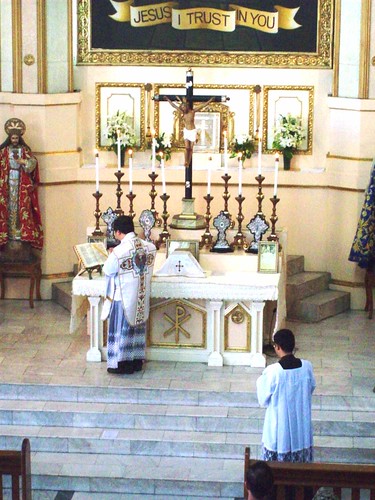
          Mass of the Assumption of Our Lady 2009 
          Tridentine Mass celebrated by Fr. Michell Joe Zerrudo, Parish of Our Lord of Divine Mercy, Sikatuna, Q.C., Philippines; Source: Flickr


          The poster "jrny from FR" on Angelqueen explains the rubrics for the Saturday Mass of the Blessed Virgin Mary as follows:
          The Saturday Mass of the BVM is 4th. Class, not 3rd. Class. It is said on any Saturday of the year which otherwise would have been a 4th. class Ferial Day if it fell on Monday-Friday.This is the normal, "obligatory" Mass (i.e. the Mass of the day per the rubrics) on Saturdays of the 4th. class which means it is not a Votive Mass (a Mass proper said by choice as allowed), strictly speaking.
          The Mass "Rorate" in Advent is a Votive Mass of the 3rd. class, but this differs from the above because this Mass can be said by choice (and not by assigned "obligation") on any day not ranked I or II Class during Advent.
          The following text is of the propers of the Mass as said on those Saturdays and Votive Masses After Trinity Sunday until Advent (Salve of the Blessed Virgin). The other four versions have slight variations in the proper prayers and are grouped into the following categories: In Advent (Rorate Coeli of the Blessed Virgin), From the Epiphany to the Purification (Vultum Tuum of the Blessed Virgin), From the Purification until Shrove Tuesday (Salve of the Blessed Virgin), and In Eastertide (Salve of the Blessed Virgin)

          If you are unfamiliar with the Traditional Latin Mass, consult my post on the Mass structure to best understand where the following prayers (the propers) fit into the unchanging prayers of the Mass.

          INTROITSedulius; Ps. 44:2
          Salve Sancta Parens, enixa purerpera Regem: qui coelum terramque regit in saecula saeculorum.(Psalm) Eructavit cor meum verbum bonum: dico ego opera mea regi. Gloria Patri. Salve Sancta Parens, enixa purerpera...Hail, holy Parent, that didst bring forth the King Who ruleth heaven and earth for ever and ever.(Psalm) My heart hath uttered a good work: I speak of my works to the King. Glory be to the Father. Hail, holy Parent....

          COLLECT(S)
          Concede nos famulos tuos, quaesumus, Domine Deus perpetua mentis et corporis sanitate gaudere, et gloriosa beatae Mariae semper Viginis intercessione, a praesenti liberari tristitia, et aeterna perfrui laetitia. Per Dominum nostrum.Grant  to us Thy servants, we beseech Thee, O Lord God, that we may enjoy perpetual health of mind and body; and through the intercession of blessed Mary ever Virgin may be delivered from present sorrow and possess eternal joy. Through our Lord.

          EPISTLEEcclus. 24:14-16
          Ab initio, et ante sawedcula cretat sum, et usque ad futurum saeculum non desinam, et in havitatione sancta coram ipso ministravi. Et sic in Sion firmata sum, et in civitate sanctificata similiter requievi, et in Jerusalem potestas mea. Et radicavi in populo honorificato, et in parte Dei mei haereditas illius, et in plenitudine sanctorum detentio mea.From the beginning, and before the world, was I created, and unto the world to come I shall not cease to be, and in the holy dwelling place I have ministered before him. And so was I established in Sion, and in the holy city likewise I rested, and my power was in Jerusalem. And I took root in an honorable people, and in the portion of my God his inheritance, and mine abode is in the full assembly of saints.


          GRADUAL
          Benedicta et venerabilis es, Virgo Maria: quae sine tactu pudoris inventa es mater Salvatoris. Virgo De Genitrix, quem totus non capit oribis in tua se clausit viscera factus homo.Blessed and venerable art thou, O Virgin Mary: who without loss of purity wert found to be the Mother of our Savior. Virgin Mother of God, He Whom the whole world cannot hold enclosed Himself in thy womb, and became man.


          ALLELUIA
          Alleluia, alleluia.  Post partum Virgon inviolata permansisti: Dei Genitrix intercdede pro nobis. Alleluia.Alleluia, alleluia.  After His birth a Virgin entire thou dost remain: O Mother of God, intercede for us.  Alleluia.

          GOSPELLk. 11:27-28
          In illo tempore: Loquente Jesu ad turbas, extollens vocem quaedam mulier de turba, dixit illi: Beatus venter qui te portavit et ubera, quae suxisti. At ille dixit: Quinimo beati, qui audiunt verbum Dei, et custodiunt illud.At that time, as Jesus was speaking to the multitudes, a certain woman from the crowd, lifting up her voice from the crowd, lifting up her voice, said to Him: Blessed is the womb that bore Thee and the paps that gave Thee suck. But He said: Yea rather, blessed are they who hear the word of God and keep it.

          OFFERTORYLk. 1:28,42
          Ave Maria, gratia plena: Dominus tecum: benedicta tu in mulieribus, et benedicta tu in mulieribus, et benedictus fructus ventris tui.Hail Mary, full of grace, the Lord is with thee blessed art thou among women and blessed is the fruit of thy womb.

          SECRET(S)
          Tua Domine, propitiatione et beatae Mariae sumper Virginis intercessione, ad perpetuam atque praesentem haec oblatio nobis proficiat proseperitatem et pacem. Per Dominum nostrum.By Thy gracious mercy, O Lord, and the intercession of blessed Mary ever Virgin, may this offering be of avail to us for welfare and peace now and for evermore. Through our Lord.

          PREFACEPreface of the Blessed Virgin Mary
          Vere dignum et justum est, aequum et salutare, nos tibi semper, et ubique gratias agere: Domine sancte, Pater omnipotens, aeterne Deus. Et te in Assumptione beatae Mariae semper Virginis collaudare, benedicere, et praedicare. Quae et Unigenitum tuum Sancti Spiritus obumbratione concepit: et virginitatis gloria permanente, lumen aeternum mundo effudit, Jesum Christum Dominum nostrum. Per quem majestatem tuam laudant Angeli, adorant Dominationes, tremunt Potestates. Coeli, coelorumque Virtutes, ac beata Seraphim, socia exsultatione concelebrant. Cum quibus et nostras voces, ut admitti jubeas deprecamur, supplici confessione dicentes:It it truly meet and just, right and for our salvation, that we should at all times, and in all places, give thanks unto Thee, O holy Lord, Father almighty, everlasting God: and that we should praise and bless, and proclaim Thee, in the Festivity of the Blessed Mary, ever-Virgin: Who also conceived Thine only-begotten Son by the overshadowing of the Holy Ghost, and the glory of her virginity still abiding, gave forth to the world the everlasting Light, Jesus Christ our Lord. Through whom the Angels praise Thy Majesty, the Dominations worship it, and the Powers stand in awe. The Heavens and the heavenly hosts together with the blessed Seraphim in triumphant chorus unite to celebrate it. Together with these we entreat Thee that Thou mayest bid our voices also to be admitted while we say with lowly praise:

          COMMUNION
          Beata viscera Mariae Virginis, quae portaverunt aeterni Patris Filium.Blessed is the womb of the Virgin Mary, which bore the Son of the Eternal Father.

          POSTCOMMUNION(S)
          Sumptis, Domine, salutis nostrae subsidiis: da, quaesumus, beatae Mariae semper Virginis patrociniis nos ubique protegi : in cugus veneratione haec tuae obtulimus majestati. Per Dominum nostrum.O Lord, grant, we beseech Thee, that we who have received these aids unto salvation, may be always and everywhere protected by the intercession of blessed Mary ever Virgin, in whose honor we offered this Sacrifice to Thy Majesty. Through our Lord.

          First Saturdays Devotion


          On Saturdays, Catholics traditionally have taken part in the "First Saturdays Devotion" which entails going to Mass and receiving Communion for the first Saturday of the month for 5 consecutive months in reparation to the Immaculate Heart of Mary.  This devotion is not to be confused with the First Friday's Devotion, which is dedicated to the Sacred Heart of our Lord Jesus Christ.

          On July 1, 1905, Pope Pius X approved and granted indulgences for the practice of the First Saturdays of twelve consecutive months in honor of the Immaculate Conception. The First Saturday Devotion did not originate as part of the apparitions of our Blessed Lady in Fatima, but the devotion did quickly spread further following our Lady's series of appearances to the three shepherd children in 1917.

          Our Blessed Lady's words to Sr. Lucia at Fatima:
          Look, my daughter, at my Heart encircled by these thorns with which men pierce it at every moment by their blasphemies and ingratitude. You, at least, strive to console me, and so I announce: I promise to assist at the hour of death with the grace necessary for salvation all those who, with the intention of making reparation to me, will, on the first Saturday of five consecutive months, go to confession, receive Holy Communion, say five decades of the beads, and keep me company for fifteen minutes while meditating on the fifteen mysteries of the Rosary.
          The First Saturday Devotion consists of offering the First Saturday of the month for five consecutive months in reparation for the many and grievous sins committed in our world. A further explanation of our Lady's request is below:
          • You must go to the Sacrament of Confession.  Your reception of the Sacrament may be 8 days before the Saturday as long as you stay in a state of grace.
          • You must receive the Holy Eucharist and as always, it must be in the state of grace or risk the most grievous sin of sacrilege
          • You must pray 5 decades of the Holy Rosary of our Lady, including the Fatima Prayer.  
          • Finally, the last requirement consist of "keeping Mary company" for 15 minutes while meditating on all of the Mysteries of the Rosary with the intention of making reparation to her. This can be done by reading Scripture or other writings relevant to the Mysteries, meditating on pictures of the Mysteries, or simple meditation. Materials for meditation and education on each of the Rosary mysteries is available online.
          Little Office of the Blessed Virgin Mary

          While the laity is not bound to pray the Divine Office, they are still encouraged to pray the Divine Office (also known as the Liturgy of the Hours).  To pray the Divine Office, I would highly encourage you to pray the 1962 Breviary or even the 1955 version as opposed to the modern version which I find lacking in the spiritual depth present in the earlier editions.

          Since you are not bound under ecclesial law to pray the Office, you can and should start by praying the English version of the Breviary.  You can find various breviaries available for sale that will fulfill this purpose.  For centuries Catholics prayed most commonly not with personal prayers and devotion as such individual prayers originated from protestant individualism.  Instead, Catholics prayed the Liturgical texts of the Church (e.g. the Prayers of the Holy Mass, the Rosary, etc) daily and many were saved.  In our world we see the majority of mankind entrenched in sin and debauchery.  Let us pray for a return to our praying the Liturgical prayers of the Holy Church.  Pray the Daily Rosary as Mary has asked of us!

          However, please also consider, in addition or instead of the standard Divine Office, the Little Office of the Blessed Virgin Mary for your daily prayers!  The text is available in English and Latin online for free viewing though many prefer an actual physical copy.

          The Little Office of the Blessed Virgin Mary is a shorter form of the Divine Office in honour of the Blessed Virgin Mary. It has long been the Church’s daily liturgical prayer to Our Lady, and these hours of praise have been used by Priests, religious and the laity throughout the centuries. Lay people used to flock to the great Cathedrals to publicly recite The Little Office during the Middle Ages, and during the great persecution, when the practice of the Catholic Faith was illegal in Great Britain, Bishop Challoner commended The Little Office to his flock.

          Through its psalms, antiphons, readings, responsorials, and prayers the Little Office stresses the role Our Lady played in salvation history, and how through her fiat the divine Word took flesh in her womb and achieved salvation for us all; and how Our Lord granted her the first fruits of the general resurrection in her holy and glorious assumption.

          All Catholics are called to a consistent prayer life. For those who do not feel called to recite the Divine Office, but still wish to participate in the liturgical prayer of the Church, or for those who have a particular devotion to the holy Mother of God, there is no finer form of prayer than the Little Office of the Blessed Virgin Mary.

            Green Scapular


            While certainly not only permitted for use on Saturdays, Saturday is an appropriate time to focus on the Immaculate Heart of the Blessed Virgin and on her great promises with the Green Scapular.  Many of you should be familiar with the Brown Scapular as you should have been invested in the Brown Scapular following your First Holy Communion.  I have written before on the merits of the Brown Scapular.  While they are not to be underestimated, I will not focus additional time on the Brown Scapular.  Instead, we focus in this post on the Green Scapular of our Lady.

            The website of Fish Eaters succinctly and accurately describes the Green Scapular of our Lady:
            In 1840, Mary appeared to Sister Justine Bisqueyburu (a Seminary Sister of the Daughters of Charity) in Paris, France and commended the Green Scapular to her. It's known as "the Scapular of Conversion," and its promises are the strengthening of faith, protection against Satan, a happy death for Catholics, and, most of all, for conversion for those outside the Church. It's to be worn or carried by the faithful, or given to an unbeliever for their conversion.
            The following prayer is to be said daily by the wearer:
            Immaculate Heart of Mary, pray for us now and at the hour of our death
            Latin version:

            Cor immaculatum Mariae, ora pro nobis nunc et in hora mortis nostrae

            If the scapular is given to an unbeliever for their conversion, the person giving the scapular prays the prayer for them if the unbeliever does not want to pray the prayer himself. If the unbeliever does not want the scapular, it may be hidden in their vicinity and the prayers said for him. Enrollment in a Confraternity is not necessary for this scapular, but the scapular should be blessed by a priest before use.
            Read more >>


            Copyright Notice: Unless otherwise stated, all items are copyrighted under a Attribution-NonCommercial-NoDerivatives 4.0 International License. If you quote from this blog, cite a link to the post on this blog in your article.

            Disclosure of Material Connection: Some of the links on this blog are “affiliate links.” This means if you click on the link and purchase the item, I will receive an affiliate commission. As an Amazon Associate, for instance, I earn a small commission from qualifying purchases made by those who click on the Amazon affiliate links included on this website. I am disclosing this in accordance with the Federal Trade Commission’s 16 CFR, Part 255: “Guides Concerning the Use of Endorsements and Testimonials in Advertising.”