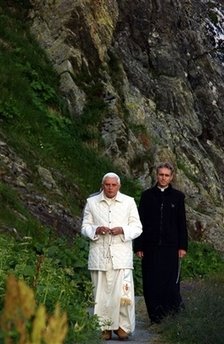
Here are images from the ordinations this month in June 2006 at the Abbey of Le Barroux (France).
Image Source: Richard L'Ollivier
 Here are images from the ordinations this month in June 2006 at the Abbey of Le Barroux (France).
 "We need to be someone for the naked who not only lack clothing but mercy."

 Please see these posts for information on Catholicism:

Answered by Father Edward McNamara, professor of liturgy at the Regina Apostolorum Pontifical University.
Q: I know of priests who wear their cassock on Sunday but do not wear it in public. Why is this? Are there guidelines that priests have to wear a cassock in church but not outside? — J.G., Stone Mountain, Georgia
A: The use of a cassock (or soutane), an ankle-length garment, worn by clerics and choristers, remains common in some parts of the world while in others it has almost disappeared or, as our reader points out, is reserved for liturgical functions.
A priest's cassock is usually black although white is sometimes used in tropical climates. Bishops and some other honorific prelates wear a purple cassock. A cardinal's cassock is red. These colored cassocks are usually reserved for liturgical functions, however, and both bishops and cardinals typically don a black cassock with colored buttons, trimmings and sash indicating the wearer's hierarchical status.
The Pope's cassock is white, a custom that arose after St. Pius V (1504-1572), a member of the Order of Preachers, continued to wear his Dominican habit even after his elevation to the papacy in 1566.
According to canon law (Canon 284) clergy are required to don some form of worthy ecclesiastical dress according to the norms of the bishops' conference and legitimate local customs.
Thus, while there is ample scope for different forms of clerical garb, a priest should be readily identifiable by his external presentation, unless some grave external circumstances, such as the legal prohibition of clerical dress, makes the ecclesiastical law impossible to practice.
In the United States, the official norms ask that priests generally use the black clerical suit and collar although nothing prevents the use of the cassock. All the same, the custom of largely reserving the cassock for "in house" use within the church, rectory or seminary is fairly long-standing in the United States and predates the Second Vatican Council.
In Poland, and some other Central European countries, the sight of a priest in cassock is still quite common, occasionally even while engaged in leading youth groups and pilgrimages.
In the Vatican, the use varies. Many priests prefer to use the clerical suit for daily chores and reserve the cassock for formal meetings; others retain the habitual use of the cassock.
In fact, until April, Cardinal Joseph Ratzinger could be observed almost daily as he walked across St. Peter's Square from home to office and back again, dressed in a simple black cassock.
Within the liturgy, the cassock may be used along with a surplice (a white large-sleeved loose-fitting garment worn over the cassock and reaching almost to the knees, usually made of linen or cotton and sometimes decorated with lace) in carrying out most rites in which an alb is not prescribed. This would include, for example, the celebration of baptisms, Benediction, and weddings outside of Mass.
However, the expanded role attributed to the alb as a universal liturgical vesture has diminished the use of the cassock and surplice both for priests and for others such as acolytes who often used it to serve Mass.
© Innovative Media, Inc.
 This week I have posted very little because I was a teacher at vacation Bible school at a nearby parish, and I was busy most of the day teaching. The Bible School is a joint project between the Catholic Church and the nearby Presbyterian Church. So, I thought both Catholics and Presbyterians. I taught 1st through 4th grades. And, it was a lot of fun.
 Distractions During Prayer
In its Wednesday issue, the L'Osservatore Romano condemned the effort to find a compromise between funding the research, which involves the destruction of days-old unborn children, and pro-life concerns about taking human life. The paper said the EU is condoning "a macabre illicit trade." Expanding on the Vatican's response to the vote, Bishop Elio Sgreccia, head of the Pontifical Academy for Life, told Vatican Radio that the vote violated a "primordial right" to life and authorized "the use of a human being on the basis of 'I kill you in order to gain benefits for others.'" "To not be opposed to research that is destructive and inherently violent" is "an act of serious inconsistency," he said.
Source: LifeNews
The compromise means that some money from the EU's $65 billion science budget will fund some embryonic stem cell research over the 2007-2013 period that it covers. But it also includes consessions to nations oppose to embryonic stem cell research that the funding would not go to pay for destroying human embryos but rather for research on existing embryonic stem cells or on research conducted after the destruction of human life has taken place. A coalition of nations, led by Germany, had been working to block any funding for embryonic stem cell research and appeared to be on the verge of winning the debate. However, Finland, which holds the EU presidency this year, proposed the compromise and Slovenia, one of the members of the coalition, reversed its position and supported it.
Source: LifeNews
 O God, Thou didst raise Thy servant, N., to the sacred priesthood of Jesus Christ, according to the Order of Melchisedech, giving him the sublime power to offer the Eternal Sacrifice, to bring the Body and Blood of Thy Son Jesus Christ down upon the altar, and to absolve the sins of men in Thine own Holy Name. We beseech Thee to reward his faithfulness and to forget his faults, admitting him speedily into Thy Holy Presence, there to enjoy forever the recompense of his labors. This we ask through Jesus Christ Thy Son, our Lord. Amen.
 (The Gospel of James). It is not part of the Bible, but the document, which was written c. 170 AD gives insight into the life of Mary and her parents. Joachim was a prominent and respected man, however, he had no children, and he viewed this as a punishment from God. In an answer to his prayers, he and Anne, his wife, were given the daughter Mary, who was conceived without sin. She remained sinless, ever-virgin, and was the Mother of God. Their prayers were answered greater than they could have ever imagined!
 . It is a site of constant miracles. Cripples have entered the Shrine on crutches and left by walking through the door because they were completely healed. Another Shrine is Ste. Anne d'Auray in Britanny, France. There is also a church of St. Anne in Jerusalem, and the church is believed to have been built on the location where Sts. Joachim and Anne lived.
 , St. Joachim is described as a rich and pious man of the house of David who regularly gave to the poor and to the temple. However, as his wife was barren, the high priest rejected Joachim and his sacrifice, as his wife's childlessness was interpreted as a sign of divine displeasure. Joachim consequently withdrew to the desert where he fasted and did penance for forty days. Angels then appeared to both Joachim and Anne to promise them a child. Joachim later returned to Jerusalem and embraced Anne at the city gate. The cycle of legends concerning Joachim and Anne were included in the Golden Legend
 and remained popular in Christian art until the Council of Trent
 restricted the depiction of apocryphal events.
 . It was added to the General Roman Calendar in 1584, for celebration on March 20, the day after the feast day of Saint Joseph. In 1738, it was transferred to the Sunday after the Octave of the Assumption of Mary. As part of his effort to allow the liturgy of Sundays to be celebrated, Pope Pius X transferred it to August 16, the day after the Assumption, so that Joachim may be remembered in the celebration of Mary's triumph. It was then celebrated as a Double of the 2nd Class, a rank that was changed in 1960 to that of 2nd Class Feast.
 Hello, everyone! Blessings and peace in the Name of Jesus Christ, the Risen Lord!
 , which contains the complete Liturgy of the Hours. I have been praying the Liturgy of the Hours at Lauds (morning), Vespers (evening), and Compline (night) ever since I left the monastery. While at the monastery, I prayed with the monks at Lauds, daytime prayer, Mass, Vespers, and Compline. It was so beautiful to hear them chanting the Liturgy, equating to the best part of my experience there. And, it was so wonderful to see men in full habit walking around and bearing witness to the Faith of the Universal Church.
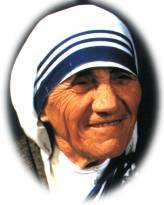
 Blessed Mother Teresa: "We too must be: the Light of Charity, the Truth of Humility, the Life of Sanctity"
 O Divine Savior!
 O holy souls, as one truly devoted to you, I promise never to forget you and continually to pray to the Most High for your release. I beseech you to respond to this offering which I make to you, and to obtain for me, from God, with Whom you are so powerful on behalf of the living, that I may be free from all dangers of souls and body.

 It's been very clear to me after I visited a Benedictine monastery, that everyone is a sinner. No one is worthy of the great glory of God. It is beyond mercy and compassion for anyone to be granted clemency. But, Our God is mercy and loving beyond all words. He is the truth, the Way, and the Light. And as He said, no one shall come to the Father except through Him (John 14:6).
Lord, I pray. I ask you to pray for me. Pray for us. I pray that all may be one. I pray that all may be one. Father, may they be in us, just as you are in me and I am in You. May they be one that the world will believe that you sent me. I gave them some glory you gave me so that they may be one just as you and I are one: I in them and You in me, so that they may be completely one that the world may know that you sent me, and that I love them as you love. I made you to known to them and will continue to do so, in order that the love you have for me may be in them and so that I also may be in them (John 17: 21-26).I hope you realized that this verse was the foundation for everything I've ever argued with any Protestant about. I don't want discord and arguing, but I have to remember that Our Lord also said He came not to bring peace but the sword (Matthew 10:34). I just want everyone to be united in the same Eucharist, the same Confirmation, and the same Sacraments. The Catholic Church, which I firmly believe, teaches that Protestant Sacraments, other than baptism and sometimes marriage, are invalid. The Church (The Magesterium) teaches this because it has the Spirit of the Lord to guide it in its teachings.