Within the walls of the Monastery of Our Lady of the Rosary in Summit, New Jersey, rows of simple crosses mark the graves of sisters who have gone before. It’s a potent symbol of life in the monastery, where women enter cloistered life intending never to leave, even in death.
These Dominican nuns have been in this place of peace for almost 100 years, sustaining the Church every day through their prayer and devotion. And while many religious orders are facing an aging religious population and steady decline, these sisters have seen the opposite trend.
In the past 10 years, 12 new women have entered the life, seven have stayed, and a steady stream of new young women visits to discern whether or not this is the life for them.
Continue Reading on Our Sunday Visitor
Monday, September 18, 2017
Saturday, September 16, 2017
Semidouble (1954 Calendar): September 16
Today the Catholic Church commemorates two friends in the service of Christ and his Church who are mentioned in the Roman Canon of the Mass.
Pope Cornelius (251-253) was the successor to Pope Fabian. During his reign a controversy arose concerning the manner of reinstating those who had fallen from the faith under the duress of persecution. The Novatians accused the Pope of too great indulgence and separated themselves from the Church. With the help of St. Lucina, Cornelius transferred the remains of the princes of the apostles to places of greater honor. On account of his successful preaching the pagans banished him to Centumcellae, where he died. St. Cyprian sent him a letter of condolence. At the time of Pope Cornelius there were at Rome forty-six priests, seven deacons, seven subdeacons, forty-two acolytes, fifty-two clerics and more than five hundred widows who were supported by the Church (according to Cornelius' letter to Bishop Fabian of Antioch).
Thascius Caecilius Cyprianus, illustrious as a pagan rhetorician in Carthage, embraced the true faith in the year 246 and was soon thereafter consecrated priest and bishop of that city (248). He was an energetic shepherd of souls and a prolific writer. He defended the unity of the Church against schismatic movements in Africa and Italy, and greatly influenced the shaping of Church discipline relative to reinstating Christians who had apostatized. He fled during the Decian persecution but guided the Church by means of letters. During the Valerian persecution (258) he was beheaded. He suffered martyrdom in the presence of his flock, after giving the executioner twenty-five pieces of gold. St. Jerome says of him: "It is superfluous to speak of his greatness, for his works are more luminous than the sun." Cyprian ranks as an important Church Father, one whose writings are universally respected and often read in the Divine Office. His principal works are: On the Unity of the Church; On Apostates; a collection of Letters; The Lord's Prayer; On the Value of Patience.
Excerpted from The Church's Year of Grace, Pius ParschCommemoration of Euphemia, Lucy, and Geminianus (also on this day):
"At Chalcedon," says The Roman Martyrology, "the birth in Heaven of Saint Euphemia, Virgin and Martyr, who was condemned to the wild beasts." This happened in 307 A.D. "At Rome, The Holy Martyrs Lucy, a noble lady, and Geminianus, who were beheaded by order of Emperor Diocletian, about 300 A.D.
Collect:
O Lord, let the prayers of Your blessed martyr bishops Cornelius and Cyprian, whom we honor today, gain us Your protection. Through our Lord . . .
Friday, September 15, 2017
Today the Church recalls a lesser known saint in the Commemoration of St. Nicomedes. His life is recounted in Butler's Lives of the Saints:
HE was a holy priest at Rome, who was apprehended in the persecution of Domitian for his assiduity in assisting the martyrs in their conflicts, and for interring their bodies. Refusing constantly to sacrifice to idols, he was beaten to death with clubs about the year 90. His tomb was on the road to Nomento, and he is commemorated on this day in the sacramentary of St. Gregory the Great, and in the Martyrologies of St. Jerom, Bede, &c. See the Acts of SS. Nereus and Achilleus.Collect:
Stay close to Your people, O Lord, so that the brilliant merits of Your blessed martyr Nicomedes may help us, and his prayers win for us Your unfailing mercy. Through our Lord . . .
Monday, September 11, 2017
Simple (1955 Calendar): September 11
September 11th is the Feast of Ss. Protus and Hyacinth.
The story of most martyrs of the first three centuries is so obscured by legend that it is difficult for us to cull out the historical kernel; this is true of today's saints. Tradition tells us that the brothers Protus and Hyacinth were chamberlains to the holy virgin Eugenia (listed as a martyr on December 25 in the Roman Martyrology) and were baptized along with their patron by Bishop Helenus. They devoted themselves zealously to the study of Sacred Scripture and lived for a time with the hermits in Egypt, illustrious for humility and holiness of life. At a later date they accompanied Eugenia to Rome and were arrested by Emperor Gallienus (260-268) for their profession of the Christian faith. In no manner could they be persuaded to deny the faith or worship the gods. Accordingly, after an inhuman scourging, they were beheaded on September 11.
Veneration of the two martyrs in the Church of Rome dates to venerable antiquity. Ancient registers contain their names, Pope Damasus praises them in verse at the end of the age of martyrs. The cemetery of Basilla marked the site of their graves; relics of St. Hyacinth were discovered there in 1845 and now are honored in the chapel of the Propaganda.
Excerpted from The Church's Year of Grace, Pius ParschCollect:
May the glorious profession of faith of Your blessed martyrs Protus and Hyacinth strengthen us, O Lord, and may the power of their intercession shield us. Through our Lord . . .
Sunday, September 10, 2017
Pope Francis celebrates Mass in Villavicencio, Colombia, Friday, Sept. 8, 2017. (Credit: AP Photo/Andrew Medichini.)
Pope Francis has issued a motu proprio Magnum Principium, a modification of Canon Law 838, which grants bishops’ conferences greater control over the translation of liturgical texts. This includes the power to make adaptations which the bishops deem appropriate for their regions.
Until now, Canon 838 (§1) stated that "The direction of the sacred liturgy depends solely on the authority of the Church, namely, that of the Apostolic See." Paragraph §2 said: "It is for the Apostolic See to order the liturgy of the universal Church," but now the Apostolic See has the task of "recognizing adaptations approved under the law of the Episcopal Conference." (§2) In other words, the power of the Curia is reduced from authorizing to approving texts that are generated by episcopal conferences.
Paragraph §4 makes it clear that the pope has now given bishops the power to determine much of the Church's liturgical direction. "Within the limits of his competence, it belongs to the diocesan bishop to lay down in the Church entrusted to his care, liturgical regulations which are binding on all."
This opens the door, not only to greater liberty in translating liturgical texts, but to creativity in drafting their own texts. What we are seeing is a further attempt to pull the Catholic world away from the Church's centralized authority and have a whimsical free-for-all.
Francis himself, on October 17, 2015, called for a "healthy decentralization" of power in the Roman Catholic Church, including changes in the papacy and greater decision-making authority for local bishops, so this latest motu proprio is part of his plan to execute this decentralization.
It calls to mind the subversive designs of Mgsr. Annibale Bugnini—the key liturgical planner of Vatican II and principal architect of Sacrosanctum Concilium—as he relayed them to Masonic Grand Master Licio Gelli in a *letter dated July 2, 1967: "The greatest liberty was given to choose between the various formulas, to individual creativity, and to chaos!"
Under the pretext of making the Faith more accessible to the laity, the enemies of the Church introduced vernacular at Vatican II for the purpose of rendering the Church secular and divided, as opposed to holy and universal. It appears that Rome is now going the full nine yards with this plan.
However, if holiness, unity, and crystal clear communication from God to man is what Francis aspires for, he will promptly scrap these modernist trappings and return the Mass to its original formula in the Latin Tridentine Rite—the formula which accomplished this perfectly through the centuries. This is what Pope Benedict XVI aspired for during his active pontificate, so why shouldn't Francis?
In speaking of the Traditional Latin Mass, Pope Benedict said on April 30, 2011: "What was sacred for prior generations, remains sacred and great for us as well." (Universae Ecclesia)
The irony of all this liturgical updating is that Latin—the very thing that modernists despise—is all too conveniently used as a tool to pull the faithful away from their Latin heritage. Perfidious documents such as the latest are published in Latin to make them appear "religious," but is this not Pharisaic? Vatican bureaucrats should at least have the decency to publish their revolution in their own Esperanto and reserve Latin for the holy things of God.
*This correspondence is taken from Andrea Tornielli's Dossie Liturgia Uma Babel Programada, that appeared in the June 1992 issue of 30 Days.
https://rorate-caeli.blogspot.com/2017/09/breaking-motu-proprio-magnum-principium.html
Monday, September 4, 2017
September 4th is the Feastday of Blessed Agnes of Bagno. Blessed Agnes was a 12th century Camaldolese nun at Santa Lucia near Bagno di Roma in Tuscany (modern day Italy). Her shrine is at Pereto. She was a friend of Blessed Joan of Bagno di Romagna. Devotion to Blessed Agnes of Bagno was confirmed in 1823 but she is not listed in the Roman Martrology.
May we never forget the lives of these lesser known saints whose lives can still serve as great inspiration for all of us.
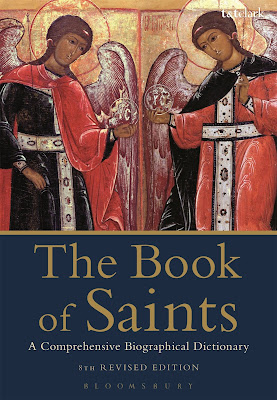
Source: The Book of Saints: A Comprehensive Biographical Dictionary by Basil Watkins. Now fully revised and updated The Book of Saints is a comprehensive biographical dictionary of saints canonised by the Roman Catholic Church. It contains the names of over 10,000 saints, including all modern ones, with significant information about their lives and achievements. Each section begins with an illustration of a particular saint, and the volume includes a list of national martyrs, a bibliography, and a helpful glossary.
While a feria day on the Universal Calendar, today is in some local calendars the Feast of St. Rose of Viterbo.
Almighty God did marvelous things in the soul of Saint Rose of Viterbo. It appears that her parents gave her that name by divine inspiration, for it was symbolic of her entire career. As long as she lived, she bloomed like a sweet-scented rose in the garden of the Church, and in full bloom as she was transplanted to Paradise.
Before she was able to speak, Saint Rose attempted to pronounce the sweet names of Jesus and Mary; and as soon as she had learned to walk, she asked to be taken to church and to other retired and quiet places to pray. When religious discourses were given, she would listen with great attention.
When Saint Rose was only 3 years old, God showed how pleased He was with her in a most wonderful way. One of her maternal aunts died. The family were standing around the bier weeping aloud. Deeply moved by the sorrow of her relatives, little Rose went to the coffin, raised her eyes to heaven, and prayed silently. Then she placed her little hand on the body of her deceased aunt and called her by name. The dead woman immediately opened her eyes and reached out to embrace her little niece, who had raised her to life again.
The child entertained a great compassion for the poor; she always tried to save some food to give to the poor. One day when she left the house with some bread in her apron, she met her father, who asked her in curt fashion what she was carrying off now. The frightened child opened her apron and fragrant roses were found in it.
When she was 7 years old, Saint Rose of Viterbo retired to a little cell in her father's house. There she spent almost all her time in contemplation and in practicing rigorous penance. She prayed much for the conversion of sinners. Meanwhile our dear Lord was preparing her for an extraordinary mission.
St Rose was not yet 10 years old when the Blessed Mother of God instructed her to join the Third Order of St. Francis. Shortly after, our Lord appeared to her on the Cross, wearing the crown of thorns on His head and bleeding profusely from all His wounds.
St Rose, aghast at the sight, called out: "O my Lord, who has reduced Thee to this state?"
Our Lord replied, "My love, my deep love for men has done this."
"But," asked Rose, "who has so pierced and torn Thee?"
"The sins of men have done it," was our Lord's answer. "Sin, sin!" cried the saint, and she scourged herself to make atonement for the sins of the world.
By divine inspiration, Rose then took a cross in her hand and went up and down the streets and public squares of her city telling people of the terrible tortures our Lord suffered and of the heinousness of sin. Every now and then she would emerge from her solitude to entreat the people to do penance.
The town of Viterbo, which belonged to the Papal States, had revolted against the authority of the pope. Disregard for religion and moral degradation were the order of the day. But the sermons of this little missionary had marvelous results. The people came in crowds to hear her. The stone on which she stood was seen to rise in the air, and she was sustained there by a miracle while burning words issued from her lips. The greater part of the citizenry had already resolved to do penance and to return to the legitimate papal allegiance when Saint Rose of Viterbo and her parents were repelled by the civil authorities.
The result was that she now had a wider field of activity. At Soriano and later at Vitorchiano, her preaching had the same blessed results. In the latter place, a sorceress had done much harm among the inhabitants. Fearing that after her departure this woman would undo the good effected there, Rose was desirous of her conversion. Her initial efforts failed. Then our saint had an immense pile of wood prepared in the public square; fire was set to it, and Rose stepped into the fire and mounted to the top of the pile. She remained untouched for three hours in the midst of the flames, singing the praises of God. The sorceress now cast herself at Rose's feet and was sincerely converted.
Meanwhile the rightful authority of the pope had been re-established at Viterbo, and Rose could return. She was now 15 years old and anxious to enter the convent of the Poor Clares. As she had no dowry, she could not be admitted.
"Well," said Rose, "you will not receive me while I am alive, but you will receive me after I am dead." She and several companions repaired to a secluded dwelling, where they intended to live as a community. The ecclesiastical authorities, however, did not approve of the plan, and Rose returned home. She died 2 years later, filled with the joyous desire of being united with her God.
Two and a half years after her death she appeared three times to Pope Alexander IV, who was in Viterbo at the time, and told him to have her body removed to the convent of the Poor Clares. When this was done, her body was found incorrupt; and it has remained in that condition to this day. Miracles are constantly occurring at her tomb. Pope Callistus III canonized her in 1457.
Although her skin is dark, the body of the saint is still flexible and the internal organs in good condition. In 1921 the heart was removed to be placed in a reliquary for a procession, and it was found to be unblemished and perfectly intact at that time.
Excerpted from: The Franciscan Book Of Saints, ed. by Marion Habig, OFM
Friday, September 1, 2017
The martyrs join with all the saints in praising the glory of God
The "Holy Twelve Brothers" refer to the fourth-century apostles who refused to offer sacrifice to pagan gods. Africans by birth, these saints were martyred in various places in the third century under the Emperors Diocletian and Maximian. Four were beheaded in Potenza, Italy on August 27. Three were beheaded at Vanossa on August 28. The others were beheaded at Sentiana on September 1. They were brought together and enshrined at Benevento in 760.
Today is also the Feast of St. Giles.
Collect:
O Lord, may the martyrdom of these brothers warm our hearts with joy, enliven our faith by an increase of virtue, and comfort us by the added number of intercessors we have in heaven. Through our Lord . . .
Wednesday, August 30, 2017
Each year we recall on August 30th not only the life of St. Rose of Lima but also Ss. Felix and Adauctus.
St. Felix was a Roman priest who was beheaded in c. 303 AD. And St. Adauctus was a Christian layman who insisted on sharing the crown of the martyred priest. Since his name was not known, he was simply called by the Latin equivalent of "added on." Thus, we refer to him as St. Adauctus rather than the name he was called on earth.
Collect:
O Lord, we humbly implore Your majesty to defend us through the intercession of Your saints, just as You fill us with happiness by the celebration of their feast. Through our Lord . . .
Tuesday, August 29, 2017
Today we rejoice along with the Holy Church in the Commemoration of St. Sabina, in addition to the Martyrdom of John the Baptist.
Saint Sabina was a martyr from Rome who lived in the 1st century AD until 126 AD. She was the widow of Senator Valentinus and daughter of Herod Metallarius.
St. Sabina was converted to the Faith by her servant, St. Serapia. Upon St. Serapia's denouncement as a Christian and subsequent martyrdom by decapitation, St. Sabina rescued her remains and had them moved to the family mausoleum. Like St. Serapia, St. Sabina too was denounced and accused of being a Christian. And after she consented to being one, she was martyred under Elpidio the Prefect in the city of Vindena in the state of Umbria, Italy.
In 430 AD, her relics were brought to a special basilica in her honor in Rome which was built on the spot of a former temple to Juno. Indeed, the Christian has conquered the Roman pagans. This church is now the world headquarters of the Dominican Order.
May we pray for the fortitude and patience of the martyrs like St. Sabina.
Collect:
O God, one of the marvelous examples of Your power was granting the victory of martyrdom even to delicate womanhood. May the example of the blessed martyr Sabina, whose birthday we celebrate today, draw us closer to You. Through our Lord . . .
Monday, August 28, 2017
Saint Hermes is the figure in the back, in armor. Other saints pictured include Saint James the Great, Saint Joseph,Saint Ghislain, and Saint Eligius.
Butler's Lives of the Saints writes of him:
HE suffered at Rome in the persecution of the emperor Adrian about the year 132. His tomb on the Salarian Way was ornamented by Pope Pelagius II. and his name is famous in the ancient western Martyrologies.Let us invoke his patronage today, along with today's other saint, St. Augustine of Hippo.
Collect:
O God, it was Your strength that kept the blessed martyr Hermes unfaltering under suffering. May we follow his example in spurning earthly riches for love of You and in fearing no worldly harm. Through our Lord . . .
Sunday, August 27, 2017
Excerpts from the SSPX Website:
Read more >>
He first recalled the vision of hell that the three shepherd children of Fatima contemplated with horror; he explained that this fear is salutary and that those who seek today to anesthetize consciences by offering them a broad path are truly assassins of souls.
Then Bishop Fellay emphasized that the message of Fatima is a message of hope: those who practice the devotion to the Immaculate Heart of Mary will be saved. This divine promise of salvation offers us an easy means: all we have to do is take it seriously. We must make reparation for the offenses against the Most Blessed Mother of God. Like little Francisco, we must seek to console the Sorrowful and Immaculate Heart of Mary. Let us accept all trials generously, offer them up, and sacrifice ourselves by faithfully accomplishing our duty of state, seeing souls through the eyes of Jesus Christ as He gazed at them from His Cross, and the eyes of Our Lady, standing at the foot of the same cross, stabat Mater.
In conclusion, the Superior General forcefully repeated that the devotion to the Immaculate Heart of Mary is willed by God for the world today. Not a superficial or mechanical devotion, but a profound one: her Heart must be our intimate refuge. The prelate also announced that he would renew the consecration of Russia right after the Mass, just as Archbishop Lefebvre did here in Fatima thirty years ago. Of course, it is up to the Holy Father and all the bishops of the world in union with him to make this consecration. The Society’s act of consecration is a way of expressing its desire to answer Heaven’s request, while fully aware of its limits, with the lively hope that the Vicar of Christ will one day consecrate the country himself.
The Rosary Crusade draws to a close, but its spirit lives on: let us never cease to beg with our fervent prayers the triumph of the Immaculate Heart of Mary, which will come when God wills. But we are assured it will come!
Tuesday, August 22, 2017
1954 Calendar: Commemoration (August 22nd)
Besides today being the Feast of the Immaculate Heart of Mary, it is the annual day we commemorate Ss. Timothy, Hippolytus, and Symphorian. The following is shared from Liturgia Latina's website:
Timothy of Antioch came to Rome in 310 and was martyred in 311. He was cruelly beaten and quicklime was sprinkled over his torn flesh. At last he was beheaded.
On the same day at Ostia, Hippolytus, bishop of Porto, was thrown into a hole filled with water and received the crown of martyrdom about A.D. 225.
Again on the same day, about A.D. 180, under the reign of Aurelian, Symphorian, who was still a young man, was beheaded at Autun. While he went to execution his mother said to him: "My son, my son, remember eternal life; look up to heaven and see the One who reigns there; life is not taken from thee, it is exchanged for a better one."Collect:
Deny us not, O merciful Lord, Thy help: but listening to the prayers of Thy blessed martyrs Timothy, Hippolytus and Symphorian, stretch forth over us the right hand of Thy merciful forgiveness.
Friday, August 18, 2017
While not on the Universal Catholic Calendar, in some parts of the world today is the Feast of Empress Helena. The following is taken from the Catholic Encyclopedia on St. Helena, the mother of Constantine, the one who legalized Christianity in the Roman Empire:
Read more >>
The mother of Constantine the Great, born about the middle of the third century, possibly in Drepanum (later known as Helenopolis) on the Nicomedian Gulf; died about 330. She was of humble parentage; St. Ambrose, in his “Oratio de obitu Theodosii”, referred to her as a stabularia, or inn-keeper. Nevertheless, she became the lawful wife of Constantius Chlorus. Her first and only son, Constantine, was born in Naissus in Upper Moesia, in the year 274. The statement made by English chroniclers of the Middle Ages, according to which Helena was supposed to have been the daughter of a British prince, is entirely without historical foundation. It may arise from the misinterpretation of a term used in the fourth chapter of the panegyric on Constantine’s marriage with Fausta, that Constantine, oriendo (i. e., “by his beginnings,” “from the outset”) had honoured Britain, which was taken as an allusion to his birth, whereas the reference was really to the beginning of his reign.
Her son’s influence caused her to embrace Christianity after his victory over Maxentius. This is directly attested by Eusebius (Vita Constantini, III, xlvii): “She (his mother) became under his (Constantine’s) influence such a devout servant of God, that one might believe her to have been from her very childhood a disciple of the Redeemer of mankind”. It is also clear from the declaration of the contemporary historian of the Church that Helena, from the time of her conversion had an earnestly Christian life and by her influence and liberality favoured the wider spread of Christianity. Tradition links her name with the building of Christian churches in the cities of the West, where the imperial court resided, notably at Rome and Trier, and there is no reason for rejecting this tradition, for we know positively through Eusebius that Helena erected churches on the hallowed spots of Palestine. Despite her advanced age she undertook a journey to Palestine when Constantine, through his victory over Licinius, had become sole master of the Roman Empire, subsequently, therefore, to the year 324. It was in Palestine, as we learn from Eusebius (loc. cit., xlii), that she had resolved to bring to God, the King of kings, the homage and tribute of her devotion. She lavished on that land her bounties and good deeds, she “explored it with remarkable discernment”, and “visited it with the care and solicitude of the emperor himself”. Then, when she “had shown due veneration to the footsteps of the Saviour”, she had two churches erected for the worship of God: one was raised in Bethlehem near the Grotto of the Nativity, the other on the Mount of the Ascension, near Jerusalem. She also embellished the sacred grotto with rich ornaments. This sojourn in Jerusalem proved the starting-point of the legend first recorded by Rufinus as to the discovery of the Cross of Christ.
Her princely munificence was such that, according to Eusebius, she assisted not only individuals but entire communities. The poor and destitute were the special objects of her charity. She visited the churches everywhere with pious zeal and made them rich donations. It was thus that, in fulfilment of the Saviour’s precept, she brought forth abundant fruit in word and deed. If Helena conducted herself in this manner while in the Holy Land, which is indeed testified to by Eusebius, Bishop of Caesarea in Palestine, we should not doubt that she manifested the same piety and benevolence in those other cities of the empire in which she resided after her conversion. Her memory in Rome is chiefly identified with the church of S. Croce in Gerusalemme. On the present location of this church formerly stood the Palatium Sessorianum, and near by were the Thermae Helenianae, which baths derived their name from the empress. Here two inscriptions were found composed in honour of Helena. The Sessorium, which was near the site of the Lateran, probably served as Helena’s residence when she stayed in Rome; so that it is quite possible for a Christian basilica to have been erected on this spot by Constantine, at her suggestion and in honour of the true Cross.
Helena was still living in the year 326, when Constantine ordered the execution of his son Crispus. When, according to Socrates account (Hist. eccl., I, xvii), the emperor in 327 improved Drepanum, his mother’s native town, and decreed that it should be called Helenopolis, it is probable that the latter returned from Palestine to her son who was then residing in the Orient. Constantine was with her when she died, at the advanced age of eighty years or thereabouts (Eusebius, “Vita Const.”, III, xlvi). This must have been about the year 330, for the last coins which are known to have been stamped with her name bore this date. Her body was brought to Constantinople and laid to rest in the imperial vault of the church of the Apostles. It is presumed that her remains were transferred in 849 to the Abbey of Hautvillers, in the French Archdiocese of Reims, as recorded by the monk Altmann in his “Translatio”. She was revered as a saint, and the veneration spread, early in the ninth century, even to Western countries. Her feast falls on 18 August.
Collect:
O Lord Jesus Christ, who didst reveal to blessed Helena the place where thy Cross lay hidden, that through her thy Church might be enriched with the precious treasure: grant us, at her intercession, that by the ransom of that life-giving wood, we may obtain the reward of everlasting life...
Lancelot-Andrewes Press Monastic Diurnal
Subscribe to:
Comments (Atom)
Copyright Notice: Unless otherwise stated, all items are copyrighted under a Attribution-NonCommercial-NoDerivatives 4.0 International License. If you quote from this blog, cite a link to the post on this blog in your article.
Disclosure of Material Connection: Some of the links on this blog are “affiliate links.” This means if you click on the link and purchase the item, I will receive an affiliate commission. As an Amazon Associate, for instance, I earn a small commission from qualifying purchases made by those who click on the Amazon affiliate links included on this website. I am disclosing this in accordance with the Federal Trade Commission’s 16 CFR, Part 255: “Guides Concerning the Use of Endorsements and Testimonials in Advertising.”
Support A Catholic Life. Your Patronage Helps Keep Us Updated and Online!
Become a Patron! Support Me On Patreon And Get Access to Exclusive Content, Free Catholic Books, Access to Discounts, and Much More!