Thursday, August 18, 2005
World Youth Day Address

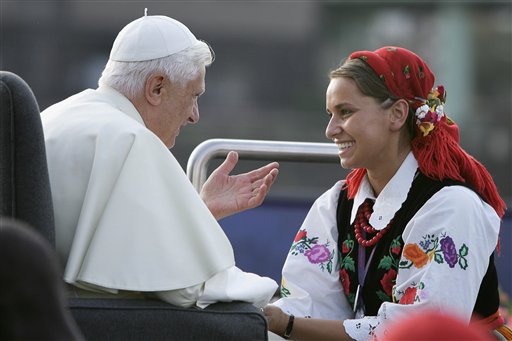
Pope Benedict XVI is in Cologne, Germany right now for World Youth Day and can be watched on EWTN. His opening address (in several languages) was very enlightening and welcoming especially the ending where He stated that by inviting Christ into our life we lose nothing but rather Christ will then bring all things in us to perfection. The following is his address from the River Rhine.

Dear young people, the happiness you are seeking, the happiness you have a right to enjoy has a name and a face: it is Jesus of Nazareth, hidden in the Eucharist. Only he gives the fullness of life to humanity! With Mary, say your own "yes" to God, for he wishes to give himself to you.

I repeat today what I said at the beginning of my Pontificate: "If we let Christ into our lives, we lose nothing, nothing, absolutely nothing of what makes life free, beautiful and great. No! Only in this friendship are the doors of life opened wide. Only in this friendship is the great potential of human existence truly revealed. Only in this friendship do we experience beauty and liberation" (Homily at the Mass of Inauguration, 24 April 2005).

Be completely convinced of this: Christ takes from you nothing that is beautiful and great, but brings everything to perfection for the glory of God, the happiness of men and women, and the salvation of the world.

In these days I encourage you to commit yourselves without reserve to serving Christ, whatever the cost. The encounter with Jesus Christ will allow you to experience in your hearts the joy of his living and life-giving presence, and enable you to bear witness to it before others. Let your presence in this city be the first sign and proclamation of the Gospel, thanks to the witness of your actions and your joy.

Let us raise our hearts in a hymn of praise and thanksgiving to the Father for the many blessings he has given us and for the gift of faith which we will celebrate together, making it manifest to the world from this land in the heart of Europe, a Europe which owes so much to the Gospel and its witnesses down the centuries.

And now I shall go as a pilgrim to the Cathedral of Cologne, to venerate the relics of the holy Magi who left everything to follow the star which was guiding them to the Saviour of the human race. You too, dear young people, have already had, or will have, the opportunity to make the same pilgrimage.

Read more: Vatican


Later in the day, the Holy Father visited the Cathedral in Rome and prayed before the relics of the Magi. Read his address there.

Photo Source: AP Photo/Patrick Hertzog, pool

Read more >>
Wednesday, August 17, 2005
My Heart is Ready

Before Jesus was scourged in the film "The Passion of the Christ", He said, looking to Heaven: "My heart is ready" yet the pain afterward was so tremendous few people could probably watch. I found an excellent article on this over on Catholic Exchange.

Image Source: Believed to be in the Public Domain, Title Unknown
Read more >>
Eucharistic Adoration, Exposition, and Benediction of the Blessed Sacrament


The Holy Eucharist is not just a symbol of God but actually is Jesus Christ's body, blood, soul, and divinity. The Eucharist is God! For more information on the Eucharist, see my page on the Eucharist.

What is Eucharistic Adoration?

Eucharistic Adoration is a special deep time of prayer. It is the adoration of Our Lord, who is truly present in the Eucharistic Host.  The bread and wine at Mass each become and remain the Sacred Body, Blood, Soul, and Divinity of Jesus.  In Eucharistic Adoration, we pray before the Eucharistic Host either in a monstrance or in the tabernacle. There are no set prayers during Adoration. People can pray the Rosary, the Litany of the Sacred Heart, or personal prayers. 

"Perpetual Eucharistic Adoration is the adoration of Jesus Christ present in the Holy Eucharist. In the many churches that have this adoration, the Eucharist is displayed in a special holder called a monstrance, and people come to pray and worship Jesus continually throughout the day and often the night. Christ’s great love for us was shown when he was crucified on the cross to pay the penalty for our sins and give us eternal life. He loves us without limit, and offers Himself to us in the Holy sacrament of the Eucharist. Can we not give Jesus a few minutes of love and adoration in return?" (Real Presence Association)

What is Exposition of the Blessed Sacrament?

We can always pray to our Lord in the tabernacle. But sometimes our Lord is taken out of the tabernacle by a priest and placed in a monstrance. This is called Exposition of the Blessed Sacrament, which is done for us to adore our Lord. The Exposition of the Most Blessed Sacrament typically traditionally begins with the recitation of the “O Salutaris Hosti.”

Some parishes have perpetual adoration chapels where you can visit and adore our Lord Jesus Christ at any time. Many saints would adore Jesus in the Eucharist for one hour a day. One of the most important life changes you can make is finding one hour each week to leave work or school or friends aside and just be present in adoration before Jesus. It can be a tremendous source of graces for you.

Find out if your parish has a time for Adoration. If not, find a nearby parish that does.

What is Benediction of the Blessed Sacrament?

In addition to Eucharistic Adoration, find a parish that offers Benediction of the Blessed Sacrament. Benediction starts with Exposition. After the O Salutaris Hostia is sung there is a period of silence when we may pray before Our Lord. After this period of silent prayer, the priest will often say the Divine Praises and the hymn, Tantum Ergo. He will then put on a special garment called a humeral veil and bless you with Jesus in the Blessed Sacrament. There are special indulgences associated with Eucharistic Adoration and Benediction.

Find out if your parish has Benediction. Some churches offer Benediction, usually on Sunday afternoons or Thursdays. If not, find a parish in your Diocese that does have Benediction. Attend Benediction within the next month.
Read more >>
Tuesday, August 16, 2005
World Youth Day Opens

Today World Youth Day opens and marks the 10th annual gathering of youth. This is an event that began under Pope John Paul ll and attempts to bring youth together, although it seems to be just another WoodStock and not in any manner an authentically Catholic retreat. I do not support World Youth Days for the debauchery, immodesty, and sacrilege which have come from these events.

So far there have been 405,000 registered individuals comprised of 101,174 Italians, 38,549 French, 31,908 Spanish and 24,237 Americans with 191 countries and territories being represented.

Now, some claim that World Youth Day attracted only those wishing to see Pope John Paul ll as a celebrity and not a religious leader, and there are no statistics available to how it helped increase the number of Catholics.

Also, I'm following it through a blog I found by a priest attending World Youth Day. Visit the blog, Coragio, to see more, though I do not necessarily endorse any views expressed on that website.
Read more >>
A Daily Reminder: The Crucifix


One very easy way to remember Our Lord's love and mercy is to either wear a crucifix or place one on our walls, typically above the bed. It is also important that we should wear a crucifix (a cross with Christ's body on it) instead of a Cross because it is through Jesus' Cross that we reach the Resurrection. Let us not forget Our Lord's sacrifice.

Some claim that since Jesus is resurrected He should not be on the cross, but if you look at it that way then we should show an empty tomb, not an empty cross. If there was an empty cross then this would be our faith - eternal death, the price of sin (Romans 5:12). But Jesus Christ, who is true Man and true God, chose to pay the price for us (1 Cor 15:3) and died for us even when He did not have to do anything of the such. Jesus never had to enter the Virgin's womb, but He chose to do it so that we might have eternal life with Him. An empty cross for each of us was our destiny, but God chose to free us from the penalty of sin that we willingly deserved. 

Every time we sin we will have only caused Our Lord greater pain on His Cross, so let us remember His sacrifice today, especially in the sorrowful mysteries of the Rosary, and thank Him for pardoning us for the sins we willingly commit.

It was Our Lord, Jesus Christ, that prepared the way for us, and we too must follow Him believing that if we die with Him we shall also rise with Him. "Whoever does not carry the cross and follow me is not worthy of me" (Matthew 10:38).

"The crucifix should be present in public and private places because this external symbol of God's presence is a reminder of humanity's shared God-given dignity" (Pope Benedict XVI, August 18, 2005)
Read more >>
Monday, August 15, 2005
Assumption of Mary


Double of the I Class with a Common Octave (1954 Calendar): August 15
First Class (1962 Calendar): August 15
Solemnity (1969 Calendar): August 15 

Today on August 15th we celebrate the Assumption of the Blessed Virgin Mary, where we profess our belief in the Dogma that Mary was assumed into Heaven body and soul by the power of God. This is a Dogma of the faith and must be believed to be Catholic; it has been taught since the early Church to the present day with allusions in the Sacred Scriptures.

The Assumption has been believed and celebrated since the earliest times of Christianity. Today's feast was celebrated under various names (Commemoration, Dormition, Passing, Assumption) from at least the fifth or sixth century. Homilies concerning the Assumption go back to at least the Sixth Century. However, in order to make it a dogma of the faith meaning all Catholics must believe it, Pope Pius XII dogmatically declared Mary's Assumption into Heaven in 1950:

"... by the authority of our Lord Jesus Christ, of the Blessed Apostles Peter and Paul, and by our own authority, we pronounce, declare, and define it to be a divinely revealed dogma: that the Immaculate Mother of God, the ever Virgin Mary, having completed the course of her earthly life, was assumed body and soul into heavenly glory" (Munificentissimus Deus)

The Eastern Churches (which are still in union with Rome) refer to today as the Dormition as opposed to the Assumption because they believe that Mary died and was then assumed into Heaven. As Roman Catholics in the Latin Rite, we are free to believe that Mary died and then was assumed into Heaven or that she didn't die but right before her death she was assumed into Heaven.

Some claim that the Assumption never happened because it is not in the Scriptures, but remember that the Bible deals with God, not Mary. The Bible does not deal with the earthy end of any of the original disciples after the Gospel ends.

Remember, today is a Holy Day of Obligation, meaning all Catholics must attend Mass.

The Early Church Believed in the Assumption

Pope Pius XII in his dogmatic proclamation mentioned or quoted St. Anthony of Padua, St. Damascene, St. Albert the Great, St. Thomas Aquinas, St. Bonaventure, St. Robert Bellarmine, St. Alphonsus Liguori, St. Peter Canisius, and Suarez, all of whom either outright supported the Assumption or at least did not deny it. For instance, St. John Damascene (675-749) states:

“It was fitting that she, who had kept her virginity intact in childbirth, should keep her own body free from all corruption even after death. It was fitting that she, who had carried the Creator as a child at her breast, should dwell in the divine tabernacles. It was fitting that the spouse, whom the Father had taken to himself, should live in the divine mansions. It was fitting that she, who had seen her Son upon the cross and who had thereby received into her heart the sword of sorrow which she had escaped in the act of giving birth to him, should look upon him as he sits with the Father. It was fitting that God’s Mother should possess what belongs to her Son, and that she should be honored by every creature as the Mother and as the handmaid of God” (Encomium in Dormitionem Dei Genetricis Semperque Virginis Mariae, Hom. II, n. 14; cf. also ibid, n. 3.).

Shockingly to Protestants, even Martin Butzer, a contemporary of Martin Luther, wrote, “Indeed, no Christian doubts that the most worthy Mother of the Lord lives with her beloved Son in heavenly joy” (Marienlexikon, vol. 3, 200)!

To deny the Assumption of Our Lady is to deny an unquestionable historical fact affirmed by centuries of Christians. Those who deny the Assumption fall prey to the errors which St. Paul warned of when he wrote, “For there shall be a time, when they will not endure sound doctrine; but, according to their own desires, they will heap to themselves teachers, having itching ears” (2 Timothy 4:3).


Purgatory:

Please pray for the Souls in Purgatory today. It is written that at the time of Mary’s Assumption, all of purgatory was emptied, and the souls detained there accompanied her in her triumphant entry into Heaven. St. Bernardine of Siena also states that through her prayers and the application of her own merits, the Virgin has the power of freeing souls, especially her devotees, from purgatory. St. Peter Damian attests that every year on the Feast of the Assumption (August 15), the Virgin liberates thousands of souls.

Scripture:

"God’s temple in heaven was opened, and the ark of his covenant could be seen in the temple. A great sign appeared in the sky, a woman clothed with the sun, with the moon under her feet, and on her head a crown of twelve stars. She was with child and wailed aloud in pain as she labored to give birth.

"Then another sign appeared in the sky; it was a huge red dragon, with seven heads and ten horns, and on its heads were seven diadems. Its tail swept away a third of the stars in the sky and hurled them down to the earth. Then the dragon stood before the woman about to give birth, to devour her child when she gave birth. She gave birth to a son, a male child, destined to rule all the nations with an iron rod. Her child was caught up to God and his throne. The woman herself fled into the desert where she had a place prepared by God."

Revelations 11:19 and Revelations 12:1-6

The Assumption of Mary by Francesco Botticini (1446 - 1498)

Deiparae Virginis Mariae:

The Christian people have never ceased to invoke and experience the Blessed Virgin Mary's assistance, and therefore they have, at all times, venerated her with ever-growing devotion. And so, because love when it is true and deeply felt tends of its own nature to manifest itself through ever renewed demonstrations, the faithful have vied with one another all through the centuries in expressing at all times their ardent piety toward the Queen of Heaven. In our opinion, this is the reason why, for a long time past, numerous petitions (those received from 1849 to 1940 have been gathered in two volumes which, accompanied with suitable comments, have been recently printed), from cardinals, patriarchs, archbishops, bishops, priests, religious of both sexes, associations, universities, and innumerable private persons have reached the Holy See, all begging that the bodily Assumption into heaven of the Blessed Virgin should be defined and proclaimed as a dogma of faith. And certainly, no one is unaware of the fact that this was fervently requested by almost two hundred fathers in the Vatican Council.

Encyclical of Pope Pius XII Promulgated on May 1, 1946

Novena:

Novena for the Assumption of Mary (August 7 - 15)

Collect:

Almighty and everlasting God, Who hast taken body and soul into heaven the Immaculate Virgin Mary, Mother of Thy Son: grant, we beseech Thee, that by steadfastly keeping heaven as our goal we may be counted worthy to join her in glory. Through the same our Lord.

Prayer Source: 1962 Roman Catholic Daily Missal

Learn More:

If you are interested in learning more about the Assumption of the Blessed Virgin Mary please consider purchasing the applicable lesson from CatechismClass.com, which is available for only a few dollars.  
Read more >>
Sunday, August 14, 2005
St. Maximilian Kolbe

Today is the feast day (August 14th) of St. Maximilian Kolbe, who died in a concentration camp because He willing took the place of a condemned man that was a father of children so that the man could be released. This heroic action of love is an example for us to imitate. "There is no greater love than to lay down one's life for one's friends" (John 15:33)

See my post on St. Maximilian Kolbe for more information.

Image Source: Believed to be in the Public Domain
Read more >>
Saturday, August 13, 2005
On Temptation

This is concluding a series of thoughts today on prayer, temptation, and doubt, which many people can easy find themselves in. Even Our Lord was tempted in the desert for 40 days with the devil even quoting Scripture (Matthew 4:1-11), but only Our Lord knew the true meaning of each line in Scripture. It is through the Church that we find a home, the dwelling place of the Holy Spirit and home of the sacraments. You can try to find a religious denomination or pray on your own but you will never know God completely without 1) prayer and 2) the Sacraments of the Catholic Church.

The bottom line is that in our own hearts we already know God. Our souls know God and never let satan come into your hearts and steal your joy from you. Keep watch with Christ and study the Word of God and soon all of our sunsets will turn into sunrises. Prayer, the Holy Mass, devotion to Mary, the reading of the Bible, etc. all prepare our souls to know God.

* I was inspired to write this after reading an article on Christ-Haunted about the top 100 Catholic Quotes of all time.

Image Source: Image of Palm Sunday Tridentine Mass, believed to be in the Public Domain
Read more >>
Some Random Catholic Information

I came across some interesting Catholic demographics towards the bottom of the page. Here's some of what it said:

  1. More science fiction writers belong to the Catholic Church than any other religious group
  2. Catholic countries consume more alcohol than protestant ones
  3. In the US Catholics and Lutherans had the lowest divorce rates

Read more >>
Conditions for Prayer

While reading This is the Faith by Canon Francis Ripley I came across a list of conditions for prayer. If you are having trouble with prayer and want to be able to pray honestly please see my comments as those from the book on page 39.

I believe before anything else when we pray we must admit our sinfulness and helplessness. Prayer is an absolute vital necessity (CCC 2744) because it is communication with God; it is a dialogue. Before we pray the Rosary or any prayer we should briefly examine ourselves and see how we can improve our lives and avoid sin. If we do not acknowledge our helplessness to God then our prayers are useless. Humility must reign in our heart.

These are from the book on page 39, with the detail coming from my opinion:

  1. Sincerity: Whether we are praying an Our Father or Hail Mary or just a prayer from our heart we must actually mean it. We should actually believe everything we are saying.
  2. Attention: We need to find a good place to pray and actually know the words we are saying. We shouldn't go about praying for others to see us as that is a horrible sin of pride, but we should pray silently to God with focusing exactly on our words and its meaning. During this time I have heard many times that people can receive temptation and "bad" thoughts in this time, but you just need to resisit them and continue to go on. We can not commit a sin if we are not willfully doing it. Temptation and sin are seperate.
  3. Humility: Again, examine how small we are before God. Try to kneel or at least lean forward. Never just lie back and pray in bed because it is too easy to fall asleep.
  4. Confidence: Trust Our Lord and know that He hears all of our prayer even if He doesn't answer them. His will and ways are far above ours, but know that in the end the outcome will all be for God's glory.
  5. Perserverance: Never give up on prayer - never. God hears you and will answer when the time is right if it is in accordance with His Holy Will. When you pray say, "Please, Lord grant me these requests if they are in your accordance with your will..."
  6. Resignation: Remember that God is Our Lord and maker is much higher than us. Let us humble ourselves and remember that He is always right so let us leave our prayers to Him.

Above all, never doubt that God loves you. Keep praying and offer God praise and thanks before anything else. And, remember, no matter how much doubt or temptation came come to you, that the Lord is Our God, the same person who freed us from sin as recorded in scripture and passed down through the Tradition of the Church. Never let doubt win and break us from prayer or faith - never.
Read more >>
Prayer & reflection on it

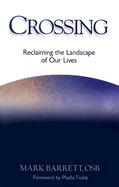
I am currently reading "Crossing: Reclaiming the Landscape of Our Lives" by Mark Barrett, OSB, which is centered on his struggle with prayer and the praying of the Liturgy of the Hours in his monastery. The Liturgy of the Hours is the prayer of the Church at different points in the day, and the author states that he does actually get bored with prayer.

Sometimes even we think "Are my prayers heard?" or "Why do I pray?" but let these thoughts go in one ear and out of the other. We believe in God and should not let doubt try to question our belief in God and the Tradition of the Church passed down through the Holy Church since the time of Christ. Prayer is not just talking with God but a dialogue between our soul and Him. Through prayer we give Our Lord thanks and praise and can ask petitions, but don't just let Mass and prayer become a habit and not an experience. Actually pray the words at Mass instead of just repeating them.

In the book the author describes our days as full of crossroads through a garden (the garden being a metaphor of our life), and only if we rely on God and think clearly about how to improve our lives through prayer can we hope to travel through life without going in circles. Make sure you see prayer as a personal dialogue with God and an opportunity to reflect on our day so far. If you, however, do not rely on God then we are nothing and surely can not find our way through a garden because it would undoubtedly seem a wilderness.

One day St. Franics saw his students reading about God and the saints in classes and was furious because it took away their prayer time and prayer time is the most important part of living with God. Prayer is the water of our soul for the seed of God's word and without water we can not hope to survive in the desert of the world around us.

I'll post a summary of the book when I complete it. I do however greatly recommend purchasing Christian Prayer, which I use to pray the Liturgy of the Hours. I love to use it.
Read more >>
Friday, August 12, 2005
Prayer to Saints


Why Pray to Saints?

A saint is a person who the Church declares possesses the beatific vision (i.e. a saint is someone who is in Heaven) and whose life is worthy of imitation on account of the virtues they possessed.

Catholics are frequently criticized for “praying to the dead” by some non-Catholics who seem to believe that by praying to the Saints we are taking something away from God. We as Catholics know that the relationship we have with the saints is entirely different than the relationship we have with God. Protestants often accuse Catholics of necromancy and idolatry because of our devotion to the saints. These claims are false.

"Therefore, confess your sins to one another and pray for one another, that you may be healed. The fervent prayer of a righteous person is very powerful." -- James 5:16.

We never pray to a saint as the end but rather ask them to pray along with us. They are intercessors for us as they are in the presence of God Himself in Heaven. These men and women in Heaven are very close to God and it makes sense that asking them to pray for us can only cause good. It is common practice to ask fellow human beings on earth to pray to God for us and our intentions. No one rightfully faults this practice. And if death is not the end of life and those who are now in Heaven see God, why should we not ask them for their intercession? 

A basic study of Church history reveals that the honoring of the saints and praying to them is of apostolic origin. The term "saint" is from the Latin word sanctus meaning "hallowed or “consecrated." The first person honored individually as a saint was Stephen, the first martyr, whose death is recorded in The Book of the Acts of the Apostles Chapters 6 and 7. For nearly four centuries, praying to St. Stephen was incredibly popular. Beginning at the end of the second century, there were special celebrations on anniversaries of the martyrs' deaths. These martyrs were witnesses of Christ. By the fourth century, sainthood was not just considered for martyrs. It was also for confessors and virgins. 

How Can the Saints Hear Our Prayers?

“And when he had opened the book, the four living creatures, and the four and twenty ancients fell down before the Lamb, having every one of them harps, and golden vials full of odours, which are the prayers of saints” (Revelations 5:8)

The Book of Revelations written by St. John the Apostle specifically mentions how the prayers of the saints are presented before God in Heaven. The saints in Heaven are very much aware of what is happening on earth because God has in His order of the world permitted them to know of prayers addressed to them. In Matthew 17:3-5, the Prophets Moses and Elijah were very much aware of what was taking place on the earth. The saints themselves are witnesses of what occurs on earth as the Book of Hebrews specifically states: ““Therefore, since we are surrounded by so great a cloud of witnesses, let us rid ourselves of every burden and sin that clings to us and persevere in running the race that lies before us” (Hebrews 12:1). And our Lord Himself in Luke 15:7-10 describes those in Heaven rejoicing over repentance on earth. How could they do so unless in the mystical order of the universe God has somehow permitted them to know and see what was happening on the earth?

Does Praying to the Saints Violate Christ’s Role as Mediator?

“For there is one God, and there is one mediator between God and men, the man Christ Jesus” (1 Tim. 2:5).

Through the hypostatic union, the fact that Jesus Christ, the Second Person of the Blessed Trinity, took on human nature, He alone can truly offer Sacrifice for mankind and stand as the sole mediator between human beings and God the Father. 

However, this does not prevent other mediators between mankind and our Lord. In the four verses immediately preceding 1 Timothy 2:5, Paul says that the Faithful should intercede for each other: “First of all, then, I urge that supplications, prayers, intercessions, and thanksgivings be made for all men, for kings and all who are in high positions, that we may lead a quiet and peaceable life, godly and respectful in every way. This is good, and pleasing to God our Savior, who desires all men to be saved and to come to the knowledge of the truth” (1 Tim. 2:1–4). St. Paul himself asks for intercession to be made for one another. If we can ask fellow Catholics on earth to pray for us to God, what would prevent us from asking fellow Catholics in Heaven to do so? The saints in Heaven are after all truly alive.

Elsewhere in Scripture St. Paul directly asks others to pray for him (Rom. 15:30–32, Eph. 6:18–20, Col. 4:3, 1 Thess. 5:25, 2 Thess. 3:1), and he assured them that he was praying for them as well (2 Thess. 1:11). If Scripture supported the notion that we should only pray to Jesus and not ask others to pray for us to God, then the Scripture would say it with such clarity. But on the contrary, the Scriptures emphasis praying for others.


Why Do Catholics Have Images or Statues of the Saints?

Catholic images include such things as statues, artistic renderings, and other works of art. Some may be concerned that this is a violation of the first commandment, but we know as Catholics that when we see a beautiful statue of the Blessed Mother or one of the saints we don’t actually worship the plaster, but we use it as a way to remind us of that individual. Just as we all display photos in our home to remind us of our loved ones, both living and dead, nobody would accuse us of worshipping or loving the photo rather than the person. Images are a way to draw us closer to God and holiness. We should take advantage of the vast array of Catholic images at our disposal and do our best to incorporate them into our homes as a vehicle for bringing ourselves and our families to the love of God.

In the Old Testament in the Book of Numbers 21:8 God commanded Moses to make the bronze serpent which we learn is a symbol of Jesus Christ (cf. John 3:14). It is only destroyed after it is worshiped (cf. 2 Kings 18:4), the making of it was not a sin. And there were images of the cherubim angels in the temple (cf. 1 Kings 6:23-31) and God blessed the temple (cf. 1 Kings 9:3). Not one line of Scripture ever condemned the creation of images or art of those in Heaven.

Imitating the Saints

The best way to learn to imitate the saints is to immerse oneself in their stories and see the courageous example of their lives. Two great examples are The Passion of the Holy Martyrs Felicity and Perpetus and Sulpitius Severus  On the Life of St. Martin.

Conclusion

Besides considering the Scriptural basis for praying to the saints, we can also look at the manifestation of miracles which attest to the truths of Catholic doctrine. Obviously, God would not bless a false doctrine with an abundance of miracles, and if there were no God, miracles could not be. So, the miracles performed by Catholics saints, and attested to by numerous witnesses of exemplary character, furnish powerful proofs of the divinity of the Catholic religion. And there are so many, we hardly know where to begin. Various authors, such as Joan Carroll Cruz have written extensively about this. Consider reading anything about St. Pio, St. Bernard of Clairvaux, St. Joseph of Cupertino, St. John Bosco, or St. Francis of Assisi. Also try to read anything about the miracles at Fatima, especially John Haffert’s Meet the Witnesses.

There are no reported miracles ever worked by Martin Luther or any protestant “reformer” or clergyman. There are no reported miracles performed and beyond the explanation of science by any religion (e.g. Protestants, Muslims, Jews, Hindus, Buddhists, et cetera) except for Catholic saints. Only the miracles alleged even to modern times by Catholic saints are without scientific proof.
Read more >>
Priests for Life Announces Lay Movement

It appears that Priests for Life has just announced a lay movement. Read about it here on the National Catholic Register.

Image Source: Photograph believed to be in the Public Domain, Title Unknown
Read more >>
Thursday, August 11, 2005
Pro-life Statistics

I just came across new poll results from CBS, which show a majority do not support abortion.

"When asked about their "personal feeling about abortion," 53 percent of respondents said all or most abortions should not be permitted and only 43 percent said all or most abortions should be permitted." (Read the article)

Any comments? What do you think this shows for America? Is it going more pro-life than before?
Read more >>
Daily Lives for Christ

I recently took several suggestions on how to live our daily lives for God and created a top ten list. They are in no particular order, but here are ten ways to live our lives with God as the center. How many do you do?

  1. Pray a morning offering and offer all of your prayers, joys, works, and sufferings of the day to Christ for His glory
  2. Pray at least the morning and evening parts of the Divine Office (Breviary)
  3. Pray the Rosary daily
  4. Forgive those that trespass against us
  5. Celebrate the seasons of the Church by doing something special for each season (Advent, Lent, Septuagesima, Chrsitmastide, Eastertide, etc)
  6. Celebrate your patron saint's feastday as well as for those in your family
  7. Read at least one chapter from Sacred Scripture daily
  8. Pray the Divine Mercy Chaplet once a day (best at 3 PM to remember Our Lord's death) as well as the Angelus at 6 AM, Noon, and 6 PM
  9. If possible visit the Blessed Sacrament in adoration or Mass
  10. At dinner light a candle and say grace before and after meals making sure to give thanks to the Lord for His goodness
Image Source: Believed to be in the Public Domain, Title Unknown
Read more >>
Wednesday, August 10, 2005
Year of the Eucharist

Last year, Pope John Paul ll declared for one year that we would celebrate the Year of the Eucharist - one full year commemorating the greatest of all the Sacraments - Christ's own body, blood, soul, and divinity which we receive in Holy Communion. For those you that have known about this special year, which ends in October, what have you done for it? Have you gone to Eucharistic Adoration or Benediction more often than normal? Have you truly contemplated the greatest and holiest of all miracles which happens at every Mass when bread and wine actually become our Lord and God?

There is still time to spend time with Our Lord. We remember that as He sat alone in the Garden of Gethsamane, when all of His friends left Him, He called out: "Will you not spend one hour with me?" And we still can do just that. You still can spend time in Adoration near you.

Recently on August 5, 2005, Francis Cardinal George of the Archdiocese of Chicago led a Eucharistic procession and Benediction in Grant Park, Illinois with thousands of people (see photos). Cardinal George said: "What needs transformation in individual lives... is anything that keeps people from being free to love God: addictions to alcohol and drugs, to sexual sin, to anger, to racism or other prejudices. These are habits of sin... Christ will change us, Christ will transform us, Christ will free us.'" (Read the whole article)

For more information on the Eucharist see my post on the Eucharist.

Image Source: Image of Archbishop Fulton J Sheen, believed to be in the Public Domain
Read more >>
Tuesday, August 9, 2005
Comment Policy

Comments are strongly encouraged on this blog.

It doesn't matter if you are a Catholic or not - I would love to hear your positions as long as they are done in a respectable manner. Your comment will however be deleted if you deliberately attack or mock Jesus Christ, other posters, or if you use inappropriate language. For example, you can discuss priests without insulting them for the actions of a few bad ones in our contemporary world. Such insults will not be tolerated.

Final decision rests with me, the author of this blog, concerning the deletion of a comment.

Unacceptable comments include but are not limited to:

  1. Posting Insulting, Derogatory, or Attacks against me or another commentor
  2. Posting heretical or blasphemous comments
  3. Posting obscene comments
  4. Advertising or Self-Promotion (email such comments to me directly)
  5. Writing a comment about something completely unrelated to the post you are commenting on
  6. Linking to a video, article, webpage, etc. that I deem anti-Catholic or inappropriate
  7. Posting a non-English Language comment.  Use of Latin within is fine, but a message entirely in another language is not acceptable.
Note: This policy is subject to change without notice.
Read more >>
Monday, August 8, 2005
Make God the center of Our Lives

World Youth Day 2005 SymbolWith World Youth Day approaching, Pope Benedict XVI prepares and is calling for God to be the most important part of our daily lives. We can live this through prayer and love of God and our neighbor.

Adoring God means recognizing his presence as creator and lord of the universe and ensuring that God is the most important part of one's life, Pope Benedict XVI said. With about 2,000 people packed into the courtyard of his summer villa south of Rome and several thousand more people gathered in the square outside the villa Aug. 7, the pope focused his address on the upcoming celebration of World Youth Day. The theme of the Aug. 16-21 celebration in Cologne, Germany, is: "We Have Come to Worship Him." Pope Benedict said an attitude of worship and adoration is the attitude that has marked the lives of saints throughout Christian history. It involves recognizing the greatness of God and the gift of salvation in Jesus with gratitude that "arises from the depths of one's heart and marks one's whole being," he said.

Source: CNS

A plenary indulgence has even been granted to those who participate at World Youth Day. A very large crowd is planned.
Read more >>
Sunday, August 7, 2005
Women in the Priesthood

This is a contemporary topic that has grown into a whole debate nowadays. Women cannot be priests because Jesus only ordained men - His disciples at the Last Supper. God is all power and knows the future, so if He knew this would clear up debate I'm sure He would have chosen a woman if women could be priests. But, since He did not, it is clear the Church holds no power to ordain women. Men and women are created differently and are not physically equal. In the same way, men and women have equally important roles in the spiritual life, but they are different roles.

However, women are in no way regarded lowly in the Catholic Church. Mother Mary is considered the highest of all saints and honored because she is the Mother of God. The Catholic Church also honors other saints that are women such as St. Joan of Arc, St. Mary Magdalene, St. Therese of Avila, St. Therese of Lisieux, and many others. The last one is even considered the most popular saint of modern times, so women are considered very important in the Catholic Church.

Women cannot be priests because it is a difference of roles in the gender. A man certainly can't be a mother, and a man can't be a nun either. Men and women have different roles as parents and also in other parts of society including religion. I don't mean to be sounding as if I think lowly of different people because of gender because that isn't true; however, I do believe men and women have different roles and the Catholic Church would love to see more nuns and religious sisters anyway.

More Information:

Read Ordinatio Sacerdotalis by Pope John Paul ll (The best thing that was written by him)

Image Source: Photograph believed to be in the Public Domain
Read more >>
Saturday, August 6, 2005
Morning Prayer

I would like to take a minute and explain the great importance of a morning offering (Lauds). In a morning offering we offer up to God our prayers, works, joys, and sufferings of the day for His glory and for His intentions.

"All that we do without offering it to God is wasted" (St. John Vianney)

I strongly recommend learning a morning offering and reciting it everday when you wake. This is not only showing that we wish to serve God that day but also that we love Him enough to put Him first at the beginning of a new day.

A Morning Offering:

O, My Jesus, through the Immaculate Heart of Mary I offer thee my prayers, works, joys, and sufferings of this day in union with the Holy Sacrifice of the Mass throughout the world. I offer them for all the intentions of your Sacred Heart: the salvation of souls, reparation of sin, and the reunion of all Christians. I offer them for the intentions of our bishops and all the apostles of prayer, and in particular those recommended by our Holy Father this month.

For those that are interested, the Liturgy of the Hours is a great way to pray each day. It is the prayer of the Church, which is prayed a specific times each day by the pope, priests, bishops, nuns, monks, and many lay people. Ebrievary offers some of the daily prayers online, but I would suggest purchasing a book instead.

"Now, throughout the day, offer up your harships and sacrifices to Jesus, uniting them with His sufferings and merits so that our works gain the merit they can never have apart from Him. It is especially beneficial to offer them to Mary to give to Jesus so that her intercession as Queen Mother of Israel renders them more pleasing.

The Morning Offering can be renewed throughout the day with simple short prayers (called "ejaculations" or "aspirations"), for ex., 'All for Thee, Jesus!'" (Source Read More Here)
Image Source: Believed to be in the Public Domain, Title Unknown
Read more >>


Copyright Notice: Unless otherwise stated, all items are copyrighted under a Attribution-NonCommercial-NoDerivatives 4.0 International License. If you quote from this blog, cite a link to the post on this blog in your article.

Disclosure of Material Connection: Some of the links on this blog are “affiliate links.” This means if you click on the link and purchase the item, I will receive an affiliate commission. As an Amazon Associate, for instance, I earn a small commission from qualifying purchases made by those who click on the Amazon affiliate links included on this website. I am disclosing this in accordance with the Federal Trade Commission’s 16 CFR, Part 255: “Guides Concerning the Use of Endorsements and Testimonials in Advertising.”