Tuesday, February 28, 2006
Prayer, Prayer, and Prayer: Lent Begins

"Pray for the wicked, pray for the lukewarm, pray even for fervent souls, but pray especially for the Supreme Pontiff, for all the Spiritual and temporal needs of Holy Church, our most tender Mother. A special prayer for all those who are working for the salvation of souls and for God’s glory" (St. Padre Pio).

Lent starts tomorrow! Let us attempt to pray each day in reparation for our sins and for sinners around the world. Lent must include daily prayer for the Holy Father, the poor, the souls in purgatory, and others that are in need. Lent is about shifting the spotlight from ourselves to others in the name and love of Christ.

Prayer:

Dear Lord, we are now in the holy season of Lent. We begin to realize anew that these are the days of salvation, these are the acceptable days. We know that we are all sinners. We know that in many things we have all offended Your infinite majesty. We know that sin destroys Your life in us as a drought withers the leaves and chokes the life from the land, leaving an arid, dusty desert. Help us now, Lord, in our feeble attempts to make up for past sin. Bless our efforts with the rich blessing of Your grace. Make us realize ever more our need of penance and of mortification.

Help us to see, in our ordinary difficulties and duties, in the trials and temptations of every day, the best opportunity of making up for past infidelities. Every day we are so often reminded in field and wood, in sky and stream, of Your own boundless generosity to us. Help us to realize that You are never outdone in generosity, and that the least thing we do for You will be rewarded, full measure, pressed down, shaken together, and flowing over. Then we shall see, in our own souls, how the desert can blossom, and the dry and wasted land can bring forth the rich, useful fruit that was expected of it from the beginning. Amen.

Prayer Source:

THE RURAL LIFE PRAYERBOOK

Imprimi Potest
Leo J. Burns, S.J.
Provincial
Wisconsin Province
Milwaukee, Wis., 17 October 1955

Imprimatur
Fr. Eduardus Caelestinus, O.P.
Episcopus Desmoinen
Des Moines, Iowa, 13 February, 1956

Written and Compiled by
Alban J. Dachauer, S.J.
In cooperation with
The National Catholic Rural Life Conference
Drawings by Tom Chouteau

Published by
The National Catholic Rural Life Conference
4625 Beaver Avenue
Des Moines, IA 50310-2199

Copyright, 1956
National Catholic Rural Life Conference

Image Source: Believed to be in the Public Domain
Read more >>
A Trip to Israel

Here was a joke that couldn't apply better to this world today...

A Jewish businessman in Chicago sent his son to Israel for a year to absorb the culture. When the son returned, he said, "Papa, I had a great time in Israel. By the way, I converted to Christianity.""Oy vey," said the father. "What have I done?"He took his problem to his best friend. "Ike," he said, "I sent my son to Israel, and he came home a Christian. What can I do?""Funny you should ask," said Ike. "I too, sent my son to Israel, and heal so came home a Christian.." Perhaps we should go see the rabbi. So they did, and they explained their problem to the rabbi."Funny you should ask," said the rabbi.. "I, too, sent my son to Israel,and he also came home a Christian. What is happening to our young people?" And so they all prayed, telling the Lord about their sons. As they finished their prayer, a voice came from the heavens: "Funny you should ask," said the voice. "I, too, sent my son to Israel...."
Read more >>
Prayer Request from Fatima, NJ

Requiem aeternam dona ei, Domine, et lux perpetua luceat ei. Requiescat in pace. Amen.

I received this prayer request in my Inbox, and I ask you to please say a prayer for this man's soul.

Please say a special prayer formy dad. He passed away 7 months ago today. I always thought it would get easier with time, but not a day goes by that I don't cry for him. Maybe it's because of the horrible pain I saw him go through... I truly believe my father lived his purgatory on earth. For the last six months of his life, he was semi-comatose due to an overdose of anesthesia given him for a simple out patient procedure. He was left paralyzed and couldn't communicate to us, but could see and hear us and feel pain. I tried to put myself in his position and couldn't fathom it...like being locked up in your own body! He would look me right in the eye when I would speak to him and start crying and I never felt more helpless. He ended up with these horrific bed sores on his back which eventually led to his death. He died a week before his 65th birthday. I hope and pray that he's at peace with God. Please help me ask God to let him know how much he is loved and missed.

Thank you all and God Bless,

Fatima - NJ

Image Source: Photo of Archbishop Fulton J. Sheen, Believed to be in the Public Domain
Read more >>
Monday, February 27, 2006
Peter's Pence Collection


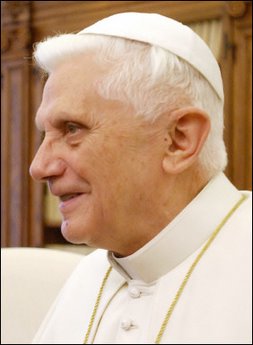
The annual collection given to the Holy Father was presented to him recently. In the closed meeting, he reminded the members of the Circle of St. Peter of his emphasis in Deus Caritas Est on Christian charity. The 2004 Peter's Pence raised $51 million, 7.4% below 2003 (Source: CWNews).

A remember that this collection given to the Holy Father to carry out his work for those in need is now online. Please visit the Vatican's Peter's Pence Page to donate to Our Holy Father online.

Photo Source: Associated Press
Read more >>
St. Gabriel of Our Lady of Sorrows

Double (1955 Calendar): February 27 or February 28 if leap year

Today we remember St. Gabriel of Our Lady of Sorrows (1838-1862). At the young age of four, he lost his mother and lived in worldly pleasures. Our Lady brought him to deeper reverence, and after being cured of two serious diseases, he knew that he was called to religious life. His request to join the Jesuits was turned down because he was only 17, but after his sister died of cholera, he was accepted to the Passionists. He then took the name Gabriel of Our Lady of Sorrows.

He was a joyous person and a shining example that living the Catholic life, one that is centered on God, is not burdening but liberating. The regulations of the Church help us to serve Christ and this brings out greater joy. St. Gabriel possessed a strong spirit of prayer, love for the poor, and a consideration of the feelings of others.

While only four years after entering religious life, St. Gabriel developed pneumonia and on February 27, 1862, at age 24, he died. In 1920 he was canonized. Pope Benedict XVI has called him a pattern for young people.

His Words:

"Love Mary! She is lovable, faithful, constant. She will never let herself be outdone in love, but will ever remain supreme. If you are in danger, she will hasten to free you. If you are troubled, she will console you. If you are sick, she will bring you relief. If you are in need, she will help you. She does not look to see what kind of person you have been. She simply comes to a heart that wants to love her. She comes quickly and opens her merciful heart to you, embraces you and consoles and serves you. She will even be at hand to accompany you on the trip to eternity."

For more see: Gabriel of Our Lady of Sorrows: Life and Prayers.

Prayer:

O God, Who didst teach blessed Gabriel to think continually of the sorrows of Thy most sweet Mother, and didst exalt him through her by the renown of holiness and miracles; grant us through his intercession and example so to join Thy Mother in her grief that we may be saved by her maternal protection: Who livest and reignest.

Prayer Source: 1962 Roman Catholic Daily Missal
Read more >>
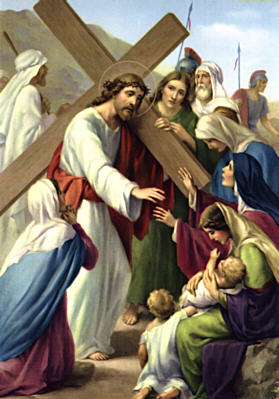
"Jesus, at the sight of the crowds, was moved with pity."

Those words from Matthew 9:36 have been chosen by Pope Benedict XVI to be our theme as we journey through this year's Lent. This will be my first year blogging through Lent, and I want to make this a spiritually-rich time. My posts will reflect the cornerstone our our Lenten journey - Christ.

I will not make these posts "politically correct" or at times even polite; they will be the truth. And this is the truth - that Christ is the Lord and we must follow Him. His commandments do not just apply to those who follow Him now but to ever last individual sharing in his divine image. We as human beings are called to salvation - and this is done only through Our Lord. Prayer will be focal point of my posts, and I hope that my readers will not only read them but pray them. Prayer is the key to the Heart of God! Prayer is essential.

Lent is about prayer, fasting, and penance. I will try to touch on all of these issues.

Pope Benedict XVI's Lenten Message:

Lent is a privileged time of interior pilgrimage towards Him Who is the fount of mercy. It is a pilgrimage in which He Himself accompanies us through the desert of our poverty, sustaining us on our way towards the intense joy of Easter. Even in the “valley of darkness” of which the Psalmist speaks (Ps 23:4), while the tempter prompts us to despair or to place a vain hope in the work of our own hands, God is there to guard us and sustain us. Yes, even today the Lord hears the cry of the multitudes longing for joy, peace, and love. As in every age, they feel abandoned. Yet, even in the desolation of misery, loneliness, violence and hunger that indiscriminately afflict children, adults, and the elderly, God does not allow darkness to prevail. In fact, in the words of my beloved Predecessor, Pope John Paul II, there is a “divine limit imposed upon evil”, namely, mercy (Memory and Identity, pp. 19ff.). It is with these thoughts in mind that I have chosen as my theme for this Message the Gospel text: “Jesus, at the sight of the crowds, was moved with pity” (Mt 9:36)...

Keep Reading

Image Source: Believed to be in the Public Domain
Read more >>
Sunday, February 26, 2006
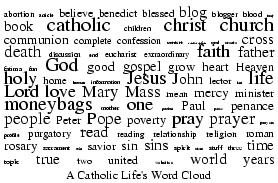
My Word Cloud


I found a really interesting website through Ma Beck's blog. The site is made to design a t-shirt, but I still went through the process just to create my word cloud. The above image is my word cloud - a list of some of the most common words in my blog. I'm quite pleased with the results. (click on it for a larger image)
Read more >>
Pray for the Repose of the Soul of Fr. Andrea Santore

Please offer up your prayers for Andrea Santore. He was shot and murdered in Trabzon, Turkey while praying in St. Mary Church. Fr. Santore was part of the Vatican's "Fidei Donum" program, which sends priests to help in missionary areas. He had worked in Turkey for 10 years and worked diligently to help young women escape from traffickers who would force them into prostitution. May Our Lord forgive Him his sins and grant Him eternal life. For this is the true example of faith - willingly putting your life in danger for Christ. This is how you know if you have faith, that you would lay down your life for Christ.

"These things I have spoken to you, that in me you may have peace. In the world you shall have distress: but have confidence, I have overcome the world" (John 16:33)

Pope Benedict XVI noted the "generosity and apostolic zeal" of Fr. Santore and assured Fr. Santore's community of his spiritual closeness to them "at this moment of sorrow". The Holy Father also said that he was "deeply affected" by the "serious loss of such an esteemed and enthusiastic priest."

Requiem aeternam dona ei, Domine, et lux perpetua luceat ei. Requiescat in pace. Amen.

Read the last letter Fr. Andrea Santore ever wrote

Update: The European Parliament has condemned his killing

Update (July 3, 2006): It's been awhile since I posted about Fr. Andrea, but I found some information today. His killer, a 16-year old Muslim, is currently on trial (source).
Read more >>
A Prayer Before Praying

I received this beautiful prayer in my inbox today and wanted to share it:

"Almighty Father, I place the Precious Blood of Jesus before my lips before I pray, that my prayers may be purified before they ascend to Your Divine Altar." AMEN

Image Source: Believed to be in the Public Domain
Read more >>
Saturday, February 25, 2006
The Da Vinci Joke

Zenit has published an interview with Mark Shea on his recent book "The Da Vinci Deception". I have been a strong proponent against this blasphemous book for months, and I'm thankful to see a good resource by a good author coming out.

"Those who say, "It's just a story," simply do not understand that this deception is part of the book's power. People often receive through fiction what they would be on guard against in reasoned debate.

And this is particularly true as Dan Brown, the author of "The Da Vinci Code," has actually stated he would not change any of his basic assertions if he were writing nonfiction. Brown means for us to understand that his claims about the origins are Christianity are true."


Shea listed just a few of the numerous errors of Dan Brown in this interview:

"He claims Leonardo Da Vinci doesn't give Jesus a chalice in his painting "The Last Supper" in order to hint that Mary Magdalene is the true chalice who held the "blood of Jesus" -- i.e., his child -- despite the fact there are 13 cups in the painting. He chatters about the meaning of an Aramaic word in the Gnostic gospel of Philip, oblivious to the fact it's written in Coptic. He calls Mary Magdalene the victim of a Catholic smear campaign without pausing to wonder why she's a Catholic saint. He blames "the Vatican" for various plots and conspiracies that are alleged to have taken place centuries before there was any Vatican to plot them. And, of course, in the biggest lie of them all, he declares that nobody before the year A.D. 325 thought of Jesus as anything other than a "mortal prophet" until Constantine muscled the Council of Nicaea into declaring him God "by a relatively close vote." Of course, he does not stop to ask why, if Jesus was just a "mortal prophet," he bothered founding a Church at all -- nor what the Church was about for the first 300 years if nobody was worshipping Jesus as God."

I hope that Catholics and Christians alike will join me in boycotting the movie and/or the book. Fr. Benedict Groeschel's Sunday program, "Sunday Night Live" at 7 PM EST tomorrow will center on the topic of the Da Vinci Code. If you have had questions with the book I recommend tuning into EWTN for the program.
Read more >>
Getting Better

I wrote last week about being sick with the flu, and I'm thankful for all of your prayers as I am getting well. Please keep me in your prayers as I near the end of this and get ready for Lent.

Thanks everyone

PS: I forgot how much I hate the flu...
Read more >>
Catholic Fasting and Abstinence Principles & Practices


Definitions:

Fasting: Fasting refers to how much food we eat. It means taking only one meal during a calendar day. The meal should be an average-sized meal as overeating at the one meal is against the spirit of the fast. Fasting generally means that the meal is to be taken later in the day. Along with the one meal, up to two snacks (technically called either a collation or frustulum) are permitted. These are optional, not required. Added up together, they may not equal the size of the one meal. No other snacking throughout the day is permitted. Fasting does not affect liquids, aside from the Eucharistic Fast which is a separate matter.

Abstinence: Abstinence in this context refers to not eating meat. Meat refers to the fleshmeat of mammals or fowl. Beef, poultry, lamb, etc are all forbidden on days of abstinence. Abstinence does not currently prohibit animal byproducts like dairy (e.g. cheese, butter, milk) or eggs, but in times past they were prohibited. Fish is permitted along with shellfish and other cold-blooded animals like alligators. In times past, days of fast were always days of abstinence as well; however, not all days of abstinence were days of mandatory fasting.

Partial Abstinence: Partial Abstinence refers to eating meat only at the principal meal of the day. Days of partial abstinence do not permit meat to be eaten as part of the collation or the frustulum. Partial abstinence started only in 1741 under Pope Benedict XIV as a concession and as part of a gradual weakening of discipline. Beforehand, days of abstinence were days of complete abstinence.

Fasting, therefore, refers to the quantity of food and the frequency of eating. Abstinence refers to what may or may not be eaten.

Want to learn more about the rules of fasting and abstinence? Check out the Definitive Guide to Catholic Fasting and Abstinence.

Man of Sorrows by William Dyce

Fasting & Abstinence in Practice During Lent:

Overview: While fasting and abstinence are always encouraged, Catholics have always practiced these together as a Universal Church on certain days and certain seasons. However, beyond the details below, you are welcome to fast any day of the year with the exception that Sundays and Pascaltide (i.e. the Easter Season) are not appropriate times for fasting.

Ash Wednesday [Fasting and Abstinence]: This is a mandatory abstinence and fasting day.

All Catholics aged 14 or older must abstain from meat on this day, as per the current 1983 Code of Canon Law. In the 1917 Code of Canon Law, the law of abstinence began at age 7. Since it is worthwhile to teach children the importance of this law, we should have our children begin to observe this even before the law explicitly commands it.

What is forbidden by the law of abstinence? All meat. Meat is considered to be the flesh and organs of mammals and fowl. Also forbidden are soups or gravies made from them. Salt and freshwater species of fish, amphibians, reptiles, and shellfish are permitted. [See: Why Do Catholics Eat Fish on Fridays?]. Eggs are presently allowed.

Additionally, besides abstaining from meat, as per the 1983 Code of Canon Law, anyone between 18 and up until 60 years of age is also bound to fast on Ash Wednesday. In the earlier 1917 Code, the fast began at age 21 and continued until a person turned 60. On this day one, normal-sized meal and two smaller snacks (called collations) that do not equal the normal meal are allowed. No indulging at a buffet at night to make up for the meals you could not eat during the day.

Eating between meals is prohibited although fruit juices and milk are allowed. Milk was added only in the recent centuries and the Church had asked that those who do consume milk on fasting days offer some additional prayers for the intentions of the Holy Father for doing so.

These rules are much more lenient than in centuries past. If you can, truly make your fasting a sacrifice. In times past, Ash Wednesday was a day when the faithful were asked to eat nothing at all.

Good Friday [Fasting and Abstinence]: This is a day of mandatory abstinence and fasting.

This day is the most somber day of the year when we recall Our Savior's death. The rules for Ash Wednesday apply to today. Today is a required day of abstaining from all meat and a required day of fasting.

Like Ash Wednesday in times past, Good Friday was a day with no food at all, for those able to keep that strictness. 

The fast is traditionally kept into the morning of Holy Saturday and ends on Holy Saturday at noon, or whenever you attend the Vigil, whatever is later.

The Fridays of Lent: All the Fridays of Lent including Good Friday are mandatory days of abstinence from meat. The abstinence rules outlined under Ash Wednesday apply today.

Since Lent was traditionally always understood as a period of 40 days of fasting, you should keep Fridays of Lent (and all days of Lent aside from Sundays) as fasting days. Failing to fast on Fridays in Lent is not a sin, except for Good Friday. However, failing to abstain from meat on Fridays of Lent is a mortal sin.

All Days of Lent except for Fridays (since the days that are covered above) and except for Sundays: Traditional Catholics will still fast all days of Lent. By the time that the 1917 Code of Canon Law was compiled, Lent had changed to allow meat at the meal of the day but never in the collations. The exception, of course, is Fridays and Ash Wednesday. This practice is called "partial abstinence". By partial abstinence, a person is allowed to eat meat only at the major meal. However, partial abstinence, which is part of the 1917 Code of Canon Law, is a modern change in itself. Some Catholics will maintain the older practice of not only fasting but abstaining entirely from all meat on all 40 days of Lent. Having meat on weekdays of Lent (except Fridays) was only allowed a few hundred years ago. Even Sundays, while not days of fasting, were kept as days of abstinence aside from Laetare Sunday, the mid-point of Lent, when the faithful had a reprieve.

While most Catholics no longer abstain from meat on non-Fridays or fast throughout the 40 days, these are still practices that should be observed by those who are physically able to do so. Keeping the strict Lenten fast and strict abstinence as done in the Early Church through the 17th century will help us conquer addictions, make reparation for sin, and avert God's justice.

Lenten Abstinence: The Lenten abstinence described above, unless otherwise stated, pertains only to meat and products like soups or gravies or broths made from them. In times past though, for centuries no animal products of any kind (e.g. dairy, cheese, butter, or eggs) were consumed during Lent. As Lent became weakened, these sacrifices became optional and fell nearly entirely out of us. However, some Orthodox Christians and Eastern Rite (e.g. Byzantine) Catholics still abstain from all meat and all animal products for all of Lent. Roman Catholics are welcome and even encouraged to do so in solidarity with them and in solidarity with our forefathers who did so. Such a penance would be highly appropriate for Lent.

Conclusion: Based on the Church's Lenten fast through the centuries, and a desire to do more than the minimum, here is a suggested fasting and abstinence plan for Lent (in imitation of how Lent used to be):
  • Fasting applies for those age 18 or older (but not obligatory for those 60 years of age or older)
  • Ash Wednesday and Good Friday: No solid food. Only black coffee, tea, or water.
  • Mondays through Saturdays: Only one meal preferably after sunset. A morning frustulum and evening collation are permitted but not required. No meat or animal products are allowed for anyone, regardless of age - that includes fish. No olive oil is permitted.
  • Sundays: No meat or animal products allowed except on Laetare Sunday. Except for Palm Sunday mentioned below.
  • Annunciation Day (March 25) and Palm Sunday: Fish and olive oil permitted.
  • Holy Week (except Good Friday): Only Bread, Salt, and Herbs are permitted for the main meal. Frustulum and collation permitted (of bread, herbs, and salt) but omitted if possible
  • Holy Saturday: No food until Noon. Abstinence including from all animal products continues until Easter begins.
Fasting & Abstinence in Practice Outside of Lent:


All Fridays of the Year outside of Lent: All Catholics must abstain from meat all Fridays of the year, not just during Lent. However, a modern novelty has arisen whereby many Bishops have said that Catholics may do another form of penance on non-Lenten Fridays in the year instead of abstaining from meat. This is the case in some countries, but not all. Fridays in Lent, though, are mandatory abstinence, and another act of penance does not void the necessity to abstain from meat and meat products. Traditional Catholics will always abstain on each Friday of the year, though, instead of substituting an alternative penance. It is important that we are united in the same common penance in the same universal Faith on such days.

Other Traditional Days of Fasting: For information on fasting days and how they have changed over time since America's founding, please click here for a landmark article on the topic.

Catholic Fasting Calendar: If you would like to follow the traditional days of fasting, consider purchasing an online calendar that will indicate the traditional fasting days. Click here for one.

Want to learn more about the history of fasting and abstinence? Check out the Definitive Guide to Catholic Fasting and Abstinence.
Read more >>
Friday, February 24, 2006
Evening Prayer (Vespers)


Image Source: Saint Johns Cathedral in Valletta Malta

"Never lie down to sleep without first having examined your conscience on the way you have spent the day and without first turning your thoughts to God. Then offer and consecrate your whole person and that of every Christian, especially my wretched self, to God just as I do for you" (St. Padre Pio: Letters II p 292).

Vespers is one of the two main times of prayer in the Christian life along with Lauds (Morning). If you are looking to incorporate Vespers into your life, you can start by praying either Vespers (from the Little Office of the Blessed Virgin Mary) or the Roman Office's Vespers (available freely online from Divinum Officium).

How do you end your day in prayer? What can we learn from each other and add to our own daily prayers?

Evening Prayer:
My God, at the end of this day I thank you most heartily for all the graces I have received from you. I am sorry that I have not made a better use of them. I am sorry for all the sins I have committed against you. Forgive me, O my God, and graciously protect me this night. Blessed Virgin Mary, my dear heavenly mother, take me under your protection. St. Joseph, my dear guardian angel, and all you saints of God, pray for me. Sweet Jesus, have pity on all poor sinners, and save them from hell. Have mercy on the suffering souls in purgatory.
Read more >>
Pope Benedict Names 15 Cardinals


This past Wednesday, February 22nd, Pope Benedict elevated 15 bishops to the level of Cardinal. They will formally be elevated in a Vatican ceremony on March 24th.

12 bishops able to vote for the next pope:
  1. William Levada, prefect of the Congregation for the Doctrine of the Faith.
  2. Franc Rode, prefect of the Congregation for the Institutes for Consecrated Life.
  3. Agostino Vallini, prefect of the Tribunal for the Apostolic Signatura.
  4. Carlo Caffarra, archbishop of Bologna, Italy
  5. Stanislaw Dziwisz, archbishop of Krakow, Poland
  6. Nicolas Cheong-Jin-Suk, archbishop of Seoul, Korea
  7. Joseph Zen, bishop of Hong Kong
  8. Gaudencio B. Rosales, archbishop of Manila
  9. Antonio Canizares Llovera, archbishop of Toledo, Spain
  10. Sean Patrick O'Malley, archbishop of Boston
  11. Jean-Pierre Ricard, archbishop of Bordeaux, France
  12. Jorge Liberato Urosa Savino, archbishop of Caracas
Pope Benedict also elevated 3 other cardinals although they are too old (over 80 years) to be able to ever vote for a pope.
  1. Andrea Cordero Lanza Di Montezemolo
  2. Peter Poreku Dery
  3. Rev. Albert Vanhoye
Here is also a list of the Cardinals. I also propose the Te Deum prayer to be said during this time in thanksgiving for our new cardinals and for our Holy Father. Pray for a restoration of the Church through them.
Read more >>
South Dakota and Abortion

November 7, 2006: South Dakota Residents did not approve the law by a roughly 45-55%. It is a sad day. But the pro-life movement will move on!!

Original Post: I have just read that the South Dakota Senate has passed a ban on virtually all abortions on a 23 to 12 vote. Governor Mike Rounds has also voiced his support for the measure. This is extremely significant in the fight for the sanctity of human life.

Let us pray that this law will prevail against the lawsuit that Planned Parenthood is preparing to file the day Gov. Rounds signs it into law. Pray for an end to abortion! We are closer now then we have ever been. Let us share the Gospel of Life with everyone for Jesus Christ came to save us from death and give us true life. Even the unborn are deserving of life.

Prayer for the unborn:

Heavenly Father, in Your love for us, protect against the wickedness of the devil, those helpless little ones to whom You have given the gift of life.Touch with pity the hearts of those women pregnant in our world today who are not thinking of motherhood.Help them to see that the child they carry is made in Your image - as well as theirs - made for eternal life.Dispel their fear and selfishness and give them true womanly hearts to love their babies and give them birth and all the needed care that a mother can give.We ask this through Jesus Christ, Your Son, Our Lord, Who lives and reigns with You and Holy Spirit, One God, forever and ever. Amen.
Read more >>
Holy Matrimony

I'm feeling a little better today, but I'm still not ready to start up major blogging again. I have recently had the flu. I did find this link though that I wanted to share. It's on Holy Matrimony:  Holy Matrimony

It is my belief that if our culture values marriage as nothing less than a sacrament instituted by God, we will become a holy people. A people of one mind and body rooted in the Gospel and the Church. And if this is true then future generations can also share in this joy.

Read more >>
Thursday, February 23, 2006
My Apologies

I apologize for not being able to blog recently. I have been very ill with the flu and was forced to stay in bed. I hopefully will start blogging again tomorrow.

I would appreciate your prayers that I will be well again very soon.

Thanks
Read more >>
Tuesday, February 21, 2006
My personal reflections from today

I wanted to post my personal reflections for today.

Today I overheard a conversation that deeply saddened me. One woman was talking with a friend and said that she was an ex-Catholic and proud of it. She claimed that growing up Catholic was a horrible time for her, so she was re-baptised last October in a non-denominational Church! How absurd. No one can be re-baptized if the baptism was valid, and it was obviously valid if done in a Catholic Church.

What deeply saddens and troubles me are stories like these. For this reason I started blogging and hoped to bring others in a deeper relationship with Christ - a relationship only found through the Catholic Church.

I was wondering what is the makeup of my readers? Were you a cradle Catholic, a Catholic that returned to the flock after falling away, or a convert? Are you stilling going through discernment or RCIA or are you not Catholic?

I must very must enunciate my the sadness that I feel when I know of someone leaving the Church. The Church is the Body of Christ! As St. Joan of Arc said, "About Jesus Christ and the Catholic Church, I simply know they are one and the same and we should not complicate the matter." Let us pray for deeper faith and more conversions to our faith.

On a positive note, the Catholic Population worldwide has grown 1.1% between 2003 and 2004, the latest statistics.

Let us also pray in reparation for the sins of the world. As Mary revealed to us at Fatima, "Do not offend the Lord our God any more, because He is already so much offended."
Read more >>
How the Church Leads us to God

The Meaning of “Church”

Before considering who is part of the Church or the marks of the true Church established by Christ, the Catechism of the Council of Trent begins by explaining the various meanings of the word “church”. The Church is referred to as the flock of Christ, the House of God, and the Spouse of Christ. In Scripture, the word “church” is often used to describe the assemblies of the faithful. Far more than describing a mere building or even the communities in which we gather on Sundays to assist at the Holy Sacrifice of the Mass, the Church collectively refers to the totality of all those who are baptized Catholics in communion with the Lord’s established religion.

“In a word, The Church, says St. Augustine, consists of the faithful dispersed throughout the world.”  Such a statement is echoed by the Baltimore Catechism: “The means instituted by Our Lord to enable men at all times to share in the fruits of His Redemption are the Church and the Sacraments. The Church is the congregation of all those who profess the faith of Christ, partake of the same Sacraments, and are governed by their lawful pastors under one visible head.” 

The Role of the Church in the Plan of Salvation

“And Jesus answering, said to him: Blessed art thou, Simon Bar-Jona: because flesh and blood hath not revealed it to thee, but My Father Who is in heaven. And I say to thee: That thou art Peter; and upon this rock I will build My Church, and the gates of hell shall not prevail against it. And I will give to thee the keys of the kingdom of heaven. And whatsoever thou shalt bind upon earth, it shall be bound also in heaven: and whatsoever thou shalt loose upon earth, it shall be loosed also in heaven” (Matt. 16:17-19).

This solemn declaration by Our Lord is the first instance in which He promised to build His Church. In fact, this is the first time the Lord used the word “church” and He did so by telling St. Peter, who would become the first Pope, that He would establish the Church on Peter. And Our Lord gave Simon a new name, Petros (Peter), meaning “rock.” The Roman Catechism expresses this divine origin of the Church by stating:
“This Church was founded not by man, but by the immortal God Himself, who built her upon a most solid rock. … Since this power, therefore, cannot be of human origin, divine faith can alone enable us to understand that the keys of the kingdom of heaven are deposited with the Church, that to her has been confided the power of remitting sins, of denouncing excommunication, and of consecrating the real body of Christ…” 
While Jesus Christ is the invisible head of the Church, He chose to build His Church on St. Peter. The Pope is the visible head of the Church who occupies the Chair of Peter and acts as Christ’s representative, His Vicar, on earth. Yet, Jesus Christ remains the ultimate head of the Church. The Church preserves the Faith as taught by the Lord and handed down over the centuries in her teachings. And she also passes down the ability to confer the Sacraments through Apostolic Succession. Catholic priests today are ordained in the same line that can be traced back, bishop by bishop, ultimately to Christ Himself, Who ordained the Apostles on Holy Thursday at the Last Supper.

The Four Marks of the Church

In order to determine which institution on earth is the true Church, there are four marks that distinguish it from all false religions and institutions. They are unity, holiness, catholicity, and apostolicity. 

One: It was the first and is the one Church founded by Christ (cf. Rom. 12:5; 1 Cor. 10:17, 12:13). St. Paul in his Epistle to the Ephesians asserted that there is “one Lord, one faith, one baptism” (Eph. 4:5). The Church is one because she was founded by Jesus, the one and only Son of God, Who taught one unified body of doctrine. Granted, there is great diversity in the Church regarding cultures, gifts, ways of life, and offices, yet there is unity in government (under the visible head, the Pope), faith, and sacraments. The Roman Catechism explains, “The first mark of the true Church is described in the Nicene Creed, and consists in unity….”  Likewise, the Baltimore Catechism teaches, “The Church is one because all its members agree in one faith, are all in one communion, and are all under one Head.” 

Holy: The Church is holy because she teaches holy doctrine and her Founder is the Source of all holiness (cf. Eph. 5:25-27; Apoc. 19:7-8). Christ joined the Church to Himself as His Mystical Body and gave her the gift of the Holy Ghost. Through Him and in Him, she becomes the means of sanctification for others. On this second mark, the Roman Catechism states: “The Church is called holy because she is consecrated and dedicated to God…. The Church is also to be called holy because she is united to her holy Head, as His Body; that is, to Christ the Lord, the fountain of all holiness…. Moreover, the Church alone has the legitimate worship of sacrifice, and the salutary use of the Sacraments, which are the efficacious instruments of divine grace, used by God to produce true holiness. Hence, to possess true holiness, we must belong to this Church.” 

There is a genuine paradox between the holiness of the divine dimension and human dimension of the Church. The divine dimension of the Church is holy, but the human dimension contains sinful members. Concerning this paradox, the wisdom of the Roman Catechism again helps clarify the matter: “It should not be deemed a matter of surprise that the Church, although numbering among her children many sinners, is called holy. For as those who profess any art, even though they depart from its rules, are still called artists, so in like manner the faithful, although offending in many things and violating the engagements to which they had pledged themselves, are still called holy, because they have been made the people of God and have consecrated themselves to Christ by faith and Baptism.” 

Catholic: The term literally means “universal.” We are the universal faith established by Christ and meant for all people of all corners of the world for all times (cf. Matt. 28:18-20; Apoc. 5:9-10). The etymology of the word “catholic” is the Greek adjective katholikos, which is related to the adverb katholou, meaning “in general” or “according to the whole.” This definition helps communicate the fact that the Catholic Faith is for people of every place, culture, and class. There is no one who is not called to a member of the true Faith. As St. John relates in the Book of the Apocalypse: “Thou art worthy, O Lord, to take the book, and to open the seals thereof; because Thou wast slain, and hast redeemed us to God, in Thy blood, out of every tribe, and tongue, and people, and nation” (Apoc. 5:9).

Apostolic: The title of “apostle” comes from the Greek word apostolus, which means “to be sent.” Through the unbroken line of bishops going back to the Twelve Apostles themselves, the “foundation” upon which the Church was built, we can trace our Faith back to Christ Himself, Who is “the chief cornerstone” (Eph. 2:20). As the Baltimore Catechism succinctly states: “The Church is apostolic because it was founded by Christ on His Apostles, and is governed by their lawful successors, and because it has never ceased, and never will cease, to teach their doctrine.” 

The Church is founded on the Apostles in three ways. First, the Apostles were the actual witnesses of what Christ taught and then were sent to evangelize by Christ. This is the origin of the Church.

Second, the Church has the “Deposit of Faith” (Scripture and Tradition) through the Apostles. The Deposit of Faith is the body of saving truth entrusted by Christ to the Apostles and handed on by them to be preserved and proclaimed. Jesus ordered them to teach the nations “all things whatsoever I have commanded you” and assured them, “I am with you always, even until the consummation of the world” (Matthew 28:18-20). Sacred Scripture and Sacred Tradition are the two unique sources of public Revelation, which together form the one Deposit of Faith.

The third way that the Church is apostolic is through Apostolic Succession. The whole Church continues to be guided by the Apostles through their successors, the bishops, as well as priests. The whole Church is apostolic because she is sent into the whole world and all members of the Church share in her mission. to pray and work for the conversion of all non-Catholics, as well as the return of all Catholics who have fallen away from the Faith.

The Church is Necessary for Salvation

Above all, in the manner in which our Lord has made the world, it is necessary to be a member of God's True Church, which is the Catholic Faith, in order to be saved. See: Can Non-Catholics Be Saved?
Read more >>
CatholicBlogs.com

I received an email about a new website - CatholicBlogs.com. The site allows visitors to search over 13,000 articles from 700 Catholic blogs. One can even subsribe to an RSS feed for any search and soon a new Catholic blogs Directory will be created.

It looks great!
Read more >>


Copyright Notice: Unless otherwise stated, all items are copyrighted under a Attribution-NonCommercial-NoDerivatives 4.0 International License. If you quote from this blog, cite a link to the post on this blog in your article.

Disclosure of Material Connection: Some of the links on this blog are “affiliate links.” This means if you click on the link and purchase the item, I will receive an affiliate commission. As an Amazon Associate, for instance, I earn a small commission from qualifying purchases made by those who click on the Amazon affiliate links included on this website. I am disclosing this in accordance with the Federal Trade Commission’s 16 CFR, Part 255: “Guides Concerning the Use of Endorsements and Testimonials in Advertising.”