Monday, August 14, 2006
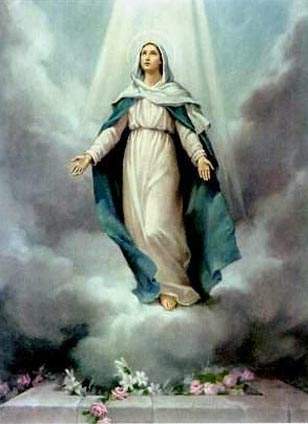
Assumption of Mary - Holy Day of Obligation

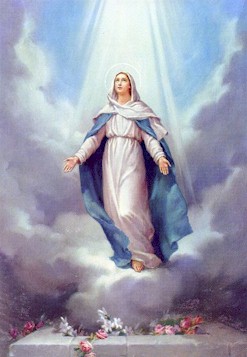
Tomorrow is the Solemnity of the Assumption of the Blessed Virgin Mary and it is a Holy Day of Obligation - all Catholics are required to attend the Holy Sacrifice of the Mass.

Collect of the Vigil of the Assumption (1962 Roman Catholic Daily Missal):


O God, You willed to choose the womb of Blessed Mary as Your dwelling place. Grant that we may joyfully celebrate her feast under the shield of her protection; who lives and rules with God the Father...
Read more >>
Memorial of St. Kolbe

Today is the Memorial of St. Maximilian Kolbe. I just updated my post on him so please see my post: St. Maximilian Kolbe for his feastday today.
Read more >>
Assumption Novena: Final Day

O Blessed Mother Assumed into Heaven, after years of heroic martyrdom on earth, we rejoice that you have at last been taken to the throne prepared for you in Heaven by the Holy Trinity. Lift our hearts with you in the glory of your Assumption above the dreadful touch of sin and impurity. Teach us how small earth becomes when viewed from heaven. Make us realize that death is the triumphant gate through which we shall pass to your Son and that someday our bodies shall rejoin our souls in the unending bliss of heaven. From this earth, over which we tread as pilgrims, we look to you for help. In honor of your Assumption into Heaven we ask for this favor (mention your request). When our hour of death has come, lead us safely to the presence of Jesus to enjoy the vision of God for all eternity together with you. Pray for us O Queen Assumed into Heaven, that we may be made worthy of the promises of Christ. Amen.
Read more >>
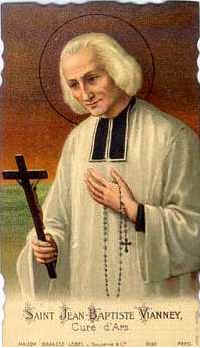
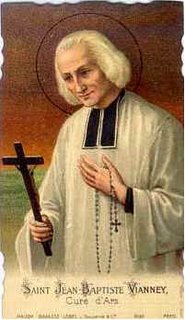
"Catechism on Impurity" by St. John Vianney


That we may understand how horrible and detestable is this sin, which the demons make us commit, but which they do not commit themselves, we must consider what a Christian is. A Christian, created in the image of God, redeemed by the Blood of a God! a Christian, the child of God, the brother of a God, the heir of a God! a Christian, whose body is the temple of the Holy Ghost; that is what sin dishonours. We are created to reign one day in Heaven, and if we have the misfortune to commit this sin, we become the den of the devils. Our Lord said that nothing impure should enter into His kingdom. Indeed, how could a soul that has rolled itself in this filth go to appear before so pure and so holy a God?

We are all like little mirrors, in which God contemplates Himself. How can you expect that God should recognize His likeness in an impure soul? There are some souls so dead, so rotten, that they lie in their defilement without perceiving it, and can no longer clear themselves from it; everything leads them to evil, everything reminds them of evil, even the most holy things; they always have these abominations before their eyes; like the unclean animal that is accustomed to live in filth, that is happy in it, that rolls itself and goes to sleep in it, that grunts in the mud; these persons are an object of horror in the eyes of God and of the holy angels. See, my children, Our Lord was crowned with thorns to expiate our sins of pride; but for this accursed sin, He was scourged and torn to pieces, since He said Himself that after his flagellation all His bones might be counted.

O my children, if there were not some pure souls here and there, to make amends to the good God, and disarm His justice, you would see how we should be punished! For now, this crime is so common in the world, that it is enough to make one tremble. One may say, my children, that Hell vomits forth its abominations upon the earth, as the chimneys of the steam engine vomit forth smoke. The devil does all he can to defile our soul, and yet our soul is everything. . . our body is only a heap of corruption: go to the cemetery to see what you love, when you love your body. As I have often told you, there is nothing so vile as the impure soul. There was once a saint, who had asked the good God to show him one; and he saw that poor soul like a dead beast that has been dragged through the streets in the hot sun for a week.

By only looking at a person, we know if he is pure. His eyes have an air of candour and modesty which leads you to the good God. Some people, on the contrary, look quite inflamed with passion. . . Satan places himself in their eyes to make others fall and to lead them to evil. Those who have lost their purity are like a piece of cloth stained with oil; you may wash it and dry it, and the stain always appears again: so it requires a miracle to cleanse the impure soul.

Read more on St. John Vianney
Read more >>
Sunday, August 13, 2006
The Church and Slavery through the Ages


One of the most erroneous claims I have heard about the Catholic Church is that it accepted slavery. This is a blatant lie. In 1435, Pope Eugene IV officially condemned the enslavement of the black natives of the Canary Islands. He decreed that all European masters were to free the enslaved within 15 days or face excommunication - the highest penalty of the Church (Sicut Dudum). In that papal bull, the Holy Father stated:
"They have deprived the natives of their property or turned it to their own use, and have subjected some of the inhabitants of said islands to perpetual slavery (subdiderunt perpetuae servituti), sold them to other persons and committed other various illicit and evil deeds against them.... Therefore We ... exhort, through the sprinkling of the Blood of Jesus Christ shed for their sins, one and all, temporal princes, lords, captains, armed men, barons, soldiers, nobles, communities and all others of every kind among the Christian faithful of whatever state, grade or condition, that they themselves desist from the aforementioned deeds, cause those subject to them to desist from them, and restrain them rigorously. And no less do We order and command all and each of the faithful of each sex that, within the space of fifteen days of the publication of these letters in the place where they live, that they restore to their pristine liberty all and each person of either sex who were once residents of said Canary Islands ... who have been made subject to slavery (servituti subicere). These people are to be totally and perpetually free and are to be let go without the exaction or reception of any money."

In 1537, Pope Paul III attributed the slavery of the West Indian and South American natives to Satan in Sublimis Deus (June 2, 1537). Further condemnations emerged under Popes Gregory XIV (1591), Urban VIII (Commissum Nobis, 1639), Innocent XI (1686), Benedict XIV (Immensa Pastorum, 1741), and Pius VII (1815).

Pope Gregory XVI wrote:
"We, by apostolic authority, warn and strongly exhort... that no one in the future dare to bother unjustly, despoil of their possessions, or reduce to slavery Indians, Blacks or other such peoples... We prohibit and strictly forbid any Ecclesiastic or lay person from presuming to defend as permissible this trade in Blacks under no matter what pretext or excuse, or from publishing or teaching in any manner whatsoever, in public or privately, opinions contrary to what We have set forth in these Apostolic Letters" (In Supremo Apostolatus, 1839).
Pope Leo XIII writes, "In the presence of so much suffering, the condition of slavery, in which a considerable part of the great human family has been sunk in squalor and affliction now for many centuries, is deeply to be deplored; for the system is one which is wholly opposed to that which was originally ordained by God and by nature" (On the Abolition of Slavery, 1888)

Even the Second Vatican Council, despite its errors in many other matters, did also condemn slavery in Gaudeum et Spes.

So, if you ever read that the Catholic Church supported slavery, that is plainly wrong.
Read more >>
Assumption Novena: Day Eight

Mary, Queen Assumed into Heaven, we rejoice at your title as Queen of Heaven and Earth. You have given your holy fiat to God and became the Mother of our Savior. Obtain peace and salvation for us through your prayers, for you have given birth to Christ our Lord, the Savior of all mankind. Intercede for us and bring our petitions before the Throne of God (mention your request). Through your prayers, may our souls be filled with an intense desire to be like you, a humble vessel of the Holy Spirit and a servant of the Almighty God. Pray for us O Queen Assumed into Heaven, that we may be made worthy of the promises of Christ. Amen.
Read more >>
"Catechism on Hope" by St. John Vianney

My children, we are going to speak of hope: that is what makes the happiness of man on earth. Some people in this world hope too much, and others do not hope enough. Some say, "I am going to commit this sin again. It will not cost me more to confess four than three. " It is like a child saying to his father, "I am going to give you four blows; it will cost me no more than to give you one: I shall only have to ask your pardon. "

That is the way men behave towards the good God. They say, "This year I shall amuse myself again; I shall go to dances and to the alehouse, and next year I will be converted. The good God will be sure to receive me, when I choose to return to Him. He is not so cruel as the priests tell us. " No, the good God is not cruel, but He is just. Do you think He will adapt Himself in everything to your will? Do you think that He will embrace you, after you have despised Him all your life? Oh no, indeed! There is a certain measure of grace and of sin after which God withdraws Himself. What would you say of a father who should treat a good child, and one not so good the same. Would you not say that the father is not just. Well! God would not be just if He made no difference between those who serve Him and those who offend Him.

My children, there is so little faith now in the world that people either hope too much, or they despair. Some say, "I have done too much evil; the good God cannot pardon me:' My children, this is a great blasphemy; it is putting a limit to the mercy of God, which has no limit -- it is infinite. You may have done evil enough to lose the souls of a whole parish, and if you confess, if you are sorry for having done this evil, and resolve not to do it again, the good God will have pardoned you.

A priest was once preaching on hope, and on ; the mercy of the good God. He reassured others, but he himself despaired. After the sermon, a young man presented himself, saying, "Father, I am come to confess to you:' The priest answered, "I am willing to hear your confession:' The other recounted his sins, after which he added, "Father, I have done much evil; I am lost!" "What do you say, my friend! We must never despair:' The young man rose, saying, "Father, you wish me not to despair, and what do you do?" This was a ray of light; the priest, all astonishment, drove away that thought of despair, became a religious and a great saint. . . . The good God had sent him an angel under the form of a young man, to show him that we must never despair. The good God is as prompt to grant us pardon when we ask it of Him as a mother is to snatch her child out of the fire.

Read more on St. John Vianney
Read more >>
Advice from St. Padre Pio


Always be faithful to God in observing the promises you made Him, and pay no attention to the mocking of the foolish. Know that the Saints were always mocked by the world and the worldly, but even so they placed the world and its maxims under their feet.

The field of battle between God and Satan is the human soul. This is where it takes place every moment of our lives. The soul must give free access to our Lord and be completely fortified by Him with every kind of weapon; His light must illuminate it to fight the darkness of error; he must put on Jesus Christ, His truth and justice, the shield of faith, the word of God to overcome such powerful enemies. To put on Jesus Christ we must die to ourselves.
Read more >>
Saturday, August 12, 2006
Assumption Novena: Day Seven

Mary, Queen of every heart, accept all that we are and bind us to you with the bonds of love, that we may be yours forever and may be able to say in all truth: “I belong to Jesus through Mary”. Our Mother, Assumed into Heaven and Queen of the Universe, ever-Virgin Mother of God, obtain for us what we ask for if it be for the glory of God and the good of our souls (mention your request). Our Mother, assumed into Heaven, we love you. Give us a greater love for Jesus and for you. Queen Assumed into Heaven, pray for us.
Read more >>
Pope St. Telesphorus


1954 Calendar (Commemoration): January 5

Pope St. Telephrous was pope from c. 127 - c. 137 AD. His feastday is commemorated on January 5th, the Vigil of the Epiphany

According to Tradition, Pope St. Telephorus established the 7-week lenten season that precedes the celebration of Easter. He also was the first pope to establish the Christmas midnight Mass. He made the Gloria part of the liturgy; however, the Gloria was only to be sung on Christmas.

Pope St. Telephorus is probably best known, though, for stating that Easter should always be celebrated on a Sunday. Before this point, Easter was celebrated three days after Passover and did not necessarily fall on a Sunday. However, since Jesus rose from the dead on Sunday, he decreed that Easter should always be celebrated on a Sunday.

He was martyred for the faith in 136, possibly for the many conversions attributed to his preaching.

Collect:

Sanctify, O Lord, the offerings consecrated to thee: and being appeased thereby, mercifully look upon us, by the intercession of blessed Telesphorus, thy Martyr and Bishop.
Read more >>
"On Anger" by St. John Vianney

Anger is an emotion of the soul, which leads us violently to repel whatever hurts or displeases us.

This emotion, my children, comes from the devil: it shows that we are in his hands; that he is the master of our heart; that he holds all the strings of it, and makes us dance as he pleases. See, a person who puts himself in a passion is like a puppet; he knows neither what he says, nor what he does; the devil guides him entirely. He strikes right and left; his hair stands up like the bristles of a hedgehog; his eyes start out of his head--he is a scorpion, a furious lion. . . . Why do we, my children, put ourselves into such a state? Is it not pitiable? It is, mind, because we do not love the good God. Our heart is given up to the demon of pride, who is angry when he thinks himself despised; to the demon of avarice, who is irritated when he suffers any loss; I to the demon of luxury, who is indignant when his pleasures are interfered with. . . . How unhappy we are, my children, thus to be the sport of demons? They do whatever they please with us; they suggest to us evil-speaking, calumny, hatred, vengeance: they even drive us so far as to put our neighbour to death. See, Cain killed his brother Abel out of jealousy; Saul wished to take away the life of David; Theodosius caused the massacre of the inhabitants of Thessalonica, to revenge a personal affront. . . . If we do not put our neighbour to death, we are angry with him, we curse him, we give him to the devil, we wish for his death, we wish for our own.

In our fury, we blaspheme the holy Name of God, we accuse His Providence. . . . What fury, what impiety! And what is still more deplorable, my children, we are carried to these excesses for a trifle, for a word, for the least injustice! Where is our faith! Where is our reason? We say in excuse that it is anger that makes us swear; but one sin cannot excuse another sin. The good God equally condemns anger, and the excesses that are its consequences. . . . How we sadden our guardian angel! He is always there at our side to send us good thoughts, and he sees us do nothing but evil. . . . If we did like Saint Remigius, we should never be angry. See, this saint, being questioned by a Father of the desert how he managed to be always in an even temper, replied, "I often consider that my guardian angel is always by my side, who assists me in all my needs, who tells me what I ought to do and what I ought to say, and who writes down, after each of my actions, the way in which I have done it. "

Philip II, King of Spain, having passed several hours of the night in writing a long letter to the Pope, gave it to his secretary to fold up and seal. He, being half asleep, made a mistake; when he meant to put sand on the letter, he took the ink bottle and covered all the paper with ink. While he was ashamed and inconsolable, the king said, quite calmly, "No very great harm is done; there is another sheet of paper"; and he took it, and employed the rest of the night in writing a second letter, without showing the least displeasure with his secretary.

Read more on St. John Vianney
Read more >>
Pope St. Sixtus I

Pope St. Sixtus (also spelled Xystus) I was the seventh pope of the Holy Catholic Church from c. 119 - c. 127 AD. He was born in Rome. According to the Liber Pontificalis , he passed the following three ordinances:
  1. No one except the sacred ministers are allowed to touch the sacred vessels (chalice, paten, etc)
  2. Bishops who have been summoned to the Holy See shall, upon their return, not be received by their diocese except on presenting Apostolic letters;
  3. After the Preface in the Mass the priest shall recite the Sanctus with the people.
He is said to have been a martyr, and his feastday is April 6th. He was buried beside the tomb of St. Peter; however, his relics were apparently transferred to Alatri in 1132. He is not the Sixtus mentioned in the Canon of the Mass (Eucharistic Prayer) - that is Pope St. Sixtus II.
Read more >>
Friday, August 11, 2006
Announcement on my Blog


During the past few weeks I have been praying the Divine Office at Lauds, Vespers, and usually Compline. It has been such a wonderful experience. If you do not pray the Divine Office (Liturgy of the Hours) I highly suggest you purchase a prayer book. It will reward your prayer life immensely.

At the end of this month I will have to blog less as I will be given a lot more work to do. So, for the following months I will not be posting anywhere nearly as much as I currently do. I hope to post once a day starting at the end of this month. During this month and last I was able not only to post a lot but to edit many of my older posts. Under Apologetics and Prayer, I added and edited many of the links. Just today I added beautiful images to my posts on All Saints Day and All Souls Day. So, I've been very busy editing.

I wanted to point out several recent blogs added to my sidebar. Please check them out. The most recent addition is This Catholic Journey, by someone that is starting RCIA very shortly.
Read more >>
Galileo and the Catholic Church


St. Robert Bellarmine as well as Pope Urban VIII, welcomed Galileo’s research and even presented him with medals and gifts. They wholeheartedly welcomed his hypothesis; however, when Galileo began to promote it as truth without providing concrete evidence, trouble arose with the Catholic Church. The notion that the Church censured Galileo because he taught heliocentricism (the revolution of the earth around the sun) is false. He was censured because he advanced a theory as fact without providing scientific proof. It was not until later that sufficient proof was provided in order to justify his theory.

Even if the Church did make a mistake with science, it does not alter any part of our Faith. The Pope is only infallible in matters of morals and ethics, not science or math as the First Vatican Council explicitly declared. The Catholic Church is never opposed to science. Science can help us understand better both God the Creator and the created world, a world our God created out of nothingness.

There are many who likewise fail to understand what the Church truly teaches about evolution.
Read more >>
Diocese of Amarillo teaches NFP


Bishop Yanta of the Diocese of Amarillo, Texas writes the following:
As announced in my pastoral letter January 28, 2006: “The Diocese of Amarillo will be a natural family planning diocese: henceforth, all marriages (except for couples past the child bearing age) will be required to attend and complete an approved Natural Family Planning course in conjunction with an approved marriage preparation program. Effective date: July 25, 2006.

“July 25th is the date selected for implementation: July 25th is four (4) months after the Annunciation (March 25th) and five (5) months before the Nativity of Jesus. July 25th is also the feast of St. James, first bishop of Jerusalem.

“July 25th is also the 38th anniversary of Humanae Vitae (on artificial contraception) by Pope Paul VI. Copies of a simplified version by Msgr. Vincent Walsh are available from Key of David Publications, 204 Haverford Road, Wynnewood, PA 19006, 610-896-1970.

“Omnia parata” (All is ready) as Jesus said in the parable of the wedding feast. In all parts of the diocese we have teachers trained to give the Natural Family Planning instruction in both English and Spanish.

“I ask Almighty God to forgive me for waiting so long to implement Natural Family Planning as normative and as a requirement for a marriage to be witnessed by our priests and deacons in the Diocese of Amarillo.

“Every married couple has the right from the Church to continue on the road to sainthood begun in baptism by living as one joined to Christ: Natural Family Planning is God’s way to live responsible parenthood. Marriage and family are the pillars of the Church and society”.
Read more >>
Pray for the Repose of the Soul of Fr. Brand

I received this prayer request for a deceased priest:
Please pray for the repose of Father Edmund Brand, OSCO, 92 Monk of Our Lady of the Holy Spirit Monastery. Eternal rest grant unto them, O Lord; and let perpetual light shine upon them. May he rest in peace.
Amen.
Read more >>
Assumption Novena: Day Six

Mary, our dear Mother and mighty Queen, take and receive our poor hearts with all their freedom and desires, all the love and all the virtues and graces with which they may be adorned. All we are and all we might be, all we have and hold in the order of nature as well as of grace, we have received from God through your loving intercession. Help us dear Mother to surrender to God all that we have including our petitions (mention your request). Our Lady and Queen, into your sovereign hands, we entrust all, that it may be returned to its noble origin. Queen Assumed into Heaven, pray for us.
Read more >>
Pope St. Alexander I & Ss. Eventius, Theodulus, and Juvenal

Pope St. Alexander I was the sixth Pope of the Catholic Church from c. 108 - c. 119 AD. Most of the information on Pope St. Alexander I is not guaranteed completely accurate. What we do know about him is that he inserted words of institution for the Eucharist in the Canon of the Mass. These words are the ones like such: "The day that He suffered, He took bread into His sacred and venerable hands and lifting the bread to You, His Almighty Father, He gave thanks, blessed it, broke it, and gave it to His disciples and said 'Take this, this is my Body..."

He is also attributed to have introduced the use of water mixed with salt to bless homes. He is said to have been martyred by decapitation on the Via Nomentana in Rome. His remains initially rested in the catacombs on the Via Nomentana but were eventually brought to the basilica of Santa Sabina by Pope Pascal I (817-824).

Under Emperor Hadrian, in A.D. 117, Pope Alexander I suffered martyrdom, together with the priests Eventius and Theodulus. Juvenal, bishop of Narni, was executed on May 3, A.D. 377. His Feastday is May 3rd where he and his companions are commemorated in the Mass.

Traditional Matins Reading:

Alexander, who was born at Rome, governed the Church during the reign of the emperor Adrian, and converted a great portion of the Roman nobles to Christ. He decreed that only bread and wine should be offered in the Mass, but that water should be mingled with the wine, in memory of the Blood and Water which flowed from the Side of Christ Jesus. He added to the Canon of the Mass these words: Qui pridie quam pateretur. He also decreed that Holy Water, with salt in it, should always be kept in the church, and that it should be used in the dwellings of the faithful for the purpose of driving away evil spirits. He governed the Church ten years, five months, and twenty days. He was illustrious for the holiness of his life and for the useful laws which he made. He was crowned with martyrdom together with the priests Eventius and Theodulus, and was buried on the Nomen tan Way, three miles out of Rome, on the very spot where he had been beheaded. He ordained, in the December of various years, six priests, two deacons, and five for divers places The bodies of these Saints were afterwards translated to the Church of Saint Sabina in Rome. On this same day occurred the death of blessed Juvenal, bishop of Narni, who, after having, by his learning and virtue, converted many persons of that city to Christ, and being celebrated for the miracles he wrought, slept in peace, and was honourably buried in the same city.

Collect:

O Almighty God, today we are celebrating the birthday of Your saints Alexander, Eventius, Theodulus, and Juvenal. Hear their prayers and rescue us from all the dangers that threaten us. Through Our Lord . . .
Read more >>
"On Gluttony" by St. John Vianney

Gluttony is an inordinate love of eating and drinking.

We are gluttonous, my children, when we take food in excess, more than is required for the support of our poor body; when we drink beyond what is necessary, so as even to lose our senses and our reason. . . . Oh, how shameful is this vice! How it degrades us! See, it puts us below the brutes: the animals never drink more than to satisfy their thirst: they content themselves with eating enough; and we, when we have satisfied our appetite, when our body can bear no more, we still have recourse to all sorts of little delicacies; we take wine and liquors to repletion! Is it not pitiful? We can no longer keep upon our legs; we fall, we roll into the ditch and into the mud, we become the laughing stock of everyone, even the sport of little children. . . .

If death were to surprise us in this state, my children, we should not have time to recollect ourselves; we should fall in that state into the hands of the good God. What a misfortune, my children! How would our soul be surprised! How would it be astonished! We should shudder with horror at seeing the lost who are in Hell. . . . Do not let us be led by our appetite; we shall ruin our health, we shall lose our soul. . . . See, my children, intemperance and debauchery are the support of doctors; that lets them live, and gives them a great deal of practice. . . . We hear every day, such a one was drunk, and falling down he broke his leg; another, passing a river on a plank, fell into the water and was drowned. . . . Intemperance and drunkenness are the companions of the wicked rich man. . . . A moment of pleasure in this world will cost us very dear in the other. There they will be tormented by a raging hunger and a devouring thirst; they will not even have a drop of water to refresh themselves; their tongue and their body will be consumed by the flames for a whole eternity. . . .

O my children! we do not think about it; and yet that will not fail to happen to some amongst us, perhaps even before the end of the year! Saint Paul said that those who give themselves to excess in eating and drinking shall not possess the kingdom of God. Let us reflect on these words! Look at the saints: they pass their life in penance, and we would pass ours in the midst of enjoyments and pleasures. Saint Elizabeth, Queen of Portugal, fasted all Advent, and also from Saint John Baptist's day to the Assumption. Soon after, she began another Lent, which lasted till the feast of Saint Michael. She lived upon bread and water only on Fridays and Saturdays, and on the vigils of the feasts of the Blessed Virgin and of the Apostles. They say that Saint Bernard drank oil for wine. Saint Isidore never ate without shedding tears! If we were good Christians, we should do as the saints have done.

We should gain a great deal for Heaven at our meals; we should deprive ourselves of many little things which, without being hurtful to our body, would be very pleasing to the good God; but we choose rather to satisfy our taste than to please God; we drown, we stifle our soul in wine and food. My children, God will not say to us at the Day of Judgment, "Give Me an account of thy body"; but, "Give Me an account of thy soul; what hast thou done with it?" . . . What shall we answer Him? Do we take as much care of our soul as of our body? O my children! let us no longer live for the pleasure of eating; let us live as the saints have done; let us mortify ourselves as they were mortified. The saints never indulged themselves in the pleasures of good cheer. Their pleasure was to feed on Jesus Christ! Let us follow their footsteps on this earth, and we shall gain the crown which they have in Heaven.

Read more on St. John Vianney
Read more >>
Thursday, August 10, 2006
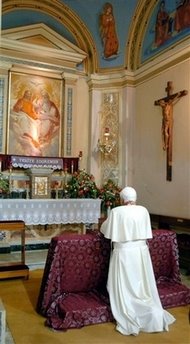
Pope Benedict XVI Visits the Virgin Mary of Tufo Sanctuary


In Rocca di Papa, which is near Rome, Pope Benedict XVI visited the Virgin Mary of Tufo sanctuary church, on Tuesday, August 8, 2006.


Photo Source: AP Photo/L' Osservatore Romano
Read more >>


Copyright Notice: Unless otherwise stated, all items are copyrighted under a Attribution-NonCommercial-NoDerivatives 4.0 International License. If you quote from this blog, cite a link to the post on this blog in your article.

Disclosure of Material Connection: Some of the links on this blog are “affiliate links.” This means if you click on the link and purchase the item, I will receive an affiliate commission. As an Amazon Associate, for instance, I earn a small commission from qualifying purchases made by those who click on the Amazon affiliate links included on this website. I am disclosing this in accordance with the Federal Trade Commission’s 16 CFR, Part 255: “Guides Concerning the Use of Endorsements and Testimonials in Advertising.”