Sunday, August 27, 2006
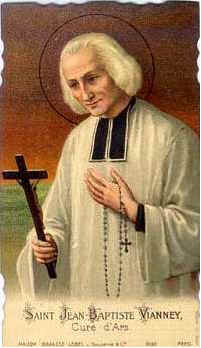
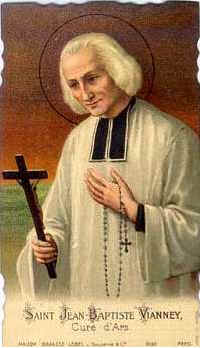
"Catechism on Suffering" by St. John Vianney

Whether we will or not, we must suffer. There are some who suffer like the good thief, and others like the bad thief. They both suffered equally. But one knew how to make his sufferings meritorious, he accepted them in the spirit of reparation, and turning towards Jesus crucified, he received from His mouth these beautiful words: "This day thou shalt be with Me in Paradise. " The other, on the contrary, cried out, uttered imprecations and blasphemies, and expired in the most frightful despair. There are two ways of suffering -- to suffer with love, and to suffer without love. The saints suffered everything with joy, patience, and perseverance, because they loved. As for us, we suffer with anger, vexation, and weariness, because we do not love. If we loved God, we should love crosses, we should wish for them, we should take pleasure in them. . . . We should be happy to be able to suffer for the love of Him who lovingly suffered for us. Of what do we complain? Alas! the poor infidels, who have not the happiness of knowing God and His infinite loveliness, have the same crosses that we have; but they have not the same consolations. You say it is hard? No, it is easy, it is consoling, it is sweet; it is happiness. Only we must love while we suffer, and suffer while we love.

On the Way of the Cross, you see, my children, only the first step is painful. Our greatest cross is the fear of crosses. . . . We have not the courage to carry our cross, and we are very much mistaken; for, whatever we do, the cross holds us tight -- we cannot escape from it. What, then, have we to lose? Why not love our crosses and make use of them to take us to Heaven? But, on the contrary, most men turn their backs upon crosses, and fly before them. The more they run, the more the cross pursues them, the more it strikes and crushes them with burdens. . . . If you were wise, you would go to meet it like Saint Andrew, who said, when he saw the cross prepared for him and raised up into the air, "Hail O good cross! O admirable cross! O desirable cross! receive me into thine arms, withdraw me from among men, and restore me to my Master, who redeemed me through thee. "

Listen attentively to this, my children: He who goes to meet the cross, goes in the opposite direction to crosses; he meets them, perhaps, but he is pleased to meet them; he loves them; he carries them courageously. They unite him to Our Lord; they purify him; they detach him from this world; they remove all obstacles from his heart; they help him to pass through life, as a bridge helps us to pass over water. . . . Look at the saints; when they were not persecuted. they persecuted themselves. A good religious complained one day to Our Lord that he was persecuted. He said, "O Lord, what have I done to be treated thus?" Our Lord answered him, "And I, what had I done when I was led to Calvary?" Then the religious understood; he wept, he asked pardon, and dared not complain any more. Worldly people are miserable when they have crosses, and good Christians are miserable when they have none. The Christian lives in the midst of crosses, as the fish lives in the sea.

Look at Saint Catherine; she has two crowns, that of purity and that of martyrdom: how happy she is, that dear little saint, to have chosen to suffer rather than to consent to sin! There was once a religious who loved suffering so much that he had fastened the rope from a well round his body; this cord had rubbed off the skin, and had by degrees buried itself in the flesh, out of which worms came. His brethren asked that he should be sent out of the community. He went away happy and pleased, to hide himself in a rocky cavern. But the same night the Superior heard Our Lord saying to him: "Thou hast lost the treasure of thy house. " Then they went to fetch back this good saint, and they wanted to see from whence these worms came. The Superior had the cord taken off, which was done by turning back the flesh. At last he got well.

Very near this, in a neighbouring parish, there was a little boy in bed, covered with sores, very ill, and very miserable; I said to him, "My poor little child, you are suffering very much!" He answered me, "No, sir; today I do not feel the pain I had yesterday, and tomorrow I shall not suffer from the pain I have now:' "You would like to get well?" "No; I was naughty before I was ill, and I might be so again. I am very well as I am. " We do not understand that, because we are too earthly. Children in whom the Holy Ghost dwells put us to shame.

If the good God sends us crosses, we resist, we complain, we murmur; we are so averse to whatever contradicts us, that we want to be always in a box of cotton: but we ought to be put into a box of thorns. It is by the Cross that we go to Heaven. Illnesses, temptations, troubles, are so many crosses which take us to Heaven. All this will soon be over. . . . Look at the saints, who have arrived there before us. . . . The good God does not require of us the martyrdom of the body; He requires only the martyrdom of the heart, and of the will. . . . Our Lord is our model; let us take up our cross, and follow Him. Let us do like the soldiers of Napoleon. They had to cross a bridge under the fire of grapeshot; no one dared to pass it. Napoleon took the colours, marched over first, and they all followed. Let us do the same; let us follow Our Lord, who has gone before us.

A soldier was telling me one day that during a battle he had marched for half an hour over dead bodies; there was hardly space to tread upon; the ground was all dyed with blood. Thus on the road of life we must walk over crosses and troubles to reach our true country. The cross is the ladder to Heaven. . . . How consoling it is to suffer under the eyes of God, and to be able to say in the evening, at our examination of conscience: "Come, my soul! thou hast had today two or three hours of resemblance to Jesus Christ. Thou hast been scourged, crowned with thorns, crucified with Him!" Oh what a treasure for the hour of death! How sweet it is to die, when we have lived on the cross! We ought to run after crosses as the miser runs after money. . . . Nothing but crosses will reassure us at the Day of Judgment. When that day shall come, we shall be happy in our misfortunes, proud of our humiliations, and rich in our sacrifices!

If someone said to you, "I should like to become rich; what must I do?" you would answer him, "You must labor:' Well, in order to get to Heaven, we must suffer. Our Lord shows us the way in the person of Simon the Cyrenian; He calls His friends to carry His Cross after Him. The good God wishes us never to lose sight of the Cross, therefore it is placed everywhere; by the roadside, on the heights, in the public squares -- in order that at the sight of it we may say, "See how God has loved us!" The Cross embraces the world; it is planted at the four corners of the world; there is a share of it for all. Crosses are on the road to Heaven like a fine bridge of stone over a river, by which to pass it. Christians who do not suffer pass this river by a frail bridge, a bridge of wire, always ready to give way under their feet.

He who does not love the Cross may indeed be saved, but with great difficulty: he will be a little star in the firmament. He who shall have suffered and fought for his God will shine like a beautiful sun. Crosses, transformed by the flames of love, are like a bundle of thorns thrown into the fire, and reduced by the fire to ashes. The thorns are hard, but the ashes are soft. Oh, how much sweetness do souls experience that are all for God in suffering! It is like a mixture into which one puts a great deal of oil: the vinegar remains vinegar; but the oil corrects its bitterness, and it can scarcely be perceived.

If you put fine grapes into the wine press, there will come out a delicious juice: our soul, in the wine press of the Cross, gives out a juice that nourishes and strengthens it. When we have no crosses, we are arid: if we bear them with resignation, we feel a joy, a happiness, a sweetness! . . . it is the beginning of Heaven. The good God, the Blessed Virgin, the angels, and the saints, surround us; they are by our side, and see us. The passage to the other life of the good Christian tried by affliction, is like that of a person being carried on a bed of roses. Thorns give out a perfume, and the Cross breathes forth sweetness. But we must squeeze the thorns in our hands, and press the Cross to our heart, that they may give out the juice they contain.

The Cross gave peace to the world; and it must bring peace to our hearts. All our miseries come from not loving it. The fear of crosses increases them. A cross carried simply, and without those returns of self-love which exaggerate troubles, is no longer a cross. Peaceable suffering is no longer suffering. We complain of suffering! We should have much more reason to complain of not suffering, since nothing makes us more like Our Lord than carrying His Cross. Oh, what a beautiful union of the soul with Our Lord Jesus Christ by the love and the virtue of His Cross! I do not understand how a Christian can dislike the Cross, and fly from it! Does he not at the same time fly from Him who has deigned to be fastened to it, and to die for us?

Contradictions bring us to the foot of the Cross, and the Cross to the gate of Heaven. That we may get there, we must be trodden upon, we must be set at naught, despised, crushed. . . . There are no happy people in this world but those who enjoy calmness of mind in the midst of the troubles of life: they taste the joys of the children of God. . . . All pains are sweet when we suffer in union with Our Lord. . . . To suffer! what does it signify? It is only a moment. If we could go and pass a week in Heaven, we should understand the value of this moment of suffering. We should find no cross heavy enough, no trial bitter enough. . . . The Cross is the gift that God makes to His friends.

How beautiful it is to offer ourselves every morning in sacrifice to the good God, and to accept everything in expiation of our sins! We must ask for the love of crosses; then they become sweet.

I tried it for four or five years. I was well calumniated, well contradicted, well knocked about. Oh, I had crosses indeed! I had almost more than I could carry! Then I took to asking for love of crosses, and I was happy. I said to myself, truly there is no happiness but in this! We must never think from whence crosses come: they come from God. It is always God who gives us this way of proving our love to Him.

Read more on St. John Vianney
Read more >>
Pope Pius XIl Condemned Nazism & The Holocaust

Far too many people have read the erroneous Hitler's Pope by the ex-seminarian John Cornwell, stating that Pope Pius XII assisted in the legitimization of Nazi Germany and the Holocaust. This assertion is bold-faced lie! The truth can be read in The Myth of Hitler's Pope: How Pope Pius XII Rescued Jews from the Nazis by Rabbi David G. Dalin (published in 2005). Dalin claims that the Catholic Church has stood by the Jewish people for centuries. He stated that the Popes never helped Hitler but rather "Hitler's cleric" was actually Hajj Amin al-Husseini, the Grand Mufti of Jerusalem.

On April 28, 1935, Cardinal Pacelli (who would become Pope Pius XII) gave an address to 250,000 in Lourdes, France. He said, "[The Nazis] are in reality only miserable plagiarists who dress up old errors with new tinsel. It does not make any difference whether they flock to the banners of social revolution, whether they are guided by a false concept of the world and of life, or whether they are possessed by the superstition of a race and blood cult."

On May 10, 1937, Pope Pius XI released the encyclical Mit Brennender Sorge (German for "With deep anxiety"). Unlike nearly all encyclicals, which are written in Latin, this encyclical was written in German. It was addressed to the German bishops and was read in all parish churches of Germany. Pope Pius XI said that his Papal Secretary of State, Eugenio Cardinal Pacelli, who later became Pope Pius XII, was the individual that should be credited for the encyclical's creation. Furthermore, Jewish Rabbi Pinchas Lapide stated that Pope Pius XI "had good reason to make Pacelli the architect of his anti-Nazi policy. Of the forty-four speeches which the Nuncio Pacelli had made on German soil between 1917 and 1929, at least forty contained attacks on Nazism or condemnations of Hitler’s doctrines. . . . Pacelli, who never met the Führer, called it ‘neo-Paganism.’"

Here is an excerpt:
"Whoever exalts race, or the people, or the State, or a particular form of State, or the depositories of power, or any other fundamental value of the human community—however necessary and honorable be their function in worldly things—whoever raises these notions above their standard value and divinizes them to an idolatrous level, distorts and perverts an order of the world planned and created by God; he is far from the true faith in God and from the concept of life which that faith upholds"

"This God, this Sovereign Master, has issued commandments whose value is independent of time and space, country and race. As God's sun shines on every human face so His law knows neither privilege nor exception. Rulers and subjects, crowned and uncrowned, rich and poor are equally subject to His word. From the fullness of the Creators' right there naturally arises the fullness of His right to be obeyed by individuals and communities, whoever they are. This obedience permeates all branches of activity in which moral values claim harmony with the law of God, and pervades all integration of the ever-changing laws of man into the immutable laws of God." "None but superficial minds could stumble into concepts of a national God, of a national religion; or attempt to lock within the frontiers of a single people, within the narrow limits of a single race, God, the Creator of the universe, King and Legislator of all nations before whose immensity they are "as a drop of a bucket" (Isaiah xl, 15). "
Eugenio Cardinal Pacelli was elected Pope on March 2, 1939, and he took the name Pius XII. On October 20th of that year, he released his first encyclical, Summi Pontificatus (On the Unity of Human Society). It was such an attack against the teachings of Nazism that the Gestapo forbade it being printed or distributed in Germany. France had 88,000 copies printed and dropped by air in Germany. The New-York Times stated the following on the front page of its October 20, 1939, edition: "Pope Condemns Dictators, Treaty Violators, Racism; Urges Restoring of Poland".

During the Holocaust, most of Rome's 8,000 Jews hid in the Vatican. Pope Pius XII saved thousands of Jewish lives. He used numerous networks in Rome to hide the Jewish people, and he even used the assets of the Vatican to ransom Jews from the Nazis. The Chief Rabbi of Rome converted to Catholicism after the war! According to Pinchas E. Lapide in his book, Three Popes and the Jews, Pope Pius XII saved 860,000 Jews from Nazi death camps (214).

Albert Einstein, a Jewish physicist, said the following, which is from a December 23, 1940, Time Magazine article:
"Being a lover of freedom, when the revolution came in Germany, I looked to the universities to defend it, knowing that them had always boasted of their devotion to the cause of truth; but, no, the universities immediately were silenced. Then I looked to the great editors of the newspapers whose flaming editorials in days gone by had proclaimed their love of freedom; but they, like the universities, were silenced in a few short weeks... Only the Church stood squarely across the path of Hitler's campaign for suppressing truth. I never had any special interest in the Church before, but now I feel a great affection and admiration because the Church alone has had the courage and persistence to stand for intellectual truth and moral freedom. I am forced thus to confess that what I once despised I now praise unreservedly."
Read more >>
Saturday, August 26, 2006
Words of Inspiration: August 26, 2006

Blessed Mother Teresa: "There is no limit to God’s love. It is without measure and its depth cannot be sounded."

St. Padre Pio: "My children, we can never prepare ourselves too much for Communion"
Read more >>
"On Sloth" by St. John Vianney


Sloth is a kind of cowardice and disgust, which makes us neglect and omit our duties, rather than do violence to ourselves.

Alas, my children, how many slothful people there are on this earth: how many are cowardly, how many are indolent in the service of the good God! We neglect, we omit our duties of piety, just as easily as we should take a glass of wine. We will not do violence to ourselves; we will not put ourselves to any inconvenience. Everything wearies, everything disgusts the slothful man. Prayer, the holy Sacrifice of the Mass, which do so much good to pious souls, are a torture to him. He is weary and dissatisfied in church, at the foot of the altar, in the presence of the good God. At first he feels only dislike and indifference towards everything that is commanded by religion. Soon after, you can no longer speak to him either of Confession or Communion; he has no time to think of those things.

O my children! how miserable we are in losing, in this way, the time that we might so usefully employ in gaining Heaven, in preparing ourselves for eternity! How many moments are lost in doing nothing, or in doing wrong, in listening to the suggestions of the devil, in obeying him! Does not that make us tremble? If one of the lost had only a day or an hour to spend for his salvation, to what profit would he turn it! What haste he would make to save his soul, to reconcile himself with the good God! And we, my children, who have days and years to think of our salvation, to save our souls--we remain there with our arms crossed, like that man spoken of in the Gospel. We neglect, we lose our souls. When death shall come, what shall we have to present to Our Lord? Ah! my children, hear how the good God threatens the idle: "Every tree that bringeth not forth good fruit shall be cut down, and shall be cast into the fire. " "Take that unprofitable servant, and cast him out into the exterior darkness, where there shall be weeping and gnashing of teeth. "

Idleness is the mother of all vices. Look at the idle; they think of nothing but eating, drinking, and sleeping. They are no longer men, but stupid beasts, giving up to all their passions; they drag themselves through the mire like very swine. They are filthy, both within and without. They feed their soul only upon impure thoughts and desires. They never open their mouth but to slander their neighbour, or to speak immodest words. Their eyes, their ears, are open only to criminal objects. . . . O my children! that we may resist idleness, let us imitate the saints. Let us watch continually over ourselves; like them, let us be very zealous in fulfilling all our duties; let the devil never find us doing nothing, lest we should yield to temptation. Let us prepare ourselves for a good death, for eternity. Let us not lose our time in lukewarmness, in negligence, in our habitual infidelities. Death is advancing: tomorrow we must, perhaps, quit our relations, our friends. Let us make haste to merit the reward promised in Paradise to the faithful servant in the Gospel!

Read more on St. John Vianney
Read more >>
Friday, August 25, 2006
"On Sin" by St. John Vianney

Sin is a thought, a word, an action, contrary to the law of God.

By sin, my children, we rebel against the good God, we despise His justice, we tread under foot His blessings. From being children of God, we become the executioner and assassin of our soul, the offspring of Hell, the horror of Heaven, the murderer of Jesus Christ, the capital enemy of the good God. O my children! if we thought of this, if we reflected on the injury which sin offers to the good God, we should hold it in abhorrence, we should be unable to commit it; but we never think of it, we like to live at our ease, we slumber in sin. If the good God sends us remorse, we quickly stifle it, by thinking that we have done no harm to anybody, that God is good, and that He did not place us on the earth to make us suffer.

Indeed, my children, the good God did not place us on the earth to suffer and endure, but to work out our salvation. See, He wills that we should work today and tomorrow; and after that, an eternity of joy, of happiness, awaits us in Heaven. . . . 0 my children! how ungrateful we are! The good God calls us to Himself; He wishes to make us happy forever, and we are deaf to His word, we will not share His happiness; He enjoins us to love Him, and we give our heart to the devil. . . . The good God commands all nature as its Master; He makes the winds and the storms obey Him; the angels tremble at His adorable will: man alone dares to resist Him. See, God forbids us that action, that criminal pleasure, that revenge, that injustice; no matter, we are bent upon satisfying ourselves; we had rather renounce the happiness of Heaven, than deprive ourselves of a moment's pleasure, or give up a sinful habit, or change our life. What are we, then, that we dare thus to resist God? Dust and ashes, which He could annihilate with a single look. . . .

By sin, my children, we despise the good God. We renew His Death and Passion; we do as much evil as all the Jews together did, in fastening Him to the Cross. Therefore, my children, if we were to ask those who work without necessity on Sunday: "What are you doing there?" and they were to answer truly, they would say, "We are crucifying the good God. " Ask the idle, the gluttonous, the immodest, what they do every day. If they answer you according to what they are really doing, they will say, "We are crucifying the good God. " O my children! it is very ungrateful to offend a God who has never done us any harm; but is it not the height of ingratitude-to offend a God who has done us nothing but good?

It is He who created us, who watches over us. He holds us in His hands; if He chose, He could cast us into the nothingness out of which He took us. He has given us His Son, to redeem us from the slavery of the devil; He Himself gave Him up to death that He might restore us to life; He has adopted us as His children, and ceases not to lavish His graces upon us. Notwithstanding all this, what use do we make of our mind, of our memory, of our health, of those limbs which He gave us to serve Him with? We employ them, perhaps, in committing crimes.

The good God, my children, has given us eyes to enlighten us, to see Heaven, and we use them to look at criminal and dangerous objects; He has given us a tongue to praise Him, and to express our thoughts, and we make it an instrument of iniquity--we swear, we blaspheme, we speak ill of our neighbour, we slander him; we abuse the supernatural graces, we stifle the salutary remorse by which God would convert us. . . . we reject the inspirations of our good guardian angel. We despise good thoughts, we neglect prayer and the Sacraments. What account do we make even of the Word of God? Do we not listen to it with disgust? How miserable we are! How much we are to be pitied! We employ the time that the good God has given us for our salvation, in losing our souls. We make war upon Him with the means He has given us to serve Him; we turn His own gifts against Him! Let us cast our eyes, my children, upon Jesus fastened to the Cross. and let us say to ourselves, "This is what it has cost my Saviour to repair the injury my sins have done to God. "

A God coming down to the earth to be the victim of our sins! A God suffering, a God dying, a God enduring every torment, because He has put on the semblance of sin, and has chosen to bear the weight of our iniquities! Ah, my children! at the sight of that Cross, let us conceive once for all the malice of sin, and the abhorrence in which we should hold it. . . . Let us enter into ourselves, and see what we ought to do to repair our past sins; let us implore the clemency of the good God, and let us all together say to Him, from the bottom of our heart, "O Lord, who art here crucified for us, have mercy upon us! Thou comest down from Heaven to cure souls of sin; cure us, we beseech Thee; cause our souls to be purified by approaching the tribunal of penance; yes, O God! make us look upon sin as the greatest of all evils, and by our zeal in avoiding it, and in repairing those we have had the misfortune to commit, let us one day attain to the happiness of the saints. "

Read more on St. John Vianney
Read more >>
Thursday, August 24, 2006
Feast of St. Bartholomew

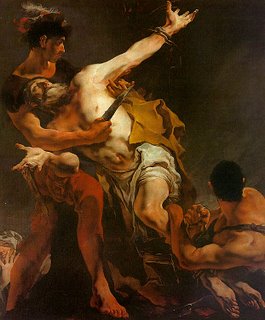
"The Martyrdom of St. Bartholomew" by Giovanni Battista, 1722, Oil on canvas, 167 x 139 cm, San Stae, Venice

Feast (1969 Calendar): August 24
Double of the II Class (1955 Calendar): August 24

Today is the Feastday of St. Bartholomew, who is also called Nathaniel in the Gospels. Let us pray to follow Our Lord as St. Bartholomew did. Let us answer Philip's call to "Come and see."

For more on the lives of all the Apostles, pick up a copy of "The Twelve: Lives and Legends of the Apostles" on paperback or as part of the online course on the Apostles, which includes a Certificate of Completion.

The Holy Gospel:

Philip found Nathanael and told him, “We have found the one about whom Moses wrote in the law, and also the prophets, Jesus son of Joseph, from Nazareth.” But Nathanael said to him, “Can anything good come from Nazareth?” Philip said to him, “Come and see.”

Jesus saw Nathanael coming toward him and said of him, “Here is a true child of Israel. There is no duplicity in him.” Nathanael said to him, “How do you know me?” Jesus answered and said to him, “Before Philip called you, I saw you under the fig tree.” Nathanael answered him, “Rabbi, you are the Son of God; you are the King of Israel.”

Jesus answered and said to him, “Do you believe because I told you that I saw you under the fig tree? You will see greater things than this.” And he said to him, “Amen, amen, I say to you, you will see heaven opened and the angels of God ascending and descending on the Son of Man.”
John 1:45-51

Excerpt from The Church's Year of Grace by Pius Parsch:

"In St. John's Gospel, Bartholomew is known by the name Nathaniel (the liturgy does not always seem aware of this identity). He hailed from Cana in Galilee, was one of the first disciples called by the Lord. On that initial meeting Jesus uttered the glorious compliment: "Behold, an Israelite indeed in whom there is no guile!" After the resurrection he was favored by becoming one of the few apostles who witnessed the appearance of the risen Savior on the sea of Galilee (John 21:2). Following the ascension he is said to have preached in Greater Armenia and to have been martyred there. While still alive, his skin was torn from his body. The Armenians honor him as the apostle of their nation. Concerning the fate of his relics, the Martyrology says: "His holy body was first taken to the island of Lipari (north of Sicily), then to Benevento, and finally to Rome on an island in the Tiber where it is honored by the faithful with pious devotion."

"The Church of Armenia has a national tradition that St. Jude Thaddeus and St. Bartholomew visited the Armenians early in the first century and introduced Christianity among the worshippers of the god Ahura Mazda. The new faith spread throughout the land, and in 302 A.D., St. Gregory the Illuminator baptized the king of Armenia, Dertad the Great, along with many of his followers. Since Dertad was probably the first ruler to embrace Christianity for his nation, the Armenians proudly claim they were the first Christian State."

Prayer:

Almighty and everlasting God, Who hast granted us a reverent and a holy joy in this day's festival of Thy blessed Apostle Bartholomew, grant, we beseech Thee, that Thy Church may both love what he believed and preach what he taught. Through our Lord.

Prayer Source: 1962 Roman Catholic Daily Missal
Read more >>
FDA Approves Morning After Pill

Unfortunately, contraception is now easier to get for women that show proof that they are 18 years of age or older. The FDA has approved Plan B, called emergency contraception, for over-the-counter status in pharmacies for people over the age of 18! Plan B was originally approved for usage as a prescription back in 1999.

According to Wisconsin Right to Life Executive Director Barbara Lyons, "The drug is known to cause devastating consequences such as blot clots and stroke. It is simply irresponsible to sell it to women without any physician oversight whatsoever." Kimberly Zenarolla, executive vice president of the National Pro-Life Action Center said the following:

“Today’s decision by the FDA shows a flagrant disregard for the health and safety of women, young girls and their innocent, unborn children. This decision smacks of the same politically-driven mentality that brought about the questionable approval of RU-486 during the Clinton administration. That decision has cost the lives on countless unborn children and the lives of several unsuspecting women who used the drug. Tragically, the Bush administration appears poised to follow in the same destructive footsteps as its predecessor.

The Catholic Church is opposed to all forms of artificial birth control!  For my position on contraception, which echoes the teachings and writings of the Church, please see my post On Artificial Contraception and Its Errors
Read more >>
"Catechism on Sin" by St. John Vianney


Sin is the executioner of the good God, and the assassin of the soul. It snatches us away from Heaven to precipitate us into Hell. And we love it! What folly! If we thought seriously about it, we should have such a lively horror of sin that we could not commit it. O my children, how ungrateful we are! The good God wishes to make us happy; that is very certain; He gave us His Law for no other end. The Law of God is great; it is broad. King David said that he found his delight in it, and that it was a treasure more precious to him than the greatest riches. He said also that he walked at large, because he had sought after the Commandments of the Lord. The good God wishes, then, to make us happy, and we do not wish to be so. We turn away from Him, and give ourselves to the devil! We fly from our Friend, and we seek after our murderer! We commit sin; we plunge ourselves into the mire. Once sunk in this mire, we know not how to get out. If our fortune were in the case, we should soon find out how to get out of the difficulty; but because it only concerns our soul, we stay where we are.

We come to confession quite preoccupied with the shame that we shall feel. We accuse ourselves by steam. It is said that many confess, and few are converted. I believe it is so, my children, because few confess with tears of repentance. See, the misfortune is, that people do not reflect. If one said to those who work on Sundays, to a young person who had been dancing for two or three hours, to a man coming out of an alehouse drunk, "What have you been doing? You have been crucifying Our Lord!" they would be quite astonished, because they do not think of it. My children, if we thought of it, we should be seized with horror; it would be impossible for us to do evil. For what has the good God done to us that we should grieve Him thus, and put Him to death afresh -- Him, who has redeemed us from Hell? It would be well if all sinners, when they are going to their guilty pleasures, could, like Saint Peter, meet Our Lord on the way, who would say to them, "I am going to that place where thou art going thyself, to be there crucified afresh. " Perhaps that might make them reflect.

The saints understood how great an outrage sin is against God. Some of them passed their lives in weeping for their sins. Saint Peter wept all his life; he was still weeping at his death. Saint Bernard used to say, "Lord! Lord! it is I who fastened Thee to the Cross!" By sin we despise the good God, we crucify the good God! What a pity it is to lose our souls, which have cost Our Lord so many sufferings! What harm has Our Lord done us, that we should treat Him so? If the poor lost souls could come back to the earth! if they were in our place! Oh, how senseless we are! the good God calls us to Him, and we fly from Him! He wishes to make us happy, and we will not have His happiness. He commands us to love Him, and we five our hearts to the devil. We employ in ruining ourselves the time He fives us to save our souls. We make war upon Him with the means He gave us to serve Him.

When we offend the good God, if we were to look at our crucifix, we should hear Our Lord saying to us in the depths of our soul, "Wilt thou too, then, take the side of My enemies? Wilt thou crucify Me afresh?" Cast your eyes on Our Lord fastened to the Cross, and say to yourself, "That is what it cost my Saviour to repair the injury my sins have done to God!" A God coming down to earth to be the victim of our sins, a God suffering, a God dying, a God enduring every torment, because He would bear the weight of our crimes! At the sight of the Cross, let us understand the malice of sin, and the hatred we ought to feel for it. Let us enter into ourselves; let us see what we can do to make amends for our poor life.

"What a pity it is!" the good God will say to us at our death; "why hast thou offended Me -Me, who loved thee so much?" To offend the good God, who has never done us anything but good; to please the devil, who can never do us anything but evil! What folly! Is it not real folly to choose to make ourselves worthy of Hell by attaching ourselves to the devil. when we might taste the joys of Heaven, even in this life, by uniting ourselves to God by love? One cannot understand this folly; it cannot be enough lamented. Poor sinners seem as if they could not wait for the sentence which will condemn them to the society of the devils; they condemn themselves to it. There is a sort of foretaste in this life of Paradise, of Hell, and of Purgatory. Purgatory is in those souls that are not dead to themselves; Hell is in the heart of the impious; Paradise in that of the perfect, who are closely united to Our Lord.

He who lives in sin takes up the habits and the appearance of the beasts. The beast, which has not reason, knows nothing but its appetites. So the man who makes himself like the beasts loses his reason, and lets himself be guided by the inclinations of his body. He takes his pleasure in good eating and drinking, and in enjoying the vanities of the world, which pass away like the wind. I pity the poor wretches who run after that wind; they gain very little, they five a great deal for very little profit -- they five their eternity for the miserable smoke of the world.

My children, how sad it is! when a soul is in a state of sin, it may die in that state; and even now, whatever it can do is without merit before God. That is the reason why the devil is so pleased when a soul is in sin, and perseveres in it, because he thinks that it is working for him, and if it were to die he would have possession of it. When we are in sin, our soul is all diseased, all rotten; it is pitiful. The thought that the good God sees it ought to make it enter into itself. And then, what pleasure is there in sin? None at all. We have frightful dreams that the devil is carrying us away, that we are falling over precipices. Put yourself on good terms with God; have recourse to the Sacrament of Penance; you will sleep as quietly as an angel. You will be glad to waken in the night, to pray to God; you will have nothing but thanksgivings on your lips; you will rise I towards Heaven with great facility, as an eagle soars through the air.

See, my children, how sin degrades man; of an angel created to love God, it makes a demon who will curse Him for eternity. Ah! if Adam, our first father, had not sinned, and if we did not sin every day, how happy we should be! we should be as happy as the saints in Heaven. There would be no more unhappy people on the earth. Oh, how beautiful it would be! In fact, my children, it is sin that brings upon us all calamities, all scourges, war, famine, pestilence, earthquakes, fires, frost, hail, storms -- all that afflicts us, all that makes us miserable. See, my children, a person who is in a state of sin is always sad. Whatever he does, he is weary and disgusted with everything; while he who is at peace with God is always happy, always joyous. . . . Oh, beautiful life! Oh, beautiful death!

My children, we are afraid of death; I can well believe it. It is sin that makes us afraid of death; it is sin that renders death frightful, formidable; it is sin that terrifies the wicked at the hour of the fearful passage. Alas! O God! there is reason enough to be terrified, to think that one is accursed -- accursed of God! It makes one tremble. Accursed of God! and why? for what do men expose themselves to be accursed of God? For a blasphemy, for a bad thought, for a bottle of wine, for two minutes of pleasure! For two minutes of pleasure to lose God, one's soul, Heaven forever! We shall see going up to Heaven, in body and soul, that father, that mother, that sister, that neighbour, who were here with us, with whom we have lived, but whom we have not imitated; while we shall go down body and soul to burn in Hell. The devils will rush to overwhelm us. All the devils whose advice we followed will come to torment us.

My children, if you saw a man prepare a great pile of wood, heaping up fagots one upon another, and when you asked him what he was doing, he were to answer you, "I am preparing the fire that is to burn me, " what would you think? And if you saw this same man set fire to the pile, and when it was lighted throw himself upon it, what would you say? This is what we do when we commit sin. It is not God who casts us into Hell; we cast ourselves into it by our sins. The lost souls will say, "I have lost God, my soul, and Heaven; it is through my fault, through my fault, through my most grievous fault!" He will raise himself out of the fire only to fall back into it. He will always feel the desire of rising because he was created for God, the greatest, the highest of beings, the Most High . . . as a bird shut up in a room flies to the ceiling, and falls down again, the justice of God is the ceiling which keeps down the lost.

There is no need to prove the existence of Hell. Our Lord Himself speaks of it, when He relates the history of the wicked rich man who cried out, "Lazarus! Lazarus!" We know very well that there is a Hell, but we live as if there were not; we sell our souls for a few pieces of money. We put off our conversion till the hour of death; but who can assure us that we shall have time or strength at that formidable moment, which has been feared by all the saints -- when Hell will gather itself up for a last assault upon us, seeing that it is the decisive moment? There are many people who lose the faith, and never see Hell till they enter it. The Sacraments are administered to them; but ask them if they have committed such a sin, and they will answer you, "Oh! settle that as you please. "

Some people offend the good God every moment; their heart is an anthill of sins: it is like a spoilt piece of meat, half-eaten by worms. . . . No, indeed; if sinners were to think of eternity -- of that terrible forever -- they would be converted instantly.

Read more on St. John Vianney
Read more >>
Wednesday, August 23, 2006
Supreme Court Asked to Review New York City's Ban on Nativity Scenes

I found this story from LifeSiteNews:


The Thomas More Law Center, a national public interest law firm based in Ann Arbor, Michigan, has petitioned the U.S. Supreme Court to review its case challenging New York City's ban on the display of the nativity in its public schools during Christmas. The City policy expressly discriminates against Christians by allowing the menorah to be displayed as a symbol of the Jewish holiday of Chanukah and the star and crescent to be displayed as a symbol of the Islamic holiday of Ramadan, but does not allow a crèche or nativity scene to be displayed as a symbol of the Christian holiday of Christmas.

This past February, a sharply divided three-judge panel of the U.S. Court of Appeals for the Second Circuit, sitting in New York, ruled that this policy was constitutional. In a lengthy, 46-page dissent, Circuit Judge Straub stated, "It is my view that the policy of the New York City Department of Education to arrange for the children to celebrate the holiday season in schools through the use of displays and activities that include religious symbols of the Jewish holiday of Chanukah and the Muslim commemoration of Ramadan, but starkly exclude any religious symbols of the Christian holiday of Christmas, fails under the [Constitution], both on its face and as applied."

The policy applies in all of the primary and secondary public schools in the City of New York, which has the Nation's largest public school system. The challenge was brought on behalf of Andrea Skoros and her two minor children, who are students in the New York City school system.

Richard Thompson, President and Chief Counsel of the Thomas More Law Center, called the City's policy a blatant example of religious bigotry, and the panel's decision another outrageous example of federal courts discriminating against Christians. Said Thompson, "Many federal courts are using the contrived endorsement test to cleanse America of Christianity. This unprincipled test allows judges to impose their ideological views under the pretext of constitutional interpretation. Thus, the majority opinion says it is legitimate to discriminate against Christians in the largest public school system in the country, with over one million students enrolled in its 1,200 public schools and programs. The Supreme Court needs to review this case."

In its petition, the Law Center is asking the Court to "abandon the endorsement test because it is unworkable and incapable of consistent application." The Law Center points out that several justices on the Court are critical of the test and see a need for overhauling the Court's Establishment Clause jurisprudence. For example, Justice Thomas has stated, "The unintelligibility of this Court's precedent raises the further concern that, either in appearance or in fact, adjudication of Establishment Clause challenges turns on judicial predilections." Justice Kennedy has noted that "the endorsement test is flawed in its fundamentals and unworkable in practice. The uncritical adoption of this standard is every bit as troubling as the bizarre result it produces." Justice Scalia and former Chief Justice Rehnquist have been similarly critical. In fact, the divided panel decision from the Second Circuit demonstrates that the test is incapable of consistent application.

Robert Muise, the Law Center trial attorney handling this case, commented, "Unfortunately, the endorsement test has been used by liberal judges to attack anything that is considered Christian. Now that Justice O'Connor, the author of the endorsement test, is no longer on the Court, and with the additions of Chief Justice Roberts and Justice Alito, two conservative Justices, we are hopeful that the Court will accept this case for review and use it to abandon its ridiculous, anti-Christian jurisprudence."

In the petition, the Law Center also claims that New York City's policy is unconstitutional because it is hostile toward the Christian religion, arguing that "the Constitution does not require complete separation of church and state; it affirmatively mandates accommodation, not merely tolerance of all religions, and forbids hostility toward any." The Law Center notes that its clients do not seek removal of religious symbols from the New York City public schools. Such intolerance toward religion is not required by the Constitution. Rather, they merely want the accommodation that the Constitution demands.

Let us pray that all Christians will be able to express their faith in Jesus at Christmas time.  "Dearly beloved, The goodness and kindness of God our Savior appeared: not by the works of justice which we have done, but according to His mercy. He saved us by the laver of regeneration and renovation of the Holy Ghost, whom He hath poured forth upon us abundantly through Jesus Christ our Savior: that, being justified by His grace, we may be heirs according to hope of life everlasting: in Christ Jesus our Lord." (Titus 3: 4,7)

Image Source: Nativity by François Boucher, 18th Century
Read more >>
Pope Benedict XVI Quotation


"Anyone who has discovered Christ must lead others to Him. A great joy cannot be kept to oneself. It has to be passed on" (World Youth Day, 2005)

Photo Source: Pope Benedict XVI on Corpus Chriti in 2006 (AP Photo/Pier Paolo Cito)
Read more >>
"On Salvation" by St. John Vianney


The happiness of man on earth, my children, is to be very good; those who are very good bless the good God, they love Him, they glorify Him, and do all their works with joy and love, because they know that we are in this world for no other end than to serve and love the good God.
Look at bad Christians; they do everything with trouble and disgust; and why, my children? because they do not love the good God, because their soul is not pure, and their hopes are no longer in Heaven, but on earth. Their heart is an impure source which poisons all their actions, and prevents them from rising to God; so they come to die without having thought of death, destitute of good works for Heaven, and loaded with crimes for Hell: this is the way they are lost forever, my children. People say it is too much trouble to save one's soul; but, my children, is it not trouble to acquire glory or fortune? Do you stay in bed when you have to go and plough, or mow, or reap? No. Well, then, why should you be more idle when you have to lay up an immense fortune which will never perish -- when you have to strive for eternal glory?

See, my children, if we really wish to be saved we must determine, once for all, to labor in earnest for our salvation; our soul is like a garden in which the weeds are ever ready to choke the good plants and flowers that have been sown in it. If the gardener who has charge of this garden neglects it, if he is not continually using the spade and the hoe, the flowers and plants will soon disappear. Thus, my children, do the virtues with which God has been pleased to adorn our soul disappear under our vices if we neglect to cultivate them. As a vigilant gardener labours from morning till night to destroy the weeds in his garden, and to ornament it with flowers, so let us labor every day to extirpate the vices of our soul and to adorn it with virtues. See, my children, a gardener never lets the weeds take root, because he knows that then he would never be able to destroy them. Neither let us allow our vices to take root, or we shall not be able to conquer them.

One day, an anchorite being in a forest with a companion, showed him four cypresses to be pulled up one after the other; the young man, who did not very well know why he told him to do this, took hold of the first tree, which was quite small, and pulled it up with one hand without trouble; the second, which was a little bigger and had some roots, made him pull harder, but yet he pulled it up with one hand; the third, being still bigger, offered so much resistance, that he was obliged to take both hands and to use all his strength; the fourth, which was grown into a tree, had such deep roots, that he exhausted himself in vain efforts. The saint then said to him, "With a little vigilance and mortification, we succeed in repressing our passions, and we triumph over them when they are only springing up; but when they have taken deep root, nothing is more difficult; the thing is even impossible without a miracle. "

Let us not reckon on a miracle of Providence, my children; let us not put off till the end of our life the care that we ought daily to take of our soul; let us labor while there is yet time -later it will no longer be within our power; let us lay our hands to the work; let us watch over ourselves; above all, let us pray to the good God -with His assistance we shall always have power over our passions. Man sins, my children; but if he has not in this first moment lost the faith, he runs, he hastens, he flies, to seek a remedy for his ill; he cannot soon enough find the tribunal of penance, where he can recover his happiness. That is the way we should conduct ourselves if we were good Christians. Yes, my children, we could not remain one moment under the empire of the devil; we should be ashamed of being his slaves.

A good Christian watches continually, sword in hand, the devil can do nothing against him, for he resists him like a warrior in full armour; he does not fear him, because he has rejected from his heart all that is impure. Bad Christians are idle and lazy, and stand hanging their heads; and you see how they give way at the first assault: the devil does what he pleases with them; he presents pleasures to them, he makes them taste pleasure, and then, to drown the cries of their conscience, he whispers to them in a gentle voice, "Thou wilt sin no more. " And when the occasion presents itself, they fall again, and more easily than the first time. If they go to confession he makes them ashamed, they speak only in half-words, they lower their voice, they explain away their sins, and, what is more miserable, they perhaps conceal some. The good Christian, on the contrary, groans and weeps over his sins, and reaches the tribunal of Penance already half justified.

Read more on St. John Vianney
Read more >>
Tuesday, August 22, 2006
Queenship of Mary


Double of the II Class (1955 Calendar): May 31 (moved to after the Octave of Corpus Christi and the Feast of the Sacred Heart if it falls during that time)
Double of the II Class (II Class): May 31
Memorial (1969 Calendar): August 22

Our Lady, the Blessed Virgin Mary, is the Queen of Heaven and Earth. This title is applied to her because of her motherhood. She was the mother of Jesus Christ. Jesus Christ is God. Jesus Christ is also the King of Heaven and Earth. In the Old Testament, a queen was not the wife of a king but the mother of a king. In this respect, Mary is precisely the Queen of Heaven and Earth. In the Old Testament, queens were honored (Kings 2:19-20), and Our Lord would never dishonor his Mother.

Pope Pius XII added the Feast of the Queenship of Mary to the Roman Calendar in 1954, moving the feastday of St. Angela Merici to June 1st.

The following is excerpted from Ad Caeli Reginam by Pope Pius XII:
With the certainty of faith we know that Jesus Christ is king in the full, literal, and absolute sense of the word; for He is true God and man. This does not, however, prevent Mary from sharing His royal prerogatives, though in a limited and analogous manner; for she was the Mother of Christ, and Christ is God; and she shared in the work of the divine Redeemer, in His struggles against enemies and in the triumph He won over them all. From this union with Christ the King she assuredly obtains so eminent a status that she stands high above all created things; and upon this same union with Christ is based that royal privilege enabling her to distribute the treasures of the kingdom of the divine Redeemer. And lastly, this same union with Christ is the fountain of the inexhaustible efficacy of her motherly intercession in the presence of the Son and of the Father.

Without doubt, then, does our holy Virgin possess a dignity that far transcends all other creatures. In the eyes of her Son she takes precedence over everyone else. In order to help us understand the preeminence that the Mother of God enjoys over all creation, it would help to remember that from the first moment of her conception the holy Virgin was filled with such a plenitude of grace as to surpass the graces enhancing all the saints. Recall what our predecessor Pius IX, of blessed memory, wrote in his Bull Ineffabilis Deus: "More than all the angels and all the saints has God ineffable freely endowed Mary with the fullness of the heavenly gifts that abound in the divine treasury; and she, preserving herself ever immaculately clean from the slightest taint of sin, attained a fullness of innocence and holiness so great as to be unthinkable apart from God Himself, a fullness that no one other than God will ever possess."

Spurred on by piety and faith, may we glory in being subject to the rule of the Virgin Mother of God; she bears the royal sceptre in her hand, while her heart is ever aflame with motherlove.

ENCYCLICAL OF POPE PIUS XII ON PROCLAIMING THE QUEENSHIP OF MARY OCTOBER 11, 1954
Prayer to Our Lady, Queen of Prophets

To thee, O Queen of Prophets, foreseen by them, Mother of God and of His people, to thee we have recourse in our necessities, confident that as thou thyself art the fulfilment of prophecy, so thou wilt desire the fulfilment of thy own words, bringing, out of all generations, N_______, to call thee blessed. Say to all the erring for whom we beseech thee, and especially to N________, "Thy light has come." Say but one word to thy Son, and the glory of the Lord shall rise upon them, and the eyes of the blind shall be opened, and so they, wondering at the star, will follow into the house of bread, where, finding thy Child with thee, they will eat of the true bread and live forever, possessing joy and gladness, while sorrow and sadness will disappear. O thou who art omnipotent in prayer, at whose request thy Son worked his first miracle, beg Him to say: "I the Lord will do this suddenly in its time," and grant to those for whom we pray, that they may draw water with joy at the fountains of the Saviour. May it be granted to us all to be united with thee, O Mother, in singing thy Magnificat to Him thy Son, our Lord Jesus.

(Indulgence of 100 Days, once a day. Leo XIII, January 24, 1901)

Mary Crowned Queen of Heaven and Earth:

Look to Revelations 12:1-5 and see that Mary is crowned as Queen:

"And a great sign appeared in heaven: A woman clothed with the sun, and the moon under her feet, and on her head a crown of twelve stars: And being with child, she cried travailing in birth, and was in pain to be delivered. And there was seen another sign in heaven: and behold a great red dragon, having seven heads, and ten horns: and on his head seven diadems: And his tail drew the third part of the stars of heaven, and cast them to the earth: and the dragon stood before the woman who was ready to be delivered; that, when she should be delivered, he might devour her son. And she brought forth a man child, who was to rule all nations with an iron rod: and her son was taken up to God, and to his throne."

The Salve Regina (Hail Holy Queen):

Hail holy Queen, mother of mercy, our life, our sweetness, and our hope. To thee do we cry, poor banished children of Eve. To thee do we send up our sighs, mourning and weeping in this valley of tears. Turn then, most gracious Advocate, thine eyes of mercy toward us. And after this our exile show unto us the blessed Fruit of thy womb, Jesus. O clement, O loving, O sweet Virgin Mary. Amen.

Latin Version: Salve, Regina, mater misericordiae: vita, dulcedo, et spes nostra, salve. Ad te clamamus exsules filii Hevae. Ad te suspiramus, gementes et flentes in hac lacrimarum valle. Eia, ergo, advocata nostra, illos tuos misericordes oculos ad nos converte. Et Iesum, benedictum fructum ventris tui, nobis post hoc exsilium ostende. O clemens, O pia, O dulcis Virgo Maria. Amen.
Read more >>
"Catechism on Salvation" by St. John Vianney

There are many Christians who do not even know why they are in the world. "Oh my God, why hast Thou sent me into the world?" "To save your soul. " "And why dost Thou wish me to be saved?" "Because I love you. " The good God has created us and sent us into the world because He loves us; He wishes to save us because He loves us. . . . To be saved, we must know, love and serve God. Oh, what a beautiful life! How good, how great a thing it is to know, to love and serve God! We have nothing else to do in this world. All that we do besides is lost time. We must act only for God, and put our works into His hands. . . . We should say, on awaking, "I desire to do everything today for Thee, O my God! I will submit to all that Thou shalt send me, as coming from Thee. I offer myself as a sacrifice to Thee But, O God, I can do nothing without Thee. Do Thou help me!"

Oh, how bitterly shall we regret at the hour of death the time we have given to pleasures, to useless conversations, to repose, instead of having employed it in mortification, in prayer, in good works, in thinking of our poor misery, in weeping over our poor sins; then we shall see that we have done nothing for Heaven. Oh, my children, how sad it is! Three-quarters of those who are Christians labor for nothing but to satisfy this body, which will soon be buried and corrupted, while they do not give a thought to their poor soul, which must be happy or miserable for all eternity. They have neither sense nor reason: it makes one tremble.

Look at that man, who is so active and restless, who makes a noise in the world, who wants to govern everybody, who thinks himself of consequence, who seems as if he would like to say to the sun, "Go away, and let me enlighten the world instead of you. " Some day this proud man will be reduced at the utmost to a little handful of dust, which will be swept away from river to river, from Saone to Saone, and at last into the sea.

See my children, I often think that we are like those little heaps of sand that the wind raises on the road, which whirl round for a moment, and are scattered directly. . . . We have brothers and sisters who are dead. Well, they are reduced to that little handful of dust of which I was speaking. Worldly people say, it is too difficult to save one's soul. Yet nothing is easier. To observe the Commandments of God and the Church, and to avoid the seven capital sins; or if you like to put it so, to do good and avoid evil: that is all. Good Christians, who labor to save their souls and to work out their salvation, are always happy and contented; they enjoy beforehand the happiness of Heaven: they will be happy for all eternity. While bad Christians, who lose their souls, are always to be pitied; they murmur, they are sad, they are as miserable as stones; and they will be so for all eternity. See what a difference!

This is a good rule of conduct, to do nothing but what we can offer to the good God. Now, we cannot offer to Him slanders, calumnies, injustice, anger, blasphemy, impurity, theatres, dancing; yet that is all that people do in the world. Speaking of dances, Saint Francis of Sales used to say that "they were like mushrooms, the best were good for nothing. " Mothers are apt to say indeed, "Oh, I watch over my daughters. " They watch over their attire, but they cannot watch over their hearts. Those who have dances in their houses load themselves with a terrible responsibility before God; they are answerable for all the evil that is done--for the bad thoughts, the slanders, the jealousies, the hatred, the revenge. . . . Ah, if they well understood this responsibility they would never have any dances. Just like those who make bad pictures and statues, or write bad books, they will have to answer for all the harm that these things will do during all the time they last. . . . Oh that makes one tremble!

See, my children, we must reflect that we have a soul to save, and an eternity that awaits us. The world, its riches, pleasures, and honours will pass away. Let us take care, then. The saints did not all begin well; but they all ended well. We have begun badly; let us end well, and we shall go one day and meet them in Heaven.

Read more on St. John Vianney
Read more >>
Alert: President Bush has Approved Plan B

President Bush has approved Plan B.

"At a White House press conference this morning, the President was asked by Bill Sammon a reporter from the Washington Examiner about Plan B and his new FDA commissioner who supports its over the counter status. "Mr. President, some pro-life groups are worried that your choice of FDA Commissioner will approve over the counter sales of Plan B, a pill that, they say, essentially can cause early-term abortions," said the reporter. "Do you stand by this choice, and how do you feel about Plan B in general?"

The President replied, "I believe that Plan B ought to be -- ought to require a prescription for minors, is what I believe. And I support Andy's decision."

Andy, of course, is the new Food and Drug Administration (FDA) Commissioner Andrew von Eschenbach.

Pro-life groups last week called for von Eschenbach's resignation over his deal with a drug company to make a high-dose of a drug (Plan B, a morning-after pill) available without a prescription to women 18 year of age and older. Concerned Women for America (CWA) blasted the decision noting that it is ludicrous to allow Plan B without medical supervision when a low-dose of the same drug (birth control pills) requires medical oversight to protect women from serious health complications.

"It is deplorable that the head of the FDA would put his career ambitions and a drug company's interests above women's health," said Wendy Wright, CWA's President. "CWA provided legal and regulatory evidence that the FDA does not have the authority to do what it is proposing and medical evidence that any dose of the drug requires medical oversight to protect women's health. The drug is known to cause serious complications such as blood clots and stroke."

Rev. Euteneuer added, "The president must demonstrate a consistent respect for the sanctity of all human life or he risks provoking a great divorce with the conservative Catholics that compromise a large part of his support base. Human beings in the embryonic stage of development deserve equal protection under the law and the president's position falls far short of that mark."

URGENT ACTION - Calls are needed more than ever to the white house. Please call the White House comment line as soon as possible to say "No Plan B!" The White House does pay attention to the number of calls which come in so your call matters.
Read more >>
Monday, August 21, 2006
Cause for Beatification of Pope John Paul I Advancing

Pope John Paul I, known as the Smiling Pope, was Pope for only 33 days in the summer of 1978. He died unexpectedly and many people still claim that he was murdered in a conspiracy. Well, his Cause for Beatification is beginning to advance.

There are some outstanding books on the subject including The Smiling Pope: The Life And Teaching Of John Paul I by Raymond Seabeck and Lauretta Seabeck & In God's Name: An Investigation Into the Murder of Pope John Paul I by David Yallop

The first stage of the cause for beatification of Pope John Paul I will be concluded in November, according to the vice-postulator for that cause.

Msgr. Giorgio Lise told Vatican Radio that an investigation in the Venice archdiocese is nearing its conclusion, and the results will be forwarded to the Vatican in the autumn, for further study by the Congregation for the Causes of Saints. Witnesses regarding the life of Pope John Paul I have been heard in Rome and in Vittorio Veneto as well as Venice.

Cardinal Albino Luciani was the Bishop of Vittorio Veneto and then Patriarch of Venice before he was elected as Sovereign Pontiff in 1978. He died after less than a month as Pope. Then anniversary of his papal election will be observed in Rome on August 26.

Source: Catholic World News

Read more >>
Pope St. Pius X


Memorial (1969 Calendar): August 21
Double (1955 Calendar): September 3

Pope St. Pius X was born at Riese, a small village in Venetia, Italy, on June 2, 1835. His name, prior to his election as pope, was Joseph Sarto. He lived in a poor family - one of eight children. He was baptized on June 3, 1835, and confirmed on September 1, 1848. He was ordained a priest at the age of 33 and worked for seventeen years as a parish priest before becoming Bishop of Mantua. In 1892, Joseph Sarto advanced to the metropolitan see of Venice with the honorary title of patriarch. On August 4, 1903, he was elected Pope of the Holy Catholic Church. 

Cardinal Rampolla was the leading candidate for the papacy in the 1903 conclave that followed the death of Pope Leo XIII. However, his candidacy was vetoed by the Holy Roman Emperor Franz Joseph I, who objected to Rampolla’s election. The conclave then elected Guiseppe Sarto, Cardinal of Venice, who took the name Pius X. Catholic monarchs had the power to veto a papal election in the past because they were given a certain level of authority over the Church in their respective territories. The veto power was exercised by Catholic monarchs who were concerned that the new Pope might take positions or make decisions that would be detrimental to their interests or the interests of their countries. The power of the veto was ended during the reign of St. Pius X.

Pope St. Pius X announced in his first encyclical that his papacy would seek to "to renew all things in Christ." He is primarily remembered for allowing children to receive First Holy Communion at a much younger age - the age of 7 instead of 12 or 14. He said, "Holy Communion is the shortest and safest way to Heaven." Consequently, he encouraged frequent reception of Holy Communion. He is also remembered for bringing Gregorian Chant back, encouraging daily Bible reading and establishing various Biblical institutes, reorganizing the Roman Curia, taking a stand against Modernism, which he called the "synthesis of all heresies."  His Holiness issued the Oath Against Modernism from his Motu Proprio Sacrorum Antistitum on 1 September 1910.  He also worked on the codification of Canon Law.

It was nearly on the 11th anniversary of his election as pope when World War I broke out. Bronchitis soon developed for Pope St. Pius X. He died on August 20, 1914, to what he called "the last affliction that the Lord will visit on me" due to worrying over World War I. He is buried under the altar of the chapel of the Presentation in Saint Peter's Basilica.

In his will, Pope St. Pius X said, "I was born poor, I have lived poor, I wish to die poor." He was canonized on May 29, 1954, by Pope Pius XII - the first Pope canonized since St. Pius V in 1672.  For a thorough description of the Funeral Rite of the Pontiffs including photos of the Funeral of His Holiness Pope St. Pius X, please see my post: The Traditional Funeral Rites of the Supreme Pontiffs.

Patron of: Archdiocese of Atlanta, Georgia; Diocese of Des Moines, Iowa: first communicants; Diocese of Great Falls-Billings, Montana; pilgrims; Diocese of Springfield-Cape Girardeau, Missouri.

Prayer:

O God, Who to safeguard Catholic faith and to restore all things in Christ, didst fill the Supreme Pontiff, Saint Pius, with heavenly wisdom and apostolic fortitude: grant in Thy mercy: that by striving to fulfill his ordinances and to follow his example, we may reap eternal rewards. Through the same our Lord.

Prayer Source: 1962 Roman Catholic Daily Missal

Photos from His Canonization:


Read more >>
"On Grace" by St. John Vianney

Can we, of our own strength, avoid sin, and practice virtue? No, my children, we can do nothing without the grace of God: that is an article of faith; Jesus Christ Himself taught it to us. See, the Church thinks, and all the saints have thought with her, that grace is absolutely necessary to us, and that without it we can neither believe, nor hope, nor love, nor do penance for our sins. Saint Paul, whose piety was not counterfeit, assures us, on his part, that we cannot of ourselves even pronounce the name of Jesus in a manner that can gain merit for Heaven. As the earth can produce nothing unless it is fertilised by the sun, so we can do no good without the grace of the good God. Grace, my children, is a supernatural assistance which leads us to good; for example, there is a sinner who goes into a church and hears an instruction: the preacher speaks of Hell, of the severity of the judgments of God; he feels himself interiorly urged to be converted; this interior impulse is what is called grace. See, my children, it is the good God taking that sinner by the hand, and wishing to teach him to walk. We are like little children: we do not know how to walk on the road to Heaven; we stagger, we fall, unless the hand of the good God is always ready to support us. O my children! how good is the good God! If we would think of all that He has done, of all that He still does every day for us, we should not be able to offend Him--we should love Him with all our heart; but we do not think of it, that is the reason. . . . The angels sin, and are cast into Hell. Man sins, and God promises him a Deliverer. What have we done to deserve this favour? What have we done to deserve to be born in the Catholic religion, while so many souls are every day lost in other religions? What have we done to deserve to be baptised, while so many little children in France, as well as in China and America, die without Baptism? What have we done to deserve the pardon of all the sins that we commit after the age of reason, while so many are deprived of the Sacrament of Penance?

O my children! Saint Augustine says, and it is very true, that God seeks in us what deserves that He should abandon us, and finds it; and that He seeks what would make us worthy of His gifts, and finds nothing, because, in fact, there is nothing in us--we are nothing but ashes and sin. All our merit, my children, consists in cooperating with grace. See, my children, a beautiful flower has no beauty nor brilliancy without the sun; for during the night it is all withered and drooping. When the sun rises in the morning, it suddenly revives and expands. It is the same with our soul, in regard to Jesus Christ, the true Sun of justice; it has no interior beauty but through sanctifying grace. In order to receive this grace, my children, our soul must turn to the good God by a sincere conversion: we must open our hearts to Him by an act of faith and love. As the sun alone cannot make a flower expand if it is already dead, so the grace of the good God cannot bring us back to life if we will not abandon sin.

God speaks to us, without ceasing, by His good inspirations; He sends us good thoughts, good desires. In youth, in old age, in all the misfortunes of life, He exhorts us to receive His grace, and what use do we make of His warnings? At this moment, even, are we cooperating rightly with grace? Are we not shutting the door of our heart against it? Consider that the good God will one day call you to account for what you have heard today; woe to you, if you stifle the cry that is rising from the depths of your conscience! We are in prosperity, we live in the midst of pleasures, all puffed up with pride; our heart is of ice towards the good God. It is a ball of copper, which the waters of grace cannot penetrate; it is a tree which receives the gentle dew, and bears no more fruit. . . . Let us be on our guard, my children; let us take care not to be unfaithful to grace. The good God leaves us free to choose life or death; if we choose death, we shall be cast into the fire, and we must burn forever with the devils. Let us ask pardon of God for having hitherto abused the graces He has given us, and let us humbly pray Him to grant us more.

Read more on St. John Vianney
Read more >>
"Sermon on Purgatory" by St. John Vianney


I come on behalf of God. Why am I up in the pulpit today, my dear brethren? What am I going to say to you? Ah! I come on behalf of God Himself. I come on behalf of your poor parents, to awaken in you that love and gratitude which you owe them. I come to bring before your minds again all those kindnesses and all the love which they gave you while they were on earth. I come to tell you that they suffer in Purgatory, that they weep, and that they demand with urgent cries the help of your prayers and your good works. I seem to hear them crying from the depths of those fires which devour them: "Tell our loved ones, tell our children, tell all our relatives how great the evils are which they are making us suffer. We throw ourselves at their feet to implore the help of their prayers. Ah! Tell them that since we have been separated from them, we have been here burning in the flames!

Oh! Who would be so indifferent to such sufferings as we are enduring?" Do you see, my dear brethren, do you hear that tender mother, that devoted father, and all those relatives who helped and tended you? "My friends," they cry, "free us from these pains; you can do it." Consider then, my dear brethren: (a) the magnitude of these sufferings which the souls in Purgatory endure; and (b) the means which we have of mitigating them: our prayers, our good works, and, above all, the holy sacrifice of the Mass. I do not wish to stop at this stage to prove to you the existence of Purgatory. That would be a waste of time. No one among you has the slightest doubt on that score. The Church, to which Jesus Christ promised the guidance of the Holy Ghost and which, consequently, can neither be mistaken herself nor mislead us, teaches us about Purgatory in a very clear and positive manner. It is certain, very certain, that there is a place where the souls of the just complete the expiation of their sins before being admitted to the glory of Paradise, which is assured them. Yes, my dear brethren, and it is an article of faith: if we have not done penance proportionate to the greatness and enormity of our sins, even though forgiven in the holy tribunal of Penance, we shall be compelled to expiate them.... In Holy Scripture there are many texts which show clearly that although our sins may be forgiven, God still imposes on us the obligation to suffer in this world by temporal hardships or in the next by the flames of Purgatory. Look at what happened to Adam. Because he was repentant after committing his sin, God assured him that He had pardoned him, and yet He condemned him to do penance for nine hundred years, penance which surpasses anything that we can imagine. See again: David ordered, contrary to the wish of God, the census of his subjects, but, stricken with remorse of conscience, he saw his sin and, throwing himself upon the ground, begged the Lord to pardon him. God, touched by his repentance, forgave him indeed. But despite that, He sent Gad to tell David that he would have to choose between three scourges which He had prepared for him as punishment for his iniquity: the plague, war, or famine. David said: "It is better that I should fall into the hands of the Lord (for his mercies are many) than into the hands of men." He chose the pestilence, which lasted three days and killed seventy thousand of his subjects. If the Lord had not stayed the hand of the Angel, which was stretched out over the city, all Jerusalem would have been depopulated! David, seeing so many evils caused by his sin, begged the grace of God to punish him alone and to spare his people, who were innocent. See, too, the penance of Saint Mary Magdalen; perhaps that will soften your hearts a little. Alas, my dear brethren, what, then, will be the number of years which we shall have to suffer in Purgatory, we who have so many sins, we who, under the pretext that we have confessed them, do no penance and shed no tears?

How many years of suffering shall we have to expect in the next life? But how, when the holy Fathers tell us that the torments they suffer in this place seem to equal the sufferings which our Lord Jesus Christ endured during His sorrowful Passion, shall I paint for you a heart-rending picture of the sufferings which these poor souls endure? However, it is certain that if the slightest torment that our Lord suffered had been shared by all mankind, they would all be dead through the violence of such suffering. The fire of Purgatory is the same as the fire of Hell; the difference between them is that the fire of Purgatory is not everlasting. Oh! Should God in His great mercy permit one of these poor souls, who bum in these flames, to appear here in my place, all surrounded by the fires which consume him, and should he give you himself a recital of the sufferings he is enduring, this church, my dear brethren, would reverberate with his cries and his sobs, and perhaps that might finally soften your hearts. Oh! How we suffer! they cry to us.

Oh! You, our brethren, deliver us from these torments! You can do it! Ah, if you only experienced the sorrow of being separated from God! ... Cruel separation! To burn in the fire kindled by the justice of God! ... To suffer sorrows incomprehensible to mortal man! . . . To be devoured by regret, knowing that we could so easily have avoided such sorrows! ... Oh! My children, cry the fathers and the mothers, can you thus so readily abandon us, we who loved you so much? Can you then sleep in comfort and leave us stretched upon a bed of fire. Will you have the courage to give yourselves up to pleasure and joy while we are here suffering and weeping night and day? You have our wealth, our homes, you are enjoying the fruit of our labors, and you abandon us here in this place of torments, where we are suffering such frightful evils for so many years! ... And not a single almsgiving, not a single Mass which would help to deliver us! ... You can relieve our sufferings, you can open our prison, and you abandon us. Oh! How cruel these sufferings are! ... Yes, my dear brethren, people judge very differently, when in the flames of Purgatory, of all those light faults, if indeed it is possible to call anything light which makes us endure such rigorous sorrows. What woe would there be to man, the Royal Prophet cries, even the most just of men, if God were to judge him without mercy. If God has found spots in the sun and malice in the angels, what, then, is this sinful man? And for us, who have committed so many mortal sins and who have done practically nothing to satisfy the justice of God, how many years of Purgatory! "My God," said Saint Teresa, "what soul will be pure enough to enter into heaven without passing through the vengeful flames?" In her last illness, she cried suddenly: "O justice and power of my God, how terrible you are!" During her agony, God allowed her to see His holiness as the angels and the saints see Him in heaven, which caused her so much dread that her sisters, seeing her trembling and extraordinarily agitated, spoke to her, weeping: "Ah! Mother, what has happened to you; surely you do not fear death after so many penances and such abundant and bitter tears?" "No, my children," Saint Teresa replied, "I do not fear death; on the contrary, I desire it so that I may be united forever with my God." "Is it your sins, then, which terrify you, after so much mortification? " "Yes, my children," she told them. "I do fear my sins, but I fear still another thing even more." "Is it the judgment then?" "Yes, I tremble at the formidable account that it will be necessary to render to God, Who, in that moment, will be without mercy, but there is still something else of which the very thought alone makes me die with terror." The poor sisters were deeply distressed. "Alas! Can it be Hell then?" "No," she told them. "Hell, thank God, is not for me. Oh! My sisters, it is the holiness of God. My God, have pity upon me! My life must be brought face to face with that of Jesus Christ Himself! Woe to me if I have the least blemish or stain! Woe to me if I am even in the very shadow of sin!" "Alas!" cried these poor sisters. "What will our deaths be like!" What will ours be like, then, my dear brethren, we who, perhaps in all our penances and our good works, have never yet satisfied for one single sin forgiven in the tribunal of Penance?

Ah! What years and centuries of torment to punish us! ... How dearly we shall pay for all those faults that we look upon as nothing at all, like those little lies that we tell to amuse ourselves, those little scandals, the despising of the graces which God gives us at every moment, those little murmurings in the difficulties that He sends us! No, my dear brethren, we would never have the courage to commit the least sin if we could understand how much it outrages God and how greatly it deserves to be rigorously punished, even in this world. God is just, my dear brethren, in all that He does. When He recompenses us for the smallest good action, He does so over and above all that we could desire. A good thought, a good desire, that is to say, the desire to do some good work even when we are not able to do it, He never leaves without a reward. But also, when it is a matter of punishing us, it is done with rigor, and though we should have only a light fault, we shall be sent into Purgatory. This is true, for we see it in the lives of the saints that many of them did not go to Heaven without having first passed through the flames of Purgatory. Saint Peter Damien tells that his sister remained several years in Purgatory because she had listened to an evil song with some little pleasure. It is told that two religious promised each other that the first to die would come to tell the survivor in what state he was. God permitted the one who died first to appear to his friend. He told him that he was remaining fifteen years in Purgatory for having liked to have his own way too much. And as his friend was complimenting him on remaining there for so short a time, the dead man replied: "I would have much preferred to be flayed alive for ten thousand years continuously, for that suffering could not even be compared with what I am suffering in the flames." A priest told one of his friends that God had condemned him to remain in Purgatory for several months for having held back the execution of a will designed for the doing of good works. Alas, my dear brethren, how many among those who hear me have a similar fault with which to reproach themselves?

How many are there, perhaps, who during the course of eight or ten years have received from their parents or their friends the work of having Masses said and alms given and have allowed the whole thing to slide! How many are there who, for fear of finding that certain good works should be done, have not wanted to go to the trouble of looking at the will that their parents or their friends have made in their favor? Alas, these poor souls are still detained in the flames because no one has desired to fulfill their last wishes! Poor fathers and mothers, you are being sacrificed for the happiness of your children and your heirs! You perhaps have neglected your own salvation to augment their fortune. You are being cheated of the good works which you left behind in your wills! ... Poor parents! How blind you were to forget yourselves! ... You will tell me, perhaps: "Our parents lived good lives; they were very good people." Ah! They needed little to go into these flames! See what Albert the Great, a man whose virtues shone in such an extraordinary way, said on this matter. He revealed one day to one of his friends that God had taken him into Purgatory for having entertained a slightly self-satisfied thought about his own knowledge. The most astonishing thing was that there were actually saints there, even ones who were beatified, who were passing through Purgatory. Saint Severinus, Archbishop of Cologne, appeared to one of his friends a long time after his death and told him that he had been in Purgatory for having deferred to the evening the prayers he should have said in the morning. Oh! What years of Purgatory will there be for those Christians who have no difficulty at all in deferring their prayers to another time on the excuse of having to do some pressing work! If we really desired the happiness of possessing God, we should avoid the little faults as well as the big ones, since separation from God is so frightful a torment to all these poor souls!

Read more on St. John Vianney
For More Information on Purgatory: Purgatory Post

Read more >>


Copyright Notice: Unless otherwise stated, all items are copyrighted under a Attribution-NonCommercial-NoDerivatives 4.0 International License. If you quote from this blog, cite a link to the post on this blog in your article.

Disclosure of Material Connection: Some of the links on this blog are “affiliate links.” This means if you click on the link and purchase the item, I will receive an affiliate commission. As an Amazon Associate, for instance, I earn a small commission from qualifying purchases made by those who click on the Amazon affiliate links included on this website. I am disclosing this in accordance with the Federal Trade Commission’s 16 CFR, Part 255: “Guides Concerning the Use of Endorsements and Testimonials in Advertising.”