Saturday, September 9, 2006
Pope Benedict XVI Visits the Column of Mary

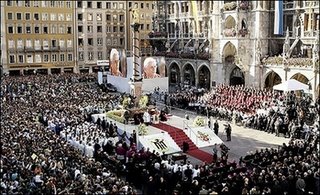
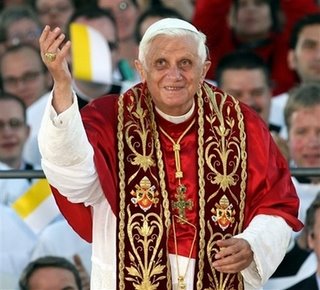
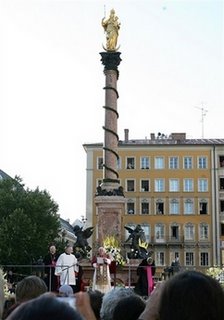
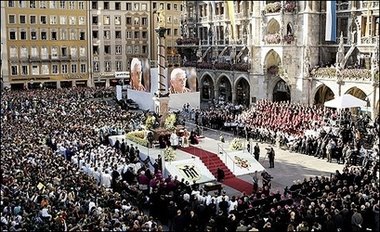
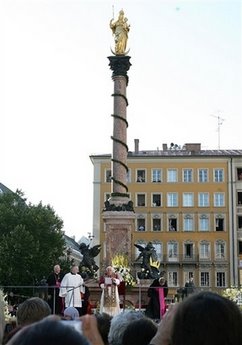
His Most Supreme Holiness, Pope Benedict XVI, has visited the Column of the Virgin in Munich's Marienplatz. His native Bavaria is rich in traditional culture and Catholicism. It is very different from Germany as a whole. In 2004, 101,000 Germans left the Catholic Church and in 2003, 129,000 left the Church of Jesus Christ. How sad...all of these souls are leaving the truth.

Let us pray that the Holy Father's return will revive the Catholic faith in Germany as a whole. According to Yahoo News, only 14 percent of Germans attend Sunday Mass.

Today on September 9, 2006, the Holy Father visited the Column of the Madonna in Marienplatz in Bavaria. The Column of Mary was erected in 1638 in the center of Munich Square and has existed as a symbol of hope for centuries. The Catholic News Agency has a good article on the history of the Column of Mary.

Photos:

AFP/DDP/Joerg Koc

AP Photo: Bernd Weissbrod, Pool


AP Photo: Maurizio Brambatti, Pool
Read more >>
Pope Benedict XVI Arrives in Bavaria, Germany

Photo Source: REUTERS/Stephan Jansen/Pool (GERMANY)

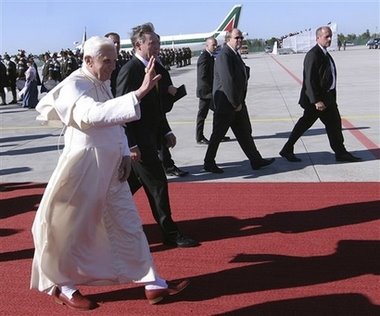
On Saturday, September 9, 2006, Pope Benedict XVI landed in Bavaria, Germany, his birthplace and where he spent most of his life. He is beginning a 6-day visit to his native country of Germany. This is his first return to Bavaria, Germany since before his election as Pope.

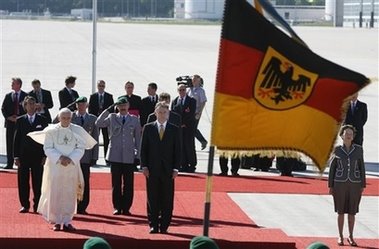
Among the many people that greeted him at the airport, he was greeted by German President Horst Köhler, Chancellor Angela Merkel, and Bavarian Minister-President Edmund Stoiber.

From Catholic News Agency:

The German president welcomed the Pope, speaking glowingly of the first years of his Pontificate. Köhler, who is Protestant, recalled the “moving experience” of last year’s World Youth Day, held in Cologne. The president remarked at the “powerful presence” of the Catholic Church in Germany and spoke hopefully of the ongoing process of ecumenical dialogue.

Following Köhler’s words of welcome, the Pope reflected briefly on the purpose of his trip. “Conscious of how much I have received,” Benedict said, “I have come here above all to express my deep gratitude towards all those who helped shape me as a person.”

But, the Pope continued, “I also come here as the Successor of the Apostle Peter, to reaffirm and strengthen the deep bonds linking the See of Rome and the Church in our native land.”

Benedict reminded everyone of the tremendous history of the Catholic faith in Germany and particularly in Bavaria. A history, he said, which has been constantly nourished by firm adherence to Christian values.

He also noted that the faith history of the country “is witnessed to by famous monuments, majestic cathedrals, statues and paintings of great artistic value, literary works, cultural initiatives and above all, the many individual and community events which reflect the Christian beliefs of successive generations in this Land which is so dear to me.”

The Pontiff insisted that although society has changed, it is important to continue passing on the faith to younger generations.

“I think we are all united in the hope that new generations will remain faithful to the spiritual patrimony which has withstood all the crises of history. My visit to the land of my birth is meant to be an encouragement in this regard: Bavaria is a part of Germany; sharing in the ups and downs of Germany’s history, and has good reason to be proud of the traditions inherited from the past. My hope is that all my compatriots in Bavaria and throughout Germany will play an active part in the transmission of the fundamental values of the Christian faith to the citizens of tomorrow.”

The Pope concluded his remarks expressing his desire to someday visit other parts of Germany and thanking all those who have worked to prepare for his visit. He offered a greeting to all Germans, noting that he was not only thinking of Catholics, but Lutherans, Orthodox Christians, and members of other Churches and Ecclesial Communities as well as “all people of good will.”

“May the Lord bless the efforts of all those concerned to build a future of true well-being for the good of the whole nation,” the Pope said, entrusting his intentions to the Blessed Virgin Mary through a traditional Bavarian prayer. “Preserve, O Virgin and Patroness, your Bavarian people, their goods, their government, their land and their religion!”

The Pope then departed for downtown Munich, where he will offer a special prayer at the Marian statue in the city’s central square.
Photos:

REUTERS/Bernd Weissbrod/Pool (GERMANY)


AP Photo/Markus Nowak, Pool

AP Photo/Markus Schreiber
Read more >>
"Catechism on the Real Presence" by St. John Vianney

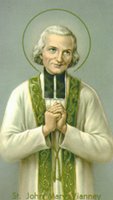
Our Lord is hidden there, waiting for us to come and visit Him, and make our request to Him. See how good He is! He accommodates Himself to our weakness. In Heaven, where we shall be glorious and triumphant, we shall see him in all His glory. If He had presented Himself before us in that glory now, we should not have dared to approach Him; but He hides Himself, like a person in a prison, who might say to us, "You do not see me, but that is no matter; ask of me all you wish and I will grant it. " He is there in the Sacrament of His love, sighing and interceding incessantly with His Father for sinners. To what outrages does He not expose Himself, that He may remain in the midst of us! He is there to console us; and therefore we ought often to visit Him. How pleasing to Him is the short quarter of an hour that we steal from our occupations, from something of no use, to come and pray to Him, to visit Him, to console Him for all the outrages He receives! When He sees pure souls coming eagerly to Him, He smiles upon them. They come with that simplicity which pleases Him so much, to ask His pardon for all sinners, for the outrages of so many ungrateful men. What happiness do we not feel in the presence of God, when we find ourselves alone at His feet before the holy tabernacles! "Come, my soul, redouble thy fervour; thou art alone adoring thy God. His eyes rest upon thee alone. " This good Saviour is so full of love for us that He seeks us out everywhere.

Ah! if we had the eyes of angels with which to see Our Lord Jesus Christ, who is here present on this altar, and who is looking at us, how we should love Him! We should never more wish to part from Him. We should wish to remain always at His feet; it would be a foretaste of Heaven: all else would become insipid to us. But see, it is faith we want. We are poor blind people; we have a mist before our eyes. Faith alone can dispel this mist. Presently, my children, when I shall hold Our Lord in my hands, when the good God blesses you, ask Him then to open the eyes of your heart; say to Him like the blind man of Jericho, "O Lord, make me to see!" If you say to Him sincerely, "Make me to see!" you will certainly obtain what you desire, because He wishes nothing but your happiness. He has His hands full of graces, seeking to whom to distribute them; Alas! and no one will have them. . . . Oh, indifference! Oh, ingratitude! My children, we are most unhappy that we do not understand these things! We shall understand them well one day; but it will then be too late!

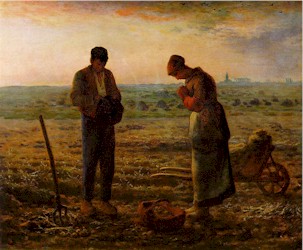
Our Lord is there as a Victim; and a prayer that is very pleasing to God is to ask the Blessed Virgin to offer to the Eternal Father her Divine Son, all bleeding, all torn, for the conversion of sinners; it is the best prayer we can make, since, indeed, all prayers are made in the name and through the merits of Jesus Christ. We must also thank God for all those indulgences that purify us from our sins. . . but we pay no attention to them. We tread upon indulgences, one might say, as we tread upon the sheaves of corn after the harvest. See, there are seven years and seven quarantines for hearing the catechism, three hundred days for reciting the Litany of the Blessed Virgin, the Salve Regina, the Angelus. In short, the good God multiplies His graces upon us; and how sorry we shall be at the end of our lives that we did not profit by them!

When we are before the Blessed Sacrament, instead of looking about, let us shut our eyes and our mouth; let us open our heart: our good God will open His; we shall go to Him, He will come to us, the one to ask, the other to receive; it will be like a breath from one to the other. What sweetness do we not find in forgetting ourselves in order to seek God! The saints lost sight of themselves that they might see nothing but God, and labor for Him alone; they forgot all created objects in order to find Him alone. This is the way to reach Heaven.

Read more on St. John Vianney
Read more >>
Words of Inspiration: September 9, 2006

Archbishop Fulton Sheen:

“What has happened to that double side of sympathy which is the basis of the Christian philosophy of life; ‘Rejoice with those who rejoice, and weep with those who weep?’ It has been said that the wounded deer sheds tears, but it belongs to man to weep with those who weep and by sympathy to divide another’s sorrows and double another’s joy.”

Blessed Mother Teresa:

"Surely if God feeds the young ravens which cry to Him, if He nourishes the birds which neither sow nor reap nor gather into barns, if He vests the flowers of the field so beautifully, how much more will He care for men whom He has made in His own image and likeness and adopted as His children, if we only act as such."

St. Padre Pio:

"This heart of mine is Yours… my Jesus, so take this heart of mine, fill it with Your love and then order me to do whatever You wish."

Read more >>
Pope Benedict XVI to Visit Bavaria

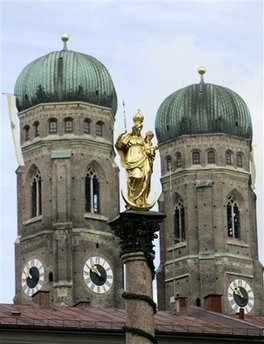
The white and gold flag of the Vatican is everyone in Bavaria, Germany, as Pope Benedict XVI starts a 6 day-trip to his native homeland in Bavaria, Germany. Even the Catedral of Our Lady in Munich (photo above) is decorated with the Vatican's flag. About 7.2 million Catholics live in the state of Bavaria - a quarter of all of the Catholics in Germany.

Very shortly Pope Benedict XVI will arrive in Germany. I hope to blog extensively on the trip. During the course of the Holy Father's trip, he will visit "Munich, the city of which he was archbishop from 1977 to 1982; the Altoetting Shrine, symbol of Bavarian Catholicism; Marktl am Inn, his birthplace; and Regensburg, where he was professor, where his brother lives, and where members of his family are buried" (Source: Zenit).

The Holy Father said the purpose of his visit is "... precisely because I want to see again the places where I grew up, the people who touched and shaped my life. I want to thank these people...Naturally I also want to express a message that goes beyond my country, just as my ministry calls me to do. The basic theme is that we have to rediscover God, not just any God, but the God that has a human face, because when we see Jesus Christ we see God."

The Holy Father's schedule (source):
September 9 & 10:
September 11:
September 12:
September 13:
September 14:
Read more >>
Friday, September 8, 2006
Hola, Amigos!

I'm still here!

And classes are extremely hard. While my history, philosophy, and calculus classes are going extremely well, I am not doing as well as I wanted in either English or my science course for this semester. Because of the huge amount of work this semester, I have not been able to post very much. Plus, with working part time, I have had even less time to post on my blog.

Anyway, thank you all for keep reading my blog. Just to let everyone know, I am still praying the Liturgy of the Hours daily, and I love it. I also will be starting the formal application process of applying to my diocese at the end of this month. Prayers for all of these things would be so graciously appreciated.
Read more >>
New Traditional Institute Created by the Vatican!


Today, the 8th of September, the Vatican created a religious institute of pontifical right (The Institute "Good Shepherd"), to accommodate 5 priests who had been expelled from the SSPX (such as Fr. Laguérie) and a few seminarians.

Of more general importance, is that, according to the piece, the Holy Father wishes to establish that the Traditional Missal is not a separate missal, but as a mere variation of the Roman Rite.

This is so exciting for me! I will definitely keep an eye on this since I am a so strongly connected to the Tridentine Rite. I love the Tridentine Latin Mass!
Read more >>
"Catechism on the Priesthood" by St. John Vianney

Since, I hope to become a priest, this Catechism by St. John Vianney is really important to me:

My children, we have come to the Sacrament of Orders. It is a Sacrament which seems to relate to no one among you, and which yet relates to everyone. This Sacrament raises man up to God. What is a priest! A man who holds the place of God -- a man who is invested with all the powers of God. "Go, " said Our Lord to the priest; "as My Father sent Me, I send you. All power has been given Me in Heaven and on earth. Go then, teach all nations. . . . He who listens to you, listens to Me; he who despises you despises Me. " When the priest remits sins, he does not say, "God pardons you"; he says, "I absolve you. " At the Consecration, he does not say, "This is the Body of Our Lord;" he says, "This is My Body. "

Saint Bernard tells us that everything has come to us through Mary; and we may also say that everything has come to us through the priest; yes, all happiness, all graces, all heavenly gifts. If we had not the Sacrament of Orders, we should not have Our Lord. Who placed Him there, in that tabernacle? It was the priest. Who was it that received your soul, on its entrance into life? The priest. Who nourishes it, to give it strength to make its pilgrimage? The priest. Who will prepare it to appear before God, by washing that soul, for the last time, in the blood of Jesus Christ? The priest -- always the priest. And if that soul comes to the point of death, who will raise it up, who will restore it to calmness and peace? Again the priest. You cannot recall one single blessing from God without finding, side by side with this recollection, the image of the priest.

Go to confession to the Blessed Virgin, or to an angel; will they absolve you? No. Will they give you the Body and Blood of Our Lord? No. The Holy Virgin cannot make her Divine Son descend into the Host. You might have two hundred angels there, but they could not absolve you. A priest, however simple he may be, can do it; he can say to you, "Go in peace; I pardon you. " Oh, how great is a priest! The priest will not understand the greatness of his office till he is in Heaven. If he understood it on earth, he would die, not of fear, but of love. The other benefits of God would be of no avail to us without the priest. What would be the use of a house full of gold, if you had nobody to open you the door! The priest has the key of the heavenly treasures; it is he who opens the door; he is the steward of the good God, the distributor of His wealth. Without the priest, the Death and Passion of Our Lord would be of no avail. Look at the heathens: what has it availed them that Our Lord has died? Alas! they can have no share in the blessings of Redemption, while they have no priests to apply His Blood to their souls!

The priest is not a priest for himself; he does not give himself absolution; he does not administer the Sacraments to himself. He is not for himself, he is for you. After God, the priest is everything. Leave a parish twenty years without priests; they will worship beasts. If the missionary Father and I were to go away, you would say, "What can we do in this church? there is no Mass; Our Lord is no longer there: we may as well pray at home. " When people wish to destroy religion, they begin by attacking the priest, because where there is no longer any priest there is no sacrifice, and where there is no longer any sacrifice there is no religion.

When the bell calls you to church, if you were asked, "Where are you going?" you might answer, "I am going to feed my soul. " If someone were to ask you, pointing to the tabernacle, "What is that golden door?" "That is our storehouse, where the true Food of our souls is kept. " "Who has the key? Who lays in the provisions? Who makes ready the feast, and who serves the table?" "The priest. " "And what is the Food?" "The precious Body and Blood of Our Lord. " O God! O God! how Thou hast loved us! See the power of the priest; out of a piece of bread the word of a priest makes a God. It is more than creating the world. . . . Someone said, "Does Saint Philomena, then, obey the Cure of Ars?" Indeed, she may well obey him, since God obeys him.

If I were to meet a priest and an angel, I should salute the priest before I saluted the angel. The latter is the friend of God; but the priest holds His place. Saint Teresa kissed the ground where a priest had passed. When you see a priest, you should say, "There is he who made me a child of God, and opened Heaven to me by holy Baptism; he who purified me after I had sinned; who gives nourishment to my soul. " At the sight of a church tower, you may say, "What is there in that place?" "The Body of Our Lord. " "Why is He there?" "Because a priest has been there, and has said holy Mass. "

What joy did the Apostles feel after the Resurrection of Our Lord, at seeing the Master whom they had loved so much! The priest must feel the same joy, at seeing Our Lord whom he holds in his hands. Great value is attached to objects which have been laid in the drinking cup of the Blessed Virgin and of the Child Jesus, at Loretto. But the fingers of the priest, that have touched the adorable Flesh of Jesus Christ, that have been plunged into the chalice which contained His Blood, into the pyx where His Body has lain, are they not still more precious? The priesthood is the love of the Heart of Jesus.

When you see the priest, think of Our Lord Jesus Christ.

Read more on St. John Vianney
Read more >>
Blessed Pier Giorgio Frassati


Blessed Pier Giorgio Frassati (1901 - 1925) was born on April 6, 1901, into a wealthy family- his mother was the painter Adelaide Ametis and his father was an agnostic, the founder of the liberal newspaper "La Stampa". His father later became Italian ambassador to Germany. Blessed Frassati was an excellent athlete, average student, and a pious youth. He was tutored at home by his sister, Luciana, and he later studied minerology after graduating high school. He worked with Catholic groups like Apostleship of Prayer and the Company of the Most Blessed Sacrament. These groups ministered to the poor and promoted Eucharistic adoration along with Marian devotion and chastity. He also worked with political groups opposed to Facisim that took care of the poor like Young Catholic Workers Congress.

In 1922 he became a Dominican tertiary and took the name Girolamo. Blessed Frassati spent his fortune on the poor and cared for the sick. And in his work, he contracted polio that would kill him on July 4, 1925. His body was found incorruptible in 1981.

On May 20, 1990, Pope John Paul II beatified him.


Here is the prayer for canonization:


"O merciful God, Who through the perils of the world deigned to preserve by Thy grace Thy servant Pier Giorgio Frassati pure of heart and ardent of charity, listen, we ask Thee, to our prayers, and, if it is in Thy designs that he be glorified by the Church, show us Thy will, granting us the graces we ask of Thee through his intercession, by the merits of Jesus Christ, Our Lord. Amen.

(Imprimatur: Maurillo, Archbishop of Turin, 1932)
Read more >>
Thursday, September 7, 2006
The Nativity of the Blessed Virgin Mary


Thy birth, O Virgin Mother of God, proclaimed joy to the whole world; for from Thee arose the sun of righteousness, Christ our God; who released us from the curse, and gave us blessing; and confounding death, He granted us eternal life.

Feast (1969 Calendar): September 8
Double of the II Class (1955 Calendar): September 8

While the day before the Nativity of our Lady is not a fasting day (and neither is it a vigil), we can nevertheless keep September 7th as a day to prepare for Marymas by praying the 9 Hail Mary's Devotion.

September 8th is the Nativity of the Blessed Virgin Mary, where we recall her birth and the beginning of her work in the accomplishment of the divine plan for our salvation. This feast dates back to c. 750 AD. It was granted an Octave by Pope Innocent IV in 1243. In 1913, with the Divino Aflatu reforms, the Octave was downgraded to a simple octave and the Octave Day itself, September 15th, was replaced by the Feast of Our Lady of Sorrows.

Let us celebrate today as a day of joy in honoring the birthday of our Blessed Mother! Today was previously a Holy Day of Obligation as listed in Universa Per Orbem by Pope Urban VIII in 1642, though it has not been one for centuries.

From a Sermon of St. Augustine of Hippo:
The hoped-for day of the blessed and venerable Mary ever a Virgin has now come; therefore let our earth rejoice with great gladness, illuminated by the birth of so great a Virgin. For she is the flower of the field from which came forth the priceless lily of the valley; by her child-bearing the nature inherited from our first parents is changed, their fault wiped out. In her that sentence passed on Eve was remitted which said, "In sorrow shall you bring forth children," for Mary brought forth the Lord in joy.
Eve sorrowed, but Mary exulted; Eve carried weeping in her womb, but Mary carried joy, for Eve brought forth a sinner, but Mary innocence itself. The mother of our race brought punishment into the world, but the Mother of our Lord brought salvation into the world. Eve was the source of sin, Mary the source of merit. Eve by killing was a hindrance, Mary by giving life was a help. Eve wounded, Mary healed. Obedience takes the place of disobedience, faith makes up for faithlessness.
Mary may now play on her instruments, the Mother strike the cymbals with swift fingers. The joyful choruses may sound out and songs alternate with sweet harmonies. Hear, then, how she sings, she who leads our chorus. For she say, "My soul magnifies the Lord, and my spirit rejoices in God my Savior; because He has regarded the lowliness of His handmaid; for, behold, henceforth all generations shall call me blessed; because He who is mighty has done great things for me." And so the miraculous new birth takes away the cause of our increasing burden of sin, and Mary's song puts an end to the weeping of Eve.

A Brief History of the Miraculous Image of Maria Santissima Bambina 

The Miraculous Image of Maria Bambina was made before 1730 by a Franciscan nun, who afterwards entrusted the image to others, so that during the ensuing years she eventually came into the care of the Sisters of Charity at Lovere, Italy. In 1866 these Sisters of Charity were requested to take over the management of the Hospital of Ciceri in Milan. In 1876 the waxen image was carried to their Mother House at Via Santa Sofia 13, where the Bambina has remained ever since. Throughout this period, the statue was exposed for veneration only on the 8th of September, the Feast of Mary's Nativity, but in 1884 Maria Bambina manifested her desire to reward those who honored her by their devotion to her Holy Infancy. 


One of the Sisters, Sr. Josephine Woinovich, due to paralysis in her arms and feet, was bedridden and in unbearable pain. On the 8th of September, Our Lady's Nativity, she begged Mother Superior to bring Maria Bambina and to leave the image near her overnight. The following morning the Mother Superior was inspired to take the image, so old, worn, and grayish colored, to the other sick Sisters in the infirmary so that they could venerate and kiss her. In the infirmary was a fervent Novice, Guila Macario, who was unable to move because of her serious illness, but who, overcome by her ardent faith, took the Maria Bambina into her arms and pleaded with her in tender and loving words for the grace of her recovery, if such was according to God's Holy Will. 

She was instantaneously cured, for such faith and confidence moves mountains! And at the very same time, the miraculous image itself underwent an amazing transformation from its former dull gray color to the warm flesh hues it has today, as can be seen, where she is enshrined in the Sanctuary of the Mother House in Milan. Many graces and miracles are attributed to the beautiful devotion to Maria Bambina, among them the recovery of Sister Josephine Woinovich herself. For this reason, the Sisters of Charity became commonly known as the Suore di Maria Bambina.

Prayer by St. Anselm:

Vouchsafe that I may praise thee, O sacred Virgin; give me strength against thine enemies, and against the enemy of the whole human race. Give me strength humbly to pray to thee. Give me strength to praise thee in prayer with all my powers, through the merits of thy most sacred nativity, which for the entire Christian world was a birth of joy, the hope and solace of its life. When thou wast born, O most holy Virgin, then was the world made light. Happy is thy stock, holy thy root, and blessed thy fruit, for thou alone as a virgin, filled with the Holy Spirit, didst merit to conceive thy God, as a virgin to bear Thy God, as a virgin to bring Him forth, and after His birth to remain a virgin. Have mercy therefore upon me a sinner, and give me aid, O Lady, so that just as thy nativity, glorious from the seed of Abraham, sprung from the tribe of Juda, illustrious from the stock of David, didst announce joy to the entire world, so may it fill me with true joy and cleanse me from every sin. Pray for me, O Virgin most prudent, that the gladsome joys of thy most helpful nativity may put a cloak over all my sins. O holy Mother of God, flowering as the lily, pray to thy sweet Son for me, a wretched sinner. Amen.

Prayer:

Bestow upon Thy servants, we beseech Thee, O Lord, the gift of Thy heavenly grace: that as the childbearing of the Blessed Virgin was the beginning of our salvation, so the solemn feast of her Nativity may bring us an increase of peace. Through our Lord.

Prayer Source: 1962 Roman Catholic Daily Missal
Read more >>
"Catechism on the Prerogatives of the Pure Soul" by St. John Vianney

Nothing is so beautiful as a pure soul. If we understood this, we could not lose our purity. The pure soul is disengaged from matter, from earthly things, and from itself. . . . That is why the saints ill-treated their body, that is why they did not grant it what it required, not even to rise five minutes later, to warm themselves, to eat anything that gave them pleasure. . . . For what the body loses the soul gains, and what the body gains the soul loses.

Purity comes from Heaven; we must ask for it from God. If we ask for it, we shall obtain it. We must take great care not to lose it. We must shut our heart against pride, against sensuality, and all the other passions, as one shuts the doors and windows that nobody may be able to get in. What joy is it to the guardian angel to conduct a pure soul! My children, when a soul is pure, all Heaven looks upon it with love! Pure souls will form the circle round Our Lord. The more pure we have been on earth, the nearer we shall be to Him in Heaven. When the heart is pure, it cannot help loving, because it has found the source of love, which is God. "Happy, " says Our Lord, "are the pure in heart, because they shall see God!"

My children, we cannot comprehend the power that a pure soul has over the good God. It is not he who does the will of God, it is God who does his will. Look at Moses, that very pure soul. When God would punish the Jewish people, He said to him: Do not pray for them, because My anger must fall upon this people. Nevertheless, Moses prayed, and God spared His people; He let Himself be entreated; He could not resist the prayer of that pure soul. O my children, a soul that has never been stained by that accursed sin obtains from God whatever it wishes!

Three things are wanted to preserve purity-the presence of God, prayer, and the Sacraments. Another means is the reading of holy books, which nourishes the soul. How beautiful is a pure soul! Our Lord showed one to Saint Catherine; she thought it so beautiful that she said, "O Lord, if I did not know that there is only one God, I should think it was one. " The image of God is reflected in a pure soul, like the sun in the water. A pure soul is the admiration of the Three Persons of the Holy Trinity. The Father contemplates His work: There is My creature! . . . The Son, the price of His Blood: the beauty of an object is shown by the price it has cost. . . . The Holy Spirit dwells in it, as in a temple.

We also know the value of our soul by the efforts the devil makes to ruin it. Hell is leagued against it--Heaven for it. Oh, how great it must be! In order to have an idea of our dignity, we must often think of Heaven, Calvary, and Hell. If we could understand what it is to be the child of God, we could not do evil--we should be like angels on earth. To be children of God, oh, what a dignity!

It is a beautiful thing to have a heart, and, little as it is, to be able to make use of it in loving God. How shameful it is that man should descend so low, when God has placed him so high! When the angels had revolted against God, this God who is so good, seeing that they could no longer enjoy the happiness for which He had created them, made man, and this little world that we see to nourish his body. But his soul required to be nourished also; and as nothing created can feed the soul, which is a spirit, God willed to give Himself for its Food. But the great misfortune is that we neglect to have recourse to this divine Food, in crossing the desert of this life. Like people who die of hunger within sight of a well-provided table, there are some who remain fifty, sixty years, without feeding their souls.

Oh, if Christians could understand the language of Our Lord, who says to them, "Notwithstanding thy misery, I wish to see near Me that beautiful soul which I created for Myself. I made it so great, that nothing can fill it but Myself. I made it so pure, that nothing but My Body can nourish it. "

Our Lord has always distinguished Pure souls. Look at Saint John, the well-beloved disciple, who reposed upon His breast. Saint Catherine was pure, and she was often transported into Paradise. When she died, angels took up her body, and carried it to Mount Sinai, where Moses had received the Commandments of the law. God has shown by this prodigy that a soul is so agreeable to Him, that it deserves that even the body which has participated in its purity should be buried by angels.

God contemplates a pure soul with love; He grants it all it desires. How could He refuse anything to a soul that lives only for Him, by Him, and in Him? It seeks God, and He shows Himself to it; it calls Him, and God comes; it is one with Him; it captivates His will. A pure soul is all-powerful with the gracious Heart of Our Lord. A pure soul with God is like a child with its mother. It caresses her, it embraces her, and its mother returns its caresses and embraces.

Read more on St. John Vianney
Read more >>
Wednesday, September 6, 2006
Brother Roger was Catholic?

According to recent news, Brother Roger was a Catholic. Brother Roger, who was stabbed to death in 2005, formed the Taize movement to help heal the Protestant-Catholic chasm. And, according to sources, speculations are correct - he did become a Catholic. According to a former Catholic bishop of Autun, Brother Roger made a "profession of faith" for the Catholic Church in 1972.

Read more on Brother Roger

Read more >>
"On the Love of God" by St. John Vianney

"If you love Me, keep My Commandments."

Nothing is so common among Christians as to say, "O my God; I love Thee," and nothing more rare, perhaps, than the love of the good God. Satisfied with making outward acts I of love, in which our poor heart often has no share, we think we have fulfilled the whole of the precept. An error, an illusion; for see, my children, Saint John says that we must not love the good God in word, but in deed. Our Lord Jesus Christ also says, "If anyone love Me he will keep My Word:' If we judge by this rule, there are very few Christians who truly love God, since there are so few who keep His Commandments. Yet nothing is more essential than the love of God. It is the first of all virtues, a virtue so necessary, that without it we shall never get to Heaven; and it is in order to love God that we are on the earth. Even if the good God did not command it, this feeling is so natural to us, that our heart should be drawn to it of its own accord.

But the misfortune is that we lavish our love upon objects unworthy of it, and refuse it to Him alone who deserves to be infinitely loved. Thus, my children, one person will love riches, another will love pleasures; and both will offer to the good God nothing but the languishing remains of a heart worn out in the service of the world. From thence comes insufficient love, divided love, which is for that very reason unworthy of the good God; for He alone, being infinitely above all created good, deserves that we should love Him above all things: more than our possessions, because they are earthly; more than our friends, because they are mortal; more than our life, because it is perishable; more than ourselves, because we belong to Him. Our love, my children, if it is true, must be without limit, and must influence our conduct....

If the Saviour of the world, addressing Himself to each one of us separately, were now to ask us the same question that He formerly asked Saint Peter: "Simon, son of John, lovest thou Me?" could we answer with as much confidence as that great Apostle, "Yea, Lord, Thou knowest that I love Thee"? Domine, tu scis quia amo te. We have perhaps pronounced these words without taking in their meaning and extent; for, my children, to love the good God is not merely to say with the mouth, "O my God! I love Thee!" Oh, no! where is the sinner who does not sometimes use this language?

To love the good God is not only to feel from time to time some emotions of tenderness towards God; this sensible devotion is not always in our own power. To love the good God is not to be faithful in fulfilling part of our duties and to neglect the rest. The good God will have no division: "Thou shalt love the Lord thy God with thy whole heart, and with thy whole soul, and with thy whole strength:' This shows the strength of the Commandment to love God. To love God with our whole heart is to prefer Him to everything, so as to be ready to lose all our possessions, our honour, our life, rather than offend this good Master. To love God with our whole heart is to love nothing that is incompatible with the love of God; it is to love nothing that can share our heart with the good God: it is to renounce all our passions, all our ill-regulated desires. Is it thus, my children, that we love the good God?

To love the good God with our whole mind is to make the sacrifice to Him of our knowledge and our reason, and to believe all that He has taught. To love the good God with our whole mind is to think of Him often, and to make it our principal study to know Him well. To love the good God with our whole strength is to employ our possessions, our health, and our talents, in serving Him and glorifying Him. It is to refer all our actions to Him, as our last end. Once more, is it thus that we love the good God? Judging by this invariable rule, how few Christians truly love God!

Do those bad Christians love the good God, who are the slaves of their passions? Do those worldly persons love the good God, who seek only to gratify their body and to please the world? Is God loved by the miser, who sacrifices Him for a vile gain? Is He loved by that voluptuary, who abandons himself to vices the most opposite to divine love? Is He loved by that man who thinks of nothing but wine and good cheer? Is He loved by that other man, who cherishes an aversion to his neighbour, and will not forgive him? Is He loved by that young girl, who loves nothing but pleasures, and thinks of nothing but indulgence and vanity? No, no, my children, none of these persons love the good God; for we must love Him with a love of preference, with an active love!

If we had rather offend the good God than deprive ourselves of a passing satisfaction, than renounce those guilty meetings, those shameful passions, we do not love the good God with a love of preference, since we love our pleasures, our passions, better than the good God Himself. Let us go down into our own souls; let us question our hearts, my children, and see if we do not love some creature more than the good God. We are permitted to love our relations, our possessions, our health, our reputation; but this love must be subordinate to the love we should have for God, so that we may be ready to make the sacrifice of it if He should require it....

Can you suppose that you are in these dispositions--you who look upon mortal sin as a trifle, who keep it quietly on your conscience for months, for years, though you know that you are in a state most displeasing to the good God? Can you suppose that you love the good God? Can you suppose that you love the good God--you who make no efforts to correct yourselves; you who will deprive yourselves of nothing; you who offend the Creator every time that you find opportunity? Yes, my children, what the miser loves with his whole heart is money; what the drunkard loves with his whole heart is wine; what the libertine loves with his whole heart is the object of his passion. You, young girls, you who had rather offend God than give up your finery and your vanities, you say that you love God; say rather that you love yourselves.

No, no, my children; it is not thus that the good God is to be loved, for we must love Him not only with a love of preference, but also with an active love. "Love," says Saint Augustine, "cannot remain without the constant action of the soul: Non potest vacare amor in anima amantis. Yes," says this great saint, "seek for a love that does not manifest itself in works, and you will find none:' What! could it be, O my God, that Thy love alone should be barren, and that the Divine fire, which ought to enkindle the whole world, should be without activity and without strength?

When you love a person, you show him the more or less affection according as the ardour of your love for him is more or less great. See, my children, what the saints were like, who were all filled with the love of the good God: nothing cost them too much; they joyfully made the greatest sacrifices; they distributed their goods to the poor, rendered services to their enemies, led a hard and penitential life; tore themselves from the pleasures of the world, from the conveniences of life, to bury themselves alive in solitude; they hastened to torments and to death, as people hasten to a feast. Such were the effects which the love of the good God produced in the saints; such ought it to produce in us. But, my children, we are not penetrated with the love of God; we do not love the good God. Can anyone say, indeed, that he loves the good God, who is so easily frightened, and who is repulsed by the least difficulty? Alas! what would have become of us if Jesus Christ had loved us only as we love Him? But, no. Triumphing over the agonies of the Cross, the bitterness of death, the shame of the most ignominious tortures, nothing costs Him too dear when He has to prove that He loves us. That is our only model. If our love is active, it will manifest itself by the works which are the effects of love, because the love of the good God is not only a love of preference, but a pious affection, a love of obedience, which makes us practice His Commandments; an active love, which makes us fulfil all the duties of a good Christian. Such is the love, my children, which God requires from us, to which He has so many titles, which He has purchased by so many benefits heaped upon us by His death for us upon the Cross. What happiness, my children, to love the good God! There is no joy, no happiness, no peace, in the heart of those who do not love the good God on earth. We desire Heaven, we aspire to it; but, that we may be sure to attain to it, let us begin to love the good God here below, in order to be able to love Him, to possess Him eternally in His holy Paradise.

Read more on St. John Vianney
Read more >>
Monday, September 4, 2006
Sara Salkahazi is to be Beatified

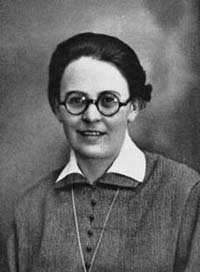
Blessed Sara Salkahazi is scheduled to be beatified on September 17, 2006, at Budapest's St. Stephen Basilica. Salkahazi was a Hungarian nun that saved the lives of dozens of Jews during World War II. She is an example of the sacrificial love that Jesus calls us to show to the whole world.

On Dec. 27, 1944, Sara Salkahazi was killed by the Arrow Cross - the Hungarian allies of the Nazis, for hiding Jews in the building used by her religious community, Sisters of Social Service.

The coming beatification will be the first held in Hungary since 1083, when Hungary's first king, St. Stephen, was beatified along with his son, St. Imre, and St. Gellert, an Italian bishop who helped convert Hungarians to Christianity. Because Pope Benedict XVI started allowing beatifications in other countries and not just the Vatican, the beatification will be the first in Hungary in centuries. It was the custom for hundreds of years to celebrate beatifications in Rome. Now, canonizations will be held in Rome, but Pope Benedict XVI is allowing beatifications in other parts of the world.

She will be the first Hungarian beatified that was not a member of the aristocracy or royalty.
Read more >>
St. Giles


Simple (1955 Calendar): September 1

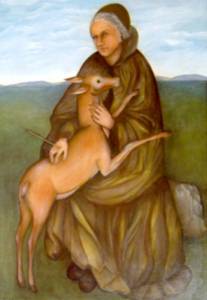
St. Giles is said to have been born in Athens, Greece, and as a youth, he cured a sick beggar by giving him his own cloak. Following the death of his parents, he was frequently showered with the applause of men, which he dreaded. He hated both applause and temporal prosperity. He took a ship and landed in Marseilles, France. After two years of journeying with St. Caesarius at Arles, he made a hermitage in the woods.

During his time of solitude and prayer, he was, according to tradition, nourished by the milk of a hind. The hind took refuge in the cave of St. Giles. The hounds of Favius, king of the Goths, were hunting the hind. On the third day, Favius and the bishop approached the area, and Favius fired an arrow into the bushes. The arrow wounded St. Giles. When the two men found the wounded St. Giles with the hind with him, they ordered him to account for himself. After St. Giles told his story, Favius and the bishop asked for his forgiveness and offered him medical help and gifts. St. Giles refused all gifts.

King Flavius continued to visit St. Giles, who eventually asked the King to found a monastery. The King agreed but only if St. Giles would serve as the abbot. The monastery was built near the cave where St. Giles lived. Soon Charles, the King of France, heard of St. Giles. They talked on spiritual matters, but the King Charles was too ashamed to admit one particular sin to the saint during their discourse.
"On the following Sunday, when the holy man was celebrating Mass according to custom and praying to God for the king during the canon, an angel of the Lord appeared to him and laid on the altar a scroll on which was written the sin which the king had committed, and which further said that he would be forgiven at Giles's intercession, provided he did penance and desisted from that sin in the future...When Mass was ended Giles gave the scroll to the king to read, who fell at the saint's feet, begging him to intercede with the Lord for him. And so the man of the Lord commended him to God in prayer and gently admonished him to refrain from that sin in the future."
St. Giles returned to his monastery and then, soon afterward, went to Rome to commend his monks to the Holy See. The pope granted them many privileges and gave him a present - two carved doors of cedar. St. Giles threw the doors in the Tiber River trusting in God's guidance, that they would arrive in France before him. And, behold, they did just that.

After being warned in a dream, St. Giles died on Sunday, September 1 in c. 710 AD. He is remembered on September 1st every year.

Source: Butler's Lives of the Saints (457 - 458)

Dom Gueranger (c. 1880) writes of the impact of his life:

"After the death of the servant of God, the place became more and more frequented. From north and east and south pilgrims poured in, to offer up their prayers and fulfil their vows at the tomb of one, who soon became known as one of the most helpful saints in heaven. Among the crowds came Pontiffs and kings. But the most numerous classes of visitors to the holy relics were soldiers and little children, the former equipped for the crusades, the latter borne in their mothers’ arms; all confiding in the humble, gentle monk who, at the risk of his life, calmed the terror of the poor little hind; all imploring his assistance against the fear which even the bravest may feel in the hour of battle, or the fright that disturbs the little one in his cradle. St. Giles’s ranked as one of the three great pilgrimages of the west; the other two being Rome and Compostello...

"We should never end, were we to enumerate the churches, parishes, abbeys, and altars consecrated to St. Giles, in all parts of Christendom, which are so many sources of grace, and new centres for pilgrimages. Spain, Italy, Belgium, Germany, Hungary, Bavaria, Poland, rival France in this respect. England is second to no country in the world; she has one hundred and forty-six sanctuaries dedicated to the pious monk, and even the established church continues to honour him."

Prayer:

May the intercession of blessed Giles the Abbot commend us unto Thee, we beseech Thee, O Lord: so that what we cannot acquire by any merits of ours, we may obtain by his patronage. Through our Lord.

Prayer Source: 1962 Roman Catholic Daily Missal
Read more >>
"Catechism on The Love of God" by St. John Vianney


Our body is a vessel of corruption; it is meant for death and for the worms, nothing morel And yet we devote ourselves to satisfying it, rather than to enriching our soul, which is so great that we can conceive nothing greater-no, nothing, nothing! For we see that God, urged by the ardour of His charity, would not create us like the animals; He has created us in His own image and likeness, do you see? Oh, how great is man?

Man, being created by love, cannot live without love: either he loves God, or he loves himself and he loves the world. See, my children, it is faith that we want. . . . When we have not faith, we are blind. He who does not see, does not know; he who does not know does not love; he who does not love God loves himself, and at the same time loves his pleasures. He fixes his heart on things which pass away like smoke. He cannot know the truth, nor any good thing; he can know nothing but falsehood, because he has no light; he is in a mist. If he had light, he would see plainly that all that he loves can give him nothing but eternal death; it is a foretaste of Hell.

Do you see, my children, except God, nothing is solid--nothing, nothing! If it is life, it passes away; if it is a fortune, it crumbles away; if it is health, it is destroyed; if it is reputation, it is attacked. We are scattered like the wind. . . . Everything is passing away full speed, everything is going to ruin. O God! O God! how much those are to be pitied, then, who set their hearts on all these things! They set their hearts on them because they love themselves too much; but they do not love themselves with a reasonable love-they love themselves with a love that seeks themselves and the world, that seeks creatures more than God. That is the reason why they are never satisfied, never quiet; they are always uneasy, always tormented, always upset. See, my children, the good Christian runs his course in this world mounted on a fine triumphal chariot; this chariot is borne by angels, and conducted by Our Lord Himself, while the poor sinner is harnessed to the chariot of this life, and the devil who drives it forces him to go on with great strokes of the whip.

My children, the three acts of faith, hope and charity contain all the happiness of man upon the earth. By faith, we believe what God has promised us: we believe that we shall one day see Him, that we shall possess Him, that we shall be eternally happy with Him in Heaven. By hope, we expect the fulfilment of these promises: we hope that we shall be rewarded for all our good actions, for all our good thoughts, for all our good desires; for God takes into account even our good desires. What more do we want to make us happy?

In Heaven, faith and hope will exist no more, for the mist which obscures our reason will be dispelled; our mind will be able to understand the things that are hidden from it here below. We shall no longer hope for anything, because we shall have everything. We do not hope to acquire a treasure which we already possess. . . . But love; oh, we shall be inebriated with it! we shall be drowned, lost in that ocean of divine love, annihilated in that immense charity of the Heart of Jesus! so that charity is a foretaste of Heaven. Oh, how happy should we be if we knew how to understand it, to feel it, to taste it! What makes us unhappy is that we do not love God.

When we say, "My God, I believe, I believe firmly, " that is, without the least doubt, without the least hesitation. . . Oh, if we were penetrated with these words: "I firmly believe that Thou art present everywhere, that Thou seest me, that I am under Thine eyes, that one day I myself shall see Thee clearly, that I shall enjoy all the good things Thou hast promised me! O my God, I hope that Thou wilt reward me for all that I have done to please Thee! O my God, I love Thee; my heart is made to love Thee!" Oh, this act of faith, which is also an act of love, would suffice for everything! If we understood our own happiness in I being able to love God, we should remain motionless in ecstasy. . . .

If a prince, an emperor, were to cause one of his subjects to appear before him, and should say to him, "I wish to make you happy; stay with me, enjoy all my possessions, but be careful not to give me any just cause of displeasure, " with what care, with what ardour, would not that subject endeavour to satisfy his prince! Well, God makes the same proposals to us . . . and we do not care for His friendship, we make no account of His promises. . . . What a pity!

Read more on St. John Vianney
Read more >>
Labor Day Prayers


Labor Day Litany:

Reader: Friends, let us offer our prayers to God, who pronounced all creation. God, who sent his Son to live and work as one like us, and who calls us to serve the poor and those oppressed. Lord, give success to the work of our hands.
ALL: Lord, give success to the work of our hands.

Reader: For all those who work:
ALL: Lord, give success to the work of our hands.

Reader: For those who are unemployed or underemployed, or have lost their jobs because of changing economic conditions, let us pray:
ALL: Lord, give success to the work of our hands.

Reader: For those who work in hazardous conditions without sufficient protection, let us pray: ALL: Lord, give success to the work of our hands.

Reader: For migrant workers and all who work the land, let us pray:
ALL: Lord, give success to the work of our hands.

Reader: For all employers that they may seek to provide a just work environment:
ALL: Lord, give success to the work of our hands.

Reader: For those who face discrimination, harassment, or abuse in the workplace, let us pray: ALL: Lord, give success to the work of our hands.

Reader: For those who must balance job commitments with the needs of their families, let us pray:
ALL: Lord, give success to the work of our hands.

Reader: Loving God, through your Son you gave us an example to love one another as He loved us. Give us the strength to continue working to bring forth your kingdom here on earth - a kingdom of justice and peace, kindness and compassion, grace, and mercy. Grant this through Christ our Lord.
ALL: Amen

Collect:

God our Creator, it is your will that man accepts the duty of work. In your kindness may the work we begin bring us growth in this life and help to extend the kingdom of Christ. We ask this through our Lord Jesus Christ, your Son, who lives and reigns with you and the Holy Spirit, one God, for ever and ever. Amen.
Read more >>
Sunday, September 3, 2006
"On Avarice" by St. John Vianney

Avarice is an inordinate love of the goods of this world.

Yes, my children, it is an ill-regulated love, a fatal love, which makes us forget the good God, prayer, the Sacraments, that we may love the goods of this world--gold and silver and lands. The avaricious man is like a pig, which seeks its food in the mud, without caring where it comes from. Stooping towards the earth, he thinks of nothing but the earth; he no longer looks towards Heaven, his happiness is no longer there. The avaricious man does no good till after his death. See, how greedily he gathers up wealth, how anxiously he keeps it, how afflicted he is if he loses it. In the midst of riches, he does not enjoy them; he is, as it were, plunged in a river, and is dying of thirst; lying on a heap of corn, he is dying of hunger; he has everything, my children, and dares not touch anything; his gold is a sacred thing to him, he makes it his divinity, he adores it. . . .

O my children! how many there are in these days who are idolators! how many there are who think more of making a fortune than of serving the good God! They steal, they defraud, they go to law with their neighbour; they do not even respect the laws of God. They work on Sundays and holydays: nothing comes amiss to their greedy and rapacious hands. Good Christians, my children, do not think of their body, which must end in corruption; they think only of their soul, which is immortal. While they are on the earth, they occupy themselves with their soul alone. So you see how assiduous they are at the Offices of the Church, with what fervour they pray before the good God, how they sanctify the Sunday, how recollected they are at holy Mass, how happy they are! The days, the months, the years are nothing to them; they pass them in loving the good God, with their eyes fixed on their eternity. . . .

Seeing us so indifferent to our salvation, and so occupied in gathering up a little mud, would not anyone say that we were never to die? Indeed, my children, we are like people who, during the summer, should make an ample provision of gourds, of melons, for a long journey; after the winter, what would remain of it? Nothing. In the same way, my children, what remains to the avaricious man of all his wealth when death comes upon him unawares? A poor covering, a few planks, and the despair of not being able to carry his gold away with him. Misers generally die in this sort of despair, and pay eternally to the devil for their insatiable thirst for riches. Misers, my children are sometimes punished even in this world.

Once Saint Hilarion, followed by a great number of his disciples, going to visit the monasteries under his rule, came to the abode of an avaricious solitary. On their approach, they found watchers in all parts of the vineyard, who threw stones and clods of earth at them to prevent their touching the grapes. This miser was well punished, for he gathered that year much fewer grapes than usual, and his wine turned into vinegar. Another solitary, named Sabbas, begged him, on the contrary, to come into his vineyard, and eat the fruit. Saint Hilarion blessed it, and sent in to it his religious, to the number of three thousand, who all satisfied their hunger; and twenty days after, the vineyard yielded three hundred measures of wine, instead of the usual quantity of ten. Let us follow the example of Sabbas, and be disinterested; the good God will bless us, and after having blessed us in this world, He will also reward us in the other.

Read more on St. John Vianney
Read more >>
Saturday, September 2, 2006
Pope Benedict XVI Visits Veronica's Veil

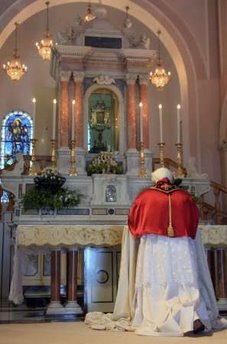
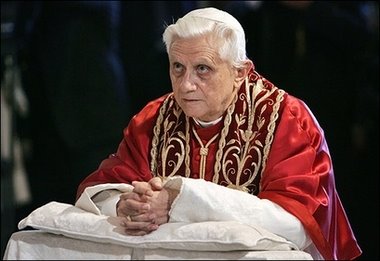
On Friday, September, 1, 2006, Pope Benedict XVI became the first Pope in history to visit the sacred shroud of St. Veronica, who wiped the face of Jesus while He was carrying His Cross to Golgatha. In this part of His Most Sacred Passion, St. Veronica, seeing Jesus' face dripping with sweat and blood, took a cloth and wiped His precious face. And, Our Lord left His Sacred imprint impressed upon the cloth.

That cloth supposedly remains to today, and it was venerated by Pope Benedict XVI last Friday. The Sacred Image is known as the "Sacred Visage". Critics claim that the image does not exist, but the fact that this image has lasted since at least the 12th Century, is quite remarkable. It has been in Manoppello since 1506. The cloth measures 17 by 24 cm and bears a great resemblance to the Shroud of Turin, believed to be Christ's burial cloth.

Pope Benedict XVI arrived in the village of Manoppello, Italy, and he was greeted by a few thousand pilgrims. The Holy Father prayed before the altar for about five minutes before going behind it to pray before the Sacred Image. Pope Benedict XVI said, “This is the reason for my visit. So that together we can try to better know the face of our Lord, so that from it we can find strength in love and peace that can show us the path.”

Photos:

Source: REUTERS/Giuseppe Cacace/Pool (ITALY)

Source: REUTERS/Giuseppe Cacace/Pool (ITALY)

Source: AFP/POOL/Max Rossi
Read more >>
Updated: Check out Te Deum

Read more >>


Copyright Notice: Unless otherwise stated, all items are copyrighted under a Attribution-NonCommercial-NoDerivatives 4.0 International License. If you quote from this blog, cite a link to the post on this blog in your article.

Disclosure of Material Connection: Some of the links on this blog are “affiliate links.” This means if you click on the link and purchase the item, I will receive an affiliate commission. As an Amazon Associate, for instance, I earn a small commission from qualifying purchases made by those who click on the Amazon affiliate links included on this website. I am disclosing this in accordance with the Federal Trade Commission’s 16 CFR, Part 255: “Guides Concerning the Use of Endorsements and Testimonials in Advertising.”