Wednesday, September 13, 2006
The Value of the Rosary by Fr. Gabriel Amorth


The Hail Mary - The Value of the Rosary

Father Gabriel Amorth, chief exorcist of the Vatican writes:

One day a colleague of mine heard the devil say during an exorcism: "Every Hail Mary is like a blow on my head. If Christians knew how powerful the Rosary was, it would be my end." The secret that makes this prayer so effective is that the Rosary is both prayer and meditation. It is addressed to the Father, to the Blessed Virgin, and to the Holy Trinity, and is a meditation centered on Christ.
I write in addition to the above: Please enunciate each word of the Rosary clearly and distinctly. Do not trample on the heels' of the words of anyone with your words. Do not speak over the leader, if you are following, or the responders if you are leading the Rosary. Remember that they also are having a conversation with Mary Our Mother and it is not polite to speak when someone else is speaking.

In the case of the public Rosary there are only two people speaking, the Leader and the Responders. Each are speaking to their Mother and listening carefully to her response within their hearts as they meditate on the scene before them in their consideration of the mystery being spoken of and interpreted and translated into their lives. Spread this powerful prayer of exorcism, The Rosary which contains the Our Father, the Perfect Prayer, prayed five times in the recitation of each set of the Rosary's Mysteries, backed up by the powerful prayers of Our Mother who prays with us as we pray 53 Hail Marys. The Eternal Father described to a group of us, through a Visionary Friend of mine, what happens when we pray the Rosary, saying, "When you pray Holy Mary Mother of God, pray for us sinners now....., the Blessed Mother comes instantly to your side to pray with you. And she does not come alone. She brings angels with her. And not just one or two for she is the Queen of Angels, so choirs of angels come with her. And she and Jesus are joined at the heart and cannot be separated so shebrings Jesus with her. And Jesus cannot be separated from the Trinity so He brings the Father and the Holy Spirit with Him.

And where the Holy Trinity is all of creation is and you are surrounded by such beauty and light as you cannot imagine in this life. Your Mother comes as Our Lady of Grace with her hands out-stretched. Rays of light emit from her hands piercing your body, healing you and filling you with graces.

This is your inheritance which was poured out from the heart of Jesus on the Cross, when the centurion pierced His Heart with the spear, into the only pure vessel ready to receive such graces at that time,Your Mother.

Now as you pray the Rosary, or even just recite one Hail Mary, you receive your portion of these graces."He also said at this time, "Anyone who goes to Mary and prays the Rosary cannot be touched by Satan." Is it any wonder that anyone who prays the Rosary from the heart is so blessed and protected and powerful in their prayers for others?"
Read more >>
Ember Days

Ember Days are set aside to pray and/or offer thanksgiving for a good harvest and God's blessings. If you are in good health, please at least fast during these three days and pray the additional prayers. Remember the words from the Gospel: "Unless you do penance, you shall likewise perish" (Luke 13:5)

From New Advent:

Ember days (corruption from Lat. Quatuor Tempora, four times) are the days at the beginning of the seasons ordered by the Church as days of fast and abstinence. They were definitely arranged and prescribed for the entire Church by Pope Gregory VII (1073-1085) for the Wednesday, Friday, and Saturday after 13 December (S. Lucia), after Ash Wednesday, after Whitsunday, and after 14 September (Exaltation of the Cross). The purpose of their introduction, besides the general one intended by all prayer and fasting, was to thank God for the gifts of nature, to teach men to make use of them in moderation, and to assist the needy. The immediate occasion was the practice of the heathens of Rome. The Romans were originally given to agriculture, and their native gods belonged to the same class.

At the beginning of the time for seeding and harvesting religious ceremonies were performed to implore the help of their deities: in June for a bountiful harvest, in September for a rich vintage, and in December for the seeding; hence their feriae sementivae, feriae messis, and feri vindimiales. The Church, when converting heathen nations, has always tried to sanctify any practices which could be utilized for a good purpose. At first the Church in Rome had fasts in June, September, and December; the exact days were not fixed but were announced by the priests. The "Liber Pontificalis" ascribes to Pope Callistus (217-222) a law ordering: the fast, but probably it is older. Leo the Great (440-461) considers it an Apostolic institution. When the fourth season was added cannot be ascertained, but Gelasius (492-496) speaks of all four. This pope also permitted the conferring of priesthood and deaconship on the Saturdays of ember week--these were formerly given only at Easter.

Before Gelasius the ember days were known only in Rome, but after his time their observance spread. They were brought into England by St. Augustine; into Gaul and Germany by the Carlovingians. Spain adopted them with the Roman Liturgy in the eleventh century. They were introduced by St. Charles Borromeo into Milan. The Eastern Church does not know them. The present Roman Missal, in the formulary for the Ember days, retains in part the old practice of lessons from Scripture in addition to the ordinary two: for the Wednesdays three, for the Saturdays six, and seven for the Saturday in December. Some of these lessons contain promises of a bountiful harvest for those that serve God.

From Catholic Culture:

Since man is both a spiritual and physical being, the Church provides for the needs of man in his everyday life. The Church's liturgy and feasts in many areas reflect the four seasons of the year (spring, summer, fall and winter). The months of August, September, October and November are part of the harvest season, and as Christians we recall God's constant protection over his people and give thanksgiving for the year's harvest.

The September Ember Days were particularly focused on the end of the harvest season and thanksgiving to God for the season. Ember Days were three days (Wednesday, Friday and Saturday) set aside by the Church for prayer, fasting and almsgiving at the beginning of each of the four seasons of the year. The ember days fell after December 13, the feast of St. Lucy (winter), after the First Sunday of Lent (spring), after Pentecost Sunday (summer), and after September 14 , the feast of the Exaltation of the Holy Cross (fall). These weeks are known as the quattor tempora, the "four seasons."

Since the late 5th century, the Ember Days were also the preferred dates for ordination of priests. So during these times the Church had a threefold focus: (1) sanctifying each new season by turning to God through prayer, fasting and almsgiving; (2) giving thanks to God for the various harvests of each season; and (3) praying for the newly ordained and for future vocations to the priesthood and religious life.
Read more >>
St. John Chrysostom


Double (1954 Calendar): January 27
Memorial (1969 Calendar): September 13

St. John Chrysostom (c. 347 - 407), called the Greatest of the Greek Fathers and the Golden-Mouth Saint, is not only venerated in Roman Catholicism but also in the Orthodox churches.

In c. 347 AD, St. John Chrysostom was born in Antioch. St. John's father died soon after John's birth, so St. John was raised by his pious mother, Anthusa. St. John became a monk as well as a priest and a preacher for a dozen years in Syria. He developed a stomach ailment there that remained with him for the rest of his life. At first, though, as a monk, he lived as a hermit studying under Hesychius.

It was because of his sermons that he earned the title "Chrysostom" meaning "golden mouth". St. John was made bishop of Constantinople in 398 AD. As bishop, he criticized the rich for not sharing their wealth, fought to reform the clergy, prevented the sale of ecclesiastical offices, called for fidelity in marriage, and encouraged practices of justice and charity. Because of his work to force the rich to help the poor, he was exiled from his diocese twice. He was banished to Pythius and died on the way in 407 AD. As he was traveling to Pythius, exhausted and dying, his final words were "Glory to God for all things."

He is a Doctor of the Church. The body of St. John Chrysostom is in St. Peter's Basilica in Rome. He is also the patron saint of Constantinople, epilepsy, orators, and preachers.

His Writings To Read Today:
Prayer:

O God, Who didst give blessed John to Thy people as a minister of eternal salvation: grant, we bessech Thee, that we, who have had him for our teacher on earth, may deserve to have him for our advocate in heaven. Through our Lord.

Prayer Source: 1962 Roman Catholic Daily Missal
Read more >>
Tuesday, September 12, 2006
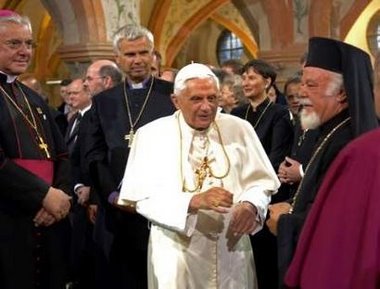
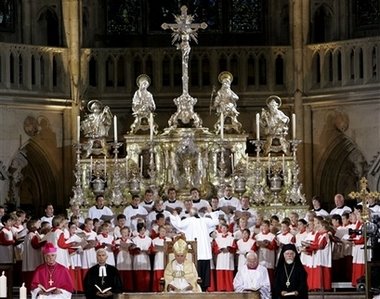
Pope Benedict XVI at Ecumenical Vespers Service

Image Source: REUTERS/KNA-Bild/Wolfgang Radtke/Pool

Today, the Holy Father, Pope Benedict XVI, ended another day in Germany by attending an ecumenical Vespers service. I hope and pray that there will one day be reunion with protestants and the Orthodox Community. However, I do not EVER want us to have to abandon the smallest of our beliefs to achieve such a thing. The others, I pray, will simply just return to the truth faith and stop believing in heretical ideas. All of us have common ground in our beliefs, but some groups like protestants also believe in heretical ideas like sola-scriptura, sola-fide, consubstantiation, etc.
From Catholic News Agency:

At the conclusion of his fourth day in Bavaria, Pope Benedict XVI prayed with members of Germany’s Orthodox and Protestant community. Leading a Vesper service at Regensburg’s Cathedral, the Pontiff told those gathered that they must not loose track of what is central to their dialogue - their common belief in Christ - and that they should bear witness to their common faith “in such a way that it shines forth as the power of love.”

The liturgy, which was punctuated by German hymns, common to all traditions, also included traditional Orthodox chant and a response from leaders of all three Christian groups.

Pope Benedict began his reflection by welcoming the religious leaders and noting that at the heart of the liturgy is the praying of the Psalms, which connects the Christian church with Jewish believers as well.

Benedict next noted the ongoing dialogue between the Catholic and Orthodox Churches, especially the conversations which are taking place in Germany itself. “I hope and pray that these discussions will be fruitful and that the communion with the living God which unites us, like our own communion in the faith transmitted by the Apostles, will grow in depth and maturity towards that full unity.”

“’So that the world may believe,’” the Pope emphasized, “we must become one: the seriousness of this commitment must spur on our dialogue.”

The Pope then turned to welcome “the various traditions stemming from the Reformation.” While he noted the particular work being done in the attempt to reach a consensus on justification, the Pope also pointed to a problem arising in society at large. “Our modern consciousness, in general, is no longer aware of the fact that we stand as debtors before God and that sin is a reality which can be overcome only by God’s initiative. Behind this weakening of the theme of justification and of the forgiveness of sins is ultimately a weakening of our relation with God. In this sense, our first task will perhaps be to rediscover in a new way the living God present in our lives.”

Turning to the liturgy’s reading from the Gospel of St. John, the Pope noted that what ultimately sets Christians apart is the belief that “Jesus is the Son of God who has come in the flesh.” This, he said, must be the starting point of any dialogue. “In this common confession, and in this common task, there is no division between us. And we pray that this shared foundation will grow ever stronger.”

From this starting point, Benedict continued, we must become witnesses. And not just empty witnesses, but witnesses in love. As the reading points out, he concluded, “’We know and believe the love God has for us’. Yes, man can believe in love. Let us bear witness to our faith in such a way that it shines forth as the power of love, ‘so that the world may believe (Jn 17:21).’”
Image Source: AP Photo/Thomas Kienzle

Read more >>
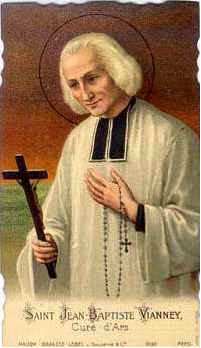
"On the Last Judgment" by St. John Vianney

Our catechism tells us, my children, that all men will undergo a particular judgment on the day of their death. No sooner shall we have breathed our last sigh than our soul, without leaving the place where it has expired, will be presented before the tribunal of God. Wherever we may die, God is there to exercise His justice. The good God, my children, has measured out our years, and of those years that He has resolved to leave us on this earth, He has marked out one which shall be our last; one day which we shall not see succeeded by other days; one hour after which there will be for us no more time. What distance is there between that moment and this -the space of an instant. Life, my children, is a smoke, a light vapour; it disappears more quickly than a bird that darts through the air, or a ship that sails on the sea, and leaves no trace of its course!
When shall we die? Alas! will it be in a year, in a month? Perhaps tomorrow, perhaps today!

May not that happen to us which happens to so many others? It may be that at a moment when you are thinking of nothing but amusing yourself, you may be summoned to the judgment of God, like the impious Baltassar. What will then be the astonishment of that soul entering on its eternity? Surprised, bewildered, separated thenceforth from its relations and friends, and, as it were, surrounded with Divine light, it will find in its Creator no longer a merciful Father, but an inflexible Judge. Imagine to yourselves, my children, a soul at its departure from this life. It is going to appear before the tribunal of its Judge, alone with God; there is Heaven on one side, Hell on the other. What object presents itself before it? The picture of its whole life! All its thoughts, all its words, all its actions, are examined.

This examination will be terrible, my children, because nothing is hidden from God. His infinite wisdom knows our most inmost thoughts; it penetrates to the bottom of our hearts, and lays open their innermost folds. In vain sinners avoid the light of day that they may sin more freely; they spare themselves a little sham in the eyes of men, but it will be of no advantage to them at the day of judgment; God will make light the darkness under cover of which they thought to sin with impunity. The Holy Ghost, my children, says that we shall be examined on our words, our thoughts, our actions; we shall be examined even on the good we ought to have done, and have not done, on the sins of others of which we have been the cause. Alas! so many thoughts to which we abandon ourselves -- to which the mind gives itself up; how many in one day! in a week! in a month! in a year! How many in the whole course of our life! Not one of this infinite number will escape the knowledge of our Judge.

The proud man must give an account of all his thoughts of presumption, of vanity, of ambition; the impure of all his evil thoughts, and of the criminal desires with which he has fed his imagination. Those young people who are incessantly occupied with their dress, who are seeking to please, to distinguish themselves, to attract attention and praise, and who dare not make themselves known in the tribunal of Penance, will they be able still to hide themselves at the day of the judgment of God? No, no! They will appear there such as they have been during their life, before Him who makes known all that is most secret in the heart of man.

We shall give an account, my children, of our oaths, of our imprecations, of our curses. God hears our slanders, our calumnies, our free conversations, our worldly and licentious songs; He hears also the discourse of the impious. This is not all, my children; God will also examine our actions. He will bring to light all our unfaithfulness in His service, our forgetfulness of His Commandments, our transgression of His law, the profanation of His churches, the attachment to the world, the ill-regulated love of pleasure and of the perishable goods of earth. All, my children, will be unveiled; those thefts, that injustice, that usury, that intemperance, that anger, those disputes, that tyranny, that revenge, those criminal liberties, those abominations that cannot be named without blushes...

Read more on St. John Vianney
Read more >>
Prayer for Faith in God's Truths


MERCIFUL Lord, hear my prayer.
May I who have received Your gift of faith
share forever in the new life of Christ.
May the continuing work of our Redeemer
bring me eternal joy.
You have freed us from the darkness
of error and sin.
Help me to believe in Your truths faithfully.
Grant that everything I do
be led by the knowledge of Your truth.
May the Eucharist give me Your grace
and bring me to a new life in You.
Read more >>
Words of Inspiration: September 12, 2006

St. Padre Pio:

"Be cheerful. Jesus will take care of everything. Let us pay no attention to people who do not know what they are saying. Let us trust in Jesus and our heavenly Mother; and everything will work out well."
Read more >>
Monday, September 11, 2006
Pope Benedict XVI visits Altotting and Markt am Inn

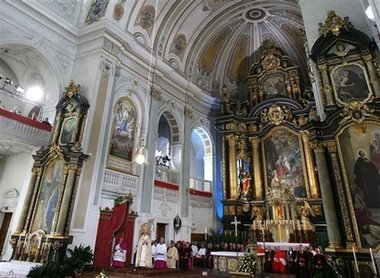
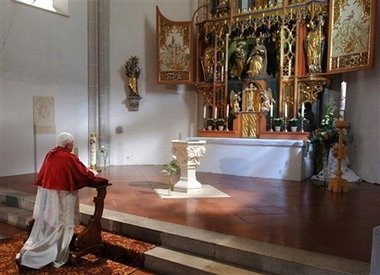
Visits Church of St. Oswald. Source: AP Photo/Giancarlo Giuliani, Pool

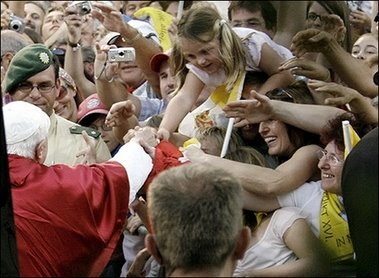
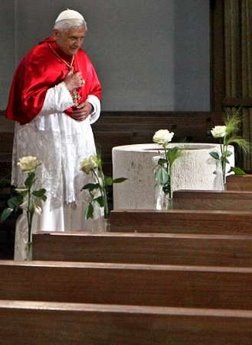
Today the Holy Father, Pope Benedict XVI, continued his journey through his native homeland of Bavaria, Germany. He visited the town of Altotting and his birthplace of Marktl am Inn along with the parish church of St. Oswald. In Altotting, the Holy Father celebrated Mass with approximately 70,000 pilgrims. He also took part in Marian vespers with religious and seminarians of Bavaria in the Basilica of St. Ann.

Here is part of his homily from the Marian Vespers:
To be with Christ -- how does this come about? Well, the first and most important thing for the priest is his daily Mass, always celebrated with deep interior participation. If we celebrate Mass truly as men of prayer, if we unite our words and our activities to the Word that precedes us and let them be shaped by the Eucharistic celebration, if in Communion we let ourselves truly be embraced by him and receive him -- then we are being with him.

The Liturgy of the Hours is another fundamental way of being with Christ: Here we pray as people conscious of our need to speak with God, while lifting up all those others who have neither the time nor the ability to pray in this way.

If our Eucharistic celebration and the Liturgy of the Hours are to remain meaningful, we need to devote ourselves constantly anew to the spiritual reading of sacred Scripture; not only to be able to decipher and explain words from the distant past, but to discover the word that the Lord is speaking to me, personally, here and now. Only in this way will we be capable of bringing the inspired Word to others as a contemporary and living Word of God.

Eucharistic adoration is an essential way of being with the Lord. Thanks to Bishop Schraml, Altoetting now has a new treasury. Where once the treasures of the past were kept, precious historical and religious items, there is now a place for the Church's true treasure: the permanent presence of the Lord in the Blessed Sacrament.

In one of his parables the Lord speaks of a treasure hidden in the field; the man who finds it sells all he has in order to buy that field, because the hidden treasure is more valuable than anything else. The hidden treasure, the good greater than any other good, is the Kingdom of God -- it is Jesus himself, the Kingdom in person.

Read more

Here is his complete homily from Mass in Altotting:
Dear Brothers and Sisters!

In today's First Reading, Responsorial Psalm and Gospel, three times and in three different ways, we see Mary, the Mother of the Lord, as a woman of prayer. In the Book of Acts we find her in the midst of the community of the apostles gathered in the Upper Room, praying that the Lord, now ascended to the Father, will fulfill his promise: Within a few days you will be baptized with the Holy Spirit (1:5).

Mary leads the nascent Church in prayer; she is, as it were in person, the Church at prayer. And thus, along with the great community of the saints and at their center, she stands even today before God interceding for us, asking her Son to send his Spirit once more upon the Church and to renew the face of the earth.

Our response to this reading is to sing with Mary the great hymn of praise which she raises after Elizabeth calls her blessed because of her faith. It is a prayer of thanksgiving, of joy in God, of blessing for his mighty works. The tenor of this hymn is clear from its very first words: My soul magnifies -- makes great -- the Lord. Making the Lord great means giving him a place in the world, in our lives, and letting him enter into our time and our activity: Ultimately this is the essence of true prayer. Where God is made great, men and women are not made small: There too men and women become great and the world is filled with light.

In the Gospel passage, Mary makes a request of her Son on behalf of some friends in need. At first sight, this could appear to be an entirely human conversation between a Mother and her Son and it is indeed a dialogue rich in humanity. Yet Mary does not speak to Jesus as if he were a mere man on whose ability and helpfulness she can count. She entrusts a human need to his power -- to a power which is more than skill and human ability.

In this dialogue with Jesus, we actually see her as a Mother who asks, one who intercedes. As we listen to this Gospel passage, it is worth going a little deeper, not only to understand Jesus and Mary better, but also to learn from Mary the right way to pray. Mary does not really ask something of Jesus: She simply says to him: They have no wine (John 2:3).

Weddings in the Holy Land were celebrated for a whole week; the entire town took part, and consequently much wine was consumed. Now the wedding couple find themselves in trouble, and Mary simply says this to Jesus. She doesn't tell Jesus what to do. She doesn't ask for anything in particular, and she certainly doesn't ask him to perform a miracle to make wine. She simply hands the matter over to Jesus and leaves him to decide what to do.

In the straightforward words of the Mother of Jesus, then, we can see two things: on the one hand her affectionate concern for people, that maternal affection which makes her aware of the problems of others. We see her heartfelt goodness and her willingness to help. This is the Mother that generations of people have come here to Altoetting to visit. To her we entrust our cares, our needs and our troubles. Her maternal readiness to help, in which we trust, appears here for the first time in the holy Scriptures.

But in addition to this first aspect, with which we are all familiar, there is another, which we could easily overlook: Mary leaves everything to the Lord's judgment. At Nazareth she gave over her will, immersing it in the will of God: Here am I, the servant of the Lord; let it be with me according to your word (Luke 1:38). And this continues to be her fundamental attitude.

This is how she teaches us to pray: not by seeking to affirm our own will and our own desires before God, but by letting him decide what he wants to do. From Mary we learn graciousness and readiness to help, but we also learn humility and generosity in accepting God's will, in the confident conviction that whatever he says in response will be best for us.

If all this helps us to understand Mary's attitude and her words, we still find it hard to understand Jesus' answer. In the first place, we don't like the way he addresses her: Woman. Why doesn't he say: Mother? But this title really expresses Mary's place in salvation history. It points to the future, to the hour of the crucifixion, when Jesus will say to her: Woman, behold your son -- Son, behold your mother (cf. John 19:26-27). It anticipates the hour when he will make the woman, his Mother, the Mother of all his disciples.

On the other hand, the title Woman recalls the account of the creation of Eve: Adam, surrounded by creation in all its magnificence, experiences loneliness as a human being. Then Eve is created, and in her Adam finds the companion whom he longed for; and he gives her the name woman. In the Gospel of John, then, Mary represents the new, the definitive woman, the companion of the Redeemer, our Mother: The name, which seemed so lacking in affection, actually expresses the grandeur of Mary's mission.

Yet we like even less the other part of Jesus' answer to Mary at Cana: Woman, what have I to do with you? My hour has not yet come (John 2:4). We want to object: You have a lot to do with her! It was Mary who gave you flesh and blood, who gave you your body, and not only your body: With the yes which rose from the depths of her heart she bore you in her womb and with a mother's love she gave you life and introduced you to the community of the people of Israel.

If this is our response to Jesus, then we are already well along the way toward understanding his answer. Because all this should remind us that in holy Scripture we find a parallelism between Mary's dialogue with the Archangel Gabriel, where she says: Let it be with me according to your word (Luke 1:38), and the passage of the Letter to the Hebrews which cites the words of Psalm 40 about the dialogue between Father and Son -- the dialogue which results in the Incarnation. The Eternal Son says to the Father: Sacrifices and offerings you have not desired, but a body you have prepared for me. ... See, I have come to do your will, O God (Hebrews 10:5-7; cf. Psalm 40:6-8).

The yes of the Son: I have come to do your will, and the yes of Mary: Let it be with me according to your word -- this double yes becomes a single yes, and thus the Word becomes flesh in Mary. In this double yes the obedience of the Son is embodied, and Mary gives him that body. Woman, what have I to do with you? Ultimately, what each has to do with the other is found in this double yes which resulted in the Incarnation.

It is to this point of profound unity that the Lord is referring. Here, in this common yes to the will of the Father, an answer is found. We too need to progress toward this point; and there we will find the answer to our questions.

If we take this as our starting point, we can also understand the second part of Jesus' answer: My hour has not yet come. Jesus never acts completely alone, and never for the sake of pleasing others. The Father is always the starting point of his actions, and this is what unites him to Mary, because she wished to make her request in this same unity of will with the Father.

And so, surprisingly, after hearing Jesus' answer, which apparently refuses her request, she can simply say to the servants: Do whatever he tells you (John 2:5). Jesus is not a wonder-worker, he does not play games with his power in what is, after all, a private affair. He gives a sign, in which he proclaims his hour, the hour of the wedding feast, the hour of union between God and man.

He does not merely make wine, but transforms the human wedding feast into an image of the divine wedding feast, to which the Father invites us through the Son and in which he gives us every good thing. The wedding feast becomes an image of the Cross, where God showed his love to the end, giving himself in his Son in flesh and blood -- in the Son who instituted the sacrament in which he gives himself to us for all time. Thus a human problem is solved in a way that is truly divine and the initial request is superabundantly granted. Jesus' hour has not yet arrived, but in the sign of the water changed into wine, in the sign of the festive gift, he even now anticipates that hour.

Jesus' definitive hour will be his return at the end of time. Yet he continually anticipates this hour in the Eucharist, in which, even now, he always comes to us. And he does this ever anew through the intercession of his Mother, through the intercession of the Church, which cries out to him in the Eucharistic prayers: Come, Lord Jesus!

In the Canon of the Mass, the Church constantly prays for this hour to be anticipated, asking that he may come even now and be given to us. And so we want to let ourselves be guided by Mary, by the Mother of Graces of Altoetting, by the Mother of all the faithful, toward the hour of Jesus.

Let us ask him for the gift of a deeper knowledge and understanding of him. And may our reception of him not be reduced to the moment of communion alone. Jesus remains present in the sacred Host and he awaits us constantly. Here in Altoetting, the adoration of the Lord in the Eucharist has found a new location in the old treasury. Mary and Jesus go together.

Through Mary we want to continue our converse with the Lord and to learn how to receive him better. Holy Mother of God, pray for us, just as at Cana you prayed for the bride and the bridegroom! Guide us toward Jesus -- ever anew! Amen!

[Translation of German original issued by the Holy See; adapted]

© Copyright 2006 -- Libreria Editrice Vaticana
Photos:
Georg Ratzinger is present; Source: AP Photo/Michaela Rehle, Pool

Celebrates Mass in the Basilica in Altotting; Source: AP Photo/Michaela Rehle, pool
Celebrates Mass in Altotting; Source: AP Photo/Maurizio Brambatti, Pool

Nuns pray at Mass in Altotting; Source: REUTERS/Michaela Rehle (GERMANY)

Greeted in Marktl am Inn; Source: AFP/Joe Klamar

Prays in Church of St. Oswald; Source: AP Photo/Giancarlo Giuliani, Pool

Stands before the font he was baptized from in the Church of St. Oswald;

Source: REUTERS/Andreas Gebert /POOL (GERMANY)
Read more >>
Words of Inspiration: September 11, 2006


Image: The body of St. John Bosco is still incorruptible to this day.

"If you are humble, nothing will touch you, neither praise nor disgrace,
because you know what you are.
If you are blamed, you won´t be discouraged;
if anyone calls you a saint, you won´t put yourself on a pedestal.
If you are a saint, thank God;
if you are a sinner, don´t remain one.
Christ tells us to aim very high,
not to be like Abraham or David or any of the Saints,
but to be like our Heavenly Father."
Read more >>
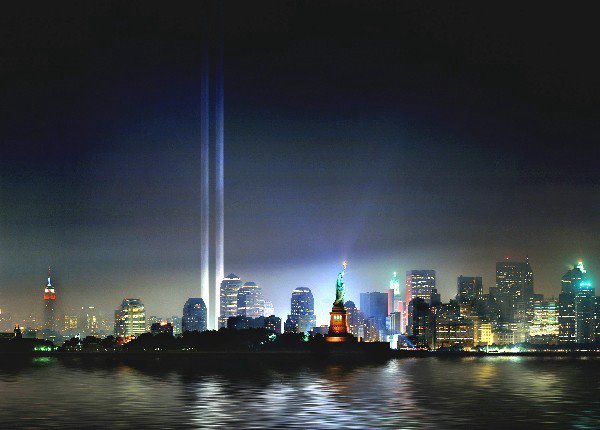
Where were you on 9/11/01?


Let us never forget September 11th, 2001, and the great people who died on that day. May God Bless America and may America bless God.

(Photo Source)

Where were you on September 11, 2001?

I was at home sick that day. I woke up around 8 AM, sat on the end of my bed and turned on the television. Then I saw the Twin Towers burning on channel after channel. I ran into my famiy room and everyone else in my family was watching it on television in there already.

I went to the doctor that day and on the way I heard that the first tower fell. I remember going down the road and seeing one man place a large sign painted on wood in his yard asking for God's mercy. At the doctor's office, I clearly remember everyone huddled around the television. The nurses were watching it through the blinds of their office while talking on the phone. I was watching television when the second tower fell. I'll never forget it. I'll never forget thinking about all of those lives snuffed out. It's hard for me to think that it's already been five years. It's hard to think about that day. I remember the pain and confusion and fear the rest of the week.

I recently re-watched a documentary on that day filmed by two French brothers and narrated by Robert DeNiro. They actually have footage from inside the burning towers. The part where people actual were jumping out of the windows was the worst part.

I'll never forget that day...

Read more >>
Sunday, September 10, 2006
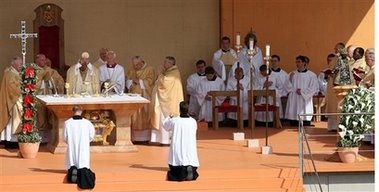
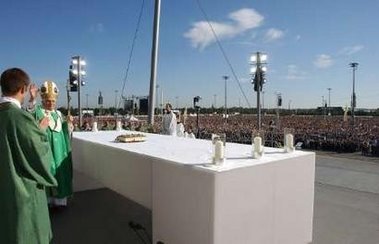
Pope Benedict XVI Celebrates Mass in Munich

Today Pope Benedict XVI celebrated an open-air Mass to 250,000 at Munich's fairgrounds Neue-Messe. He also prayed in the crypt of the cathedral Liebfrauenkirche in Munich today. Read more via BBC News.

Here is the Homily:

Dear Brothers and Sisters,

First, I would like to offer all of you an affectionate greeting. I am happy to be among you once again and to celebrate Holy Mass with you. I am also happy to revisit familiar places which had a decisive influence on my life, shaping my thoughts and feelings: places where I learned how to believe and how to live. This is a time to say thanks to all those -- living and deceased -- who guided and accompanied me along the way. I thank God for this beautiful country and for all the persons who have made it truly my homeland.

We have just listened to the three biblical readings which the Church's liturgy has chosen for this Sunday. All three develop a double theme which is ultimately one, bringing out -- as circumstances dictate -- one or another of its aspects. All three readings speak of God as the center of all reality and the center of our personal life.

"Here is your God!" exclaims the prophet Isaiah (35:4). In their own way, the Letter of James and the Gospel passage say the very same thing. They want to lead us to God, to set us on the right path. But to speak of "God" is also to speak of society: of our shared responsibility for the triumph of justice and love in the world. This is powerfully expressed in the second reading, in which James, a close relative of Jesus, speaks to us.

He is addressing a community beginning to be marked by pride, since it included affluent and distinguished persons, and consequently the risk of indifference to the rights of the poor. The words of James give us a glimpse of Jesus, of that God who became man. Though he was of Davidic, and thus royal, stock, he became a simple man in the midst of simple men and women. He did not sit on a throne, but died in the ultimate poverty of the cross.

Love of neighbor, which is primarily a commitment to justice, is the touchstone for faith and love of God. James calls it "the royal law" (cf. 2:8), echoing the words which Jesus used so often: the reign of God, God's kingship. This does not refer to just any kingdom, coming at any time; it means that God must become the force shaping our lives and actions.

This is what we ask for when we pray: "Thy Kingdom come!" We are not asking for something off in the distance, something we may not even want to experience. Rather, we pray that God's will may here and now determine our own will, and that in this way God can reign in the world. We pray that justice and love may become the decisive forces affecting our world. A prayer like this is surely addressed first to God, but it is also unsettling for us. Really, is this what we want? Is this the direction in which we want our lives to move?

For James, "the royal law," the law of God's kingship, is also "the law of freedom": If we follow God in all that we think and do, then we draw closer together, we gain freedom and thus true fraternity is born. When Isaiah, in the first reading, speaks about God, he goes on to speak about salvation for the suffering, and when James speaks of the social order as a necessary expression of our faith, he logically goes on to speak of God, whose children we are.

But now we must turn our attention to the Gospel, which speaks of Jesus' healing of a man born deaf and mute. Here too we encounter the two aspects of this one theme. Jesus is concerned for the suffering, for those pushed to the margins of society. He heals them and, by enabling them to live and work together, he brings them to equality and fraternity.

This obviously has something to say to all of us: Jesus points out the goal of all our activity. Yet the whole story has a deeper dimension, one which the fathers of the Church constantly brought out, one which particularly speaks to us today. The fathers were speaking to and about the men and women of their time. But their message also has new meaning for us modern men and women.

There is not only a physical deafness which largely cuts people off from social life; there is also a "hardness of hearing" where God is concerned, and this is something from which we particularly suffer in our own time. Put simply, we are no longer able to hear God -- there are too many different frequencies filling our ears. What is said about God strikes us as pre-scientific, no longer suited to our age.

Along with this hardness of hearing or outright deafness where God is concerned, we naturally lose our ability to speak with him and to him. And so we end up losing a decisive capacity for perception. We risk losing our inner senses. This weakening of our capacity for perception drastically and dangerously curtails the range of our relationship with reality. The horizon of our life is disturbingly foreshortened.

The Gospel tells us that Jesus put his fingers in the ears of the deaf-mute, touched the sick man's tongue with spittle and said "Ephphatha" -- "Be opened." The evangelist has preserved for us the original Aramaic word which Jesus spoke, and thus he brings us back to that very moment. What happened then was unique, but it does not belong to a distant past: Jesus continues to do the same thing anew, even today.

At our baptism he touched each of us and said "Ephphatha" -- "Be opened" -- thus enabling us to hear God's voice and to be able to talk to him. There is nothing magical about what takes place in the sacrament of baptism. Baptism opens up a path before us. It makes us part of the community of those who are able to hear and speak; it brings us into fellowship with Jesus himself, who alone has seen God and is thus able to speak of him (cf. John 1:18): Through faith, Jesus wants to share with us his seeing God, his hearing the Father and his conversation with him. The path upon which we set out at baptism is meant to be a process of increasing development, by which we grow in the life of communion with God, and acquire a different way of looking at man and creation.

The Gospel invites us to realize that we have a "deficit" in our capacity for perception -- initially, we do not notice this deficiency as such, since everything else seems so urgent and logical; since everything seems to proceed normally, even when we no longer have eyes and ears for God and we live without him. But it is true that everything goes on as usual when God no longer is a part of our lives and our world? Before raising any further questions, I would like to share some of my experience in meeting bishops from throughout the world.

The Catholic Church in Germany is outstanding for its social activities, for its readiness to help wherever help is needed. During their visits "ad limina," the bishops, most recently those of Africa, have always mentioned with gratitude the generosity of German Catholics and ask me to convey that gratitude. Just recently, the bishops of the Baltic countries told me about how German Catholics assisted them greatly in rebuilding their churches, which were badly in need of repair after decades of Communist rule.

Every now and then, however, some African bishop will say: "If I come to Germany and present social projects, suddenly every door opens. But if I come with a plan for evangelization, I meet with reservations." Clearly some people have the idea that social projects should be urgently undertaken, while anything dealing with God or even the Catholic faith is of limited and lesser importance.

Yet the experience of those bishops is that evangelization itself should be foremost, that the God of Jesus Christ must be known, believed in and loved, and that hearts must be converted if progress is to be made on social issues and reconciliation is to begin, and if -- for example -- AIDS is to be combated by realistically facing its deeper causes and the sick are to be given the loving care they need. Social issues and the Gospel are inseparable.

When we bring people only knowledge, ability, technical competence and tools, we bring them too little. All too quickly the mechanisms of violence take over: The capacity to destroy and to kill becomes the dominant way to gain power -- a power which at some point should bring law, but which will never be able to do so.

Reconciliation, and a shared commitment to justice and love, recede into the distance. The criteria by which technology is placed at the service of law and love are no longer clear: Yet it is precisely on these criteria that everything depends: Criteria which are not only theories, but which enlighten the heart and thus set reason and action on the right path.

People in Africa and Asia admire our scientific and technical prowess, but at the same time they are frightened by a form of rationality which totally excludes God from man's vision, as if this were the highest form of reason, and one to be imposed on their cultures too. They do not see the real threat to their identity in the Christian faith, but in the contempt for God and the cynicism that considers mockery of the sacred to be an exercise of freedom and that holds up utility as the supreme moral criterion for the future of scientific research.

Dear friends, this cynicism is not the kind of tolerance and cultural openness that the world's peoples are looking for and that all of us want! The tolerance which we urgently need includes the fear of God -- respect for what others hold sacred. This respect for what others hold sacred demands that we ourselves learn once more the fear of God. This sense of respect can be reborn in the Western world only if faith in God is reborn, if God becomes once more present to us and in us.

We impose this faith upon no one. Such proselytism is contrary to Christianity. Faith can develop only in freedom. But we do appeal to the freedom of men and women to be open to God, to seek him, to hear his voice. As we gather here, let us here ask the Lord with all our hearts to speak anew his "Ephphatha," to heal our hardness of hearing for God's presence, activity and word, and to give us sight and hearing. Let us ask his help in rediscovering prayer, to which he invites us in the liturgy and whose essential formula he has given us in the Our Father.

The world needs God. We need God. But what God? In the first reading, the prophet tells a people suffering oppression that: "He will come with vengeance" (Isaiah 35:4). We can easily suppose how the people imagined that vengeance. But the prophet himself goes on to reveal what it really is: the healing goodness of God. The definitive explanation of the prophet's word is to be found in the one who died on the cross: in Jesus, the Son of God incarnate. His "vengeance" is the cross: a "no" to violence and a "love to the end." This is the God we need.

We do not fail to show respect for other religions and cultures, profound respect for their faith, when we proclaim clearly and uncompromisingly the God who counters violence with his own suffering; who in the face of the power of evil exalts his mercy, in order that evil may be limited and overcome. To him we now lift up our prayer, that he may remain with us and help us to be credible witnesses to himself. Amen!

[Translation issued by the Holy See; adapted]

© Copyright 2006 -- Libreria Editrice Vaticana

Photos:


REUTERS/Artuto Mari O.R./Pool/COC


AP Photo/Wolfgang Radtke, Pool
Read more >>
9-year Old Meets Pope Benedict XVI

I just came across a very inspiring news article about a nine-year old boy that got his dream answered - he was able to meet the Pope on Christmas Eve last year. Read this inspiring story.
Read more >>
"Catechism on the Sanctification of Sunday" by St. John Vianney

You labor, you labor, my children; but what you earn ruins your body and your soul. If one ask those who work on Sunday, "What have you been doing?" they might answer, "I have been selling my soul to the devil, crucifying Our Lord, and renouncing my Baptism. I am going to Hell; I shall have to weep for all eternity in vain. " When I see people driving carts on Sunday, I think I see them carrying their souls to Hell.

Oh, how mistaken in his calculations is he who labours hard on Sunday, thinking that he will earn more money or do more work! Can two or three shillings ever make up for the harm he does himself by violating the law of the good God? You imagine that everything depends on your working; but there comes an illness, an accident. . . . so little is required! a tempest, a hailstorm, a frost. The good God holds everything in His hand; He can avenge Himself when He will, and as He will; the means are not wanting to Him. Is He not always the strongest? Must not He be the master in the end?

There was once a woman who came to her priest to ask leave to get in her hay on Sunday. "But, " said the priest, "it is not necessary; your hay will run no risk. " The woman insisted, saying, "Then you want me to let my crop be lost?" She herself died that very evening; she was more in danger than her crop of hay. "Labor not for the meat which perisheth, but for that which endureth unto life everlasting. " [Jn. 6:27].

What will remain to you of your Sunday work? You leave the earth just as it is; when you go away, you carry nothing with you. Ah! when we are attached to the earth, we are not willing to go! Our first end is to go to God; we are on the earth for no other purpose. My brethren, we should die on Sunday, and rise again on Monday.

Sunday is the property of our good God; it is His own day, the Lord's day. He made all the days of the week: He might have kept them all; He has given you six, and has reserved only the seventh for Himself. What right have you to meddle with what does not belong to you? You know very well that stolen goods never bring any profit. Nor will the day that you steal from Our Lord profit you either. I know two very certain ways of becoming poor: they are working on Sunday and taking other people's property.

Read more on St. John Vianney
Read more >>
Saturday, September 9, 2006
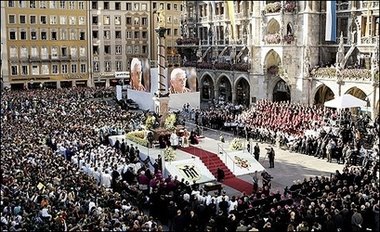
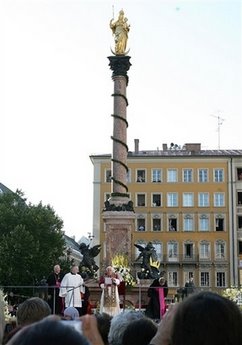
Pope Benedict XVI Visits the Column of Mary

His Most Supreme Holiness, Pope Benedict XVI, has visited the Column of the Virgin in Munich's Marienplatz. His native Bavaria is rich in traditional culture and Catholicism. It is very different from Germany as a whole. In 2004, 101,000 Germans left the Catholic Church and in 2003, 129,000 left the Church of Jesus Christ. How sad...all of these souls are leaving the truth.

Let us pray that the Holy Father's return will revive the Catholic faith in Germany as a whole. According to Yahoo News, only 14 percent of Germans attend Sunday Mass.

Today on September 9, 2006, the Holy Father visited the Column of the Madonna in Marienplatz in Bavaria. The Column of Mary was erected in 1638 in the center of Munich Square and has existed as a symbol of hope for centuries. The Catholic News Agency has a good article on the history of the Column of Mary.

Photos:

AFP/DDP/Joerg Koc

AP Photo: Bernd Weissbrod, Pool


AP Photo: Maurizio Brambatti, Pool
Read more >>
Pope Benedict XVI Arrives in Bavaria, Germany

Photo Source: REUTERS/Stephan Jansen/Pool (GERMANY)

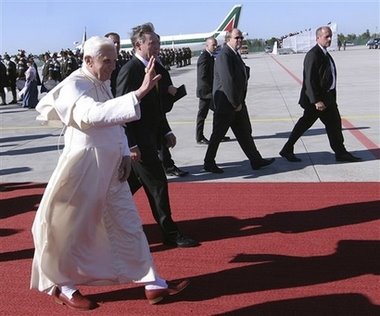
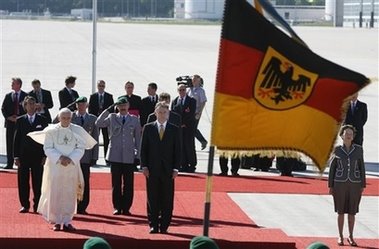
On Saturday, September 9, 2006, Pope Benedict XVI landed in Bavaria, Germany, his birthplace and where he spent most of his life. He is beginning a 6-day visit to his native country of Germany. This is his first return to Bavaria, Germany since before his election as Pope.

Among the many people that greeted him at the airport, he was greeted by German President Horst Köhler, Chancellor Angela Merkel, and Bavarian Minister-President Edmund Stoiber.

From Catholic News Agency:

The German president welcomed the Pope, speaking glowingly of the first years of his Pontificate. Köhler, who is Protestant, recalled the “moving experience” of last year’s World Youth Day, held in Cologne. The president remarked at the “powerful presence” of the Catholic Church in Germany and spoke hopefully of the ongoing process of ecumenical dialogue.

Following Köhler’s words of welcome, the Pope reflected briefly on the purpose of his trip. “Conscious of how much I have received,” Benedict said, “I have come here above all to express my deep gratitude towards all those who helped shape me as a person.”

But, the Pope continued, “I also come here as the Successor of the Apostle Peter, to reaffirm and strengthen the deep bonds linking the See of Rome and the Church in our native land.”

Benedict reminded everyone of the tremendous history of the Catholic faith in Germany and particularly in Bavaria. A history, he said, which has been constantly nourished by firm adherence to Christian values.

He also noted that the faith history of the country “is witnessed to by famous monuments, majestic cathedrals, statues and paintings of great artistic value, literary works, cultural initiatives and above all, the many individual and community events which reflect the Christian beliefs of successive generations in this Land which is so dear to me.”

The Pontiff insisted that although society has changed, it is important to continue passing on the faith to younger generations.

“I think we are all united in the hope that new generations will remain faithful to the spiritual patrimony which has withstood all the crises of history. My visit to the land of my birth is meant to be an encouragement in this regard: Bavaria is a part of Germany; sharing in the ups and downs of Germany’s history, and has good reason to be proud of the traditions inherited from the past. My hope is that all my compatriots in Bavaria and throughout Germany will play an active part in the transmission of the fundamental values of the Christian faith to the citizens of tomorrow.”

The Pope concluded his remarks expressing his desire to someday visit other parts of Germany and thanking all those who have worked to prepare for his visit. He offered a greeting to all Germans, noting that he was not only thinking of Catholics, but Lutherans, Orthodox Christians, and members of other Churches and Ecclesial Communities as well as “all people of good will.”

“May the Lord bless the efforts of all those concerned to build a future of true well-being for the good of the whole nation,” the Pope said, entrusting his intentions to the Blessed Virgin Mary through a traditional Bavarian prayer. “Preserve, O Virgin and Patroness, your Bavarian people, their goods, their government, their land and their religion!”

The Pope then departed for downtown Munich, where he will offer a special prayer at the Marian statue in the city’s central square.
Photos:

REUTERS/Bernd Weissbrod/Pool (GERMANY)


AP Photo/Markus Nowak, Pool

AP Photo/Markus Schreiber
Read more >>
"Catechism on the Real Presence" by St. John Vianney

Our Lord is hidden there, waiting for us to come and visit Him, and make our request to Him. See how good He is! He accommodates Himself to our weakness. In Heaven, where we shall be glorious and triumphant, we shall see him in all His glory. If He had presented Himself before us in that glory now, we should not have dared to approach Him; but He hides Himself, like a person in a prison, who might say to us, "You do not see me, but that is no matter; ask of me all you wish and I will grant it. " He is there in the Sacrament of His love, sighing and interceding incessantly with His Father for sinners. To what outrages does He not expose Himself, that He may remain in the midst of us! He is there to console us; and therefore we ought often to visit Him. How pleasing to Him is the short quarter of an hour that we steal from our occupations, from something of no use, to come and pray to Him, to visit Him, to console Him for all the outrages He receives! When He sees pure souls coming eagerly to Him, He smiles upon them. They come with that simplicity which pleases Him so much, to ask His pardon for all sinners, for the outrages of so many ungrateful men. What happiness do we not feel in the presence of God, when we find ourselves alone at His feet before the holy tabernacles! "Come, my soul, redouble thy fervour; thou art alone adoring thy God. His eyes rest upon thee alone. " This good Saviour is so full of love for us that He seeks us out everywhere.

Ah! if we had the eyes of angels with which to see Our Lord Jesus Christ, who is here present on this altar, and who is looking at us, how we should love Him! We should never more wish to part from Him. We should wish to remain always at His feet; it would be a foretaste of Heaven: all else would become insipid to us. But see, it is faith we want. We are poor blind people; we have a mist before our eyes. Faith alone can dispel this mist. Presently, my children, when I shall hold Our Lord in my hands, when the good God blesses you, ask Him then to open the eyes of your heart; say to Him like the blind man of Jericho, "O Lord, make me to see!" If you say to Him sincerely, "Make me to see!" you will certainly obtain what you desire, because He wishes nothing but your happiness. He has His hands full of graces, seeking to whom to distribute them; Alas! and no one will have them. . . . Oh, indifference! Oh, ingratitude! My children, we are most unhappy that we do not understand these things! We shall understand them well one day; but it will then be too late!

Our Lord is there as a Victim; and a prayer that is very pleasing to God is to ask the Blessed Virgin to offer to the Eternal Father her Divine Son, all bleeding, all torn, for the conversion of sinners; it is the best prayer we can make, since, indeed, all prayers are made in the name and through the merits of Jesus Christ. We must also thank God for all those indulgences that purify us from our sins. . . but we pay no attention to them. We tread upon indulgences, one might say, as we tread upon the sheaves of corn after the harvest. See, there are seven years and seven quarantines for hearing the catechism, three hundred days for reciting the Litany of the Blessed Virgin, the Salve Regina, the Angelus. In short, the good God multiplies His graces upon us; and how sorry we shall be at the end of our lives that we did not profit by them!

When we are before the Blessed Sacrament, instead of looking about, let us shut our eyes and our mouth; let us open our heart: our good God will open His; we shall go to Him, He will come to us, the one to ask, the other to receive; it will be like a breath from one to the other. What sweetness do we not find in forgetting ourselves in order to seek God! The saints lost sight of themselves that they might see nothing but God, and labor for Him alone; they forgot all created objects in order to find Him alone. This is the way to reach Heaven.

Read more on St. John Vianney
Read more >>
Words of Inspiration: September 9, 2006

Archbishop Fulton Sheen:

“What has happened to that double side of sympathy which is the basis of the Christian philosophy of life; ‘Rejoice with those who rejoice, and weep with those who weep?’ It has been said that the wounded deer sheds tears, but it belongs to man to weep with those who weep and by sympathy to divide another’s sorrows and double another’s joy.”

Blessed Mother Teresa:

"Surely if God feeds the young ravens which cry to Him, if He nourishes the birds which neither sow nor reap nor gather into barns, if He vests the flowers of the field so beautifully, how much more will He care for men whom He has made in His own image and likeness and adopted as His children, if we only act as such."

St. Padre Pio:

"This heart of mine is Yours… my Jesus, so take this heart of mine, fill it with Your love and then order me to do whatever You wish."

Read more >>
Pope Benedict XVI to Visit Bavaria

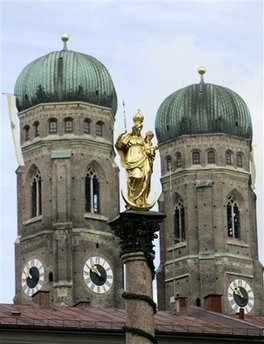
The white and gold flag of the Vatican is everyone in Bavaria, Germany, as Pope Benedict XVI starts a 6 day-trip to his native homeland in Bavaria, Germany. Even the Catedral of Our Lady in Munich (photo above) is decorated with the Vatican's flag. About 7.2 million Catholics live in the state of Bavaria - a quarter of all of the Catholics in Germany.

Very shortly Pope Benedict XVI will arrive in Germany. I hope to blog extensively on the trip. During the course of the Holy Father's trip, he will visit "Munich, the city of which he was archbishop from 1977 to 1982; the Altoetting Shrine, symbol of Bavarian Catholicism; Marktl am Inn, his birthplace; and Regensburg, where he was professor, where his brother lives, and where members of his family are buried" (Source: Zenit).

The Holy Father said the purpose of his visit is "... precisely because I want to see again the places where I grew up, the people who touched and shaped my life. I want to thank these people...Naturally I also want to express a message that goes beyond my country, just as my ministry calls me to do. The basic theme is that we have to rediscover God, not just any God, but the God that has a human face, because when we see Jesus Christ we see God."

The Holy Father's schedule (source):
September 9 & 10:
September 11:
September 12:
September 13:
September 14:
Read more >>
Friday, September 8, 2006
Hola, Amigos!

I'm still here!

And classes are extremely hard. While my history, philosophy, and calculus classes are going extremely well, I am not doing as well as I wanted in either English or my science course for this semester. Because of the huge amount of work this semester, I have not been able to post very much. Plus, with working part time, I have had even less time to post on my blog.

Anyway, thank you all for keep reading my blog. Just to let everyone know, I am still praying the Liturgy of the Hours daily, and I love it. I also will be starting the formal application process of applying to my diocese at the end of this month. Prayers for all of these things would be so graciously appreciated.
Read more >>
New Traditional Institute Created by the Vatican!


Today, the 8th of September, the Vatican created a religious institute of pontifical right (The Institute "Good Shepherd"), to accommodate 5 priests who had been expelled from the SSPX (such as Fr. Laguérie) and a few seminarians.

Of more general importance, is that, according to the piece, the Holy Father wishes to establish that the Traditional Missal is not a separate missal, but as a mere variation of the Roman Rite.

This is so exciting for me! I will definitely keep an eye on this since I am a so strongly connected to the Tridentine Rite. I love the Tridentine Latin Mass!
Read more >>


Copyright Notice: Unless otherwise stated, all items are copyrighted under a Attribution-NonCommercial-NoDerivatives 4.0 International License. If you quote from this blog, cite a link to the post on this blog in your article.

Disclosure of Material Connection: Some of the links on this blog are “affiliate links.” This means if you click on the link and purchase the item, I will receive an affiliate commission. As an Amazon Associate, for instance, I earn a small commission from qualifying purchases made by those who click on the Amazon affiliate links included on this website. I am disclosing this in accordance with the Federal Trade Commission’s 16 CFR, Part 255: “Guides Concerning the Use of Endorsements and Testimonials in Advertising.”