Thursday, September 21, 2006
Pray the Liturgy of the Hours in Latin!

Please consider the resources below to pray the Traditional (pre-Vatican II) Breviary in Latin.

Print Resources:
  1. Breviarium Romanum ex decreto ss. concilii tridentini restitutum By Pars Hiemalis
  2. Breviarium Romanum Ex Decreto SS Concilii Tridentini Restitutum S. PII V Pontificis Maximi (Jussu Editum Aliorumque Pontificum Cura Recognitum PII Papae X Auctoritate Reformatum Editio II Juxta Typicam Vaticanam Amplificata I, Pars Hiemalis)
  3. Learning the New Breviary by S. J. Bernard A Hausmann.  The title word "new" is rather misleading today, as it actually refers to the new code of rubrics promulgated in July 1960 for the traditional Roman Breviary. In this handy, concise and easy-to-read book, Fr. Hausmann leads the reader step by step through each of the 8 canonical hours, their contents, special particulars, and how they are said, all the while providing important tips on how to recite the Divine Office with a correct liturgical spirit. An indispensable book for any Catholic who would like to become better acquainted with the traditional Roman Breviary, the Church's liturgical treasure that in connection with the Holy Sacrifice of the Mass forms the Church's official daily prayer. 
  4. A Short Breviary for Religious and the Laity By Monks of St. John's Abbey
Electronic Resources:

  1. Breviary.net
  2. Divinum Officium (Latin for "Divine Office)
Read more >>
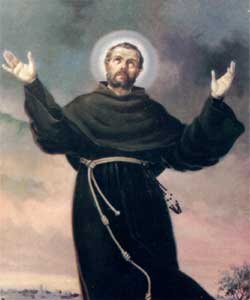
Words of Inspiration: September 21, 2006


"True obedience is a genuine act of love.
Obedience makes us practice the other virtues.
It likens us to martyrs,
for it is a much greater martyrdom to persevere
in obedience all through life
than to die in a moment by a stroke of the sword."
Read more >>
Wednesday, September 20, 2006
Prayer to St. Joseph of Cupertino for Success in Examinations

This powerful prayer is very effective in examinations. It has to be said before appearing in the examination. There are two variants to this prayer. Both the prayers are equally effective. You can choose any one of these:

First Prayer

O Great St. Joseph of Cupertino who while on earth did obtain from God the grace to be asked at your examination only the questions you knew, obtain for me a like favour in the examinations for which I am now preparing. In return I promise to make you known and cause you to be invoked.

Through Christ our Lord.

St. Joseph of Cupertino, Pray for us.

Amen.

Second Prayer

O St. Joseph of Cupertino who by your prayer obtained from God to be asked at your examination, the only preposition you knew. Grant that I may like you succeed in the (here mention the name of Examination eg. History paper I ) examination.

In return, I promise to make you known and cause you to be invoked.

O St. Joseph of Cupertino pray for me
O Holy Ghost enlighten me
Our Lady of Good Studies pray for me
Sacred Head of Jesus, Seat of divine wisdom, enlighten me.

Remember, when you succeed in the exams then you should thank St. Joseph of Cupertino. And if you would like a prayer card you can use and include in your books, find a great option here.
Read more >>
Blog Banner Ads: "I Support the Pope"


Smaller version:
Read more >>
The Miracle of St. Januarius Occurs!

From Catholic World News:
Sep. 19 (CWNews.com) - The familiar "miracle of St. Januarius"-- the liquefaction of the blood of the 4th-century martyr-- occurred once again in Naples on the saint's feast day, September 19.

Cardinal Crescenzio Sepe, newly installed as the Archbishop of Naples presided for the first time at the celebration of the city's patron saint, who died in the persecutions under Emperor Diocletian. A vial containing the preserved blood of the martyr was brought into the sanctuary. After the Gospel was read, the cardinal told the congregation that "the blood is starting to melt." The announcement drew warm applause.

According to a popular tradition, the liquefaction is a sign of assurance that the year will be free from disasters. (One of the rare years in which the miracle did not occur was 1939, the year that saw the beginning of World War II.)
Read more >>
Sunday, September 17, 2006
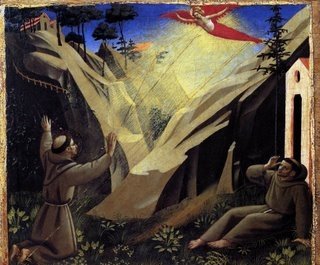
St. Francis Receiving the Stigmata


Double (1954 Calendar): September 17
Commemoration (1962 Calendar): September 17

Today, September 17th is the Commemoration of the Impression of the Sacred Stigmata which St. Francis, received on his hands, feet, and side at Mount Alverina in Etruria while in the midst of his St. Michael's Lenten fast.

St. Bonaventure in the Life of St. Francis writes the following account:
“On a certain morning about the Feast of the Exaltation of the Cross [September 14], while Francis was praying on the mountainside, he saw a Seraph with six fiery and shining wings descend from the height of heaven. And when in swift flight the Seraph had reached a spot in the air near the man of God, there appeared between the wings the figure of the a man crucified, with his hands and feet extended in the form of a cross and fastened to a cross. Two of the wings were lifted above his head, two were extended for flight and two covered his whole body"
Thomas of Celano, writing within a few years of St. Francis’ death in 1229 AD, also described what happened:
“....the marks of nails began to appear in his hands and feet, just as he had seen them slightly earlier in the crucified man above him. His wrists and feet seemed to be pierced by nails, with the heads of the nails appearing on his wrists and on the upper sides of his feet, the points appearing on the other side. The marks were round on the palm of each hand but elongated on the other side, and small pieces of flesh jutting out from the rest took on the appearance of the nail-ends, bent and driven back. In the same way the marks of nails were impressed on his feet and projected beyond the rest of the flesh. Moreover, his right side had a large wound as if it had been pierced with a spear, and it often bled so that his tunic and trousers were soaked with his sacred blood.”
Prayer:

O Lord Jesus Christ, Who, when the world was growing cold, in order to enkindle in our hearts the fire of Thy love, didst renew the sacred makers of Thy Passion on the body of blessed Francis: mercifully grant, that with the aid of his merits and prayers we may ever bear our cross, and bring forth worthy fruits of penance: Who livest and reignest.

Prayer Source: 1962 Roman Catholic Daily Missal
Read more >>
Prayers Needed for the Holy Father


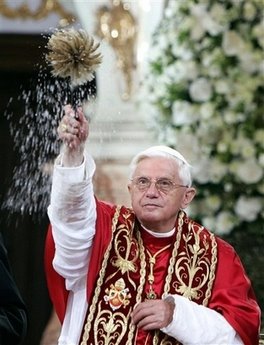
During Pope Benedict XVI's visit to Germany, he quoted a medival text that of Manuel II Paleologus, one of the last Christian emperors, who said - while Constantinople was under threat from Muslim forces - the teachings of the Prophet Muhammad were “evil and inhuman”. Manuel II also accused Muhammad of “spreading faith by the sword." As a result, huge demoninstrations against the Holy Father have begun. Seven churches, two this morning, in the West Bank and Gaza were burned and a nun was murdered at a children's hospital! Your prayers are desperately needed!

The Holy Father apologized for his comments causing such violence. Pray that no further death or destruction will come out of this. Pray that those who resorted to violence will repent.

The Holy Father said: “These words were in fact a quotation from a medieval text which do not in any way express my personal thought. I hope that this serves to placate souls and to clarify the true meaning of my address, which in its totality was and is an invitation to frank and sincere dialogue, with great mutual respect.”

Image Source: AFP/Daniele Colarieti
Read more >>
Prayer to Jesus Crucified


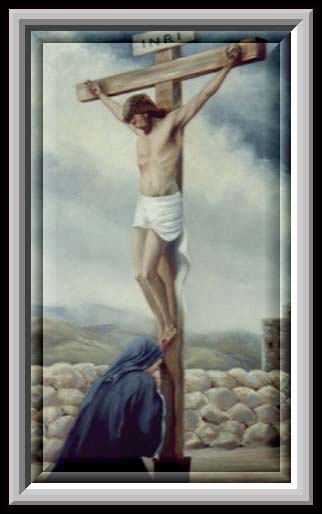
Behold, my beloved and good Jesus, I cast myself upon my knees in your sight, and with the most fervent desire of my soul I pray and beseech you to impress upon my heart lively sentiments of faith, hope and charity, with true repentance for my sins and a most firm desire of amendment; while with deep affection and grief of soul I consider within myself and mentally contemplate your five most precious wounds, having before my eyes that which David the prophet long ago spoke about you, my Jesus: "They have pierced my hands and my feet; I can count all my bones" (Ps 22:17-18).
Read more >>
Saturday, September 16, 2006
Updates on my Life

Classes are getting a little easier and I don't have so much work right now. Thanks for your prayers! Today is also my birthday so today and tomorrow I will be spending time relaxing and enjoying some time with family.

God Bless!
Read more >>
The Lingering Effects of Suffering


"Notice that the risen Jesus still bears his wounds. How can it be otherwise? In our own lives, times of suffering may lead to times of peace and joy, but we cannot escape the lingering effects of suffering. It permanently changes us -- we cannot pretend that it never happened. That the risen Jesus still bears his wounds is good news, for it tells us that there is a continuity between the lives we have now and the lives that we will enjoy in the Resurrection. Jesus is the same person. His wounds, though, are different: they are not a source of suffering but a source of recognition. It is only through seeing Jesus' wounds that Thomas recognizes him. In the Resurrection, we will still bear the effects of the hurts that have been done to us, but they will no longer cause us pain."
Read more >>
Friday, September 15, 2006
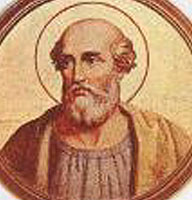
Pope St. Hyginus

Commemoration (1954 Calendar): January 11

Pope St. Hyginus was pope from c. 139 - 140 AD. He was born in Athens, Greece, and during his papacy, he determined the different prerogatives of the clergy and defined the grades of the ecclesiastical hierarchy. Hyginus also started the practice of including godparents at Baptism to assist the newly born during his Christian life. He also decreed that all churches be consecrated. It is rumored that he became a martyr under the persecutions of Marcus Aurelius. 


"The Church makes commemoration, today, of the holy Pope and Martyr Hyginus. He held the Apostolic Chair under the reign of Antoninus, and closed his four years’ Pontificate by martyrdom. We have no history of his life, but we venerate in him one of the links of that grand chain of Pontiffs which unites us, by St. Peter, to our Lord Jesus Christ. The whole weight of the government of the Church was upon his shoulders, and he was courageous and faithful in the discharge of his duties; his reign was during the age of Persecution, when to be Pope was to be a victim of tortures and death. As we have already said, he soon won his Palm, and was associated in heaven with the three Magi, who had, before leaving this world, preached the Gospel in Greece, the country of our Saint. Let us ask him to bless the offerings we are making to the Divine Infant of Bethlehem, and to pray for us, that we may obey this sweet King, who asks us to give him not our blood by martyrdom, but our hearts by charity."

Collect:

O Eternal Shepherd, who appointed blessed Hyginus shepherd of the whole Church, let the prayers of this martyr and supreme pontiff move You to look with favor upon Your flock and to keep it under Your continual protection. Through Our Lord . . .
Read more >>
Pope Benedict XVI's Final Day in Bavaria

Image Source: REUTERS/Maurizo Brambatti/Pool (Germany)

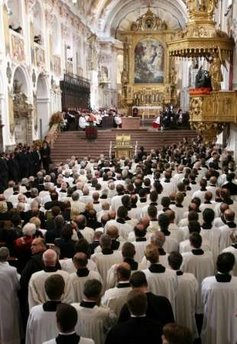
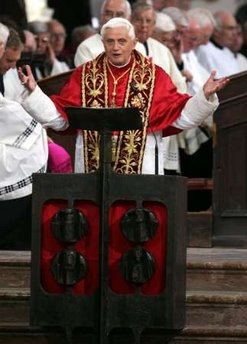
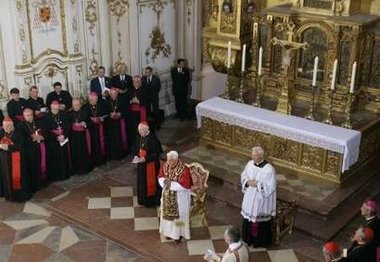
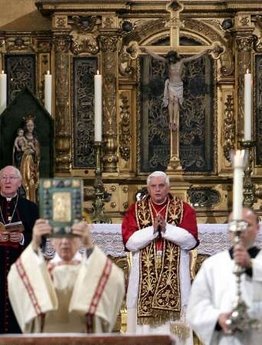
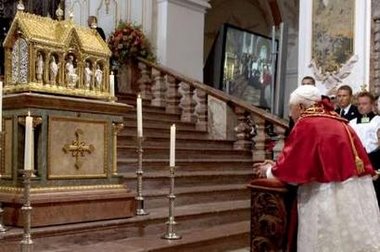
On Thursday, September 14, 2006, the Holy Father ended his journey to Bavaria in his homeland of Germany. During his final day in Bavaria, he visited priests and permanent deacons of Bavaria in the cathedral of Sts. Mary and Corbinian. During the visit, he prayed before the Shrine of the Holy Corbinian, the relics of St. Corbinian. Fifty-five years ago, Pope Benedict XVI was ordained in that cathedral.

Photos:


REUTERS/Maurizo Brambatti/Pool (Germany)


REUTERS/Alexandra Beier (GERMANY)

REUTERS/Maurizo Brambatti/Pool (Germany)

REUTERS/KNA-Bild/Wolfgang Radtke/Pool (GERMANY)
Read more >>
"Catechism on Communion" by St. John Vianney


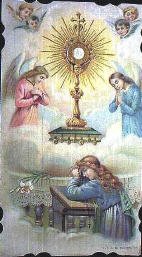
I hope all of my readers have enjoyed all of the posts on the writings of St. John Vianney. This is my final post on it - the 37th post. And I am very proud to end on his writting entitled "Catechism on Communion". After all, Jesus is truly and really present - body, blood, soul, and divinity - in the Holy Eucharist. We are to adore Him in the Eucharist. We are to receive Him, while in grace, in the Eucharist. And for those that deny such a beautiful gift spoken of in the Gospel of John Chapter 6 by Jesus Himself, pray for such doubters. The Eucharist is one of the two pillars of salvation.

Catechism on Communion:

To sustain the soul in the pilgrimage of life, God looked over creation, and found nothing that was worthy of it. He then turned to Himself, and resolved to give Himself. O my soul, how great thou art, since nothing less than God can satisfy thee! The food of the soul is the Body and Blood of God! Oh, admirable Food! If we considered it, it would make us lose ourselves in that abyss of love for all eternity! How happy are the pure souls that have the happiness of being united to Our Lord by Communion! They will shine like beautiful diamonds in Heaven, because God will be seen in them.

Our Lord has said, Whatever you shall ask the Father in My name, He will give it you. We should never have thought of asking of God His own Son. But God has done what man could not have imagined. What man cannot express nor conceive, and what he never would have dared to desire, God in His love has said, has conceived, and has executed. Should we ever have dared to ask of God to put His Son to death for us, to give us His Flesh to eat and His Blood to drink? If all this were not true, then man might have imagined things that God cannot do; he would have gone further than God in inventions of love! That is impossible. Without the Holy Eucharist there would be no happiness in this world; life would be insupportable. When we receive Holy Communion, we receive our joy and our happiness. The good God, wishing to give Himself to us in the Sacrament of His love, gave us a vast and great desire, which He alone can satisfy. In the presence of this beautiful Sacrament, we are like a person dying of thirst by the side of a river -- he would only need to bend his head; like a person still remaining poor, close to a great treasure -- he need only stretch out his hand. He who communicates loses himself in God like a drop of water in the ocean. They can no more be separated.

At the Day of Judgment we shall see the Flesh of Our Lord shine through the glorified body of those who have received Him worthily on earth, as we see gold shine in copper, or silver in lead. When we have just communicated, if we were asked, "What are you carrying away to your home?" we might answer, "I am carrying away Heaven. " A saint said that we were Christ-bearers. It is very true; but we have not enough faith. We do not comprehend our dignity. When we leave the holy banquet, we are as happy as the Wise Men would have been, if they could have carried away the Infant Jesus. Take a vessel full of liquor, and cork it well -- you will keep the liquor as long as you please. So if you were to keep Our Lord well and recollectedly, after Communion, you would long feel that devouring fire which would inspire your heart with an inclination to good and a repugnance to evil. When we have the good God in our heart, it ought to be very burning. The heart of the disciples of Emmaus burnt within them from merely listening to His voice.

I do not like people to begin to read directly when they come from the holy table. Oh no! what is the use of the words of men when God is speaking? We must do as one who is very curious, and listens at the door. We must listen to all that God says at the door of our heart. When you have received Our Lord, you feel your soul purified, because it bathes itself in the love of God. When we go to Holy Communion, we feel something extraordinary, a comfort which pervades the whole body, and penetrates to the extremities. What is this comfort? It is Our Lord, who communicates Himself to all parts of our bodies, and makes them thrill. We are obliged to say, like Saint John, "It is the Lord!" Those who feel absolutely nothing are very much to be pitied.

Read more on St. John Vianney
Read more >>
Our Lady of Sorrows

Today is the Memorial of Our Lady of Sorrows, where we remember the pain Mary experienced in Christ's passion. How appropriate that today is Friday - the day Jesus died on the Cross.

Read my post on Our Lady of Sorrows.
Read more >>
Thursday, September 14, 2006
Pope Benedict XVI Visits his Family Graves


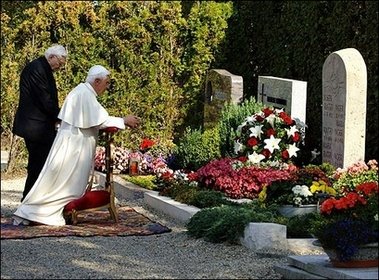
Yesterday, Wednesday, September 13, 2006, the Holy Father visited his brother, Georg, and spent time in prayer at the graves of his father, mother, and sister.

Image Source: AFP/Pool/Wolfgang Radtke
Read more >>
Dedication of Oneself to the Blessed Virgin Mary


Dearest Mother, I desire to belong to you forever and in the most perfect manner, and through you I want to become the property of the Divine Heart of Jesus for time and eternity.

Behold I dedicate to you this day and all the days of my life, but especially at the hours of my death, my soul with its faculties,my body with its senses, in a word my whole person.

I unite this dedication with the Sacred Life, Passion and Death of Jesus, with all holy Masses, ever to be said, and with all holy communions, ever to be received. I unite it with your glorious merits, dear mother, with the merits of all the saints and elect, and with all good deeds ever to be done.

With these I unite my own prayers, labors and sufferings; also all indulgences I can gain, all merits I can acquire; I place it all into your motherly hands. Purify my gift of every stain, dispose of it, and offer it up to the Holy Trinity in accordance and in union with the infinitely holy intentions of the Sacred Heart of Jesus.

Help me, dear Mother, to sacrifice myself for the honor of your Son and for immortal souls. Grant, not as a reward but as a favor that I may ever serve you, and that I may never - not even by purgatory be separated from your Divine Son. O clement, O pious sweet O Virgin Mary. Amen.
Read more >>
Wednesday, September 13, 2006
Pope Benedict XVI Continues Visit to Bavaria


Image: High altar at Alte Kapelle


Today the Holy Father addressed representatives of science of the University of Rosenburg. He also spent time at the Basilica of Our Lady of the Old Chapel ("Alte Kapelle"), of which his brother, Monsignor Georg Ratzinger, was director. During his visit, he blessed the Basilica's new organ. Here is his address:
This venerable house of God, the Basilica of "Our Lady of the Old Chapel," has been splendidly refurbished and today receives a new organ, which will now be blessed and solemnly dedicated to its proper aim: the glorification of God and the strengthening of faith.

An important contribution to the renewal of sacred music in the 19th century was made by a canon of this collegiate church, Carl Joseph Proske. Gregorian chant and classic choral polyphony were integrated into the liturgy. The attention given to liturgical sacred music in the "Old Chapel" was so significant that it reached far beyond the confines of the region, making Regensburg a center for the reform of sacred music, and its influence has continued to the present time.

In the constitution on sacred liturgy of the Second Vatican Council ("Sacrosanctum Concilium"), it is emphasized that the "combination of sacred music and words … forms a necessary or integral part of the solemn liturgy" (No. 112). This means that music and song are more than an embellishment of worship; they are themselves part of the liturgical action.

Solemn sacred music, with choir, organ, orchestra and the singing of the people, is not an addition of sorts that frames the liturgy and makes it more pleasing, but an important means of active participation in worship. The organ has always been considered, and rightly so, the king of musical instruments, because it takes up all the sounds of creation and gives resonance to the fullness of human sentiments. By transcending the merely human sphere, as all music of quality does, it evokes the divine.

The organ's great range of timbre, from "piano" through to a thundering "fortissimo," makes it an instrument superior to all others. It is capable of echoing and expressing all the experiences of human life. The manifold possibilities of the organ in some way remind us of the immensity and the magnificence of God.

Psalm 150 speaks of trumpets and flutes, of harps and zithers, cymbals and drums; all these musical instruments are called to contribute to the praise of the triune God. In an organ, the many pipes and voices must form a unity. If here or there something becomes blocked, if one pipe is out of tune, this may at first be perceptible only to a trained ear. But if more pipes are out of tune, dissonance ensues and the result is unbearable.

Also, the pipes of this organ are exposed to variations of temperature and subject to wear. Now, this is an image of our community. Just as in an organ an expert hand must constantly bring disharmony back to consonance, so we in the Church, in the variety of our gifts and charisms, always need to find anew, through our communion in faith, harmony in the praise of God and in fraternal love. The more we allow ourselves, through the liturgy, to be transformed in Christ, the more we will be capable of transforming the world, radiating Christ's goodness, his mercy and his love for others.

The great composers, each in his own way, ultimately sought to glorify God by their music. Johann Sebastian Bach wrote above the title of many of his musical compositions the letters S.D.G., "Soli Deo Gloria" -- to God alone be glory. Anton Bruckner also prefaced his compositions with the words: "Dem lieben Gott gewidmet" -- dedicated to the good God. May all those who enter this splendid basilica, experiencing the magnificence of its architecture and its liturgy, enriched by solemn song and the harmony of this new organ, be brought to the joy of faith.

[Translation issued by the Holy See; adapted]

© Copyright 2006 -- Libreria Editrice Vaticana

Photos from this beautiful place!


(AP Photo/Maurizio Brambatti, pool)

(AP Photo/Maurizio Brambatti, pool)
Read more >>
The Value of the Rosary by Fr. Gabriel Amorth


The Hail Mary - The Value of the Rosary

Father Gabriel Amorth, chief exorcist of the Vatican writes:

One day a colleague of mine heard the devil say during an exorcism: "Every Hail Mary is like a blow on my head. If Christians knew how powerful the Rosary was, it would be my end." The secret that makes this prayer so effective is that the Rosary is both prayer and meditation. It is addressed to the Father, to the Blessed Virgin, and to the Holy Trinity, and is a meditation centered on Christ.
I write in addition to the above: Please enunciate each word of the Rosary clearly and distinctly. Do not trample on the heels' of the words of anyone with your words. Do not speak over the leader, if you are following, or the responders if you are leading the Rosary. Remember that they also are having a conversation with Mary Our Mother and it is not polite to speak when someone else is speaking.

In the case of the public Rosary there are only two people speaking, the Leader and the Responders. Each are speaking to their Mother and listening carefully to her response within their hearts as they meditate on the scene before them in their consideration of the mystery being spoken of and interpreted and translated into their lives. Spread this powerful prayer of exorcism, The Rosary which contains the Our Father, the Perfect Prayer, prayed five times in the recitation of each set of the Rosary's Mysteries, backed up by the powerful prayers of Our Mother who prays with us as we pray 53 Hail Marys. The Eternal Father described to a group of us, through a Visionary Friend of mine, what happens when we pray the Rosary, saying, "When you pray Holy Mary Mother of God, pray for us sinners now....., the Blessed Mother comes instantly to your side to pray with you. And she does not come alone. She brings angels with her. And not just one or two for she is the Queen of Angels, so choirs of angels come with her. And she and Jesus are joined at the heart and cannot be separated so shebrings Jesus with her. And Jesus cannot be separated from the Trinity so He brings the Father and the Holy Spirit with Him.

And where the Holy Trinity is all of creation is and you are surrounded by such beauty and light as you cannot imagine in this life. Your Mother comes as Our Lady of Grace with her hands out-stretched. Rays of light emit from her hands piercing your body, healing you and filling you with graces.

This is your inheritance which was poured out from the heart of Jesus on the Cross, when the centurion pierced His Heart with the spear, into the only pure vessel ready to receive such graces at that time,Your Mother.

Now as you pray the Rosary, or even just recite one Hail Mary, you receive your portion of these graces."He also said at this time, "Anyone who goes to Mary and prays the Rosary cannot be touched by Satan." Is it any wonder that anyone who prays the Rosary from the heart is so blessed and protected and powerful in their prayers for others?"
Read more >>
Ember Days

Ember Days are set aside to pray and/or offer thanksgiving for a good harvest and God's blessings. If you are in good health, please at least fast during these three days and pray the additional prayers. Remember the words from the Gospel: "Unless you do penance, you shall likewise perish" (Luke 13:5)

From New Advent:

Ember days (corruption from Lat. Quatuor Tempora, four times) are the days at the beginning of the seasons ordered by the Church as days of fast and abstinence. They were definitely arranged and prescribed for the entire Church by Pope Gregory VII (1073-1085) for the Wednesday, Friday, and Saturday after 13 December (S. Lucia), after Ash Wednesday, after Whitsunday, and after 14 September (Exaltation of the Cross). The purpose of their introduction, besides the general one intended by all prayer and fasting, was to thank God for the gifts of nature, to teach men to make use of them in moderation, and to assist the needy. The immediate occasion was the practice of the heathens of Rome. The Romans were originally given to agriculture, and their native gods belonged to the same class.

At the beginning of the time for seeding and harvesting religious ceremonies were performed to implore the help of their deities: in June for a bountiful harvest, in September for a rich vintage, and in December for the seeding; hence their feriae sementivae, feriae messis, and feri vindimiales. The Church, when converting heathen nations, has always tried to sanctify any practices which could be utilized for a good purpose. At first the Church in Rome had fasts in June, September, and December; the exact days were not fixed but were announced by the priests. The "Liber Pontificalis" ascribes to Pope Callistus (217-222) a law ordering: the fast, but probably it is older. Leo the Great (440-461) considers it an Apostolic institution. When the fourth season was added cannot be ascertained, but Gelasius (492-496) speaks of all four. This pope also permitted the conferring of priesthood and deaconship on the Saturdays of ember week--these were formerly given only at Easter.

Before Gelasius the ember days were known only in Rome, but after his time their observance spread. They were brought into England by St. Augustine; into Gaul and Germany by the Carlovingians. Spain adopted them with the Roman Liturgy in the eleventh century. They were introduced by St. Charles Borromeo into Milan. The Eastern Church does not know them. The present Roman Missal, in the formulary for the Ember days, retains in part the old practice of lessons from Scripture in addition to the ordinary two: for the Wednesdays three, for the Saturdays six, and seven for the Saturday in December. Some of these lessons contain promises of a bountiful harvest for those that serve God.

From Catholic Culture:

Since man is both a spiritual and physical being, the Church provides for the needs of man in his everyday life. The Church's liturgy and feasts in many areas reflect the four seasons of the year (spring, summer, fall and winter). The months of August, September, October and November are part of the harvest season, and as Christians we recall God's constant protection over his people and give thanksgiving for the year's harvest.

The September Ember Days were particularly focused on the end of the harvest season and thanksgiving to God for the season. Ember Days were three days (Wednesday, Friday and Saturday) set aside by the Church for prayer, fasting and almsgiving at the beginning of each of the four seasons of the year. The ember days fell after December 13, the feast of St. Lucy (winter), after the First Sunday of Lent (spring), after Pentecost Sunday (summer), and after September 14 , the feast of the Exaltation of the Holy Cross (fall). These weeks are known as the quattor tempora, the "four seasons."

Since the late 5th century, the Ember Days were also the preferred dates for ordination of priests. So during these times the Church had a threefold focus: (1) sanctifying each new season by turning to God through prayer, fasting and almsgiving; (2) giving thanks to God for the various harvests of each season; and (3) praying for the newly ordained and for future vocations to the priesthood and religious life.
Read more >>
St. John Chrysostom


Double (1954 Calendar): January 27
Memorial (1969 Calendar): September 13

St. John Chrysostom (c. 347 - 407), called the Greatest of the Greek Fathers and the Golden-Mouth Saint, is not only venerated in Roman Catholicism but also in the Orthodox churches.

In c. 347 AD, St. John Chrysostom was born in Antioch. St. John's father died soon after John's birth, so St. John was raised by his pious mother, Anthusa. St. John became a monk as well as a priest and a preacher for a dozen years in Syria. He developed a stomach ailment there that remained with him for the rest of his life. At first, though, as a monk, he lived as a hermit studying under Hesychius.

It was because of his sermons that he earned the title "Chrysostom" meaning "golden mouth". St. John was made bishop of Constantinople in 398 AD. As bishop, he criticized the rich for not sharing their wealth, fought to reform the clergy, prevented the sale of ecclesiastical offices, called for fidelity in marriage, and encouraged practices of justice and charity. Because of his work to force the rich to help the poor, he was exiled from his diocese twice. He was banished to Pythius and died on the way in 407 AD. As he was traveling to Pythius, exhausted and dying, his final words were "Glory to God for all things."

He is a Doctor of the Church. The body of St. John Chrysostom is in St. Peter's Basilica in Rome. He is also the patron saint of Constantinople, epilepsy, orators, and preachers.

His Writings To Read Today:
Prayer:

O God, Who didst give blessed John to Thy people as a minister of eternal salvation: grant, we bessech Thee, that we, who have had him for our teacher on earth, may deserve to have him for our advocate in heaven. Through our Lord.

Prayer Source: 1962 Roman Catholic Daily Missal
Read more >>


Copyright Notice: Unless otherwise stated, all items are copyrighted under a Attribution-NonCommercial-NoDerivatives 4.0 International License. If you quote from this blog, cite a link to the post on this blog in your article.

Disclosure of Material Connection: Some of the links on this blog are “affiliate links.” This means if you click on the link and purchase the item, I will receive an affiliate commission. As an Amazon Associate, for instance, I earn a small commission from qualifying purchases made by those who click on the Amazon affiliate links included on this website. I am disclosing this in accordance with the Federal Trade Commission’s 16 CFR, Part 255: “Guides Concerning the Use of Endorsements and Testimonials in Advertising.”