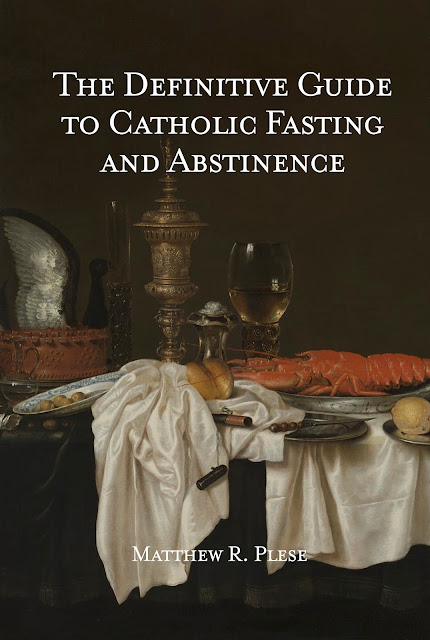
Today the Church celebrates and remembers St. Padre Pio (1887 - 1968), one of my personal favorite saints. Please read my post on the Memorial of St. Padre Pio for today.


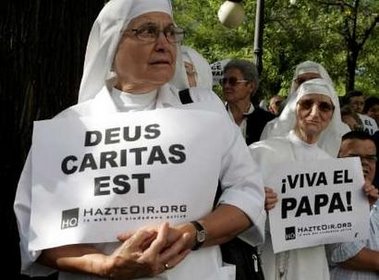 REUTERS/Paul Hanna (SPAIN)
 REUTERS/Paul Hanna (SPAIN)
 Please consider the resources below to pray the Traditional (pre-Vatican II) Breviary in Latin.
 This powerful prayer is very effective in examinations. It has to be said before appearing in the examination. There are two variants to this prayer. Both the prayers are equally effective. You can choose any one of these:
Sep. 19 (CWNews.com) - The familiar "miracle of St. Januarius"-- the liquefaction of the blood of the 4th-century martyr-- occurred once again in Naples on the saint's feast day, September 19.
Cardinal Crescenzio Sepe, newly installed as the Archbishop of Naples presided for the first time at the celebration of the city's patron saint, who died in the persecutions under Emperor Diocletian. A vial containing the preserved blood of the martyr was brought into the sanctuary. After the Gospel was read, the cardinal told the congregation that "the blood is starting to melt." The announcement drew warm applause.
According to a popular tradition, the liquefaction is a sign of assurance that the year will be free from disasters. (One of the rare years in which the miracle did not occur was 1939, the year that saw the beginning of World War II.)
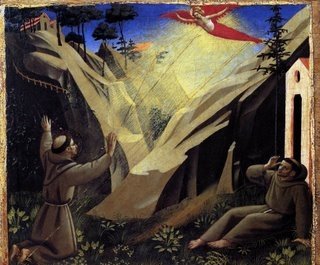
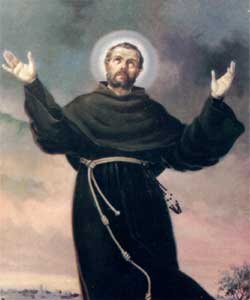
“On a certain morning about the Feast of the Exaltation of the Cross [September 14], while Francis was praying on the mountainside, he saw a Seraph with six fiery and shining wings descend from the height of heaven. And when in swift flight the Seraph had reached a spot in the air near the man of God, there appeared between the wings the figure of the a man crucified, with his hands and feet extended in the form of a cross and fastened to a cross. Two of the wings were lifted above his head, two were extended for flight and two covered his whole body"
Prayer:“....the marks of nails began to appear in his hands and feet, just as he had seen them slightly earlier in the crucified man above him. His wrists and feet seemed to be pierced by nails, with the heads of the nails appearing on his wrists and on the upper sides of his feet, the points appearing on the other side. The marks were round on the palm of each hand but elongated on the other side, and small pieces of flesh jutting out from the rest took on the appearance of the nail-ends, bent and driven back. In the same way the marks of nails were impressed on his feet and projected beyond the rest of the flesh. Moreover, his right side had a large wound as if it had been pierced with a spear, and it often bled so that his tunic and trousers were soaked with his sacred blood.”


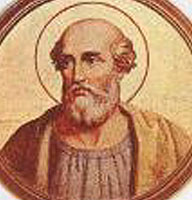 Commemoration (1954 Calendar): January 11
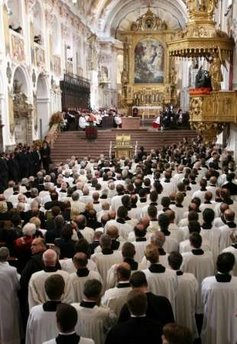 Image Source: REUTERS/Maurizo Brambatti/Pool (Germany)
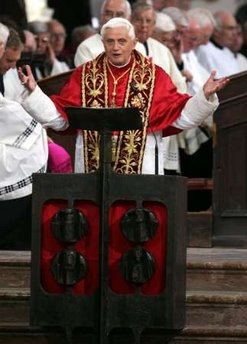 REUTERS/Maurizo Brambatti/Pool (Germany)
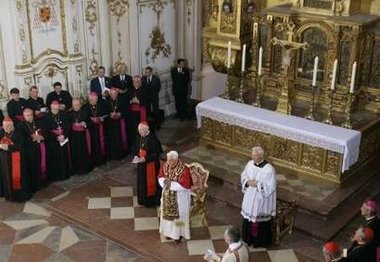 REUTERS/Alexandra Beier (GERMANY)
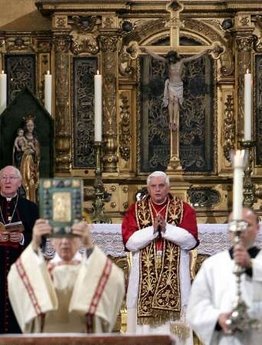 REUTERS/Maurizo Brambatti/Pool (Germany)
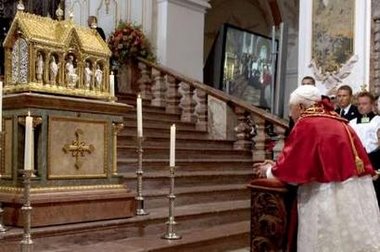 REUTERS/KNA-Bild/Wolfgang Radtke/Pool (GERMANY)
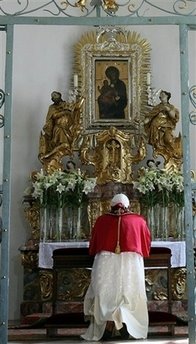
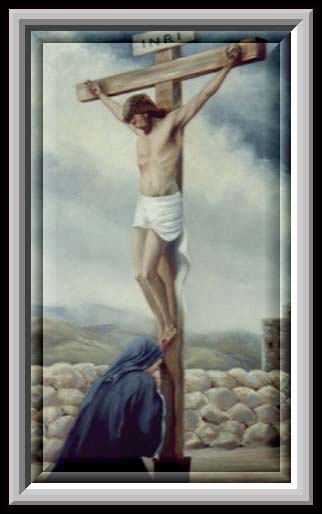 Today is the Memorial of Our Lady of Sorrows, where we remember the pain Mary experienced in Christ's passion. How appropriate that today is Friday - the day Jesus died on the Cross.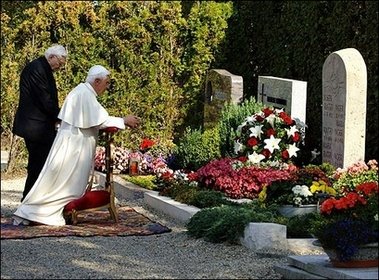


This venerable house of God, the Basilica of "Our Lady of the Old Chapel," has been splendidly refurbished and today receives a new organ, which will now be blessed and solemnly dedicated to its proper aim: the glorification of God and the strengthening of faith.
An important contribution to the renewal of sacred music in the 19th century was made by a canon of this collegiate church, Carl Joseph Proske. Gregorian chant and classic choral polyphony were integrated into the liturgy. The attention given to liturgical sacred music in the "Old Chapel" was so significant that it reached far beyond the confines of the region, making Regensburg a center for the reform of sacred music, and its influence has continued to the present time.
In the constitution on sacred liturgy of the Second Vatican Council ("Sacrosanctum Concilium"), it is emphasized that the "combination of sacred music and words … forms a necessary or integral part of the solemn liturgy" (No. 112). This means that music and song are more than an embellishment of worship; they are themselves part of the liturgical action.
Solemn sacred music, with choir, organ, orchestra and the singing of the people, is not an addition of sorts that frames the liturgy and makes it more pleasing, but an important means of active participation in worship. The organ has always been considered, and rightly so, the king of musical instruments, because it takes up all the sounds of creation and gives resonance to the fullness of human sentiments. By transcending the merely human sphere, as all music of quality does, it evokes the divine.
The organ's great range of timbre, from "piano" through to a thundering "fortissimo," makes it an instrument superior to all others. It is capable of echoing and expressing all the experiences of human life. The manifold possibilities of the organ in some way remind us of the immensity and the magnificence of God.
Psalm 150 speaks of trumpets and flutes, of harps and zithers, cymbals and drums; all these musical instruments are called to contribute to the praise of the triune God. In an organ, the many pipes and voices must form a unity. If here or there something becomes blocked, if one pipe is out of tune, this may at first be perceptible only to a trained ear. But if more pipes are out of tune, dissonance ensues and the result is unbearable.
Also, the pipes of this organ are exposed to variations of temperature and subject to wear. Now, this is an image of our community. Just as in an organ an expert hand must constantly bring disharmony back to consonance, so we in the Church, in the variety of our gifts and charisms, always need to find anew, through our communion in faith, harmony in the praise of God and in fraternal love. The more we allow ourselves, through the liturgy, to be transformed in Christ, the more we will be capable of transforming the world, radiating Christ's goodness, his mercy and his love for others.
The great composers, each in his own way, ultimately sought to glorify God by their music. Johann Sebastian Bach wrote above the title of many of his musical compositions the letters S.D.G., "Soli Deo Gloria" -- to God alone be glory. Anton Bruckner also prefaced his compositions with the words: "Dem lieben Gott gewidmet" -- dedicated to the good God. May all those who enter this splendid basilica, experiencing the magnificence of its architecture and its liturgy, enriched by solemn song and the harmony of this new organ, be brought to the joy of faith.
[Translation issued by the Holy See; adapted]
© Copyright 2006 -- Libreria Editrice Vaticana
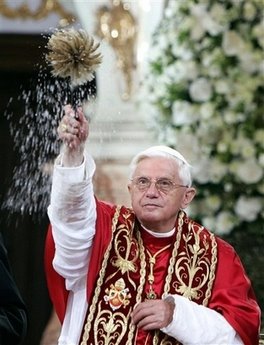
 (AP Photo/Maurizio Brambatti, pool)