A fellow Catholic has asked for prayers for Mark B. Please say a prayer for him; God knows exactly what he needs.
Thank you.
Read more >>
Thank you.


A Utah doctor who was a member of a Food and Drug Administration's advisory panel says the morning after pill will not reduce the number of abortions and pregnancies that its supports claim it will do. He also indicated that the Plan B drug can work as an abortion agent in certain circumstances.
Dr. Joseph Stanford, associate professor of family and preventative medicine at the University of Utah School of Medicine, said the morning after pill won't be as effective as its maker claims.
He told the Deseret News that studies he and fellow researchers have done show a lower effectiveness rate than the 89 percent Barr Laboratories claims.
"We did more a precise meta-analysis that shows it's effective only 72 percent of the time, and even that number is optimistic," he indicated.
Stanford explained that earlier studies, which gave Barr its 89 percent figure, did not take into account normal variations in the timing of ovulation.
He also told the newspaper that studies from Europe, China and the United States show that the morning after pill does not reduce abortions. In fact, new abortion figures in England and Scotland show that abortions have reached their highest point ever despite over the counter sales of Plan B.
 I have just posted the Rosary Intentions for October for the Catholic Community Forum (CCF). Please read them and pray for them.
 2, 2: SCh 248, 148; cf. Ep. Barnabae 19, 5: PG 2, 777; Ad Diognetum 5, 6: PG 2, 1173; Tertullian, Apol. 9: PL 1, 319-320.] God, the Lord of life, has entrusted to men the noble mission of safeguarding life, and men must carry it out in a manner worthy of themselves. Life must be protected with the utmost care from the moment of conception: abortion and infanticide are abominable crimes. [GS 51 # 3.]"
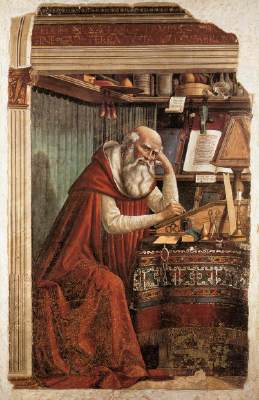 Today is the Memorial of St. Jerome, who taught us to love Scripture. Please read my post on him.
 Simple (1954 Calendar): July 11
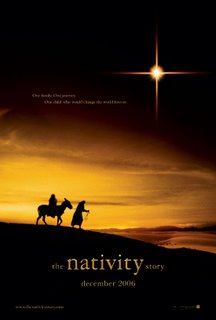 From New Line Cinema, opening December, 2006.
According to the great St. Alphonsus Liguori, veneration of the holy Angels, and particularly of St. Michael, is an outstanding sign of predestination. St. Lawrence Justinian says: "Although we must honor all the Angels, we ought to invoke in a very special manner the glorious St. Michael, as the Prince of all the heavenly spirits, because of his sublime dignity, his pre-eminent office and his invincible power, which he proved in his conflict with Satan, as well as against the combined forces of Hell." Again, the same Saint says: "Let all acknowledge St. Michael as their protector, and be devoted to him, for he cannot despise those who pray to him . . . But he guards them through life, directs them on their way and conducts them to their eternal home."
St. Michael is one of the principal angels; his name was the war-cry of the good angels in the battle fought in heaven against the enemy and his followers. Four times his name is recorded in Scripture: Daniel 10:13…Daniel 12…In the Catholic Epistle of St. Jude: ‘When Michael the Archangel, disputing with the devil, contended about the body of Moses’, etc. St. Jude alludes to an ancient Jewish tradition of a dispute between Michael and Satan over the body of Moses, an account of which is also found in the apocryphal book on the assumption of Moses (Origen, De Principiis III.2.2). St. Michael concealed the tomb of Moses; Satan, however, by disclosing it, tried to seduce the Jewish people to the sin of hero-worship. St. Michael also guards the body of Eve, according to the ‘Revelation of Moses’… Apocalypse 12:7, "And there was a great battle in heaven, Michael and his angels fought with the dragon." St. John speaks of the great conflict at the end of time, which reflects also the battle in heaven at the beginning of time. According to the Fathers there is often question of St. Michael in Scripture where his name is not mentioned. They say he was the cherub who stood at the gate of paradise, ‘to keep the way of the tree of life’ (Genesis 3:24), the angel through whom God published the Decalogue to his chosen people, the angel who stood in the way against Balaam (Numbers 22:22), the angel who routed the army of Sennacherib (2 Kings 19:35)…
Collect:
O God, who wondrously directs the services of angels and men, grant that our lives on earth may be guarded by the angels who stand ever before Your face ministering to You in heaven. Through our Lord . . .

 Back on September 8, 2006, Pope Benedict XVI met with Canadian bishops. I didn't post on the story then, so I wanted to post now:
Your Eminence,
Dear Brother Bishops,
1. "God is love, and he who abides in love abides in God, and God abides in him" (1Jn 4:16). With fraternal affection I cordially welcome you, the Bishops of Ontario, and I thank Bishop Smith for the kind sentiments expressed on your behalf. I warmly reciprocate them and assure you, and those entrusted to your pastoral care, of my prayers and solicitude. Your visit ad Limina Apostolorum, and to the successor of Peter, is an occasion to affirm your commitment to make Christ increasingly more visible within the Church and society, through joyful witness to the Gospel that is Jesus Christ himself.
The Evangelist John's numerous exhortations to abide in the love and truth of Christ evoke an appealing image of a sure and safe dwelling place. God first loves us (1 Jn 4:10) and we, drawn towards this gift, find a resting place where we can "constantly drink anew from the original source, which is Jesus Christ, from whose pierced heart flows the love of God" (Deus Caritas Est, 7). Saint John was also compelled to urge his communities to remain in that love. Already some had been weakened by the disputes and distractions which eventually lead to division.
2. Dear Brothers, your own Diocesan communities are challenged to resonate with the living statement of faith: "we know and believe the love God has for us" (1 Jn 4:16). These words, which eloquently reveal faith as personal adherence to God and concurrent assent to the whole truth that God reveals (cf. Dominus Iesus, 7), can be credibly proclaimed only in the wake of an encounter with Christ. Drawn by his love the believer entrusts his entire self to God and so becomes one with the Lord (cf. 1 Cor 6:17). In the Eucharist this union is strengthened and renewed by entering into the very dynamic of Christ's self-giving so as to share in the divine life: "He who eats my flesh and drinks my blood abides in me and I in him" (Jn 6:56; cf. Deus Caritas Est, 13).
St John's admonition, however, still holds. In increasingly secularized societies such as yours, the Lord's outpouring of love to humanity can remain unnoticed or rejected. By imagining that withdrawing from this relationship is somehow a key to his own liberation, man in fact becomes a stranger to himself, since "in reality it is only in the mystery of the Word made flesh that the mystery of man truly becomes clear" (Gaudium et spes, n. 22). Dismissive of the love which discloses the fullness of man's truth, many men and women continue to walk away from the Lord's abode into a wilderness of individual isolation, social fragmentation and loss of cultural identity.
3. Within this perspective, one sees that the fundamental task of the evangelization of culture is the challenge to make God visible in the human face of Jesus. In helping individuals to recognize and experience the love of Christ, you will awaken in them the desire to dwell in the house of the Lord, embracing the life of the Church. This is our mission. It expresses our ecclesial nature and ensures that every initiative of evangelization concurrently strengthens Christian identity. In this regard, we must acknowledge that any reduction of the core message of Jesus, that is, the 'Kingdom of God', to indefinite talk of 'kingdom values' weakens Christian identity and debilitates the Church's contribution to the regeneration of society. When believing is replaced by 'doing' and witness by talk of 'issues', there is an urgent need to recapture the profound joy and awe of the first disciples whose hearts, in the Lord's presence, "burned within them" impelling them to "tell their story" (cf. Lk 24:32; 35).
Today, the impediments to the spread of Christ's Kingdom are experienced most dramatically in the split between the Gospel and culture, with the exclusion of God from the public sphere. Canada has a well-earned reputation for a generous and practical commitment to justice and peace, and there is an enticing sense of vibrancy and opportunity in your multicultural cities. At the same time, however, certain values detached from their moral roots and full significance found in Christ have evolved in the most disturbing of ways. In the name of 'tolerance' your country has had to endure the folly of the redefinition of spouse, and in the name of 'freedom of choice' it is confronted with the daily destruction of unborn children. When the Creator's divine plan is ignored the truth of human nature is lost.
May Canada move from the "dictatorship of relativism" that Pope Benedict warned is growing throughout the world.
False dichotomies are not unknown within the Christian community itself. They are particularly damaging when Christian civic leaders sacrifice the unity of faith and sanction the disintegration of reason and the principles of natural ethics, by yielding to ephemeral social trends and the spurious demands of opinion polls. Democracy succeeds only to the extent that it is based on truth and a correct understanding of the human person. Catholic involvement in political life cannot compromise on this principle; otherwise Christian witness to the splendour of truth in the public sphere would be silenced and an autonomy from morality proclaimed (cf. Doctrinal Note The Participation of Catholics in Political Life, 2-3; 6). In your discussions with politicians and civic leaders I encourage you to demonstrate that our Christian faith, far from being an impediment to dialogue, is a bridge, precisely because it brings together reason and culture.
4. Within the context of the evangelization of culture, I wish to mention the fine network of Catholic schools at the heart of ecclesial life in your Province. Catechesis and religious education is a taxing apostolate. I thank and encourage those many lay men and women, together with Religious, who strive to ensure that your young people become daily more appreciative of the gift of faith which they have received. More than ever this demands that witness, nourished by prayer, be the all-encompassing milieu of every Catholic school. Teachers, as witnesses, account for the hope that nourishes their own lives (cf. 1 Pt 3:15) by living the truth they propose to their pupils, always in reference to the one they have encountered and whose dependable goodness they have sampled with joy (cf. Address to Rome's Ecclesial Diocesan Convention, Living the Truth that God Loves his People, 6 June 2005). And so with Saint Augustine they say: "we who speak and you who listen acknowledge ourselves as fellow disciples of a single teacher" (St. Augustine, Sermons, 23:2).
A particularly insidious obstacle to education today, which your own reports attest, is the marked presence in society of that relativism which, recognizing nothing as definitive, leaves as the ultimate criterion only the self with its desires. Within such a relativistic horizon an eclipse of the sublime goals of life occurs with a lowering of the standards of excellence, a timidity before the category of the good, and a relentless but senseless pursuit of novelty parading as the realization of freedom. Such detrimental trends point to the particular urgency of the apostolate of 'intellectual charity' which upholds the essential unity of knowledge, guides the young towards the sublime satisfaction of exercising their freedom in relation to truth, and articulates the relationship between faith and all aspects of family and civic life. Introduced to a love of truth, I am confident that young Canadians will relish exploring the house of the Lord who "enlightens every person who comes into the world" (Jn 1:9) and satisfies every desire of humanity.
5. Dear Brothers, with affection and fraternal gratitude I offer these reflections to you and encourage you in your proclamation of the Good News of Jesus Christ. Experience his love and in this way cause the light of God to enter into the world! (cf. Deus Caritas Est, 39). Invoking upon you the intercession of Mary, Seat of Wisdom, I cordially impart my Apostolic Blessing to you and the priests, Religious, and lay faithful of your dioceses.
© Copyright 2006 - Libreria Editrice Vaticana
 Then I heard the words: As you are united with Me in life, so will you be united at the moment of death. After these words, such great trust in God's great mercy was awakened in my soul that, even if I had had the sins of the whole world, as well as the sins of all the condemned souls weighing on my conscience, I would not have doubted God's goodness but, without hesitation, would have thrown myself into the abyss of the divine mercy, which is always open to us; and, with a heart crushed to dust, I would have cast myself at His feet, abandoning myself totally to His holy will, which is mercy itself. (1552)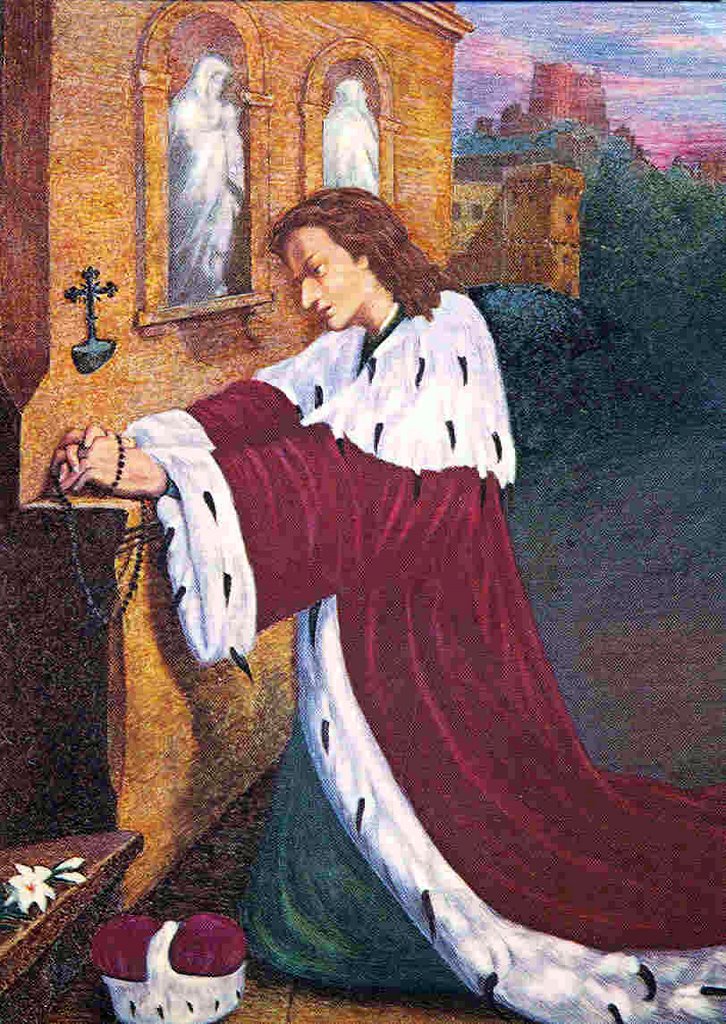
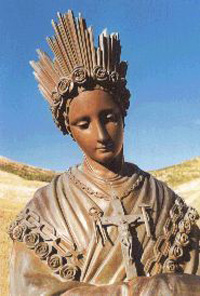 On September 19, 1846, the Blessed Virgin Mary appeared on the mountain of La Salette in France to Melanie Calvat and Maximin Giraud, two young shepherds who had only known each other for two days. Our Blessed Mother appeared to them on this day, the feastday of Our Lady of Sorrows, and she asked them to make her message known. Mother Mary also told each of them a private secret.
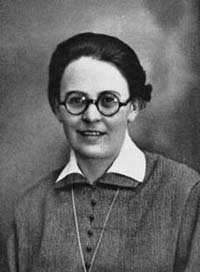 Sara Salkahazi was beatified on September 17, 2006, at Budapest's St. Stephen Basilica. Salkahazi was a Hungarian nun that saved the lives of dozens of Jews during World War II. She is an example of the sacrificial love that Jesus calls us to show to the whole world.
Szociális Testvérek Társasága
Bartók Béla út 61. III./6, 1114
Budapest, HUNGARY
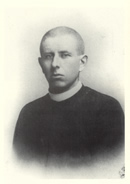
Santuario delle Grazie
Via Grazie, 13
25122 Brescia, ITALY