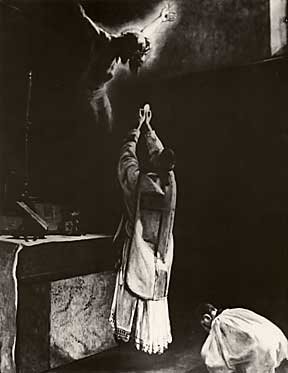
 "The man who receives Holy Communion loses himself in God like a drop of water in the ocean: It's impossible to separate them anymore . . . . In these vast depths of love, there's enough to lose yourself for eternity"
(St. John Vianney)
 "The man who receives Holy Communion loses himself in God like a drop of water in the ocean: It's impossible to separate them anymore . . . . In these vast depths of love, there's enough to lose yourself for eternity"
 On the Care of the Tongue: Its importance and difficulty. What is to be observed and avoided in conversation. How we are to bear the evil tongues of others.


 This powerful prayer is very effective in examinations. It has to be said before appearing in the examination. There are two variants to this prayer. Both the prayers are equally effective. You can choose any one of these:

In a Dec. 27 statement responding to the request, Bishop Asenjo said he believed Cordoba's "relatively small" Muslim minority -- less than 1 percent of its 350,000 inhabitants -- did not need extra facilities
......................
However, he added, the Catholic Church held "irrefutable historic titles" to exclusive use of the cathedral and believed that sharing it would "only generate confusion among the faithful and give rise to religious skepticism."
"The Christian roots of Cordoba and its 1,700-year Christian history deserve respect," said the bishop. "Catholics in Cordoba wish to live in peace with believers of other creeds. But we do not want to be continually subjected to pressure that contributes nothing."
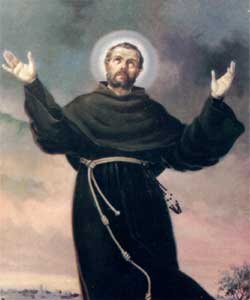
 Optional Memorial (1969 Calendar): January 7
St Raymund has the honour of having been intrusted to draw up the Church's Code of Canon Law. It was he who, in the year 1234, compiled, by order of Pope Gregory the Ninth, the five Books of the Decretals; and his name will ever be associated with this great work which forms the basis of the actual discipline of the Church.
Raymund was a faithful disciple of that God who came down from heaven to save sinners by calling them to receive pardon. He has merited the beautiful title, conferred on him by the Church, of excellent Minister of the Sacrament of Penance. He was the first who collected together into one body of doctrine the maxims of Christian morality, which regulate the duties of the confessor with regard to the faithful who confess their sins to him. The Sum of Penitential Cases opened the series of those important treatises in which learned and holy men have carefully considered the claims of law and the obligations of man, in order to instruct the Priest how to pass judgement, as the Scripture says, between leprosy and leprosy.
In fine, when the glorious Mother of God, who is also the Mother of men, raised up for the redemption of captives the generous Peter Nolasco—whom we shall meet, a few days hence, at the Crib of our Redeemer—Raymund was an important instrument in this great work of mercy; and it is with good reason that the Order of Mercy looks upon him as one of its Founders, and that so many thousand captives, who were ransomed by the Religious of that Order from the captivity of the Moors, have honoured him as one of the principal authors of their liberty.Prayer:


"This group engages in various practices within their special liturgy that are regularly considered abuses, such as standing at the Consecration, decorating the Altar with flowers, dancing around the Altar, or 'Table' as they call it, after Mass, accompanying the chanting of the Eucharistic Prayer with guitars, to name a few." I found a picture of a Baptism done by a deacon instead of a priest via Yahoo Images. It is done very differently than in a typical parish. Also, notice the flowers on the altar, which should not be there as this is a violation of the laws of the Church.Comments (Updated 2011):
Thank you for posting the article "Avoid The Neocatechumenal Way". Four years worth of comments - Wow. I just included the following in my comment and hope you'll consider it.
"The four years worth of comments here are mostly tantrums of the teenage angst vein - "you don't understand me" - instead of intelligent discussion. There are a couple really great comments though and it would be helpful if the original poster would stick in a P.S. to advise all new commentors to at least read these two before they post their own.
Update: August 13, 2011
1. - two part post beginning February 24, 2010 - 12:42 AM
2. - seven part post beginning July 18, 2010 - 3:18 PM"
The Vatican’s approval of the Neo-Catechumenal Way’s forms of “celebration” only applies to non-liturgical prayers within their catechesis and not to the Mass or other liturgies of the Church.
“With respect to the celebrations of the Holy Mass and the other liturgies of the Church,” communities of the Neo-Catechumenal Way must “follow the norms of the Church as indicated in the liturgical books – to do otherwise must be understood to be a liturgical abuse,” a Vatican official told CNA on Jan. 21.
Pope Benedict XVI met with around 7000 members of the movement in the Vatican’s Paul VI Audience Hall on Jan. 20 for an annual event to send families on mission destinations worldwide.
The invitation issued by the movement to bishops for yesterday’s event stated that “the purpose of this meeting is that His Holiness will sign a Decree from the Congregation of Divine Worship recognizing the full approval of the liturgies of the Neo-Catechumenal Way.”
However, the approval for non-liturgical practices of the group came by way of another source. It was Pontifical Council for the Laity that issued a decree of approval – after having consulted the Congregation for Divine Worship – for those “celebrations” present in their Catechetical Directory.
Update (November 2015):
In this process, “the Neocatechumenal Way obtained no new permissions whatsoever,” said the official, who is familiar with the approval process for prayers and liturgies.
“Essentially, the Pontifical Council is only approving these things that are found in the Catechetical Directory of the Neocatechumenal Way, and in no way touches those things contained in the liturgical books.”
According to the founders’ thinking, the Passion and Death of Christ plays no role in man’s redemption. Therefore, the Mass is not a renewal of His Sacrifice, and not an altar but a table is where the banquet feast is held. This is quite similar to the Protestant doctrine so dear to Archbishop Bugnini.
Argüello and Hernandez justify all their changes with the “profound renewal of the liturgy that came at Vatican II.” Indeed, many of the neocatechumenal practices are common in Novus Ordo Masses.
Other Protestant-inspired changes
For many years, the teachings of Argüello and Hernandez were kept away from the public. But during the Vatican process of approval, some of their texts were published. These texts, taken from The Neocatecumenate, A Christian Initiative for Adults, (3) clearly reveal the Protestant thinking that inspires the movement:
It justifies Luther’s revolt: “It is understandable why Luther emerged making a clean break with everything he believed was a purely human addition or tradition.”
It promotes Luther’s teaching on justification: “Man is not saved by good works … Jesus Christ did not come to give us a model of life, an example. … The Holy Spirit does not lead us to perfection, to good works … God freely forgives the sins of those who believe that Jesus is the Savior.”
It rejects transubstantiation: “Luther, who never doubted the real presence of Christ in the eucharist, rejected ‘transubstantiation,’ because it was bound to Aristotelian-Thomistic concept of substance, which is foreign to the Church of the Apostles and the Fathers”
It rejects the Council of Trent: “The rigidity and fixity of the Council of Trent generated a static mentality in the liturgy, which has persisted to our day.”
After a serious study on the Neocatechumenal Way, theologian Fr. Enrico Zoffoli did not hesitate to accuse the movement of being heretical in an article that can be read here.
Fr. Zoffoli also expressed grave concern for the fact that these errors are taught in the 78 Redemptoris Mater seminaries of the Neocatechumenal Way, which have already ordained 12,000 priests in the last 20 years. (4)
Given its Lutheran inspiration and the solid study of Fr. Zoffoli, one can legitimately question whether the “celebrations” of the Neocatechumenal Way are actually valid Masses. Do their priests intend to do what the Church does, offer a propitious sacrifice, when their founders explicitly deny that the Mass is a sacrifice?
Notwithstanding these doctrinal errors, at the recent papal audience, Benedict XVI approved the movement and encouraged its members to continue their work and "offer your original contribution to the cause of the Gospel."
Unorthodox liturgical practices
The liturgy of the Neocatechumenal Way was shaped by Kiko Argüello and Carmen Hernández based, they claim, squarely on the new teachings of Vatican II. It pretends to return to the practices of the early Church, which were allegedly warped and deviated from the true path for centuries until the Council. One of the movement’s early mentors and supporters was none other than Archbishop Annibale Bugnini, the main architect of the New Mass.
Dancing and singing around the table, a regular part of the Neocatechumenal celebration
Kiko Argüello and Carmen Hernandez say that the original emphasis on the resurrection of Christ in the Mass was lost in the Constantine era and an erroneous sacrificial tone was inserted in its place. Their liturgy calls for paschal exultation at a table, not a sacrifice at an altar.
The members of the Neocatechumenal Way, make their “celebrations” (they do not call them masses) on Saturday night. The small community – ideally no more than 20 or 30 - gathers in chairs around a table (never an altar, which suggests sacrifice) in the center of one of the parish buildings (which they prefer to churches). There they perform their “celebration” sitting and standing, never kneeling or genuflecting. For the Consecration the whole community stands.
Communion is received standing. Each member receives in his hands a piece of the bread broken from a huge loaf – baked by the members themselves according to Argüello’s specific instructions. Then the celebrant sits and waits for all the faithful to receive the bread. After the presbyter says, “Body of Christ, bring us everlasting life,” the whole congregation consumes the loaf together. Then the cup is shared by all. The presbyter is supposed to carry it around, but often the members pass it from hand to hand, to give the sense of eating and drinking around a dinner table.
Since, according to their doctrine, the interpretation of the Word of God is not reserved for the Hierarchy, before the sermon anyone present can give his witness.
Participants dance or process around the table, chanting songs written by Argüello and accompanied by guitar, defined as the instrument “closest to the ancient Hebrew psalter.” There are no hymns or special devotion to Our Lady and the Saints.