Tuesday, May 11, 2010
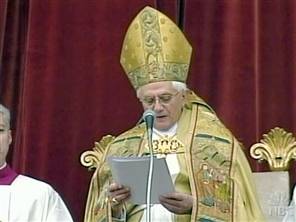
Pope's Address Upon Arriving to Portugal


Image Source: Getty Images

Mr President,
Distinguished Authorities,
Dear Brother Bishops,
Ladies and Gentlemen,

Only now has it been possible for me to accept the kind invitations of the President and my Brother Bishops to visit this beloved and ancient Nation, which this year is celebrating the centenary of the proclamation of the Republic. As I set foot on Portuguese soil for the first time since Divine Providence called me to the See of Peter, I feel greatly honoured and I am moved to gratitude by the respectful and hospitable presence of all of you. I thank you, Mr President, for your kind words of welcome, giving voice to the sentiments and the hopes of the beloved Portuguese people. To all, whatever their faith or religion, I extend a greeting in friendship, especially to those who were unable to be here to meet me. I come as a pilgrim to Our Lady of Fatima, having received from on high the mission to strengthen my brothers as they advance along their pilgrim journey to heaven.

Since the earliest days of their nationhood, the Portuguese people have looked to the Successor of Peter for recognition of their existence as a Nation; in due course, one of my predecessors was to honour Portugal, in the person of its King, with the title "most faithful" (cf. Pius II, Bull Dum Tuam, 25 January 1460), for long and distinguished service to the cause of the Gospel. As for the event that took place 93 years ago, when heaven itself was opened over Portugal -- like a window of hope that God opens when man closes the door to him -- in order to refashion, within the human family, the bonds of fraternal solidarity based on the mutual recognition of the one Father, this was a loving design from God; it does not depend on the Pope, nor on any other ecclesial authority: "It was not the Church that imposed Fatima", as Cardinal Manuel Cerejeira of blessed memory used to say, "but it was Fatima that imposed itself on the Church."

The Virgin Mary came from heaven to remind us of Gospel truths that constitute for humanity -- so lacking in love and without hope for salvation -- the source of hope. To be sure, this hope has as its primary and radical dimension not the horizontal relation, but the vertical and transcendental one. The relationship with God is constitutive of the human being, who was created and ordered towards God; he seeks truth by means of his cognitive processes, he tends towards the good in the sphere of volition, and he is attracted by beauty in the aesthetic dimension. Consciousness is Christian to the degree to which it opens itself to the fullness of life and wisdom that we find in Jesus Christ. The visit that I am now beginning under the sign of hope is intended as a proposal of wisdom and mission.

From a wise vision of life and of the world, the just ordering of society follows. Situated within history, the Church is open to cooperating with anyone who does not marginalize or reduce to the private sphere the essential consideration of the human meaning of life. The point at issue is not an ethical confrontation between a secular and a religious system, so much as a question about the meaning that we give to our freedom. What matters is the value attributed to the problem of meaning and its implication in public life. By separating Church and State, the Republican revolution which took place 100 years ago in Portugal, opened up a new area of freedom for the Church, to which the two concordats of 1940 and 2004 would give shape, in cultural settings and ecclesial perspectives profoundly marked by rapid change. For the most part, the sufferings caused by these transformations have been faced with courage. Living amid a plurality of value systems and ethical outlooks requires a journey to the core of one’s being and to the nucleus of Christianity so as to reinforce the quality of one’s witness to the point of sanctity, and to find mission paths that lead even to the radical choice of martyrdom.

Dear Portuguese brothers and sisters, my friends, I thank you once more for your cordial welcome. May God bless those who are here and all the inhabitants of this noble and beloved Nation, which I entrust to Our Lady of Fatima, the sublime image of God’s love embracing all as children.

© Copyright 2010 -- Libreria Editrice Vaticana
Read more >>
Friday, May 7, 2010
Prayer in the Catholic Educational System

Zenit offers the following article in response to some of the comments of Cardinal Sean Brady. I have emphasized some especially key points.

Teaching prayer in Catholic schools is not an extra feature, but rather an essential part of the institutions, which children have a right to receive, said Cardinal Sean Brady.

The archbishop of Armagh and Primate of All Ireland stated this today at a conference on the theme, "Catholic Schools: Envisioning a Future," near Kilkenny. The conference was organized by the Diocese of Ossory and will end Saturday.

He invited his listeners to renew their commitment to "respecting and promoting the right of children in our schools to be led and formed in authentic worship of God in the Catholic tradition."

"This is not some optional extra," the prelate asserted. "Children and their parents have a right to expect a Catholic school to provide children with a formation in prayer and worship."

He appealed to the leaders of the educational institutions "reflect seriously and with commitment on this essential part of our shared duty of stewardship."

"A Catholic school without worship and prayer is a contradiction in terms," the cardinal said. "It is also a school which is failing in its fundamental obligation to parents and children."

As people of faith, he said, "we should particularly cherish" the "right of a child to know and to love God."

The whole truth

"Children also have a right to know God's love for them," Cardinal Brady added.

He continued: "They have a right to receive the truth and life which God offers them in the Sacred Scriptures, in the sacraments and in prayer.

"If we really believe that Jesus Christ reveals the whole truth about the human person, then children have a right to receive that truth.

"If we really believe that the message of Jesus Christ is the key to a better world and the source of our eternal hope, then children have a right to be part of a school community in which Jesus and his message are lived, respected and promoted."

Image Source: Fr Seward at St. Gregory the Great School (Oxford)
Read more >>
Sunday, May 2, 2010
How is the New Commandment "New"?

In the Old Testament, God already gave the commandment to love, so what makes Christ's "new commandment" something new?

Benedict XVI answered this question today in Turin where he celebrated Mass this morning during a one-day trip to the city.

"What is new is precisely this 'loving as Jesus loved,'" he explained. "The Old Testament did not give any model of love but only formulated the precept to love. Jesus, however, gave himself to us as model and source of love. This is a love without limits, universal, able to transform all the negative circumstances and all the obstacles into occasions for progress in love. [...]

"Giving us the new commandment, Jesus asks us to live his own love, which is the truly credible, eloquent and efficacious sign that announces to the world the Kingdom of God."

Source: Zenit
Image Source: AP Photos. Pope Benedict XVI, white figure at center on stage, prays in front of the Holy Shroud in Turin's cathedral, Italy, Sunday, May 2, 2010. Benedict XVI prayed before the Shroud of Turin, believed to be Christ's burial cloth.
Read more >>
Saturday, May 1, 2010
Solemn High Mass for the Feast of St. George


Solemn High Mass for the Feast of St. George at St. Mary's Church, Chislehurst, 23 April, 2010. Celebrant is Fr. Charles Briggs, (Parish Priest, Chislehurst) Deacon is Fr. Tim Finigan (Parish Priest, Blackfen) and Sub-Deacon is Fr. Christopher Basden (Parish Priest, Clapham Park.).

The background music (used with permission) is Mass I from Chants of the Ordinary, Volume I, by Cantus Angeli, directed by Nick Gale. Copies of the CD can be obtained from Gregorian Chant.
Read more >>
Wednesday, April 28, 2010
May 1st Events at the Institute of Christ the King - Chicago, IL

Read more >>
Wednesday, April 21, 2010
Bishop Thomas Wenski Named Archbishop of Miami


Benedict XVI appointed Bishop Thomas Wenski of Orlando, Florida, as archbishop of Miami yesterday, April 20, 2010. Archbishop Wenski, 59, succeeds Archbishop John Favalora, 74, who resigned as he will reach the age limit this year. Does anyone know of Bishop Wenski's position on the Traditional Latin Mass and issues concerning Traditional Catholic Doctrine?
Read more >>
Monday, April 19, 2010
5th Anniversary of the Election of Pope Benedict XVI


V. Oremus pro pontifice nostro Benedicto.

R. Dominus conservet eum, et vivificet eum, et beatum faciat eum in terra, et non tradat eum in animam inimicorum eius.

Deus, omnium fidelium pastor et rector, famulum tuum Benedictum, quem pastorem Ecclesiae tuae praeesse voluisti, propitius respice: da ei, quaesumus, verbo et exemplo, quibus praeest, proficere: ut ad vitam, una cum grege sibi credito, perveniat sempiternam. Per Christum, Dominum nostrum. Amen.

V. Let us pray for Benedict our pope.

R. The Lord preserve him, and give him life, and make him blessed upon the earth, and deliver him not up to the will of his enemies.

O God, Shepherd and Ruler of all Thy faithful people, look mercifully upon Thy servant Benedict, whom Thou hast chosen as shepherd to preside over Thy Church. Grant him, we beseech Thee, that by his word and example, he may edify those over whom he hath charge, so that together with the flock committed to him, may he attain everlasting life. Through Christ our Lord. Amen.

[Prayer is from the Roman Missal.  Attached to the versicle and response is a partial indulgence.]


Today we recall the fifth anniversary of the election of His Holiness Pope Benedict XVI to the Seat of the Vicar of Christ.

Our Holy Father has shown us that through his pontificate, the Sacred Traditions of our Holy Faith are being rightfully restored to their former glory. Let's look at some example of restoration by Pope Benedict XVI.

In August 2006, Pope Benedict XVI abolished the Christmas concert featuring "pop" music established by Pope John Paul II. In January 2007, he called on the Vatican Courts to tighten up the annulment criteria, as annulments have exponentially increased following Vatican II.

Pope Benedict XVI has further restored the use of the Pascal Mozetta in the Octave of Easter 2008.

Examine the vestments used by the Holy Father at the 3rd Anniversary Mass of John Paul II's death in 2008 (below). At this Mass the Holy Father has discontinued using the staff of Pope John Paul II featured a bent Christ on the Cross, aesthetically unpleasant, and replaced it with a new beautiful pastoral staff (ferula).

(Reuters/Alessandro Bianchi)

Notice in the above image Pope Benedict XVI is using a papal asteriscus, an item that, in addition to practical applications, symbolizes the Star of Bethlehem. He has restored it to use in the Papal Liturgy at times.

On the Feast of Sts Peter and Paul 2008, Pope Benedict XVI introduced a different Papal Pallium, establishing better continuity with the past than with the Pallium that became used during the pontificate of John Paul II. "This is the development of the Latin form of the pallium used up to John Paul II," explains the Master of Papal Liturgical Celebrations, Monsignor Guido Marini.

Former Pallium


Restored Pallium

In 2009, the mosaic depicting Pope Benedict XVI in the line of papal portraits in the Basilica of St. Paul Outside the Walls has been changed to reflect this shift in the Papal Pallium.(Above Images from St. Paul Outside the Walls by Pope Benedict Forum user "Benodette".)

And remember that in January 2008, His Holiness Pope Benedict XVI celebrated the Baptism of the Lord ad orientem in the Sistine Chapel.

Believed to be Associated Press (AP)

In January 2009, His Holiness wore a fiddleback chausible on the Feast of the Epiphany. This was another return back to prior Traditions. Pope Benedict XVI again shows his desire for a restoration of the Sacred Liturgy. And while vestments may seem unimportant, continuity with the past and symbolism is highly important. Each vestment has its own vesting prayer, and each particular garment holds symbolic importance (e.g. the maniple symbolizes Christ at the Pillar of Flagellation, the cincture symbols the rope by which Our Lord was bound and dragged in the streets, et cetera).

Therefore, the exteriors again are an expression of the interior. And, in the past 40 years we have lost not only the interior aspects of the Faith (e.g. lack of knowledge of integral Catholic beliefs such as Transubstantiation, etc) and a decrease in devotion but also exterior aspects of the Faith (e.g. vestments, proper Sacred Liturgy, Rosaries, etc). Coincidence or has the loss of exteriors contributed to the loss of interior Faith?


Image Sources: Franco Origlia/Getty Images

And of substantial importance, Holy Communion is to be given only to those kneeling henceforth, when Pope Benedict XVI distributes Holy Communion. EWTN reports, "To receive Communion from Pope Benedict at Papal Liturgies one will have to receive on the tongue," which is a fantastic affirmation of the Real Presence of our Lord. And as the Body and Blood of Jesus, nothing is of higher value than the Most Holy Eucharist.

St. Thomas Aquinas: "Out of reverence towards this Sacrament, nothing touches it but when it is consecrated" - Summa, Pt III Q, Q2 Art. 3

Also from Wikipedia, "Each year a papal tiara is placed on the head of the famous bronze statue of Saint Peter in St. Peter's Basilica from the vigil of the Feast of the Cathedra of Saint Peter on February 22 until the Feast of Saints Peter and Paul on June 29. Although this custom was not observed in 2006, it was reintroduced in 2007."

Finally in this example, compare the below progression of photos of the Urbi et Orbi addresses given on Christmas Day by Pope Benedict XVI.

2005, Source: MSNBC

2006, Source: REUTERS/Osservatore Romano/Handout

2007, Source: CNS photo/L'Osservatore Romano via Reuters

2008, Source: REUTERS/Osservatore Romano

The photos are from 2005 - 2008, and there is a progression in these photos. Tradition is being restored.


For a list of numerous articles on the events in the Pontificate of Pope Benedict XVI, please see the following post: Pope Benedict XVI (permanently linked in the sidebar).
Read more >>
Saturday, April 17, 2010
800th Anniversary of Royal Maundy Service at Derby Cathedral

Read more >>
Friday, April 16, 2010
83rd Birthday of Pope Benedict XVI

VATICAN CITY, APRIL 16, 2010 (Zenit.org).- Benedict XVI turned 83 today, spending his birthday with normal activities punctuated by numerous congratulatory messages from around the world.

Italian President Giorgio Napolitano sent the Pope a message expressing his "deep esteem for your elevated magisterium."

In the Vatican, the Holy Father doesn't celebrate his birthday, but rather his name day, the feast of St. Joseph.

Image Source: Pope Benedict XVI says Holy Mass at the Granaries in Floriana in Valletta April 18, 2010. (Reuters)
Read more >>
Thursday, April 15, 2010
Cause for the Canonization of 17 Laotian Martyrs Moves Forward

The beatification process for 17 martyrs who died in Laos between 1954 and 1970 is moving forward. The diocesan phase for 15 of the martyrs concluded in France; two others are already in the Roman phase.

The martyrs were religious and lay missionaries: five French women religious and an Italian member of the Oblates of Mary Immaculate; five members of the Paris Society for Foreign Missions and five Laotians (a priest and four laymen, including a catechist of the Hmong ethnic group).

Source: Zenit
Read more >>
Dates for 7 Upcoming Beatifications Confirmed

Zenit Reports this glorious news.  Deo Gratias!

The Vatican has confirmed dates for seven upcoming beatifications, including that of Manuel "Lolo" Lozano Garrido, a Spanish journalist hailed as a layperson's example of sanctity.

Lozano Garrido (1920-1971) will be beatified in his hometown of Linares, Spain, on June 12.

Lolo wrote for various media, including the daily "Ya" and the Associated Press. In 1942 he began to suffer from spondylitis, which left him an invalid and blind. He eventually founded Sinai, a magazine for sick people. He also authored nine books, which he dictated to his sister and his friends.

Also on the list to be beatified is the chaplain of the Polish Solidarity movement, Father Jerzy Popieluszko (1947-1984). The 37-year-old priest was assassinated by Communist secret service agents. He will be beatified June 6 in Warsaw, Poland.

The other five beatifications will take place this month and next, two in Spain, and three in Italy.

Jesuit Father Bernardo Francisco de Hoyos will be beatified April 18 in Valladolid, Spain.

Carmelite Father Angelo Paoli will be beatified April 25 in the Basilica of St. John Lateran in Rome.

Capuchin Friar José Tous y Soler, founder of the Institute of the Capuchin sisters of the Mother of the Divine Shepherd, will be beatified April 25 in Barcelona, Spain.

Franciscan Teresa Manganiello, inspirer of the Congregation of the Franciscan Immaculatine Sisters, will be beatified May 22 in Benevento, Italy.

Finally, Sister Maria Pierina De Micheli of the Daughters of the Immaculate Conception in Buenos Aires will be beatified May 30 in Rome.
Read more >>
Sunday, April 11, 2010
Archbishop Gomez named to Los Angeles Archdiocese

What does this news mean for the Traditional Latin Mass Movement in Los Angeles? Surely this is a step up. I especially welcome comments from those in the state of California on this matter.

LOS ANGELES, APRIL 11, 2010 (Zenit.org).- The archbishop of San Antonio has been named the coadjutor of Los Angeles, one of the largest archdioceses in the world.

Archbishop José Gómez, 58, was appointed to the California archdiocese last Tuesday.

He will assist Cardinal Roger Mahony, 74, until the cardinal retires.

José Gómez was born in Monterrey, Mexico, in 1951. He was ordained a priest for Opus Dei in 1978. He has been serving in the episcopate for nearly a decade, having been named auxiliary bishop of Denver in 2001, and then the archbishop of San Antonio in 2004.

He has a well-established history of advocacy for Hispanic Catholics. The year he was installed as archbishop of San Antonio, he was named one of Time Magazine's 25 most influential Hispanics in the United States, and in 2007 he was on a CNN list of "Notable Hispanics."

In Los Angeles, Archbishop Gómez will lead more than 4.3 million Catholics (according to 2005 statistics), served by 530 diocesan priests, 640 religious priests and 1,710 religious sisters. The archdiocese has a significant Hispanic population.
Read more >>
Saturday, April 10, 2010
Spiritual Bouquet for Pope Benedict XVI

Dear Blogger,
 
 
The Institute of Christ the King Sovereign Priest is preparing to send a spiritual bouquet to His Holiness, Pope Benedict XVI.  Via an online form, the faithful, including your readers, may contribute to this bouquet, along with others throughout the world, which will be presented directly to His Holiness.  All are invited to contribute Holy Masses, Rosaries, Novenas, Holy Hours, or Works of Charity for our Holy Father at a time in which he is being unjustly attacked.
 
The Institute is especially encouraging prayers and sacrifices during a special Novena beginning on Saturday, April 24, the 5th anniversary of the inauguration of Pope Benedict XVI, through May 2, which is the first Sunday of the month of Mary, Mother of the Church.
 
Read more >>
Wednesday, April 7, 2010
Cardinal Egan: Tridentine Mass from March 25, 2010

Does anyone have any photographs from the Mass that I blogged about previously - His Eminence Edward Card. Egan, Archbishop Emeritus of New York, accepted the invitation from the Agnus Dei Council of the Knights of Columbus in New York City to celebrate a Solemn Pontifical Mass in the Extraordinary Form of the Roman Rite – a Mass for Life – on 25 March 2010, the Feast of the Annunciation.

I have yet to see any photographs or video from the Mass.
Read more >>
Monday, April 5, 2010
Easter 2010: Urbi et Orbi

Here is the text of Pope Benedict XVI's Urbi et Orbi Address for Easter 2010. The Urbi et Orbi Address is given on Christmas Day and Easter each year by the Holy Father:
Cantemus Domino: gloriose enim magnificatus est.
"Let us sing to the Lord, glorious his triumph!" (Liturgy of the Hours, Easter, Office of Readings, Antiphon 1).

Dear Brothers and Sisters,

I bring you the Easter proclamation in these words of the Liturgy, which echo the ancient hymn of praise sung by the Israelites after crossing the Red Sea. It is recounted in the Book of Exodus (cf 15:19-21) that when they had crossed the sea on dry land, and saw the Egyptians submerged by the waters, Miriam, the sister of Moses and Aaron, and the other women sang and danced to this song of joy: "Sing to the Lord, for he has triumphed wonderfully: horse and rider he has thrown into the sea!" Christians throughout the world repeat this canticle at the Easter Vigil, and a special prayer explains its meaning; a prayer that now, in the full light of the resurrection, we joyfully make our own: "Father, even today we see the wonders of the miracles you worked long ago. You once saved a single nation from slavery, and now you offer that salvation to all through baptism. May the peoples of the world become true sons of Abraham and prove worthy of the heritage of Israel."

The Gospel has revealed to us the fulfilment of the ancient figures: in his death and resurrection, Jesus Christ has freed us from the radical slavery of sin and opened for us the way towards the promised land, the Kingdom of God, the universal Kingdom of justice, love and peace. This "exodus" takes place first of all within man himself, and it consists in a new birth in the Holy Spirit, the effect of the baptism that Christ has given us in his Paschal Mystery. The old man yields his place to the new man; the old life is left behind, and a new life can begin (cf. Rom 6:4). But this spiritual "exodus" is the beginning of an integral liberation, capable of renewing us in every dimension – human, personal and social.

Yes, my brothers and sisters, Easter is the true salvation of humanity! If Christ – the Lamb of God – had not poured out his blood for us, we would be without hope, our destiny and the destiny of the whole world would inevitably be death. But Easter has reversed that trend: Christ’s resurrection is a new creation, like a graft that can regenerate the whole plant. It is an event that has profoundly changed the course of history, tipping the scales once and for all on the side of good, of life, of pardon. We are free, we are saved! Hence from deep within our hearts we cry out: "Let us sing to the Lord: glorious his triumph!"

The Christian people, having emerged from the waters of baptism, is sent out to the whole world to bear witness to this salvation, to bring to all people the fruit of Easter, which consists in a new life, freed from sin and restored to its original beauty, to its goodness and truth. Continually, in the course of two thousand years, Christians – especially saints – have made history fruitful with their lived experience of Easter. The Church is the people of the Exodus, because she constantly lives the Paschal Mystery and disseminates its renewing power in every time and place. In our days too, humanity needs an "exodus", not just superficial adjustment, but a spiritual and moral conversion. It needs the salvation of the Gospel, so as to emerge from a profound crisis, one which requires deep change, beginning with consciences.

I pray to the Lord Jesus that in the Middle East, and especially in the land sanctified by his death and resurrection, the peoples will accomplish a true and definitive "exodus" from war and violence to peace and concord. To the Christian communities who are experiencing trials and sufferings, especially in Iraq, the Risen Lord repeats those consoling and encouraging words that he addressed to the Apostles in the Upper Room: "Peace be with you!" (Jn 20:21).

For the countries in Latin America and the Caribbean that are seeing a dangerous resurgence of crimes linked to drug trafficking, let Easter signal the victory of peaceful coexistence and respect for the common good. May the beloved people of Haiti, devastated by the appalling tragedy of the earthquake, accomplish their own "exodus" from mourning and from despair to a new hope, supported by international solidarity. May the beloved citizens of Chile, who have had to endure another grave catastrophe, set about the task of reconstruction with tenacity, supported by their faith.

In the strength of the risen Jesus, may the conflicts in Africa come to an end, conflicts which continue to cause destruction and suffering, and may peace and reconciliation be attained, as guarantees of development. In particular I entrust to the Lord the future of the Democratic Republic of Congo, Guinea and Nigeria.

May the Risen Lord sustain the Christians who suffer persecution and even death for their faith, as for example in Pakistan. To the countries afflicted by terrorism and by social and religious discrimination, may He grant the strength to undertake the work of building dialogue and serene coexistence. To the leaders of nations, may Easter bring light and strength, so that economic and financial activity may finally be driven by the criteria of truth, justice and fraternal aid. May the saving power of Christ’s resurrection fill all of humanity, so that it may overcome the multiple tragic expressions of a "culture of death" which are becoming increasingly widespread, so as to build a future of love and truth in which every human life is respected and welcomed.

Dear brothers and sisters, Easter does not work magic. Just as the Israelites found the desert awaiting them on the far side of the Red Sea, so the Church, after the resurrection, always finds history filled with joy and hope, grief and anguish. And yet, this history is changed, it is marked by a new and eternal covenant, it is truly open to the future. For this reason, saved by hope, let us continue our pilgrimage, bearing in our hearts the song that is ancient and yet ever new: "Let us sing to the Lord: glorious his triumph!"

©Copyright 2010 - Libreria Editrice Vaticana

Image Source: Getty Images
Read more >>
Sharability

http://communitywealth.com/Newsletter/August%202009/Images/top%2010.png 


I would like to bring your attention to the recent changes added to this blog.  Now at the bottom of each post is the option to share the post by email, Facebook, Twitter, Digg, and over 250 social media sites.  I have added this to improve the ease of sharing posts as this raises awareness of the Catholic Church and the universal Faith in Christ. 

So if you see a post on here that you like, please share it using the social media sites that you use!  If you have any questions on how to use this new feature, please comment below.
Read more >>
Why Have Mass in Latin?


Overall a good video with some beautiful footage from the Sacred Liturgy.
Read more >>
Sunday, April 4, 2010
Easter Homily of Latin Patriarch of Jerusalem, Fouad Twal

His Easter Homily:

Dear brothers and sisters, the Lord is risen! He is truly risen!

That Sunday morning the two apostles, Peter and John and before them the pious women with the Magdalene, reached this very tomb. Great was their amazement at seeing the stone rolled away form the mouth of the tomb. Even greater was their distress at not finding the Lord’s body there.Who had dared to remove that huge stone?

Perhaps the Roman soldiers? Surely not! A stunt like that would have certainly cost them their lives. The chief priests? Impossible! It was just these men who had demanded Jesus’ crucifixion. The apostles? No, since they were cowering and hidden! The pious women, then? But how could a few women lacking in physical strength move a rock that only several robust men could have handled?
For a few instants, the two apostles stood facing and wondering at the empty tomb, with its funeral cloth and wrappings. Up to then they had not yet understood the Scriptures. But there they began to remember the words that Our Lord himself had spoken to them when he was still and alive and which the very angels had communicated to the pious women: “He is not here, for he has been raised just as he said” (Mt 28:06). These words were confirmed shortly after by the numerous apparitions of Christ, who desired to show himself alive to his disciples, strengthening them in their faith in Him, who died and rose again: “Look at my hands and my feet, that it is I myself" (Lk 24:39).

We, bishops, priests and faithful, men and women, young and old from all Churches and from all peoples, have the privilege of standing today before this same empty tomb with a different emotion, with great amazement, surrounded by a cloud of so many witnesses who at that time and throughout history have witnessed to the truth of the Resurrection, giving their very lives for Christ.

Weighing in on the side of the Resurrection there is the witness of the empty tomb, the numerous apparitions of the Rison One to his disciples, and of history itself. Since it is certainly held that credible testimony comes from the dignity of the witness, we cannot but trust the testimony of the apostles and of the women who saw the Lord, who saw him alive after having gone to the tomb and who were then ready to die in order to affirm their testimony.

Science and archeology, of course, have never found the Lord’s body since he is risen! His enemies, not managing to come up with his body, spread the false rumor of it having been stolen. In reality, they were unable to find his remains because He, after having suffered, was alive, had risen.  The apostles shouted out exultantly the announcement of his resurrection and we, with them, do likewise. Were we to choose to be silent, were we to decide to keep quiet, the stones before us would cry out in our place since these very stones are mum andongoing witnesses to the Resurrection of the Lord, as he himself said.

This year, then, our joy is double. All of us, the pastors and faithful of the diverse Churches, are celebrating the same Easter on the same day in the same place. It is the same voice. The Christians of all the world shout out today in a loud voice: “Christ is Risen!” Together with the Oriental Liturgy we praise Christ who “by his death has trodden death under foot and given life again to those who were in the tombs.” With the words of the Latin Liturgy we sing to the Lord of Life: “Victimae paschali laudes immolent christiani. Agnus redemit oves, Christus innocens Patri reconciliavit peccatores.”

Perhaps someone might be disturbed by the overlapping of prayers and songs that are heard at the same time and in diverse rites. Yet this seeming cacophony, lived in faith becomes instead a symphony that expresses the unity of the faith and of the joyful celebration of the Lord’s victory over evil and death, of the One who arose again on the third day precisely from this tomb. Yes, we are the Church of Cavalry, the Church of the empty Tomb, and of the glorious Resurrection!

Today more than ever we need hope and a special kind of strength in order to conquer the evil that is within us and around us. This year, 2010, has seen two terrible earthquakes, in Haiti and in Chile, with hundreds of thousands of victims. Thanks precisely to the hope that lives in the heart of every man and woman of good will, all of humanity was able to show a great deal of solidarity towards the survivors. Even our own Diocese participated: on the Fourth Sunday of Lent we collected the fruit of our abstinence and our fasting in order to offer succor to our brothers and sisters who were struck by such huge cataclysms, with the very same charity with which the world came to our aid in the suffering and privation that we witnessed not long ago.

This solidarity in our difficulties does much to strengthen the hope that is in us. We have said it and we repeat it: Today more than ever we need a lively hope in the midst of so much violence, in midst of bloody clashes and ethnic and religious divisions. The many wars, numerous conflicts and religious intolerance, besides the direct persecutions of which Christians are often victims, seem to confirm that the Prince of Darkness has conquered forever. But that is not the case! The small flock should not be afraid, as Jesus himself assures us: “Now the ruler of this world will be driven out. And when I am lifted up from the earth, I will draw everyone to myself" (Jn 12:31b-32).

From this sacred site that saw the most unexpected and surprising event in human history and that gives witness to the victory of Christ over death and evil, our Mother Church, united with the Church of Rome, turns to all the faithful of the Holy Land, to all the pilgrims, and even to the entire word, in order to greet them and wish them a joyful Easter. We pray for them and ask for their prayers for us so that the grace be given to all our parochial communities of our Diocese, extending over Jordan, Palestine, Israel and Cyprus, to be joyful witnesses of this event, so unique in human history.

We wish not to testify with our lips alone, but with our very lives.  The Lord, himself, in fact, invites us with all the power of the Resurrection, to cast off the old man, who is a slave to sin, cast off death and impotence and to put on the new man created in His image and likeness.  We will be witnesses not only by word, but by our lives, with sanctity and universal love, with our patience and our enduring in the Holy Land beside the Holy Places.

With Your strength, Risen Lord,
We hold out against the evil that is in us and around us.
Our trust does not come from ourselves,
But from You who have overcome the world.
We ask You for victory over our divisions, religious, political and familial;
Strength for our weakness, healing for our illnesses,
freedom for prisoners, return for our refugees,
peace and reconciliation for all people in conflict.

“This is the day that the Lord has made!  Let us rejoice and be glad in it!” (Ps 117,24)
Read more >>
Christus Resurrexit! Alleluia! Alleluia!

Alleluia!

Today the whole Church rejoices in the greatest celebration in the entire liturgical year - even greater than Christmas. For today, in the city of Jerusalem, Our Crucified and Buried Lord, rose again in all glory and power. As we profess at Mass, by His dying, He destroyed our death and by His rising.

Gospel:

"When the sabbath was over, Mary Magdalene, Mary, the mother of James, and Salome bought spices so that they might go and anoint him. Very early when the sun had risen, on the first day of the week, they came to the tomb. They were saying to one another, “Who will roll back the stone for us from the entrance to the tomb?” When they looked up,they saw that the stone had been rolled back; it was very large. On entering the tomb they saw a young man sitting on the right side, clothed in a white robe, and they were utterly amazed. He said to them, “Do not be amazed! You seek Jesus of Nazareth, the crucified. He has been raised; he is not here. Behold the place where they laid him. But go and tell his disciples and Peter, ‘He is going before you to Galilee; there you will see him, as he told you.’” (Mk 16:1-7)

The following information on Customs for Easter is from Fish Eaters:

On this, the holiest day of the entire year, and for the entire Octave of Easter, Latin Catholics greet each other with the words of Luke 24:34, "Surrexit Dominus vere, alleluia!" ("The Lord is risen indeed!"). The person so greeted responds, "Et apparuit Simoni, alleluia!" ("And hath appeared unto Simon!"). Catholics may even answer their telephones with this greeting. An old Ukrainian legend relates that, after His Resurrection, Christ threw Satan into a deep pit, chaining him with twelve iron chains. When Satan has chewed through each of the twelve chains, the end of the world will come. All year long, the Evil One gnaws at the iron, getting to the last link in the last chain -- but too late, for it is Easter, and when the people cry "Christ is risen!" all of Satan's efforts are reversed. When the faithful stop saying the Easter acclamation, the end of time has come...

Throughout the entire Easter Season, the Angelus prayer that is offered, when possible, at the ringing of the Angelus bells, is replaced by the joyous Regina Coeli, which begins, "Queen of Heaven rejoice, alleluia: For He whom you merited to bear, alleluia, Has risen as He said, alleluia."

On this most beautiful of Feasts, the Easter table should be adorned with the best of everything -- the most beautiful china, a pure, white tablecloth, the best possible wine, flowers (especially pussy willow, lilies, and spring bulb flowers), etc., all with the colors white and gold -- symbolizing purity and glory -- and the traditional symbols of Easter predominating. And we should look our best, too; it is common for those who can afford it to buy a new outfit to wear on this day. This custom springs from the idea of "newness" inherent in the entire Season -- the new members of the Church baptized at the Vigil in their new Baptismal albs, the New Law, a new life in Christ.

Read more...

Let us make Easter, the holiest day in the year, and the Octave that follows, some of the holiest days of our lives. Our entire observance of Lent was for this day - to honor the Risen King! Come, let us worship Him!
Read more >>
Saturday, April 3, 2010
Lamentations for Holy Saturday


Today a great silence reigns on earth, a great silence and a great stillness. A great silence because the King is asleep. The earth trembled and is still because God has fallen asleep in the flesh and he has raised up all who have slept ever since the world began... ..He has gone to search for Adam, our first father, as for a lost sheep. Greatly desiring to visit those who live in darkness and in the shadow of death, he has gone to free from sorrow Adam in his bonds and Eve, captive with him -- He who is both their God and the son of Eve.. "I am your God, who for your sake have become your son... ...I order you, O sleeper, to awake. I did not create you to be a prisoner in hell. Rise from the dead, for I am the life of the dead." [Ancient Homily for Holy Saturday]
Read more >>


Copyright Notice: Unless otherwise stated, all items are copyrighted under a Attribution-NonCommercial-NoDerivatives 4.0 International License. If you quote from this blog, cite a link to the post on this blog in your article.

Disclosure of Material Connection: Some of the links on this blog are “affiliate links.” This means if you click on the link and purchase the item, I will receive an affiliate commission. As an Amazon Associate, for instance, I earn a small commission from qualifying purchases made by those who click on the Amazon affiliate links included on this website. I am disclosing this in accordance with the Federal Trade Commission’s 16 CFR, Part 255: “Guides Concerning the Use of Endorsements and Testimonials in Advertising.”