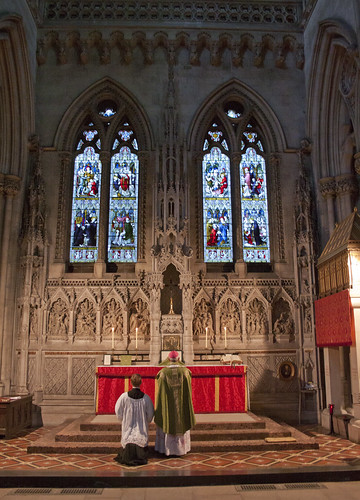
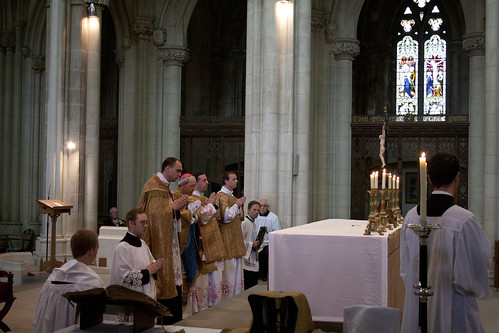
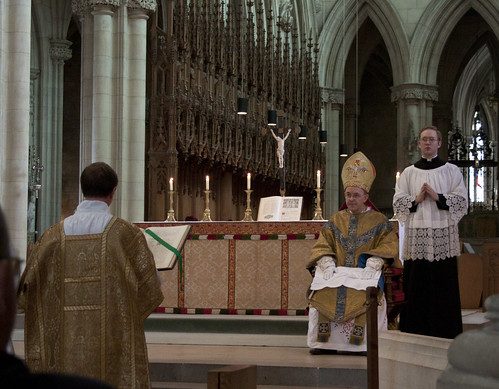
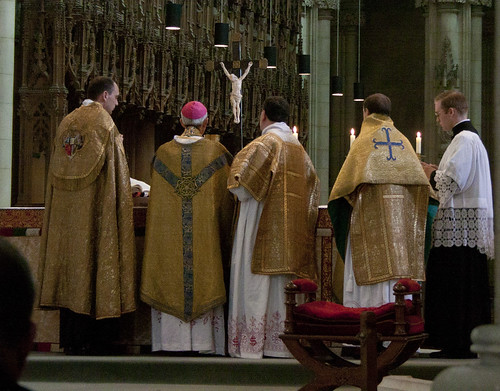
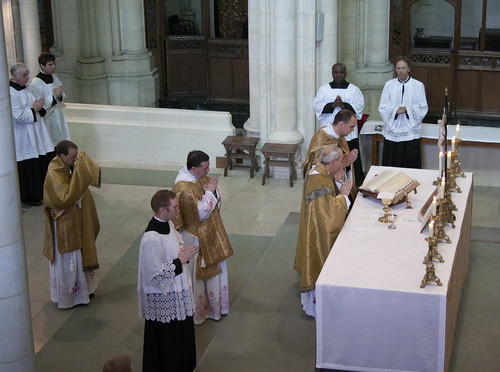
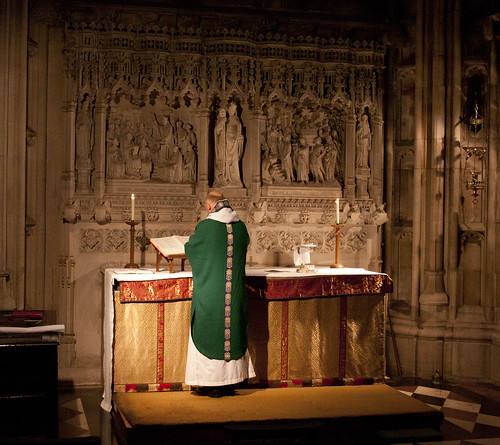
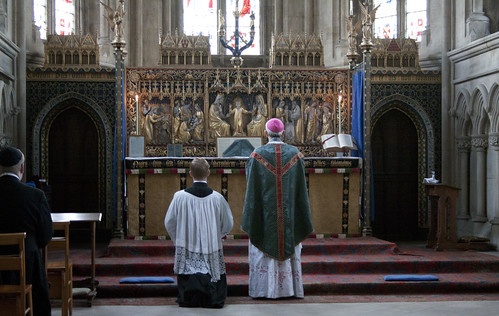
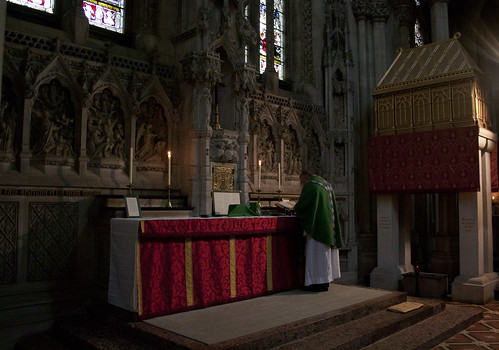
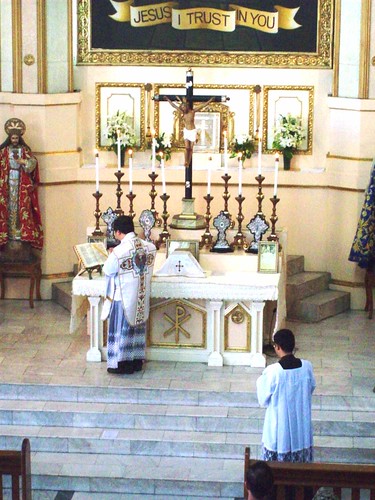
I have posted a photo before of St. Agnes Church on my post dedicated to the errors of Centering Prayer.
The Gospel reading for the 7th Sunday after Pentecost, given on Sunday, 11 July 2010.
The beheading of St. John Baptist, who was put to death by Herod about the feast of Easter. However, his solemn commemoration takes place today, when his venerable head was found for the second time. It was afterwards solemnly carried to Rome, where it is kept in the church of St. Sylvester, near the Campus Martius, and honoured by the people with the greatest devotion.For information on this feastday, please see my post entitled Martyrdom of St. John the Baptist.
Source: pre-1960 Martyrology
In the Office for the Dead throughout the year | |
| Oratio Orémus. Deus, qui inter apostólicos sacerdótes fámulos tuos pontificáli seu sacerdotáli fecísti dignitáte vigére : præsta, quæsumus ; ut eórum quoque perpétuo aggregéntur consórtio. | Collect Let us pray. O God, who didst cause thy servants, for whom we pray, to enjoy the dignity of the priesthood, and some to be bishops, after the order of thine Apostles : grant unto them, we beseech thee, finally to rejoice in the company of those Saints in heaven whose ministry they did sometime share on earth. |
| Deus, véniæ largítor et humánæ salútis amátor : quæsumus cleméntiam tuam ; ut nostræ congregatiónis fratres, propínquos et benefactóres, qui ex hoc sæculo transiérunt, beáta María semper Vírgine intercedénte cum ómnibus Sanctis tuis, ad perpétuæ beatitúdinis consórtium perveníre concédas. | O God, who desirest not the death of a sinner but rather that all mankind should be saved : we beseech thee mercifully to grant that the brethren, kinsfolk, and benefactors of our congregation, who have passed out of this world, may by the intercession of blessed Mary Ever-Virgin and of all thy Saints come to enjoy with them everlasting blessedness. |
| Fidélium, Deus, ómnium cónditor et redémptor, animábus famulórum famularúmque tuárum remissiónem cunctórum tríbue peccatórum : ut indulgéntiam, quam semper optavérunt, piis supplicatiónibus consequántur : Qui vivis et regnas cum Deo Patre in unitáte Spíritus Sancti Deus, per ómnia sæcula sæculórum. R. Amen. | O God, the Creator and Redeemer of all them that believe : grant unto the souls of thy servants and handmaidens the remission of all their sins ; that as they have ever desired thy merciful pardon, so by the supplications of their brethren they may receive the same. Who livest and reignest with the Father, in the unity of the Holy Ghost, ever one God, world without end. R. Amen. |
At Hippo in Africa, the birthday of St. Augustine, bishop and famous doctor of the Church. Converted and baptized by the blessed bishop Ambrose, he defended the Catholic faith with the greatest zeal against the Manicheans and other heretics, and after having sustained many other labours for the Church of God, he went to his reward in heaven. His relics, owing to the invasion of barbarians, were first brought from his own city into Sardinia, and afterwards taken by Luitprand, king of the Lombards, to Pavia, where they were deposited with due honours.
Traditional Matins Reading:
Augustine was born at Tagaste in Africa of noble parents. As a child he was so apt in learning that in a short time he far surpassed in know ledge all those of his own age. When he was a young man he went to Carthage where he fell into the Manichæan heresy. Later on, he journeyed to Rome, and was sent thence to Milan to teach rhetoric. Having frequently listened to the teaching of Ambrose the bishop, he was through his influence inflamed with a desire of the Catholic faith and was baptized by him at the age of thirty-three. On his return to Africa, as his holy life was in keeping with his religion, Valerius the bishop, who was then renowned for his sanctity, ordained him priest. It was at this time that he founded a religious community with whom he lived, sharing their food, and dress, and training them with the utmost care in the rules of apostolic life and teaching. The Manichæan heresy was then growing very strong: he opposed it with great vigour and refuted one of its leaders named Fortunatus.
Valerius perceiving Augustine’s great piety made him his coadjutor in the bishopric. He was always most humble and most temperate. His clothing and his bed were of the simplest kind: he kept a frugal table, which was always seasoned by reading or holy conversation. Such was his loving kindness to the poor, that when he had no other resource, he broke up the sacred vessels, for their relief. He avoided all intercourse and conversation with women, even with his sister and his niece, for he used to say that though such near relatives could not give rise to any suspicion, yet might the women who came to visit them. Never, except when seriously ill, did he omit preaching the word of God. He pursued heretics unremittingly both in public disputations and in his writings, never allowing them to take foothold anywhere; and by these means he almost entirely freed Africa from the Manichees, Donatists and other heretics.
His numerous works are full of piety, deep wisdom and eloquence, and throw the greatest light on Christian doctrine, so that he is the great master and guide of all those who later on reduced theological teaching to method. 'While the Vandals were devastating Africa, and Hippo had been besieged by them for three months, Augustine was seized with a fever. When he perceived that his death was at hand, he had the penitential psalms of David placed before him, and used to read them with an abundance of tears. He was accustomed to say that no one, even though not conscious to himself of any sin, ought to be presumptuous enough to die without repentance. He was in full posses sion of his faculties and intent on prayer to the end. After exhorting his brethren who were around him, to charity, piety and the practice of every virtue, he passed to heaven, having lived seventy-six years, and thirty-six as bishop. His body was first of all taken to Sardinia, afterwards Luitprand, king of the Lombards, translated it to Pavia, where it was honourably entombed.


In the Office for the Dead throughout the year | |
| Oratio Orémus. Deus, qui inter apostólicos sacerdótes fámulos tuos pontificáli seu sacerdotáli fecísti dignitáte vigére : præsta, quæsumus ; ut eórum quoque perpétuo aggregéntur consórtio. | Collect Let us pray. O God, who didst cause thy servants, for whom we pray, to enjoy the dignity of the priesthood, and some to be bishops, after the order of thine Apostles : grant unto them, we beseech thee, finally to rejoice in the company of those Saints in heaven whose ministry they did sometime share on earth. |
| Deus, véniæ largítor et humánæ salútis amátor : quæsumus cleméntiam tuam ; ut nostræ congregatiónis fratres, propínquos et benefactóres, qui ex hoc sæculo transiérunt, beáta María semper Vírgine intercedénte cum ómnibus Sanctis tuis, ad perpétuæ beatitúdinis consórtium perveníre concédas. | O God, who desirest not the death of a sinner but rather that all mankind should be saved : we beseech thee mercifully to grant that the brethren, kinsfolk, and benefactors of our congregation, who have passed out of this world, may by the intercession of blessed Mary Ever-Virgin and of all thy Saints come to enjoy with them everlasting blessedness. |
| Fidélium, Deus, ómnium cónditor et redémptor, animábus famulórum famularúmque tuárum remissiónem cunctórum tríbue peccatórum : ut indulgéntiam, quam semper optavérunt, piis supplicatiónibus consequántur : Qui vivis et regnas cum Deo Patre in unitáte Spíritus Sancti Deus, per ómnia sæcula sæculórum. R. Amen. | O God, the Creator and Redeemer of all them that believe : grant unto the souls of thy servants and handmaidens the remission of all their sins ; that as they have ever desired thy merciful pardon, so by the supplications of their brethren they may receive the same. Who livest and reignest with the Father, in the unity of the Holy Ghost, ever one God, world without end. R. Amen. |
"O God! by Whose word and power all things have been created, by Whose will all things are directed, we humbly beseech Thy Majesty, Who art the joy and gladness of all the faithful, that Thou wouldst deign in Thy fatherly love to bless and sanctify this rose, most delightful in odour and appearance, which we this day carry in sign of spiritual joy, in order that the people consecrated by Thee and delivered from the yoke of Babylonian slavery through the favour of Thine only-begotten Son, Who is the glory and exultation of the people of Israel and of that Jerusalem which is our Heavenly mother, may with sincere hearts show forth their joy. Wherefore, O Lord, on this day, when the Church exults in Thy name and manifests her joy by this sign [the rose], confer upon us through her true and perfect joy and accepting her devotion of today; do Thou remit sin, strengthen faith, increase piety, protect her in Thy mercy, drive away all things adverse to her and make her ways safe and prosperous, so that Thy Church, as the fruit of good works, may unite in giving forth the perfume of the ointment of that flower sprung from the root of Jesse and which is the mystical flower of the field and lily of the valleys, and remain happy without end in eternal glory together with all the saints."The prayer finished, the pope puts incense (handed by the cardinal-deacon) into the censer and incenses the balsam and then the musk, and afterwards puts the balsam and powdered musk into the tiny cup in the heart of the principal rose. He then incenses the rose and sprinkles it with holy water. It is then given to the youngest cleric of the Camera, who carries it in front of the pope to the chapel, where it is placed on the altar at the foot of the cross upon a richly embroidered silk veil, where it remains during the Mass sung by the first cardinal-priest. After the Mass, the rose is carried in procession before the pope to the sacristy, where it is carefully put away in a place set apart for it, until bestowed upon some worthy personage.
The apostle St. Bartholomew, who preached the Gospel of Christ in India. Passing thence into the Greater Armenia where, after converting many to the faith, he was flayed alive by the barbarians, and having his head cut off by order of King Astyages, he fulfilled his martyrdom. His holy body was first carried to the island of Lipara, then to Benevento, and finally to Rome in the Island of the Tiber, where it is venerated by the pious faithful.
Source: Pre-1960 Martyrology
The Saturday Mass of the BVM is 4th. Class, not 3rd. Class. It is said on any Saturday of the year which otherwise would have been a 4th. class Ferial Day if it fell on Monday-Friday.This is the normal, "obligatory" Mass (i.e. the Mass of the day per the rubrics) on Saturdays of the 4th. class which means it is not a Votive Mass (a Mass proper said by choice as allowed), strictly speaking.
The Mass "Rorate" in Advent is a Votive Mass of the 3rd. class, but this differs from the above because this Mass can be said by choice (and not by assigned "obligation") on any day not ranked I or II Class during Advent.The following text is of the propers of the Mass as said on those Saturdays and Votive Masses After Trinity Sunday until Advent (Salve of the Blessed Virgin). The other four versions have slight variations in the proper prayers and are grouped into the following categories: In Advent (Rorate Coeli of the Blessed Virgin), From the Epiphany to the Purification (Vultum Tuum of the Blessed Virgin), From the Purification until Shrove Tuesday (Salve of the Blessed Virgin), and In Eastertide (Salve of the Blessed Virgin)
| Salve Sancta Parens, enixa purerpera Regem: qui coelum terramque regit in saecula saeculorum.(Psalm) Eructavit cor meum verbum bonum: dico ego opera mea regi. Gloria Patri. Salve Sancta Parens, enixa purerpera... | Hail, holy Parent, that didst bring forth the King Who ruleth heaven and earth for ever and ever.(Psalm) My heart hath uttered a good work: I speak of my works to the King. Glory be to the Father. Hail, holy Parent.... |
| Concede nos famulos tuos, quaesumus, Domine Deus perpetua mentis et corporis sanitate gaudere, et gloriosa beatae Mariae semper Viginis intercessione, a praesenti liberari tristitia, et aeterna perfrui laetitia. Per Dominum nostrum. | Grant to us Thy servants, we beseech Thee, O Lord God, that we may enjoy perpetual health of mind and body; and through the intercession of blessed Mary ever Virgin may be delivered from present sorrow and possess eternal joy. Through our Lord. |
| Ab initio, et ante sawedcula cretat sum, et usque ad futurum saeculum non desinam, et in havitatione sancta coram ipso ministravi. Et sic in Sion firmata sum, et in civitate sanctificata similiter requievi, et in Jerusalem potestas mea. Et radicavi in populo honorificato, et in parte Dei mei haereditas illius, et in plenitudine sanctorum detentio mea. | From the beginning, and before the world, was I created, and unto the world to come I shall not cease to be, and in the holy dwelling place I have ministered before him. And so was I established in Sion, and in the holy city likewise I rested, and my power was in Jerusalem. And I took root in an honorable people, and in the portion of my God his inheritance, and mine abode is in the full assembly of saints. |
| Benedicta et venerabilis es, Virgo Maria: quae sine tactu pudoris inventa es mater Salvatoris. Virgo De Genitrix, quem totus non capit oribis in tua se clausit viscera factus homo. | Blessed and venerable art thou, O Virgin Mary: who without loss of purity wert found to be the Mother of our Savior. Virgin Mother of God, He Whom the whole world cannot hold enclosed Himself in thy womb, and became man. |
| Alleluia, alleluia. Post partum Virgon inviolata permansisti: Dei Genitrix intercdede pro nobis. Alleluia. | Alleluia, alleluia. After His birth a Virgin entire thou dost remain: O Mother of God, intercede for us. Alleluia. |
| In illo tempore: Loquente Jesu ad turbas, extollens vocem quaedam mulier de turba, dixit illi: Beatus venter qui te portavit et ubera, quae suxisti. At ille dixit: Quinimo beati, qui audiunt verbum Dei, et custodiunt illud. | At that time, as Jesus was speaking to the multitudes, a certain woman from the crowd, lifting up her voice from the crowd, lifting up her voice, said to Him: Blessed is the womb that bore Thee and the paps that gave Thee suck. But He said: Yea rather, blessed are they who hear the word of God and keep it. |
| Ave Maria, gratia plena: Dominus tecum: benedicta tu in mulieribus, et benedicta tu in mulieribus, et benedictus fructus ventris tui. | Hail Mary, full of grace, the Lord is with thee blessed art thou among women and blessed is the fruit of thy womb. |
| Tua Domine, propitiatione et beatae Mariae sumper Virginis intercessione, ad perpetuam atque praesentem haec oblatio nobis proficiat proseperitatem et pacem. Per Dominum nostrum. | By Thy gracious mercy, O Lord, and the intercession of blessed Mary ever Virgin, may this offering be of avail to us for welfare and peace now and for evermore. Through our Lord. |
| Vere dignum et justum est, aequum et salutare, nos tibi semper, et ubique gratias agere: Domine sancte, Pater omnipotens, aeterne Deus. Et te in Assumptione beatae Mariae semper Virginis collaudare, benedicere, et praedicare. Quae et Unigenitum tuum Sancti Spiritus obumbratione concepit: et virginitatis gloria permanente, lumen aeternum mundo effudit, Jesum Christum Dominum nostrum. Per quem majestatem tuam laudant Angeli, adorant Dominationes, tremunt Potestates. Coeli, coelorumque Virtutes, ac beata Seraphim, socia exsultatione concelebrant. Cum quibus et nostras voces, ut admitti jubeas deprecamur, supplici confessione dicentes: | It it truly meet and just, right and for our salvation, that we should at all times, and in all places, give thanks unto Thee, O holy Lord, Father almighty, everlasting God: and that we should praise and bless, and proclaim Thee, in the Festivity of the Blessed Mary, ever-Virgin: Who also conceived Thine only-begotten Son by the overshadowing of the Holy Ghost, and the glory of her virginity still abiding, gave forth to the world the everlasting Light, Jesus Christ our Lord. Through whom the Angels praise Thy Majesty, the Dominations worship it, and the Powers stand in awe. The Heavens and the heavenly hosts together with the blessed Seraphim in triumphant chorus unite to celebrate it. Together with these we entreat Thee that Thou mayest bid our voices also to be admitted while we say with lowly praise: |
| Beata viscera Mariae Virginis, quae portaverunt aeterni Patris Filium. | Blessed is the womb of the Virgin Mary, which bore the Son of the Eternal Father. |
| Sumptis, Domine, salutis nostrae subsidiis: da, quaesumus, beatae Mariae semper Virginis patrociniis nos ubique protegi : in cugus veneratione haec tuae obtulimus majestati. Per Dominum nostrum. | O Lord, grant, we beseech Thee, that we who have received these aids unto salvation, may be always and everywhere protected by the intercession of blessed Mary ever Virgin, in whose honor we offered this Sacrifice to Thy Majesty. Through our Lord. |
Look, my daughter, at my Heart encircled by these thorns with which men pierce it at every moment by their blasphemies and ingratitude. You, at least, strive to console me, and so I announce: I promise to assist at the hour of death with the grace necessary for salvation all those who, with the intention of making reparation to me, will, on the first Saturday of five consecutive months, go to confession, receive Holy Communion, say five decades of the beads, and keep me company for fifteen minutes while meditating on the fifteen mysteries of the Rosary.The First Saturday Devotion consists of offering the First Saturday of the month for five consecutive months in reparation for the many and grievous sins committed in our world. A further explanation of our Lady's request is below:
The Little Office of the Blessed Virgin Mary is a shorter form of the Divine Office in honour of the Blessed Virgin Mary. It has long been the Church’s daily liturgical prayer to Our Lady, and these hours of praise have been used by Priests, religious and the laity throughout the centuries. Lay people used to flock to the great Cathedrals to publicly recite The Little Office during the Middle Ages, and during the great persecution, when the practice of the Catholic Faith was illegal in Great Britain, Bishop Challoner commended The Little Office to his flock.
Through its psalms, antiphons, readings, responsorials, and prayers the Little Office stresses the role Our Lady played in salvation history, and how through her fiat the divine Word took flesh in her womb and achieved salvation for us all; and how Our Lord granted her the first fruits of the general resurrection in her holy and glorious assumption.
All Catholics are called to a consistent prayer life. For those who do not feel called to recite the Divine Office, but still wish to participate in the liturgical prayer of the Church, or for those who have a particular devotion to the holy Mother of God, there is no finer form of prayer than the Little Office of the Blessed Virgin Mary.
In 1840, Mary appeared to Sister Justine Bisqueyburu (a Seminary Sister of the Daughters of Charity) in Paris, France and commended the Green Scapular to her. It's known as "the Scapular of Conversion," and its promises are the strengthening of faith, protection against Satan, a happy death for Catholics, and, most of all, for conversion for those outside the Church. It's to be worn or carried by the faithful, or given to an unbeliever for their conversion.
The following prayer is to be said daily by the wearer:
Immaculate Heart of Mary, pray for us now and at the hour of our death
Latin version:
Cor immaculatum Mariae, ora pro nobis nunc et in hora mortis nostrae
If the scapular is given to an unbeliever for their conversion, the person giving the scapular prays the prayer for them if the unbeliever does not want to pray the prayer himself. If the unbeliever does not want the scapular, it may be hidden in their vicinity and the prayers said for him. Enrollment in a Confraternity is not necessary for this scapular, but the scapular should be blessed by a priest before use.
22. It is not lawful to keep the priest at the altar waiting on account of the chant or the music for a length of time not allowed by the liturgy. According to the ecclesiastical prescriptions the Sanctus of the Mass should be over before the elevation, and therefore the priest must here have regard for the singers. The Gloria and the Credo ought, according to the Gregorian tradition, to be relatively short.