However, at this time, I do wish to thank everyone who regularly reads this blog. I am thankful for the 5.5 years of blogging on A Catholic Life, and I hope for many additional years!
Thursday, September 16, 2010
However, at this time, I do wish to thank everyone who regularly reads this blog. I am thankful for the 5.5 years of blogging on A Catholic Life, and I hope for many additional years!
Wednesday, September 15, 2010
In the past I have mentioned Romanitas Press, and I wish to again mention their products. The company offers a highly practical SERVERS' MASS RESPONSE CARD which is explained below
AN EASY-TO-USE training guide for teaching the proper liturgical pronunciation of the Latin responses made by the altar server at Mass.
The card's exterior partitions contain the Latin responses with their corresponding English phonetic renderings per the more romano (like the Romans) liturgical pronunciation as endorsed by Popes St. Pius X, Benedict XV, and Pius XI.
Also included are expanded rubrical instructions for the liturgical gestures and reverences made in connection with the responses, and the responses made when serving for a bishop. The layout of the exterior partitions was carefully arranged to allow card’s use at the altar if necessary.
The card’s inside partitions contain helpful explanations and basic rules about making the responses, more romano pronunciation, a list of common pronunciation mistakes made by English-speakers, and even several informative and authoritative footnotes.
Red and black text was printed on heavy matte paper stock (to keep the card stiff when being held), then coated with a matte varnish to increase the anti-glare property and protect the card from moisture and frequent use.
Measures folded at 11 14/16" x 4¼" (folds out completely to 17” wide).
Read more >>
AN EASY-TO-USE training guide for teaching the proper liturgical pronunciation of the Latin responses made by the altar server at Mass.
The card's exterior partitions contain the Latin responses with their corresponding English phonetic renderings per the more romano (like the Romans) liturgical pronunciation as endorsed by Popes St. Pius X, Benedict XV, and Pius XI.
Also included are expanded rubrical instructions for the liturgical gestures and reverences made in connection with the responses, and the responses made when serving for a bishop. The layout of the exterior partitions was carefully arranged to allow card’s use at the altar if necessary.
The card’s inside partitions contain helpful explanations and basic rules about making the responses, more romano pronunciation, a list of common pronunciation mistakes made by English-speakers, and even several informative and authoritative footnotes.
Red and black text was printed on heavy matte paper stock (to keep the card stiff when being held), then coated with a matte varnish to increase the anti-glare property and protect the card from moisture and frequent use.
Measures folded at 11 14/16" x 4¼" (folds out completely to 17” wide).
Tuesday, September 14, 2010
Today we commemorate the great Feast of the Exaltation of the Holy Cross. Today is also the 3rd Anniversary of the implementation of Pope Benedict XVI's Summorum Pontificum. For this day I wish to highlight some of my past posts.
Exaltation of the Holy Cross
Today is the Feast of the Exaltation of the Holy Cross, where we recall the triumph of the Cross against sin, satan, and death as well as fact that when we are baptized each one of us becomes part of Christ on His Cross so that through our daily crosses we may be brought to the Resurrection (Luke 9:23, 24).
"The Cross is more than something to be looked at. It’s something to join. The Cross is an invitation to the Christian to join Jesus on the Cross. Oftentimes, this is a part of the mystery of the cross we just don’t understand. There are many references in Sacred Scripture that tell us that we are invited to participate in the cross. Jesus said, "What I have done, so must you do also." He said that on Holy Thursday after He washed feet, but what He meant was, "If I have been a servant, then you too must be a servant. If I have washed feet, you must wash feet. And if I have suffered, so you must suffer." It says elsewhere in the scriptures, "Where I have gone, you must follow." In 1st Peter it is so clear – "Christ suffered for you, and left you an example to have you follow in His footsteps."
Continue Reading...
The Anniversary of Summorum Pontificum
It is at this time that I wish to especially remember Archbishop Marcel Lefebvre, who resisted the Second Vatican Council's false propositions of ecumenism, religious liberty, and the altering of the Mass of All Times. It is through his witness and the formation of the Priestly Fraternity of St. Pius X (SSPX) that the Mass of All Times has spread. And, I will venture to say that without Archbishop Marcel Lefebvre's role, the Traditional Latin Mass would have been at last forgotten and no organized resistance to the change would have existed.It is Archbishop Lefebvre who has been slandered in recent years. The cause of canonization of his saintly mother has long been forgotten. Instead, in the words of Bishop Bernard Fellay during a sermon in Paris following Archbishop Lefebvre's death said, "Archbishop Lefebvre has gone, but the Mass is saved, the Catholic priesthood is saved..." Because of his resistance to all of changes affecting all of the Sacraments, the Society of St. Pius X is largely responsible for Pope Benedict XVI's issuance of the motu proprio and then the clear declaration that the Bishops of the Society of St. Pius X consecrated by Archbishop Marcel Lefebvre are not excommunicated.
In the words of Father Franz Schmidberger at the Requiem Mass of Archbishop Lefebvre, "The work of the Archbishop on this earth is accomplished. Now begins his ministry as intercessor in eternity. He has given everything he could give...the miracle of a new generation of priests."
...
Our Holy Father has shown us that through his pontificate, the Sacred Traditions of our Holy Faith are being rightfully restored to their former glory. Let's look at some examples of restoration by Pope Benedict XVI.
In August 2006, Pope Benedict XVI abolished the Christmas concert featuring "pop" music established by Pope John Paul II. In January 2007, he called on the Vatican Courts to tighten up the annulment criteria, as annulments have exponentially increased following Vatican II. Pope Benedict XVI has further restored the use of the Pascal Mozetta in the Octave of Easter 2008.
Continue Reading...
Read more >>
Exaltation of the Holy Cross
Today is the Feast of the Exaltation of the Holy Cross, where we recall the triumph of the Cross against sin, satan, and death as well as fact that when we are baptized each one of us becomes part of Christ on His Cross so that through our daily crosses we may be brought to the Resurrection (Luke 9:23, 24).
"The Cross is more than something to be looked at. It’s something to join. The Cross is an invitation to the Christian to join Jesus on the Cross. Oftentimes, this is a part of the mystery of the cross we just don’t understand. There are many references in Sacred Scripture that tell us that we are invited to participate in the cross. Jesus said, "What I have done, so must you do also." He said that on Holy Thursday after He washed feet, but what He meant was, "If I have been a servant, then you too must be a servant. If I have washed feet, you must wash feet. And if I have suffered, so you must suffer." It says elsewhere in the scriptures, "Where I have gone, you must follow." In 1st Peter it is so clear – "Christ suffered for you, and left you an example to have you follow in His footsteps."
Continue Reading...
The Anniversary of Summorum Pontificum
It is at this time that I wish to especially remember Archbishop Marcel Lefebvre, who resisted the Second Vatican Council's false propositions of ecumenism, religious liberty, and the altering of the Mass of All Times. It is through his witness and the formation of the Priestly Fraternity of St. Pius X (SSPX) that the Mass of All Times has spread. And, I will venture to say that without Archbishop Marcel Lefebvre's role, the Traditional Latin Mass would have been at last forgotten and no organized resistance to the change would have existed.It is Archbishop Lefebvre who has been slandered in recent years. The cause of canonization of his saintly mother has long been forgotten. Instead, in the words of Bishop Bernard Fellay during a sermon in Paris following Archbishop Lefebvre's death said, "Archbishop Lefebvre has gone, but the Mass is saved, the Catholic priesthood is saved..." Because of his resistance to all of changes affecting all of the Sacraments, the Society of St. Pius X is largely responsible for Pope Benedict XVI's issuance of the motu proprio and then the clear declaration that the Bishops of the Society of St. Pius X consecrated by Archbishop Marcel Lefebvre are not excommunicated.
In the words of Father Franz Schmidberger at the Requiem Mass of Archbishop Lefebvre, "The work of the Archbishop on this earth is accomplished. Now begins his ministry as intercessor in eternity. He has given everything he could give...the miracle of a new generation of priests."
...
Our Holy Father has shown us that through his pontificate, the Sacred Traditions of our Holy Faith are being rightfully restored to their former glory. Let's look at some examples of restoration by Pope Benedict XVI.
In August 2006, Pope Benedict XVI abolished the Christmas concert featuring "pop" music established by Pope John Paul II. In January 2007, he called on the Vatican Courts to tighten up the annulment criteria, as annulments have exponentially increased following Vatican II. Pope Benedict XVI has further restored the use of the Pascal Mozetta in the Octave of Easter 2008.
Continue Reading...
Monday, September 13, 2010
On Tuesday (Sept 14), a HIGH Mass will be celebrated at Queen of Peace at 7 PM in honor of the 3-year anniversary of the institution of Summorum Pontificum, the Apostolic Letter of Pope Benedict XVI granting greater freedom to priests who wish to celebrate the Traditional Latin Mass and the Faithful who wish access to it. Let us remember to thank Our Blessed Lord on this anniversary for the tremendous gift of the ancient Mass and ask him to bless Our Holy Father Benedict XVI with holiness and good health for many years to come.
Queen of Peace is located in Patton, PA. The full address is 907 Sixth Ave, Patton, PA 16668
Celebrated in accordance with the expressed wishes of Pope Benedict XVI, with the official support of Bishop Joseph Adamec and Archabbot Douglas Nowicki, OSB.
"What earlier generations held as sacred remains sacred and great for us, too.... It behooves all of us to preserve the riches which have developed in the Church's faith and prayer and to give them their proper place.” -- Pope Benedict XVI, Summorum Pontificum
Read more >>
Queen of Peace is located in Patton, PA. The full address is 907 Sixth Ave, Patton, PA 16668
"What earlier generations held as sacred remains sacred and great for us, too.... It behooves all of us to preserve the riches which have developed in the Church's faith and prayer and to give them their proper place.” -- Pope Benedict XVI, Summorum Pontificum
Sunday, September 12, 2010
With the upcoming beatification of John Henry Cardinal Newman, I wish to highlight some of his best works that I would recommend to those seeking to learn from this holy man. Formerly a priest in the Church of England, Newman was received into the Roman Catholic Church on 9 October 1845.
In his early life, he was a major figure in the Oxford Movement to bring the Church of England back to its Catholic roots. Eventually his studies in history persuaded him to become a Catholic. Both before and after becoming a Catholic, he wrote influential books, including Via Media, Essay on the Development of Christian Doctrine (1845), Apologia Pro Vita Sua (1865–66) and the Grammar of Assent (1870).
One of his most powerful statements which I have mentioned in prior posts is his words: "To know history is to cease to be protestant."
1. An Essay on the Development of Christian Doctrine (A classic and a must read for anyone that reads Newman)
2. The Apologia Pro Vita Sua (Now a Classic in Western literature)
3. 3ed of the preface of the Via Media (very good also, talks about the roles of the Church as priest, prophet and king)
4. An Essay in Aid of a Grammar of Assent (A more philosophical work; very good also)
5. Many of the sermons (very powerful and critical of 19th century culture and reflections on the human condition. Furthermore it concerns itself with hell and the afterlife)
Read more >>
In his early life, he was a major figure in the Oxford Movement to bring the Church of England back to its Catholic roots. Eventually his studies in history persuaded him to become a Catholic. Both before and after becoming a Catholic, he wrote influential books, including Via Media, Essay on the Development of Christian Doctrine (1845), Apologia Pro Vita Sua (1865–66) and the Grammar of Assent (1870).
One of his most powerful statements which I have mentioned in prior posts is his words: "To know history is to cease to be protestant."
1. An Essay on the Development of Christian Doctrine (A classic and a must read for anyone that reads Newman)
2. The Apologia Pro Vita Sua (Now a Classic in Western literature)
3. 3ed of the preface of the Via Media (very good also, talks about the roles of the Church as priest, prophet and king)
4. An Essay in Aid of a Grammar of Assent (A more philosophical work; very good also)
5. Many of the sermons (very powerful and critical of 19th century culture and reflections on the human condition. Furthermore it concerns itself with hell and the afterlife)
Below is the itinerary for Pope Benedict XVI's visit to the United Kingdom, scheduled to take place over the course of September 16 - 19, 2010. Stay tuned to this blog as we will blog throughout the course of the Pope's visit to the United Kingdom.
To begin, see my recommended works/texts by Cardinal Newman.
September 16
September 17
September 18
September 19
To begin, see my recommended works/texts by Cardinal Newman.
September 16
- Depart Rome at 8:10 a.m.
- Arrival at the international airport of Edinburgh, Scotland at 10:30.
- Welcome Ceremony at the Royal Palace of Holyroodhouse in Edinburgh, where he will make a courtesy visit to Queen Elizabeth II.
- At 11:40, the Holy Father will address the authorities in the park of the palace
- Lunch in the archbishop's residence in that same city.
- Mass at 5:15 p.m. in Bellahouston Park in Glasgow, Scotland.
- After the Mass, he will depart by plane from Glasgow to London.
September 17
- He will begin the morning by saying a private Mass at the apostolic nunciature in Wimbledon.
- At 10:00 a.m. he will give an address to leaders from the world of Catholic education at an event in the sports field of St. Mary's University College in Twickenham.
- Pontiff will meet with leaders of other religions in the Waldegrave Drawing Room of that same college.
- He will pay a special courtesy visit to the Anglican archbishop of Canterbury, Rowan Williams, in Lambeth Palace. The Holy Father will give an address in the presence of the other Anglican "bishops" as well as the Catholic prelates of England and Wales.
- 5:10 P.M.: Benedict XVI is scheduled to go to Westminster Hall to address representatives of the civil society, as part of his State visit. He will meet with civil leaders from the worlds of academics, culture and business, with the diplomatic corps, and with other religious leaders.
- Pope will conclude that day by participating in an ecumenical celebration in Westminster Abbey along with the archbishop of Canterbury and other Christian leaders.
September 18
- Morning meeting with Prime Minister David Cameron and other government leaders in the archbishop's palace.
- At 10:00 a.m., the Holy Father will celebrate Mass in the Cathedral of the Most Precious Blood of Our Lord Jesus Christ, also known as Westminster Cathedral, where he will greet the people of Wales.
- Young people will gather in the plaza outside the cathedral to greet Benedict XVI after the Mass.
- The Pope will visit St. Peter's residential home for the elderly in the evening to greet those who are unable to travel to see him, and will then participate in a prayer vigil in Hyde Park.
September 19
- Pontiff will leave Wimbledon by helicopter for Birmingham, where he will arrive at 9:30 a.m.
- At 10:00, he will celebrate Mass and the beatification of Cardinal John Henry Newman in Cofton Park of Rednal in Birmingham. The Holy Father will give the homily and, after Mass, will recite the Angelus with the pilgrims gathered there.
- He will make a private visit to the oratory of St. Philip Neri, where he will be the first person to pray at the new shrine for Cardinal Newman, who will at that time be beatified.
- Benedict XVI will conclude his visit with a meeting with the bishops of Scotland, England and Wales,
- Ddepart Birmingham by plane for Rome at 6:45 p.m.
- Arrival in Rome at 10:30.
Saturday, September 11, 2010
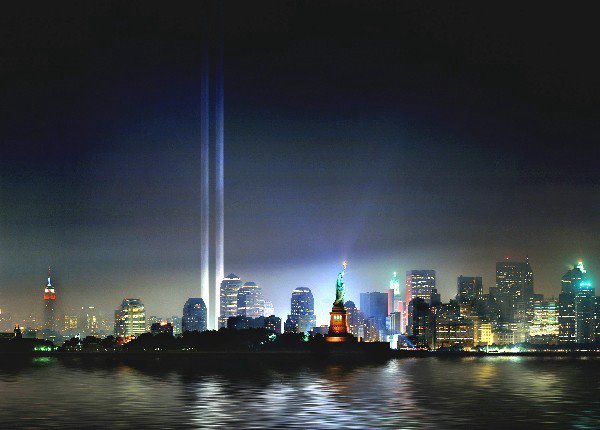
Let us never forget September 11th, 2001, and the great people who died on that day. May God Bless America and may America praise and glorify God.Image Source: Associated Press
Friday, September 10, 2010
I feel that the overall resistance to the Traditional Latin Mass and many of its traditional teachings (e.g. no salvation outside of the Church, necessity of Baptism for salvation, the existence of an eternal hell, et cetera) is attributable to a pervasive lack of faith and spiritual laxity that have penetrated our culture. Our culture has not only neglected the Faith of our Fathers but has repudiated traditional and time-tested philosophies, governments, ways of public conduct, attire, etc. Some would say that the cause of discord in the Church originated at the 2nd Vatican Council. While I do feel that the Council was one of the most debilitating assaults to the traditional faith, our world has been suffering from a pernicious cancer induced during the Enlightenment. The philosophers of the enlightened led to the French Revolution and the essential collapse of Catholicism in what was once regarded the most Catholic nation in the world. Since that time we have seen mankind exalted and the faith and piety of many vanish.
Our Blessed Lady’s appearance in Fatima (1917) illustrates the revolution in the hearts of mankind long before the Council. And, recall Our Lady’s similar appearance in La Salette (1846). Our world has been rebelling against authority, against traditional manners of dress and practices of sexuality, etc, etc for generations. And it was this modernism that was so forcefully condemned by His Holiness Pope St. Pius X. Unfortunately, modernism – the true cause of our problems – has been misunderstood. We are certainly – and should not be – opposed to advances in technologies and ways of life that improve our living. However, modernism the heresy is the movement in Roman Catholic thought that sought to interpret the teachings of the Church in the light of philosophic and scientific conceptions prevalent in the late 19th and early 20th centuries.
Unfortunately, modernism entered the ranks of some prominent members of the clergy in the 1950s and 1960s leading to the collapse of interior piety and reverence as well as the exterior visibility of our internal faith (e.g. genuflections, public processions, etc). It was precisely this school of thought of modernism that individuals present at the Council sought to fight – people like Archbishop Marcel Lefebvre. Unfortunately, the members of the clergy who consented to the enlightenment philosophies have worked exceedingly hard to tarnish the name and reputation of His Grace Marcel Lefebvre and any Catholics who wish to attend the Mass of the Saints. Have you noticed that of all priests canonized as of this point, none of them said the Novus Ordo Mass.
I would highly recommend that you read “Apologia Pro Marcel Lefebvre” by Michael Davies. There are also other sophisticated accounts behind your question on why the clergy can seem so opposed to the Traditional Mass. One such account which details the modernistic influence at the Council is “Rhine Flows Into the Tiber”
Read more >>
Unfortunately, modernism entered the ranks of some prominent members of the clergy in the 1950s and 1960s leading to the collapse of interior piety and reverence as well as the exterior visibility of our internal faith (e.g. genuflections, public processions, etc). It was precisely this school of thought of modernism that individuals present at the Council sought to fight – people like Archbishop Marcel Lefebvre. Unfortunately, the members of the clergy who consented to the enlightenment philosophies have worked exceedingly hard to tarnish the name and reputation of His Grace Marcel Lefebvre and any Catholics who wish to attend the Mass of the Saints. Have you noticed that of all priests canonized as of this point, none of them said the Novus Ordo Mass.
I would highly recommend that you read “Apologia Pro Marcel Lefebvre” by Michael Davies. There are also other sophisticated accounts behind your question on why the clergy can seem so opposed to the Traditional Mass. One such account which details the modernistic influence at the Council is “Rhine Flows Into the Tiber”
Thursday, September 9, 2010
Definitely an appropriate read at this time of year since we just celebrated the Feast of St. Pius X (September 3) and the 100th Anniversary of the Oath Against Modernism (September 1).
Wednesday, September 8, 2010
Today is the Nativity of the Blessed Virgin Mary. Please see my prior post for sermons and prayers for this day.
Prayer:
Bestow upon Thy servants, we beseech Thee, O Lord, the gift of Thy heavenly grace: that as the childbearing of the Blessed Virgin was the beginning of our salvation, so the solemn feast of her Nativity may bring us an increase of peace. Through our Lord.
Read more >>
Prayer:
Bestow upon Thy servants, we beseech Thee, O Lord, the gift of Thy heavenly grace: that as the childbearing of the Blessed Virgin was the beginning of our salvation, so the solemn feast of her Nativity may bring us an increase of peace. Through our Lord.
Tuesday, September 7, 2010
Through the providential gift of the Holy Father's Motu Proprio Summorum Pontificum, Ss. Peter and Paul in Wisconsin Rapids will begin to offer the Extraordinary Form of the Roman Rite on the First Sunday of the month at 4 PM. This will begin the 3rd of October of this year. The Institute of Christ King will be offering the Holy Mass.
A Facebook group promoting the occasion has been created.
Sunday, September 5, 2010
LMS Chairman has shared some very beautiful images of the Liturgy celebrated as part of a pilgrimage. You can see two very different sanctuaries in these photos yet both successfully convey the holiness of that which belongs to God alone.
Read more >>
The blog Salvem to Liturgy, features these photos from today of a priest celebrating the traditional Mass at the altar of St. Joseph of St. Peter's Basilica in Rome.
Read more >>
Saturday, September 4, 2010
Romanitas Press has successfully republished this classic text of Reverend Edwin Ryan on Candles in the Roman Rite. Description and Photos of this product follow.
CANDLES IN THE ROMAN RITE
Rev. Edwin Ryan, D.D.
3rd edition; 1937
IN the Catholic Faith, candles not only represent “the True Light Which enlightens every man who comes into the world” but much more besides! Discover the rich symbolism and ancient history surrounding the use of church candles in this fascinating, illustrated book. Educate yourself about the rules and practices concerning candles in the Roman Rite through chapters that cover Masses offered by a priest or bishop, a sick call, the Divine Office and even when administering the other Sacraments or for other solemn occasions.
Last published in 1937 and simply written by noted American professor of liturgy, Fr. Edwin Ryan, this large format 36-page book (originally intended as an advertising medium for the now defunct Gross Candle Co.) is also unique and interesting for its wonderful illustrations.
Created especially for this book by artists, Terence J. Hughes and James R. Howard, the illustrations are a combination of vivid watercolors and striking black and white line drawings of altars decorated with candles according to rules of the Roman Church. The illustrations are even more interesting for showing properly constructed altars decorated with a full array of flowers (in the Roman fashion), antependiums, conopaeums, pavement candles, candelabra, and even riddel post curtains and candles.
Perfect for any Catholic (cleric or laic) who wishes to learn more about the traditional Latin Mass. Especially appropriate for sacristans, altar servers, church artisans, ladies’ altar guilds and parish florists. Also a great reference for seminaries, catechism classes, and Catholic libraries.
BOOK REVIEW
Yet another fine reprint from Romanitas Press, this book does not fail either in quality of content or quality of stock. It was originally published by the advertising department of the A. Gross Candle Co., Inc. of Baltimore, Maryland. Romanitas Press has done it again by finding this rare but important work and making it available.
Upon reading the book, one finds out how much they do not know about the use of candles in the Roman Rite. So many of us have been to Mass how many thousands times, always noticing the lit candles on the altar but never putting much thought into why the candles are there and what they symbolize.
Candles gives you the "how" (the rubrics) and the "why" (this history and symbolism) of the use of candles. A nugget of teaching from the book: "The custom of making church candles from beeswax was suggested from the then supposed virginity of bees, their wax being taken as a symbol of the Body of the Redeemer derived from His Virgin Mother, an interpretation which retains its beauty even though the biological concept underlying it has been long since rejected."
Anyone with an interest in the rituals of the Catholic Church will find Candles in the Roman Rite to be a fine addition to their liturgical library. Review by www.churchlatin.com
Read more >>
CANDLES IN THE ROMAN RITE
Rev. Edwin Ryan, D.D.
3rd edition; 1937
IN the Catholic Faith, candles not only represent “the True Light Which enlightens every man who comes into the world” but much more besides! Discover the rich symbolism and ancient history surrounding the use of church candles in this fascinating, illustrated book. Educate yourself about the rules and practices concerning candles in the Roman Rite through chapters that cover Masses offered by a priest or bishop, a sick call, the Divine Office and even when administering the other Sacraments or for other solemn occasions.
Last published in 1937 and simply written by noted American professor of liturgy, Fr. Edwin Ryan, this large format 36-page book (originally intended as an advertising medium for the now defunct Gross Candle Co.) is also unique and interesting for its wonderful illustrations.
Created especially for this book by artists, Terence J. Hughes and James R. Howard, the illustrations are a combination of vivid watercolors and striking black and white line drawings of altars decorated with candles according to rules of the Roman Church. The illustrations are even more interesting for showing properly constructed altars decorated with a full array of flowers (in the Roman fashion), antependiums, conopaeums, pavement candles, candelabra, and even riddel post curtains and candles.
Perfect for any Catholic (cleric or laic) who wishes to learn more about the traditional Latin Mass. Especially appropriate for sacristans, altar servers, church artisans, ladies’ altar guilds and parish florists. Also a great reference for seminaries, catechism classes, and Catholic libraries.
BOOK REVIEW
Yet another fine reprint from Romanitas Press, this book does not fail either in quality of content or quality of stock. It was originally published by the advertising department of the A. Gross Candle Co., Inc. of Baltimore, Maryland. Romanitas Press has done it again by finding this rare but important work and making it available.
Upon reading the book, one finds out how much they do not know about the use of candles in the Roman Rite. So many of us have been to Mass how many thousands times, always noticing the lit candles on the altar but never putting much thought into why the candles are there and what they symbolize.
Candles gives you the "how" (the rubrics) and the "why" (this history and symbolism) of the use of candles. A nugget of teaching from the book: "The custom of making church candles from beeswax was suggested from the then supposed virginity of bees, their wax being taken as a symbol of the Body of the Redeemer derived from His Virgin Mother, an interpretation which retains its beauty even though the biological concept underlying it has been long since rejected."
Anyone with an interest in the rituals of the Catholic Church will find Candles in the Roman Rite to be a fine addition to their liturgical library. Review by www.churchlatin.com
Friday, September 3, 2010
Today is the Feast of His Holiness Pope St. Pius X. Just two days ago we recalled the 100th Anniversary of his promulgation of the Oath Against Modernism.
Visit my prior post dedicated to this champion defender against modernism and pray in a special way this day for his intercession. Also read my post on his funeral.
Some Photos of St. Pius X
Read more >>
Visit my prior post dedicated to this champion defender against modernism and pray in a special way this day for his intercession. Also read my post on his funeral.
O God, Who to safeguard Catholic faith and to restore all things in Christ, didst fill the Supreme Pontiff, Saint Pius, with heavenly wisdom and apostolic fortitude: grant in Thy mercy: that by striving to fulfill his ordinances and to follow his example, we may reap eternal rewards. Through the same our Lord.
Prayer Source: 1962 Roman Catholic Daily Missal
Some Photos of St. Pius X
While many are aware that Gregorian Chant remains the official music of the Catholic Church, considerable attention should also be focused on Old Roman Chant. To illustrate the style of Old Roman Chant, we begin with the following video of the Graduale of the Christmas Midnight Mass.
The encyclopedia Britannica describes Old Roman as "[a] repertory of liturgical melodies written in Rome between the 11th and the 13th century and discovered about 1890". Staying true to its name, the chant originated and largely remained in use in Rome although there is some indication that it spread to central Italy and possibly the areas of present-day Great Britain and Ireland.
Notably, Gregorian Chant and Old Roman Chant not only share similar melodic qualities but also the same liturgical texts. For example, the video above of the Gradual chanted in Old Roman Chant uses the Gradual text which is commonly chanted using Gregorian Chant. In fact, Gregorian Chant is closest to Old Roman Chant than to Ambrosian chant, Mozarabic chant, and Gallican chant. It is believed that Gregorian Chant and Old Roman Chant split into different styles after 800 AD since the feast of All Saints, a later addition to the liturgical calendar, has markedly different chants in the two traditions.
Liturgica.com offers a good overview of Old Roman Chant:
and Schola Hungarica. I would say that Marcel Peres
is better because he uses exclusively male voices, which is more historically accurate. Here are some samples of Marcel Peres
and his Ensemble Organum.
More Information
Read more >>
The encyclopedia Britannica describes Old Roman as "[a] repertory of liturgical melodies written in Rome between the 11th and the 13th century and discovered about 1890". Staying true to its name, the chant originated and largely remained in use in Rome although there is some indication that it spread to central Italy and possibly the areas of present-day Great Britain and Ireland.
Notably, Gregorian Chant and Old Roman Chant not only share similar melodic qualities but also the same liturgical texts. For example, the video above of the Gradual chanted in Old Roman Chant uses the Gradual text which is commonly chanted using Gregorian Chant. In fact, Gregorian Chant is closest to Old Roman Chant than to Ambrosian chant, Mozarabic chant, and Gallican chant. It is believed that Gregorian Chant and Old Roman Chant split into different styles after 800 AD since the feast of All Saints, a later addition to the liturgical calendar, has markedly different chants in the two traditions.
Liturgica.com offers a good overview of Old Roman Chant:
The two principal positions regarding Old Roman Chant result from the fact that there are no manuscripts from before the 13th century that accurately and indisputeably represent the form, and thus (at best) accurately documenting the chant form would be a function of "oral tradition." What comprised Old Roman Chant tends to be seen two ways. What might be described as the “academic liturgical” view essentially begins with the thesis that the Roman chant that was completed by about 750 is inaccessible to us in its original form. Further, it is only the Roman chant that was transmitted to the Franks after 754 AD and was modified in significant ways by them (giving us what we know as Gregorian chant), that is accessible to us via extant manuscripts. In the Roman Catholic chant manuscript corpus, it is known that the five manuscripts labeled as “Old Roman Chant” are dated from the late 11th to the mid-12th centuries. Thus, by general agreement, the Old Roman and Gregorian sources each represent a development or modification of the same original, the Roman chant of around 750. Little, if anything, however, is said by proponents of this view about the nature of the liturgical chant sung in the Church of Rome up to that time and it is no surprise that their interpretation of Old Roman Chant sounds like a simplified Gregorian chant. Examples are recordings by Schola Hungarica.There are a couple major purveyors of reconstructed Old Roman Chant these days, notably Marcel Peres
In contrast, what might be described as the “historical reconstructionist” view begins with the common sense assumption that the early church exemplified a high degree of homogeneity, and therefore since early Christian music forms were based on older Greek music forms, it can be safely assumed that Old Roman Chant had its roots in, and probably sounded very similar to pre-Byzantine chant in the early church period. Most of the proponents of this understanding of Old Roman Chant have begun with the oldest manuscripts they have available, and informed by a variety of "extra-musical" datum, set out to try and recreate Old Roman chant--this is an undertaking akin to playing classical compositions on original instruments with the goal or recreating the original sound intended by the composer. In addition, this approach considers manuscripts outside the traditional Roman Catholic corpus to be valid, and since the earliest have notation akin to Byzantine notation, are not afraid to involve Byzantine musicologists to try to understand and recreate the sound. Thus it is no surprise that their interpretation of Old Roman Chant sound somewhat like early Byzantine chant. Examples are recordings by Marcel Peres and Ensemble Organum.
More Information
- Apel, Willi (1990). Gregorian Chant. Bloomington, IN Indiana University Press. ISBN 0-253-20601-4.
- Hiley, David (1995). Western Plainchant: A Handbook. Clarendon Press. ISBN 0-19-816572-2.
- Hoppin, Richard (1978). Medieval Music. W. W. Norton & Company. ISBN 0-393-09090-6.
- Wilson, David (1990). Music of the Middle Ages. Schirmer Books. ISBN 0-02-872951-X.
Wednesday, September 1, 2010
On Saturday, September 25th, I will be conducting an interview with Fr. Frank Pavone, internationally recognized for his work with Priests for Life. I am turning to the readers of this blog and encouraging you to post your questions to Fr. Pavone in the comments section and/or email them to me. I will choose from among the questions to determine the topics in the interview.
If you ever had a question to ask Fr. Frank Pavone and Priests for Life now is your chance.
Read more >>
If you ever had a question to ask Fr. Frank Pavone and Priests for Life now is your chance.
To be sworn to by all clergy, pastors, confessors, preachers, religious superiors, and professors in philosophical-theological seminaries.
I _____________________________firmly embrace and accept each and every definition that has been set forth and declared by the unerring teaching authority of the Church, especially those principal truths which are directly opposed to the errors of this day. And first of all, I profess that God, the origin and end of all things, can be known with certainty by the natural light of reason from the created world (see Rom. 1:90), that is, from the visible works of creation, as a cause from its effects, and that, therefore, his existence can also be demonstrated: Secondly, I accept and acknowledge the external proofs of revelation, that is, divine acts and especially miracles and prophecies as the surest signs of the divine origin of the Christian religion and I hold that these same proofs are well adapted to the understanding of all eras and all men, even of this time. Thirdly, I believe with equally firm faith that the Church, the guardian and teacher of the revealed word, was personally instituted by the real and historical Christ when he lived among us, and that the Church was built upon Peter, the prince of the apostolic hierarchy, and his successors for the duration of time. Fourthly, I sincerely hold that the doctrine of faith was handed down to us from the apostles through the orthodox Fathers in exactly the same meaning and always in the same purport. Therefore, I entirely reject the heretical' misrepresentation that dogmas evolve and change from one meaning to another different from the one which the Church held previously. I also condemn every error according to which, in place of the divine deposit which has been given to the spouse of Christ to be carefully guarded by her, there is put a philosophical figment or product of a human conscience that has gradually been developed by human effort and will continue to develop indefinitely. Fifthly, I hold with certainty and sincerely confess that faith is not a blind sentiment of religion welling up from the depths of the subconscious under the impulse of the heart and the motion of a will trained to morality; but faith is a genuine assent of the intellect to truth received by hearing from an external source. By this assent, because of the authority of the supremely truthful God, we believe to be true that which has been revealed and attested to by a personal God, our creator and lord.
Furthermore, with due reverence, I submit and adhere with my whole heart to the condemnations, declarations, and all the prescripts contained in the encyclical Pascendi and in the decree Lamentabili, especially those concerning what is known as the history of dogmas. I also reject the error of those who say that the faith held by the Church can contradict history, and that Catholic dogmas, in the sense in which they are now understood, are irreconcilable with a more realistic view of the origins of the Christian religion. I also condemn and reject the opinion of those who say that a well-educated Christian assumes a dual personality-that of a believer and at the same time of a historian, as if it were permissible for a historian to hold things that contradict the faith of the believer, or to establish premises which, provided there be no direct denial of dogmas, would lead to the conclusion that dogmas are either false or doubtful. Likewise, I reject that method of judging and interpreting Sacred Scripture which, departing from the tradition of the Church, the analogy of faith, and the norms of the Apostolic See, embraces the misrepresentations of the rationalists and with no prudence or restraint adopts textual criticism as the one and supreme norm. Furthermore, I reject the opinion of those who hold that a professor lecturing or writing on a historico-theological subject should first put aside any preconceived opinion about the supernatural origin of Catholic tradition or about the divine promise of help to preserve all revealed truth forever; and that they should then interpret the writings of each of the Fathers solely by scientific principles, excluding all sacred authority, and with the same liberty of judgment that is common in the investigation of all ordinary historical documents.
Finally, I declare that I am completely opposed to the error of the modernists who hold that there is nothing divine in sacred tradition; or what is far worse, say that there is, but in a pantheistic sense, with the result that there would remain nothing but this plain simple fact-one to be put on a par with the ordinary facts of history-the fact, namely, that a group of men by their own labor, skill, and talent have continued through subsequent ages a school begun by Christ and his apostles. I firmly hold, then, and shall hold to my dying breath the belief of the Fathers in the charism of truth, which certainly is, was, and always will be in the succession of the episcopacy from the apostles. The purpose of this is, then, not that dogma may be tailored according to what seems better and more suited to the culture of each age; rather, that the absolute and immutable truth preached by the apostles from the beginning may never be believed to be different, may never be understood in any other way.
I promise that I shall keep all these articles faithfully, entirely, and sincerely, and guard them inviolate, in no way deviating from them in teaching or in any way in word or in writing. Thus I promise, this I swear, so help me God. . .
Subscribe to:
Posts (Atom)
Copyright Notice: Unless otherwise stated, all items are copyrighted under a Attribution-NonCommercial-NoDerivatives 4.0 International License. If you quote from this blog, cite a link to the post on this blog in your article.
Disclosure of Material Connection: Some of the links on this blog are “affiliate links.” This means if you click on the link and purchase the item, I will receive an affiliate commission. As an Amazon Associate, for instance, I earn a small commission from qualifying purchases made by those who click on the Amazon affiliate links included on this website. I am disclosing this in accordance with the Federal Trade Commission’s 16 CFR, Part 255: “Guides Concerning the Use of Endorsements and Testimonials in Advertising.”
Support A Catholic Life. Your Patronage Helps Keep Us Updated and Online!
Become a Patron! Support Me On Patreon And Get Access to Exclusive Content, Free Catholic Books, Access to Discounts, and Much More!


.jpg)


.jpg)
.jpg)
.jpg)
.jpg)
.jpg)
.jpg)
.jpg)
.jpg)
.jpg)
.jpg)