Monday, January 2, 2012
Christmas 2011 Urbi et Orbi


Image Source: Getty Images


Dear Brothers and Sisters in Rome and throughout the world! Christ is born for us! Glory to God in the highest and peace on earth to the men and women whom he loves. May all people hear an echo of the message of Bethlehem which the Catholic Church repeats in every continent, beyond the confines of every nation, language and culture. The Son of the Virgin Mary is born for everyone; he is the Saviour of all.

This is how Christ is invoked in an ancient liturgical antiphon: “O Emmanuel, our king and lawgiver, hope and salvation of the peoples: come to save us, O Lord our God”. Veni ad salvandum nos! Come to save us! This is the cry raised by men and women in every age, who sense that by themselves they cannot prevail over difficulties and dangers. They need to put their hands in a greater and stronger hand, a hand which reaches out to them from on high. Dear brothers and sisters, this hand is Christ, born in Bethlehem of the Virgin Mary. He is the hand that God extends to humanity, to draw us out of the mire of sin and to set us firmly on rock, the secure rock of his Truth and his Love (cf. Ps 40:2).

This is the meaning of the Child’s name, the name which, by God’s will, Mary and Joseph gave him: he is named Jesus, which means “Saviour” (cf. Mt 1:21; Lk 1:31). He was sent by God the Father to save us above all from the evil deeply rooted in man and in history: the evil of separation from God, the prideful presumption of being self-sufficient, of trying to compete with God and to take his place, to decide what is good and evil, to be the master of life and death (cf. Gen 3:1-7). This is the great evil, the great sin, from which we human beings cannot save ourselves unless we rely on God’s help, unless we cry out to him: “Veni ad salvandum nos! – Come to save us!”

The very fact that we cry to heaven in this way already sets us aright; it makes us true to ourselves: we are in fact those who cried out to God and were saved (cf. Esth [LXX] 10:3ff.). God is the Saviour; we are those who are in peril. He is the physician; we are the infirm. To realize this is the first step towards salvation, towards emerging from the maze in which we have been locked by our pride. To lift our eyes to heaven, to stretch out our hands and call for help is our means of escape, provided that there is Someone who hears us and can come to our assistance.

Jesus Christ is the proof that God has heard our cry. And not only this! God’s love for us is so strong that he cannot remain aloof; he comes out of himself to enter into our midst and to share fully in our human condition (cf. Ex 3:7-12). The answer to our cry which God gave in Jesus infinitely transcends our expectations, achieving a solidarity which cannot be human alone, but divine. Only the God who is love, and the love which is God, could choose to save us in this way, which is certainly the lengthiest way, yet the way which respects the truth about him and about us: the way of reconciliation, dialogue and cooperation.

Dear brothers and sisters in Rome and throughout the world, on this Christmas 2011, let us then turn to the Child of Bethlehem, to the Son of the Virgin Mary, and say: “Come to save us!” Let us repeat these words in spiritual union with the many people who experience particularly difficult situations; let us speak out for those who have no voice.

Together let us ask God’s help for the peoples of the Horn of Africa, who suffer from hunger and food shortages, aggravated at times by a persistent state of insecurity. May the international community not fail to offer assistance to the many displaced persons coming from that region and whose dignity has been sorely tried.

May the Lord grant comfort to the peoples of South-East Asia, particularly Thailand and the Philippines, who are still enduring grave hardships as a result of the recent floods.

May the Lord come to the aid of our world torn by so many conflicts which even today stain the earth with blood. May the Prince of Peace grant peace and stability to that Land where he chose to come into the world, and encourage the resumption of dialogue between Israelis and Palestinians. May he bring an end to the violence in Syria, where so much blood has already been shed. May he foster full reconciliation and stability in Iraq and Afghanistan. May he grant renewed vigour to all elements of society in the countries of North Africa and the Middle East as they strive to advance the common good.

May the birth of the Saviour support the prospects of dialogue and cooperation in Myanmar, in the pursuit of shared solutions. May the Nativity of the Redeemer ensure political stability to the countries of the Great Lakes Region of Africa, and assist the people of South Sudan in their commitment to safeguarding the rights of all citizens.

Dear Brothers and Sisters, let us turn our gaze anew to the grotto of Bethlehem. The Child whom we contemplate is our salvation! He has brought to the world a universal message of reconciliation and peace. Let us open our hearts to him; let us receive him into our lives. Once more let us say to him, with joy and confidence: “Veni ad salvandum nos!”
Read more >>
Litany of the Holy Name of Jesus

Baciccio's "The Worship of the Holy Name of Jesus"

This litany is especially worthwhile to pray on the Feast of the Most Holy Name of Jesus. However, it may be prayed any day and, since it is a public and not a private litany, it may be prayed in a formal parish setting.

Litany of the Holy Name of Jesus

V. Lord, have mercy on us.
R. Christ, have mercy on us.

V. Lord, have mercy on us. Jesus, hear us.
R. Jesus, graciously hear us.

V. God the Father of Heaven
R. Have mercy on us. 

V. God the Son, Redeemer of the world,
R. Have mercy on us.

V. God the Holy Spirit,
R. Have mercy on us.

V. Holy Trinity, one God,
R. Have mercy on us.

V. Jesus, Son of the living God, R. Have mercy on us.
Jesus, splendor of the Father, [etc.]
Jesus, brightness of eternal light.
Jesus, King of glory.
Jesus, sun of justice.
Jesus, Son of the Virgin Mary.
Jesus, most amiable.
Jesus, most admirable.
Jesus, the mighty God.
Jesus, Father of the world to come.
Jesus, angel of great counsel.
Jesus, most powerful.
Jesus, most patient.
Jesus, most obedient.
Jesus, meek and humble of heart.
Jesus, lover of chastity.
Jesus, lover of us.
Jesus, God of peace.
Jesus, author of life.
Jesus, example of virtues.
Jesus, zealous lover of souls.
Jesus, our God.
Jesus, our refuge.
Jesus, father of the poor.
Jesus, treasure of the faithful.
Jesus, good Shepherd.
Jesus, true light.
Jesus, eternal wisdom.
Jesus, infinite goodness.
Jesus, our way and our life.
Jesus, joy of Angels.
Jesus, King of the Patriarchs.
Jesus, Master of the Apostles.
Jesus, teacher of the Evangelists.
Jesus, strength of Martyrs.
Jesus, light of Confessors.
Jesus, purity of Virgins.
Jesus, crown of Saints.

V. Be merciful, R. spare us, O Jesus.
V. Be merciful, R. graciously hear us, O Jesus.
V. From all evil, R. deliver us, O Jesus.

From all sin, deliver us, O Jesus.
From Your wrath, [etc.]
From the snares of the devil.
From the spirit of fornication.
From everlasting death.
From the neglect of Your inspirations.
By the mystery of Your holy Incarnation.
By Your Nativity.
By Your Infancy.
By Your most divine Life.
By Your labors.
By Your agony and passion.
By Your cross and dereliction.
By Your sufferings.
By Your death and burial.
By Your Resurrection.
By Your Ascension.
By Your institution of the most Holy Eucharist.
By Your joys.
By Your glory.

V. Lamb of God, who takest away the sins of the world,
R. spare us, O Jesus.

V. Lamb of God, who takest away the sins of the world,
R. graciously hear us, O Jesus.

V. Lamb of God, who takest away the sins of the world,
R. have mercy on us, O Jesus.

V. Jesus, hear us.
R. Jesus, graciously hear us.

Let us pray.

O Lord Jesus Christ, You have said, "Ask and you shall receive, seek, and you shall find, knock, and it shall be opened to you." Grant, we beg of You, to us who ask it, the gift of Your most divine love, that we may ever love You with our whole heart, in word and deed, and never cease praising You. 

Give us, O Lord, as much a lasting fear as a lasting love of Your Holy Name, for You, who live and are King for ever and ever, never fail to govern those whom You have solidly established in Your love. R. Amen.
Read more >>
Saturday, December 31, 2011
New Years Indulgences

 
December 31 Indulgence: A PLENARY INDULGENCE is granted when the Te Deum is recited publicly on the last day of the year. Otherwise a partial indulgence is granted to those who recite the Te Deum in thanksgiving.

January 1 Indulgence: A PLENARY INDULGENCE is granted when the Veni, Creator Spiritus is recited on the first of January or Pentecost.

If you don't know what an indulgence is or how to get one, please view my Indulgences post.

General Notes on Indulgences:

Requirements for obtaining a plenary indulgence:

  •  Do the work while in a state of grace,
  •  Receive Sacramental confession within 20 days of the work (several plenary indulgences may be earned per reception),
  •  Receive Eucharistic communion (one plenary indulgence may be earned per reception),
  •  Pray for the pope’s intentions (Our Father and Hail Mary, or other appropriate prayer, is sufficient),
  •  Have no attachment to sin (even venial) – i.e., it is sufficient that the Christian makes an act of the will to love God and despise sin.
Requirements for a partial indulgence: The work must be done while in a state of grace and with the general intention of earning an indulgence.

Notes:

  • Only baptized persons in a state of grace who generally intend to do so may earn indulgences.
  • Indulgences cannot be applied to the living, but only to the one doing the work or to the dead.
  • Only one plenary indulgence per day can be earned (except for prayer at the hour of one’s own death).
  • Several partial indulgences can be earned during the same day.
  • If only part of a work with plenary indulgence attached is completed, a partial indulgence still obtains.
  • If the penance assigned in confession has indulgences attached, the one work can satisfy both penance and indulgence.
  • Confessors may commute the work or the conditions if the penitent cannot perform them due to legitimate obstacles.
  • In groups, indulgenced prayer must be recited by at least one member while the others at least mentally follow the prayer.
  • If speech/hearing impairments make recitation impossible, mental expression or reading of the prayer is sufficient.
  • For an indulgence attached to a particular day requiring a church visit, the day begins at noon the day before and ends at midnight.
Read more >>
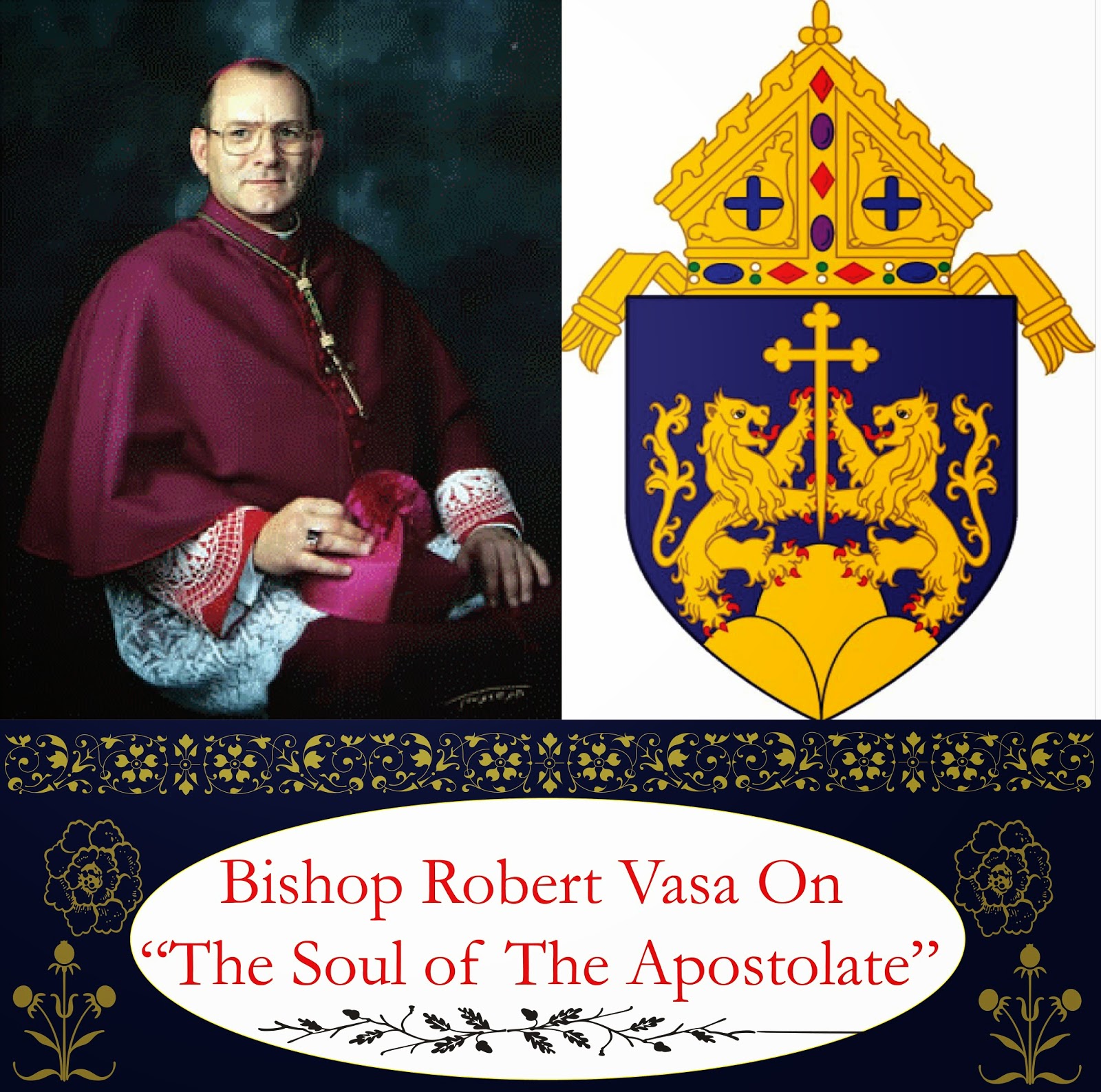
CatechismClass.com Now Offering Bishop Vasa’s Meditation on "The Soul of the Apostolate"

http://www.catechismclass.com/vasa_talks.php

CatechismClass.com is pleased to announce that effective immediately it will begin offering a series of 16 talks given by His Excellency Bishop Robert Vasa on Dom Chautard's (Jean-Baptiste Chautard) work: “The Soul of the Apostolate.” The entire series of 16 talks is available for purchase for only $9.99. This series of talks was given when His Excellency was still the Bishop of the Diocese of Baker, Oregon.

Bishop Robert Vasa serves as the Episcopal Advisor to CatechismClass.com. CatechismClass.com operates with the singular goal of being nothing short of the best online Catholic catechesis program in the world. The company provides online, interactive catechetical lessons for parishes and families. They offer a comprehensive K-8 program as well as the original online high school program modeled after the USCCB’s “Doctrinal Elements of a Curriculum Framework for the Development of Catechetical Materials for Young People of High School Age.”

Additionally, the site provides a well-received and thoroughly developed program for use for Adult Catechesis, which has been used around the country as part of RCIA programs.

Now, CatechismClass.com is expanding into audio lessons and will start by offering Bishop Vasa’s series of sixteen talks. Additionally, the company has offered to donate 85% of all sales to the Diocese of Baker, Oregon as a gift to the ministry of the Diocese.

Click here to learn more and receive ordering information.
Read more >>
Friday, December 30, 2011
Catholic Resolutions 2012


So the year 2011 has come and nearly gone.  This past year I did not specifically compose any "Catholic Resolutions" as I have done in past years, but I would like to take some time to reflect upon some of my achievements this past year.

The year 2011 overall was a year without significant activity but I did have several personal milestones this past year.

In May, I earned my Artium Baccalaureus (Bachelor of Arts) with a major in Business Administration and a minor in Philosophy.  The end of May marked my move to the city of Minneapolis where I lived in a downtown apartment until Thanksgiving.

June 1st marked my entry into a secular career, of which I found great opposition to adherence to Catholicism (e.g. abstaining from work on Sundays and all 1st Class Feast Days, refraining from crude and inappropriate jokes, etc).

The week of Thanksgiving ushered in a new era, as I was permanently laid off, forcing me to at least temporarily relocate back to the far south Chicago suburbs.  While this newfound time again with my family is highly welcoming, I do miss the ability to frequently attend Masses at Immaculate Heart of Mary (SSPX) Chapel in St. Paul.  Now I am driving around 60 miles each way to attend a Traditional Mass or Divine Liturgy.

So with six months of the year in a secular job that considered 40 hour work weeks to be "lazy," my ability to focus on the blog and on my other apostolates declined notably.  Now, with more time to again devote to my online Catholic endeavors and the daily recitation of the Divinum Officium, I can again focus on cultivating a true Catholic life.

Thus, I would like to list my Catholic Resolutions for the upcoming year.


2012 Catholic Resolutions

1) Continue to pray the Rosary daily (at least 5 decades) along with Lauds, Prime, one of the day time offices (Terce, Sext, or None), and Vespers.
2) Increase my network of Catholics who attend the Traditional Sacraments in the greater Northern Illinois area.
3) Purchase many different books and build up my Catholic library further.  I have an Amazon Wishlist for some of these items (along with some of my other interests).  If anyone would like to send me one of these items, please know that you will be remembered in my prayers each day while I recite the Breviary at my home altar.  I would specifically like to obtain a copy of the Liber Usualis, the Liber Hymnarius, a Summa Theologica, the Little Office of the Blessed Virgin Mary (pre Vatican II version), Divine Intimacy by Fr. Gabriel, the Catechism of the Council of Trent (Hardcover), My Catholic Faith by Angelus Press, How Christ Said the First Mass by Meagher, The Holy Mass by Dom Prosper, and the Forty Dreams of St. John Bosco.
4) Continue to discern a vocation with a Traditional Order and try to save up more money so that, if I am called, I may more easily join one
5) Attend a 5-day Ignatian Silent retreat in February 2012 at the SSPX retreat center in Phoenix, Arizona
6) Seek to grow spiritually and avoid all of the sins that I have committed often in the past.  As part of this, my goal is to make a weekly Confession.
7) Increase my proficiency in Latin through private tutoring, individual self study, and/or reciting liturgical prayers in Latin.

Additionally, I intend to post regular updates on this blog on the above goals and continue to provide you with inspiring Catholic content.  As long time readers will notice, my blog does not post sacrilegious liturgies, reports of liturgical abuse, or other depressing stories.  My goal is to continue to provide you with the devotions, prayers, and beliefs necessary to foster a traditional Catholic culture for yourselves and your families.

In addition to the above, I of course have several goals for 2012 for CatechismClass.com and will be working diligently each day in order to expand our programs, hire more employees, and deliver orthodox Catholic teachings.  To be updated on developments in this area, please sign up for a free CatechismClass.com account and subscribe to our free newsletter.  2012 should be a very good year for CatechismClass.com.

2012 Catholic Resolutions (updated as of February 13, 2012)

After just returning from the five day Ignatian retreat (#5 mentioned above), I have updated an added to my resolutions:

1) 15 minutes of daily spiritual reading
2) Find a spiritual director
Read more >>
Age of Martyrs Continues: Anno Domini 2011


Taken from Catholic World News
December 30, 2011

Twenty-six pastoral workers--including 18 priests, 4 sisters, and 4 laity--were killed in 2011, according to the news agency of the Congregation for the Evangelization of Peoples.

Seven were killed in Colombia, five in Mexico, three in India, two in Burundi, and one each in Brazil, Paraguay, Nicaragua, the Democratic Republic of the Congo, South Sudan, Tunisia, Kenya, the Philippines, and Spain.

The Fides news agency commented:

"The true imitation of Christ is love," said the Holy Father on December 26. And this was certainly the rule of life for Sister Angelina, who was killed in South Sudan by militants of the Lord's Resistance Army (LRA) while she was bringing medical aid to refugees; and also for Maria Elizabeth Macías Castro, of the Scalabrinian Lay Movement of Nuevo Laredo (Mexico), who worked for a newspaper and was committed to assisting migrants, she was kidnapped and murdered by drug dealers; even for Father Fausto Tentorio, Italian missionary of PIME, priest in Mindanao (Southern Philippines), who devoted his life to the service of literacy and development of indigenous people; or even for the layman Rabindra Parichha, killed in Orissa in eastern India: former itinerant catechist was very involved in the legal field and a promoter of human rights.

Fides’ list does not only include missionaries ad gentes in the strict sense, but all pastoral care workers who died violent deaths. We do not propose to use the term "martyrs," since it is up to the Church to judge their possible merits and also because of the scarcity of available information in most of cases, with regard to their life and even the circumstances of their death.

Additional sources for this story: THE NAMES OF PASTORAL WORKERS, BISHOPS, PRIESTS, MEN AND WOMEN RELIGIOUS AND LAY CATHOLICS, KILLED IN THE YEAR 2011 (Fides) http://www.fides.org/eng/documents/missionaries_killed_2011.doc
Read more >>
3 Year Anniversary of Grandfather's Death

Today marks the three-year anniversary of the death of my grandfather, John J.  Your prayers this day for the repose of his soul are most appreciated.  I will be reciting the Office for the Dead this day at Lauds and at Vespers.


Requiem aeternam dona ei, Domine, et lux perpetua luceat ei. Requiescat in pace. Amen.

In paradisum deducant te Angeli; in tuo adventu suscipiant te martyres, et perducant te in civitatem sanctam Ierusalem. Chorus angelorum te suscipiat, et cum Lazaro quondam paupere æternam habeas requiem.
Read more >>
Thursday, December 29, 2011
Validity of SSPX Confessions & Marriages in light of Canon Law


Drawing upon the first two paragraph's of Father Paul L. Kramer's "The Suicide of Altering the Faith in the Liturgy," Chapter II, Part II.  The book is a work of outstanding scholarship and many of the following sentences and throughout the book are footnoted extensively.  This book is highly recommended.
The faithful have the right to receive sacraments that are certainly valid.  The Canon Law Society Commentary elaborates, "This right is rooted in baptism; it is not a privilege granted by Church authorities but a claim rooted in the action of Christ."  The Church may not impose new rites on the faithful, because Catholics have the "right to worship God according to the prescriptions of their own right."  This right establishes on the part of the faithful an inviolable moral faculty according to which they can and must demand to be provided the goods and services of the Church according to their own custom and rite.

Since the Divine Law establishes the right and duty which constitutes an inviolable claim on the part of the faithful to receive the sacraments according to their own custom and rite, that claim may not be legitimately denied.  It is in virtue of this inviolable claim, and that if the faithful are unlawfully denied their traditional rites, then, in accord with the principle of equity, they may not be punished for availing themselves of services of priests and bishops whose adherence to Tradition has earned for them the withdrawal or deprivation of their priestly faculties.  Such withdrawal of faculties is unlawful, while the penal deprivation of faculties under such circumstances is certainly invalid, since such priests are guilty of nothing other than exercising  their divinely commissioned ministry.

Continued...

Image Source: SSPX.ORG
Read more >>
Nativitate Domini (Christmas)


The following Mass Propers are from the First Mass at Midnight.  For all priests saying more than three Masses on Christmas, since priests are permitted to say three Masses on this day, they should be familiar with the rules for celebrating Mass more than once the same day. See The Celebration of Mass - A Study of the Rubrics of the Roman Missal by Rev. O'Connell pages 371 - 373 for more information specific to Christmas. Also, while the time in which Mass may traditionally be said is specified in the 1917 Code of Canon Law as no earlier than one hour before dawn, Canon 821 §2 provides the specific exception for the time of midnight Mass.

Epistle (Titus 2: 11-15) - Dearly beloved, The grace of God our Savior hath appeared to all men, instructing us, that, denying ungodliness and worldly desires, we should live soberly and justly and godly in this world, looking for the blessed hope and coming of the glory of the great God and our Savior Jesus Christ: Who gave Himself for us, that He might redeem us from all iniquity, and might cleanse to Himself a people acceptable, a pursuer of good works. These things speak and exhort: in Christ Jesus our Lord.

Secret - May our offering on this day's feast be acceptable to Thee, O Lord, we beseech Thee: that by Thy bounteous grace, though this sacred intercourse, we may be found like unto Him, in whom our nature is united to Thee. Who with Thee liveth and reigneth...

Special Form of Communicantes - Communicating, and keeping this most holy night, in which the spotless virginity of blessed Mary brought forth a Savior to this world; and also reverencing the memory first of the same glorious Mary, ever Virgin, Mother of the same our God and Lord Jesus Christ: as also . . .

Post Communion - Grant to us, we beseech Thee, O Lord, that we, who rejoice in celebrating by these Mysteries, the Birth of Our Lord Jesus Christ, may by worthy lives, deserve to attain unto fellowship with Him. Who with Thee liveth and reigneth in the unity . . .

For the full Mass propers for Christmas Day for all three Masses, please click here.
Read more >>
SSPX Appoints Fr. Petrucci as New Superior of Italian District


Father Pierpaolo Maria Petrucci has been named by the General House as the new Superior of the Italian District of the Society of St. Pius X. Father Petrucci was born in 1962 on the Adriatic coast in Rimni.

In 1981 he graduated from High School and enter the Priestly Seminary of Econe. Six years later he was ordained a a Catholic priest by Archbishop Marcel Lefebvre. At first he was active for five years as an educator at the Boys Gymnasium "Etoile du Matin" in Bitche (Lothringen). Then he was a Director of Spiritual Excercises in Italy from 1993 as pastor in various priories in France (Priory "St. Regis" in Unieux near Lyon, then Prior of St Louis in Nantes in der Vendée). In 2005 he was the Prior of the Priory of Nantes, the largest operation in the Society after Paris, and Dean of the Society for northwest France. In 2008 he returned back to Italy and took over the priory of "Our Dear Lady of Loretto" in Rimni at the request of the District Superior. 


Source: Eponymous Flower
Read more >>
Sunday, December 25, 2011
Feast of the Synaxis


On the second day of the Nativity, the Christian Church gives glory and thanksgiving to the Most-holy Theotokos, who gave birth to our Lord, God and Savior Jesus Christ. This feast is called 'the Synaxis' because on this day all of the faithful gather to glorify her, the Most-holy Theotokos, and to solemnly and universally celebrate a feast in her honor.

In 431, after the Council of Ephesus, the Byzantine Church established a special feast of the Maternity of Mary on Dec. 26.


KONTAKION (TONE 6)

He who before the birth of the Morning Star was born of the Father, without a mother, became incarnate on earth of you, O mother of God, without a father. Wherefore a star annouces to wise men that you have given birth without human seed, and the angels and shepherds glorify you, O Woman full of grace!
Read more >>
Blessing of Children (Rituale Romanum)


P: Our help is in the name of the Lord.

All: Who made heaven and earth.

P: The Lord be with you.

All: May He also be with you.

Let us pray.


We implore you, almighty God, to bless + these children, and we ask that you keep them in your love. Strengthen their hearts by the power of the Holy Spirit, sanctify their lives, foster their innocence. Keep their minds intent on good, help them to prosper, give them peace, health, and charity. By your might and protection shield them always from every temptation of men or demons. And in your mercy may they finally attain the happiness and rest of Paradise; through Christ our Lord.

All: Amen.

Let us pray.


Lord Jesus Christ, who embraced the little children when they came or were brought to you (here the priest extends his hands over them), and laying your hands on them blessed them and said: "Let the little children come to me, and do not stop them. The kingdom of heaven belongs to such as these; and their angels ever see the face of my Father;" we beg you to look with favor on the devotion of these boys and girls here present, and let your blessing come on them in fullest measure. Let them ever advance in your grace and goodness, the better to know you, love you, fear you, and serve you, and happily reach their blessed destiny. We ask this of you, Savior of the world, who live and reign with the Father and the Holy Spirit, God, forever and ever.

All: Amen.


May the blessing of almighty God, Father, Son, + and Holy Spirit, come upon you, keep and direct you, and remain with you forever.

All: Amen.


They are sprinkled with holy water.


Images: From the Institute of Christ the King Sovereign Priest Shrine in Chicago, Illinois from the Blessing of Children according to the Rituale Romanum in Latin (1962) following the 10 AM Solemn High Mass of Christmas Day.  The children and then the remaining faithful then came forward to venerate a relic of the Crib of Bethlehem (pictured in the third image in the reliquary).
Read more >>
Saturday, December 24, 2011
The Vigil of the Nativity of our Lord Jesus Christ

Office of Prime on the Vigil of the Nativity presided by His Eminence, Cardinal Burke, at our Seminary in Gricigliano. Taken in 2019. 

Privileged Vigil (1955 Calendar): December 24

Christmas Eve Is A Distinct Liturgical Day Separate From Christmas.

This is the final day of Advent.  This is a day of fasting and abstinence. It is also the day when Italian generally have as their meatless meal the "Feast of Seven Fishes."

The following is quoted from Dom Gueranger:

“At length,” says St. Peter Damian in his sermon for this holy eve, “we have come from the stormy sea into the tranquil port; hitherto it was the promise, now it is the prize; hitherto labor, now rest; hitherto despair, now hope; hitherto the way, now our home. The heralds of the divine promise came to us; but they gave us nothing but rich promises. Hence our psalmist himself grew wearied and slept, and, with a seemingly reproachful tone, thus sings his lamentation to God: ‘But thou hast rejected and despised us; Thou hast deferred the coming of Thy Christ’ (Ps. 138).

At another time he assumes a tone of command and thus prays: ‘O Thou that sittest upon the Cherubim, show Thyself!” (Ps. 129) Seated on Thy high throne, with myriads of adoring angels around Thee, look down upon the children of men, who are victims of that sin, which was committed indeed by Adam, but permitted by Thy justice. Remember what my substance is (Ps. 138); Thou didst make it to the likeness of Thine own; for though every living man is vanity, yet inasmuch as he is made to Thy image, he is not a passing vanity (Ps. 38). Rend Thy heavens and come down, and turn the eyes of Thy mercy upon us Thy miserable supplicants, and forget us not unto the end!

This holy eve is, indeed, a day of grace and hope, and we ought to spend it in spiritual joy. The Church, contrary to Her general practice, prescribes that if Christmas Eve fall on a Sunday, the Office and the Mass of the Vigil should take precedence over the Office and Mass of the 4th Sunday of Advent. How solemn, then, in the eyes of the Church, are these few hours, which separate us from the great Feast! On all other Feasts, no matter how great they may be, the solemnity begins no earlier then First Vespers, and until then the Church restrains Her joy, and celebrates the Divine Office and Mass of most vigils according to the Lenten rite. Christmas, on the contrary, seems to begin with the Vigil; and one would suppose that this morning’s Lauds were the opening of the Feast; for the solemn intonation of this portion of the Office is that of a Double, and the antiphons are sung before and after each psalm or canticle. The violet vestments are used at the Mass, but the rubrics are less somber than on the Advent ferias.

Let us enter into the spirit of the Church, and prepare ourselves, in all the joy of our hearts, to meet the Savior Who is coming to us. Let us observe with strictness the fast which is prescribed; it will enable our bodies to aid the promptness of our spirit. Let us delight in the thought that, before we again lie down to rest, we shall have seen Him born, in the solemn midnight, Who comes to give light to every creature. For surely it is the duty of every faithful child of the Catholic Church to celebrate with Her this happy night, when, in spite of all the coldness of devotion, the whole universe keeps up its watch for the arrival of its Savior. It is one of the last vestiges of the piety of ancient days, and God forbid it should ever be effaced!

Let us, in a spirit of prayer, look at the principal portions of the Office of this beautiful Vigil. First then, the Church makes a mysterious announcement to Her children. It serves as the Invitatory of Matins, and as the Introit and Gradual of the Mass. They are the words which Moses addressed to the people of God when he told them of the heavenly manna, which they would receive on the morrow. We too are expecting our Manna, our Jesus, the Bread of Life, Who is to be born in Bethlehem, which translated means the "House of Bread":

This day you shall know that the Lord will come, and in the morning you shall see His glory.

The Responsories are full of sublimity and sweetness. Nothing can be more affecting than their lyric melody, sung to us by our Mother the Church, on the very night which precedes the night of Jesus’ Birth:

R. Sanctify yourselves this day, and be ready: for on the morrow you shall see * the Majesty of God amongst you. V. This day you shall know that the Lord will come, and in the morning you shall see * the Majesty of God amongst you.

R. Be constant; you shall see the help of the Lord upon you: fear not, Judea and Jerusalem: * Tomorrow you shall go forth, and the Lord shall be with you: V. Sanctify yourselves, children of Israel, and be ready. * Tomorrow you shall go forth, and the Lord shall be with you.

R. Sanctify yourselves, children of Israel, saith the Lord: for on the morrow, the Lord shall come down: * And He shall take from you all that is languid. V. Tomorrow the iniquity of the earth shall be cancelled, and over us shall reign the Savior of the world. * And He shall take from you all that is languid.

  
Monks in solemn prostration at the announcement of the Nativity of Our Lord Jesus Christ

At the Office of Prime, in cathedral chapters and monasteries, the announcement of tomorrow’s Feast is made with unusual solemnity. The lector, who frequently is one of the dignitaries of the choir, sings with a magnificent chant the following lesson from the Martyrology. All the assistants remain standing during it, until the lector comes to the word Bethlehem, at which all genuflect, and continue with bended knee until all the glad tidings are told:

The Eighth of the Calends of January. The year from the creation of the world, when in the beginning God created Heaven and earth, five thousand one hundred and ninety-nine: from the deluge, the year two thousand nine hundred and fifty-seven: from the birth of Abraham, the year two thousand and fifteen: from Moses and the going out of the people of Israel from Egypt, the year one thousand five hundred and ten: from David’s being anointed king, the year one thousand and thirty-two: in the sixty-fifth week according to the prophecy of Daniel: in the one hundred and ninety-fourth Olympiad: from the building of the city of Rome, the year seven hundred and fifty-two: in the forty-second year of the reign of Octavian Augustus: the whole world being in peace: in the sixth age of the world: Jesus Christ, the eternal God, and Son of the eternal Father, wishing to consecrate this world by His most merciful coming, being conceived of the Holy Ghost, and nine months since His conception having passed, in Bethelehem of Juda, is born of the Virgin Mary, being made Man: The Nativity of Our Lord Jesus Christ According to the Flesh!

Thus have passed before us, in succession, all the generations of the world. (It should be noted that on this one day alone, and on this single occasion, does the Church adopt the Septuagint chronology, according to which the Birth of our Savior took place five thousand years after the Creation; whereas the Vulgate version, and the Hebrew text, place only four thousand years between the two events. This shows us the liberty which the Church allows us on this question.) Each generation is asked if it may have seen Him Whom we are expecting, and each is silent; until the Name of Mary is pronounced, and then is proclaimed the Nativity of Jesus Christ, the Son of God made Man. St. Bernard, speaking of this announcement, says: “The voice of joy has gone forth in our land, the voice of rejoicing and of salvation is in the tabernacles of the just. There has been heard a good word, a word that gives consolation, a word that is full of gladsomeness, a word worthy of all acceptance. Resound with praise, ye mountains, and all ye trees of the forests clap your hands before the face of the Lord, for He is coming. Hearken, O ye heavens, and give ear, O earth! Be astounded and give praise, O all ye creatures! But thou, O man, more than all they! Jesus Christ the Son of God, is born in Bethlehem of Juda! O brief word of the Word abridged (Rom. 9: 28), and yet how full of heavenly beauty! The heart, charmed with the honeyed sweetness of the expression, would fain diffuse it and spread it out into more words; but no, it must be given just as it is, or you spoil it: Jesus Christ, the Son of God, is born in Bethlehem of Juda!” (Second Sermon for Christmas Eve)
 
The Gospel of today’s Mass is the passage which relates the trouble of St. Joseph and the visit he received from the Angel. This incident, which forms one of the preludes to the Birth of our Savior, could not be omitted from the Liturgy for Advent; and so far, there was no suitable occasion for its insertion. The Vigil of Christmas was the right day for the Gospel, for another reason: the Angel, in speaking to St. Joseph, tells him that the Name to be given to the Child of Mary is Jesus, which signifies that He will save His people from their sins.
Read more >>
Friday, December 23, 2011
Christmas Eve: Fasting and Abstinence

It has been a long-standing custom up until Vatican II to observe fasting & abstinence from meat on Christmas Eve.  It is a custom I still observe and encourage you to do so as well.  The feasts and celebration of the Lord's Nativity should wait until the Nativity begins.

This day is known as the Feast of Seven Fishes for many Italians who will customarily have a dinner of seven fishes in honor of the seven Sacraments and seven days of Creation.


The 1917 Code stated for all Latin Rite Catholics in Canon 1252:
§ 1. The law of abstinence alone is to be observed on all Fridays.
§ 2. The law of abstinence and fast together is to be observed on Ash Wednesday, the Fridays and Saturdays of Lent, the Ember days [all day], and on the Vigils of Pentecost, the Assumption, All Saints, and the Nativity.
§ 3. The law of fast alone is to be observed on the other days of Lent.
§ 4. On Sundays and days of obligation the law ceases except on a feast of obligation during Lent; and the vigils are not anticipated; likewise the law ceases on Holy Saturday at noon.
This Tradition of Fasting is still observed in the Byzantine Tradition.  I quote:
The Christmas Fast, in preparation for the feast of the Nativity on December 25, is one of the minor fasts of the Church. This fast of forty days was introduced in the 12th century. Counting back 40 days from the feast of the Nativity, the fast begins on the evening of November 14 - the feast of the holy apostle Phillip. As a result, it is traditionally called Phillip's Fast or the Phillipian Fast (in Slavonic, Filipovka).

This fast is not penitential, but is rather a fast of preparation, like the pre-Communion fast. By abstaining from certain foods, we are opening up a "space" in our lives through asceticism and obedience, into which God may enter.

One final day of strict fasting awaits us. Normally, this would be the Vigil (in Greek, Paramony) of the Nativity, December 24. But Saturday and Sunday are never days of strict fasting in the Byzantine Rite (with the single exception of Great and Holy Saturday). So when December 24 falls on one of these two days, the day of strict fast is anticipated on Friday. 
On this day, a special service called the Royal Hours is celebrated. This service consists of the daytime services of the First Hour, Third Hour, Sixth Hour, Ninth Hour, and Typika, celebrated with special psalms and readings for the Nativity. (This service is called royal because, at one time, the Emperor himself always attended the service.) Each part of the service has an Old Testament prophecy, an Epistle reading, and a reading from the Holy Gospel.

The Vigil of the Nativity

Finally, we have come to the very eve of the Nativity - the Paramony or Vigil of Christmas (December 24). If it is a weekday, it is a day of strict fasting, with the Royal Hours celebrated during the day, and Vespers and the Divine Liturgy of Saint Basil in the evening. 

If December 24 is a Saturday or Sunday, the Divine Liturgy may be celebrated in the morning, and we sing the troparion of the Vigil:
At that time, Mary registered in Bethlehem with the elder Joseph, who was of the house of David. She had conceived without seed and was with child; and her time to give birth had come. They found no room in the inn, but the cave became a pleasant palace for the Queen. Christ is born to raise up the likeness that had fallen.
The fast is not quite over; if there is a meal or Holy Supper in the evening of December 24, after Vespers, it is a meatless one. But we have arrived at the feast of the Nativity of our Lord, God and Savior Jesus Christ.
Source: Byzantine Catholic Archeparchy of Pittsburg
Read more >>
O Antiphon: December 23


The O Antiphons are a series of antiphons to the Magnificant, which are prayed as part of Vespers (evening prayer) from December 17th - 23th inclusive. Each of the titles of the O Antiphons addresses Jesus with a special title given to the Messiah and refers to a prophecy from the Prophet Isaiah. It is unknown when the O Antiphons started, however, there is mention of them as far back as the 400's AD. They are often called the Great Antiphons too.

If one were to start with the last title and takes the first letter of each one—Emmanuel, Rex, Oriens, Clavis, Radix, Adonai, Sapientia—the Latin words ero cras are formed, meaning, "Tomorrow, I will come". Thus, the "O Antiphons" not only bring intensity to our Advent preparation, but bring it to a joyful conclusion.
Read more >>
Thursday, December 22, 2011
O Antiphon: December 22


The O Antiphons are a series of antiphons to the Magnificant, which are prayed as part of Vespers (evening prayer) from December 17th - 23th inclusive. Each of the titles of the O Antiphons addresses Jesus with a special title given to the Messiah and refers to a prophecy from the Prophet Isaiah. It is unknown when the O Antiphons started, however, there is mention of them as far back as the 400's AD. They are often called the Great Antiphons too.

If one were to start with the last title and takes the first letter of each one—Emmanuel, Rex, Oriens, Clavis, Radix, Adonai, Sapientia—the Latin words ero cras are formed, meaning, "Tomorrow, I will come". Thus, the "O Antiphons" not only bring intensity to our Advent preparation, but bring it to a joyful conclusion.
Read more >>
Wednesday, December 21, 2011
Angelus Press' "The Catechism in Pictures"


Last week I received in the mail a copy of Angelus Press' The Catechism in Pictures.  What I received was even beyond the quality and detail that I have come to value and expect in the publishing done by Angelus Press.

The Catechism in Pictures came in a very large book.  On the left hand side of each page is a beautiful, authentically Catholic explanation of the Faith.  It takes the core tenets of Catholicism, explaining them in detail and with examples but doing so without being too theologically involved for the average reader.  In fact, this book is a must-have for parents seeking to teach the Faith to their children.

This holy images can move your hearts to sentiments of adoration and respect and can show to children in pictures what they can't yet understand in words.  The Church has rightfully used visual artwork to teach the faith for millennia and this book is a prime example of why it is so effective. 

This book, because it is oversized, makes a great addition to coffee tables or end tables or even on one side of your home altar.
Large Hardcover Book 13" x 10 1/4"; 125 pages; 69 full-color pictures; gold gilled page ends; and attached Ribbon Page Marker. Originally published in 1909. Reprinted in 2009. A unique pictorial catechism of 66 chapters, each covering a different topic of the Creed, the Sacraments, the Ten Commandments, the Commandents of the Church, Prayer, the Last Things, Sin, Virtue, and the Works of Mercy. All of the basic truths of Faith and Morality are covered. The Faith is presented via 69 huge (12" x 8.5") full-color classic pictures. The text facing the picture explains the Church's teaching on the matter and then explains the applicable symbolism of the picture. An excellent way to pass the Faith on to your children who will find the pictures very engaging. Children can look at the picture as you point out how the lesson is pictorially presented. Includes an index to the pictures and a topical index.
Read more >>
O Antiphon: December 21


The O Antiphons are a series of antiphons to the Magnificant, which are prayed as part of Vespers (evening prayer) from December 17th - 23th inclusive. Each of the titles of the O Antiphons addresses Jesus with a special title given to the Messiah and refers to a prophecy from the Prophet Isaiah. It is unknown when the O Antiphons started, however, there is mention of them as far back as the 400's AD. They are often called the Great Antiphons too.

If one were to start with the last title and takes the first letter of each one—Emmanuel, Rex, Oriens, Clavis, Radix, Adonai, Sapientia—the Latin words ero cras are formed, meaning, "Tomorrow, I will come". Thus, the "O Antiphons" not only bring intensity to our Advent preparation, but bring it to a joyful conclusion.
Read more >>
Tuesday, December 20, 2011
Music Review: A Blessed Day Has Dawned by the St. Vincent Camerata Scholars

Out of all of the wonderful musical CDs that I have reviewed for Jade Music, my recent review of "A Blessed Day Has Dawned: Sacred Choral Music: Palestrina, Laude, Gregorian Chant" is probably my favorite CD so far.

A Blessed Day Has Dawned is the inaugural recording by the The Saint Vincent Camerata Scholars under the direction of Fr. Stephen Concordia, OSB. The choir is associated with Saint Vincent Archabbey, which was founded in 1846 and is the oldest Benedictine monastery in the United States.

The musical program on this album revolves around the Mass setting of Giovanni Pierluigi da Palestrina entitled "Missa: Dies Sanctificatus," one of Palestrina's most popular works. It includes the various parts of the Mass: Kyrie, Gloria, Creed, Sanctus, Agnus Dei. The album also includes Gregorian Chant as sung during the Renaissance. 

1. O MARIA, DIANA STELLA
2. SOPRA IL FIENO COLCATO
3. LODATE DIO
4. INTROIT: PUER NATUS EST
5. MOTET: DIES SANCTIFICATUS
6. KYRIE
7. CHRISTE
8. KYRIE II
9. GLORIA
10. ALLELUIA: DIES SANCTIFICATUS
11. INITIUM SANCTI EVANGELII SECUNDUM IOANNES
12. CREDO
13. SANCTUS/BENEDICTUS
14. AGNUS DEI I
15. AGNUS DEI II
16. COMMUNION: VIDERUNT OMNES
17. HYMN: CHRISTE REDEMPTOR OMNIUM
18. MOTET: ALMA REDEMPTORIS MATER

The CD features the above tracks. I highly recommend this CD to all Catholics.  You may listen to samples of the chants by clicking here.
Read more >>
O Antiphon: December 20


The O Antiphons are a series of antiphons to the Magnificant, which are prayed as part of Vespers (evening prayer) from December 17th - 23th inclusive. Each of the titles of the O Antiphons addresses Jesus with a special title given to the Messiah and refers to a prophecy from the Prophet Isaiah. It is unknown when the O Antiphons started, however, there is mention of them as far back as the 400's AD. They are often called the Great Antiphons too.

If one were to start with the last title and takes the first letter of each one—Emmanuel, Rex, Oriens, Clavis, Radix, Adonai, Sapientia—the Latin words ero cras are formed, meaning, "Tomorrow, I will come". Thus, the "O Antiphons" not only bring intensity to our Advent preparation, but bring it to a joyful conclusion.
Read more >>


Copyright Notice: Unless otherwise stated, all items are copyrighted under a Attribution-NonCommercial-NoDerivatives 4.0 International License. If you quote from this blog, cite a link to the post on this blog in your article.

Disclosure of Material Connection: Some of the links on this blog are “affiliate links.” This means if you click on the link and purchase the item, I will receive an affiliate commission. As an Amazon Associate, for instance, I earn a small commission from qualifying purchases made by those who click on the Amazon affiliate links included on this website. I am disclosing this in accordance with the Federal Trade Commission’s 16 CFR, Part 255: “Guides Concerning the Use of Endorsements and Testimonials in Advertising.”