Saturday, May 18, 2013
58 Confirmed in Kansas City SSPX Ceremonies

I wish to present some images from the Confirmations and the Pontifical Low Mass at St. Vincent de Paul Church in Kansas City, Missouri, from Saturday, May 11, 2013. 58 confirmands (32 young men and 26 ladies) knelt before Bishop Bernard Tissier de Mallerais to receive the Holy Ghost and become Soldiers of Christ.  Please join me in praying for all of them.


Source: SSPX.ORG
Read more >>
Vigil of Pentecost: Fast and Abstinence


Today is the Vigil for Pentecost, and tomorrow we will celebrate the Descent of the Holy Spirit and the foundation of the Church. Pentecost marks the completion of the work of redemption, the fullness of grace for the Church and its children, and the gift of faith for all nations.

Fast and Abstain on the Vigil of Pentecost

Today's preparation should not be underestimated.  Catholics should fast and abstain from meat today in order to better conform themselves to celebrate this High Holy Day of Pentecost. The Vigil of Pentecost has been a day of required fasting and abstinence for centuries and it was kept as such even through the early 1960s.

The days of obligatory fasting as listed in the 1917 Code of Canon Law were the forty days of Lent (including Ash Wednesday, Good Friday, and Holy Saturday until noon); the Ember Days; and the Vigils of Pentecost, the Assumption of the Blessed Virgin Mary, All Saints, and Christmas.

On January 28, 1949, the United States bishops issued modified regulations on abstinence in America again after receiving a ruling from the Sacred Congregation of the Council. Partial abstinence replaced complete abstinence for Ember Wednesdays, Ember Saturdays, and the Vigil of Pentecost.

By 1962, the laws of fasting and abstinence were as follows as described in "Moral Theology" by Rev. Heribert Jone and adapted by Rev. Urban Adelman for the "laws and customs of the United States of America" copyright 1961: "Complete abstinence is to be observed on all Fridays of the year, Ash Wednesday, the Vigils of Immaculate Conception and Christmas. Partial abstinence is to be observed on Ember Wednesdays and Saturdays and on the Vigil of Pentecost. Days of fast are all the weekdays of Lent, Ember Days, and the Vigil of Pentecost."

Shortly after the close of the Second Vatican Council, Paul VI issued an apostolic constitution on fasting and abstaining on February 17, 1966, called Paenitemini, whose principles were later incorporated into the 1983 Code of Canon Law. Paenitemini allowed the commutation of the Friday abstinence to an act of penance at the discretion of the local ordinaries and gave authority to the episcopal conferences on how the universal rules would be applied in their region. Abstinence which previously began at age 7 was modified to begin at age 14. Additionally, the obligation of fasting on the Ember Days and on the remaining Vigils was abolished.

Learn more about this forgotten history in the Definitive Guide to Catholic Fasting and Abstinence.

The Vigil Mass of Pentecost   

The Mass for Pentecost was formerly celebrated during the night and has since been anticipated.  It seems that the Vigil was modeled on that of Easter.  As was observed on Holy Saturday, a vigil was kept during the night of Pentecost Sunday to prepare for the Sacrament of Baptism.  The Feast of Whitsun - the term Whitsunday is another name for Pentecost, alluding to the white vestments of the neophytes - is as ancient as that of Easter.  The Saturday following the Octave of Pentecost officially begins the Season After Pentecost. For the special prayers and readings for the pre-1955 Vigil of Pentecost, click here.

While the Novus Ordo calendar unfortunately only has 2 octaves, traditional Catholics will be familiar with the idea of multiple overlapping Octaves.  The practice of celebrating an Octave, while not only traced to the time spent by the Apostles and the Blessed Virgin Mary awaiting the Paraclete also has its origins in the Old Testament eight-day celebration of the Feast of Tabernacles (Leviticus 23:36) and the Dedication of the Temple (2 Chronicles 7:9). Very truly, Christ did not come to abolish the Old Law but to fulfill it.

This is one of the most important celebrations in the Church's liturgical year. I've prepared for this day through the Original Novena. The Feast of Pentecost (i.e., Whitsunday) is one of the principal feasts in the life of the Church.  After tomorrow's Feast (and the subsequent Octave), we will conclude Pascaltide and begin the Season after Pentecost.

Collect for the Vigil of Pentecost from the 1962 Missal:

Grant, we beseech Thee, O almighty God, that the splendor of Thy brightness may shine forth upon us, and the light of Thy light may, by the illumination of the Holy Ghost, confirm the hearts of those who have been born again by Thy grace.  Through our Lord...in the unity of the same Holy Ghost
Read more >>
Friday, May 17, 2013
St. Paschal Baylon

1955 Calendar (Double): May 17

Born on the Feast of Pentecost in 1540, St. Paschal lived a quiet start to his life, just as our Lord did.  His name Paschal refers to "the Pasch (Passover) of the Holy Ghost" which is the Spanish term for Pentecost.  Until the age of 20, Paschal (1540-92) tended flocks on the hills of Aragon. He would carry a book with him and beg passersby to teach him the alphabet and to read, and as he toiled in the fields he would read religious books.

He then became a Franciscan Brother and spent the rest of his years mainly as doorkeeper in various friaries of Spain. St. Paschal chose to work in poverty as he said, "I was born poor and am resolved to die in poverty and penance."  All through his life he was animated with a burning love for the Holy Eucharist, a love so intense that it enabled him to speak triumphantly to heretics about the most obscure mysteries of the Faith. He was a mystic and contemplative, and he had frequent ecstatic visions. He would spend many nights before the altar in prayer. At the same time, he sought to downplay any glory that might come from this piety. He passed from earth to Heaven in 1592. He was beatified by Pope Paul V and canonized by Pope Alexander VIII.

Pope Leo XIII declared him patron of all Eucharistic confraternities and congresses.  Christian art usually depicts him wearing the Franciscan habit and bearing a monstrance, signifying his devotion to the Holy Eucharist. During the Red Terror at the time of the Spanish Civil War his grave was desecrated and his relics burned by anticlerical leftists.

Collect:

O God, who didst adorn blessed Paschal Thy Confessor with a wonderful love for the holy Mysteries of Thy Body and Blood: mercifully grant that we too may be worthy to receive the rich spiritual graces which he received from this divine banquet; who lives and reigns with God the Father...

Prayer Source: 1962 Roman Catholic Daily Missal
Read more >>
Thursday, May 16, 2013
St. Ubaldus


1955 Calendar (Semidouble): May 16

Today the Holy Church celebrates the life of St. Ubadlus, Bishop of Gubio and Confessor.  Born to noble parents, St. Ubaldus lived a pious childhood.  After his father died while Ubadlus was still quite young, the boy became a canon regular for the local Cathedral.

He felt a vocation to become a monk, and entered to the Monastery of St. Secondo in the same city, where he remained for some years. Recalled by his bishop, he returned to the cathedral monastery, where he was made prior. Having heard that at Vienna Blessed Peter de Honestis some years before had established a very fervent community of canons regular, to whom he had given special statutes which had been approved by Paschal II, Ubald went there, remaining with his brother canons for three months, to learn the details and the practice of their rules, wishing to introduce them among his own canons of Gubbio.

After being consecrated Bishop of Gubio by Pope Honorius II, he returned to his people and became a perfect pattern of all Christian virtues and a powerful protector in all their spiritual and temporal needs.  It is said that St. Ubaldus helped prevent Frederick Barbarossa from sacking Gubio when the bishop went out on the road to plead with Frederick.

He died of natural causes after a long and painful two year illness in 1160.

At the solicitation of Bishop Bentivoglio, Pope Celestine III canonized him in 1192. His power, as we read in the Office for his feast, is chiefly manifested over the evil spirits, and the faithful are instructed to have recourse to him "contra omnes diabolicas inequities".
The power St. Ubaldus possessed against evil spirits was evident. The Church moves in a spirit world--good angels are all about, while constant vigilance is exercised against Satan and his devils. The liturgy contains a considerable number of exorcisms and adjurations. Then there are a series of sacramentals directed against the power of evil spirits; for example, holy water, palms, candles. Hold these sacramentals in highest esteem. — Excerpted from The Church's Year of Grace, Pius Parsch
Similarly, Dom Gueranger writes in the Liturgical Year:
In order to honour her eternal High Priest, the Church presents to him this day the merits of a pontiff who, after his mortal career, was admitted into a happy immortality. Ubaldus, here on earth, was the image of our Lord Jesus Christ. Like his divine Master, he received the holy anointing of priesthood; he was a mediator between God and man; he was the shepherd of a flock; and now he is united with our Risen Jesus, the great Anointed, the Mediator, the Shepherd. In proof of his influence in heaven, Ubaldus has had given to him a special power against the wicked spirits who lay snares for our perdition. It has frequently happened that the simple invocation of his name has sufficed to foil their machinations. The Church has fixed this day as his feast with the view of encouraging the faithful to have recourse to his protection. 
Collect:

Help us, O Lord, and stretch out Your right hand in compassion to save us from the wickedness of the devil, through the intercession of Your blessed confessor bishop Ubaldus. Through Our Lord . .

Prayer Source: 1962 Roman Catholic Daily Missal
Read more >>
Wednesday, May 15, 2013
St. John Baptist de la Salle

1955 Calendar (Double): May 15

Today we celebrate the life of St. John Baptist de la Salle.  Born April 30, 1651, St. John would live until Good Friday, April 7, 1719.  He would be remembered especially as the founder of the Brothers of Christian Charity.  This order, despite its former greatness, has fallen considerably since Vatican II.

La Salle received the tonsure at the young age of eleven and was named canon of Rheims Cathedral when he was fifteen. He was sent to the College des Bons Enfants, where he pursued higher studies and, on July 10, 1669, he took the degree of Master of Arts. When De La Salle had completed his classical, literary, and philosophical courses, he was sent to Paris to enter the Seminary of Saint-Sulpice on October 18, 1670. His mother died on July 19, 1671, and on April 9, 1672, his father died. This circumstance obliged him to leave Saint-Sulpice on April 19, 1672. He was now twenty-one, the head of the family, and as such had the responsibility of educating his four brothers and two sisters. He completed his theological studies and was ordained to the priesthood at the age of 26 on April 9, 1678. Two years later he received a Doctorate in Theology.

De La Salle became involved in education little by little, without ever consciously setting out to do so. He lived in a time when society was characterized by great disparity between the rich and the poor. Jean Baptiste de la Salle believed that education gave hope and opportunity for people to lead better lives of dignity and freedom.

In 1685, he founded what is generally considered the first normal school — that is, a school whose purpose is to train teachers — in Rheims, France.

Although good teaching was important to John Baptist, spiritual formation was more so; and, in the face of a rampant Jansenism, he was advocating frequent and even daily Communion. When his foundation was firmly rooted and oriented, he resigned as superior, living thereafter as the humblest of his subjects. He died two years later, on Good Friday.

He was canonized by Pope Leo XIII on May 24, 1900, and was inserted in the Roman Catholic calendar of saints in 1904. Because of his life and inspirational writings, he was proclaimed as the Patron Saint of Teachers on May 15, 1950, by Pope Pius XII

Collect:

O God, You inspired the holy confessor John Baptist to teach the poor and to lead the young in the path of truth, and then founded a new congregation in Your Church through him. May his intercession and example fill us with zeal to glorify You by the saving of souls, so that we may also share his reward in Heaven. Through Our Lord . . .

Prayer Source: 1962 Roman Catholic Daily Missal
Read more >>
Tuesday, May 14, 2013
May I Trasmit "That Which I Have Also Received": A Testimony Against Activism

The theme of this month's Holy Cross Seminary Newsletter resolves on prayer and the necessity to place prayer first in our lives - even before our apostolic works.  The full newsletter is below but I quote from it now to highlight some noteworthy sections:


Prayer is work and it is the work of God. Man was. created in order to share in the divine occupation of. glorifying God in his life on earth and in heaven. Nonetheless, man may, and must, apply himself to the. vicissitudes of life in a prayerful manner, as is befitting. the talents God has given him.

What a work prayer is! It is a work we do not take on alone. Christ was sent to dwell among us for this reason – to pray for us and to pray with us. Christ is our success. If we refuse to work with Him, our prayer becomes restless, we seek distractions from His loving and piercing gaze, and we avoid prayer for some other good work. This temptation to ignore prayer for good works is the fallacy of activism. Activity becomes a replacement for prayer and may accomplish some good, but for others who will profit from the work – for such an activist is not growing, but is spiritually undeveloped and therefore risks losing his soul. St. Paul illustrates this danger: But I chastise my body, and bring it into subjection: lest perhaps, when I have preached to others, I myself should become a castaway (I Corinthians 9:27).

How many misguided souls made spiritual dwarves are caught up in busy-work and not the work of adoring God as He wishes? Such a soul has no recollection and fails to purify his intentions in his activities, which become more and more for the glory of the worker. By contrast, the true apostolate is genuine when the apostle is “pre-occupied” with, and steeped in, the life of prayer.

St. Pius X, in Hærent Animo (his 1908 Encyclical on priestly holiness, §27) says: There are some who think, and even declare openly, that the true measure of the merits of a priest is his dedication to the service of others; consequently, with an almost complete disregard for the cultivation of the virtues which lead to the personal sanctification of the priest (these they describe as passive virtues), they assert that all his energies and fervour should be directed to the development and practice of what they call the active virtues. One can only be astonished by this gravely erroneous and pernicious teaching.

The 1917 Code of Canon Law directs Bishops to ensure that their clergy adhere to a regimen that fosters holiness of life and “success” in the ministry, beginning with frequenting the Sacrament of Penance, daily mental prayer, regular visits to the Blessed Sacrament, the daily Holy Rosary and examination of conscience and the spiritual retreat.
Read more >>
Why did our Lord Ascend into Heaven?


Many of us Catholics may have a difficult time articulating the reason why our Lord ascended into Heaven?  Why did He have to ascend in order to accomplish His divine mission of redemption?  What exactly is the effect of His Ascension?  The reason that we fail to understand the answer is one of the chief reasons why we neglect to adequately celebrate the Ascension and Ascensiontide.

Why Did Our Lord Ascend into Heaven?

The answer to this fundamental question is found in the Preface for the Ascension, a Preface found in the Traditional Roman Rite but abandoned in the Novus Ordo.
It is truly meet and just, right and availing unto salvation that we should at all time and in all places give thanks unto Thee, O holy Lord, Father almighty and everlasting God; through Christ or Lord. Who after His resurrection appeared and showed Himself to all His disciples; and while they beheld Him, was lifted up into heaven, so that He might make us partakers of His Godhead. And therefore with angles and archangels, with thrones and dominations, and with all the heavenly hosts, we sing a hymn to Thy glory, saying without ceasing...
The answer to our question is underlined above - "so that He might make us partakers of His Godhead."  Our Lord ascended for us.  He ascended so that we might become divine.

Dom Guéranger, O.S.B. expresses this sublime reason for our Lord's Ascension thusly:
Jesus ascended into heaven. His Divinity had never been absent; but, by Ascension, His Humanity was also enthroned there, and crowned with the brightest diadem of glory. This is another phase of the mystery we are now solemnizing. Besides a triumph, the Ascension gave to the sacred Humanity a place on the very throne of the eternal Word, to whom it was united in unity of Person. From this throne, it is to receive the adoration of men and of angels. At the name of Jesus, Son of Man, and Son of God—of Jesus who is seated at the right hand of the Father almighty—“Every knee shall bend, in heaven, on earth and in hell.”
Dom Gueranger elsewhere reflects as to why the Ascension is always mentioned in the Canon of the Mass. Here he expresses similar noteworthy sentiments:
The feast of the Ascension shows us the work of God in its completion. Hence it is that the Church, in her daily offering of the holy sacrifice, thus addresses the eternal Father: the words occur immediately after the consecration, and contain the motives of her confidence in the divine mercy: ‘Wherefore, O Lord, we Thy servants, as also Thy holy people, calling to mind the blessed Passion of Christ Thy Son our Lord, His Resurrection from the dead, and His admirable Ascension into heaven, offer unto Thy most excellent Majesty a pure, holy, and unspotted Host.’ 
It is not enough for man to hope in the merits of his Redeemer’s Passion, which cleansed him from his sins; it is not enough for him to add to the commemoration of the Passion that of the Resurrection, whereby our Redeemer conquered death; man is not saved, he is not reinstated, except by uniting these two mysteries with a third: the Ascension of the same Jesus who was crucified and rose again.
Heaven was not opened until our Lord's Ascension:

It was fitting that Christ, the conqueror of death, would be the first to open the gates of Heaven. He did so not on the day of His Resurrection but 40 days later when He opened Heaven, led the souls of the just from the Limbo of the Fathers (e.g. Adam, Eve, Moses, Isaiah, et cetera) into Heaven, and He took His seat at the right hand of the Father. For the first time in world history, human flesh had entered Heaven.

As St. Thomas Aquinas stated in the Summa:
"Ascending on high, He led captivity captive," because He took with Him to heaven those who had been held captives by the devil—to heaven, as to a place strange to human nature. captives in deed of a happy taking, since they were acquired by His victory
Reflection from Archbishop Fulton J. Sheen:

"In the Ascension the Savior did not lay aside the garment of flesh with which He had been clothed; for His human nature would be the pattern of the future glory of other human natures, which would become incorporated to Him through a sharing of His life. Intrinsic and deep was the relation between His Incarnation and His Ascension. The Incarnation or the assuming of a human nature made it possible for Him to suffer and redeem. The Ascension exalted into glory that same human nature that was humbled to the death." (Archbishop Fulton Sheen, Life of Christ)
Read more >>
Monday, May 13, 2013
Feast of St. Robert Bellarmine


1955 Calendar (Double): May 13

Today the Holy Church celebrates the feastday of St. Robert Bellarmine (4 October 1542 – 17 September 1621), who was one of the most notable Catholics during the Catholic Counter Reformation.  His saintly example and teachings helped preserve the Church against the heresies of the Protestants.

St. Robert Bellarmine was born the third of ten children of Vincenzo Bellarmine and Cinzia Cervini, a family of nobles, albeit poor ones. His mother, a niece of Pope Marcellus II, was dedicated to almsgiving, prayer, meditation, fasting, and mortification.  It was these traits that Robert would be famous for one day.  In this manner, may we see the importance of faith active in the family life.

Robert suffered assorted health problems all his life. Educated by Jesuits as a boy, he later joined the Jesuits on September 20, 1560, despite the opposition of his father who wanted Robert to enter politics.  The young Robert studied at the Collegio Romano from 1560 to 1563, Jesuit centers in Florence, Italy in 1563, then in Mondovi, Piedmont, the University of Padua in 1567 and 1568, and the University of Louvain, Flanders in 1569.

He was ordained to the priesthood on Palm Sunday, 1570 in Ghent, Belgium. He served as a Professor of Theology at the University of Louvain from 1570 to 1576. At the request of Pope Gregory XIII, he taught polemical theology at the Collegio Romano from 1576 to 1587. While there he wrote Disputationes de Controversiis Christianae Fidei adversus hujus temporis hereticos, the most complete work of the day to defend Catholicism against Protestant attack.

He served as the Spiritual director of the Roman College from 1588, and he taught Jesuit students and other children while he wrote a children‘s catechism, Dottrina cristiana breve.  Shortly thereafter he wrote a catechism for teachers, Dichiarazione piu copiosa della dottrina cristiana.

St. Robert was the confessor of Saint Aloysius Gonzaga until his death, and then St. Robert worked for the boy‘s canonization. In 1590 he worked in France to defend the interests of the Church during a period of turmoil and conflict.  He served as a member of the commission for the 1592 revision of the Vulgate Bible as well as the rector of the Collegio Romano from 1592 to 1594. Thereafter, he was the Jesuit provincial in Naples, Italy from 1594 to 1597, followed by the role of Theologian to Pope Clement VIII from 1597 to 1599.

He is most well known for his role as examiner of bishops and consultor of the Supreme Sacred Congregation of the Roman and Universal Inquisition in 1597; he was strongly concerned with discipline among the bishops. Created a Cardinal-priest on March 3, 1598, by Pope Clement VIII, he continued to live an austere life in Rome, giving most of his money to the poor. At one point he used the tapestries in his living quarters to clothe the poor, saying that “the walls won’t catch cold.”

He helped Saint Francis de Sales obtain formal approval of the Visitation Order.  He was graced with the honor of being named Archbishop of Capua, Italy on March 18, 1602. He served in the two conclaves of 1605.

Concerning the controversy over Galileo, St. Robert Cardinal Bellarmine, Doctor of the Church, as well as Pope Urban VIII, welcomed Galileo’s research; they even presented him with medals and gifts. They wholeheartedly welcomed his hypothesis; however, when Galileo began to promote it as truth without providing concrete evidence, trouble arose with the Catholic Church.  That matter is a separate issue.  He wrote Tractatus de potestate Summi Pontificis in rebus temporalibus adversus Gulielmum Barclaeum in opposition to Gallicanism. He opposed action against Galileo Galilei in 1615, and established a friendly correspondence with him, but was forced to deliver the order for the scientist to submit to the Church.

He served as an elector in the conclave of 1621 and was considered for Pope. Instead, he would serve as the Theological Advisor to Pope Paul V as well as the Head of the Vatican library and the Prefect of the Sacred Congregation of the Rites.  He also bore the role of Prefect of the Sacred Congregation of the Index.

He died on September 17, 1621.  He was canonized in 1930 and one year later proclaimed a Doctor of the Church on September 17, 1931.


His remains, in a cardinal's red robes, are displayed behind glass under a side altar in the Church of Saint Ignatius, the chapel of the Roman College, next to the body of his student, St. Aloysius Gonzaga, as he himself had wished.

Collect:

O God, You fortified Your blessed bishop and doctor Robert with remarkable learning and courage to expose the dangers of error and defend the rights of the Holy See. May we grow in love of truth, and may they who have been led astray by falsehood come back to the unity of Your Church through the intercession of Your saint. Through Our Lord . . .

Prayer Source: 1962 Roman Catholic Daily Missal
Read more >>
Sunday, May 12, 2013
FSSP in Joliet, IL Announces Change in Mass Locations


As announced this morning to the members of the Joliet Latin Mass Community:

Effective August 5th, 2013, Bishop Conlon has appointed Fr Joseph R Valentine FSSP as Administrator of St Joseph Parish in Rockdale. This move will provide a much more stable "home" for the Traditional Latin Mass in the Joliet Diocese and, with God's help, allow us to solidify what we have accomplished and move forward in ways that were not possible before. We are grateful to Bishop Conlon for this opportunity, and to the faithful of St Joseph's for allowing us to become a part of their community; May it be a fruitful relationship for all! St Joseph, pray for us!

What this will mean:
  • We will have a Sunday morning Mass time for the Latin Mass in the Joliet area. 
  • We will have daily Latin Masses at St Joseph's (the daily Masses at Ss Peter & Paul, Naperville will be discontinued, at least for the time being). 
  • The 5:30 PM Sunday Mass at Ss Peter & Paul will continue as before. 
  • The Noon Sunday Mass at St Bernard's will be discontinued. 
  • The neighboring parishes will provide priests to celebrate an English Novus Ordo Mass on Saturday Evening for the parishioners who desire it. 
Source: Press Release from the Joliet Latin Mass Community
Read more >>
Traditional Mass Propers: Sunday After Ascension (within the Octave)


DOUBLE / WHITE

INTROIT Ps. 26:7, 8, 9

Hear, O Lord, my voice as I cry to You, alleluia! my heart has spoken to You; I have sought You. Your presence, O Lord, I will seek; hide not Your face from me, alleluia, alleluia! Ps. 26:1. The Lord is my light and my salvation; whom should I fear? V. Glory be . . .


COLLECT
O Almighty and Eternal God, make our wills devoted to You so that our hearts may sincerely serve Your majesty. Through Our Lord . . .

EPISTLE 
I Peter 4:7-11

Beloved: Be prudent therefore and watch in prayers. But before all things have a constant mutual charity among yourselves: for charity covereth a multitude of sins. Using hospitality one towards another, without murmuring, As every man hath received grace, ministering the same one to another: as good stewards of the manifold grace of God. If any man speak, let him speak, as the words of God. If any minister, let him do it, as of the power which God administereth: that in all things God may be honoured through Jesus Christ our Lord.

Alleluia, alleluia!  Ps. 46:9
God reigns over all the nations, God sits on His holy throne. Alleluia!
V. John 14:18. I will not leave you orphans; I go away, but I will come to you, and your heart shall rejoice. Alleluia!

GOSPEL  
John 15:26-27; 16:1-4

At that time, Jesus said to His disciples: "When the Paraclete cometh, whom I will send you from the Father, the Spirit of truth, who proceedeth from the Father, he shall give testimony of me. And you shall give testimony, because you are with me from the beginning."These things have I spoken to you things have I spoken to you that you may not be scandalized. They will put you out of the synagogues: yea, the hour cometh, that whosoever killeth you will think that he doth a service to God. And these things will they do to you; because they have not known the Father nor me. But these things I have told you, that when the hour shall come, you may remember that I told you of them."

OFFERTORY ANTIPHON  
Ps. 46:6
God ascends His throne amid shouts of joy, the Lord is taken up with the sound of trumpets, alleluia!


SECRET
Cleanse us through this spotless offering, O Lord, and let our souls be made strong by Your heavenly grace. Through Our Lord . . .

COMMUNION ANTIPHON  
John 17:12-13, 15
Father, while I was with them, I kept them whom You gave Me, alleluia! but now I am coming to You; I do not pray that You take them out of the world, but that You keep them from evil, alleluia, alleluia!

POSTCOMMUNION
Grant, O Lord, that we may always be grateful for the Sacramental Gift that we have just received. Through Our Lord . . .

Read more >>
Saturday, May 11, 2013
Video: Fulton Sheen on "What Makes a Mother"


Rejoice Mary, Mother of God, Virgin, full of grace, the Lord is with thee: blessed art thou among women and blessed is the Fruit of thy womb, for thou hast borne the Savior of our souls. Meet it is in truth, to glorify thee, O Birth-giver of God, ever blessed, and all undefiled, the Mother of our God. More honorable than the Cherubim, and beyond compare more glorious than the Seraphim, thou who without stain didst bear God the word, true Birth-giver of God, we magnify thee.

O gracious Mother of the gracious God, O most pure and blessed Mary, the Mother of God, pour the mercy of thy Son and our God upon my impassionate soul, and with thine intercessions set me unto good deeds, that I may pass the rest of my life without blemish and, with thine aid, attain heaven. O Virgin mother of God, the only one who art pure and blessed. O Queen of the Heavenly Host, Defender of our souls: being delivered from evil, as thy servants, O Mother of God, we offer unto thee the hymns of thanks and victory; but as thou hast power invincible, deliver us from all calamity, that we may cry unto thee: Rejoice, O ever-Virgin Bride!

O virgin, spotless, undefiled, unstained, all-chaste and Pure Lady, Bride of God, who by the glorious birth-giving hast united God the Word with Man and linked our fallen nature with Heavenly Things; who art the hope of the hopeless, the helper of the oppressed, the ready protection of those who haste unto thee, and the refuge of Christians; despise me not, who am defiled and sinful, who by my wicked thoughts, words and deeds, have become an unworthy servant, and by my slothfulness have turned into a slave to evil affections. O Mother of the God of Love, have mercy and compassion upon me, a sinner and a prodigal. Accept this prayer which is offered to thee from my impure lips; and putting forward thy maternal influence with thy Son, my Lord and Master, beseech Him to open unto me the lovingkindness of His grace; beseech Him to overlook my countless transgressions, to give me true repentance and to make me to be a zealous doer of His commandments. And thou, being gracious and compassionate and tender-hearted, be thou ever present with me in this life as my defender and helper, so that I may turn aside the assault of my enemies, and guide me into salvation; help my poor soul at the hour of my death, and drive far from it all the dark forms of the evil ones. And in the dreadful Judgement Day, deliver me from everlasting punishment, and present me as an inheritor of the ineffable glory of the son, our God.


O may I obtain this, most-holy Lady and Birth-giver of God, through thine intercessions and mediations, by the grace and exceeding great love of thine Only-Begotten son, my Lord and God and Savior, Jesus Christ, to Whom is due, with the eternal Father and the All-Holy, Good and Life-Giving Spirit, all honor and glory and worship, now and ever, and unto ages of ages. Amen.

O most glorious Ever-Virgin Mary, Mother of Christ our God, accept our prayers and present them to thy son and our God, that He may, for thy sake, enlighten and save our souls.
Read more >>
Friday, May 10, 2013
Visual Tour of Catholicism at DePaul University's Library

While few universities bearing the name of their holy founders are still truly Catholic, many of them still house great treasures of the Church.  Last week I traveled to DePaul located in Chicago, IL, and toured their library.  Inside, I found a beautiful vestment and several stained glass windows that each were individually praiseworthy for their beauty.

The following is a selection of the treasures present at the DePaul Library.

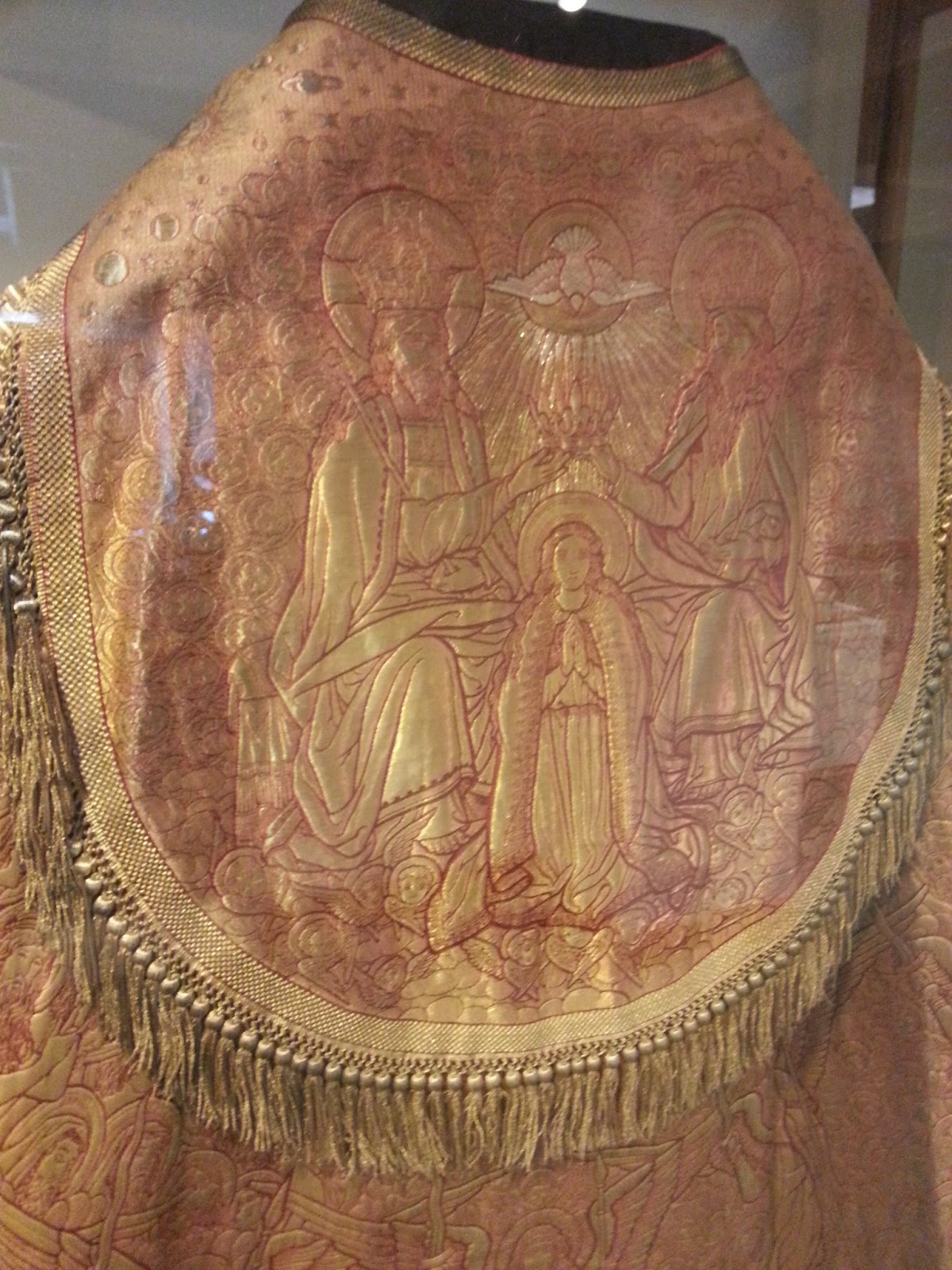
 A cope is a priestly vestment.  Woven by hand with gold and silk brocade on silk in Lyon, France in 1925, this cope was purchased for the 50th Anniversary of St. Vincent de Paul parish.  It was worn by a priest who represented the Vincentian order at the 1926 Eucharistic Congress in Chicago.  According to the importer's description: "The Vestments derive their name from the fact that throughout the suit angelic forms appear, adoring God and chanting His praise."


 In this image you can see a close-up on the upper most part of the Cope.  The intricate design beautifully depicts the Coronation of our Blessed Lady by the Trinity.


In this close up, you may see the great detail that went into this beautiful, sacred vestment.

Located in the Library, this depiction of the Miraculous Medal is just one of the many beautiful stained glass windows still preserved on campus.  This particular stained glass image is located directly above the location of the cope pictured above. 
Read more >>
Novena to the Holy Ghost for Pentecost


Novena to the Holy Ghost
Pray especially starting on the day after Ascension Thursday, ending on the Pentecost

First Day:
Almighty and eternal God, Who hast vouchsafed to regenerate us by water and the Holy Ghost, and hast given us forgiveness of all our sins, vouchsafe to send forth from heaven upon us Thy sevenfold Spirit, the Spirit of Wisdom and Understanding, the Spirit of Counsel and Fortitude, the Spirit of Knowledge and Piety, and fill us with the Spirit of Holy Fear. Amen.

Recite one Our Father, one Hail Mary, and seven Glory Be's

Second Day:
Come, O blessed Spirit of Holy Fear, penetrate my inmost heart, that I may set Thee, my Lord and God, before my face forever; help me to shun all things that can offend Thee, and make me worthy to appear before the pure eyes of Thy Divine Majesty in heaven, where Thou livest and reignest in the unity of the ever Blessed Trinity, God world without end. Amen.

Recite one Our Father, one Hail Mary, and seven Glory Be's

Third Day:
Come, O Blessed Spirit of Piety, possess my heart. Enkindle therein such a love for God, that I may find satisfaction only in His service, and for His sake lovingly submit to all legitimate authority. Amen.

Recite one Our Father, one Hail Mary, and seven Glory Be's

Fourth Day:
Come, O Blessed Spirit of Fortitude, uphold my soul in times of trouble and adversity, sustain my efforts after holiness, strengthen my weakness, give me courage against all the assaults of my enemies, that I may never be overcome and separated from Thee, my God and greatest Good. Amen.

Recite one Our Father, one Hail Mary, and seven Glory Be's

Fifth Day:
Come, O Blessed Spirit of Knowledge, and grant that I may perceive the will of the Father; show me the nothingness of earthly things, that I may realize their vanity and use them only for Thy glory and my own salvation, looking ever beyond them to Thee, and Thy eternal rewards. Amen.

Recite one Our Father, one Hail Mary, and seven Glory Be's

Sixth Day:
Come, O Spirit of Understanding, and enlighten our minds, that we may know and believe all the mysteries of salvation; and may merit at last to see the eternal light in Thy light; and in the light of glory to have a clear vision of Thee and the Father and the Son. Amen.

Recite one Our Father, one Hail Mary, and seven Glory Be's

Seventh Day:
Come, O Spirit of Counsel, help and guide me in all my ways, that I may always do Thy holy will. Incline my heart to that which is good; turn it away from all that is evil, and direct me by the straight path of Thy commandments to that goal of eternal life for which I long. Amen.

Recite one Our Father, one Hail Mary, and seven Glory Be's

Eighth Day:
Come, O Spirit of Wisdom, and reveal to my soul the mysteries of heavenly things, their exceeding greatness, power and beauty. Teach me to love them above and beyond all passing joys and satisfactions of the earth. Help me to attain them and possess them for ever. Amen.

Recite one Our Father, one Hail Mary, and seven Glory Be's

Ninth Day:
Come, O Divine Spirit, fill my heart with Thy heavenly fruits, Thy charity, joy, peace, patience, benignity, goodness, faith, mildness, and temperance, that I may never weary in the service of God, but by continued faithful submission to Thy inspiration, may merit to be united eternally with Thee in the love of the Father and the Son. Amen.

Recite one Our Father, one Hail Mary, and seven Glory Be's


Recommended Reading:
 
 
Read more >>
Thursday, May 9, 2013
Ascension of our Lord into Heaven

 
INTROIT Acts 1:11
< Men of Galilee, why do you stand looking up to heaven? Alleluia! He shall come in the same way as you have seen him going up to heaven, alleluia, alleluia, alleluia!
 
Ascension Thursday in the liturgical year marks the 40th day after Easter Sunday and the day we celebrate Our Lord's Glorious Ascension into Heaven. The Ascension has three principal parts: the departure of Jesus from earth, His going up into heaven, and taking His place at the right hand of the Father.

As Our Lord ascended, He rose to sit forever at the right-hand of the Father, since He abides eternally in the Father’s bliss, which is termed as “the right hand.” And, while many of us are familiar with the image of Christ sitting at the right hand of the Father, the Scriptures do in one instance mention Christ standing – not sitting – at the right hand of the Father. This instance is during the stoning of Stephen. Reflecting upon this St. Gregory says in a Homily on the Ascension (Hom. xxix in Evang.), "it is the judge's place to sit, while to stand is the place of the combatant or helper. Consequently, Stephen in his toil of combat saw Him standing whom He had as his helper. But Mark describes Him as seated after the Ascension, because after the glory of His Ascension He will at the end be seen as judge."

Regarding the place from which Christ ascended, Sulpicius, bishop of Jerusalem, says, and the 'Gloss' also says, that when a church was built [on the Mount of Olives] later on, the spot where Christ had stood could never be covered with pavement; and more than that, the marble slabs placed there burst upwards into the faces of those who were laying them. He also says that footmarks in the dust there prove that the Lord had stood on that spot: the footprints are discernible and the ground still retains the depressions his feet had left.

Read more >>
Tuesday, May 7, 2013
Morning Offering: For All who have Left the Church

The German king Henry IV, who had been excommunicated by Pope Gregory VII in 1076, stands by the gate of the castle of Canossa, in Northern Italy, to beg pardon to the pope.


Daily offering 


(To be recited every morning when you wake up)


O Jesus, through the Immaculate Heart of Mary, I offer Thee all my prayers, works, joys and sufferings of this day, for all the intentions of Thy Sacred Heart in union with the Holy Sacrifice of the Mass throughout the world, and in reparation for my sins. I offer them particularly for the return to the Church of all those that left her.
Read more >>
Monday, May 6, 2013
Minor Rogation Days: May 6 - 8, 2013

The Church in Cornwall: A Rogation Day Process (1906)

While frequently forgotten after Vatican II, the observation of Rogation Days is still encouraged. This year the Minor Rogation, the days leading up to Ascension Thursday, are May 6-8  inclusive. Today is the first day of the Minor Rogation, a day which should be a day of fasting.

These were traditionally days of penance, fasting, and praying litanies. If you are in good health, please remember to observe these days. Again, while not required until penalty of sin by the Holy Church, these days can still be observed. I am greatly encouraging them. For more information on Rogation days, see my post: Major Rogation Day.

I greatly encourage people to observe these days and spend time praying the Litany of Saints not only for a bountiful harvest but also for mercy and repentance.

Commemoration of the MASS OF ROGATION (1962 Missal)

Mercifully grant us our requests, O Lord, that the consolation we receive in our grievous troubles may increase our love for You.
Read more >>
Sunday, May 5, 2013
Pope St. Pius V

 
Double (1955 Calendar): May 5

Michael Ghislieri, a Dominican friar from his fifteenth year, a teacher of religion at twenty, as a simple religious, as inquisitor, bishop, and cardinal, was famous both for the spotless purity of his own life and for his intrepid defense of the Church's faith and discipline. Surrounded in his time by great men and great Saints, in apostolic virtue he was surpassed by none.

As Pope, his first concern was to reform the Roman court and the capital city by the strict example of his own household and the punishment of offenders. He next endeavored to obtain from the Catholic powers recognition of the decrees of the Council of Trent, two of which he strictly enforced: the obligatory residence of bishops in their sees, and the establishment of diocesan seminaries. He revised the Missal and Breviary, and reformed ecclesiastical music.

He was not less active in protecting the Church outside Italy. We see him at the same time supporting the Catholic King of France against the Huguenot rebels, and encouraging Mary, Queen of Scots in the bitterness of her captivity. It is he who excommunicated her rival, the usurper Elizabeth, when the best blood of England flowed upon the scaffold and the measure of her crimes was full. The intrepidity of this Vicar of Christ found enemies. The holy Pope was accustomed to kiss the feet of the crucifix on leaving or entering his room. One day the feet moved away from his lips. Sorrow filled his heart, and he made acts of contrition, fearing that he must have committed some secret offense, yet he still could not kiss the feet. It was afterwards discovered that they had been poisoned by an enemy.

Pope St. Pius V issued the papal bull Consueverunt Romani Pontifices on September 17, 1569, which described the essence of the rosary's present configuration. The Pope made it clear that there are two essential elements of the Rosary: vocal prayer and mental prayer. He also made it clear that the Rosary is composed of 150 Hail Marys, in connection with the 150 Psalms. The papal bull referred to the Dominican roots of the Rosary and the fact that as a young friar, St. Pius V had been a member of the Dominican Order:

And so Dominic looked to that simple way of praying and beseeching God, accessible to all and wholly pious, which is called the Rosary, or Psalter of the Blessed Virgin Mary, in which the same most Blessed Virgin is venerated by the angelic greeting repeated one hundred and fifty times, that is, according to the number of the Davidic Psalter, and by the Lord's Prayer with each decade. Interposed with these prayers are certain meditations showing forth the entire life of Our Lord Jesus Christ, thus completing the method of prayer devised by the Fathers of the Holy Roman Church.

It was in the Lepanto victory that the Saint's power was most plainly manifest. There, in October of 1571, by the holy league which he had formed but still more by the prayers of the aging Pontiff to the great Mother of God, the defeat of the advancing Ottoman forces was obtained,  and Christendom was saved from the Turk. Six months later, Saint Pius V died, having reigned for only six years.

He is well known among Traditional Catholics for codifying the Roman Missal and decreeing the bull "Quo Primum," which codified for all times and all peoples the Tridentine Mass

Source: Little Pictorial Lives of the Saints, a compilation based on Butler's Lives of the Saints and other sources by John Gilmary Shea (Benziger Brothers: New York, 1894); Vie des Saints pour tous les jours de l'année, by Abbé L. Jaud (Mame: Tours, 1950). 

Collect: 

O God, You chose blessed Pius as Pope to overcome the enemies of the Church and to restore the beauty of sacred liturgy. May his prayers protect us and help us to persevere in serving You, so that we may avoid the snares laid by our enemies and enjoy everlasting peace. Through Our Lord . . .

1962 Roman Catholic Daily Missal
Read more >>
Saturday, May 4, 2013
The Errors of Reincarnation: Reincarnation versus a Glorious Bodily Resurrection


As we celebrate our Lord’s Resurrection from the dead, we choose today to turn our attention to understanding the important difference between the Catholic belief in a resurrected body and the false principle of re-incarnation.

According to re-incarnation, all peoples receive a new body after death; thus, the body that a person has now is not the body that he will have in the future. Believers in reincarnation directly contradict the Creed which professes a resurrection of the same body that a person currently possesses. Our Lord’s example shows forth to us a model since we are to follow Him in His Passion, Death, and Resurrection (of the same body!) since He Himself has foretold it (cf. John 13:36).

Christ did not inherit a new body. Christ’s body in Heaven still bears the same wounds from the Cross. It is for that reason that St. Thomas was told by Christ to put his hand into the Sacred Side of our Lord so that Thomas would believe in the Resurrection (cf. John 20:24-29). Christ rose from the dead in the same Body!

Even the modern Catechism of the Church is clear when it plainly teaches “There is no "reincarnation" after death” (CCC 1013). This teaching was similarly expressed with great clarify in the Catechism of the Council of Trent: “Man is, therefore, to rise again in the same body with which he served God, or was a slave to the devil; that in the same body he may experience rewards and a crown of victory, or endure the severest punishments and torments.”

But for reasons aside from our Creed, reincarnation is unacceptable for purely philosophic reasons.
As stated in the Catholic Encyclopedia: “Substance, the first of Aristotle's categories, signifies being as existing in and by itself, and serving as a subject or basis for accidents and accidental changes.”
Succinctly put, the substance of something is what that thing properly is.

Let’s take a chair for instance. There are leather chairs, wooden chairs, three-legged chairs, four-legged chairs, recliners, et cetera. What makes all of these a chair? A chair is a substance and all of these manifestations share in the quality of “chair-ness”. In this sense, we see that something is not defined by its accidents (i.e. “any contingent, or nonessential attribute” – Catholic Encyclopedia). Even if I took a dining chair and broke its legs, painted it, and threw it outside in the dumpster, it would still be a chair (albeit a poor quality one!).

A human being is a union of body and soul. The substance of a person is not merely his soul which can travel from body to body and occupy them at whim. A human person’s substance is a union of body and soul. You may never talk about a particular person without referring to the wholeness of that person. St. Thomas Aquinas addresses this same point in Question 75, Article 4 of his Summa:
I answer that, The assertion "the soul is man," can be taken in two senses. 
First, that man is a soul; though this particular man, Socrates, for instance, is not a soul, but composed of soul and body. I say this, forasmuch as some held that the form alone belongs to the species; while matter is part of the individual, and not the species. This cannot be true; for to the nature of the species belongs what the definition signifies; and in natural things the definition does not signify the form only, but the form and the matter. Hence in natural things the matter is part of the species; not, indeed, signate matter, which is the principle of individuality; but the common matter. For as it belongs to the notion of this particular man to be composed of this soul, of this flesh, and of these bones; so it belongs to the notion of man to be composed of soul, flesh, and bones; for whatever belongs in common to the substance of all the individuals contained under a given species, must belong to the substance of the species.   
It may also be understood in this sense, that this soul is this man; and this could be held if it were supposed that the operation of the sensitive soul were proper to it, apart from the body; because in that case all the operations which are attributed to man would belong to the soul only; and whatever performs the operations proper to a thing, is that thing; wherefore that which performs the operations of a man is man. But it has been shown above (Article 3) that sensation is not the operation of the soul only. Since, then, sensation is an operation of man, but not proper to him, it is clear that man is not a soul only, but something composed of soul and body. Plato, through supposing that sensation was proper to the soul, could maintain man to be a soul making use of the body.
Thus, on both purely religions and purely philosophical grounds, valid arguments are raised against reincarnation. 

For those of us faithful to the Traditions of the Church, it behooves us to learn the future of our own bodies.   We know that we shall rise again in a glorified body but what is a glorified body?  What does it look like?  How does it function?  We now turn to understanding this point.

The qualities of a glorified body are the subject of the following selection from the Catechism of the Council of Trent.  When reading this, please specifically recall how our Lord’s Body possesses all of these criteria:
The Qualities Of A Glorified Body 
In addition to this, the bodies of the risen Saints will be distinguished by certain transcendent endowments, which will ennoble them far beyond their former condition. Among these endowments four are specially mentioned by the Fathers, which they infer from the doctrine of St. Paul, and which are called gifts. 
Impassibility 
The first endowment or gift is impassibility, which shall place them beyond the reach of suffering anything disagreeable or of being affected by pain or inconvenience of any sort. Neither the piercing severity of cold, nor the glowing intensity of heat, nor the impetuosity of waters can hurt them. It is sown says the Apostle, in corruption, it shall rise in incorruption This quality the Schoolmen call impassibility, not incorruption, in order to distinguish it as a property peculiar to a glorified body. The bodies of the damned, though incorruptible, will not be impassible; they will be capable of experiencing heat and cold and of suffering various afflictions. 
Brightness 
The next quality is brightness, by which the bodies of the Saints shall shine like the sun, according to the words of our Lord recorded in the Gospel of St. Matthew: The just shall shine as the sun, in the kingdom of their Father. To remove the possibility of doubt on the subject, He exemplifies this in His Transfiguration. This quality the Apostle sometimes calls glory, sometimes brightness: He will reform the body of our lowness, made like to the body of his glory; " and again, It is sown in dishonour, it shall rise in glory. Of this glory the Israelites beheld some image in the desert, when the face of Moses, after he had enjoyed the presence and conversation of God, shone with such lustre that they could not look on it. 
This brightness is a sort of radiance reflected on the body from the supreme happiness of the soul. It is a participation in that bliss which the soul enjoys just as the soul itself is rendered happy by a participation in the happiness of God. 
Unlike the gift of impassibility, this quality is not common to all in the same degree. All the bodies of the Saints will be equally impassible; but the brightness of all will not be the same, for, according to the Apostle, One is the glory of the sun, another the glory of the moon, and another the glory of the stars, for star differeth from star in glory: so also is the resurrection of the dead. 
Agility 
To the preceding quality is united that which is called agility, by which the body will be freed from the heaviness that now presses it down, and will take on a capability of moving with the utmost ease and swiftness, wherever the soul pleases, as St. Augustine teaches in his book On the City of God, and St. Jerome On Isaias. Hence these words of the Apostle: It is sown in weakness, it shall rise in power. 
Subtility 
Another quality is that of subtility, which subjects the body to the dominion of the soul, so that the body shall be subject to the soul and ever ready to follow her desires. This quality we learn from these words of the Apostle: It is sown a natural body, it shall rise a spiritual body. 
These are the principal points which should be dwelt on in the exposition of this Article. 
Advantages of Deep Meditation on this Article 
But in order that the faithful may appreciate the fruit they derive from a knowledge of so many and such exalted mysteries, it is necessary, first of all, to point out that to God, who has hidden these things from the wise and made them known to little ones, we owe a debt of boundless gratitude. How many men, eminent for wisdom or endowed with singular learning, who ever remained blind to this most certain truth ! The fact, then, that He has made known to us these truths, although we could never have aspired to such knowledge, obliges us to pour forth our gratitude in unceasing praises of His supreme goodness and clemency. 
Another important advantage to be derived from reflection on this Article is that in it we shall find consolation both for ourselves and others when we mourn the death of those who were endeared to us by relationship or friendship. Such was the consolation which the Apostle himself gave the Thessalonians when writing to them concerning those who are asleep. 
Again, in all our afflictions and calamities the thought of a future resurrection must bring the greatest relief to the troubled heart, as we learn from the example of holy Job, who supported his afflicted and sorrowing soul by this one hope that the day would come when, in the resurrection, he would behold the Lord his God. 
The same thought must also prove a powerful incentive to the faithful to use every exertion to lead lives of rectitude and integrity, unsullied by the defilement of sin. For if they reflect that those boundless riches which will follow after the resurrection are now offered to them as rewards, they will be easily attracted to the pursuit of virtue and piety.
On the other hand, nothing will have greater effect in subduing the passions and withdrawing souls from sin, than frequently to remind the sinner of the miseries and torments with which the reprobate will be visited, who on the last day will come forth unto the resurrection of judgment.
Read more >>
First Saturday Devotion for May

First Saturdays Devotion


On Saturdays, Catholics traditionally have taken part in the "First Saturdays Devotion" which entails going to Mass and receiving Communion for the first Saturday of the month for 5 consecutive months in reparation to the Immaculate Heart of Mary.  This devotion is not to be confused with the First Friday's Devotion, which is dedicated to the Sacred Heart of our Lord Jesus Christ.

On July 1, 1905, Pope Pius X approved and granted indulgences for the practice of the First Saturdays of twelve consecutive months in honor of the Immaculate Conception. The First Saturday Devotion did not originate as part of the apparitions of our Blessed Lady in Fatima, but the devotion did quickly spread further following our Lady's series of appearances to the three shepherd children in 1917.

Our Blessed Lady's words to Sr. Lucia at Fatima:
Look, my daughter, at my Heart encircled by these thorns with which men pierce it at every moment by their blasphemies and ingratitude. You, at least, strive to console me, and so I announce: I promise to assist at the hour of death with the grace necessary for salvation all those who, with the intention of making reparation to me, will, on the first Saturday of five consecutive months, go to confession, receive Holy Communion, say five decades of the beads, and keep me company for fifteen minutes while meditating on the fifteen mysteries of the Rosary.
The First Saturday Devotion consists of offering the First Saturday of the month for five consecutive months in reparation for the many and grievous sins committed in our world. A further explanation of our Lady's request is below:
  • You must go to the Sacrament of Confession.  Your reception of the Sacrament may be 8 days before the Saturday as long as you stay in a state of grace.
  • You must receive the Holy Eucharist and as always, it must be in the state of grace or risk the most grievous sin of sacrilege
  • You must pray 5 decades of the Holy Rosary of our Lady, including the Fatima Prayer.  
  • Finally, the last requirement consist of "keeping Mary company" for 15 minutes while meditating on all of the Mysteries of the Rosary with the intention of making reparation to her. This can be done by reading Scripture or other writings relevant to the Mysteries, meditating on pictures of the Mysteries, or simple meditation. Materials for meditation and education on each of the Rosary mysteries is available online.

Little Office of the Blessed Virgin Mary

While the laity is not bound to pray the Divine Office, they are still encouraged to pray the Divine Office (also known as the Liturgy of the Hours).  To pray the Divine Office, I would highly encourage you to pray the 1962 Breviary or even the 1955 version as opposed to the modern version which I find lacking in the spiritual depth present in the earlier editions.

Since you are not bound under ecclesial law to pray the Office, you can and should start by praying the English version of the Breviary.  You can find various breviaries available for sale that will fulfill this purpose.  For centuries Catholics prayed most commonly not with personal prayers and devotion as such individual prayers originated from protestant individualism.  Instead, Catholics prayed the Liturgical texts of the Church (e.g. the Prayers of the Holy Mass, the Rosary, etc) daily and many were saved.  In our world we see the majority of mankind entrenched in sin and debauchery.  Let us pray for a return to our praying the Liturgical prayers of the Holy Church.  Pray the Daily Rosary as Mary has asked of us!

However, please also consider, in addition or instead of the standard Divine Office, the Little Office of the Blessed Virgin Mary for your daily prayers!
The Little Office of the Blessed Virgin Mary is a shorter form of the Divine Office in honour of the Blessed Virgin Mary. It has long been the Church’s daily liturgical prayer to Our Lady, and these hours of praise have been used by Priests, religious and the laity throughout the centuries. Lay people used to flock to the great Cathedrals to publicly recite The Little Office during the Middle Ages, and during the great persecution, when the practice of the Catholic Faith was illegal in Great Britain, Bishop Challoner commended The Little Office to his flock.

Through its psalms, antiphons, readings, responsorials, and prayers the Little Office stresses the role Our Lady played in salvation history, and how through her fiat the divine Word took flesh in her womb and achieved salvation for us all; and how Our Lord granted her the first fruits of the general resurrection in her holy and glorious assumption.

All Catholics are called to a consistent prayer life. For those who do not feel called to recite the Divine Office, but still wish to participate in the liturgical prayer of the Church, or for those who have a particular devotion to the holy Mother of God, there is no finer form of prayer than the Little Office of the Blessed Virgin Mary.

    Read more >>
    Friday, May 3, 2013
    May's First Friday Devotion

    Today is the First Friday of January. Because today is the first Friday of the Month, many Catholic parishes will have special Masses today for the First Friday Devotion.

    Beginning on December 27, 1673, through 1675, Our Lord appeared to St. Margaret Mary Alacoque asking her to receive Him in Holy Communion on the first Friday of every month and to meditate on His passion from 11:00 PM to 12:00 midnight each Thursday. He also revealed to her twelve promises for all who are devoted to His Sacred Heart; he asked for a Feast of the Sacred Heart to be instituted in the liturgical calendar of the Church. Our Lord appeared to St. Margaret Mary Alacoque with twelve promises for those devoted to His Most Sacred Heart.

    Promises for those devoted to the Sacred Heart:

    1. "I will give them all the graces necessary in their state of life."
    2. "I will establish peace in their homes."
    3. "I will comfort them in their afflictions."
    4. "I will be their secure refuge during life, and above all in death."
    5. "I will bestow a large blessing upon all their undertakings."
    6. "Sinners shall find in My Heart the source and the infinite ocean of mercy."
    7. "Tepid souls shall grow fervent."
    8. "Fervent souls shall quickly mount to high perfection."
    9. "I will bless every place where a picture of My Heart shall be set up and honored."
    10. "I will give to priests the gift of touching the most hardened hearts."
    11. "Those who shall promote this devotion shall have their names written in My Heart, never to be blotted out."
    12. "I promise thee in the excessive mercy of My Heart that My all-powerful love will grant to all those who communicate on the First Friday in nine consecutive months, the grace of final penitence; they shall not die in My disgrace nor without receiving the Sacraments; My Divine heart shall be their safe refuge in this last moment."

    Prayer of Reparation:


    O Most Holy Trinity, Father, Son and Holy Spirit, I adore thee profoundly. I offer thee the most precious Body, Blood, Soul and Divinity of Jesus Christ, present in all the tabernacles of the world, in reparation for the outrages, sacrileges and indifferences by which He is offended. By the infinite merits of the Sacred Heart of Jesus, and the Immaculate Heart of Mary, I beg of thee the conversion of poor sinners. Amen.
    Read more >>


    Copyright Notice: Unless otherwise stated, all items are copyrighted under a Attribution-NonCommercial-NoDerivatives 4.0 International License. If you quote from this blog, cite a link to the post on this blog in your article.

    Disclosure of Material Connection: Some of the links on this blog are “affiliate links.” This means if you click on the link and purchase the item, I will receive an affiliate commission. As an Amazon Associate, for instance, I earn a small commission from qualifying purchases made by those who click on the Amazon affiliate links included on this website. I am disclosing this in accordance with the Federal Trade Commission’s 16 CFR, Part 255: “Guides Concerning the Use of Endorsements and Testimonials in Advertising.”