Monday, March 27, 2017
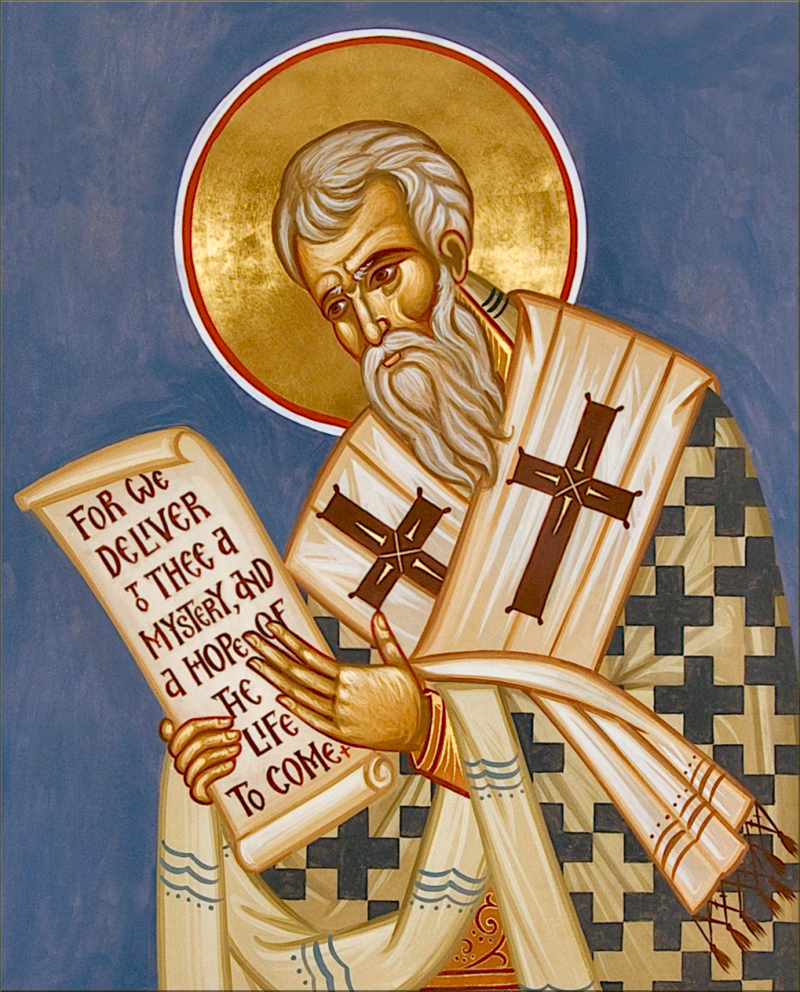
St. John Damascene

Double (1954 Calendar): March 27th

Today is the Feast of St. John Damascene.  Also known as St. John of Damascus, St. John Damascene was a Syrian monk and priest who died in Mar Saba, near Jerusalem. On feastdays in Lent, more usually the Mass of the Lenten feria is said with only a commemoration of the feast - unlike the other seasons in the Church's liturgical year.

St. John Damascene - also known as St. John of Damascus - was born in 645 AD and lived until 749 AD.  The Roman Martyrology on this date proclaims: "St. John Damascene, priest, confessor, and doctor of the Church, whose birthday is commemorated on the 6th of May."

Butler's Lives of the Saints fittingly summarizes his life and example:
ST JOHN OF DAMASCUS, the last of the Greek fathers and the first of the long line of Christian Aristotelians, was also one of the two greatest poets of the Eastern church, the other being St Romanus the Melodist. The whole of the life of St John was spent under the government of a Mohammedan khalif, and it exhibits the strange spectacle of a Christian father of the Church protected from a Christian emperor, whose heresy he was able to attack with impunity because he lived under Moslem rule. He and St Theodore Studites were the principal and the ablest defenders of the cultus of sacred images in the bitterest period of the Iconoclastic controversy. As a theological and philosophical writer he made no attempt at originality, for his work was rather to compile and arrange what his predecessors had written. Still, in theological questions he remains the ultimate court of appeal among the Greeks, and his treatise Of the Orthodox Faith is still to the Eastern schools what the Summa of St Thomas Aquinas became to the West. 
The Moslem rulers of Damascus, where St John was born, were not unjust to their Christian subjects, although they required them to pay a poll tax and to submit to other humiliating conditions. They allowed both Christians and Jews to occupy important posts, and in many cases to acquire great fortunes. The khalif J s doctor was nearly always a Jew, whilst Christians were employed as scribes, administrators and architects. Amongst the officials at his court in 675 was a Christian called John, who held the post of chief of the revenue department — an office which seems to have become hereditary in his family. He was the father of our saint, and the surname of al-Mansur which the Arabs gave him was afterwards transferred to the son. The younger John was born about the year 690 and was baptized in infancy. 
With regard to his early education, if we may credit his biographer, " His father took care to teach him, not how to ride a horse, not how to wield a spear, not to hunt wild beasts and change his natural kindness into brutal cruelty, as happens to many. John, his father, a second Chiron, did not teach him all this, but he sought a tutor learned in all science, skilful in every form of knowledge, who would produce good words from his heart ; and he handed over his son to him to be nourished with this kind of food ". 
Afterwards he was able to provide another teacher, a monk called Cosmas, " beautiful in appearance and still more beautiful in soul ", whom the Arabs had brought back from Sicily amongst other captives. John the elder had to pay a great price for him, and well he might for, if we are to believe our chronicler, " he knew grammar and logic, as much arithmetic as Pythagoras and as much geometry as Euclid ". He taught all the sciences, but especially theology, to the younger John and also to a boy whom the elder John seems to have adopted, who also was called Cosmas, and who became a poet and a singer, sub- sequently accompanying his adopted brother to the monastery in which they both became monks. 
In spite of his theological training St John does not seem at first to have con- templated any career except that of his father, to whose office he succeeded. Even at court he was able freely to live a Christian life, and he became remarkable there for his virtues and especially for his humility. Nevertheless, after filling his responsible post for some years, St John resigned office, and went to be a monk in the laura of St Sabas (Mar Saba) near Jerusalem. It is still a moot point whether his earlier works against the iconoclasts were written while he was still at Damascus, but the best authorities since the days of the Dominican Le Quien, who edited his works in 17 12, incline to the opinion that he had become a monk before the outbreak of the persecution, and that all three treatises were composed at St Sabas. In any case John and Cosmas settled down amongst the brethren and occupied their spare time in writing books and composing hymns. 
It might have been thought that the other monks would appreciate the presence amongst them of so doughty a champion of the faith as John, but this was far from being the case. They said the new-comers were introducing disturbing elements. It was bad enough to write books, but it was even worse to compose and sing hymns, and the brethren were scandalized. The climax came when, at the request of a monk whose brother had died, John wrote a hymn on death and sang it to a sweet tune of his own composition. His master, an old monk whose cell he shared, rounded upon him in fury and ejected him from the cell. " Is this the way you forget your vows ? " he exclaimed. "In- stead of mourning and weeping, you sit in joy and delight yourself by singing." He would only permit him to return at the end of several days, on condition that he should go round the laura and clear up all the filth with his own hands. St John obeyed unquestioningly, but in the visions of the night our Lady appeared to the old monk and told him to allow his disciple to write as many books and as much poetry as he liked. From that time onwards St John was able to devote his time to study and to his literary work. 
The legend adds that he was sometimes sent, perhaps for the good of his soul, to sell baskets in the streets of Damascus where he had once occupied so high a post. It must, however, be confessed that these details, written by his biographer more than a century after the saint's death, are of very questionable authority. 
If the monks at St Sabas did not value the two friends, there were others outside who did. The patriarch of Jerusalem, John V, knew them well by reputation and wished to have them amongst his clergy. First he took Cosmas and made him bishop of Majuma, and afterwards he ordained John priest and brought him to Jerusalem. St Cosmas, we are told, ruled his flock admirably until his death, but St John soon returned to his monastery. He revised his writings carefully, " and wherever they flourished with blossoms of rhetoric, or seemed superfluous in style, he prudently reduced them to a sterner gravity, lest they should have any display of levity or want of dignity ". His works in defence of eikons had become known and read everywhere, and had earned him the hatred of the persecuting emperors.
Collect:

Almighty and Eternal God, You endowed blessed John with divine learning and wondrous fortitude of soul in order that he might defend the veneration of sacred images. May the example and prayers of blessed John help us to imitate the virtues and enjoy the protection of the saints whose images we venerate. Through our Lord . . .

Read more >>
Friday, March 24, 2017
St. Gabriel the Archangel


Greater Double (1954 Calendar): March 24th

Today is the Feast of St. Gabriel the Archangel.  On feastdays in Lent, more often the Mass of the Lenten feria is said with only a commemoration of the feast - unlike the other seasons in the Church's liturgical year. Today is also the day before the Feast of the Annunciation - which commemorates the announcement to Mary that she would conceive and give birth to the Lord. March 25th is the most important day in human history 3 times over!

The following is taken from Butler's Lives of the Saints for today:
By a decree of the Congregation of Sacred Rites dated October 26, 1921, issued by command of Pope Benedict XV, it was directed that the feast of St Gabriel the Archangel should be kept in future as a greater double on March 24 throughout the Western church. 
As the question of the liturgical celebration of festivals in honour of the great archangels will be more naturally treated in connection with the older feast of St Michael on September 29, it will be sufficient here to point out that according to Daniel (ix 21) it was Gabriel who announced to the prophet the time of the coming of the Messiah, that it was he again who appeared to Zachary "standing on the right side of the altar of incense" (Luke i 10 and 19) to make known the future birth of the Precursor, and finally that it was he who as God's ambassador was sent to Mary at Nazareth (Luke i 26) to proclaim the mystery of the Incarnation.  
It was therefore very appropriate that Gabriel should be honoured on this day which immediately precedes the feast of the Annunciation of the Blessed Virgin. There is abundant archaeological evidence that the cultus of St Gabriel is in no sense a novelty. 
An ancient chapel close beside the Appian Way, rescued from oblivion by Armellini, preserves the remains of a fresco in which the prominence given to the figure of the archangel, his name being written underneath, strongly suggests that he was at one time honoured in that chapel as principal patron. There are also many representations of Gabriel in the early Christian art both of East and West which make it plain that his connection with the sublime mystery of the Incarnation was remembered by the faithful in ages long anterior to the devotional revival of the thirteenth century.  
This messenger is the appropriate patron-saint of postal, telegraph and telephone workers. See the Acta Apostolicae Sedis, vol. xiii (1921), and the note to Michael the Archangel on September 29.
It was St. Gabriel, according to some, who also announced the birth of Jesus to the shepherds. And according to Dom Gueranger in his "Liturgical Year," was the angel that comforted our Lord in the Garden before the beginning of His Passion: "Lastly, when Jesus is suffering His agony in the garden of Gethsemani, an angel appears to Him, not merely as a witness of His sufferings, but that he might strengthen Him under the fear His human nature felt at the thought of the chalice of the Passion He was about to drink. Who is this angel? It is Gabriel, as we learn not only from the writings of several holy and learned authors, but also from a hymn which the Holy See has permitted to be used in the liturgy."

More Reading for Today: What are Angels? A Summary & Exposition on Angels for Catholics


Gabriel, angel of light, and strength of God!
whom our Emmanuel selected from the rest of the heavenly princes,
that thou shouldst expound unto Daniel
the mystery of the savage goat.

Thou didst joyfully hasten to the prophet as he prayed,
and didst tell him of the sacred weeks,
which were to give us the birth of the King of heaven,
and enrich us with plenteous joy.

’Tis thou didst bring to the parents of the Baptist
the wondrous and gladsome tidings that Elizabeth,
though barren, and Zachary,
though old, should have a son.

What the prophets had foretold from the beginning of the world,
this thou didst announce in all the fulness
of the mystery to the holy virgin,
telling her that she was to be the true Mother of God.

Thou, fair spirit, didst fill the Bethlehem shepherds with joy,
when thou didst tell them the heavenly tidings;
and with thee a host of angels sang
the praises of the newborn God.

As Jesus was in prayer on that last night,
when a bloody sweat bathed his limbs,
thou didst leave heaven to be near him,
and offer him the chalice that his Father willed him to drink.

O blessed Trinity!
strengthen Catholic hearts with the heavenly gift of faith.
Give us grace,
as we to thee give glory for ever.

Amen.

Collect:

O God, from among all the angels You chose the archangel Gabriel as the messenger of the mystery of Your Incarnation. May his intercession in heaven help us as we celebrate his feast on earth; who lives and rules with God the Father, in the unity of the Holy Spirit, one God forever and ever.
Read more >>
Saturday, March 18, 2017
St. Cyril of Jerusalem

Double (1954 Calendar): March 18th

Today is the Feast of St. Cyril of Jerusalem, a Doctor of the Church.  On feastdays in Lent, more usually the Mass of the Lenten feria is said with only a commemoration of the feast - unlike the other seasons in the Church's liturgical year.

St. Cyril of Jerusalem was born in 313 AD around the same time that Christianity was finally legalized in the Roman Empire.  The holy saint would in 349 AD be ordained the bishop of the holy city of Jerusalem, yet he would not be free from sufferings even in the era of the legalization of Christianity.  On three occasions St. Cyril was banished from Jerusalem by various bishops and emperors who espoused the Arian heresy.

In May of 381, Theodosius called the second ecumenical council at Constantinople to resolve theological disputes. Since Theodosius was the Emperor of the East at this time (he did not become the Emperor of the entire Roman Empire until 392) only the Eastern Bishops were invited. The Council met in the church of Hagia Irene (Holy Peace). Although only 150 Bishops attended, several have become recognized as saints – Gregory of Nazianzus, Meletius of Antioch, Gregory of Nyssa, Peter of Sebaste, Pelagius of Laodicea, Eulogius of Edessa, Amphilochius of Iconium and Cyril of Jerusalem - just to name a few.  The most important contribution from this Council was the expansion of the Nicene Creed.  The new Nicene – Constantinopolitan Creed described the incarnation, suffering and death of Jesus and the Holy Spirit.

Dr. Italy on CrossRoad Initiatives further elaborates:
Saint Cyril of Jerusalem is one of the most important sources we have for how the church celebrated the liturgy and sacraments during the first few decades after the legalization of Christianity. In his famous 24 lectures commonly known as the Jerusalem Catecheses, Saint Cyril instructs new Christians in the days immediately before and after their initiation into the life of the Church at the Easter Vigil. In these catechetical instructions, which are the only documents that survive by St. Cyril, we find very strong insistence on the value and efficacy of the sacrament of baptism as well as heavy emphasis on the real presence of Christ’s body and blood in the sacrament of the Eucharist.  
St. Cyril of Jerusalem is considered to be one of the Early Church Fathers and is also reckoned among the number of the Doctors of the Catholic Church. St. Cyril of Jerusalem died about 386 AD, shortly after the First Council of Constantinople which completed the Creed commonly known as the Nicene Creed.  (bio by Dr. Italy)
You may read his 24 lectures online for free.  Click here for Part 1 and click here for Part 2.

Collect:

O Almighty God, may the prayers of Your blessed bishop Cyril help us to know You, the one true God, and Jesus Christ whom You have sent, so that we may be numbered among the flock that obeys His voice. Through the same Jesus Christ . . .
Read more >>
Wednesday, March 15, 2017
How Did Jesus Pay the Debt for All Sins?

Meditations for Each Day of Lent
by St. Thomas Aquinas

Wednesday After the Second Sunday

The Passion of Christ brought about our salvation
because it was an act of satisfaction

He is the propitiation for our sins, and not for ours only but also for those of the whole world.--I John ii. 2.

Satisfaction for offences committed is truly made when there is offered to the person offended a thing which he loves as much as, or more than, he hates the offences committed.

Christ, however, by suffering out of love and out of obedience, offered to God something greater by far than the satisfaction called for by all the sins of all mankind, and this for three reasons. In the first place, there was the greatness of the love which moved Him to suffer. Then there was the worth of the life which He laid down in satisfaction, the life of God and man. Finally, on account of the way in which His Passion involved every part of His being, and of the greatness of the suffering he undertook.

So it is that the Passion of Christ was not merely sufficient but superabundant as a satisfaction for men's sins. It would seem indeed to be the case that satisfaction should be made by the person who committed the offence. But head and members are as it were one mystical person, and therefore the satisfaction made by Christ avails all the faithful as they are the members of Christ. One man can always make satisfaction for another, so long as the two are one in charity.

2. Although Christ, by His death, made sufficient satisfaction for original sin, it is not unfitting that the penal consequences of original sin should still remain even in those who are made sharers in Christ's redemption. This has been done fittingly and usefully, so that the penalties remain even though the guilt has been removed.

(i) It has been done so that there might be conformity between the faithful and Christ, as there is conformity between members and head. Just as Christ first of all suffered many pains and came in this way to His glory, so it is only right that His faithful should also first be subjected to sufferings and thence enter into immortality, themselves bearing as it were the livery of the Passion of Christ so as to enjoy a glory somewhat like to His.

(ii) A second reason is that if men coming to Christ were straightway freed from suffering and the necessity of death, only too many would come to Him attracted rather by these temporal advantages than by spiritual things. And this would be altogether contrary to the intention of Christ, who came into this world that He might convert men from a love of temporal advantages and win them to spiritual things.

(iii) Finally, if those who came to Christ were straightway rendered immortal and impassible, this would in a kind of way compel men to receive the faith of Christ, and so the merit of believing would be lessened.
Read more >>
Monday, March 13, 2017
Albertus de Chiavari: 10th Dominican Master

Continuing my articles on the Masters of the Dominican Order, we now arrive at the 10th Dominican Master: Albertus de Chiavari.  Albertus governed the Dominican Order after Nicola Boccasini (Pope Benedict XI), left the role when he was elected as the Supreme Pontiff.

For a quick recap on the previous Masters of the Order, please click here.

Albertus de Chiavari governed the Order only for less than one year.  In fact, little is known on Albertus of certainty.  A quick internet search reveals nothing on his life.  

Let us pray for this "forgotten" Dominican and all those in the past ages who have no one to pray for them now.

Pater Noster. Ave Maria.
Read more >>
Sunday, March 12, 2017
St. Gregory the Great


Double (1954 Calendar): March 12
III Class (1962 Calendar): March 12 (2nd Class in England & Wales)

Today is the Feast of St. Gregory I (i.e., St. Gregory the Great), who ruled the Church as Pope from September 3, 590 AD until his death on March 12, 604 AD.  During Lent, the Lenten feria is said with only a commemoration of the feast per the 1962 rubrics - unlike the other seasons in the Church's liturgical year. Yet even with that being the case, today is still worth reflecting on this great saint in the midst of our Lenten discipline.

Let's read what the Roman Martyrology says of St. Gregory: "Also at Rome, the raising to the Sovereign Pontificate of St. Gregory the Great. This incomparable man, being forced to take that burden upon himself, sent forth from the exalted throne brighter rays of sanctity upon the world." His contributions to the Liturgy and to the Church's official music (named Gregorian Chant after him) along with his charity will never be forgotten. He was the first pope to take the title "servant of the servants of God," and all Popes since have kept as an official title.

Dom Gueranger writes in part on him:

Among all the pastors whom our Lord Jesus Christ has placed, as His vicegerents, over the universal Church, there is not one whose merits and renown have surpassed those of the holy Pope, whose feast we keep to-day. His name is Gregory, which signifies watchfulness; his surname is ‘the Great,’ and he was in possession of that title, when God sent the Seventh Gregory, the glorious Hildebrand, to govern His Church. In recounting the glories of this illustrious Pontiff, it is but natural we should begin with his zeal for the services of the Church. 

The Roman liturgy, which owes to him some of its finest hymns, may be considered as his work, at least in this sense, that it is he who collected together and classified the prayers and rites drawn up by his predecessors, and reduced them to the form in which we now have them. He collected also the ancient chants of the Church, and arranged them in accordance with the rules and requirements of the divine Service. Hence it is, that our sacred music, which gives such solemnity to the liturgy, and inspires the soul with respect and devotion during the celebration of the great mysteries of our faith, is known as the Gregorian chant. He is, then, the apostle of the liturgy, and this alone would have immortalized his name; but we must look for far greater things from such a Pontiff as Gregory. His name was added to the three, who had hitherto been honoured as the great Doctors of the Latin Church. These three are Ambrose, Augustine, and Jerome; who else could be the fourth but Gregory? The Church found in his writings such evidence of his having been guided by the Holy Ghost, such a knowledge of the sacred Scriptures, such a clear appreciation of the mysteries of faith, and such unction and authority in his teachings, that she gladly welcomed him as a new guide for her children.

The following account of his life is from the Traditional reading of Matins:

Gregory the Great, a Roman by birth, was son of the senator Gordian. He applied early to the study of philosophy, and was entrusted with the office of prætor. After his father’s death he built six monasteries in Sicily, and a seventh, under the title of Saint Andrew, in his own house in Rome, near the basilica of Saints John and Paul, on the hill Scaurus. In this last named monastery, he embraced the monastic life, under the guidance of Hilarión and Maximian, and was, later on, elected abbot. Shortly afterwards, he was created Cardinal-Deacon, and was by Pope Pelagius sent to Constantinople, as legate, to confer with the emperor Constantine. While there, he achieved that celebrated victory over the patriarch Eutychius, who had written against the resurrection of the flesh, maintaining that it would not be a real one. Gregory so convinced him of his error, that the emperor threw his book into the fire. Eutychius himself fell ill not long after, and when he perceived his last hour had come, he took between his fingers the skin of his hand, and said before the many who were there: ‘I believe that we shall all rise in this flesh.’

On his return to Rome, he was chosen Pope, by unanimous consent, for Pelagius had been carried off by the plague. He refused, as long as it was possible, the honour thus offered him. He disguised himself and hid himself in a cave; but he was discovered by a pillar of fire shining over the place, and was consecrated at Saint Peter’s. As Pontiff, he was an example to his successors by his learning and holiness of life. He every day admitted pilgrims to his table, among whom he received, on one occasion, an angel, and, on another, the Lord of angels, who wore the garb of a pilgrim. He charitably provided for the poor, both in and out of Rome, and kept a list of them. He re-established the Catholic faith in several places where it had fallen into decay. Thus, he put down the Donatists in Africa, and the Arians in Spain; and drove the Agnoites out of Alexandria. He refused to give the pallium to Syagrius, bishop of Autun, until be should have expelled the Neophyte heretics from Gaul. He induced the Goths to abandon the Arian heresy. He sent Augustine and other monks into Britain, and, by these learned and saintly men, converted that island to the faith of Christ Jesus; so that Bede truly calls him the Apostle of England. He checked the haughty pretensions of John, the patriarch of Constantinople, who had arrogated to himself the title of bishop of the universal Church. He obliged the emperor Mauritius to revoke the decree, whereby he had forbidden any soldier to become a monk.

He enriched the Church with many most holy practices and laws. In a Council held at St. Peter’s he passed several decrees. Among these, the following may be mentioned: That in the Mass the Kyrie eleison should be said nine times; that the Alleluia should always be said, except during the interval between Septuagesima and Easter. That these words should be inserted in the Canon: Diesque nostros in tua pace disponas (And mayst thou dispose our days in thy peace). He increased the number of processions (litanies) and stations, and completed the Office of the Church. He would have the four Councils, of Nicea, Constantinople, Ephesus, and Chalcedon, to be received with the same honour as the four Gospels. He allowed the bishops of Sicily, who, according to the ancient custom of their Churches, used to visit Rome every three years, to make that visit once every fifth year. He wrote several books; and Peter the deacon assures us, that he frequently saw the Holy Ghost in the form of a dove resting on the head of the Pontiff, while he was dictating. It is a matter of wonder that, with his incessant sickness and ill health, he would have said, done, written, and decreed, as he did. At length, after performing many miracles, he was called to his reward in heaven, after a pontificate of thirteen years, six months and ten days; it was on the fourth of the Ides of March (March 12), which the Greeks also observe as a great feast, on account of this Pontiff’s extraordinary learning and virtue. His body was buried in the basilica of Saint Peter near the secretarium.


Collect:

O God, You rewarded the soul of Your servant Gregory with eternal happiness. Mercifully relieve us from the oppressive weight of our sins through the intercession of this saint. Through Our Lord . . .
Read more >>
Prayer on the Imposition of the Papal Tiara


In the coronation of all popes — including Pius XII, on March 12, 1939 — the tiara is placed on the candidate’s head with the words: “Receive the tiara adorned with three crowns and know that thou art Father of princes and kings, Ruler of the world, Vicar of our Savior Jesus Christ.”

If this phraseology had not been sanctified by long usage, it would not have been coined in this generation to express the relation of the pope to the political and social order; but it would not have been created in the first place if it had not meant then what it says — “Ruler of the world.”
Read more >>
Thursday, March 9, 2017
Sacred Metals


I recently came across the website SacredMetals.com which offers a number of beautiful medals, crosses, Rosaries, Rings, and more.  While I have not used them personally, I have been very impressed with their selection and their apparent quality.

They are currently offering a Lenten sale of up to 50% off. Check them out and if you have used them, please let me know your thoughts.
Read more >>
Wednesday, March 8, 2017
The Lenten Ember Fast Starts Today


Ember Days are set aside to pray and/or offer thanksgiving for a good harvest and God's blessings. If you are in good health, please at least fast during these three days and pray the additional prayers. Remember the words from the Gospel: "Unless you do penance, you shall likewise perish" (Luke 13:5).  Ember Days are days of fasting and abstinence.

Ember Days this Lent: March 8, 10, and 11

From New Advent:

Ember days (corruption from Lat. Quatuor Tempora, four times) are the days at the beginning of the seasons ordered by the Church as days of fast and abstinence. They were definitely arranged and prescribed for the entire Church by Pope Gregory VII (1073-1085) for the Wednesday, Friday, and Saturday after 13 December (S. Lucia), after Ash Wednesday, after Whitsunday, and after 14 September (Exaltation of the Cross). The purpose of their introduction, besides the general one intended by all prayer and fasting, was to thank God for the gifts of nature, to teach men to make use of them in moderation, and to assist the needy. The immediate occasion was the practice of the heathens of Rome. The Romans were originally given to agriculture, and their native gods belonged to the same class.

At the beginning of the time for seeding and harvesting religious ceremonies were performed to implore the help of their deities: in June for a bountiful harvest, in September for a rich vintage, and in December for the seeding; hence their feriae sementivae, feriae messis, and feri vindimiales. The Church, when converting heathen nations, has always tried to sanctify any practices which could be utilized for a good purpose. At first the Church in Rome had fasts in June, September, and December; the exact days were not fixed but were announced by the priests. The "Liber Pontificalis" ascribes to Pope Callistus (217-222) a law ordering: the fast, but probably it is older. Leo the Great (440-461) considers it an Apostolic institution. When the fourth season was added cannot be ascertained, but Gelasius (492-496) speaks of all four. This pope also permitted the conferring of priesthood and deaconship on the Saturdays of ember week--these were formerly given only at Easter.

Before Gelasius the ember days were known only in Rome, but after his time their observance spread. They were brought into England by St. Augustine; into Gaul and Germany by the Carlovingians. Spain adopted them with the Roman Liturgy in the eleventh century. They were introduced by St. Charles Borromeo into Milan. The Eastern Church does not know them. The present Roman Missal, in the formulary for the Ember days, retains in part the old practice of lessons from Scripture in addition to the ordinary two: for the Wednesdays three, for the Saturdays six, and seven for the Saturday in December. Some of these lessons contain promises of a bountiful harvest for those that serve God.


From Catholic Culture:
Since man is both a spiritual and physical being, the Church provides for the needs of man in his everyday life. The Church's liturgy and feasts in many areas reflect the four seasons of the year (spring, summer, fall and winter). The months of August, September, October and November are part of the harvest season, and as Christians we recall God's constant protection over his people and give thanksgiving for the year's harvest.

The September Ember Days were particularly focused on the end of the harvest season and thanksgiving to God for the season. Ember Days were three days (Wednesday, Friday and Saturday) set aside by the Church for prayer, fasting and almsgiving at the beginning of each of the four seasons of the year. The ember days fell after December 13, the feast of St. Lucy (winter), after the First Sunday of Lent (spring), after Pentecost Sunday (summer), and after September 14 , the feast of the Exaltation of the Holy Cross (fall). These weeks are known as the quattor tempora, the "four seasons."

Since the late 5th century, the Ember Days were also the preferred dates for ordination of priests. So during these times the Church had a threefold focus: (1) sanctifying each new season by turning to God through prayer, fasting and almsgiving; (2) giving thanks to God for the various harvests of each season; and (3) praying for the newly ordained and for future vocations to the priesthood and religious life.
Read more >>
Friday, March 3, 2017
Book Review: Saint Junipero Serra's Camino by Stephen Binz


Back in 2014 I spent a week visiting southern California - specifically Los Angeles down to San Diego. As part of my journey, I visited several missions including the Mission Basilica of San Diego de Alcala and Mission San Juan Capistrano.

Flash forward to early 2017.  I was contacted by Pete Socks in January with an opportunity to review one of Franciscan Media's newest books entitled Saint Junipero Serra's Camino by Stephen Binz.  As someone went on a pilgrimage to Rome last year, I jumped at the chance.  I found travel guide books very helpful in making the most out of pilgrimage in Rome, and I was excited to see how a guidebook would help in promoting the Catholicity of the California missions.  I was excited to have the chance to read Stephen Binz's book for myself.

And the result?  I wish I had this book back in 2014 when I first went to California.  In fact, I have not seen a book that so appropriately and usefully summarizes the missions.  This book importantly goes further than merely presenting the facts as to what is in each mission.  The book highlights the history of the missions and includes relevant prayers, litanies, and Scripture readings in each chapter, thus making this an ideal companion for those on pilgrimage in Southern California.

The book is easy to read, spiritually uplifting, and conveniently fits in your travel bag.  As a result, I'm happy to recommend this book to all.  To learn more, please check out Saint Junipero Serra's Camino by Stephen Binz on Amazon.com.

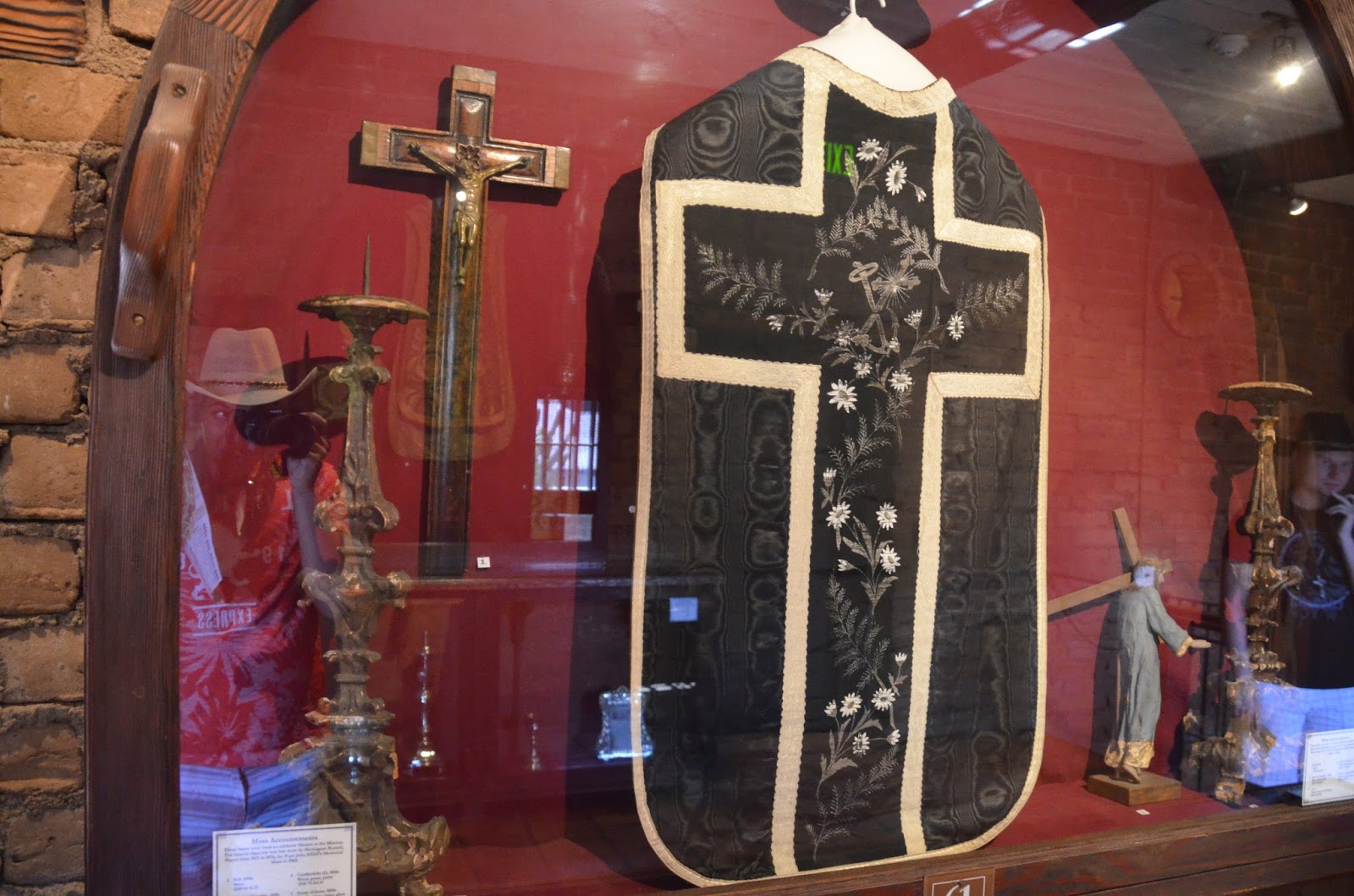
For those interested in journeying with this book to the missions founded by St. Junipero Serra, the following are just a few of the images from my travels there:


St. Junipero Serra, pray for us and for the Church!
Read more >>
Thursday, March 2, 2017
31-Day St. Joseph Daily Reflection Manual

Did you know that the Month of March is dedicated to St. Joseph?

Throughout the centuries, Holy Mother Church has set aside particular months of the year for special devotion. May is dedicated to Our Lady. June to the Sacred Heart. October to the Holy Rosary. And March—leading us toward the great solemnity of March 19—is dedicated to St. Joseph, the Spouse of the Blessed Virgin Mary and the Foster Father of Our Lord Jesus Christ.

Why March?

The Church honors St. Joseph in a particular way on March 19, his principal feast day: the Solemnity of St. Joseph, Spouse of the Blessed Virgin Mary. Because of this great feast, the entire month gradually came to be consecrated to him in popular Catholic devotion.

March is also a fitting time spiritually. As we move deeper into Lent—often a season of quiet sacrifice, hidden prayer, and humble obedience—we look to St. Joseph as the model of interior virtue. The Gospels record not a single word of his, yet his actions speak profoundly: obedience to the angel, courage in protecting the Holy Family, faithful labor in Nazareth, and steadfast trust in God’s providence.

In an age of confusion about fatherhood, work, leadership, and masculinity, devotion to St. Joseph has only grown stronger. Popes from Pius IX (who declared him Patron of the Universal Church in 1870) to Leo XIII (who wrote Quamquam Pluries on devotion to St. Joseph) and Pius XII (who established the Feast of St. Joseph the Worker on May 1) have continually urged the faithful to place themselves under his protection.

The 31-Day Devotion to St. Joseph

One beautiful way to honor St. Joseph throughout March is the traditional 31-day devotion.

Originally composed by St. Alphonsus Liguori, the text in this booklet was later adapted by Hugh J. O’Connell, C.SS.R. Printed with an Imprimatur in 1962, it has since become difficult to find in print. The text has recently been arranged as a PDF download, ready to print at home for family devotions.

The booklet is composed of 31 short but fervent reflections on St. Joseph, arranged for each day of the month. Every line bears testimony to the deep respect, confidence, and love which St. Alphonsus felt for the foster father of Jesus. The meditations are practical, doctrinally rich, and warm in tone—ideal for personal prayer, family devotions, or even brief parish use.

Each day invites us to reflect on one of St. Joseph’s virtues:

  • His purity
  • His obedience
  • His silence
  • His prudence
  • His protection of the Holy Family
  • His confidence in divine providence

These reflections help us grow in trust, humility, and love of hidden service—the very virtues that made St. Joseph pleasing to God.

Why Turn to St. Joseph Today?

St. Joseph is:

  • Patron of the Universal Church
  • Terror of demons
  • Protector of families
  • Model of workers
  • Patron of a happy death

He lived in obscurity, labored faithfully, guarded purity, and died in the arms of Jesus and Mary. For those striving to live the Catholic Faith seriously—especially in times of confusion and moral instability—there may be no greater earthly intercessor.

If you have never made a sustained devotion to St. Joseph, March is the perfect time to begin.

You can read and download the 31-Day Devotion here: https://www.papamio.org/31-days-devotion-to-st-joseph

Read more >>
Sunday, February 26, 2017
Archbishop Purcell on Papal Infallibility


"If the Pope, for instance, were to say that the belief in God is false, you would not be obliged to believe him, or if he were to deny the rest of the creed... The supposition is injurious to the Holy Father in the very idea, but serves to show you the fullness with which the subject has been considered and the ample thought given to every possibility.  If he denies any dogma of the Church held by every true believer, he is no more Pope than either you or I; and so in this respect the dogma of infallibility amounts to nothing as an article of temporal government or cover for heresy" (Archbishop Purcell in "The Vatican Council")
Read more >>
Saturday, February 25, 2017
Do Penance Now Rather Than in Purgatory

We must ask ourselves before we soon begin Lent: Is our process of purification a priority now or are we putting everything off until Purgatory?

The meditation themes for improvement of the "requisite qualities" of Christian heart, to make it worthy to receive the seeds of Divine Sower, Our Lord Jesus Christ. Fragments taken from "Divine Intimacy" by Fr. Gabriel of St. Mary Magdalen, OCD.


"The Night of the senses"

PRESENCE OF GOD - O lord, strengthen my desire for union with You, so that I may have the courage to face, for love of You, the total purification of the senses.

MEDITATION.

1. "In order to attain to divine union with God, the soul must pass through the dark night of mortification of the appetites and the denial of pleasure in all things" (J.C. AS I, 4,1). St. John of the Cross calls the total mortification of the senses the "dark night", because the soul that renounces every irregular attachment to creatures and to pleasure it might find in them, remains "unoccupied and in the darkness" (ibid., 3,1) as far as the senses are concerned.

It is to help us to enter this night, through which we must pass in order to attain to union with God, that the Saint tells us to mortify our inordinate tendencies toward sensible satisfactions. However, it is evident that even if we sincerely wish to mortify our senses, we cannot always avoid seeing agreeable things, listening to interesting news, eating appetizing food, and so forth. Sometimes sensible satisfactions will be imposed on us by the necessities of life, by the duties of our state, or even by our superiors. It is absolutely necessary, even in these cases, that our soul remain wholly free from all attachment to creatures and to sensible satisfactions. It will suffice to desire not to have this pleasure, and promptly to "mortify our senses, voiding them of such pleasure," depriving them of everything, "as though they were in darkness" (cf. ibid., 13,4).

In other words, we should not stop at the selfish enjoyment of what pleases our senses, but try to raise our heart at once to God by offering Him the enjoyment we feel and which He permits for the renewal of our strength, so that we may be able to take up again with greater generosity the practice of mortification.

In this way even natural joys will help to bring us to God and to increase our love. This is what St Therese of the Child Jesus called "to rejoice for Love." This is the pure doctrine of St. Paul, who said, "Rejoice in the Lord always"; and again, "Whether you eat or drink, or whatsoever else you do, do all to the glory of God" (Phil 4,4 - 1 Cor 10,31). If, on the contrary, we stop at the enjoyment of sensible things, we shall never be able to enter the night of the senses.

2. "The soul ordinarily enters this night of the senses in two ways: the one is active, the other passive. The active way consist in that which is the soul can do, and does of itself, in order to enter therein. The passive way is that wherein the soul does nothing, and God works in it, and it remains, as it were, patient" (J.C. AS I, 13,1). The active way include everything that we can do on our own initiative to rid ourselves of every affection for and attachment to creatures. For example, it is in our power to apply ourselves to the practice of poverty, corporeal mortification, penance, and chastity - all of which are virtues that detach the soul from the goods of earth and the satisfaction of the senses.

If we want to do all that we can to enter the night, we must practice these virtues generously, keeping our eyes fixed on Jesus, our divine model, who wished to give us an example in everything. But no matter how much we do, our own practices will never be sufficient to destroy completely all the roots of attachments. If we examine ourselves carefully, we shall see that, even in the practice of voluntary mortification, a little complacency may enter in because of what we have chosen, which is to our liking and according to our wishes. In order that our purification be complete, the work of God must intervene, that work which will bring us passively into the night of the senses. He does this by means of trials and contradictions both exterior and interior.

It is a time of submission rather than of action; we must accept with humility and docility all that God permits, without trying either to escape the trial or to lessen or change it. In the Ascent of Mount Carmel St. John of the Cross gives the picture of a soul which, "kindled in love with yearning, sings of the happy fortune which befell it to pass through the dark night. "In fact, to be brought into the passive night is one of the greatest graces the soul can receive, because then God Himself is preparing and disposing it for divine union. If we wish to obtain this grace, we must do everything we can to enter the active night, that is, we must practice renunciation and total detachment.

COLLOQUY

O Lord, deign to come to me with Your grace and inflame me with Your love, that I may be able to plunge enthusiastically into the dark night which is to prepare me for union with You. Night does not please my nature which loves the light, the sun, the full radiant daylight. But with your help, and for love of You, why should I not be willing to deprive my senses of all satisfactions and to annihilate them in the night, when all it amounts to is the giving up of a few worthless trifles in order to have the enjoyment of You, in whom are all light, all joy, all happiness? .......

"O Lord, keep far from the heart of Your servant the thought that any kind of joy will bring happiness! On the contrary, there is a joy which is not granted to the wicked, but to those who honour You unselfishly. You are their joy. All happiness consists in this: to rejoice in You, because of You and through You; there is no other. He who believes that any other happiness exists is pursuing a strange and false joy" (St Augustine)
Read more >>
An Act of Charity for Souls

Eternal Heavenly Father,
Through the Immaculate Heart of Mary,
I offer Thee the most precious Body and Blood,
Soul and Divinity of Thine Only begotten Son, our Lord and Savior,
Jesus Christ,
With the merits and prayers of all Thy Saints,
And my whole self as victim-soul and holocaust,
In union with the Holy Sacrifice of the Mass,
Offered throughout the world,
For all the Holy Souls in Purgatory,
And for the souls of all poor sinners on earth,
Especially bishops, priests, and religious,
And those within my home and family,
According to Thy most holy Will,
In Jesus’ Name and in the unity of the Holy Spirit,
One God forever and ever.
Amen.

Mary, Mother of Jesus and my Mother, pray for us.
Holy Angels and Saints of the Living God, pray for us.
Read more >>
Thursday, February 23, 2017
Pamphlets Defending the Catholic Faith to Distribute

As we prepare to enter the holy season of Lent, we have to begin preparing ourselves.  What penance will you be doing?  Besides prayer, fasting, and almsgiving, there are a lot of options.  Click here for my prior Top 20 Pious Practices for Lent article.

In addition to what I shared in that article, consider distributing flyers promoting the Catholic Faith to those who need to hear these words - fallen away Catholics, protestants, those in doubt, etc. 

Below is a list of various pamphlets available from St. Paul's Street Evangelization.  It's a good place to start.  Make it an effort to distribute some of these this Lent and keep them in stock in your home and car to distribute to people, on bulletin boards, in protestant bibles, and anywhere else you can when the opportunity presents itself:

Permission Guidelines: “Individuals may print specific pages, such as tracts from this website for personal use. Permission needs to be obtained for large-scale distribution (more than 20 copies).” See the full text here. 

Click here to see their pamphlet inventory and order some today.


Our Lady of the Rosary Library (OLRL) also offers excellent pamphlets and prayer cards for distribution. They, unfortunately, do not have an online checkout option but you can order via a check in the mail and they will ship you the items for an extremely low price, making it very affordable to distribute these. They offer wonderful prayer cards to give to family members, friends, those who have suffered a loss, those in the hospital, and anyone else you meet in life.
Read more >>
Thursday, February 16, 2017
Nicola Boccasini: 9th Dominican Master

Continuing my articles on the Masters of the Dominican Order, we arrive at the 9th Dominican Master: Nicola Boccasini.  Nicola Boccasini, who would become Pope Benedict XI, governed the order after Stephen of Besançon.

For a quick recap on the previous Masters of the Order, please click here.


Blessed Pope Benedict XI was born Nicola Boccasini in 1240 in Treviso, Italy, in the Holy Roman Empire.  He would live 64 years until his death on July 7, 1304.  

At a young age, his father died and left his mother, Bernarda, a widow.  It was at that time a Dominican friar left a sum of money in his will to Bernarda and the children.  And part of the will stipulated that if Nicola were to enter the Dominican Order, he would receive half of the legacy.  Bernarda worked as a laundress for the Dominican Friars in Treviso so the family was well familiar with the Order.

Even at a young age, the future Pope Benedict XI was preparing for a life of a monk.  His teacher was his uncle who was a priest of St. Andrea. And in 1254, at the age of 14, Nicola entered the Order of Preachers.   For the next seven years, Nicola pursued his basic education in Venice. In 1262, Nicola was transferred to Milan where he spent the next six years of his life.  At that time, he became a professed member of the Dominican Order. He served as lector for fourteen years, from 1268 to 1282.

The next greatest change took place in 1286 when Fr. Nicola was elected the Provincial Prior of Lombary. Instead of being firmly attached to a single convent for years, he would instead become peripatetic, moving from one convent to another on visits of inspection, encouragement and correction. In Lombardy at the time there were some fifty-one convents. After his tiring three year term was completed in 1289, he was released from the office of Provincial of Lombardy.  However, he was elected Provincial Prior of Lombardy again at the Provincial Chapter held at Brescia in 1293.

In 1296, Nicola was elected as the Master of the Order of Preachers, a role he would serve in until 1303.  During this same time, on December 4, 1298, he was made a Cardinal by Pope Boniface VIII.  He also served as Papal Legate to France.

When Pope Boniface VIII was seized at Anagni in September, 1303, Nicola was one of only two cardinals to defend the Pope in the Episcopal Palace itself.  He would be imprisoned for three days before being liberated.

On October 22, 1303, Nicola was elected to succeed Boniface VIII as the Supreme Pontiff. He took the name Benedict XI and reigned not one year until his death on July 7, 1304. Historians speculate he may have been poisoned.  It was after his death that the Papacy moved to Avignon from Rome and thus began the long and trying time known as the Avignon Papacy.

Pope Benedict XI, the first Dominican Pope, was widely regarded for his holiness.  And in response to his life and the miracles attributed to pilgrims who journeyed to his tomb, Pope Clement XII beatified him on April 24, 1736, and assigned his feastday to July 7th.

Blessed Pope Benedict XI, 9th Dominican Master, pray for us!

Pater Noster.  Ave Maria.
Read more >>
Wednesday, February 15, 2017
Pope St. Urban I

Pope St. Urban I. Photograph on Wikipedia by User: Pleple2000.  Taken July 12, 2006.

Next in the continuing series of posts on the History of the Sovereign Pontiffs, after the death of Pope St.  Callistus I on October 14, 222, St. Urban I was elected as the Supreme Pontiff.

Pope St. Urban I was a Roman who served as the Successor of St. Peter for nearly nine years.  According to legend, St. Urban baptized Valerian, the husband of St. Cecilia.  But little is known with certainty of his life.  He died in 230 and is buried in the Cemetary of Callixtus.

Concerning St. Urban, Butler's Lives of the Saints offers the following:
The notice in the Roman Martyrology reads : "At Rome on the Via Nomentana, the birthday of Blessed Urban, Pope and Martyr, by whose exhortation and teaching many persons, including Tiburtius and Valerian, received the faith of Christ, and underwent martyrdom therefor ; he himself also suffered much for God's Church in the persecution of Alexander Severus and at length was crowned with martyrdom, being beheaded." 
It is to be feared that even this short notice is mainly apocryphal. The reference to Tiburtius and Valerian is derived from the very unsatisfactory Acts of St Cecilia, from which also the account of Urban in the Liber Pontificalis has borrowed. It is quite certain in any case that Pope Urban was not buried on the Via Nomentana, but in the cemetery of St Callistus, on the Via Appia, where a portion of his sepulchral slab, bearing his name, has been found in modern times. 
Not far from the cemetery of Callistus on the same main road was the cemetery of Praetextatus, and there another Urban, a martyr, had been buried. Confusion arose between the two, and an old building close beside the Praetextatus catacomb was converted into a small church, afterwards known as St Urbano alia Caffarella. The confusion of the two Urbans and the muddle hence resulting in the notices of the Hieronymianum are points full of interest, but too complicated to be discussed here. 
Collect (from his feastday on May 25th):

O Eternal Shepherd, who appointed blessed Urban shepherd of the whole Church, let the prayers of this martyr and supreme pontiff move You to look with favor upon Your flock and keep it under Your continual protection. Through our Lord . . .
Read more >>
Tuesday, February 14, 2017
Feast of The Prayer of Christ (Masses in Some Places)

Each year on the Tuesday after Septuagesima there was celebrated a "Mass in Some Places," according to the 1955 Missal. This special Mass is for The Prayer of Christ and has been around for several hundred years.  The Catholic Encyclopedia summarizes this special feastday that is worthy of our meditation:
This feast occurs on the Tuesday after Septuagesima (double major). Its object is to commemorate the prolonged prayer which Christ offered in Gethsemane in our behalf in preparation for His Sacred Passion. 
The Office insists on the great importance of prayer. The feast is placed at the beginning of Lent to remind us that the penitential season is above all a time of prayer. The Office probably was composed by Bishop Struzzieri of Todi, at the suggestion of St. Paul of the Cross (d. 1775), and, together with the other six offices by which the mysteries of Christ's Passion are celebrated (see Moveable Feasts in Some Places), was approved by Pius VI. 
The hymns were composed by Fatati (Schulte, "Hymnen des röm. Brev."). Outside the Congregation of St. Paul this feast was adopted later than any of the other feasts of the Passion. It is not found in the proprium of Salerno (1793) nor in that of Livorno (1809). Other dioceses took it up only after the city of Rome had adopted it (1831). It has not yet been inserted in the Baltimore Ordo.
Collect:

O Lord Jesus Christ, who in the garden, with words and example, taught us to pray to overcome the dangers of temptations, grant us, that, always intent on prayer, we deserve to obtain copious fruit: You who are God and live and reign with God the Father in the unity of the Holy Spirit for ever and ever. Amen.
Read more >>
Monday, February 13, 2017
Francis Apparently not Happy with Roman Posters

Image Source: CNN

Guest Post by David Martin

Pope Francis seems to have taken offense over an anonymous poster campaign which called into question his mercy. On February 4, Romans woke up to more than 200 posters of a stern-faced pope plastered all over the city, with a caption that asks, "But where is your mercy?"

The unidentified posters accused Francis of having "ignored cardinals" and "decapitated the Order of Malta" — references to a bitter dispute between the order and the Vatican that benched a conservative cardinal.

The day after the incident, the pope called on pilgrims during the Angelus prayer to stay far away from "the polluting germs of ego, envy, and slander."

The following Sunday he criticized the everyday use of "insults," an apparent reference to the anonymous posters, though it seems he was also alluding to a barrage of criticism he has received in recent months over his progressive Vatican reforms and his dissent from Church teaching and practice. In his weekly Angelus address, Francis highlighted Jesus' commandment, "Thou shalt not kill," saying the edict applied not only to actual homicide, "but also to those behaviors which offend the dignity of the human person, including insulting words." He added that he "who insults his brother kills that brother in his heart."

Insults indeed are grave sins against charity, especially insults against the Faith. However, the anonymous posters were not intended as insults to the pope, but were earnest inquiries as to where his mercy is at. After all, he has shown mercy for liberal U.N. anti-life agents who use his Vatican to promote a more "sustained" planet through population control (abortion), and he has exonerated people like Albrecht von Boseselager of the Knights of the Order of Malta after he was rightfully dismissed by his superior Fra' Matthew Festing for distributing $millions worth of contraceptives and abortifacient drugs, while Festing was asked by the pope to resign. Where is the pope's mercy?

He has shown his mercy to offenders like abortionist Emma Bonino whom he called "one of Italy's greats," and to Fidel Castro who lived by the firing squad, while demoting and showing disdain for outstanding Vatican prelates like Cardinals Burke and Sarah for their humble witness of the Catholic Faith.

Worse yet, he has made fun of young Catholics who prefer to attend the Traditional Latin Mass, and went so far as to say that the reason young people attend this more "rigid" form of the Mass is to "hide their evils." In an interview given by Pope Francis to his close confidant Fr. Antonio Spadaro SJ, who is Editor-in-Chief of Civiltà Cattolica, he expressed wonder over why young people, who were not raised with the Latin Mass, nonetheless prefer it.

"And I ask myself: Why so much rigidity? Dig, dig, this rigidity always hides something, insecurity or even something else. Rigidity is defensive. True love is not rigid."

Words like these are "the polluting germs of ego, envy, and slander" that need to be cleansed from the Church. When Christ said "Thou shalt not kill," it also meant not to kill the spirit of young people, who after much prayer, deliberation, and struggle, have decided to do something right in life to the delight of their Maker. A crime it is that they should be insulted this way for their fidelity.

If Francis were true of heart, he would cry tears of gratitude that these young people, who could be using their time to engage in pop culture and sin, have chosen rather to grow up and to attach themselves to God in the old Mass. And he would be instant to understand that it is Christ himself who gently draws these precious souls to himself in the Traditional Mass. Why should Francis Wonder!?

He seems to have a phobia about the goodness of God. This goodness was manifest through the ages by the glories of tradition wherewith God enriched his Church. In his mercy He extended to us the jewels of sacred tradition and the Latin Mass, that it might be a joy and cleansing to his people, so why does Francis scorn these treasures while adulterating the Church with change? Women deacons? Lay Eucharistic ministers? Communion to adulterers? Respect for "gay orientation?" Youth Mass on the beach with guitars, beachwear, and gay dancers? What kind of scandal is he pushing on the youth? He discards rules and regulations and then teases the flock with this socialist merry-making that he calls mercy! "Woe to the world because of scandals!" (Matthew 18:7)

Nay, the posters in Rome were not an insult to the pope, but were providentially arranged for his instruction. Let us pray that Francis will revisit this matter and learn by it. And let him "dig, dig," that he might discover his own "rigidity" which makes him "defensive" against tradition.

https://www.yahoo.com/news/pope-francis-speaks-against-insults-175811979.html?soc_src=mail&soc_trk=ma
Read more >>
Monday, February 6, 2017
Pope St. Pius X on the Importance of Religious Instruction

Guest Post by CatechismClass.com
"How many and how grave are the consequences of ignorance in matters of religion! And on the other hand, how necessary and how beneficial is religious instruction! It is indeed vain to expect a fulfillment of the duties of a Christian by one who does not even know them." Pope St. Pius X - Acerbo Nimis
Let us all do our part to support traditional Catholic teachings in a world that increasingly hates the True Faith of Christ.

Read more >>


Copyright Notice: Unless otherwise stated, all items are copyrighted under a Attribution-NonCommercial-NoDerivatives 4.0 International License. If you quote from this blog, cite a link to the post on this blog in your article.

Disclosure of Material Connection: Some of the links on this blog are “affiliate links.” This means if you click on the link and purchase the item, I will receive an affiliate commission. As an Amazon Associate, for instance, I earn a small commission from qualifying purchases made by those who click on the Amazon affiliate links included on this website. I am disclosing this in accordance with the Federal Trade Commission’s 16 CFR, Part 255: “Guides Concerning the Use of Endorsements and Testimonials in Advertising.”