Showing posts sorted by relevance for query Liquids. Sort by date Show all posts
Thursday, September 14, 2023
What Liquids Are Permitted on Fasting Days?

Liquids Permitted on Fasting Days

Around the 14th century water and other liquids become widely permitted to all classes of persons – not just monastics – outside the meal on fast days. This had been so widely known and taught that the 1917 Code did not even comment on the use of liquids on days of fast. In commenting on the Church’s law, Father Jone notes that while liquids do not violate the fast, this adage concerns liquids understood in the proper sense and not quasi-food items like milk shakes. In a similar vein, juices made from puree or pureed food would violate the fast:

"...liquids, including milk and fruit juices, are allowed. The usual amount of cream in coffee or tea is permitted. Milk is understood as ordinary or homogenized, but does not include such combinations as malted milk or milk shakes. However combinations based on skimmed milk and coloring or special flavoring such as chocolate milk are rather a drink than a food and, therefore, permissible." 

Father Prümmer states the same with some additional language worth nothing:

"There is a common saying that drinks do not break the fast, but only those things are to be classified as liquids which normally aid the digestion of food: therefore any drink which has a notable nutritive value cannot be regarded as pure liquid, such as milk, chocolate made with milk. But wine, beer, coffee and tea are permissible." 

Antoine Villien in "A History of the Commandments of the Church" published in 1915 provides a history of the origin of the frustulum and the collation while noting that the distinction in liquids of simple liquids from others that would break the fast, showing that this distinction stretches back to at least the Middle Ages:

“To allow the meal to be taken at noon was to render it possible to work harder in the afternoon but then the fatigued body required some refreshment at night. A little liquid to quench the thirst was at first permitted for it was held that liquids did not break the fast. The Church refrains from forbidding liquids because their primary function is to relieve thirst and aid digestion rather than to nourish although, as St Thomas admits, liquids do give some nourishment. However, the liquids in common use, water and wine, do not always suffice; they are not even an aid to digestion for everybody. Since there are other liquids more beneficial to digestion and better able to quench thirst, e.g., the electuaria, viz. more or less liquid jellies, preserves, candied fruit; could not these electuaria replace water and wine? St Thomas thought that it was just as lawful to take them as to take any other medicine provided only that they be not taken in large quantities or as a food. The permissible quantity was not specified and it devolved upon custom to determine it. Quantity like custom naturally varied in different localities. In the monasteries where everything was better regulated this little lunch consisting of fruit herbs bread water or wine was taken in common, while the Collationes of Cassian were read; hence the name collation was given it and an effort was made so to limit the repast that it might never be equivalent to a full meal. Thus, the essence of the fast was saved.

“The collation was for the night. But in the morning also the weakened stomach felt the need of some relief. Since liquid did not break the fast it could not be forbidden. Neither did the electuaria break the fast as we have seen above provided they were not taken in too great a quantity or per modum cibi; hence they were likewise permitted. Water, wine, coffee were simple liquids; hot chocolate without milk was placed in the class of the electuaria: all were tolerated. A little bread is sometimes necessary with wine or coffee ne potus noceat, so as not to inconvenience delicate stomachs; hence it likewise was permitted and thus originated the morsel of food commonly called frustulum. So it was still true that only a single meal was taken.” 

Hence, in the context of fasting, liquids do not only refer to what is drunk. They also refer to beverages meant to aid in digestion and which offer no real nutritional value (i.e., no or virtually no calories).

Is Chocolate a Liquid or a Solid?

The discovery of the New World also brought with it questions directly impacting what may or may not be consumed on days of fasting and one of the most significant of those concerned a newly discovered substance – chocolate. Was chocolate a liquid or a solid? Could someone consume it on a day of fasting at any time since it is a liquid when heated and left at room temperature? The Economics of Chocolate describes this interesting history:

“The first fight over the definition of ‘chocolate’ was within the Catholic Church. After the Spanish conquest of America, chocolate was imported to Europe and consumed as a beverage. In the sixteenth and seventeenth centuries in Catholic countries such as Spain, France, or Italy, the issue of whether or not it was permitted to drink chocolate during Christian fasting periods…arose. Christian fasting implied that flesh is ‘mortified,’ therefore more ‘nourishing’ substances couldn’t be taken. If chocolate was a drink, it did not break the fast, but if it was a food, then it could not be consumed during Christian fasting periods…

“Catholic scholars debated the issue. Juan de Cardenas (1591-1913) and Nicephoro Sebasto Melisseno (1665) argued that chocolate could not be consumed during the fast because of the addition of butter. Antonio de Escobar y Mendoza (1626), Antonio de Leon Pinelo (1636), and Tomas Hurtado (1645) had a different opinion. According to them, it depended if (and how much) nourishing substances were added to the chocolate. If mixed with water it became a drink and was thus permitted (as was wine), but if mixed with other substances (as milk, eggs, and dry bread) it become a food and, therefore, was forbidden. Cardinal Francesco Mario Brancaccio (1664) also argued if the water component prevailed over the cocoa component, then chocolate did not break the fast…

“Several popes were asked to settle the dispute as leaders of the Catholic Church. According to Coe and Coe (2013), Popes Gregory XIII, Clement VII, Paul V, Pius V, Urban VIII, Clement XI, and Benedict XIV all agreed in private that chocolate did not break the fast. However, there was never an official Papal statement to end the debate.” 

Peter Dens in A Synopsis of the Moral Theology states a similar position from the Church at that time in a more succinct manner:

“Does the taking of chocolate break an ecclesiastical fast? It is certain, with the consent of all, that to eat chocolate undiluted breaks the fast; because it is food, and is taken by way of food. The question is concerning the drinking of chocolate; to wit, when chocolate, mixed with water and diluted and boiled, is drunk, or rather, is sucked. Cozza and La Croix propose this as a question controverted by their patrons on both sides, whom they cite. Benedict XIV, the Supreme Pontiff, has published a lucid dissertation upon this question, who, however, resolves that it is more safe to abstain from chocolate on a fast day; and to him we adhere with Billuart. The reason is, because such a potion in itself, and more especially serves for nourishment, and not properly cooling, or for quenching thirst; for it is a kind of hot concoction. This is confirmed from the fact that by this potion weak persons are nourished." 

To a serious Catholic, what was and was not permitted on a day of fasting was worth careful consideration. 

Want to learn more about the history of fasting and abstinence? Check out the Definitive Guide to Catholic Fasting and Abstinence.

Read more >>
Friday, March 4, 2022
Early Christians Fasted Even from Water During Lent

The history of the Lenten fast is replete with inspiration for us. Whereas modern man has steadily over the centuries given in to laxities and has abandoned fasting - and prayer and almsgiving too - it is necessary for those Catholics faithful to the Traditions to restore some of the fervor of our forefathers in the Faith. 

To the Early Christians, fasting was performed until sundown, in imitation of the previous Jewish tradition. Dom Gueranger’s writings affirm, “It was the custom with the Jews, in the Old Law, not to take the one meal, allowed on fasting days, till sun-set. The Christian Church adopted the same custom. It was scrupulously practiced, for many centuries, even in our Western countries." 

Liquids Broke the Fast In the Early Church

In the early Church, fasting also included abstinence from wine, taking man back to his antediluvian diet before God permitted Noah to eat meat and drink wine. As such, in apostolic times, the main meal was a small one, mainly of bread and vegetables. Fish, but not shellfish, became permitted on days of abstinence around the 6th century. Hence, some Eastern Rites will abstain from meat, animal products, wine, oil, and fish on fasting days which harkens back to these ancient times.

Remarkably, even water was forbidden during fasting times in the very ancient church. Fr. Alban Butler in Moveable Feasts and Fasts provides testimony of this when he writes: 

"St. Fructuosus, the holy bishop of Tarragon in Spain, in the persecution of Valerian in 259, being led to martyrdom on a Friday at ten o'clock in the morning, refused to drink, because it was not the hour to break the fast of the day, though fatigued with imprisonment, and standing in need of strength to sustain the conflict of his last agony. 'It is a fast,' said he: 'I refuse to drink; it is not yet the ninth hour; death itself shall not oblige me to abridge my fast.'"

The Pulpit Orator published in 1884 by Fr. Pustet & Company similarly notes: "That we take only one full meal, Sundays excepted. The Christians of the first ages observed this ecclesiastical ordinance very exactly, after the setting of the sun. Nor did they drink water, unless there was a necessity. A council at Aix-la-Chapelle declares: 'Only when necessity requires it, on account of hard labor or weakness, is it allowed to drink.'"

Father Alban writes elsewhere, "It is undoubted, that anciently to drink on fasting days was no less forbidden than to eat, only in the refection after sunset." The account of St. Fructuosus illustrates that while water would break the fast, water was permitted when the meal was taken later in the evening. This reference to taking the meal after a set time prescribed by the Church would last for centuries, even though it would be moved up ultimately to noon by the 14th century. 

Father Alban also insightfully remarks, "Even the first allowance of a collation, which consisted only of a draught of drink, shows it was not allowed before to drink at all on fasting days before the hour of the meal...The Mahometans, though immersed in sensuality and vice, keep up this essential law in their fasts, which consist in neither eating, nor drinking, nor smoking the whole day, from morning to the rising of the stars in the evening." The custom of fasting even from water was similarly practiced in ancient Judaism.

The American Ecclesiastical Review in a 1938 piece on the Lenten fast notes that in the Early Church, even after water became allowed, liquids other than water would break the fast:

The fast observed in the early Church was much more severe than that of later centuries. The law of fasting did not permit the use of any food earlier than sunset during Lent and not earlier than three o'clock in the afternoon on fast days outside of Lent. Even in St. Thomas's time, the hour for the taking of food was circa horam sextam or noon. The earlier custom prohibited all liquids except water outside the meal, later liquids were allowed according to the principle that they do not break the fast. It was not until the thirteenth century that the custom of taking a little food such as fruit bread salad and the like in the evening was introduced. This refection received the name of collation apparently from the Collations of Cassian usually read by the monks at this repast. The frustulum or small quantity of food allowed in the morning is a practice of comparatively recent origin. Only when we consider the rigor of fasting as practised by our forefathers in the Faith can we appreciate the indulgence that the Church has accorded Catholics in this age.

Water Broke the Eucharistic Fast Until 1953

The final vestige of abstaining from even water was in the form of the Eucharistic fast leading up to the reception of Holy Communion. This was changed by Pope Pius XII on January 6, 1953, in Christus Dominus, which stated: “In the future, it shall be a general and common principle for all, both priests and faithful, that natural water does not break the Eucharistic fast.” Further changes were introduced on March 25, 1957, in Sacram Communionem by Pope Pius XII again. While legislating on a number of finer details, as a whole, Pope Pius XII’s legislation mitigated the fast to be for three hours before Holy Communion from all solid food and all alcoholic beverages. Nonalcoholic beverages were subject to a one hour fast, though water was permitted at any time as stated in Christus Dominus. Those old enough to remember Masses before 1953 may recall that Catholic schools would cover the drinking fountains until after Holy Mass had ended.

Conclusion

While this practice of abstaining from liquids may not be something we want to practice this Lent, it is worthwhile to consider for the sake of inspiration the remarkable discipline that Early Christians kept in the Lenten fast. And we too can keep an austere Lent this year by retaining some of the practices kept by our forefathers in the Early and/or Medieval Church.

Want to learn more about the history of fasting and abstinence? Check out the Definitive Guide to Catholic Fasting and Abstinence.

Read more >>
Wednesday, January 17, 2024
2nd Edition of "The Definitive Guide to Fasting and Abstinence" Now Available

In early 2023, I launched "The Definitive Guide to Fasting and Abstinence" based on over 3 years of research into the forgotten and untold history of how the Catholic Church went from roughly one-third of the year of fasting (and two-thirds as days of abstinence) to only two days of fasting. I published the book so that it would be available in time for Lent, and even though many priests said that 95% of it was new to them, I still had more research to undertake to finish my study of this forgotten history.

After another year of work, I'm delighted to launch the 2nd edition of the book. The 2nd edition features the following topics which were not covered (or covered only briefly) in the first edition:

  1. Detailed explanations of how fasting changed in other countries besides America, including Spain and the Philippines.
  2. A detailed explanation of who was exempt from fasting and/or abstinence and how those changes were documented and taught in various catechisms over the centuries
  3. Easter Week food traditions, highlighting their connection with the Lenten fast
  4. Armenian fasting and abstinence rigors
  5. Maronite fasting guidelines
  6. The heroic example of St. John of the Cross and the Primitive Rule of Pope Innocent IV vs. the mitigated rule approved by Pope Eugenius IV
  7. How the time of the meal on fasting days differed (e.g., sunset for Ember Days but 3 PM for the weekly devotional fasts)
  8. The food customs that originate due to Ember Days
  9. The forgotten fast from fleshmeat and foods cooked in fat on Holy Innocents Day
  10. Why do the laws of fasting and abstinence bind mortally
  11. The Bula de Cruzada history
  12. Semi-Fast vs. Full-Fast Days
  13. The time of the conventual Mass and how the traditional midnight fast would (or would not) impact that.
  14. Testimonials from those who followed the traditional fasting proposed in the first edition of the book
  15. Drinks other than water and if they were allowed in connection with the Eucharistic Fast
  16. The distinction between black fasting, the Passion Fast, and Xerophagiae
  17. The Importance of Thanksgiving after Holy Communion
  18. St. Michael's Lent
  19. The Assumption Fast
  20. The distinction of simple vs. complex liquids: What does it mean that liquids are allowed? What is a liquid, and what is not?
  21. Chocolate: Is it a liquid or a solid? When and how may it historically be consumed, if at all, on days of fasting
  22. Why and when beaver, muskrat, and capybara became permitted on days of abstinence for some
  23. Protestant Fasting: Does it exist? If so, how is it? What is the so-called "Daniel" Fast practiced by some?
  24. Lard, Bouillon, and Broth explained over time
  25. The size of the one meal explained, including how long is too long
  26. And much more! 
All in all, the second edition is more than double the length of the first edition! Even if you purchased the first edition of the book, the 2nd edition should be in every Catholic home that is striving to restore the fasting and abstinence practices of our ancestors for the conversion of sinners, reparation of sin, and the increase of virtue in our own lives.

Ordering Options:


“This work is highly important for faithful Catholics! Matthew has written a book that contains the potential for notable impact on our Prayer Life, Personal Sanctity, and increased historical understanding of the teachings of Holy Mother Church. Since Vatican II the understanding of Fasting, Holy Days of Obligation, and the need to gain self-control have been lessened by transfers of Solemnities and the emotional dispensations from fasting given by ecclesiastical authorities. Armed with this renewed knowledge of age-old practices used by serious Catholics in offering personal acts of sacrifice through abstinence and fasting, a barrier of a hum-drum prayer life can be broken, and Catholics can achieve new levels of Active Participation in the life of the Church.” (Father Scott DuVall)

“To paraphrase St. John Henry Newman, prayer and fasting are the two wings that carry us to Heaven.  We cannot achieve eternal life unless both wings are functioning.  The Definitive Guide to Catholic Fasting and Abstinence is not only a history of the practice of fasting, but also more importantly a guide to show Catholics how to love fasting in an age where satisfaction for sin is most needed!” (Father John Lovell, Co-Founder of the Coalition for Canceled Priests)

“The Definitive Guide to Catholic Fasting and Abstinence fills a great lacuna in the life of the Church. Matthew’s articulate and cogent account of an integral Catholic way of life is one which gives rightful place to the body and its healthy, holistic, and holy subordination to the soul and spirit. Matthew’s book is not only a call to arms, but a call to the recovery of the vital narrative memories of the saints of yesterday, who in their fundamental anthropology, struggles, and strivings are no different from us, the saints of today. With sobriety, intelligence, and authentic piety, The Definitive Guide to Catholic Fasting and Abstinence serves as a point of reference, understanding, and motivation so that the strength and the joy of our forefathers may be ours in the here and now.” (Father Cassian DiRocco)

“Many ask what do I do to stem the tide of evil and promote the salvation of souls? This book gives us one of the most important tools. By giving a thorough history and explanation of the laws and practices of fasting and abstinence, the reader cannot help but be motivated to more than the current minimal requirements. The famous quote by Archbishop Fulton Sheen came to mind as I realized the potential for others to be moved by this book: ‘Who will save the Church? ...the laity.’  I believe a return to the Church’s rich traditions could be a big part of the work of the laity to save the Church. This book will also inspire priests, as most of us were never instructed in this tradition but will be inspired as well to do more fasting and lead the souls in their care to use the power of fasting and abstinence.” (Father Joseph Nicolosi). 

Read more >>
Monday, February 13, 2023
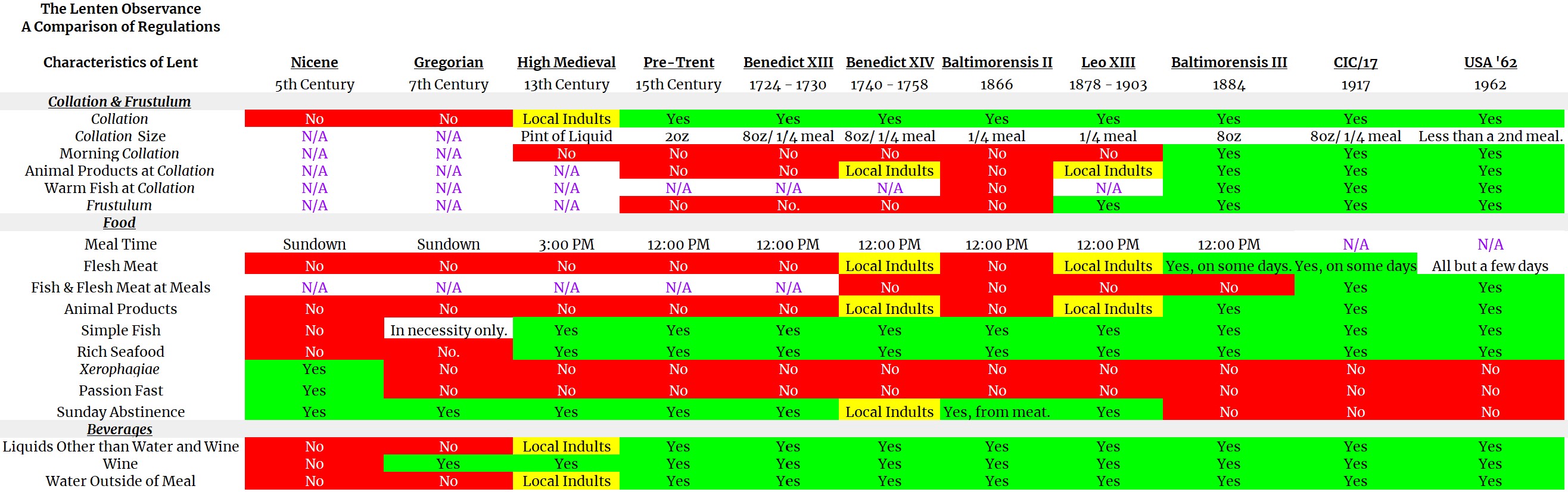
Lenten Observance Over Time: A Comparison of Regulations Over the Centuries

Click for the Full Image

As we prepare for another holy season of Lent, I wish to share this chart developed by Tyler Gonzalez showing the changes over time to the Lenten fast. His contributions to this chart and the subsequent annotations were invaluable. I am not aware of any such comparison ever having been created. We would do well to see in this image the great discipline of our forefathers and to rekindle some of these practices this Lent in our fasting.

Key of Terms and Annotated Citations: 

A collation is a small repast allowed originally only in the evenings of fast days. 

A frustulum is a small repast allowed originally only in the mornings on fast days. 

Xerophagiae is a diet of simple, dry, uncooked food, such as raw nuts, bread, fruits and vegetables. Fish and oil are not part of it neither are flesh and animal products. It was a precept to fast on these only during Holy Week by custom and/or decree until the time of Gregory the Great who mentions nothing of it. It may still have been a custom at that time but no mention of it is made in the decretals. 

The Passion Fast is a term which refers to the fast which began for some as early as sunset on Holy Thursday and as late as 8am on Good Friday. No one was allowed to eat any food during that time until sunset on Holy Saturday, which since most fasted for Communion extended until morning on Easter Sunday. It was often called a “40hrs Fast” and represents the original Lenten fast. For those who were to weak to follow this fast the minimum fast at this time was that of xerophagiae. 

1. Water is not allowed during the day outside of sunset repast. (Butler, Moveable Feasts, Fasts…, 1839, p.155) (C.f. AP. S. Prudentius, hymn, vi, p.188) 

2. On the Sunset Repast. (Butler, p.149) (Tertullian, De Jejun, c.x., p.549); (Weiser, Handbook of Christian Feasts and Customs…, 1958, p.170)

3. When the collation was allowed by indult. (Butler, p. 149) 

4. When the collation was allowed to the laity. (Butler, p. 152) 

5. The original size of the collation. (Butler, p.152) 

6. When the collation became ¼ of a meal/8 ounces. It became ¼ of a meal in the 16th century. (Laymann, Theologia Moralis, Lib. IV, Tract. VIII, Ch. I, pp.186-187, 1630) 

7. The origin of the frustulum originated around the time of St. Alphonsus Liguori c. 18th century (The Jurist, 1952, p.188) The more common opinion is that St. Alphonsus speaks of electuaries and not a frustulum which were popular in his time. That the origins of the frustulum can be traced to his time is true as a kind of proto-frustulum. However, the greater proof lies in the claim that the frustulum was not explicitly allowed until the end of the 19th century. (Catholic Encyclopedia, Lent) 

8. Fish in Lent permitted in its simple “less dainty” form in the 7th Century. The allowance of shellfish permitted around the 10th century (Butler, Moveable Feasts, Fasts…, 1839, p.146)

9. That animal products were not had on days of abstinence. (Weiser, p.170) (Cf. Decretals of Gratian, Letter of Pope St. Gregory the Great to Saint Augustine of Canterbury, 604 AD).

10. That Sundays were days of abstinence. (Thurston, Herbert. "Lent." The Catholic Encyclopedia. Vol. 9, 1910.) 

11. The Passion Fast. (Weiser, Handbook of Christian Feasts and Customs…, 1958, p.201) (Cf. The writings of Saint Irenaeus in 202 AD as quoted in The Church History of Eusebius V 24, 12; PG, 20, 502f)

12. Xerophagiae in Lent. (Butler, p.203-204) 

13. On wine in Lent. (Dom Prosper Guéranger, The Liturgical Year: Lent, 1887, p. 5) (Cf. St. Cyril of Jerusalem [Catech. iv]) 

14. On when liquids other than wine and water allowed. (St. Thomas Aquinas, Summa Theologiae, IIa IIae,qu.cxlvii,art.vi,ad eum.) (Rev. Antoine Villien, "A History of the Commandments of the Church", p. 315). Since liquids do not break the fast the kind of liquid and/or when it can be taken is now a non-matter. This discourse by St. Thomas was the beginning of this radical change which would not become a general custom until around the 15th century when food became allowed at the collation. Until then liquid was strictly speaking only allowed twice a day.

15. When the time of the meal changed to 3pm. (Butler, p.149) (St. Thomas, Summa Theologiae, Second Part of the Second Part, q.147, a.7) 

16. When the time of the meal changed to 12pm. (Butler, p.150) (Durandus a S. Porciano, in 4 dist., 15 quaest., 9., art. 7) 

17. When the time of the meal became a defunct matter. (CIC/17, c.1252) 

18. Not less than a second meal for collation size. (Jone, p. 263) (McHugh and Callan, pp. 3118-3119). As of 1951 the United States Conference of Bishops adopted the relative norm as the law for the US and as such now allows the collation to be more than 8 ounces. 

19. The quality of food at the collation-Fish, warm fish, animal products. (Butler, p. 153) (Metropolitan Catholic Almanac and Laity’s Directory, 1839, Baltimore.) (Villien, p. 312)

20. The consumption of both fish and flesh meat at the same meal. (Butler, p.163) 

Want to learn more about the history of fasting and abstinence? Check out the Definitive Guide to Catholic Fasting and Abstinence.
Read more >>
Tuesday, November 9, 2021
2022 Traditional Catholic Fasting and Abstinence Calendar

Click to enlarge

As a follow-up to the significant research I have done in regard to Traditional (both Roman and Eastern) Catholic fasting and abstinence, I have put together a 2022 fasting and abstinence calendar for my own devotional purposes. I share it here so that anyone who wishes to better observe the Church's precepts may do so. As our Lady of Fatima has pleaded with us to advance in prayer and penance, fasting beyond the mere minimum should be the aspiration for all Catholics who are physically able to do so.

Traditional Catholic Fasting Rules:

Fasting: Fasting refers to how much food we eat. It means taking only one meal during a calendar day. The meal should be an average-sized meal as overeating at the one meal is against the spirit of the fast. Fasting generally means that the meal is to be taken later in the day. Along with the one meal, up to two snacks (technically called either a collation or frustulum) are permitted. These are optional, not required. Added up together, they may not equal the size of the one meal. No other snacking throughout the day is permitted. Fasting does not affect liquids, aside from the Eucharistic Fast which is a separate matter.

Abstinence: Abstinence in this context refers to not eating meat. Meat refers to the fleshmeat of mammals or fowl. Beef, poultry, lamb, etc are all forbidden on days of abstinence. Abstinence does not currently prohibit animal byproducts like dairy (e.g. cheese, butter, milk) or eggs, but in times past they were prohibited. Fish is permitted along with shellfish and other cold-blooded animals like alligators. In times past, days of fast were always days of abstinence as well; however, not all days of abstinence were days of mandatory fasting.

Partial Abstinence: Partial Abstinence refers to eating meat only at the principal meal of the day. Days of partial abstinence do not permit meat to be eaten as part of the collation or the frustulum. Partial abstinence started only in 1741 under Pope Benedict XIV as a concession and as part of a gradual weakening of discipline. Beforehand, days of abstinence were days of complete abstinence.

Fasting, therefore, refers to the quantity of food and the frequency of eating. Abstinence refers to what may or may not be eaten.

Calendar Notes:

1. Partial Abstinence is a modern invention and is not part of this calendar. Abstinence is always full, never partial. 

2. All Days of Lent aside from Sundays are days of fasting and abstinence. Sundays are days only of abstinence.

3. For Lent only abstinence refers to all animal products (e.g. dairy, butter, eggs) in addition to meat. This includes Sundays.

4. January 22nd is in the USA only an obligatory day of penance for offenses against the dignity of human life.

5. This calendar keeps the 1954 Roman Catholic Calendar and the pre-1917 practice of anticipating Vigils on Saturday that fall on Sunday in a given year.

6. Major Fasts: Great Lent (March 2 - April 16), Apostles Fast (June 13 - June 28), Dormition Fast (Aug 1 - Aug 14), St. Martin's Lent (Nov 14 - Dec 24).

7. Dominican Specific Fasting Days: April 29, August 3, and October 6 are not on the calendar but will be observed by Dominican Tertiary per the 1923 Rule (the last one before Vatican II). Same with all Fridays of the year which Dominicans are asked to keep as days of fasting.

8. Days of fasting generally include all of the Major Fasts as noted above in addition to the following days when they fall outside of those periods: Ember Days, Vigils of the Apostles, and Vigils for Major Feasts. Rogation Days were often days of abstinence but not fast.

9. Saturday Abstinence used to be obligatory year-round with some exceptions for days "as often as no major solemnity (e.g. Christmas) occurs on Saturday, or no infirmity serves to cancel the obligation.” One exception granted in some places was for all Saturdays of the Christmas Season to be exempted.

10. Above all, this calendar goes far beyond the mere "minimums" which are virtually non-existent and attempts to present concrete ways for Catholics to actually fast in the manner as our forefathers did.

Not listed but certainly recommendable based on the Early Church's practice of Wednesday penance (and based on the wishes of Our Lady of Mount Carmel), would be to also observe abstinence year-round on Wednesdays (beyond the dates noted on the calendar). Such a practice would be commendable on all additional Wednesdays of the year with exemptions when either a Holy Day of Obligation, Former Holy Day of Obligation, or First Class Feast falls.

For those interested in understanding the various ways fasting and abstinence have changed over time, please explore the archives regarding fasting and abstinence. And for those looking for ideas on what to make to eat on fasting days, the Lenten Cookbook produced by Sophia Institute Press has a section on vegan recipes that is worth checking out.

Read more >>
Monday, October 9, 2023
2024 Traditional Catholic Fasting and Abstinence Calendar

Click for Larger Size

As a follow-up to the significant research I have done regarding Traditional (Roman and Eastern) Catholic fasting and abstinence, I have put together a 2024 fasting and abstinence calendar for my devotional purposes. This is a follow-up to a similar one I did in 2022 and 2023.

Traditional Catholic Fasting Rules:

Fasting: Fasting refers to how much food we eat. It means taking only one meal during a calendar day. The meal should be an average-sized meal as overeating at the one meal is against the spirit of the fast. Fasting generally means that the meal is to be taken later in the day. Along with the one meal, up to two snacks (technically called either a collation or frustulum) are permitted. These are optional, not required. Added up together, they may not equal the size of the one meal. No other snacking throughout the day is permitted. Fasting does not affect liquids, aside from the Eucharistic Fast which is a separate matter.

Abstinence: Abstinence in this context refers to not eating meat. Meat refers to the fleshmeat of mammals or fowl. Beef, poultry, lamb, etc are all forbidden on days of abstinence. Abstinence does not currently prohibit animal byproducts like dairy (e.g. cheese, butter, milk) or eggs, but in times past they were prohibited. Fish is permitted along with shellfish and other cold-blooded animals like alligators. In times past, days of fast were always days of abstinence as well; however, not all days of abstinence were days of mandatory fasting.

Partial Abstinence: Partial Abstinence refers to eating meat only at the principal meal of the day. Days of partial abstinence do not permit meat to be eaten as part of the collation or the frustulum. Partial abstinence started only in 1741 under Pope Benedict XIV as a concession and as part of a gradual weakening of discipline. Beforehand, days of abstinence were days of complete abstinence.

Fasting, therefore, refers to the quantity of food and the frequency of eating. Abstinence refers to what may or may not be eaten.

Calendar Notes:

1. Partial Abstinence is a modern invention and is not part of this calendar. Abstinence is always full, never partial. 

2. All Days of Lent, aside from Sundays, are days of fasting and abstinence. Sundays are days only of abstinence.

3. For Lent only, abstinence refers to all animal products (e.g., dairy, butter, eggs) in addition to meat. This includes Sundays.

4. January 22nd is in the USA only an obligatory day of penance for offenses against the dignity of human life.

5. This calendar keeps the 1954 Roman Catholic Calendar and the pre-1917 practice of anticipating Vigils on Saturday that fall on Sunday in a given year.

6. Major Fasts: Great Lent (March 2 - April 16), Apostles Fast (June 3 - June 28)Dormition Fast (Aug 1 - Aug 14)St. Martin's Lent (Nov 14 - Dec 24).

7. Dominican Specific Fasting Days: April 29, August 3, and October 6 are not on the calendar but will be observed by Dominican Tertiary per the 1923 Rule (the last one before Vatican II). Same with all Fridays of the year, which Dominicans are asked to keep as days of fasting.

8. Days of fasting generally include all of the Major Fasts as noted above, in addition to the following days when they fall outside those periods: Ember Days, Vigils of the Apostles, and Vigils for Major Feasts. Rogation Days were often days of abstinence but not fast.

9. Saturday Abstinence used to be obligatory year-round with some exceptions for days "as often as no major solemnity (e.g., Christmas) occurs on Saturday, or no infirmity serves to cancel the obligation.” One exception granted in some places was for all Saturdays of the Christmas Season to be exempted.

10. Above all, this calendar goes far beyond the mere "minimums," which are virtually non-existent, and attempts to present concrete ways for Catholics to actually fast in the manner our forefathers did.

Not listed but certainly recommendable based on the Early Church's practice of Wednesday penance (and based on the wishes of Our Lady of Mount Carmel), would be to also observe abstinence year-round on Wednesdays (beyond the dates noted on the calendar). Such a practice would be commendable on all additional Wednesdays of the year with exceptions whenever either a Holy Day of Obligation, Former Holy Day of Obligation, or First Class Feast falls on Wednesday.

Want to learn more about the history of fasting and abstinence? Check out the Definitive Guide to Catholic Fasting and Abstinence.

Digital Version:

To order a digital .ics file of the above calendar that can be easily imported into your calendar application (e.g., Outlook, Google, Apple, etc), order below. The file is only $3.95. I will email you the relevant .ics file within 24 hours of your order. The file will have relevant details and links with more information to help you live out the recommended traditional Catholic fasts.

The file is only $3.95. Please order it by clicking here.

After you complete the order, you will have a ZIP file. You MUST unzip that file to extract the ICS file. That ICS file can be added to the calendar application of your choice. Check out details for how easy it is to add an ICS file (after you unzip it) online.

Note that the file is a free benefit to all Patreon members. So, if you become a patron, you will get that and many other benefits.

Read more >>
Sunday, April 2, 2017
St. Francis of Paola


Double (1954 Calendar): April 2nd

St. Francis was born to parents who were childless for many years.  Yet the parents pleaded through the intercession of St. Francis of Assisi that they should be given children by God.  And so their prayers were heard.  They had three children, of which St. Francis of Paola (Paula) was one of them.

As a young boy, St. Francis journeyed to Rome on a pilgrimage to Rome and Assisi and decided to followed the will of God and become a hermit.  Before he was even 20 years old he began to attract followers and thus founded the Hermits of Saint Francis of Assisi, who were approved by the Holy See in 1474. In 1492 they were renamed the Franciscan Order of Minim Friars, with the use of "Minim," it meant that they counted themselves as the least worthy of those in the household of God.

St. Francis was regarded as a miracle worker, prophet, and defender of the poor.  In 1464 St. Francis wanted to cross the Straits of Messina to reach Sicily, but a boatman refused to take him. St. Francis responded by laying his cloak on the water, tying one end to his staff to make a sail, and then he proceeded to sail across with his companions. Franz Liszt wrote a piece of music inspired by the incident.

At the request of Pope Sixtus IV, he journeyed to Paris and helped Louis XI prepare for death.  He also used his position to help restore peace between France and Brittany by advising a marriage between the ruling families and between France and Spain by persuading Louis XI to return some disputed land.

St. Francis had a love for animals and took a vow to never eat any animals, even fish.  According to his biographers, it is said: "Francis had a favorite trout that he called ‘Antonella.’ One day, one of the priests, who provided religious services, saw the trout swimming about in his pool. To him it was just a delicious dish, so he caught it and took it home, tossing it into the frying pan. Francis missed ‘Antonella’ and realized what had happened. He asked one of his followers to go to the priest to get it back. The priest, annoyed by this great concern for a mere fish, threw the cooked trout on the ground, shattering it into several pieces. The hermit sent by Francis gathered up the broken pieces in his hands and brought them back to Francis. Francis placed the pieces back in the pool and, looking up to Heaven and praying, said: ‘Antonella, in the name of Charity, return to life.’ The trout immediately became whole and swam joyously around his pool as if nothing had happened. The friars and the workers who witnessed this miracle were deeply impressed by the miracle."

St. Francis also raised his pet lamb from the dead after it had been killed and eaten by workmen. "Being in need of food, the workmen caught and slaughtered Francis’ pet lamb, Martinello, roasting it in their lime kiln. They were eating when the Saint approached them, looking for the lamb. They told him they had eaten it, having no other food. He asked what they had done with the fleece and the bones. They told him they had thrown them into the furnace. Francis walked over to the furnace, looked into the fire and called ‘Martinello, come out!’ The lamb jumped out, completely untouched, bleating happily on seeing his master."

St. Francis of Paola died on Good Friday, April 2, 1507, in Pelssis, France. He died as the Passion, according to St. John, was read to him. He was canonized in 1519 by Pope Leo X. Tragically, in 1562, Huguenots (Protestant heretics) broke open his tomb, found his body incorrupt, and burned it; the bones were salvaged by Catholics, and distributed as relics to various churches.

The Influence of the Minims on Beer

The Minims went out to continue long after St. Francis of Paola passed to Heaven.   

Concerning fasting, it was his order, the Minims, who began the “beer fast” of the monks. George Ryan, writing for uCatholic, explains:

“In the early 1600s, Paulaner friars of the Order of Minims moved from Southern Italy and settled in the monastery Neudeck ob der Au in Bavaria. The friars observed a strict ascetic lifestyle, living in perpetual abstinence from all meat and dairy products. This ‘Lenten way of life,’ termed vita quadragesimalis in Latin, is a distinct character of the Order of Minims. Because they already observed a Lenten lifestyle year-round, they invented a beer only diet for Lent as a special fast beyond what they already observed.

“In 1634, the Paulaner friars came up with a special brew, so malty and rich they could sustain themselves on it alone for the entire 40 days of Lent. The “liquid bread” as they called it, was full of carbohydrates and other nutrients, with the idea being that liquids cleanse both body and soul. It was a common belief that the more “liquid bread” one consumed, the more purified they would be for Lent.

“The doppelback, as it is called in German, was quite strong for its time, and people occasionally got drunk off it. When the friars recipe improved, they feared the beer was too tasty and intoxicating to be drunk during Lent.

“Around the year 1700, they sent a barrel to the pope asking for his opinion. However, on its travels through the Alps and through the hot Italian sun, it went foul and the pope received a flagrant concoction that resembled nothing of the original brew. After tasting it, the pope sent a message that the disgusting liquid would most definitely help cleanse the friars of their sins, and so the Order of Minim’s tradition of leitenbock was born: 40 days without solid food, drinking only water and beer.”

Those wishing to honor St. Francis of Paola should plan to pray the 13 Fridays in Honor of St. Francis of Paola starting in January of each year.

Collect:

O God, the exaltation of the lowly, who hast raised Thy blessed Confessor Francis to the glory of the Saints; grant, we beseech Thee, that by his merits and example we may happily obtain the rewards promised to the lowly. Through Our Lord . . .
Read more >>
Monday, September 12, 2022
2023 Traditional Catholic Fasting and Abstinence Calendar


Click for Larger Size

As a follow-up to the significant research I have done in regard to Traditional (both Roman and Eastern) Catholic fasting and abstinence, I have put together a 2023 fasting and abstinence calendar for my own devotional purposes. This is a follow-up to a similar one I did in 2022.

To see the calendars for other years, including more recent ones, click here

Traditional Catholic Fasting Rules:

Fasting: Fasting refers to how much food we eat. It means taking only one meal during a calendar day. The meal should be an average-sized meal as overeating at the one meal is against the spirit of the fast. Fasting generally means that the meal is to be taken later in the day. Along with the one meal, up to two snacks (technically called either a collation or frustulum) are permitted. These are optional, not required. Added up together, they may not equal the size of the one meal. No other snacking throughout the day is permitted. Fasting does not affect liquids, aside from the Eucharistic Fast which is a separate matter.

Abstinence: Abstinence in this context refers to not eating meat. Meat refers to the fleshmeat of mammals or fowl. Beef, poultry, lamb, etc are all forbidden on days of abstinence. Abstinence does not currently prohibit animal byproducts like dairy (e.g. cheese, butter, milk) or eggs, but in times past they were prohibited. Fish is permitted along with shellfish and other cold-blooded animals like alligators. In times past, days of fast were always days of abstinence as well; however, not all days of abstinence were days of mandatory fasting.

Partial Abstinence: Partial Abstinence refers to eating meat only at the principal meal of the day. Days of partial abstinence do not permit meat to be eaten as part of the collation or the frustulum. Partial abstinence started only in 1741 under Pope Benedict XIV as a concession and as part of a gradual weakening of discipline. Beforehand, days of abstinence were days of complete abstinence.

Fasting, therefore, refers to the quantity of food and the frequency of eating. Abstinence refers to what may or may not be eaten.

Calendar Notes:

1. Partial Abstinence is a modern invention and is not part of this calendar. Abstinence is always full, never partial. 

2. All Days of Lent, aside from Sundays, are days of fasting and abstinence. Sundays are days only of abstinence.

3. For Lent only abstinence refers to all animal products (e.g. dairy, butter, eggs) in addition to meat. This includes Sundays.

4. January 22nd is in the USA only an obligatory day of penance for offenses against the dignity of human life.

5. This calendar keeps the 1954 Roman Catholic Calendar and the pre-1917 practice of anticipating Vigils on Saturday that fall on Sunday in a given year.

6. Major Fasts: Great Lent (March 2 - April 16), Apostles Fast (June 13 - June 28)Dormition Fast (Aug 1 - Aug 14)St. Martin's Lent (Nov 14 - Dec 24).

7. Dominican Specific Fasting Days: April 29, August 3, and October 6 are not on the calendar but will be observed by Dominican Tertiary per the 1923 Rule (the last one before Vatican II). Same with all Fridays of the year, which Dominicans are asked to keep as days of fasting.

8. Days of fasting generally include all of the Major Fasts as noted above in addition to the following days when they fall outside of those periods: Ember Days, Vigils of the Apostles, and Vigils for Major Feasts. Rogation Days were often days of abstinence but not fast.

9. Saturday Abstinence used to be obligatory year-round with some exceptions for days "as often as no major solemnity (e.g., Christmas) occurs on Saturday, or no infirmity serves to cancel the obligation.” One exception granted in some places was for all Saturdays of the Christmas Season to be exempted.

10. Above all, this calendar goes far beyond the mere "minimums," which are virtually non-existent, and attempts to present concrete ways for Catholics to actually fast in the manner our forefathers did.

Not listed but certainly recommendable based on the Early Church's practice of Wednesday penance (and based on the wishes of Our Lady of Mount Carmel), would be to also observe abstinence year-round on Wednesdays (beyond the dates noted on the calendar). Such a practice would be commendable on all additional Wednesdays of the year with exceptions whenever either a Holy Day of Obligation, Former Holy Day of Obligation, or First Class Feast falls on Wednesday.

For those interested in understanding the various ways fasting and abstinence have changed over time, please explore the archives regarding fasting and abstinence. And for those looking for ideas on what to make to eat on fasting days, the Lenten Cookbook produced by Sophia Institute Press has a section on vegan recipes that is worth checking out.

Want to learn more about the history of fasting and abstinence? Check out the Definitive Guide to Catholic Fasting and Abstinence.

Digital Version:

To order a digital .ics file of the above calendar that can be easily imported into your calendar application (e.g., Outlook, Google, Apple, etc.), order below. 

The file is only $3.95. Please order it by clicking here.

After you complete the order, you will have a ZIP file. You MUST unzip that file to extract the ICS file. That ICS file can be added to the calendar application of your choice. Check out details for how easy it is to add an ICS file (after you unzip it) online.

Note that the file is a free benefit to all my Patreon members. So, if you become a patron, you will get that and many other benefits.

Read more >>
Tuesday, February 28, 2023
Who is Exempt from the Law of Fasting or Abstinence?

While we have lost so much of our heritage with the collapse of Catholic fasting and abstinence, especially in Lent, which is the very "badge of Christian honor," there are still some who try to excuse themselves from the minimal amount required. And there are others who, in their zeal to restore the older discipline, do too great an injury to themselves. It is, therefore, a good question to ask who is rightfully dispensed from the law of fasting and abstinence. Do manual workers have to fast? Do pregnant women have to fast or abstain? The question is worth considering in light of the Church's clear teaching in past times.

The Law of Fasting is Distinct From the Law of Abstinence

To start, some basic definitions are in order. First and foremost, there are two laws affected by this question - namely, the law of fasting and the law of abstinence. These are distinct. You may be dispensed from one but not the other. 

Fasting refers to how much food we eat. It means taking only one meal during a calendar day. The meal should be an average-sized meal as overeating at the one meal is against the spirit of the fast. Fasting generally means that the meal is to be taken later in the day. Along with the one meal, up to two snacks (technically called either a collation or frustulum) are permitted. These are optional, not required. Added up together, they may not equal the size of the one meal. No other snacking throughout the day is permitted. Fasting does not affect liquids, aside from the traditional Eucharistic Fast, which is a separate matter. 

Abstinence in this context refers to not eating meat. Meat refers to the flesh meat of mammals or fowl. Beef, poultry, lamb, etc, are all forbidden on days of abstinence. Abstinence does not currently prohibit animal byproducts like dairy (e.g. cheese, butter, milk) or eggs, but in varying times past, they were prohibited. Fish is permitted along with shellfish and other cold-blooded animals like alligators, though there was a time these two were not permitted. In times past, days of fasting were always days of abstinence as well; however, not all days of abstinence were days of mandatory fasting. 

Partial Abstinence refers to eating meat only at the principal meal of the day. Days of partial abstinence do not permit meat to be eaten as part of the collation or the frustulum. Partial abstinence started only in 1741 under Pope Benedict XIV as a concession and as part of a gradual weakening of discipline. Beforehand, days of abstinence were days of complete abstinence. Partial abstinence ceased being part of Catholic practice when it was removed in the 1960s.

Hence, fasting refers to the quantity and frequency of eating. Abstinence refers to what may or may not be eaten.

Who is Exempt From Fasting?

While the earliest catechisms ever made (i.e. the Catechism of the Council of Trent and the Catechism of St. Peter Canisius) do not mention fasting regulations, subsequent catechisms even centuries ago did.

The Catechism of Perseverance (1849)

Thus the Catechism of Perseverance notes the following are exempt from the law of fasting: the sick, those in "hard labor," and those in poverty. Likewise, the Catechism notes that the law of fasting binds starting at 21 years of age, so those under 21 were not bound to fast either.  

Yet for those classes of people who were dispensed from the law, the Catechism adds: "When we doubt as to the obligation of fasting, we must consult our confessor or a pious and experienced physician. When we cannot fast, we must perform some other good works, watch more carefully over our senses, and support our labor and sufferings with more resignation." Hence, those who were dispensed were not free to go about their day as usual. They were to spend sufficient time on other good works, and besides fasting, the other two chief good works are prayer and almsgiving. Hence, the poor were enjoined to pray to a much greater degree.

Fr. Stephen Keenan's Catechism (1846)

Father Keenan, in his catechism, notes those exempt from the law of fasting include those under age 21, the weak, pregnant women, nursing women, those in "heavy and laborious employments," and "the poor who are never certain of sufficient and regular food." In an era before refrigeration, due to the uncertainty that those in poverty would have enough food to live from day to day, the Church dispensed them from the strictness of the law, which at that time was stricter than on modern fasting days

Note that in this catechism, as in the Catechism of Perseverance, there is no exception to the law of abstinence. There are only exemptions to the law of fasting. As importantly stated at the beginning of this article, these are two distinct laws that become obligatory at two very different ages.

Bp. George Hay's Catechism (1781). 

Hay's Catechism from 1781 contains the oldest mention of the age of fasting in an English-language catechism. Bishop Hays mentions those exempt from the law of fasting include those under age 21, the old who "are able to take only a little at a time but require it frequently," both pregnant and nursing women, those who are subjected to hard labor such as "husbandmen and tradesmen," those who are obliged to travel on foot. 

Bishop Hay counsels for these classes of people: "But though these are exempted from the obligation of fasting, yet they are still obliged to observe the rules of abstinence unless some other particular reason require the contrary, as is often the case with people in sickness, where not only the quantity but also the quality of the food must be dispensed with, as their disease, according to the opinion of physicians, may require it."

He importantly concludes by reminding: "And when any such dispensation is given, it is sometimes enjoined, and always supposed, that they make up for this indulgence by other works of piety, such as more frequent prayer, and works of mercy towards their fellow creatures in distress." He then goes on in Question 41 to comment on how too many seek exemption from laws of abstinence on account of health where, to the contrary, abstinence would be good for their health. In context, abstinence laws in place in the late 1700s required abstinence much more often than nowadays, including even on Sundays in Lent, and mandated abstinence from eggs and dairy products (exceptions aside).

Pregnant and Nursing Women Are Exempt From Fasting, Not Abstinence

Based on these catechisms, both pregnant women and nursing women were exempt from the law of fasting but not the law of abstinence. Unfortunately, the United States Conference of Catholic Bishops stated the following in their Lenten regulation guides in recent years, showing that the editors have conflated the law of fasting and abstinence as too many people do:

Those that are excused from fast and abstinence outside the age limits include the physically or mentally ill including individuals suffering from chronic illnesses such as diabetes. Also excluded are pregnant or nursing women.

Unless a traditional Catholic priest and a competent physician - ideally one who understands the sacredness of Friday abstinence - advise her not to abstain, a pregnant woman should not excuse herself from the law of abstinence on Fridays. Such a practice is not part of the Church's tradition. The Church requires only one day a week to abstain from the flesh meat of mammals and birds. Meat is, after all, not medically necessary.

Conclusion

Therefore, the Church traditionally notes as exempt from fasting the following groups of people:
  1. Pregnant Women
  2. Nursing Women
  3. Manual Laborers who would be physically unable to work given the strictness of fasting
  4. Those who are seriously ill - not those with minor allergy symptoms or basic colds but those with true medical conditions (e.g., cancer, diabetes, the flu, etc.). It should also be noted that the poor diet of many in countries like the United States often falsely causes people to feel that they are ill with a blood sugar issue when it really is just a poor diet. Those who believe they are exempt from the law of fasting due to legitimate sickness should speak with a component physician and a priest.
  5. The elderly, which presently starts at age 60.
  6. Those under the age of fasting, which traditionally began at 21 but is now 18 (though in the Middle Ages, it began at age 10)
Even if someone is exempt from the law of fasting, such an individual is bound to make up for the dispensation with fitting acts of piety and other good works (e.g., prayer and almsgiving). And to prevent scandalizing others, they should not eat in a place where others may see and thus become scandalized.

As to abstinence, unless truly medically necessary (which is not medically the case), there is no exemption from the law. Those who are exempt above from fasting must still observe the law of abstinence. And since modern law mandates only abstinence on Fridays, there is no medical reason why a person can not refrain from meat one day a week when other nutritious and iron-rich foods like fish remain permissible. There are also iron supplements for those with anemia and vitamins and minerals that can serve as supplements for various needs, both those with legitimate health conditions and those who want protein-rich diets for sports or aesthetic reasons. 

As Dom Gueranger has counsels:

But it will be asked: “Are there, then, no lawful dispensations?” We answer that there are; and that they are more needed now than in former ages, owing to the general weakness of our constitutions. Still, there is great danger of our deceiving ourselves. If we have strength to go through great fatigues when our own self-love is gratified by them, how is it we are too weak to observe abstinence? If a slight inconvenience deters us from doing this penance, how shall we ever make expiation for our sins? For expiation is essential painful to nature. The opinion of our physician that fasting will weaken us, may be false, or it may be correct; but is not this mortification of the flesh the very object that the Church aims at, knowing that our soul will profit by the body being brought into subjection? 
 
But let us suppose the dispensation to be necessary: that our health would be impaired, and the duties of our state of life neglected, if we were to observe the law of Lent to the letter: do we, in such a case, endeavor, by other works of penance, to supply for those which our health does not allow us to observe? Are we grieved and humbled to find ourselves thus unable to join with the rest of the faithful children of the Church, in bearing the yoke of lenten discipline? Do we ask of our Lord to grant us the grace, next year, of sharing in the merits of our fellow Christians, and of observing those holy practices which give the soul an assurance of mercy and pardon? If we do, the dispensation will not be detrimental to our spiritual interests; and when the feast of Easter comes, inviting the faithful to partake in its grand joys, we may confidently take our place side by side with those who have fasted; for though our bodily weakness has not permitted us to keep pace with them exteriorly, our heart has been faithful to the spirit of Lent.

Want to learn more about the history of fasting and abstinence? Check out the Definitive Guide to Catholic Fasting and Abstinence.
Read more >>
Saturday, November 19, 2022
The Definitive Guide to Traditional Catholic Fasting & Abstinence


This compilation of books and articles is based on years of research.

The Definitive Guide to Catholic Fasting & Abstinence

8 Part Series on the History of Catholic Fasting & Abstinence:

  1. The Purpose of Fasting
  2. Fasting in the Early Church Through the 5th Century
  3. Lenten Fasting in the Medieval Church: 5th – 13th Centuries
  4. Other Fasts in the Medieval Church: 5th – 13th Centuries
  5. Fasting During the Renaissance: 13th – Middle 18th Centuries
  6. Fasting in the Early Modern Era
  7. Fasting in the 1900s Pre-Vatican II
  8. Fasting Post-Vatican II

Various Individual Articles on Fasting & Abstinence:

Liturgical Year-Related Articles for Fasting & Abstinence:

Fasting Calendars (in JPG and ICS Format):

Read more >>
Tuesday, April 9, 2024
How Fasting on Vigils Was Reduced Over Time

Click for a larger image. Holy Saturday is not included as it is covered separately by Lenten regulations.

What are Vigils?

Even though the Great Fast of Lent has ended, our fasting has not ended. There are many other days of fasting this year, such as Ember Days and Vigils, which are still coming this year. Understanding fasting on Vigils is something that has been forgotten by the average Catholic today. And rediscovering this practice will help us better celebrate the feastday following the vigil while allowing us more shared days of penance.

Some feasts have vigils associated with them. The term “vigil” is used in several ways. It most properly refers to an entire day before a major feast day (e.g., the Vigil of Christmas, which refers to the entire day of December 24). This kind of vigil is a liturgical day in itself and marks the following day as a day of greater liturgical significance. This is the proper meaning of a vigil. In a similar way, the Catechism of Perseverance, published in 1849, states: “The word vigil signifies watching. The vigils are the days of abstinence and fast which precede the great festivals of the year. There are five; those of Christmas, Easter, Pentecost, Assumption, and All Saints. In some dioceses, the feast of St. Peter and St. Paul is also preceded by a vigil.”

NB: A Mass using the Sunday propers that is anticipated (i.e., offered) on a Saturday evening is sometimes, though incorrectly, called a vigil. This practice, however, is a post-Vatican II novelty and not part of Catholic Tradition, so I counsel Catholics to never attend such “vigil Masses” on Saturday evenings.

Definition of Key Terms in the Vigils Table:

Fasting: Fasting refers to how much food we eat. It means taking only one meal during a calendar day. The meal should be an average-sized meal as overeating at the one meal is against the spirit of the fast. Fasting generally means that the meal is to be taken later in the day. Along with the one meal, up to two snacks (technically called either a collation or frustulum) are permitted. These are optional, not required. Added up together, they may not equal the size of the one meal. No other snacking throughout the day is permitted. Fasting does not affect liquids, aside from the Eucharistic Fast which is a separate matter.

Abstinence: Abstinence in this context refers to not eating meat. Meat refers to the flesh meat of mammals or fowl. Beef, poultry, lamb, etc. are all forbidden on days of abstinence. Abstinence does not currently prohibit animal byproducts like dairy (e.g., cheese, butter, milk) or eggs, but in times past, they were prohibited. Fish is permitted along with shellfish and other cold-blooded animals like alligators. In times past, days of fasting were always days of abstinence as well; however, not all days of abstinence were days of mandatory fasting.

Partial Abstinence: Partial Abstinence refers to eating meat only at the principal meal of the day. Days of partial abstinence do not permit meat to be eaten as part of the collation or the frustulum. Partial abstinence started only in 1741 under Pope Benedict XIV as a concession and as part of a gradual weakening of discipline. Beforehand, days of abstinence were days of complete abstinence.

NB: The table concerns only fasting and abstinence for Vigils and thus omits other possible days of fasting and/or abstinence: Lent, Ember Days, Rogation Days, etc.

Explanation of Key Changes to Vigils in the English-Speaking World:

1. On March 9, 1777, Pope Pius VI reduced for English Catholics days of fasting to consist of the Ember Days; the forty days Lent; Wednesdays and Fridays in Advent; and the vigils of Christmas, Whitsun Sunday (i.e. Pentecost), Ss. Peter and Paul, and All Saints.

2. As mentioned in the Irish Ecclesiastical Record from 1882, Pope Benedict XIV in 1755 removed 18 feasts from double precept and reduced them to single precept. Shortly thereafter in 1778, Pope Pius VI reduced the number of holy days to 13. And as the Record states, "On this occasion, the obligation of hearing Mass was removed, as well as the obligation of abstaining from servile works." The Record continues: "the number of those Vigils to which the obligation of fasting had been attached [as of 1778] was in fact but eight - these being the Vigils of the feast of St. Laurence the Martyr (August 9th), and of seven of the nine suppressed feasts of the Apostles." No fasting was observed beforehand on the Vigil of St. John on December 26 or the Vigil of Ss. Philip and James on account of them always falling in Christmas and Pascaltide respectively.

3. The Vigil of Ss. Peter and Paul ceased being a fast day in America by 1842. In Great Britain, Ireland, Australia, and Canada the Vigil of Ss. Peter and Paul remained a day of fasting and abstinence up until the 1917 Code of Canon law. In 1902, the Holy Father granted a special dispensation for Catholics in England from fasting on the Vigil of Ss. Peter and Paul in honor of the coronation of King Edward VII, illustrating historical proof of its observance in the early part of the 20th century.

4. "The Catholic's Pocket Prayer-Book" published by Henri Proost & Co in 1924 notes "in the United Kingdom (except during Lent), abstinence is not binding on Ember Saturdays or on any Vigil that immediately precedes or follows a Friday or other day of abstinence."

5. Effective with the 1917 Code, fasting and abstinence were no longer observed should a vigil fall on a Sunday as stated in the code: "If a vigil that is a fast day falls on a Sunday the fast is not to be anticipated on Saturday but is dropped altogether that year." Before 1917, the fast of a Vigil that fell on a Sunday was observed instead on the preceding Saturday.

6. On January 28, 1949, the United States bishops issued modified regulations on abstinence in America again after receiving a ruling from the Sacred Congregation of the Council. Partial abstinence replaced complete abstinence for Ember Wednesdays, Ember Saturdays, and the Vigil of Pentecost.

7. In March 1955, Pope Pius XII abolished the liturgical Vigil of All Saints. The US Bishops requested an official determination from Rome on whether the custom of fasting and abstinence on the suspended Vigil of All Saints had also been terminated. They received a pre-printed notice in a response dated March 15, 1957, stating: "The Decree of the Sacred Congregation of Rites...looks simply to the liturgical part of the day and does not touch the obligation of fast and abstinence that are a penitential preparation for the following feast day." The US Bishop thereafter dispensed both the fast and partial abstinence law for the Vigil of All Saints.

8. On July 25, 1957, Pope Pius XII commuted the fast in the Universal Church from the Vigil of the Assumption to the Vigil of the Immaculate Conception on December 7, even though he had previously abrogated the Mass for the Vigil of the Immaculate Conception. 

9. In 1959, Pope John XXIII permitted the Christmas Eve fast and abstinence to be transferred to 23rd. While the United States, Great Britain, and Ireland kept the penance on December 24, other nations, including Canada and the Philippines, transferred it to December 23.

10. As stated in a January 1960 issue of the Catholic Standard and Times, following an October 1959 meeting, the Bishops of Canada issued new regulations taking effect in 1960 that provided that the law of abstinence henceforth will apply only on all Fridays of the year, while the regulations for fast and abstinence will apply only on four days—Ash Wednesday; Good Friday; December 7, the vigil of the feast of the Immaculate Conception, and December 23, the anticipated vigil before Christmas.

How are Vigils Observed?

There are two characteristics of vigils: penance and prayer. 

As to penance, many liturgical vigils, if not all, were originally also days of fasting and abstinence. Over time, the fasting and abstinence was dropped from many. By the time of the Catechism of Perseverance, there were only a few such vigils. But the days of fasting and abstinence differed – including on vigils in various places. For instance, by 1893, the only fasting days kept in Rome were the forty days of Lent, the Ember Days, and the Vigils of the Purification, of Pentecost, of St. John the Baptist, of Ss. Peter and Paul, of the Assumption, of All Saints, and of Christmas. This is summarized from the Handbook to Christian and Ecclesiastical Rome. In just a few years, Rome would abrogate the fast on the Vigil of the Purification and on the Vigil of St. John the Baptist. By the 1917 Code of Canon Law, fasting vigils were dropped universally to only four days: Vigils of Pentecost, the Assumption of the Blessed Virgin Mary, All Saints, and Christmas. These are what Americans at that time were aware of, but previously, there were differing vigils.

By 1917, there were, however, still many other liturgical vigils on the calendar that were not obligatory days of abstinence at that time. For instance, before the changes to the Roman Rite liturgical calendar in 1955, nearly all feasts of the Apostles were preceded by a vigil. And the Church put those days in place to help us prepare for the importance of the feast of an Apostle, since all feasts of the Apostles were in former times Holy Days of Obligation. We have lost the importance of the feast days of the Apostles, I believe, in part due to losing the vigils. We can change that for ourselves by observing those feast days in our own prayer lives. And the same is true for the Vigil of All Saints (i.e., Halloween), a traditional day when we would fast and abstain from meat, but which is neither found in the Novus Ordo calendar nor even in the 1962 Missal.  Hence any of the older vigils (e.g., the Vigil of St. Lawrence, the Vigil of Epiphany, the Vigil of the Nativity of St. John the Baptist, etc.) can and arguably, should, be observed with fasting and abstinence even if they are not obliged under penalty of sin. 

The second key feature of vigils is prayer. 

The Catechism of Perseverance explains this aspect well: “How should we spend the vigils? Whatever be our age, we should spend those days in a more holy manner than other days, in order to prepare for the celebration of the festival and to receive the graces which God always gives more abundantly at that time.” Praying an extra rosary, making time for mental prayer, and even praying into the evening as the vigil becomes the feastday itself are all worthwhile practices to make vigils slightly more penitential and all the more prayerful.

While we know that Sundays and Holy Days of Obligation should be spent in prayer, attendance at Holy Mass, and in avoidance of servile work, we often pay little mind to vigils since the Church over the past several decades has virtually eliminated them. But we must honor our Lady of Fatima’s call for penance and can model our example after that of our forefathers who observed the vigils in preparation for the feast.

Works Cited:

1. Great Britain (1776): American Ecclesiastical Review (Hardy and Mahony, 1886), vol. 11, p. 469.https://www.google.com/books/edition/The_American_Catholic_Quarterly_Review/lz0QAAAAYAAJ 

2. USA (1789): American Ecclesiastical Review (Hardy and Mahony, 1886), vol. 11, p. 469.https://www.google.com/books/edition/The_American_Catholic_Quarterly_Review/lz0QAAAAYAAJ 

3. USA (1909): O'Neill, J.D. (1909). Fast. In The Catholic Encyclopedia. New York: Robert Appleton Company. http://www.newadvent.org/cathen/05789c.htm

4. Great Britain (1909): O'Neill, J.D. (1909). Fast. In The Catholic Encyclopedia. New York: Robert Appleton Company. http://www.newadvent.org/cathen/05789c.htm

5. Canada (1909): O'Neill, J.D. (1909). Fast. In The Catholic Encyclopedia. New York: Robert Appleton Company. http://www.newadvent.org/cathen/05789c.htm

6. CIC (1917): Peters, Edward N.  1917 Pio-Benedictine Code of Canon Law: in English translation, with extensive scholarly apparatus.  San Francisco: Ignatius Press, 2001. https://www.jgray.org/codes/ 

7. Canada (1952): https://sspx.ca/en/rules-fast-abstinence 

8. USA (1962): Rev. Heribert Jone, “Moral Theology: Englished and Adapted to the Laws and Customs of the United States of America,” (Newman Press, 2009), p. 285.

9. Canada (1962): The Catholic Standard and Times, Volume 65, Number 19, Published January 29, 1960. https://thecatholicnewsarchive.org/?a=d&d=cst19600129-01.2.77&e=-------en-20--1--txt-txIN-------- 

10. Great Britain (1962): 1962 Roman Catholic Daily Missal, (Angelus Press, 2004). 
Read more >>


Copyright Notice: Unless otherwise stated, all items are copyrighted under a Attribution-NonCommercial-NoDerivatives 4.0 International License. If you quote from this blog, cite a link to the post on this blog in your article.

Disclosure of Material Connection: Some of the links on this blog are “affiliate links.” This means if you click on the link and purchase the item, I will receive an affiliate commission. As an Amazon Associate, for instance, I earn a small commission from qualifying purchases made by those who click on the Amazon affiliate links included on this website. I am disclosing this in accordance with the Federal Trade Commission’s 16 CFR, Part 255: “Guides Concerning the Use of Endorsements and Testimonials in Advertising.”