Showing posts sorted by date for query Receiving communion twice in one day. Sort by relevance Show all posts
Tuesday, March 10, 2020
What is the Eucharistic Fast?


The Authority of Scripture 

St. Paul admonished those who approach Holy Communion with the purpose of merely eating food with condemnation: “For everyone taketh before his own supper to eat. And one indeed is hungry, and another is drunk. What, have you not houses to eat and to drink in? Or despise ye the church of God; and put them to shame that have not? What shall I say to you? Do I praise you? In this I praise you not" (1 Cor 11:21-22). Likewise, in the Acts of the Apostles 13:2, St. Luke mentions a connection between those present at the liturgy also fasting.

Observed Since Apostolic Times

Fasting before receiving our Lord in Holy Communion, although the specifics have changed over time, is of apostolic origin. Hippolytus (c. 170 – 235 AD) in the Apostolic Tradition writes, "The faithful shall be careful to partake of the eucharist before eating anything else." At the Synod of Hippo in 393, the Eucharistic Fast was codified in Canon 29, and again a few years later it was likewise codified at the Synod of Carthage in Canon 28.

St. Augustine bears witness to the universality of the fast before Holy Communion in his writings: “Must we therefore censure the universal Church because the sacrament is everywhere partaken of by persons fasting? Nay, verily, for from that time it pleased the Holy Spirit to appoint, for the honour of so great a sacrament, that the body of the Lord should take the precedence of all other food entering the mouth of a Christian; and it is for this reason that the custom referred to is universally observed.”

Why Do We Observe the Eucharistic Fast?

St. Thomas Aquinas provides three salutary reasons for this ancient discipline in th Summa Theologica (ST III, q. 80, a. 8):
1) First, as Augustine says (Resp. ad Januar., Ep. liv), “out of respect for this sacrament,” so that it may enter into a mouth not yet contaminated by any food or drink. 
2) Secondly, because of its signification. i.e. to give us to understand that Christ, Who is the reality of this sacrament, and His charity, ought to be first of all established in our hearts, according to Mt. 6:33: “Seek first the kingdom of God.” 
3) Thirdly, on account of the danger of vomiting and intemperance, which sometimes arise from over-indulging in food, as the Apostle says (1 Corinthians 11:21): “One, indeed, is hungry, and another is drunk.”
What is the Current Eucharistic Fast? 

The 1983 Code of Canon Law provides the following, which incorporates the changes made by Pope Paul VI on November 21, 1964 and January 29, 1973
Can. 919 §1 Whoever is to receive the blessed Eucharist is to abstain for at least one hour before holy communion from all food and drink, with the sole exception of water and medicine. 
§2 A priest who, on the same day, celebrates the blessed Eucharist twice or three times may consume something before the second or third celebration, even though there is not an hour’s interval. 
§3 The elderly and those who are suffering from some illness, as well as those who care for them, may receive the blessed Eucharist even if within the preceding hour they have consumed something.
What was the Fast Prior to 1964?

The Eucharistic Fast immediately prior to Paul VI’s changes followed the mitigated discipline introduced by Pope Pius XII on January 6, 1953, in Christus Dominus and on March 25, 1957, in Sacram Communionem. While legislating on a number of finer details, as a whole, Pope Pius XII’s legislation mitigated the fast to be for three hours before Holy Communion from all solid food and all alcoholic beverages. Nonalcoholic beverages were subject to a one hour fast, though water was permitted as stated in Christus Dominus: “In the future it shall be a general and common principle for all, both priests and faithful, that natural water does not break the Eucharistic fast.”

Note, that Pope Pius XII encouraged those who could keep the older fast to continue to do so: “We strongly exhort priests and faithful who are able to do so to observe the old and venerable form of the Eucharistic fast before Mass and Holy Communion. All those who will make use of these concessions must compensate for the good received by becoming shining examples of a Christian life and principally with works of penance and charity.”

What was the Fast Prior to Pope Pius XII?

The traditional Eucharistic fast involved total abstinence from all food and all drinks, including water, from midnight until the reception of Holy Communion. Such a fast applied to priests as well as anyone approaching Holy Communion. This was enriched into Canon 858 of the 1917 Code: “Those who have not kept the natural fast from midnight are not allowed to receive, except in danger of death, or in case it should become necessary to consume the Blessed Sacrament to safeguard it against irreverence.”

The Eucharistic Fast is Grave Matter

The intentional violation of the Eucharistic fast is a mortal sin: "Communion is forbidden under grave sin to one who has broken his fast by taking even a small amount of food or forbidden drink" (Fr. Heribert Jone's Moral Theology, page 358).

Conclusion

The Eucharistic Fast is set by the Church so that those who are to receive our Lord in Holy Communion are more consciously aware of this sublime encounter. We need to fast beforehand to adequately prepare ourselves. To intentionally violate the Eucharistic fast is a mortal sin. Let us endeavor to observe in our own lives the strictness of the traditional discipline, in a time when so few do penance.

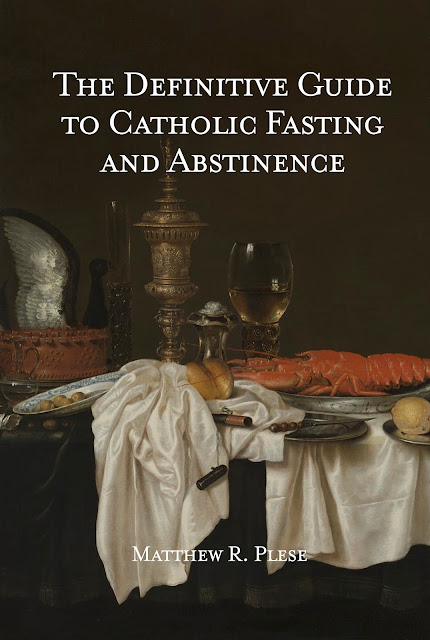
Want to learn more about the history of fasting and abstinence? Check out the Definitive Guide to Catholic Fasting and Abstinence.
Read more >>
Thursday, June 15, 2017
Receive Holy Communion as an Act of Reparation

An Act of Reparation From the Angel of of Peace at Fatima as taught to the three young children one year before Mary appeared in Fatima.  Let us pray this prayer during this Feast of Corpus Christi:
Most Holy Trinity, Father, Son and Holy Ghost, I adore You profoundly and I offer You the most precious Body, Blood, Soul and Divinity of Jesus Christ, present in all the tabernacles of the world, in reparation for the outrages, sacrileges and indifferences by which He Himself is offended. And by the infinite merits of His Most Sacred Heart and the Immaculate Heart of Mary, I beg of You the conversion of poor sinners.
As we celebrate today the Most Glorious Eucharist, let us consider this article and perservere in our acts of reparation this day against sin.  Recall that Our Lord is already much offended as our Lady said at Fatima:

Reparation to the Sacred Heart
Fr. Raoul Plus, S. J.

Section III: The Practice of Reparation

THE spirit of reparation, if it is sincere and profound, will seek to manifest itself by a number of tangible proofs, by certain practices, which may be ranged under the following three heads: Affective reparation, effective reparation, and aiffictive reparation, according as the virtue especially exercised is love, self-sacrifice, or penance.

AFFECTIVE REPARATION

Sin and indifference deprive our Lord of love; therefore to make up for this we must give Him love. Hearts are turned away from God; then we must give Him ours. It is in prayer especially that the heart is given; and hence we have the practice of offering reparation by means of the Holy Hour. Our Lord is forgotten in His most Holy Sacrament. The object of this devotion is to give to our Lord not only one's own homage, but also the homage of those who deny His Real Presence, and so, according as one's duties permit, a certain time is spent in reparation before the Blessed Sacrament. These turns of prayer and watching before the Blessed Sacrament are organized and facilitated by certain Associations founded for the purpose.

Others may prefer to make a Novena of Reparation from the 1st to the 9th of each month. The purpose of this devotion is to console and compensate our Saviour for the insults He receives in the Blessed Sacrament. No exercises or set prayers are prescribed; you are advised to assist at Mass as often as possible, to receive Communion in reparation at least once, and to have a Mass said for the same intention at least once a year.

By reason of the fewness of vocations, in France alone 12,000 priests are lacking. This means that every day 12,000 Masses are not offered; there are 12,000 altars upon which the Precious Blood is not shed for the remission of sins, upon which Christ does not appear daily to restore the balance between Divine justice and man's iniquity. Why should there not be some souls who would take the place of these priests, souls devoted to the Passion and the Eucharistic sacrifice, filled with the spirit of redemption and love, who would try to make up, by the complete sacrifice of their hearts, for all these Masses that are lacking? The following method might be suggested: In the case of one who attends Mass daily, to offer the Mass for the said intention. If one is unable to attend Mass every day, to offer a particular half-hour of the day for that purpose, reciting the following or a similar prayer: "O Jesus, eternal Priest, deign to raise up numerous priests in whom Thou may fully livest Thy priestly life . . . Deign also to raise up many souls which by their detachment from the earth and their zeal for the salvation of souls will be coadjutors of the priesthood, and in a manner take the place of the priests that are lacking."

A practice taught by our Lord Himself is the devotion, in the spirit of reparation, of the First Friday. It is too well known to need much emphasis. Suffice it to quote two extracts from St. Margaret Mary's letters: "My Divine Saviour had bidden me to go to Communion on the first Friday of every month, to make reparation, so far as in me lies, for the insults that are offered to Him each month in the Blessed Sacrament of the Altar." . . . "Let those who wish to honour the Sacred Heart of Jesus in a special way choose for this purpose the first Friday of each month, to offer Him homage according as their piety inspires them." (Ed. Paray, t. II, p. 72.)

Everyone knows the promises -----at first sight rather surprising-----which our Lord has attached to the faithful fulfilment of these practices. No wonder he speaks of the "exceeding mercy of His Divine Heart." Those who receive Holy Communion on the first Friday of nine consecutive months "will not die in My disfavour, nor without receiving the Sacraments, and my Heart will be their refuge at their last hour." And it must be admitted that it is partly in view of these wonderful promises that the devotion of the faithful to the Nine Fridays has increased so rapidly.

But it must be understood that these promises of our Lord are not to be set on the same footing as the words of the Gospels. Their value -----though it must not be minimized-----is simply such as attaches to a private revelation approved by the Church.

Moreover, it may be asked whether these words are to be taken absolutely, or are we to add the implicit condition: "Provided that he who has made the nine Fridays does not wilfully expose himself to the peril of damnation"? Authors are disagreed as to the answer. It seems to us that in this, as in the case of the sabbatine promise connected with the scapular of Mount Carmel, the second explanation is the better one.

Another practice popular among devotees of reparation, and recommended by our Lord, is that of Holy Communion offered in reparation. Really if everyone properly understood the doctrine of the Eucharist and the intention with which Christ instituted this Sacrament, no Communion would ever be received except in a sacrificial spirit. Our Lord instituted the Eucharist not so much to give us the benefit of His Presence as to associate us closely with His sacrifice. On the altar, as we have said above, He still has the intention of offering Himself absolutely to His Father for His glory and for the salvation of the world; and as by our Baptism we have become an integral part of His Person, He asks us as members of Christ to unite our sacrificial oblation to that of the Head. Thus, while the minimum disposition for the reception of the Eucharist is the state of grace, the disposition which is necessary in order to receive the fullest benefit from the Sacrament is the spirit of sacrifice.

Since, however, many of those who go to Communion are far from having this comprehensive, and yet only truly exact, idea of the Eucharist, also because it is permissible to each individual to emphasize more or less the reparative aspect of  Holy Communion, we can understand why our Lord should have recommended in a particular way the offering of Masses and the reception of Holy Communion in reparation for the insults offered to the Blessed Sacrament.

In accordance with this desire of our Lord an Association was founded in I854 -----and erected canonically at Paray in I865-----with the special object of "consoling our Lord by the frequent reception of Holy Communion, of turning away from us the scourge of His anger and His chastisements, and of making reparation and expiation in a certain measure for the continual blasphemies committed against the Divine Majesty and the Blessed Sacrament of the Altar." These are Pius Xl's own words.

This offering of oneself in reparation is specially recommended at Mass and Communion. But it may profitably be renewed at other moments during the day. Our Lord had suggested to St. Margaret Mary that she should offer a prayer or an act of reparation thirty-three times during the day in honour of the thirty-three years of His life on earth. The practice is a praiseworthy one, as long as too much stress is not laid on the mathematical aspect of the devotion. Others will prefer to make an offering to God for the sake of reparation at the thought that at this very minute our Lord is offering Himself to the Father in a Mass which is now being celebrated. Given the number of priests in the world it may be calculated that about four consecrations take place every second; hence it is certain that at whatever moment we may make the oblation of ourselves, our Lord is offering Himself too. In any case is not our Lord in the constant act of offering Himself, since in our tabernacles He remains always in the state of perpetual victimhood?

It is significant that in the Memoirs of St. Margaret Mary we find this request of our Lord: "Every time that I tell you of the ill-treatment which I receive from this soul, I want you, after receiving Me in Holy Communion, to prostrate yourself at My feet, to make amends to My love, offering to My eternal Father the bloody sacrifice of the Cross for this intention, and offering your whole being to give homage to Mine, and to make reparation for the indignities that are put upon Me by this soul. Setting Me on the throne of your heart, you will adore Me prostrate at My feet. You will offer yourself to My eternal Father to appease His just anger, and to urge His mercy to forgive them." (Ed. Paray, t. II, p. 147.)

More efficacious for reparation, because free from any defect whatever, are the acts of homage and reparation of our Lord Himself. It is true that we are called upon to fill up what is wanting of the sufferings of Christ, but however generous we may be, our offering will never be more than a mere drop in the wine of the chalice. Our Lord, fortunately, supplies all our deficiencies. Let us, then, offer our drop of water, but still more let us offer the Precious Blood of the Divine Head. The offering of that Blood is the great act of reparation, and by reason of my Baptismal vocation whereby I am one with Christ, I can take my humble part in it.

To give God a moment of the day in reparation is an excellent thing. But what if one could give Him the entire day? "I don't like sleeping," said a little girl once to her mother; "I don't like going to bed; so much time given to sleeping is so much time lost to loving." And what she said of sleep may be said too of external occupations. As a matter of fact, as we have explained elsewhere, both our sleep and our external occupations, although they are not explicit acts of prayer, may be transformed by us into a state of prayer through our intention. So that the child is not quite right, when it is a matter of the love of God.


Nevertheless, supposing that we were able to make every moment of our day an explicit act of prayer, what a harvest there would be! But what is not possible for one individual may become possible where there is a group; and this is the principle of the "Guard of Honour." In a celebrated vision to St. Margaret Mary the Angels offered to make an alliance with her, undertaking to adore the Blessed Sacrament in her place while she was busy with her domestic occupations (Ed. Paray, t. II, p. 108), and to make reparation "for all the daily acts of irreverence committed before the face of God."

The Saint thereupon desired that this idea should become widely known. In the year 1863 the practical formula was invented at the Visitation Convent at Bourg. Each member of the Guard of Honour chooses an hour of the day, undertaking during that time to think more than usual of the Sacred Heart of Jesus, and to offer to him at least one sacrifice and an act of love. No special practice of piety is prescribed; nothing more than the duty of the moment.

But sin abounds during the night as well as during the day. So some have adopted the pious custom of devoting an hour to prayer during the night from Thursday to Friday to commemorate the terrible night which Christ passed during His Agony. How can we think of the horrors of Gethsemane without wishing to offer to our Lord the homage of our adoration and reparation? Every devout soul must feel inclined to say with the young girl who was later to be Sister Claire of Jesus: "When you have meditated on the Passion of Christ how is it possible to lie down in bed, when you think that it is the hour in which our Lord suffered His Agony in the Garden! Can I think of Christ bowed under that weight of suffering and yet not seek with my tears, my prayers, my sacrifices and my love, to console my Divine Master and give Him a word of comfort?"

"The darkness of night seemed to open," so writes Huysmans of the Agony in the Garden, "and as in a frame of sombre shadows there appeared pictures lit up by a mysterious light. On a background that glowed with menacing radiance the centuries passed in procession, pushing before them sins of idolatry and incest, sacrileges and murders, all the ancient crimes that had been committed since the fall of Adam; and the cheers of wicked Angels greeted them as they passed. Jesus, overcome with grief, lowered His eyes. When He raised them again, these phantoms of past generations had disappeared; but there before Him now were the crimes of the Jews to whom He was preaching the Gospel, drawn up in menacing array. He saw Judas, He saw Caiphas, He saw Pilate . . . He saw Peter. He saw the brutes who would strike Him on the face, who would encircle His brow with the crown of thorns. Gaunt against the sinister sky rose the Cross, and groans were heard from the nether regions. He rose to His feet, and dizzy and tottering, reached out for a supporting arm. He was alone.

"He dragged Himself as far as the spot where He had left His disciples; and there they were asleep in the peaceful night. He aroused them. They looked at Him agape, filled with fright, wondering whether this man with the distraught gestures and strained eyes was indeed the same Jesus Whom they had seen transfigured before them on Mount Thabor, with radiant face and garment of snow. Our Lord could not but give them a pitying smile. He only reproached them with not having kept awake, and twice more He went back to suffer in his corner of the Garden.

"He knelt to pray, and this time it was no longer the past and the present, but still more terrible, the future that unfolded itself before His eyes; the centuries to come followed one after another, showing changing countries and changing towns; even the seas and the continents changed their form before His eyes; only men remained the same, though their costumes altered from age to age; they continued to steal and to kill, they persisted in crucifying their Saviour, to sate their greed for luxury and gain. Amidst the changing civilization of the ages, the Golden Calf stood there immovable, ruler of mankind. Then it was that, overcome with sorrow, Jesus sweated Blood and cried: 'Father, if it be possible let this chalice pass from Me.  . . . But Thy will be done.' "

Jesus Himself has asked for souls generous enough to share and thus console Him in His Agony: "Every Thursday night," He said to St. Margaret Mary, "I will make you share in the mortal sorrow that I suffered in the Garden of Olives, a sorrow which will give you an agony harder to bear even than death. And to keep Me company in the humble prayer which I then offered to the Father, you will prostrate yourself on your face, to appease the Divine justice, asking mercy for sinners." (Ed. Paray, t. II, p. 126.)

Compare this request with those sad words related in the Gospels: "Could you not watch one hour with Me?" (Mark xiv:38), and ask yourself whether you would not do well to adopt this beautiful devotion of the Holy Hour. Since it is not always possible or desirable for all to get up in the middle of the night, the Church permits that the Holy Hour should begin at any time after four, or even from two o'clock onwards during the shorter days of the year. Evidently, where it is possible, eleven o'clock at night is the hour indicated, because this is approximately the hour at which our Lord was in the Garden; this was the hour chosen by St. Margaret Mary; and moreover prayer at that time has an additional merit from the sacrifice of one's sleep. Plenty of pretexts may be found for refusing this act of devotion. A little generosity is needed. Why is it that a person who does not hesitate to sacrifice his or her night for some social function or to listen to the wireless, finds that it would be injurious to health to pray for an hour during the night once a week or once a month? Let us confess that we are weak; but let us not add hypocrisy to our weakness.

A very practical form of the Holy Hour is that invented by P ère Mateo; it is called "Night Watching in the Home." Seven persons, either in the same house or in different houses, undertake once a month to make an hour's adoration before the picture of the Sacred Heart, between ten o'clock in the evening and five in the morning. By December, 1928-----that is, within eighteen months from its inception-----this devotion had rallied 21,766 adherents, thus ensuring 2723 nights of adoration, or an average of 900 adorers every night, or 110 a minute. This movement has received the august approval of the Cardinal Archbishop of Paris, all the archbishops and bishops of Portugal, eleven bishops of France, and several other prelates of Spain, Belgium, Uruguay and Venezuela. 
Read more >>
Friday, November 4, 2005
Common Questions on the Eucharist

Frequently Asked Questions on the Eucharist (FAQ)


First Holy Communion at a Parish in France (March 1952)


Q: What is Holy Communion?

A: Also known as the Eucharist, Holy Communion is the center of the Catholic faith because it is truly the Body, Blood, Soul, and Divinity of Our Lord Jesus Christ. It is not in any way a symbol but literally Christ’s most Holy body. The bread and wine at the Mass become the holiest of holies through the priest’s words by the power of God. The moment when the Bread and Wine become Jesus Christ is called transubstantiation. The entire Gospel of John Chapter Six even wrote specifically on the Eucharist and how Christ’s body is truly present.

Some people that don't believe in the Eucharist say that Jesus meant for it to be symbolic. Well, then we look to the Gospel of John Chapter 6. That chapter is entirely on the Eucharist, and we see that when Our Lord tells them "Unless you eat my Body and Drink my Blood you will have no life within you" the people do one thing: they leave Him. If Jesus was speaking symbolically He would have said "No, you misunderstand" like He did before in the Gospels, but this time He just let them walk away. Thousands left Him, but He let them because what He spoke was literally true and they couldn't accept it. “Since Christ Himself has said, ‘This is My Body’ who shall dare to doubt that it is His Body? (Saint Cyril of Jerusalem)

For more information see: The Eucharist.

Q: Does the Sacred Host also contain Christ's Blood?


A: Yes, the Consecrated Host also contains the Blood, Soul, and Divinity of Our Lord. The wine also becomes at the Consecration not just Christ s Blood but His Body, Soul, and Divinity also. After the Consecration, the presence of Christ only remain. The consecrated bread may look like bread but no part of its substance is bread. Only the accidents (the mere appearance, taste, smell, etc) of bread remains the same applies to the Consecrated wine - it is not wine.

The breaking of the Body of Christ or the separation of the Blood does not divide Christ, so receiving only a piece of a full Communion Host is still receiving Jesus Christ completely (as affirmed at the Council of Trent: Thirteenth Session: Canon III)

Q: Do the People Also Need to Receive Holy Communion From the Chalice?

For centuries, only the priest alone received the Consecrated Wine from the chalice. The notion in the past few decades that the faithful need to also receive from the chalice is a grave error. The fullness of Christ is received under either species. Traditionally, as is still done of course in the Tridentine Mass, the faithful will only receive the Consecrated Host.

The Baltimore Catechism in Q. 900 advised, "The Church does not give Holy Communion to the people as it does to the priest under the appearance of wine also, to avoid the danger of spilling the Precious Blood; to prevent the irreverence some might show if compelled to drink out of a chalice used by all, and lastly, to refute those who denied that Our Lord's blood is present under the appearance of bread also."

For more information, please see Holy Communion Under One or Both Species?

Q: What are Eucharistic Miracles?

A: These are outward signs of the majesty of Our Lord’s true presence in the Holy Eucharist. I recognize this mirroring the Transfiguration when Our Lord on Mt. Tabor appeared dazzlingly white with Elijah and Moses. This was an outward manifestation of Our Lord’s immense greatness. The Transfiguration wasn’t in and of itself the greatest part of this mystery, but what is even greater is that Christ humbled Himself and kept in His immense glory while on earth.

Eucharistic miracles are the same where the Lord’s greatness reveals itself and scientific testing has proven it to be true blood and tissue. These miracles are not required beliefs of the Catholic faith, and the Eucharist from these Mass is no less amazing then the Eucharist at other Masses because the Eucharist is always the same true presence of Jesus Christ. Read about these beautiful miracles.

Q: If I suspect someone is taking the Eucharist from Mass without the intentions of giving it to the sick what should I do?

A: If someone takes Communion back to the pew and doesn’t consume it PLEASE report it to the priest or someone in an authority position at the parish. Sometimes people will take Our Lord’s Body to desecrate it and this destruction of Our Lord in the Eucharist is a grave sacrilege. We can help prevent this by working to stop Communion in the hand.

Q: Can Holy Communion ever be denied? 


A: It can be denied to individuals in a public act of scandal. For example, if one regularly known non-Catholic is at a Mass and wishes to receive Holy Communion it is to be denied. Holy Communion may - and should - be denied to those Catholics who promote intrinsic evils such as abortion, gay marriage, and artificial contraception. Also, if one suspects a person is going to desecrate the Eucharist it can be denied.

Q. Should the Faithful be Forced to Receive Communion in the Hand?

No. Even during health crises, Holy Communion may never be denied on the tongue. No one may force Holy Communion in the Hand. The Vatican has affirmed this.


Q: Are there special conditions on receiving the Eucharist?

A: Yes. One must be a Catholic in good standing with the Church. You must also obey the Eucharistic fast and not be in a state of mortal sin (Ecclesia de Eucharistia, 37). Those who have committed a mortal sin must first receive absolution in Confession. Those who fail to do so commit the most grievous sin of sacrilege.

The Catechism of the Council of Trent states, “As of all the sacred mysteries bequeathed to us by our Lord and Savior as most infallible instruments of divine grace, there is none comparable to the most holy Sacrament of the Eucharist; so, for no crime is there a heavier punishment to be feared from God than for the unholy or irreligious use by the faithful of that which contains the author and source of holiness.”

St. Cyril of Alexandria explains further the gravity when he says, “They who make a sacrilegious Communion receive Satan and Jesus Christ into their heart.  Satan, that they may let him rule, and Jesus Christ that they may offer Him in sacrifice to Satan.”

That’s a sacrilegious Communion.  That’s why it is so grave and evil and truly few sins offend the Lord’s heart as much as this.  Indeed, our Lord told St. Bridget in a vision, “There does not exist on earth a punishment great enough to punish it sufficiently.”

Q: How many times a day can we receive communion?

A: In the old 1917 Code of Cannon Law, reception of Holy Communion more than once a day was prohibited. Unfortunately, in another novelty after Vatican II, the 1983 Code was revised to state that Holy Communion can be received twice a day, noting though that the second time must be in a Mass. Traditionally, we receive our Lord only once a day (that is once each calendar day and not necessarily once every 24 hours). Traditional Catholics will still maintain this practice.

As an exception to both the 1917 and the 1983 Canon Law, a person may receive Holy Communion again the same day in the form of the Viaticum, which is the name of the Eucharist when given to one who is extremely ill and seemly near death. Holy Communion is often given to souls during Last Rites, and it would be called Viaticum.

"Christ held Himself in His hands when He gave His Body to His disciples saying: 'This is My Body.' No one partakes of this Flesh before he has adored It" (Saint Augustine).

Q: What act of reverence should we show before receiving Holy Communion?

A: An act of reverence must be made before receiving Holy Communion because it is showing reverence to Our Lord truly present before us. People are also still allowed to receive the Holy Eucharist while kneeling, and as is the traditional practice, Holy Communion should be received while kneeling.

Q: What is Intinction?

A: Intinction is only allowed to be performed by the ordinary minister of Holy Communion (i.e. the priest). No "lay minister" may do so. Intinction is where the Sacred Host is dipped in the Sacred Blood of Christ. In the Byzantine Rite one receives the Lord without saying “Amen” but the priest puts the Host dipped in the Sacred Blood in the person’s mouth. Those receiving this way always have their head tipped backwards.

This form of receiving Holy Communion is rarely observed in the Roman Catholic Rite because of the risk of dripping the Lord's body and blood on the ground. When observed, the priest has a minister standing at his side holding the consecrated wine and he takes a particle of the consecrated bread and dips it. He then says "The body and blood of Jesus". A paten must be held under the Body and Blood to prevent any from falling to the ground. While uncommon, this form of receiving is permitted in the Roman Catholic Church (i.e. the Latin Rite).

Q: What is the Eucharistic fast and how long is it?

A: The Eucharistic fast is a fast before receiving Holy Communion to observe a period of reflecting and spiritual hunger for Our Lord. Currently, only medicine and water are allowed before hand, but if one needs to eat for serious medical reason this can be circumvented. Note that a priest who celebrates the Eucharist two or three times a day can take something before the second and third Mass even if it is less than one hour before receiving the Blessed Sacrament again. Also, the elderly, ill, and those that care for them may receive the Eucharist if they have eaten something in the previous hour (Canon 919).

 Many Traditional Catholics will take part in the traditional fast, which was three hours long. Other Traditional Catholics will take part in an older form of the fast which mandated fasting from midnight until receiving Communion.

For more thorough information see: What is the Eucharistic Fast?

Q: How often is one required to receive the Eucharist?

A: A Catholic is only required to receive the Eucharist once a year and that is to be done during the Easter season (Canon 920). However, one should receive our Lord more often - even daily - if they are in the state of grace and have the right dispositions so they do not receive our Lord out of mere habit.

When is the Easter Season for the purpose of observing our "Easter Duty"? In the United States it is from the first Sunday of Lent to Trinity Sunday inclusive; in other countries, the season may begin on Ash Wednesday and close on Low Sunday or Ascension Thursday.
Read more >>


Copyright Notice: Unless otherwise stated, all items are copyrighted under a Attribution-NonCommercial-NoDerivatives 4.0 International License. If you quote from this blog, cite a link to the post on this blog in your article.

Disclosure of Material Connection: Some of the links on this blog are “affiliate links.” This means if you click on the link and purchase the item, I will receive an affiliate commission. As an Amazon Associate, for instance, I earn a small commission from qualifying purchases made by those who click on the Amazon affiliate links included on this website. I am disclosing this in accordance with the Federal Trade Commission’s 16 CFR, Part 255: “Guides Concerning the Use of Endorsements and Testimonials in Advertising.”