Showing posts sorted by date for query 40 hours. Sort by relevance Show all posts
Sunday, February 15, 2026
A Catholic Life Podcast: Episode 142


This is Episode 142 of the A Catholic Life Podcast. In today’s episode I discuss developing a Lenten regiment built on prayer, fasting, and almsgiving. I also cover the importance of the 40 Hours Devotion at the beginning of Lent. As we prepare to enter into the holy season of Lent, we should prepare to observe a strict routine of prayer, fasting, and almsgiving. Below are 14 articles worth reading at this time:

  1. The Importance of 40 Hours at the Beginning and End of Lent
  2. Fasting and Abstinence Rules
  3. History of Lenten Fasting: How to Observe the Traditional Lenten Fast
  4. Why do we fast? St. Thomas Aquinas Explains
  5. Lenten Embertide Fast
  6. How the Traditional Latin Mass Reinforces Lent as a Fast
  7. Stational Churches for Each Day of Lent
  8. What is Ash Wednesday & what are the rules for this day?
  9. Read One Spiritual Book this Lent
  10. Book Recommendations for Lent
  11. 10 Traditional Catholic Charities: Almsgiving During Lent
  12. Each Feria Day in Lent has a Proper Mass
  13. Holy Communion in Lent: The Most Pleasing to God
  14. Printable Lent Preparation Guide

This episode is sponsored by PrayLatin.comPrayLatin.com offers Latin prayer cards to learn and share prayers in the sacred language. Learn your basic prayers in Latin conveniently on the go. Practice your pronunciation with easy-to-follow English phonetic renderings of Latin words. PrayLatin.com offers prayer cards in various formats, including Latin-English rosary pamphlets with the traditional 15 mysteries. Shop for additional Latin resources like missal booklets, server response cards, and more. Visit PrayLatin.com today.

Subscribe to the podcast on Buzzsprout, Apple Podcasts, Spotify, I-tunes, and many other platforms!

Read more >>
Friday, April 18, 2025
The 40 Hour Passion Fast and the Black Fast


The Strictness of Holy Week

The Passion Fast is a term which refers to the fast which began for some as early as sunset on Holy Thursday and as late as 8 AM on Good Friday. No one was allowed to eat any food during that time until sunset on Holy Saturday, which – since most fasted for Communion – extended until the morning on Easter Sunday. It was often called a “40 Hours Fast” and represents the original Lenten fast. For those who were too weak to follow this fast the minimum fast at this time was that of xerophagiae.

Xerophagiae is a diet of simple, dry, uncooked food, such as raw nuts, bread, fruits, and vegetables. Fish and oil are not part of it and neither are flesh nor animal products. It was a precept to fast on these only during Holy Week by custom and/or decree until approximately the time of Pope St. Gregory the Great (reigned 590 – 604 AD), who mentions nothing of it. It may still have been a custom at that time but no mention of it is made in the Decretals of Gregory IX published in 1234.

The Black Fast

A commonly misunderstood aspect of fasting is the “black fast.” Is the Passion Fast a Black Fast? Is it the only Black Fast? What is the true definition of a black fast? And what is it not? The Catholic Encyclopedia from 1907 answers as follows:

This form of fasting, the most rigorous in the history of church legislation, was marked by austerity regarding the quantity and quality of food permitted on fasting days as well as the time wherein such food might be legitimately taken. 

This is based in practice on the fasting done by the Early Church and the Apostles. In practice, there are three criteria that make a fast a “black fast” as the Encyclopedia identifies:

In the first place more than one meal was strictly prohibited. At this meal flesh meat, eggs, butter, cheese, and milk were interdicted (Gregory I, Decretals IV, cap. vi; Trullan Synod, Canon 56). Besides these restrictions, abstinence from wine, especially during Lent, was enjoined (Thomassin, Traité des jeûnes de l'Église, II, vii). Furthermore, during Holy Week the fare consisted of bread, salt, herbs, and water (Laymann, Theologia Moralis, Tr. VIII; De observatione jejuniorum, i). Finally, this meal was not allowed until sunset. St. Ambrose (De Elia et jejunio, sermo vii, in Psalm CXVIII), St. Chrysostom (Homil. iv in Genesim), St. Basil (Oratio i, De jejunio) furnish unequivocal testimony concerning the three characteristics of the black fast. 

Hence a black fast is one that meets these criteria:

1. Only one meal a day

2. Complete abstinence from all meat and animal products

3. The one meal may only be consumed after sunset.

Consequently, it is not a total abstinence from all food and drink whatsoever that makes a fast a “black fast”. And it also does not mean that one eats only bread. Vegetables are certainly allowed at the meal. And the Passion Fast is one such Black Fast

Want to learn more about the history of fasting and abstinence? Check out the Definitive Guide to Catholic Fasting and Abstinence.

Read more >>
Thursday, March 30, 2023
The History of the Holy Saturday Fast

Eugene Burnand. Holy Saturday. 1907-1908. Musee des Beaux Arts, La Chaux de Finds, France.

The observance of Lent stretches back as far as Apostolic times. Lent was for centuries observed as forty days of fasting in the Roman Church with Sundays excluded from fasting but not from abstinence. That is, Ash Wednesday (since its institution) through Holy Saturday were days of fasting. I have separately cataloged the history of Lenten fasting in "History of Lenten Fasting: How to Observe the Traditional Lenten Fast."

The Lenten fast began under the Apostles themselves and was practiced in various forms in the Early Church. As time went on, the fast became uniformly observed under the pain of sin. As with all Lenten practices, changes occurred over time regarding the fast, abstinence, and hearing of Holy Mass on Holy Saturday. 

Holy Saturday Fasting Was Practiced in Apostolic Times

In the Early Church, Holy Saturday was part of the apostolic practice of abstaining from all food completely from Holy Thursday evening (or Good Friday morning) until sunset on Holy Saturday (or later). This was known as the "Passion Fast," and in practice, the aim was to fast 40 hours in honor of the 40 hours our Blessed Lord’s body lay in the tomb. Holy Saturday's fast was also practiced like the rest of Holy Week as xerophagiae: “The strictest Christian fast which is observed chiefly in the Eastern churches during Lent or especially Holy Week and in which only bread, salt, water, and vegetables may be eaten” (Webster’s Dictionary). In practice, bread, herbs, raw nuts, or raw vegetables and fruit without oil or dressing may be consumed for those who seek to keep this strict and who are unable to fast from all food whatsoever for two whole days in a row.

Heortology: A History of the Christian Festivals from their Origin to the Present Day by Dr. K.A. Heinrich Kellner states the following regarding the Lenten fast in the ancient Church:

"Among Catholics also abstinence was pushed to great lengths. The canons of Hippolytus prescribe for Holy Week only bread and salt. The Apostolic Constitutions will only permit bread, vegetables, salt and water, in Lent, flesh and wine being forbidden; and, on the last two days of Holy Week, nothing whatsoever is to be eaten. The ascetics, whose acquaintance the Gallic pilgrim made in Jerusalem, never touched bread in Lent, but lived on flour and water. Only a few could keep so strict a fast, and generally speaking people were satisfied with abstaining from flesh and wine. But this lasted throughout the entire Lent, and Chrysostom tells us that in Antioch no flesh was eaten during the whole of Lent. Abstinence from milk and eggs (the so-called lacticinia) was also the general rule."

Regarding Holy Saturday's fast, in particular, Canon 89 of the Council in Trullo in 692 AD provides an account of the piety and devotion of the faithful of that time: 

“The faithful, spending the days of the Salutatory Passion in fasting, praying and compunction of heart, ought to fast until the midnight of the Great Sabbath: since the divine Evangelists, Matthew and Luke, have shewn us how late at night it was [that the resurrection took place].” 

That tradition of fasting on Holy Saturday until midnight would last for centuries. Dom Gueranger writes in the Liturgical Year:

Such, we repeat, was the discipline of the Latin Church for nearly a thousand years: but about the 11th century, an important change began to be introduced with regard to the celebration of Mass on Holy Saturday. The Mass which, hitherto, had been celebrated during the Night preceding Easter Sunday, then began to be anticipated on the Saturday; but it was always considered as the Mass of the hour of our Lord’s Resurrection, and not as the Mass of Holy Saturday. The relaxations that had been introduced with regard to Fasting were the occasion of this change in the Liturgy.

Holy Saturday Was A Holy Day of Obligation in the Middle Ages

Holy Saturday also used to be a Holy Day of Obligation. The first catalog of Holy Days comes from the Decretals of Gregory IX in 1234, which listed 45 Holy Days. In 1642, His Holiness Pope Urban VIII issued the papal bull "Universa Per Orbem" which altered the required Holy Days of Obligation for the Universal Church to consist of 35 such days as well as the principal patrons of one's locality. 

Some of the Holy Days of Obligation removed between 1234 and 1642 included Holy Monday through Holy Saturday in addition to Easter Wednesday through Easter Saturday. Hence by 1642, Holy Saturday was no longer a Holy Day of Obligation.

Holy Saturday Fasting Remained Practiced for Centuries

In my series outlining the changes to fasting and abstinence in the colonies—and through the modern-day United States—I pointed out that Holy Saturday often remained a day of obligatory fasting even when mitigations were issued due to the change in the time of the Vigil that happened back in the 11th century.

For instance, the papal bull "Altitudo Divini Concilii" of Pope Paul III in 1537 reduced the days of penance and those of hearing Mass for the Indians out of pastoral concern due to the physically demanding lifestyle that they lived and also largely due to the fact that they fasted so much already. As a result, the natives were required to only hear Mass on a much smaller number of days: Sundays, Christmas, Circumcision, Epiphany, Candlemas, Annunciation, Sts Peter and Paul, Ascension, Corpus Christi, the Assumption, and the Nativity of the Blessed Virgin. And the only fasting days were the Fridays in Lent, Holy Saturday, and Christmas Eve. Holy Saturday remained.

Centuries later, when Pope Leo XIII issued further changes allowing animal products throughout Lent, he explicitly excluded Holy Saturday from those mitigations:

“In 1886 Leo XIII allowed meat, eggs, and milk products on Sundays of Lent and at the main meal on every weekday [of Lent] except Wednesday and Friday in the [United States]. Holy Saturday was not included in the dispensation. A small piece of bread was permitted in the morning with coffee, tea, chocolate, or a similar beverage.”

By the time of the 1917 Code of Canon Law, the days of obligatory fasting as listed in the 1917 Code of Canon Law were the forty days of Lent, including Ash Wednesday, Good Friday, and Holy Saturday until noon. The Deharbe Catechism in the 1800s refers to the fast ending at Noon, so it does predate the 1917 Code. Why did Holy Saturday fasting only last until noon? It likely dates to when the Vigil Mass for Easter was moved from the night of Holy Saturday into Easter Sunday back to the morning of Holy Saturday. By the High medieval period, the celebration in the morning of the Easter Vigil (and other Triduum services) was almost the universal custom, in large part due to the fasting regulations requiring the fast to last until after Vespers. As a result, sometime after 692 AD, the fast on Holy Saturday was modified to end at noon.

Holy Saturday Fasting Wanes Along With All Other Fasting in the 1900s

Before 1951, Bishops were able to dispense laborers and their family members from the laws of abstinence, if necessary, under the workingmen's privilege that was introduced in 1895. This privilege of eating meat, though, excluded Fridays, Ash Wednesday, Holy Week, and the Vigil of Christmas. In 1951, the abstinence laws in America were again revised as Father Ruff summarizes:

"In 1951 the U.S. bishops standardized regulations calling for complete abstinence from meat on Fridays, Ash Wednesday, the vigils of Assumption and Christmas, and Holy Saturday morning for everyone over age seven. On the vigils of Pentecost and All Saints, meat could be taken at just one meal. Fast days, applying to everyone between 21 and 59, were the weekdays of Lent, Ember days, and the vigils of Pentecost, Assumption, All Saints, and Christmas. On these fast days only one full meal was allowed, with two other meatless meals permitted which together did not make up one full meal. Eating between meals was not permitted, with milk and fruit juice permitted. Health or ability to work exempted one." 

In 1956 under Pope Pius XII, the fast, which previously ended at noon, was extended to the midnight between Holy Saturday and Easter Sunday, on account of the Holy Week changes enacted which made the Vigil Mass obligatory in the evening of Holy Saturday:

"The abstinence and fast prescribed for Lent, which hitherto has ceased on Holy Saturday after noon, according to canon 1252, §4 [1917 Code], will cease in the future at midnight of the same Holy Saturday."

Maxima Redemptionis Nostrae Mysteria (Nov. 16, 1955) AAS 47 (1955)

Fr. Frederick McManus, an American Canon Lawyer, commented on this change:

The Decree on the revised Holy Week changes the law of canon 1252, §4, concerning fast and abstinence on Holy Saturday. According to the canon, the Lenten fast ended after noon on Holy Saturday. This is now abrogated, the obligation is extended until midnight of Holy Saturday, and the entire day becomes one of abstinence and fast. Local Ordinaries at present possess the faculty to dispense all their subjects, including religious (even exempt), from the law of fast and abstinence on Holy Saturday.Thus they may dispense from fast or from abstinence or from both fast and abstinence on this day. 

The Rites of Holy Week (Bruce 1956), pgs 22 and 23.

In 1966, Paul VI's Paenitemini eliminated Holy Saturday and all other days of fasting except for Good Friday and Ash Wednesday in a radical departure from the past. Sadly, those changes were incorporated in the 1983 Code of Canon Law, which largely took Paenitemini while modifying the age of fasting.

A Traditional Holy Saturday Fast (Summary and Application)

  • Early Church: All of Holy Saturday was a strict fast with abstinence
  • 11th Century: The Vigil, which had taken place at night between Holy Saturday and Easter Sunday, is moved to the daytime of Holy Saturday. This change would cause mitigations with the strict fast that had previously always been obligatory on Holy Saturday.
  • 1917 Code: For at least 100+ years before the 1917 Code, the fast, which previously ended at midnight into Sunday, ended at Noon on Holy Saturday. This is largely due to the Vigil Mass taking place in the morning of Holy Saturday.
  • 1956: Pope Pius XII, in changing the Vigil Mass to start only after sunset on Holy Saturday, extends the fast to midnight.

For those seeking more traditional fasting for the final days of Lent - and in preparation for the Lord's Resurrection - a return not to the 1950s or 1917 is in order. Rather, a return to treating all of Holy Saturday as a day of fasting and abstinence in the form of the Passion Fast practiced with the principles of Xerophagiae is the ideal. If we do attend a pre-1955 Easter Vigil Mass in the morning or daytime of Holy Saturday, we can eat after that Mass but I would encourage souls to keep abstinence until after attending Easter Sunday Mass.

While this is not obligatory under penalty of sin, it is a worthwhile end to our fasting as we present to Almighty God the final day of Lenten fasting for His honor and glory and in reparation for our sins. Let us all seek greater perfection and never the minimum of the law.

Want to learn more about the history of fasting and abstinence? Check out the Definitive Guide to Catholic Fasting and Abstinence.

Read more >>
Sunday, February 19, 2023
The Importance of 40 Hours at the Beginning & End of Lent

 "I have fought a good fight, I have finished my course, I have kept the faith" (2 Timothy 4:7)

As we prepare to enter into the holy season of Lent, we should prepare to observe a strict routine of prayer, fasting, and almsgiving. Below are 13 articles worth reading at this time:

  1. Fasting and Abstinence Rules
  2. History of Lenten Fasting: How to Observe the Traditional Lenten Fast
  3. Why do we fast? St. Thomas Aquinas Explains
  4. Lenten Embertide Fast
  5. How the Traditional Latin Mass Reinforces Lent as a Fast
  6. Stational Churches for Each Day of Lent
  7. What is Ash Wednesday & what are the rules for this day?
  8. Read One Spiritual Book this Lent
  9. Book Recommendations for Lent
  10. 10 Traditional Catholic Charities: Almsgiving During Lent
  11. Each Feria Day in Lent has a Proper Mass
  12. Holy Communion in Lent: The Most Pleasing to God
  13. Printable Lent Preparation Guide

While it is important that we observe prayer, fasting (including abstinence from meat), and almsgiving throughout all of Lent, there should be a particular focus on beginning and ending Lent well. This can take the form of starting and ending with 40 intense hours.

Why 40 Hours?

40 hours is significant because Our Blessed Lord was dead for 40 hours before His Resurrection. 40 is also a number of completion as shown by His 40 day fast in the desert, the Great Flood which lasted 40 days, and the 40 years of wandering in the desert by the Chosen People after their deliverance from Egypt.

40 Hours is also connected with Mardi Gras immediately preceding Lent. As a result of the excesses of Fat Tuesday and the carnival season, the Church instituted the practice of observing the 40 Hours Devotion in front of the Blessed Sacrament. Father Weiser remarks:

In order to encourage the faithful to atone in prayer and penance for the many excesses and scandals committed at carnival time, Pope Benedict XIV, in 1748, instituted a special devotion for the three days preceding Lent, called ‘Forty Hours of Carnival,’ which is held in many churches of Europe and America, in places where carnival frolics are of general and long-standing tradition. The Blessed Sacrament is exposed all day Monday and Tuesday, and devotions are held in the evening, followed by the Eucharistic benediction.

The Church also instituted the Votive Feast of the Holy Face of Our Lord Jesus Christ Deformed in the Passion for the Tuesday after Quinquagesima (i.e., Fat Tuesday) as a means of making reparation for the sins of Mardi Gras. In fact, our Blessed Lord Himself asked for such reparation to His Holy Face in apparition to Mother Pierina in 1938:

See how I suffer. Nevertheless, I am understood by so few. What gratitude on the part of those who say they love me. I have given My Heart as a sensible object of My great love for man and I give My Face as a sensible object of My Sorrow for the sins of man. I desire that it be honored by a special feast on Tuesday in Quinquagesima (Shrove Tuesday – the Tuesday before Ash Wednesday). The feast will be preceded by novena in which the faithful make reparation with Me uniting themselves with my sorrow.

Start And End Lent Well

Beyond making reparation this Tuesday for the sins of Mardi Gras and the mortal sins of those who will violate the laws of fast and abstinence, we can start Lent well by observing a 40 hour fast. In fact, as St. Thomas Aquinas relates, the Lenten Fast at his time was characterized by no food taken on either Ash Wendesday or Good Friday, if possible. This is a significant sacrifice, far beyond the "one meal and two smaller meals" statement which most Catholics associate with fasting days.

Beyond beginning our Lenten fast with a 40 hour fast from all solid food, which should open our minds to heavenly things and allow us to perform penance, we should conclude Lent with the same vigour. In honor of the 40 hours our Blessed Lord's soul was separated from His Body in death, let us offer an intense beginning and end of Lent this year for the honor of God, as far as our health permits us to do so.

May God grant us the strength to begin and end well so that, like St. Paul, we may say: "I have fought a good fight, I have finished my course, I have kept the faith."

Want to learn more about the history of fasting and abstinence? Check out the Definitive Guide to Catholic Fasting and Abstinence.

Read more >>
Sunday, February 13, 2022
History of Lenten Fasting: How to Observe the Traditional Lenten Fast

The Purpose of Fasting

In principio, in the beginning, the very first Commandment of God  to Adam and Eve was one of fasting from the fruit of the tree of the knowledge of good and evil (cf. Genesis 2:16-17), and their failure to fast brought sin and disorder to all of creation. The second sin of mankind was gluttony. Both are intricately tied to fasting.

Both Elijah and Moses fasted for forty days in the Old Testament before seeing God. Until the Great Flood, man abstained entirely from the flesh meat of animals (cf. Genesis 9:2-3). Likewise, in the New Testament, St. John the Baptist, the greatest prophet (cf. Luke 7:28) fasted and his followers were characterized by their fasting. And our Blessed Lord also fasted for forty days (cf. Matthew 4:1-11) not for His own needs but to serve as an example for us. Our Redeemer said, “Unless you shall do penance, you shall all likewise perish” (Luke 13:3). Fasting and abstinence from certain foods characterized the lives of man since the foundation of the world.

The Church has hallowed the practice of fasting, encourages it, and mandates it at certain times. Why? The Angelic Doctor writes that fasting is practiced for a threefold purpose: 

“First, in order to bridle the lusts of the flesh…Secondly, we have recourse to fasting in order that the mind may arise more freely to the contemplation of heavenly things: hence it is related of Daniel that he received a revelation from God after fasting for three weeks. Thirdly, in order to satisfy for sins: wherefore it is written: ‘Be converted to Me with all your heart, in fasting and in weeping and in mourning.’ The same is declared by Augustine in a sermon: ‘Fasting cleanses the soul, raises the mind, subjects one's flesh to the spirit, renders the heart contrite and humble, scatters the clouds of concupiscence, quenches the fire of lust, kindles the true light of chastity.’”  

St. Basil the Great also affirmed the importance of fasting for protection against demonic forces: “The fast is the weapon of protection against demons. Our Guardian Angels more really stay with those who have cleansed our souls through fasting.”

The Baltimore Catechism echoes these sentiments: “The Church commands us to fast and abstain, in order that we may mortify our passions and satisfy for our sins” (Baltimore Catechism #2 Q. 395). Concerning this rationale, Fr. Thomas Kinkead in “An Explanation Of The Baltimore Catechism of Christian Doctrine” published in 1891 writes, “Remember it is our bodies that generally lead us into sin; if therefore we punish the body by fasting and mortification, we atone for the sin, and thus God wipes out a part of the temporal punishment due to it.” 

Pope St. Leo the Great in 461 wisely counseled that fasting is a means and not an end in itself. For those who could not observe the strictness of fasting, he sensibly said, "What we forego by fasting is to be given as alms to the poor.”  To simply forgo fasting completely, even when for legitimate health reasons, does not excuse a person from the universal command to do penance (cf. Luke 13:3).

The Lenten Fast in the Early Church

The great liturgical Dom Gueranger writes that the fast which precedes Easter originated with the Apostles themselves:

“The forty days' fast, which we call Lent, is the Church's preparation for Easter, and was instituted at the very commencement of Christianity. Our blessed Lord Himself sanctioned it by fasting forty days and forty nights in the desert; and though He would not impose it on the world by an express commandment (which, in that case, could not have been open to the power of dispensation), yet He showed plainly enough, by His own example, that fasting, which God had so frequently ordered in the old Law, was to be also practiced by the children of the new…The apostles, therefore, legislated for our weakness, by instituting, at the very commencement of the Christian Church, that the solemnity of Easter should be preceded by a universal fast...”

The Catechism of the Liturgy by a Religious of the Sacred Heart published by The Paulist Press, New York, 1919 affirms the apostolic origin of the Lenten fast: “The Lenten fast dates back to Apostolic times as is attested by Saint Jerome, Saint Leo the Great, Saint Cyril of Alexandria and others.” In the 2nd century, St. Irenaeus wrote to Pope St. Victor I inquiring on how Easter should be celebrated, while mentioning the practice of fasting leading up to Easter.

Initially, the Lenten fast was practiced by catechumens preparing for their Baptism with a universal fast for all the faithful observed only during Holy Week, in addition to the weekly fasts that were devotionally practiced. But early on, the baptized Christians began to join the catechumens in fasting on the days immediately preceding Easter.  The duration of the fast varied with some churches observing one day, others several days, and yet others observing intensive 40-hour fasting, in honor of the forty hours that the Lord spent in the sepulcher. By the third and fourth centuries, the fast became forty days in most places. St. Athanasius, in 339 AD, referred to the Lenten fast as a forty-day fast that “the whole world” observed. 

Heortology: A History of the Christian Festivals from their Origin to the Present Day by Dr. K.A. Heinrich Kellner states the following regarding the Lenten fast in the ancient Church, noting the strictness that intensified in Holy Week and even more so on Good Friday and Holy Saturday:

"Among Catholics also abstinence was pushed to great lengths. The canons of Hippolytus prescribe for Holy Week only bread and salt. The Apostolic Constitutions will only permit bread, vegetables, salt and water, in Lent, flesh and wine being forbidden; and, on the last two days of Holy Week, nothing whatsoever is to be eaten. The ascetics, whose acquaintance the Gallic pilgrim made in Jerusalem, never touched bread in Lent, but lived on flour and water. Only a few could keep so strict a fast, and generally speaking people were satisfied with abstaining from flesh and wine. But this lasted throughout the entire Lent, and Chrysostom tells us that in Antioch no flesh was eaten during the whole of Lent. Abstinence from milk and eggs (the so-called lacticinia) was also the general rule."

Shortly after the legislation of Christianity in the Roman Empire, the bishops at the Council of Nicea in 325 AD fixed the date of Easter as the first Sunday after the first full moon after the vernal equinox. The canons emerging from that council also referenced a 40-day Lenten season of fasting.

To the Early Christians, fasting was performed until sundown, in imitation of the previous Jewish tradition. Dom Gueranger’s writings affirm, “It was the custom with the Jews, in the Old Law, not to take the one meal, allowed on fasting days, till sun-set. The Christian Church adopted the same custom. It was scrupulously practiced, for many centuries, even in our Western countries. But, about the 9th century, some relaxation began to be introduced in the Latin Church.”

And notably in the early Church, fasting also included abstinence from wine, taking man back to the same diet that mankind practiced before God permitted Noah to eat meat and drink wine. As such, in apostolic times, the main meal was a small one, mainly of bread and vegetables. Fish, but not shellfish, became permitted on days of abstinence around the 6th century. Hence, some Eastern Rite Catholics will abstain from meat, animal products, wine, oil, and fish on fasting days which harkens back to these ancient times.

Remarkably, even water was forbidden during fasting times in the very ancient church. Fr. Alban Butler, in Moveable Feasts and Fasts, provides testimony of this when he writes: "St. Fructuosus, the holy bishop of Tarragon in Spain, in the persecution of Valerian in 259, being led to martyrdom on a Friday at ten o'clock in the morning, refused to drink, because it was not the hour to break the fast of the day, though fatigued with imprisonment, and standing in need of strength to sustain the conflict of his last agony. 'It is a fast,' said he: 'I refuse to drink; it is not yet the ninth hour; death itself shall not oblige me to abridge my fast.'"

The Lenten Fast in the Early Middle Ages

The Lenten fast began under the Apostles themselves and was practiced in various forms in the Early Church. As time went on, the fast became uniformly observed under pain of sin. 

St. Augustine in the fourth century remarked, “Our fast at any other time is voluntary; but during Lent, we sin if we do not fast.” At the time of St. Gregory the Great at the beginning of the 7th century, the fast was universally established to begin on what we know as Ash Wednesday. While the name "Ash Wednesday" was not given to the day until Pope Urban II in 1099, the day was known as the “Beginning of the Fast.” 

In 604, in a letter to St. Augustine of Canterbury, Pope St. Gregory the Great announced the form that abstinence would take on fast days. This form would last for almost a thousand years: "We abstain from flesh meat and from all things that come from flesh, as milk, cheese, and eggs."  When fasting was observed, abstinence was likewise always observed.

Regarding Holy Saturday's fast in particular, Canon 89 of the Council in Trullo in 692 AD provides an account of the piety and devotion of the faithful of that time: “The faithful, spending the days of the Salutatory Passion in fasting, praying and compunction of heart, ought to fast until the midnight of the Great Sabbath: since the divine Evangelists, Matthew and Luke, have shewn us how late at night it was [that the resurrection took place].” That tradition of fasting on Holy Saturday until midnight would last for centuries.

Historical records further indicate that Lent was not a merely regional practice observed only in Rome. It was part of the universality of the Church. Lenten fasting began in England, for instance, sometime during the reign of Earconberht, the king of Kent, who was converted by the missionary work of St. Augustine of Canterbury in England. During the Middle Ages, fasting in England, and many other then-Catholic nations, was required both by Church law and the civil law. Catholic missionaries brought fasting, which is an integral part of the Faith, to every land they visited.

The Lenten fast included fasting from all lacticinia (Latin for milk products) which included butter, cheese, eggs, and animal products. And this abstinence was practiced even on the Sundays of Lent. From this tradition, Easter Eggs were introduced, and therefore the Tuesday before Ash Wednesday is when pancakes are traditionally eaten to use leftover lacticinia. And similarly, Fat Tuesday is known as Carnival, coming from the Latin words carne levare – literally the farewell to meat.


Collations Are Introduced on Fasting Days in the 8th Century

The rules on fasting remained largely the same for hundreds of years. Food was to be taken once a day after sunset. After the meal, the fast resumed and was terminated only after the sun had once again set on the horizon. But relaxations were to soon begin. 

By the eighth century, the time for the daily meal was moved to the time that the monks would pray the Office of None in the Divine Office. This office takes place around 3 o'clock in the afternoon. As a consequence of moving the meal up in the day, the practice of a collation was introduced. The well-researched Father Francis Xavier Weiser summarizes this major change with fasting:

"It was not until the ninth century, however, that less rigid laws of fasting were introduced. It came about in 817 when the monks of the Benedictine order, who did much labor in the fields and on the farms, were allowed to take a little drink with a morsel of bread in the evening...Eventually the Church extended the new laws to the laity as well, and by the end of the medieval times they had become universal practice; everybody ate a little evening meal in addition to the main meal at noon." 

The Lenten Fast in the High Middle Ages

Through the writings of St. Thomas Aquinas, we can learn how Lent was practiced in his own time and attempt to willingly observe such practices in our own lives. The Lenten fast as mentioned by St. Thomas Aquinas constituted of the following: 
  • Monday through Saturday were days of fasting. The meal was taken at 3 PM and a collation was allowed at night.
  • All meat or animal products were prohibited throughout Lent.
  • Abstinence from these foods remained even on Sundays of Lent, though fasting was not practiced on Sundays. 
  • No food was to be eaten at all on either Ash Wednesday or Good Friday, if possible.
  • Holy Week was a more intense fast that consisted only of bread, salt, water, and herbs. 
The Lenten Fast in the Renissance

By the fourteenth century, the meal had begun to move up steadily until it began to take place even at 12 o’clock. The change became so common it became part of the Church’s discipline. In one interesting but often unknown fact, because the monks would pray the liturgical hour of None before they would eat their meal, the custom of called midday by the name “noon” entered into our vocabulary as a result of the fast. With the meal moved up, the evening collation remained.

In the Middle Ages, abstinence from meat on Fridays and during Lent was not only Church law – it was civil law as well. And people gladly obeyed these laws out of respect for the teaching authority of the Church. Yet after the Protestant revolt which began in 1517 and continued through the middle of the 1600s, this was to change.

English Royalty proclamations, even after Henry VIII's illegal separation from the Church, supporting abstinence of meat continued to occur in England in 1563, 1619, 1625, 1627, and 1631. The same likewise occurred in 1687 under King James II. After the Revolution in 1688 and the overthrow of Catholicism by William III and Mary II, the laws were no longer enforced and officially removed from the law books by the Statue Law Revision Act in 1863. Similar changes occurred throughout Europe as Protestants reviled the fast. 

But changes continued even in Catholic nations. St. Epiphanius (367 - 403 AD), the bishop of Salamis at the end of the 4th century, wrote that "Wednesday and Friday are days of fasting up to the ninth hour because, as Wednesday began the Lord was arrested and on Friday he was crucified." Wednesday abstinence persisted for centuries. In Ireland for instance the use of meat on all Wednesdays of the year was prohibited until around the middle of the 17th century. This harkened back to the vestige of those earlier times when Wednesdays were days of weekly fasting as Father Slater notes in “A Short History of Moral Theology” published in 1909:

"The obligation of fasting on all Wednesdays and Fridays ceased almost entirely about the tenth century, but the fixing of those days by ecclesiastical authority for fasting, and the desire to substitute a Christian observance at Rome for certain pagan rites celebrated in connection with the seasons of the year, seem to have given rise to our Ember Days…About the tenth century the obligation of the Friday fast was reduced to one of abstinence from flesh meat, and the Wednesday fast after being similarly mitigated gradually disappeared altogether."

The Lenten Fast Begins Deteriorating in the 1700s

Some of the most significant changes to fasting would occur under the reign of Pope Benedict XIV who reigned from 1740 – 1758. 

On May 31, 1741, Pope Benedict XIV issued Non Ambiginius which granted permission to eat meat on fasting days while explicitly forbidding the consumption of both fish and flesh meat at the same meal on all fasting days during the year in addition to the Sundays during Lent. Beforehand, the forty days of Lent were held as days of complete abstinence from meat. The concept of partial abstinence was born even though the term would not appear until the 1917 Code of Canon Law. Yet even with these changes, Pope Benedict XIV implored the faithful to return to the devotion of earlier eras:

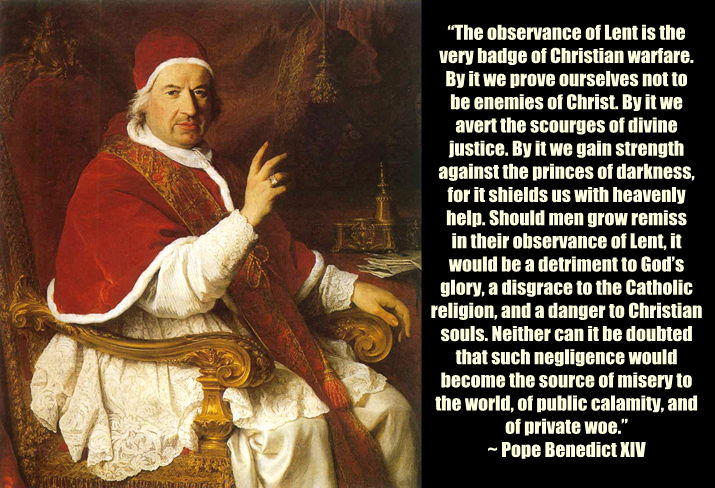
"The observance of Lent is the very badge of the Christian warfare. By it we prove ourselves not to be enemies of the cross of Christ. By it we avert the scourges of divine justice. By it we gain strength against the princes of darkness, for it shields us with heavenly help. Should mankind grow remiss in their observance of Lent, it would be a detriment to God's glory, a disgrace to the Catholic religion, and a danger to Christian souls. Neither can it be doubted that such negligence would become the source of misery to the world, of public calamity, and of private woe." 

Yet changes continued during the 18th and 19th centuries as Antoine Villien's "History of the Commandments" from 1915 documents:

The use of meat on Sundays [of Lent] was at first tolerated, then expressly permitted, for the greater part of Lent. Old people still remember the time when its use was completely forbidden in France from the Friday of Passion week to Easter. Later, new dispensations allowed the gradual extension of the Sunday privilege to Tuesday and Thursday of each week, up to Thursday before Palm Sunday. About the beginning of the pontification of Pius IX [c. 1846], Monday was added to the days on which abstinence need not be observed; a few years later the use of meat on those four days began to be permitted up to Wednesday of Holy Week. Lastly the Saturdays, expect Ember Saturday and Holy Saturday, were included in the dispensations."

Mitigations to fasting also began to accelerate for other periods in the 18th and 19th centuries and this is seen strikingly in the series of changes to occur to fasting in the American Colonies which can be read in detail in the two-part series: A History of Holy Days of Obligation & Fasting for American Catholics.

Father Anthony Ruff relates in his article "Fasting and Abstinence: The Story" the changes made by Pope Leo XIII in the document entitled Indultum quadragesimale:

"In 1886 Leo XIII allowed meat, eggs, and milk products on Sundays of Lent and at the main meal on every weekday [of Lent] except Wednesday and Friday in the [United States]. Holy Saturday was not included in the dispensation. A small piece of bread was permitted in the morning with coffee, tea, chocolate, or a similar beverage."

While the evening collation had been widespread since the 14th century, the practice of an additional morning snack (i.e. a frustulum) was introduced only around the 18th century as part of the gradual relaxation of discipline. Volume 12 of The Jurist, published by the Catholic University of America in 1952, writes, "It is stated that the two-ounce breakfast arose at the time of St. Alphonsus, since which time the usage of the popular two and eight-ounce standards for the breakfast and the collation, respectively, has been extant." 

Mara Morrow in Sin in the Sixties elaborates on the concessions given by Pope Leo XIII which in the late 19th century expanded the practice of the frustulum and further reduced strict abstinence:

"It also allowed for the use of eggs and milk products at the evening collation daily during Lent and at the principal meal when meat was not allowed. [It] further allowed a small piece of bread in the morning with a beverage, the possibility of taking the principal meal at noon or in the evening, and the use of lard and meat drippings in the preparation of foods. Those exempt from the law of fasting were permitted to eat meat, eggs, and milk more than once a day." 

Consequently, the Baltimore Manual published by the Third Plenary Council of Baltimore in 1884 states: "Only one full meal is allowed, to be taken about noon or later. Besides this full meal, a collation of eight ounces is allowed. If the full meal is taken about the middle of the day, the collation will naturally be taken in the evening; if the full meal is taken late in the day, the collation may be taken at noon. Besides the full meal and collation, the general custom has made it lawful to take up to two ounces of bread (without butter) and a cup of some warm liquid - as coffee or tea - in the morning. This is important to observe, for by means of this many persons are enabled - and therefore obliged - the keep the fast who could not otherwise do so."

The Catechism of Father Patrick Powers published in Ireland in 1905 mentions that abstinence includes flesh meat and "anything produced from animals, as milk, butter, cheese, eggs." However, Father Patrick notes, "In some countries, however, milk is allowed at collation." The United States was one of those nations whereas Ireland and others were not granted such dispensations. The use of eggs and milk during Lent was to drastically change in a few years with the 1917 Code of Canon Law.

In 1895, the workingmen's privilege gave bishops in the United States the ability to permit meat in some circumstances. Mara Morrow summarizes that these circumstances occurred when there was "difficulty in observing the common law of abstinence, excluding Fridays, Ash Wednesday, Holy Week, and the Vigil of Christmas. This workingmen's privilege (or indult) allowed only for meat once a day during Lent, taken at the principal meal, and never taken in conjunction with fish. This particular indult was extended not only to the laborer but to his family, as well. The motivation of such an indult was no doubt to allow for enough sustenance such that the many Catholic immigrants to the United States who worked as manual laborers could perform their difficult, energy-demanding physical work without danger to their health" (Sin in the Sixties).


The Remnant of the Lenten Fast Left by the 20th Century

The Catholic Encyclopedia from 1909 in describing that fast immediately before the changes to occur under St. Pius X enumerates them as follows: "In the United States of America all the days of Lent; the Fridays of Advent (generally); the Ember Days; the vigils of Christmas and Pentecost, as well as those (14 Aug.) of the Assumption; (31 Oct.) of All Saints, are now fasting days. In Great Britain, Ireland, Australia, and Canada, the days just indicated, together with the Wednesdays of Advent and (28 June) the vigil of Saints Peter and Paul, are fasting days." 

The days of obligatory fasting as listed in the 1917 Code of Canon Law were the forty days of Lent (including Ash Wednesday, Good Friday, and Holy Saturday until noon); the Ember Days; and the Vigils of Pentecost, the Assumption of the Blessed Virgin Mary, All Saints, and Christmas. Partial abstinence, the eating of meat only at the principal meal, was obligatory on all weeks of Lent (Monday through Thursday). And of course, complete abstinence was required on all Fridays, including Fridays of Lent, except when a holy day of obligation fell on a Friday outside of Lent. Saturdays in Lent were likewise days of complete abstinence. Fasting and abstinence were not observed should a vigil fall on a Sunday as stated in the code: "If a vigil that is a fast day falls on a Sunday the fast is not to be anticipated on Saturday, but is dropped altogether that year." Eggs and milk (i.e. lacticinia) became universally permitted.

But additional changes quickly ensued. Mara Morrow, writing on the fasting days around this time, states, "In 1917 Pope Benedict XV granted the faithful of countries in World War I the privilege of transferring Saturday Lenten abstinence to any other day of the week, excepting Friday and Ash Wednesday. In 1919 Cardinal Gibbons was granted his request of transferring Saturday Lenten abstinence to Wednesday for all bishops’ dioceses in the U.S. This permission, as well as the workingmen’s privilege, were frequently renewed, but, after 1931, this permission was only on the basis of personal requests from individual bishops."

Pope Pius XII accelerated the changes to fasting and abstinence as Father Ruff relates: "In 1941 Pope Pius XII allowed bishops worldwide to dispense entirely from fast and abstinence except on Ash Wednesday and Good Friday, provided that there was abstinence from meat every Friday, and fast and abstinence on these two days and the vigil of the Assumption and Christmas. Eggs and milk products were permitted at breakfast and in the evening." And effective in 1956 per the decree in Maxima Redemptionis Nostrae Mysteria, Holy Saturday's fast and abstinence were extended from noon to midnight.

By 1962, the laws of fasting and abstinence were as follows as described in "Moral Theology" by Rev. Heribert Jone and adapted by Rev. Urban Adelman for the "laws and customs of the United States of America" copyright 1961: 

"Complete abstinence is to be observed on all Fridays of the year, Ash Wednesday, the Vigils of Immaculate Conception and Christmas. Partial abstinence is to be observed on Ember Wednesdays and Saturdays and on the Vigil of Pentecost. Days of fast are all the weekdays of Lent, Ember Days, and the Vigil of Pentecost." If a vigil falls on a Sunday, the law of abstinence and fasting is dispensed that year and is not transferred to the preceding day. 

Thus, even before the Second Vatican Council opened, the fasting customs were drastically reduced within only a few hundred years. 


The Lenten Fast Virtually Eliminated Post Vatican II

Shortly after the close of the Second Vatican Council, Paul VI an apostolic constitution on fasting and abstaining on February 17, 1966, called Paenitemini, whose principles were later incorporated into the 1983 Code of Canon Law. Paenitemini allowed the commutation of the Friday abstinence to an act of penance at the discretion of the local ordinaries and gave authority to the episcopal conferences on how the universal rules would be applied in their region. Abstinence which previously began at age 7 was modified to begin at age 14. Additionally, the obligation of fasting on the Ember Days and on the remaining Vigils was abolished. Paenitemini maintained the traditional practice that "abstinence is to be observed on every Friday which does not fall on a day of obligation."

The NCCB issued a statement on November 18, 1966. Abstinence was made obligatory on all Fridays of Lent, except Solemnities (i.e. First Class Feasts), on Ash Wednesday, and on Good Friday. Abstinence on all Fridays throughout the year was "especially recommended," and the faithful who did choose to eat meat were directed to perform an alternative penance on those Fridays outside of Lent, even though the US Bishops removed the long-establish precept of requiring Friday penance. The document stated in part: "Even though we hereby terminate the traditional law of abstinence binding under pain of sin, as the sole prescribed means of observing Friday, we ... hope that the Catholic community will ordinarily continue to abstain from meat by free choice as formerly we did in obedience to church law." And finally, fasting on all weekdays of Lent was "strongly recommended" but not made obligatory under penalty of sin.

The 1983 Code of Canon Law largely took Paul VI's apostolic constitution aside from the modification of the age at which fasting binds. Per the 1983 Code of Canon Law, the age of fast was changed to begin at 18 - previously it was 21 - and to still conclude at midnight when an individual completes his 59th birthday. Friday penance is required per these laws on all Fridays of the year except on Solemnities, a dramatic change from the previous exception being only on Holy Days of Obligation.

Per the 1983 Code of Canon Law, fasting and complete abstinence per these rules are required only on Ash Wednesday and Good Friday. The notion of "partial abstinence," introduced under Pope Benedict XIV in 1741, was also removed along with nearly all fast days. 

So What Should Traditional Catholics Do To Restore the Lenten Fast?

While no authority in the Church may change or alter any established dogmas of the Faith, the discipline of both Holy Days of Obligation and fast days may change. The days of obligation and the days of penance are matters of discipline, not matters of dogma. Lawful authorities in the Church do have the power to change these practices.

In the observance of the two precepts, namely attending Holy Mass on prescribed days and fasting and abstaining on commanded days, we obey them because the Church has the power by Christ to command such things. We do not abstain from meat on Fridays for instance because the meat is unclean or evil. It is the act of disobedience that is evil. As Fr. Michael Müller remarks in his Familiar Explanation of Christian Doctrine from 1874: "It is not the food, but the disobedience that defiles a man." To eat meat on a forbidden day unintentionally, for instance, is no sin. As the Scriptures affirm it is not what goes into one's mouth that defiles a man but that disobedience which comes from the soul (cf. Matthew 15:11).

Yet, even with such a distinction, the Church has historically been wise to change disciplines only very slowly and carefully. As Archbishop Fulton J. Sheen once remarked, "It is a long-established principle of the Church never to completely drop from her public worship any ceremony, object or prayer which once occupied a place in that worship." The same may be said for matters concerning either Holy Days of Obligation or fast days. What our forefathers held sacred should remain sacred to us in an effort to preserve our catholicity not only with ourselves but with our ancestors who see God now in Heaven.

St. Francis de Sales remarked in the 16th / early 17th century, “If you’re able to fast, you will do well to observe some days beyond what are ordered by the Church.” 

This Lent, I propose for Traditional Catholics the following Lenten fasting plan:
  • Fasting applies for those age 18 or older (but not obligatory for those 60 years of age or older)
  • Ash Wednesday and Good Friday: No solid food. Only black coffee, tea, or water.
  • Mondays through Saturdays: Only one meal preferably after sunset. A morning frustulum and evening collation are permitted but not required. No meat or animal products are allowed for anyone, regardless of age - that includes fish. No olive oil.
  • Sundays: No meat or animal products allowed except on Laetare Sunday. Exceptions for Palm Sunday are mentioned below.
  • Annunciation Day (March 25) and Palm Sunday: Fish and olive oil permitted.
  • Holy Week (except Good Friday): Only Bread, Salt, and Herbs are permitted for the main meal. Frustulum and collation permitted (of bread, herbs, and salt) but omitted if possible
  • Holy Saturday: No food until Noon. Abstinence including from all animal products continues until Easter begins.
And for those looking for ideas on what to make to eat on fasting days, the Lenten Cookbook produced by Sophia Institute Press has a section on vegan recipes that is worth checking out.

Want to learn more about the history of fasting and abstinence? Check out the Definitive Guide to Catholic Fasting and Abstinence.
Read more >>
Saturday, September 21, 2019
How to Live a Liturgical Life

Part 1: The Sacredness of Time

Under the Old Law that we study in the Old Testament, God’s people observed annual ceremonies commemorating important events in salvation history which prefigured the completion of the Old Law through Christ. Similarly, Holy Church commemorates important mysteries, events, and persons, using an annual cycle of prayers, scriptures, hymns, and various spiritual disciplines. In the same way, each of the 12 months has a unique focus and each day of the week has a unique focus as well. Even in the day, the hours of the day are divided up into the canonical hours. In so doing, all time is devoted to God since He alone created all time and redeemed all of time.

Unlike the pagan religions which often view time as an endless cycle of death and rebirth, the Christian view of time is linear. While God alone has always existed and has no beginning, time had a beginning. There was a first day on earth. And there will be a last day. There will be a day ultimately when the sun will rise for the last time and when it will set for the last time. Time will end. And God Himself will end it as time belongs to Him. It is our duty to honor God in time.

The Catholic Day

Each day is comprised of the Canonical Hours during which priests, religious sisters and brothers, and any laypeople who want to pray the set prayers for those hours. Called the Divine Office, or the Breviary, these 7 prayers throughout the day are a primary means by which we sanctify time. We will discuss the breviary at a much greater extent later in this talk.

Furthermore, the day is further consecrated to God by the Angelus Prayers. Traditionally said at 6AM, Noon, and 6PM the Angelus is a means by which we consecrate time to God, invoke the Blessed Mother, and honor the Incarnation. For this reason, church bells will often ring at noon and at 6 PM as a call to prayer for the Angelus. 6am is usually too early for bells to ring so most parishes don’t ring them then, nevertheless 6 am is the first time for the Angelus each day.

In fact, Mother Teresa and other missionary nuns have remarked that the sight of seeing Catholics fall to their knees to pray the Angelus when the Angelus bell sounded brought about many conversions. One former Hindu who converted and became a nun remarked that the sight of seeing Catholics instantly fall to their knees to offer those prayers even in the market at noon left such an impact on her that it brought about her conversion. We can have a similar impact by keeping the sacredness of the Catholic Liturgical Day.

The Angelus is traditionally prayed kneeling on everyday of the week except Sundays and except during Pascaltide (that is the 50 days of the Easter Season). On Sundays and during Easter time, you instead make a genuflection on your right knee at the mention of the Incarnation. If you are not familiar with the Angelus prayers, I would direct you to go online and find those prayers, save them, and start saying them daily. Even if you are not up at 6 AM or you are busy at precisely noon, you may still say them. In that case, you can pray the Angelus Prayers before your breakfast and likewise offer the next two prayers before lunch and before dinner respectively.

Some Catholics might also pray a Morning Offering Prayer upon awaking and make a Nightly Examination of Conscience just before bed. If you are not familiar with these practices look them up as well. In such a way, we can consecrate the day and time to God, the author of time.

The Catholic Week

All time belongs to God Himself as He has redeemed all time, and we see the sacredness of time chiefly on Sunday.  Just as we are to pay a tithe, a share of our earnings, for the poor and for the Church’s needs, so too we are required to pay a tithe of our time to God in the form of Sunday Mass.

We read in the Baltimore Catechism the clear teaching of the Church on the sacredness of Sunday time:
“By the third Commandment we are commanded to keep holy the Lord's day and the holy days of obligation, on which we are to give our time to the service and worship of God. Holy days of obligation are special feasts of the Church on which we are bound, under pain of mortal sin, to hear Mass and to keep from servile or bodily labors when it can be done without great loss or inconvenience. Whoever, on account of their circumstances, cannot give up work on holydays of obligation should make every effort to hear Mass and should also explain in confession the necessity of working on holy days.”
The Third Commandment explicitly forbids servile work on Sundays. We cannot mow the lawn, we cannot move to a new apartment on Sunday, we cannot paint, we cannot perform physical work that is servile – that is work that would have been done by a servant in past eras. Yet, the Church further commands that all Sundays — and all other Holy Days of Obligation — are mandatory days of Mass attendance. The Sacredness of Sunday requires not only abstaining from certain actions but also the doing of other ones. Missing Mass on one of these days without a grave reason — such as grave illness or the inability to reasonably obtain transportation— is a mortal sin. If you were not able to attend the Holy Sacrifice of the Mass for a good reason, you should still read the Missal for that day and pray the prayers from the Missal or watch an online broadcast of the Mass. There are several sites which broadcast daily the Traditional Mass. These activities though do not fulfill your obligation. If you are not able to make it to Mass for a legitimate reason, the obligation to attend Mass is lifted for you that day. But these pious activities can still help our own spiritual edification.

Sunday is also a day in which to participate in communal Rosary, Vespers, and Benediction services. Sunday is the day on which the Faithful should be most willing to read Catholic newspapers, books, and magazines. Listen to Catholic podcasts or You-Tube videos. Study catechism and supplemental religious education lessons. It is a day of rest from physical work so that we can give this tithe of our time to God.

And it should also be underscored that only attendance at the Catholic Mass fulfills our Sunday obligation. Attending a protestant service does not. In fact, attending a non-Catholic form of worship is sinful. If you were to go with a friend to say a Lutheran service on Sunday instead of Mass, you would have two mortal condemning your soul – first the missing of Sunday Mass and second, the taking part in false worship of other religions. The Church’s teachings on this are clear.

Likewise, only the Catholic religion rightfully understands that not only Sunday but the entire week is devoted to God.

Let’s take for instance Fridays. Fridays are penitential days in remembrance of our Lord’s brutal torture, crucifixion, and death on Friday. And we are required to perform penance on all Fridays of the year.

One of the most common caricatures of Catholics is our frequent eating of fish on Fridays. Yet, few non-Catholics understand this practice at all. And the sad truth is that many Catholics nowadays fails to properly observe these practices since abstinence from meat is actually required all year long - NOT just during Lent.

Let's take a few minutes to understand this practice.

Let me summarize these requirements. Catholics are required without exception to abstain from meat on Fridays in Lent. And Catholics are also required to abstain from meat on all Fridays of the year unless the Bishops Conference of that area allows an alternative penance to be performed. This is a novelty though. Many faithful Catholics however choose just to honor the tradition of abstaining from all meat on Fridays year-round instead of substituting an alternative. That is what I do and what I encourage you to do as well. Due note, in Lent there is no substituting allowed.

Back when I was in college, I had a roommate who one Friday in Lent said he was going to a party that Friday so he would just abstain from meat on Thursday instead.  You can’t do that. It’s Friday. Christ died on Friday. And having to eat a salad and not a burger is a small sacrifice. If you can’t do that, how can you resist the tempting sins of the flesh? The same is true for Sundays. You can’t say, I’m really busy on Sunday so I’ll just go to Mass before class on Monday morning to fulfill my obligation. It doesn’t work that way.

The Church had over the past several hundred years lessened the discipline of Lent significantly little by little over the centuries. We would do well to return to forty days of abstinence from meat and animal products while also observing them as days of fast. Returning simply to the fast as practiced in 1917 is still a shadow of the fast as formerly practiced by our ancestors and forefathers in the Faith.

So, we can live a Catholic liturgical life in part by 1. Going to Mass on Sundays and Holy Days, 2. Refraining from all servile work (manual work, cleaning, physical labor) on Sundays and Holy Days, and 3. Abstaining from meat on all Fridays of the year unless a dispensation is offered.

But these are the minimums. These are the requirements. To truly live a liturgical life, we cannot be satisfied with only not sinning against these laws. We have to want to enter deeper into the liturgical life. And we can do that by honoring each day of the week. Sunday is devoted to the Resurrection and Friday is dedicated to the Passion of Christ, but there are still 5 other days in the week.

Mondays are devoted to the Holy Ghost and the Souls in Purgatory. Do you pray to the Holy Ghost for guidance especially on Mondays? Do you pray for the souls in purgatory on Mondays? Have you made it a custom to visit a nearby cemetery on Mondays to pray for the dead there?

Tuesdays are devoted to the Holy Angels. Do you make sure you pray to your guardian angel on Tuesdays? We can also pray the Chapel of St. Michael the Archangel on Tuesdays. If you not familiar with that, look it up online. The Chapel of St. Michael is a devotion that few Catholics are aware of anymore. Tuesdays are also dedicated to the Holy Face and also to St. Anthony of Padua and St. Dominic.

Wednesdays are devoted to St. Joseph. What devotions can you do on Wednesday to honor St. Joseph? After all, after the Blessed Virgin Mary, he is given the highest veneration among all the saints.

Thursdays are devoted to the Blessed Sacrament. Can you visit your local church, chapel, or Shrine for Adoration? Even if the Sacred Host is in the Tabernacle, God is still there, and we can and should make an effort to honor Him on Thursdays in the Adorable Sacrament of the Altar. This of course is on Thursday since our Lord instituted the Sacrament on Thursday. And what’s interesting, is that traditionally seminaries were closed not only on Sundays but also on Thursdays. Thursdays in honor of the institution of the Blessed Sacrament and of the priesthood. That is a custom that has also fallen by the wayside.

And lastly Saturdays are devoted to the Blessed Virgin Mary. Do we invoke her in a special way on Saturdays? Do we especially make sure we pray the Rosary then? Do we honor the First Saturday devotion?

These are real questions that I ask you to consider. How can you better live out the Catholic Liturgical Week?

The Catholic Month

And just as we considered the Catholic Day and the Catholic Week, each month of the year has a specific focus as well:

January is devoted to the Holy Name and the Childhood of our Lord
February is devoted to the Holy Family
March is devoted to St. Joseph
April is dedicated to the Blessed Sacrament
May is in honor of the Blessed Virgin Mary
June is devoted to the Sacred Heart of our Lord
July is dedicated to His Precious Blood
August is in honor of the Immaculate Heart
September is dedicated to the Seven Sorrows of Mary
October is in honor of both the Holy Rosary and the Holy Angels
November is dedicated to praying for the Poor Souls in Purgatory
And December is dedicated to the Immaculate Conception

In regard to these months, how often do we give these any thought? Do you pray the Litany of Loreto in May or the Litany of the Sacred Heart in June? Do we make special devotions to the Precious Blood in July? Do we honor the dead and make special satisfaction for souls in November? If you are truly serious about living a Catholic liturgical life, I ask you to look up these monthly devotions and live them out.


Part 2: An Overview of the Catholic Liturgical Year

After considering the liturgical day, week, and month, we come now to the second part of this talk: The Catholic Liturgical Year. Running concurrently with the weekly and monthly devotions is the annual liturgical calendar.

Through the liturgical year, we re-live the life of Christ each year starting with His coming and ending with the end of time. The Church runs on a special schedule all year long, with special days focused on different events in the life of Christ. In fact, many protestants are shocked to learn that Catholics have Mass daily – not just on Sundays. And they are even more shocked when they learn about the hundreds of feast days we have throughout the year. Whereas many of them will celebrate Christmas and Easter, a Catholic sees nearly every day of the year dedicated in some way to a unique saint or mystery of the Faith.

Every year the Catholic Church remembers certain key events — the birth of Christ, the death of Christ, His Resurrection and Ascension. The birth and death of Christ are preceded by a time of preparation — Advent and Lent respectively.

Advent is the beginning of the liturgical year and is an approximate four week long time of preparation for the birth of Christ. It begins around the end of November. Advent ends with Christmas.

Christmas is always celebrated on December 25th. The Reverend Dom Prosper Gueranger, an abbot who lived until 1875, wrote a long series of reflections on the different seasons of the year in fifteen volumes (although he did not live to complete his monumental work). Father Gueranger’s Liturgical Year volumes are the gold-standard in knowledge on the liturgical year. If you could buy just one set of books on the Liturgical Year, save up and buy his volumes. They are incredible.  For instance, Father Gueranger wrote about the characteristics of Christmas when he wrote:
“It is twofold: it is joy, which the whole Church feels at the coming of the divine Word in the Flesh; and it is admiration of that glorious Virgin, who was made the Mother of God. There is scarcely a prayer, or a rite, in the Liturgy of this glad Season, which does not imply these two grand Mysteries: - an Infant-God, and a Virgin-Mother” (Gueranger, 4)
And Father Gueranger has lengthy reflections for every single traditional feast day in the year. Now, Christmas itself is not only a single day but an entire season. And after it we have, the third season: time after epiphany.

After the Christmas and Epiphany seasons, the Church enters Lent, a time of repentance. Lent is actually preceded by a period of pre-Lent called Septuagesima and then Lent officially begins on Ash Wednesday. This observance is on the Wednesday forty-six days before Easter and features the imposition of blessed ashes. The priest traces the sign of the cross on each person’s forehead (though he does so on the head at the place of tonsure for clerics not their foreheads) while saying “Remember man that you are dust, and unto dust you shall return”. It is a day of mandatory fasting and abstinence. This sets the tone for the entire Lenten season. As the Saint Joseph Sunday Missal urges us:
“The ashes on your forehead have only as much meaning as you are giving them. Make this symbolism a meaningful beginning of a time of penance, preparing to celebrate the paschal mystery of our Lord’s death and resurrection” (Saint Joseph Sunday Missal, 233).
The Lenten season is penitential, so we are asked to devote time to spiritual and corporal acts of mercy as well as prayer, fasting, and the giving of alms. In all of these ways, we can make satisfaction for sins if we are in the state of grace. Catholics often give up something for Lent such as candy or watching television although, as we will discuss later, much greater sacrifices are needed and asked for. The notion that Catholics are only asked to give up chocolate for Lent is scandalous. The sacrifices of our forefathers in the Faith puts the modern Catholic to shame.

Catholics should also participate in additional prayers such as attending extra Masses during the week or making the Stations of the Cross on Fridays. This is also a particularly important time to confess our sins to a priest and receive God’s mercy in the Sacrament of Confession. Lent is traditionally forty days of fasting and forty days without meat.

The final two weeks of Lent are traditionally called Passiontide, and Lent culminates in the second week of Passiontide, called Holy Week, which commemorates the final days of our Lord’s life on earth before His Crucifixion. Palm Sunday starts Holy Week and on that day, we commemorate Christ’s triumphant entry into Jerusalem. Many of the crowd who shouted “Hosanna” and placed palms before His path only a few days later demanded His death. The Liturgy for Palm Sunday shows us the great immutability of human beings. How fast we are to forget.

On Holy Thursday we remember the Institution of the Holy Eucharist and on Good Friday, God Himself is crucified. Good Friday is also a day of required fasting and abstinence and is the most somber day in the entire year. The day after, Holy Saturday, is a day of mourning and quiet. God has died and sleeps in the tomb. We then arrive at the most joyous celebration of the entire year, the crowning joy of the liturgical life: Easter Sunday!

Easter bursts forth as we hear of the Lord’s rising from the dead, the greatest proof of His own divinity. Astonished, His Apostles and disciples first hear of His resurrection and then see His risen body. The Easter Season is a period of joy for us as well and lasts for fifty days, eclipsing the long forty days of fasting and penance during Lent.

Jesus would not stay with His Apostles for long but ascended to heaven. We celebrate this forty day after Easter Sunday on Ascension Thursday. However, our Lord promised not to leave us as orphans but to send the Holy Ghost. The Apostles gathered in Jerusalem, waiting for the Holy Ghost. And we celebrate the coming of the Holy Ghost on Pentecost Sunday, 50 days after Easter Sunday. Trinity Sunday occurs the Sunday after Pentecost to honor the Blessed Trinity and begins the period called Time after Pentecost. And that season will run until we begin it all over again with Advent.

Thus, to summarize, there are traditionally 2 Liturgical Cycles and 7 Liturgical Seasons: The first cycle is the Christmas Cycle and includes Advent, Christmastide, and the time after the Epiphany.  The second cycle is the Easter Cycle and includes Septuagesima, Lent, Pascaltide (also called Eastertide), and the Time after Pentecost.

It’s also important to realize that each rite in the Church (Roman, Maronite, Chaldean, etc.) has its own calendar, and some have multiple uses or forms (e.g. within the Roman rite are the Traditional Roman Calendar of 1962, the Traditional Catholic Calendar in place in 1954, the modern Roman Calendar of 1969 that your typical parish down the road would use, and the Anglican Use Calendar). Even within the same use or form, there are variations according to local customs. For instance, the patron saint of a church or of the cathedral would be ranked higher in that calendar for that local jurisdiction.

It’s also important to define some important aspects of the liturgical year before we can do more a deep dive into it. And for those definitions, I’m relying on a good summary presented by TraditionalMass.info, a website that I’d encourage all of you to get to know well.

The Liturgical Year

Whereas civil calendars presently start on January 1st (even though that was not always the case), Church calendars begin four Sundays before Christmas (not counting Christmas itself), so that the date of the Church’s “new year” varies from late November to early December. There is also a lunar element to how celebrations in our liturgical year are determined. The lunar element is in the method of calculating the date of Easter, from which the other variable feastdays follow. Easter Sunday is calculated as the first Sunday after the First Full Moon after the Vernal Equinox.

Holy Days and Feasts

It’s a very common term when we are discussing the liturgical life. But what exactly do they mean? Although the terms “holy day” and “feast” are sometimes used interchangeably, they have distinct meanings.

In fact, our English word “holiday” is based on the concept of a “holy day”. A holy day in the general sense, is any day the Church has set apart for a regularly recurring public ceremonial observance. It finds expression primarily in the Mass and Divine Office, which have special prayers, and sometimes special ceremonies (such the distribution of candles on February 2nd) or special disciplines (such as fasting in Lent), for each holy day. In this sense, every feast day is a holy day.

Sunday is the primary holy day; its weekly ceremonial observance replaces that of the Jewish Sabbath.

However, sometimes “holy day” is short for “holy day of obligation,” as in the expression “Sundays and holy days.”

A feast, in the general sense, can also mean a holy day or set of holy days commemorating a particular person, event, or mystery of the Catholic Religion. Feast, when we are discussing the liturgical year, does not mean a large dinner gathering.

A feast may fall on a Sunday, either regularly (e.g. Easter Sunday) or coincidentally (in which case either the Sunday or the feast takes precedence depending on their liturgical ranks). For example, what happens when St. James’ feastday falls on a Sunday? Which takes precedence? Does that change if your parish is the Church of St. James or if the Cathedral in our Diocese is the Cathedral of St. James? These are questions that someone who wants to live a liturgical life should keep in mind.

On the modern (1969) calendar in the Novus Ordo, a “feast” in a narrower sense is a holy day of lesser rank than a “solemnity” and greater than a “memorial.”

Ranks have changed over the past several decades. In the modern Church, they will use the terms solemnity, feast, memorial, or optional memorial. In the 1962 Missal, we have First, Second, Third, or Fourth Class feastdays. But before the 1962 Missal up until the changes made by Pope Pius XII in 1955, there were from least to most important: Simples, Semidoubles, Lesser Doubles or also known as Doubles, Greater Doubles, Doubles of the second class, and lastly Doubles of the first class.

Temporal and Sanctoral Cycles

Feasts are listed in liturgical books according to two different, concurrent annual cycles.

The Proper of Seasons, or Temporal Cycle traces the earthly life of Our Lord Jesus Christ. It consists mainly of Sundays related to the various liturgical seasons. This maps onto the 7 liturgical seasons contained in the two cycles we previously discussed: the Christmas Cycle and the Easter Cycle. It starts with Advent then goes through Christmas, Epiphany, Septuagesima, Lent, Easter, and Time after Pentecost.

There is also the Proper of Saints, called the Sanctoral Cycle, which is the annual cycle of feasts not necessarily connected with the seasons. We commemorate and ask the intercession of those holy men and women who set a marvelous example that we should all strive to imitate. We also commemorate various events and mysteries of the faith in the Sanctoral Cycle.

Fixed and Moveable Feasts

Besides Sundays, holy days are generally associated with a liturgical calendar in one of two ways:
  • We have Fixed Feasts which generally fall on the same date each year, e.g. Christmas on Dec 25th. (Though as an exception in some cases, a fixed feast, in spite of its name, can be moved if it coincides with a moveable feast of greater rank.)
  • Moveable Feasts may shift a few days forward or backward from year to year, mainly depending on the date of Easter for that year. (Pentecost, for example, is 49 days after Easter.)
Easter Sunday is “moveable” only insofar as its date varies somewhat depending on the lunar cycle; otherwise it cannot be moved, as it is the highest feast and the basis for many others.

Vigils 

We also have vigils. The term “vigil” is used in several ways. It may refer to an entire day before a major feast day (e.g. the Vigil of Christmas is all day on Dec 24th). This kind of vigil is a feast day in itself. Before the changes to the Roman calendar in 1955, nearly all feasts of the apostles were preceded by a Vigil Day (some of which were days of required fasting but those requirements generally disappeared in the 1700s).

Finally, a Sunday Mass anticipated on a Saturday evening is sometimes, though incorrectly, called a vigil. This practice though is a novelty and not part of Catholic Tradition, so I always encourage Catholics to never attend such “vigil masses” on Saturday evenings.

Ferias

Lastly, we have ferias. A weekday with no feast associated with it is called a feria or ferial day (from the Latin feria meaning “free day”). On such a day, in the traditional rite, the priest generally offers the Mass of the previous Sunday or a Votive Mass of his choice. He may choose to honor the mystery of that day (for instance, on a ferial Wednesday he may be offering a Votive Mass of St. Joseph) but he may offer a Votive Mass for any saint. He may also generally, exceptions aside, offer a Requiem Mass.

So now that we have some essential definitions down, I’d like to walk through a guided meditation on the Liturgical Year in our time left. Again, this material will come from the Liturgical Year Course offered on CatechismClass.com and is just the tip of the iceberg. There are so many insightful meditations in the liturgical year for us to consider that this is just a small piece of that.


Part 3: Details of the Catholic Liturgical Year 

Note: Much of this section is taken from the affordable and extensive online course on the Liturgical Year offered by CatechismClass.com.

Advent

To many in our world today, Advent is extinct. Christmas starts around Thanksgiving with in-store sales and Christmas carols and ends on December 26th. To a Catholic, this borders on blasphemy.

With the First Sunday of Advent, the Church now begins anew the liturgical year.  In the words of Archbishop Fulton J. Sheen, it is in one liturgical year that the Church re-lives the 33 years of Christ’s life – thirty years obeying, three years teaching, and three hours redeeming.  Advent is a unique season of its own, not an extension of Christmas. It is neither an appropriate time to sing Christmas carols, nor is it a time for Christmas parties.

Advent is a time of penance in anticipation for the Nativity of Our Blessed Lord.  But it is also a time to help us remember that we must always be prepared for the Final Judgment and the Second Coming of Christ.

Advent as a season is quite ancient. The season itself went through slow development, taking form back in the 4th century and reaching a definite form in Rome by 6th century. Advent starts on the Sunday nearest Nov 30th (Saint Andrew’s feastday) and formed the beginning of the liturgical year by the 10th century. It started earlier at one time (as early as Nov 11th) because it was fashioned after Lent, so it had forty days originally in some areas, and even earlier in other areas (starting in September) which forms the basis of the monastic fast. However, by the 6th to 7th centuries the number is set as a span of four Sundays. And the 1962 Missal preserves most of the ancient Masses of this season even though they are not in the Novus Ordo.

And while the modern Catholic will be generally familiar with Advent, the main part of Advent that they will be largely ignorant of is the Advent Embertide Fast. Ember days (in Latin the Quatuor Tempora, meaning four times) are the days at the beginning of the seasons ordered by the Church as days of fast and abstinence.

Although Ember Days are no longer considered required in mainstream Catholicism following Vatican II, they can - and should - still be observed by the Faithful. In fact, many Traditional priests encourage the Faithful to observe the days. Ember Days are set aside to pray and offer thanksgiving for a good harvest and God's blessings. If you are in good health, fast during these three days and pray the additional prayers prescribed in the Breviary. Remember the words from the Gospel: "Unless you do penance, you shall likewise perish" (Luke 13:5). We are called to do penance throughout the year, and we can do that by uniting to the traditional times of penance which have nearly all been forgotten.

I now with some slight modifications quote from the New Advent encyclopedia:
“They were definitely arranged and prescribed for the entire Church by Pope Gregory VII (who reigned from 1073-1085) for the Wednesday, Friday, and Saturday after December 13th (St Lucia), after Ash Wednesday, after Whitsunday (another name for Pentecost Sunday), and after September 14th (The Exaltation of the Cross).  
“The purpose of their introduction, besides the general one intended by all prayer and fasting, was to thank God for the gifts of nature, to teach men to make use of them in moderation, and to assist the needy.  The "Liber Pontificalis" ascribes to Pope Callistus (who reigned from 217-222) a law ordering the fast, but probably it is older. Pope Leo the Great considers it an Apostolic institution. When the fourth season was added cannot be ascertained, but Gelasius (around 495) speaks of all four. This pope also permitted the conferring of priesthood and deaconship on the Saturdays of ember week--these were formerly given only at Easter.” 
By observing these Ember Days in Advent, we truly live a more liturgical life. Not a single day of the year should pass when we do not feel a connection with the Liturgical Calendar. To do so, to neglect the feast days and fast days before us, is to live as orphans. Just as we keep these holy days, so too in Heaven there are holy days. It is our purpose in life to make it to Heaven, and Heaven will have feast days. If we do not feel within ourselves a desire to unite with the Church and honor and praise Almighty God through the Liturgical Year, we are not living truly Catholic lives.

Lent

Lent is a period of 40 days of penance (excluding the Sundays of Lent in the number) in preparation for the solemn celebration of the Lord's Resurrection on Easter Sunday. Our Lord, before beginning His earthly public ministry, fasted and prayed for 40 days and 40 nights. As the Gospel continually reaffirms, penance is an important part of repentance. And the Lord gave us the example of fasting for 40 days and nights. The concept of 40 days existing as preparation was seen by the Prophet Elijah, who fasted and journeyed to Horeb for 40 days (1 Kings 19:8). There are dozens of other references to the number 40 in the Old Testament.

For those Catholics who wish to more closely follow the ancient customs of the Church, Lent is a time of austere penance undertaken to make reparation to God for sin (our own sins and those of others), to grow in virtue and good works, and to comfort the heart of our Savior much offended by the proliferation of sin and filth increasing by the day.

Yet, there are very few Catholics who undertake the true discipline of prayer, fasting, and almsgiving. You, the remnant of the Catholic Faith, must observe the strictest of Lents. If you don’t, who will?

How many of us observe all 40 days as true fast days and not just Ash Wednesday and Good Friday?  Yet our ancestors did.  In fact, it was forbidden to eat meat or any animal products (e.g., eggs, dairy, cheese, butter, olive oil, or even fish) through all of Lent, even on Sundays!  How many of us are making this kind of intense sacrifice?  How many of us are finding the time during Lent to pray the Rosary every day or go to Daily Mass more often or at least pray the Stations of the Cross each Friday?

We live in sad, pitiful times when few souls even care to observe Lent.  The prophetic words of Pope Benedict XIV are coming true when he said:
“The observance of Lent is the very badge of Christian warfare. By it we prove ourselves not to be enemies of Christ. By it we avert the scourges of divine justice. By it we gain strength against the princes of darkness, for it shields us with heavenly help. Should men grow remiss in their observance of Lent, it would be a detriment to God’s glory, a disgrace to the Catholic religion, and a danger to Christian souls. Neither can it be doubted that such negligence would become the source of misery to the world, of public calamity, and of private woe.” 
And yet, how many people indulge in public sin, lust, and gluttony on Fat Tuesday in a mockery of our ancestors?  Nowadays, few Catholics fast for all forty days.  Yet, people are engaging in eating on Shrove Tuesday like they were.  It is a mockery of the Faith!  How many people are fasting by "light eating" on Ash Wednesday and then indulging on cheeseburgers on the Thursday after Ash Wednesday on a Lenten feria day!

Even the great liturgist Father Dom Guaranger wrote of the excesses and sinfulness of Mardi Gras in his own time.  And how much worse it is in our own times than his back in the 1800s! He said in part:
“How far from being true children of Abraham are those so-called Christians who spend Quinquagesima (The Sunday before Ash Wednesday) and the two following days in intemperance and dissipation, because Lent is soon to be upon us!...”
It is a shame.   It is a public scandal.  And our Lord Himself has asked for reparation. In an approved apparition of our Blessed Lord to Mother Pierina in 1938, the Lord said:
“See how I suffer. Nevertheless, I am understood by so few. What gratitude on the part of those who say they love Me. I have given My Heart as a sensible object of My great love for man and I give My Face as a sensible object of My Sorrow for the sins of man. I desire that it be honoured by a special feast on Tuesday in Quinquagesima (Shrove Tuesday – the Tuesday before Ash Wednesday). The feast will be preceded by novena in which the faithful make reparation with Me uniting themselves with my sorrow.”
Thus, our Lord wished for us to make amends on the Tuesday before Ash Wednesday, the last day of the period of Septuagesima, and yet so few people know of this. Living a liturgical life necessitates that we live true Lents. 40 Days of Fasting and abstinence from meat. And that we care enough to learn of these traditions. So when next Lent comes, I ask you – how can you observe a truly Catholic Lent? And what will you be able to do on the Tuesday before Ash Wednesday in reparation for the sins of those who give in to carnal lusts on Mardi Gras?

The great Fr. Gueranger provides hundreds of meditations for Lent. Regarding the true uniqueness of the Lenten season, Fr. Gueranger writes:
“Each feria of Lent has a proper Mass; whereas, in Advent, the Mass of the preceding Sunday is repeated during the week. This richness of the lenten liturgy is a powerful means for our entering into the Church's spirit, since she hereby brings before us, under so many forms, the sentiments suited to this holy time... All this will provide us with most solid instruction; and as the selections from the Bible, which are each day brought before us, are not only some of the finest of the sacred volume, but are, moreover, singularly appropriate to Lent, their attentive perusal will be productive of a twofold advantage.”
After having given consideration to Advent, Lent, and Ember Days, I wish to share a final reflection on Rogation Days, another element of our liturgical life that has fallen by the wayside.

Rogation Days are the four days set apart to bless the fields and to invoke God's mercy on all of creation. The 4 days are April 25th, which is called the Major Rogation (and is only coincidentally the same day as the Feast of St. Mark); and the three days preceding Ascension Thursday, which are called the Minor Rogations days (i.e., the Lesser Litanies). Traditionally, on these days, the congregation marches the boundaries of a parish, blessing every tree and stone, while chanting or reciting a Litany of Mercy, usually the Litany of the Saints.

These were long before the 1962 Missal, days of fasting and abstinence from meat. The requirement for abstinence was universally kept for some time but the fasting was kept only in some locations (e.g. the Churches in Gaul where the Rogations days originated from as well as by St. Charles Borromeo in Milan). The Church Universal did not mandate days of fasting in the Easter Season so these days were often observed by abstinence from meat. Of course, keeping them as fast days is certainly in the proper spirit of penance, as St. Charles Borromeo's example shows us.

Besides keeping these days of penance, we can join in these processions. We can also pray special Rogation Days prayers. I personally try to go to a field of crops on April 25th where I pray the Litany of Saints in keeping with the liturgical spirit for the Major Rogation and say some additional prayers appropriate for the day.

Father Christopher Smith, a priest of the Diocese of Charleston, South Carolina has put together a beautifully illustrated guide explaining both the Rogations and Ember Days, with a number of very useful quotes from various liturgical sources.


Part 4: Living a Liturgical Life through the Mass & the Office

The entire year helps us to commemorate Jesus’ life and the work of the Holy Trinity. Through the Mass, meditation, prayers, acts of mercy, and devotions, we become closer to God. The Mass and all prayers are ultimately for the sole purpose of the worship of the Trinity. Our purpose in life is ultimately orientated to the worship of the Holy Trinity. The Mass, the greatest act of Catholic worship, at its core is the greatest worship that can be given to the Trinity because the Mass is the re-presentation of Jesus Christ on the Cross to God the Father. And we know from our attendance at Mass that the Mass is the chief way we come into contact with the liturgical life.

Mass is not a mere obligation. It is a privilege. It is the ability to worship God in the manner He wishes to be worshiped. It is the most perfect prayer and we have the unique privilege if we are in the state of grace to unite our prayers and sacrifices with the One Sacrifice of Christ on the Cross at the altar during Mass. There is no prayer more in line with a Catholic liturgical life.

But I am also a strong proponent of the Divine Office. Through the Divine Office we can sanctify our day and live in uniformity with the liturgical year. Now, I’m not suggesting that all of you are called to the priesthood and religious life, but I suspect that among us here are souls that God has called to this life. And to you, those chosen by God to consecrate your entire lives to His service, you will have the awesome privilege to pray the Divine Office 7 times a day. Traditional Orders will start the divine office in the night – I’ve seen schedules for it to begin at 3 AM.

Why do we pray the Divine Office 7 times a day? This is in part from the words of King David in the Psalms: “Seven times a day I rose to sing thy praises.” And we can do so likewise.

But for those of you called to married life or single life, you too can and should, according to your abilities, pray the Divine Office. Now, there are several versions of the Divine Office. We have the modern Liturgy of the Hours used by the Novus Ordo and which uses the new calendar. That is one that I do not recommend. There is also the 1962 Breviary. Or there is the Office as said in 1955, when Pope Pius XII made a number of changes to the rankings of the feastdays and changed the number of octaves drastically. There is also the version that I pray, the pre-1955 version that is the version promulgated by Pope St. Pius X in Divino Afflatu in 1911.

In the modern Liturgy of the Hours, they removed some of the hours and changed some of the naming. Traditionally, the hours were:
  • Matins and Lauds: Technically they can be said at different times but are usually said together very early in the morning (even before sunrise)
  • Prime: This office is said usually around sunrise
  • Then we have the daytime hours of Terce, Sext, and None
  • Then we come to evening and have Vespers
  • Then we conclude the day with Compline at night before bed
Nowadays, Matins has been replaced by the Office of Readings which is said at anytime of the day. Lauds is usually just known as morning prayer. Vespers is called evening prayer. Compline is known as night prayer. But the actual prayers in these hours has been changed significantly, in addition to using the New Calendar.

So what I encourage all of you – even those who are not called to the consecrated religious life – is to pray a few of those offices a day. Start the day with the readings from Matins. That will only take a few minutes if you read the last nocturn’s readings on the saint whose feastday is that day. Then pray Lauds or Prime. That can take around 10 – 15 minutes.  If you can, take time in your day to pray the Angelus and/or the Sext prayer at Noon.  Before dinner, say the Angelus again and spend 10 – 15 minutes praying Vespers and thanking God for the great blessings of the day. And finally, end your day before bed by praying Compline, which includes in it a short examination of conscience.

What I really recommend to those starting out with incorporating the Divine Office into their life is to use the online website: divinum officium.  In that site you can choose for instance Divino Afflatu or the 1960 rubrics and then click on the hour you want to pray. All of the prayers will be on that page and there is no guesswork. The site is well-formatted for using it on a desktop, laptop, tablet, or even a mobile phone. They even have an app. I would recommend this as an easy way to start living a liturgical life.

And lastly, familiarize yourself with the liturgical year. If you go to Google and search: a catholic life feastdays. The top listing should be a listing that I have put together and updated throughout the years. It is the traditional pre-1955 Catholic calendar with various meditations for the sanctoral cycle and some days in the temporal cycle. Study. Learn.  Care about our Catholic heritage.  Learn about the devotions to St. Nicholas on December 6th, learn about the feast of St. Martin on November 11th which is known as Martinmas. What’s interesting is that Martinmas used to be one of the last times in the year we would have outdoor processions before winter.  And that is one reason the anti-Catholic President Woodrow Wilson put Armistice Day (Veterans Day) there so that it could help block out that Catholic feastday.

I’m shocked when I learn of Catholics who are not aware that February 2nd is the feast of Candlemas and the last day of the Christmas season, or that on February 3rd we get our throats blessed in honor of St. Blasé, or that wine is traditionally blessed by our priests for us on December 27th, the feast of St. John. These are just a few of the hundreds of ways we can live out the liturgical year. So spend time and immerse yourself into the Traditional Catholic liturgical year’s customs.  Learn about the unique indulged prayers that occur on select days throughout the liturgical year.

It is no coincidence that the Feast of the Immaculate Heart of Mary is on the Octave Day of the Assumption. It is no coincidence that the Transfiguration celebrated on August 6th is 40 days before the Feast of the Exaltation of the Holy Cross. And it is no coincidence that there are 40 days between the Assumption and St. Michael’s feastday – a time known as St. Michael's Lent. It was during this time that St. Francis of Assisi observed a second Lenten fast of 40 days in honor of St. Michael and for his protection. Part of this ancient tradition even remains today in the form of the monastic fast.

I would also direct you to fisheaters.com and click on “Being Catholic” at the top. And from there, you will find dozens of articles on practical tips of living out the liturgical life.

A truly Catholic life is a liturgical life.  Make time now to help the Church uncover what so few Catholics keep anymore. And through our collective keeping of the Catholic liturgical life (the Angelus, feastdays, the divine Office, Ember Days, Rogation Days, Sunday rest, Friday penance, and more) we truly give honor to Almighty God who is worthy of all liturgical worship and honor per omni secula seculorum.


Read more >>


Copyright Notice: Unless otherwise stated, all items are copyrighted under a Attribution-NonCommercial-NoDerivatives 4.0 International License. If you quote from this blog, cite a link to the post on this blog in your article.

Disclosure of Material Connection: Some of the links on this blog are “affiliate links.” This means if you click on the link and purchase the item, I will receive an affiliate commission. As an Amazon Associate, for instance, I earn a small commission from qualifying purchases made by those who click on the Amazon affiliate links included on this website. I am disclosing this in accordance with the Federal Trade Commission’s 16 CFR, Part 255: “Guides Concerning the Use of Endorsements and Testimonials in Advertising.”