Showing posts sorted by date for query Sspx. Sort by relevance Show all posts
Monday, June 3, 2024
List of Traditional Catholic Third Orders

The Church is comprised of many members, such as the Mystical Body of Christ. It is composed of priests, nuns, religious or ordered men and women, and lay people. Each person has a unique vocation from God. Let’s learn about many of the positions and roles in the Catholic Church hierarchy.

There are four major religious Orders in the Church, as well as many other branches. One is the Benedictines, who follow the Benedictine Rule. Their mission is “ora et labora” or work and pray. They can be either contemplative or active. Another Order is the Carmelites. They refer to themselves as the “Order of Our Lady of Mount Carmel.” They wear the brown scapular given by Our Lady to St. Simon Stock. They have the spirit of hermits and prefer silence and solitude. Another major Order is the Franciscans. The women’s branch is called the Poor Clares. Both are dedicated to “living the Gospel” and emphasize poverty and simplicity. Then, there are the Dominicans. They are very committed to learning and study whose mission is to share the fruit of their contemplation.

A Third Order is connected to a major Order, such as Third Order Franciscans. These individuals remain members of the laity, but they live by a rule of life (e.g., the Franciscans, Dominicans, Benedictines, etc). They may marry and have a family. But they make special promises to live in a holy way but do not make vows. They do not wear any specific clothing and go about life looking externally like an average Catholic in the pews.

During this period of crisis in the Church, committed Catholics who wish to join a Third Order that is in conformity with the Traditional Catholic Faith and not with Modernism thankfully have options. Here are some of those options:

Traditional Dominicans

There are two traditional Dominican Third Orders (i.e., The Third Order of Penance). There is a group loosely affiliated with the SSPX under Fr. Albert, which is the one that I'm a member of.  Fr. Albert, even though he has left the now-dissolved community in Belgium, still leads the SSPX-affiliated Third Order. The Third Order is very much still active with tertiaries around the country and in other non-US locations. More information can be found online.

The Resistance (i.e., SSPX-SO) has its own Third Order out of France as well. It is still very much active and going strong with tertiaries in the United States and abroad. More information can be found online. More information can be found online.

Traditional Benedictines

Since Benedict of Nursia (AD 480-547) began his monastic quest for God, ordinary Christians have sought guidance from his spiritual teachings. This led to the formation of a communal life where laypeople and secular clergy became affiliated with his communities, a tradition that persists to this day. The term 'oblate' derives from the Latin "oblatus," meaning "one who is offered." Oblates are Christians who affiliate themselves with a Benedictine community, dedicating themselves to God by striving to apply the Rule of St. Benedict to their lives as much as their circumstances allow.

The Monks of Nursia have a very active number of Oblates spread throughout the world. More information can be found online.

Traditional Franciscans

The Franciscan Third Order was established by St. Francis in 1221 to accommodate many married men, women, and diocesan clergy who wished to adopt his way of life but could not join the first or second orders. Within the Third Order of St. Francis, there is a distinction between the Third Order Regular and the Third Order Secular.

Some of these tertiaries eventually began living in communities, which evolved into a religious order that professes vows of poverty, chastity, and obedience. This order is now known as the Third Order Regular (TOR). Members of these communities, whether male or female, live together according to their gender. This branch of the Franciscan Family was officially founded in 1447 by a papal decree that united several groups.

The Third Order Secular (Ordo Franciscanus Saecularis, in Latin), known as the Secular Franciscans, includes devout men and women who do not live in a religious community but lead their everyday lives in the world. Nevertheless, they regularly gather in community and profess vows, committing to live the Gospel following the example of Francis.

The Marian Friars Minor Third Order offers a traditional Catholic Franciscan option. There is also a Franciscan Third Order affiliated with the SSPX.

Traditional Carmelites

The Third Order of Our Lady of Mount Carmel, also known as the Lay Carmelites, is a third order of the Carmelite Order of the Ancient Observance, established in 1476 by a bull from Pope Sixtus IV. It is a community of individuals who choose to live the Gospel in the spirit of the Carmelite Order and under its guidance.

The Traditional Lay Carmelites of Fatima are one option

Other Traditional Options

Besides the aforementioned religious orders, the SSPX has an active Third Order, as does the Priestly Fraternity of St. Peter, which is known as the Confraternity of St. Peter, and the Institute of Christ the King Sovereign Priest has its own Lay Society, which is not strictly the same as a Third Order.

Do you know of any others? Share the details below in the comments box!

Read more >>
Tuesday, April 9, 2024
How Fasting on Vigils Was Reduced Over Time

Click for a larger image. Holy Saturday is not included as it is covered separately by Lenten regulations.

What are Vigils?

Even though the Great Fast of Lent has ended, our fasting has not ended. There are many other days of fasting this year, such as Ember Days and Vigils, which are still coming this year. Understanding fasting on Vigils is something that has been forgotten by the average Catholic today. And rediscovering this practice will help us better celebrate the feastday following the vigil while allowing us more shared days of penance.

Some feasts have vigils associated with them. The term “vigil” is used in several ways. It most properly refers to an entire day before a major feast day (e.g., the Vigil of Christmas, which refers to the entire day of December 24). This kind of vigil is a liturgical day in itself and marks the following day as a day of greater liturgical significance. This is the proper meaning of a vigil. In a similar way, the Catechism of Perseverance, published in 1849, states: “The word vigil signifies watching. The vigils are the days of abstinence and fast which precede the great festivals of the year. There are five; those of Christmas, Easter, Pentecost, Assumption, and All Saints. In some dioceses, the feast of St. Peter and St. Paul is also preceded by a vigil.”

NB: A Mass using the Sunday propers that is anticipated (i.e., offered) on a Saturday evening is sometimes, though incorrectly, called a vigil. This practice, however, is a post-Vatican II novelty and not part of Catholic Tradition, so I counsel Catholics to never attend such “vigil Masses” on Saturday evenings.

Definition of Key Terms in the Vigils Table:

Fasting: Fasting refers to how much food we eat. It means taking only one meal during a calendar day. The meal should be an average-sized meal as overeating at the one meal is against the spirit of the fast. Fasting generally means that the meal is to be taken later in the day. Along with the one meal, up to two snacks (technically called either a collation or frustulum) are permitted. These are optional, not required. Added up together, they may not equal the size of the one meal. No other snacking throughout the day is permitted. Fasting does not affect liquids, aside from the Eucharistic Fast which is a separate matter.

Abstinence: Abstinence in this context refers to not eating meat. Meat refers to the flesh meat of mammals or fowl. Beef, poultry, lamb, etc. are all forbidden on days of abstinence. Abstinence does not currently prohibit animal byproducts like dairy (e.g., cheese, butter, milk) or eggs, but in times past, they were prohibited. Fish is permitted along with shellfish and other cold-blooded animals like alligators. In times past, days of fasting were always days of abstinence as well; however, not all days of abstinence were days of mandatory fasting.

Partial Abstinence: Partial Abstinence refers to eating meat only at the principal meal of the day. Days of partial abstinence do not permit meat to be eaten as part of the collation or the frustulum. Partial abstinence started only in 1741 under Pope Benedict XIV as a concession and as part of a gradual weakening of discipline. Beforehand, days of abstinence were days of complete abstinence.

NB: The table concerns only fasting and abstinence for Vigils and thus omits other possible days of fasting and/or abstinence: Lent, Ember Days, Rogation Days, etc.

Explanation of Key Changes to Vigils in the English-Speaking World:

1. On March 9, 1777, Pope Pius VI reduced for English Catholics days of fasting to consist of the Ember Days; the forty days Lent; Wednesdays and Fridays in Advent; and the vigils of Christmas, Whitsun Sunday (i.e. Pentecost), Ss. Peter and Paul, and All Saints.

2. As mentioned in the Irish Ecclesiastical Record from 1882, Pope Benedict XIV in 1755 removed 18 feasts from double precept and reduced them to single precept. Shortly thereafter in 1778, Pope Pius VI reduced the number of holy days to 13. And as the Record states, "On this occasion, the obligation of hearing Mass was removed, as well as the obligation of abstaining from servile works." The Record continues: "the number of those Vigils to which the obligation of fasting had been attached [as of 1778] was in fact but eight - these being the Vigils of the feast of St. Laurence the Martyr (August 9th), and of seven of the nine suppressed feasts of the Apostles." No fasting was observed beforehand on the Vigil of St. John on December 26 or the Vigil of Ss. Philip and James on account of them always falling in Christmas and Pascaltide respectively.

3. The Vigil of Ss. Peter and Paul ceased being a fast day in America by 1842. In Great Britain, Ireland, Australia, and Canada the Vigil of Ss. Peter and Paul remained a day of fasting and abstinence up until the 1917 Code of Canon law. In 1902, the Holy Father granted a special dispensation for Catholics in England from fasting on the Vigil of Ss. Peter and Paul in honor of the coronation of King Edward VII, illustrating historical proof of its observance in the early part of the 20th century.

4. "The Catholic's Pocket Prayer-Book" published by Henri Proost & Co in 1924 notes "in the United Kingdom (except during Lent), abstinence is not binding on Ember Saturdays or on any Vigil that immediately precedes or follows a Friday or other day of abstinence."

5. Effective with the 1917 Code, fasting and abstinence were no longer observed should a vigil fall on a Sunday as stated in the code: "If a vigil that is a fast day falls on a Sunday the fast is not to be anticipated on Saturday but is dropped altogether that year." Before 1917, the fast of a Vigil that fell on a Sunday was observed instead on the preceding Saturday.

6. On January 28, 1949, the United States bishops issued modified regulations on abstinence in America again after receiving a ruling from the Sacred Congregation of the Council. Partial abstinence replaced complete abstinence for Ember Wednesdays, Ember Saturdays, and the Vigil of Pentecost.

7. In March 1955, Pope Pius XII abolished the liturgical Vigil of All Saints. The US Bishops requested an official determination from Rome on whether the custom of fasting and abstinence on the suspended Vigil of All Saints had also been terminated. They received a pre-printed notice in a response dated March 15, 1957, stating: "The Decree of the Sacred Congregation of Rites...looks simply to the liturgical part of the day and does not touch the obligation of fast and abstinence that are a penitential preparation for the following feast day." The US Bishop thereafter dispensed both the fast and partial abstinence law for the Vigil of All Saints.

8. On July 25, 1957, Pope Pius XII commuted the fast in the Universal Church from the Vigil of the Assumption to the Vigil of the Immaculate Conception on December 7, even though he had previously abrogated the Mass for the Vigil of the Immaculate Conception. 

9. In 1959, Pope John XXIII permitted the Christmas Eve fast and abstinence to be transferred to 23rd. While the United States, Great Britain, and Ireland kept the penance on December 24, other nations, including Canada and the Philippines, transferred it to December 23.

10. As stated in a January 1960 issue of the Catholic Standard and Times, following an October 1959 meeting, the Bishops of Canada issued new regulations taking effect in 1960 that provided that the law of abstinence henceforth will apply only on all Fridays of the year, while the regulations for fast and abstinence will apply only on four days—Ash Wednesday; Good Friday; December 7, the vigil of the feast of the Immaculate Conception, and December 23, the anticipated vigil before Christmas.

How are Vigils Observed?

There are two characteristics of vigils: penance and prayer. 

As to penance, many liturgical vigils, if not all, were originally also days of fasting and abstinence. Over time, the fasting and abstinence was dropped from many. By the time of the Catechism of Perseverance, there were only a few such vigils. But the days of fasting and abstinence differed – including on vigils in various places. For instance, by 1893, the only fasting days kept in Rome were the forty days of Lent, the Ember Days, and the Vigils of the Purification, of Pentecost, of St. John the Baptist, of Ss. Peter and Paul, of the Assumption, of All Saints, and of Christmas. This is summarized from the Handbook to Christian and Ecclesiastical Rome. In just a few years, Rome would abrogate the fast on the Vigil of the Purification and on the Vigil of St. John the Baptist. By the 1917 Code of Canon Law, fasting vigils were dropped universally to only four days: Vigils of Pentecost, the Assumption of the Blessed Virgin Mary, All Saints, and Christmas. These are what Americans at that time were aware of, but previously, there were differing vigils.

By 1917, there were, however, still many other liturgical vigils on the calendar that were not obligatory days of abstinence at that time. For instance, before the changes to the Roman Rite liturgical calendar in 1955, nearly all feasts of the Apostles were preceded by a vigil. And the Church put those days in place to help us prepare for the importance of the feast of an Apostle, since all feasts of the Apostles were in former times Holy Days of Obligation. We have lost the importance of the feast days of the Apostles, I believe, in part due to losing the vigils. We can change that for ourselves by observing those feast days in our own prayer lives. And the same is true for the Vigil of All Saints (i.e., Halloween), a traditional day when we would fast and abstain from meat, but which is neither found in the Novus Ordo calendar nor even in the 1962 Missal.  Hence any of the older vigils (e.g., the Vigil of St. Lawrence, the Vigil of Epiphany, the Vigil of the Nativity of St. John the Baptist, etc.) can and arguably, should, be observed with fasting and abstinence even if they are not obliged under penalty of sin. 

The second key feature of vigils is prayer. 

The Catechism of Perseverance explains this aspect well: “How should we spend the vigils? Whatever be our age, we should spend those days in a more holy manner than other days, in order to prepare for the celebration of the festival and to receive the graces which God always gives more abundantly at that time.” Praying an extra rosary, making time for mental prayer, and even praying into the evening as the vigil becomes the feastday itself are all worthwhile practices to make vigils slightly more penitential and all the more prayerful.

While we know that Sundays and Holy Days of Obligation should be spent in prayer, attendance at Holy Mass, and in avoidance of servile work, we often pay little mind to vigils since the Church over the past several decades has virtually eliminated them. But we must honor our Lady of Fatima’s call for penance and can model our example after that of our forefathers who observed the vigils in preparation for the feast.

Works Cited:

1. Great Britain (1776): American Ecclesiastical Review (Hardy and Mahony, 1886), vol. 11, p. 469.https://www.google.com/books/edition/The_American_Catholic_Quarterly_Review/lz0QAAAAYAAJ 

2. USA (1789): American Ecclesiastical Review (Hardy and Mahony, 1886), vol. 11, p. 469.https://www.google.com/books/edition/The_American_Catholic_Quarterly_Review/lz0QAAAAYAAJ 

3. USA (1909): O'Neill, J.D. (1909). Fast. In The Catholic Encyclopedia. New York: Robert Appleton Company. http://www.newadvent.org/cathen/05789c.htm

4. Great Britain (1909): O'Neill, J.D. (1909). Fast. In The Catholic Encyclopedia. New York: Robert Appleton Company. http://www.newadvent.org/cathen/05789c.htm

5. Canada (1909): O'Neill, J.D. (1909). Fast. In The Catholic Encyclopedia. New York: Robert Appleton Company. http://www.newadvent.org/cathen/05789c.htm

6. CIC (1917): Peters, Edward N.  1917 Pio-Benedictine Code of Canon Law: in English translation, with extensive scholarly apparatus.  San Francisco: Ignatius Press, 2001. https://www.jgray.org/codes/ 

7. Canada (1952): https://sspx.ca/en/rules-fast-abstinence 

8. USA (1962): Rev. Heribert Jone, “Moral Theology: Englished and Adapted to the Laws and Customs of the United States of America,” (Newman Press, 2009), p. 285.

9. Canada (1962): The Catholic Standard and Times, Volume 65, Number 19, Published January 29, 1960. https://thecatholicnewsarchive.org/?a=d&d=cst19600129-01.2.77&e=-------en-20--1--txt-txIN-------- 

10. Great Britain (1962): 1962 Roman Catholic Daily Missal, (Angelus Press, 2004). 
Read more >>
Monday, July 17, 2023
Weekday Traditional Latin Mass and Eastern Rite Options In and Around Chicagoland

Photo of St. John Cantius on All Souls Day (c) A Catholic Life Blog, 2022

Traditional Latin Mass Options on the First Sunday of Each Month

The website "The Four Marks" has a great list of options of Traditional Latin Mass and Eastern Rite options in and around Chicagoland for the First Sunday of the month when the Tridentine Mass is forbidden in the Archdiocese of Chicago. After the draconian changes announced in January 2022, the number of TLM locations in the Archdiocese was significantly reduced. In addition to forbidding the TLM at several places which had offered it for many years, the TLM was forbidden at all parishes on the first Sunday of each month as well as Christmas, Easter Sunday, and Pentecost Sunday. I highly recommend using the list at The Four Marks for those dates.

Traditional Latin Mass Options for Other Sundays

The following TLM locations are available on most Sundays (except for the First Sunday of the month, Christmas Day, Easter Sunday, and Pentecost Sunday):

  • St. John Cantius Church (Chicago): 7:30 AM Low Mass, 12:30 PM High Mass
  • Saint James at Sag Bridge (Lemont): 12 PM
  • Our Lady Immaculate (Oak Park): 9 AM (unaffected by the Archdiocese's persecution as this is an SSPX chapel)
  • Our Lady of the Holy Rosary Chapel (Elgin): 10 AM (unaffected by the Archdiocese's persecution as this is an independent chapel)
Weekday Traditional Latin Mass Options

For those looking for weekday Tridentine Mass options or Eastern Rite Liturgies, there are also options in Chicago or within relatively close 40-mile driving distance:

  • St. John Cantius Church (Chicago): 6:30 AM Low Mass (Monday through Friday), 7:30 PM High Mass (Wednesday), 8:30 AM Low Mass (Saturday) [Updated Time in April 2026]
  • St. Joseph Church (Rockdale): 7:30 AM Low Mass (Monday through Friday), 5:30 PM (Thursday), 8:00 AM Low Mass (Saturday)
  • Our Lady Immaculate (Oak Park): 7:00 PM (First Fridays and certain feast days. Check the calendar before going).
  • SSPX Priory (Chicago): This is at the priory and not at the Oak Park church: 11:00 AM (Monday), 7:15 AM Low Mass (Tuesday through Thursday), 7:15 AM Low Mass (Fridays except for First Fridays and special feasts). Check the calendar before going.
Weekday Eastern Rite Liturgy Options

For all of the Sunday options, see The Four Marks, as they are unaffected by the Archdiocese. Their regular Sunday Liturgies are available on all Sundays of the month. For weekday options, these options exist in close proximity to the city of Chicago:
  • Mart Mariam Chaldean Catholic Church (Northbrook): 6:30 PM Divine Liturgy in Surath (Friday)
  • St. John the Baptist Melkite Catholic Church
  • St. Thomas Syro-Malabar Cathedral (Chicago): 8:30 AM Divine Liturgy in Malayalam (Monday through Friday), 7:00 PM Divine Liturgy in English (Monday through Friday), 8:30 AM Liturgy in Malayalam (Saturday).
  • St. Mary’s Syro-Malabar Knanaya Catholic Church (Morton Grove): Divine Liturgies all in Malayalam: 8:15 AM (Monday through Friday), 7:00 PM (Monday through Thursday), 10:00 AM (Saturday). Divine Liturgy in English: 6:00 PM (Friday)
  • St. Nicholas Ukrainian Catholic Cathedral (Chicago): 5:00 PM Vespers (Saturday), 6:00 PM Matins (Saturday)
  • SS. Volodymyr and Olha Ukrainian Catholic Church (Chicago): 8:00 AM Divine Liturgy in Ukrainian (Monday through Friday), 9:00 AM Divine Liturgy in Ukrainian (Saturday)
  • St. Joseph the Betrothed Ukrainian Catholic Church (Chicago): 9:00 AM Divine Liturgy in the Chapel (Monday - Friday), 9:00 AM Divine Liturgy in the Church (Saturday), 5:00 PM Vespers (Saturdays), 6:30 PM Vespers (Eve of Major Feasts)
  • Immaculate Conception Ukrainian Byzantine Catholic Church (Palatine): Divine Liturgies: 8:00 AM (Monday through Friday), 9:00 AM (Saturday), 7:00 PM (Weekday Holy Days)
  • St. George Byzantine Catholic Church (Aurora): 6:00 PM Divine Liturgy (Monday through Thursday), 1:00 PM Divine Liturgy (Friday)
  • Annunciation Byzantine Catholic Church (Homer Glen): 7:00 PM (Thursday and Holy Days)
  • St. Mary Byzantine Catholic Church (Whitting, IN): 5:00 PM Great Vespers (Saturday)
If you know of any other options, please leave the details in the comments section below.
Read more >>
Friday, July 7, 2023
Should A Catholic Convert to Eastern Orthodoxy?

The Divine Liturgy celebrated at St. Mary's Byzantine Catholic Church in Whitting, IN shows that it is possible to have the beauty of Eastern Liturgies in Communion with Rome.

Is Orthodoxy the True Faith?

It is evident with the crisis in the Catholic Church concerning not only the sexual abuse crisis but the crisis in the Liturgy after Vatican II that some Catholics have become disillusioned with the current Catholic hierarchy. From an outside perspective, some might ask why they should remain Catholic and not convert to Eastern Orthodoxy, which is known for reverent, ancient liturgies under the name of the Divine Liturgy of St. John Chrysostom (or St. Basil the Great at some times).

But on a more deep analysis, there is no refuge in Orthodoxy. While we often think of the Orthodox as schismatics and not as heretics, the doctrinal crisis has also affected them. Some definitions to start from the Catholic Modern Dictionary of Father John Hardon:

Heresy: In the Roman Catholic Church, heresy has a very specific meaning. Anyone who, after receiving baptism, while remaining nominally a Christian, pertinaciously denies or doubts any of the truths that must be believed with divine and Catholic faith is considered a heretic. Accordingly four elements must be verified to constitute formal heresy; previous valid baptism, which need not have been in the Catholic Church; external profession of still being a Christian, otherwise a person becomes an apostate; outright denial or positive doubt regarding a truth that the Catholic Church has actually proposed as revealed by God; and the disbelief must be morally culpable, where a nominal Christian refuses to accept what he knows is a doctrinal imperative.

Schismatic: According to Church law, a schismatic is a person who, after receiving baptism and while keeping the name of Christian, pertinaciously refuses to submit to the Supreme Pontiff or refuses to associate with those who are subject to him. The two factors, submission to the Pope and association with persons subject to him, are to be taken disjunctively. Either resisting papal authority or refusing to participate in Catholic life and worship induces schism, even without further affiliation with another religious body. Like heresy, schism is formal and culpable only when the obligations are fully realized.

How is the Orthodox Church Falling Into Heresy?

The Orthodox generally reject the following dogmatically defined truths which a Christian must accept:

  1. The Holy Ghost proceeds from both the Father and the Son. Those interested in the Church's treatment of this should look into Father Henry Chadwick's "The Early Church" or "Fr. John Meyendorff's "Byzantine Theology," which address this well. The Church Fathers all believed in the Filioque.
  2. The Immaculate Conception of the Blessed Virgin Mary (i.e., that She was conceived without the stain of original sin) despite significant proof from the Early Church Fathers. It is well known that a number of Orthodox prelates believed this.
  3. Papal Supremacy. This is well defended by Fr. Francis Dvornik in "Byzantium and the Roman Primacy."
  4. The indissolubility of Marriage since the Orthodox allow a second and even a third marriage for divorced persons. On the contrary, the Magisterium has always maintained the prohibition of divorce and remarriage, even for Eastern Rite Catholics (Council of Lyon II [1274], Benedict XIV [1743] due to our Lord's own words (Matthew 19:6).
  5. The state of the soul needed to approach the Blessed Sacrament.
  6. The use of artificial contraception as being opposed to the will of God.
  7. The fact that Baptism may validly be received only once.
There is No Unified Body of Doctrine in the Orthodox Church

The Orthodox Church is actually not a unified Church but a collection of different groups with different beliefs, which attacks two fundamental marks of the Church. The four marks of the Church can only be present in the Church founded by our Lord Jesus Christ. And Orthodoxy attacks two of them significantly:

Oneness: St. Paul in his Epistle to the Ephesians asserted that there is “one Lord, one faith, one baptism” (Eph. 4:5). The Church is one because she was founded by Jesus, the one and only Son of God, Who taught one unified body of doctrine. Granted, there is great diversity in the Church regarding cultures, gifts, ways of life, and offices, yet there is unity in government (under the visible head, the Pope), faith, and sacraments. The Roman Catechism explains, “The first mark of the true Church is described in the Nicene Creed, and consists in unity….”  Likewise, the Baltimore Catechism teaches, “The Church is one because all its members agree in one faith, are all in one communion, and are all under one Head.” 

Catholicity (i.e., Universality): The word "Catholic" literally means “universal.” The Church is the universal body of believers established by Christ and meant for all people of all corners of the world for all times (cf. Matt. 28:18-20; Apoc. 5:9-10). The etymology of the word “catholic” is the Greek adjective katholikos, which is related to the adverb katholou, meaning “in general” or “according to the whole.” This definition helps communicate the fact that the Catholic Faith is for people of every place, culture, and class. There is no one who is not called to a member of the true Faith. As St. John relates in the Book of the Apocalypse: “Thou art worthy, O Lord, to take the book, and to open the seals thereof; because Thou wast slain, and hast redeemed us to God, in Thy blood, out of every tribe, and tongue, and people, and nation” (Apoc. 5:9).

How exactly does Orthodoxy violate this? A revert from Orthodoxy explains: 

In hindsight, I came to realise that what Greek Orthodoxy lacked was the universality of the Creed; “I believe in ONE, holy, CATHOLIC and Apostolic Church…”. I experienced holiness and Apostolic succession, but didn’t feel the oneness in the increasingly splintering Orthodox churches nor any sense of universality. I felt cut off from my family and peers, because the Greeks showed no interest in my desire to evangelize the Australian people. I was told sternly, “That’s not our way, not our spirit. No one will listen to you because you are not Greek. Besides, you joined a Greek church, why do you want to change us? We are Greek, that’s who we are.” I couldn’t reconcile this attitude with Christ’s solemn command to baptise the nations, nor the actions of the Apostles in the Book of Acts.

As long as the Orthodox attack fundamental dogmas of the Christian Religion, they can never be an option. On the contrary, the Catholic Church comprises many Eastern Rite Catholics who left Orthodoxy to be reunited with Rome and the oneness of doctrine but retain their beautiful and reverent liturgies. 

In fact, some groups like the Society of St. Josaphat are aligned with the SSPX in the fight for Tradition and for the preservation of the Eastern Rites.

Resources for Anyone Tempted to Leave Traditional Catholicism for Orthodoxy

Books:

Articles:

Videos:

Read more >>
Thursday, August 18, 2022
St. Michael's Lent: The 40 Day Fast Before Michaelmas

Why Have A Devotion to St. Michael?

The Benedictine Sisters of Perpetual Adoration in a 2006 book published by Tan Books answered this question well:

According to the great St. Alphonsus Liguori, veneration of the holy Angels, and particularly of St. Michael, is an outstanding sign of predestination. St. Lawrence Justinian says: "Although we must honor all the Angels, we ought to invoke in a very special manner the glorious St. Michael, as the Prince of all the heavenly spirits, because of his sublime dignity, his pre-eminent office and his invincible power, which he proved in his conflict with Satan, as well as against the combined forces of Hell." Again, the same Saint says: "Let all acknowledge St. Michael as their protector, and be devoted to him, for he cannot despise those who pray to him . . . But he guards them through life, directs them on their way and conducts them to their eternal home."

What is St. Michael's Lent?

St. Bonaventure records in his biography (written between 1260-1266) how St. Francis of Assisi, “was brought after many and varied toils unto a high mountain apart, that is called Mount Alverna. When, according unto his wont he began to keep a Lent there, fasting, in honor of St. Michael Archangel, he was filled unto overflowing, and as never before, with the sweetness of heavenly contemplation.”

The Little Flowers of St. Francis, a collection of stories about St. Francis that was compiled during the 13th century, records these words of St. Francis to his brothers, “My sons, we are drawing nigh to our forty days’ fast of St. Michael the Archangel; and I firmly believe that it is the will of God that we keep this fast in the mountain of Alvernia, the which by Divine dispensation hath been made ready for us, to the end that we may, through penance, merit from Christ the consolation of consecrating that blessed mountain to the honor and glory of God and of His glorious mother, the Virgin Mary, and of the holy angels.”

Fasting for St. Michael's Lent:

This fasting period begins on the Assumption (August 15) and ends on the feast of St. Michael (September 29). It excludes Assumption Day itself and all Sundays, which are never days of fasting although they may be days of abstinence if one so chooses to keep them as such.

Since this is a purely devotional fast, there is no historical basis to go off of, like we have with Lent, the Assumption Fast, etc. Using the standard for 1 meal, 1 frustulum, and 1 collation would be a good rule to follow here too.

I'd recommend adding, if you don't already, Wednesdays and Saturdays (in addition to Fridays) as days of abstinence.

Prayers for St. Michael's Lent

The SSPX Chapel in Oak Park, IL, recently distributed an excellent brochure featuring prayers to say each day of St. Michael's Lent. Those prayers are available as a scanned PDF by clicking here. Print them off and plan to say them each day for this period of penance. May God, through St. Michael, drive out from his Church and from all baptized souls any taint from the evil one.

Resources:

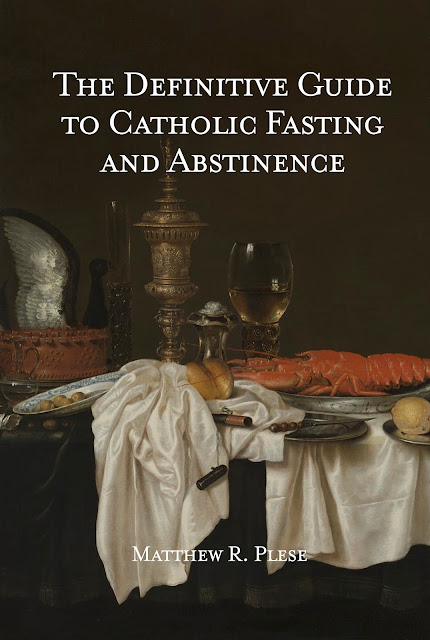
Want to learn more about the history of fasting and abstinence? Check out the Definitive Guide to Catholic Fasting and Abstinence.

Read more >>
Tuesday, October 12, 2021
The 8 BEST Traditional Catholic Podcasts Worth Listening To

As a follow-up to 4 Traditional Catholic Radio Stations, I wanted to assemble a list of 7 Traditional Catholic-themed podcasts. Podcasts have been increasingly popular as a way to consume content. Spotify, one of the largest music platforms, has a significant number of podcast listeners as Statista writes, "At the end of Q1 2021, Spotify had 2.6 million (!) podcasts on its platform as roughly 25 percent of its 356 million monthly active engaged with podcast content."

With the rise of the popularity of podcasts, it is natural that the Faith should be made available through new mediums. All too often, traditionalists have a tendency to shun new technology, with some priests and faithful still scorning the Internet and email despite their ubiquitousness and usefulness in spreading the Faith. Thankfully, there are Traditional Catholics engaging with souls today via podcasts. 

In no particular order, here are 7 Traditional Catholic Podcasts to listen to:

A Catholic Life

Added in March 2023: A Catholic Life seeks the preservation of authentic traditional Catholicism, as practiced before the Second Vatican Council. The focus of this podcast will be directed toward the Traditional Catholic Mass, Traditional Fasting and Abstinence, the Breviary, Prayers and Devotions, and Unwaveringly Traditional Catholic Catechesis. Episodes will typically be released each Sunday and be available on Spotify, Apple Music, and elsewhere.

The Fatima Center Podcast

This regularly updated channel features excellent commentary on the crisis in the Church, the praying of the Rosary, Faith formation talks by priests, and all-around great content.

SSPX Podcast

The SSPX Podcast features interviews, conferences, and sermons delivered by SSPX  priests, and gathered from various English-speaking sources. Many talks center around the crisis in the Church and clarity on the Church's official and timeless teachings.

What Catholics Believe

The long-running YouTube program "What Catholics Believe" is now in podcast format. Listen to the priests of the Society of St. Pius V teach and discuss the disasters of Vatican Council II, the crisis in the modern Church, and the traditional teachings of the Catholic faith.

The Meaning of Catholic

The Meaning of Catholic is a lay apostolate dedicated to uniting Catholics against the enemies of the Holy Catholic Church. The founder is the now current editor of One Peter Five

Dr. Taylor Marshall

A former Episcopalian "priest" turned traditional FSSP-going Catholic who regularly engages in writing and talks to spread and defend the Faith, his clarity and concern for the Faith are palpable. 

St. Gertrude the Great Sermons

Sermons from the independent chapel in West Chester Ohio, whose sermons are profoundly insightful and connected to the traditional liturgical year.

Return to Tradition

Covering the crisis in the Catholic Church and its connection to the ongoing degradation of society, Return to Tradition dives into the news and history of the Church.

There are even more quality traditional Catholic podcasts out there. For more podcasts beyond the 7 already mentioned, please share your recommendations in the comments box below.

Read more >>
Monday, July 26, 2021
Pontifical High Mass by Bishop Vitus Huonder at the SSPX Seminary

Images were recently shared online of Bishop Huounder offering a Pontifical Mass at the SSPX Seminary. The video is available on YouTube.

In 2019, Pope Francis relieved Bishop Vitus Huonder of his duties as Bishop of the Diocese of Chur (Switzerland) for him to live at the house of the Society of St. Pius X. In a joint statement in 2019, Bishop Huounder and the Superior General of the SSPX, Father Pagliarani, stated:

On Monday, May 20, 2019, Pope Francis relieved Bishop Vitus Huonder of his duties as Bishop of the Diocese of Chur (Switzerland), while appointing an administrator with a view to the election of his successor. According to an intention that he stated long ago, Bishop Huonder is retiring to a house of the Society of Saint Pius X. The one sole purpose of this step is to dedicate himself to prayer and silence, to celebrate the traditional Mass exclusively, and to work for Tradition, the only way of renewing the Church. The Society of Saint Pius X appreciates Bishop Huonder’s courageous decision and rejoices to be able to provide him with the spiritual and priestly surroundings that he desires so deeply. May this example be followed by others, so as to “restore everything in Christ”.

May Bishop Huonder help to restore Tradition in his work, and may his presence at the SSPX help quash the slanders against the Society of St. Pius X.

Read more >>
Sunday, October 11, 2020
The 5 Best Daily Meditation Resources for the Traditional Catholic Liturgical Year

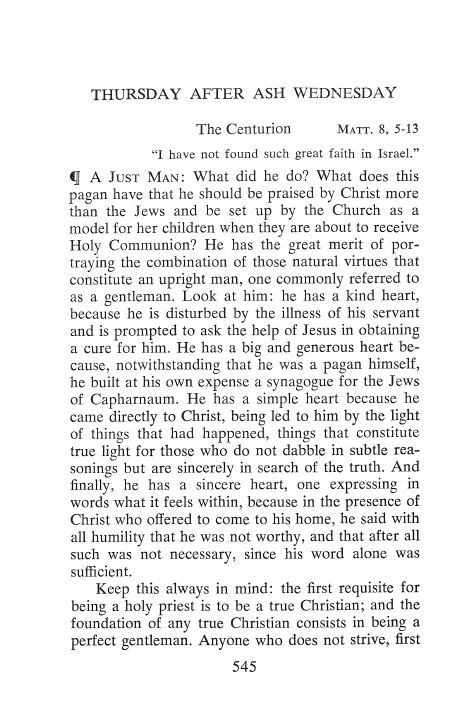
Divine Intimacy by Fr. Gabriel of Saint Mary Magdalen provides deeply enriching spiritual commentary in line with the Carmelite spirituality. It is organized based on the Traditional readings for the Sunday Gospels and around the seasonal themes in the liturgical year. Yet the meditations often are appropriate for any day as they center on true spiritual progress. Divine Intimacy has received great accolades from people who I personally know read from it. The Liturgy Guy provides a very good review of Divine Intimacy where he says in part: "The brilliance of Divine Intimacy comes from Fr. Gabriel’s unique ability to balance spiritual depth with literary brevity: each daily entry typically is no more than three pages long. However, within those few pages, the reader is invited to seek God through the direction of Fr. Gabriel."

 As stated on the product listing at Baronius Press: "This Book of Meditations is a classic and is seeped in Carmelite spirituality. For every day it offers two meditations, in liturgical arrangement, that enable the soul to enter the conscious presence of God and to reflect on the theme of the day. These are followed by a ‘Colloquy’ that helps the person at prayer to start a friendly conversation with God where acts of praise and love, petition, and thanksgiving are made, together with good resolutions for the future. Here we are at the very heart of prayer, which is a heart-to-heart encounter in faith with the living God. Divine Intimacy is the highest state attainable on earth. In this union of love, the soul produces acts of love which have an immense apostolic influence on a multitude of souls. This knowledge of the ways that lead to God, according to the teaching of the renowned Spanish mystics, is distilled into the pages of this book."

Daily Breviary Meditations by Bishop Angrisani are a 4 volume set that follows the Traditional (pre-1955 Catholic liturgical year). These daily meditations tend to follow the cycle of readings in Matins and are heavily geared toward the clergy. However, the meditations here are certainly still worthwhile for even lay Catholics, especially those who pray the Divine Office. 

This reprint from Refuge of Sinners Publishing states: "The extremely important aim of this work, which is the sanctification of the Clergy and laity alike, increases its value and suitableness to the needs of our times. For never before, as in our day, in this period of general disorientation of minds and of most grave threats to the Faith and moral life of the people, has there been felt the necessity of holy priests and laity who for the salvation of Christian civilization must constitute an impenetrable barrier to the onslaughts of impiety and evil customs. This is a rare work that will be a valuable asset to any library." A sample image from a page of the meditations may be viewed here.

The Church's Year by Fr. Leonard Goffine is also worth mentioning. While not a "daily" source of meditations, Fr. Goffine's work includes explanations on the Epistles and Gospel readings for all Sundays and holy days. He includes other explanations of Church doctrine and ecclesiastical customs throughout as well. The meditations can certainly serve worthwhile to be read throughout the year - not just on the particular Sunday he has assigned them. The website for the SSPX Asia has the work available to read freely online.

Dom Gueranger's Liturgical Year is the gold standard when it comes to insights, spiritual enrichment, and historical information on the Traditional Liturgical Year. In fact, his "Liturgical Year" would influence Fr. Pius Parsch who is mentioned further down this list with a work of his own. 

This 15 volume set is described as follows on the product page: "This monumental liturgical work, comprising fifteen volumes, was the life-long labor of Benedictine Abbot Dom Guéranger. Written with the heart of a seraphic contemplative, the holy abbot takes the reader on a daily spiritual pilgrimage through the liturgies of both the East and the West as he immerses the soul into the very life of the ecclesia orans et adorans (the church praying and adoring). The author achieves this by providing daily entries corresponding to the yearly cycle of the Church's worship in both her divine seasonal feasts and those of her saints. Each day begins with a rich and provocative meditation on the mystery of faith to be celebrated together with the ecclesial history of the same; this is followed by excerpts from the Roman Missal's Mass of the day (complete with Propers, i.e., Introits, Collects, Offertory prayers, etc ) as well a host of exquisite hymns from the divine office which are coupled with varied and sundry sequences garnered from other ancient Catholic rites."

The FSSP Apostolate in Atlanta has a free email subscription to Dom Gueranger's liturgical year. Sign up to receive the daily meditation using the pre-1955 calendar that was in place at the time of Dom Gueranger's writing. In fact, his writings precede even the liturgical changes of Pope St. Pius X. While the volume does include the feasts added to the liturgical calendar in the early 1900s, it is still a true gem and one that I read through every morning.

Also worth mentioning are the Sermons on the liturgy for Sundays and feast days by Fr. Pius Parsch. Fr. Parsch was a leading figure in the Liturgical Movement in the early 1900s and his works "The Liturgy of the Mass" (1940) and "The Breviary Explained" (1952) are still read. Fr. Parsch was unfortunately a promoter of the liturgical trend to celebrating Mass on a table while facing the people away from the tabernacle. He died in 1954. 

While these are not "daily meditations" Fr. Parsch provides really insightful and meaningful commentary on the Mass texts. No modernism here in the five Sunday entries I have read thus far. More than merely discussing the Gospel reading, he provides holistic commentary on the Mass texts as a whole, often providing historical context and going much deeper and on different topics than discussed in most other commentaries. I've personally been using it every Sunday and highly recommend it. For a sample, see my Facebook post where I shared pictures of his meditation for the 14th Sunday after Pentecost.

And lastly, I highly recommend the CatechismClass.com course on the Liturgical Year. With various lessons on the feast days and fast days throughout the liturgical year, it is a great resource. The lessons combined Scripture, traditional catechism passages, prayers, devotions, activities, saintly writing, and other sources in a way that other commentaries cannot do. Again, while they do not have lessons for every single day in the year - or all Sundays - they do have a wide range of lessons, covering saints for instance like St. Jeanne Jugan, who are not covered in any other work mentioned on this list.

Read more >>
Sunday, July 26, 2020
Why You Should NOT Attend the Novus Ordo


Sometimes I hear people ask the question of whether they can or should attend the Novus Ordo if the Tridentine Mass is not accessible locally. The closest Mass may be more than an hour's drive away. Or someone may be on vacation and there is no Tridentine Mass in the local area - or even in the country. What should someone do? Should they attend the Novus Ordo instead, even though they often attend the Tridentine Mass? Alternatively, I have heard some people ask whether it would be better to attend Eucharistic Adoration instead of the Novus Ordo Mass during the week.

After having attended the Tridentine Mass exclusively now for 10 years, and after having left the Novus Ordo seminary after two years in it, I do not hesitate to say that no one is bound to attend (or should attend) the Novus Ordo.

Why such a dramatic view that the Novus Ordo should never be attended? The Novus Ordo is unfortunately impregnated with the very spirit of Protestantism. It is harmful to the Faith, even when exterior acts of reverence are inserted into it.

I'd like to briefly outline why I would encourage every Catholic to leave the Novus Ordo behind and cease attending it, promoting it, or donating to it.

1. The Novus Ordo Prayers are Protestant at the Core

Archbishop Marcel Lefebvre famously remarked, "The Novus Ordo Missae, even when said with piety and respect for the liturgical rules, ...is impregnated with the spirit of Protestantism. It bears within it a poison harmful to the faith." Simply put, every Novus Ordo is harmful to one's faith. Even though it is possible for God to work good out of evil and lead to the Truth even those in false religions or heretical denominations, this does not make the Novus Ordo as praiseworthy, as honoring, or as fitting for God. Rather, the defects in the Novus Ordo are not merely external but intrinsic in the very prayers created for the New Rite of Mass.

The Holy Mass is the Sacrifice of Christ on the Cross. The purpose of Mass is to be present at the Sacrifice of Christ that is made present again through the priesthood of Jesus Christ.  We worship God at Mass in the manner which He has established for His worship. We are present at Calvary.  Rather than merely remembering the life and death of Christ, we are present at it and partake of its eternal fruits which flow to us from the altar and during the Canon when the priest stands in the place of Christ and offers the Eternal Victim on the Altar to God.  We can further receive grace by partaking of the Holy Eucharist if we are Catholics in the state of grace. This view of the Mass as a propitiatory Sacrifice has been lost in the Novus Ordo and replaced by notions of community, where the priest is a presider, and many Catholics falsely view receiving Holy Communion as the purpose of going to Mass, rather than being present at the august sacrifice of the Eternal Victim.

As Archbishop Lefebvre noted in Chapter 4 of the Open Letter to Confused Catholics, the changes to the Mass in the offertory, the sermon, the canon, and elsewhere mimic the changes sought by Martin Luther! They are in their very core protestant, especially for instance in the newly created prayers of the Offertory which bear no similarity to the Offertory in the Tridentine Mass.

Of course, while any validly ordained priest may consecrate bread and wine using the words of consecration, even while omitting the rest of the Mass (which is done at times in cases of necessity for instance by priests who are imprisoned and can only smuggle in a small piece of bread and a small amount of wine), this is not the same as promoting and saying protestantized prayers. I do not hold the Novus Ordo lacking merely because it does not have as many beautiful prayers. I hold it as protestantized because the prayers which are a part of it were written with the intention of appealing to protestants.

Jean Guitton, an intimate friend of Paul VI wrote: “The intention of Pope Paul VI with regard to what is commonly called the [New] Mass, was to reform the Catholic liturgy in such a way that it should almost coincide with the Protestant liturgy. There was with Pope Paul VI an ecumenical intention to remove, or, at least to correct, or, at least to relax, what was too Catholic in the traditional sense in the Mass and, I repeat, to get the Catholic Mass closer to the Calvinist Mass.” And we know that the Calvinists - and any protestants for that matter - do not have a valid rite of Mass and do not confect the Holy Eucharist.


2. The Novus Ordo was Formed Under the Error of Archeologism

Those who encourage or at least tolerate the Novus Ordo often do so by saying that Paul VI sought for the Church to merely return to a more ancient manner of saying the Mass. This view is actually the error of Archeologism as Fr. Peter Scott explains:

"Pius XII inveighs against the error of those who would want to use the pretence of antiquity to bring
about changes in the Church’s prayers and ceremonies: “It is neither wise nor laudable to reduce
everything to antiquity by every possible device” (§ 62), for “ancient usage must not be esteemed
more suitable and proper, either in its own right or in its significance for later times and new
situations, on the simple ground that it carries the savor and aroma of antiquity” (§61). This is the
error of Archeologism, namely that because something is older it is necessarily better, and it denies
that the development of liturgical rites over the centuries owes its “inspiration to the Holy Spirit,
Who assists the Church in every age”. (Ib.)

"This error of those who try to justify liturgical revolution by ancient practices is clearly condemned
by the Pope: “The temerity and daring of those who introduce novel liturgical practices, or call for
the revival of obsolete rites out of harmony with prevailing laws and rubrics, deserve severe
reproof” (§ 59). Here are some of the examples of archeologism listed by the Pope:

  • Replacement of Latin by the vernacular in the august Eucharistic Sacrifice
  • Transferral of feast days to Sundays
  • Deletion from the liturgy of some texts of the Old Testament
  • Replacement of the altar by a table – “one would be straying from the straight path were he
  • to wish the altar restored to its primitive table-form” (§ 62)
  • Excluding black as a liturgical color
  • Eliminating the use of sacred statues and images
  • Crucifixes not showing Christ’s suffering (Risen Christ)

"It is interesting to note that twenty years later every single one of these examples of abuses
condemned by Pope Pius XII had been incorporated into the New Mass, always under the pretence
that it is returning to old things. Other examples Pius XII did not mention are the procession for the
presentation of the gifts and the Kiss of peace for the laity, the abolition of the prayers at the foot of
the altar, the elimination of “mystery of faith” from the words of consecration, the elimination of
the Roman Canon (although it is the truly oldest part of the Mass), many feast of saints, the Last
Gospel and the prayers after Mass."

Even if we claim that Paul VI imposed the Novus Ordo under good intentions, they are still nevertheless imbued with archeologism. And this is not just "bad." It is heretical as Fr. Scott further explains:

"Pius XII further explains that this“exaggerated and senseless antiquarianism”(§64) is not new,but derives from the illegal Council of Pistoia, condemned by Pope Pius VI in 1794.  Due protestant influence this false council wanted to promote a return to the simplicity of the earlyChurch, despising later developments. Its principle is found in the first proposition, which Pius VIcondemned as heretical: “In these latter times there has been spread a general obscuring of the more important truths pertaining to religion, which are the basis of faith and of the moral teachings of Jesus Christ”(Db 1501). This is precisely the reasoning of the modernists, when they want to do away with devotions to the Sacred Heart, to the Blessed Virgin, to the Blessed Sacrament, to the saints. Yet it is condemned as heretical."

3. The Novus Ordo's Fruits are Manifestly Rotten

We do know from first-hand experience, the fruits that have followed Vatican II, the New Mass, Communion in the Hand, and the near elimination of fasting and abstinence. Christ, Himself said, "Beware of false prophets, who come to you in the clothing of sheep, but inwardly they are ravening wolves. By their fruits you shall know them" (Matthew 7:15-16). What are these fruits? These are the fruits as shown by the Old Evangelization Website:


The results are grim beyond the statistics shown above. Only 30% of Americans who were raised Catholic are still practicing, and 10% of all adults in America are ex-Catholics.

Turning again to the words of Archbishop Lefebvre, who saw firsthand the effect of the Novus Ordo on the African continent and how it eroded the successful work that Catholic missionaries had done there, he writes:
"Furthermore it can be said without any exaggeration whatsoever, that the majority of Masses celebrated without altar stones, with common vessels, leavened bread, with the introduction of profane words into the very body of the Canon, etc., are sacrilegious, and they prevent faith by diminishing it. The desacralization is such that these Masses can come to lose their supernatural character, “the mystery of faith,” and become no more than acts of natural religion. 
"Your perplexity takes perhaps the following form: may I assist at a sacrilegious Mass which is nevertheless valid, in the absence of any other, in order to satisfy my Sunday obligation? The answer is simple: these Masses cannot be the object of an obligation; we must moreover apply to them the rules of moral theology and canon law as regards the participation or the attendance at an action which endan- gers the faith or may be sacrilegious."
Conclusion

For those who are unable to attend a Tridentine Mass on Sundays and Holy Days, it is better to pray the Rosary, sanctify the day by abstaining from servile works, read the prayers of the Missal, listen to good sermons, perform works of charity, and even to watch a live stream of the Mass.

I do not hold any animosity toward those who do go to the Novus Ordo through mere ignorance. The truth is that the vast majority of Catholics do not know of the Tridentine Mass or at least do not view it as important. They do not see the errors in the New Church and have likely been told to avoid the Latin Mass or at least the SSPX or groups more traditional than them. These people may even view the FSSP for instance as traditional enough and posit them as an ideal, claiming falsely that the SSPX is schismatic (which it is not).


The changes to the Catholic Church in the past fifty years have been disastrous and that is in a significant part due to the imposition of the Novus Ordo. As I mentioned in my article 20 Immediate Actions to End the Protestantization of the Catholic Church, the Restoration of the Traditional Latin Mass - the Mass of All Times - in all Latin Rite parishes and the abolition of the 1969 Rite of Mass known as the Novus Ordo is necessary.

Please join me in praying for the Restoration of the Roman Mass.
Read more >>
Saturday, April 4, 2020
Pre-1955 Holy Week Livestreams

As a follow up to my previous post, Comprehensive List of Live Streaming Traditional Latin Masses, here is a link of some places where you may watch live streams of the pre-1955 Holy Week services. Why is the 1954 Holy Week superior in many respects to the changes in 1955 that became part of the 1962 Missal? That topic is worthy of significant study. I would direct you to the Pre 1955 Holy Week Website or to the series of articles on this topic published by the New Liturgical Movement.

Many chapels and oratories of the FSSP and the ICKSP will be offering the pre-1955 rites. Unfortunately, the SSPX is stuck in a 1962 only mentality so you will notice they are not listed here. Besides the FSSP chapels that are listed here, more can be found on the FSSP website.

St. Mary's Oratory in Wausau, Wisconsin


UPDATED. They will now be live streaming on Youtube through Sensus Fidelium and not through their Facebook Page, as was done for Palm Sunday. All times are in Central Daylight Time (CDT).

Mater Ecclesia in Berlin, New Jersey


The liturgies will be live-streamed on the parish's Facebook. Yet the parish advised, "The ceremonies will be very stark and most basic. This will be the lowest Holy Week we have ever had at Mater, but we will plow ahead in the Spiritus Domini." Times are in Eastern Daylight Time (EDT).

St. Joseph's Shrine in Detroit, Michigan


These are all in Eastern Daylight Time (EDT).

Benedictines of Mary Queen of Apostles in Gower, Missouri


St. Stephen the First Martyr in Sacramento, California


All times in Pacific Daylight Time (PDT):  Palm Sunday 8 a.m.; Holy Thursday 6 p.m.; Good Friday 5 p.m.; Holy Saturday Vigil Mass 4 p.m.; Easter Sunday 8 a.m. Livestreamed on YouTube.

St. Francis de Sales Oratory in St. Louis, MO


All times in Central Daylight Time. The live stream is viewable on YouTube.

THE FOLLOWING LOCATIONS WILL BE OFFERING THE PRE-1955 RITES ALONG WITH THE PRE-1955 PRAYER FOR THE JEWS. THE ABOVE LOCATIONS WILL USE THE MODIFIED PRAYER CREATED BY POPE BENEDICT XVI.

St. Pius V Chapel in Oyster Bay, New York (SSPV)

St. Gertrude the Great in West Chester, Ohio


All liturgies will be live-streamed on their website and available for playback later. All times are in Eastern Standard Time.

Additional locations and times will be listed here as I learn of them.
Read more >>
Monday, March 16, 2020
Comprehensive List of Live Streaming Traditional Latin Masses


Updated 11/23/2020

With the current crisis in regards to the coronavirus, many Dioceses or governments have suspended all Masses and gatherings. This is unprecedented in the Church. As a result, in most places, the faithful have been dispensed from Sunday Mass. Yet, while it is possible to be dispensed from the precept of assisting at Mass, the divine law requires that Sundays are nevertheless honored. We must refrain from servile works on Sundays, pray, worship God as we can, and perform works of mercy, in addition to using the time for rest and leisure with family or friends. See: Top 5 Ways to Sanctify Sunday When Mass is Suspended

In order for the faithful to help sanctify Sunday, many parishes are now live streaming their Masses. In fact, many of the links here offer daily streaming - even the weekday Masses and the devotions.

During this Lent, we especially bear these crosses which the Lord has given us. When Lent started, we never planned to receive this Cross, but like our Lord, we must bear it with patience and resignation.

Some of these live streams are only during this period of crisis. Others are available all year round. If you know of any more, please list them in the comment section below. Some of these and more are listed on LatinMass.live as well.

Priestly Fraternity of St. Peter
Society of St. Pius V
Society of St. Pius X
Institute of Christ the King
Diocesan / Independent / Others in the USA
Churches in England & Wales
Eastern Catholic Rites
Read more >>


Copyright Notice: Unless otherwise stated, all items are copyrighted under a Attribution-NonCommercial-NoDerivatives 4.0 International License. If you quote from this blog, cite a link to the post on this blog in your article.

Disclosure of Material Connection: Some of the links on this blog are “affiliate links.” This means if you click on the link and purchase the item, I will receive an affiliate commission. As an Amazon Associate, for instance, I earn a small commission from qualifying purchases made by those who click on the Amazon affiliate links included on this website. I am disclosing this in accordance with the Federal Trade Commission’s 16 CFR, Part 255: “Guides Concerning the Use of Endorsements and Testimonials in Advertising.”