Showing posts sorted by relevance for query 40 hours fast. Sort by date Show all posts
Sunday, February 19, 2023
The Importance of 40 Hours at the Beginning & End of Lent

 "I have fought a good fight, I have finished my course, I have kept the faith" (2 Timothy 4:7)

As we prepare to enter into the holy season of Lent, we should prepare to observe a strict routine of prayer, fasting, and almsgiving. Below are 13 articles worth reading at this time:

  1. Fasting and Abstinence Rules
  2. History of Lenten Fasting: How to Observe the Traditional Lenten Fast
  3. Why do we fast? St. Thomas Aquinas Explains
  4. Lenten Embertide Fast
  5. How the Traditional Latin Mass Reinforces Lent as a Fast
  6. Stational Churches for Each Day of Lent
  7. What is Ash Wednesday & what are the rules for this day?
  8. Read One Spiritual Book this Lent
  9. Book Recommendations for Lent
  10. 10 Traditional Catholic Charities: Almsgiving During Lent
  11. Each Feria Day in Lent has a Proper Mass
  12. Holy Communion in Lent: The Most Pleasing to God
  13. Printable Lent Preparation Guide

While it is important that we observe prayer, fasting (including abstinence from meat), and almsgiving throughout all of Lent, there should be a particular focus on beginning and ending Lent well. This can take the form of starting and ending with 40 intense hours.

Why 40 Hours?

40 hours is significant because Our Blessed Lord was dead for 40 hours before His Resurrection. 40 is also a number of completion as shown by His 40 day fast in the desert, the Great Flood which lasted 40 days, and the 40 years of wandering in the desert by the Chosen People after their deliverance from Egypt.

40 Hours is also connected with Mardi Gras immediately preceding Lent. As a result of the excesses of Fat Tuesday and the carnival season, the Church instituted the practice of observing the 40 Hours Devotion in front of the Blessed Sacrament. Father Weiser remarks:

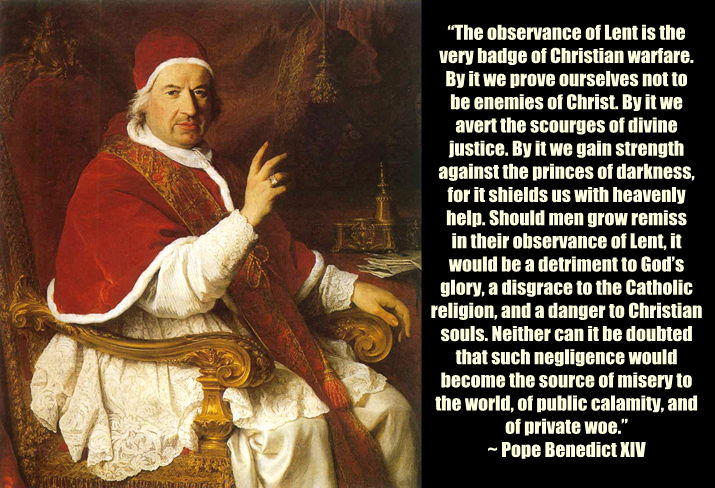
In order to encourage the faithful to atone in prayer and penance for the many excesses and scandals committed at carnival time, Pope Benedict XIV, in 1748, instituted a special devotion for the three days preceding Lent, called ‘Forty Hours of Carnival,’ which is held in many churches of Europe and America, in places where carnival frolics are of general and long-standing tradition. The Blessed Sacrament is exposed all day Monday and Tuesday, and devotions are held in the evening, followed by the Eucharistic benediction.

The Church also instituted the Votive Feast of the Holy Face of Our Lord Jesus Christ Deformed in the Passion for the Tuesday after Quinquagesima (i.e., Fat Tuesday) as a means of making reparation for the sins of Mardi Gras. In fact, our Blessed Lord Himself asked for such reparation to His Holy Face in apparition to Mother Pierina in 1938:

See how I suffer. Nevertheless, I am understood by so few. What gratitude on the part of those who say they love me. I have given My Heart as a sensible object of My great love for man and I give My Face as a sensible object of My Sorrow for the sins of man. I desire that it be honored by a special feast on Tuesday in Quinquagesima (Shrove Tuesday – the Tuesday before Ash Wednesday). The feast will be preceded by novena in which the faithful make reparation with Me uniting themselves with my sorrow.

Start And End Lent Well

Beyond making reparation this Tuesday for the sins of Mardi Gras and the mortal sins of those who will violate the laws of fast and abstinence, we can start Lent well by observing a 40 hour fast. In fact, as St. Thomas Aquinas relates, the Lenten Fast at his time was characterized by no food taken on either Ash Wendesday or Good Friday, if possible. This is a significant sacrifice, far beyond the "one meal and two smaller meals" statement which most Catholics associate with fasting days.

Beyond beginning our Lenten fast with a 40 hour fast from all solid food, which should open our minds to heavenly things and allow us to perform penance, we should conclude Lent with the same vigour. In honor of the 40 hours our Blessed Lord's soul was separated from His Body in death, let us offer an intense beginning and end of Lent this year for the honor of God, as far as our health permits us to do so.

May God grant us the strength to begin and end well so that, like St. Paul, we may say: "I have fought a good fight, I have finished my course, I have kept the faith."

Want to learn more about the history of fasting and abstinence? Check out the Definitive Guide to Catholic Fasting and Abstinence.

Read more >>
Friday, April 18, 2025
The 40 Hour Passion Fast and the Black Fast


The Strictness of Holy Week

The Passion Fast is a term which refers to the fast which began for some as early as sunset on Holy Thursday and as late as 8 AM on Good Friday. No one was allowed to eat any food during that time until sunset on Holy Saturday, which – since most fasted for Communion – extended until the morning on Easter Sunday. It was often called a “40 Hours Fast” and represents the original Lenten fast. For those who were too weak to follow this fast the minimum fast at this time was that of xerophagiae.

Xerophagiae is a diet of simple, dry, uncooked food, such as raw nuts, bread, fruits, and vegetables. Fish and oil are not part of it and neither are flesh nor animal products. It was a precept to fast on these only during Holy Week by custom and/or decree until approximately the time of Pope St. Gregory the Great (reigned 590 – 604 AD), who mentions nothing of it. It may still have been a custom at that time but no mention of it is made in the Decretals of Gregory IX published in 1234.

The Black Fast

A commonly misunderstood aspect of fasting is the “black fast.” Is the Passion Fast a Black Fast? Is it the only Black Fast? What is the true definition of a black fast? And what is it not? The Catholic Encyclopedia from 1907 answers as follows:

This form of fasting, the most rigorous in the history of church legislation, was marked by austerity regarding the quantity and quality of food permitted on fasting days as well as the time wherein such food might be legitimately taken. 

This is based in practice on the fasting done by the Early Church and the Apostles. In practice, there are three criteria that make a fast a “black fast” as the Encyclopedia identifies:

In the first place more than one meal was strictly prohibited. At this meal flesh meat, eggs, butter, cheese, and milk were interdicted (Gregory I, Decretals IV, cap. vi; Trullan Synod, Canon 56). Besides these restrictions, abstinence from wine, especially during Lent, was enjoined (Thomassin, Traité des jeûnes de l'Église, II, vii). Furthermore, during Holy Week the fare consisted of bread, salt, herbs, and water (Laymann, Theologia Moralis, Tr. VIII; De observatione jejuniorum, i). Finally, this meal was not allowed until sunset. St. Ambrose (De Elia et jejunio, sermo vii, in Psalm CXVIII), St. Chrysostom (Homil. iv in Genesim), St. Basil (Oratio i, De jejunio) furnish unequivocal testimony concerning the three characteristics of the black fast. 

Hence a black fast is one that meets these criteria:

1. Only one meal a day

2. Complete abstinence from all meat and animal products

3. The one meal may only be consumed after sunset.

Consequently, it is not a total abstinence from all food and drink whatsoever that makes a fast a “black fast”. And it also does not mean that one eats only bread. Vegetables are certainly allowed at the meal. And the Passion Fast is one such Black Fast

Want to learn more about the history of fasting and abstinence? Check out the Definitive Guide to Catholic Fasting and Abstinence.

Read more >>
Thursday, March 30, 2023
The History of the Holy Saturday Fast

Eugene Burnand. Holy Saturday. 1907-1908. Musee des Beaux Arts, La Chaux de Finds, France.

The observance of Lent stretches back as far as Apostolic times. Lent was for centuries observed as forty days of fasting in the Roman Church with Sundays excluded from fasting but not from abstinence. That is, Ash Wednesday (since its institution) through Holy Saturday were days of fasting. I have separately cataloged the history of Lenten fasting in "History of Lenten Fasting: How to Observe the Traditional Lenten Fast."

The Lenten fast began under the Apostles themselves and was practiced in various forms in the Early Church. As time went on, the fast became uniformly observed under the pain of sin. As with all Lenten practices, changes occurred over time regarding the fast, abstinence, and hearing of Holy Mass on Holy Saturday. 

Holy Saturday Fasting Was Practiced in Apostolic Times

In the Early Church, Holy Saturday was part of the apostolic practice of abstaining from all food completely from Holy Thursday evening (or Good Friday morning) until sunset on Holy Saturday (or later). This was known as the "Passion Fast," and in practice, the aim was to fast 40 hours in honor of the 40 hours our Blessed Lord’s body lay in the tomb. Holy Saturday's fast was also practiced like the rest of Holy Week as xerophagiae: “The strictest Christian fast which is observed chiefly in the Eastern churches during Lent or especially Holy Week and in which only bread, salt, water, and vegetables may be eaten” (Webster’s Dictionary). In practice, bread, herbs, raw nuts, or raw vegetables and fruit without oil or dressing may be consumed for those who seek to keep this strict and who are unable to fast from all food whatsoever for two whole days in a row.

Heortology: A History of the Christian Festivals from their Origin to the Present Day by Dr. K.A. Heinrich Kellner states the following regarding the Lenten fast in the ancient Church:

"Among Catholics also abstinence was pushed to great lengths. The canons of Hippolytus prescribe for Holy Week only bread and salt. The Apostolic Constitutions will only permit bread, vegetables, salt and water, in Lent, flesh and wine being forbidden; and, on the last two days of Holy Week, nothing whatsoever is to be eaten. The ascetics, whose acquaintance the Gallic pilgrim made in Jerusalem, never touched bread in Lent, but lived on flour and water. Only a few could keep so strict a fast, and generally speaking people were satisfied with abstaining from flesh and wine. But this lasted throughout the entire Lent, and Chrysostom tells us that in Antioch no flesh was eaten during the whole of Lent. Abstinence from milk and eggs (the so-called lacticinia) was also the general rule."

Regarding Holy Saturday's fast, in particular, Canon 89 of the Council in Trullo in 692 AD provides an account of the piety and devotion of the faithful of that time: 

“The faithful, spending the days of the Salutatory Passion in fasting, praying and compunction of heart, ought to fast until the midnight of the Great Sabbath: since the divine Evangelists, Matthew and Luke, have shewn us how late at night it was [that the resurrection took place].” 

That tradition of fasting on Holy Saturday until midnight would last for centuries. Dom Gueranger writes in the Liturgical Year:

Such, we repeat, was the discipline of the Latin Church for nearly a thousand years: but about the 11th century, an important change began to be introduced with regard to the celebration of Mass on Holy Saturday. The Mass which, hitherto, had been celebrated during the Night preceding Easter Sunday, then began to be anticipated on the Saturday; but it was always considered as the Mass of the hour of our Lord’s Resurrection, and not as the Mass of Holy Saturday. The relaxations that had been introduced with regard to Fasting were the occasion of this change in the Liturgy.

Holy Saturday Was A Holy Day of Obligation in the Middle Ages

Holy Saturday also used to be a Holy Day of Obligation. The first catalog of Holy Days comes from the Decretals of Gregory IX in 1234, which listed 45 Holy Days. In 1642, His Holiness Pope Urban VIII issued the papal bull "Universa Per Orbem" which altered the required Holy Days of Obligation for the Universal Church to consist of 35 such days as well as the principal patrons of one's locality. 

Some of the Holy Days of Obligation removed between 1234 and 1642 included Holy Monday through Holy Saturday in addition to Easter Wednesday through Easter Saturday. Hence by 1642, Holy Saturday was no longer a Holy Day of Obligation.

Holy Saturday Fasting Remained Practiced for Centuries

In my series outlining the changes to fasting and abstinence in the colonies—and through the modern-day United States—I pointed out that Holy Saturday often remained a day of obligatory fasting even when mitigations were issued due to the change in the time of the Vigil that happened back in the 11th century.

For instance, the papal bull "Altitudo Divini Concilii" of Pope Paul III in 1537 reduced the days of penance and those of hearing Mass for the Indians out of pastoral concern due to the physically demanding lifestyle that they lived and also largely due to the fact that they fasted so much already. As a result, the natives were required to only hear Mass on a much smaller number of days: Sundays, Christmas, Circumcision, Epiphany, Candlemas, Annunciation, Sts Peter and Paul, Ascension, Corpus Christi, the Assumption, and the Nativity of the Blessed Virgin. And the only fasting days were the Fridays in Lent, Holy Saturday, and Christmas Eve. Holy Saturday remained.

Centuries later, when Pope Leo XIII issued further changes allowing animal products throughout Lent, he explicitly excluded Holy Saturday from those mitigations:

“In 1886 Leo XIII allowed meat, eggs, and milk products on Sundays of Lent and at the main meal on every weekday [of Lent] except Wednesday and Friday in the [United States]. Holy Saturday was not included in the dispensation. A small piece of bread was permitted in the morning with coffee, tea, chocolate, or a similar beverage.”

By the time of the 1917 Code of Canon Law, the days of obligatory fasting as listed in the 1917 Code of Canon Law were the forty days of Lent, including Ash Wednesday, Good Friday, and Holy Saturday until noon. The Deharbe Catechism in the 1800s refers to the fast ending at Noon, so it does predate the 1917 Code. Why did Holy Saturday fasting only last until noon? It likely dates to when the Vigil Mass for Easter was moved from the night of Holy Saturday into Easter Sunday back to the morning of Holy Saturday. By the High medieval period, the celebration in the morning of the Easter Vigil (and other Triduum services) was almost the universal custom, in large part due to the fasting regulations requiring the fast to last until after Vespers. As a result, sometime after 692 AD, the fast on Holy Saturday was modified to end at noon.

Holy Saturday Fasting Wanes Along With All Other Fasting in the 1900s

Before 1951, Bishops were able to dispense laborers and their family members from the laws of abstinence, if necessary, under the workingmen's privilege that was introduced in 1895. This privilege of eating meat, though, excluded Fridays, Ash Wednesday, Holy Week, and the Vigil of Christmas. In 1951, the abstinence laws in America were again revised as Father Ruff summarizes:

"In 1951 the U.S. bishops standardized regulations calling for complete abstinence from meat on Fridays, Ash Wednesday, the vigils of Assumption and Christmas, and Holy Saturday morning for everyone over age seven. On the vigils of Pentecost and All Saints, meat could be taken at just one meal. Fast days, applying to everyone between 21 and 59, were the weekdays of Lent, Ember days, and the vigils of Pentecost, Assumption, All Saints, and Christmas. On these fast days only one full meal was allowed, with two other meatless meals permitted which together did not make up one full meal. Eating between meals was not permitted, with milk and fruit juice permitted. Health or ability to work exempted one." 

In 1956 under Pope Pius XII, the fast, which previously ended at noon, was extended to the midnight between Holy Saturday and Easter Sunday, on account of the Holy Week changes enacted which made the Vigil Mass obligatory in the evening of Holy Saturday:

"The abstinence and fast prescribed for Lent, which hitherto has ceased on Holy Saturday after noon, according to canon 1252, §4 [1917 Code], will cease in the future at midnight of the same Holy Saturday."

Maxima Redemptionis Nostrae Mysteria (Nov. 16, 1955) AAS 47 (1955)

Fr. Frederick McManus, an American Canon Lawyer, commented on this change:

The Decree on the revised Holy Week changes the law of canon 1252, §4, concerning fast and abstinence on Holy Saturday. According to the canon, the Lenten fast ended after noon on Holy Saturday. This is now abrogated, the obligation is extended until midnight of Holy Saturday, and the entire day becomes one of abstinence and fast. Local Ordinaries at present possess the faculty to dispense all their subjects, including religious (even exempt), from the law of fast and abstinence on Holy Saturday.Thus they may dispense from fast or from abstinence or from both fast and abstinence on this day. 

The Rites of Holy Week (Bruce 1956), pgs 22 and 23.

In 1966, Paul VI's Paenitemini eliminated Holy Saturday and all other days of fasting except for Good Friday and Ash Wednesday in a radical departure from the past. Sadly, those changes were incorporated in the 1983 Code of Canon Law, which largely took Paenitemini while modifying the age of fasting.

A Traditional Holy Saturday Fast (Summary and Application)

  • Early Church: All of Holy Saturday was a strict fast with abstinence
  • 11th Century: The Vigil, which had taken place at night between Holy Saturday and Easter Sunday, is moved to the daytime of Holy Saturday. This change would cause mitigations with the strict fast that had previously always been obligatory on Holy Saturday.
  • 1917 Code: For at least 100+ years before the 1917 Code, the fast, which previously ended at midnight into Sunday, ended at Noon on Holy Saturday. This is largely due to the Vigil Mass taking place in the morning of Holy Saturday.
  • 1956: Pope Pius XII, in changing the Vigil Mass to start only after sunset on Holy Saturday, extends the fast to midnight.

For those seeking more traditional fasting for the final days of Lent - and in preparation for the Lord's Resurrection - a return not to the 1950s or 1917 is in order. Rather, a return to treating all of Holy Saturday as a day of fasting and abstinence in the form of the Passion Fast practiced with the principles of Xerophagiae is the ideal. If we do attend a pre-1955 Easter Vigil Mass in the morning or daytime of Holy Saturday, we can eat after that Mass but I would encourage souls to keep abstinence until after attending Easter Sunday Mass.

While this is not obligatory under penalty of sin, it is a worthwhile end to our fasting as we present to Almighty God the final day of Lenten fasting for His honor and glory and in reparation for our sins. Let us all seek greater perfection and never the minimum of the law.

Want to learn more about the history of fasting and abstinence? Check out the Definitive Guide to Catholic Fasting and Abstinence.

Read more >>
Sunday, February 13, 2022
History of Lenten Fasting: How to Observe the Traditional Lenten Fast

The Purpose of Fasting

In principio, in the beginning, the very first Commandment of God  to Adam and Eve was one of fasting from the fruit of the tree of the knowledge of good and evil (cf. Genesis 2:16-17), and their failure to fast brought sin and disorder to all of creation. The second sin of mankind was gluttony. Both are intricately tied to fasting.

Both Elijah and Moses fasted for forty days in the Old Testament before seeing God. Until the Great Flood, man abstained entirely from the flesh meat of animals (cf. Genesis 9:2-3). Likewise, in the New Testament, St. John the Baptist, the greatest prophet (cf. Luke 7:28) fasted and his followers were characterized by their fasting. And our Blessed Lord also fasted for forty days (cf. Matthew 4:1-11) not for His own needs but to serve as an example for us. Our Redeemer said, “Unless you shall do penance, you shall all likewise perish” (Luke 13:3). Fasting and abstinence from certain foods characterized the lives of man since the foundation of the world.

The Church has hallowed the practice of fasting, encourages it, and mandates it at certain times. Why? The Angelic Doctor writes that fasting is practiced for a threefold purpose: 

“First, in order to bridle the lusts of the flesh…Secondly, we have recourse to fasting in order that the mind may arise more freely to the contemplation of heavenly things: hence it is related of Daniel that he received a revelation from God after fasting for three weeks. Thirdly, in order to satisfy for sins: wherefore it is written: ‘Be converted to Me with all your heart, in fasting and in weeping and in mourning.’ The same is declared by Augustine in a sermon: ‘Fasting cleanses the soul, raises the mind, subjects one's flesh to the spirit, renders the heart contrite and humble, scatters the clouds of concupiscence, quenches the fire of lust, kindles the true light of chastity.’”  

St. Basil the Great also affirmed the importance of fasting for protection against demonic forces: “The fast is the weapon of protection against demons. Our Guardian Angels more really stay with those who have cleansed our souls through fasting.”

The Baltimore Catechism echoes these sentiments: “The Church commands us to fast and abstain, in order that we may mortify our passions and satisfy for our sins” (Baltimore Catechism #2 Q. 395). Concerning this rationale, Fr. Thomas Kinkead in “An Explanation Of The Baltimore Catechism of Christian Doctrine” published in 1891 writes, “Remember it is our bodies that generally lead us into sin; if therefore we punish the body by fasting and mortification, we atone for the sin, and thus God wipes out a part of the temporal punishment due to it.” 

Pope St. Leo the Great in 461 wisely counseled that fasting is a means and not an end in itself. For those who could not observe the strictness of fasting, he sensibly said, "What we forego by fasting is to be given as alms to the poor.”  To simply forgo fasting completely, even when for legitimate health reasons, does not excuse a person from the universal command to do penance (cf. Luke 13:3).

The Lenten Fast in the Early Church

The great liturgical Dom Gueranger writes that the fast which precedes Easter originated with the Apostles themselves:

“The forty days' fast, which we call Lent, is the Church's preparation for Easter, and was instituted at the very commencement of Christianity. Our blessed Lord Himself sanctioned it by fasting forty days and forty nights in the desert; and though He would not impose it on the world by an express commandment (which, in that case, could not have been open to the power of dispensation), yet He showed plainly enough, by His own example, that fasting, which God had so frequently ordered in the old Law, was to be also practiced by the children of the new…The apostles, therefore, legislated for our weakness, by instituting, at the very commencement of the Christian Church, that the solemnity of Easter should be preceded by a universal fast...”

The Catechism of the Liturgy by a Religious of the Sacred Heart published by The Paulist Press, New York, 1919 affirms the apostolic origin of the Lenten fast: “The Lenten fast dates back to Apostolic times as is attested by Saint Jerome, Saint Leo the Great, Saint Cyril of Alexandria and others.” In the 2nd century, St. Irenaeus wrote to Pope St. Victor I inquiring on how Easter should be celebrated, while mentioning the practice of fasting leading up to Easter.

Initially, the Lenten fast was practiced by catechumens preparing for their Baptism with a universal fast for all the faithful observed only during Holy Week, in addition to the weekly fasts that were devotionally practiced. But early on, the baptized Christians began to join the catechumens in fasting on the days immediately preceding Easter.  The duration of the fast varied with some churches observing one day, others several days, and yet others observing intensive 40-hour fasting, in honor of the forty hours that the Lord spent in the sepulcher. By the third and fourth centuries, the fast became forty days in most places. St. Athanasius, in 339 AD, referred to the Lenten fast as a forty-day fast that “the whole world” observed. 

Heortology: A History of the Christian Festivals from their Origin to the Present Day by Dr. K.A. Heinrich Kellner states the following regarding the Lenten fast in the ancient Church, noting the strictness that intensified in Holy Week and even more so on Good Friday and Holy Saturday:

"Among Catholics also abstinence was pushed to great lengths. The canons of Hippolytus prescribe for Holy Week only bread and salt. The Apostolic Constitutions will only permit bread, vegetables, salt and water, in Lent, flesh and wine being forbidden; and, on the last two days of Holy Week, nothing whatsoever is to be eaten. The ascetics, whose acquaintance the Gallic pilgrim made in Jerusalem, never touched bread in Lent, but lived on flour and water. Only a few could keep so strict a fast, and generally speaking people were satisfied with abstaining from flesh and wine. But this lasted throughout the entire Lent, and Chrysostom tells us that in Antioch no flesh was eaten during the whole of Lent. Abstinence from milk and eggs (the so-called lacticinia) was also the general rule."

Shortly after the legislation of Christianity in the Roman Empire, the bishops at the Council of Nicea in 325 AD fixed the date of Easter as the first Sunday after the first full moon after the vernal equinox. The canons emerging from that council also referenced a 40-day Lenten season of fasting.

To the Early Christians, fasting was performed until sundown, in imitation of the previous Jewish tradition. Dom Gueranger’s writings affirm, “It was the custom with the Jews, in the Old Law, not to take the one meal, allowed on fasting days, till sun-set. The Christian Church adopted the same custom. It was scrupulously practiced, for many centuries, even in our Western countries. But, about the 9th century, some relaxation began to be introduced in the Latin Church.”

And notably in the early Church, fasting also included abstinence from wine, taking man back to the same diet that mankind practiced before God permitted Noah to eat meat and drink wine. As such, in apostolic times, the main meal was a small one, mainly of bread and vegetables. Fish, but not shellfish, became permitted on days of abstinence around the 6th century. Hence, some Eastern Rite Catholics will abstain from meat, animal products, wine, oil, and fish on fasting days which harkens back to these ancient times.

Remarkably, even water was forbidden during fasting times in the very ancient church. Fr. Alban Butler, in Moveable Feasts and Fasts, provides testimony of this when he writes: "St. Fructuosus, the holy bishop of Tarragon in Spain, in the persecution of Valerian in 259, being led to martyrdom on a Friday at ten o'clock in the morning, refused to drink, because it was not the hour to break the fast of the day, though fatigued with imprisonment, and standing in need of strength to sustain the conflict of his last agony. 'It is a fast,' said he: 'I refuse to drink; it is not yet the ninth hour; death itself shall not oblige me to abridge my fast.'"

The Lenten Fast in the Early Middle Ages

The Lenten fast began under the Apostles themselves and was practiced in various forms in the Early Church. As time went on, the fast became uniformly observed under pain of sin. 

St. Augustine in the fourth century remarked, “Our fast at any other time is voluntary; but during Lent, we sin if we do not fast.” At the time of St. Gregory the Great at the beginning of the 7th century, the fast was universally established to begin on what we know as Ash Wednesday. While the name "Ash Wednesday" was not given to the day until Pope Urban II in 1099, the day was known as the “Beginning of the Fast.” 

In 604, in a letter to St. Augustine of Canterbury, Pope St. Gregory the Great announced the form that abstinence would take on fast days. This form would last for almost a thousand years: "We abstain from flesh meat and from all things that come from flesh, as milk, cheese, and eggs."  When fasting was observed, abstinence was likewise always observed.

Regarding Holy Saturday's fast in particular, Canon 89 of the Council in Trullo in 692 AD provides an account of the piety and devotion of the faithful of that time: “The faithful, spending the days of the Salutatory Passion in fasting, praying and compunction of heart, ought to fast until the midnight of the Great Sabbath: since the divine Evangelists, Matthew and Luke, have shewn us how late at night it was [that the resurrection took place].” That tradition of fasting on Holy Saturday until midnight would last for centuries.

Historical records further indicate that Lent was not a merely regional practice observed only in Rome. It was part of the universality of the Church. Lenten fasting began in England, for instance, sometime during the reign of Earconberht, the king of Kent, who was converted by the missionary work of St. Augustine of Canterbury in England. During the Middle Ages, fasting in England, and many other then-Catholic nations, was required both by Church law and the civil law. Catholic missionaries brought fasting, which is an integral part of the Faith, to every land they visited.

The Lenten fast included fasting from all lacticinia (Latin for milk products) which included butter, cheese, eggs, and animal products. And this abstinence was practiced even on the Sundays of Lent. From this tradition, Easter Eggs were introduced, and therefore the Tuesday before Ash Wednesday is when pancakes are traditionally eaten to use leftover lacticinia. And similarly, Fat Tuesday is known as Carnival, coming from the Latin words carne levare – literally the farewell to meat.


Collations Are Introduced on Fasting Days in the 8th Century

The rules on fasting remained largely the same for hundreds of years. Food was to be taken once a day after sunset. After the meal, the fast resumed and was terminated only after the sun had once again set on the horizon. But relaxations were to soon begin. 

By the eighth century, the time for the daily meal was moved to the time that the monks would pray the Office of None in the Divine Office. This office takes place around 3 o'clock in the afternoon. As a consequence of moving the meal up in the day, the practice of a collation was introduced. The well-researched Father Francis Xavier Weiser summarizes this major change with fasting:

"It was not until the ninth century, however, that less rigid laws of fasting were introduced. It came about in 817 when the monks of the Benedictine order, who did much labor in the fields and on the farms, were allowed to take a little drink with a morsel of bread in the evening...Eventually the Church extended the new laws to the laity as well, and by the end of the medieval times they had become universal practice; everybody ate a little evening meal in addition to the main meal at noon." 

The Lenten Fast in the High Middle Ages

Through the writings of St. Thomas Aquinas, we can learn how Lent was practiced in his own time and attempt to willingly observe such practices in our own lives. The Lenten fast as mentioned by St. Thomas Aquinas constituted of the following: 
  • Monday through Saturday were days of fasting. The meal was taken at 3 PM and a collation was allowed at night.
  • All meat or animal products were prohibited throughout Lent.
  • Abstinence from these foods remained even on Sundays of Lent, though fasting was not practiced on Sundays. 
  • No food was to be eaten at all on either Ash Wednesday or Good Friday, if possible.
  • Holy Week was a more intense fast that consisted only of bread, salt, water, and herbs. 
The Lenten Fast in the Renissance

By the fourteenth century, the meal had begun to move up steadily until it began to take place even at 12 o’clock. The change became so common it became part of the Church’s discipline. In one interesting but often unknown fact, because the monks would pray the liturgical hour of None before they would eat their meal, the custom of called midday by the name “noon” entered into our vocabulary as a result of the fast. With the meal moved up, the evening collation remained.

In the Middle Ages, abstinence from meat on Fridays and during Lent was not only Church law – it was civil law as well. And people gladly obeyed these laws out of respect for the teaching authority of the Church. Yet after the Protestant revolt which began in 1517 and continued through the middle of the 1600s, this was to change.

English Royalty proclamations, even after Henry VIII's illegal separation from the Church, supporting abstinence of meat continued to occur in England in 1563, 1619, 1625, 1627, and 1631. The same likewise occurred in 1687 under King James II. After the Revolution in 1688 and the overthrow of Catholicism by William III and Mary II, the laws were no longer enforced and officially removed from the law books by the Statue Law Revision Act in 1863. Similar changes occurred throughout Europe as Protestants reviled the fast. 

But changes continued even in Catholic nations. St. Epiphanius (367 - 403 AD), the bishop of Salamis at the end of the 4th century, wrote that "Wednesday and Friday are days of fasting up to the ninth hour because, as Wednesday began the Lord was arrested and on Friday he was crucified." Wednesday abstinence persisted for centuries. In Ireland for instance the use of meat on all Wednesdays of the year was prohibited until around the middle of the 17th century. This harkened back to the vestige of those earlier times when Wednesdays were days of weekly fasting as Father Slater notes in “A Short History of Moral Theology” published in 1909:

"The obligation of fasting on all Wednesdays and Fridays ceased almost entirely about the tenth century, but the fixing of those days by ecclesiastical authority for fasting, and the desire to substitute a Christian observance at Rome for certain pagan rites celebrated in connection with the seasons of the year, seem to have given rise to our Ember Days…About the tenth century the obligation of the Friday fast was reduced to one of abstinence from flesh meat, and the Wednesday fast after being similarly mitigated gradually disappeared altogether."

The Lenten Fast Begins Deteriorating in the 1700s

Some of the most significant changes to fasting would occur under the reign of Pope Benedict XIV who reigned from 1740 – 1758. 

On May 31, 1741, Pope Benedict XIV issued Non Ambiginius which granted permission to eat meat on fasting days while explicitly forbidding the consumption of both fish and flesh meat at the same meal on all fasting days during the year in addition to the Sundays during Lent. Beforehand, the forty days of Lent were held as days of complete abstinence from meat. The concept of partial abstinence was born even though the term would not appear until the 1917 Code of Canon Law. Yet even with these changes, Pope Benedict XIV implored the faithful to return to the devotion of earlier eras:

"The observance of Lent is the very badge of the Christian warfare. By it we prove ourselves not to be enemies of the cross of Christ. By it we avert the scourges of divine justice. By it we gain strength against the princes of darkness, for it shields us with heavenly help. Should mankind grow remiss in their observance of Lent, it would be a detriment to God's glory, a disgrace to the Catholic religion, and a danger to Christian souls. Neither can it be doubted that such negligence would become the source of misery to the world, of public calamity, and of private woe." 

Yet changes continued during the 18th and 19th centuries as Antoine Villien's "History of the Commandments" from 1915 documents:

The use of meat on Sundays [of Lent] was at first tolerated, then expressly permitted, for the greater part of Lent. Old people still remember the time when its use was completely forbidden in France from the Friday of Passion week to Easter. Later, new dispensations allowed the gradual extension of the Sunday privilege to Tuesday and Thursday of each week, up to Thursday before Palm Sunday. About the beginning of the pontification of Pius IX [c. 1846], Monday was added to the days on which abstinence need not be observed; a few years later the use of meat on those four days began to be permitted up to Wednesday of Holy Week. Lastly the Saturdays, expect Ember Saturday and Holy Saturday, were included in the dispensations."

Mitigations to fasting also began to accelerate for other periods in the 18th and 19th centuries and this is seen strikingly in the series of changes to occur to fasting in the American Colonies which can be read in detail in the two-part series: A History of Holy Days of Obligation & Fasting for American Catholics.

Father Anthony Ruff relates in his article "Fasting and Abstinence: The Story" the changes made by Pope Leo XIII in the document entitled Indultum quadragesimale:

"In 1886 Leo XIII allowed meat, eggs, and milk products on Sundays of Lent and at the main meal on every weekday [of Lent] except Wednesday and Friday in the [United States]. Holy Saturday was not included in the dispensation. A small piece of bread was permitted in the morning with coffee, tea, chocolate, or a similar beverage."

While the evening collation had been widespread since the 14th century, the practice of an additional morning snack (i.e. a frustulum) was introduced only around the 18th century as part of the gradual relaxation of discipline. Volume 12 of The Jurist, published by the Catholic University of America in 1952, writes, "It is stated that the two-ounce breakfast arose at the time of St. Alphonsus, since which time the usage of the popular two and eight-ounce standards for the breakfast and the collation, respectively, has been extant." 

Mara Morrow in Sin in the Sixties elaborates on the concessions given by Pope Leo XIII which in the late 19th century expanded the practice of the frustulum and further reduced strict abstinence:

"It also allowed for the use of eggs and milk products at the evening collation daily during Lent and at the principal meal when meat was not allowed. [It] further allowed a small piece of bread in the morning with a beverage, the possibility of taking the principal meal at noon or in the evening, and the use of lard and meat drippings in the preparation of foods. Those exempt from the law of fasting were permitted to eat meat, eggs, and milk more than once a day." 

Consequently, the Baltimore Manual published by the Third Plenary Council of Baltimore in 1884 states: "Only one full meal is allowed, to be taken about noon or later. Besides this full meal, a collation of eight ounces is allowed. If the full meal is taken about the middle of the day, the collation will naturally be taken in the evening; if the full meal is taken late in the day, the collation may be taken at noon. Besides the full meal and collation, the general custom has made it lawful to take up to two ounces of bread (without butter) and a cup of some warm liquid - as coffee or tea - in the morning. This is important to observe, for by means of this many persons are enabled - and therefore obliged - the keep the fast who could not otherwise do so."

The Catechism of Father Patrick Powers published in Ireland in 1905 mentions that abstinence includes flesh meat and "anything produced from animals, as milk, butter, cheese, eggs." However, Father Patrick notes, "In some countries, however, milk is allowed at collation." The United States was one of those nations whereas Ireland and others were not granted such dispensations. The use of eggs and milk during Lent was to drastically change in a few years with the 1917 Code of Canon Law.

In 1895, the workingmen's privilege gave bishops in the United States the ability to permit meat in some circumstances. Mara Morrow summarizes that these circumstances occurred when there was "difficulty in observing the common law of abstinence, excluding Fridays, Ash Wednesday, Holy Week, and the Vigil of Christmas. This workingmen's privilege (or indult) allowed only for meat once a day during Lent, taken at the principal meal, and never taken in conjunction with fish. This particular indult was extended not only to the laborer but to his family, as well. The motivation of such an indult was no doubt to allow for enough sustenance such that the many Catholic immigrants to the United States who worked as manual laborers could perform their difficult, energy-demanding physical work without danger to their health" (Sin in the Sixties).


The Remnant of the Lenten Fast Left by the 20th Century

The Catholic Encyclopedia from 1909 in describing that fast immediately before the changes to occur under St. Pius X enumerates them as follows: "In the United States of America all the days of Lent; the Fridays of Advent (generally); the Ember Days; the vigils of Christmas and Pentecost, as well as those (14 Aug.) of the Assumption; (31 Oct.) of All Saints, are now fasting days. In Great Britain, Ireland, Australia, and Canada, the days just indicated, together with the Wednesdays of Advent and (28 June) the vigil of Saints Peter and Paul, are fasting days." 

The days of obligatory fasting as listed in the 1917 Code of Canon Law were the forty days of Lent (including Ash Wednesday, Good Friday, and Holy Saturday until noon); the Ember Days; and the Vigils of Pentecost, the Assumption of the Blessed Virgin Mary, All Saints, and Christmas. Partial abstinence, the eating of meat only at the principal meal, was obligatory on all weeks of Lent (Monday through Thursday). And of course, complete abstinence was required on all Fridays, including Fridays of Lent, except when a holy day of obligation fell on a Friday outside of Lent. Saturdays in Lent were likewise days of complete abstinence. Fasting and abstinence were not observed should a vigil fall on a Sunday as stated in the code: "If a vigil that is a fast day falls on a Sunday the fast is not to be anticipated on Saturday, but is dropped altogether that year." Eggs and milk (i.e. lacticinia) became universally permitted.

But additional changes quickly ensued. Mara Morrow, writing on the fasting days around this time, states, "In 1917 Pope Benedict XV granted the faithful of countries in World War I the privilege of transferring Saturday Lenten abstinence to any other day of the week, excepting Friday and Ash Wednesday. In 1919 Cardinal Gibbons was granted his request of transferring Saturday Lenten abstinence to Wednesday for all bishops’ dioceses in the U.S. This permission, as well as the workingmen’s privilege, were frequently renewed, but, after 1931, this permission was only on the basis of personal requests from individual bishops."

Pope Pius XII accelerated the changes to fasting and abstinence as Father Ruff relates: "In 1941 Pope Pius XII allowed bishops worldwide to dispense entirely from fast and abstinence except on Ash Wednesday and Good Friday, provided that there was abstinence from meat every Friday, and fast and abstinence on these two days and the vigil of the Assumption and Christmas. Eggs and milk products were permitted at breakfast and in the evening." And effective in 1956 per the decree in Maxima Redemptionis Nostrae Mysteria, Holy Saturday's fast and abstinence were extended from noon to midnight.

By 1962, the laws of fasting and abstinence were as follows as described in "Moral Theology" by Rev. Heribert Jone and adapted by Rev. Urban Adelman for the "laws and customs of the United States of America" copyright 1961: 

"Complete abstinence is to be observed on all Fridays of the year, Ash Wednesday, the Vigils of Immaculate Conception and Christmas. Partial abstinence is to be observed on Ember Wednesdays and Saturdays and on the Vigil of Pentecost. Days of fast are all the weekdays of Lent, Ember Days, and the Vigil of Pentecost." If a vigil falls on a Sunday, the law of abstinence and fasting is dispensed that year and is not transferred to the preceding day. 

Thus, even before the Second Vatican Council opened, the fasting customs were drastically reduced within only a few hundred years. 


The Lenten Fast Virtually Eliminated Post Vatican II

Shortly after the close of the Second Vatican Council, Paul VI an apostolic constitution on fasting and abstaining on February 17, 1966, called Paenitemini, whose principles were later incorporated into the 1983 Code of Canon Law. Paenitemini allowed the commutation of the Friday abstinence to an act of penance at the discretion of the local ordinaries and gave authority to the episcopal conferences on how the universal rules would be applied in their region. Abstinence which previously began at age 7 was modified to begin at age 14. Additionally, the obligation of fasting on the Ember Days and on the remaining Vigils was abolished. Paenitemini maintained the traditional practice that "abstinence is to be observed on every Friday which does not fall on a day of obligation."

The NCCB issued a statement on November 18, 1966. Abstinence was made obligatory on all Fridays of Lent, except Solemnities (i.e. First Class Feasts), on Ash Wednesday, and on Good Friday. Abstinence on all Fridays throughout the year was "especially recommended," and the faithful who did choose to eat meat were directed to perform an alternative penance on those Fridays outside of Lent, even though the US Bishops removed the long-establish precept of requiring Friday penance. The document stated in part: "Even though we hereby terminate the traditional law of abstinence binding under pain of sin, as the sole prescribed means of observing Friday, we ... hope that the Catholic community will ordinarily continue to abstain from meat by free choice as formerly we did in obedience to church law." And finally, fasting on all weekdays of Lent was "strongly recommended" but not made obligatory under penalty of sin.

The 1983 Code of Canon Law largely took Paul VI's apostolic constitution aside from the modification of the age at which fasting binds. Per the 1983 Code of Canon Law, the age of fast was changed to begin at 18 - previously it was 21 - and to still conclude at midnight when an individual completes his 59th birthday. Friday penance is required per these laws on all Fridays of the year except on Solemnities, a dramatic change from the previous exception being only on Holy Days of Obligation.

Per the 1983 Code of Canon Law, fasting and complete abstinence per these rules are required only on Ash Wednesday and Good Friday. The notion of "partial abstinence," introduced under Pope Benedict XIV in 1741, was also removed along with nearly all fast days. 

So What Should Traditional Catholics Do To Restore the Lenten Fast?

While no authority in the Church may change or alter any established dogmas of the Faith, the discipline of both Holy Days of Obligation and fast days may change. The days of obligation and the days of penance are matters of discipline, not matters of dogma. Lawful authorities in the Church do have the power to change these practices.

In the observance of the two precepts, namely attending Holy Mass on prescribed days and fasting and abstaining on commanded days, we obey them because the Church has the power by Christ to command such things. We do not abstain from meat on Fridays for instance because the meat is unclean or evil. It is the act of disobedience that is evil. As Fr. Michael Müller remarks in his Familiar Explanation of Christian Doctrine from 1874: "It is not the food, but the disobedience that defiles a man." To eat meat on a forbidden day unintentionally, for instance, is no sin. As the Scriptures affirm it is not what goes into one's mouth that defiles a man but that disobedience which comes from the soul (cf. Matthew 15:11).

Yet, even with such a distinction, the Church has historically been wise to change disciplines only very slowly and carefully. As Archbishop Fulton J. Sheen once remarked, "It is a long-established principle of the Church never to completely drop from her public worship any ceremony, object or prayer which once occupied a place in that worship." The same may be said for matters concerning either Holy Days of Obligation or fast days. What our forefathers held sacred should remain sacred to us in an effort to preserve our catholicity not only with ourselves but with our ancestors who see God now in Heaven.

St. Francis de Sales remarked in the 16th / early 17th century, “If you’re able to fast, you will do well to observe some days beyond what are ordered by the Church.” 

This Lent, I propose for Traditional Catholics the following Lenten fasting plan:
  • Fasting applies for those age 18 or older (but not obligatory for those 60 years of age or older)
  • Ash Wednesday and Good Friday: No solid food. Only black coffee, tea, or water.
  • Mondays through Saturdays: Only one meal preferably after sunset. A morning frustulum and evening collation are permitted but not required. No meat or animal products are allowed for anyone, regardless of age - that includes fish. No olive oil.
  • Sundays: No meat or animal products allowed except on Laetare Sunday. Exceptions for Palm Sunday are mentioned below.
  • Annunciation Day (March 25) and Palm Sunday: Fish and olive oil permitted.
  • Holy Week (except Good Friday): Only Bread, Salt, and Herbs are permitted for the main meal. Frustulum and collation permitted (of bread, herbs, and salt) but omitted if possible
  • Holy Saturday: No food until Noon. Abstinence including from all animal products continues until Easter begins.
And for those looking for ideas on what to make to eat on fasting days, the Lenten Cookbook produced by Sophia Institute Press has a section on vegan recipes that is worth checking out.

Want to learn more about the history of fasting and abstinence? Check out the Definitive Guide to Catholic Fasting and Abstinence.
Read more >>
Sunday, February 15, 2026
A Catholic Life Podcast: Episode 142


This is Episode 142 of the A Catholic Life Podcast. In today’s episode I discuss developing a Lenten regiment built on prayer, fasting, and almsgiving. I also cover the importance of the 40 Hours Devotion at the beginning of Lent. As we prepare to enter into the holy season of Lent, we should prepare to observe a strict routine of prayer, fasting, and almsgiving. Below are 14 articles worth reading at this time:

  1. The Importance of 40 Hours at the Beginning and End of Lent
  2. Fasting and Abstinence Rules
  3. History of Lenten Fasting: How to Observe the Traditional Lenten Fast
  4. Why do we fast? St. Thomas Aquinas Explains
  5. Lenten Embertide Fast
  6. How the Traditional Latin Mass Reinforces Lent as a Fast
  7. Stational Churches for Each Day of Lent
  8. What is Ash Wednesday & what are the rules for this day?
  9. Read One Spiritual Book this Lent
  10. Book Recommendations for Lent
  11. 10 Traditional Catholic Charities: Almsgiving During Lent
  12. Each Feria Day in Lent has a Proper Mass
  13. Holy Communion in Lent: The Most Pleasing to God
  14. Printable Lent Preparation Guide

This episode is sponsored by PrayLatin.comPrayLatin.com offers Latin prayer cards to learn and share prayers in the sacred language. Learn your basic prayers in Latin conveniently on the go. Practice your pronunciation with easy-to-follow English phonetic renderings of Latin words. PrayLatin.com offers prayer cards in various formats, including Latin-English rosary pamphlets with the traditional 15 mysteries. Shop for additional Latin resources like missal booklets, server response cards, and more. Visit PrayLatin.com today.

Subscribe to the podcast on Buzzsprout, Apple Podcasts, Spotify, I-tunes, and many other platforms!

Read more >>
Monday, December 23, 2013
Christmas Eve: Fasting & Abstinence


It has been a long-standing requirement to observe Christmas Eve as a day of fasting and abstinence from meat until midnight Mass. Feasting in celebration of the Lord's Nativity should wait until Christmas Day begins. 

Christmas Eve as a Day of Fasting and Abstinence

Christmas Eve has been a Vigil of fasting and abstinence for centuries. In fact, even when various groups or nations were exempted from various fast days, the Vigil of our Lord's Nativity virtually always remained. For instance, the papal bull Altitudo Divini Concilii of Pope Paul III in 1537 reduced the days of penance and those of hearing Mass for the Native Americans, out of pastoral concern due to the physically demanding lifestyle that they lived and also largely due to the fact that they fasted so much already. As a result, the only fasting days required under the pain of sin for the Native Americans were the Fridays in Lent, Holy Saturday, and Christmas Eve. And when certain colonies in the New World kept differing fast days, all kept Christmas Eve as a fasting day.

By 1893, the only fasting days kept in Rome were the forty days of Lent, the Ember Days, and the vigils of the Purification, Pentecost, Feast of St. John the Baptist, Feast of Saints Peter and Paul, the Assumption, Feast of All Saints, and of Christmas.

The Catholic Encyclopedia from 1909 in describing the days of fast immediately before the changes to occur under St. Pius X enumerates them as follows: "In the United States of America all the days of Lent; the Fridays of Advent (generally); the Ember Days; the vigils of Christmas and Pentecost, as well as those (14 Aug.) of the Assumption; (31 Oct.) of All Saints, are now fasting days. In Great Britain, Ireland, Australia, and Canada, the days just indicated, together with the Wednesdays of Advent and (28 June) the vigil of Saints Peter and Paul, are fasting days."

The fast along with complete abstinence for Christmas Eve was retained in the 1917 Code of Canon Law in Canon 1252 § 2: "The law of abstinence and fast together is to be observed on Ash Wednesday, the Fridays and Saturdays of Lent, the Ember days [all day], and on the Vigils of Pentecost, the Assumption, All Saints, and the Nativity."

In the late 1950s, changes to fasting accelerated and included even the immemorial fast on Christmas Eve. In 1959, John XXIII permitted the Christmas Eve fast and abstinence to be transferred to 23rd. While the United States, Great Britain, and Ireland kept the penance on December 24, other nations including Canada and the Philippines transferred it to December 23.

By 1962, the laws of fasting and abstinence were as follows as described in "Moral Theology" by Rev. Heribert Jone and adapted by Rev. Urban Adelman for the "laws and customs of the United States of America" copyright 1961: "Complete abstinence is to be observed on all Fridays of the year, Ash Wednesday, the Vigils of Immaculate Conception and Christmas. Partial abstinence is to be observed on Ember Wednesdays and Saturdays and on the Vigil of Pentecost. Days of fast are all the weekdays of Lent, Ember Days, and the Vigil of Pentecost." 

Sadly, this Vigil ceased being a day of fasting in the modern Catholic Church following the changes in 1966. Yet, Traditional Catholics continue to keep this day as a day of fasting and abstinence, as our forefathers in the Faith did for centuries. 

The Double Collation on Christmas Eve

Father Jone adds additional guidance for the Vigil of the Nativity fast: "General custom allows one who is fasting to take a double portion of food at the collation on Christmas Eve (jejunium gaudiosum)." The size of the collation (i.e. the snack eaten on a fasting day that may not amount to more than the size of the meal) is normally to be only 8 ounces. This guidance had previously been provided in the Baltimore Manual published by the Third Plenary Council of Baltimore in 1884 regarding fast days: "Only one full meal is allowed, to be taken about noon or later. Besides this full meal, a collation of eight ounces is allowed. If the full meal is taken about the middle of the day, the collation will naturally be taken in the evening; if the full meal is taken late in the day, the collation may be taken at noon. Besides the full meal and collation, the general custom has made it lawful to take up to two ounces of bread (without butter) [called a frustulum] and a cup of some warm liquid - as coffee or tea - in the morning. This is important to observe, for by means of this many persons are enabled - and therefore obliged - the keep the fast who could not otherwise do so."

However, Christmas Eve uniquely has permitted a double collation as noted by Father Jone. As such, sixteen to eighteen ounces may be taken at the collation rather than eight. This is in keeping with the spirituality of Christmas Eve. While few people attend the morning Mass of Christmas Eve - which uses the proper for the Vigil and is not to be confused with the Masses for Christmas - the prayers of the Mass and those of the Breviary already begin to express the joy for the Lord's birth. For instance, the 2nd and 3rd antiphons in Lauds sing out: "This day you shall know that the Lord is coming, and tomorrow you shall see His glory" and "Tomorrow the sinfulness of the earth will be wiped out, and the Savior of the world will reign over us."

The American Ecclesiastical Review affirms this custom as long preceding the 20th century: "St. Alphonsus allowed double the usual quantity at the collation on Christmas Eve. This means that about eighteen ounces in weight are permissible at the 'jejunium gaudiosum' as the Christmas Eve collation is called. Thus eighteen ounces for the collation and two ounces for the frustulum on Christmas Eve are permitted even by St. Alphonsus" (The American Ecclesiastical Review: A Monthly Publication for the Clergy, Volume 98 published in 1938, pages 108 - 109).

Feast of Seven Fishes

One particularly notable custom for observing Christmas Eve abstinence is the Italian custom of the Feast of Seven Fishes. Many Italian families will customarily have a dinner of seven fishes in honor of the seven Sacraments and seven days of Creation.

For families who are accustomed to spending the evening together in a family meal before attending midnight Mass, look up appropriate recipes in keeping with this tradition. For larger families, twelve kinds of fish may be eaten, in honor of the twelve apostles. And for smaller families, either three kinds of fish (in honor of the Trinity) or five kinds (in honor of the Five Wounds of Christ) may be used instead. In all of these variations, the meal remains meatless and ends the day's fast. FishEaters.com has more information on various regional customs for both the evening of Christmas Eve as well as Christmas Day.

Byzantine Catholic Fast on Christmas Eve

The Byzantine Catholic Tradition, in addition to the Roman Rite, has kept the Vigil of Christmas as a fast day for centuries. Christmas Eve is the final day of the Nativity Fast, a period of 40 days of fasting leading up to Christmas. The Roman Catholic equivalent, known as St. Martin's Lent, has long vanished from observance except by the most devout. 

Regarding the Byzantine Fast on Christmas Eve, the Byzantine Catholic Archeparchy of Pittsburg states: "Finally, we have come to the very eve of the Nativity - the Paramony or Vigil of Christmas (December 24). If it is a weekday, it is a day of strict fasting, with the Royal Hours celebrated during the day, and Vespers and the Divine Liturgy of Saint Basil in the evening. If December 24 is a Saturday or Sunday, the Divine Liturgy may be celebrated in the morning, and we sing the troparion of the Vigil...The fast is not quite over; if there is a meal or Holy Supper in the evening of December 24, after Vespers, it is a meatless one. But we have arrived at the feast of the Nativity of our Lord, God and Savior Jesus Christ."

What if Christmas Eve is on a Sunday?

As Sundays are not fasting days, a question arises in years when December 24th falls on a Sunday. Prior to the Code of Canon Law published in 1917, the fast of a Vigil that fell on a Sunday was observed instead on the preceding Saturday, which helped prepare the faithful not only for the feast that was transferred to Monday but also for Sunday. In years when December 23rd is Ember Saturday, prior to 1917, there would be no change in practice as Ember Saturday was already a day of mandatory fasting and complete abstinence at that time. 

This changed with the 1917 Code of Canon Law as fasting was no longer observed should a vigil fall on a Sunday as stated in the code: "If a vigil that is a fast day falls on a Sunday, the fast is not to be anticipated on Saturday, but is dropped altogether that year." The same is true for abstinence. It is not transferred up to Saturday either. The 1917 Code made several liberalizing changes.

Thus, after 1917, the Vigil of the Nativity would not be observed obligatorily on years when December 24th is observed on a Sunday. Of course, the faithful may still transfer the fast and abstinence up to Saturday. And for those who do observe St. Martin's Lent by keeping Sundays as days of abstinence, it would be meritorious to still keep Sunday, December 24th, as a day of abstinence but not fasting.
Read more >>
Friday, December 23, 2011
Christmas Eve: Fasting and Abstinence

It has been a long-standing custom up until Vatican II to observe fasting & abstinence from meat on Christmas Eve.  It is a custom I still observe and encourage you to do so as well.  The feasts and celebration of the Lord's Nativity should wait until the Nativity begins.

This day is known as the Feast of Seven Fishes for many Italians who will customarily have a dinner of seven fishes in honor of the seven Sacraments and seven days of Creation.


The 1917 Code stated for all Latin Rite Catholics in Canon 1252:
§ 1. The law of abstinence alone is to be observed on all Fridays.
§ 2. The law of abstinence and fast together is to be observed on Ash Wednesday, the Fridays and Saturdays of Lent, the Ember days [all day], and on the Vigils of Pentecost, the Assumption, All Saints, and the Nativity.
§ 3. The law of fast alone is to be observed on the other days of Lent.
§ 4. On Sundays and days of obligation the law ceases except on a feast of obligation during Lent; and the vigils are not anticipated; likewise the law ceases on Holy Saturday at noon.
This Tradition of Fasting is still observed in the Byzantine Tradition.  I quote:
The Christmas Fast, in preparation for the feast of the Nativity on December 25, is one of the minor fasts of the Church. This fast of forty days was introduced in the 12th century. Counting back 40 days from the feast of the Nativity, the fast begins on the evening of November 14 - the feast of the holy apostle Phillip. As a result, it is traditionally called Phillip's Fast or the Phillipian Fast (in Slavonic, Filipovka).

This fast is not penitential, but is rather a fast of preparation, like the pre-Communion fast. By abstaining from certain foods, we are opening up a "space" in our lives through asceticism and obedience, into which God may enter.

One final day of strict fasting awaits us. Normally, this would be the Vigil (in Greek, Paramony) of the Nativity, December 24. But Saturday and Sunday are never days of strict fasting in the Byzantine Rite (with the single exception of Great and Holy Saturday). So when December 24 falls on one of these two days, the day of strict fast is anticipated on Friday. 
On this day, a special service called the Royal Hours is celebrated. This service consists of the daytime services of the First Hour, Third Hour, Sixth Hour, Ninth Hour, and Typika, celebrated with special psalms and readings for the Nativity. (This service is called royal because, at one time, the Emperor himself always attended the service.) Each part of the service has an Old Testament prophecy, an Epistle reading, and a reading from the Holy Gospel.

The Vigil of the Nativity

Finally, we have come to the very eve of the Nativity - the Paramony or Vigil of Christmas (December 24). If it is a weekday, it is a day of strict fasting, with the Royal Hours celebrated during the day, and Vespers and the Divine Liturgy of Saint Basil in the evening. 

If December 24 is a Saturday or Sunday, the Divine Liturgy may be celebrated in the morning, and we sing the troparion of the Vigil:
At that time, Mary registered in Bethlehem with the elder Joseph, who was of the house of David. She had conceived without seed and was with child; and her time to give birth had come. They found no room in the inn, but the cave became a pleasant palace for the Queen. Christ is born to raise up the likeness that had fallen.
The fast is not quite over; if there is a meal or Holy Supper in the evening of December 24, after Vespers, it is a meatless one. But we have arrived at the feast of the Nativity of our Lord, God and Savior Jesus Christ.
Source: Byzantine Catholic Archeparchy of Pittsburg
Read more >>
Sunday, December 24, 2006
Christmas Eve: Fasting and Abstience

It has been a long-standing custom up until Vatican II to observe fasting & abstinence from meat on Christmas Eve.  It is a custom I still observe and encourage you to do so as well.  The feasts and celebration of the Lord's Nativity should wait until the Nativity begins.

This day is known as the Feast of Seven Fishes for many Italians who will customarily have a dinner of seven fishes in honor of the seven Sacraments and seven days of Creation.


The 1917 Code stated for all Latin Rite Catholics in Canon 1252:
§ 1. The law of abstinence alone is to be observed on all Fridays.
§ 2. The law of abstinence and fast together is to be observed on Ash Wednesday, the Fridays and Saturdays of Lent, the Ember days [all day], and on the Vigils of Pentecost, the Assumption, All Saints, and the Nativity.
§ 3. The law of fast alone is to be observed on the other days of Lent.
§ 4. On Sundays and days of obligation the law ceases except on a feast of obligation during Lent; and the vigils are not anticipated; likewise the law ceases on Holy Saturday at noon.
This Tradition of Fasting is still observed in the Byzantine Tradition.  I quote:
The Christmas Fast, in preparation for the feast of the Nativity on December 25, is one of the minor fasts of the Church. This fast of forty days was introduced in the 12th century. Counting back 40 days from the feast of the Nativity, the fast begins on the evening of November 14 - the feast of the holy apostle Phillip. As a result, it is traditionally called Phillip's Fast or the Phillipian Fast (in Slavonic, Filipovka).

This fast is not penitential, but is rather a fast of preparation, like the pre-Communion fast. By abstaining from certain foods, we are opening up a "space" in our lives through asceticism and obedience, into which God may enter.

One final day of strict fasting awaits us. Normally, this would be the Vigil (in Greek, Paramony) of the Nativity, December 24. But Saturday and Sunday are never days of strict fasting in the Byzantine Rite (with the single exception of Great and Holy Saturday). So when December 24 falls on one of these two days, the day of strict fast is anticipated on Friday. 
On this day, a special service called the Royal Hours is celebrated. This service consists of the daytime services of the First Hour, Third Hour, Sixth Hour, Ninth Hour, and Typika, celebrated with special psalms and readings for the Nativity. (This service is called royal because, at one time, the Emperor himself always attended the service.) Each part of the service has an Old Testament prophecy, an Epistle reading, and a reading from the Holy Gospel.

The Vigil of the Nativity

Finally, we have come to the very eve of the Nativity - the Paramony or Vigil of Christmas (December 24). If it is a weekday, it is a day of strict fasting, with the Royal Hours celebrated during the day, and Vespers and the Divine Liturgy of Saint Basil in the evening. 

If December 24 is a Saturday or Sunday, the Divine Liturgy may be celebrated in the morning, and we sing the troparion of the Vigil:
At that time, Mary registered in Bethlehem with the elder Joseph, who was of the house of David. She had conceived without seed and was with child; and her time to give birth had come. They found no room in the inn, but the cave became a pleasant palace for the Queen. Christ is born to raise up the likeness that had fallen.
The fast is not quite over; if there is a meal or Holy Supper in the evening of December 24, after Vespers, it is a meatless one. But we have arrived at the feast of the Nativity of our Lord, God and Savior Jesus Christ.
Source: Byzantine Catholic Archeparchy of Pittsburg
Read more >>
Sunday, February 19, 2012
20 Pious Practices for Lent: What Should I Give Up for Lent?

Our Lord tells us, as recorded in Scripture, "Unless you shall do penance, you shall all likewise perish" (Luke 13:3). And St. John the Baptist announced the coming of the Savior with the ominous admonition, "Do penance: for the kingdom of heaven is at hand." (Matt. 3:2).

With regard to prayer, St. Paul tells us to "Pray without ceasing." (1 Thess. 5:17). And Our dear Lord advises us, "Amen, amen I say to you: if you ask the Father anything in my name, he will give it you." (John 16:23). Also He said, "If you abide in me [i.e., "live in Me," or "stay in the state of grace"], and my words abide ["live"] in you, you shall ask whatever you will, and it shall be done unto you." (John 15:7). Further, Our Lord has said, "Watch ye, therefore, praying at all times, that you may be accounted worthy to escape all these things that are to come, and to stand before the Son of man." (Luke 21:36). And in the Book of Judith we read, "Know ye that the Lord will hear your prayers if you continue with perseverance in fastings and prayers in the sight of the Lord." (Judith 4:11).

Our obligation to do apostolic work, no matter who we are, is seen in the general admonition of St. John the Baptist, ". . .make straight the way of the Lord . . ." (In. 1:23; Is. 40:3). The Church has used this counsel in her Advent liturgy, so we know it applies to all—at least to the extent that all must pray and do penance for the success of the Church's missionary activity, help support it financially—and wherever possible take an active part in the conversion or reversion of those we know.

The primary purpose of Lent, of course, is to help us become truly holy—and we should work toward this goal during Lent by extra prayer, penance, good works, almsgiving, attendance at Mass and reception of the Sacraments (the chief sources of grace). When many Catholics neglect to practice Lent to the fullest, here are 20 ways to improve your Lent and to observe a Traditional Catholic Lent.

20 PIOUS PRACTICES FOR CATHOLICS TO PRACTICE DURING LENT:

1. Abstain from Meat

We should all know that Catholics are required to abstain from all meat on Ash Wednesday, Good Friday, and all the Fridays of Lent.  This is the minimum requirement and violation of this law is a mortal sin and, if you die without Confession and Contrition, for this sin your soul will be damned.

Yet, certainly, we can do more than the simple minimum practice for Lent.  Traditionally, Catholics would fast and partially abstain from meat all days of Lent, except for Fridays and Saturdays (which were full abstinence). By partial abstinence, a person can eat meat only at the major meal. Some Catholics will maintain the older practice of not only fasting but abstaining entirely from all meat on all 40 days of Lent, since even partial abstinence was a modern mitigation of the traditional fast that our forefathers in the Faith observed. See Fasting & Abstinence Rules for Lent.

This Lent resolve to abstain from meat all 40 days. You could even pick up the older custom of abstaining from all animal products (e.g. dairy, eggs, et cetera) and observing the strict Lenten abstinence of our ancestors. If you can not say no to meat or eggs or milk, how can you say no to sin?

2. Fasting

On Ash Wednesday and Good Friday, all Catholics are bound under pain of mortal sin to fast.  Those between 18 and 59 years of age are also bound to fast on these two days. Only one normal-sized meal and two smaller meals that do not equal the normal meal are allowed. Eating between meals, however, is prohibited although fruit juices and milk are allowed. This is the minimum under the current Code of Canon Law.

What should a pious Catholic do?   All days of Lent aside from Sundays were in times past observed with a strict fast. If you fast all of these days, you will have fasted the 40 Days of Lent, as Christ did in the desert. See Fasting & Abstinence Rules for Lent.

3. Limit (i.e. Remove) your Television During Lent

Even if you have not read Television: The Soul at Risk (and I do highly recommend it), television is by most accounts, an occasion of sin.  Limit your television to only a few hours a day for your entire family or - better yet - unplug it all together.  Television is a passive activity not only leading to obesity and passivity but allowing indecent speech and dress as well as suggestive dialogue and environments into our very homes.  Unplug it for Lent.  And think about keeping it unplugged afterward.

4. Daily Rosary

If you are not praying the daily Rosary, you should be. This was the central request of Our Lady of Fatima. On May 13, 1917, Our Lady told Lucia, Jacinta, and Francisco: "Say the Rosary every day to obtain peace for the world and the end of the war." In an apparition on July 13, she requested devotion to her Immaculate Heart and Communions of reparation on the first Saturday of each month. In a September 13th apparition, the Blessed Mother stressed the importance of the daily Rosary, and in her final apparition, she said, "I am the Lady of the Rosary." Pray the Rosary daily and use Lent to start if you need to.

So pray the Rosary daily and use Lent to start if you need to.

5. Wear the Brown Scapular

If you were not properly invested in the Brown Scapular (or if you are uncertain), find a traditional Catholic priest to be properly enrolled in the Confraternity of the Brown Scapular.  Recall that by the wearing of the Brown Scapular, Mary promises to pray for us at the hour of death. And more than that, she will intercede with God to obtain the graces we need to remain in the state of grace. And if we are in a state of mortal sin, she will intercede for us that sanctifying grace may come back into our soul before we die. Our Lady also promises that the Scapular will be “a safeguard in danger.”

While those who wear the Scapular are required to fast on Wednesdays and Saturdays in addition to the daily prayer of the Little Office of the Blessed Virgin Mary, priests nearly always dispense the Faithful to instead simply pray the Rosary Daily.

If you lost your Brown Scapular, simply purchase one online.  The Brown Scapular does not have to be blessed before it is worn, unlike most Sacramentals. Consider buying one for a family member who does not regularly wear one.

6. Saturday Devotions to the Blessed Virgin Mary

If you don't already, set aside the First Saturday of this and next month as a time for special reparation and prayers to the Mother of God.  See Saturday Devotions to the Blessed Virgin Mary for more ideas on how to sanctify this day.

7. Go to an extra Mass or more each week of Lent.

The Holy Sacrifice of the Mass is the greatest prayer there is. Sacrifice time and make the effort to attend the Traditional Latin Mass more often than just on Sundays.

8. Add a Holy Hour, once a week, twice a week, or each day. 

"If we really loved the good God, we should make it our joy and happiness to come and spend a few moments to adore Him, and ask Him for the grace of forgiveness; and we should regard those moments as the happiest of our lives" (St. John Vianney on Adoration of Jesus in the Most the Blessed Sacrament).

“Of all devotions, that of adoring Jesus in the Blessed Sacrament is the greatest after the sacraments, the one dearest to God and the one most helpful to us" (St. Alphonsus Liguori)

9. Pray for the Souls in Purgatory

We have an obligation to pray for our relatives and for anyone we may have harmed by our sins. A Rosary before the Blessed Sacrament after Mass is extremely efficacious for the Poor Souls and can lead to the gaining of a plenary indulgence—all other conditions for this being fulfilled.

We should pray fervently and frequently for the souls in Purgatory.  Start by adding the St. Gertrude Prayer to your daily prayers. Our Lord told St. Gertrude the Great that 1,000 souls would be released from Purgatory every time this is said. This prayer has now even been "extended to living sinners which would alleviate the indebtedness accrued to them during their lives."

Additionally, it should be widely promoted for the Faithful to ask the clergy to offer the Holy Sacrifice of the Mass with the intention of freeing the souls in Purgatory.  Many souls are released from Purgatory by the graces from the Mass.  Furthermore, we should seek to gain Indulgences for the souls in Purgatory. One such way to do so is by visiting a cemetery and saying a prayer for the dead.

Lastly, the souls in Purgatory are greatly aided when we offer our Holy Communions for them.  Make it a practice to offer your Holy Communion at least once weekly for the souls in Purgatory.


10. Pray for those in Danger of Dying

Such prayers should be offered to Our Lady to apply as she desires, for she sees clearly who really needs the extra graces at any given time.   

11. Pray for anyone you may have had the misfortune to lead into sin. 

Not only should you make prayers of reparation, but you must seek out these souls and seek to repair the damage.  Lent is an opportune time for this. 

12. Pray & Work for the End of Abortion

We should not neglect to pray for an end to abortion which robs children of life, brings excommunication on all those involved in the murder of the child, and bars the innocent life from Baptism and the beatific vision. Work to end abortion. Support pro-life charities that are in line with Catholic values this Lent.

13. Go to Weekly Confession

Confession is the only means that our Lord instituted for the forgiveness of sins.  If you are out of the habit of going regularly, now is the opportune time. Encourage others who have been away for awhile to use this time to receive true forgiveness.

14. Make an Examination of Conscience at Lunch and before Sleep

As recommended in the Spiritual Exercises of St. Ignatius, make your examination of conscience at lunch and then again before sleep.  At lunch, reflect on your words, thoughts, and deeds (or lack thereof) for each hour of the day up until then.  If you have sinned, make a sincere Act of Contrition.  Remember to confess these sins at your next Confession.  In the evening, again make an examination of conscience on each hour of the day starting with lunch until the present moment. This practice helps us notice trends in our life and helps us know what to confess.

15. Make Voluntary acts of Daily Penance

To Sr. Lucy of Fatima, Our Lord revealed that "The penance I now ask and require is that necessary for the fulfillment of My law and the performance of one's daily duties." 

16. Perform Good Works of Mercy
  • Increase your donation at Church.
  • Give to traditional monasteries and convents.
  • Support good traditional Catholic schools.
  • Support crisis pregnancy centers.
  • Support local soup kitchens.
  • Help those who are poor. 
17. Do Apostolic Work
18. Perform 15 minutes of Spiritual Reading Daily

Read from the Bible Daily or the Lives of the Saints.  The monks of the order of St. Benedict have long required spiritual reading by all of their members during Lent.  Spiritual reading helps us turn to the Lord and become deeper in our prayer life.  In the words of St. Thomas Aquinas, "Union with God consists in knowing God perfectly. For the better one is known, the more perfectly one is loved." There are many traditional Catholic books freely available online for reading.


19. Consecrate Your Life Each Day to God

Each day of Lent, pray and renew both your Consecration to the Sacred Heart of Jesus and your Consecration to the Immaculate Heart of Mary.

20. Talk as Little as Possible

Vain speech is of little avail for eternal life.  During Lent, mirror the practices of the religious orders and speak only when necessary. As said in the Rule of St. Benedict, "Indeed, so important is silence that permission to speak should seldom be granted even to mature disciples, no matter how good or holy or constructive their talk, because it is written: In a flood of words you will not avoid sin (Prov 10:19); and elsewhere, The tongue holds the key to life and death (Prov 18:21). Speaking and teaching are the master's task; the disciple is to be silent and listen"

BONUS: 21. Pray the Stations of the Cross

The Stations of the Cross are often prayed on Fridays at Catholic Churches during Lent. Make it a resolution to go each Friday to the stations. If you can't attend in person, you can still pray the Stations at home. Pray the Stations for instance by listening to Fr Benedict Groeschel's Stations of the Cross said for the benefit of the Poor Souls. Also, keep in mind the necessary requirements for earning an indulgence for the Stations of the Cross.

Conclusion

As you can see none of these practices included "giving up" candy, chocolate, dessert, et cetera.  There is a modern misconception that Lent is about dieting or about "giving up" time wasters in order to increase productivity.  This is not further from the Truth.  For those of you out there who think Lent is about getting in shape and increasing efficiency, "you have received your rewards" (cf. Matthew 6:5) and the discipline of Lent has done little to help your immortal soul.

This Lent, use the two and a half week period of Septuagesima leading up to Lent to get a plan in place. What sacrifices will you make? What alms will you give? What fasting and abstinence will you undertake? What additional prayers will you say?
Read more >>


Copyright Notice: Unless otherwise stated, all items are copyrighted under a Attribution-NonCommercial-NoDerivatives 4.0 International License. If you quote from this blog, cite a link to the post on this blog in your article.

Disclosure of Material Connection: Some of the links on this blog are “affiliate links.” This means if you click on the link and purchase the item, I will receive an affiliate commission. As an Amazon Associate, for instance, I earn a small commission from qualifying purchases made by those who click on the Amazon affiliate links included on this website. I am disclosing this in accordance with the Federal Trade Commission’s 16 CFR, Part 255: “Guides Concerning the Use of Endorsements and Testimonials in Advertising.”