Showing posts sorted by relevance for query Penance. Sort by date Show all posts
Friday, August 30, 2019
The 4 Type of Penance


Our Lady, when she appeared in 1917 in Fatima, repeatedly called for penance - penance for our own sins and for the sins of others. But what is penance? Our Lord called explicitly for us to do penance: "Unless you do penance, you will perish" (Luke 13:3).

So many people assume penance is only fasting or praying an extra Rosary. There are actually four major types of penance that we can perform to satisfy sin (our own sins and those of others) and to help prevent current or future sins.

Definition of Penance from the Father Hardon Modern Catholic Dictionary:

The virtue or disposition of heart by which one repents of one's own sins and is converted to God. Also the punishment by which one atones for sins committed, either by oneself or by others. And finally the sacrament of penance, where confessed sins committed after baptism are absolved by a priest in the name of God.

Hence penance is sometimes used to refer to the means we can make restitution to God for the sins we have committed and from which we have already been forgiven. The four types of penance to do so are listed below. This is different from the "Sacrament of Penance," which is another term for the Sacrament of Confession.

The Four Type of Penance:
  1. Willing Acceptance of Crosses. In this life, we are prone to receive daily crosses which Divine Providence chooses to send to us. Whether it be headaches, car troubles, family issues, financial problems, terminations on the job, or others, if we willingly accept these in patience and with the intention of making reparation, these are very meritorious. In fact, such crosses are called "tokens of God's love" by the Council of Trent. In fact, willingly accepting hardships, rather than choosing our penance, is more meritorious.
  2. Faithful Discharge of our Duties of State. If we perform our duties of state with the proper intention, and of course, in the state of grace, we can make fitting penance in reparation for sins. Rather than doing them in the spirit of rancor, if we accept our long days, difficulties in raising the children, our difficulties in living out our vows or promises, etc., we can make reparation. Like the first category, it is more meritorious to faithfully fulfill our state in life than to choose to fast if, in so doing, we are neglecting the responsibilities God has placed in our lives.
  3. Fasting and Almsgiving. Fasting is the denial of pleasure which therefore helps put an order in our souls and makes satisfaction for sin. Fasting also helps us to combat the vices of impurity and to grow in the virtue of temperance. Some sins, our Lord taught, can only be conquered through prayer and fasting (cf. Matthew 17:21). Almsgiving refers to giving to the poor. By giving to the poor, we make reparation for sins as we see in the poor the person of Christ Himself. Though, while not strictly almsgiving, the giving of our time to visit the sick, the elderly, or those in prison also makes reparation for sin.
  4. Privations and Mortifications. Saying an extra Rosary, stopping at the cemetery to pray, saying the Stations of the Cross every Friday, and other such practices are ways we can add privations to our own lives. Mortifications are helpful as well. Through mortification, which unlike privations is more focused on preventing future and current sins rather than satisfying for past ones, can involve four types. We can observe the mortifications of the exterior senses, the interior senses, the passions, or the higher faculties (i.e., the will and the intellect).
There is a proliferation of sin in the world. The unborn who are slaughtered in abortion demand justice. The sins of the entire world demand satisfaction. If we, Traditional Catholics, are not making reparation for them, who is? Our Lady at Fatima, Lourdes, La Salette, and elsewhere has always focused on reparation. Let us make fitting reparation each and every day. Let a day not pass when we are not making reparations.

Our Lady of Fatima, pray for us!
Read more >>
Thursday, March 16, 2006
The Necessity of Confession


Through the life-giving, seven Sacraments, the Church continues to bring the love of Jesus Christ to all mankind. The priests of the Holy Catholic Church have the unique ability to forgive sins because Our Lord Jesus Christ gave them the ability. In the three years that the disciples journeyed with Jesus in His public life, He taught them the Truth and the Faith. Our Lord gave His disciples "power and authority" (Luke 9:1), and later, He gave them the unique power to forgive sins (John 20:21-23).
"[Jesus] said therefore to them again: Peace be to you. As the Father hath sent me, I also send you. When he had said this, he breathed on them; and he said to them: Receive ye the Holy Ghost. Whose sins you shall forgive, they are forgiven them; and whose sins you shall retain, they are retained." (John 20:21-23)
In those words, Our Lord Jesus Christ instituted the Sacrament of Confession (Sacrament of Penance). These words of Our Lord were not a symbolic act but one of true and lasting importance. Truly, by these words, the Sacrament of Penance was instituted (Lamentabili Sane 47; Council of Trent, Session Fourteen, Canons 1-15).

In the Holy Scriptures, the only other reference to God breathing upon someone is recorded in Genesis 2:7, when God breathed upon Adam and gave him life. In John 20:21-23 we understand that God is truly giving the eleven apostles this profound ability to forgive sins just as He truly gave Adam the unique gift of life.

Some people ask, "Just because God gave the apostles the power doesn't mean that this is the only way to have our sins forgiven." While on this Earth, Jesus would go through the streets of Jerusalem and heal and forgive those that desired forgiveness. But today Jesus is not walking in the streets. After Our Lord's Resurrection, He gave the apostles the duty to go forth and forgive sins; He never told anyone to pray to Him for forgiveness. Rather, He told the disciples to forgive the sins of penitents. Today our priests and bishops, successors of the apostles, continue to forgive our sins by the power of God.

At the Fourteenth Session of the Council of Trent in 1551 AD, the Holy Church declared the following:

Canons Concerning The Most Holy Sacrament Of Penance

Canon 1. If anyone says that in the Catholic Church penance is not truly and properly a sacrament instituted by Christ the Lord for reconciling the faithful of God as often as they fall into sin after baptism, let him be anathema.

Canon 2. If anyone, confounding the sacraments, says that baptism is itself the sacrament of penance, as though these two sacraments were not distinct, and that penance therefore is not rightly called a second plank after shipwreck, let him be anathema.

Canon 3. If anyone says that those words of the Lord Savior, are not to be understood of the power of forgiving and retaining sins in the sacrament of penance, as the Catholic Church has always understood them from the beginning, but distorts them, contrary to the institution of this sacrament, as applying to the authority of preaching the Gospel, let him be anathema.

Canon 4. If anyone denies that for the full and perfect remission of sins three acts are required on the part of the penitent, constituting as it were the matter of the sacrament of penance, namely, contrition, confession and satisfaction, which are called the three parts of penance; or says that there are only two parts of penance, namely, the terrors of a smitten conscience convinced of sin and the faith received from the Gospel or from absolution, by which one believes that his sins are forgiven him through Christ, let him be anathema.

Canon 5. If anyone says that the contrition which is evoked by examination, recollection and hatred of sins, whereby one recounts his years in the bitterness of his soul, by reflecting on the grievousness, the multitude, the baseness of his sins, the loss of eternal happiness and the incurring of eternal damnation, with a purpose of amendment, is not a true and beneficial sorrow, does not prepare for grace, but makes a man a hypocrite and a greater sinner; finally, that this sorrow is forced and not free and voluntary, let him be anathema.

Canon 6. If anyone denies that sacramental confession was instituted by divine law or is necessary to salvation; or says that the manner of confessing secretly to a priest alone, which the Catholic Church has always observed from the beginning and still observes, is at variance with the institution and command of Christ and is a human contrivance, let him be anathema.

Canon 7. If anyone says that in the sacrament of penance it is not required by divine law for the remission of sins to confess each and all mortal sins which are recalled after a due and diligent examination, also secret ones and those that are a violation of the two last commandments of the Decalogue, as also the circumstances that change the nature of a sin, but that this confession is useful only to instruct and console the penitent and in olden times was observed only to impose a canonical satisfaction; or says that they who strive to confess all sins wish to leave nothing to the divine mercy to pardon; or finally, that it is not lawful to confess venial sins, let him be anathema.

Canon 8. If anyone says that the confession of all sins as it is observed in the Church is impossible and is a human tradition to be abolished by pious people; or that each and all of the faithful of Christ of either sex are not bound thereto once a year in accordance with the constitution of the great Lateran Council and that for this reason the faithful of Christ are to be persuaded not to confess during Lent, let him be anathema.

Canon 9. If anyone says that the sacramental absolution of the priest is not a judicial act but a mere service of pronouncing and declaring to him who confesses that the sins are forgiven, provided only he believes himself to be absolved, even though the priest absolves not in earnest but only in jest; or says that the confession of the penitent is not necessary in order that the priest may be able to absolve him, let him be anathema.

Canon 10. If anyone says that priests who are in mortal sin have not the power of binding and loosing, or that not only priests are the ministers of absolution but that to each and all of the faithful of Christ was it said: by virtue of which words everyone can absolve from sins, from public sins by reproof only, provided the one reproved accept correction, and from secret sins by voluntary confession, let him be anathema.

Canon 11. If anyone says that bishops have not the right to reserve cases to themselves except such as pertain to external administration, and that therefore the reservation of cases does not hinder a priest from absolving from reserved cases, let him be anathema.

Canon 12. If anyone says that God always pardons the whole penalty together with the guilt and that the satisfaction of penitents is nothing else than the faith by which they perceive that Christ has satisfied for them, let him be anathema.

Canon 13. If anyone says that satisfaction for sins, as to their temporal punishment, is in no way made to God through the merits of Christ by the punishments inflicted by Him and patiently borne, or by those imposed by the priest, or even those voluntarily undertaken, as by fasts, prayers, almsgiving or other works of piety, and that therefore the best penance is merely a new life, let him be anathema.

Canon 14. If anyone says that the satisfactions by which penitents atone for their sins through Christ are not a worship of God but traditions of men, which obscure the doctrine of grace and the true worship of God and the beneficence itself of the death of Christ, let him be anathema.

Canon 15. If anyone says that the keys have been given to the Church only to loose and not also to bind, and that therefore priests, when imposing penalties on those who confess, act contrary to the purpose of the keys and to the institution of Christ, and that it is a fiction that there remains often a temporal punishment to be discharged after the eternal punishment has by virtue of the keys been removed, let him be anathema.


Baltimore Catechism:

Q. 776. What is Confession?


A. Confession is the telling of our sins to a duly authorized priest, for the purpose of obtaining forgiveness.

Q. 777. Who is a duly authorized priest?

A. A duly authorized priest is one sent to hear confessions by the lawful bishop of the diocese in which we are at the time of our confession.

Q. 778. Is it ever allowed to write our sins and read them to the priest in the confessional or give them to him to read?

A. It is allowed, when necessary, to write our sins and read them to the priest, as persons do who have almost entirely lost their memory. It is also allowed to give the paper to the priest, as persons do who have lost the use of their speech. In such cases the paper must, after the confession, be carefully destroyed either by the priest or the penitent.

Q. 779. What is to be done when persons must make their confession and cannot find a priest who understands their language?

A. Persons who must make their confession and who cannot find a priest who understands their language, must confess as best they can by some signs, showing what sins they wish to confess and how they are sorry for them.

Q. 780. What sins are we bound to confess?

A. We are bound to confess all our mortal sins, but it is well also to confess our venial sins.

Q. 783. Should a person stay from confession because he thinks he has no sin to confess ?

A. A person should not stay from confession because he thinks he has no sin to confess, for the Sacrament of Penance, besides forgiving sin, gives an increase of sanctifying grace, and of this we have always need, especially to resist temptation. The Saints, who were almost without imperfection, went to confession frequently.

Q. 785. Which are the chief qualities of a good Confession?

A. The chief qualities of a good Confession are three: it must be humble, sincere, and entire.

Q. 786. When is our Confession humble?

A. Our Confession is humble when we accuse ourselves of our sins, with a deep sense of shame and sorrow for having offended God.

Q. 787. When is our Confession sincere?

A. Our Confession is sincere when we tell our sins honestly and truthfully, neither exaggerating nor excusing them.

Q. 788. Why is it wrong to accuse ourselves of sins we have not committed?

A. It is wrong to accuse ourselves of sins we have not committed, because, by our so doing, the priest cannot know the true state of our souls, as he must do before giving us absolution.

Q. 789. When is our Confession entire?

A. Our Confession is entire when we tell the number and kinds of our sins and the circumstances which change their nature.

Q. 790. What do you mean by the "kinds of sin?"

A. By the "kinds of sin," we mean the particular division or class to which the sins belong; that is, whether they be sins of blasphemy, disobedience, anger, impurity, dishonesty, etc. We can determine the kind of sin by discovering the commandment or precept of the Church we have broken or the virtue against which we have acted.

Q. 791. What do we mean by "circumstances which change the nature of sins?"

A. By "circumstances which change the nature of sins" we mean anything that makes it another kind of sin. Thus to steal is a sin, but to steal from the Church makes our theft sacrilegious. Again, impure actions are sins, but a person must say whether they were committed alone or with others, with relatives or strangers, with persons married or single, etc., because these circumstances change them from one kind of impurity to another.

Q. 792. What should we do if we cannot remember the number of our sins?

A. If we cannot remember the number of our sins, we should tell the number as nearly as possible, and say how often we may have sinned in a day, a week, or a month, and how long the habit or practice has lasted.

Q. 793. Is our Confession worthy if, without our fault, we forget to confess a mortal sin?

A. If without our fault we forget to confess a mortal sin, our Confession is worthy, and the sin is forgiven; but it must be told in Confession if it again comes to our mind.

Q. 795. Is it a grievous offense willfully to conceal a mortal sin in Confession?

A. It is a grievous offense willfully to conceal a mortal sin in Confession, because we thereby tell a lie to the Holy Ghost, and make our Confession worthless.

Q. 796. How is concealing a sin telling a lie to the Holy Ghost?

A. Concealing a sin is telling a lie to the Holy Ghost, because he who conceals the sin declares in confession to God and the priest that he committed no sins but what he has confessed, while the Holy Ghost, the Spirit of Truth, saw him committing the sin he now conceals and still sees it in his soul while he denies it.

Q. 797. Why is it foolish to conceal sins in confession?

A. It is foolish to conceal sins in confession:

1. Because we thereby make our spiritual condition worse;
2. We must tell the sin sometime if we ever hope to be saved;
3. It will be made known on the day of judgment, before the world, whether we conceal it now or confess it.

Q. 798. What must he do who has willfully concealed a mortal sin in Confession?

A. He who has willfully concealed a mortal sin in Confession must not only confess it, but must also repeat all the sins he has committed since his last worthy Confession.

Q. 799. Must one who has willfully concealed a mortal sin in confession do more than repeat the sins committed since his last worthy confession?

A. One who has willfully concealed a mortal sin in confession must, besides repeating all the sins he has committed since his last worthy confession, tell also how often he has unworthily received absolution and Holy Communion during the same time.

Q. 800. Why does the priest give us a penance after Confession?

A. The priest gives us a penance after Confession, that we may satisfy God for the temporal punishment due to our sins.

Q. 801. Why should we have to satisfy for our sins if Christ has fully satisfied for them?

A. Christ has fully satisfied for our sins and after our baptism we were free from all guilt and had no satisfaction to make. But when we willfully sinned after baptism, it is but just that we should be obliged to make some satisfaction.

Q. 802. Is the slight penance the priest gives us sufficient to satisfy for all the sins confessed?

A. The slight penance the priest gives us is not sufficient to satisfy for all the sins confessed:

1. Because there is no real equality between the slight penance given and the punishment deserved for sin;
2. Because we are all obliged to do penance for sins committed, and this would not be necessary if the penance given in confession satisfied for all. The penance is given and accepted in confession chiefly to show our willingness to do penance and make amends for our sins.

Q. 803. Does not the Sacrament of Penance remit all punishment due to sin?

A. The Sacrament of Penance remits the eternal punishment due to sin, but it does not always remit the temporal punishment which God requires as satisfaction for our sins.

Q. 804. Why does God require a temporal punishment as a satisfaction for sin?

A. God requires a temporal punishment as a satisfaction for sin to teach us the great evil of sin and to prevent us from falling again.

Q. 805. Which are the chief means by which we satisfy God for the temporal punishment due to sin?

A. The chief means by which we satisfy God for the temporal punishment due to sin are: Prayer, Fasting, Almsgiving; all spiritual and corporal works of mercy, and the patient suffering of the ills of life.

Commentary on the Baltimore Catechism:

The Catechism teaches that for a Confession to be authentic and our sins to be forgiven, we must confess all mortal sins. If we willingly do not confess a mortal sin, our sins are not forgiven. For a sin to be mortal, it must fulfill three categories:
  • It must be serious matter (against one of the Commandments)
  • The individual must know it's wrong when he/she does it
  • The individual must have full control of will (ex. he/she is not dreaming or forced to do it)
Confession is essential for reception of the Most Holy Eucharist. The Eucharist, the Body and Blood of Our Savior, is the most supreme gift. The Eucharist is the source and summit of the Christian life. If we are in a state of mortal sin we are forbidden to receive the Eucharist before Confession. As St. Paul writes: "Therefore whosoever shall eat this bread, or drink the chalice of the Lord unworthily, shall be guilty of the body and of the blood of the Lord" (1 Corinthians 11:27).

Some claim that when the veil in the temple veil was torn in half, priests were no longer needed: "And Jesus having cried out with a loud voice, gave up the Ghost. And the veil of the temple was rent in two, from the top to the bottom" (Mark 15:37-38).

This logic, though, is incorrect. Jesus did not remove the priesthood but founded a new one. The veil was torn to signify the New Covenant replacing the Old Covenant with the Israelites. The Old Testament priesthood prefigured the new Testament's priesthood. The veil was placed in the temple to separate the Holy of Holies (i.e. The Ark of the Covenant) from the people of Israel. The people of God could not touch the Holy Ark because by doing so they died. But, when Christ died we were redeemed - man could now approach God and hope to receive the new Holy of Holies, Our Lord. In Matthew Chapter Nine, Jesus forgives a man's sins and St. Matthew in the Gospel writes:
"When the crowds saw this they were struck with awe and glorified God who had given such authority to human beings." The point remains that God has given this authority to forgive sins to the apostles who in turn passed it to their successors through the imposition of hands. This process called the imposition or laying on of hands has ensured that today's priests and bishops can forgive sins.
Some people may further object to the Sacrament of Confession by citing 1 John 1:9 "If we confess our sins, he is faithful and just, to forgive us our sins, and to cleanse us from all iniquity." But this passage again does not disprove Confession. This passage is referring to the Confession of sins and not the manner in which it is achieved. It can only be inferred that St. John would refer to the confession of sins to the apostles, of which he wrote in the Gospel of John 20:21-23.

Confession by Phone? Internet?

I've heard a question asked recently whether or not Confession by telephone or the Internet is permitted. The answer is of course no. As we see in the Gospels, it is about a personal encounter with Jesus Christ that matters. In Confession, we not only confess our sins but we humble ourselves by kneeling down and begging for mercy. The Prodigal Son did not call from across the field: "Forgive me." Rather, the Gospel says, the Son "...rising up he came to his father. And when he was yet a great way off, his father saw him, and was moved with compassion, and running to him fell upon his neck, and kissed him" (Luke 15:20).

In Confession, Jesus Christ runs back to us and pours grace into our souls. It is about this personal encounter that matters.

The Catholic Church has also condemned Confession through the Internet:

The Pontifical Council on Social Communications on the Church and the Internet published a document in 2002 that says, “virtual reality cannot substitute for the real presence of Christ in the Eucharist, nor the sacramental reality of the other sacraments, nor the worship shared in a human community of flesh and bones....Sacraments on the Internet do not exist....Even religious experiences that are possible there through the grace of God are insufficient if they are separated from interaction in the real world with other persons of faith.”

Conclusion:

So, let us remember not only to understand the Sacrament well but also to receive forgiveness through it. Before Confession, read an Examination of Conscience. And, for those of you preparing to make your first Confession, read up on How to Go to Confession. I also recommend reading St. John Vianney's Catechism on Confession.
Read more >>
Friday, June 14, 2013
Friday Penance Reminder

O Lord, Our God, have mercy on us sinners!


Today is Friday, the day in which we commemorate Our Lord's passion and death. It was our own sins that condemned our glorious Lord to death on Good Friday - death on a Cross. As Catholics, we are still bound to either abstain from meat or rather to do some act of penance each Friday in the entire year. It was on this day of the week that our glorious Redeemer died for us. Please, never forget this, especially at 3 o'clock, the hour that He died. At 3 o'clock attempt to pray the 3 o'clock Mercy Prayer. Please remember Our Lord's love and repent today.

Code of Canon Law:
Can. 1249 All Christ's faithful are obliged by divine law, each in his or her own way, to do penance. However, so that all may be joined together in a certain common practice of penance, days of penance are prescribed. On these days the faithful are in a special manner to devote themselves to prayer, to engage in works of piety and charity, and to deny themselves, by fulfilling their obligations more faithfully and especially by observing the fast and abstinence which the following canons prescribe.
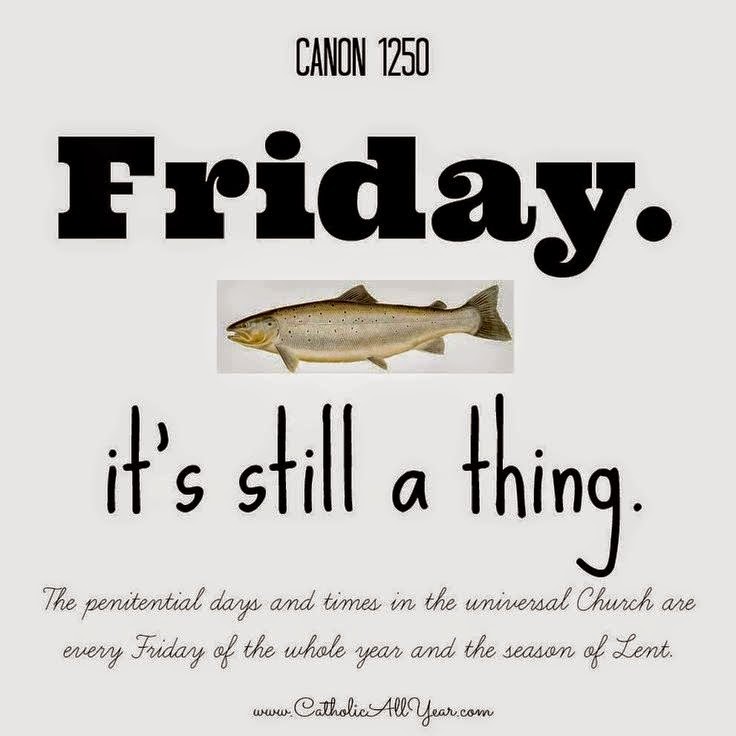
Can. 1250 The days and times of penance for the universal Church are each Friday of the whole year and the season of Lent.
Can. 1251 Abstinence from meat, or from some other food as determined by the Episcopal Conference, is to be observed on all Fridays, unless a solemnity should fall on a Friday. Abstinence and fasting are to be observed on Ash Wednesday and Good Friday.
Can. 1252 The law of abstinence binds those who have completed their fourteenth year. The law of fasting binds those who have attained their majority, until the beginning of their sixtieth year. Pastors of souls and parents are to ensure that even those who by reason of their age are not bound by the law of fasting and abstinence, are taught the true meaning of penance.
Can. 1253 The Episcopal Conference can determine more particular ways in which fasting and abstinence are to be observed. In place of abstinence or fasting it can substitute, in whole or in part, other forms of penance, especially works of charity and exercises of piety.

Read more >>
Friday, July 8, 2011
Friday Reminder - Still a Day of Penance

O Lord, Our God, have mercy on us sinners!


Today is Friday, the day in which we commemorate Our Lord's passion and death. It was our own sins that condemned our glorious Lord to death on Good Friday - death on a Cross. As Catholics, we are still bound to either abstain from meat or rather to do some act of penance each Friday in the entire year. It was on this day of the week that our glorious Redeemer died for us. Please, never forget this, especially at 3 o'clock, the hour that He died. At 3 o'clock attempt to pray the 3 o'clock Mercy Prayer. Please remember Our Lord's love and repent today.

Code of Canon Law:


Can. 1249 All Christ's faithful are obliged by divine law, each in his or her own way, to do penance. However, so that all may be joined together in a certain common practice of penance, days of penance are prescribed. On these days the faithful are in a special manner to devote themselves to prayer, to engage in works of piety and charity, and to deny themselves, by fulfilling their obligations more faithfully and especially by observing the fast and abstinence which the following canons prescribe.
Can. 1250 The days and times of penance for the universal Church are each Friday of the whole year and the season of Lent.
Can. 1251 Abstinence from meat, or from some other food as determined by the Episcopal Conference, is to be observed on all Fridays, unless a solemnity should fall on a Friday. Abstinence and fasting are to be observed on Ash Wednesday and Good Friday.
Can. 1252 The law of abstinence binds those who have completed their fourteenth year. The law of fasting binds those who have attained their majority, until the beginning of their sixtieth year. Pastors of souls and parents are to ensure that even those who by reason of their age are not bound by the law of fasting and abstinence, are taught the true meaning of penance.
Can. 1253 The Episcopal Conference can determine more particular ways in which fasting and abstinence are to be observed. In place of abstinence or fasting it can substitute, in whole or in part, other forms of penance, especially works of charity and exercises of piety.
Today is also a great day to pray the Stations of the Cros. Please join me in praying the Stations of the Cross. Remember, it was on this day that He gave up His life all for you.

Prayer to the Glorious Cross:

I adore You, O glorious Cross, which was adorned with the Heart and Body of my Savior Jesus Christ, stained and covered with blood. I adore You, O Holy Cross, out of love for Him, Jesus, who is my Savior and my God.

(Pope Pius IX declared that reciting this prayer five times on Friday will free five souls from Purgatory and 33 souls by reciting it on Good Friday. This prayer should be recited before a crucifix with a contrite heart and praying a few minutes for the Pope).

Prayer to Jesus Christ Crucified:

My good and dear Jesus, I kneel before you asking you most earnestly to engrave upon my heart a deep and lively faith, hope, and charity, with true repentance for my sins, and a firm resolve to make amends. As I reflect upon your five wounds, and dwell upon them with deep compassion and grief, I recall the words the prophet David spoke long ago concerning yourself: they have pierced my hands and my feet, they have numbered all my bones!
Read more >>
Friday, April 19, 2013
Friday Reminder - Still a Day of Penance (even in Eastertide)

Today is Friday, the day in which we commemorate Our Lord's passion and death. It was our own sins that condemned our glorious Lord to death on Good Friday - death on a Cross. As Catholics, we are still bound to either abstain from meat or rather to do some act of penance each Friday in the entire year. It was on this day of the week that our glorious Redeemer died for us. Please, never forget this, especially at 3 o'clock, the hour that He died. At 3 o'clock attempt to pray the 3 o'clock Mercy Prayer. Please remember Our Lord's love and repent today.

Code of Canon Law:

Can. 1249 All Christ's faithful are obliged by divine law, each in his or her own way, to do penance. However, so that all may be joined together in a certain common practice of penance, days of penance are prescribed. On these days the faithful are in a special manner to devote themselves to prayer, to engage in works of piety and charity, and to deny themselves, by fulfilling their obligations more faithfully and especially by observing the fast and abstinence which the following canons prescribe.
Can. 1250 The days and times of penance for the universal Church are each Friday of the whole year and the season of Lent.
Can. 1251 Abstinence from meat, or from some other food as determined by the Episcopal Conference, is to be observed on all Fridays, unless a solemnity should fall on a Friday. Abstinence and fasting are to be observed on Ash Wednesday and Good Friday.
Can. 1252 The law of abstinence binds those who have completed their fourteenth year. The law of fasting binds those who have attained their majority, until the beginning of their sixtieth year. Pastors of souls and parents are to ensure that even those who by reason of their age are not bound by the law of fasting and abstinence, are taught the true meaning of penance.
Can. 1253 The Episcopal Conference can determine more particular ways in which fasting and abstinence are to be observed. In place of abstinence or fasting it can substitute, in whole or in part, other forms of penance, especially works of charity and exercises of piety.

Prayer to the Glorious Cross:

I adore You, O glorious Cross, which was adorned with the Heart and Body of my Savior Jesus Christ, stained and covered with blood. I adore You, O Holy Cross, out of love for Him, Jesus, who is my Savior and my God.

(Pope Pius IX declared that reciting this prayer five times on Friday will free five souls from Purgatory and 33 souls by reciting it on Good Friday. This prayer should be recited before a crucifix with a contrite heart and praying a few minutes for the Pope).

Prayer to Jesus Christ Crucified:

My good and dear Jesus, I kneel before you asking you most earnestly to engrave upon my heart a deep and lively faith, hope, and charity, with true repentance for my sins, and a firm resolve to make amends. As I reflect upon your five wounds, and dwell upon them with deep compassion and grief, I recall the words the prophet David spoke long ago concerning yourself: they have pierced my hands and my feet, they have numbered all my bones!
Read more >>
Friday, December 5, 2014
Friday Penance Reminder


Today is Friday, the day in which we commemorate Our Lord's passion and death. It was our own sins that condemned our glorious Lord to death on Good Friday - death on a Cross. As Catholics, we are still bound to either abstain from meat or rather to do some act of penance each Friday in the entire year. It is not just during the holy season of Lent.

It was on this day of the week that our glorious Redeemer died for us. Please, never forget this, especially at 3 o'clock, the hour that He died. At 3 o'clock attempt to pray the 3 o'clock Mercy Prayer. Please remember Our Lord's love and repent today.

Code of Canon Law:

Can. 1249 All Christ's faithful are obliged by divine law, each in his or her own way, to do penance. However, so that all may be joined together in a certain common practice of penance, days of penance are prescribed. On these days the faithful are in a special manner to devote themselves to prayer, to engage in works of piety and charity, and to deny themselves, by fulfilling their obligations more faithfully and especially by observing the fast and abstinence which the following canons prescribe.
Can. 1250 The days and times of penance for the universal Church are each Friday of the whole year and the season of Lent.
Can. 1251 Abstinence from meat, or from some other food as determined by the Episcopal Conference, is to be observed on all Fridays, unless a solemnity should fall on a Friday. Abstinence and fasting are to be observed on Ash Wednesday and Good Friday.
Can. 1252 The law of abstinence binds those who have completed their fourteenth year. The law of fasting binds those who have attained their majority, until the beginning of their sixtieth year. Pastors of souls and parents are to ensure that even those who by reason of their age are not bound by the law of fasting and abstinence, are taught the true meaning of penance.
Can. 1253 The Episcopal Conference can determine more particular ways in which fasting and abstinence are to be observed. In place of abstinence or fasting it can substitute, in whole or in part, other forms of penance, especially works of charity and exercises of piety.
Read more >>
Friday, June 8, 2007
Friday: Still a Day of Penance

O Lord, Our God, have mercy on us sinners!

Today is Friday, the day in which we commemorate Our Lord's passion and death. It was our own sins that condemned our glorious Lord to death on Good Friday - death on a Cross. As Catholics, we are still bound to either abstain from meat or rather to do some act of penance each Friday in the entire year. It was on this day of the week that our glorious Redeemer died for us. Please, never forget this, especially at 3 o'clock, the hour that He died. At 3 o'clock attempt to pray the 3 o'clock Mercy Prayer. Please remember Our Lord's love and repent today.
Code of Canon Law:


Can. 1249 All Christ's faithful are obliged by divine law, each in his or her own way, to do penance. However, so that all may be joined together in a certain common practice of penance, days of penance are prescribed. On these days the faithful are in a special manner to devote themselves to prayer, to engage in works of piety and charity, and to deny themselves, by fulfilling their obligations more faithfully and especially by observing the fast and abstinence which the following canons prescribe.
Can. 1250 The days and times of penance for the universal Church are each Friday of the whole year and the season of Lent.
Can. 1251 Abstinence from meat, or from some other food as determined by the Episcopal Conference, is to be observed on all Fridays, unless a solemnity should fall on a Friday. Abstinence and fasting are to be observed on Ash Wednesday and Good Friday.
Can. 1252 The law of abstinence binds those who have completed their fourteenth year. The law of fasting binds those who have attained their majority, until the beginning of their sixtieth year. Pastors of souls and parents are to ensure that even those who by reason of their age are not bound by the law of fasting and abstinence, are taught the true meaning of penance.
Can. 1253 The Episcopal Conference can determine more particular ways in which fasting and abstinence are to be observed. In place of abstinence or fasting it can substitute, in whole or in part, other forms of penance, especially works of charity and exercises of piety.
Today is also a great day to pray the Stations of the Cross. The Stations are a wonderful devotion that can be prayed in Church or at home. Nonetheless, the stations allow us to contemplate the true love of our Redeemer during His bitter Passion. Please join me in praying the Stations of the Cross. Remember, it was on this day that He gave up His life all for you.

Prayer to the Glorious Cross:

I adore You, O glorious Cross, which was adorned with the Heart and Body of my Savior Jesus Christ, stained and covered with blood. I adore You, O Holy Cross, out of love for Him, Jesus, who is my Savior and my God.

(Pope Pius IX declared that reciting this prayer five times on Friday will free five souls from Purgatory and 33 souls by reciting it on Good Friday. This prayer should be recited before a crucifix with a contrite heart and praying a few minutes for the Pope).

Prayer to Jesus Christ Crucified:

My good and dear Jesus, I kneel before you asking you most earnestly to engrave upon my heart a deep and lively faith, hope, and charity, with true repentance for my sins, and a firm resolve to make amends. As I reflect upon your five wounds, and dwell upon them with deep compassion and grief, I recall the words the prophet David spoke long ago concerning yourself: they have pierced my hands and my feet, they have numbered all my bones!
Read more >>
Friday, September 13, 2013
Friday: Mandatory Day of Penance

O Lord, Our God, have mercy on us sinners!


Today is Friday, the day in which we commemorate Our Lord's passion and death. It was our own sins that condemned our glorious Lord to death on Good Friday - death on a Cross. As Catholics, we are still bound to either abstain from meat or rather to do some act of penance each Friday in the entire year. It was on this day of the week that our glorious Redeemer died for us. Please, never forget this, especially at 3 o'clock, the hour that He died. At 3 o'clock attempt to pray the 3 o'clock Mercy Prayer. Please remember Our Lord's love and repent today.

Code of Canon Law:


Can. 1249 All Christ's faithful are obliged by divine law, each in his or her own way, to do penance. However, so that all may be joined together in a certain common practice of penance, days of penance are prescribed. On these days the faithful are in a special manner to devote themselves to prayer, to engage in works of piety and charity, and to deny themselves, by fulfilling their obligations more faithfully and especially by observing the fast and abstinence which the following canons prescribe.
Can. 1250 The days and times of penance for the universal Church are each Friday of the whole year and the season of Lent.
Can. 1251 Abstinence from meat, or from some other food as determined by the Episcopal Conference, is to be observed on all Fridays, unless a solemnity should fall on a Friday. Abstinence and fasting are to be observed on Ash Wednesday and Good Friday.
Can. 1252 The law of abstinence binds those who have completed their fourteenth year. The law of fasting binds those who have attained their majority, until the beginning of their sixtieth year. Pastors of souls and parents are to ensure that even those who by reason of their age are not bound by the law of fasting and abstinence, are taught the true meaning of penance.
Can. 1253 The Episcopal Conference can determine more particular ways in which fasting and abstinence are to be observed. In place of abstinence or fasting it can substitute, in whole or in part, other forms of penance, especially works of charity and exercises of piety.
Today is also a great day to pray the Stations of the Cros. Please join me in praying the Stations of the Cross. Remember, it was on this day that He gave up His life all for you.

Prayer to the Glorious Cross:

I adore You, O glorious Cross, which was adorned with the Heart and Body of my Savior Jesus Christ, stained and covered with blood. I adore You, O Holy Cross, out of love for Him, Jesus, who is my Savior and my God.

(Pope Pius IX declared that reciting this prayer five times on Friday will free five souls from Purgatory and 33 souls by reciting it on Good Friday. This prayer should be recited before a crucifix with a contrite heart and praying a few minutes for the Pope).

Prayer to Jesus Christ Crucified:

My good and dear Jesus, I kneel before you asking you most earnestly to engrave upon my heart a deep and lively faith, hope, and charity, with true repentance for my sins, and a firm resolve to make amends. As I reflect upon your five wounds, and dwell upon them with deep compassion and grief, I recall the words the prophet David spoke long ago concerning yourself: they have pierced my hands and my feet, they have numbered all my bones!
Read more >>
Wednesday, April 12, 2023
Fasting and Penance Is Not Prohibited in Pascaltide

The total length of Paschaltide (i.e., the Easter Season) from Easter Sunday to the end of Whitsuntide is 56 days inclusive. In this way, Holy Mother Church shows us the joy of Easter has eclipsed the time of penance of Lent. Yet even in this time of joy, some penance is obligatory and even mandatory by Church Law. Thus, even in times of joy, we can and should continue to offer up fasting and abstinence for the good of souls.

Year-Round Friday Abstinence Is Required (Not Just in Lent!)

As Catholics, we are still bound to either abstain from meat or rather to do some act of penance each Friday of the entire year. Abstinence should always be what we choose to do since this underscored Christian culture for nearly 2,000 years since mandatory Friday abstinence went back to the time of the Apostles. As such, the 1983 Code of Canon Law decrees:

Can. 1251 Abstinence from meat, or from some other food as determined by the Episcopal Conference, is to be observed on all Fridays, unless a solemnity should fall on a Friday. Abstinence and fasting are to be observed on Ash Wednesday and Good Friday.


Rogationtide Is A Time of Penance in Eastertide

Virtually forgotten by all Catholics is the important practice of Rogationtide, which falls during Pascaltide as well.

The Major Rogation Day is on April 25th, which is coincidentally the Feast of St. Mark the Evangelist. Should it happen that the feast of St. Mark the Evangelist is transferred to another day (e.g., when a day in the Octave of Easter falls on April 25th), the Rogation procession is held nevertheless on April 25th, unless the feast falls on Easter Sunday or Monday, in which case the procession is transferred to Easter Tuesday. The Minor Rogation Days are the Monday, Tuesday, and Wednesday preceding Ascension Thursday. Hence, the date of the Minor Rogation Days varies.

In 2020, Dom Alcuin Reid gave a monastic conference on the Minor Rogation Days where he said in part:

Their observance is now similar in format to the Greater Litanies of April 25th, but these three days have a different origin, having been instituted in Gaul in the fifth century as days of fasting, abstinence and abstention from servile work in which all took part in an extensive penitential procession, often barefoot. The procession and litanies only found a place in the Roman liturgy much later (around the beginning of the ninth century) and even then purely as days of rogation – of intercession – rather than as ones of fasting and penance; the latter being deemed incompatible with the nature of Eastertide.

He continued:

Indeed, this ancient tradition itself is now widely lost in the West. How many Catholics understand what is meant by the greater or lesser litanies, or by the expression “the Rogations” – clergy included? 

... 

Dom Guéranger himself lamented the lack of appreciation of the Rogations in his own day: “If we compare the indifference shown by the Catholics of the present age for the Rogation days, with the devotion wherewith our ancestors kept them, we cannot but acknowledge that there has been a great falling off in faith and piety. Knowing, as we do, the great importance attached to these processions by the Church, we cannot help wondering how it is that there are so few among the faithful who assist at them. Our surprise increases when we find persons preferring their own private devotions to these public prayers of the Church, which, to say nothing of the result of good example, merit far greater graces than any exercises of our own choosing.”

The Minor Rogation Days go back to 470 AD when Bishop Mamertus of Vienne in Gaul instituted an annual observance of penance on the three days immediately before the Feast of the Ascension. He prescribed litanies in the form of processions for all three days. Thereafter they spread to the Frankish part of France in 511, to Spain in the 6th century, and to the German part of the Frankish empire in 813.  In 816, Pope Leo III incorporated the lesser litanies into the Roman Liturgy, and during the subsequent centuries, the custom of holding these litanies was customary for each year.


Is Penance Unbefitting for the Pascal Season?

Dom Guéranger, the great liturgist and Church historian who lived around the end of the 1800s, answers this question which many liturgically-minded Catholics ask: 

The question naturally presents itself, why did St. Gregory choose the 25th of April for a Procession and Station, in which everything reminds us of compunction and penance, and which would seem so out of keeping with the joyous Season of Easter? 

The first to give a satisfactory answer to this difficulty, was Canon Moretti, a learned Liturgiologist of last century. In a dissertation of great erudition, he proves that in the 5th, and probably even in the 4th, century, the 25th of April was observed at Rome as a day of great solemnity. The Faithful went, on that day, to the Basilica of St. Peter, in order to celebrate the anniversary of the first entrance of the Prince of the Apostles into Rome, upon which he thus conferred the inalienable privilege of being the Capital of Christendom. It is from that day that we count the twenty-five years, two months and some days that St. Peter reigned as Bishop of Rome. The Sacramentary of St. Leo gives us the Mass of this Solemnity, which afterwards ceased to be kept. St. Gregory, to whom we are mainly indebted for the arrangement of the Roman Liturgy, was anxious to perpetuate the memory of a day, which gave to Rome her grandest glory. He, therefore, ordained that the Church of St. Peter should be the Station of the Great Litany, which was always to be celebrated on that auspicious day. The 25th of April comes so frequently during the Octave of Easter, that it could not be kept as a Feast, properly so called, in honor of St. Peter's entrance into Rome; St. Gregory, therefore, adopted the only means left of commemorating the great event.

Hence from ancient times the Church kept these days as days of supplication. And even if fasting, the hallmark of Lent, would be ill-suited for Pascaltide, abstinence is still permitted and even obligatory in the Pascal Season. In former times, Rome enjoined abstinence from meat on the faithful during Rogationtide. Other places, however, such as the Churches in Gaul where Rogation Days originated, required fasting. Dom Guéranger testifies unknown custom to this:

A day, then, like this, of reparation to God’s offended majesty, would naturally suggest the necessity of joining some exterior penance to the interior dispositions of contrition which filled the hearts of Christians. Abstinence from flesh meat has always been observed on this day at Rome; and when the Roman Liturgy was established in France by Pepin and Charlemagne, the Great Litany of April 25 was, of course, celebrated, and the abstinence kept by the faithful of that country. A Council of Aix-la-Chapelle, in 836, enjoined the additional obligation of resting from servile work on this day: the same enactment is found in the Capitularia of Charles the Bald. As regards fasting, properly so-called, being contrary to the spirit of Paschal Time, it would seem never to have been observed on this day, at least not generally. Amalarius, who lived in the ninth century, asserts that it was not then practiced even in Rome.

Fasting was championed as well by St. Charles Borromeo in Milan, although Rome has never obligated fasting during the Pascal Season. Fasting during the Pascal Season, though is not a sin, just as almsgiving and prayer, the other Lenten pillars, are certainly praiseworthy during Pascaltide.

May we continue to incorporate some of our Lenten practices going forward and offer them in joy for the conversion of sinners and the exaltation of Holy Mother Church. And chief among our weapons to conquer demons and concupiscence is fasting.

Want to learn more about the history of fasting and abstinence? Check out the Definitive Guide to Catholic Fasting and Abstinence.
Read more >>
Thursday, April 24, 2014
Meatless Fridays during Eastertide


Today is Friday, the day in which we commemorate Our Lord's passion and death. It was our own sins that condemned our glorious Lord to death on Good Friday - death on a Cross. As Catholics, we are still bound to either abstain from meat or rather to do some act of penance each Friday in the entire year. It was on this day of the week that our glorious Redeemer died for us. Please, never forget this, especially at 3 o'clock, the hour that He died. At 3 o'clock attempt to pray the 3 o'clock Mercy Prayer. Please remember Our Lord's love and repent today.

Code of Canon Law:

Can. 1249 All Christ's faithful are obliged by divine law, each in his or her own way, to do penance. However, so that all may be joined together in a certain common practice of penance, days of penance are prescribed. On these days the faithful are in a special manner to devote themselves to prayer, to engage in works of piety and charity, and to deny themselves, by fulfilling their obligations more faithfully and especially by observing the fast and abstinence which the following canons prescribe.
Can. 1250 The days and times of penance for the universal Church are each Friday of the whole year and the season of Lent.
Can. 1251 Abstinence from meat, or from some other food as determined by the Episcopal Conference, is to be observed on all Fridays, unless a solemnity should fall on a Friday. Abstinence and fasting are to be observed on Ash Wednesday and Good Friday.
Can. 1252 The law of abstinence binds those who have completed their fourteenth year. The law of fasting binds those who have attained their majority, until the beginning of their sixtieth year. Pastors of souls and parents are to ensure that even those who by reason of their age are not bound by the law of fasting and abstinence, are taught the true meaning of penance.
Can. 1253 The Episcopal Conference can determine more particular ways in which fasting and abstinence are to be observed. In place of abstinence or fasting it can substitute, in whole or in part, other forms of penance, especially works of charity and exercises of piety.
Read more >>
Friday, June 22, 2007
Friday: Abstain from Meat

Today is Friday, the day in which we commemorate Our Lord's Passion and Death. It was our own sins that condemned our glorious Lord to death on Good Friday - death on a Cross. As Catholics, we are still bound to either abstain from meat or rather to do some act of penance each Friday in the entire year. It was on this day of the week that our glorious Redeemer died for us. Please, never forget this, especially at 3 o'clock, the hour that He died. At 3 o'clock attempt to pray the 3 o'clock Mercy Prayer. Please remember Our Lord's love and repent today.
 
Code of Canon Law:
Can. 1249 All Christ's faithful are obliged by divine law, each in his or her own way, to do penance. However, so that all may be joined together in a certain common practice of penance, days of penance are prescribed. On these days the faithful are in a special manner to devote themselves to prayer, to engage in works of piety and charity, and to deny themselves, by fulfilling their obligations more faithfully and especially by observing the fast and abstinence which the following canons prescribe. 

Can. 1250 The days and times of penance for the universal Church are each Friday of the whole year and the season of Lent. 
Can. 1251 Abstinence from meat, or from some other food as determined by the Episcopal Conference, is to be observed on all Fridays, unless a solemnity should fall on a Friday. Abstinence and fasting are to be observed on Ash Wednesday and Good Friday. 

Can. 1252 The law of abstinence binds those who have completed their fourteenth year. The law of fasting binds those who have attained their majority, until the beginning of their sixtieth year. Pastors of souls and parents are to ensure that even those who by reason of their age are not bound by the law of fasting and abstinence, are taught the true meaning of penance. 

Can. 1253 The Episcopal Conference can determine more particular ways in which fasting and abstinence are to be observed. In place of abstinence or fasting it can substitute, in whole or in part, other forms of penance, especially works of charity and exercises of piety.
Today is also a great day to pray the Stations of the Cross. The Stations are a wonderful devotion that can be prayed in Church or at home. Nonetheless, the stations allow us to contemplate the true love of our Redeemer during His bitter Passion. Please join me in praying the Stations of the Cross. Remember, it was on this day that He gave up His life all for you.

Prayer to the Glorious Cross:

I adore You, O glorious Cross, which was adorned with the Heart and Body of my Savior Jesus Christ, stained and covered with blood. I adore You, O Holy Cross, out of love for Him, Jesus, who is my Savior and my God.

(Pope Pius IX declared that reciting this prayer five times on Friday will free five souls from Purgatory and 33 souls by reciting it on Good Friday. This prayer should be recited before a crucifix with a contrite heart and praying a few minutes for the Pope).

Prayer to Jesus Christ Crucified:

My good and dear Jesus, I kneel before you asking you most earnestly to engrave upon my heart a deep and lively faith, hope, and charity, with true repentance for my sins, and a firm resolve to make amends. As I reflect upon your five wounds, and dwell upon them with deep compassion and grief, I recall the words the prophet David spoke long ago concerning yourself: they have pierced my hands and my feet, they have numbered all my bones!
Read more >>
Friday, January 8, 2016
Catholic Friday Fast


Today is Friday, the day in which we commemorate Our Lord's passion and death. It was our own sins that condemned our glorious Lord to death on Good Friday - death on a Cross. As Catholics, we are still bound to either abstain from meat or rather to do some act of penance each Friday of the entire year.

It was on this day of the week that our glorious Redeemer died for us. Please, never forget this, especially at 3 o'clock, the hour that He died. At 3 o'clock attempt to pray a prayer of reparation and remember Our Lord's love and sacrifice today.

Code of Canon Law:
Can. 1249 All Christ's faithful are obliged by divine law, each in his or her own way, to do penance. However, so that all may be joined together in a certain common practice of penance, days of penance are prescribed. On these days the faithful are in a special manner to devote themselves to prayer, to engage in works of piety and charity, and to deny themselves, by fulfilling their obligations more faithfully and especially by observing the fast and abstinence which the following canons prescribe.
Can. 1250 The days and times of penance for the universal Church are each Friday of the whole year and the season of Lent.
Can. 1251 Abstinence from meat, or from some other food as determined by the Episcopal Conference, is to be observed on all Fridays, unless a solemnity should fall on a Friday. Abstinence and fasting are to be observed on Ash Wednesday and Good Friday.
Can. 1252 The law of abstinence binds those who have completed their fourteenth year. The law of fasting binds those who have attained their majority, until the beginning of their sixtieth year. Pastors of souls and parents are to ensure that even those who by reason of their age are not bound by the law of fasting and abstinence, are taught the true meaning of penance.
Can. 1253 The Episcopal Conference can determine more particular ways in which fasting and abstinence are to be observed. In place of abstinence or fasting it can substitute, in whole or in part, other forms of penance, especially works of charity and exercises of piety.

Read more >>
Sunday, February 7, 2021
At What Age Do Catholics Fast?

Current Church Minimums

Shortly after the close of the Second Vatican Council, Paul VI issued an apostolic constitution on fasting and abstaining on February 17, 1966, called Paenitemini, whose principles were later incorporated into the 1983 Code of Canon Law. Abstinence from meat which previously began at age 7 was modified to begin at age 14. The 1983 Code of Canon Law also changed the age of fast to begin at 18 - previously it was 21 - and to still conclude at midnight when an individual completes his 59th birthday. 

Abstinence beginning at age 14 and fasting beginning at age 18 are the current minimums. There is no terminating age for the law abstinence - it will continue for the rest of a person's life. Fasting which begins at age 18 ends when a person completes his 59th year and turns 60 years old.

The Previous Practice

One of the only positive changes to fasting in the past 100 years was the lowering of the age of fasting to 18. If an 18-year-old can sin, he should be able to fast. The lowering of the minimum incorporated this change into law. Unfortunately, the change of abstinence to 14 from 7 is an immense disservice to the souls of children as this small weekly sacrifice teaches children the value of penance and the importance of a communal penance uniting us throughout the Catholic world.

The previous practice of fasting beginning at age 21, however, has a long history. While the earliest catechisms ever made (i.e. the Catechism of the Council of Trent and the Catechism of St. Peter Canisius) do not mention fasting regulations, subsequent catechisms even centuries ago did.

The Catechism of Perseverance (1849)

Fr. Stephen Keenan's Catechism (1846)

Bp. George Hay's Catechism (1781). The Oldest Mention of the Age of Fasting in an English language Catechism.

Father Alban Butler Referencing Fasting Beginning As Early As Age 10. It had risen to 21 by the time of St. Thomas Aquinas

Fasting Requires More Than the Legal Minimum

For those Catholics who wish to more closely follow the ancient customs of the Church, Lent is a time of austere penance undertaken to make reparation to God for sin (our own sins and others), to grow in virtue and good works, and to comfort the heart of our Savior much offended by the barrage of sin and filth increasing by the day. Yet, there are very few Catholics who undertake the true discipline of prayer, fasting, and almsgiving. 

How many of us are observing all 40 days as true fast days and not just Ash Wednesday and Good Friday?  Yet our ancestors did.  In fact, it was forbidden to eat meat or any animal products (e.g. eggs, dairy, cheese, butter, etc.) through all of Lent.  How many of us are making this kind of intense sacrifice?  How many of us are finding the time this Lent to pray the Rosary every day or go to Daily Mass more often or at least pray the Stations of the Cross each Friday?

While we can talk about the minimums required by Church law or previous laws, we have to remember that these are exactly that - minimums. The Church asks for everyone to perform penance according to their own abilities. While those who were ill (among other reasons) were dispensed from the law of fasting, the sick could still perform other penance or even try to observe fasting if they chose. The same is true for children. Encouraging our children to abstain from meat on all Fridays of the year and all of forty days of Lent is very worthwhile. And encouraging adolescent children in high school to fast is also very meritorious even though it is beyond the mere minimum. We recall that Our Blessed Mother was pleased by the penance offered by the three young children at Fatima who were far below the age of fasting. Yet, they fasted and would eat foods they did not prefer as extra penance. And this was pleasing to our Lady and our Lord. Let us encourage our children to do the same - all for Jesus. This Lent is the ideal time to start.

Want to learn more about the history of fasting and abstinence? Check out the Definitive Guide to Catholic Fasting and Abstinence.
Read more >>
Tuesday, June 30, 2015
The Year of Mercy: What is Mercy?

With the announcement of a Year of Mercy by Pope Francis, we should start by asking ourselves "what is mercy?"  And let us follow up that question with another: "what does mercy require of me?"  Far too many think mercy is a nothing more than a complacency with sin in practice: "God loves me.  I am forgiven.  I can go and not feel bad about my sins."

On the contrary, true mercy is found in prayer and penance.  It is found in our spiritual works of mercy: admonishing sinners to repent, go to Confession, and reunite themselves with the Sacraments.  True mercy is not a "feel good ideal" similar to how the protestants view salvation.  True mercy is inseparable from Catholic notions of penance.

Bishop Fellay in his Letter of May 2015 provided a reflection on True Mercy.  The following an except from that document:
What exactly is [mercy] about? In itself mercy is a word that is dear to the heart of every Catholic, because it designates the most touching manifestation of God’s love for us. In past centuries the apparitions of the Sacred Heart were nothing but a more intense revelation of this mercy of God toward mankind. The same must be said about devotion to the Sorrowful and Immaculate Heart of Mary.

Nevertheless true mercy, which implies this initial, extremely touching movement of God toward the sinner and His misery, continues in a moment of the creature’s conversion to God: “God desires not the death of the wicked, but that the wicked turn from his way and live” (cf. Ezek 33:11). Hence the Gospels insist on the duty of conversion, renunciation and penance.  Our Lord went so far as to say: “Unless you do penance, you shall all perish” (cf. Lk 13:5).

This call to conversion is the heart of the Gospel, which we find in St. John the Baptist as well as in St. Peter. When sinners, touched by preaching, ask what they must do, they hear only this recommendation: “be converted and do penance.” The Blessed Virgin in her apparitions in recent centuries, both in La Salette and in Lourdes or Fatima, says nothing different: “prayer and penance”.

Now the new preachers of a new mercy insist so much on the first step taken by God toward human beings who are lost because of sin, ignorance and misery that they too often omit this second movement, which must come from the creature: repentance, conversion, the rejection of sin. Ultimately, the new mercy is nothing but complacency about sin. God loves you... no matter what.
Read more >>
Friday, April 8, 2016
Friday Penance: Still Required in Eastertide


Abstinence Required In Pascaltide

Friday is the day in which we commemorate Our Lord's passion and death. As Catholics, we are still bound to abstain from meat each Friday of the entire year, not just in Lent. This is required during the season of Pascaltide. This is affirmed even in the modern 1983 Code of Canon Law - all Fridays of the entire year are days of penance (with few exceptions). There can be no doubt that Catholics must be informed that Friday abstinence is not to be confided to Lent only. Failing to observe Friday penance is a mortal sin, as affirmed by multiple pontiffs.

Abstinence on Easter Friday

How should we treat abstinence specifically on Friday in the Octave of Easter (i.e. Easter Friday)? The 1917 Code of Canon Law stipulated that the requirement to abstain from meat (i.e. Friday penance) was required each and every Friday of the year unless that particular Friday was a Holy Day of Obligation outside of Lent: 

"On [Sundays] or feasts of precept, the law of abstinence or of abstinence and fast or of fast only ceases, except during Lent, nor is the vigil anticipated; likewise it ceases on Holy [Saturday] afternoon" (1917 Code, Canon 1252 § 4). [Translation taken from THE 1917 OR PIO-BENEDICTINE CODE OF CANON LAW in English Translation by Dr. Edward Peters]

Easter Friday is not a feast of precept (i.e., a Holy Day of Obligation), and neither is any Friday in the Pascal Season between Easter Sunday and Trinity Sunday. The 1917 Code of Canon Law outlined the rules of fasting and abstinence in Canons 1250-1254. Before 1917, even Holy Days of Obligation outside of Lent required explicitly papal dispensation or else Friday abstinence would be observed even on days of precept.

The 1983 Code and the myriad of weakening dispensations offered in the 20th century has led to a continual decline in penance and devotion. Due to the errors and ambiguities in the 1983 Code, it must be rejected, and the older Code must be used. One of these issues is the unprecedented novelty of solemnities like Easter Friday breaking the immemorial tradition of Friday abstinence. The notion of day's liturgical rank abrograting abstinence has no basis in Church practice prior to 1983. 

It is essential for all Roman Catholics to continue abstaining from meat even on Easter Friday.

Conclusion

Friday abstinence is still the Catholic practice throughout Eastertide, and it is the Church's Law. Let us not be so keen to forget our Lord's sacrifice on the Cross. Pray and do penance on this and all Fridays. It is after all, on Friday that our Blessed Lord redeemed us. Let us never forget His Sacrifice on that first Good Friday.

Want to learn more about the history of fasting and abstinence? Check out the Definitive Guide to Catholic Fasting and Abstinence.
Read more >>
Wednesday, September 23, 2020
What is Better: Shared Days of Penance or Private Acts of Penance?

As mentioned in my articles on the catastrophic decline in fasting in the lives of Catholics, the notion of shared days of communal penance (e.g. abstinence on Fridays and shared days of fasting for Lent, Ember Days, and Vigils) has all but vanished. What is even more concerning than losing these traditions and connections with the Faith as it has been practised for centuries is that the Church has taught that days of communal penance are more efficacious than mere private penances. The trend to encourage private fasting and penances and reduce Church-wide fasting to only Ash Wednesday and Good Friday is deplorable.

As Dom Gueranger writes in his article on Ember Wednesday for September:

We have already spoken of the necessity of private penance for the Christian who is at all desirous to make progress in the path of salvation. But in this, as in all spiritual exercises, a private work of devotion has neither the merit nor the efficacy of one that is done in company with the Church, and in communion with her public act; for the Church, as bride of Christ, communicates an exceptional worth and power to works of penance done, in her name, in the unity of the social body.

He continues by quoting the following passage from Pope St. Leo the Great:

God has sanctioned this privilege, that what is celebrated in virtue of a public law is more sacred than that which depends on a private regulation. The exercise of self-restraint which an individual Christian practises by his own will is for the advantage of that single member; but a fast undertaken by the Church at large includes everyone in the general purification. God’s people never is so powerful as when the hearts of all the faithful join together in the unity of holy obedience, and when, in the Christian camp, one and the same preparation is made by all, and one and the same bulwark protects all...

Let us not only keep the traditional days of fasting as were known and practiced long before the 1900s but also work to restore their observance to the Universal Church. Then we can reap even greater merits.

Read more >>
Friday, December 29, 2023
12 NEW YEAR’S RESOLUTIONS FOR CATHOLICS

Each year, I have made what I call "Catholic Resolutions."  These New Year's Resolutions are not centered on losing weight, eating more vegetables, or securing a raise. I make resolutions for all facets of my life, including these.  Rather, these resolutions each year are centered around my spiritual life.  I encourage all of you to make resolutions specifically geared toward improving your own Faith life and your own knowledge of the Faith.  One's spiritual health needs the same care - if not more - than our physical, financial, or professional health.

Ask yourself:
  1. Do I know the Faith that I profess to believe in?  If not, how can I learn more?  For example, CatechismClass.com has an ideal Adult Course just for this purpose.
  2. Am I truly living a Catholic life?  Am I learning more prayers?  Am I helping others to learn the Faith and live it out?  Do I regularly receive the Sacraments?
  3. Do you struggle with certain sins or addictions? What actions do I need to take to really conquer them?
  4. Do you need to make more donations to Catholic organizations or pro-life charities?
  5. What is my dominant fault, and how can I tackle it and grow in virtues?
  6. What additional days of penance can you observe as days of fasting and abstinence? Can you observe the vigils of the apostles as fast days? What about all 40 days of Lent or the 40 days leading up to Christmas? Will you keep all days of Lent including Sundays as day of abstinence? There are many venerable ways we can practice penance this year and fulfill our Lady's call for "Penance, penance, penance." See the 2024 Catholic Fasting Calendar for ideas.
This is the time of year to truly set Catholic Resolutions, which will have eternal repercussions. Now is the time to actually make true and lasting Catholic Resolutions for the new year.

Some General Suggestions of Catholic Resolutions:
  1. Pray the Rosary every day, if you are out of the habit of it
  2. Pray Lauds, Vespers, and Compline (from the Little Office of the Blessed Virgin Mary or the Divine Office) every day.
  3. Say a prayer for the Poor Souls in Purgatory every day, such as the St Gertrude Prayer. Getting a copy of The Purgatorian Manual: Containing Spiritual Reading and Prayers for Every Day of the Month is also an excellent idea.
  4. Attend Mass one day extra a week in addition to Sunday. And if you have fallen away from Mass, start going weekly again.
  5. Make it a habit to go to Confession every 2 weeks. Ensure that you are sincere and actually detest your sins and desire to amend your life.
  6. Fulfill the First Friday Devotion as well as the First Saturday Devotion.
  7. Start wearing the Brown Scapular if you do not already. But ensure you are properly enrolled by a priest.
  8. Determine what is your predominant fault and make a plan to fight it and conquer it this next year.
  9. Make time for a morning meditation and mental prayer each and every day before work.
  10. Identify one virtue to acquire and one vice to conquer this year. Make an action plan for how you will actually make progress on a daily and weekly basis to do so.
  11. Make it a point to learn much more about the Faith. For example, CatechismClass.com has an ideal Adult Course just for this purpose.
  12. Add additional days of penance in the form of fasting and abstinence and adopt the traditional suggestions in the 2024 Catholic Fasting Calendar.
I encourage you to make Catholic Resolutions. What are yours? Share them below in the comments box.
Read more >>


Copyright Notice: Unless otherwise stated, all items are copyrighted under a Attribution-NonCommercial-NoDerivatives 4.0 International License. If you quote from this blog, cite a link to the post on this blog in your article.

Disclosure of Material Connection: Some of the links on this blog are “affiliate links.” This means if you click on the link and purchase the item, I will receive an affiliate commission. As an Amazon Associate, for instance, I earn a small commission from qualifying purchases made by those who click on the Amazon affiliate links included on this website. I am disclosing this in accordance with the Federal Trade Commission’s 16 CFR, Part 255: “Guides Concerning the Use of Endorsements and Testimonials in Advertising.”