

Notice the people on the step kneeling as the priest approaches with the Blessed Sacrament. Where has our piety gone? Have the vast majority of men lost this gift of the Holy Ghost?
Kyrie eleison!

.jpg)


The Feast of St. Michael, September 29th, is a special day for the brothers of the Society of St. Pius X as the Archangel is their particular patron. At St. Thomas Aquinas Seminary, also SSPX’s USA Brothers’ Novitiate, the novices made their religious vows during the Solemn Mass.
After a 6-day retreat preached by Fr. Iscarra according to the spirituality of the Desert Fathers, 3 Brothers will make their First vows and 4 others will renew their vows. They are 18 attending the retreat. According to the Statutes written by Archbishop Lefebvre for the SSPX’s brothers, the brothers make their vows for one year, then twice for a three-year period, before being allowed to make their perpetual vows.
The first religious profession takes place after a year of novitiate. Adding to the brothers’ ranks, on the eve of the feast of St. Michael, 2 postulants received the habit (black cassock and plain sash) and became novices, Mr. Curtis became Br. Albert Mary and Mr. Goldade became Br. Philip. The Society St. Pius X number more than 110 Brothers and 15 are presently assigned in the US
Source: SSPX

.jpg)
Almighty, everlasting God, you who cure our body and soul through healing self-denial, we humbly entreat your majesty to hear favorably the devout prayer of those who fast, and to grant us help for the present and the future. Through our Lord...Amen.

St. Januarius was born in Italy and was bishop of Benevento during the Emperor Diocletion persecution. Bishop Januarius went to visit two deacons and two laymen in prison. He was then also imprison along with his deacon and lector. They were thrown to the wild beasts, but when the animals did not attack them, they were beheaded. What is believed to be Januarius' blood is kept in Naples, as a relic. It liquifies and bubbles when exposed in the cathedral. Scientists have not been able to explain this miracle to date. St. Januarius lived and died around 305 A.D. and his feast day is September 19th.Miracle of the Liquefaction of His Blood:
Saint Januarius is famous for the miracle of the annual liquefaction of his blood, which, according to legend, was saved by a woman called Eusebia just after the saint's death. Thousands of people assemble to witness this event in Naples Cathedral three times a year: on September 19 (Saint Januarius day, to commemorate his martyrdom), on December 16 (to celebrate his patronage of both Naples and of the archdiocese), and on the Saturday before the first Sunday of May (to commemorate the reunification of his relics). Although the city of Naples became known as urbs sanguinum, the miracle is not a unique phenomenon. Other examples include Saint Patricia, blood said to belong to Saint John the Baptist in the monastery of San Gregorio Armeno, and that of Saint Pantaleon which liquifies in nearby Ravello. The liquefication of coagulated blood is therefore peculiar to the region of Campania and virtually unheard of elsewhere. (Source: Wikipedia)

"The Neapolitans honor this saint as the principal patron of their city and nation, and the Lord himself has continued to honor him, by allowing many miracles to be wrought through his intercession, particularly when the frightful eruptions of Mount Vesuvius have threatened the city of Naples with utter destruction. While the relics of St. Januarius were being brought in procession towards this terrific volcano, the torrents of lava and liquid fire which it emitted have ceased, or turned their course from the city. But the most stupendous miracle, and that which is greatly celebrated in the church, is the liquefying and boiling up of this blessed martyr's blood whenever the vials are brought in sight of his head. This miracle is renewed many times in the year, in presence of all who desire to witness it; yet some heretics have endeavored to throw a doubt upon its genuineness, by frivolous and incoherent explanations; but no one can deny the effect to be miraculous, unless he be prepared to question the evidence of his senses."John Henry Cardinal Newman also attested to the veracity of the miracle of liquefaction:
.jpg)
Since man is both a spiritual and physical being, the Church provides for the needs of man in his everyday life. The Church's liturgy and feasts in many areas reflect the four seasons of the year (spring, summer, fall and winter). The months of August, September, October and November are part of the harvest season, and as Christians we recall God's constant protection over his people and give thanksgiving for the year's harvest.
The September Ember Days were particularly focused on the end of the harvest season and thanksgiving to God for the season. Ember Days were three days (Wednesday, Friday and Saturday) set aside by the Church for prayer, fasting and almsgiving at the beginning of each of the four seasons of the year. The ember days fell after December 13, the feast of St. Lucy (winter), after the First Sunday of Lent (spring), after Pentecost Sunday (summer), and after September 14 , the feast of the Exaltation of the Holy Cross (fall). These weeks are known as the quattor tempora, the "four seasons."
Since the late 5th century, the Ember Days were also the preferred dates for ordination of priests. So during these times the Church had a threefold focus: (1) sanctifying each new season by turning to God through prayer, fasting and almsgiving; (2) giving thanks to God for the various harvests of each season; and (3) praying for the newly ordained and for future vocations to the priesthood and religious life.
.jpg)
[The] aging generation of progressives continues to lobby church leaders to change Catholic teachings on reproductive rights, same-sex marriage and women's ordination. But it is being replaced by younger men and women who are attracted to the church because of the very timelessness of its teachings.Source: "Traditional Catholicism Is Winning", Wall Street Journal, April 12, 2012, by Hendershott and White.
They are attracted to the philosophy, the art, the literature and the theology that make Catholicism countercultural. They are drawn to the beauty of the liturgy and the church's commitment to the dignity of the individual. They want to be contributors to that commitment—alongside faithful and courageous bishops who ask them to make sacrifices. It is time for Catholics to celebrate their arrival.
.jpg)
From a tree came death, from a tree also should come forth life. He who triumphed on a tree should also be defeated on a tree.The Power of the Cross
 Today is Friday, the day in which we commemorate Our Lord's passion and death. It was our own sins that condemned our glorious Lord to death on Good Friday - death on a Cross. As Catholics, we are still bound to either abstain from meat or rather to do some act of penance each Friday in the entire year. It was on this day of the week that our glorious Redeemer died for us. Please, never forget this, especially at 3 o'clock, the hour that He died. At 3 o'clock attempt to pray the 3 o'clock Mercy Prayer. Please remember Our Lord's love and repent today.
Can. 1249 All Christ's faithful are obliged by divine law, each in his or her own way, to do penance. However, so that all may be joined together in a certain common practice of penance, days of penance are prescribed. On these days the faithful are in a special manner to devote themselves to prayer, to engage in works of piety and charity, and to deny themselves, by fulfilling their obligations more faithfully and especially by observing the fast and abstinence which the following canons prescribe.
Can. 1250 The days and times of penance for the universal Church are each Friday of the whole year and the season of Lent.
Can. 1251 Abstinence from meat, or from some other food as determined by the Episcopal Conference, is to be observed on all Fridays, unless a solemnity should fall on a Friday. Abstinence and fasting are to be observed on Ash Wednesday and Good Friday.
Can. 1252 The law of abstinence binds those who have completed their fourteenth year. The law of fasting binds those who have attained their majority, until the beginning of their sixtieth year. Pastors of souls and parents are to ensure that even those who by reason of their age are not bound by the law of fasting and abstinence, are taught the true meaning of penance.
Can. 1253 The Episcopal Conference can determine more particular ways in which fasting and abstinence are to be observed. In place of abstinence or fasting it can substitute, in whole or in part, other forms of penance, especially works of charity and exercises of piety.Today is also a great day to pray the Stations of the Cros. Please join me in praying the Stations of the Cross. Remember, it was on this day that He gave up His life all for you.

My father was a doctor in a small Austrian village, and in April 1889, he was asked to deliver to two children: one was a healthy boy, and the other a poor little child. She was trisomic. My father followed closely these two children. The little girl had a rather sad life. One day her mother grew sick when she was only 16 or 17. And although she had a very week intellectual quota, she was by the side of her mother for four years, and softened the end of her mother’s life. Then she was placed in a nursing home. This was a rather sad life. Strange enough, my father does not recall the name of the girl, but he remembers very well that of the little boy. This child had a brilliant destiny and reached the summit. Oh, yes, he is somewhat forgotten, his name was Adolph Hitler.Who can decide that one life can be lived rather than another? Who can pretend to judge such things? Behold the professor in that conference hall understands that there is being set a diabolical order. There are two options:[though in reality there is only one] either a) he plays the dummy and keeps quiet, or b) he takes the prize, leaves the place and life goes on as ever – as if nothing happened at all!
You know as well as me, and any student in genetics knows this, that, at the very moment of its conception, every creature carries within itself its chromosomic message, and nothing can change it. This will make a man be neither a monkey, or a duck, because you cannot confuse them as nothing can be added or subtracted to them. Thus, do not tell me, when you request to suppress these children, that you are not suppressing a human being because it is already a human being and nothing will change anything: he needs only to grow if he is allowed to. No! You are suppressing a human being who is not according to your norms, but do not deny it its human nature, which you allow to be quietly assassinated.

Born at Sant' Angelo, near Fermo, in the March of Ancona, about 1246; d. 10 September, 1306. He is depicted in the black habit of the Hermits of St. Augustine — a star above him or on his breast, a lily, or a crucifix garlanded with lilies, in his hand. Sometimes, instead of the lily, he holds a vial filled with money or bread. His parents, said to have been called Compagnonus de Guarutti and Amata de Guidiani (these surnames may merely indicate their birth-places), were pious folk, perhaps gentle born, living content with a small substance. Nicholas was born in response to prayers, his mother a model of holiness.
He excelled so much in his studies that even before they were over he was made a canon of St. Saviour's church; but hearing a sermon by a hermit of St. Augustine upon the text: "Nolite diligere mundum, nec ea quae sunt in mundo, quia mundus transit et concupiscentia ejus", he felt a call to embrace the religious life. He besought the hermit for admittance into his order. His parents gave a joyful consent. Even before his ordination he was sent to different monasteries of his order, at Recanati, Macerata etc., as a model of generous striving after perfection. He made his profession before he was nineteen. After his ordination he preached with wonderful success, notably at Tolentino, where he spent his last thirty years and gave a discourse nearly every day.
Towards the end diseases tried his patience, but he kept up his mortifications almost to the hour of death. He possessed an angelic meekness, a guileless simplicity, and a tender love of virginity, which he never stained, guarding it by prayer and extraordinary mortifications. He was canonized by Eugene IV in 1446; his feast is celebrated on 10 September. His tomb, at Tolentino, is held in veneration by the faithful.
Concerning the rank of his feast, Dom Gueranger writes:
Collect:The hermits of St. Augustine were being grouped and organized by the Vicar of Christ, when Nicholas was admitted into their family, of which he was soon to become the thaumaturgus. When he died, in 1305, the Roman Pontiffs were beginning their exile at Avignon; and his canonization, deferred for nearly a century and a half through the troubles of the period, marked the close of the lamentable dissensions which followed that exile. Peace so long lost; peace, of which even the wisest despaired—such was the ardent prayer, the solemn adjuration of Eugenius IV, when, towards the close of his laborious pontificate, he committed the cause of the Church to the humble servant of God placed by him upon her altars. According to the testimony of Sixtus V, the obtaining of this peace was the greatest of Nicholas’s miracles; a miracle which moved the latter Pontiff to order the celebration of the saint’s feast as a double, at a time when days of that rank were much rarer on the calendar than now.


.jpg)
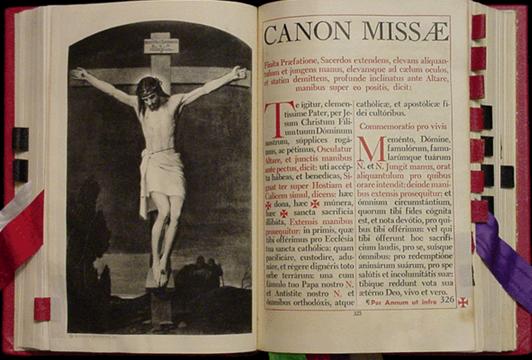
+Rite+(3).jpg)
.jpg)
.jpg)
.png)
.jpg)
.jpg)
.jpg)
.jpg)
.jpg)
.jpg)
.jpg)
.jpg)
.jpg)
.jpg)
.jpg)
.jpg)
.jpg)
.jpg)
.jpg)
.jpg)
.jpg)
.jpg)

.jpg)
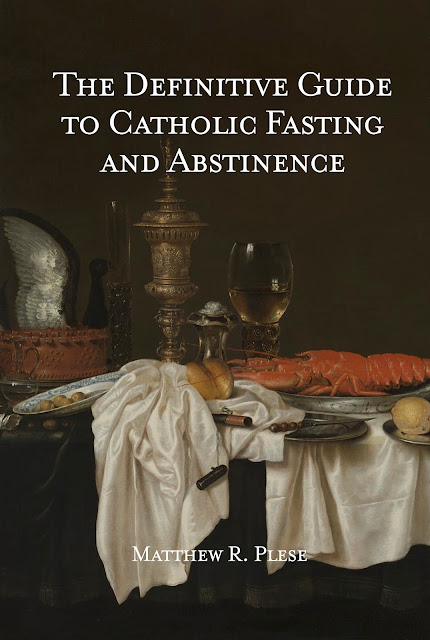
Ember days (corruption from Lat. Quatuor Tempora, four times) are the days at the beginning of the seasons ordered by the Church as days of fast and abstinence. They were definitely arranged and prescribed for the entire Church by Pope Gregory VII (1073-1085) for the Wednesday, Friday, and Saturday after 13 December (S. Lucia), after Ash Wednesday, after Whitsunday, and after 14 September (Exaltation of the Cross). The purpose of their introduction, besides the general one intended by all prayer and fasting, was to thank God for the gifts of nature, to teach men to make use of them in moderation, and to assist the needy. The immediate occasion was the practice of the heathens of Rome. The Romans were originally given to agriculture, and their native gods belonged to the same class.Mark your calendars for this year's September Embertide: September 18, 20, and 21






.jpg)


.jpg)