Thursday, July 28, 2005
The Two Pillars

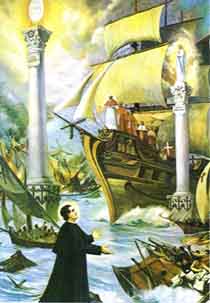
The Vision of St. John BoscoI feel compelled to write this after naming my blog "A Catholic Life" because this story is fundamental in the journey of a Christian life. Everyone will agree that there are many ways to grow in grace. "Grace is first and foremost the gift of the Spirit that sanctifies us", which includes the Spirit working through the Sacraments (CCC 2003). We, unlike the people of the Old Testament, have the greatest grace ever in our hearts at ever Mass when we receive Holy Communion.

Salvation is not possible outside of the Catholic Church (more info). Everyone is called to holiness to be with God through the One True Faith established by Christ, and as today's Gospel illustrates, we must look after ourselves and the state of our soul first and foremost. For the day of the harvest will come, and we must ask ourselves: "If that day was tomorrow, would I be ready?"

I found an article yesterday describing a vision from St. John Bosco, who envisioned the Church as a boat that could only be saved when between two pillars: The Eucharist and Devotion to Mary. This is a vital part of the Christian Life: without the Eucharist we have no hope, and without Mary we lose a powerful intercessor and a loving Mother.

In the dream the boat of the Church was lead by its Pope through the sea with many ships nearing it to attack. Suddenly the Pope falls ill but upon rises up. Then he falls a second time and he dies. The other ships erupt in joy, but a new Pope rises up in the old one's place and steers the vessel between the two pillars -the Eucharist, which the Pillar states is the "Salvation of Souls," and the other pillar is the Immaculate Heart of Mary, which says, "The help of Christians."

Image Source: Believed to be in the Public Domain, Title Unknown
Read more >>
Wednesday, July 27, 2005
Union Between Christ and His Church

I found this in the Catechism of the Catholic Church while looking for quotations concerning Mary. What do you think of this? I think it reaffirms the great importance of the Church first found in Matthew 16:18

The Church—mystery of man's union with God

772 It is in the Church that Christ fulfills and reveals his own mystery as the purpose of God's plan: "to unite all things in him." St. Paul calls the nuptial union of Christ and the Church "a great mystery." Because she is united to Christ as to her bridegroom, she becomes a mystery in her turn. Contemplating this mystery in her, Paul exclaims: "Christ in you, the hope of glory."

773 In the Church this communion of men with God, in the "love [that] never ends," is the purpose which governs everything in her that is a sacramental means, tied to this passing world. "[The Church's] structure is totally ordered to the holiness of Christ's members. And holiness is measured according to the ‘great mystery' in which the Bride responds with the gift of love to the gift of the Bridegroom." Mary goes before us all in the holiness that is the Church's mystery as "the bride without spot or wrinkle." This is why the "Marian" dimension of the Church precedes the "Petrine."

Image Source: Believed to be in the Public Domain, Title Unknown
Read more >>
Weekly Discussion Topics

I am going to take next week off from the weekly discussion topic and see how many people here would like to have this continued. I would like to see how many people like this feature. So, if you like having a weekly discussion topic just let me know by commenting below.

Thanks
Read more >>
Adult Stem Cell Research

Catholics are not opposed to stem cell research but only embryonic stem cell research. The Archdiocese of Sydney just announced they are contributing $100,000 to adult stem cell research.

Adult stem cell research is also more productive than embryonic stem cell reserach. Look at everything that adult stem cells have done. This list in from the IL Right to Life website:
  • Spinal cord injury repair (using stem cells from nasal and sinus regions)
  • Complete reversal of juvenile diabetes in mice using adult spleen cells, with Harvard now preparing for human patient trials using spleen cells
  • Crohn’s Disease put into remission (using patient’s blood stem cells)
  • Lupus put into remission (using stem cells from patient’s bloodstream)
  • Parkinson’s disease put into remission (using patient’s brain stem cells)
  • Repair heart muscle in cases of congestive heart failure (using stem cells from bone marrow)
  • Repair heart attack damage (using the patient’s own blood stem cells)
  • Restore bone marrow in cancer patients (using stem cells from umbilical cord blood)
  • Restore weak heart muscles (using immature skeletal muscle cells)
  • Put leukemia into remission (using umbilical cord blood)
  • Heal bone fractures (using bone marrow cells)
  • Restore a blind man’s sight (using an ocular surface stem-cell transplant & a cornea transplant)
  • Recovery from a stroke (using stem cells from bone marrow)
  • Treat urinary incontinence (using under arm muscle stem cells)
  • Reverse severe combined immunodeficiency (SCID) (using genetically modified adult stem cells)
  • Restore blood circulation in legs (using bone marrow stem cells)
  • Treat sickle-cell anemia (using stem cells from unbilical cord blood)
Read more >>
Tuesday, July 26, 2005
Marian Quotations

What is your favorite Marian quotation? There are so many excellent and loving quotations by Mary. I will just direct my readers to Mary, Mother of God to read some of my articles on her.
Read more >>
Holy Cards


I wanted to share this article that talks about holy cards and what they are for those here that are not Catholic. For a source of many beautiful Holy Cards, please see Holy Cards for Your Inspiration as well as Holy Reflections. Beautiful holy cards are featured on those websites.
Here is part of an article on holy cards:
"From the beginning of the church, it has been important to Christians to maintain practices that help them remember holy men and women whose lives they feel are an inspiration and to whom they can pray for intercession. These practices have included telling stories, singing songs and looking at pictures. Holy cards, which are small cards that bear the image of a saint, angel or scene from the Bible, are part of this tradition" (Catholic Online)

Image Source: Believed to be in the Public Domain, Title Unknown
Read more >>
Saturday, July 23, 2005
Quotations by Pope Benedict XVI

Well, the poll is almost over for this week and the topic will certainly be on Pope Benedict XVI. I wanted to start by writing down some quotations by him that I view as important.

First:

"'Rock' [music]. . . is the expression of elemental passions, and at rock festivals it assumes a cultic character, a form of worship, in fact, in opposition to Christian worship. People are, so to speak, released from themselves by the experience of being part of a crowd and by the emotional shock of rhythm, noise, and special lighting effects. However, in the ecstasy of having all their defenses torn down, the participants sink, as it were, beneath the elemental force of the universe."

"An adult faith does not follow the waves of fashion and the latest novelty."

"We are moving toward a dictatorship of relativism which does not recognize anything as for certain and which has as its highest goal one's own ego and one's own desires."

I believe those three comments show something very important about Our Holy Father; he is very concerned with the Church and is determined to keep us together by Sacred Tradition and Holy Scripture. I believe that secularism is growing too acceptable in the world, and I think the Pope also is concerned that too many are leaving the Church behind - the Church that Christ started out of love for us.

Second:

"Pray for me, that I may not flee for fear of the wolves."

I think this shows his humility and determination to serve Christ although he calls for our prayers. I think more people should also pray for him that he may help lead the Church. For more quotations see EWTN & All Great Quotes. If you wish to continue reading on updates concerning the Holy Father, read the mainpage of my blog and check out Pope Benedict XVI, a page on my blog.
Read more >>
Friday, July 22, 2005
Learning to Forgive

Forgiveness may be one of the hardest aspects of the Christian/Catholic life. Not only must we go to Confession to be forgiven our sins, but we must also forgive those that harm us. As Christ said, "Love thy enemies", but this radical gospel calling is still possible although to answer Christ's calling He must be the visible center of our faith and life.

Forgiveness is something that came from the Cross, where Christ died the death for sins and in doing so redeemed everyone of us. However, we must still repent for our sins, confess them, and forgive others. The road to Heaven is far from easy. Jesus made Heaven possible; He didn't open the door for the unrepentant. At this time, I must also reiterate the value of indulgences.

"Therefore, just as through one man sin entered the world, and death through sin, and thus death spread to all men, because all sinned," but "God did not send His Son into the world to condemn the world but that the world might be saved through Him" (Romans 5:12, John 3:17). Remember, "His mercy endures forever" (Psalm 118:4).

6 steps into forgiveness:

1) We can spend a few minutes every day looking at a cross and considering that Jesus gave up his very life to win forgiveness for us.

2) We can pray constantly to be filled with his perspective of love. Looking at others with eyes of mercy goes a long way toward undercutting the tendency to revenge.

3) We can pray and intercede for those who have wronged, offended, abused, or hurt us. Doing this frees us to love as God loves. God's grace has power not only to change us but also those who have done us injury as well.

4) We can try to perform at least one act of kindness toward someone who has hurt us or who rubs us the wrong way.

5) We can ask the Holy Spirit to cultivate within us an attitude of forgiveness.

6) We can get more serious about following the promptings of the Holy Spirit — especially those that touch on relationships we find difficult. Ask the Holy Spirit to help you find the way to peace, restoration, and reconciliation.

(Source: Catholic Exchange)


Image Source: Believed to be in the Public Domain, Title Unknown
Read more >>
Thursday, July 21, 2005
Book Report: Memory and Identity

http://amzn.to/2v2THmZ
I recently read "Memory and Identity," but I was only able, though, to read the first three parts (about 70 pages) since I have another book I have to read. For the pages I did read, I separated my reports below.

Part One: Good and Evil
Part Two: Freedom
Part Three: Native Land
Read more >>
"Memory and Identity" Part III

This is my summary/opinions for Part Three of "Memory and Identity" by Pope John Paul ll. After this part I had to quit reading the book, though, because I have another book I have to read very, very soon for someone else. Here is my final report for "Memory and Identity".

Part 3:

When we speak of our native land it is more than just a territory; it includes the country’s values and culture. For Pope John Paul ll, we saw how vitally important this was to him, and with Pope Benedict XVI in “Memoirs”, I saw such a fervent love for his own homeland and fellow countrymen. However, in Germany, as Pope Benedict XVI expressed, not all values were good, and this realization of what is good and not is only through God. If we don’t have God then we become our own gods and decided what is good and what is not while no definite opinion remains.

On page 62, Pope John Paul ll wrote “Christ’s teachings contain the most profound elements of a theological vision of both native land and culture.” He went on to write much about these examples, but I also thought of something while reading this: we all are attached to our native land and its values, but we must only remain attached to the values which God would condone; the values mentioned must be in God’s will, which can be summed up as love itself.

Culture is also changing where we develop new lands such as a Christian land, which began from Christ himself. We also believe in Christ’s second coming where we hopefully will reach Heaven where our new homeland, our refuge, exists. Pope John Paul ll loved his homeland of Poland, but he also loved its values as those values God would condone. But, we don’t need to leave our current country and go to Poland; we only need to be with God, and Christ is present first and foremost in the Blessed Sacrament. Christ gave us the Catholic Church, where “catholic” means “universal” showing that Christ is with us through His Church to the end of the ages (Matthew 16:18).

Overall, I found the book very refreshing although at times repetitive. I give it a 6.0/10, and would encourage it.
Read more >>


Copyright Notice: Unless otherwise stated, all items are copyrighted under a Attribution-NonCommercial-NoDerivatives 4.0 International License. If you quote from this blog, cite a link to the post on this blog in your article.

Disclosure of Material Connection: Some of the links on this blog are “affiliate links.” This means if you click on the link and purchase the item, I will receive an affiliate commission. As an Amazon Associate, for instance, I earn a small commission from qualifying purchases made by those who click on the Amazon affiliate links included on this website. I am disclosing this in accordance with the Federal Trade Commission’s 16 CFR, Part 255: “Guides Concerning the Use of Endorsements and Testimonials in Advertising.”