Saturday, August 20, 2005
The DaVinci Protest

With the release of Dan Brown’s “The DaVinci Code” coming to the big screen, a 61-year-old nun protested outside of the cathedral where it was filmed in London for 12 hours by praying the Rosary on the concrete in reparation for the lies of the movie against Jesus.

Many view this book offensive because it states lies about Christ and the Church including that Jesus was married to Mary Magdalene, had a child with her, and she started the papacy. Some claim this is fiction and is no harm, but while I watched the program many people talked about how they believe it as the truth! I’m certainly opposed to a movie like this that distorts the truth, and the Only Truth at that, just to make money.

August 2006 Update: Visit Jesus Decoded and my later post on this.
Read more >>
Let us adore Him

I'm writing this post after the WYD celebrations have concluded but as I put these posts in the archives of my blog I felt that the WYD section would not be complete without Eucharistic Adoration mentioned.

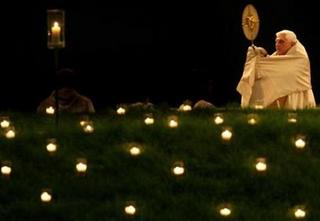
On August 20, 2005, many, many people remained in an all-night Eucharistic Adoration Vigil to adore Our Lord who is truly present (Body, Blood, Soul, and Divinity) in the Eucharist. Eucharistic adoration is indeed a great gift and my favorite form of prayer.

Christ-Haunted posted that beautiful photo above of Pope Benedict XVI during Adoration.

Here is the address of Pope Benedict XVI for the youth vigil:

Dear young friends,

In our pilgrimage with the mysterious Magi from the East, we have arrived at the moment which St Matthew describes in his Gospel with these words: "Going into the house (over which the star had halted), they saw the child with Mary his mother, and they fell down and worshipped him" (Mt 2: 11). Outwardly, their journey was now over. They had reached their goal.

But at this point a new journey began for them, an inner pilgrimage which changed their whole lives. Their mental picture of the infant King they were expecting to find must have been very different. They had stopped at Jerusalem specifically in order to ask the King who lived there for news of the promised King who had been born. They knew that the world was in disorder, and for that reason their hearts were troubled.

They were sure that God existed and that he was a just and gentle God. And perhaps they also knew of the great prophecies of Israel foretelling a King who would be intimately united with God, a King who would restore order to the world, acting for God and in his Name.

It was in order to seek this King that they had set off on their journey: deep within themselves they felt prompted to go in search of the true justice that can only come from God, and they wanted to serve this King, to fall prostrate at his feet and so play their part in the renewal of the world. They were among those "who hunger and thirst for justice" (Mt 5: 6). This hunger and thirst had spurred them on in their pilgrimage - they had become pilgrims in search of the justice that they expected from God, intending to devote themselves to its service.

Even if those who had stayed at home may have considered them Utopian dreamers, they were actually people with their feet on the ground, and they knew that in order to change the world it is necessary to have power. Hence, they were hardly likely to seek the promised child anywhere but in the King's palace. Yet now they were bowing down before the child of poor people, and they soon came to realize that Herod, the King they had consulted, intended to use his power to lay a trap for him, forcing the family to flee into exile.

The new King, to whom they now paid homage, was quite unlike what they were expecting. In this way they had to learn that God is not as we usually imagine him to be. This was where their inner journey began. It started at the very moment when they knelt down before this child and recognized him as the promised King. But they still had to assimilate these joyful gestures internally.

They had to change their ideas about power, about God and about man, and in so doing, they also had to change themselves. Now they were able to see that God's power is not like that of the powerful of this world. God's ways are not as we imagine them or as we might wish them to be.

God does not enter into competition with earthly powers in this world. He does not marshal his divisions alongside other divisions. God did not send 12 legions of angels to assist Jesus in the Garden of Olives (cf. Mt 26: 53). He contrasts the noisy and ostentatious power of this world with the defenceless power of love, which succumbs to death on the Cross and dies ever anew throughout history; yet it is this same love which constitutes the new divine intervention that opposes injustice and ushers in the Kingdom of God.

God is different - this is what they now come to realize. And it means that they themselves must now become different, they must learn God's ways.

They had come to place themselves at the service of this King, to model their own kingship on his. That was the meaning of their act of homage, their adoration. Included in this were their gifts - gold, frankincense and myrrh - gifts offered to a King held to be divine. Adoration has a content and it involves giving. Through this act of adoration, these men from the East wished to recognize the child as their King and to place their own power and potential at his disposal, and in this they were certainly on the right path.

By serving and following him, they wanted, together with him, to serve the cause of good and the cause of justice in the world. In this they were right.

Now, though, they have to learn that this cannot be achieved simply through issuing commands from a throne on high. Now they have to learn to give themselves - no lesser gift would be sufficient for this King. Now they have to learn that their lives must be conformed to this divine way of exercising power, to God's own way of being.

They must become men of truth, of justice, of goodness, of forgiveness, of mercy. They will no longer ask: how can this serve me? Instead, they will have to ask: How can I serve God's presence in the world? They must learn to lose their life and in this way to find it. Having left Jerusalem behind, they must not deviate from the path marked out by the true King, as they follow Jesus.

Dear friends, what does all this mean for us?

What we have just been saying about the nature of God being different, and about the way our lives must be shaped accordingly, sounds very fine, but remains rather vague and unfocused. That is why God has given us examples. The Magi from the East are just the first in a long procession of men and women who have constantly tried to gaze upon God's star in their lives, going in search of the God who has drawn close to us and shows us the way.

It is the great multitude of the saints - both known and unknown - in whose lives the Lord has opened up the Gospel before us and turned over the pages; he has done this throughout history and he still does so today. In their lives, as if in a great picture-book, the riches of the Gospel are revealed. They are the shining path which God himself has traced throughout history and is still tracing today.

My venerable Predecessor Pope John Paul II, who is with us at this moment, beatified and canonized a great many people from both the distant and the recent past. Through these individuals he wanted to show us how to be Christian: how to live life as it should be lived - according to God's way. The saints and the blesseds did not doggedly seek their own happiness, but simply wanted to give themselves, because the light of Christ had shone upon them.

They show us the way to attain happiness, they show us how to be truly human. Through all the ups and downs of history, they were the true reformers who constantly rescued it from plunging into the valley of darkness; it was they who constantly shed upon it the light that was needed to make sense - even in the midst of suffering - of God's words spoken at the end of the work of creation: "It is very good".

One need only think of such figures as St Benedict, St Francis of Assisi, St Teresa of Avila, St Ignatius of Loyola, St Charles Borromeo, the founders of 19-century religious orders who inspired and guided the social movement, or the saints of our own day - Maximilian Kolbe, Edith Stein, Mother Teresa, Padre Pio. In contemplating these figures we learn what it means "to adore" and what it means to live according to the measure of the Child of Bethlehem, by the measure of Jesus Christ and of God himself.

The saints, as we said, are the true reformers. Now I want to express this in an even more radical way: only from the saints, only from God does true revolution come, the definitive way to change the world.

In the last century we experienced revolutions with a common programme - expecting nothing more from God, they assumed total responsibility for the cause of the world in order to change it. And this, as we saw, meant that a human and partial point of view was always taken as an absolute guiding principle. Absolutizing what is not absolute but relative is called totalitarianism. It does not liberate man, but takes away his dignity and enslaves him.

It is not ideologies that save the world, but only a return to the living God, our Creator, the guarantor of our freedom, the guarantor of what is really good and true. True revolution consists in simply turning to God who is the measure of what is right and who at the same time is everlasting love. And what could ever save us apart from love?

Dear friends! Allow me to add just two brief thoughts.

There are many who speak of God; some even preach hatred and perpetrate violence in God's Name. So it is important to discover the true face of God. The Magi from the East found it when they knelt down before the Child of Bethlehem. "Anyone who has seen me has seen the Father", said Jesus to Philip (Jn 14: 9). In Jesus Christ, who allowed his heart to be pierced for us, the true face of God is seen. We will follow him together with the great multitude of those who went before us. Then we will be travelling along the right path.

This means that we are not constructing a private God, we are not constructing a private Jesus, but that we believe and worship the Jesus who is manifested to us by the Sacred Scriptures and who reveals himself to be alive in the great procession of the faithful called the Church, always alongside us and always before us.

There is much that could be criticized in the Church. We know this and the Lord himself told us so: it is a net with good fish and bad fish, a field with wheat and darnel.

Pope John Paul II, as well as revealing the true face of the Church in the many saints that he canonized, also asked pardon for the wrong that was done in the course of history through the words and deeds of members of the Church. In this way he showed us our own true image and urged us to take our place, with all our faults and weaknesses, in the procession of the saints that began with the Magi from the East.

It is actually consoling to realize that there is darnel in the Church. In this way, despite all our defects, we can still hope to be counted among the disciples of Jesus, who came to call sinners.

The Church is like a human family, but at the same time it is also the great family of God, through which he establishes an overarching communion and unity that embraces every continent, culture and nation. So we are glad to belong to this great family that we see here; we are glad to have brothers and friends all over the world.

Here in Cologne we discover the joy of belonging to a family as vast as the world, including Heaven and earth, the past, the present, the future and every part of the earth. In this great band of pilgrims we walk side by side with Christ, we walk with the star that enlightens our history.

"Going into the house, they saw the child with Mary his mother, and they fell down and worshipped him" (Mt 2: 11). Dear friends, this is not a distant story that took place long ago. It is with us now. Here in the Sacred Host he is present before us and in our midst. As at that time, so now he is mysteriously veiled in a sacred silence; as at that time, it is here that the true face of God is revealed. For us he became a grain of wheat that falls on the ground and dies and bears fruit until the end of the world (cf. Jn 12: 24).

He is present now as he was then in Bethlehem. He invites us to that inner pilgrimage which is called adoration. Let us set off on this pilgrimage of the spirit and let us ask him to be our guide. Amen.

© Copyright 2005 - Libreria Editrice Vaticana

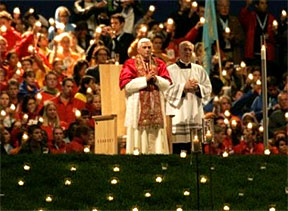
Other Images:

(AP Photo/Thomas Kienzle)

The purple areas are the youth in attendance:

(AP Photo/WJT, Hacky Hagemeyer)
Read more >>
The Ladder to Heaven

"Apart from the cross, there is no other ladder by which we may get to heaven" -- St. Rosa de Lima.

Image Source: Believed to be in the Public Domain
Read more >>
St. Bernard of Clairvaux

Memorial (1969 Calendar): August 20
Double (1955 Calendar): August 20

Today the Church remembers St. Bernard of Clairvaux (1090-1153), abbot and Doctor of the Church, who was canonized, 21 years after his death. He is referred to as the second founder of the Cistercians, the Mellifluous Doctor, the Apostle of the Crusades, the miracle-worker, the reconciler of kings, the leader of peoples, and the counselor of popes. In 1830, he was given the title of Doctor of the Church by Pope Pius VIII.

He was born in 1090, the third son of a noble Burgundian family. At an early age he was sent to college at Chatillon. He studied Holy Scripture and Theology. St. Bernard, at the age of 22, entered the monastery of Citeaux (where the Cistercian order began) following the death of his mother and fearing the ways of the world. He convinced 25 other youths in the noble class as well as four his brothers to follow him. His father and a fifth brother later followed. St. Stephen, the abbot at Citeaux, after seeing the great progress of Bernard in the spiritual life, sent him with twelve monks to found a new monastery. St. Bernard would found the famous Abbey of Clairvaux. St. Bernard became abbot in 1115; he founded numerous other monasteries too. St. Bernard dedicated his work, De Consideratione, to his disciple, Bernard of Pisa, who later became Pope Eugene III. Pope Eugene III later asked St. Bernard to preach the second Crusade, so St. Bernard traveled France and Germany preaching. After the failure of the crusade, some people turned on St. Bernard. St. Bernard countered by saying that the knights failed because of their sinfulness.

St. Bernard's influence on the princes, clergy, and people of his time was remarkable. He was an advisor to King Louis the Fat and King Louis the Young. St. Bernard attended the Second Lateran Council and both fought Albigensianism and helped to end the schism of anti-Pope Anacletus II. He was also endowed with the gift of miracles. He died on August 20, 1153. St. Bernard was the first Cistercian monk placed on the calendar of saints. He was canonized just 21 years after his death by Pope Alexander III. In 1830 Pope Pius VIII declared him a Doctor of the Church.

Traditional Matins Reading:

Bernard was born of a distinguished family at Fontaines in Burgundy. As a youth, on account of his great beauty he was much Bought after by women, but could never be shaken in his resolution of observing chastity. To escape these temptations of the devil, he, at twenty-two years of age, determined to enter the monastery of Citeaux, the first house of the Cistercian Order, then famous for sanctity. When his brothers learnt Bernard’s design, they did their best to deter him from it; but he, more eloquent and more successful, won them and many others to his opinion; so that together with him thirty young men embraced the Cistercian Rule. As a monk he was so given to fasting, that whenever he had to take food he seemed to be undergoing torture. He applied himself in a wonderful manner to prayer and watching, and was a great lover of Christian poverty; thus he led a heavenly life on earth, free from all anxiety or desire of perishable goods.

The virtues of humility, mercy, and kindness shone conspicuously in his character. He devoted himself so earnestly to contemplation, that he seemed hardly to use his senses except to do acts of charity, and in these he was remarkable for his prudence. While thus occupied he refused the bishoprics of Genoa, Milan, and others, which were offered to him, declaring that he was unworthy of so great an office. He afterwards became Abbot of Clairvaux, and built monasteries in many places, wherein the excellent rules and discipline of Bernard long flourished. When the monastery of SS. Vincent and Anastasius of Rome was restored by Pope Innocent II, St. Bernard appointed as Abbot the future Sovereign Pontiff, Eugenius III; to whom he also sent his book 'De Considera tione.'

He wrote many other works which clearly show that his doctrine was more the gift of God than the result of his own labours. On account of his great reputation for virtue, the greatest princes begged him to act as arbiter in their disputes, and he went several times into Italy for this purpose, and for arranging ecclesiastical affairs. He was of great assistance to the Supreme Pontiff Innocent II in putting down the schism of Peter de Leone, both at the courts of the emperor and of King Henry of England, and at a Council held at Pisa. At length, being sixty-three years old, he fell asleep in the Lord. He was famous for miracles, and Pope Alexander III placed him among the saints. Pope Pius VIII, with the advice of the Sacred Congregation of Rites, declared St. Bernard a Doctor of the universal Church, and commanded all to recite the Mass and Office of a Doctor on his feast. He also granted a plenary indulgence yearly for ever, to all who visit churches of the Cistercian Order on this day.

Quotation:

“In dangers, in doubts, in difficulties, think of Mary, call upon Mary. Let not her name depart from your lips, never suffer it to leave your heart. And that you may more surely obtain the assistance of her prayer, neglect not to walk in her footsteps. With her for guide, you shall never go astray; while invoking her, you shall never lose heart; so long as she is in your mind, you are safe from deception; while she holds your hand, you cannot fall; under her protection you have nothing to fear; if she walks before you, you shall not grow weary; if she shows you favor, you shall reach the goal.”

Doctor Mellifluus:
The "Doctor Mellifluus," "the last of the Fathers, but certainly not inferior to the earlier ones,"[1] was remarkable for such qualities of nature and of mind, and so enriched by God with heavenly gifts, that in the changing and often stormy times in which he lived, he seemed to dominate by his holiness, wisdom, and most prudent counsel. Wherefore, he has been highly praised, not only by the sovereign Pontiffs and writers of the Catholic Church, but also, and not infrequently, by heretics. Thus, when in the midst of universal jubilation, Our predecessor, Alexander III, of happy memory, inscribed him among the canonized saints, he paid reverent tribute when he wrote: "We have passed in review the holy and venerable life of this same blessed man, not only in himself a shining example of holiness and religion, but also shone forth in the whole Church of God because of his faith and of his fruitful influence in the house of God by word and example; since he taught the precepts of our holy religion even to foreign and barbarian nations, and so recalled a countless multitude of sinners . . . to the right path of the spiritual life."[2] "He was," as Cardinal Baronius writes, "a truly apostolic man, nay, a genuine apostle sent by God, mighty in work and word, everywhere and in all things adding luster to his apostolate through the signs that followed, so that he was in nothing inferior to the great apostles, . . . and should be called . . . at one and the same time an adornment and a mainstay of the Catholic Church."[3]
ENCYCLICAL OF POPE PIUS XII ON ST. BERNARD OF CLAIRVAUX, THE LAST OF THE FATHERS MAY 24, 1953

Prayer:

O God, Who didst give blessed Bernard to Thy people as a minister of eternal salvation: grant, we beseech Thee, that we, who have had him for our teacher on earth, may deserve to have him for our advocate in heaven. Through our Lord.

Prayer Source: 1962 Roman Catholic Daily Missal
Read more >>
Favorite Saint

Since I'm going to start a weekly topic on a saint I wanted to ask a question:

Who is your favorite saint and why?
Read more >>
Why have a Mass for a Deceased Loved One?

Q: What is the Mass?

Mass is the Sacrifice of Christ on the Cross and for that reason, it is by definition efficacious.  We are present at Calvary.  Rather than merely remembering the life and death of Christ, we are present at it and partake of its eternal fruits which flow to us from the altar when the priest stands in the place of Christ and offers the Eternal Victim on the altar to God.  

Q: What is the value of the Mass?

The Miraculous Value of the Holy Mass is well documented by a number of the saints whose inspiring writings and visions bear testimony to this: “My son, if men only knew the value of the Holy Mass, they would be forever on their knees listening to it” (Padre Pio to Vittorio Chimetto)

The Holy Mass is the renewal of the sacrifice of the Cross”. It is the sacrifice that detains Divine justice, that rules the entire Church, that saves the world. In the hour of death, the Masses that you have devoutly attended will be your greatest consolation. In each Mass the temporal suffering due to your sins is diminished in accordance with the degree of commitment you bring to it. In each Mass, Jesus forgives you the venial sins you have not confessed but have repented. In each Mass, Satan’s dominion over you is reduced. One Mass heard by you in your life does more good than many that may be heard for you after your death. In each Mass, you are given protection against dangers and misfortunes that would otherwise have befallen you. With each Mass your time in Purgatory is reduced. The Holy Sacrifice is the most effective of prayers, over and above all other prayers, good works and penance; by its own virtue it immediately and infallibly produces effect in favour of souls. Each Mass procures for you a higher grade of glory in Heaven. And you are blessed also in your personal affairs and interests. “If we only knew the worth of the Holy Sacrifice of the Mass,with how much greater zeal we would listen it” (the Holy Cure of Ars).

“You must be aware, Christian, that the Mass is the most sacred act of religion: you can do nothing more glorious for God, nor more advantageous for your soul, that to piously and as frequently as possible attend Mass” (B.B Eymard)

“It is worth more to hear a single Mass that to distribute all your riches among the poor and to make pilgrimage throughout the whole earth” (St. Bernard).

“The Lord grants us all we ask of him in the Holy Mass, and what’s more, He grants us even what we do not think of asking but which we also need!" (St Girolamo).

“Be sure”, Jesus said to St. Gertrude, “that to the one who listens devoutly to the Holy Mass, in the last moments of life, I will send him many of my Saints to comfort and protect him, in accordance with the Masses he has attended well” (Book 3, chapter 16.)

So to summarize, we wish to make clear that the Mass truly is the Sacrifice of Christ on the Cross.  


Q. Since the Mass is the same as the Sacrifice of Christ on the Cross, Why Is One Mass Said Not Necessarily Sufficient to Free A Soul From Purgatory?

On this question, The Purgatorian Manual well explains:

"The Sacrifice of the Mass is the great devotion of the Catholic Church, and, of all means to assist the souls in Purgatory, none is more valuable or meritorious; for there Jesus Christ offers Himself and His infinite merits to His Heavenly Father, by the hands of the Priest, in behalf of the suffering souls. The unbloody Sacrifice of the Mass does not essentially differ from the sacrifice of the cross, but only accidentally as to the mode of oblation, and no limit can be placed to the effect of this great sacrifice, which contains in itself all graces. From this inestimable efficacy, however, we may not infer that the offering of one Mass is sufficient to release the souls we love; for, though the Sacrifice on Calvary was infinite, we cannot conclude that the application of it, through the Mass, must also be infinite. St. Thomas Aquinas tells us, it was not the intention of Jesus Christ to bestow the full efficacy of His suffering and death, which is celebrated in every Mass, upon us; His merits are applied according to His Adorable Will, for the ways of God are often inscrutable. It is very salutary, therefore, to have the Holy Sacrifice offered frequently for the repose of a soul. Should the souls who are dear to us, for whom we intercede in this manner, be already in the enjoyment of eternal will bestow the merit of the Masses offered on other suffering souls."

Q: When a Mass is said for the soul of a deceased loved one, does this help lessen the soul's time in purgatory?

A: Just as we pray for others here on earth, we are encouraged by the Church to pray for souls who may be in purgatory. Why? We are all in need of grace to come into the perfection of charity. We cannot enter heaven if we have not been completely cleansed of sin and all punishment due to sin.

Since the Mass is the "source and summit" of the Christian Life, we naturally look to that Holy Sacrifice of Christ, containing the perfect prayer, to offer for our deceased relatives and friends who may still need the help of our prayers. Priests are under a strict obligation to remember in a special way the person for whom the Mass is being offered. Often you will hear the priests say the name of the person in the part of the Mass which specifically remembers those who have gone before us. Sometimes the intention for the Mass is listed in the bulletin or announced before the Mass.

We can't really speak of "time" since the deceased person has entered eternity, but we can speak in terms of "final purification" before entrance into heaven. We believe that a Mass offered for a departed relative or friend may help hasten that final purification which he/she may still be undergoing in purgatory.  So yes, a Mass does help lessen the soul's time in purgatory.

And since the Mass truly is the Sacrifice of Jesus on the Cross, it is the most perfect prayer and sacrifice.  As such, there is nothing more glorious that we can offer to God on behalf of souls.


Q: How exactly can I have a Mass said for the repose of the soul of a friend/relative?

A: Ask a priest to offer a Mass for the intention of the repose of the soul of your friend or relative. We also highly encourage having Gregorian Masses said for the repose of the deceased. These pious practices are truly worthwhile. For more information on Gregorian Masses and how to have one offered, see the American TFP Website

Separately from Gregorian Masses, see the Regina Caeli Purgatorial Society and enroll as many souls as you would like.  There is no cost. For other places where you can request Tridentine Masses for the souls of the departed, please click here.

Q. What Indulged Prayers May I Offer for the Benefit of my loved one's soul?

For a listing of hundreds of prayers with indulgences and special blessings attached to them, be sure to refer to a copy of the Raccolta oftenAnd for a list of other private works that you can do for the souls of the dead in purgatory (e.g. heroic acts of charity, fasting, etc) please click here.

Related Posts:
Read more >>
Friday, August 19, 2005
More on World Youth Day (August 19)

Today Pope Benedict XVI continued World Youth Day with the Way of the Cross, also called the Stations of the Cross, as well as his visit to a synagogue and his address to seminarians at the Church of St. Pantaleon in Cologne, Germany. He also attended an ecumenical gathering in Cologne today. [False Ecumenism it seems]

Here is his address to the seminarians:


Dear Brothers in the Episcopate and in the Priesthood, Dear Seminarians,

I greet all of you with great affection and gratitude for your festive welcome and particularly for the fact that you have come to this gathering from so many countries the world over. Here we are truly a spectacular image of the Catholic Church in the world.

I thank especially the seminarian, the priest and the Bishop who have given us their own personal witness. I must say that I was moved to see these paths on which the Lord has guided these men in an unexpected way and not according to their own projects.

I cordially thank you and am very pleased to have this meeting. I had asked - and this has already been said - that the programme of these days in Cologne should include a special meeting with young seminarians, so that the vocational dimension would truly emerge in all of its importance, since it plays an evermore important role in the World Youth Days. It seems to be that the rain too that is falling down from heaven is a blessing.

You are seminarians, that is to say, young people devoting an intense period of your lives to seeking a personal relationship with Christ, an encounter with him, in preparation for your important mission in the Church. This is what a seminary is: more than a place, it is a significant time in the life of a follower of Jesus.

I can imagine the echo that resounds in your hearts from the words of the theme of this 20th World Youth Day - "We have come to worship him" - and the entire moving narration of the searching and finding of the Wise Men. Each in his own way - we consider the three witnesses we have just heard - like them, they see a star, set out on their journey, they too must face what is unclear and are able to arrive at their destination under God's guidance.

This evangelical passage of the Wise Men who search out and find Jesus has a special meaning precisely for you, dear seminarians, because you are on an authentic journey, engaged in discerning - and this is a true journey - and confirming your call to the priesthood. Let us pause and reflect on this theme.

Why did the Magi set off from afar to go to Bethlehem? The answer has to do with the mystery of the "star" which they saw "in the East" and which they recognized as the star of the "King of the Jews", that is to say, the sign of the birth of the Messiah (cf. Mt 2: 2). So their journey was inspired by a powerful hope, strengthened and guided by the star, which led them towards the King of the Jews, towards the kingship of God himself. This is the meaning behind our journey: to serve the kingship of God in the world.

The Magi set out because of a deep desire which prompted them to leave everything and begin a journey. It was as though they had always been waiting for that star. It was as if the journey had always been a part of their destiny, and was finally about to begin.

Dear friends, this is the mystery of God's call, the mystery of vocation. It is part of the life of every Christian, but it is particularly evident in those whom Christ asks to leave everything in order to follow him more closely.

The seminarian experiences the beauty of that call in a moment of grace which could be defined as "falling in love". His soul is filled with amazement, which makes him ask in prayer: "Lord, why me?". But love knows no "why"; it is a free gift to which one responds with the gift of self.

The seminary years are devoted to formation and discernment. Formation, as you well know, has different strands which converge in the unity of the person: it includes human, spiritual and cultural dimensions. Its deepest goal is to bring the student to an intimate knowledge of the God who has revealed his face in Jesus Christ.

For this, in-depth study of Sacred Scripture is needed, and also of the faith and life of the Church in which the Scripture dwells as the Word of life. This must all be linked with the questions prompted by our reason and with the broader context of modern life.

Such study can at times seem arduous, but it is an indispensable part of our encounter with Christ and our vocation to proclaim him. All this is aimed at shaping a steady and balanced personality, one capable of receiving validly and fulfilling responsibly the priestly mission.

The role of formators is decisive: the quality of the presbyterate in a particular Church depends greatly on that of the seminary, and consequently on the quality of those responsible for formation.

Dear seminarians, for this very reason we pray today with genuine gratitude for your superiors, professors and educators, who are spiritually present at this meeting. Let us ask the Lord to help them carry out as well as possible the important task entrusted to them.

The seminary years are a time of journeying, of exploration, but above all of discovering Christ. It is only when a young man has had a personal experience of Christ that he can truly understand the Lord's will and consequently his own vocation.

The better you know Jesus the more his mystery attracts you. The more you discover him, the more you are moved to seek him. This is a movement of the Spirit which lasts throughout life, and which makes the seminary a time of immense promise, a true "springtime".

When the Magi came to Bethlehem, "going into the house they saw the child with Mary his mother, and they fell down and worshiped him" (Mt 2: 11). Here at last was the long-awaited moment: their encounter with Jesus.

"Going into the house": this house in some sense represents the Church. In order to find the Saviour, one has to enter the house, which is the Church.

During his time in the seminary, a particularly important process of maturation takes place in the consciousness of the young seminarian: he no longer sees the Church "from the outside", but rather, as it were, "from the inside", and he comes to sense that she is his "home", inasmuch as she is the home of Christ, where "Mary his mother" dwells.

It is Mary who shows him Jesus her Son; she introduces him and in a sense enables him to see and touch Jesus, and to take him into his arms. Mary teaches the seminarian to contemplate Jesus with the eyes of the heart and to make Jesus his very life.

Each moment of seminary life can be an opportunity for loving experience of the presence of Our Lady, who introduces everyone to an encounter with Christ in the silence of meditation, prayer and fraternity. Mary helps us to meet the Lord above all in the celebration of the Eucharist, when, in the Word and in the consecrated Bread, he becomes our daily spiritual nourishment.

"They fell down and worshiped him... and offered him gifts: gold, frankincense and myrrh" (Mt 2: 11-12). Here is the culmination of the whole journey: encounter becomes adoration; it blossoms into an act of faith and love which acknowledges in Jesus, born of Mary, the Son of God made man.

How can we fail to see prefigured in this gesture of the Magi the faith of Simon Peter and of the other Apostles, the faith of Paul and of all the saints, particularly of the many saintly seminarians and priests who have graced the 2,000 years of the Church's history?

The secret of holiness is friendship with Christ and faithful obedience to his will. St Ambrose said: "Christ is everything for us"; and St Benedict warned against putting anything before the love of Christ.

May Christ be everything for you. Dear seminarians, be the first to offer him what is most precious to you, as Pope John Paul II suggested in his Message for this World Youth Day: the gold of your freedom, the incense of your ardent prayer, the myrrh of your most profound affection (cf. n. 4).

The seminary years are a time of preparing for mission. The Magi "departed for their own country" and most certainly bore witness to their encounter with the King of the Jews.

You too, after your long, necessary programme of seminary formation, will be sent forth as ministers of Christ; indeed, each of you will return as an alter Christus.

On their homeward journey, the Magi surely had to deal with dangers, weariness, disorientation, doubts. The star was no longer there to guide them! The light was now within them. Their task was to guard and nourish it in the constant memory of Christ, of his Holy Face, of his ineffable Love.

Dear seminarians! One day, God willing, by the consecration of the Holy Spirit you too will begin your mission. Remember always the words of Jesus: "Abide in my love" (Jn 15: 9). If you abide close to Christ, with Christ and in Christ, you will bear much fruit, just as he promised. You have not chosen him - we have just heard this in the witnesses given -, he has chosen you (cf. Jn 15: 16).

Here is the secret of your vocation and your mission! It is kept in the Immaculate Heart of Mary, who watches over each one of you with a mother's love. Have recourse to Mary, often and with confidence.

I assure you of my affection and my daily prayers. And I bless all of you from my heart.

© Copyright 2005 - Libreria Editrice Vaticana


Image Source: Believed to be in the Public Domain
Read more >>
Some Saintly Topics

I was thinking of starting a weekly project, where we can all talk about a certain saint for that week. I could put up a poll for what saint, and when we have a saint we can talk about their life and debate on their signfigance to the Church. We also can look at devotions to them. I could even learn a lot.

Would anyone here like to participate in this?
Read more >>
Thursday, August 18, 2005
Do Small Things With Great Love

Those words of St. Therese are found through doing the little things in life - like putting a bumper sticker on your car: "Abortion stops a beating heart".

I just read on the blog, Open Wide the Doors to Christ, about a woman that changed her mind on having an abortion just by reading one of those bumper stickers. What a great story of how the little things can be great!
Read more >>
Litany of Humility

I found a prayer online called the "Litany of Humility". Humility is indeed a rare virtue so I felt it wise to share a special prayer for humility. The Beatitudes even mention the grace of being meek and humble in Matthew 5:3-12.


For Private Devotion Only.

O Jesus! Meek and humble of heart, hear me.

From the desire of being esteemed, deliver me Jesus

From the desire of being loved, deliver me Jesus

From the desire of being extolled, deliver me Jesus

From the desire of being honored, deliver me Jesus

From the desire of being praised, deliver me Jesus

From the desire of being preferred, deliver me Jesus

From the desire of being consulted, deliver me Jesus

From the desire of being approved, deliver me Jesus.

From the fear of being humiliated, deliver me Jesus

From the fear of being despised, deliver me Jesus

From the fear of suffering rebukes, deliver me Jesus

From the fear of being calumniated, deliver me Jesus

From the fear of being forgotten, deliver me Jesus

From the fear of being ridiculed, deliver me Jesus

From the fear of being wronged, deliver me Jesus

From the fear of being suspected, deliver me Jesus

That others may be loved more than I, Jesus, grant me the grace to desire it.

That others may be esteemed more than I, Jesus, grant me the grace to desire it

That in the opinion of the world, others may increase and I may decrease, Jesus, grant me the grace to desire it.

That others may be chosen and I set aside, Jesus, grant me the grace to desire it.

That others may be praised and I unnoticed, Jesus, grant me the grace to desire it.

That others may be preferred to me in everything, Jesus, grant me the grace to desire it.

That others become holier than I, provided that I may become as holy as I should, Jesus, grant me the grace to desire it.
Read more >>
World Youth Day Address

Pope Benedict XVI is in Cologne, Germany right now for World Youth Day and can be watched on EWTN. His opening address (in several languages) was very enlightening and welcoming especially the ending where He stated that by inviting Christ into our life we lose nothing but rather Christ will then bring all things in us to perfection. The following is his address from the River Rhine.

Dear young people, the happiness you are seeking, the happiness you have a right to enjoy has a name and a face: it is Jesus of Nazareth, hidden in the Eucharist. Only he gives the fullness of life to humanity! With Mary, say your own "yes" to God, for he wishes to give himself to you.

I repeat today what I said at the beginning of my Pontificate: "If we let Christ into our lives, we lose nothing, nothing, absolutely nothing of what makes life free, beautiful and great. No! Only in this friendship are the doors of life opened wide. Only in this friendship is the great potential of human existence truly revealed. Only in this friendship do we experience beauty and liberation" (Homily at the Mass of Inauguration, 24 April 2005).

Be completely convinced of this: Christ takes from you nothing that is beautiful and great, but brings everything to perfection for the glory of God, the happiness of men and women, and the salvation of the world.

In these days I encourage you to commit yourselves without reserve to serving Christ, whatever the cost. The encounter with Jesus Christ will allow you to experience in your hearts the joy of his living and life-giving presence, and enable you to bear witness to it before others. Let your presence in this city be the first sign and proclamation of the Gospel, thanks to the witness of your actions and your joy.

Let us raise our hearts in a hymn of praise and thanksgiving to the Father for the many blessings he has given us and for the gift of faith which we will celebrate together, making it manifest to the world from this land in the heart of Europe, a Europe which owes so much to the Gospel and its witnesses down the centuries.

And now I shall go as a pilgrim to the Cathedral of Cologne, to venerate the relics of the holy Magi who left everything to follow the star which was guiding them to the Saviour of the human race. You too, dear young people, have already had, or will have, the opportunity to make the same pilgrimage.

Read more: Vatican


Later in the day, the Holy Father visited the Cathedral in Rome and prayed before the relics of the Magi. Read his address there.

Photo Source: AP Photo/Patrick Hertzog, pool

Read more >>
Wednesday, August 17, 2005
My Heart is Ready

Before Jesus was scourged in the film "The Passion of the Christ", He said, looking to Heaven: "My heart is ready" yet the pain afterward was so tremendous few people could probably watch. I found an excellent article on this over on Catholic Exchange.

Image Source: Believed to be in the Public Domain, Title Unknown
Read more >>
Eucharistic Adoration, Exposition, and Benediction of the Blessed Sacrament


The Holy Eucharist is not just a symbol of God but actually is Jesus Christ's body, blood, soul, and divinity. The Eucharist is God! For more information on the Eucharist, see my page on the Eucharist.

What is Eucharistic Adoration?

Eucharistic Adoration is a special deep time of prayer. It is the adoration of Our Lord, who is truly present in the Eucharistic Host.  The bread and wine at Mass each become and remain the Sacred Body, Blood, Soul, and Divinity of Jesus.  In Eucharistic Adoration, we pray before the Eucharistic Host either in a monstrance or in the tabernacle. There are no set prayers during Adoration. People can pray the Rosary, the Litany of the Sacred Heart, or personal prayers. 

"Perpetual Eucharistic Adoration is the adoration of Jesus Christ present in the Holy Eucharist. In the many churches that have this adoration, the Eucharist is displayed in a special holder called a monstrance, and people come to pray and worship Jesus continually throughout the day and often the night. Christ’s great love for us was shown when he was crucified on the cross to pay the penalty for our sins and give us eternal life. He loves us without limit, and offers Himself to us in the Holy sacrament of the Eucharist. Can we not give Jesus a few minutes of love and adoration in return?" (Real Presence Association)

What is Exposition of the Blessed Sacrament?

We can always pray to our Lord in the tabernacle. But sometimes our Lord is taken out of the tabernacle by a priest and placed in a monstrance. This is called Exposition of the Blessed Sacrament, which is done for us to adore our Lord. The Exposition of the Most Blessed Sacrament typically traditionally begins with the recitation of the “O Salutaris Hosti.”

Some parishes have perpetual adoration chapels where you can visit and adore our Lord Jesus Christ at any time. Many saints would adore Jesus in the Eucharist for one hour a day. One of the most important life changes you can make is finding one hour each week to leave work or school or friends aside and just be present in adoration before Jesus. It can be a tremendous source of graces for you.

Find out if your parish has a time for Adoration. If not, find a nearby parish that does.

What is Benediction of the Blessed Sacrament?

In addition to Eucharistic Adoration, find a parish that offers Benediction of the Blessed Sacrament. Benediction starts with Exposition. After the O Salutaris Hostia is sung there is a period of silence when we may pray before Our Lord. After this period of silent prayer, the priest will often say the Divine Praises and the hymn, Tantum Ergo. He will then put on a special garment called a humeral veil and bless you with Jesus in the Blessed Sacrament. There are special indulgences associated with Eucharistic Adoration and Benediction.

Find out if your parish has Benediction. Some churches offer Benediction, usually on Sunday afternoons or Thursdays. If not, find a parish in your Diocese that does have Benediction. Attend Benediction within the next month.
Read more >>
Tuesday, August 16, 2005
World Youth Day Opens

Today World Youth Day opens and marks the 10th annual gathering of youth. This is an event that began under Pope John Paul ll and attempts to bring youth together, although it seems to be just another WoodStock and not in any manner an authentically Catholic retreat. I do not support World Youth Days for the debauchery, immodesty, and sacrilege which have come from these events.

So far there have been 405,000 registered individuals comprised of 101,174 Italians, 38,549 French, 31,908 Spanish and 24,237 Americans with 191 countries and territories being represented.

Now, some claim that World Youth Day attracted only those wishing to see Pope John Paul ll as a celebrity and not a religious leader, and there are no statistics available to how it helped increase the number of Catholics.

Also, I'm following it through a blog I found by a priest attending World Youth Day. Visit the blog, Coragio, to see more, though I do not necessarily endorse any views expressed on that website.
Read more >>
A Daily Reminder: The Crucifix


One very easy way to remember Our Lord's love and mercy is to either wear a crucifix or place one on our walls, typically above the bed. It is also important that we should wear a crucifix (a cross with Christ's body on it) instead of a Cross because it is through Jesus' Cross that we reach the Resurrection. Let us not forget Our Lord's sacrifice.

Some claim that since Jesus is resurrected He should not be on the cross, but if you look at it that way then we should show an empty tomb, not an empty cross. If there was an empty cross then this would be our faith - eternal death, the price of sin (Romans 5:12). But Jesus Christ, who is true Man and true God, chose to pay the price for us (1 Cor 15:3) and died for us even when He did not have to do anything of the such. Jesus never had to enter the Virgin's womb, but He chose to do it so that we might have eternal life with Him. An empty cross for each of us was our destiny, but God chose to free us from the penalty of sin that we willingly deserved. 

Every time we sin we will have only caused Our Lord greater pain on His Cross, so let us remember His sacrifice today, especially in the sorrowful mysteries of the Rosary, and thank Him for pardoning us for the sins we willingly commit.

It was Our Lord, Jesus Christ, that prepared the way for us, and we too must follow Him believing that if we die with Him we shall also rise with Him. "Whoever does not carry the cross and follow me is not worthy of me" (Matthew 10:38).

"The crucifix should be present in public and private places because this external symbol of God's presence is a reminder of humanity's shared God-given dignity" (Pope Benedict XVI, August 18, 2005)
Read more >>
Monday, August 15, 2005
Assumption of Mary


Double of the I Class with a Common Octave (1954 Calendar): August 15
First Class (1962 Calendar): August 15
Solemnity (1969 Calendar): August 15 

Today on August 15th we celebrate the Assumption of the Blessed Virgin Mary, where we profess our belief in the Dogma that Mary was assumed into Heaven body and soul by the power of God. This is a Dogma of the faith and must be believed to be Catholic; it has been taught since the early Church to the present day with allusions in the Sacred Scriptures.

The Assumption has been believed and celebrated since the earliest times of Christianity. Today's feast was celebrated under various names (Commemoration, Dormition, Passing, Assumption) from at least the fifth or sixth century. Homilies concerning the Assumption go back to at least the Sixth Century. However, in order to make it a dogma of the faith meaning all Catholics must believe it, Pope Pius XII dogmatically declared Mary's Assumption into Heaven in 1950:

"... by the authority of our Lord Jesus Christ, of the Blessed Apostles Peter and Paul, and by our own authority, we pronounce, declare, and define it to be a divinely revealed dogma: that the Immaculate Mother of God, the ever Virgin Mary, having completed the course of her earthly life, was assumed body and soul into heavenly glory" (Munificentissimus Deus)

The Eastern Churches (which are still in union with Rome) refer to today as the Dormition as opposed to the Assumption because they believe that Mary died and was then assumed into Heaven. As Roman Catholics in the Latin Rite, we are free to believe that Mary died and then was assumed into Heaven or that she didn't die but right before her death she was assumed into Heaven.

Some claim that the Assumption never happened because it is not in the Scriptures, but remember that the Bible deals with God, not Mary. The Bible does not deal with the earthy end of any of the original disciples after the Gospel ends.

Remember, today is a Holy Day of Obligation, meaning all Catholics must attend Mass.

The Early Church Believed in the Assumption

Pope Pius XII in his dogmatic proclamation mentioned or quoted St. Anthony of Padua, St. Damascene, St. Albert the Great, St. Thomas Aquinas, St. Bonaventure, St. Robert Bellarmine, St. Alphonsus Liguori, St. Peter Canisius, and Suarez, all of whom either outright supported the Assumption or at least did not deny it. For instance, St. John Damascene (675-749) states:

“It was fitting that she, who had kept her virginity intact in childbirth, should keep her own body free from all corruption even after death. It was fitting that she, who had carried the Creator as a child at her breast, should dwell in the divine tabernacles. It was fitting that the spouse, whom the Father had taken to himself, should live in the divine mansions. It was fitting that she, who had seen her Son upon the cross and who had thereby received into her heart the sword of sorrow which she had escaped in the act of giving birth to him, should look upon him as he sits with the Father. It was fitting that God’s Mother should possess what belongs to her Son, and that she should be honored by every creature as the Mother and as the handmaid of God” (Encomium in Dormitionem Dei Genetricis Semperque Virginis Mariae, Hom. II, n. 14; cf. also ibid, n. 3.).

Shockingly to Protestants, even Martin Butzer, a contemporary of Martin Luther, wrote, “Indeed, no Christian doubts that the most worthy Mother of the Lord lives with her beloved Son in heavenly joy” (Marienlexikon, vol. 3, 200)!

To deny the Assumption of Our Lady is to deny an unquestionable historical fact affirmed by centuries of Christians. Those who deny the Assumption fall prey to the errors which St. Paul warned of when he wrote, “For there shall be a time, when they will not endure sound doctrine; but, according to their own desires, they will heap to themselves teachers, having itching ears” (2 Timothy 4:3).


Purgatory:

Please pray for the Souls in Purgatory today. It is written that at the time of Mary’s Assumption, all of purgatory was emptied, and the souls detained there accompanied her in her triumphant entry into Heaven. St. Bernardine of Siena also states that through her prayers and the application of her own merits, the Virgin has the power of freeing souls, especially her devotees, from purgatory. St. Peter Damian attests that every year on the Feast of the Assumption (August 15), the Virgin liberates thousands of souls.

Scripture:

"God’s temple in heaven was opened, and the ark of his covenant could be seen in the temple. A great sign appeared in the sky, a woman clothed with the sun, with the moon under her feet, and on her head a crown of twelve stars. She was with child and wailed aloud in pain as she labored to give birth.

"Then another sign appeared in the sky; it was a huge red dragon, with seven heads and ten horns, and on its heads were seven diadems. Its tail swept away a third of the stars in the sky and hurled them down to the earth. Then the dragon stood before the woman about to give birth, to devour her child when she gave birth. She gave birth to a son, a male child, destined to rule all the nations with an iron rod. Her child was caught up to God and his throne. The woman herself fled into the desert where she had a place prepared by God."

Revelations 11:19 and Revelations 12:1-6

The Assumption of Mary by Francesco Botticini (1446 - 1498)

Deiparae Virginis Mariae:

The Christian people have never ceased to invoke and experience the Blessed Virgin Mary's assistance, and therefore they have, at all times, venerated her with ever-growing devotion. And so, because love when it is true and deeply felt tends of its own nature to manifest itself through ever renewed demonstrations, the faithful have vied with one another all through the centuries in expressing at all times their ardent piety toward the Queen of Heaven. In our opinion, this is the reason why, for a long time past, numerous petitions (those received from 1849 to 1940 have been gathered in two volumes which, accompanied with suitable comments, have been recently printed), from cardinals, patriarchs, archbishops, bishops, priests, religious of both sexes, associations, universities, and innumerable private persons have reached the Holy See, all begging that the bodily Assumption into heaven of the Blessed Virgin should be defined and proclaimed as a dogma of faith. And certainly, no one is unaware of the fact that this was fervently requested by almost two hundred fathers in the Vatican Council.

Encyclical of Pope Pius XII Promulgated on May 1, 1946

Novena:

Novena for the Assumption of Mary (August 7 - 15)

Collect:

Almighty and everlasting God, Who hast taken body and soul into heaven the Immaculate Virgin Mary, Mother of Thy Son: grant, we beseech Thee, that by steadfastly keeping heaven as our goal we may be counted worthy to join her in glory. Through the same our Lord.

Prayer Source: 1962 Roman Catholic Daily Missal

Learn More:

If you are interested in learning more about the Assumption of the Blessed Virgin Mary please consider purchasing the applicable lesson from CatechismClass.com, which is available for only a few dollars.  
Read more >>
Sunday, August 14, 2005
St. Maximilian Kolbe

Today is the feast day (August 14th) of St. Maximilian Kolbe, who died in a concentration camp because He willing took the place of a condemned man that was a father of children so that the man could be released. This heroic action of love is an example for us to imitate. "There is no greater love than to lay down one's life for one's friends" (John 15:33)

See my post on St. Maximilian Kolbe for more information.

Image Source: Believed to be in the Public Domain
Read more >>
Saturday, August 13, 2005
On Temptation

This is concluding a series of thoughts today on prayer, temptation, and doubt, which many people can easy find themselves in. Even Our Lord was tempted in the desert for 40 days with the devil even quoting Scripture (Matthew 4:1-11), but only Our Lord knew the true meaning of each line in Scripture. It is through the Church that we find a home, the dwelling place of the Holy Spirit and home of the sacraments. You can try to find a religious denomination or pray on your own but you will never know God completely without 1) prayer and 2) the Sacraments of the Catholic Church.

The bottom line is that in our own hearts we already know God. Our souls know God and never let satan come into your hearts and steal your joy from you. Keep watch with Christ and study the Word of God and soon all of our sunsets will turn into sunrises. Prayer, the Holy Mass, devotion to Mary, the reading of the Bible, etc. all prepare our souls to know God.

* I was inspired to write this after reading an article on Christ-Haunted about the top 100 Catholic Quotes of all time.

Image Source: Image of Palm Sunday Tridentine Mass, believed to be in the Public Domain
Read more >>
Some Random Catholic Information

I came across some interesting Catholic demographics towards the bottom of the page. Here's some of what it said:

  1. More science fiction writers belong to the Catholic Church than any other religious group
  2. Catholic countries consume more alcohol than protestant ones
  3. In the US Catholics and Lutherans had the lowest divorce rates

Read more >>
Conditions for Prayer

While reading This is the Faith by Canon Francis Ripley I came across a list of conditions for prayer. If you are having trouble with prayer and want to be able to pray honestly please see my comments as those from the book on page 39.

I believe before anything else when we pray we must admit our sinfulness and helplessness. Prayer is an absolute vital necessity (CCC 2744) because it is communication with God; it is a dialogue. Before we pray the Rosary or any prayer we should briefly examine ourselves and see how we can improve our lives and avoid sin. If we do not acknowledge our helplessness to God then our prayers are useless. Humility must reign in our heart.

These are from the book on page 39, with the detail coming from my opinion:

  1. Sincerity: Whether we are praying an Our Father or Hail Mary or just a prayer from our heart we must actually mean it. We should actually believe everything we are saying.
  2. Attention: We need to find a good place to pray and actually know the words we are saying. We shouldn't go about praying for others to see us as that is a horrible sin of pride, but we should pray silently to God with focusing exactly on our words and its meaning. During this time I have heard many times that people can receive temptation and "bad" thoughts in this time, but you just need to resisit them and continue to go on. We can not commit a sin if we are not willfully doing it. Temptation and sin are seperate.
  3. Humility: Again, examine how small we are before God. Try to kneel or at least lean forward. Never just lie back and pray in bed because it is too easy to fall asleep.
  4. Confidence: Trust Our Lord and know that He hears all of our prayer even if He doesn't answer them. His will and ways are far above ours, but know that in the end the outcome will all be for God's glory.
  5. Perserverance: Never give up on prayer - never. God hears you and will answer when the time is right if it is in accordance with His Holy Will. When you pray say, "Please, Lord grant me these requests if they are in your accordance with your will..."
  6. Resignation: Remember that God is Our Lord and maker is much higher than us. Let us humble ourselves and remember that He is always right so let us leave our prayers to Him.

Above all, never doubt that God loves you. Keep praying and offer God praise and thanks before anything else. And, remember, no matter how much doubt or temptation came come to you, that the Lord is Our God, the same person who freed us from sin as recorded in scripture and passed down through the Tradition of the Church. Never let doubt win and break us from prayer or faith - never.
Read more >>


Copyright Notice: Unless otherwise stated, all items are copyrighted under a Attribution-NonCommercial-NoDerivatives 4.0 International License. If you quote from this blog, cite a link to the post on this blog in your article.

Disclosure of Material Connection: Some of the links on this blog are “affiliate links.” This means if you click on the link and purchase the item, I will receive an affiliate commission. As an Amazon Associate, for instance, I earn a small commission from qualifying purchases made by those who click on the Amazon affiliate links included on this website. I am disclosing this in accordance with the Federal Trade Commission’s 16 CFR, Part 255: “Guides Concerning the Use of Endorsements and Testimonials in Advertising.”