Monday, August 9, 2010
St. Mary's in Cashton, Wisconsin - Traditional Latin Mass


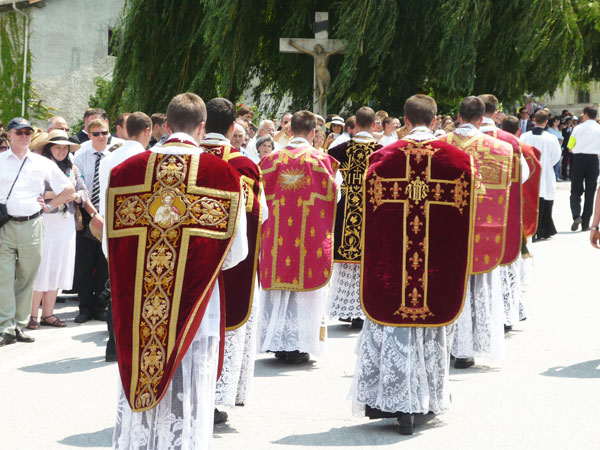
These images were taken by Mario Antonetti of a weekly Sunday Mass offered by Canon Glenn Gardner of the Institute of Christ the King on the 7th Sunday after Pentecost at St. Mary's in Cashton, Wisconsin.
Read more >>
Monday, August 2, 2010
Introibo ad altare Dei (Psalm 42)


P: In the name of the Father, + and of the Son, and of the Holy Ghost. Amen.

I will go in to the altar of God. R: To God, Who giveth joy to my youth.

P: Judge me, O God, and distinguish my cause from the nation that is not holy; deliver me from the unjust and deceitful man. R: For Thou art, God, my strength; why hast Thou cast me off? and why do I go sorrowful whilst the enemy afflicteth me?

P: Send forth Thy light and Thy truth: they have conducted me and brought me unto Thy holy hill, and into Thy tabernacles. R: And I will go in to the altar of God: to God Who giveth joy to my youth.

P: To Thee, O God, my God, I will give praise upon the harp: why art thou sad, O my soul, and why dost thou disquiet me? R: Hope in God, for I will still give praise to Him, the salvation of my countenance and my God.

P: Glory be to the Father, and to the Son, and to the Holy Ghost. R: As it was in the beginning, is now, and ever shall be, world without end. Amen.

P: I will go in to the altar of God. R: To God, Who giveth joy to my youth.

P: Our help + is in the name of the Lord.
R: Who made heaven and earth.
  P: In nomine Patris, + et Filii, et Spiritus Sancti. Amen.

Introibo ad altare Dei. R: Ad deum qui laetificat juventutem meam.
 
P: Judica me Deus, et discerne causam meam de gente non sancta: ab homine iniquo et doloso erue me. R: Quia tu es Deus fortitudo mea: quare me repulisti, et quare tristis incedo, dum affligit me inimicus?

P: Emitte lucem tuam, et veritatem tuam: ipsa me deduxerunt, et adduxerunt in montem sanctum tuum, et in tabernacula tua. R: Et introibo ad altare Dei: ad Deum qui laetificat juventutem meam.

P: Confitebor tibi in cithara Deus, Deus meus: quare tristis es anima mea, et quare conturbas me?R: Spera in Deo, quoniam adhuc confitebor illi: salutare vultus mei, et Deus meus.

P: Gloria Patri, et Filio, et Spiritu Sancto.R: Sicut erat in principio et nunc, et semper, et in saecula saeculorum. Amen.

P: Introibo ad altare Dei. R: Ad Deum qui laetificat juventutem meam.

P: Adjutorium nostrum + in nomine Domini.
R: Qui fecit coelum et terram.


Read more >>
Sunday, August 1, 2010
YouTube Video on the Beauty of Tradition

Read more >>
Tuesday, July 27, 2010
Monsignor Angelo Amodeo says the Latin Mass


Monsignor Angelo Amodeo, a canon of the Metropolitan Chapter of Milan, celebrated Holy Mass in Rome according to the Usus Antiquior in the private house chapel of Prince Massimo in Rome's historic center. Monsignor Amodeo was ordained priest in 1957 by Archbishop Montini, future Pope Paul VI.

I found the video to be very beautiful.
Read more >>
Friday, July 23, 2010
Benedict XVI Now 7th Oldest Pope in History

An interesting article from Zenit:

On Monday, Benedict XVI became the seventh oldest pope in history, considering only those popes who reigned since the year 1400 when records became more reliable.

Blogger and author Anura Guruge reported this milestone at his site Popes and the Papacy.

There, he includes a chart showing the 83-year-old Benedict in the No. 7 slot, having overtaken Gregory XIII, Paul IV and Benedict XIV, who all died at age 83, but closer to their 83rd birthdays then Benedict XVI now is. On Monday, the Holy Father was 30,410 days old.

Pope John Paul II, who died just over a month before his 85th birthday, is in the No. 6 spot, having lived 31,000 days.

The record for the oldest pope in history, Guruge reports, is held by Pope Leo XIII, who died at age 93, reigning from 1878 to 1903.

The chart also includes the records for the longest papal reign, and an interesting datum: the percentage of their lives they spent as pope.

Pope Pius IX, who reigned from 1846 to 1878, that is, 31 years, spent 36.5% of his life as pope. He died at age 85, putting him in the No. 4 slot for history's oldest pope.
Read more >>
Monday, July 19, 2010
Upcoming ICKSP Mass

Read more >>
Sunday, July 18, 2010
Reflection on the Precious Blood by Fr. Fidelis Rice


July is designated especially as the Month of the Precious Blood of Jesus, a special time to honor the Blood of Jesus. Please see my post entitled Devotions to the Precious Blood of Jesus for more information.

The following is taken from Thinking of God by Father Fidelis Rice, C.P.:
"The executioners take their stand beside the whipping post...They raise their muscular arms...there is a ripple of sinews...then, like ugly snakes about to strike...the whips hiss through the air...there is a dull, sickening thud...ugly welts rise on the quivering flesh of the God-Man...Again and again they strike, and furrow adjoins furrow in His flesh until His body is criss-crossed with ghastly ridges and bleeding wounds...But still there is the almost rhythmic rise and fall of the lashes.

"Hardly had they commenced before the Precious Blood began to flow...down upon the stone pavement it trickled, forming crimson rivulets and pools. The Angels must have prostrated in adoration before that redeeming Blood...They were watching a world being paid for...and every drop of that Blood was the price of a thousand worlds. But still the agony went on!

"How long this torture lasted, we do not know, but it must have been almost beyond description, since the Evangelists do not trust themselves to write it...They simply say: 'Pilate scourged Him.'

"But finally it was over...The ropes were cut, and slowly Christ slumped to the ground...That stone pavement which was wet with His own Blood"
Read more >>
Sunday, July 11, 2010
Reflection on the Precious Blood by Fr. Frederick Faber


July is designated especially as the Month of the Precious Blood of Jesus, a special time to honor the Blood of Jesus. Please see my post entitled Devotions to the Precious Blood of Jesus for more information.

The Precious Blood by Fr. Frederick Faber:

"The Precious Blood was assumed directly to our Blessed Lord's Divine Person from His Immaculate Mother...Mary's blood was the material out of which the Holy Ghost, the Third Person of the Most Holy Trinity, the artificer of Sacred Humanity, fashioned the Blood of Jesus. Here we see how needful to the joy and gladness of our devotion is the doctrine of the Immaculate Conception.  Who could bear to think that the matter of the Precious Blood had ever been itself corrupted with the taint of sin, that it had once been part of the devil's kingdom, that what was to supply the free price of our redemption was once enslaved to God's darkest, foulest enemy?  Is it not indeed an endless daily jubilee to us, that the church has laid upon us as an article of our faith that sweet truth which the instincts of our devotion had so long made a real part of our belief?

"Moreover, there is some portion of the Precious Blood which once was Mary's own blood, and which remains still in our Blessed Lord, incredibly exalted by its union with His Divine Person, yet still the same.  This portion of Himself, it is piously believed, has not been allowed to undergo the usual changes of human substance.  At this moment in heaven He retains something which once was His Mother's..."
Read more >>
Friday, July 9, 2010
Institute of Christ the King 2010 Ordinations

Please visit the following link and use the navigation links at the top of the screen to see many beautiful images of the recent Institute of Christ the King Sovereign Priest Traditional Ordinations said by His Emminence Raymond Cardinal Burke.  Below are two examples of these beautiful images.  And, now is a fitting time to one again extol you to pray for vocations to the Church; especially, pray for holy and traditional vocations. 


http://www.icrsp.org/IMAGES-APOSTOLATS/IMAGES-2010/Gricigliano/Ordinations-2010/Sacerdoce/sacerdoce.htm
Read more >>
Monday, July 5, 2010
2010 Econe Ordination Photos


Above, I share some of the images from the recent June 29, 2010, Priestly Ordination that took place in Econe, Switzerland for the Priestly Society of St. Pius X.  Nine new priests were ordained by His Excellency Bishop Tissier de Mallerais.  Visit the website of La Porte Latine for more photos.
Read more >>
Tuesday, June 29, 2010
5th Anniversary of A Catholic Life

The month of June joyfully marks the 5th year anniversary of this blog.  Today I opened the archives in the sidebar of this blog and opened what was my very first post entitled First Post.  Since that time much has changed in my life and I realize that my life is ever changing.  On July 1, 2010, in just a few days, I buy a well-recognized Catholic company and intend to take it to another level of success.  I formed this blog on June 19, 2005, for the purposes of winning souls for our Lord Jesus Christ. And to this day - 5 years later - my purpose remains unchanged.

I have at this time resumed a project that I began last year; namely, to write a short pdf book on "How to Successfully Create a Catholic Blog."  Reflecting on my blog, I realize that it has in five years received over 1.2 million page views with approximately 700,000 unique visitors.  I wish to pass along the knowledge that I have gained to help the Catholic Blogosphere.

In the scope of this project, I realize that I would like to share testimonials with my readers about the effectiveness of blogging.  And, surely there is no better time to share such thoughts than now - my 5 year blog anniversary!  So, if I have - in any way - helped your spiritual life please do share your comments below.  They can be completely anonymous if you so choose.  I will be choosing some of these comments to include in my book as examples of the effectiveness of blogs in serving as a witness to Our Lord and the One True Church.
Read more >>
Saturday, June 26, 2010
In Minneapolis-St. Paul This Summer

Throughout this summer I will be living and working in the Twin Cities Metropolitan Area.  Generally I work 6 AM - 2 PM Monday - Friday at a large national corporation as a financial data anaylst.  In the evenings and weekends I regularly meet with local business leaders and individuals.  During that time I operate a new media marketing/technology company that I have helped form and I also work for CatechismClass.com.

I would additionally like the opportunity to interview local individuals for A Catholic Life and/or be interviewed by interested individuals/organizations. If any other readers of my blog are also in the St. Paul-Minneapolis area this summer, please send me an email so that we can attempt to meet, preferably over lunch or dinner.
Read more >>
Wednesday, June 23, 2010
Music-Based Evangelization Opportunities For Young, Catholic Musicians


Attention Homeschooling Parents and Students

Music-Based Evangelization Opportunities
For Young, Catholic Musicians

Proclaiming the faith through beautiful music


Do you like to sing or can you play an instrument well?


Do you enjoy sharing your Catholic faith with others?


Can you be a good role model for today’s young people?

As faithful Catholics, we are all called to take up the challenge of Pope John Paul II’s call for a “New Evangelization”. Saint Cecilia Classical Productions was founded in response to that call. We are a music-based, Catholic, evangelization apostolate whose principle focus is the advancement of the Culture of Life by the promotion of authentic Catholic family values to today’s young people. As an orthodox, lay organization, we profess complete fidelity to the Magisterium.

We are searching for traditional Catholic young women who wish to use their musical talents and knowledge of the faith to make a difference in the lives of young people. We are looking for young ladies with above average music ability in the areas of classical voice, string or wind instruments. While not a requirement, acting, music theater, choir or public speaking experience would be an additional plus. Some knowledge of Latin would also be helpful.

We are especially interested in individuals who were homeschooled or were raised in the Tridentine Mass tradition. High school seniors, college age women or recent graduates, especially those with degrees in music, are encouraged to apply. This is a great opportunity to learn more about one’s own faith, while evangelizing our young people, and bringing them the pro-life message. At the same time, you will also be working with other young Catholic musicians who share the same traditional values.

Saint Cecilia Classical Productions is a non-profit, 501 (c) (3) public charity. We were organized exclusively for religious, educational and charitable purposes.
Read more >>
Saturday, June 12, 2010
March of Silveri

The blog The New Liturgical Movement had a truly inspiring piece on the March of Silveri.  This inspiring musical piece used to be played at the elevation in the old solemn Papal Mass.  I re-post from that blog these two videos.  The video illustrates at 2:55 the March of Silveri during the Mass of Coronation of John XXIII.  

The second video [now removed was] of the Evening Prayer Vigil held by His Holiness Pope Benedict XVI for the conclusion of the Year of the Priest.  You will notice at 63:15 that the March of Silveri can be heard on the arrival of the Blessed Sacrament to St. Peter's Square.  For me, it reminds me of the joy felt by the Israelites upon the return of the Ark of the Covenant to them.  This could very well be the first time in decades that the March of Silveri was played in the context of a Papal Liturgy.


Read more >>
Monday, June 7, 2010
Traditional Confirmations by Bishop Salvatore Corileone

The blog Veritatem facientes in caritate has some pictures and a video taken from the Confirmation Ceremony and Pontifical Low Mass in the Traditional Latin Rite (Extraordinary Form) at St. Margaret Mary's Church on May 20, 2010. The Mass was said by His Excellency, Bishop Salvatore Cordileone (Diocese of Oakland, CA).  Visit the post for more photos.
Read more >>
Bishop-Elect David O'Connell's Commencement Address - Inspirational

On 4 June 2010, the Holy Father appointed Fr. David M. O'Connell, president of the Catholic University of America in Washington D.C., U.S.A., as coadjutor of Trenton (area 5,580, population 2,048,000, Catholics 822,000, priests 314, permanent deacons 320, religious 510), U.S.A. The bishop-elect was born in Philadelphia, U.S.A. in 1955 and ordained a priest in 1982. [note: He will be consecrated in the Trenton Cathedral on 6 August at 2 pm.]

On 15 May, Fr./Bishop-elect O'Connell gave the Commencement Address at Catholic University (DC), which is quoted below.

Address by Very Rev. David M. O'Connell, C.M., president

I want to tell you a story about our 16th and, perhaps, greatest president, Abraham Lincoln. His biographers tell us that he was never baptized, never joined a church, and rarely mentioned Jesus. His widow, Mary Todd Lincoln, once remarked after his death, “He was a religious man always but he was not a technical Christian (Daniel Burke, “Lincoln’s Faith Still a Puzzle, Washington Post, Feb. 7, 2009, page B09).” He did go to church services on occasion, not too far from here at the New York Avenue Presbyterian Church. On one of those occasions, President Lincoln listened intently to the sermon of the pastor. After leaving the church, the president was asked by his Pinkerton secret-service guard, “What did you think of the sermon, Mr. President?” Lincoln paused and said with obvious hesitation, “It was … good.” The guard inquired, “You didn’t like it?” to which Abraham Lincoln responded, “He never asked us to do something great.”

Archbishop Wuerl, members of the Board of Trustees, my university colleagues, dear families and guests of the graduates, and, especially, members of this class of 2010:

Today you will graduate from The Catholic University of America, 1,400 undergraduates, graduates and doctoral students. Today, no doubt, you will reflect on your studies and research, your interactions with faculty, staff and peers, your life and time here at CUA over the past several years. Today you finish one chapter of your life only to commence another, with your bachelor’s, master’s and doctoral degrees in hand. As president and the leader of this university community, I want to ask you “to do something great.”

In his immortal Gettysburg Address — a speech for which he was roundly criticized during his lifetime — we hear, again from Abraham Lincoln, words that addressed a completely different situation than the one that brings us together here, but that have significance for us just the same. Lincoln said, “The world will little note nor long remember what we say here but it can never forget what they did here.” Those brave soldiers in blue and gray, drenched with the red of their blood, whose names have been all but forgotten, made the greatest sacrifice for a great cause they believed in. Their greatness came not from being remembered or from any speech given to honor them. No. Their greatness came, as it always does, from what they did because of who they were and what they made of themselves. Their greatness came, as it always does, not from doing what was easy, but, rather from doing something that required sacrifice. Their greatness came, as it always does, not only from what they had been given but, rather, from what they chose to give away. And so it was, and so it is and so it shall be with you.

Your diploma from The Catholic University of America represents years of effort on your part. As you examine that parchment in a few moments, as you read your name underneath CUA’s name and seal, I ask you to see on that page the sacrifices made on your behalf by your parents and those who love you most; the lessons taught by a dedicated faculty; the support and friendship of those who surround you now in long gowns and silly hats; and, finally, your own labors and life here. With all of that as background, see also in your diploma one more important thing: an invitation to do something great.

Shakespeare once wrote, “Be not afraid of greatness. Some are born great, some achieve greatness, and some have greatness thrust upon us (Twelfth Night, II, v. 159).” Let’s face it: Most of us are not born great. Still fewer of us have greatness thrust upon us. It is for us, the vast majority, to achieve greatness by sacrifice: putting what we have and who we are at the service of others.

Architects and engineers; philosophers and theologians; nurses and social workers; musicians and actors; librarians and lawyers; teachers, politicians, psychologists, scientists, historians, journalists, linguists, accountants, economists, mathematicians --- these and many others are the disciplines represented here today for which The Catholic University of America will confer degrees that you will take with you. Do something great with what you have learned and experienced. Your efforts will mean precious little if you are content to graduate magna cum mediocrity, willing to ignore all the sacrifices that have brought you to this moment. Do not just “leave” the university today — live what the university has given you, live what your parents have given you, live what God has given you and give it away to a world, to a humanity that needs our unique brand of greatness, your unique brand of greatness, to make it a better place tomorrow than it is today. Make no mistake about it: this is no easy task. A diploma on a wall somewhere is no greater than the frame that holds it. Take the diploma to heart, take it in hand and add to all that diploma represents passion and enthusiasm and conscience and integrity and the desire to serve others. Blend that diploma with a life and profession lived well and you will make a difference, you will do something great. It will take time and effort and sacrifice, for sure. You probably will not become famous — most of us do not — but you will become known for whom and what you are among those to whom you matter most and who matter most to you. The young, naïve idealist may hope to see his or her name in lights one day. The mature, seasoned realist prefers to see light shine from within his or her mind and heart.

The 19th-century English novelist William Makepeace Thackeray said it well when he wrote: “To endure is greater than to dare; to tire out hostile fortune; to be daunted by no difficulty; to keep heart when all have lost it; to go through intrigue spotless; to forgo even ambition when the end is gained – who can say this is not greatness (The Virginians, 92)?”

The believer acknowledges that he or she is a child of God, created by God in his image and likeness. We acknowledge and profess that here at The Catholic University of America. That truth of faith plants the seed of greatness in our souls. How we nurture and water and grow that seed is up to us, my dear graduates; it is up to you.

Belief in yourself and God’s gifts to you. Gratitude for what you have been given. Courage in your convictions. Willingness to sacrifice for a greater, even inconvenient good. Confidence in the presence and love and grace of God. The wisdom to choose what is right and to stand by it when the prevailing culture says that’s not necessary or advantageous or comfortable or politically correct. “Great things are done when men and mountains meet” (William Blake). Your education here has been an early step. Do not let it be your only, your final step up the mountain. I cannot tell you where the path of life will lead you but as you make your way on life’s journey, set out to do something great. You will not travel alone for the great work to be done is God’s.

I began my remarks today quoting a truly great American president. As you leave The Catholic University of America, let me end by quoting another who spoke in this city almost fifty years ago. President John Fitzgerald Kennedy – the symbol of a new generation of Americans at the time – concluded his inaugural address with these memorable words:

"With a good conscience our only sure reward, with history the final judge of our deeds, let us go forth to lead the land we love, asking His blessing and His help, but knowing that here on earth God's work must truly be our own."
Read more >>
Sunday, June 6, 2010
Photo Submission: Corpus Christi

Readers of "A Catholic Life":

Today is the External Solemnity of Corpus Christi, and many processions will be taking place around the world today. A Catholic Life would like to honor as many of these processions as possible. So, please send me any photos from today's processions and I will be sure to honor the parish, diocese, location, etc at which it took place. So, if you have not had your procession yet, please bring a camera!

Emails should be sent to acatholiclife[at]gmail[dot]com.

Image Sources: REUTERS/Giampiero Sposito
Read more >>
Tuesday, June 1, 2010
St. Christopher’s in Radcliff to celebrate Latin Mass

A first since 1969 and Vatican II

By BECCA OWSLEY

An event that hasn’t happened in Hardin County for many years will take place 8 a.m. Saturday at St. Christopher Catholic Church located at 1225 S. Wilson Road in Radcliff.

A Tridentine Latin Mass, or the Extraordinary Form, will kick off the Kentucky Catholic Home School Conference at St. Christopher but it is open to the public and not strictly for conference attendees.

This Mass was celebrated by the Catholic Church for almost 1,500 years, event organizer Julie Siscoe said.

Pope Paul VI introduced a Mass after the Second Vatican Council in 1969 that replaced the Latin Mass. Siscoe said the Tridentine Mass was restricted by many Bishops because they thought it had been banned. In July of 2007 Pope Benedict XVI issued a Motu Proprio, Summorum Pontificum that declared the Mass had never been banned and lifted the restrictions.

The Mass will be the first public Tridentine Mass celebrated at St. Christopher or in Hardin County since the release of the Summorum Pontificum in 2007, Siscoe said. From her research she concluded that there hasn’t been one celebrated in the county since 1969.

While the Mass at St. Christopher is a one time event, the only regular celebrations of Latin Mass in the diocese are at St. Martin of Tours in Louisville, Our Lady of the Caves in Horse Cave and St. Helen Catholic Church in Glasgow, Siscoe said.

Siscoe and her husband did not grow up in the Catholic faith and were not familiar with the Latin Mass. They now drive about an hour every Sunday and most Mondays to attend Mass at Our Lady of the Caves for that experience. She expects many will drive much farther to celebrate Saturday’s Mass.

Read More....
Read more >>
Saturday, May 29, 2010
Improvements in Blog Loading Speeds

Thank you for all of your patience with the load speeds of the blog. Tonight I was able to make some slight modifications to the display settings and page elements of the blog. As a result, you will should see improvements in the site's loading speeds. Any comments - positive or negative - on the site's loading speeds will be appreciated.

Additionally, at this time I would especially invite you to share your general comments about the blog and general suggestions.  I am looking to continue investing time in this site even as I expand my Catholic apostolate work with other new and exciting projects.  Some of which, I will be promoting in the near future.

Regards,

Matthew
Read more >>
Tuesday, May 25, 2010
Whit Embertide

Although Ember Days are no longer considered required in mainstream Roman Catholicism following Vatican II, they can - and should - still be observed by the Faithful. In fact, many Traditional priests encourage the Faithful to observe the days. Ember Days are set aside to pray and/or offer thanksgiving for a good harvest and God's blessings. If you are in good health, please at least fast during these three days and pray the additional prayers. Remember the words from the Gospel: "Unless you do penance, you shall likewise perish" (Luke 13:5)

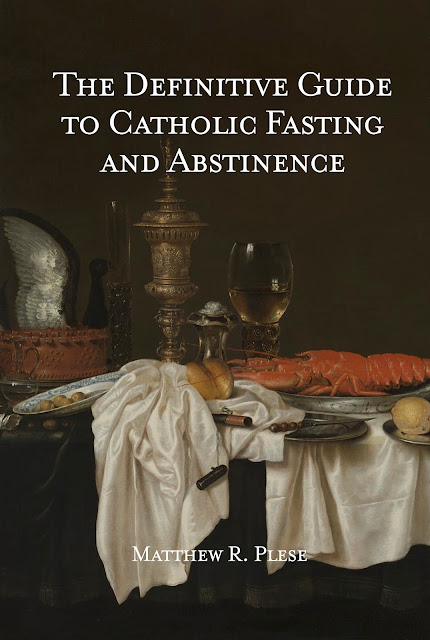
Ember Days this Pentecost: May 26, 28, and 29

From New Advent:

Ember days (corruption from Lat. Quatuor Tempora, four times) are the days at the beginning of the seasons ordered by the Church as days of fast and abstinence. They were definitely arranged and prescribed for the entire Church by Pope Gregory VII (1073-1085) for the Wednesday, Friday, and Saturday after 13 December (S. Lucia), after Ash Wednesday, after Whitsunday, and after 14 September (Exaltation of the Cross). The purpose of their introduction, besides the general one intended by all prayer and fasting, was to thank God for the gifts of nature, to teach men to make use of them in moderation, and to assist the needy. The immediate occasion was the practice of the heathens of Rome. The Romans were originally given to agriculture, and their native gods belonged to the same class.

At the beginning of the time for seeding and harvesting religious ceremonies were performed to implore the help of their deities: in June for a bountiful harvest, in September for a rich vintage, and in December for the seeding; hence their feriae sementivae, feriae messis, and feri vindimiales. The Church, when converting heathen nations, has always tried to sanctify any practices which could be utilized for a good purpose. At first the Church in Rome had fasts in June, September, and December; the exact days were not fixed but were announced by the priests. The "Liber Pontificalis" ascribes to Pope Callistus (217-222) a law ordering: the fast, but probably it is older. Leo the Great (440-461) considers it an Apostolic institution. When the fourth season was added cannot be ascertained, but Gelasius (492-496) speaks of all four. This pope also permitted the conferring of priesthood and deaconship on the Saturdays of ember week--these were formerly given only at Easter.

Before Gelasius the ember days were known only in Rome, but after his time their observance spread. They were brought into England by St. Augustine; into Gaul and Germany by the Carlovingians. Spain adopted them with the Roman Liturgy in the eleventh century. They were introduced by St. Charles Borromeo into Milan. The Eastern Church does not know them. The present Roman Missal, in the formulary for the Ember days, retains in part the old practice of lessons from Scripture in addition to the ordinary two: for the Wednesdays three, for the Saturdays six, and seven for the Saturday in December. Some of these lessons contain promises of a bountiful harvest for those that serve God.

From Catholic Culture:

Since man is both a spiritual and physical being, the Church provides for the needs of man in his everyday life. The Church's liturgy and feasts in many areas reflect the four seasons of the year (spring, summer, fall and winter). The months of August, September, October and November are part of the harvest season, and as Christians we recall God's constant protection over his people and give thanksgiving for the year's harvest.

The September Ember Days were particularly focused on the end of the harvest season and thanksgiving to God for the season. Ember Days were three days (Wednesday, Friday and Saturday) set aside by the Church for prayer, fasting and almsgiving at the beginning of each of the four seasons of the year. The ember days fell after December 13, the feast of St. Lucy (winter), after the First Sunday of Lent (spring), after Pentecost Sunday (summer), and after September 14 , the feast of the Exaltation of the Holy Cross (fall). These weeks are known as the quattor tempora, the "four seasons."

Since the late 5th century, the Ember Days were also the preferred dates for ordination of priests. So during these times the Church had a threefold focus: (1) sanctifying each new season by turning to God through prayer, fasting and almsgiving; (2) giving thanks to God for the various harvests of each season; and (3) praying for the newly ordained and for future vocations to the priesthood and religious life.
Read more >>


Copyright Notice: Unless otherwise stated, all items are copyrighted under a Attribution-NonCommercial-NoDerivatives 4.0 International License. If you quote from this blog, cite a link to the post on this blog in your article.

Disclosure of Material Connection: Some of the links on this blog are “affiliate links.” This means if you click on the link and purchase the item, I will receive an affiliate commission. As an Amazon Associate, for instance, I earn a small commission from qualifying purchases made by those who click on the Amazon affiliate links included on this website. I am disclosing this in accordance with the Federal Trade Commission’s 16 CFR, Part 255: “Guides Concerning the Use of Endorsements and Testimonials in Advertising.”