Wednesday, March 28, 2012
Bishop Mark Davies: A Light of Tradition in the Midst of the Darkness of Modernism

I do wish to share this piece by Damian Thompson of the Telegraph.  His Excellency is an example of a true Catholic bishop, who seeks to uphold the laws of God in a God-less society.  


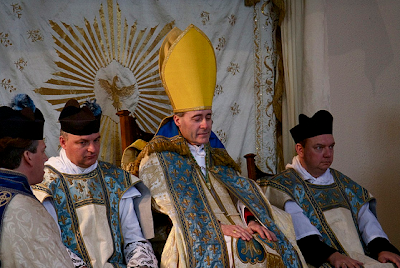
Here's a photograph to gladden the heart of any traditional Catholic and to give The Tablet's Bobbie Mickens a fit of the vapours. The prelate wearing that magnificent mitre is a bishop of England and Wales, believe it or not, presiding at a solemn Latin Mass to mark the re-opening of a parish where the worship will be in the Extraordinary Form. More than a thousand people attended.

Yes, you read that right. Summorum Pontificum has finally been fully implemented by a diocesan bishop – the Rt Rev Mark Davies, Bishop of Shrewsbury, who has entrusted the Shrine Church of Ss Peter and Paul and St Philomena in New Brighton, Wirral, to the Institute of Christ the King Sovereign Priest. This much-loved building, once known as "the dome of home" to returning sailors, had previously been closed. Bishop Davies saw no reason why this dynamic apostolic institute should not revive it.

"Perhaps in this image we can recognise the new mission given to this church in a new and vibrant parish and amid the new needs of those who travel through the century before us,” said the bishop in his address. "Today we do not simply wish to open the doors of a closed building but to be open in our hearts to what Blessed John Paul II called ‘Eucharistic amazement’. I was asked in a radio interview whether I saw myself as part of an old, traditional church or a dynamic, evangelising community. My interviewer saw these as distinct alternatives but to the Catholic mind the answer must always be both."

Can you imagine any other bishop of England and Wales having the conviction and courage to implement the Motu Proprio so enthusiastically? No, me neither. Bishop Davies is a pastor of remarkable calibre; the question now is whether Rome will send us another bishop in his mould – or will simply allow the Magic Circle to shunt its candidates into soon-to-be-vacant diocesan sees. 
 Some other recent news further reveals the caliber of His Excellency:


Bishop urges faithful to face ‘the reality of hell’ in Lent
http://www.catholicherald.co.uk/news/2012/02/24/bishop-urges-faithful-to-face‘the-reality-of-hell’-in-lent/

Bishop Mark Davies to restore central position of Tabernacle
http://caritasveritas.blogspot.com/2011/12/bishop-mark-davies-to-restore-central.html

Bishop Mark Davies: God, not Parliament, is the author of marriage
http://catholicismpure.wordpress.com/2012/02/14/bishop-mark-davies-god-not-parliament-is-the-author-of-marriage/
Read more >>
Monday, March 26, 2012
1956 Changes to the Roman Breviary and Catholic Missal

Included below are the 1956 changes to the breviary and the missal. They are formatted for easier reading and printing.  Please distribute these and use them as you need.

De Rubricis Ad Simpliciorem Formam

The changes are not complete, however as there is another document (Maxima Redemptoris) that changed the Holy Week and Vigil of Pentecost. Please search online to find this document.

Also, below is a list of main documents that address these changes. Usually they can be found in Canon law digests and tracts or if you read Latin the Acta Apostolicae Sedis

1951, Feb. Dominicae resurrectionis, De Solemni Vigilia Pashchali Linstauranda. (The restoration of the Solemn Paschal Vigil.)
 
1955, Mar. "Cum nostra haec aetate" "De rubricis ad simpliciorem formam redigendis." (On the simplification of the rubrics).  This is the document that I have included above.

1955, Nov. 16: Maxima redemptionis nostrae mysteria, Liturgicu Hebdomadae Sanctae Ordo instauratur. (The restoration of the liturgy of Holy Week).
 
1960, July 25: Codex Rubricarum
General rubrics
General rubrics of the breviary
General rubrics of the missal
Additionally it addresses the changes to the martyrology, the new calendar of 1960, etc.

1961, "De calendariis particularibus et Officiorum ac Missarum Propriis ad norman et mentem CSR revisedis." "The particular calendars and Proper Offices and Masses revised according to the norm and mind (spirit) of the Code of Rubrics"
Read more >>
Catholicism as the Foundation of Monetary Economics

It will come to no surprise to someone familiar with history that the Roman Catholic Church truly built Western Civilization.  Even if you are familiar with the Church's role in agriculture, industrial production of iron ore, translation of ancient Latin and Greek texts, formulation of international law, and astronomy, you may be unaware of the Church's role in economics.

The key in self-education and in the education of your children is to find an appropriate text that accurately addresses not only the Church's contributions but also refutes the errors of modern economics, including Communion and Socialism.

The Church's role in economics is not new - it goes back over 700 years!  San Bernardino of Siena (1380–1444) was the first theologian after Olivi to write an entire work systematically devoted to scholastic economics.  But, he was not even the first, illustrating that the Church's involvement in political and social life was (and is) necessary to sustain a culture with a proper ordering.

The Catholic Church can be credited to founding monetary economics and the value theory based on subjective utility.  This theory stands in sharp contrast to the Labor Theory of Value, which has its roots in the Communist Manifesto of Karl Marx.

Under the Labor Theory of Value, an object's worth is said to not be based on subjective utility but rather on the labor added to the object.  Yet, in a common refutation of this theory, let us consider the case of a painting.  How can this theory be valid when a painting's value rises after the death of its creator, even after no additional labor has been expended?  Marx could not explain this phenomena.  Only the subjective value theory can explain value.

Simply put, the value of a good does not depend on the number of labor hours put into the good.  To succumb to this error is to fall into Communism.  And we have the Church to thank for supporting and defending through the centuries this theory.
Read more >>
Sunday, March 25, 2012
Anniversary of the Death of Archbishop Marcel Lefebvre


In paradisum deducant te Angeli; in tuo adventu suscipiant te martyres, et perducant te in civitatem sanctam Ierusalem. Chorus angelorum te suscipiat, et cum Lazaro quondam paupere æternam habeas requiem.

May angels lead you into Paradise; may the martyrs receive you at your coming and lead you to the holy city of Jerusalem. May a choir of angels receive you, and with Lazarus, who once was poor, may you have eternal rest.


"Amen, amen I say to you, that you shall lament and weep, but the world shall rejoice; and you shall be made sorrowful, but your sorrow shall be turned into joy" (John 16:20)

"In the spiritual reality of the church, neither Marcel Lefebvre, nor his bishops and priests, nor the people who frequent the SSPX chapels suffered or suffer excommunication. I believe history will record that the intent to impose such an excommunication was invalid and illicit." - Father Malachi Martin

Read more >>
Saturday, March 24, 2012
Ceremonial Notes for Holy Week Liturgies for Servers


Our friends over at Romanitas Press have again put together serving notes for those saying the Traditional Latin Mass for Holy Week.  Pass these documents along to any sacristans, servers, or priests that you think may benefit from this. Do note however these are for the 1962 Missal and are not for the pre-1955 Holy Week that is the more traditional Holy Week Liturgy.

Click here to read their ceremonial notes.
Read more >>
Friday, March 23, 2012
Our Lady of Victories (March 23) for Hungary

Historically today is the feast of Our Lady of Victories, (there are nine seperate days in honor of Our Lady of Victory, the main being October 7) Today's feast commemorates the victory in Hungary. On August 6, 1716, Prince Eugene of Savoy defeated a large invading Ottoman army at Peterwardein, Hungary. The victory set the stage for the reconquest of Hungary from the Turks.


Excerpted from The Catholic Southern Front Dispatch Chapter 9/32 - Hungary invaded:

In 1432, John Hunyady, a Catholic Hungarian national distinguished himself at the Siege of the Szendro Castle in Hungary. For this very reason King Sigismund appointed him as one of his royal counselors. John Hunyady later became Count of Temes and supported the election of Wladislaw III of Poland, to the throne of Hungary. For supporting the Polish King, Hunyady was proclaimed Commander of the Fortress of Belgrade and Voivode of Transylvania. John Hunyady was privately devoted to the Blessed Virgin and prayed for her intercession during the wars against the Ottoman powers. Victories always occurred, following his prayers to Our Lady. In 1441, the Hungarians were victorious against the Ottomans at Szendro, at Maros-Szent-Imre in 1442, and captured Sofia in Bulgaria in 1443. In 1453, the Ottoman Islamists invaded the Christian territories, conquering Constantinople. Churches were demolished and the Byzantine Cathedral, referred to as Saint Sophia’s Cathedral, was desecrated and converted into a mosque. Following the fall of Constantinople, Sultan Mehmet II prepared for war against Hungary.

In 1454, Serbia fell to the Ottoman Sultan. Together with the Franciscan monk, Father John Capistrano, John Hunyady marshaled an army at Szeged, and won back the territory at Szendro. The Ottomans pressed forward and Hunyady defended the Southern border of Hungary. Father Capistrano was ordered by the Catholic Pontiff to preach a crusade against the Ottoman invaders. On July 21 and 22, Father Capistrano and John Hunyady lead the Hungarian troops to battle. Invoking the name of Jesus Christ and his Blessed Mother, Father John urged the troops and led them to victory. The cleric was hailed as the ‘Apostle of Europe’ for the victory delivered on July 21, halted the Islamic Ottoman expansion for another seventy years. In 1690, Father Capistrano was canonized. Both Father Capistrano and John Hunyadi died shortly following the Battle at Belgrade where the miraculous intervention of the Blessed Virgin took place.

John Hunyady experienced defeats and was at least twice captured by his enemies, in 1458 his second son became King of Hungary. Following the victory at Belgrade, in recognition of the heavenly aid granted by Our Lady, Pope Callistus III ordered the daily Angelus to be recited at midday, for that was the hour the Ottoman forces were defeated. In modern times the prayer of the Angelus is recited at midday commemorating the Catholic victory at Belgrade and in honor of Our Lady. Apart from Father Capistrano, a second Franciscan who saved Hungary from similar invasions was the Capuchin Father Mark D’Aviano. Following the successful defense in Vienna of 1683, the Battle of Budapest in Hungary, was the next place where the Ottoman Scimitar was to fall. Budapest capitulated to the Islamic Empire and a triple ring of fortifications was constructed around the city. The city’s Catholic Cathedral, dedicated to Saint Stephen, was similarly to Constantinople’s Saint Sophia, profanely converted into a mosque. Holding a large banner bearing the Image of Saint Joseph, Father Mark ran into the thick of battle. Once the bastions were breached, Father Mark entered the breach intending to reach the profaned cathedral. Fearlessly, ignoring the thundering cannons, he sang litanies to the Blessed Virgin and by evening he placed the banner of Saint Joseph in the reconquered cathedral. Following this victory, Catholic churches were once again rebuilt in this land and a short period of peace ensued. At the Battle of Essech, Father Mark encouraged the generals by assuring them a speedy victory. He postulated that in order to defeat such a formidable enemy, the recourse with confidence to the God of the Heavenly Hosts was necessary, “…without whom all human endeavor is vain.”(1) Although he was a cleric, Father Mark D’Aviano did not neglect the necessary and essential preparations for properly training troops, stocking ammunition, defining supply lines, speed when marching, efficient spying and the maintenance of a good diplomatic rapport between the Christian leaders. He advocated that: “The leaders must fight with upright intentions and not out of jealousy, pride, or personal interest.”(2) Belgrade was the next battle scene. When exposed to the grandiose power of the Ottoman forces the Catholic leaders faltered and hesitated, Father Mark insisted that even if such odds were against them, the Christians would be victorious. According to Father D’Aviano, armies could do nothing against the Ottoman Turk, but if Our Lady was worthily honored, she would intercede for victory. The battles were indeed won and the Ottomans ousted. In 1699, the Turks signed the Peace of Karlowitz. That same year Father Mark D’Aviano, passed away peacefully.

The son of Prince Eugene Maurice of Savoy was born in 1663 and named Eugene after his father. Throughout his early youth he brought himself as an exemplary Catholic. Many at court thought that Eugene was destined at becoming an abbot, in fact he was referred to as the ‘petit abbe’ or the ‘little abbot.’ To the court’s surprise, Eugene developed a liking for the military but was denied entrance by the king. Eugene left France to enroll within the Austrian military, and was deployed where the most need was required, that meant against the invading Ottomans. In 1683, Eugene distinguished himself at Petronell and was appointed Commander of a Dragoon regiment. He served against the Ottomans at Buda and Belgrade. In 1690, the Ottoman Turks recaptured Belgrade and Eugene defeated the Ottomans at the Battle of Zenta. The 1699, the ‘Treaty of Karlowitz’ followed the victory. After Karlowitz, a short time of peace was welcome, unfortunately, the Ottoman Empire was not true to the treaty. The Empire ignored its pledges of Peace and invaded the West, retaking Morea from Venice in 1714. The Austrians declared war on the Ottoman Empire on April 13, 1716. Prince Eugene of Savoy defeated the Ottoman Turks at the Battle of Peterwardein on August 5 (Feast of Our Lady of the Snows) and Temesvar on the morrow of the Feast of Our Lady of the Pillar, October 13, 1716, he captured Belgrade. In 1716, the Battle at Peterwardein witnessed an Ottoman army consisting of 40,000 Janissaries, 20,000 Sipahis and 10,000 Tartars under the command of Grand Vizier Damad Ali. Battles started on August 3, and on August 5 the Austrian counter-attack under Prince Eugene began. The Austrians attacked by encircling the Sipahis and the Tartars, who gave way to the superior, disciplined army. Following this victory, Eugene attacked the Ottoman camp and was supported by the firing cannon of six frigates from the Danube River. In the Ottoman camps many were slain, including Damad Ali, their Commander. An event which was considered unusual for the time and season of the year, was a heavy snowfall on the morning of August 5, which covered Peterwardein. Prince Eugene sought the intercession of Our Lady of the Snows and following this victory granted by Our Lady’s intercession; he commemorated this event by ordering the construction of a church on Tekije Hill. The church overlooks the battlefield and is today known as ‘Our Lady of Tekije’ and ‘Our Lady of the Snows.’ The church is used both by the Roman Catholic and Orthodox denominations. On the morrow of the Feast of the Assumption of 1717, on August 16, the Ottoman forces were ousted from Belgrade. At the Treaty of Passarowitz on July 21, 1718, the Ottoman Empire ceded the Banat, Serbia, a portion of Bosnia and Vallachia to Austria.

Excerpted from The Catholic Southern Front Dispatch Chapter 9/32 - Hungary invaded
Read more >>
SSPX's new Priority in Nigeria set to open in August

I would like to direct your attention to the short newsletter to the Friends of Nigeria published by St. Michael's Priority of the Society of St. Pius X. I wish to quote from the opening of this newsletter.  Please do read the remainder online and consider sending in a tax-deductible donation to help support this new priority in its missionary work of saving souls.  All donations are appreciated and very much needed.

What would have happened to the young Christian communities of the first centuries if the Second Vatican Council had happened around 70 or 80 years after the Apostles’ preaching? The question seems astonishing. However, this is the sad history of the Roman Catholic Church in Nigeria. The Catholic evangelization of Nigeria started in 1884 in the Niger Delta with the African Missions of Lyon, and in 1889 in Biafra with the Holy Ghost Fathers. These first missionaries spread out over the whole country during the first half of the 20th century, taking precedence over animism in the south and over Islam in the north, and competing with the Methodists who had started their propaganda in 1874 in Lagos. We then saw in Nigeria the joy of a new born Christianity enthusiastic in discovering the basics of the Faith, the knowledge of Our Lord and Our Lady, the devotion to the Holy Mass, and the devotion to the Papacy. A wonderful Christian civilization started to dawn and to gain ground on the fetishes and witchcraft, which the new Christian could hardly forsake.

But the Second Vatican Council takes place between1962 - 65, with its religious freedom, ecumenism,  collegiality, “novus ordo” Mass and inculturation. Henceforth, the hierarchy of the Catholic Church teaches that all religions are equal, that we have the same God as the Muslims, the same cult as the Protestants and that a certain wisdom is to be found in pagan superstitions. Worse still, one must dialogue with these false religions and adapt Catholic belief with the cult of the animists. And to compound the scandal for the African people who are traditionally so respectful of any authority, collegiality deprives the Pope and the bishops of their authority! This Council and its reforms have been disastrous for the Kingdom of God, so much so that, as a poison exudes drop by drop, these reforms have slowly but surely been imposed in Nigeria. For instance, Communion in the hand was only introduced in 2008.
Read more >>
Thursday, March 22, 2012
Blessed Columba Marmion on Living a Daily Catholic Life


1. The substance of every seriously devout life is the faithful accomplishment of God's known will. This will is manifested in a) the Commandments b) the Evangelical counsels c) for us, in our Rule and the orders of Superiors.  All the rest is accidental, and of more or less importance according as it helps us do what is substantial.

2. Fidelity to religious duties, Divine Office, mental prayer, spiritual reading is the source of the strength we need to carry out this will of God.  That is why, although these practices are not the substance of sanctity, negligence in these duties leads inevitably to the more or less grave violation of the intrinsic obligations, and to the ruin of spiritual life.

3. True love of God in the heart of one who has gravely sinned ought to take the form of compunction.  Not that compunction ought to be the exclusive form, but the basis, the point to which he returns: "DAILY to confess one's past sins with tears and sighs to God."

4. When one has sinned much, he ought not to be surprised to find himself deprived of savor and sweetness in his devotions.  This lost grave must be expiated or redeemed by long fidelity.

5. Among the practices of piety, the most fruitful is the union of our life and sentiments with those of Jesus Christ.  "Let this mind be in you, which was also in Christ Jesus."  "No man cometh to the Father but by Me."  "I am the Way."

Source: Union with God: Letters of Spiritual Direction by Blessed Columba Marmion.
Read more >>
Words of Inspiration: March 22, 2012

"In the spiritual reality of the church, neither Marcel Lefebvre, nor his bishops and priests, nor the people who frequent the SSPX chapels suffered or suffer excommunication. I believe history will record that the intent to impose such an excommunication was invalid and illicit."

- Father Malachi Martin
Read more >>
Wednesday, March 21, 2012
Video: Monastery of Saint Benedict in Nursia


The Monastery of Saint Benedict in Nursia, dedicated mostly to the Traditional Latin Mass and exclusively to the Traditional Benedictine Divine Office, has produced a special 40-minute documentary about their inspiring life seeking Almighty God in the birthplace of Saint Benedict and Saint Scholastica. The above is the trailer version.

In the Jubilee year 2000 the monks of Norcia breathed new life into the birthplace of St Benedict. Armed with only their faith and zeal they founded a monastic community which has been attracting men from all over the world to follow St. Benedict's ancient Rule. Many of their friends have long wanted an insight into the inner workings of their life and so they have produced this high quality up to date film which shows the monks as they go through the daily ora et labora. The title of the film, "Quaerere Deum", means to Seek God. This is the true calling of all monks, the first and most essential quality of an authentic monastic vocation, as laid out in the Rule of our Holy Father St. Benedict.

For information, please contact:

Monastary of San Benedetto
monastero@osbnorcia.org
Read more >>
Pope Pius XII on St. Benedict March 21, 1947


St. Benedict by Georges Jansoone


Like a star in the darkness of night, Benedict of Nursia brilliantly shines, a glory not only to Italy but of the whole Church. Whoever considers his celebrated life and studies in the light of the truth of history, the gloomy and stormy times in which he lived, will without doubt realize the truth of the divine promise which Christ made to the Apostles and to the society He founded "I am with you all days even to the consummation of the world."[1] At no time in history does this promise lose its force; it is verified in the course of all ages flowing, as they do, under the guidance of divine Providence. But when enemies assail the Christian name more fiercely, when the fateful barque of Peter is tossed about more violently and when everything seems to be tottering with no hope of human support, it is then that Christ is present, bondsman, comforter, source of supernatural power, and raises up fresh champions to protect Catholicism, to restore it to its former vigor, and give it even greater increase under the inspiration and help of heavenly grace.

Encyclical of His Holiness Pope Pius XII On St. Benedict March 21, 1947
Read more >>
Tuesday, March 20, 2012
Should Traditional Catholics Attend the Novus Ordo?


In recent news, Catholics may have seen that the Institute of Christ the King encourages concelebration in the Novus Ordo with bishops (source).  In Msgr. Rifan's scandalous defense of concelebration, he says, "I do not see why we should, if it were asked of us, reject this sign (concelebrating- sign of communion with the bishop)" (note: this is an English translation of the Spanish text)

This is just one example to show you that the Institute and by far the vast majority of other non-SSPX orders are attached to the Tridentine Mass for a feeling of nostalgia or "preference." This is not what makes someone a Traditional Catholic.

A traditional Catholic knows that a Catholic can not attend a Novus Ordo, or go to a Novus Ordo ordained priest, or support religious liberty, ecumenism, or collegiality. Why is this?  Because in so doing, they are denying the Traditional dogmas and authority of the Universal Church on ecumenism, religious liberty, and even on the propitiatory nature of the Sacrifice of the Mass.  In the Novus Ordo, unlike the traditional Roman Rite (and other Traditional Rites), the word propitiatory does not appear in the beginning of the Novus Ordo Roman Missal's doctrinal exposition.

The very nature of the Novus Ordo Sacraments, while not necessarily invalid (but questionable in many instances), bear in them the theology of the New Rite and the Post Vatican II Church.  To frequent these Sacraments is to mix the good, true, and beautiful with that which is present in the New Sacraments: novelty.  By receiving the Novus Ordo Sacraments, you profess your Communion in and with the beliefs of the Novus Ordo Church, even those beliefs that are flawed.

His Grace Bishop Williamson comments in his "Eleison Comments" #241 in February 2012 the following:
For instance a Protestant may believe in God, he may even believe in the divinity of the man Jesus of Nazareth, but if he does not believe in the Real Presence of God, body, blood, soul and divinity, beneath the appearances of bread and wine after their consecration at Mass, then he has a profoundly different and deficient concept of the love of Jesus Christ and of the God in whom he believes. Can one then say that the true Protestant and the true Catholic believe in the same God ? Vatican II says one can, and on the basis of supposedly more or less shared beliefs between Catholics and all non-Catholics, it builds its ecumenism. On the contrary Dr Schüler illustrates by a series of comparisons that what may look like the same belief, when it forms part of two different creeds, is not really the same at all. Here is one illustration: oxygen molecules mixed with nitrogen are the selfsame molecules as when compounded with hydrogen, but they are as different in the two cases as the air we breathe (O + 4N) from the water we drink (H20)!
Even a number of priests offering the Traditional Sacraments (e.g. the FSSP) were ordained in the Novus Ordo ordination rite.  And many priests (non SSPX that is) that happen to have received traditional ordinations, received them from bishops who were themselves ordained to the episcopacy in the Novus Ordo.

Oil and water do not mix just as theological novelties and the unerring, immutable, eternal Truths of the Catholic Faith.

Just to summarize, this particular issue is one of great complexity and no one post can do justice to the situation to explain it fully in terms of its philosophical, theological, and societal implications.  I merely wish to raise the question that very few Traditionalist raise, namely, whether or not Traditional Catholics should (or can) attend the Novus Ordo.

The following segment of What We Have Lost...And the Road to Restoration helps to give a concise overview of the depths of the problem.


I would invite all of you to also read Why You Should Not Attend the Novus Ordo. This particular document helps go in more detail with the problems inherent in the Novus Ordo.  An additional resource is the Society's page: Is the New Mass Legit? As said by His Excellency Marcel Lefebvre, "The Novus Ordo Missae, even when said with piety and respect for the liturgical rules, is impregnated with the spirit of Protestantism...it bears within it a poison harmful to the Faith"
Read more >>
Monday, March 19, 2012
Pope offers plenary indulgence to all who attend opening of first church in Britain dedicated to Extraordinary Form

Pope Benedict XVI is offering a Papal Blessing with an attached Plenary Indulgence for all the faithful who attend the grand opening of the Shrine Church of Ss Peter and Paul and St Philomena, New Brighton, Wirral, on March 24

The Mass will mark the opening of the shrine church following the closure of the parish church in 2008 amid rising maintenance and repair costs.

The shrine church will be a special place of prayer and devotion open every day for adoration of the Most Holy Eucharist.

The church will also serve as a centre in the Diocese of Shrewsbury for the celebration of the Holy Mass and other sacraments in the Latin Extraordinary Form of the Roman Rite.

The Parish of Holy Apostles and Martyrs is served from the Parish Church of English Martyrs and Father Philip Moor, the parish priest, will assist at the opening Mass.

Source: Diocese of Shrewsburg

(Pictures of Canon Olivier Meney of the Institute of Christ the King Sovereign Priest, celebrating Mass in the Weekday Chapel of Ss Peter and Paul and St Philomena, New Brighton, and of the dome of the shrine church by Simon Caldwell, St Gabriel News and Media)
Read more >>
Saturday, March 17, 2012
Euclid: Father of Catholic Mathematics


If any of you are homeschoolers, you may be familiar with Khan Academy, a website in which high quality and free video content from a wide variety of subjects (earth sciences, mathematics, physics, business taxation, art, etc) is distributed.  In the above video from the Khan Academy, you can listen to a basic overview of Euclid, the Father of Geometry.

Yet, I suggest that Euclid, who lived nearly 300 years before the advent of Christ, is to be considered the Father of Catholic Mathematics.

Some anti-Catholics may think that I am choosing a pagan mathematician to be the "Father of Catholic Mathematics" because there simply are no successful Catholic mathematicians. After all, don't all Catholics reject science and empirical study in order to blindly follow the teachings of the Pope and factual inaccuracies (e.g. orbit of the Earth)? To this group of depressed and ill-informed individuals, I'd like to direct you to "How the Catholic Church Built Western Civilization," in which Dr. Woods expounds upon the varied, significant, and priceless contributions of Catholics to mathematics, science, industrial production, art, charity, and a whole host of other worthy endeavors.

My choosing of Euclid to be the Father of Catholic Mathematics, albeit an informal title, is not in the least because there are few Catholic mathematicians. I believe that Euclid is the true precursor to the Catholic mathematician.

Euclid's systemic demonstrations of geometry - including planar geometry, three-dimensional geometry, and number theory - expressed in his Elements is one of the greatest collection of mathematics (if not the greatest) ever produced. By some estimates, Euclid's Elements is second only to the Sacred Scriptures as the most printed book in human history.

Lincoln himself toward the end of the video at the beginning of this post expressed his admiration for Euclid. In fact, it was held, up until the modern era, that a man was not educated if he had not read, studied, and memorized some of the proofs of Euclid!

But what is it that makes Euclid the "Father of Catholic Mathematics"?  It is a two-fold comparison that I would like to illustrate.  First, I wish to illustrate that the very foundations of Euclidean geometry parallel the foundations for Catholic theology. 

Now you might be surprised by this assertion.  After all, how does geometry compare to Theology?  Well, let's take a step back.  What is the underpinning of Theology?  Well for anyone that has studied it, we would recognize Philosophy as the underpinning of Theology.  One does not study Theology without first studying Philosophy. 

Axioms & First Principles

But how is geometry and philosophy both connected?  Euclidean geometry consists in assuming a small set of intuitively appealing axioms, and deducing many other propositions (theorems) from these.  In Euclid's method, the most basic of axioms include:
  1. Things that are equal to the same thing are also equal to one another.
  2. If equals are added to equals, then the wholes are equal.
  3. If equals are subtracted from equals, then the remainders are equal.
  4. Things that coincide with one another equal one another.
  5. The whole is greater than the part.
In a similar manner, philosophy is based upon "first principles."  What are "first principles"?   According to Collins English Dictionary – Complete and Unabridged, first principles are "one of the fundamental assumptions on which a particular theory or procedure is thought to be based, also called axioms".

Both in Euclidean geometry and philosophy are based on the notion of using a small set of axioms to come to knowledge of a larger body of knowledge!  In philosophy, we have the following axioms as first principles:
  • The principle of noncontradiction: the same thing cannot both be and not be at the same time and in the same respect. The same proposition cannot be both true and false.
  • The principle of excluded middle: Either a thing is or it is not, there is no third possibility. (Tertium non datur: a third is not provided.)
  • The principle of the reason of being (the principle of intelligibility): being is intelligible to the human intellect and as an object of intellection it can be explained ontically only through being, and so it cannot be identified with non-being. Every being has a reason of its existence either in itself or in something else.
  • The principle of finality: Every agent acts for an end.
  • The principle of causality: Every effect has a cause.
  • The principle of identity: Every being is that which it is. Each being is separated in its existence from other beings.
Both Euclid and St. Thomas can be said to use the same thought process in their respective disciplines to come to greater knowledge.  Yet, while this is certainly interesting, is it possible to observe Euclidean geometry actually affecting Catholic practices and thought, rather than merely sharing a common method?  Absolutely, and to that we now turn.

Euclidean Geometry in Cathedrals

Hugh McCague of York University in "A Mathematical Look at a Medieval Cathedral" explains the importance of geometry in the building of Cathedrals.  Rather than simply re-writing what has already been written, I'd like to direct you to that link.  In the article, you will note that Euclid's Elements is cited as the important precursor to the practical geometry that was of central importance in the building of some of the greatest Cathedrals ever made for the honor of God.

Simply put, every Catholic, whether he is a mathematician, artist, architect, student, or average layperson should be familiar with the works of Euclid.  Euclid's theories truly impacted the construction of Catholic architecture for centuries.

Conclusion

The website Much More About Math (Editor Note: website no longer exists) does a good job at summarizing the importance of Euclidean geometry:
Geometry holds great importance in the forever-expanding world of mathematics. It enables us to picture what is happening in problems we may encounter in the study of mathematics. The study of geometry helps us develop the ability to visualize shapes, volume, area, and so on. Geometric proofs play an important role in the expansion and understanding of many branches of mathematics, from Venn diagrams in set theory to area under the graph in calculus.

One must realize that probably the most important reason a mathematician and/or non-mathematician should understand geometry is the use of deductive thinking and logic. For the mathematician, the use of logic and deductive thinking is important especially in such courses as finite mathematics. For the non-mathematician, logic and deductive reasoning could play a role in doing such courses as Philosophy.

Geometry holds great importance in the forever-expanding world of mathematics. It enables us to picture what is happening in problems we may encounter in the study of mathematics. The study of geometry helps us develop the ability to visualize shapes, volume, area, and so on. Geometric proofs play an important role in the expansion and understanding of many branches of mathematics, from Venn diagrams in set theory to area under the graph in calculus.

One must realize that probably the most important reason a mathematician and/or non-mathematician should understand geometry is the use of deductive thinking and logic. For the mathematician, the use of logic and deductive thinking is important especially in such courses as finite mathematics. For the non-mathematician, logic and deductive reasoning could play a role in doing such courses as Philosophy.
Below you can find through Amazon.com all of the contents of the Elements in English.  This set of three books is also added to my Wishlist so if any reader would be so kind as to purchase these three for me, know that I would be extremely grateful.

Read more >>
Friday, March 16, 2012
SSPX 2010 Conference on the 40th Anniversary of the Society of St. Pius X

If you have not yet signed up for the 2012 Conference October 19 - 21st now is a good time!  See my post on the topic for more information.

Photos from the 2010 Conference on the 40th Anniversary of the Society of St. Pius X are below.  These images were from the Pontifical High Mass said by Bishop Fellay during that weekend.  The photos are part of an album taken by True Restoration.


Read more >>
Thursday, March 15, 2012
Novena for the Feast of the Annunciation


Annunciation by Francisco de Zurbarán, 1638


Novena for the Feast of the Annunciation

I greet thee, ever-blessed Virgin, Mother of God, Throne of Grace, miracle of Almighty Power! I greet thee, sanctuary of the Most Holy Trinity and Queen of the Universe, Mother of Mercy and Refuge of sinners.

Most loving Mother, attracted by thy beauty and sweetness, and by thy tender compassion, I confidently turn to thee, miserable as I am, and beg of thee to obtain from thy Dear Son the favor I request in this novena:

Mention you request here

Obtain for me also, O Queen of Heaven, the most lively contrition for my many sins and the grace to imitate closely those virtues which thou practiced so faithfully, especially humility, purity and obedience. Above all, I beg thee to be my Mother and Protectress, to receive me into the number of thy devoted children, and to guide my from thy high throne of glory.

Do not reject my petitions, O Mother of Mercy! Have pity on me, and do not abandon me during life and especially at the moment of my death.

+Amen
Read more >>
Wednesday, March 14, 2012
Can a Priest Say a Reverent Novus Ordo Mass?

"The Novus Ordo Missae, even when said with piety and respect for the liturgical rules, is impregnated with the spirit of Protestantism...it bears within it a poison harmful to the Faith". - Archbishop Marcel LeFebvre, founder of the SSPX. 

See his collection of written books for more.
Read more >>
Monday, March 12, 2012
Traditional Mass in Piper City, IL May 5, 2012

For Catholics living in the middle part of Illinois, toward the very end of the Diocese of Joliet or to the northern part of the Diocese of Peoria, please consider going to this special Mass.


Read more >>
1967 Letter from Father DePauw, President of the Catholic Traditionalist Movement, to Pope Paul VI on the Aftermath of the Crisis of Vatican II


Be Thou Peter!

Fr. Gommar A. DePauw, J.C.D,
President of the Catholic Traditionalist Movement

This letter was originally sent to Pope Paul VI as a private communication between a priest and the Supreme Pontiff who, two years earlier, had blessed and commissioned him as leader of the Catholic Traditionalist Movement (C.T.M.). ...

TIA reproduces here important excerpts of this letter, which was sent to Pope Paul VI on August 15, 1967, by Father Gommar A. DePauw, J.C.D, President of the Catholic Traditionalist Movement.  Father DePauw died on the morning of May 6, 2005.  His biography is available here.

The subtitles were added by TIA’s website desk

Your Holiness:

I still vividly remember that December 1, 1965 evening when Your Holiness personally blessed me and my work with the traditionalist Catholics who selected me to be their spokesman ….

I equally remember how Your Holiness literally begged me to urge the Catholics I was to lead in their fight for “TRUTH and TRADITION,” not to lose faith in the Church. And Your Holiness justified that request by stating: “Once the dust stirred up by the recent Ecumenical Council will have settled down, the Church will come out of all this with renewed strength and vigor.”

May I humbly submit that during this past year and a half I have labored as hard as any human individual could to do precisely what Your Holiness asked me to do: to keep the faith in our Church alive among those Catholics who had justifiedly become alarmed to the point of publicly asking themselves and others: “What, in the name of God, is happening to our Catholic Church?!” And may I add that one of the principal aspects of my efforts to keep that faith in our Church alive has consistently been the stressing of belief in the divine foundation of the Roman Papacy and respectful loyalty to its present incumbent, Your Holiness, Paul VI.

Already then, December 1, 1965, Your Holiness asked me to realize that our Church was going through “one of the gravest crises in her history.” If such a description of our Church’s condition was true then, how much more can the same be said of our Church today! To say that it has gone from bad to worse would be the understatement of the century.

Today's condition of the Catholic Church is beyond the point of doctrinal heresy, factual schism, and even apostasy. It is in a state of chaos and utter collapse resulting from the systematic destruction of first our liturgical and other traditions, and now our very beliefs and morals ….

In open violation of all past and present liturgical directives, the Roman Catholic Liturgy, once the envy of all other religions, has for all practical purposes been destroyed. And it gives us very little personal satisfaction to know that all those responsible for this destruction were in advance irrevocably anathematized by the still valid solemn decree of the Council of Trent: “If anyone says that the Mass ought to be celebrated in the vernacular only, let him be cursed.”(Canons of the Most Holy Sacrifice of the Mass, n. 9.)

Coercive changes have subrogated our traditional practices with the “litniks”of our Church Establishment daily intensifying their attempts to subjugate the “people of God” to becoming “Protestant” Catholics.

Our churches are no longer Catholic in appearance, atmosphere, or aim. Tables looking like butcher blocks or ironing boards have replaced our altars in perfect harmony with the 16th century Protestant Reformation directives bent on destroying the belief in the dogma of Transubstantiation and the sacrificial nature of the Mass and replacing it with a symbolical trans-signification-communal meal.

Our Holy Mass has disappeared an in its place our people are offered a holy mess of vernacularized vacuum stripped of the surety, serenity, uniformity, and dignity of our traditional Latin liturgy.

Hymns associated with the anti-Catholic rebellions of Luther, Calvin and Wesley have unceremoniously uprooted our cherished Catholic hymns to our God and the Blessed Mother, while our uniquely Catholic Gregorian and polyphonic music has been discarded for sounds and instruments sometimes borrowed from the decadent milieu of young human animals.

Communion rails are ripped out and Holy Communion is refused to the “people of God” unless they stand (not kneel) to receive Him at the mention of Whose name all knees should bend, if one is still to trust the text of the “unrevised” New Testament we were given at one time in our Catholic institutions.

The Most Blessed Sacrament, to be reserved in “the central place of honor” according to the legitimate liturgical directives, is relegated to an obscure shoe box-type niche, playing much less than second fiddle to the throne-type chair of the presiding clerical Buddha set up in dead center of a religious flavored discotheque-barn, from which the traditional statues and Stations of the Cross have been shipped to the nearest auction gallery or antiques shop.

A steadily increasing number of once unsuspecting Catholics are suddenly realizing that, as we predicted more than two years ago, they are gradually, first with subtle and then with increasing bold changes in the liturgy, being ushered into a humanistic rite of a universal brotherhood meal expressive of the existentialist pantheistic concepts of an illuminated “one-world-religion” preparing the way for a Communist controlled “one-world-government.”

The aggiornamento changed dogmatic and moral precepts

But, not only our liturgical traditions have been destroyed. The very beliefs and morals of our Catholic heritage are now up for grabs in our so-called “Church of the Aggiornamento.” Steadily, day in and day out since Vatican II, silt has subversively been shunted in to the minds of the Roman Catholics in America.

Our “Catholic” universities, seminaries, and colleges are bluntly rejecting the religious character that justifies their existence, and their teachers of the “new theology” are calling into question, if not outright rejecting, every tenet of our doctrinal heritage ….

Sunday after Sunday our traditional dogmas and moral precepts are denigrated with pseudo-modern preachments of Socialism or worse emanating from our pulpits occupied by “new breed” clergymen, whose pathological obsession with sex has brought them to the low point of not only advocating the end of clerical celibacy, but even of condoning Fornication, homosexuality, trial marriages, artificial birth control, divorce, and abortion.

Our Church Establishment's press and radio and television presentations are totally captured by the same heretical forces. And our once respected nuns not only have become nonentity “nones” with absurdity of demeanor and dress, but are sabotaging the religious instruction of our youngsters and children by replacing our traditional catechisms with brain-washing religion (?) books subtly poisoning the minds of our coming generations into gradual acceptance of first a unitarian, then a pantheistic, and finally an atheistic philosophy of life.

While some of our American Cardinals and Bishops are way in front of these apostatic hordes of religious rioters, the rest of our Hierarchy are burying their heads in the sand, rocking their consciences to sleep with the proverbial “Everything will be O.K.!” or trying to compensate for the trust and respect they no longer command among their own Catholic people by hob-nobbing with those outside-the-fold merely to produce nothing but a superficial inter-faith harmony built on the swift sand of doctrinal compromise and false hopes.

Your Holiness, we traditionalist Catholics see the evil visibly extant and reject any portion of that evil!

Rejection of the Conciliar Church

Your Holiness …. taking a closer look at the “Conciliar” church forced upon us in the name of Vatican II, and simply judging the tree by its fruits, we are tempted to agree with one of your own immediate collaborators in Rome who has been quoted as characterizing the recent Vatican Council as “a sinister farce acted out by a number of good-for-nothings, some of whom, despite the gold crosses on their chests, don't even believe in the Holy Trinity or the Virgin.”

Your Holiness, we were, we are, and we intend to remain members of the CATHOLIC Church, and we refuse to become absorbed into any new CONCILIAR church! WE CONDEMN AND REJECT THE CONCILIAR CHURCH!

In spite of all the gigantic and expensive promotional techniques used to “sell” it, the “Conciliar” church fails to fascinate the public, and refuses to spiritually refresh the individual. Instead it is repugnant to the point of rejection so tragically evident in the all-time low of our conversion rate and religious vocations, and the pathetic trek of our most loyal and devout Catholics transferring the almost snuffed out candle of traditional Catholic beliefs and practices from our desecrated churches to the underground sanctuary of their hearts and homes.

Responsibility of Paul VI

Your Holiness, if no IMMEDIATE ACTION is taken by YOU, the public reality of the Catholic religion will phase out very soon. Already the memory of a “real” Mass is fading away from the minds of our younger generation, while their elders are growing indifferent or bitter over a Church which, if all her former beliefs and practices were so irrelevant as to be replaced so quickly and drastically, they prefer to forget as the biggest hoax ever on record.

Your Holiness, take one last, hard look at the dying embers of your Church and ours! And decide, bluntly and honestly, whether you wish to be a POPE, Vicar of Jesus Christ, Supreme Pontiff of the one true Church, or to perpetuate your current image of the BISHOP of Rome, the first among equals, with a place of HONOR but without authority within the ranks of a so-called “college” of Bishops …..

We of the C.T.M. still refuse to join the increasing number of Catholics all over the world who accuse you of being part of the team out to destroy the Church we once knew, and of being less interested in remaining the Supreme Pontiff of Christ's one true Church than in becoming the Chief-Chaplain of a new one-world religion in the service of a one-world government.

We of the C.T.M. still have pent up in the reserve of our hearts the enthusiastic loyalty we, traditionalist Catholics, exclusively set apart for our Supreme Pontiff. And we would like nothing better than to forget the past four years and shower our loyalty on a Paul VI turned into a new Saint Pius X who had the courage to face the reality of enemies within our own ranks and the integrity to condemn them. The first four years of your pontificate, Your Holiness, have been disappointing to the most loyal of your sons and daughters. But, late as it is, you still have the opportunity to once more be capable instead of culpable.

Practical suggestions

May we, the traditionalist Catholics whose unworthy spokesman I am, help Your Holiness out of the impasse your enemies cornered you into, by humbly submitting to you the following requests:

Vatican II must be annulled.

Publicly announce via all available international public media that you are again exercising the prerogatives of the Supreme Pontiff of Christ's One True Church, and that the interregnum of Vatican II is over ….

[The Vatican II turned out to be a horrible mistake.] Maybe it was precisely the fear of this horrendous possibility that caused the Holy Ghost to have Pope John declare from the very start that Vatican II, unlike all previous Ecumenical Councils, was not a DOCTRINAL Council but simply a PASTORAL one, thus leaving the door open for any future Pope to eradicate it from the records.

Your Holiness, when honest people commit a blunder they admit it and try to undo it as quickly as possible. Vatican II has so far produced nothing but confusion and disunity among the people of God's Church. It takes humility and courage to admit that even a Pope, outside the realm of his infallible ex cathedra definitions, can commit a blunder. But it is this kind of humility that endears a truly great leader to his subjects. Even so, you know better than all of us together that to lose face is nothing compared to losing souls.

Rescind that falsely interpreted and abused “Collegiality” decree IMMEDIATELY and PERMANENTLY. The burden of the Papacy cannot be shared and was never intended to be. To Peter and to him alone were given the keys of the Kingdom. Peter and Peter ALONE was appointed to strengthen the faith of “his brethren,” the first bishops who governed the primitive Church not just WITH but UNDER Peter. Stop wearing that Bishop's mitre and place the papal tiara back on your anointed head where it was placed the day you accepted to serve as Christ's Vicar and Supreme Pontiff. You accepted the job; you have tasted the privileges – now, taste the responsibilities; they are the two sides of the same coin. Give us another opportunity to let the world know once again that: “HABEMUS PAPAM!” We have a Pope!

Stop accepting decisions made by your alleged “advisors.” Stand on your own two feet! These advisors have led you and the Church into the abyss of their anti-Christ activity. They have forced you into a world position of being apparently at ease in such impossible situations as your praying at the pantheistic monstrosity of the United Nations’ “meditation room,” your denying to the favorite visionary child of Fatima the favor granted to publicly known, unrepentant examples of degraded womanhood, your hobnobbing and exchanging symbols of religious authority with leaders of what still are heretical or schismatic sects, and above all, your lending respectability to the leaders of international Communism, which is still out to destroy our Church and all other religious bodies for that matter.

Stop listening to the politically attuned and diabolical-oriented “advisors” who have infiltrated the highest echelons of our Church, exactly as Our Lady foretold in her last message of Fatima which has been unjustifiedly withheld from our Catholic people for seven years now ….

Listen instead to the genuine Roman Catholic, the traditionalist “man and woman in the pew” who want their Pope to act like a Pope; the same Catholic who continues to kneel when receiving his living God in Holy Communion; who still prays the Rosary to his Mother in Heaven; who still genuflects at the words “And the Word was made flesh by the Holy Ghost of the Virgin Mary: and was made man”; who still reads the Last Gospel of St. John in his or her worn-out missal; who still says the Leonine prayers after Mass for the conversion of Russia; who still abstains from meat on Fridays; who still goes to church on Sundays instead of Saturdays; in one word, the traditionalist Catholics who refuse to turn their backs on the Son of God for any son of man, despite the red or purple he proudly preens ….

Your Holiness! In the name of Jesus Christ, your and our Lord and Saviour, have the courage to disperse the false shepherds and listen to your own conscience! Prove once again to friend and foe alike that the gates of Hell did indeed not prevail. Stir the embers of a dying Church and, with gallant despair, make her once more a House of Refuge in lieu of a house of refuse. Bind instead of grind the gnawing wounds of Christ's Mystical Body ….

Your Holiness! If we do not receive a satisfactory answer from Your Holiness or at least are given an opportunity to discuss our requests and proposals with Your Holiness personally - within the next month, we shall consider our requests denied and our proposals rejected, and draw the sad and tragic conclusion that Our Mother the Church has temporarily abandoned the best ones of her children.

I pray to God and to His blessed Mother whose Assumption we commemorate today – and millions all over the world are joining me in this prayer – that such a dark and tragic day will never come. But, if we have no other choice, we will jealously protect the small but still burning candle of our traditional Catholic Faith, and patiently carry on our spiritual “Resistance” movement without the hoped-for papal approval ….

Holy Father! Do no reject the best and most loyal ones of your sons and daughters! But, even if Paul VI would close his soul and heart to us – Quod Deus avertat! – we will not reject the Papacy!

Abandoned by you, we would sorrowfully pray and wait for the day a new successor of St. Peter would open his arms again to those of his children whose only crime it was to live up to the admonition of your patron saint: “Even if an angel from Heaven should preach a gospel to you other than that which we have preached to you, let him be cursed.” (Gal 1: 8), or of those other early Church leaders who taught us: “We ought to obey God rather than men.” (Acts 5: 29) ….

Prayerfully expecting Your Holiness' fatherly reply to this final anguished cry of today's “Suffering Church,” I beg to remain.

Your loyal and devoted son in Jesus Christ,

Fr. Gommar A. DePauw
Read more >>
The Ministry (Order) of the Lector

History of Lector


The Order of the Lector has been around since ancient times and this has served as an important function since the time of the Early Christians.  As explained in the Catholic Encyclopedia:
A lector (reader) in the West is a clerk having the second of the four minor orders. In all Eastern Churches also, readers are ordained to a minor order preparatory to the diaconate. The primary reason for a special class of readers was the need of some persons sufficiently educated to be able to read the books in church, for the Christians continued the Jewish practice of reading the Sacred Books publicly. The first mention of a Christian liturgical reader is by Justin Martyr (d. about 165) in I Apol., lxvii, 3, 4. 
For centuries the Order of Lector was a minor Order, an office to which a man on the path to ordination to the priesthood was ordained.  In the Traditional Roman Rite, it is the second minor order (Ostiarius, Lector, Exorcista, Acolythus).

In this image, we can see the dignity in which the Traditional Order of Lector is conferred.

The seminarian upon receiving the Order of Lector would hear: "May you believe with all you heart and accomplish in your actions that which your lips read... As you stand erect to read, you ought also to give good example and practice a height degree of virtue than those who listen to you."

The duty of the lector is (and was) to chant the Epistle when Mass is sung without a deacon and subdeacon.  This of course can only take place in the context of the Traditional Latin Mass.

Now enter the Novus Ordo and the unprecedented changes to the Sacraments.

In 1972, Pope Paul VI drastically altered the Minor Orders, essentially wiping them away and destroying much of the tradition of the Church.  Indeed, one may attribute to this action the very words from Paul VI, "...the smoke of satan has entered the Church."  Pope Paul VI’s motu proprio Ministeria Quaedam (1972) stated, "What up to now were called minor orders are henceforth to be called ministries."  He would also state that "their conferral will not be called ordination, but institution."

Why does this matter?

As explained in a scholarly article entitled Doubtfulness of New Catholic Ordination Rite, I wish to quote from one of the latter parts of the article: "The attack on the priesthood was also accomplished in ways that are practical and demonstrative. The conciliar revolution sought to make the priest a mere leader of the congregation, by bringing him down to the people’s level in various ways, including but not limited to:

A.) The use of lay Eucharistic ministers, to make this priestly role one that anyone can fulfill;  B.) The use of lay lectors for the same reason; C.) The practice of communion in the hand,to remove the distinction between the priest’s consecrated hands and the hands of laymen;  D.) The practice of general absolution, to eliminate the priest’s role as judge in the sacrament of  penance"

This does not even look like this belongs in a Catholic Church!

Women are now Lectors in the Novus Ordo!

Anyone that has attended a Novus Ordo Mass has likely seen women reading the readings for Mass, which is problematic enough for reasons above.  But now, in a direction violation of Sacred Teachings of the Church, the Synod of Bishops in 2008 went so far as to advise Pope Benedict XVI to allow women to receive the new "ministry" of Lector!  This is a stepping stone to having women-priests within the Novus Ordo Church. 

How long will Catholics continue to accept the Novus Ordo changes and regularly attend them, when in fact, they are subscribing to the Protestant practices of Luther, Kramer, and the other so-called Reformers.

My advice is relatively simple, find a Traditional Mass with priests ordained through a lineage of traditionally ordained bishops.  This is now the only way to be certain of a priest's proper and valid ordination.  What times we live in - how very troubling to the True Church and to our Lord.  Yet so many falsely follow along with neoprotestanism in the so-called name of "obedience" when in fact we must be obedient to the Commandments and teachings of God, as revealed throughout two millennia in His Church, rather than follow the whims and novelties of the New Church leaders.
Read more >>


Copyright Notice: Unless otherwise stated, all items are copyrighted under a Attribution-NonCommercial-NoDerivatives 4.0 International License. If you quote from this blog, cite a link to the post on this blog in your article.

Disclosure of Material Connection: Some of the links on this blog are “affiliate links.” This means if you click on the link and purchase the item, I will receive an affiliate commission. As an Amazon Associate, for instance, I earn a small commission from qualifying purchases made by those who click on the Amazon affiliate links included on this website. I am disclosing this in accordance with the Federal Trade Commission’s 16 CFR, Part 255: “Guides Concerning the Use of Endorsements and Testimonials in Advertising.”