Thursday, May 31, 2012
Prayer to Our Lady, Queen of Prophets


Coronation of the Virgin by El Greco

To thee, O Queen of Prophets, foreseen by them, Mother of God and of His people, to thee we have recourse in our necessities, confident that as thou thyself art the fulfilment of prophecy, so thou wilt desire the fulfilment of thy own words, bringing, out of all generations, N_______, to call thee blessed. Say to all the erring for whom we beseech thee, and especially to N________, "Thy light has come." Say but one word to thy Son, and the glory of the Lord shall rise upon them, and the eyes of the blind shall be opened, and so they, wondering at the star, will follow into the house of bread, where, finding thy Child with thee, they will eat of the true bread and live forever, possessing joy and gladness, while sorrow and sadness will disappear. O thou who art omnipotent in prayer, at whose request thy Son worked his first miracle, beg Him to say: "I the Lord will do this suddenly in its time," and grant to those for whom we pray, that they may draw water with joy at the fountains of the Saviour. May it be granted to us all to be united with thee, O Mother, in singing thy Magnificat to Him thy Son, our Lord Jesus.

(Indulgence of 100 Days, once a day. Leo XIII, January 24, 1901)
Read more >>
Wednesday, May 30, 2012
Whit Embertide

Although Ember Days are no longer considered required in mainstream Roman Catholicism following Vatican II, they can - and should - still be observed by the Faithful. In fact, many Traditional priests encourage the Faithful to observe the days. Ember Days are set aside to pray and/or offer thanksgiving for a good harvest and God's blessings. If you are in good health, please at least fast during these three days and pray the additional prayers. Remember the words from the Gospel: "Unless you do penance, you shall likewise perish" (Luke 13:5)

Ember Days this Pentecost: May30, June 1, June 2

From New Advent:

Ember days (corruption from Lat. Quatuor Tempora, four times) are the days at the beginning of the seasons ordered by the Church as days of fast and abstinence. They were definitely arranged and prescribed for the entire Church by Pope Gregory VII (1073-1085) for the Wednesday, Friday, and Saturday after 13 December (S. Lucia), after Ash Wednesday, after Whitsunday, and after 14 September (Exaltation of the Cross). The purpose of their introduction, besides the general one intended by all prayer and fasting, was to thank God for the gifts of nature, to teach men to make use of them in moderation, and to assist the needy. The immediate occasion was the practice of the heathens of Rome. The Romans were originally given to agriculture, and their native gods belonged to the same class.

At the beginning of the time for seeding and harvesting religious ceremonies were performed to implore the help of their deities: in June for a bountiful harvest, in September for a rich vintage, and in December for the seeding; hence their feriae sementivae, feriae messis, and feri vindimiales. The Church, when converting heathen nations, has always tried to sanctify any practices which could be utilized for a good purpose. At first the Church in Rome had fasts in June, September, and December; the exact days were not fixed but were announced by the priests. The "Liber Pontificalis" ascribes to Pope Callistus (217-222) a law ordering: the fast, but probably it is older. Leo the Great (440-461) considers it an Apostolic institution. When the fourth season was added cannot be ascertained, but Gelasius (492-496) speaks of all four. This pope also permitted the conferring of priesthood and deaconship on the Saturdays of ember week--these were formerly given only at Easter.

Before Gelasius the ember days were known only in Rome, but after his time their observance spread. They were brought into England by St. Augustine; into Gaul and Germany by the Carlovingians. Spain adopted them with the Roman Liturgy in the eleventh century. They were introduced by St. Charles Borromeo into Milan. The Eastern Church does not know them. The present Roman Missal, in the formulary for the Ember days, retains in part the old practice of lessons from Scripture in addition to the ordinary two: for the Wednesdays three, for the Saturdays six, and seven for the Saturday in December. Some of these lessons contain promises of a bountiful harvest for those that serve God.

From Catholic Culture:
Since man is both a spiritual and physical being, the Church provides for the needs of man in his everyday life. The Church's liturgy and feasts in many areas reflect the four seasons of the year (spring, summer, fall and winter). The months of August, September, October and November are part of the harvest season, and as Christians we recall God's constant protection over his people and give thanksgiving for the year's harvest.

The September Ember Days were particularly focused on the end of the harvest season and thanksgiving to God for the season. Ember Days were three days (Wednesday, Friday and Saturday) set aside by the Church for prayer, fasting and almsgiving at the beginning of each of the four seasons of the year. The ember days fell after December 13, the feast of St. Lucy (winter), after the First Sunday of Lent (spring), after Pentecost Sunday (summer), and after September 14 , the feast of the Exaltation of the Holy Cross (fall). These weeks are known as the quattor tempora, the "four seasons."

Since the late 5th century, the Ember Days were also the preferred dates for ordination of priests. So during these times the Church had a threefold focus: (1) sanctifying each new season by turning to God through prayer, fasting and almsgiving; (2) giving thanks to God for the various harvests of each season; and (3) praying for the newly ordained and for future vocations to the priesthood and religious life.
Read more >>
First Communions at Our Lady of Mt Carmel (SSPX)

These images are taken from the website of the SSPX and are from Our Lady of Mount Carmel Church at the Dallas-Ft. Worth area chapel in North Richland Hills. Fr. Richard Boyle is the pastor of the chapel.  Please let us pray for these children to preserve in God's grace!


Read more >>
Tuesday, May 29, 2012
St Simon the Stylite


16th-century icon of Simeon Stylites. At the base of the pillar is his mother's body. (Historic Museum in Sanok, Poland)


Liturgical Commemorated on: January 5 (in Western Christianity)

Simon was born in 389 in a village called Sisan in the suburbs of Antioch. When he was young, he worked as shepherd with his father and brothers. In the mountains where he was tending the sheep, he learnt calmness and contemplation. He also grew used to solitude and silence. It happened once that while he was meditating, he heard a priest reading the Gospel of the Sermon on the Mount: "Blessed are the poor in spirit. Blessed are they that mourn. Blessed are the meek. Blessed are the hungry. Blessed are the clean of heart …” These words touched his heart, and he asked the priest to explain this interesting reading. Then after having had a dream, he decided to join a monastery, to free himself up for the worship of God. First he went to a monastery near his village, at which he remained for two years. After that time, Simon moved to another monastery, where he stayed for ten years, learning about life as a monk from Eliothoros.

Later, Simon went to a well that had little water, and he stayed there praising God until the superior of the monastery sent two monks searching him. They found him in a sorry state and brought him back to his cell. After some time had passed, Simon again wanted to be alone in the mountains and to devote himself to the worship of God. He left the monastery and stayed in a cottage for three years. But he was seeking a more ascetical life. He left the cottage and went to a highland where he built a hermitage without roof, exposed to the changes of the weather.

The news of his holiness spread throughout the region, people came asking his blessing and counsel, and healing for the sick. He was afraid of losing the spirit of silence and prayer, so he left this hermitage. He arrived at a deserted place, where he built a narrow column, and climbed up it, spending forty-two years up there. Most of his time he spent praying softly to God for the Church and for those who asked his prayers. But the people sought him out and found him. They came to him and joined him in prayer. He saw in this the will of God, and made of his post a spiritual symbol pointing to the evangelical virtues and urged people to look on heaven and seek the kingdom of God.

In his seventieth year, in AD 459, illness struck him; he was ill for four days, and after giving his blessing to the crowds, Simon passed away. The faithful ran to carry his corpse to Antioch, where he was buried in a solemn celebration. After his death, the Emperor Zenon came and built a great church around the column in the form of a Cross. This monument remains to the present day, and it is considered as a jewel among the churches, and is called "The forgotten Cities”. It is one of the greater and more grandiose Churches that has ever been built in the world.


Bishop Issam John Darwish BSO DD
Eparch
Read more >>
Monday, May 28, 2012
Happy Memorial Day (2012)

The Eleventh Day of the Eleventh Month at the Eleventh Hour...

Before Omaha Beach, D-Day (June 1944)

If I should die, think only this of me:
That there's some corner of a foreign field
That is forever England. There shall be

During World War I (1914 - 1918)

In that rich earth a richer dust concealed;
A dust whom England bore, shaped, made aware,
Gave, once, her flowers to love, her ways to roam,

Funeral Mass (Date Unknown)

A body of England's, breathing English air,
Washed by the rivers blest by the suns of home.

Mass on the Battlefield (Date Unknown)

And think, this heart, all evil shed away,
A pulse in the eternal mind, no less
Gives somewhere back the thought by England given;

Mass on the Battlefield (Date Unknown)

Her sights and sounds; dreams happy as her day;
And laughter, learnt of friends; and gentleness,
In hearts at peace, under an English Heaven

Source: "The Soldier" by Rupert Brooke (1887 - 1915)
Image Sources: Believed to be in the Public Domain
Read more >>
Saturday, May 26, 2012
Veni Sancte Spiritus (Pentecost Sequence)


Gregorian chant notation from the Liber Usualis (1961), pp. 880-881. Latin lyrics sung by the Benedictine monks of Santo Domingo de Silos.
 

Latin text English version
Veni, Sancte Spiritus,
et emitte caelitus
lucis tuae radium.
Veni, pater pauperum,
veni, dator munerum
veni, lumen cordium.
Consolator optime,
dulcis hospes animae,
dulce refrigerium.
In labore requies,
in aestu temperies
in fletu solatium.
O lux beatissima,
reple cordis intima
tuorum fidelium.
Sine tuo numine,
nihil est in homine,
nihil est innoxium.
Lava quod est sordidum,
riga quod est aridum,
sana quod est saucium.
Flecte quod est rigidum,
fove quod est frigidum,
rege quod est devium.
Da tuis fidelibus,
in te confidentibus,
sacrum septenarium.
Da virtutis meritum,
da salutis exitum,
da perenne gaudium,
Come, Holy Spirit,
send forth the heavenly
radiance of your light.
Come, father of the poor,
come giver of gifts,
come, light of the heart.
Greatest comforter,
sweet guest of the soul,
sweet consolation.
In labor, rest,
in heat, temperance,
in tears, solace.
O most blessed light,
fill the inmost heart
of your faithful.
Without your grace,
there is nothing in us,
nothing that is not harmful.
Cleanse that which is unclean,
water that which is dry,
heal that which is wounded.
Bend that which is inflexible,
fire that which is chilled,
correct what goes astray.
Give to your faithful,
those who trust in you,
the sevenfold gifts.
Grant the reward of virtue,
grant the deliverence of salvation,
grant eternal joy.
Veni Sancte Spiritus, sometimes called the "Golden Sequence," is a sequence prescribed in the Roman Liturgy for the Masses of Pentecost and its octave, exclusive of the following Sunday (Trinity Sunday).  It is usually attributed to either the thirteenth-century Pope Innocent III or to the Archbishop of Canterbury Stephen Langton, although it has been attributed to others as well.

Veni Sancte Spiritus is one of only four medieval Sequences which were preserved in the Missale Romanum published in 1570 following the Council of Trent (1545-63). Before Trent many feasts had their own sequences.

This hymn is not to be confused with Veni Creator Spiritus, which (if said on Pentecost or New Years) remits the temporal punishment of sin (i.e. produces an indulgence)
Read more >>
Vigil of Pentecost: Fast and Abstinence


Today is the Vigil for Pentecost and tomorrow we will celebrate the Descent of the Holy Spirit and foundation of the Church. Pentecost marks the completion of the work of redemption, the fullness of grace for the Church and its children, and the gift of faith for all nations.

The Feast of Pentecost (i.e. Whit Sunday) is one of the principal feasts in the life of the Church.  After tomorrow's Feast and the subsequent Octave, we will conclude Pascaltide and begin the Season after Pentecost. Today's preparation should not be underestimated. 

Catholics should fast and abstain from meat today in order to better conform themselves to celebrate this High Holy Day of Pentecost. These fasting requirements (and abstinence from meat) were in place up until Paul VI's changes. Observing these days as fast and abstinence is part of Catholic Tradition.

Collect (Vigil of Pentecost 1954 Missal):

Let the brightness of Your glory shine upon us, Almighty God, so that the Holy Spirit, light of Your light, may strengthen the hearts of those who are reborn in Your grace. Through Our Lord . . .
Read more >>
Friday, May 25, 2012
Cardinal Brandmuller: "Not all of Vatican II is binding"

A good read to start the day:
Here we have yet another prelate re-emphasizing the fact that the texts of the Second Vatican Council are not binding. Though these admissions would have been welcome even earlier, the growing number of such statements shows that perhaps the wind is starting to blow in a different direction. One can imagine how much differently the 1970’s and 1980’s may have been if one did not have to pretend that Vatican II contained the same doctrinal content as Nicea or Trent.

The 16 texts of Vatican II are titled in different ways. Here are a few examples among the most controversial texts: Some are called: Dogmatic Constitution (Lumen Gentium), Decree (Unitatis Redintegratio) Declaration (Dignitatis Humane; Nostra Aetate), and Pastoral Constitution (Gaudium et Spes.)Obviously they do not have the same value and the same level of importance. For instance, the Dogmatic Constitution Lumen Gentium speaks about the nature and definition of the Church whereas its equivalent, Gaudium et Spes, speaks of the Church in its relation with the present world.

Continue Reading
Read more >>
Tuesday, May 22, 2012
Has Bishop Fellay Betrayed Archbishop Lefebvre?

The following article is taken from a 2007 book by Fr. Celier, SSPX, and counters the claim that Bishop Fellay has abandoned the principles of Archbishop Lefebvre by his attitude and position towards Rome and the Holy Father. It's particularly good because Fr. Celier has been a priest for over 25 years, and knew Archbishop Lefebvre personally.

Please see the SSPX archives for more...  http://sspx.org/en/articles-index
Read more >>
Marriage in the Heart and Mind of the Church


Written by Preston E Wiggins, Jr, Marriage in the Heart and the Mind of the Church is a series of reflections on the Sacrament of Holy Matrimony.  Intended for couples preparing to receive the Sacrament, this guide prepares the couple for the Sacrament of Matrimony and the interior dispositions necessary for marriage.

Available in a 94-page paperback, this book draws upon the writings of John Paul II, Paul VI, Pius XII, and Christopher West to present a comprehensive marriage preparation aid.  A must-read for all couples and a great resource for parishes to use with couples!

The following is taken from the book's forward:
In his 1978 Apostolic Exhortation Catechesi Tradendae (On Catechesis In Our Time), Pope John Paul II proclaimed “the definitive aim of catechesis is to put people not only in touch but in communion, in intimacy, with Jesus Christ.”  This sounds like a high and lofty goal, but what does it look like?  Our Lord and Savior Jesus Christ taught using parables; this helped His audience to understand because parables bring the supernatural into the natural realm.  His technique was to use a situation that His listeners would be familiar with in order to unveil certain supernatural truths (cf. Mt 11:25).  Can we use this method to find a modern day “visual” (parable) of what exactly does an intimate communion look like?
We are all called, by virtue of our Baptism, to be in an intimate communion with Jesus Christ. I did not really begin to understand what this entails until I was granted the great privilege of being united as one with the former Susan Kamaski.  I had spent two years in a pre-theologate program in serious discernment for the priesthood.  The time was well spent as I drew closer to the Lord, fell more in love with His Church, and built a life firmly anchored on the Rock foundation that is Jesus Christ.  I had no doubt that God, our Father, truly loved me as a beloved son, as did the Blessed Mother.  A relationship I had, but I was not sure just what the nature of that relationship was.
A week after our marriage, I began to realize that there was a different quality to our relationship; we had a union that did not exist before we said, “I do.”  This new intimate communion with Susan was the catalyst for reflection and meditation on the nature of one’s relationship with Jesus Christ.  Two titles of the Church have been the primary fuel of my reflections: the Bride of Christ and the Body of Christ.  In recent years, there has been a widespread discovery of Pope John Paul II’s Theology of the Body,which gave credence to my conviction that the nature of our relationship with Jesus is spousal. 
This book is a tribute to those reflections, guided by the Holy Spirit with frequent contact with Sacred Scripture and the Catechism of the Catholic Church.  These reflections are augmented by the reality of the emotional and psychological damage that children experience due to an unstable family life that my wife has witnessed as a mental health counselor, our own experience as mentors for engaged couples and our involvement in Engaged Encounter.  I have brought these reflections into talks and teaching with head bobs of agreement from the participants.  Hopefully, you, too, will bob your head in agreement and be motivated to do whatever you can to strengthen marriages and families as God has planned from the very beginning.  There is little that is more powerful than prayer and witness of faithful Catholics madly in love with Jesus Christ.
You may purchase physical paper book books at the following link: Lulu.com.
Read more >>
Monday, May 21, 2012
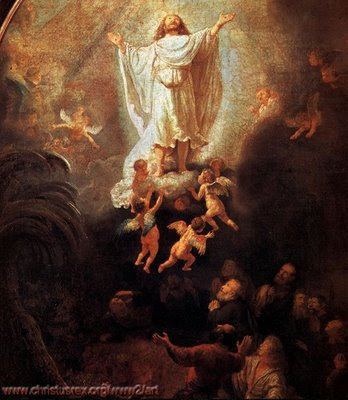
Understanding Ascensiontide: Ascension Thursday through Vigil of Pentecost

Of all the seasons that the Modern Novus Ordo Catholic Calendar has neglected to properly retain and celebrate, Ascensiontide has, like Epiphanytide, unfortunately, fallen by the wayside.  But, for those Catholics committed to the Sacred Traditions of the past, Ascensiontide holds a special length of time.

Ascentiontide lasts for 10 days and is part of Pascaltide. The first nine days of Ascensiontide include the traditional Octave of the Ascension. The last day in Ascentiontide is the Vigil of Pentecost. Pentecost Sunday, which traditionally has its own octave, follows. Trinity Sunday, the Sunday after Pentecost, officially begins the Season After Pentecost. The total length of Paschaltide, from Easter Sunday to the end of Whitsuntide is 56 days (inclusively)

For this season of Ascensiontide, Catholics are welcomed and encouraged to immerse themselves in the devotions appropriate for the season.  For example, during this season there are special prayers for the time between Ascension and Pentecost.

Before the changes of Pope Pius XII in 1955, there was a liturgical octave for the Ascension, and remnants of the octave can be found in the Office as it now stands.  The appropriate texts for the minor hours (except for the collects) are set out in the psalter. For the collects, Lauds and Vespers however, you need to keep your ribbon on the page for the Ordinary of Ascensiontide. The key points to note are set out via Saints will Arise.

So what exactly is Ascensiontide and what customs do traditional Catholics observe during this time?

Ascension Thursday

Image Source: A Catholic Life Blog (c) 2019 of the Torre Dell'Orologio

Taking place 40 days after Easter Sunday, the Church celebrates Our Lord's Glorious Ascension into Heaven on Ascension Thursday. The Ascension has three principal parts: the departure of Jesus from earth, His going up into heaven, and taking His place at the right hand of the Father.

It was precisely on the fortieth day after our Lord's Resurrection that He ascended into Heaven.

On the Mount of Olives, the same mount where the Passion began, Our Lord physically ascended into Heaven. At the top of the mount is a chapel in honor of the Ascension and the ground still retains the depressions His sacred feet had left.

Fisheaters further shares some of the great regional customs for this Feast Day and Holy Day of Obligation in reference to the above image: "Something else wonderful happens in Italy on the Feast of the Ascension and the days following: in Venice, there is a clock tower in the Piazza San Marco. This marvelous clock, made in A.D. 1499 (and recently restored) indicates not only the minutes and hours, but the days, months, Zodiacal signs, and phases of the Moon as well. At the top of the tower are two large figures known as the Moors ("Mori"), who signal the hour by striking a large bell. Underneath them is a large, golden lion -- the symbol of St. Mark, patron of Venice. Underneath this is a niche which holds a figure of Our Lady and her Son. Twice a year -- on the Feast of the Epiphany and during the festivities surrounding the Ascension (known as "la Festa della Sensa" in Venice) -- doors on either side of Our Lady open up, and out come the three Magi, led by an angel. The angel and Kings make their way around Our Lady and Jesus, the angel regaling them with his trumpet, and the Kings bowing and removing their crowns."


Vigil of Pentecost

The Mass for Pentecost was formerly celebrated during the night and has since been anticipated.  It seems that the Vigil was modeled on that of Easter.  As on Holy Saturday, a vigil was kept during the night of Pentecost Sunday to prepare for the Sacrament of Baptism. Even before the changes in 1955, the Vigil of Pentecost, while not kept in the night, was still filled with rich symbolism and in many respects mirrored the Easter Vigil.

Octave of Pentecost

The Feast of Whitsun - the term Whitsunday is another name for Pentecost alluding to the white vestments of the neophytes - is as ancient as that of Easter.  The Saturday following the Octave of Pentecost officially begins the Season After Pentecost.

While the Novus Ordo calendar unfortunately only has 2 octaves, traditional Catholics will be familiar with the idea of multiple overlaping Octaves.  The practice of celebrating an Octave, while not only traced to the time spent by the Apostles and the Blessed Virgin Mary awaiting the Paraclete, also has its origins in the Old Testament eight-day celebration of the Feast of Tabernacles (Leviticus 23:36) and the Dedication of the Temple (2 Chronicles 7:9). Very truly, Christ did not come to abolish the Old Law but to fulfill it.

By the 8th century, Rome had developed liturgical octaves not only for Easter, Pentecost, and Christmas, but also for the Epiphany and the feast of the dedication of a church.

After 1568, when Pope Pius V reduced the number of octaves (since by then they had grown considerably), the number of Octaves was still plentiful.  Octaves were classified into several types. Easter and Pentecost had "specially privileged" octaves, during which no other feast whatsoever could be celebrated. Christmas, Epiphany, and Corpus Christi had "privileged" octaves, during which certain highly ranked feasts might be celebrated. The octaves of other feasts allowed even more feasts to be celebrated.

To reduce the repetition of the same liturgy for several days, Pope Leo XIII and Pope St. Pius X made further distinctions, classifying octaves into three primary types: privileged octaves, common octaves, and simple octaves. Privileged octaves were arranged in a hierarchy of first, second, and third orders. For the first half of the 20th century, octaves were ranked in the following manner, which affected holding other celebrations within their timeframes:
  • Privileged Octaves
    • Privileged Octaves of the First Order
      • Octave of Easter
      • Octave of Pentecost
    • Privileged Octaves of the Second Order
      • Octave of Epiphany
      • Octave of Corpus Christi
    • Privileged Octaves of the Third Order
      • Octave of Christmas
      • Octave of the Ascension
      • Octave of the Sacred Heart
  • Common Octaves
    • Octave of the Immaculate Conception of the BVM
    • Octave of the Solemnity of St. Joseph
    • Octave of the Nativity of St. John the Baptist
    • Octave of Saints Peter and Paul
    • Octave of All Saints
    • Octave of the Assumption of the BVM
  • Simple Octaves
    • Octave of St. Stephen
    • Octave of St. John the Apostle
    • Octave of the Holy Innocents
As one can notice, the Octave of the Pentecost ranked even higher than the Octave of Christmas!
Read more >>
Sunday, May 20, 2012
Traditional Latin Masses in Tacoma, Washington


This message comes from a reader.  If you know of any information for him, please post it in the comment box.
Hi Matthew,

Are there any plans to bring the TLM to Tacoma, WA ?? There are some in Seattle. There is one in Tacoma called St. Marys; however I believe they are sedevacantists and are in schism.  Seattle in quite the drive though 30 + miles one way. I am a Traditional Roman Catholic.

Thank you,
Sincerely Robert
Read more >>
Thursday, May 17, 2012
Extensive Interview with Fr. Rostand

From the interview (in answer to a question about Archbishop Lefebvre), Fr. Rostand says:

"He has always expressed a desire to subordinate ourselves to the Pope, granting protection for the growth of Tradition, the existence of the Society, and guarantees that we will not be asked to minimize the fight, nor to compromise on the Faith. As he said in 1987: “If Rome really wants to give us true autonomy, like we have now but with our submission—we would like to be submitted to the Holy Father, and we have always wished for it...if Rome agrees to let us try this experiment of Tradition, there will no longer be any problem.” (Fideliter no. 60, Nov./Dec. 1987) "

Source: The Remnant
Read more >>
Ascension Thursday Sermon by St. Leo the Great (Sermon 74)

This Holy day of Obligation, 40th day of Easter, commemorates Christ's Ascension into Heaven from Mount Olivet 40 days after He rose from the dead (Mark 16:14-20). After the Gospel is sung, the Paschal Candle, lit from the New Fire of the Easter Vigil, is extinguished to symbolize the departure of Christ (if you use a Paschal candle at home, it should be put away today, too).


I. The Ascension completes our faith in Him, who was God as well as man  

The mystery of our salvation, dearly-beloved, which the Creator of the universe valued at the price of His blood, has now been carried out under conditions of humiliation from the day of His bodily birth to the end of His Passion. And although even in "the form of a slave" many signs of Divinity have beamed out, yet the events of all that period served particularly to show the reality of His assumed Manhood. But after the Passion, when the chains of death were broken, which had exposed its own strength by attacking Him, Who was ignorant of sin, weakness was turned into power, mortality into eternity, contumely into glory, which the Lord Jesus Christ showed by many clear proofs in the sight of many, until He carried even into heaven the triumphant victory which He had won over the dead. As therefore at the Easter commemoration, the Lord's Resurrection was the cause of our rejoicing; so the subject of our present gladness is His Ascension, as we commemorate and duly venerate that day on which the Nature of our humility in Christ was raised above all the host of heaven, over all the ranks of angels, beyond the height of all powers, to sit with God the Father. On which Providential order of events we are founded and built up, that God's Grace might become more wondrous, when, notwithstanding the removal from men's sight of what was rightly felt to command their awe, faith did not fail, hope did not waver, love did not grow cold. For it is the strength of great minds and the light of firmly-faithful souls, unhesitatingly to believe what is not seen with the bodily sight, and there to fix one's affections whither you cannot direct your gaze. And whence should this Godliness spring up in our hearts, or how should a man be justified by faith, if our salvation rested on those things only which lie beneath our eyes? Hence our Lord said to him who seemed to doubt of Christ's Resurrection, until he had tested by sight and touch the traces of His Passion in His very Flesh, "because you have seen Me, you have believed: blessed are they who have not seen and yet have believed John 20:29 ."

II. The Ascension renders our faith more excellent and stronger  

In order, therefore, dearly-beloved, that we may be capable of this blessedness, when all things were fulfilled which concerned the Gospel preaching and the mysteries of the New Testament, our Lord Jesus Christ, on the fortieth day after the Resurrection in the presence of the disciples, was raised into heaven, and terminated His presence with us in the body, to abide on the Father's right hand until the times Divinely fore-ordained for multiplying the sons of the Church are accomplished, and He comes to judge the living and the dead in the same flesh in which He ascended. And so that which till then was visible of our Redeemer was changed into a sacramental presence , and that faith might be more excellent and stronger, sight gave way to doctrine, the authority of which was to be accepted by believing hearts enlightened with rays from above.

III. The marvellous effects of this faith on all  

This Faith, increased by the Lord's Ascension and established by the gift of the Holy Ghost, was not terrified by bonds, imprisonments, banishments, hunger, fire, attacks by wild beasts, refined torments of cruel persecutors. For this Faith throughout the world not only men, but even women, not only beardless boys, but even tender maids, fought to the shedding of their blood. This Faith cast out spirits, drove off sicknesses, raised the dead: and through it the blessed Apostles themselves also, who after being confirmed by so many miracles and instructed by so many discourses, had yet been panic-stricken by the horrors of the Lord's Passion and had not accepted the truth of His resurrection without hesitation, made such progress after the Lord's Ascension that everything which had previously filled them with fear was turned into joy. For they had lifted the whole contemplation of their mind to the Godhead of Him that sat at the Father's right hand, and were no longer hindered by the barrier of corporeal sight from directing their mind.' gaze to That Which had never quitted the Father's side in descending to earth, and had not forsaken the disciples in ascending to heaven.
Read more >>
Tuesday, May 15, 2012
Exclusive interview with Bishop Bernard Fellay


An exclusive interview with Bishop Bernard Fellay, superior general of the Society of St. Pius X, at the society's headquarters in Menzingen, Switzerland. Bishop Fellay has been at the heart of a drama within the Catholic Church since he was ordained by the group's founder, Archbishop Marcel Lefebvre, in 1988, protesting the modernizing reforms of the Second Vatican Council.

Since 2009, he has been involved in private doctrinal talks with Rome in an effort to overcome the division between his traditionalist society and the Vatican. An announcement is expected by the end of May regarding the outcome of those talks.
Read more >>
Monday, May 14, 2012
Minor Rogation Days: May 14 - 16, 2012

This year the Minor Rogation, the days leading up to Ascension Thursday, are May 14-16 inclusive. Today is the first day of the Minor Rogation, a day which should be a day of fasting.

These were traditionally days of penance, fasting, and praying litanies. If you are in good health, please remember to observe these days. For more information on Rogation days, see the links in my post entitled Rogation Day: Fasting and Penance.

I greatly encourage people to observe these days and spend time praying the Litany of Saints not only for a bountiful harvest but also for mercy and repentance.

Commemoration of the MASS OF ROGATION (1962 Missal)

Mercifully grant us our requests, O Lord, that the consolation we receive in our grievous troubles may increase our love for You.
Read more >>
Sunday, May 13, 2012
First Apparition of the Virgin Mary at Fatima : Sunday, May 13th, 1917

Today is the anniversary of the Blessed Virgin Mary's first apparition to Fatima on May 13th.  See my post on Fatima for more information and photos.

Sr. Lucia narrated the following:
While playing with Jacinta and Francisco on the hill, near Cova de Iria, we were building a wall with stones around a blooming plant, all of a sudden we saw a light like lightning.

“It is flashing,” I said. “A storm can come. It is better to return home.”

“Oh, yes, alright,” my cousins responded. We started to come down from the hill taking the sheep down the path. In the middle of our way on the slope, near the evergreen oak which still exists today, we saw a flash of lightning and after we took some more steps over the slope, we saw a Lady dressed in white, more brilliant than the sun, scattering clear and intense light, more than a ray of sunlight through a glass of water.
We were so close that we were in the light She irradiated. Our Lady said: “Don’t be afraid. I will not harm you.” I asked her: “ Where are you from ?”  “I’m from Heaven.”

Source: Pierced Hearts
Image Source:  Take from the Facebook Page (Marian Events).  The one who designed the photo is Mr. John Ryan M. Debil from the Philippines.
Read more >>
Friday, May 11, 2012
Help the SSPX US District Stop the Spread of False Information

As I’m sure you’ve seen, there is a lot of news coming out in both national and Catholic media outlets about discussions between Rome and the Society. Too often these blog posts and news reports take the form of sensationalism, gossip, rumor-mongering, etc. and seem to have as an aim to put undue pressure on those charged with leading the Society.

I understand that many may come to different conclusions, but I don’t think anyone would argue that we can use different facts to come to those conclusions. For this reason, I’m encouraging you to join the Society’s email list. Regardless of what side of the fence people fall on, the current news and information on events between Rome and the Society is certainly historic. For that reason, the email list will deliver official Society information and commentary as it becomes available on any breaking news, new articles, events, etc.
Read more >>
Thursday, May 10, 2012
The Finding of the Holy Cross

Ant. O Tree loftier than all cedars! whereon hung the Life of the world, and Christ triumphed, and death conquered death for ever, alleluia.

Double of the 2nd Class (1955 Calendar): May 3

May 3rd is the often forgotten traditional Feast of the Finding of the True Cross by St. Helena. Today was in some places known as Roodmas. It is also called the "Invention of the Holy Cross." Today is also the Commemoration of Pope St. Alexander I and his companions in both the 1954 Calendar and in the 1962 Calendar.

The second nocturn of Matins today in the pre-1955 Breviary recounts how St. Helena used a sick person to discern which of several candidates was indeed the True Cross of our Lord. The sick were healed instantly upon touching the True Cross. Despite the liturgical changes of the 1950s and 1960s that saw this feast day dropped even in the 1962 Missal, the Latin rite Catholics in the Church of the Holy Sepulchre in Jerusalem still observe this feast. While the feastday is not kept even in the 1962 Missal, priests who offer the 1962 Missal may (and arguably should) say a Votive Mass today for the Finding of the Holy Cross. Since in the 1962 Missal May 3rd is a feria, a Votive Mass may be offered today (unless today falls on a Sunday or another high ranking day in the sanctoral cycle like Ascension Thursday). 

The following is taken from the Brighton Oratory:
The Cross on which Our Blessed Lord suffered for us was, following Jewish usage, buried on Mount Calvary after the Crucifixion. The precise spot was revealed in a vision to the Empress Helena, mother of Constantine, the first Christian Emperor. This date commemorates the recovery of the True Cross in the reign of the Emperor Heraclius and its delivery by him about the year 629 into the hands of the Patriarch Zacharias of Jerusalem, from which city it had been carried away some years previously by the Persians with the object of transporting it to their own country. God has been pleased to give so much power to the Cross that at its sign alone the demons fly; by it the priest blesses the faithful, the devout receive abundant graces. The early Christians had so much devotion to it that, according to the ancient Fathers, they never began any action without first making the sign of the cross upon themselves. In the Middle Ages no public deed, inscription, law etc., was begun to be written without first tracing upon it the sign of the cross. This sign was accepted as the signature of the uneducated; it often preceded that of ecclesiastics, and in many country districts even the dough and the bread were marked with a cross before they were baked. 
In the Epistle the triumph of the Redeemer of the world, Our Lord Jesus Christ, must be preceded by "His humiliation unto death, even the death of the Cross." In the Gospel Christ reveals His mission in His discourse with Nicodemus: "The Son of Man must be lifted up" on the Cross for the salvation of mankind. 
The Feast of the Exaltation of the Holy Cross on September 14th commemorates the day after the consecration of the church (September 13th 335) built by Macarius and Helena when the good bishop was prevailed upon to elevate the True Cross publicly for the faithful to venerate. It also commemorates the recovery of the True Cross from the Persians by Heraclius in the seventh century.

Collect:

O God, Who didst cause that the Cross of our salvation should in most honorable wise be found again, and Who didst manifest thereby the marvelous efficacy of thy sufferings, mercifully grant that by the Ransom which Thou didst pay upon that tree of life we may finally attain unto life eternal. Who livest and reignest with God the Father in the unity of the Holy Spirit, one God, world without end. R. Amen

Source: 1945 Roman Catholic Daily Missal 

Holy Cross Weather Blessing


Ant. O Cross! brighter than all stars, honoured throughout the world, beloved by men, holiest of holy things, that alone wast worthy to bear the ransom of the world! O sweet Wood! O sweet nails! that bore so sweet a weight! save the people assembled here this day to sing thy praise! Alleluia, alleluia.

From May 3rd, the Feast of the Finding of the Cross, until September 14th, the Feast of the Exaltation of the Holy Cross, a special blessing beseeching God’s protection against violent and damaging storms may be given with a relic of the True Cross of Our Lord Jesus Christ. 

In light of this, I wanted to share this beautiful prayer from the Rituale Romanum.  Share with your priests and encourage them to say this blessing during this time of year from May 3rd through September 14th on Fridays.

In Latin:

V. A fúlgure, grádine et tempestáte.
R. Líbera nos, Dómine Jesu Christe.

V. Osténde nobis, Dómine, misericórdiam tuam.
R. Et salutáre tuum da nobis.

V. Dómine exáudi oratiónem meam.
R. Et clamor meus ad te véniat.

V. Dóminus vobíscum.
R. Et cum spíritu tuo.

Orémus.  Quaesumus, omnípotens Deus, ut, intercessióne Sanctae Dei Genetrícis Maríae, sanctórum Angelórum, Patriarchárum, Prophetárum, Apostolórum, Mártyrum, Confessórum, Vírginum, Viduárum, et ómnium Sanctórum tuórum, contínuum nobis praestes subsídium, tranquíllam auram permíttas, atque contra fúlgura et tempestátes désuper nobis indígnis tuam salútem effúndas de caelis, et géneri húmano semper aemulas, déxtera poténtiae tuae, aéreas cónteras potestátes.  Per eúndem Christum Dóminum nostrum.
R. Amen.

V. Sit nomen Dómini benedíctum.
R. Ex hoc nunc et usque in saeculum.

V. Adjutórium nostrum in nómine Dómini.
R. Qui fecit caelum et terram.

V. Benedíctio Dei omnipoténtis, Patris + et Fílii, et Spíritus Sancti, descéndat super vos, locum istum et fructus terrae et máneat semper.
R. Amen.

In English:

V. From lightning strikes, hail, and violent storms.
R. Deliver us, O Lord Jesus Christ.

V. Show us, O Lord, Thy mercy.
R. And grant us Thy salvation.

V. O Lord, hear my prayer.
R. And let my cry come unto Thee.

V. The Lord be with you.
R. And with thy spirit.

Let us pray.  We beseech Thee, O Almighty God, through the intercession of Holy Mary, the Mother of God, of the holy angels, patriarchs, prophets, apostles, martyrs, confessors, virgins, widows, and of all Thy saints, that Thou show us Thy continuing protection, permit tranquil winds, and also pour out to us, Thy unworthy servants, Thy safety from heaven above against lightning strikes and violent storms, and that Thou remain always protective of the human race and crush down the aerial powers by the right hand of Thy power.  Through the same Christ our Lord.
R. Amen

V. Blessed be the Name of the Lord.
R. Now and forever.

V. Our help is in the Name of the Lord.
R. Who made heaven and earth.

V. May the blessing of Almighty God, the Father, + the Son, and the Holy Ghost, descend upon you, this place, and the fruits of the earth and remain forever.
R. Amen.
Read more >>
Wednesday, May 9, 2012
First Communions at St. Vincent's SSPX Chapel


On Sunday, May 8, 2012, at St. Vincent de Paul Church in Kansas City, Missouri, 22 children received our Blessed Lord Jesus Christ in the Blessed Sacrament for the first time. Also receiving her First Communion was a 94-year old lady (an adult convert), the great-grandmother of two of the children.

Please keep these 23 souls in your prayers - that they will always remain in God's grace.  O Lady, Mediatrix of all Graces, ora pro nobis!

Source: SSPX
Read more >>


Copyright Notice: Unless otherwise stated, all items are copyrighted under a Attribution-NonCommercial-NoDerivatives 4.0 International License. If you quote from this blog, cite a link to the post on this blog in your article.

Disclosure of Material Connection: Some of the links on this blog are “affiliate links.” This means if you click on the link and purchase the item, I will receive an affiliate commission. As an Amazon Associate, for instance, I earn a small commission from qualifying purchases made by those who click on the Amazon affiliate links included on this website. I am disclosing this in accordance with the Federal Trade Commission’s 16 CFR, Part 255: “Guides Concerning the Use of Endorsements and Testimonials in Advertising.”