Monday, April 18, 2016
Faithful Catholics Express Grave Concerns over Amoris Laetita


Guest Post by David Martin

On EWTN’s April 14, World Over Live program hosted by Raymond Arroyo, canon law expert Fr. Gerald Murray and Robert Royal, Catholic author and president of the Faith and Reason Institute, expressed serious concerns over Pope Francis’ Apostolic Exhortation Amoris Laetita, and sympathized with concerns that many Catholics are having about the "problematic" parts of the document.

For example, in Paragraph 3, Francis says that "not all discussions of doctrinal, moral or pastoral issues need to be settled by interventions of the Magisterium... Each country or region, moreover, can seek solutions better suited to its culture and sensitive to its traditions and local needs."

In other words, each country or region can decide for itself which doctrines, laws, and disciplines it will adopt according to the whims of the people. This disagrees with tradition. The Church is universal so that its laws and teachings apply equally in all places and in every age. It is man that must change to conform to God, but God never changes. His unchanging doctrine and rule of law constitute the highest good for all peoples, so that any altering of the rule shows insensitivity and negligence, and contributes to the detriment of the people.

If we have a church today that is divided, confused, and out of grace, it is precisely because of this relaxation of the rule. Catering to the people and allowing secular influence into the Church is the plan of the Freemasons to destroy the Catholic Church.

It all started at Vatican II with the introduction of cultural diversity, i.e. changes of discipline, introduction of vernacular, where "active participation of the faithful" now became the focus. For example, in Article 37 of the Concilium it states that "the Church has no wish to impose a rigid uniformity" but rather "respects the genius and talents of the various races and peoples" and even studies with sympathy "these people's way of life," so that "she admits such things into the liturgy itself." The end result today is a Church divided, and a general falling away from God.

Note that the Church before the Council was united and whole. It was unthinkable that the Church would even consider giving Communion to those living in adultery, but now the Church sanctions this in defiance of it's own teachings. Amoris Laetitia permits some divorced and civilly remarried Catholics to receive Communion with no stipulation to live as brother and sister. (Paragraph 300, note 336) Footnote 351 to Article 305 explicitly states that the "help" offered by the Church to those living in adultery can "in certain cases... include the help of the sacraments." That is, the Church helps adulterers by giving them Communion.

This not only breaks with the Church's centuries old discipline on the reception of Communion, but constitutes a change of doctrine, since altering the discipline now proclaims to the Church that adultery is no longer a mortal sin.

The pope in Amoris Laetita says that the Eucharist "is not a reward for the perfect," so who then are the beneficiaries of this reward? The Eucharist is a reward, not for the perfect, but for those striving to "be perfect, as also your heavenly father is perfect." (Mt. 5:48) It is divine medicine for the contrite, and must be merited. It is not a formality for the casual, the lukewarm, and the ungrateful.

But especially, the Holy Eucharist is not for adulterers or those who flirt with the same sex. Jesus said, "Give not that which is holy to dogs." (Mt. 7:6) Concerning those that are divorced and civilly remarried, St. Paul warns, "Know you this and understand, that no fornicator, or unclean, or covetous person (which is a serving of idols), hath inheritance in the kingdom of Christ." (Ephesians 5:5)

According to the Apostle, the reception of the Holy Eucharist by such persons is a sacrilege, and works to their condemnation. (1 Corinthians 11:27-29) What manner of insanity is this that benched Catholics are now permitted to approach the Eucharist while their souls are degraded with sin of a mortal nature? Is Rome deliberately attempting to send these souls to Hell? Where is the mercy, Your Holiness? Your mission is to admonish and instruct souls about the proper reception of Communion, not to Protestantize them.

We pray that Pope Francis will repose confidence in the tradition of the Apostles that was passed on by his predecessors of the Petrine Office. And we pray he not listen to the rebellious spirits loosed "in the high places." (Ephesians 6:12) To long has Kasper the unfriendly ghost been haunting the Church with his weird ideas, too long have the spooks of modernism been springing their surprises on the faithful. We don't need these "gods of surprises," but we need the One True God Who never surprises His people with respect to how we are to approach Him in the Blessed Sacrament. If the Church today is in darkness, it is because the sins of the church are standing between God and his people, courtesy of our high clergy that make no effort to cure the flock of this moral leprosy.

We pray that Francis will show true mercy on souls by leveling with them and passing on to them the good things of tradition that have proved fruitful, remembering the exhortation of St. Paul: "Prove all things; hold fast that which is good." (1 Thess. 5:21)
Read more >>
Thursday, April 14, 2016
Francis defends Judas, Whacks the High Priests

 
Guest Post by David Martin

Pope Francis is not happy with his good bishops. For the past several months he has showed irritation toward Vatican conservatives who oppose his synodal proposals that we show more openness to homosexuals and civilly remarried Catholics. It seems he has been on a rant by constantly lashing out against traditional cardinals whom he compares to the "doctors of the law" that "are closed to the prophecies and the lives of persons," though he does this indirectly through little digs that surface in his homilies.

His morning homily at the Vatican Casa Santa Marta on April 11 was no exception to this. Therein he defended Judas as the "poor man," while lamenting that "the doctors of the letter" had no compassion on him. "It hurts when I read that small passage from the Gospel of Matthew, when Judas, who has repented, goes to the priests and says: ‘I have sinned' and wants to give... and gives them the coins. ‘Who cares! - they say to him: it’s none of our business!’ They closed their hearts before this poor, repentant man."

First of all, it's important to note that there was no contrition in Judas' repentance. Were it otherwise, he would have gone directly to Jesus and apologized to him. He rather went and hung himself with a halter, which was an act of final impenitence—a mortal sin. Revelation has it that he is now one of the demons of Hell who tempt the faithful on earth, something God would never permit had he truly been innocent and contrite.

And whereas the chief priests were most wicked, they were not inhumane to Judas, because Judas was not seeking their forgiveness or understanding. Judas simply returned the money to them because he didn't want to bear the blame of the Crucifixion; he couldn't face up to what he did. It was an attempt to wash his hands. Like Pilate, he knew of Jesus' innocence, so he said, 'look to it yourself, I don't want your money.'

One cannot help to note, too, how Francis laments so deeply the hardness of heart wherewith the high priests behaved toward Judas, yet he says nothing of the cruelty and hardness that they demonstrated toward the Son of God whom they were about to kill. Where in the Church's history was it said or taught that the high priests were evil because they were mean to Judas?

The pope's homily on April 11 came on the heels of his widely criticized Apostolic Exhortation Amoris Laetitia issued on April 8, wherein he confirms the proposals of the October 2014-15 Synods on the Family that the Church be open to the lives of unrepentant gays and adulterers. Francis' thrust is that we accept them into the Church as they are, but this unfortunately blesses sin before the faithful—something that God will never ratify. "Woe to the world because of scandals?" (Mt 18:7)

As expected, Amoris Laetitia breaks with 2000 years of tradition by permitting some divorced and civilly remarried Catholics to receive Communion with no stipulation to live as brother and sister. (Paragraph 300, note 336) Footnote 351 to Article 305 explicitly states that the "help" offered by the Church to those living in adultery can "in certain cases... include the help of the sacraments." That is, the Church helps adulterers by giving them Communion.

This not only breaks with the Church's centuries old discipline on the reception of Communion, but constitutes a change of doctrine, since altering the discipline now proclaims to the Church that adultery is no longer a mortal sin.

But it also defies the warning of St. Paul to those who approach the Blessed Sacrament while in serious sin. "Therefore whosoever shall eat this bread, or drink the chalice of the Lord unworthily, shall be guilty of the body and of the blood of the Lord... For he that eateth and drinketh unworthily, eateth and drinketh judgment to himself." (1 Corinthians 11: 27-29)

From the onset the pope's focus was never about admitting Communion to gays and adulterers, but about integration. The "liturgical, educational, pastoral, and institutional" roles advocated by the October 2015 Synod were outlined by the pope two years ago, as we read in the Dec. 8, 2014 issue of CNS: "Pope Francis said that the Catholic Church must consider various ways to integrate the divorced and civilly remarried in the life of the church—not merely allowing them to receive Communion, but letting them serve as Eucharistic ministers and godparents."

These attempts are futile. The path to integration has already been laid out through holy tradition. Those living in sin simply need to renounce their lifestyle and partner, and go to confession, so that their integration will be complete. Now they can be reinstated into the Church and even receive Communion, so that the Eucharist will now help them, and not condemn them as St. Paul warns.

But allowing irregular couples into the Church as they are only sustains their offense, so that they remain separated from God and unable to be saved should they die without repentance. It deceives them, and deceives the faithful, which is no charity.

True charity means converting the wayward, that they might leave their unhappy state and be joined with Christ in His Church, but Francis sees this as an imposition. Jesus cleansed the lepers that they might be liberated from their affliction, yet Francis leaves the morally afflicted in their leprosy to suffer, and then calls it love and mercy.

Love is in the faithful keeping of God's laws, as expressed by Christ: "If you love me, keep my commandments." (John 14:15) Yet, Francis expresses irritation over tradition-minded Catholics who faithfully keep the law, comparing them to the hypocritical Pharisees and high priests who followed the law to "the letter." Let us not forget that the Pharisees were not the teachers of the law, but were apostates that had completely left the Jewish law, evidenced by their sorcery, their child abuse, and their murder of the Messiah who gave them the law. The Pharisees never obeyed God's law, but only pretended to. It was their pretense and hypocrisy that irked Our Lord.

Alluding to our traditional bishops, the pope on April 11 spoke of these callous high priests, saying that all that mattered to them "were the laws, so many words and things they had built." What is implied is that the holy doctrines and traditions of the Catholic Faith are just "traditions of men" which today's Pharisaic conservatives have built up for themselves. Has Francis not considered that he is the Pharisee persecuting these holy men?

The pope said: "History tells us of many people who were judged and killed, although they were innocent: [were] judged according to the Word of God, against the Word of God. Let’s think of witch hunts or of St. Joan of Arc, and of many others who were burnt to death, condemned because according to the judges they were not in line with the Word of God." 

Francis seems to think that the Cardinal Burkes and good bishops are the "judges" who persecute the innocent—whom he holds to be the poor gays, Judases, and adulterers—because they don't adhere to their own "stiff-necked" version of the Word of God. He overlooks the fact that all the martyrs through the centuries, and without exception, were the staunch Catholics who adhered strictly to the laws, doctrines, and tradition of the Faith, so much so, that they chose to die rather than compromise one point of tradition. We speak of those tough and holy bishops, virgins, hermits, and fighters for Heaven who absolutely refused to change with the times. This is why they were saints.

Francis has forgotten that in every case, without exception, it was the left-wing dissident Catholics, heretics, Marxists, infidels, adulterers, homosexuals, i.e. the enemies of tradition, that inflicted this persecution upon the Catholics. This persecution has now reached unprecedented heights.

We today are witnessing the re-crucifixion of Christ; the Mystical Body is truly passing through its Passion. It is a reply of the Crucifixion as the scribes and high priests of the new order go about stirring up the people against Jesus and His traditions. Sorrowfully, we see Francis at the helm persecuting the innocent while praising the names of the martyrs, which calls to mind the Pharisees who pretended to honor the memory of the prophets, but who were "the sons of them that killed the prophets." (Mt. 23:31)

We've seen the replay of the Crucifixion; now we need a replay of Damascus. Jesus cries out today, saying, "Francis, Francis, why do you persecute me?" We pray he will open his heart and recognize who his true friends are—the Bishop Schneiders, Cardinal Burkes, and Cardinal Sarahs—that he may open his eyes and see their genuine love for God's people, evidenced by their tireless efforts to bring the pure waters of tradition to the thirsting flock.

May Francis do likewise. May he open his eyes and understand that if he loves souls, he will labor with all his will to bestow on the people the treasures of the Catholic Faith in all its facets—the knowledge of Heaven, the saints, the mystics, the miracles, the dogmas, the laws, the Tridentine Mass—that they be enriched and edified like no other people on earth.

And may he likewise deign to reach out and extend the beauties of the Faith to all peoples, that they may leave their particular ideas, miseries, idols, and religions, and be joined with Christ in the bosom of His Church. The jewels of sacred tradition were not to be hoarded, but shared. What greater mercy can the pope show for poor sinners than by enriching them with the glories of the One True Faith!

Jesus said to Peter, "Simon, son of John, do you love me?" Peter answered, "You know that I love thee." Jesus said, "Feed my sheep." We pray that Francis will embrace the Church's mission to convert the world, and not see this as "competition" or the pompous flaunt of Pharisaic peacocks that want to fan their ostentatious feathers. May he see it rather as the Church's mission of mercy, as given to us by Jesus Christ 2000 years ago.

http://en.radiovaticana.va/news/2016/04/11/pope_francis_warns_against_those_who_judge_with_closed_hea/1221870

Read more >>
Friday, April 8, 2016
Friday Penance: Still Required in Eastertide


Abstinence Required In Pascaltide

Friday is the day in which we commemorate Our Lord's passion and death. As Catholics, we are still bound to abstain from meat each Friday of the entire year, not just in Lent. This is required during the season of Pascaltide. This is affirmed even in the modern 1983 Code of Canon Law - all Fridays of the entire year are days of penance (with few exceptions). There can be no doubt that Catholics must be informed that Friday abstinence is not to be confided to Lent only. Failing to observe Friday penance is a mortal sin, as affirmed by multiple pontiffs.

Abstinence on Easter Friday

How should we treat abstinence specifically on Friday in the Octave of Easter (i.e. Easter Friday)? The 1917 Code of Canon Law stipulated that the requirement to abstain from meat (i.e. Friday penance) was required each and every Friday of the year unless that particular Friday was a Holy Day of Obligation outside of Lent: 

"On [Sundays] or feasts of precept, the law of abstinence or of abstinence and fast or of fast only ceases, except during Lent, nor is the vigil anticipated; likewise it ceases on Holy [Saturday] afternoon" (1917 Code, Canon 1252 § 4). [Translation taken from THE 1917 OR PIO-BENEDICTINE CODE OF CANON LAW in English Translation by Dr. Edward Peters]

Easter Friday is not a feast of precept (i.e., a Holy Day of Obligation), and neither is any Friday in the Pascal Season between Easter Sunday and Trinity Sunday. The 1917 Code of Canon Law outlined the rules of fasting and abstinence in Canons 1250-1254. Before 1917, even Holy Days of Obligation outside of Lent required explicitly papal dispensation or else Friday abstinence would be observed even on days of precept.

The 1983 Code and the myriad of weakening dispensations offered in the 20th century has led to a continual decline in penance and devotion. Due to the errors and ambiguities in the 1983 Code, it must be rejected, and the older Code must be used. One of these issues is the unprecedented novelty of solemnities like Easter Friday breaking the immemorial tradition of Friday abstinence. The notion of day's liturgical rank abrograting abstinence has no basis in Church practice prior to 1983. 

It is essential for all Roman Catholics to continue abstaining from meat even on Easter Friday.

Conclusion

Friday abstinence is still the Catholic practice throughout Eastertide, and it is the Church's Law. Let us not be so keen to forget our Lord's sacrifice on the Cross. Pray and do penance on this and all Fridays. It is after all, on Friday that our Blessed Lord redeemed us. Let us never forget His Sacrifice on that first Good Friday.

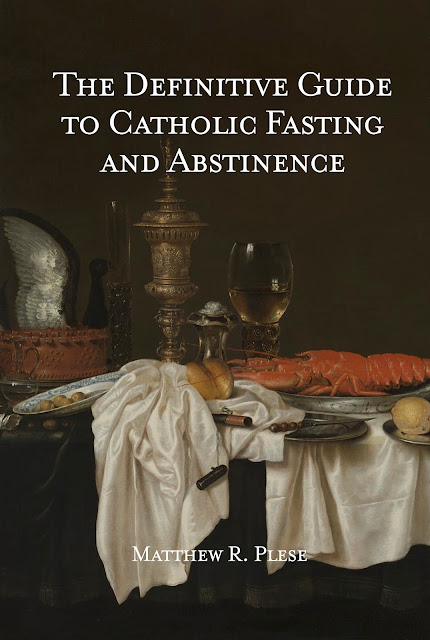
Want to learn more about the history of fasting and abstinence? Check out the Definitive Guide to Catholic Fasting and Abstinence.
Read more >>
Pilgrimage to Rome: Part I

I would like to thank everyone who sent in suggestions and helpful advice to me as I traveled to Rome for Holy week.  A few weeks ago I shared my itinerary, and with most plans, I didn't stick to it.  Fortunately, I ended up visiting far more places than even I had planned.  Sometimes breaking from the plan is for the better.

I was able to visit such a number of holy places (nearly 25 different basilicas) and I prayed for the intentions of all of my readers while there.  I also visited Florence and had a brief trip to Pompeii.

I am now safety back in the United States after being able to visit some of the most sacred relics: the Holy Stairs, all 4 of the Holy Doors, relics of the True Cross, the tombs of Ss Peter and Ss Paul, the chains of both of those saints, the crib in which our Lord was born, the Pillar of Flagellation, some pieces of the Crown of Thorns, the sign that hung above our Lord on the cross, the bodies/tombs of many saints including St. Philip Neri, St. Helena, Blessed Fra Angelico, St. Pius X, St. Catherine of Siena, the head of St. Agnes, the skull of St. Valentine, and so much else.

Over the next few weeks I will be sharing some of my experiences and photos from this trip.  Please stay tuned!

Here are some of the photos as part of a very small preview of what is to come:


Read more >>
Tuesday, April 5, 2016
Feast of St. Vincent Ferrer


Today is the feast of the great Dominican missionary St. Vincent Ferrer. Vincent Ferrer (1350-1419) was a great Spanish Dominican missionary and master of souls. It is estimated that through the labors of St. Vincent, over 25,000 Jews were brought into the Church.  He also brought in numerous converts among the Islamic Moors.

In addition to carrying on an inspired apostolate in Spain, he preached to thousands of persons in France, Switzerland, and Italy. By his preaching and miracles, he converted thousands of sinners and heretics. He pleaded so eloquently for penance that he was known as the "Angel of the Judgment." He raised over 30 people from the dead.

The Roman Martyrology says of him: "At Vannes in Brittany, St. Vincent Ferrer, of the Order of Preachers, and confessor. He was mighty in word and deed, and converted many thousands of infidels to Christ."

Dom Gueranger writes, "To-day, again, it is Catholic Spain that offers one of her sons to the Church, that she may present him to the Christian world as a model and a patron. Vincent Ferrer, or, as he was called, the angel of the judgment, comes to us proclaiming the near approach of the Judge of the living and the dead. During his lifetime, he traversed almost every country of Europe, preaching this terrible truth; and the people of those times went from his sermons striking their breasts, crying out to God to have mercy upon them—in a word, converted."

The traditional Matins lessons:
Vincent was born at Valencia, in Spain, of respectable parents. He showed the gravity of old age, even when quite a child. Considering within himself, as far as his youthful mind knew it, the dangers of this dark world, he received the Habit in the Order of Preachers when he was eighteen years of age. After his solemn profession, he diligently applied himself to sacred studies, and gained, with much applause, the degree of doctor of divinity. Shortly after this, he obtained leave from his superiors to preach the word of God. He exposed the perfidy of the Jews, and refuted the false doctrines of the Saracens, but with so much earnestness and success, that he brought a great number of infidels to the faith of Christ, and converted many thousand Christians from sin to repentance, and from vice to virtue. God had chosen him to teach the way of salvation to all nations, and tribes, and tongues; as also to warn men of the coming of the last and dread day of judgment. He so preached, that he struck terror into the minds of all his hearers, and turned them from earthly affections to the love of God. 
His mode of life, while exercising this office of apostolic preaching, was as follows: he every day sang Mass early in the morning, delivered a sermon to the people, and, unless absolutely obliged to do otherwise, observed a strict fast. He gave holy and prudent advice to all who consuited him. He never ate flesh meat, or wore linen garments. He reconciled contending parties, and restored peace among nations that were at variance. He zealously laboured to restore and maintain the union of the seamless garment of the Church, which, at that time, was rent by a direful schism. He shone in every virtue. He was simple and humble, and treated his revilers and persecutors with meekness and affection. 
Many were the signs and miracles which God wrought through him, in confirmation of the holiness of his life and preaching. He very frequently restored the sick to health, by placing his hands upon them. He drove out the unclean spirits from the bodies of such as were possessed. He gave hearing to the deaf, speech to the dumb, sight to the blind. He cured lepers, and raised the dead to life. At length, worn out by old age and bodily infirmities, after travelling through many countries of Europe, and reaping an abundant harvest of souls, this untiring herald of the Gospel terminated his preaching and life at Vannes, in Brittany, in the year of our Lord 1419. He was canonized by Pope Calixtus III.
This noble Dominican is an example for us all.  Please read the story of his noteworthy life at Nobility.org by clicking here. And for more information, the book "The Angel of Judgment" is a must-read.

Collect:

O God, who didst vouchsafe to glorify Thy Church by the merits and preaching of blessed Vincent, Thy Confessor: grant to us Thy servants that we may be taught by his example, and delivered by his patronage from all adversities. Through our Lord . . .

Prayer Source: 1962 Roman Catholic Daily Missal
Read more >>
Sunday, April 3, 2016
March 25th: The Most Important Day in Human History (3 Times Over)


Note: This article is taken from Society of St. Vincent Ferrer.

(1) Creation - According to very ancient sources, March 25th is the day of creation. Contrary to the false science and errors of evolution, Scripture and Tradition teach that God created instantaneously (simply by speaking) and out of nothing. There are also traditions that relate March 25th was the day on which Adam and Eve were created and therefore also the day on which Adam and Eve committed the Original Sin.

(2) Incarnation - It was on this same calendar day that Jesus Christ assumed our human nature. March 25th is the day of the Mysteries of the Annunciation and Incarnation. On this day, God sent the archangel Gabriel to the Virgin Mary and she gave her fiat. As we well know, Christ was then born nine months later, on Dec 25th.

(3) Crucifixion - We read in the Roman Martyrology that March 25th is also the day on which St. Dismas, the good thief, died. This corroborates the ancient and venerable tradition that Our Lord was crucified on March 25th. In other words, the calendar date of the original Good Friday was March 25th. St. Irenaeus explains that it is eminently fitting that on the same day which the fallen angel seduced the virgin Eve, so on that day the archangel Gabriel spoke the words of salvation for all mankind to the Virgin Mary. He adds that on the same day that mankind was lost on account of the fruit of the forbidden tree, so on that day Christ hangs on the tree of the Cross and wins salvation for mankind. 

St. Irenaeus is the most prolific writer among the early Church Fathers. He was the spiritual son of St, Polycarp, who in turn was ordained and taught by St. John the Apostle. He emigrated from the East to Lyon (Gaul or France), advised several popes, was consecrated a bishop, fought against numerous heresies, and was ultimately martyred for the Faith. The popes of his day considered him a most reliable source for Apostolic Tradition and on that basis accepted his counsel on several important matters. Thus, in the writings of St. Irenaeus, we have a very important and trustworthy witness; and we are in direct contact with the traditions taught by the Apostles themselves. (In fact, St. Irenaeus writes that it is an apostolic tradition that Our Lord was conceived on March 25th) Those interested can read a bit more about this from Dom Guéranger's The Liturgical Year for March 25, linked here.

We have writings from a number of other Fathers and Doctors of the Church who convey this tradition, including St. Augustine, St. Clement of Alexandria, St. Cyprian, and St. Maximus the Confessor, 

Once again, in this 2016th year of Our Lord, Good Friday will fall on March 25th. This is rather singular since it will only happen twice in this entire century. The other occurrence was in 2005, just a few weeks before Cardinal Ratzinger was elected Pope Benedict XVI. This means in all likelihood, most of us will never again by alive on a Good Friday that falls on March 25. (It will take 141 years for it to happen again. Incidentally, this 141 year gap will be the longest such gap in several centuries. For example, Good Friday fell on March 25th three times during the 20th century, but all prior to 1933.)

(4) Other Events. Traditions that come to us from antiquity also claim that many other key events in salvation history occurred on March 25th. For example: Cain slaying Abel, Melchisedech offering bread and wine in the presence of Abraham, Abraham's offering of Isaac, and the Crossing of the Red Sea. If this subject interests you, The Lepanto Institute has an article that goes into more detail and it can be read HERE.

Let us consider the providence of God behind these remarkable events and respond by cooperating as much as we possibly can with His grace.

Read more >>
Thursday, March 31, 2016
Pray for (Not To) Mother Angelica


On Easter Sunday, March 27th, Mother Angelica passed from this world to the next.  Mother Angelica was a well known Catholic figure and the founder of EWTN.  Over the years on the air, Mother Angelica spoke against a myriad of liturgical abuses and liberal practices in the Mainstream Church; though never fully committing to the Traditional Mass exclusively, she was recognized as a supporter of it and a staunch conservative in the Church.

As we remember the life of Mother Angelica and as her body lies in Hanceville, AL now, it is important to remember that we should pray for the repose of her soul.  I have seen a large number of Catholics on Facebook pressing for her immediate canonization and even praying to her.

If Mother Angelica was alive, I'm sure that she would be reminding us to pray for the souls of the deceased - including her own.  We can never assume anyone is a saint unless they have been validly and infallibly canonized by the Supreme Pontiff.  If Mother Angelica's soul is in purgatory to pay off any remaining debt she may owe to the Divine Justice, it is a grievous error for us not to help her pay off that debt.

So please join me in praying for the repose of the soul of Mother Angelica - not praying for her immediate canonization.  Remember, God does not waste our prayers. If her soul is in Heaven, our prayers are simply applied to the relief of a soul who is in Purgatory.

Prayers for the Repose of Mother Angelica's Soul:

Requiem aeternam dona eis, Domine, et lux perpetua luceat eis. Te decet hymnus, Deus, in Sion, et tibi reddetur votum in Jerusalem. Exaudi orationem meam, ad te omnis care veniet. Requiem aeternam dona eis, Domine, et lux perpetua luceat eis.

Grant them eternal rest, Lord, and let perpetual light shine on them. You are praised, God, in Zion, and homage will be paid to You in Jerusalem.
Hear my prayer, to You all flesh will come.
Grant them eternal rest, Lord, and let perpetual light shine on them.
Read more >>
Wednesday, March 30, 2016
The Saintly Example of Archbishop Marcel Lefebvre

This past Friday was the 25th anniversary of the death of Archbishop Marcel Lefebvre.

It is at this time that I wish to especially remember Archbishop Marcel Lefebvre, who resisted the Second Vatican Council's false propositions of ecumenism, religious liberty, and the altering of the Mass of All Times. It is through his witness and the formation of the Priestly Fraternity of St. Pius X (SSPX) that the Mass of All Times has spread. And, I will venture to say that without Archbishop Marcel Lefebvre's role, the Traditional Latin Mass would have been at last forgotten and no organized resistance to the change would have existed.

Archbishop Marcel Lefebvre

It is Archbishop Lefebvre who has been slandered in recent years. The cause of canonization of his saintly mother has long been forgotten. Instead, in the words of Bishop Bernard Fellay during a sermon in Paris following Archbishop Lefebvre's death said, "Archbishop Lefebvre has gone, but the Mass is saved, the Catholic priesthood is saved..." Because of his resistance to all of changes affecting all of the Sacraments, the Society of St. Pius X is largely responsible for Pope Benedict XVI's issuance of the motu proprio and then the clear declaration that the Bishops of the Society of St. Pius X consecrated by Archbishop Marcel Lefebvre are not excommunicated.

In the words of Father Franz Schmidberger at the Requiem Mass of Archbishop Lefebvre, "The work of the Archbishop on this earth is accomplished. Now begins his ministry as intercessor in eternity. He has given everything he could give...the miracle of a new generation of priests."

Archbishop Lefebvre only wished to teach that which he himself was taught in seminary. He wished to hand on the Catholic faith as taught and celebrated for the past centuries. And his resistance has directly led to the establishment of the Ecclesia Dei Commission and the motu proprio, Summorum Pontificum. I highly encourage the reading of Apologia Pro Marcel by Michael Davies as well as Open Letter to Confused Catholics and The Mass of All Times.

Mortal Remains of Archbishop Lefebvre

"I will finish with my testament. I would like that it be an echo of the testament of Our Lord: a New and Eternal Testament...the heritage that Jesus Christ gave us, His Sacrifice, His Blood, His Cross. I will say the same for you: for the glory of the Holy Trinity, for love of the Church, for the salvation of the world: keep the Holy Sacrifice of Our Lord Jesus Christ! Keep the Mass forever!" (Archbishop Lefebvre, 23rd September 1979)

"Amen, amen I say to you, that you shall lament and weep, but the world shall rejoice; and you shall be made sorrowful, but your sorrow shall be turned into joy" (John 16:20)
Read more >>
50 Days of Easter


A Blessed Feast of our Lord's Resurrection to all of you!

As Catholics, Easter for us is not only a Sunday holiday.  The Feast of our Lord's Resurrection (i.e. Easter) takes place over the equivalent of 8 earthly days (i.e. it has its Octave).  Each day of the Octave is the same as the first day in terms of the joy expressed in the Liturgy although the obligation to attend Mass is no longer in force for the whole of the Octave. That ended before the year 1234 when only Easter Monday and Easter Tuesday were kept as Holy Days. They are no longer Holy Days of Obligation.

But after the Octave of Easter ends, the Pascal season still remains.  While Lent was observed by prayer, fasting for forty days, and abstinence for 46 days, we celebrate Easter for 50 days, not including the Octave of Pentecost.  Trinity Sunday, the Sunday after Pentecost, officially begins the Season After Pentecost. The total length of Paschaltide as a result, from Easter Sunday to the end of Whitsuntide, is 56 days inclusive. In this way, Holy Mother Church shows us the joy of Easter has eclipsed the time of penance of Lent.

Let all of us who have fasted and prayed through Lent celebrate this great season of grace.

Read more >>
Thursday, March 24, 2016
Traditional Mass Propers: Holy Thursday


Holy Thursday celebrates especially the institution of the Mass at the Last Supper as the Sacrifice and Sacrament of Christian unity. On this day also, Jesus first shared His priesthood with men by ordaining the Apostles. Then He uttered the command that is the reason for every Mass: “Do this in remembrance of Me.” This is a day to think of the great love Jesus showed in instituting the Eucharist and to return that love by receiving Him in Holy Communion.

Through Holy Communion, we are united to Christ and to one another. By sacrificing His life to unite men to God, by feeding men on Hid own Flesh and Blood, by an example of mutual charity given in washing the Apostles’ feet, by the command to love one another and to wash one another’s feet, by praying that they be one like the Father and Himself, and by showing the actual unity of all of them in Himself as branches in a living vine--in all these ways Jesus taught and molded men into one.

The Holy Thursday provides a ceremonial washing of feet (traditionally done separate from the mass). Wherever this is performed it is a living picture of Our Lord’s command that we love one another. Everyone should spend some time today in adoring Jesus at the altar of repose. The stripping of the Altars after Mass is a sign that Mass will not be offered again until Holy Saturday evening.

Holy Thursday is the beginning of the Holy Triduum which includes Holy Thursday, Good Friday, and Holy Saturday. In former times, these were Holy Days of Obligation. However, due to the Reformation and liberalism even of those times, they were removed as Holy Days of Obligation centuries ago. They were no longer Holy Days of Obligation by the time that Pope Urban VIII listed the Holy Days of Obligation for the Univeral Church in Universa per Orbem in 1642.

Remember that there is a Plenary Indulgence available today. And today is a great day to remember why we must restore Eucharistic reverence.

1962 vs pre-1955 Holy Thursday:

The changes to the Rite on Holy Thursday are important. While the readings given below are not impacted and are the same in both Missals, the omission of the Creed in the 1962 Missal, as well as significant changes by the priest at the altar, should not be ignored. Please click here to read the New Liturgical Movement on these matters. Click here for a PDF on the 1954 Rubrics and Readings.

Holy Thursday Commemorates:

(1) The eating of the Easter lamb or the paschal meal;
(2) The washing of the disciple's feet;
(3) The institution of the Most Holy Eucharist (the first Mass at which Jesus Christ, the eternal high priest, is the celebrant; the First Communion of the apostles; the first conferring of Holy Orders);
(4) The foretelling of Judas' betrayal and Peter's denials;
(5) The farewell discourse and priestly prayer of Jesus;
(6) The agony and capture of Jesus in the Garden of Olives.

INTROIT
Ga. 6:14

But it is fitting that we should glory in the cross of our Lord Jesus Christ, in whom is salvation, life and resurrection for us, by whom we are saved and delivered. Ps. 66:2. May God have mercy on us and bless us; may He let His face shine upon us; and may He have mercy on us. But it is fitting . . .

The Gloria is sung. After the Gloria, the organ is not played, nor are the bells sounded, until the Mass of the Easter Vigil on Saturday night.

COLLECT

O God, who punished Judas for his crime and rewarded the good thief for his penitence, be merciful to us! Our Lord Jesus Christ in His passion gave each one recompense according to his deserts; may He deliver us from our sins of old, and bestow on us the grace of His resurrection; who lives and rules with You . . .

EPISTLE
I Cor. 11:20-32

Brethren: When you come therefore together into one place, it is not now to eat the Lord's supper. For every one taketh before his own supper to eat. And one indeed is hungry and another is drunk. What, have you no houses to eat and to drink in? Or despise ye the church of God and put them to shame that have not? What shall I say to you? Do I praise you? In this I praise you not.

For I have received of the Lord that which also I delivered unto you, that the Lord Jesus, the same night in which he was betrayed, took bread, And giving thanks, broke and said: Take ye and eat: This is my body, which shall be delivered for you. This do for the commemoration of me. In like manner also the chalice, after he had supped, saying: This chalice is the new testament in my blood. This do ye, as often as you shall drink, for the commemoration of me. For as often as you shall eat this bread and drink the chalice, you shall shew the death of the Lord, until he come.

Therefore, whosoever shall eat this bread, or drink the chalice of the Lord unworthily, shall be guilty of the body and of the blood of the Lord. But let a man prove himself: and so let him eat of that bread and drink of the chalice. For he that eateth and drinketh unworthily eateth and drinketh judgment to himself, not discerning the body of the Lord. Therefore are there many infirm and weak among you: and many sleep. But if we would judge ourselves, we should not be judged. But whilst we are judged, we are chastised by the Lord, that we be not condemned with this world.

GRADUAL
Philipp. 2:8-9

For us Christ became obedient to death, even to death on a cross. V. Therefore God also has exalted Him and has bestowed upon Him the name that is above every name.

GOSPEL
John 13:1-15

Before the festival day of the pasch, Jesus knowing that his hour was come, that he should pass out of this world to the Father: having loved his own who were in the world, he loved them unto the end. And when supper was done (the devil having now put into the heart of Judas Iscariot, the son of Simon, to betray him), Knowing that the Father had given him all things into his hands and that he came from God and goeth to God, He riseth from supper and layeth aside his garments and, having taken a towel, girded himself. After that, he putteth water into a basin and began to wash the feet of the disciples and to wipe them with the towel wherewith he was girded. He cometh therefore to Simon Peter. And Peter saith to him: “Lord, dost thou wash my feet?” Jesus answered and said to him: “What I do, thou knowest not now; but thou shalt know hereafter.” Peter saith to him: “Thou shalt never wash my feet“. Jesus answered him: “If I wash thee not, thou shalt have no part with me.” Simon Peter saith to him: “Lord, not only my feet, but also my hands and my head.” Jesus saith to him: “He that is washed needeth not but to wash his feet, but is clean wholly. And you are clean, but not all.” For he knew who he was that would betray him; therefore he said: “You are not all clean.”

Then after he had washed their feet and taken his garments, being set down again, he said to them: “Know you what I have done to you? You call me Master and Lord. And you say well: for so I am. If then I being your Lord and Master, have washed your feet; you also ought to wash one another's feet. For I have given you an example, that as I have done to you, so you do also.”

OFFERTORY
Ps. 117:16, 17

The right hand of the Lord has exercised power, the right hand of the Lord has lifted me up. I shall not die, but live, and shall declare the works of the Lord.

SECRET

O Lord, Holy Father, Almighty and Eternal God, may our sacrifice be acceptable to You through our Lord Jesus Christ, Your Son, who on this day commanded His disciples to perform this rite in commemoration of Him; who lives and rules with You . . .

COMMUNION
John 13:12, 13, 15

The Lord Jesus, after He had eaten the supper with His disciples, washed their feet, and said to them, “Do you know what I, your Lord and Master, have done to you? I have given you an example, that you also should do.”

POST COMMUNION

We are nourished by the Bread of Life, O Lord our God. may this most sacred rite of our mortal life bestow upon us Your gift of immortality. Through Our Lord . . .
Read more >>
Wednesday, March 16, 2016
Canticle of the Passion (Canticum de Passione)


The Canticle of the Passion is a Dominican tradition with a long history.  The following passage recounts how after the first time St. Catherine experienced her mysterious ecstasy (which she did for a number of years on each Friday) that united her so closely to Jesus Crucified, Our Lady  appeared to her and revealed to her what have come to be called the Verses of  the Passion, a series of Scripture passages that refer to Our Lord’s sufferings.

These verses are solemnly chanted in the Dominican Order every Friday during Lent : may  they help you to foster in your soul this devotion so dear to our Order and so extremely important for the whole Church and the whole world.


 From the Life of Saint Catherine de Ricci  

Père Hyacinthe Bayonne, O.P., Vie de Sainte Catherine de Ricci de Florence, religieuse du Tiers Ordre régulier de saint Dominique au monastère de Saint Vincent de Prato, en Toscane, (1522=1590), Paris, 1873, p. 163-167.

The Blessed Virgin herself wished to consecrate all these testimonies of the authenticity of this grace by a singular favor which would henceforth serve to nourish the piety of the faithful. Immediately after the first ecstasy of the Passion, she appeared to Catherine in order to congratulate her on the perfect resemblance she now had to herself in the mystery of the Compassion at the foot of the cross of her Son. Content to meet, after sixteen centuries, a worthy imitator in this magnanimous path, she was pleased to encourage her with her sympathy and to increases the holy ardors of her love. She taught her to celebrate this mystery in a form that is fitting for the great emotions of the heart, in the form of a sacred canticle. This canticle, composed exclusively with words from Holy Scripture, she had no doubt composed originally for herself, after the death of her divine Son, as a sustenance for her dolor, a bouquet for her love, during the remainder of her life. And now that Catherine had taken her place at the foot of the cross, the divine Mary made it pass from her heart into the heart of the saint, so that she, in her turn, might make it the object of her meditations and the sustenance of her love. Who wouldn’t love to hear the Mother of dolors reciting the dolors of the Bridegroom to the new bride crucified with Him, and singing in her virginal voice the nuptial-song of the heroic wedding of Calvary ?

This canticle is composed of two parts. In the first part, the divine Redeemer Himself passes in review the principal phases of the Passion, taking all His words from the prophets and the Evangelists. This representation of the holy victim by Himself has about it something profoundly moving. While we hear the plaintive cries of His love, we embrace, in thought, the whole bloody drama in each of its acts, counting all His wounds, one by one. The heart, softened, is penetrated by vivid compunction and gives itself up to the feelings inspired by gratitude and love for a God who so loved us first. Let everyone judge for himself :

1.    My friends and my neighbors, have drawn near and stood against me.
2.    I was delivered up and came not forth, my eyes languished through poverty.
3.    And my sweat became as drops of blood, trickling down upon the ground.
4.    For many dogs have encompassed me, the council of the malignant hath besieged me.
5.    I have given my body to the strikers; and my cheeks to them that plucked them.
6.    I have not turned away my face from them that rebuked me, and spat upon me.
7.    For I am ready for scourges, and my sorrow is continually before me.
8.    The soldiers plaiting a crown of thorns, placed it upon my head.
9.    They have pierced my hands and my feet, they have numbered all my bones.
10.    And they gave gall for my food, and in my thirst they gave me vinegar to drink.
11.    All they that saw me laughed me to scorn; they have spoken with their lips, and wagged their heads.
12.    They have looked and stared upon me, they parted my garments amongst them, and upon my vesture they cast lots.
13.    Into thy hands I commend my spirit; thou hast redeemed me, O God of truth.

Here the soul that has meditated on the words of the divine Savior, seeing Him about to expire, addresses to Him, in the name of all the faithful, the prayer of the Good Thief :

14.    Be mindful, O Lord, of Thy servants; when Thou shalt come into Thy kingdom.

Then this first part concludes with this final word of His account of His Passion :

15.    Be mindful, O Lord, of Thy servants; when Thou shalt come into Thy kingdom.

The second part is consecrated entirely to the reflections this great mystery inspires in the soul, always in the beautiful language of Scripture, which says so much in so few words. It is first of all a cry of gratitude for the mercies of the Lord that rings out even into eternity. It is followed by a regretful look back on all that we have cost our sweet liberator. Then, after a clamorous call of alarm to His goodness for us and an act of unlimited confidence in Him who called Himself our Savior, the canticle concludes with a humble prayer to Jesus Christ that the merits of His blood be applied to us.

16.    The mercies of the Lord, I will sing for all eternity.
17.    Surely He hath borne our infirmities, and carried our sorrows.
18.    He was wounded for our iniquities; He was bruised for our sins.
19.    All we like sheep have gone astray, every one hath turned aside into his own way.
20.    For the Lord hath placed upon him the iniquities of us all.
21.    Arise, why sleepest Thou, O Lord? arise, and cast us not off forever.
22.    Behold, God is my Saviour, I will deal confidently, and will not fear.
23.    We beseech Thee, O Lord, help Thy servants, whom thou hast redeemed with Thy precious blood.

On transmitting this canticle to Catherine, the Blessed Virgin ordered her to propagate it in the monastery, as a form of contemplation and prayer sovereignly pleasing to her divine Son. (Her confessor) submitted it to the approval of the Order. The Master-General, who at that time was Father Francesco Romeo de Castiglione, did not just permit its usage in the monastery of Saint Vincent. By a circular letter to all the Provinces, he inscribed it among the devotional practices of the Order of Saint Dominic. It has become known as the Canticle of the Passion, as a monument to the piety of Saint Catherine de Ricci for her Jesus Crucified. It is still today the general custom in our churches to sing it publicly on certain occasions, and especially all the Fridays of Lent. It always produces a profound impression of piety in recollected souls.

Read more >>
Sunday, March 13, 2016
Thoughts On The Passion by Father Louis Bourdaloue, S.J.

“JESUS IS STRUCK BY THE HIGH-PRIEST’S SERVANT”
 TRANSLATION OF A SERMON BY BOURDALOUE

 Accessed via Servants of the Holy Family

“And when He had said these things, one of the servants standing by gave Jesus a blow, saying: ‘Answerest Thou the High Priest so?’ (Jn. 18, 22).

WHAT, pray, had Our Savior answered when questioned by the High Priest? What did He do to deserve such prompt chastisement? What was there in His reply to call for such an outrage?

Annas had asked Him for an account of His teaching, and in reply Jesus had referred him to His disciples whose testimony should be sought on this point. Does this constitute an offence? Is this sufficient cause for insulting Him, for striking Him on the face? But we cannot argue here according to the laws of equity, they are all transgressed; we cannot expect justice in a trial where passion dominates, and that one of the most violent of passions—envy. The only object of our consideration, of our admiration, of our imitation, must be the imperturbable calm of the Son of God under circumstances which would upset any man no matter how strong, no matter how much master of himself. Long ago had the Lord said by the mouth of His Prophet: “I have not turned away my face from them that rebuked Me, and spit upon Me.” (Isaias 50, 6). It is in this way that He would teach us to receive injuries, a lesson which is of practical importance in daily life—to receive injuries as Jesus did, that is, to bear and even to welcome them: to bear them by accepting them patiently, and even to welcome them by accepting them with joy: far from breaking forth into anger or seeking revenge, to go so far as to expose ourselves to them and even to love them.

PART I. FORGIVENESS OF INJURIES

What a test it must have been for Our Lord’s patience to receive a blow in the presence of a large assembly; to receive a blow as a punishment, as a correction; to receive a blow from a common servant. This is an unpardonable insult if offered to an ordinary man, but what an enormous crime it must be when we consider that it is offered, not to an ordinary man, but to the Son of God, to God-made-Man? Our Savior could have exacted terrible vengeance for this insult: He had only to say the word and fire would have come down from heaven to destroy the insolent aggressor: He had only to ask His Father for legions of angels to assist Him: He had but to make use of His own miraculous power in His defense. Not only had He the power to avenge Himself for the insult, but it would even seem to have been incumbent on Him to do so. For there is here a question of scandal. He is struck on the ground that he had shown disrespect to the High Priest. If He accepts it, He would seem to admit the charge of disrespect of authority; it would leave a stain on His character whose purity they had sought in vain to tarnish. Nevertheless, He would not exact the justice, because His action would be capable of being interpreted as springing from a spirit of resentment or a desire for revenge, and this is just what He desires to banish from men’s hearts, namely, all trace of that spirit of resentment and that desire for revenge.

It is not as if vengeance does not belong to Him since He is God: “Revenge is Mine” (Rom. 12. 19). But if it belongs to Him as God, it does not belong to Him as man; and since He is man as well as God, and what He did as God might be attributed to Him as man, He would not avenge Himself, in order to teach men not to seek revenge, and in order not to provide them with even an apparent precedent to which to appeal.

He had indeed worked a miracle in the garden, when, at His single word, the soldiers, sent to seize Him, had fallen backwards on the ground. But that was before they had attacked and laid hands on Him, when such a miracle could not be regarded as an act of revenge. But now that He has been outraged He does nothing. If He worked a new miracle His enemies would fear Him; but He prefers to appear helpless, rather than appear to act under the influence of passion, Therefore He answers, not haughtily, not insisting on His rights, but with unutterable gentleness: “If I have spoken evil, give testimony of the evil; but if well, why strikest thou Me?” (Jn. 18, 23). This is His only answer. He does not vindicate His rights: He does not punish the evil-doer with a punishment that would be an example for all time. For no matter how well-merited this chastisement might be, it could not but be taken for an act of revenge springing from natural resentment.

Our divine Lord avoids even appearing to take vengeance, for He has come to destroy among men the spirit of revenge. And since in this matter the appearance and the reality are hardly distinguishable, in order to destroy the reality, which is sinful, the slightest appearance must be avoided. As the giver of the New Law, He had already given His commandment, and had taught forgiveness of injuries to His disciples; but, St. John Chrysostom says, that was not enough. He must safeguard this precept and put it outside the reach of all the stratagems and subtleties to which men descend, when under the influence of passion, in order to avoid its obligation and practice. For, the holy Doctor adds, how inventive we become when our self-love is aroused: we persuade ourselves that we are insulted when the injury is only imaginary; or if we have indeed received some slight injury, we magnify it out of all proportion. In order to justify ourselves, we put on a mask of righteousness, of zeal for the laws of equity: we draw up arguments and call in authorities to prove that we are doing only what is reasonable, what is expected of us, and seek a thousand and one reasons for justifying our action. It was necessary to put an end to all this; and in order to achieve this purpose, man could be left no room for argument; because there is nothing so subtle and so full of guile as the reasoning of a mind under the influence of passion, for then it is really the heart that reasons.

So our Divine Savior had to strengthen this precept by putting it outside reason; and this He did by His example—by example in allowing this outrage to go unpunished, with even demanding reparation. For even if He did not wish to punish this insult offered so publicly, even if He did not wish to make use of His divine power by which He could overwhelm evil-doers and make them feel the severity of His chastisements, could He not appeal to the judge, could He not appeal to His own outraged innocence and to the High Priest’s dignity which was injured by this act of violence committed before his tribunal, before his very eyes? Instead, He renounces all His rights, He forgets all His interests, He sacrifices all His glory, and is concerned only in giving us an example of the most heroic patience.

This is an example so striking that it leases us no room for hedging. Now you will have difficulty in arguing, in justifying your action. After this example of our divine Savior you can only remain silent and give in. There is now no other rule to be followed, no other principle on which to act. It is a principle that is clear-cut and compromising; we cannot escape from it, inasmuch as it is so well within our powers of grasping. It is according to this principle that we must judge all others. It is the only principle that can repress the outbursts of a heart carried away by passion, be it ever so little Christian in outlook. In a word, from this principle there follows this great counsel put by our Divine Savior among the most important articles of that heavenly doctrine He came to teach us: “But I say to you not to resist evil, but if one strike thee on thy right cheek, turn to him also the other.” (Mt. 5, 39).

If our divine Lord had merely spoken as Master and Teacher, we should always have received His word with reverence as coming from the source of all holiness and wisdom, but we could still say that it was too severe, that its practice was too difficult: “This word is hard,” using the words spoken by the people of Capharnaum in another context. The Son of God foresaw this possibility, and we see the measures He took to prevent it. “Well,” He says to us, “if I must temper the apparent rigor of My teaching, I shall do so, I shall make it easy, and how shall I do so? By My example, for I do not want it to become a stumbling-block for you; I do not want My word, which is the word of life, to be the occasion of your leaving Me, to be the occasion of your loss by estranging you from Me. Is there anything more insulting than a blow on the face? Well, I shall expose Myself to this outrage, and My patience will temper the harshness of My precept which you find so difficult, and so impracticable.”

Indeed, it is impossible not to relish this teaching of our divine Savior, bitter though it may seem, when we see Him putting it into practice Himself. We cannot say that He demands too much of us in wishing us to follow His example. Should we not regulate our lives according to His? Does He not wish to reform the world as much by His example as by His preaching? It was for this very reason that He became like unto us, that He assumed our human nature, that we might become like unto Him, that we might follow His example. It is just this example of God bearing patiently a most grievous insult that is the greatest condemnation of our countless susceptibilities and extreme sensitiveness in all that concerns the false honor of the world, of our impatience and irritation so difficult to moderate or satisfy.

This is a vice that is very prevalent in our time, and is always on the increase. This is a vice which preachers of the Gospel with all their zeal and eloquence have not been able to correct. This is the last of all the vices of which we strive to rid ourselves, of which we believe we ought to rid ourselves. There are good people in the world who lead a fairly orderly life: their lives are characterized by nothing underhand, by no vicious habits or scandalous excesses; they are rather the soul of uprightness and honor in all things. There are pious and devout souls who give themselves to pious practices, who visit churches, listen to the word of God, practice mental prayer, frequent the sacraments, and exercise charity towards the poor. There are religious souls who go yet further: with a view to arriving at the most sublime perfection, they give up all this world’s goods, renounce pleasures of sense, shut themselves up in a cloister, and there pass their days in poverty and obscurity, in a state of subjection and dependence, in works of penance and mortification. All these things are due to the Grace of God, and for them we cannot thank Him too much. But,—can I venture to say it? among all these good Christians, among all those souls who are virtuous, or who at least strive after virtue, among all these souls who are perfect, or who at least wish to be perfect, and for that reason have retired from the world, among all these there is perhaps hardly a single one who can overlook an insult, who can forgive and forget. We learn all other things, we train ourselves in all other accomplishments, we practice all other virtues; we discipline ourselves to fasting, to watching, to prayer; we learn to chastise the flesh and to mortify it. However, we hardly learned silence, patience, charity, moderation, self-control (especially when we believe ourselves to be offended).  We hardly want to learn these things.  We make a point not to be so good, not to be so forbearing; we do not want to pass for a person who can be attacked with impunity, who cannot defend himself.  We would rather pride ourselves on the fact that we have rendered ourselves invulnerable—that we have taught others to respect us, not to take liberties with us. For all this we have a thousand and one reasons of prudence, of dignity, of justice:  but reasons that, when examined and sifted, reduce to this sole reason—we do not want to suffer.

Nevertheless, we claim to live in accordance with the highest standards of morality, we spend long hours before the Tabernacle; we belong to a circle that sets itself up as a model of virtue; we experience raptures and ecstasies: of a truth, we are like those mountains mentioned in Scripture, which a single touch causes to emit thick clouds of smoke and blazing names: “Touch the mountains, and they shall smoke” (Ps. 143, 5). Such mountains are those souls so pure and holy, or at least that pass for such. They are high mountains, mountains that reach almost to the third heaven by the sublimity of their views and aspirations. But just cross them even in the slightest way; just let slip one word, one gesture of disparagement; just contradict them in any way, ah! then they become volcanoes in eruption, belching forth smoke and fiery lava: or if, perchance, they restrain themselves and show no signs of annoyance, it is only to nourish a secret grudge, which, like a hidden poison, acts slowly indeed, but only to produce its effects the more surely and the more malignantly at the opportune moment. This is a fatal obstacle to the virtue of so many souls that are otherwise irreproachable. It is an obstacle that can cause their ruin, from which they can never escape because it follows them everywhere; and besides, it is often in the most regular communities that it is most to be feared.

Whatever be your position in life, the example of Jesus Christ is meant for you. For the words of the Prophet addressed to Almighty God can easily he applied to you, you can say to yourself: “Look on the face of Thy Christ” (Ps. 83, 10). Have you been offended by word or deed? Have you difficulty in holding yourself in check and putting up with the offence? There are many considerations which would help to control your anger and to sweeten the bitterness of your heart, but the most potent of all is to look upon the face of your Christ. See this face before which the angels prostrate themselves in adoration, this adorable face struck by a servant?  Look on the face of Thy Christ—your Christ, because He was anointed for you.  You’re Christ, because He has delivered Himself into the hands of His enemies for you. You’re Christ, because He was immolated on Calvary for you.  Your Christ—He is more than that, He is your God. Now compare person with person, insult with insult—the sacred person of the God-Man, and your miserable little self; a blow on the face, and an offence, perhaps in itself altogether insignificant, which you nevertheless make such a fuss about. It is a stain on your honor, do you say? Is your honor more precious than that of the Son of God? It is against your interests? Is your interest more important than that of our holy religion which is attacked in the person of its head and author? You have been insulted or your person, your name, your rank, your birth, has been disregarded? Is the insult offered to you greater than the insult offered to the sovereign majesty of God? No matter what you say, the answer is always the same: Look on the face of Thy Christ. Look on your Christ and learn of Him, not only to accept injuries patiently, but even joyfully, and, if needs be, to expose yourself to them, to love them. This is the point to be treated next.

BEARING INJURIES JOYFULLY.

It is not enough for the example of the Son of God to extinguish in our hearts all desire for revenge. It should result in something more. It should make us ready to receive insult and contempt and any attack on our honor, about which we are so very sensitive. What does this mean? Does it mean that we must be ready to accept generously any aspersions on our honor? No, that is too little to expect. Does it mean accepting it all willingly as coming from the hand of God? Even this is not enough. Does it mean that we must welcome it, love it, glory in it and seek after it? Yes, that is what we must strive after, and this, I venture to say, is something essential and often indispensable. Perfection, it would seem, cannot be raised to a higher degree; and yet this perfection, which appears to be so elevated, becomes, on many occasions in our daily lives, a precept which obliges us strictly in conscience. Let us develop this important point and make it as clear as possible.

For instance, what means must I take if I am to forgive injuries generously, as I ought, and not to desire revenge? What must I do if I am to be prepared on every occasion to uphold the cause of God, and to defend it; to oppose scandals which I see arising at every instant in the world about me, scandals which, in virtue of my office, it is my duty to suppress as far as I can; to disregard all those considerations which might deter me when the honor of religion and its interests are at stake? In a word, what must I do if I am to have an unshakeable resolution to behave as a Christian, and not bring dishonor on this glorious name, regardless of the cost, regardless of what may be said about me? In all these eases, and in countless others, what contradiction, what false judgments, what sharp words, reproaches, and calumnious talk, and even insults must be faced? How can we undergo all these evils with resolute firmness unless we are ready to love them for God’s sake, to welcome them for God’s sake, to honor them and even to glory in them for God’s sake? The faith which we profess demands of us the same sentiments which the Apostles expressed when they were calumniated and ill-treated by the Sanhedrin. They considered themselves happy to suffer all kinds of opprobrium for the name of Jesus Christ. “They were rejoicing that they were accounted worthy to suffer reproach for the name of Jesus.” (Acts 5, 41).

It is quite true, and beyond any possible doubt, that this requires great purity and generosity of heart; but it is a necessary virtue. And if our holy religion imposes on us a law that is so difficult and contrary to the tendencies of our nature, it also gives us the aids we need to practice it, and of these is there any more potent and more capable of consoling and strengthening us in the humiliations of this life than the contemplation of Our Divine Savior, God-made-Man receiving a blow on the face, and not merely receiving it, but even desiring and seeking it? Be quite sure of this, He received it only because He willed to receive it, for He could have prevented it. But not only did He not wish to prevent it, He desired it, He exposed Himself to it: He made it the object of His most ardent desires and, as it were, the object of His delight. The Prophet Jeremias, when speaking of the sufferings of Our Divine Savior, used an expression which is very apt and very forceful, namely, that He would be sated with opprobrium: “Saturabitur opprobriis.” We do not partake of a dish which is distasteful to us; or if we must, only the bare minimum. But if it is a dish we like, we eat of it with relish, even with avidity; we eat our fill of it, even to satiety. Our divine Master made humiliation His food. He took His fill of it. If the Son of God made humiliation His food and the object of His desires, in order to procure the Glory of His Father and the salvation of men, should it not become for us an object of respect, of veneration, even of love, especially since by it the same Glory of God and the salvation of men are obtained?

This explains why the saints have rejoiced at being the objects of persecution and the contempt of the world. It is for this reason that St. Paul, who was as proud as any man and knew what real honor was, since he was of noble blood and enjoyed the privileges of Roman citizenship, nevertheless found pleasure in even the most humiliating outrages, as he so emphatically declared on several occasions: “I place myself in my infirmities, in reproaches, in necessities, in persecutions, in distresses for Christ.” (II Cor. 12, 10). He did not say merely: “I console myself”, “I am resigned”, “I strengthen myself to face these outrages,” but “I take pleasure in them” And why does he say this? “Because my Savior has made them holy, and they have become precious in my estimation.”

It is for this reason that David, though he was King, seeing this mystery of God being violently outraged, instead of fleeing from insults, awaited them, asked for them, and received them with thanks as if he received favors. “My heart hath expected reproach.” (Ps. 68, 21). Semei, one of his subjects, poured out maledictions and reproaches upon him, but the King blessed God for them. His whole court, righteously indignant, wished to punish the audacity and presumption of the insolent fellow, but the King forbade them. “Let him be,” he said, “God has sent me this humiliation: it is a gift from God. Do not take it away from me.” Who could have inspired David with a sentiment so unusual in a King, and even so much opposed to all principles of policy? It could be nothing else than the consideration of His God and Savior, undergoing the ignominious sufferings of His Passion, revealed to him in vision. He saw the God of all glory, the sovereign majesty, insulted by a blow on the face, and filled with a holy indignation at this spectacle, he cried out: “Ah, Lord, who fear after this all the outrages in the world; who would not long for them, since You take them for yourself and make them ornaments of Your Sacred Humanity? Therefore, My Lord, I accept them, no longer simply as a proof of my patience, for I have no longer any need of this virtue, but as the fulfillment of the desires of my soul which waits for them and longs for them. My heart hath expected reproaches.” Note well the reason he gives, for it contains a short formula for the whole of the gospel teaching: “For the reproaches of them that reproached Thee are fallen upon me.” (Ps. 68, 10). Because, My God, all the outrages heaped upon You in Your dolorous Passion, have fallen in anticipation on me: because, having considered them carefully and in thinking upon them, I have had most lively experience of them myself: because they have filled my heart with a supernatural desire, with a supernatural love of them, with a love of them not in You, Lord, but in myself. For even though I am attacked personally and these outrages are offered to me, I regard them as Yours, and considering them in that light, how can I not love them? Yes, Lord, they are Yours, since You have made them pass from Yourself to me, and after first experiencing them You have made them fall back on me. “Because the reproaches of them that attacked Thee, have fallen upon me.” (Cf. St. Augustine: Commentary on Ps. 60).

Only the Grace of God can establish a soul in this disposition and this is not surprising, for only by the Grace of God can we do homage to the humiliations of the God-Man. Flesh and blood cannot teach us these grand maxims or those exalted moral principles; only the Father Who is in heaven can reveal them to us, only the Son Who came down on earth, only the Holy Ghost Who abides in our soul. And this work is, as it were, the masterpiece of God’s all-powerful Grace. But let us be fully convinced of this fundamental truth, that without it we cannot be Christian at all. This is what Scripture teaches, and this is what we must take to heart. For this is a point that must be insisted on, a point that we cannot meditate on too much: that it is impossible to be a Christian, even a simple Christian, if we are not prepared for insults of all kinds; for there are countless occasions in our lives on which we are bound, under pain of damnation, to expose ourselves to humiliations in order to satisfy our conscience and for the salvation of our soul. Furthermore, it is impossible to be really prepared for humiliations as long as we retain a voluntary aversion for them; and finally, we must inevitably have the same horror of them, unless we have a just estimation for them and love them for God’s sake. These propositions follow necessarily one from the other, because we cannot love what we do not value, and we must value what we consider wretched and contemptible. We must therefore begin with the intellect in order to form in our hearts those real tendencies which God requires of us. In proportion as we learn to value insults and outrages, as the world calls them, we shall reverence and welcome them.

But how can we value and love what lowers us in the eyes of men, what humiliates us and takes away from us our honor? As long as we regard them in themselves, and do not look beyond them, we cannot value them; but we must not consider them in themselves, we must view them in Jesus Christ, in relation to Jesus Christ. That is, we must look upon them as a portion of the reproaches offered to Our Lord, as making us like Our Lord; as something to offer to Our Lord, as an opportunity of showing our love for Him. When viewed in this light there is nothing so humiliating, nothing so degrading in the eyes of the world, which does not become glorious to the eye of Faith, which we do not embrace as a benefit, as a favor.

This lesson is so much beyond ordinary human views, that it is impossible to make it too clear, and to point out exactly what is expected of us in practice. Such expressions as to esteem insults, to love insults and rejoice in them, to receive insults willingly and even with pleasure, are so strange and so much above our feeble nature, that we wonder what it all means. It does not mean that we must stifle all feelings of repugnance. It does not mean that we most become so entirely callous that we do not experience those movements of self – love or displeasure which are really inseparable from our human nature. It does not mean that we must feel pleasure in them or that they should appeal to our sensitive nature. It is true that some saints have reached the stage where they had so far repressed their lower nature that no insult or outrage could disturb in any way their peace of soul; they sought them as eagerly as ambitious men seek vain distinctions and worldly honors. Numerous examples can be given, but they are all extraordinary graces, miracles of Christian humility which are in no way indispensable to the practice of this virtue. It means that in spite of what worldly prudence tells us, in spite of even the most violent revolt of our sensitive nature, we consider ourselves happy to share the ignominy of the Son of God, especially when it is for the Glory of God or in defense of the Faith. It means that we must prefer to be despised, to be ridiculed, to be condemned and even persecuted for justice’ sake, rather than by compromising, to be applauded and praised and honored. It means that we must have an inviolable resolution never to deviate from the path of virtue, whether in the hope of worldly distinction or through disgust for a hidden and a lowly condition.

Sometimes we may be greatly agitated, we may be moved to the very depths of our being, we may be tempted to burst out in reproaches and angry recriminations. At critical moments we may feel helpless, unable to bear any more. But amid this storm of our senses from which our reason and our will stand aloof, we remain immovably fixed in our adherence to the same principles, which are the principles of the Gospel. We hold firmly that it is a good, the greatest good in this life, to be able to prove our fidelity to God when we feel most desperate. We find strength in Our Lord’s words to the Apostles: “They will accuse you, they will calumniate you, they will speak all kind of evil against you. But do not you relax in the exercise of your ministry, do not worry. On the contrary, you ought to glorify it, and rejoice. Be glad and rejoice.” (Mt. 5;12). We are sustained by these consoling thoughts: that the greatest glory of a Christian is to make to God the sacrifice of his own glory; that if it is the most difficult sacrifice, it is also the most meritorious of eternal life; that a humiliation received in such a good cause is a deposit which receives hundredfold profit; that there is no better way of showing Him our inviolable devotedness; that if at first it is bitter to the taste, this bitterness soon changes into a sweetness that is real and sometimes even overflows into the senses, if we use the eye of Faith in judging an insult which is offered to us. All such considerations give the soul, not the blind prudence of this world, but a truly divine wisdom; they strengthen it; they restore its calm, and give it peace in the midst of circumstances which give rise to so many disturbances and wars among men.

Almighty God is never outdone in generosity; He never abandons a faithful soul; but pours out His Grace in abundance, so that there is nothing, no matter how distasteful, no matter how repellent, which His Grace cannot make sweet. With the help of His Grace we are in a position, if I may so speak, to face for the honor of God, for the defense of Holy Church, for the good of religion, for the fulfillment of our duty, any insult and outrage. In fact, the more we are loaded with insult, the more do we cry out with the Royal Prophet: “It is good for me that Thou hast humiliated me. (Ps. 118, 71). Blessed art Thou, O Lord, for allowing me to be thus humiliated, since it is all for You.” We repeat the words of the Apostle: “Maledictions are heaped upon us, but we cannot answer but in benediction and thanksgiving. Blasphemies are hurled against us, but we reply by praying for those who speak evil of us. We are regarded as the least among men, and far from being grieved, we rejoice in it. (I, Cor. 4, 12). For we know why we are treated in this manner. It is because we belong to God and wish to belong to Him always; it is because we never wish to depart from the obedience due to the commandments of God nor to turn away from His Law; it is because we use the authority which we have received from God to maintain order, to uphold the law of equity, and know no compromise in these matters; it is because we use the gifts God has given us and the zeal with which His Grace has inspired us to attack vice, to combat error, to unmask falsehood. If for these reasons we are decried, if our characters are painted in the blackest colors, if we are the object of hatred and spite, it ought to be a source of consolation for us, it is a sign of our triumph, it is something for which we cannot sufficiently thank the Lord, Who is testing us, and we cannot repeat often enough the words of the Psalmist: “We have rejoiced for the days in which Thou hast humbled us, for the years in which we have seen evils.’ (Ps. 8. 151.)”


II.

May it please God to animate you with this spirit. If He does not raise you to the point of rejoicing in insult, He will at least strengthen you against one failing which is very common among Christians—namely, human respect, which is an obstacle to so many good works, and is the cause of many disorders and evils. Because we are afraid of ridicule or mockery we often neglect most important obligations and even allow ourselves to be led on to excesses and crimes which are abhorrent to us; because we have not the strength to overcome a false sense of shame, how often do we experience its disastrous results. If we wish to free ourselves from this slavery, let us follow the advice of the Apostle, and keep before our minds the example of Our Blessed Lord: “Looking on Jesus, the Author and Finisher of Faith.” (Heb. 12, 2).

He is its Author by His wisdom and its Finisher by His love: He is its Author by His all-holy doctrine, and its Finisher by His divine example. He did not wish to be the Author of our Faith without also perfecting it; not only lest we should think that it was quite easy for Him to order things thus without having to observe them Himself, but above all because its perfection seemed to Him as glorious and as worthy of Him as its authorship. While wishing us to be faithful observers of His Law, He reserved to Himself the glory of being the perfect model of its observance, the Finisher of our Faith. St. Paul tells in very explicit terms how He did this: “Who having joy set before Him, endured the cross, despising the shame.” (Heb. 12, 2). It was by despising the shame, by rising above it and bearing it with courage and constancy. But I venture to add something to these words of the great Apostle without altering their meaning; it was not only by despising the shame but by loving it.

Hence I can never hope to have a really strong faith nor a truly solid piety, as long as I am dominated by human respect, by the fear of not being the subject of conversation, by the fear that man will turn against me, that they will attack me. But as soon as I am freed from this slavery, as soon as I am no longer ashamed of my God and of my duty, then I begin to be a Christian. Going, if necessary along the way of humiliation, which is so contrary to the false ideas of this world, I shall arrive at that true glory, which is the eternal glory.
Read more >>


Copyright Notice: Unless otherwise stated, all items are copyrighted under a Attribution-NonCommercial-NoDerivatives 4.0 International License. If you quote from this blog, cite a link to the post on this blog in your article.

Disclosure of Material Connection: Some of the links on this blog are “affiliate links.” This means if you click on the link and purchase the item, I will receive an affiliate commission. As an Amazon Associate, for instance, I earn a small commission from qualifying purchases made by those who click on the Amazon affiliate links included on this website. I am disclosing this in accordance with the Federal Trade Commission’s 16 CFR, Part 255: “Guides Concerning the Use of Endorsements and Testimonials in Advertising.”