Monday, September 4, 2017
Blessed Agnes of Bagno

http://amzn.to/2eyvsDl

September 4th is the Feastday of Blessed Agnes of Bagno.  Blessed Agnes was a 12th century Camaldolese nun at Santa Lucia near Bagno di Roma in Tuscany (modern day Italy).  Her shrine is at Pereto.  She was a friend of Blessed Joan of Bagno di Romagna.  Devotion to Blessed Agnes of Bagno was confirmed in 1823 but she is not listed in the Roman Martrology. 

May we never forget the lives of these lesser known saints whose lives can still serve as great inspiration for all of us.


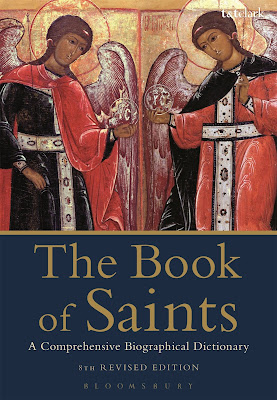
Source: The Book of Saints: A Comprehensive Biographical Dictionary by Basil Watkins.  Now fully revised and updated The Book of Saints is a comprehensive biographical dictionary of saints canonised by the Roman Catholic Church. It contains the names of over 10,000 saints, including all modern ones, with significant information about their lives and achievements. Each section begins with an illustration of a particular saint, and the volume includes a list of national martyrs, a bibliography, and a helpful glossary.
Read more >>
St. Rose of Viterbo (Mass in Some Places)


While a feria day on the Universal Calendar, today is in some local calendars the Feast of St. Rose of Viterbo.
Almighty God did marvelous things in the soul of Saint Rose of Viterbo. It appears that her parents gave her that name by divine inspiration, for it was symbolic of her entire career. As long as she lived, she bloomed like a sweet-scented rose in the garden of the Church, and in full bloom as she was transplanted to Paradise. 
Before she was able to speak, Saint Rose attempted to pronounce the sweet names of Jesus and Mary; and as soon as she had learned to walk, she asked to be taken to church and to other retired and quiet places to pray. When religious discourses were given, she would listen with great attention. 
When Saint Rose was only 3 years old, God showed how pleased He was with her in a most wonderful way. One of her maternal aunts died. The family were standing around the bier weeping aloud. Deeply moved by the sorrow of her relatives, little Rose went to the coffin, raised her eyes to heaven, and prayed silently. Then she placed her little hand on the body of her deceased aunt and called her by name. The dead woman immediately opened her eyes and reached out to embrace her little niece, who had raised her to life again. 
The child entertained a great compassion for the poor; she always tried to save some food to give to the poor. One day when she left the house with some bread in her apron, she met her father, who asked her in curt fashion what she was carrying off now. The frightened child opened her apron and fragrant roses were found in it. 
When she was 7 years old, Saint Rose of Viterbo retired to a little cell in her father's house. There she spent almost all her time in contemplation and in practicing rigorous penance. She prayed much for the conversion of sinners. Meanwhile our dear Lord was preparing her for an extraordinary mission.

St Rose was not yet 10 years old when the Blessed Mother of God instructed her to join the Third Order of St. Francis. Shortly after, our Lord appeared to her on the Cross, wearing the crown of thorns on His head and bleeding profusely from all His wounds.
St Rose, aghast at the sight, called out: "O my Lord, who has reduced Thee to this state?"
Our Lord replied, "My love, my deep love for men has done this." 
"But," asked Rose, "who has so pierced and torn Thee?" 
"The sins of men have done it," was our Lord's answer. "Sin, sin!" cried the saint, and she scourged herself to make atonement for the sins of the world. 
By divine inspiration, Rose then took a cross in her hand and went up and down the streets and public squares of her city telling people of the terrible tortures our Lord suffered and of the heinousness of sin. Every now and then she would emerge from her solitude to entreat the people to do penance. 
The town of Viterbo, which belonged to the Papal States, had revolted against the authority of the pope. Disregard for religion and moral degradation were the order of the day. But the sermons of this little missionary had marvelous results. The people came in crowds to hear her. The stone on which she stood was seen to rise in the air, and she was sustained there by a miracle while burning words issued from her lips. The greater part of the citizenry had already resolved to do penance and to return to the legitimate papal allegiance when Saint Rose of Viterbo and her parents were repelled by the civil authorities. 
The result was that she now had a wider field of activity. At Soriano and later at Vitorchiano, her preaching had the same blessed results. In the latter place, a sorceress had done much harm among the inhabitants. Fearing that after her departure this woman would undo the good effected there, Rose was desirous of her conversion. Her initial efforts failed. Then our saint had an immense pile of wood prepared in the public square; fire was set to it, and Rose stepped into the fire and mounted to the top of the pile. She remained untouched for three hours in the midst of the flames, singing the praises of God. The sorceress now cast herself at Rose's feet and was sincerely converted. 
Meanwhile the rightful authority of the pope had been re-established at Viterbo, and Rose could return. She was now 15 years old and anxious to enter the convent of the Poor Clares. As she had no dowry, she could not be admitted. 
"Well," said Rose, "you will not receive me while I am alive, but you will receive me after I am dead." She and several companions repaired to a secluded dwelling, where they intended to live as a community. The ecclesiastical authorities, however, did not approve of the plan, and Rose returned home. She died 2 years later, filled with the joyous desire of being united with her God.  
Two and a half years after her death she appeared three times to Pope Alexander IV, who was in Viterbo at the time, and told him to have her body removed to the convent of the Poor Clares. When this was done, her body was found incorrupt; and it has remained in that condition to this day. Miracles are constantly occurring at her tomb. Pope Callistus III canonized her in 1457. 
Although her skin is dark, the body of the saint is still flexible and the internal organs in good condition. In 1921 the heart was removed to be placed in a reliquary for a procession, and it was found to be unblemished and perfectly intact at that time. 
Excerpted from: The Franciscan Book Of Saints, ed. by Marion Habig, OFM
Read more >>
Friday, September 1, 2017
Commemoration of the Holy Twelve Brothers

The martyrs join with all the saints in praising the glory of God

The "Holy Twelve Brothers" refer to the fourth-century apostles who refused to offer sacrifice to pagan gods. Africans by birth, these saints were martyred in various places in the third century under the Emperors Diocletian and Maximian. Four were beheaded in Potenza, Italy on August 27. Three were beheaded at Vanossa on August 28. The others were beheaded at Sentiana on September 1. They were brought together and enshrined at Benevento in 760.

Today is also the Feast of St. Giles.

Collect:

O Lord, may the martyrdom of these brothers warm our hearts with joy, enliven our faith by an increase of virtue, and comfort us by the added number of intercessors we have in heaven. Through our Lord . . .
Read more >>
Wednesday, August 30, 2017
Commemoration of Ss. Felix and Adauctus


Each year we recall on August 30th not only the life of St. Rose of Lima but also Ss. Felix and Adauctus.

St. Felix was a Roman priest who was beheaded in c. 303 AD. And St. Adauctus was a Christian layman who insisted on sharing the crown of the martyred priest. Since his name was not known, he was simply called by the Latin equivalent of "added on." Thus, we refer to him as St. Adauctus rather than the name he was called on earth.

Collect:

O Lord, we humbly implore Your majesty to defend us through the intercession of Your saints, just as You fill us with happiness by the celebration of their feast. Through our Lord . . .
Read more >>
Tuesday, August 29, 2017
St. Sabina


Today we rejoice along with the Holy Church in the Commemoration of St. Sabina, in addition to the Martyrdom of John the Baptist.

Saint Sabina was a martyr from Rome who lived in the 1st century AD until 126 AD.  She was the widow of Senator Valentinus and daughter of Herod Metallarius.

St. Sabina was converted to the Faith by her servant, St. Serapia.  Upon St. Serapia's denouncement as a Christian and subsequent martyrdom by decapitation, St. Sabina rescued her remains and had them moved to the family mausoleum.  Like St. Serapia, St. Sabina too was denounced  and accused of being a Christian.  And after she consented to being one, she was martyred under Elpidio the Prefect in the city of Vindena in the state of Umbria, Italy.

In 430 AD, her relics were brought to a special basilica in her honor in Rome which was built on the spot of a former temple to Juno.  Indeed, the Christian has conquered the Roman pagans.  This church is now the world headquarters of the Dominican Order.

May we pray for the fortitude and patience of the martyrs like St. Sabina.

Collect:

O God, one of the marvelous examples of Your power was granting the victory of martyrdom even to delicate womanhood. May the example of the blessed martyr Sabina, whose birthday we celebrate today, draw us closer to You. Through our Lord . . .
Read more >>
Monday, August 28, 2017
St. Hermes

Saint Hermes is the figure in the back, in armor. Other saints pictured include Saint James the Great, Saint Joseph,Saint Ghislain, and Saint Eligius.

Few people are likely aware that we as Catholics invoke St. Hermes.  St. Hermes - not at all to be confused with the fictitious mythological deity by the same name - was a real person.  He was a martyr with companions his Rome, who all suffered at the hands of a judge named Aurelian. They are mentioned in the Acts of Pope St. Alexander I .

Butler's Lives of the Saints writes of him:
HE suffered at Rome in the persecution of the emperor Adrian about the year 132. His tomb on the Salarian Way was ornamented by Pope Pelagius II. and his name is famous in the ancient western Martyrologies.
Let us invoke his patronage today, along with today's other saint, St. Augustine of Hippo.

Collect:

O God, it was Your strength that kept the blessed martyr Hermes unfaltering under suffering. May we follow his example in spurning earthly riches for love of You and in fearing no worldly harm. Through our Lord . . .
Read more >>
Sunday, August 27, 2017
Bishop Fellay's Sermon in Fatima

 
Excerpts from the SSPX Website:
He first recalled the vision of hell that the three shepherd children of Fatima contemplated with horror; he explained that this fear is salutary and that those who seek today to anesthetize consciences by offering them a broad path are truly assassins of souls.

Then Bishop Fellay emphasized that the message of Fatima is a message of hope: those who practice the devotion to the Immaculate Heart of Mary will be saved. This divine promise of salvation offers us an easy means: all we have to do is take it seriously. We must make reparation for the offenses against the Most Blessed Mother of God. Like little Francisco, we must seek to console the Sorrowful and Immaculate Heart of Mary. Let us accept all trials generously, offer them up, and sacrifice ourselves by faithfully accomplishing our duty of state, seeing souls through the eyes of Jesus Christ as He gazed at them from His Cross, and the eyes of Our Lady, standing at the foot of the same cross, stabat Mater.

In conclusion, the Superior General forcefully repeated that the devotion to the Immaculate Heart of Mary is willed by God for the world today. Not a superficial or mechanical devotion, but a profound one: her Heart must be our intimate refuge. The prelate also announced that he would renew the consecration of Russia right after the Mass, just as Archbishop Lefebvre did here in Fatima thirty years ago. Of course, it is up to the  Holy Father and all the bishops of the world in union with him to make this consecration. The Society’s act of consecration is a way of expressing its desire to answer Heaven’s request, while fully aware of its limits, with the lively hope that the Vicar of Christ will one day consecrate the country himself.

The Rosary Crusade draws to a close, but its spirit lives on: let us never cease to beg with our fervent prayers the triumph of the Immaculate Heart of Mary, which will come when God wills. But we are assured it will come!
Read more >>
Tuesday, August 22, 2017
Com. of Sts. Timothy, Hippolytus and Symphorian


1954 Calendar: Commemoration (August 22nd)

Besides today being the Feast of the Immaculate Heart of Mary, it is the annual day we commemorate Ss. Timothy, Hippolytus, and Symphorian.  The following is shared from Liturgia Latina's website:
Timothy of Antioch came to Rome in 310 and was martyred in 311. He was cruelly beaten and quicklime was sprinkled over his torn flesh. At last he was beheaded. 
On the same day at Ostia, Hippolytus, bishop of Porto, was thrown into a hole filled with water and received the crown of martyrdom about A.D. 225. 
Again on the same day, about A.D. 180, under the reign of Aurelian, Symphorian, who was still a young man, was beheaded at Autun. While he went to execution his mother said to him: "My son, my son, remember eternal life; look up to heaven and see the One who reigns there; life is not taken from thee, it is exchanged for a better one."
Collect:

Deny us not, O merciful Lord, Thy help: but listening to the prayers of Thy blessed martyrs Timothy, Hippolytus and Symphorian, stretch forth over us the right hand of Thy merciful forgiveness.
Read more >>
Friday, August 18, 2017
Empress Helena (Mass in Some Places)

While not on the Universal Catholic Calendar, in some parts of the world today is the Feast of Empress Helena. The following is taken from the Catholic Encyclopedia on St. Helena, the mother of Constantine, the one who legalized Christianity in the Roman Empire:

The mother of Constantine the Great, born about the middle of the third century, possibly in Drepanum (later known as Helenopolis) on the Nicomedian Gulf; died about 330. She was of humble parentage; St. Ambrose, in his “Oratio de obitu Theodosii”, referred to her as a stabularia, or inn-keeper. Nevertheless, she became the lawful wife of Constantius Chlorus. Her first and only son, Constantine, was born in Naissus in Upper Moesia, in the year 274. The statement made by English chroniclers of the Middle Ages, according to which Helena was supposed to have been the daughter of a British prince, is entirely without historical foundation. It may arise from the misinterpretation of a term used in the fourth chapter of the panegyric on Constantine’s marriage with Fausta, that Constantine, oriendo (i. e., “by his beginnings,” “from the outset”) had honoured Britain, which was taken as an allusion to his birth, whereas the reference was really to the beginning of his reign. 
 Her son’s influence caused her to embrace Christianity after his victory over Maxentius. This is directly attested by Eusebius (Vita Constantini, III, xlvii): “She (his mother) became under his (Constantine’s) influence such a devout servant of God, that one might believe her to have been from her very childhood a disciple of the Redeemer of mankind”. It is also clear from the declaration of the contemporary historian of the Church that Helena, from the time of her conversion had an earnestly Christian life and by her influence and liberality favoured the wider spread of Christianity. Tradition links her name with the building of Christian churches in the cities of the West, where the imperial court resided, notably at Rome and Trier, and there is no reason for rejecting this tradition, for we know positively through Eusebius that Helena erected churches on the hallowed spots of Palestine. Despite her advanced age she undertook a journey to Palestine when Constantine, through his victory over Licinius, had become sole master of the Roman Empire, subsequently, therefore, to the year 324. It was in Palestine, as we learn from Eusebius (loc. cit., xlii), that she had resolved to bring to God, the King of kings, the homage and tribute of her devotion. She lavished on that land her bounties and good deeds, she “explored it with remarkable discernment”, and “visited it with the care and solicitude of the emperor himself”. Then, when she “had shown due veneration to the footsteps of the Saviour”, she had two churches erected for the worship of God: one was raised in Bethlehem near the Grotto of the Nativity, the other on the Mount of the Ascension, near Jerusalem. She also embellished the sacred grotto with rich ornaments. This sojourn in Jerusalem proved the starting-point of the legend first recorded by Rufinus as to the discovery of the Cross of Christ. 
Her princely munificence was such that, according to Eusebius, she assisted not only individuals but entire communities. The poor and destitute were the special objects of her charity. She visited the churches everywhere with pious zeal and made them rich donations. It was thus that, in fulfilment of the Saviour’s precept, she brought forth abundant fruit in word and deed. If Helena conducted herself in this manner while in the Holy Land, which is indeed testified to by Eusebius, Bishop of Caesarea in Palestine, we should not doubt that she manifested the same piety and benevolence in those other cities of the empire in which she resided after her conversion. Her memory in Rome is chiefly identified with the church of S. Croce in Gerusalemme. On the present location of this church formerly stood the Palatium Sessorianum, and near by were the Thermae Helenianae, which baths derived their name from the empress. Here two inscriptions were found composed in honour of Helena. The Sessorium, which was near the site of the Lateran, probably served as Helena’s residence when she stayed in Rome; so that it is quite possible for a Christian basilica to have been erected on this spot by Constantine, at her suggestion and in honour of the true Cross. 
Helena was still living in the year 326, when Constantine ordered the execution of his son Crispus. When, according to Socrates account (Hist. eccl., I, xvii), the emperor in 327 improved Drepanum, his mother’s native town, and decreed that it should be called Helenopolis, it is probable that the latter returned from Palestine to her son who was then residing in the Orient. Constantine was with her when she died, at the advanced age of eighty years or thereabouts (Eusebius, “Vita Const.”, III, xlvi). This must have been about the year 330, for the last coins which are known to have been stamped with her name bore this date. Her body was brought to Constantinople and laid to rest in the imperial vault of the church of the Apostles. It is presumed that her remains were transferred in 849 to the Abbey of Hautvillers, in the French Archdiocese of Reims, as recorded by the monk Altmann in his “Translatio”. She was revered as a saint, and the veneration spread, early in the ninth century, even to Western countries. Her feast falls on 18 August.

Collect:

O Lord Jesus Christ, who didst reveal to blessed Helena the place where thy Cross lay hidden, that through her thy Church might be enriched with the precious treasure: grant us, at her intercession, that by the ransom of that life-giving wood, we may obtain the reward of everlasting life...

Lancelot-Andrewes Press Monastic Diurnal 

Read more >>
Tuesday, August 15, 2017
Prayer of Pope Pius XII to Our Lady of the Assumption


O Immaculate Virgin, Mother of God and Mother of Humanity, we believe with all the fervour of our faith in your triumphal Assumption both in body and in soul into heaven where you are acclaimed as Queen by all the choirs of angels and all the legions of saints; we unite with them to praise and bless the Lord who has exalted you above all other pure creatures and to offer you the tribute of our devotion and our love.

We know that your gaze, which on earth watched over the humble and suffering humanity of Jesus, in heaven is filled with the vision of that humanity glorified and with the vision of uncreated Wisdom, and that the joy of your soul in the direct contemplation of the adorable Trinity causes your heart to throb with overwhelming tenderness; and we, poor sinners whose body weights down the flight of the soul, beg you to purify our hearts so that, while we remain below, we may learn to see God and God alone in the beauties of his creatures.

We trust that your merciful eyes may deign to gaze down upon our miseries and anguish, upon our struggles and our weaknesses; that your countenance may smile upon our joys and our victories; that you may hear the voice of Jesus saying to you of each one of us, as He once said to you of His Beloved Disciple: "Behold you son," and we who call upon you as our Mother, we, like John, take you as the guide, strength and consolation of our mortal life.

We are inspired by the certainty that your eyes, which wept over the earth crimsoned by the blood of Jesus, are yet turned toward this world racked by wars and persecutions, the oppression of the just and the weak. From the shadows of this vale of tears, we seek in your heavenly assistance, tender mercy, comfort for our aching hearts, and help in the trials of Church and country.

We believe finally that in the glory where you reign, clothed with the sun and crowned with stars, you are, after Jesus, the joy and gladness of all the angels and the saints, and from this earth, over which we tread as pilgrims, comforted by our faith in the future resurrection, we look to you our life, our sweetness, our hope; draw us onward with the sweetness of your voice, so that one day, after our exile, you may show us Jesus, the blessed fruit of your womb. O clement, O loving, O sweet Virgin Mary.

Amen.
Read more >>
Sunday, August 13, 2017
Sts. Hippolytus and Cassian

Simple (1954 Calendar): August 13

Hippolytus was a prominent priest of the church of Rome at the beginning of the third century and guardian of St. Laurence. Together with the Pope St. Pontian he was exiled to Sardinia, and his sufferings ended in martyrdom A.D. 235. In about the year 320, officials at Imola, Italy, arrested Cassian, a Christian schoolmaster. The governor ordered him to be tortured by his own pagan pupils. After making barbarous sport of Cassian in various ways, the pagan boys stabbed their former teacher to death with their stilettos.

The following is taken from Father Francis Xavier Weninger, 1876:

St. Hippolytus, an officer of the body-guard of the emperor Decius, had been born in the darkness of idolatry, but he had become a Christian, with all his household, in consequence of witnessing the many miracles which St. Lawrence performed while in the prison under his charge. He had also been present when the saint, lying on the red-hot gridiron, endured the most terrible tortures. At the sight of the heroism of St. Lawrence, he was filled with the desire to denounce himself a Christian, but he was prevented by St. Lawrence. But when this martyr had gloriously ended his combat, Hippolytus, with the assistance of a priest, named Justinus, buried the sacred remains with great devotion and veneration. The emperor on being informed of it, had Hippolytus seized and brought before him. He asked him if it was true that he had become a Christian? Hippolytus answered firmly: "Yes, I am a Christian, and moreover resolved to die such." The emperor, who had always highly esteemed him, endeavored, first by promises and then by menaces, to induce him to forsake Christ. As, however, all was unavailing, he caused him to be tortured.

He was accordingly stretched on the ground, whipped with scourges, and beaten with clubs so fearfully, that it was believed he could not survive. But God, by a visible miracle, prolonged his life. Keeping his eyes fixed upon Heaven, he frequently repeated: "I am a Christian, I suffer for Christ's sake." After having been tormented for a long time, he was cast into prison, and the prefect received the order to behead him. Before executing this order, however, he went to the house of Hippolytus to secure his property. Finding the entire household had become Christians, he took them beyond the gates of the city and had them beheaded. Concordia, an old and holy matron, who had been Hippolytus' nurse, was scourged until she expired, because she encouraged the others to remain firm in their faith. At last, Hippolytus was taken out of prison and fastened to the tails of two horses, and dragged by them until he was torn to pieces, and his heroic soul was in the presence of Him Whom he had so fearlessly confessed.

On the same day, though at another place, St. Cassian suffered a martyrdom of unprecedented cruelty. This saint, was bishop of Brescia, but had been banished from his See on account of his faith. He intended to go to Rome and offer the Pope his services for the salvation of souls in some other place. On his way, he changed his mind, and taking up his residence at Imola, a town in Italy, he resolved to teach children to read and write, hoping that occasion would not be wanting to do good. In this apparently humble position, he was no less zealous than he had been in the administration of his diocese. He taught the children with love and gentleness, and endeavored to inspire them with respect for the Christian faith, fear and horror of sin, and love of virtue and piety. He continued in this occupation with great zeal for some years, to the great benefit of young and old, when suddenly a terrible persecution of the Christians arose.

He was one of the first who were taken prisoners. The tyrant commanded him to sacrifice to the gods. The holy bishop and teacher refused, as might have been expected, and tried to convince the judge of his fearful blindness in worshipping dumb idols or making gods of godless men. The tyrant, furious at his arguments, ordered the executioners to strip him of his clothes and tie his hands behind his back, and leave him exposed to the mercy of the children whom he had taken such pains to teach. The children, who had been taught that Cassian was a magician and consequently must die a most painful death, took their sharp iron pencils with which, in those days, they wrote upon their wax tablets, and pierced him with them till the blood ran profusely from his veins. This torture lasted long and was extremely painful. The saint, however, never complained of the ingratitude of his pupils, nor gave a sign of impatience, but praised and thanked the Lord until his soul went to Heaven to receive the crown of martyrdom.

Prayer:

O Almighty God, grant that our solemn celebration of the feast of your holy martyrs Hippolytus and Cassian may increase our devotion and bring us closer to our salvation. Through our Lord . . .
Read more >>
Wednesday, August 9, 2017
Solemn High Mass for 10 New Carmelite Nuns in Philadelphia

Philadelphia’s Carmelite Monastery of St. Joseph and St. Anne, at 66th Avenue and Old York Road, celebrated the 115th anniversary of its foundation with a Solemn High Mass on the evening of Wednesday, July 26. 
The Carmel, which was established by nuns from the Boston Carmel and originally located at 18th and Poplar Streets then at 44th and Spruce Streets, has been at its current monastery since 1910, according to the Prioress, who in keeping with the Carmelite charism does not wish to be named. 
The nuns themselves were an unseen presence at the Mass because of their rules of strict enclosure. They only receive visitors from behind a screen. 
... 
The Mass was celebrated in the monastery’s beautiful chapel which was designed by Maginnis and Walsh, the Boston architects that later designed the Basilica of the National Shrine of the Immaculate Conception in Washington. The celebrant was the monastery’s new chaplain, Father Scott W. Allen, F.S.S.P. (Fraternal Society of St. Peter). 
The Mass itself was in Latin in the Extraordinary Form using the 1962 Missal. It was unlike the typical Ordinary Form Masses that are usually celebrated in a vernacular language using modern translations of the Scripture readings. 
The Latin at the Extraordinary Form Mass was straight from the fourth century Vulgate Bible of St. Jerome, with a pamphlet that provided English translations taken from the Douay-Rheims Bible was compiled from 1582 to 1610. 
... 
Wherever they come from, they are welcome to this quiet gem of prayer in Philadelphia where day after day, year after year this small band of religious women live out the hidden life, all for the greater honor and glory of God.
Read more at Catholic Philly
Read more >>
Monday, August 7, 2017
Litany of the Immaculate Heart of Mary by Cardinal Newman


Litany of the Immaculate Heart of Mary
(Composed by Cardinal Newman)

Lord, have mercy on us
Christ have mercy on us.
Lord, have mercy on us.

Christ hear us.
Christ graciously hear us.

God the Father of Heaven,
Have mercy on us.

God the Son, redeemer of the world,
Have mercy on us.

God the Holy Ghost,
Have mercy on us.

Holy Trinity, one God,
Have mercy on us.

Heart of Mary,
Pray for us.

Heart of Mary, according to the heart of God,
Pray for us.

Heart of Mary, united to the Heart of Jesus,
Pray for us.

Heart of Mary, organ of the Holy Ghost,
Pray for us

Heart of Mary, sanctuary of the Divine Trinity,
Pray for us

Heart of Mary, tabernacle of God Incarnate,
Pray for us

Heart of Mary, immaculate from thy creation,
Pray for us

Heart of Mary, full of grace,
Pray for us

Heart of Mary, blessed among all hearts,
Pray for us

Heart of Mary, Throne of glory,
Pray for us

Heart of Mary, most humble,
Pray for us

Heart of Mary, holocaust of Divine Love,
Pray for us

Heart of Mary, fastened to the Cross with Jesus Crucified,
Pray for us

Heart of Mary, comfort of the afflicted,
Pray for us

Heart of Mary, refuge of sinners,
Pray for us

Heart of Mary, hope of the agonizing,
Pray for us

Heart of Mary, seat of mercy,
Pray for us

Lamb of God, who take away the sins of the world,
Spare us, O Lord.

Lamb of God, who take away the sins of the world,
Graciously hear us, O Lord.

Lamb of God, who take away the sins of the world,
Have mercy on us.

Christ, hear us.
Christ, graciously hear us.

Immaculate Mary, meek and humble of heart.
Make our hearts according to the Heart of Jesus.

Let us pray:

O most merciful God, who for the salvation of sinners and the refuge of the miserable, wast pleased that the Most Pure Heart of Mary should be most like in charity and pity to the Divine Heart of Thy Son, Jesus Christ: grant that we who commemorate this sweet and loving Heart may, by the merits and intercession of the same Blessed Virgin, merit to be found according to the Heart of Jesus. Through the same Christ, Our Lord. Amen.

Note: The saintly John Henry Newman, in filial devotion to the Mother of God and of man, composed this litany in honor of the Immaculate (Pure) Heart soon after his reception into the Catholic Church (1845).

Taken from “Kyrie Eleison” by Benjamin Francis Musser.
Read more >>
Tuesday, August 1, 2017
Prayer Request for a Lapsed Catholic Near Death


Can you please pray for Larrine, a long time friend of my dad. She is 87 and being put in hospice. She was baptised Catholic but does not have any desire to believe or practice the Faith. I pray thru our Lady's intercession for a conversion in time before she dies.
Read more >>
Sunday, July 30, 2017
Sts. Abdon and Sennen

Simple (1954 Calendar): July 30

The following is taken from The Liturgical Year by Abbot Gueranger:

"The decrees of eternal Wisdom ordained that the West should be honoured before the East with the glory of martyrdom. Yet when the hour had come, Jesus was to have, beyond the Tigris, millions of witnesses by no means inferior to their forerunners, astonishing heaven and earth by new forms of heroism. Impatient of the delay, two noble Persians won their palm on this day by the command of Rome. By shedding their blood they paid tribute for their native land to the eternal City; and now they protect our Latin Churches, and receive the prayers and praise of the West. France receive a goodly portion of their sacred relics; and the city of Arles-sur-Tech, in Roussillon, can show to an incredulous generation the sarcophagus, from which flows a mysterious liquor, a symbol of the continual benefits bestowed on us by these holy martyrs."
During the of Decius, two Persians, Abdon and Sennen, were accused of burying on their own estate the bodies of the Christians which had been exposed. By order of the Emperor they were apprehended and commanded to sacrifice to the gods. As they refused to obey, and moreover with the greatest constancy proclaimed Jesus Christ to be God they were placed in close confinement, and when later Decius returned to Rome they were led in chains in his triumphal march. They were dragged to the Roman idols, but to show their hatred of the demons, they spat upon them. Upon this they were exposed to the fury of lions and bears, but the beasts did not dare to touch them; at length they were put to death by the sword. Their bodies were dragged by the feet before the statue of the sun, but they were secretly carried away and buried by Quirinus the deacon in his own house."
Prayer:

Hearken to our earnest prayers, O blessed martyrs! May the faith at length triumph in that land of Persia whence so many flowers of martyrdom have been culled for heaven. Before the time appointed for the struggle to begin in your native land, ye went to meet death elsewhere, and thus ye gained a new fatherland whereon to bestow your love. Bless us, the fellow-citizens of your choice, and bring us all to the eternal fatherland of all the children of God.
Read more >>
Be Religious or Be Damned - Sermon by St. John Vianney

St. John Vianney does not mince words as he warns his people in the following sermon. We too should heed his admonitions. "There is always the person who says to me, "What harm can there be in enjoying oneself for a while? I do no wrong to anyone; I do not want to be religious or to become a religious! If I do not go to dances, I will be living in the world like someone dead!" My good friend, you are wrong. Either you will be religious or you will be damned."

The sermon is available this week only on the Servants of the Holy Family Website.
Read more >>
Thursday, July 27, 2017
St. Ignatius Retreat House: A Week For Reflection

 
Four years ago I went on an Ignatian retreat at the Society of St. Pius X’s retreat house in Phoenix, Arizona.  The retreat was a very spiritually energizing time and one that left a mark on me.  As a Third Order Dominican, a retreat of at least 3 days is highly recommended in our Rule of Life – and for all Catholics, not just Dominicans, there is a plenary indulgence available to those who go on retreat for at least 3 days.

Yet over the past four years from work to my graduate coursework, I could not find time to go on a retreat.  This year I made it a personal resolution to go on retreat and I’m happy to share my experiences from my recent Ignatian retreat at St. Ignatius Retreat House in Ridgefield, CT.  This retreat is structured just as the one at Our Lady of Sorrows in Phoenix as it follows the Ignatian spiritual exercises and is led by SSPX priests.

My retreat began on July 10th (just a two weeks ago) and lasted through the subsequent Saturday at midday.  It was admittedly, a very difficult time.  As we are all accustomed to busy-ness and noise, I welcomed the opportunity to disconnect and pray.  Yet, for the same reason, it was by the end of the 2nd day, a very difficult endeavor.  It really helped me improve my patience, perseverance in trial, and helped me better restructure my life to the Lord’s will.

The retreat generally runs daily from 6 AM until 8:30 PM.  Retreatants rise at 6 AM and assemble for Prime at 6:30.  Meditation follows and then Mass at 7:15.  Breakfast is at 8 AM and then conferences until lunch time at 12:30 PM.  Then a series of afternoon conferences until Rosary at 6 PM.  Dinner is served at 6:30 PM and then one final conference at 7:30 PM.

The conferences follow the Ignatian Spiritual exercises which I have written on in the past.  For those who do not have a copy of “Christian Warfare,” the book is a must-have.  Not only does it contain the text of the Spiritual Exercises but it contains numerous prayers, the Mass prayers, devotions, Confession resources, and much more.  It is truly a book for those who wish to engage in the fight against the powers of darkness.

Some of my main takeaways from the retreat include:
  • Needing to better align my life to the Lord’s will
  • Making time each day and evening for meditation
  • Making time for 10 – 15 minutes of spiritual reading daily
  • A true acknowledgement that the devil is real and we are in a battle. He constantly fights us and tempts us.  Let us recall this to mind every single day and in all temptations.  He is real and he is really seeking to destroy us at every moment in the day.  Be vigilant and fight!
  • Heaven is hard – very hard.  Hell is real, and many souls go there forever
  • Confession requires true sorrow.  Don’t turn the Sacrament into a revolving door every month or week.  It is a real battle and it’s hard but we must fight temptations.
These were some of my insights from the meditations that followed each conference.  I am very grateful for the opportunity to have gone and prayed for everyone that reached out to me and requested special prayers.  I ask for your prayers that despite great difficulties, I better conform my life to the Lord’s will and fight the good fight.

For those who wish to learn more about going on retreat, please click here for the SSPX retreat site.  The site lists the many benefits of the retreats.  Find this time to spiritually recharge – your soul’s salvation may depend on it.

Photos From My Trip:


Read more >>
Tuesday, July 25, 2017
The Twelve: Lives and Legends of The Apostles


In honor of today's Feast of St. James the Greater, I am happy to announce Frances Spilman's latest book on the Apostles.  I was very honored to have served as the editor for this work.

What were the Apostles of Jesus really like? CatechismClass.com is pleased to announce that its latest online course and paperback will examine the Gospels, the Fathers of the Church, Apocryphal writings, encyclicals and other sources to search out the Apostles’ personalities and history.

Along the way we will look at the prayers, poetry, music and architecture the Apostles inspired and see how these twelve men are still teaching us today almost 2,000 years after their deaths. We will see how the faith spread throughout the Roman Empire and even beyond its borders and how each Apostle met his death. You will be surprised at the many different paths of the Apostles as they witnessed for Christ.

If you can not name all 12 Apostles and a description of what each of them did after the Ascension, this course is for you!

To learn more about the online course: Please Click here

To preview the paperback book option: Please Click here

Frances Spilman lives in a small town in northern New Jersey.  She went to Catholic schools from Grammar to Graduate school and taught CCD for several years.  She has played the organ in Catholic Churches for almost 45 years and has recently started to work with both 40 Days for Life and LifeRunners.  Frances is the author of both “A Step Towards Heaven: An Introduction to Religion” (2015) and “The Councils of the Catholic Church: Nicea to Now” (2015).  Both of her previous books are available on Amazon.com or directly through CatechismClass.com as an online course. 

 
Read more >>
Sunday, July 23, 2017
Book Review: Return to Order

http://amzn.to/2ui2flY
Last year I began to read an electronic copy of "Return to Order: From a Frenzied Economy to an Organic Christian Society--Where We've Been, How We Got Here, and Where We Need to Go" by John Horvat II

Mr. Horvath's book was full of truly insightful wisdom detailing the root causes of society's fall from its former glory.  Many may point to the sexual revolution, the World Wars, or the industrial revolution as the cause.  All of these however are merely symptoms and consequences of a much larger disorder.  In "Return to Order," the true culprit is identified as "frentic intemperance."

Mr. Horvath points to the consequences of these actions when he describes secularism: "Secular society is the logical consequence of a predominantly materialistic society...personal belief in God is allowed and even encouraged as long as it is confined to the personal unofficial realm. A secular society in general is one which is officially purged of all references to a reality beyond that of our naturalistic and materialistic world."

He continues by quoting Plino Correa de Oliveira who calls secularism a "curious form of atheism," and then continues expounding on the topic in a rather insightful manner.

But Mr. Horvath's book does more than provide these good and clear-cut explanations, it also and powerfully addresses the errors in the modern economy.  He writes, "Our great error is that we have turned economic activity into an end in itself.  We have separated economics from the influence of those human sciences and norms that should orient all human actions.  Economics, which should be a faithful servant to help man reach his end in life, thus becomes a domineering master."

What is the best society?  In "Return to Order," it is described as being organic, possessing upright spontaneity, and fostering and built on a virtuous order.  In Chapter 26, Mr. Horvath outlines the ordering principles of autonomy, authority, vital flux, and subsidiarity as vital principles which must return to our society if we are to reverse the calamities of the past decades and centuries.

I recommend the book for those looking to better understand the root cause of today's societal woes and a very easy and inspiring read on how we might restore order to our world.
Read more >>
Friday, July 21, 2017
St. Praxedes


Simple (1954 Calendar): July 21
Commemoration (1962 Calendar): July 21

Praxedes was a Roman virgin and sister of the virgin Pudentiana. When the Emperor Marcus Antoninus persecuted the Christians, she devoted both her time and her wealth to consoling them, and doing them every charitable service in her power. Some she concealed in her house: others she encouraged to firmness of faith. She buried the dead, and saw that those who were imprisoned wanted for nothing. But at length being unable to bear the grief caused by such a wholesale butchery of the Christians, she prayed God, that if it were expedient for her to die he would take her away from so much evil. Her prayer was heard, and on the 12th of the Calends of August, she was called to heaven, to receive the reward of her charity. Her body was buried by the priest Pastor in the tomb where lay her father and her sister Pudentiana, in the cemetery of Priscilla, on the Salarian Way.

The following is taken from The Liturgical Year by Abbot Gueranger:

On this day Pudentiana’s angelic sister at length obtained from her Spouse release from bondage, and from the burden of exile that weighed so heavily on this last scion of a holy and illustrious stock. New races, unknown to her fathers when they laid the world at the feet of Rome, now governed the Eternal City. Nero and Domitian had been actuated by a tyrannical spirit; but the philosophical Cæsars showed how absolutely they misconceived the estinies of the great city. The salvation of Rome lay in the hands of a different dynasty: a century back, Praxedes’ grandfather, more legitimate inheritor of the traditions of the Capitol than all the Emperors present or to come, hailed in his guest, Simon Bar-Jona, the ruler of the future. Host of the Prince of the Apostles was a title handed down by Pudens to his posterity: for in the time of Pius I, as in that of St. Peter, his house was still the shelter of the Vicar of Christ. Left the sole heiress of such traditions, Praxedes, after the death of her beloeved sister, converted her palaces into Churches, which resounded day and night with divine praises, and where pagans hastened in crowds to be baptized. The policy of Antoninus respected the dwelling of a descendant of the Cornelii; but his adopted son, Marcus Aurelius, would make no such exception. An assault was made upon the title of Praxedes, and many Christians were taken and put to the sword. The virgin, overpowered with grief at seeing all slain around her, and herself untouched, turned to God and besought him that she might die. Her body was laid with those of her relatives in the cemetery of her grandmother, Priscilla.

Prayer:

Mother Church is ever grateful to thee, O Praxedes! Thou hast long been in the enjoyment of thy divine spouse, and still thou continuest the traditions of thy noble family, for the benefit of the Saints on earth. When, in the eighth and ninth centuries, the martyrs, exposed to the profanations of the Lombards, were raised from their tombs and brought within the walls of the eternal City, Paschal I sought hospitality for them, where Peter had found it in the first century. What a day was that 20th of July 817, when, leaving the Catacombs, 2300 of these heroes of Christ came to seek in the title of Praxedes the repose which the barbarians had disturbed! What a tribute Rome offered thee, O Virgin, on that day! Can we do better than unite our homage with that of this glorious band, coming on the day of thy blessed feast, thus to acknowledge thy benefits? Descendant of Pudens and Priscilla, give us thy love of Peter, thy devotedness to the Church, thy zeal for the Saints of God, whether militant still on earth or already reigning in glory.
Read more >>


Copyright Notice: Unless otherwise stated, all items are copyrighted under a Attribution-NonCommercial-NoDerivatives 4.0 International License. If you quote from this blog, cite a link to the post on this blog in your article.

Disclosure of Material Connection: Some of the links on this blog are “affiliate links.” This means if you click on the link and purchase the item, I will receive an affiliate commission. As an Amazon Associate, for instance, I earn a small commission from qualifying purchases made by those who click on the Amazon affiliate links included on this website. I am disclosing this in accordance with the Federal Trade Commission’s 16 CFR, Part 255: “Guides Concerning the Use of Endorsements and Testimonials in Advertising.”