In today’s episode, on this Palm Sunday, I address the following:
- The Strictness of the Holy Week Fast: Passion Fast & Xerophagiae
- Traditions for Holy Week: Indulgences, Forgotten Customs, & Suggestions for a Holy Week


The observance of Lent stretches back as far as Apostolic times. Lent was for centuries observed as forty days of fasting in the Roman Church with Sundays excluded from fasting but not from abstinence. That is, Ash Wednesday (since its institution) through Holy Saturday were days of fasting. I have separately cataloged the history of Lenten fasting in "History of Lenten Fasting: How to Observe the Traditional Lenten Fast."
The Lenten fast began under the Apostles themselves and was practiced in various forms in the Early Church. As time went on, the fast became uniformly observed under the pain of sin. As with all Lenten practices, changes occurred over time regarding the fast, abstinence, and hearing of Holy Mass on Holy Saturday.
Holy Saturday Fasting Was Practiced in Apostolic Times
In the Early Church, Holy Saturday was part of the apostolic practice of abstaining from all food completely from Holy Thursday evening (or Good Friday morning) until sunset on Holy Saturday (or later). This was known as the "Passion Fast," and in practice, the aim was to fast 40 hours in honor of the 40 hours our Blessed Lord’s body lay in the tomb. Holy Saturday's fast was also practiced like the rest of Holy Week as xerophagiae: “The strictest Christian fast which is observed chiefly in the Eastern churches during Lent or especially Holy Week and in which only bread, salt, water, and vegetables may be eaten” (Webster’s Dictionary). In practice, bread, herbs, raw nuts, or raw vegetables and fruit without oil or dressing may be consumed for those who seek to keep this strict and who are unable to fast from all food whatsoever for two whole days in a row.
Heortology: A History of the Christian Festivals from their Origin to the Present Day by Dr. K.A. Heinrich Kellner states the following regarding the Lenten fast in the ancient Church:
"Among Catholics also abstinence was pushed to great lengths. The canons of Hippolytus prescribe for Holy Week only bread and salt. The Apostolic Constitutions will only permit bread, vegetables, salt and water, in Lent, flesh and wine being forbidden; and, on the last two days of Holy Week, nothing whatsoever is to be eaten. The ascetics, whose acquaintance the Gallic pilgrim made in Jerusalem, never touched bread in Lent, but lived on flour and water. Only a few could keep so strict a fast, and generally speaking people were satisfied with abstaining from flesh and wine. But this lasted throughout the entire Lent, and Chrysostom tells us that in Antioch no flesh was eaten during the whole of Lent. Abstinence from milk and eggs (the so-called lacticinia) was also the general rule."
Regarding Holy Saturday's fast, in particular, Canon 89 of the Council in Trullo in 692 AD provides an account of the piety and devotion of the faithful of that time:
“The faithful, spending the days of the Salutatory Passion in fasting, praying and compunction of heart, ought to fast until the midnight of the Great Sabbath: since the divine Evangelists, Matthew and Luke, have shewn us how late at night it was [that the resurrection took place].”
That tradition of fasting on Holy Saturday until midnight would last for centuries. Dom Gueranger writes in the Liturgical Year:
Such, we repeat, was the discipline of the Latin Church for nearly a thousand years: but about the 11th century, an important change began to be introduced with regard to the celebration of Mass on Holy Saturday. The Mass which, hitherto, had been celebrated during the Night preceding Easter Sunday, then began to be anticipated on the Saturday; but it was always considered as the Mass of the hour of our Lord’s Resurrection, and not as the Mass of Holy Saturday. The relaxations that had been introduced with regard to Fasting were the occasion of this change in the Liturgy.
Holy Saturday Was A Holy Day of Obligation in the Middle Ages
Holy Saturday also used to be a Holy Day of Obligation. The first catalog of Holy Days comes from the Decretals of Gregory IX in 1234, which listed 45 Holy Days. In 1642, His Holiness Pope Urban VIII issued the papal bull "Universa Per Orbem" which altered the required Holy Days of Obligation for the Universal Church to consist of 35 such days as well as the principal patrons of one's locality.
Some of the Holy Days of Obligation removed between 1234 and 1642 included Holy Monday through Holy Saturday in addition to Easter Wednesday through Easter Saturday. Hence by 1642, Holy Saturday was no longer a Holy Day of Obligation.
Holy Saturday Fasting Remained Practiced for Centuries
In my series outlining the changes to fasting and abstinence in the colonies—and through the modern-day United States—I pointed out that Holy Saturday often remained a day of obligatory fasting even when mitigations were issued due to the change in the time of the Vigil that happened back in the 11th century.
For instance, the papal bull "Altitudo Divini Concilii" of Pope Paul III in 1537 reduced the days of penance and those of hearing Mass for the Indians out of pastoral concern due to the physically demanding lifestyle that they lived and also largely due to the fact that they fasted so much already. As a result, the natives were required to only hear Mass on a much smaller number of days: Sundays, Christmas, Circumcision, Epiphany, Candlemas, Annunciation, Sts Peter and Paul, Ascension, Corpus Christi, the Assumption, and the Nativity of the Blessed Virgin. And the only fasting days were the Fridays in Lent, Holy Saturday, and Christmas Eve. Holy Saturday remained.
Centuries later, when Pope Leo XIII issued further changes allowing animal products throughout Lent, he explicitly excluded Holy Saturday from those mitigations:
“In 1886 Leo XIII allowed meat, eggs, and milk products on Sundays of Lent and at the main meal on every weekday [of Lent] except Wednesday and Friday in the [United States]. Holy Saturday was not included in the dispensation. A small piece of bread was permitted in the morning with coffee, tea, chocolate, or a similar beverage.”
By the time of the 1917 Code of Canon Law, the days of obligatory fasting as listed in the 1917 Code of Canon Law were the forty days of Lent, including Ash Wednesday, Good Friday, and Holy Saturday until noon. The Deharbe Catechism in the 1800s refers to the fast ending at Noon, so it does predate the 1917 Code. Why did Holy Saturday fasting only last until noon? It likely dates to when the Vigil Mass for Easter was moved from the night of Holy Saturday into Easter Sunday back to the morning of Holy Saturday. By the High medieval period, the celebration in the morning of the Easter Vigil (and other Triduum services) was almost the universal custom, in large part due to the fasting regulations requiring the fast to last until after Vespers. As a result, sometime after 692 AD, the fast on Holy Saturday was modified to end at noon.
Holy Saturday Fasting Wanes Along With All Other Fasting in the 1900s
Before 1951, Bishops were able to dispense laborers and their family members from the laws of abstinence, if necessary, under the workingmen's privilege that was introduced in 1895. This privilege of eating meat, though, excluded Fridays, Ash Wednesday, Holy Week, and the Vigil of Christmas. In 1951, the abstinence laws in America were again revised as Father Ruff summarizes:
"In 1951 the U.S. bishops standardized regulations calling for complete abstinence from meat on Fridays, Ash Wednesday, the vigils of Assumption and Christmas, and Holy Saturday morning for everyone over age seven. On the vigils of Pentecost and All Saints, meat could be taken at just one meal. Fast days, applying to everyone between 21 and 59, were the weekdays of Lent, Ember days, and the vigils of Pentecost, Assumption, All Saints, and Christmas. On these fast days only one full meal was allowed, with two other meatless meals permitted which together did not make up one full meal. Eating between meals was not permitted, with milk and fruit juice permitted. Health or ability to work exempted one."
In 1956 under Pope Pius XII, the fast, which previously ended at noon, was extended to the midnight between Holy Saturday and Easter Sunday, on account of the Holy Week changes enacted which made the Vigil Mass obligatory in the evening of Holy Saturday:
"The abstinence and fast prescribed for Lent, which hitherto has ceased on Holy Saturday after noon, according to canon 1252, §4 [1917 Code], will cease in the future at midnight of the same Holy Saturday."
Maxima Redemptionis Nostrae Mysteria (Nov. 16, 1955) AAS 47 (1955)
Fr. Frederick McManus, an American Canon Lawyer, commented on this change:
The Decree on the revised Holy Week changes the law of canon 1252, §4, concerning fast and abstinence on Holy Saturday. According to the canon, the Lenten fast ended after noon on Holy Saturday. This is now abrogated, the obligation is extended until midnight of Holy Saturday, and the entire day becomes one of abstinence and fast. Local Ordinaries at present possess the faculty to dispense all their subjects, including religious (even exempt), from the law of fast and abstinence on Holy Saturday.Thus they may dispense from fast or from abstinence or from both fast and abstinence on this day.
The Rites of Holy Week (Bruce 1956), pgs 22 and 23.
In 1966, Paul VI's Paenitemini eliminated Holy Saturday and all other days of fasting except for Good Friday and Ash Wednesday in a radical departure from the past. Sadly, those changes were incorporated in the 1983 Code of Canon Law, which largely took Paenitemini while modifying the age of fasting.
A Traditional Holy Saturday Fast (Summary and Application)
For those seeking more traditional fasting for the final days of Lent - and in preparation for the Lord's Resurrection - a return not to the 1950s or 1917 is in order. Rather, a return to treating all of Holy Saturday as a day of fasting and abstinence in the form of the Passion Fast practiced with the principles of Xerophagiae is the ideal. If we do attend a pre-1955 Easter Vigil Mass in the morning or daytime of Holy Saturday, we can eat after that Mass but I would encourage souls to keep abstinence until after attending Easter Sunday Mass.
While this is not obligatory under penalty of sin, it is a worthwhile end to our fasting as we present to Almighty God the final day of Lenten fasting for His honor and glory and in reparation for our sins. Let us all seek greater perfection and never the minimum of the law.
Want to learn more about the history of fasting and abstinence? Check out the Definitive Guide to Catholic Fasting and Abstinence.

In today’s episode, on this Fourth Sunday of Lent (Laetare Sunday), I address the following:
To start, though, I’d like to remind everyone that Meaning of Catholic has launched its online shop, and PDFs of my book on the Roman Catechism and my book on fasting and abstinence are available at https://meaningofcatholic.com/shop/. For the fasting one, English, Spanish, and Polish are all available there. So please check them out if you would like a PDF of any of these books. PDFs are only $9.99 each. For links for the paperback and Kindle versions on Amazon, click here.
Subscribe to the podcast on Buzzsprout, Apple Podcasts, Spotify, I-tunes, and many other platforms!

2018 St. Joseph Table at St. Ann Parish, Excelsior Springs (Marty Denzer/Key photo)
This coming Sunday is St. Joseph's Day (which is liturgically transferred to March 20th this year since it falls on a Sunday in Lent), but it is still an excellent time for us to have a festive meal in honor of St. Joseph. The following is quoted and adapted from The Year of St. Joseph Website.
The Feast of St. Joseph, which always falls in the middle of Lent, is especially commemorated and celebrated in Italy in general, and Sicily in particular, where St. Joseph has been long-regarded as the island’s Patron saint. It is there, among Sicilians, that the tradition of the “Tavola di San Giuseppe” or “St. Joseph’s Table” has its origins.
Since it is Lent, the meal is traditionally vegetarian, and we would do well to ensure that no meat is eaten at this meal, especially in our traditional Catholic churches and families.
What is served? There are two constants for the “table”: 1) there is no meat since it’s Lent and 2) the presence of sesame-coated bread in symbolic shapes. Breads, baked into symbolic shapes, are the centerpiece of the food table and the altar. The breads themselves are made from the same dough that forms traditional Italian bread and are often made into interesting and symbolic shapes for St. Joseph’s Day.
Other foods that are often present at more elaborate St. Joseph’s Table “feasts” include:
As no feast is complete without dessert, no Saint Joseph’s altar would be finished without the flourish of sweet items. There are typically many cakes, biscotti, and cookies, many of which are embellished with almonds.
Two traditional desserts found at St. Joseph’s tables are sfingi–fried pieces of bread dough rolled in sugar—and zeppoli–a pastry shaped like a donut, fried or baked, and filled with a sweet pastry crème, then garnished with a dusting of powdered sugar and a maraschino cherry. Such items rose in popularity after eggs and dairy became widely permitted during Lent. Though it is possible to have vegan alternatives, in keeping with the traditional Lenten practice.

.jpg)
Lent is the most solemn of all fasting times in the Church. From Apostolic times until 1741, meat was never allowed in Lent. Even after it was permitted at some meals, Fridays and Saturdays remained mandatory days of complete abstinence in Lent into the early 1900s. Friday in particular, the most solemn of all days on account of our Lord's death on the Cross on Friday, was a mandatory day of abstinence all year round (and it still is!) Up until the 1917 Code of Canon Law, meat was not even allowed on Holy Days of Obligation which fell on a Friday outside of Lent. The Friday fast, like Sunday Mass, is integral to Catholic life. This post is based heavily on the research which is incorporated in "The Definitive Guide to Catholic Fasting and Abstinence." Read the full book for much more information relevant to this topic.
Definition of Fasting vs. Abstinence
Fasting refers to how much food we eat and, historically, when we eat it. It means taking only one meal during a calendar day. The meal should be an average-sized meal as overeating at the one meal is against the spirit of the fast. Fasting generally means that the meal is to be taken later in the day. Along with the one meal, up to two snacks (technically called either a collation or frustulum) are permitted. These are optional, not required. Added up together, they may not equal the size of the one meal. No other snacking throughout the day is permitted.
Abstinence in this context refers to not eating meat. Meat refers to the fleshmeat of mammals or fowl. Beef, poultry, lamb, etc are all forbidden on days of abstinence. Abstinence does not currently prohibit animal byproducts like dairy (e.g. cheese, butter, milk) or eggs, but in times past they were prohibited. Fish is currently permitted along with shellfish and other cold-blooded animals like alligators. In times past, days of fast were always days of abstinence as well; however, not all days of abstinence were days of mandatory fasting.
The Church's Law in 1917
The days of obligatory fasting as listed in the 1917 Code of Canon Law were the forty days of Lent (including Ash Wednesday, Good Friday, and Holy Saturday until noon); the Ember Days; and the Vigils of Pentecost, the Assumption of the Blessed Virgin Mary, All Saints, and Christmas. Partial abstinence, the eating of meat only at the principal meal, was obligatory on all weeks of Lent (Monday through Thursday). And of course, complete abstinence was required on all Fridays, including Fridays of Lent, except when a holy day of obligation fell on a Friday outside of Lent. Saturdays in Lent were likewise days of complete abstinence.
The Modern Church Law
The National Conference of Catholic Bishops issued a statement on November 18, 1966. Abstinence was kept obligatory on all Fridays of Lent, except Solemnities (i.e. First Class Feasts), on Ash Wednesday, and on Good Friday. Abstinence on all Fridays throughout the year was "especially recommended," and the faithful who did choose to eat meat were directed to perform an alternative penance on those Fridays outside of Lent, even though the US Bishops removed the long-establish precept of requiring Friday penance. The document stated in part: "Even though we hereby terminate the traditional law of abstinence binding under pain of sin, as the sole prescribed means of observing Friday, we ... hope that the Catholic community will ordinarily continue to abstain from meat by free choice as formerly we did in obedience to church law." And finally, fasting on all weekdays of Lent was "strongly recommended" but not made obligatory under penalty of sin.
The 1983 Code of Canon Law largely took Paul VI's apostolic constitution aside from the modification of the age at which fasting binds. Per the 1983 Code of Canon Law, the age of fast was changed to begin at 18 - previously it was 21 - and to still conclude at midnight when an individual completes his 59th birthday. Friday penance is required per these laws on all Fridays of the year except on Solemnities, a dramatic change from the previous exception being only on Holy Days of Obligation.
Per the 1983 Code of Canon Law, fasting and complete abstinence per these rules are required only on Ash Wednesday and Good Friday. The notion of "partial abstinence," introduced under Pope Benedict XIV in 1741, was also removed. By this point, the days of obligatory fast had been reduced to merely two days. And most Catholics only abstained from meat on the 7 Fridays in Lent.

"The observance of Lent is the very badge of the Christian warfare. By it we prove ourselves not to be enemies of the cross of Christ. By it we avert the scourges of divine justice. By it we gain strength against the princes of darkness, for it shields us with heavenly help. Should mankind grow remiss in their observance of Lent, it would be a detriment to God's glory, a disgrace to the Catholic religion, and a danger to Christian souls. Neither can it be doubted that such negligence would become the source of misery to the world, of public calamity, and of private woe."
But it will be asked: “Are there, then, no lawful dispensations?” We answer that there are; and that they are more needed now than in former ages, owing to the general weakness of our constitutions. Still, there is great danger of our deceiving ourselves. If we have strength to go through great fatigues when our own self-love is gratified by them, how is it we are too weak to observe abstinence? If a slight inconvenience deters us from doing this penance, how shall we ever make expiation for our sins? For expiation is essential painful to nature.

In today’s episode, on this Second Sunday of Lent, I address the following:
1. Proving that our Lord Jesus Christ was a real person
2. The Feastdays of this week, with an emphasis on St. Thomas Aquinas and St. John of God
3. The Holy Shroud (Friday after the Second Sunday in Lent. This was kept in Turin, Italy)
To start, though, I’m happy to announce that Meaning of Catholic has launched its online shop, and PDFs of my book on the Roman Catechism and my book on fasting and abstinence are now available. For the fasting one, English, Spanish, and Polish are all available there. So please check them out if you would like a PDF of any of these books. PDFs are only $9.99 each.
Subscribe to the podcast on Buzzsprout, Apple Podcasts, Spotify, I-tunes, and many other platforms!
All hail, O Jesus, all honor to You, For man degraded, humiliated, To You, all holy, praises and glory. To You, Christ Redeemer.
Gorzkie żale (Bitter Lamentations) is a Catholic devotion containing many hymns that developed out of Poland in the 18th century. The devotion is primarily a sung reflection and meditation on the Passion of Christ and the sorrows of His Blessed Mother. For an English translation of this devotion, please click here.

While we have lost so much of our heritage with the collapse of Catholic fasting and abstinence, especially in Lent, which is the very "badge of Christian honor," there are still some who try to excuse themselves from the minimal amount required. And there are others who, in their zeal to restore the older discipline, do too great an injury to themselves. It is, therefore, a good question to ask who is rightfully dispensed from the law of fasting and abstinence. Do manual workers have to fast? Do pregnant women have to fast or abstain? The question is worth considering in light of the Church's clear teaching in past times.
The Law of Fasting is Distinct From the Law of Abstinence
To start, some basic definitions are in order. First and foremost, there are two laws affected by this question - namely, the law of fasting and the law of abstinence. These are distinct. You may be dispensed from one but not the other.
Fasting refers to how much food we eat. It means taking only one meal during a calendar day. The meal should be an average-sized meal as overeating at the one meal is against the spirit of the fast. Fasting generally means that the meal is to be taken later in the day. Along with the one meal, up to two snacks (technically called either a collation or frustulum) are permitted. These are optional, not required. Added up together, they may not equal the size of the one meal. No other snacking throughout the day is permitted. Fasting does not affect liquids, aside from the traditional Eucharistic Fast, which is a separate matter.
Abstinence in this context refers to not eating meat. Meat refers to the flesh meat of mammals or fowl. Beef, poultry, lamb, etc, are all forbidden on days of abstinence. Abstinence does not currently prohibit animal byproducts like dairy (e.g. cheese, butter, milk) or eggs, but in varying times past, they were prohibited. Fish is permitted along with shellfish and other cold-blooded animals like alligators, though there was a time these two were not permitted. In times past, days of fasting were always days of abstinence as well; however, not all days of abstinence were days of mandatory fasting.
Partial Abstinence refers to eating meat only at the principal meal of the day. Days of partial abstinence do not permit meat to be eaten as part of the collation or the frustulum. Partial abstinence started only in 1741 under Pope Benedict XIV as a concession and as part of a gradual weakening of discipline. Beforehand, days of abstinence were days of complete abstinence. Partial abstinence ceased being part of Catholic practice when it was removed in the 1960s.
Hence, fasting refers to the quantity and frequency of eating. Abstinence refers to what may or may not be eaten.
Who is Exempt From Fasting?
While the earliest catechisms ever made (i.e. the Catechism of the Council of Trent and the Catechism of St. Peter Canisius) do not mention fasting regulations, subsequent catechisms even centuries ago did.


Those that are excused from fast and abstinence outside the age limits include the physically or mentally ill including individuals suffering from chronic illnesses such as diabetes. Also excluded are pregnant or nursing women.
Unless a traditional Catholic priest and a competent physician - ideally one who understands the sacredness of Friday abstinence - advise her not to abstain, a pregnant woman should not excuse herself from the law of abstinence on Fridays. Such a practice is not part of the Church's tradition. The Church requires only one day a week to abstain from the flesh meat of mammals and birds. Meat is, after all, not medically necessary.
But it will be asked: “Are there, then, no lawful dispensations?” We answer that there are; and that they are more needed now than in former ages, owing to the general weakness of our constitutions. Still, there is great danger of our deceiving ourselves. If we have strength to go through great fatigues when our own self-love is gratified by them, how is it we are too weak to observe abstinence? If a slight inconvenience deters us from doing this penance, how shall we ever make expiation for our sins? For expiation is essential painful to nature. The opinion of our physician that fasting will weaken us, may be false, or it may be correct; but is not this mortification of the flesh the very object that the Church aims at, knowing that our soul will profit by the body being brought into subjection?
But let us suppose the dispensation to be necessary: that our health would be impaired, and the duties of our state of life neglected, if we were to observe the law of Lent to the letter: do we, in such a case, endeavor, by other works of penance, to supply for those which our health does not allow us to observe? Are we grieved and humbled to find ourselves thus unable to join with the rest of the faithful children of the Church, in bearing the yoke of lenten discipline? Do we ask of our Lord to grant us the grace, next year, of sharing in the merits of our fellow Christians, and of observing those holy practices which give the soul an assurance of mercy and pardon? If we do, the dispensation will not be detrimental to our spiritual interests; and when the feast of Easter comes, inviting the faithful to partake in its grand joys, we may confidently take our place side by side with those who have fasted; for though our bodily weakness has not permitted us to keep pace with them exteriorly, our heart has been faithful to the spirit of Lent.

In today’s episode, on this First Sunday of Lent, I would like to go over a few things:
First and foremost, though, keep up the disciplines you have begun, especially prayer, fasting, and almsgiving. And even though this is a Sunday and fasting is not done, I’ve written before how Sundays in Lent were still days of mandatory abstinence. For centuries, no meat or animal products were consumed during Lent – even on Sundays. Let’s bring this back. For a full treatment of the topic, see my article “Abstinence from Meat & Animal Products on Sundays in Lent,” published in 2021.
Above all, remember what Pope Benedict XIV famously lamented the following: "The observance of Lent is the very badge of the Christian warfare. By it we prove ourselves not to be enemies of the cross of Christ. By it we avert the scourges of divine justice. By it, we gain strength against the princes of darkness, for it shields us with heavenly help. Should mankind grow remiss in their observance of Lent, it would be a detriment to God's glory, a disgrace to the Catholic religion, and a danger to Christian souls. Neither can it be doubted that such negligence would become the source of misery to the world, of public calamity, and of private woe."
Subscribe to the podcast on Buzzsprout, Apple Podcasts, Spotify, I-tunes, and many other platforms!

I'm excited to announce the launch of the new A Catholic Life Podcast!
This Episode launched last Sunday on Quinquagesima. And a new episode will come out each week on Sunday (God willing) going forward. Those who are supporters of mine on Patreon will get early access to the episodes.
Quinquagesima Sunday is the final Sunday before the start of Lent. In this inaugural episode of the "A Catholic Life" Podcast, we consider how to prepare for the upcoming fast of Lent. We mention a comparison chart on how Lenten regulations have changed over time, and we mention the newest book on the topic: "The Definitive Guide to Catholic Fasting & Abstinence" by Matthew Plese, published by Our Lady of Victory Press. We conclude by mentioning ways to make reparation this week for sins of Mardi Gras in the Votive Feast of the Holy Face of Our Lord Jesus Christ Deformed in the Passion.
You can listen to this and future episodes on Buzzsprout, Spotify, Amazon Music, Itunes, and many other Podcast services. Please note that it may take a few weeks for it to appear on all of these platforms, but it has been submitted. And in time, I hope to improve the quality of these episodes as I learn more about audio production, which is a new venture for me.
God grant all of you a most blessed Lent!

"I have fought a good fight, I have finished my course, I have kept the faith" (2 Timothy 4:7)
As we prepare to enter into the holy season of Lent, we should prepare to observe a strict routine of prayer, fasting, and almsgiving. Below are 13 articles worth reading at this time:
While it is important that we observe prayer, fasting (including abstinence from meat), and almsgiving throughout all of Lent, there should be a particular focus on beginning and ending Lent well. This can take the form of starting and ending with 40 intense hours.
Why 40 Hours?
40 hours is significant because Our Blessed Lord was dead for 40 hours before His Resurrection. 40 is also a number of completion as shown by His 40 day fast in the desert, the Great Flood which lasted 40 days, and the 40 years of wandering in the desert by the Chosen People after their deliverance from Egypt.
40 Hours is also connected with Mardi Gras immediately preceding Lent. As a result of the excesses of Fat Tuesday and the carnival season, the Church instituted the practice of observing the 40 Hours Devotion in front of the Blessed Sacrament. Father Weiser remarks:
In order to encourage the faithful to atone in prayer and penance for the many excesses and scandals committed at carnival time, Pope Benedict XIV, in 1748, instituted a special devotion for the three days preceding Lent, called ‘Forty Hours of Carnival,’ which is held in many churches of Europe and America, in places where carnival frolics are of general and long-standing tradition. The Blessed Sacrament is exposed all day Monday and Tuesday, and devotions are held in the evening, followed by the Eucharistic benediction.
The Church also instituted the Votive Feast of the Holy Face of Our Lord Jesus Christ Deformed in the Passion for the Tuesday after Quinquagesima (i.e., Fat Tuesday) as a means of making reparation for the sins of Mardi Gras. In fact, our Blessed Lord Himself asked for such reparation to His Holy Face in apparition to Mother Pierina in 1938:
See how I suffer. Nevertheless, I am understood by so few. What gratitude on the part of those who say they love me. I have given My Heart as a sensible object of My great love for man and I give My Face as a sensible object of My Sorrow for the sins of man. I desire that it be honored by a special feast on Tuesday in Quinquagesima (Shrove Tuesday – the Tuesday before Ash Wednesday). The feast will be preceded by novena in which the faithful make reparation with Me uniting themselves with my sorrow.
Start And End Lent Well
Beyond making reparation this Tuesday for the sins of Mardi Gras and the mortal sins of those who will violate the laws of fast and abstinence, we can start Lent well by observing a 40 hour fast. In fact, as St. Thomas Aquinas relates, the Lenten Fast at his time was characterized by no food taken on either Ash Wendesday or Good Friday, if possible. This is a significant sacrifice, far beyond the "one meal and two smaller meals" statement which most Catholics associate with fasting days.
Beyond beginning our Lenten fast with a 40 hour fast from all solid food, which should open our minds to heavenly things and allow us to perform penance, we should conclude Lent with the same vigour. In honor of the 40 hours our Blessed Lord's soul was separated from His Body in death, let us offer an intense beginning and end of Lent this year for the honor of God, as far as our health permits us to do so.
May God grant us the strength to begin and end well so that, like St. Paul, we may say: "I have fought a good fight, I have finished my course, I have kept the faith."
Want to learn more about the history of fasting and abstinence? Check out the Definitive Guide to Catholic Fasting and Abstinence.
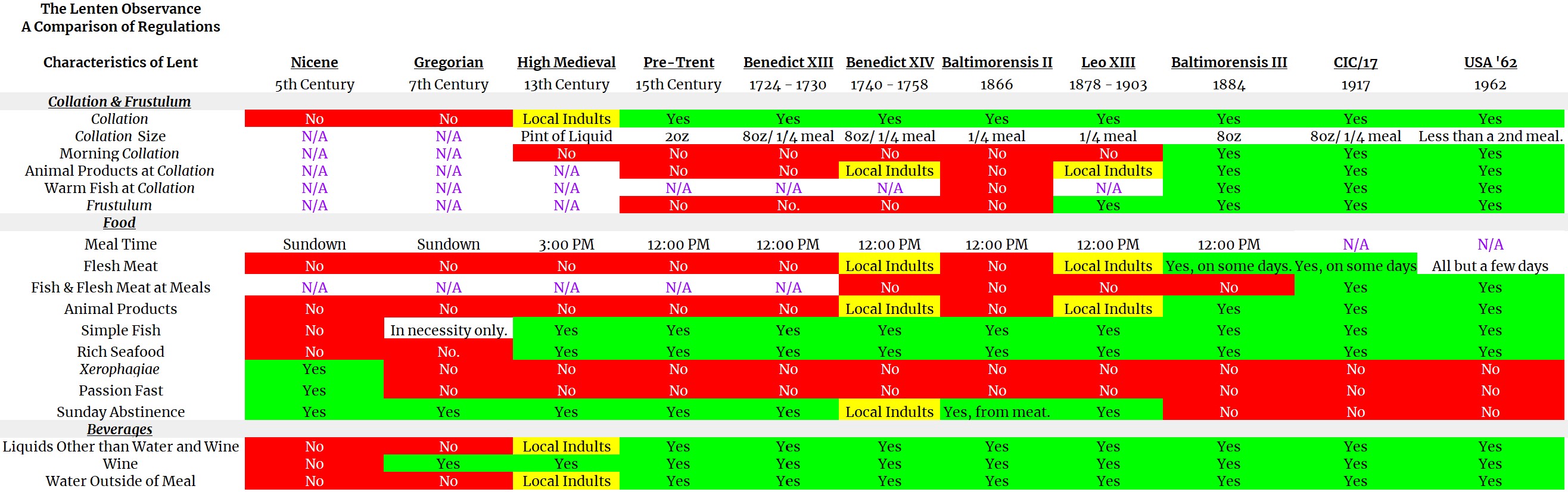
As we prepare for another holy season of Lent, I wish to share this chart developed by Tyler Gonzalez showing the changes over time to the Lenten fast. His contributions to this chart and the subsequent annotations were invaluable. I am not aware of any such comparison ever having been created. We would do well to see in this image the great discipline of our forefathers and to rekindle some of these practices this Lent in our fasting.
Key of Terms and Annotated Citations:
A collation is a small repast allowed originally only in the evenings of fast days.
A frustulum is a small repast allowed originally only in the mornings on fast days.
Xerophagiae is a diet of simple, dry, uncooked food, such as raw nuts, bread, fruits and vegetables. Fish and oil are not part of it neither are flesh and animal products. It was a precept to fast on these only during Holy Week by custom and/or decree until the time of Gregory the Great who mentions nothing of it. It may still have been a custom at that time but no mention of it is made in the decretals.
The Passion Fast is a term which refers to the fast which began for some as early as sunset on Holy Thursday and as late as 8am on Good Friday. No one was allowed to eat any food during that time until sunset on Holy Saturday, which since most fasted for Communion extended until morning on Easter Sunday. It was often called a “40hrs Fast” and represents the original Lenten fast. For those who were to weak to follow this fast the minimum fast at this time was that of xerophagiae.
1. Water is not allowed during the day outside of sunset repast. (Butler, Moveable Feasts, Fasts…, 1839, p.155) (C.f. AP. S. Prudentius, hymn, vi, p.188)
2. On the Sunset Repast. (Butler, p.149) (Tertullian, De Jejun, c.x., p.549); (Weiser, Handbook of Christian Feasts and Customs…, 1958, p.170)
3. When the collation was allowed by indult. (Butler, p. 149)
4. When the collation was allowed to the laity. (Butler, p. 152)
5. The original size of the collation. (Butler, p.152)
6. When the collation became ¼ of a meal/8 ounces. It became ¼ of a meal in the 16th century. (Laymann, Theologia Moralis, Lib. IV, Tract. VIII, Ch. I, pp.186-187, 1630)
7. The origin of the frustulum originated around the time of St. Alphonsus Liguori c. 18th century (The Jurist, 1952, p.188) The more common opinion is that St. Alphonsus speaks of electuaries and not a frustulum which were popular in his time. That the origins of the frustulum can be traced to his time is true as a kind of proto-frustulum. However, the greater proof lies in the claim that the frustulum was not explicitly allowed until the end of the 19th century. (Catholic Encyclopedia, Lent)
8. Fish in Lent permitted in its simple “less dainty” form in the 7th Century. The allowance of shellfish permitted around the 10th century (Butler, Moveable Feasts, Fasts…, 1839, p.146)
9. That animal products were not had on days of abstinence. (Weiser, p.170) (Cf. Decretals of Gratian, Letter of Pope St. Gregory the Great to Saint Augustine of Canterbury, 604 AD).
10. That Sundays were days of abstinence. (Thurston, Herbert. "Lent." The Catholic Encyclopedia. Vol. 9, 1910.)
11. The Passion Fast. (Weiser, Handbook of Christian Feasts and Customs…, 1958, p.201) (Cf. The writings of Saint Irenaeus in 202 AD as quoted in The Church History of Eusebius V 24, 12; PG, 20, 502f)
12. Xerophagiae in Lent. (Butler, p.203-204)
13. On wine in Lent. (Dom Prosper Guéranger, The Liturgical Year: Lent, 1887, p. 5) (Cf. St. Cyril of Jerusalem [Catech. iv])
14. On when liquids other than wine and water allowed. (St. Thomas Aquinas, Summa Theologiae, IIa IIae,qu.cxlvii,art.vi,ad eum.) (Rev. Antoine Villien, "A History of the Commandments of the Church", p. 315). Since liquids do not break the fast the kind of liquid and/or when it can be taken is now a non-matter. This discourse by St. Thomas was the beginning of this radical change which would not become a general custom until around the 15th century when food became allowed at the collation. Until then liquid was strictly speaking only allowed twice a day.
15. When the time of the meal changed to 3pm. (Butler, p.149) (St. Thomas, Summa Theologiae, Second Part of the Second Part, q.147, a.7)
16. When the time of the meal changed to 12pm. (Butler, p.150) (Durandus a S. Porciano, in 4 dist., 15 quaest., 9., art. 7)
17. When the time of the meal became a defunct matter. (CIC/17, c.1252)
18. Not less than a second meal for collation size. (Jone, p. 263) (McHugh and Callan, pp. 3118-3119). As of 1951 the United States Conference of Bishops adopted the relative norm as the law for the US and as such now allows the collation to be more than 8 ounces.
19. The quality of food at the collation-Fish, warm fish, animal products. (Butler, p. 153) (Metropolitan Catholic Almanac and Laity’s Directory, 1839, Baltimore.) (Villien, p. 312)
20. The consumption of both fish and flesh meat at the same meal. (Butler, p.163)
Want to learn more about the history of fasting and abstinence? Check out the Definitive Guide to Catholic Fasting and Abstinence.
Fasting is one of the chief means of penance we can perform to make satisfaction for sin, as our Lady of Fatima repeatedly called for. However, in a modern Church that legislates fasting only two days a year, we find a woefully lacking answer to Heaven’s incessant calls for penance and reparation. Understanding the decline of fasting over time in the Church should inspire us to observe these older customs and to encourage other Catholics to do so for the purpose of making satisfaction for sin.
While the purpose of fasting has remained the same, how fasting is observed has changed. As more Catholics seek to rediscover the traditions of earlier centuries and piously observe these traditions, they are often confused by the changing disciplines and exceptions for certain times, places, and circumstances. St. Francis de Sales remarked, “If you’re able to fast, you will do well to observe some days beyond what are ordered by the Church.”
This book explains fasting and how it has changed over the centuries in one of the most complete compilations yet written. Unfortunately, most summaries of fasting are either inaccurate or incomplete. However, rather than being a mere academic exercise, the purpose of studying the history of fasting is ultimately to help us rediscover these more ancient practices in an attempt to better observe our Lord and our Blessed Mother’s call for penance and reparation for sins.
As Archbishop Fulton J. Sheen once remarked, "It is a long-established principle of the Church never to completely drop from her public worship any ceremony, object or prayer which once occupied a place in that worship." The same may be said for matters concerning either Holy Days of Obligation or fast days. What our forefathers held sacred should remain sacred to us in an effort to preserve our catholicity not only with ourselves but with our ancestors who see God now in Heaven.
It is available in English, Spanish (La Guía Completa del Ayuno y Abstinencia en el Catolicismo), and Polish (Wszechstronny przewodnik katolickiego postu i wstrzemięzliwośći)!
Ordering Options:
English Paperback Version ($12.95): https://amzn.to/3I0oZiQ
English Kindle Version ($5.95): https://amzn.to/3x2EQHE
Spanish Paperback Version ($12.95): https://amzn.to/3XA2gip
Spanish Kindle Version ($12.95): https://amzn.to/3S42xsv
Polish Paperback Version ($12.95): https://amzn.to/415jiYt
PDF Version of Any of those Languages ($9.99): https://meaningofcatholic.com/shop/

In the Church, each of the twelve months of the year is dedicated to a particular facet of the Catholic Faith. However, the particular focus assigned to each month is not a dogmatic matter which has been defined by the Church’s solemn authority. Rather, these devotions have been practiced by the faithful and grown as popular piety. February is devoted to the Holy Family, the Purification of Our Lady, and our Lord's Passion.
On the Holy Family by St. Bernard of Clairvaux
In Mary we praise that which places her above all others, that is, fruitfulness of offspring together with virginity. For never has it been known in this world that anyone was at the same time mother and virgin. And see of Whom she is mother. Where does your astonishment at this so wondrous dignity lead you? Is it not to this, that you may gaze in wonder yet never sufficiently revere? Is she not in your veneration, nay, in the esteem of Truth itself, raised above choirs of angels? Does not Mary address the Lord and God of all the angels as Son, saying: Son, why hast thou done so to us?
Who among the angels may thus presume? It is enough for them, and for them their greatest honour, that while they are spirits by nature they have become and are called angels, as David testifies: Who makest thy angels spirits. Mary, knowing herself mother, with confidence calls that Majesty Son Whom the angels in reverence serve. Nor does God disdain to be called that which He disdained not to be. For the Evangelist adds a little later: He was subject to them.
Who was subject to whom? A God to men. God, I repeat, to Whom the angels are subject: Whom principalities and powers obey: was subject to Mary; and not alone to Mary, but to Joseph also, because of Mary. Admire and revere both the one and the other, and choose which you admire the more: the most sweet condescension of the Son, or the sublime dignity of the Mother. For either am I at a loss for words: for both are wondrous. For that God should obey a woman is humility without compare; and that a woman should have rule over God dignity without equal. In praise of virgins is it joyfully proclaimed: that they follow the lamb withersoever he goeth. Of what praise shall you esteem her worthy who also goeth before Him?
Learn, O Man, to obey. Learn, O Earth, to be subject. Learn, O Dust, to submit. The Evangelist in speaking of thy Maker says: He was subject to them; that is, without doubt, to Mary and to Joseph. Be you ashamed, vain ashes that you are. God humbles Himself, and do you exalt yourself? God becomes subject to men, and will you, eager to lord it over men, place yourself above your Maker? O would that God might deign to make me, thinking such thoughts at times in my own mind, such answer as He made, reproving him, to His apostle: Go behind Me, Satan: because thou savorest not the things that are of God.
For as often as I desire to be foremost among men, so often do I seek to take precedence of God; and so do I not truly savour the things that are of God. For of Him was it said: And he was subject to them. If you disdain, O Man, to follow the example of a Man, at least it will not lower thee to imitate thy Maker. If perhaps you cannot follow Him wheresoever He goeth, at least follow in that wherein He has come down to you.
If you are unable to follow Him on the sublime way of virginity, then follow God by that most sure way of humility; from whose straitness should some even from among the virgins go aside, then must I say what is true, that neither do they follow the Lamb withersoever he goeth. He that is humble, even though he be stained, he follows the Lamb; so too does the proud virgin; but neither of the two whithersoever He goeth: because the one cannot ascend to the purity of the Lamb that is without stain, nor will the other deign to come down to the meekness of the Lamb, Who stood silent, not merely before the shearer, but before the one that put Him to death. Yet the sinner who makes after Him in humility, has chosen a wholesomer part than the one that is proud in his virtue; since the humble repentance of the one washes away uncleanness, but the pride of the other contaminates his own virtue.
Truly blessed was Mary who possessed both humility and virginity. And truly wondrous the virginity whose fruitfulness stained not, but adorned her; and truly singular the humility, which this fruitful virginity has not troubled, but rather exalted; and wholly incomparable the fruitfulness which goes hand in hand with her humility and her virginity. Which of these things is not wondrous? Which is not beyond all comparison? Which that is not wholly singular? It would be strange if you did not hesitate to decide which you regard as most worthy of praise: whether the wonder of fruitfulness of offspring in virginity, or of virginal integrity in a mother: sublimity of Offspring, or humility joined to such dignity: unless it be that we place both together above each one singly: and it is truly beyond any doubt more excellent and more joyful to have beheld these perfections united in her, than to see but one part of them.
And can we wonder that God, of Whom it is written that He is wonderful in his saints, shows Himself in His own Mother yet more wondrous still. Venerate then, Ye spouses, this integrity of flesh in our corruptible flesh. Revere likewise, Ye virgins, fruitfulness in virginity. Let all men imitate the humility of God's Mother. Honour, Ye angels, the Mother of your King, you who adore the Offspring of our Virgin; Who is your King and our King, the Healer of our race, the Restorer of our fatherland: Who among you is so sublime, yet among us was so lowly: to Whose Majesty as well from you as from us let there be adoration and reverence: to whose Perfection be there honour and glory and empire for ever and ever. Amen.

As Catholics, we are still bound to abstain from meat each Friday of the entire year, not just in Lent. This is required during the season of Christmas - even on Friday in the Octave of Christmas.
The 1917 Code of Canon Law stipulated that the requirement to abstain from meat (i.e., Friday penance) was required each and every Friday of the year unless that particular Friday was a Holy Day of Obligation:"On [Sundays] or feasts of precept, the law of abstinence or of abstinence and fast or of fast only ceases, except during Lent, nor is the vigil anticipated; likewise it ceases on Holy [Saturday] afternoon" (1917 Code, Canon 1252 § 4). [Translation taken from THE 1917 OR PIO-BENEDICTINE CODE OF CANON LAW in English Translation by Dr. Edward Peters]