Wednesday, September 1, 2010
Catholic Devotions for the Dead

It has and always will be a pious and holy practice to pray for the repose of the souls who have passed on to the next life.  However, in the past few decades the occurrence of prayers said for the souls in purgatory and their blessed repose have fallen into such disuse that such a lack of charity for their souls is an atrocity.  For generations, Catholics would pray for the souls of the faithful who have gone before them in the sleep of death and hope in the future resurrection.

You as a member of the Catholic Church on earth (i.e. The Church Militant) have a solemn duty to pray for souls in purgatory (i.e. The Church Suffering).  As this month slowly draws to a close we shall in the not too distant future arrive at the month of November, traditionally devoted to praying for the dead.  However, these prayers and devotions should not only be prayed in November.

It is a traditional and pious practice with references not only in the Magesterium of the Church but also through the Holy Scriptures.  As stated in the holy book of Maccabees: "It is a holy and wholesome thought to pray for the dead, that they may be loosed from sins" (2 Maccabees 12:46).  In 230 AD Tertullian writes, "The widow who does not pray for her dead husband has as good as divorced him."

Topics:

1. Requiescat in Pace (RIP)
2. Judgment (Particular and Final)
3. All Souls Day
4. Funeral Masses (all types)
5. 3rd, 7th, and 30th Day After Burial Devotions
6. Funeral Mass of the Supreme Pontiffs
7. Prayers for Souls in Purgatory
8. Obtain Indulgences for the Dead


1. Requiescat in Pace (RIP)

Unfortunately, the sacred in many ways has become too common and ordinary so that we fail - when encountering holy things - to stand in the awe appropriate for the situation.  In much the same manner, we have become accustomed to the three letters R.I.P on the headstones of those who have died; yet, few of us adequately understand the liturgical connection of these three simple letters to the Mass said for the repose of their souls.

The expression R.I.P, despite modern understandings, does not stand for "rest in peace" but instead represents the Latin phrase "requiescat in pace", who English equivalent is coincidentally "rest in peace".  These three holy letters were not formerly placed on the tombstones of all of the departed or even all "Christians" but only on the tombstones of Catholics who have departed.  The phrase "requiescat in pace" is taken from the final prayers of the priest at the place of burial: Anima eius et animae omnium fidelium defunctorum per Dei misericordiam requiescant in pace whose English equivalent is May his soul and the souls of all the departed faithful by God's mercy rest in peace

The letters RIP first appeared in the 8th century although it did not become common on the tombstones of Catholics until the 18th century.  The Roman catacombs bear witness to prayers for the dead since many prayers for the dead are preserved on the tombs of the departed (e.g. Mayst thou live among the saints, 3rd century).  The phrase refers not to our wish for their bodies to live peacefully in the ground but our prayer that their souls may be forgiven by Christ the Judge and found worthy - after the necessary purification - to enter into Heavenly beatitude.  Namely, we pray that the souls of the departed shall one day be worthy for beatitude - to behold the face of God in Heaven.

Consequently, it should be viewed as a pious and humble practice to frequently visit the cemeteries and pray for the dead.  And surely, when you see the letters R.I.P you should pray for the salvation of the departed.  Recall that our prayers are outside of time so do not fail in praying for the dead because you assume that you are "too late".  Rather, your prayers offered in a humble and contrite spirit pay the price of the departed's sins and free their souls from purgatory (c.f. Mt. 5:48, Mt. 5:26, Mt. 12:32, 1 Cor. 15:29, 1 Tim. 1:16).  It is in this instance that your prayers have truly saved a soul.

2. Judgment

It is a dogmatic teaching of the Faith that at the moment of our death we will appear “before the judgment seat of Christ” (2 Cor. 5:10), Who will pronounce our eternal sentence: ultimate life in Heaven, though likely after cleansing in Purgatory, or an eternity of uninterrupted and unspeakable torment in hell.

Writing of the Particular Judgement, the Catechism of the Council of Trent explains:
“The first [judgment] takes place when each one of us departs this life; for then he is instantly placed before the judgment seat of God, where all that he has ever done or spoken or thought during life shall be subjected to the most rigid scrutiny. This is called the particular judgment.” 
Likewise, in the same spirit but with the docility of a pastor who yearned for the salvation of all men, St. John Vianney wrote on the Particular Judgment:
“Our catechism tells us, my children, that all men will undergo a particular judgment on the day of their death. No sooner shall we have breathed our last sigh than our soul, without leaving the place where it has expired, will be presented before the tribunal of God. Wherever we may die, God is there to exercise His justice. The good God, my children, has measured out our years, and of those years that He has resolved to leave us on this earth, He has marked out one which shall be our last; one day which we shall not see succeeded by other days; one hour after which there will be for us no more time.” 
While the certainly of the private judgment has been known since apostolic times, the particulars of the immediate consequences of our sentence was the subject of theological debate throughout the Middle Ages. Seeking to end a period of debate on whether the blessed will have the vision of God immediately after their sentence or if they must wait until the General Judgment at the end of time, Pope Benedict XII issued Benedictus Deus (On the Beatific Vision of God) in the year of Our Lord 1336, thus ending the debate vis-à-vis a dogmatic definition:
“By this Constitution which is to remain in force forever, We, with apostolic authority, define the following: According to the general disposition of God, the souls of all the saints who departed from this world before the passion of our Lord Jesus Christ and also of the holy apostles, martyrs, confessors, virgins and other faithful who died after receiving the holy baptism of Christ – provided they were not in need of any purification when they died, or will not be in need of any when they die in the future, or else, if they then needed or will need some purification, after they have been purified after death – and again the souls of children who have been reborn by the same baptism of Christ or will be when baptism is conferred on them, if they die before attaining the use of free will: all these souls, immediately after death and, in the case of those in need of purification, after the purification mentioned above, since the ascension of our Lord and Savior Jesus Christ into heaven, already before they take up their bodies again and before the general judgment, have been, are and will be with Christ in heaven, in the heavenly kingdom and paradise, joined to the company of the holy angels. 
“… we define that according to the general disposition of God, the souls of those who die in actual mortal sin go down into hell immediately after death and there suffer the pain of hell. Nevertheless, on the day of judgment, all men will appear with their bodies ‘before the judgment seat of Christ’ to give an account of their personal deeds, ‘so that each one may receive good or evil, according to what he has done in the body’ (2 Cor. 5.10).” 
In addition to the Particular Judgment of each individual soul immediately after death, the Church solemnly teaches that there shall also be a second and final judgment, which will occur at the End of Time. This final judgment is also known as the General Judgment and will occur at the very end of the world, when our Blessed Lord comes again to judge the living and dead (inde venturus est iudicare vivos et mortuos), as we profess in the Creed. At that time, as our Savior Himself has told us, He shall “sit upon the seat of his majesty. And all nations shall be gathered together before Him, and He shall separate them one from another, as the shepherd separateth the sheep from the goats” (Matt. 25:31-32). Elsewhere in the Gospel, Our Lord described the Last Judgment with these words: “ Wonder not at this; for the hour cometh, wherein all that are in the graves shall hear the voice of the Son of God. And they that have done good things, shall come forth unto the resurrection of life; but they that have done evil, unto the resurrection of judgment” (John 5:28-29).

Similarly, St. John the Apostle wrote the following in his Book of the Apocalypse, the last book of the Bible:
“And I saw the dead, great and small, standing in the presence of the throne, and the books were opened; and another book was opened, which is the book of life; and the dead were judged by those things which were written in the books, according to their works. And the sea gave up the dead that were in it, and death and hell gave up their dead that were in them; and they were judged everyone according to their works. And hell and death were cast into the pool of fire. This is the second death. And whosoever was not found written in the book of life, was cast into the pool of fire.” (Apoc. 20:12-15)
The Catholic Church teaches that at the time of the Last Judgment, Christ will come in His glory, “and all the angels with Him” (Matt. 25:31), and in His presence the truth of each man's relationship with God will be laid bare. Each person who has ever lived will be judged with the perfect justice of an omnipotent and omniscient God. Those already in Heaven will remain in Heaven, those already in hell will remain in hell, and those in Purgatory will be released into Heaven. After the Last Judgment, the universe itself will be renewed there will be “a new heaven and a new earth” (Apoc. 21:1).

If the Last Judgment will in no way alter the verdict of our own particular judgment, some may ask why the Last Judgment is even necessary. In her wisdom, Holy Mother Church in the Seventh Article of the Creed in the Roman Catechism expounds on the reason:
“Those who depart this life sometimes leave behind them children who imitate their conduct, dependents, followers and others who admire and advocate their example, language and actions. Now by all these circumstances the rewards or punishments of the dead must needs be increased, since the good or bad influence of example, affecting as it does the conduct of many, is to terminate only with the end of the world. Justice demands that in order to form a proper estimate of all these good or bad actions and words a thorough investigation should be made. This, however, could not be without a general judgment of all men.” 
In a similar though more succinct manner, the Baltimore Catechism explains the rationale for the Last Judgment by stating: “There is need of a general judgment, though everyone is judged immediately after death, that the providence of God, which, on earth, often permits the good to suffer and the wicked to prosper, may in the end appear just before all men.”  And further, “There are other reasons for the general judgment, and especially that Christ Our Lord may receive from the whole world the honor denied Him at His first coming, and that all may be forced to acknowledge Him as their God and Redeemer.”

The Last Judgment will not alter in any way the eternal sentence pronounced upon us at our own Particular Judgement. On the contrary, the Last Judgment will make our sins and the sins of every person in history known to everyone else. Nothing will remain secret any longer, according to Our Lord’s own words: “For there is not any thing secret that shall not be made manifest, nor hidden, that shall not be known and come abroad” (Luke 8:17). All will be revealed, and all bad will be punished and all good, even the hidden good for which we never received recognition on earth, will be rewarded openly before all.

3. All Souls Day

This annual liturgical commemoration, dating back to the 11th Century, is a time to remember all of the faithful depart and pray that they are now in the grace of God. God certainly is Love and He is mercy. The only thing we can do is trust in Him and pray for our loved ones.

In the middle of the 11th century, St. Odilo, the abbot of Cluny (France), said that all Cluniac monasteries were to offer special prayers and sing the Office for the Dead on November 2, the day after the feast of All Saints. The custom spread from Cluny and was adopted throughout the entire Roman Catholic Church. Now we the entire Church celebrates November 2nd as All Soul's Day.

During the First World War, Pope Benedict XV on August 10, 1915, allowed all priests everywhere to say three Masses on All Souls' Day. The two extra Masses were in no way to benefit the priest himself: one was to be offered for all the faithful departed, the other for the Pope's intentions, which at that time were presumed to be for all the victims of that war. The permission remains.


4. Funeral Mass

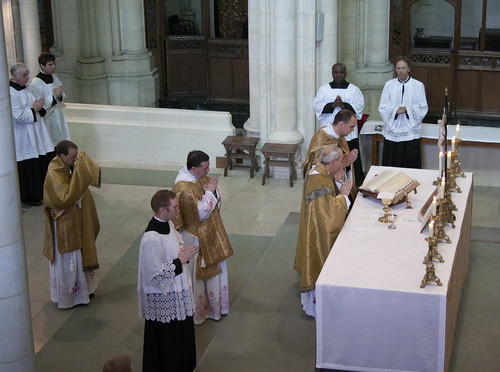
When we think of praying for the dead many of us think of a funeral Mass.  For this lesson, we focus in a particular way on the Traditional Rite of the Roman Liturgy and the Funeral Mass in the context of the 1962 Missal.  We begin though with an important distinction.  All Catholics should have a Catholic funeral and should be buried in a Catholic cemetery; however, there are some further clarifications from Canon Law worthy of iterating. 

Limits are placed on public offering of Mass for the unbaptized and notorious sinners although prayers and even Mass in private can be said for them. The present Code of Canon Law states that, unless the person concerned gave some signs of repentance before death, no form of funeral Mass may be offered for notorious apostates, heretics and schismatics; those who for anti-Christian motives chose that their bodies be cremated; and other manifest sinners to whom a Church funeral could not be granted without public scandal to the faithful (c.f. Canon 1184).

5. 3rd, 7th, and 30th Day After Burial Devotions

Why are special Masses and Prayers Offered on the 3rd, 7th, and 30th days after the Burial?

Special prayers are offered in the Breviary on the 3rd day after the burial in commemoration of the three days our Blessed Lord spent in the tomb. There is special prescription in the Apostolic Constitutions (VIII, xlii) regarding this which states, "With respect to the dead, let the third day be celebrated in psalms, lessons, and prayers, because of him who on the third day rose again."

Why is the 7th day commemorated in a special manner? This too is an ancient observance. With regard to the seventh day, we have the testimony of St. Ambrose who bears witness to the ancient practice, and gives the reason for it: "Now, since on the seventh day, which is symbolical of eternal repose, we return to the tomb). The 30th day is in imitation for the mourning of Moses as recounted in the Scriptures. 

Learn more about the history of all of these and how they are calculated by clicking here.

We also highly encourage you to pray for the repose of the souls of your friends and relatives on the day of death, day of burial, the 3rd day after burial, the 7th day after burial, the 30th day after burial, and on the anniversary of death/burial.  Please pray the Office of the Dead (which is available online) in the 1955 Breviary for that purpose.

6. Funeral Mass of the Supreme Pontiffs

Throughout the 20th century up until the Second Vatican Council, the Funeral Rite for a Deceased Pope was virtually identical. As succinctly stated, the Funeral Rite of Pope Leo XIII would have looked nearly identical to the Funeral Rite of Pope John XXIII. According to a Fish eaters poster, "Rubrical changes in 1955 had no affect on the text or rubrics of the Requiem itself. The rubrical changes of 1960 had no affect on the actual Mass itself, only when certain Masses could be said and which and how many collects would be said at these." To read an in-depth analysis and article on the Funeral Rites of the Supreme Pontiffs, please visit that post directly.


7. Prayers for Souls in Purgatory

At last, we arrive at the section pertaining most closely with the laity, namely praying for the souls in Purgatory.  We should pray fervently and frequently for the souls in Purgatory.  Start by adding the St. Gertrude Prayer to your daily prayers:
Eternal Father, I offer You the most precious blood of thy Divine Son, Jesus, in union with the Masses said throughout the world today, for all the Holy Souls in Purgatory, for sinners everywhere, for sinners in the universal Church, for those in my own home, and in my family. Amen.
Our Lord told St. Gertrude the Great that 1,000 souls would be released from Purgatory every time this is said. This prayer has now even been "extended to living sinners which would alleviate the indebtedness accrued to them during their lives."

8. Obtain Indulgences for the Poor Souls

It should be widely promoted for the Faithful to ask the clergy to offer the Holy Sacrifice of the Mass with the intention of freeing the souls in Purgatory.  Many souls are released from Purgatory by the graces from the Mass.  Furthermore, we should seek to gain Indulgences for the souls in Purgatory.  The easiest way to do this is by obtaining a Raccolta which lists the indulgenced prayers and the conditions for obtaining the indulgence.

One the easiest indulgences we can gain is to visit a cemetery and pray for the dead there. Any prayer may be said.

Furthermore, the souls in Purgatory are greatly aided when we offer our Holy Communions for them.  Make it a practice to offer your Holy Communion at least once weekly for the souls in Purgatory.

In the past, I have reflected on Praying the Stations of the Cross - which also happen to have indulgences attached to them - and at this time I would also encourage you to pray the Stations for the souls in Purgatory.  Similarly, almsgiving, penance, and fasting performed with the intention of freeing souls in Purgatory can help the suffering souls in the Church Suffering.  And these souls, when freed from their purgation, shall certainly pray without ceasing for our salvation. See: Alms for the Poor Souls.

For resources on devotions for the souls in Purgatory, please see my former post on Purgatory. And read Indulgences for the Dead for more information

Conclusion:

The words of the eternal and immutable Scriptures should be frequently on our mind as well as our lips.  And it is these Holy Scriptures that declare, "It is a holy and wholesome thought to pray for the dead, that they may be loosed from sins" (2 Maccabees 12:46).  Praying for the dead should not only be done in the month of November or on the day of our loved one's burial.  We should stop thinking "They are in Heaven" - what a dangerous lack of charity to your relatives, friends, and ancestors departed!  The souls in Purgatory need our prayers as they are unable to pray for themselves.  Stop believing that all people are immediately saved since many do go to Hell and a great majority of the remaining first go to Purgatory (c.f. Hell: The Dogma of Hell, Illustrated by Facts Taken from Profane and Sacred History by F. X. Schouppe, SJ).  Few - very few - souls go straight to Heaven. 

Spread this post as far as possible encouraging the laity to pray for the souls in Purgatory and priests to offer prayers and the Holy Sacrifice of the Mass in its traditional form for the faithful departed.
Read more >>
Tuesday, August 31, 2010
October 31, 2010: Special Event at Institute of Christ the King in Chicago, IL

Read more >>
July 2010 Tridentine Mass at St. Agnes in New York City

The Tridentine Mass is said every Sunday at 11 p.m. at St. Agnes Church in New York City. The following two videos are from July 11, 2010. Please particularly note the beautiful paintings present in this fitting House of God.

I have posted a photo before of St. Agnes Church on my post dedicated to the errors of Centering Prayer.


The Gospel reading for the 7th Sunday after Pentecost, given on Sunday, 11 July 2010.


Read more >>
Monday, August 30, 2010
Asperges Me

Before the principal celebration of Sunday Holy Mass, the Roman Catholic liturgy calls for a ritual sprinkling of the congregation with holy water, an act symbolic of the cleansing of their spirits to receive the Eucharist. During this liturgy act, in all seasons but Eastertide when the Antiphon is "Vidi aquam," the music chanted is the "Asperges me." The Holy Mass antiphon's texts are, in succession, "Asperges me," an invocation for the Lord's cleansing with the hyssop plant as used by the Israelites (Exod. 12:21-23; Lev. 14:4-6, 49-57)

Here is a video of a beautiful rendition of this prayer:


Here is a video of the Asperges me as performed in the context of a Mass:


In both of these videos note the importance of both the priest and the Faithful kneeling during the Glori Patri at mention of the Holy Trinity. According to the Catholic Encyclopedia: “The ceremony [of the Asperges me and the Vidi Aquam] has been in use at least from the tenth century, growing out of the custom of early antiquity of blessing water for the faithful on Sundays.”

Was the usage of the Asperges Me changed with the 1955 rubrics? No. As explained by a Fish Eaters poster named MagisterMusicae, "The text and rules for the Asperges did not change between 1945 and 1962. The only difference is that the in 1955 the Asperges was omitted for Palm Sunday (because of the blessing of the Palms). The Asperges is done a single time on Sunday preceding the Principal Mass (provided it is a Sung or Solemn Mass). It may not be duplicated unless local custom allows. This follows SRC Decrees 3268 and 4051."
Read more >>
Simultaneous Masses

The photo above comes from the blog Juventutem Argentina, which features a photograph from the Franciscans of the Immaculate.  You will notice that there are four Masses occuring simultaneously on separate altars in the Church.  Each priest is celebrating his own low mass and each priest is assisted by an acolyte.  In many respects, the silence and reverence in the low Mass has converted many souls from vices to love for Christ.

Long time readers of the blog will remember a video that I posted before of a Mass said by the Franciscans of the Immaculate.  View that video.
Read more >>
Sunday, August 29, 2010
Martyrdom of St. John the Baptist


Today Holy Church recalls the martyrdom of St. John the Baptist.
The beheading of St. John Baptist, who was put to death by Herod about the feast of Easter. However, his solemn commemoration takes place today, when his venerable head was found for the second time. It was afterwards solemnly carried to Rome, where it is kept in the church of St. Sylvester, near the Campus Martius, and honoured by the people with the greatest devotion.

Source: pre-1960 Martyrology
For information on this feastday, please see my post entitled Martyrdom of St. John the Baptist.
Read more >>
Saturday, August 28, 2010
Tridentine Latin Mass: Saint John Lateran Basilica on April 16, 2009

Highlights from the Solemn High Mass according to the Extraordinary Form, celebrated in Saint John Lateran Basilica, by the Franciscan Friars and Sisters of the Immaculate. All sacred music sung by the Friars and Sisters (Polyphony and Gregorian Chant) This is the first time that the Tridentine Mass has been celebrated in the pope's chair since Vatican II. Quite a magnificent site to behold!

Read more >>
Pray for the repose of the soul of Judy Ortego


In the Office for the Dead throughout the year
Oratio          Orémus.
Deus, qui inter apostólicos sacerdótes fámulos tuos pontificáli seu sacerdotáli fecísti dignitáte vigére : præsta, quæsumus ; ut eórum quoque perpétuo aggregéntur consórtio.
Collect          Let us pray.
O God, who didst cause thy servants, for whom we pray, to enjoy the dignity of the priesthood, and some to be bishops, after the order of thine Apostles : grant unto them, we beseech thee, finally to rejoice in the company of those Saints in heaven whose ministry they did sometime share on earth.
Deus, véniæ largítor et humánæ salútis amátor : quæsumus cleméntiam tuam  ; ut nostræ congregatiónis fratres, propínquos et benefactóres, qui ex hoc sæculo transiérunt, beáta María semper Vírgine intercedénte cum ómnibus Sanctis tuis, ad perpétuæ beatitúdinis consórtium perveníre concédas.
O God, who desirest not the death of a sinner but rather that all mankind should be saved : we beseech thee mercifully to grant that the brethren, kinsfolk, and benefactors of our congregation, who have passed out of this world, may by the intercession of blessed Mary Ever-Virgin and of all thy Saints come to enjoy with them everlasting blessedness.
Fidélium, Deus, ómnium cónditor et redémptor, animábus famulórum famularúmque tuárum remissiónem cunctórum tríbue peccatórum : ut indulgéntiam, quam semper optavérunt, piis supplicatiónibus consequántur : Qui vivis et regnas cum Deo Patre in unitáte Spíritus Sancti Deus, per ómnia sæcula sæculórum.
R.  Amen.
O God, the Creator and Redeemer of all them that believe : grant unto the souls of thy servants and handmaidens the remission of all their sins ; that as they have ever desired thy merciful pardon, so by the supplications of their brethren they may receive the same.  Who livest and reignest with the Father, in the unity of the Holy Ghost, ever one God, world without end.
R.  Amen.
Read more >>
St. Augustine of Hippo


Memorial (1969 Calendar): August 28
Class III (1962 Calendar): August 28
Double (1955 Calendar): August 28

Today is the feastday of St. Augustine, an illustrious and glorious Doctor of the Church. His conversion through the prayers of his mother, St. Monica, illustrates to all of us the necessity to never cease praying for the conversion of our family and friends - even after years of seemingly "unanswered" prayers.

Traditional (pre-1960 Martrology):
At Hippo in Africa, the birthday of St. Augustine, bishop and famous doctor of the Church. Converted and baptized by the blessed bishop Ambrose, he defended the Catholic faith with the greatest zeal against the Manicheans and other heretics, and after having sustained many other labours for the Church of God, he went to his reward in heaven. His relics, owing to the invasion of barbarians, were first brought from his own city into Sardinia, and afterwards taken by Luitprand, king of the Lombards, to Pavia, where they were deposited with due honours.

Traditional Matins Reading: 

Augustine was born at Tagaste in Africa of noble parents. As a child he was so apt in learning that in a short time he far surpassed in know ledge all those of his own age. When he was a young man he went to Carthage where he fell into the Manichæan heresy. Later on, he journeyed to Rome, and was sent thence to Milan to teach rhetoric. Having frequently listened to the teaching of Ambrose the bishop, he was through his influence inflamed with a desire of the Catholic faith and was baptized by him at the age of thirty-three. On his return to Africa, as his holy life was in keeping with his religion, Valerius the bishop, who was then renowned for his sanctity, ordained him priest. It was at this time that he founded a religious community with whom he lived, sharing their food, and dress, and training them with the utmost care in the rules of apostolic life and teaching. The Manichæan heresy was then growing very strong: he opposed it with great vigour and refuted one of its leaders named Fortunatus.

Valerius perceiving Augustine’s great piety made him his coadjutor in the bishopric. He was always most humble and most temperate. His clothing and his bed were of the simplest kind: he kept a frugal table, which was always seasoned by reading or holy conversation. Such was his loving kindness to the poor, that when he had no other resource, he broke up the sacred vessels, for their relief. He avoided all intercourse and conversation with women, even with his sister and his niece, for he used to say that though such near relatives could not give rise to any suspicion, yet might the women who came to visit them. Never, except when seriously ill, did he omit preaching the word of God. He pursued heretics unremittingly both in public disputations and in his writings, never allowing them to take foothold anywhere; and by these means he almost entirely freed Africa from the Manichees, Donatists and other heretics.

His numerous works are full of piety, deep wisdom and eloquence, and throw the greatest light on Christian doctrine, so that he is the great master and guide of all those who later on reduced theological teaching to method. 'While the Vandals were devastating Africa, and Hippo had been besieged by them for three months, Augustine was seized with a fever. When he perceived that his death was at hand, he had the penitential psalms of David placed before him, and used to read them with an abundance of tears. He was accustomed to say that no one, even though not conscious to himself of any sin, ought to be presumptuous enough to die without repentance. He was in full posses sion of his faculties and intent on prayer to the end. After exhorting his brethren who were around him, to charity, piety and the practice of every virtue, he passed to heaven, having lived seventy-six years, and thirty-six as bishop. His body was first of all taken to Sardinia, afterwards Luitprand, king of the Lombards, translated it to Pavia, where it was honourably entombed.

Read more >>
Plenary Indulgence at the Hour of Death


Funeral of St. Bonaventure in the presence of the Roman Pontiff

My Lord God, even now resignedly and willingly, I accept at Thy hand, with all its anxieties, pains, and sufferings, whatever kind of death it shall please Thee to be mine.

By a decree of the Congregation of Indulgences of 9 March 1904, His Holiness Pope Pius X, has granted a plenary indulgence at the moment of death to all the faithful who, on any day they may choose, will receive the sacraments of Penance and Holy Eucharist and make this act for the love of God
Read more >>
Friday, August 27, 2010
The Latin Mass: Explained by RealCatholicTV


A video that is accurate for the most part although please note that some parts (e.g. the usage of the term "Extraordinary Ministers of the Eucharist") are inaccurate.
Read more >>
Latin Mass Training Conference at Downside

The photographer Joseph Shaw shares these photos in August 2010 of a Latin Mass Training Conference at Downside.  Below are some of the photos in that set. 


2010 08 11_7412

2010 08 12_7279

2010 08 12_7292

2010 08 12_7307

2010 08 12_7317

2010 08 13_7211

2010 08 13_7223

2010 08 13_7227
Read more >>
Video: Final Profession of Br. Martin Mary, F.SS.R

Read more >>
Pray for the Repose of the Soul of Mrs. Valerie Potkins

The Transalpine Redemptorists recently posted photos of a Mass said for the repose of the soul of Mrs. Valerie Potkins.  Please pray for her soul.  I would particularly recommend these prayers from the Office of the Dead:

In the Office for the Dead throughout the year
Oratio          Orémus.
Deus, qui inter apostólicos sacerdótes fámulos tuos pontificáli seu sacerdotáli fecísti dignitáte vigére : præsta, quæsumus ; ut eórum quoque perpétuo aggregéntur consórtio.
Collect          Let us pray.
O God, who didst cause thy servants, for whom we pray, to enjoy the dignity of the priesthood, and some to be bishops, after the order of thine Apostles : grant unto them, we beseech thee, finally to rejoice in the company of those Saints in heaven whose ministry they did sometime share on earth.
Deus, véniæ largítor et humánæ salútis amátor : quæsumus cleméntiam tuam  ; ut nostræ congregatiónis fratres, propínquos et benefactóres, qui ex hoc sæculo transiérunt, beáta María semper Vírgine intercedénte cum ómnibus Sanctis tuis, ad perpétuæ beatitúdinis consórtium perveníre concédas.
O God, who desirest not the death of a sinner but rather that all mankind should be saved : we beseech thee mercifully to grant that the brethren, kinsfolk, and benefactors of our congregation, who have passed out of this world, may by the intercession of blessed Mary Ever-Virgin and of all thy Saints come to enjoy with them everlasting blessedness.
Fidélium, Deus, ómnium cónditor et redémptor, animábus famulórum famularúmque tuárum remissiónem cunctórum tríbue peccatórum : ut indulgéntiam, quam semper optavérunt, piis supplicatiónibus consequántur : Qui vivis et regnas cum Deo Patre in unitáte Spíritus Sancti Deus, per ómnia sæcula sæculórum.
R.  Amen.
O God, the Creator and Redeemer of all them that believe : grant unto the souls of thy servants and handmaidens the remission of all their sins ; that as they have ever desired thy merciful pardon, so by the supplications of their brethren they may receive the same.  Who livest and reignest with the Father, in the unity of the Holy Ghost, ever one God, world without end.
R.  Amen.
Read more >>
Wednesday, August 25, 2010
Papal Golden Rose

On August 23, 2010, His Holiness Pope Benedict XVI gave the 11th Golden Rose of his pontificate to Mary at the Shrine of Our Lady of the Valley in Argentina.  This occasion is an appropriate time to examine the history and tradition of the Papal Golden Rose.

To explain this devotion we quote from texts in the public domain as follows.

The rose is blessed on the fourth Sunday of Lent, Lætare Sunday (hence also known as Rose Sunday), when rose-coloured vestments and draperies are substituted for the penitential purple, symbolizing hope and joy in the midst of Lenten solemnity. Throughout most of Lent, Catholics pray, fast, perform penance, and meditate upon the malice of sin and the terrible punishment it brings; Rose Sunday is an opportunity to look beyond Christ's death at Calvary and see Christ, the redeemer, risen in the first rays of the Easter sun, and rejoice. The shining golden flower shows forth Christ's majesty, appropriate because prophets called him "the flower of the field and the lily of the valleys."[1] Its fragrance, according to Pope Leo XIII "shows the sweet odor of Christ which should be widely diffused by His faithful followers" (Acta, vol. VI, 104), and the thorns and red tint refer to His Passion. See Isaiah 63:2: "Why then is thy apparel red, and thy garments like theirs that tread in the winepress?"


The earliest roses were not blessed; instead, blessing was introduced to render the ceremony more solemn and induce greater reverence for it on the part of the recipient. According to Cardinal Petra (Comment. in Constit. Apostolicas, III, 2, col. 1), Pope Innocent IV (1245–54) was the first to bless it. However, others claim that Pope Innocent III (1198–1216), Pope Alexander III (1159–81) or Pope Leo IX (1049–55) was the first. It is said that Leo IX, in 1051, obliged the monastery (nuns) of Bamberg in Franconia, to furnish a Golden Rose to be blessed and carried on Lætare Sunday each year (Theop. Raynaud, De rosa mediana a pontifice consecrata, IV, 413). Pope Benedict XIV attests that the ceremony of blessing originated at the end of the 14th or the beginning of the 15th century. Catalanus, papal master of ceremonies, believes that even the earliest roses were anointed with musk and balsam, but the blessing with prayers, incense, and holy water had its inception later on, sometime before pontificate of Pope Julius II (1503–13). Currently, the pope blesses the rose every year, but it is not always a new and different rose; the old one is used until it has been given away.

Originally (before the papacy moved to Avignon) the rose was blessed in the Hall of Vestments (sacristy) in the palace where the pope was; but the solemn Mass and the donation of the rose took place in the Santa Croce in Gerusalemme (a figure, according to Pope Innocent III, of the heavenly Jerusalem). The blessing was followed by a solemn Mass sung either by the pope himself or the first Cardinal Priest. In the former case the rose was placed on a veil of rose-colored silk richly embroidered with gold; in the latter the pope held the rose in his hand, except while kneeling, or during the Introit, Confiteor, Elevation and the singing of "Laudemus in Domino". Rose in hand, the pope returned processionally to the Lateran Palace; the Prefect of Rome led his horse by the bridle and aided him in dismounting. Upon arrival, he gave the rose to the Prefect, as a recompense for these acts of respect and homage. Prior to 1305, the rose was given in Rome to no foreigner, except the Emperor on the day of his coronation. While residing at Avignon (1305–1375), the popes, unable to visit Roman churches and basilicas, performed many of their sacred functions, among them the blessing of the rose, in the private chapel of their palace (whence the origin of the Cappella Pontificia). On their return to Rome they (Sixtus V excepted) retained this custom.

The blessing of the rose now takes place in the Hall of Vestments (camera dei parimenti), and the solemn Mass in the papal chapel. The rose is placed on a table with lighted candles, and the pope, vested in alb and rose-colored stole and cope with precious mitre on his head, begins the ceremony with the usual versicles and the following poetical prayer:
"O God! by Whose word and power all things have been created, by Whose will all things are directed, we humbly beseech Thy Majesty, Who art the joy and gladness of all the faithful, that Thou wouldst deign in Thy fatherly love to bless and sanctify this rose, most delightful in odour and appearance, which we this day carry in sign of spiritual joy, in order that the people consecrated by Thee and delivered from the yoke of Babylonian slavery through the favour of Thine only-begotten Son, Who is the glory and exultation of the people of Israel and of that Jerusalem which is our Heavenly mother, may with sincere hearts show forth their joy. Wherefore, O Lord, on this day, when the Church exults in Thy name and manifests her joy by this sign [the rose], confer upon us through her true and perfect joy and accepting her devotion of today; do Thou remit sin, strengthen faith, increase piety, protect her in Thy mercy, drive away all things adverse to her and make her ways safe and prosperous, so that Thy Church, as the fruit of good works, may unite in giving forth the perfume of the ointment of that flower sprung from the root of Jesse and which is the mystical flower of the field and lily of the valleys, and remain happy without end in eternal glory together with all the saints."
The prayer finished, the pope puts incense (handed by the cardinal-deacon) into the censer and incenses the balsam and then the musk, and afterwards puts the balsam and powdered musk into the tiny cup in the heart of the principal rose. He then incenses the rose and sprinkles it with holy water. It is then given to the youngest cleric of the Camera, who carries it in front of the pope to the chapel, where it is placed on the altar at the foot of the cross upon a richly embroidered silk veil, where it remains during the Mass sung by the first cardinal-priest. After the Mass, the rose is carried in procession before the pope to the sacristy, where it is carefully put away in a place set apart for it, until bestowed upon some worthy personage.

Zenit reports on the use of the Papal Golden Rose by Pope Benedict XVI as follows:

The Golden Rose is a papal decoration conferred on prominent Catholic personalities; it has gone through a significant evolution. Initially, kings and dignitaries received it, later it was conferred almost exclusively on queens and, more recently, on Our Lady. The distinction was created by Pope Leo IX in 1049.

In more recent times, after the Second Vatican Council, the papal decoration has become almost exclusively a gift from popes to Our Lady. This was the 11th Golden Rose that the Pontiff has given to Our Lady in the more than five years of his pontificate. The other 10 were given to the Shrine of Jasna Góra in Poland (2006), the Basilica of Aparecida in Brazil (2007), the Mariazell Basilica in Austria (2007), the Basilica of the National Shrine of the Immaculate Conception in Washington, D.C. (2008), Our Lady of Bonaria in Cagliari, Italy (2008), Our Lady of Pompeii, Italy (2008), Our Lady of Europe in Gibraltar (2009), and the "Virgen de la Cabeza" (literally, Virgin of the Head) of the Diocese of Jaen, Spain (2009), the Shrine of Our Lady of Ta' Pinu (2010), and Our Lady of Fatima (2010).
Read more >>
Tuesday, August 24, 2010
First Solemn Mass of Fr. Aaron Huberfeld

On Sunday, August 22nd, Fr. Aaron Huberfeld, Canon of the Institute of Christ the King, Sovereign Priest, offered his first Solemn High Mass in the United States in Norwalk, CT.  The following photos are taken from The Society of St. Hugh of Cluny Blog. 


Read more >>
Feast of St. Bartholomew

Today is the Feast of the Holy Apostle, Bartholomew.  Today's Roman Martyrology writes of him:
The apostle St. Bartholomew, who preached the Gospel of Christ in India. Passing thence into the Greater Armenia where, after converting many to the faith, he was flayed alive by the barbarians, and having his head cut off by order of King Astyages, he fulfilled his martyrdom. His holy body was first carried to the island of Lipara, then to Benevento, and finally to Rome in the Island of the Tiber, where it is venerated by the pious faithful.
Source: Pre-1960 Martyrology

Read my prior post dedicated to St. Bartholomew for more information and prayers on this holy saint.  St. Barholomew, ora pro nobis!
Read more >>
Monday, August 23, 2010
Free the Monks & Free Enterprise: Saint Joseph Abbey v. Louisiana State Board of Embalmers and Funeral Directors


Update: As of 10/23/2013, the monks have won their lawsuit!

Original Post: Under Louisiana law, it is a crime for anyone but a licensed funeral director to sell “funeral merchandise,” which includes caskets. To sell caskets legally, the monks of Saint Joseph Abbey would have to abandon their calling for one full year to apprentice at a licensed funeral home, learn unnecessary skills and take a funeral industry test. They would also have to convert their monastery into a “funeral establishment” by, among other things, installing equipment for embalming human remains.
Read more >>
Saturday of the Blessed Virgin Mary

Just a few days ago I was surprised to see a Catholic posting a question on an online Catholic forum asking for more information on a Saturday Mass of the Blessed Virgin Mary in which he was invited to attend. He was confused as to the reason that the priest intended to say Holy Mass in honor of the Blessed Virgin Mother of God when it was not a feastday dedicated to her.

To alleviate such confusion and to better educate the faithful on the concept of Saturday Masses of the Blessed Virgin Mary, I offer this post as a reflection on the Saturday Office of the Blessed Virgin Mary. For more information on our Lady for other topics, such as apparitions, dogmas, prayers, etc., please see my post dedicated to our Blessed Lady.

Please also pick up a copy of my organization's newest book: To Mary our Morning Star: 10 Lessons in Mariology.

Saturday Mass of the Blessed Virgin Mary

Mass of the Assumption of Our Lady 2009 
Tridentine Mass celebrated by Fr. Michell Joe Zerrudo, Parish of Our Lord of Divine Mercy, Sikatuna, Q.C., Philippines; Source: Flickr


The poster "jrny from FR" on Angelqueen explains the rubrics for the Saturday Mass of the Blessed Virgin Mary as follows:
The Saturday Mass of the BVM is 4th. Class, not 3rd. Class. It is said on any Saturday of the year which otherwise would have been a 4th. class Ferial Day if it fell on Monday-Friday.This is the normal, "obligatory" Mass (i.e. the Mass of the day per the rubrics) on Saturdays of the 4th. class which means it is not a Votive Mass (a Mass proper said by choice as allowed), strictly speaking.
The Mass "Rorate" in Advent is a Votive Mass of the 3rd. class, but this differs from the above because this Mass can be said by choice (and not by assigned "obligation") on any day not ranked I or II Class during Advent.
The following text is of the propers of the Mass as said on those Saturdays and Votive Masses After Trinity Sunday until Advent (Salve of the Blessed Virgin). The other four versions have slight variations in the proper prayers and are grouped into the following categories: In Advent (Rorate Coeli of the Blessed Virgin), From the Epiphany to the Purification (Vultum Tuum of the Blessed Virgin), From the Purification until Shrove Tuesday (Salve of the Blessed Virgin), and In Eastertide (Salve of the Blessed Virgin)

If you are unfamiliar with the Traditional Latin Mass, consult my post on the Mass structure to best understand where the following prayers (the propers) fit into the unchanging prayers of the Mass.

INTROITSedulius; Ps. 44:2
Salve Sancta Parens, enixa purerpera Regem: qui coelum terramque regit in saecula saeculorum.(Psalm) Eructavit cor meum verbum bonum: dico ego opera mea regi. Gloria Patri. Salve Sancta Parens, enixa purerpera...Hail, holy Parent, that didst bring forth the King Who ruleth heaven and earth for ever and ever.(Psalm) My heart hath uttered a good work: I speak of my works to the King. Glory be to the Father. Hail, holy Parent....

COLLECT(S)
Concede nos famulos tuos, quaesumus, Domine Deus perpetua mentis et corporis sanitate gaudere, et gloriosa beatae Mariae semper Viginis intercessione, a praesenti liberari tristitia, et aeterna perfrui laetitia. Per Dominum nostrum.Grant  to us Thy servants, we beseech Thee, O Lord God, that we may enjoy perpetual health of mind and body; and through the intercession of blessed Mary ever Virgin may be delivered from present sorrow and possess eternal joy. Through our Lord.

EPISTLEEcclus. 24:14-16
Ab initio, et ante sawedcula cretat sum, et usque ad futurum saeculum non desinam, et in havitatione sancta coram ipso ministravi. Et sic in Sion firmata sum, et in civitate sanctificata similiter requievi, et in Jerusalem potestas mea. Et radicavi in populo honorificato, et in parte Dei mei haereditas illius, et in plenitudine sanctorum detentio mea.From the beginning, and before the world, was I created, and unto the world to come I shall not cease to be, and in the holy dwelling place I have ministered before him. And so was I established in Sion, and in the holy city likewise I rested, and my power was in Jerusalem. And I took root in an honorable people, and in the portion of my God his inheritance, and mine abode is in the full assembly of saints.


GRADUAL
Benedicta et venerabilis es, Virgo Maria: quae sine tactu pudoris inventa es mater Salvatoris. Virgo De Genitrix, quem totus non capit oribis in tua se clausit viscera factus homo.Blessed and venerable art thou, O Virgin Mary: who without loss of purity wert found to be the Mother of our Savior. Virgin Mother of God, He Whom the whole world cannot hold enclosed Himself in thy womb, and became man.


ALLELUIA
Alleluia, alleluia.  Post partum Virgon inviolata permansisti: Dei Genitrix intercdede pro nobis. Alleluia.Alleluia, alleluia.  After His birth a Virgin entire thou dost remain: O Mother of God, intercede for us.  Alleluia.

GOSPELLk. 11:27-28
In illo tempore: Loquente Jesu ad turbas, extollens vocem quaedam mulier de turba, dixit illi: Beatus venter qui te portavit et ubera, quae suxisti. At ille dixit: Quinimo beati, qui audiunt verbum Dei, et custodiunt illud.At that time, as Jesus was speaking to the multitudes, a certain woman from the crowd, lifting up her voice from the crowd, lifting up her voice, said to Him: Blessed is the womb that bore Thee and the paps that gave Thee suck. But He said: Yea rather, blessed are they who hear the word of God and keep it.

OFFERTORYLk. 1:28,42
Ave Maria, gratia plena: Dominus tecum: benedicta tu in mulieribus, et benedicta tu in mulieribus, et benedictus fructus ventris tui.Hail Mary, full of grace, the Lord is with thee blessed art thou among women and blessed is the fruit of thy womb.

SECRET(S)
Tua Domine, propitiatione et beatae Mariae sumper Virginis intercessione, ad perpetuam atque praesentem haec oblatio nobis proficiat proseperitatem et pacem. Per Dominum nostrum.By Thy gracious mercy, O Lord, and the intercession of blessed Mary ever Virgin, may this offering be of avail to us for welfare and peace now and for evermore. Through our Lord.

PREFACEPreface of the Blessed Virgin Mary
Vere dignum et justum est, aequum et salutare, nos tibi semper, et ubique gratias agere: Domine sancte, Pater omnipotens, aeterne Deus. Et te in Assumptione beatae Mariae semper Virginis collaudare, benedicere, et praedicare. Quae et Unigenitum tuum Sancti Spiritus obumbratione concepit: et virginitatis gloria permanente, lumen aeternum mundo effudit, Jesum Christum Dominum nostrum. Per quem majestatem tuam laudant Angeli, adorant Dominationes, tremunt Potestates. Coeli, coelorumque Virtutes, ac beata Seraphim, socia exsultatione concelebrant. Cum quibus et nostras voces, ut admitti jubeas deprecamur, supplici confessione dicentes:It it truly meet and just, right and for our salvation, that we should at all times, and in all places, give thanks unto Thee, O holy Lord, Father almighty, everlasting God: and that we should praise and bless, and proclaim Thee, in the Festivity of the Blessed Mary, ever-Virgin: Who also conceived Thine only-begotten Son by the overshadowing of the Holy Ghost, and the glory of her virginity still abiding, gave forth to the world the everlasting Light, Jesus Christ our Lord. Through whom the Angels praise Thy Majesty, the Dominations worship it, and the Powers stand in awe. The Heavens and the heavenly hosts together with the blessed Seraphim in triumphant chorus unite to celebrate it. Together with these we entreat Thee that Thou mayest bid our voices also to be admitted while we say with lowly praise:

COMMUNION
Beata viscera Mariae Virginis, quae portaverunt aeterni Patris Filium.Blessed is the womb of the Virgin Mary, which bore the Son of the Eternal Father.

POSTCOMMUNION(S)
Sumptis, Domine, salutis nostrae subsidiis: da, quaesumus, beatae Mariae semper Virginis patrociniis nos ubique protegi : in cugus veneratione haec tuae obtulimus majestati. Per Dominum nostrum.O Lord, grant, we beseech Thee, that we who have received these aids unto salvation, may be always and everywhere protected by the intercession of blessed Mary ever Virgin, in whose honor we offered this Sacrifice to Thy Majesty. Through our Lord.

First Saturdays Devotion


On Saturdays, Catholics traditionally have taken part in the "First Saturdays Devotion" which entails going to Mass and receiving Communion for the first Saturday of the month for 5 consecutive months in reparation to the Immaculate Heart of Mary.  This devotion is not to be confused with the First Friday's Devotion, which is dedicated to the Sacred Heart of our Lord Jesus Christ.

On July 1, 1905, Pope Pius X approved and granted indulgences for the practice of the First Saturdays of twelve consecutive months in honor of the Immaculate Conception. The First Saturday Devotion did not originate as part of the apparitions of our Blessed Lady in Fatima, but the devotion did quickly spread further following our Lady's series of appearances to the three shepherd children in 1917.

Our Blessed Lady's words to Sr. Lucia at Fatima:
Look, my daughter, at my Heart encircled by these thorns with which men pierce it at every moment by their blasphemies and ingratitude. You, at least, strive to console me, and so I announce: I promise to assist at the hour of death with the grace necessary for salvation all those who, with the intention of making reparation to me, will, on the first Saturday of five consecutive months, go to confession, receive Holy Communion, say five decades of the beads, and keep me company for fifteen minutes while meditating on the fifteen mysteries of the Rosary.
The First Saturday Devotion consists of offering the First Saturday of the month for five consecutive months in reparation for the many and grievous sins committed in our world. A further explanation of our Lady's request is below:
  • You must go to the Sacrament of Confession.  Your reception of the Sacrament may be 8 days before the Saturday as long as you stay in a state of grace.
  • You must receive the Holy Eucharist and as always, it must be in the state of grace or risk the most grievous sin of sacrilege
  • You must pray 5 decades of the Holy Rosary of our Lady, including the Fatima Prayer.  
  • Finally, the last requirement consist of "keeping Mary company" for 15 minutes while meditating on all of the Mysteries of the Rosary with the intention of making reparation to her. This can be done by reading Scripture or other writings relevant to the Mysteries, meditating on pictures of the Mysteries, or simple meditation. Materials for meditation and education on each of the Rosary mysteries is available online.
Little Office of the Blessed Virgin Mary

While the laity is not bound to pray the Divine Office, they are still encouraged to pray the Divine Office (also known as the Liturgy of the Hours).  To pray the Divine Office, I would highly encourage you to pray the 1962 Breviary or even the 1955 version as opposed to the modern version which I find lacking in the spiritual depth present in the earlier editions.

Since you are not bound under ecclesial law to pray the Office, you can and should start by praying the English version of the Breviary.  You can find various breviaries available for sale that will fulfill this purpose.  For centuries Catholics prayed most commonly not with personal prayers and devotion as such individual prayers originated from protestant individualism.  Instead, Catholics prayed the Liturgical texts of the Church (e.g. the Prayers of the Holy Mass, the Rosary, etc) daily and many were saved.  In our world we see the majority of mankind entrenched in sin and debauchery.  Let us pray for a return to our praying the Liturgical prayers of the Holy Church.  Pray the Daily Rosary as Mary has asked of us!

However, please also consider, in addition or instead of the standard Divine Office, the Little Office of the Blessed Virgin Mary for your daily prayers!  The text is available in English and Latin online for free viewing though many prefer an actual physical copy.

The Little Office of the Blessed Virgin Mary is a shorter form of the Divine Office in honour of the Blessed Virgin Mary. It has long been the Church’s daily liturgical prayer to Our Lady, and these hours of praise have been used by Priests, religious and the laity throughout the centuries. Lay people used to flock to the great Cathedrals to publicly recite The Little Office during the Middle Ages, and during the great persecution, when the practice of the Catholic Faith was illegal in Great Britain, Bishop Challoner commended The Little Office to his flock.

Through its psalms, antiphons, readings, responsorials, and prayers the Little Office stresses the role Our Lady played in salvation history, and how through her fiat the divine Word took flesh in her womb and achieved salvation for us all; and how Our Lord granted her the first fruits of the general resurrection in her holy and glorious assumption.

All Catholics are called to a consistent prayer life. For those who do not feel called to recite the Divine Office, but still wish to participate in the liturgical prayer of the Church, or for those who have a particular devotion to the holy Mother of God, there is no finer form of prayer than the Little Office of the Blessed Virgin Mary.

    Green Scapular


    While certainly not only permitted for use on Saturdays, Saturday is an appropriate time to focus on the Immaculate Heart of the Blessed Virgin and on her great promises with the Green Scapular.  Many of you should be familiar with the Brown Scapular as you should have been invested in the Brown Scapular following your First Holy Communion.  I have written before on the merits of the Brown Scapular.  While they are not to be underestimated, I will not focus additional time on the Brown Scapular.  Instead, we focus in this post on the Green Scapular of our Lady.

    The website of Fish Eaters succinctly and accurately describes the Green Scapular of our Lady:
    In 1840, Mary appeared to Sister Justine Bisqueyburu (a Seminary Sister of the Daughters of Charity) in Paris, France and commended the Green Scapular to her. It's known as "the Scapular of Conversion," and its promises are the strengthening of faith, protection against Satan, a happy death for Catholics, and, most of all, for conversion for those outside the Church. It's to be worn or carried by the faithful, or given to an unbeliever for their conversion.
    The following prayer is to be said daily by the wearer:
    Immaculate Heart of Mary, pray for us now and at the hour of our death
    Latin version:

    Cor immaculatum Mariae, ora pro nobis nunc et in hora mortis nostrae

    If the scapular is given to an unbeliever for their conversion, the person giving the scapular prays the prayer for them if the unbeliever does not want to pray the prayer himself. If the unbeliever does not want the scapular, it may be hidden in their vicinity and the prayers said for him. Enrollment in a Confraternity is not necessary for this scapular, but the scapular should be blessed by a priest before use.
    Read more >>
    Saturday, August 21, 2010
    Institute of the Good Shepherd, July 2010 Ordinations

    The Institute of the Good Shepherd have some photos from recent ordinations in Courtalain (France) which occurred this month. A full photo gallery is available at the website of their seminary, the Seminaire Saint Vincent de Paul.

    Via Traditional Vocations Blog
    Read more >>
    Traditional Confirmations by Alfonso de Galarreta, St. Jude Roman Catholic Church, 2010

    His Lordship Bishop Alfonso de Galarreta confers the Holy Sacrament of Confirmation at St. Jude Roman Catholic Church.  The following photos are taken from the Flickr Photostream of Jim, the Photographer.  Following each photo is a short meditation with a link for more information on that verse.

    IMG_3115

    “How beautiful are the feet of those who preach the Gospel of peace" (Source: Symbolism of a Bishop's Dress)

    IMG_3119

    The priest says, "Introibo ad altare Dei" (I will go up to the altar of God) to which the servers respond "Ad Deum qui laetificat juventutem mean" (To God who giveth joy to my youth). Source: The Prayers of the Mass

    "But I have prayed for thee, that thy faith fail not: and thou, being once converted, confirm thy brethren" Source: Luke 22:32

    IMG_3141

    Almighty everlasting God, who once gave new life to these servants of yours by water and the Holy Spirit, forgiving them all their sins; send forth on them from heaven your Holy Spirit, the Advocate, along with His sevenfold gifts. Source: Confirmation Prayer via CatechismClass.com

    IMG_3144

    Fill them with the Spirit of holy fear, and seal them with the sign of the cross +of Christ, in token of everlasting life. We ask this through our Lord Jesus Christ, your Son, who lives and reigns with you, in the unity of the Holy Spirit, God, forever and ever. Source: Confirmation Prayer via CatechismClass.com

    IMG_3163

    I seal you with the sign of the +cross; and I confirm you with the chrism that sanctifies; in the name of the Father, and of the Son, + and of the Holy Spirit. Source: The Prayer of Confirmation
    Read more >>
    Excerpt from Tra le Sollecitudini on Sacred Music by Pope St. Pius X

    On 22nd November, 1903, the Feast of St. Cecilia, St. Pius X issued his Motu Proprio Tra le Sollecitudini on Sacred Music:

    22. It is not lawful to keep the priest at the altar waiting on account of the chant or the music for a length of time not allowed by the liturgy. According to the ecclesiastical prescriptions the Sanctus of the Mass should be over before the elevation, and therefore the priest must here have regard for the singers. The Gloria and the Credo ought, according to the Gregorian tradition, to be relatively short.

    Via Traditional Vocations Blog
    Read more >>
    Friday, August 20, 2010
    USCCB Approves New Translation of Roman Missal

    The new Translation of the Novus Ordo Missale will go into effect on the first Sunday of Advent 2011.  It is certainly a step back in the right direction but it certainly does not go far enough to conform with the Latin texts of the Mass.

    For information please see The New Translation of the Roman Missal: A Guide and Explanation

    A summary of those changes can be found on these past posts:
    Read more >>
    Feast of St. Bernard of Clairvaux


    St. Bernard of Clairvaux 1090-1153 and William X 1099-1137 Duke of Aquitaine by Martin Pepyn (Pepin), 1575-1642


    For information on this holy saint, please see my past post dedicated to St. Bernard of Clairvaux.

    O God, Who didst give blessed Bernard to Thy people as a minister of eternal salvation: grant, we beseech Thee, that we, who have had him for our teacher on earth, may deserve to have him for our advocate in heaven. Through our Lord.

    Prayer Source: 1962 Roman Catholic Daily Missal
    Read more >>
    Wednesday, August 18, 2010
    Consecration of the Seminary Chapel of Ss. Peter and Paul

    In the past I wrote an article outlining the rubrics for the Consecration of a Church as well as for the Consecration of a Paten and a Chalice.

    I wish to make available to my readers the following series of videos. These videos include commentary throughout by EWTN reporters allowing you to observe and better understand the ceremonies surrounding the Consecration of a Church. The following series of videos depict the Consecration of the Seminary Chapel of Ss. Peter and Paul in the Traditional Rite.

    Read more >>


    Copyright Notice: Unless otherwise stated, all items are copyrighted under a Attribution-NonCommercial-NoDerivatives 4.0 International License. If you quote from this blog, cite a link to the post on this blog in your article.

    Disclosure of Material Connection: Some of the links on this blog are “affiliate links.” This means if you click on the link and purchase the item, I will receive an affiliate commission. As an Amazon Associate, for instance, I earn a small commission from qualifying purchases made by those who click on the Amazon affiliate links included on this website. I am disclosing this in accordance with the Federal Trade Commission’s 16 CFR, Part 255: “Guides Concerning the Use of Endorsements and Testimonials in Advertising.”