Showing posts sorted by relevance for query Eucharist. Sort by date Show all posts
Friday, November 4, 2005
Common Questions on the Eucharist

Frequently Asked Questions on the Eucharist (FAQ)


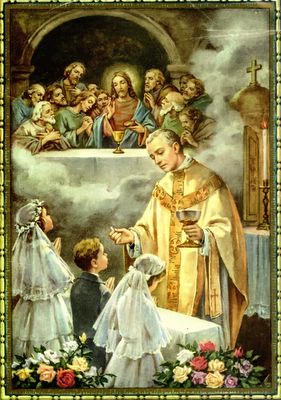
First Holy Communion at a Parish in France (March 1952)


Q: What is Holy Communion?

A: Also known as the Eucharist, Holy Communion is the center of the Catholic faith because it is truly the Body, Blood, Soul, and Divinity of Our Lord Jesus Christ. It is not in any way a symbol but literally Christ’s most Holy body. The bread and wine at the Mass become the holiest of holies through the priest’s words by the power of God. The moment when the Bread and Wine become Jesus Christ is called transubstantiation. The entire Gospel of John Chapter Six even wrote specifically on the Eucharist and how Christ’s body is truly present.

Some people that don't believe in the Eucharist say that Jesus meant for it to be symbolic. Well, then we look to the Gospel of John Chapter 6. That chapter is entirely on the Eucharist, and we see that when Our Lord tells them "Unless you eat my Body and Drink my Blood you will have no life within you" the people do one thing: they leave Him. If Jesus was speaking symbolically He would have said "No, you misunderstand" like He did before in the Gospels, but this time He just let them walk away. Thousands left Him, but He let them because what He spoke was literally true and they couldn't accept it. “Since Christ Himself has said, ‘This is My Body’ who shall dare to doubt that it is His Body? (Saint Cyril of Jerusalem)

For more information see: The Eucharist.

Q: Does the Sacred Host also contain Christ's Blood?


A: Yes, the Consecrated Host also contains the Blood, Soul, and Divinity of Our Lord. The wine also becomes at the Consecration not just Christ s Blood but His Body, Soul, and Divinity also. After the Consecration, the presence of Christ only remain. The consecrated bread may look like bread but no part of its substance is bread. Only the accidents (the mere appearance, taste, smell, etc) of bread remains the same applies to the Consecrated wine - it is not wine.

The breaking of the Body of Christ or the separation of the Blood does not divide Christ, so receiving only a piece of a full Communion Host is still receiving Jesus Christ completely (as affirmed at the Council of Trent: Thirteenth Session: Canon III)

Q: Do the People Also Need to Receive Holy Communion From the Chalice?

For centuries, only the priest alone received the Consecrated Wine from the chalice. The notion in the past few decades that the faithful need to also receive from the chalice is a grave error. The fullness of Christ is received under either species. Traditionally, as is still done of course in the Tridentine Mass, the faithful will only receive the Consecrated Host.

The Baltimore Catechism in Q. 900 advised, "The Church does not give Holy Communion to the people as it does to the priest under the appearance of wine also, to avoid the danger of spilling the Precious Blood; to prevent the irreverence some might show if compelled to drink out of a chalice used by all, and lastly, to refute those who denied that Our Lord's blood is present under the appearance of bread also."

For more information, please see Holy Communion Under One or Both Species?

Q: What are Eucharistic Miracles?

A: These are outward signs of the majesty of Our Lord’s true presence in the Holy Eucharist. I recognize this mirroring the Transfiguration when Our Lord on Mt. Tabor appeared dazzlingly white with Elijah and Moses. This was an outward manifestation of Our Lord’s immense greatness. The Transfiguration wasn’t in and of itself the greatest part of this mystery, but what is even greater is that Christ humbled Himself and kept in His immense glory while on earth.

Eucharistic miracles are the same where the Lord’s greatness reveals itself and scientific testing has proven it to be true blood and tissue. These miracles are not required beliefs of the Catholic faith, and the Eucharist from these Mass is no less amazing then the Eucharist at other Masses because the Eucharist is always the same true presence of Jesus Christ. Read about these beautiful miracles.

Q: If I suspect someone is taking the Eucharist from Mass without the intentions of giving it to the sick what should I do?

A: If someone takes Communion back to the pew and doesn’t consume it PLEASE report it to the priest or someone in an authority position at the parish. Sometimes people will take Our Lord’s Body to desecrate it and this destruction of Our Lord in the Eucharist is a grave sacrilege. We can help prevent this by working to stop Communion in the hand.

Q: Can Holy Communion ever be denied? 


A: It can be denied to individuals in a public act of scandal. For example, if one regularly known non-Catholic is at a Mass and wishes to receive Holy Communion it is to be denied. Holy Communion may - and should - be denied to those Catholics who promote intrinsic evils such as abortion, gay marriage, and artificial contraception. Also, if one suspects a person is going to desecrate the Eucharist it can be denied.

Q. Should the Faithful be Forced to Receive Communion in the Hand?

No. Even during health crises, Holy Communion may never be denied on the tongue. No one may force Holy Communion in the Hand. The Vatican has affirmed this.


Q: Are there special conditions on receiving the Eucharist?

A: Yes. One must be a Catholic in good standing with the Church. You must also obey the Eucharistic fast and not be in a state of mortal sin (Ecclesia de Eucharistia, 37). Those who have committed a mortal sin must first receive absolution in Confession. Those who fail to do so commit the most grievous sin of sacrilege.

The Catechism of the Council of Trent states, “As of all the sacred mysteries bequeathed to us by our Lord and Savior as most infallible instruments of divine grace, there is none comparable to the most holy Sacrament of the Eucharist; so, for no crime is there a heavier punishment to be feared from God than for the unholy or irreligious use by the faithful of that which contains the author and source of holiness.”

St. Cyril of Alexandria explains further the gravity when he says, “They who make a sacrilegious Communion receive Satan and Jesus Christ into their heart.  Satan, that they may let him rule, and Jesus Christ that they may offer Him in sacrifice to Satan.”

That’s a sacrilegious Communion.  That’s why it is so grave and evil and truly few sins offend the Lord’s heart as much as this.  Indeed, our Lord told St. Bridget in a vision, “There does not exist on earth a punishment great enough to punish it sufficiently.”

Q: How many times a day can we receive communion?

A: In the old 1917 Code of Cannon Law, reception of Holy Communion more than once a day was prohibited. Unfortunately, in another novelty after Vatican II, the 1983 Code was revised to state that Holy Communion can be received twice a day, noting though that the second time must be in a Mass. Traditionally, we receive our Lord only once a day (that is once each calendar day and not necessarily once every 24 hours). Traditional Catholics will still maintain this practice.

As an exception to both the 1917 and the 1983 Canon Law, a person may receive Holy Communion again the same day in the form of the Viaticum, which is the name of the Eucharist when given to one who is extremely ill and seemly near death. Holy Communion is often given to souls during Last Rites, and it would be called Viaticum.

"Christ held Himself in His hands when He gave His Body to His disciples saying: 'This is My Body.' No one partakes of this Flesh before he has adored It" (Saint Augustine).

Q: What act of reverence should we show before receiving Holy Communion?

A: An act of reverence must be made before receiving Holy Communion because it is showing reverence to Our Lord truly present before us. People are also still allowed to receive the Holy Eucharist while kneeling, and as is the traditional practice, Holy Communion should be received while kneeling.

Q: What is Intinction?

A: Intinction is only allowed to be performed by the ordinary minister of Holy Communion (i.e. the priest). No "lay minister" may do so. Intinction is where the Sacred Host is dipped in the Sacred Blood of Christ. In the Byzantine Rite one receives the Lord without saying “Amen” but the priest puts the Host dipped in the Sacred Blood in the person’s mouth. Those receiving this way always have their head tipped backwards.

This form of receiving Holy Communion is rarely observed in the Roman Catholic Rite because of the risk of dripping the Lord's body and blood on the ground. When observed, the priest has a minister standing at his side holding the consecrated wine and he takes a particle of the consecrated bread and dips it. He then says "The body and blood of Jesus". A paten must be held under the Body and Blood to prevent any from falling to the ground. While uncommon, this form of receiving is permitted in the Roman Catholic Church (i.e. the Latin Rite).

Q: What is the Eucharistic fast and how long is it?

A: The Eucharistic fast is a fast before receiving Holy Communion to observe a period of reflecting and spiritual hunger for Our Lord. Currently, only medicine and water are allowed before hand, but if one needs to eat for serious medical reason this can be circumvented. Note that a priest who celebrates the Eucharist two or three times a day can take something before the second and third Mass even if it is less than one hour before receiving the Blessed Sacrament again. Also, the elderly, ill, and those that care for them may receive the Eucharist if they have eaten something in the previous hour (Canon 919).

 Many Traditional Catholics will take part in the traditional fast, which was three hours long. Other Traditional Catholics will take part in an older form of the fast which mandated fasting from midnight until receiving Communion.

For more thorough information see: What is the Eucharistic Fast?

Q: How often is one required to receive the Eucharist?

A: A Catholic is only required to receive the Eucharist once a year and that is to be done during the Easter season (Canon 920). However, one should receive our Lord more often - even daily - if they are in the state of grace and have the right dispositions so they do not receive our Lord out of mere habit.

When is the Easter Season for the purpose of observing our "Easter Duty"? In the United States it is from the first Sunday of Lent to Trinity Sunday inclusive; in other countries, the season may begin on Ash Wednesday and close on Low Sunday or Ascension Thursday.
Read more >>
Wednesday, June 22, 2005
The Eucharist


The Catechism of St. Pius X summarizes the doctrine of the Eucharist well: “The Eucharist is a sacrament in which, by the marvelous conversion of the whole substance of bread into the Body of Jesus Christ, and that of wine into His precious Blood, is contained truly, really, and substantially, the Body, the Blood, the Soul and Divinity of the same Lord Jesus Christ, under the appearance of bread and wine as our spiritual food.”  Plainly stated, the Most Holy Eucharist is the Body, Blood, Soul, and Divinity of Jesus Christ under the mere appearance of bread and wine.

The Institution of the Eucharist

Our Redeemer instituted the Sacrament of His Body and Blood on the night before His Passion and death. That the Eucharist was instituted by Jesus Christ Himself at the Last Supper is affirmed by the Catechism of the Council of Trent:
“That its institution was as follows, is clearly inferred from the Evangelist. Our Lord, having loved his own, loved them to the end. As a divine and admirable pledge of this love, knowing that the hour had now come that He should pass from the world to the Father, that He might not ever at any period be absent from His own, He accomplished with inexplicable wisdom that which surpasses all the order and condition of nature. For having kept the supper of the Paschal lamb with His disciples, that the figure might yield to the reality, the shadow to the substance, He took bread, and giving thanks unto God, He blessed, and brake, and gave to the disciples, and said: "Take ye and eat, this is My body which shall be delivered for you; this do for a commemoration of Me." In like manner also, He took the chalice after He had supped, saying: "This chalice is the new testament in My blood; this do, as often as you shall drink it, in commemoration of Me"
Bread & Wine

The Sacramental matter for the Holy Eucharist is two-fold: wheat bread and wine. Turning to the Catechism of the Council of Trent (also known as the Roman Catechism) we read: 
“There are, however, various sorts of bread, either because they consist of different materials, such as wheat, barley, pulse and other products of the earth; or because they possess different qualities, some being leavened, others altogether without leaven. It is to be observed that, with regard to the former kinds, the words of the Savior show that the bread should be wheaten; for, according to common usage, when we simply say bread, we are sufficiently understood to mean wheaten bread. This is also declared by a figure in the Old Testament, because the Lord commanded that the loaves of proposition, which signified this Sacrament, should be made of fine flour.” 
An interesting question arises on whether the Sacrament must be confected from unleavened or if leavened wheat bread is equally valid. On this point, the Catechism makes clear that the Eucharist “was consecrated and instituted by Him on the first day of unleavened bread, on which it was not lawful for the Jews to have anything leavened in their house.” However, the sacred authors continue, “This quality of the bread, however, is not to be deemed so essential that, if it be wanting, the Sacrament cannot exist.” 

Thus, we see a difference between the Roman Catholic Church and the Eastern Rites of the Church in the character of the bread since the Latin Rite uses unleavened bread whereas the Eastern Rites use leavened bread. Despite such a difference, all else being equal, the matter is valid in both instances, though it would be illicit – but not invalid – for a Roman Catholic priest to consecrate leavened bread at Mass.

Along with wheaten bread, wine constitutes the other required component for the matter of the Sacrament. The wine is not optional and may not be replaced by any other liquid, for any reason, in virtue of our Lord’s own command:
“That in the institution of this Sacrament our Lord and Savior made use of wine has been at all times the doctrine of the Catholic Church, for He Himself said: ‘I will not drink from henceforth of this fruit of the vine until that day’. On this passage Chrysostom observes: He says, ‘Of the fruit of the vine,’ which certainly produced wine not water; as if he had it in view, even at so early a period, to uproot the heresy which asserted that in these mysteries water alone is to be used.” 
During Mass, the priest will add a drop of water into the chalice along with the wine. Why? The Roman Catechism explains: “First, because Christ the Lord did so, as is proved by the authority of Councils and the testimony of St. Cyprian; next, because by this mixture is renewed the recollection of the blood and water that issued from His side.” But the Catechism appropriately clarifies: “But although there are reasons so grave for mingling water with the wine that it cannot be omitted without incurring the guilt of mortal sin, yet its omission does not render the Sacrament null.”  

Therefore, wine along with wheaten bread constitutes the matter for the Sacrament as summarized by the Catechism: “These, then, are the only two elements of this Sacrament; and with reason has it been enacted by many decrees that, although there have been those who were not afraid to do so, it is unlawful to offer anything but bread and wine.” The gifts of bread and wine are presented to Almighty God during the offertory of the Mass and from that moment forward may only be offered in divine worship. They may not be used for any other purpose aside from the Holy Sacrifice of the Mass.


The Words of Consecration

“Hoc Est Enimen Corpus Meum” (This is My Body) are the exact words required for the consecration of the bread into our Blessed Lord. The words “Take and eat” immediately before “This is My Body” should by “all means to be pronounced by the priest… But they are not necessary to the validity of the Sacrament.”

“We are then taught by the holy Evangelists, Matthew and Luke, and also by the Apostle, that the form consists of these words: ‘This is My body;’ for it is written: Whilst they were at supper, Jesus took bread, and blessed it, and brake, and gave to His disciples, and said: ‘Take and eat, This is My body.’” 

On the consecration of the wine, the Catechism similarly explains: 
“We are then firmly to believe that it consists in the following words: ‘This is the chalice of my blood, of the new and eternal testament, the mystery of faith, which shall be shed for you and for many, to the remission of sins.’ Of these words the greater part are taken from Scripture; but some have been preserved in the Church from Apostolic tradition.” 
The double consecration of both the bread and wine must occur at Mass. Should a priest die after the Consecration of the bread but before the Consecration of the wine, a different priest must, as soon as possible, resume the Holy Sacrifice. Canon 927 in the Code of Canon Law promulgated in 1983 affirms that it is absolutely forbidden, even in cases of necessity, for a priest to consecrate only one of the two necessary species. The Sacrifice, once it has begun, must be accomplished.

Transubstantiation - The Real Presence of Christ in the Eucharist

The changing of the bread and wine into the Body, Blood, Soul, and Divinity of our Lord Jesus Christ is known as Transubstantiation. The substance of bread and the substance of wine give way to the substance of our Lord Himself when the words of consecration are said.

At the moment of this divine act accomplished through the words of a validly ordained priest, each participle of bread and each particle of wine become the entire Christ. The former wine is not only the blood of Christ, and likewise, the former bread is not only the Body of the Lord. Each particle of the Eucharist is the fullness of the God-Man. On this point, the Baltimore Catechism teaches:
“Jesus Christ is whole and entire both under the form of bread and under the form of wine. After the substance of the bread and wine had been changed into the substance of the body and blood of our Lord there remained only the appearances of bread and wine. By the appearances of bread and wine I mean the figure, the color, the taste, and whatever appears to the senses. This change of the bread and wine into the body and blood of our Lord is called Transubstantiation.” 
The Fathers of the Council of Trent affirm in Canon III in the Thirteenth Session: “If any one denieth, that, in the venerable sacrament of the Eucharist, the whole Christ is contained under each species, and under every part of each species, when separated; let him be anathema.” And the Roman Catechism likewise teaches: “This conversion, then, is so effected that the whole substance of the bread is changed by the power of God into the whole substance of the body of Christ, and the whole substance of the wine into the whole substance of His blood, and this, without any change in our Lord Himself. He is neither begotten, nor changed, not increased, but remains entire in His substance.” 

Likewise, in this Sacrament the fullness of Christ, including His Divinity, is present. The Eucharist does not only contain the admirable flesh and blood of the Savior. Jesus Christ, the God-Man, who possesses both a complete human nature and a complete divine nature, can never be separated from His Divinity. Consequently, the Catechism admonishes: “hence it would be impious, to suppose that the body of Christ, which is contained in the Sacrament, is separated from His Divinity.” As a result, in Holy Communion, when we receive the Sacred Host that was consecrated on the altar, we receive not only the sacred humanity of our Redeemer but also His Soul and His Divinity. We receive God.

The Lord plainly said to His disciples: “Take ye and eat. This is My body” (Matthew 26:26).  St. Cyril of Jerusalem succinctly remarks on these words: “Since Christ Himself has said, ‘This is My Body’ who shall dare to doubt that It is His Body?” St. Augustine likewise declares: "Christ held Himself in His hands when He gave His Body to His disciples saying: 'This is My Body.' No one partakes of this Flesh before he has adored It.” 

St. Ignatius of Antioch, who lived during the time of the Apostles, remarks, "The Eucharist is the flesh of our Savior Jesus Christ which suffered for our sins, which the Father raised up by His goodness." That the Eucharist is God is attested to by the Scripture, the Apostles, and the entire Early Church. To claim the contrary is to believe in a complete fabrication that has no basis in Early Christianity.

The Accidents

After the consecration, the only elements of bread and wine remaining are the accidents. While the bread and wine cease to exist, we refer to the species of bread or the species of wine remaining. On the term “species”, Fr. John Hardon’s Catholic Dictionary defines them as: “Appearances, especially those of bread and wine, after the Eucharistic consecration.” Father Hardon continues, “The term ‘species’ is used by the Council of Trent to identify the accidents, i.e., the size, weight, color, resistance, taste, and odor of bread, which remain exactly the same after transubstantiation. They are not mere appearances as though these physical properties were unreal. But they are appearances because after the consecration they lack any substance that underlies them or in which they inhere.” 

To summarize, when a validly ordained priest speaks the proper words of Consecration and uses proper matter, transubstantiation occurs. Bread and wine become our Blessed Lord and remain as such as long as the species of bread and wine remain. The only properties of bread and wine remaining are the accidental properties (i.e. the species) perceivable by our senses.  Thus, when we affirm our belief in the Real Presence of Christ in the Eucharist, we truly affirm in the words of the Roman Catechism: “that the true body of Christ the Lord, the same that was born of the Virgin, and is now seated at the right hand of the Father in heaven, is contained in this Sacrament.”

Several times in history the accidents themselves have vanished and the appearance of the Eucharist has become the flesh and blood of God. These Eucharistic miracles have been studied by science which continues to find them unexplainable, in further divine proof that the Eucharist is truly God.

Consubstantiation Condemned

Transubstantiation is not to be confused with the Lutheran teaching of consubstantiation, a belief that the bread and wine continue to also exist alongside the Lord’s Body and Blood. The Roman Catechism states: “The substance of the bread and wine does not continue to exist in the Sacrament after consecration.”

Lutherans and Anglicans, unlike most other protestant denominations, generally believe in the presence of Christ in the Sacrament of the Altar. Other sects tend to view the Eucharist as only a symbol and neither a Sacrament nor Christ’s Body and Blood, directly contrary to two millennia of doctrine. However, both Lutherans and Anglicans do not have valid holy orders and thus do not have valid priests. As a result, they can not confect the Holy Eucharist so the Sacrament that they propose to their followers does not actually contain Christ’s presence. It remains only bread and wine. However, as to their theology, they believe it to be both Christ’s Presence in addition to remaining bread and wine. Such a view is called consubstantiation, which is in direct contradiction to transubstantiation and of which the Council of Trent unwaveringly condemned:
“If any one saith, that, in the sacred and holy sacrament of the Eucharist, the substance of the bread and wine remains conjointly with the body and blood of our Lord Jesus Christ, and denieth that wonderful and singular conversion of the whole substance of the bread into the Body, and of the whole substance of the wine into the Blood-the species Only of the bread and wine remaining-which conversion indeed the Catholic Church most aptly calls Transubstantiation; let him be anathema.” 
The Eucharist is a Sacrifice

After the Consecration, the priest who acts in persona Christi offers to the Eternal Father the Sacrifice of Jesus Christ. During the Canon of the Holy Sacrifice of the Mass, Jesus Christ acting through the priest offers Himself present on the altar to His Father in Heaven. The Mass is therefore the very same Sacrifice of Christ on the Cross which is made present again on the altar. Our Lord is not sacrificed again before us; rather, we are mystically present before the one and selfsame Sacrifice. This all holy reality is beautifully expressed in the words of the Roman Catechism:
“We therefore confess that the Sacrifice of the Mass is and ought to be considered one and the same Sacrifice as that of the cross, for the victim is one and the same, namely, Christ our Lord, who offered Himself, once only, a bloody Sacrifice on the altar of the cross. The bloody and unbloody victim are not two, but one victim only, whose Sacrifice is daily renewed in the Eucharist, in obedience to the command of our Lord: Do this for a commemoration of me. 
“The priest is also one and the same, Christ the Lord; for the ministers who offer Sacrifice, consecrate the holy mysteries, not in their own person, but in that of Christ, as the words of consecration itself show, for the priest does not say: This is the body of Christ, but, This is my body; and thus, acting in the Person of Christ the Lord, he changes the substance of the bread and wine into the true substance of His body and blood.” 
Holy Communion at Mass

To those Catholics who are in the state and who have observed the Eucharistic Fast, they may approach the Holy Altar to partake of the Sacrifice and receive our Lord in Holy Communion. But the point of Mass is not Communion. It is the worship of God in the manner He established for His worship. We are present before that Sacrifice. And the partaking of this Sacrifice can only be shared by those who are Catholics. If we are Catholics and in the state of grace, we are thus in Communion with both our Lord and each other in the Mystical Body of Christ. It is for this reason that the Holy Eucharist is often called "Holy Communion."

To the Most Holy Eucharist be all honor and glory world without end. Amen!


Common Questions:
  1. What are the parts of the Holy Sacrifice of the Mass?
  2. Why did Jesus institute the Holy Eucharist?
  3. What are the conditions on receiving Our Lord in Holy Communion?
  4. What is Holy Communion?
  5. Does the Sacred Host also contain Christ's Blood?
  6. What are Eucharistic Miracles?
  7. Can Holy Communion ever be denied?
  8. How many times a day can we receive Communion?
  9. What is Intinction?
  10. What is the Eucharistic fast and how long is it?
  11. How often is one required to receive the Eucharist?
  12. What is a Eucharistic Procession?
  13. What is Eucharistic Adoration?
Related Websites/Encyclicals:
  1. New Advent, Catholic Encyclopedia
  2. Real Presence Association
  3. Mirae Caritatis, Encyclical of Leo XII on May 28, 1902
Read more >>
Monday, October 24, 2005
Summary on the Synod Final Update

I haven't followed the Synod too closely, but I wanted to post a summary of some Synod news for readers. This Synod is a three week assembly on the Eucharist and the first synod under Pope Benedict XVI during what better time than during the end of the Year of the Eucharist.

Note: Links below are to the National Catholic Reporter. I do not endorse all - even most - of the content.

1. Priest shortage is first concern (10/3)
2. Topic of Divorced/Remarried Catholics takes center stage (10/5)
3. The environment and social justice emerge as topics (10/6)
4. Outreach to Latin Mass Catholics (10/15)
5. How is Jesus present in the Eucharist? (10/17)
6. Day of Reflection and Adoration (10/17)
7. Draft on 50 propositions presented (10/18) (287 propositions originally submitted)
8. No changes on Church discipline recommended (10/18)
9. 50 Propositions released (10/22)
10. End of the Synod (10/23)

Year of the Eucharist ends (10/23)

This Sunday the Year of the Eucharist formally ended, but I pray that love for Christ truly present (Body, blood, soul, and divinity) in the Holy Eucharist might not end. For continued information on the Eucharist visit the Year of the Eucharist Website. Also, at the closing Mass for the Year of the Eucharist, Pope Benedict XVI officially declared five individuals as saints. Read Our Holy Father's homily

"For I have received of the Lord that which also I delivered unto you, that the Lord Jesus, the same night in which he was betrayed, took bread. And giving thanks, broke, and said: Take ye, and eat: this is my body, which shall be delivered for you: this do for the commemoration of me. In like manner also the chalice, after he had supped, saying: This chalice is the new testament in my blood: this do ye, as often as you shall drink, for the commemoration of me. For as often as you shall eat this bread, and drink the chalice, you shall shew the death of the Lord, until he come. Therefore whosoever shall eat this bread, or drink the chalice of the Lord unworthily, shall be guilty of the body and of the blood of the Lord. But let a man prove himself: and so let him eat of that bread, and drink of the chalice. For he that eateth and drinketh unworthily, eateth and drinketh judgment to himself, not discerning the body of the Lord. Therefore are there many infirm and weak among you, and many sleep" (1 Cor. 11:23-30).
Read more >>
Sunday, February 25, 2018
Cardinal Sarah’s Indictment of Communion in the Hand Stands with Tradition

Guest Post by David Martin

Cardinal Robert Sarah who heads the Vatican’s Congregation for Divine Worship has decried Communion in the hand and is summoning the Catholic faithful to return to receiving Communion on the tongue while kneeling.

In the preface to a new book on the subject, Cardinal Sarah warns that lack of reverence for the Blessed Sacrament is the major disorder undermining the Faith today and that Communion in the hand was deliberately sown by the devil for this very end.

“The most insidious diabolical attack consists in trying to extinguish faith in the Eucharist, sowing errors and favoring an unsuitable manner of receiving it," the cardinal wrote. "Truly the war between Michael and his Angels on one side, and Lucifer on the other, continues in the heart of the faithful: Satan’s target is the Sacrifice of the Mass and the Real Presence of Jesus in the consecrated Host."

“Why do we insist on receiving Communion standing and on the hand?,” the cardinal asks. According to Sarah, the manner in which the Holy Eucharist is distributed and received "is an important question on which the Church today must reflect." Cardinal Sarah: Widespread Communion in the hand is part of Satan’s attack on the Eucharist

Sarah hits the nail on the head, since the major crisis facing the Church today is the loss of the awareness of the supernatural presence of Christ in his tabernacle. With the crisis ever intensifying, it somehow has evaded the hierarchy that the crux of the problem has been our denigrating regard for the Holy Eucharist, encouraged most especially by this errant practice of receiving Communion in the hand. This is a Protestant practice that was introduced in the sixties by renegade bishops to detract from Christ’s divinity and foment disbelief in the Real Presence. 

However, the faithful are not empowered to touch the Body of Christ as in the priesthood, which is why Communion in the hand was never *promulgated as a universal practice for the Church. And whereas it is allowed today as common law, lay people are not consecrated to handle the Blessed Sacrament, so that should they do so, a sacrilege is committed.

This in turn brings on spiritual repercussions and draws the plague of the devil upon the church, so that what is nurtured is an adulterated mindset (evidenced by all the profanation and display of indecency in church), as well as heretical notions about the Sacrament and the Holy Sacrifice (i.e. the Eucharist is holy bread, the Mass is a meal, the Mass is a community gathering, etc.) If Catholics today no longer believe that the Eucharist is the Creator Himself in person, it is because of this diabolical practice that has cheapened their religion and nurtured this apostate mentality.

It was for reason that Pope Paul VI in his instruction Memoriale Domini (May 29, 1969), warned that Communion in the hand “carries certain dangers with it… the danger of a loss of reverence for the August Sacrament of the altar, of profanation, of adulterating the true doctrine."
The late Fr. John Hardon, speaking at the Call to Holiness Conference in Detroit, Michigan, on November 1, 1997, told his audience: “Behind Communion in the hand—I wish to repeat and make as plain as I can—is a weakening, a conscious, deliberate weakening of faith in the Real Presence…. Whatever you can do to stop Communion in the hand will be blessed by God.”

Communion in the hand caters to human pride and warps our conception of Jesus Christ. It serves no other purpose than to nourish contempt for Christ in the Eucharist. It promotes personal uncleanness and fosters the general mentality of transgressing into forbidden realms
(touching that which we ought not), which calls to mind the transgression of Eve when she rose up in her pride and partook of the forbidden fruit.

However, the author of both is the devil, who is given great strength to work in the Church through this practice. His objective is to destroy the monarchical concept of the Church so that Christ is now seen as mere man, “symbolized” by bread and wine, and Communion in the hand has been an effective tool in hand to advance this heresy.

Pope Paul VI in his 1969 pastoral letter reaffirmed the Church’s teaching on the reception of Communion, stating, “This method [on the tongue] must be retained.” This was in response to the Dutch bishops who were clamoring for Communion in the hand against his wishes and in defiance of the centuries-old prohibition against it.

The prohibitions against Communion in the hand go back to the early Church. Pope St. Sixtus I (115-125) issued the following decree: "It is prohibited for the faithful to even touch the sacred vessels, or receive in the hand.”

Communion in the hand has in fact received several ecclesiastical condemnations. The Council of Saragossa (380 AD) excommunicated anyone who dared continue receiving Communion in the hand. This was confirmed by the Synod of Toledo (589), known for its staunch defense of Christ’s divinity.

The Sixth Ecumenical Council of Constantinople (680-81) likewise forbade the faithful from taking the Host in their hand, even threatening transgressors with excommunication.

The Synod of Rouen (650) condemned Communion in the hand to halt widespread abuses that occurred through this practice, and as a safeguard against sacrilege. The Council decreed:

“Do not put the Eucharist in the hands of any layman or laywoman, but only in their mouths.”

The foregoing prohibitions have never been legally overturned. Communion in the hand is simply carried on today as “common law,” and has been a major deterrent in the spiritual advance of the faithful. It is no wonder that St. Basil the Great regarded Communion in the hand as “a grave fault.” (Letter 93)

A grave fault it is that bishops through poor liturgical discipline have allowed the faithful to fall into the lamentable blindness of not acknowledging the physical and supernatural presence of Christ in the Eucharist. Because of Communion in the hand and other like shams, many today do not understand what the Mass is.

During the Consecration of Holy Mass, the Sacrifice of Christ is reenacted through the commemorative formula commanded by Christ to his Apostles—This is My Body, This is My Blood—so that upon consecration, the substance of bread and wine is changed into the very substance of Jesus Christ. It is no longer the substance of bread and wine, but the substance of Christ, only and entirely, without any other substance mingling with it. Only the accidents or physical properties of bread and wine remain.

The acknowledgment of this supernatural Mystery is the first and foremost requirement placed on the faithful to receive Holy Communion, without which one may not receive. To this end, the Church has always taught that communicants not touch the Host, since it is the very substance of the Creator which only the consecrated hands of a priest may touch.

Hence by allowing lay persons to handle the Host, it tends to erase this dogmatic fact from mind and suggests that Holy Communion is just a formality, i.e. a holy meal, a community gathering, in which people can come up in cafeteria fashion to have their “blessed bread.” It promotes all manner of disrespect, e.g. women coming up in promiscuous attire, tattooed, etc.

Gallop surveys indicate that a mere 30 percent of America’s Catholics believe in the True Presence. And whereas Pope Francis may see strict adherence to dogma as “idolatry,” he needs to understand that without preserving dogma through traditional discipline, people will fall into the idolatry of human worship where they turn to each other at Mass instead of to God.

The faithful would do well to consider the conduct of Moses when he approached the burning bush in the mount. The Lord ordered him to put off his sandals because he was on holy ground. And "Moses hid his face: for he durst not look at God." (Exodus 3:6) And to think that this was only a manifestation of God's presence, not an actual physical presence.

With how much greater reverence must we approach the altar where the Creator Himself dwells day and night in full Body and Spirit? Shall we mock Him and do a little dance (guitar Mass), and then stick our dirty hands out and try to make the Lord of Hosts our pet wafer? God forbid!

Thanks to Communion in the hand, members of satanic cults are given easy access to enter the Church and take the Host, so that they bring it back to their covens where it is abused and brutalized in the ritualistic Black Mass to Satan. They defecate on the Host and crush it under their shoes as a mockery to the living God, and we do nothing to stop this? Among themselves satanists declare that Communion in the hand is the greatest thing that ever happened to them, and we assist them with our casual practice?

Mike Warnke, a former satanic high priest who converted to Christianity, warned the U.S. bishops that allowing Communion in the hand was a mistake, pointing out how this allows satanists easy access in procuring the host, which they desecrate in their rituals.

This is confirmed by Fr. Andrew Trapp of South Carolina, who posted a web-story about a former satanist in his prayer group [Nicholas] who revealed to him how they steal consecrated Hosts from Catholic Churches for the purpose of desecrating them in the satanic Black Mass. Satanism & the Eucharist | Saint Factory

It was for reason that Benedict XVI attempted to reverse this practice during his pontificate.
Cardinal Llovera, the former Prefect for the Congregation for Divine Worship and the Discipline of the Sacraments, said in 2009, “It is the mission of the Congregation for Divine Worship and Sacraments to work to promote Pope Benedict’s emphasis on the traditional practices of liturgy, such as reception of Communion on the tongue while kneeling.”

The pope was clear that he did not want Catholics receiving Communion in the hand, nor did he want them standing to receive, for which reason the faithful at his Masses were required to kneel and receive on the tongue.

The centuries-old ordinance allowing only the consecrated hands of a priest to handle the Body of Christ also rules out lay “Eucharistic Ministers.” The Council of Trent puts to shame today’s burlesque practice of allowing lay people to distribute Communion.

“To priests alone has been given power to consecrate and administer to the faithful, the Holy Eucharist.” (The Council of Trent)

Pope John Paul II, lenient as he was in enforcing the rule, made it clear that the Sacred Host is not something that lay persons can touch. “To touch the sacred species and to distribute them with their own hands is a privilege of the ordained.” (Dominicae Cenae, Feb. 1980)

This stems from the fact that lay people’s hands are not anointed to touch the Eucharist, unlike the hands of a priest. St. Thomas Aquinas beautifully articulates this teaching in his Summa Theologiae.

“Because out of reverence towards this Sacrament, nothing touches it, but what is consecrated; hence the corporal and the chalice are consecrated, and likewise the priest’s hands, for touching this Sacrament.”

It suffices to say that Communion in the hand is illicit, despite the flippant approbation of today’s wayward bishops. Father John Hardon explains: “Communion in the hand began with the publication of the Dutch Catechism with nobody's permission except the bishops—in effect, in principle separated themselves from the Holy See.  One country after another began then to ask for permission, which the Dutch bishops never asked for.” (Speaking at the Call to Holiness Conference, Nov. 1, 1997)

Communion in the hand, more specifically, is tied to the late Cardinal Suenens of Belgium, a known heretic and initiated Freemason (initiated 6-15-67, code-name “LESU”) who introduced this practice to the Dutch bishops in the mid-sixties. Suenens, who oversaw the implementation of the worldwide charismatic “renewal” in the Catholic Church and who advocated married priests, was notorious for defaming the Eucharist and the priesthood.

However, Communion in the hand goes back to the heretical Arians of the third century who introduced this practice as a means of expressing their belief that Christ was not divine. Unfortunately, it has served to express the same in our time and has been at the very heart of the present heresy and desecration that is rampant throughout the universal Church. If we have “abuse” problems today, it is because we're abusing the sacrament—it’s backfiring on us!

Pope Benedict XVI did his part to try to purge the Church of this abuse, seeing how it has contributed mightily to the loss of the awareness of the Mystery of Faith. We might say that a form of ‘Eucharistic atheism’ has set in. Poor liturgical discipline has contributed mightily to apostasy, so the remedy is to return to our knees and receive the Eucharist on the tongue. Without this basic humility before the Eucharist, our efforts at restoring the Church are futile.

Those who approach the Eucharist in a casual, nonchalant manner would do well to consider the warning from St. Paul in Holy Scripture:

“Whosoever shall eat this bread, or drink the chalice of the Lord unworthily, shall be guilty of the Body and of the Blood of the Lord... For he that eateth and drinketh unworthily, eateth and drinketh judgment to himself, not discerning the Body of the Lord.” (1 Corinthians 11:27, 28)

* In 1969, Pope Paul VI made an exception for the bishops of Holland by leaving it up to them to decide whether to adopt this practice, though he very much dissuaded it. Unfortunately, it spread rapidly from Holland to other countries with no formal sanction from Rome. 

http://www.catholicherald.co.uk/news/2018/02/23/cardinal-sarah-communion-in-the-hand-part-of-diabolical-attack-on-eucharist/
Read more >>
Wednesday, August 17, 2005
Eucharistic Adoration, Exposition, and Benediction of the Blessed Sacrament


The Holy Eucharist is not just a symbol of God but actually is Jesus Christ's body, blood, soul, and divinity. The Eucharist is God! For more information on the Eucharist, see my page on the Eucharist.

What is Eucharistic Adoration?

Eucharistic Adoration is a special deep time of prayer. It is the adoration of Our Lord, who is truly present in the Eucharistic Host.  The bread and wine at Mass each become and remain the Sacred Body, Blood, Soul, and Divinity of Jesus.  In Eucharistic Adoration, we pray before the Eucharistic Host either in a monstrance or in the tabernacle. There are no set prayers during Adoration. People can pray the Rosary, the Litany of the Sacred Heart, or personal prayers. 

"Perpetual Eucharistic Adoration is the adoration of Jesus Christ present in the Holy Eucharist. In the many churches that have this adoration, the Eucharist is displayed in a special holder called a monstrance, and people come to pray and worship Jesus continually throughout the day and often the night. Christ’s great love for us was shown when he was crucified on the cross to pay the penalty for our sins and give us eternal life. He loves us without limit, and offers Himself to us in the Holy sacrament of the Eucharist. Can we not give Jesus a few minutes of love and adoration in return?" (Real Presence Association)

What is Exposition of the Blessed Sacrament?

We can always pray to our Lord in the tabernacle. But sometimes our Lord is taken out of the tabernacle by a priest and placed in a monstrance. This is called Exposition of the Blessed Sacrament, which is done for us to adore our Lord. The Exposition of the Most Blessed Sacrament typically traditionally begins with the recitation of the “O Salutaris Hosti.”

Some parishes have perpetual adoration chapels where you can visit and adore our Lord Jesus Christ at any time. Many saints would adore Jesus in the Eucharist for one hour a day. One of the most important life changes you can make is finding one hour each week to leave work or school or friends aside and just be present in adoration before Jesus. It can be a tremendous source of graces for you.

Find out if your parish has a time for Adoration. If not, find a nearby parish that does.

What is Benediction of the Blessed Sacrament?

In addition to Eucharistic Adoration, find a parish that offers Benediction of the Blessed Sacrament. Benediction starts with Exposition. After the O Salutaris Hostia is sung there is a period of silence when we may pray before Our Lord. After this period of silent prayer, the priest will often say the Divine Praises and the hymn, Tantum Ergo. He will then put on a special garment called a humeral veil and bless you with Jesus in the Blessed Sacrament. There are special indulgences associated with Eucharistic Adoration and Benediction.

Find out if your parish has Benediction. Some churches offer Benediction, usually on Sunday afternoons or Thursdays. If not, find a parish in your Diocese that does have Benediction. Attend Benediction within the next month.
Read more >>
Wednesday, December 21, 2016
Communion in The Hand Undermining the Faith


Guest Post by David Martin

With the crisis of faith ever intensifying, it somehow has evaded the Catholic hierarchy that the crux of the problem has been our casual and disparaging regard for the Holy Eucharist, reflected most especially by today’s errant practice of receiving Communion in the hand.

This is a Protestant practice that was introduced in the late-sixties by renegade bishops to detract from Christ’s divinity and to foment a false empowerment among the laity.

However, the faithful are not empowered to touch the Body of Christ as if they were priests. And whereas this is allowed today as common law, no pope to date has formally approved Communion in the hand. Lay people simply are not consecrated to handle the Blessed Sacrament, so that should they do so, a sacrilege is committed.

This in turn brings on spiritual repercussions and draws the plague of the devil upon the church, so that what is nurtured is an adulterated mindset (evidenced by all the profanation and display of indecency in church), as well as heretical notions about the Sacrament and the Holy Sacrifice (i.e. the Eucharist is holy bread, the Mass is a meal, the Mass is a community gathering, etc.) If Catholics today no longer believe that the Eucharist is the Creator Himself in person, it is because of this diabolical practice that has cheapened their religion and nurtured this apostate mentality.

It was for reason that Pope Paul VI in his instruction Memoriale Domini (May 29, 1969), warned that Communion in the hand “carries certain dangers with it… the danger of a loss of reverence for the August Sacrament of the altar, of profanation, of adulterating the true doctrine."

The late Fr. John Hardon, speaking at the Call to Holiness Conference in Detroit, Michigan, on November 1, 1997, told his audience: “Behind Communion in the hand—I wish to repeat and make as plain as I can—is a weakening, a conscious, deliberate weakening of faith in the Real Presence…. Whatever you can do to stop Communion in the hand will be blessed by God.”

Communion in the hand indeed caters to human pride and warps our conception of Jesus Christ. It serves no other purpose than to nourish contempt for Christ in the Eucharist. It promotes personal uncleanness and fosters the general mentality of transgressing into forbidden realms (touching that which we ought not), which calls to mind the transgression of Eve when she rose up in her pride and partook of the forbidden fruit.

However, the author of both is the devil, who is given great strength to work among us in the Church through this practice. His objective is to destroy the monarchical concept of the Church where Christ is no longer seen as the King of kings in His palace. The ancient serpent seeks to cast mockery on Christ’s divinity where he is reduced to a mere man, “symbolized” by bread and wine, and Communion in the hand has been an effective tool in hand to advance this heresy.

Hence, Pope Paul in his 1969 pastoral letter reaffirmed the Church’s teaching on the reception of Communion, stating, “This method [on the tongue] must be retained.” This was in response to the Dutch bishops who were clamoring for Communion in the hand against his wishes and in defiance of the centuries-old prohibition against it.

The prohibitions against Communion in the hand go back to the early Church. Pope St. Sixtus I (115-125) issued the following decree: "It is prohibited for the faithful to even touch the sacred vessels, or receive in the hand.”

Communion in the hand has in fact received several ecclesiastical condemnations. The Council of Saragossa (380 AD) excommunicated anyone who dared continue receiving Communion in the hand. This was confirmed by the Synod of Toledo (589), known for its staunch defense of Christ’s divinity.

The Sixth Ecumenical Council of Constantinople (680-81) likewise forbade the faithful from taking the Host in their hand, even threatening transgressors with excommunication.

The Synod of Rouen (650) condemned Communion in the hand to halt widespread abuses that occurred through this practice, and as a safeguard against sacrilege. The Council decreed:

“Do not put the Eucharist in the hands of any layman or laywoman, but only in their mouths.”

The foregoing prohibitions have never been legally overturned. Communion in the hand is simply carried on today as “common law,” and has served no other purpose than to nurture contempt for Christ in the Eucharist. It is no wonder that St. Basil the Great regarded Communion in the hand as “a grave fault.” (Letter 93)

Communion in the hand indeed reflects a lamentable blindness of spirit in not acknowledging the physical and supernatural presence of the Son of God under the species of bread and wine. The light of holy dogma is urgently needed today to dispel this ignorance which is alienating the faithful from their Eucharistic King.

During the Consecration of Holy Mass, the Sacrifice of Christ is reenacted on the altar through the commemorative formula commanded by Christ to his Apostles—This is My Body, This is My Blood—so that upon pronouncing these words during the elevation of the bread and chalice, the substance of bread and wine is changed into the very substance of Jesus Christ, whereby the substance of bread and wine ceases to exist. It is now the substance of Jesus Christ, only and entirely, without any other substance mingling with it.

The acknowledgment of this supernatural Mystery is the first and foremost requirement placed on us by the Church to receive Holy Communion, without which one may not receive. To this end, the Church has always taught that communicants not touch the Host, since it is the very substance of the Creator Himself which only the consecrated hands of a priest may touch.

Hence by allowing lay persons to handle the Host, it tends to erase this dogmatic fact from mind and suggests mightily that Holy Communion is just a formality, i.e. a holy meal, a community gathering, where people can come up in cafeteria fashion to have their “blessed bread.” Yea, it promotes all manner of disrespect, i.e. women coming up in promiscuous attire with holes in their jeans.

Gallop surveys indicate that a mere 30 percent of America’s Catholics believe in the True Presence. And whereas Pope Francis may see the tenacious adherence to dogma as “idolatry,” he needs to understand that his failure to teach dogma is causing his church to fall into the idolatry of human worship where the people at Mass turn to each other instead of to their God in the Eucharist. It’s now become a “peace be with you” church, instead of a place of adoration.

The faithful would do well to consider the conduct of Moses when he approached the burning bush in the mount. The Lord ordered him to put off his sandals because he was on holy ground. And "Moses hid his face: for he durst not look at God." (Exodus 3:6) And to think that this was only a manifestation of God's presence, not an actual physical presence.

With how much greater reverence must we approach the altar where the Creator Himself dwells day and night in full Body and Spirit? Shall we mock Him and do a little dance (guitar Mass), and then stick our dirty hands out and try to make the Lord of Hosts our pet wafer? God forbid!

Thanks to Communion in the hand, members of satanic cults are given easy access to enter     the Church and take the Host, so that they bring it back to their covens where it is abused and brutalized in the ritualistic Black Mass to Satan. They defecate on the Host and crush it under their shoes as a mockery to the living God, and we do nothing to stop this? Among themselves satanists declare that Communion in the hand is the greatest thing that ever happened to them, and we assist them with our casual practice?

Mike Warnke, a former satanic high priest who converted to Christianity, warned the U.S. bishops that allowing Communion in the hand was a mistake, pointing out how this allows satanists easy access in procuring the host, which they desecrate in their satanic rituals.

This is confirmed by Fr. Andrew Trapp of South Carolina, who posted a web-story about a former satanist in his prayer group [Nicholas] who revealed to him how they steal consecrated Hosts from Catholic Churches for the purpose of desecrating them in the satanic Black Mass.

It was for reason that Benedict XVI attempted to reverse this practice during his pontificate.
Cardinal Llovera, the former Prefect for the Congregation for Divine Worship and the Discipline of the Sacraments, stated in 2009, “It is the mission of the Congregation for Divine Worship and Sacraments to work to promote Pope Benedict’s emphasis on the traditional practices of liturgy, such as reception of Communion on the tongue while kneeling.”

The pope was clear that he did not want Catholics receiving Communion in the hand, nor did he want them standing to receive, for which reason the faithful at his Masses were required to kneel and receive on the tongue. Benedict’s objective was to foster renewed love for the Eucharist and to offset the various trends of our time (guitar liturgy, altar girls, lay ministers, Communion in the hand) that have worked together to destroy our regard for the Sacred Mysteries.

The centuries-old ordinance allowing only the consecrated hands of a priest to handle the Body of Christ rules out lay “Eucharistic Ministers” as well. The Council of Trent puts to shame today’s burlesque practice of allowing lay people to distribute Communion.

“To priests alone has been given power to consecrate and administer to the faithful, the Holy Eucharist.” (The Council of Trent)

Pope John Paul II, lenient as he was in enforcing the rule, made it clear that the Sacred Host is not something that lay persons can touch. “To touch the sacred species and to distribute them with their own hands is a privilege of the ordained.” (Dominicae Cenae, Feb. 1980)

This stems from the fact that lay people’s hands are not anointed to touch the Eucharist, unlike the hands of a priest. St. Thomas Aquinas beautifully articulates this point in his Summa Theologica.

“Because out of reverence towards this Sacrament, nothing touches it, but what is consecrated; hence the corporal and the chalice are consecrated, and likewise the priest’s hands, for touching this Sacrament.”

It suffices to say that Communion in the hand is illicit, despite the flippant approbation of today’s wayward bishops. Father John Hardon explains: “Communion in the hand began with the publication of the Dutch Catechism with nobody's permission except the bishops—in effect, in principle separated themselves from the Holy See.  One country after another began then to ask for permission, which the Dutch bishops never asked for.” (Speaking at the Call to Holiness Conference, Nov. 1, 1997)

Communion in the hand, more specifically, is tied to the late Cardinal Suenens of Belgium, a known heretic and initiated Freemason (initiated 6-15-67, code-name “LESU”) who introduced this practice to the Dutch bishops in the mid-sixties. Suenens, who oversaw the implementation of the worldwide charismatic “renewal” in the Catholic Church and who advocated married priests, was all about defaming the Eucharist and the priesthood.

However, Communion in the hand goes back to the heretical Arians of the third century who introduced this practice as a means of expressing their belief that Christ was not divine. Unfortunately, it has served to express the same in our time and has been at the very heart of the present heresy and desecration that is rampant throughout the universal Church. If we have “abuse” problems today, it is because we're abusing the sacrament—it’s backfiring on us!

Hence Pope Benedict did his part to try to purge the Church of this abuse, seeing how it has contributed mightily to the loss of the awareness of the supernatural presence of Christ in his tabernacle. We might say that a form of Eucharistic atheism has set in. Poor liturgical discipline has given way to apostasy, so the remedy is to return to our knees and receive the Eucharist on the tongue. Without this basic humility before the Eucharist, our efforts at restoring the Church are vain.

Those who approach the Eucharist in a casual, nonchalant manner would do well to consider this warning from St. Paul in Holy Scripture:

“Whosoever shall eat this bread, or drink the chalice of the Lord unworthily, shall be guilty of the Body and of the Blood of the Lord... For he that eateth and drinketh unworthily, eateth and drinketh judgment to himself, not discerning the Body of the Lord.” (1 Corinthians 11:27, 28) 

Comment by A Catholic Life - For more information, please see my prior post entitled Mission: Restore Eucharistic Reverence
Read more >>
Sunday, January 1, 2017
An Appeal for the Heart that Conquered Death: Reflections for a Catholic New Year

As the world dives further into a century of “progress” and uncharted horizons, mankind continues its dissent from God, which is eerily reminiscent of the words of Jesus Christ: “What profit is there for one to gain the whole world and forfeit his life? What could one give in exchange for his life? Whoever is ashamed of me and of my words in this faithless and sinful generation, the Son of Man will be ashamed of when he comes in his Father's glory with the holy angels” (Mark 8:36-38).

This dissent can be blamed in part on numerous evils afflicting our world from abortion to homosexual marriage to artificial contraception and to poverty.  Yet, blame should not hold a central part in the debate on our world’s fate.  We must never allow blame to become our primary mode of response to anything.  Blame first surfaced in the Garden of Eden as Adam sought to shift the blame for his disobedience.  Yet, the technicalities are of no importance – Adam suffered the same fate as Eve.

Our world is above all suffering from a lack of love, and each one of us must fulfill our baptismal promises to love.  In my personal observations, atheists lack two characteristics – humility and love for others.  Catholics are called to love everyone even those that insult and attack ourselves.  For Christ said the greatest of all the Commandments was to love the Lord our God and the second greatest to love our neighbor as yourself (Mark 12:30-31).

While society may ignore the reality of this lack of love, we can blame no one except ourselves.  We must be beacons of the Light of Christ.  We must become mirrors of His love to “bring the Gentiles from darkness.”  The Lord will judge each of us per our works (Romans 2:6), and unfortunately, society ignores the inevitably reality of Judgment.

Do not be disheartened when men rebuke you and insult you for preaching the truth.  For the Light of the World dispels darkness and in turn reveals ourselves completely – sin and all.  And many people in our world do not want to admit their sins.  They wish to live in darkness because in darkness they can hide from the truth of their own sinfulness.  But, as St. John of the Cross has said, "In the evening of life, we will be judged on love alone.”

Of course we can ignore the spread of sin in society and seek shelter in darkness, but we can blame no one else when more people die from new and deadly viruses or when thousands starve to death in Western Africa.  And, at Judgment we can blame no one except ourselves for refusing to accept Jesus as the Light of our life. The light is the true refuge of the world and the world must return to that refuge.  First, we must individually return and pledge to love and honor Christ.  Only after this first pledge can we go out into the wilderness and seek the lost sheep of the Kingdom of God.

Each one of us can only grow closer to Jesus Christ through prayer and the Sacraments – the Sacraments of the Catholic Church.  We all are obligated by our Baptism and Confirmation to go out and proclaim the Truth, but we must first grow interiorly.  We must read Sacred Scripture, frequent the Sacraments of Holy Communion and Penance, and understand what the Church truly teaches on a matter, which does require extensive mental prayer, studying from approved Catholic sources, and personal penance. Without the Sacraments and finding the oasis of prayer in a desert of sin, we will wither up and die.  We must all learn to balance our zealous urge to teach with a desire to learn from the one true teacher, the Lord.

Most supreme of all Sacraments is the Most Holy Eucharist, the consecrated bread and wine from Mass, because It truly is Jesus Christ.  The Eucharist is the Body, Blood, Soul, and Divinity of Jesus Christ.  And since Jesus Christ, being the eternal Son of the Father, has the same soul and divinity as the Father and Holy Spirit, we can say that the Eucharist contains God completely.  The Catechism of the Catholic Church calls the Eucharist “…the source and summit of the Christian life” (CCC 1324).

As the Church progressed through the centuries, many divisions have separated the people of God.  The Church fought heresies nearly as long as Christianity has existed.  Against Gnosticism and Arianism, the Church has fought for hundreds of years and continues to fight.  In 336 AD, Arius began to teach that Jesus Christ was not divine claiming He was inferior to the Father.  Thus, Arianism became the first great heresy against the faith.  Other heresies including Manichaeism had occurred before, but the impact of Arianism was far more widespread; it still seeps into modern culture.  Through God’s providence, notable saints like St. Anthony of Padua and St. Boniface emerged to preserve the Church and the authentic teachings of Jesus Christ, including His Real Presence in the Holy Eucharist.

After an extended period of differences, the Church broke into two bodies, Eastern Orthodoxy and Roman Catholic in the West.  While this did not certainly occur in one year, 1024 AD is the officially recognized date of the Great Schism.  By this action the people of God were first split.  Following this in 1517, Martin Luther ripped open God’s Church.  Through his 95th Thesis, many souls would leave the Catholic faith and the authentic Sacraments.  Luther would teach justication through faith alone, encourage private interpretation of the Scriptures, deny the Mass, abolish Confession, and deny the Supremacy of the Pope.  Lutheranism was condemned as a heresy in the Council of Trent between 1545 and 1563.

But, Martin Luther also taught against the Most Holy Eucharist.  Catholics believe in transubstantiation meaning that at the words of Consecration, the bread and wine truly become Jesus Christ. After the words of Consecration, which Jesus gave us from Scripture (cf. Matthew 26:26-28), the only thing remaining of bread and wine is called the "accidents", which is the appearance of bread and wine.  Lutherans believe in consubstantiation meaning that the Eucharist is both Christ and bread and wine.  The Eucharist to Protestants is like a sponge that soaks up the divinity of Christ.  After their service, they believe the bread and wine become bread and wine fully again.  In Catholicism, the Eucharist becomes Christ at the moment of Consecration and remains Christ.

However, theologically, the Communion bread and wine from any non-Catholic service can not be Jesus Christ.  Catholics do not view Protestant Communion as legitimate.  We realize that Jesus Christ gave the power to consecrate bread and wine to His disciples alone.  He did not give them to everyone of His followers but a select few.  This is clear at the Last Supper recorded in the Gospels.  And, these men passed down the power to consecrate the bread and wine through the ordained priesthood.  Through the imposition of hands, a man can be made a priest of Our Lord and can consecrate bread and wine.  No protestant church has this power. 

Martin Luther was excommunicated from the Catholic faith and could no longer celebrate the Sacraments along with all other people that broke away.  An excommunicated person is forbidden “… to have any ministerial part in the celebration of the Sacrifice of the Eucharist or in any other ceremonies of public worship; to celebrate the sacraments or sacramentals and to receive the sacraments; [and] to exercise any ecclesiastical offices, ministries, functions or acts of governance” (Canon 1331 of the Code of Canon Law 1983).  The power of excommunication is a power given to the Apostles and their successors, the bishops. Excommunication is alluded to in Matthew 18:18. 

Consequently, the Sacraments of all Protestant denominations except baptism are considered illegitimate. Thankfully, the Roman Catholic Faith remains still bearing the essential four marks of the Church of Jesus Christ – It is One, Holy, Catholic, and Apostolic.  These four marks are all qualities of His True Church on earth.  If any denomination is lacking one of the marks, it is not the Church of Christ.  This does not mean the denomination teaches complete lies; it means that it does not teach all of the truth.  And we are called to the complete truth in Jesus Christ.

The time for humanity to return to God and His laws is long past.  Our Lady of Fatima told three young shepherd children in 1917 that war was the result of sin.  Namely, she said that if the world did not repent than a second great war would erupt.  Sadly, the world did nothing.  It is long past the time for action – we must act immediately. Yet, what is the appropriate cause of action?  Our world is suffering from an array of calamities from natural disasters to deadly influenza strands such as the H5N1 Virus.  But the answer is simple – we must return to the Sacred Heart of Jesus.  Only in the pierced Heart of Our Redeemer can the world find lasting peace.  The Sacraments and prayer all converge on the Sacred Heart of Jesus. 

How truly ironic that the Heart encircled with thorns is the center of the entire world.  The same event occurred after the Resurrection as the greatest tragedy would become the richest source of grace.  Jesus even said that after His death he would life up all men to himself: “And just as Moses lifted up the serpent in the desert, so must the Son of Man be lifted up, so that everyone who believes in him may have eternal life” (John 3:14-15).

From the sacred side of Jesus on the Cross, the Church was born.  And this grace continues to gush forth from the wounded heart of Christ to everyone in the entire world.  And He is met with dwindling congregations, increased abortions, and violations of His most supreme Commandments.  We should be grateful that our world is not yet destroyed by our own selfishness!

Remember that God is Divine Mercy but He is also perfect justice.  Our world must return to the Sacred Heart of Our Redeemer or plunge further into a dark chasm without the light of salvation.   The read to Hell is wide and full of attractions and comfort but caves in to a never-ending chasm of despair.  But, the road to Heaven is laden with rocks, and thorns, and many Crosses.  However, it is only through the Cross that one can reach the royal road to the Resurrection.  For us, that road has been blockaded and roped off by the temptations of the world.

Between 1673 and 1675, Our Lord appeared to St. Margaret Mary Alacoque asking her to receive Him in Holy Communion on the first Friday of every month and to meditate on His passion from 11:00 PM to 12:00 midnight each Thursday.  He also revealed to her twelve promises for all that are devoted to His Sacred Heart.  This new year, let us resolve to observe each month the First Friday Devotions, the First Saturday Devotions, and devotion on the 13th day of each month from May through October in honor of the apparitions of Our Lady 100 years ago in Fatima

In honor of this event, a special indulgence has been granted:
1. Make a pilgrimage to the shrine

The first way is for "the faithful to make a pilgrimage to the Fatima Shrine in Portugal and participate in a celebration or prayer dedicated to the Virgin."

In addition, the faithful must pray the Our Father, recite the Creed, and invoke the Mother of God.

2. Pray before any statue of Our Lady of Fatima

The second way applies to "the pious faithful who visit with devotion a statue of Our Lady of Fatima solemnly exposed for public veneration in any church, oratory or proper place during the days of the anniversary of the apparitions, the 13th of each months from May to October (2017), and there devoutly participate in some celebration or prayer in honor of the Virgin Mary."

Regarding this second way, the rector of the Fatima Shrine told CNA that the visit to the statue of the Virgin, "does not necessarily have to be only at Fatima or exclusively in Portugal," but can be done anywhere in the world.

Those seeking an indulgence must also pray an Our Father, recite the Creed and invoke Our Lady of Fatima.

3. The elderly and infirm

The third way to obtain a plenary indulgence applies to people who, because of age, illness or other serious cause, are unable to get around.

These individuals can pray in front of a statue of Our Lady of Fatima and most spiritually unite themselves to the jubilee celebrations on the days of the apparitions, the 13th of each month, between May and October 20017.

They also must "offer to merciful God with confidence, through Mary, their prayers and sufferings or the sacrifices they make in their own lives."
I write this as an earnest appeal for the new year for all to return to the Heart that won our salvation.  With the recent failure of the blood of St. Januarius to liquefy as a sign, we must repent now as danger and disaster is imminent.  Our Savior is being insulted, offended, and blasphemed each and everyday.  We must repent and believe in the Gospel. The Sacred Heart of Jesus is the Immaculate Heart of Mary.

Sacred Heart of Jesus, have mercy on us!
Immaculate Heart of Mary, pray for us!
Our Lady of Fatima, pray for us!
Read more >>
Monday, March 16, 2020
Holy Communion Under One or Both Species?


What is Holy Communion?

The Eucharist - Holy Communion - simply is Christ's body, blood, soul, and divinity under the appearance of bread and wine. It is not a symbol of Christ, but rather, it is truly and really Jesus Christ! At the point in the Mass known as the consecration the priest, acting in persona Christi, will say "This is my Body, which will be given up for you" and "This is my Blood...". These were the words of Our Savior when He turned the bread and wine at the Last Supper into His Body and Blood, and, by the divine power of God in the priesthood, the bread and wine become Jesus Christ.

The Council of Trent condemned as heretical anyone who claimed that the Eucharist is not the Body and Blood and Soul and Divinity of Christ: “If anyone denieth, that, in the sacrament of the most holy Eucharist, are contained truly, really, and substantially, the body and blood together with the soul and divinity of our Lord Jesus Christ, and consequently the whole Christ; but saith that He is only therein as in a sign, or in figure, or virtue; let him be anathema.”

What is Transubstantiation?

The Baltimore Catechism Q. 246 asks, “What is this change of the bread and wine into the body and blood of our Lord called? This change of the bread and wine into the body and blood of our Lord is called Transubstantiation.”

Only the Catholic Church and the Orthodox Church have a valid Eucharist. The protestants, who do not have valid Holy Orders, do not have valid priests and therefore can not confect the Holy Eucharist. They can not by their words cause transubstantiation to occur. A Lutheran or Anglican priest is not a valid priest.

What is Consubstantiation? 

That being said, the Lutherans, although, they do not have a valid Eucharist, believe the Communion in their services is both the Lord’s Body and Blood alongside the substance of bread and wine. This is called consubstantiation. The theological view of consubstantiation, which has no basis in the teachings of the Early Church at all, was explicitly condemned as heretical by the Council of Trent:

“If any one saith, that, in the sacred and holy sacrament of the Eucharist, the substance of the bread and wine remains conjointly with the body and blood of our Lord Jesus Christ, and denieth that wonderful and singular conversion of the whole substance of the bread into the Body, and of the whole substance of the wine into the Blood-the species Only of the bread and wine remaining-which conversion indeed the Catholic Church most aptly calls Transubstantiation; let him be anathema.”

The writings of the Early Church Fathers abound in teaching the Catholic doctrine of transubstantiation, long before the term was coined by the Church. To illustrate the clear Catholic view that existed centuries, even a millennium before Martin Luther, we can turn to a few examples. St. Cyril of Jerusalem (313 – 386 AD) wrote, "Do not, therefore, regard the bread and wine as simply that, for they are, according to the Master's declaration, the body and blood of Christ.” And St. Augustine (354 – 430 AD) similarly and succinctly wrote, “Christ held Himself in His hands when He gave His Body to His disciples saying: 'This is My Body.' No one partakes of this Flesh before he has adored It.”

What is a Eucharistic Species?

In Theology we use the terms species in reference to the Eucharist. What does species mean? The Modern Catholic Dictionary by Fr. John A. Hardon, S.J. defines “species” as the following: “Appearances, especially those of bread and wine, after the Eucharistic consecration. The term "species" is used by the Council of Trent to identify the accidents, i.e., the size, weight, color, resistance, taste, and odor of bread, which remain exactly the same after transubstantiation. They are not mere appearances as though these physical properties were unreal. But they are appearances because after the consecration they lack any substance that underlies them or in which they inhere.”

This is an important definition because by it we see a few things. First, the Catholic view is transubstantiation. Second, in transubstantiation the bread and wine, at the moment of consecration, cease being bread and wine and are now the substance of the Lord’s Body, His Blood, His Soul, and His Divinity.  The only thing remaining of bread and wine are the accidents (the color, taste, smell, appearance, et cetera) of bread and wine. They are however not bread and wine any more.


Is Christ’s Body Only in the Consecrated Host? Is the Consecrated Wine Only His Blood?

In the Catechism of St. Pius X we find the clear and universal teaching of the Church: “Both under the species of the bread and under the species of the wine the living Jesus Christ is all present, with His Body, His Blood, His Soul and His Divinity. Both in the host and in the chalice Jesus Christ is whole and entire, because He is living and immortal in the Eucharist as He is in heaven; hence where His Body is, there also are His Blood, His Soul, and His Divinity; and where His Blood is, there also are His Body, His Soul and His Divinity, all these being inseparable in Jesus Christ.”

The smallest fragment of the Eucharistic Host is the fullness of Christ: Body, Blood, Soul, and Divinity. And the smallest drop of the Consecrated wine is likewise the fullness of Our Lord: Body, Blood, Soul, and Divinity. We may in conversation refer to the Consecrated Host as “Christ’s Body” and the Consecrated Wine as “Christ’s Blood,” but in reality under each of the species of bread and wine there is no substance of bread or wine and there is the fullness of Christ.

The great confusion on this necessary teaching for salvation comes from the modernism that has infected the Church in the past few decades. In fact, many Catholics fail to understand this because Catholic parishes have introduced Communion in the hand, which was introduced as a liturgical abuse, and they now also distribute Holy Communion from the chalice. The sacrilege of Communion in the hand and the distribution of both Eucharistic species has led to a growing trend in Catholics failing to believe in the Real Presence (i.e. in transubstantiation) and, even for those who do believe, there is a trend in Catholics who believe the Consecrated Host is only Christ’s Body and the Consecrated Wine is only Christ’s Blood.

Should We Receive Holy Communion from the Chalice? 

In the Traditional Latin Mass, Holy Communion is given to those who are kneeling (with the elderly and ill able to stand), on the tongue, and only under one species. Why? The Baltimore Catechism in Q. 900 advised, "The Church does not give Holy Communion to the people as it does to the priest under the appearance of wine also, to avoid the danger of spilling the Precious Blood; to prevent the irreverence some might show if compelled to drink out of a chalice used by all, and lastly, to refute those who denied that Our Lord's blood is present under the appearance of bread also."

The trend following Vatican II to distribute both Eucharistic species incorporates a protestant practice that the Church had repeatedly prohibited in order to both safeguard our Lord’s Body and Blood and to teach the authentic Theology of the Real Presence under one species more fully. The Catholic Encyclopedia summarizes the Church’s history of this topic for those looking for more thorough information. While the Eastern Rites of the Church have continued to offer the Holy Eucharist through intinction (where the Consecrated Bread is dipped in the Consecrated Wine), this practice has long ago vanished from the Western Rites of the Church. The protestants introduction of this was done due to their heretical view of the Consecrated Bread containing the fullness of Christ.

We should not receive Holy Communion from the chalice as traditionally this was for the priest alone. We should also attend the Traditional Latin Mass and not the Novus Ordo. And we should of course never receive Holy Communion in the hand.  As Fr. John Hardon remarked: “Whatever you can do to stop Communion in the hand will be blessed by God.”
Read more >>


Copyright Notice: Unless otherwise stated, all items are copyrighted under a Attribution-NonCommercial-NoDerivatives 4.0 International License. If you quote from this blog, cite a link to the post on this blog in your article.

Disclosure of Material Connection: Some of the links on this blog are “affiliate links.” This means if you click on the link and purchase the item, I will receive an affiliate commission. As an Amazon Associate, for instance, I earn a small commission from qualifying purchases made by those who click on the Amazon affiliate links included on this website. I am disclosing this in accordance with the Federal Trade Commission’s 16 CFR, Part 255: “Guides Concerning the Use of Endorsements and Testimonials in Advertising.”