Saturday, August 6, 2005
Morning Prayer

I would like to take a minute and explain the great importance of a morning offering (Lauds). In a morning offering we offer up to God our prayers, works, joys, and sufferings of the day for His glory and for His intentions.

"All that we do without offering it to God is wasted" (St. John Vianney)

I strongly recommend learning a morning offering and reciting it everday when you wake. This is not only showing that we wish to serve God that day but also that we love Him enough to put Him first at the beginning of a new day.

A Morning Offering:

O, My Jesus, through the Immaculate Heart of Mary I offer thee my prayers, works, joys, and sufferings of this day in union with the Holy Sacrifice of the Mass throughout the world. I offer them for all the intentions of your Sacred Heart: the salvation of souls, reparation of sin, and the reunion of all Christians. I offer them for the intentions of our bishops and all the apostles of prayer, and in particular those recommended by our Holy Father this month.

For those that are interested, the Liturgy of the Hours is a great way to pray each day. It is the prayer of the Church, which is prayed a specific times each day by the pope, priests, bishops, nuns, monks, and many lay people. Ebrievary offers some of the daily prayers online, but I would suggest purchasing a book instead.

"Now, throughout the day, offer up your harships and sacrifices to Jesus, uniting them with His sufferings and merits so that our works gain the merit they can never have apart from Him. It is especially beneficial to offer them to Mary to give to Jesus so that her intercession as Queen Mother of Israel renders them more pleasing.

The Morning Offering can be renewed throughout the day with simple short prayers (called "ejaculations" or "aspirations"), for ex., 'All for Thee, Jesus!'" (Source Read More Here)
Image Source: Believed to be in the Public Domain, Title Unknown
Read more >>
Feast of the Transfiguration

Transfiguration by Giovanni Gerolamo Savoldo, 16th century

Feast (1969 Calendar): August 6
Double of the II Class (1955 Calendar): August 6

Today is the celebration of the Feast of the Transfiguration, when we recall Christ's divinity showing forth on Mount Tabor. This event foreshadowed the glorious Resurrection and Ascension of Christ that would occur after His death on the Cross. This is the beginning of a 40-day before until the Feast of the Holy Cross.
Jesus took Peter, James, and his brother John, and led them up a high mountain apart by themselves. And he was transfigured before them, and his clothes became dazzling white, such as no fuller on earth could bleach them. Then Elijah appeared to them along with Moses, and they were conversing with Jesus.Then Peter said to Jesus in reply, “Rabbi, it is good that we are here! Let us make three tents: one for you, one for Moses, and one for Elijah.” He hardly knew what to say, they were so terrified. Then a cloud came, casting a shadow over them; from the cloud came a voice, “This is my beloved Son. Listen to him.” Suddenly, looking around, they no longer saw anyone but Jesus alone with them. As they were coming down from the mountain, he charged them not to relate what they had seen to anyone, except when the Son of Man had risen from the dead. So they kept the matter to themselves, questioning what rising from the dead meant. Mark 9:2-10
Yet, the greatest mystery in this was not that Christ shone forth in glory. The true mystery is in that Christ kept that light and divinity hidden all during his earthly ministry to save our souls. The 4th Reading at Matins is from a sermon by St. Leo the Great who wrote:
The Lord taketh chosen witnesses, and in their presence, revealeth His glory. That form of body which He had in common with other men, He so transfigured with light, that His Face did shine as the sun, and His raiment became exceeding white as snow. Of this metamorphosis the chief work was to remove from the hearts of the disciples the stumbling at the Cross. Before their eyes was unveiled the splendour of His hidden majesty, that the lowliness of His freely-chosen suffering might not confound their faith. But none the less was there here laid by the Providence of God a solid foundation for the hope of the Holy Church, whereby the whole body of Christ should know with what a change it is yet to be honoured. The members of that body whose Head hath already been transfigured in light may promise themselves a share in His glory.
Before the changes to the Roman Missal in 1955, the Preface for the Nativity was used in Masses today. This changed to the common preface and was included as the preface in the 1962 Missal. The Preface for the Nativity though indicates the hidden reality we contemplate today:
It is truly meet and just, right and for our salvation, that we should at all times and in all places give thanks to Thee, holy Lord, Father almighty, eternal God: for through the Mystery of the Word made flesh, new radiance from Thy glory hath so shone on the eye of the soul that the recognition of our God made visible draweth us to love what is invisible. And therefore with Angels and Archangels, with Thrones and Dominations, and with all the host of the heavenly army we sing a hymn to Thy glory, evermore saying: Sanctus... 
The Transfiguration only became a feast of general observance in the mid-15th century. When it did, the Feast of Ss. Sixtus II and Companions, which was kept on August 6th, was reduced to a Commemoration. Dom Gueranger has more of the history of how this feastday became universal in the Roman Catholic Church:

The origin of today's feast in the West is not so easy to determine. But the authors who place its introduction into our countries as late as 1457, when Callixtus III promulgated by precept a new Office enriched with indulgences, overlook the fact that the pontiff speaks of the feast as already widespread and ‘commonly called of the Saviour.’ It is true that in Rome especially the celebrity of the more ancient feast of St. Sixtus II, with its double Station at the two cemeteries which received respectively the relics of the pontiff-martyr and those of his companions, was for a long time an obstacle to the acceptance of another feast on the same day. Some churches, to avoid the difficulty, chose another day in the year to honor the mystery. As the feast of our Lady of the Snow, so that of the Transfiguration had to spread more or less privately, with various offices and masses, until the supreme authority should intervene to sanction and bring to unity the expressions of the devotion of different Churches. Callixtus III considered that the hour had come to consecrate the work of centuries; he made the solemn and definitive insertion of this feast of triumph on the universal Calendar the memorial of the victory which arrested, under the walls of Belgrade in 1456, the onward march of Mahomet II, conqueror of Byzantium, against Christendom.

Already in the ninth century, if not even earlier, martyrologies and other liturgical documents furnish proofs that the mystery was celebrated with more or less solemnity, or at least with some sort of commemoration, in divers places. In the twelfth century Peter the Venerable, under whose government Cluny took possession of Thabor, ordained that ‘in all the monasteries or churches belonging to his order, the Transfiguration should be celebrated with the same degree of solemnity as the Purification of our Lady'; and he gave for his reason, besides the dignity of the mystery, the 'custom, ancient or recent, of many churches throughout the world, which celebrate the memory of the said Transfiguration with no less honour than the Epiphany and the Ascension of our Lord.’

On the other hand at Bologna, in 1233, in the juridical instruction preliminary to the canonization of St. Dominic, the death of the saint is declared to have taken place on the feast of St. Sixtus, without mention of any other. It is true, and we believe this detail is not void of meaning, that a few years earlier, Sicardus of Cremona thus expressed himself in his Mitrale: 'We celebrate the Transfiguration of our Lord on the day of St. Sixtus.’ Is not this sufficient indication that while the feast of the latter continued to give its traditional name to the eighth of the Ides of August, it did not prevent a new and greater solemnity from taking its place beside it, preparatory to absorbing it altogether? For he adds: ‘Therefore on this same day, as the Transfiguration refers to the state in which the faithful will be after the resurrection, we consecrate the Blood of our Lord from new wine, if it is possible to obtain it, in order to signify what is said in the Gospel: I will not drink from henceforth of this fruit of the vine, until that day when I shall drink it with you new in the kingdom of My Father. But if it cannot be procured, then at least a few ripe grapes are pressed over the chalice, or else grapes are blessed and distributed to the people.’

The author of the Mitrale died in 1215; yet he was only repeating the explanation already given in the second half of the preceding century by John Beleth, Rector of the Paris University. We must admit that the very ancient benedictiouvœ found in the Sacramentaries on the day of St. Sixtus has nothing corresponding to it in the life of the great pope which could justify our referring to him. The Greeks, who have also this blessing of grapes fixed for August 6, celebrate on this day the Transfiguration alone, without any commemoration of Sixtus II. Be it as it may, the words of the Bishop of Cremona and of the Rector of Paris prove that Durandus of Mende, giving at the end of the thirteenth century the same symbolical interpretation, did but echo a tradition more ancient than his own time.

St. Pius V did not alter the ancient office of the feast, except the lessons of the first and second Nocturns, which were taken from Origen, and the three hymns for Vespers, Matins, and Lauds, which resembled somewhat in structure the corresponding hymns of the Blessed Sacrament. The hymn now used for Vespers and Matins, which we here give, is borrowed from the beautiful canticle of Prudentius on the Epiphany in his Cathemerinon.

There is a wonderful custom for blessing fruit on the Feast of the Transfiguration in the Byzantine Catholic Church, which dates back to ancient times. Those who are located near a Byzantine Catholic Church should strive to participate in such a blessing. 

Collect:
O God, Who in the glorious Transfiguration of Thine only-begotten Son didst confirm the mysteries of the faith by the witness of the fathers, and in the voice which came down from the shining cloud, didst wondrously foreshow the perfect adoption of sons: vouchsafe in Thy loving kindness, to make us coheirs with this King of glory, and to grant that we may be made partakers of that same glory. Through the same our Lord.

Prayer Source: 1962 Roman Catholic Daily Missal
Read more >>
Thursday, August 4, 2005
Minnesota Abortion-Fetal Pain Law

Minnesota is the second state in America to have the Unborn Child Pain Prevention Act, second to Arkansas. This bill also appears to have greatly helped cut down on abortions:

"The Minnesota Department of Health says there were 13,788 abortions reported in 2004, compared to 14,174 in 2003 -- a decrease of nearly three percent.

The abortion report covers 2004, the first full year the Woman's Right to Know law was in place. The law requires abortion centers to inform women of abortion risks, complications and alternatives. It also provides women with facts on fetal development throughout gestation, the facts of fetal pain and other vital information.
In 2004, a total of 15,859 pregnant women sought out information about abortion services, but more than 2,100 decided against having an abortion." (Bold emphasis mine)

Source
Read more >>
Wednesday, August 3, 2005
Contaception Bill

I just learned that Gov. Pataki of New York, an abortion supporter, plans on vetoing a bill that would make emergency contraception available over the counter. Although he is a Catholic, he plans to veto it because the bill does not have age restrictions for minors. This is definitely a good step in spreading a pro-life agenda, but I only wish that he would stop supporting abortion rights.

I have also learned that Gov. Romney of Massachusetts has vetoed the same bill. Does anyone know of the faith of this bill in any other states?

More Information:

Why is Contraception Wrong?
Read more >>
Brain-dead woman gives birth to child

After several months of waiting and praying, I just learned that Susan Torres, a brain-dead woman, has just sucessfully given birth to a healthy baby girl. This is a great moment when we know that her child has survived against many great odds. Due to Susan's melanoma, she suffered a stroke on May 7, 2005, and has been on life support. Her husband also has had to quit his job, but I'm very happy to see that the child is safe.

Yesterday on August 2, 2005, the child was born. Unfortunately, Susan Torres (the mother) died today (August 3, 2005) after her life support machines were disconnected. Please say a prayer for her soul. She was raised a protestant but converted to Catholicism in college.

September 11, 2005 Update: The baby has died.

Any donations should be sent to the following address:

The Susan M. Torres Fund
c/o Faith and Action
P.O. Box 34105
Washington, D.C. 20043-0105

Visit the Susan M. Torres Fund.
Read more >>
Monday, August 1, 2005
Stem Cell Research Update

Update. Try this link and click on "send message". Let me know if this works for those of you that couldn't get it to send before.

Original Post: We, as Catholics, believe embryonic stem cell research is intrinsically evil and never acceptable because it requires the killing of a human embryo, a life (read more). We do, however, eagerly support adult stem cell research and umbilical cord stem cell research. Besides the morality, these forms of research have already helped people; no one has ever been helped by embryonic stem cell research.

As of today, July 29th, 2005, Senate Majority Leader Bill Frist has voiced his change of position on the matter and now supports embryonic stem cell research. I urge everyone to write to their Senators and urge them not to support S. 471, which funds embryonic stem cell research. Also, ask them to support S. 658 (ban on human cloning) and S. 1373 (ban the creation of human/animal chimeras).
Read more >>
Sunday, July 31, 2005
A Prayer for the Souls in Purgatory


A prayer is a vital necessity for the Christian life. But through prayer we also can ease the sufferings of the souls in Purgatory by praying for them.
Eternal Father, I offer Thee the Most Precious Blood of Thy Divine Son, Jesus, in union with the masses said throughout the world today, for all the holy souls in purgatory, for sinners everywhere, for sinners in the universal church, those in my own home and within my family. Amen.
Say this prayer for the souls in Purgatory. Our Lord told St. Gertrude the Great that 1,000 souls would be released from Purgatory every time this is said. This prayer has now even been "extended to living sinners which would alleviate the indebtedness accrued to them during their lives."
Read more >>
Saturday, July 30, 2005
What are Indulgences?


Preface: For a listing of hundreds of prayers with indulgences and special blessings attached to them, be sure to refer to a copy of the Raccolta oftenClick here to order one.

What Are Indulgences?

Pope Paul VI said: “An indulgence is a remission before God of the temporal punishment due to sins whose guilt has already been forgiven, which the faithful Christian who is duly disposed gains under certain defined conditions through the Church’s help when, as a minister of redemption, she dispenses and applies with authority the treasury of the satisfactions won by Christ and the saints” (Indulgentiarum Doctrina 1).

An indulgence is a removal of the temporal punishment due to sin. Although you are forgiven in Confession for sins, the punishment stills remains, which would have to be achieved through purification like that accomplished in Purgatory. If an indulgence is performed and earned, then part or all of this punishment is removed. Catechists often use the story of a boy hitting a baseball through his neighbor’s window to explain indulgences. The neighbor forgives the boy for the offense – which corresponds to our forgiveness in the confessional – yet the boy must still make restitution and pay for a new window – which relates to our need for penance to remove the temporal effects of sin.

Remember, indulgences are only possible because of God’s infinite Love, most perfectly displayed upon the Cross. Without Jesus Christ, Who won all the graces we can ever receive through indulgences or otherwise, we would have no chance to be forgiven and obtain salvation. 


How Much Merit Does the Church Have to Give Away in Indulgences?

Holy Mother Church possesses an infinite treasury of merits that can be applied to souls. This treasury is composed of the merits of earlier acts of those who are now in Heaven or who are still on Earth that they did not need at the time of their act (i.e. their souls were already clean from the temporal punishment due to sin). This excess is not ‘lost’ if the person performing the indulged act does not ask God to apply the merits to someone in particular, in which case they remain in the Church’s treasury.

However, these merits are small, in fact infinitely small, in comparison to the merits won by Our Lord on the Cross. By His Sacrifice, Our Lord won for us an infinite treasure of merits which He entrusts to His Bride, the one holy Catholic Church. This treasury as such can never run out. There is no concern that the Church will run out of merits to apply to us for our indulged acts.

How Are Indulgences Classified?

While there are in general only two “kinds” of indulgences (partial and plenary), there are various terms used to classify or distinguish them. The more common ecclesiastical terms include: universal, local, perpetual, temporary, plenary, and partial.

A universal indulgence is granted anywhere in the world, while a local indulgence applies to only a specific place or area. A perpetual indulgence is one that may be gained at any time, while a temporary indulgence is only available for certain times – for example, like certain indulgences for the Holy Souls in November. A plenary indulgence is the complete remission of the temporal punishment due to sin, while a partial indulgence is the remission of only some of the temporal punishment.

Indulgences only remit (or ‘cancel out,’ in more colloquial language) a certain amount of temporal punishment, of which only God knows. If more temporal punishment remains, more indulgences or time in Purgatory (which is also biblical) is required in order to reach the perfection of Heaven.

It is important to realize that although many older holy cards and prayer books indicate a certain length of time of indulgence – for example, 300 days partial indulgence – time as we know it does not exist in Purgatory or Heaven or hell. The Church has never taught that if such a prayer was said, the person would ‘automatically’ get 300 days off their Purgatory time. Ultimately, an indulgence only reduces temporal punishment as God, in His perfect justice and mercy, deems fit. Rather, these time frames corresponded only to penitential practices as were commonly prescribed by the early Church. For example, the 300 days indulgence would correspond to 300 days of earthly fasting and penance. Since it was so misunderstood, most prayer cards no longer print these dates, referring to indulgences instead as either partial or plenary.


The Catechism of St. Pius X states the following:

124 Q. What is an Indulgence?
A. An Indulgence is the remission of the temporal punishment due on account of our sins which have been already pardoned as far as their guilt is concerned — a remission accorded by the Church outside the sacrament of Penance.

125 Q. From whom has the Church received the power to grant Indulgences?
A. The Church has received the power to grant Indulgences from Jesus Christ.

126 Q. In what way does the Church by means of Indulgences remit this temporal punishment?
A. The Church by means of Indulgences remits this temporal punishment by applying to us the superabundant merits of Jesus Christ, of the Blessed Virgin and of the Saints, which constitute what is known as the Treasure of the Church.

127 Q. Who has the power to grant Indulgences?
A. The Pope alone has the power to grant Indulgences in the whole Church, and the Bishop in his own diocese, according to the faculty given him by the Pope.

128 Q. How many kinds of Indulgences are there?
A. Indulgences are of two kinds: plenary and partial.

129 Q. What is a plenary Indulgence?
A. A plenary Indulgence is that by which the whole temporal punishment due to our sins is remitted. Hence, if one were to die after having gained such an Indulgence, he would go straight to Heaven, being, as he is, perfectly exempt from the pains of Purgatory.

130 Q. What is a partial Indulgence?
A. A partial Indulgence is that by which is remitted only a part of the temporal punishment due to our sins.

131 Q. Why does the Church grant Indulgences?
A. In granting Indulgences the Church intends to aid our incapacity to expiate all the temporal punishment in this world, by enabling us to obtain by means of works of piety and Christian charity that which in the first ages Christians gained by the rigour of Canonical penances.

132 Q. What is meant by an Indulgence of forty or a hundred days or of seven years, and the like?
A. By an Indulgence of forty or a hundred days, or of seven years and the like, is meant the remission of so much of the temporal punishment as would have been paid by penances of forty or a hundred days, or seven years, anciently prescribed in the Church.

133 Q. What value should we set on Indulgences?
A. We should set the greatest value on Indulgences because by them we satisfy the justice of God and obtain possession of Heaven sooner and more easily.

134 Q. Which are the conditions necessary to gain Indulgences?
A. The conditions necessary to gain Indulgences are: (1) The state of grace (at least at the final completion of the work), and freedom from those venial faults, the punishment of which we wish to cancel; (2) The fulfilment of all the works the Church enjoins in order to gain the Indulgence; (3) The intention to gain it.

135 Q. Can Indulgences be applied also to the souls in Purgatory?
A. Yes, Indulgences can be applied also to the souls in Purgatory, when he who grants them says that they may be so applied.

136 Q. What is a Jubilee?
A. A Jubilee, which as a rule is granted every twenty-five years, is a Plenary Indulgence to which are attached many privileges and special concessions, such as that of being able to obtain absolution from certain reserved sins and from censures, and the commutation of certain vows.

The Conditions for All Indulgences:
  1. Person must be in the state of grace by the completion of the indulgence.
  2. The person must also want to gain the indulgence.
The Additional Conditions for Plenary Indulgences:
  1. The above conditions as well as the following:
  2. One is free from all attachment from sin, even venial sins
  3. One receives the Sacraments of Penance and the Eucharist (Within 7 days of the indulgence)
  4. One prays for the intentions of the Pope (Apostles Creed, 1 Our Father, and any other prayers)
If a person does not meet the plenary criteria but meets the criteria for a partial indulgence, the individual will obtain the partial indulgence. A plenary indulgence can be gained only once a day unless the person is in danger of death.

List of Various Indulgences:
  1. Also see a listing of prayers with the ones with indulgences marked
  2. There are indulgences for reading the Bible
  3. Some Rosary Indulgences
  4. The Stations of the Cross have a plenary indulgence attached (see bottom of link's page for more information on obtaining the indulgence)
  5. New Years Day & New Years Eve Indulgences 
  6. Holy Thursday has a special indulgence for praying "Tantum Ergo"
  7. Indulgences for All Saints Day, All Souls Day, and November
  8. Indulgences for Pentecost
  9. Indulgence for the Feast of Portiuncula (August 2nd)
  10. Indulgence for the Solemnity of Christ the King
  11. "A plenary indulgence is granted to the faithful, who in the solemn liturgical action of Good Friday devoutly assist at the adoration of the Cross and kiss it" (Source)
  12. "A plenary indulgence is granted to the faithful, for the recitation of En ego, o bone et dulcissime Iesu after reception of Communion on a Friday during Lent before an image of the crucified Christ"
  13. "A plenary indulgence is granted to the faithful, who devoutly receive the Papal Blessing to the City and to the World (Urbi et Orbi), even if by radio or television"
  14. "A plenary indulgence is granted to the faithful, who spend at least three days in spiritual exercises during a retreat"
  15. "A plenary indulgence is granted to the faithful, who recite The Act of Reparation to the Sacred Heart of Jesus on the Solemnity of the Sacred Heart"
  16. "A plenary indulgence is granted to the faithful for visiting a church or altar on the day of its dedication"
  17. Plenary Indulgence at the Hour of Death 
  18. For teaching or studying Christian Doctrine
  19. Indulgence for reciting the Act of Reparation to the Sacred Heart on the Feast of the Sacred Heart
Read more >>
Thursday, July 28, 2005
The Two Pillars

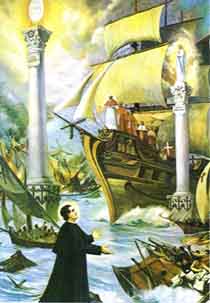
The Vision of St. John BoscoI feel compelled to write this after naming my blog "A Catholic Life" because this story is fundamental in the journey of a Christian life. Everyone will agree that there are many ways to grow in grace. "Grace is first and foremost the gift of the Spirit that sanctifies us", which includes the Spirit working through the Sacraments (CCC 2003). We, unlike the people of the Old Testament, have the greatest grace ever in our hearts at ever Mass when we receive Holy Communion.

Salvation is not possible outside of the Catholic Church (more info). Everyone is called to holiness to be with God through the One True Faith established by Christ, and as today's Gospel illustrates, we must look after ourselves and the state of our soul first and foremost. For the day of the harvest will come, and we must ask ourselves: "If that day was tomorrow, would I be ready?"

I found an article yesterday describing a vision from St. John Bosco, who envisioned the Church as a boat that could only be saved when between two pillars: The Eucharist and Devotion to Mary. This is a vital part of the Christian Life: without the Eucharist we have no hope, and without Mary we lose a powerful intercessor and a loving Mother.

In the dream the boat of the Church was lead by its Pope through the sea with many ships nearing it to attack. Suddenly the Pope falls ill but upon rises up. Then he falls a second time and he dies. The other ships erupt in joy, but a new Pope rises up in the old one's place and steers the vessel between the two pillars -the Eucharist, which the Pillar states is the "Salvation of Souls," and the other pillar is the Immaculate Heart of Mary, which says, "The help of Christians."

Image Source: Believed to be in the Public Domain, Title Unknown
Read more >>
Wednesday, July 27, 2005
Union Between Christ and His Church

I found this in the Catechism of the Catholic Church while looking for quotations concerning Mary. What do you think of this? I think it reaffirms the great importance of the Church first found in Matthew 16:18

The Church—mystery of man's union with God

772 It is in the Church that Christ fulfills and reveals his own mystery as the purpose of God's plan: "to unite all things in him." St. Paul calls the nuptial union of Christ and the Church "a great mystery." Because she is united to Christ as to her bridegroom, she becomes a mystery in her turn. Contemplating this mystery in her, Paul exclaims: "Christ in you, the hope of glory."

773 In the Church this communion of men with God, in the "love [that] never ends," is the purpose which governs everything in her that is a sacramental means, tied to this passing world. "[The Church's] structure is totally ordered to the holiness of Christ's members. And holiness is measured according to the ‘great mystery' in which the Bride responds with the gift of love to the gift of the Bridegroom." Mary goes before us all in the holiness that is the Church's mystery as "the bride without spot or wrinkle." This is why the "Marian" dimension of the Church precedes the "Petrine."

Image Source: Believed to be in the Public Domain, Title Unknown
Read more >>
Weekly Discussion Topics

I am going to take next week off from the weekly discussion topic and see how many people here would like to have this continued. I would like to see how many people like this feature. So, if you like having a weekly discussion topic just let me know by commenting below.

Thanks
Read more >>
Adult Stem Cell Research

Catholics are not opposed to stem cell research but only embryonic stem cell research. The Archdiocese of Sydney just announced they are contributing $100,000 to adult stem cell research.

Adult stem cell research is also more productive than embryonic stem cell reserach. Look at everything that adult stem cells have done. This list in from the IL Right to Life website:
  • Spinal cord injury repair (using stem cells from nasal and sinus regions)
  • Complete reversal of juvenile diabetes in mice using adult spleen cells, with Harvard now preparing for human patient trials using spleen cells
  • Crohn’s Disease put into remission (using patient’s blood stem cells)
  • Lupus put into remission (using stem cells from patient’s bloodstream)
  • Parkinson’s disease put into remission (using patient’s brain stem cells)
  • Repair heart muscle in cases of congestive heart failure (using stem cells from bone marrow)
  • Repair heart attack damage (using the patient’s own blood stem cells)
  • Restore bone marrow in cancer patients (using stem cells from umbilical cord blood)
  • Restore weak heart muscles (using immature skeletal muscle cells)
  • Put leukemia into remission (using umbilical cord blood)
  • Heal bone fractures (using bone marrow cells)
  • Restore a blind man’s sight (using an ocular surface stem-cell transplant & a cornea transplant)
  • Recovery from a stroke (using stem cells from bone marrow)
  • Treat urinary incontinence (using under arm muscle stem cells)
  • Reverse severe combined immunodeficiency (SCID) (using genetically modified adult stem cells)
  • Restore blood circulation in legs (using bone marrow stem cells)
  • Treat sickle-cell anemia (using stem cells from unbilical cord blood)
Read more >>
Tuesday, July 26, 2005
Marian Quotations

What is your favorite Marian quotation? There are so many excellent and loving quotations by Mary. I will just direct my readers to Mary, Mother of God to read some of my articles on her.
Read more >>
Holy Cards


I wanted to share this article that talks about holy cards and what they are for those here that are not Catholic. For a source of many beautiful Holy Cards, please see Holy Cards for Your Inspiration as well as Holy Reflections. Beautiful holy cards are featured on those websites.
Here is part of an article on holy cards:
"From the beginning of the church, it has been important to Christians to maintain practices that help them remember holy men and women whose lives they feel are an inspiration and to whom they can pray for intercession. These practices have included telling stories, singing songs and looking at pictures. Holy cards, which are small cards that bear the image of a saint, angel or scene from the Bible, are part of this tradition" (Catholic Online)

Image Source: Believed to be in the Public Domain, Title Unknown
Read more >>
Saturday, July 23, 2005
Quotations by Pope Benedict XVI

Well, the poll is almost over for this week and the topic will certainly be on Pope Benedict XVI. I wanted to start by writing down some quotations by him that I view as important.

First:

"'Rock' [music]. . . is the expression of elemental passions, and at rock festivals it assumes a cultic character, a form of worship, in fact, in opposition to Christian worship. People are, so to speak, released from themselves by the experience of being part of a crowd and by the emotional shock of rhythm, noise, and special lighting effects. However, in the ecstasy of having all their defenses torn down, the participants sink, as it were, beneath the elemental force of the universe."

"An adult faith does not follow the waves of fashion and the latest novelty."

"We are moving toward a dictatorship of relativism which does not recognize anything as for certain and which has as its highest goal one's own ego and one's own desires."

I believe those three comments show something very important about Our Holy Father; he is very concerned with the Church and is determined to keep us together by Sacred Tradition and Holy Scripture. I believe that secularism is growing too acceptable in the world, and I think the Pope also is concerned that too many are leaving the Church behind - the Church that Christ started out of love for us.

Second:

"Pray for me, that I may not flee for fear of the wolves."

I think this shows his humility and determination to serve Christ although he calls for our prayers. I think more people should also pray for him that he may help lead the Church. For more quotations see EWTN & All Great Quotes. If you wish to continue reading on updates concerning the Holy Father, read the mainpage of my blog and check out Pope Benedict XVI, a page on my blog.
Read more >>
Friday, July 22, 2005
Learning to Forgive

Forgiveness may be one of the hardest aspects of the Christian/Catholic life. Not only must we go to Confession to be forgiven our sins, but we must also forgive those that harm us. As Christ said, "Love thy enemies", but this radical gospel calling is still possible although to answer Christ's calling He must be the visible center of our faith and life.

Forgiveness is something that came from the Cross, where Christ died the death for sins and in doing so redeemed everyone of us. However, we must still repent for our sins, confess them, and forgive others. The road to Heaven is far from easy. Jesus made Heaven possible; He didn't open the door for the unrepentant. At this time, I must also reiterate the value of indulgences.

"Therefore, just as through one man sin entered the world, and death through sin, and thus death spread to all men, because all sinned," but "God did not send His Son into the world to condemn the world but that the world might be saved through Him" (Romans 5:12, John 3:17). Remember, "His mercy endures forever" (Psalm 118:4).

6 steps into forgiveness:

1) We can spend a few minutes every day looking at a cross and considering that Jesus gave up his very life to win forgiveness for us.

2) We can pray constantly to be filled with his perspective of love. Looking at others with eyes of mercy goes a long way toward undercutting the tendency to revenge.

3) We can pray and intercede for those who have wronged, offended, abused, or hurt us. Doing this frees us to love as God loves. God's grace has power not only to change us but also those who have done us injury as well.

4) We can try to perform at least one act of kindness toward someone who has hurt us or who rubs us the wrong way.

5) We can ask the Holy Spirit to cultivate within us an attitude of forgiveness.

6) We can get more serious about following the promptings of the Holy Spirit — especially those that touch on relationships we find difficult. Ask the Holy Spirit to help you find the way to peace, restoration, and reconciliation.

(Source: Catholic Exchange)


Image Source: Believed to be in the Public Domain, Title Unknown
Read more >>
Thursday, July 21, 2005
Book Report: Memory and Identity

http://amzn.to/2v2THmZ
I recently read "Memory and Identity," but I was only able, though, to read the first three parts (about 70 pages) since I have another book I have to read. For the pages I did read, I separated my reports below.

Part One: Good and Evil
Part Two: Freedom
Part Three: Native Land
Read more >>
"Memory and Identity" Part III

This is my summary/opinions for Part Three of "Memory and Identity" by Pope John Paul ll. After this part I had to quit reading the book, though, because I have another book I have to read very, very soon for someone else. Here is my final report for "Memory and Identity".

Part 3:

When we speak of our native land it is more than just a territory; it includes the country’s values and culture. For Pope John Paul ll, we saw how vitally important this was to him, and with Pope Benedict XVI in “Memoirs”, I saw such a fervent love for his own homeland and fellow countrymen. However, in Germany, as Pope Benedict XVI expressed, not all values were good, and this realization of what is good and not is only through God. If we don’t have God then we become our own gods and decided what is good and what is not while no definite opinion remains.

On page 62, Pope John Paul ll wrote “Christ’s teachings contain the most profound elements of a theological vision of both native land and culture.” He went on to write much about these examples, but I also thought of something while reading this: we all are attached to our native land and its values, but we must only remain attached to the values which God would condone; the values mentioned must be in God’s will, which can be summed up as love itself.

Culture is also changing where we develop new lands such as a Christian land, which began from Christ himself. We also believe in Christ’s second coming where we hopefully will reach Heaven where our new homeland, our refuge, exists. Pope John Paul ll loved his homeland of Poland, but he also loved its values as those values God would condone. But, we don’t need to leave our current country and go to Poland; we only need to be with God, and Christ is present first and foremost in the Blessed Sacrament. Christ gave us the Catholic Church, where “catholic” means “universal” showing that Christ is with us through His Church to the end of the ages (Matthew 16:18).

Overall, I found the book very refreshing although at times repetitive. I give it a 6.0/10, and would encourage it.
Read more >>
"Memory and Identity" Part II

Part Two summary/opinions of "Memory and Identity" by Pope John Paul II:

In the chapter “Lessons of Recent History”:

Through faith and love good conquers evil, and this occurred in the Communist lands. One thing I am reminded of is the pullout of the Germans from Austria in a rosary miracle. This again reaffirms that God is mercy and love and can turn all evil into good, which is the underlying theme of the book.

The Paschal Mystery proves that good all triumphs, and just as St. John the Baptist called before Christ, I see St. Faustina calling out before World War II for us to go to Christ through the Divine Mercy Chaplet (55).

Mercy and love go hand in hand. All those that request mercy and show love will be given it. God is the perfect mercy and perfect justice, his “His mercy endures forever”, and I would say before His justice is always His mercy.

Freedom can only be reacted through truth, and it is this realization in the perfect truth of Jesus Christ that God frees us from sin and suffering. I think we should mention the atonement of sins at this point.

On page 40, it states, “Freedom is for love: its realization can even reach heroic proportions.” I believe true freedom is found only in God because if we are free from sin then we truly are free. Many people today enjoy the beatific vision (sainthood), and this includes those that have given their lives for the faith, martyrs. These martyrs, though, still possessed a strong freedom. The world today believes freedom is in doing what you want, but I view freedom as one world: Sainthood, where we are truly free from Sin, Satan, and death. Some will say we are not free if bound in servitude to the Gospel, but in Heaven all bondage ends and we enjoy the freedom of Christ on the Cross. Christ was held firmly to the Cross by our sins, but all the freedom Christ had He gave for us so that we might have eternal life.

Simply, there is no freedom without truth, and this truth is only found in the perfect truth of Jesus Christ. This realization of truth leads us to the virtues of the faith and in turn we show love and mercy. This love is characteristic of what freedom is according to Aristotle: “…is a property of the will which is realized through faith.” If we have realized the real truth then we must be in God’s grace and serving Him; each of the two greatest Commandments include one word “love”.
Read more >>
"Memory and Identity" by Pope John Paul ll

I'm currently reading this book and will be posting thoughts by Our Holy Father along with my opinions for the next few days. Here is my summary/opinion of part one:

Before anything else, I must state an important conclusion I realized through this book. When we speak of good, we must understand God equals the supreme good; all things God has done and creates is good and perfect serving a definite purpose, and if we are to rate any action in relation to good or lack there of good (evil), we must have a definite value of the perfect good, which is God. I can therefore conclude that sin, an offense against God, is evil because it is against God’s perfect will. I also can conclude that this action of sin is evil, defined as a complete lack of good (the Supreme good being God), so evil must also be the lack of God. Therefore any sin, no matter how small, infinitely offends Our Good God.

Though, evil and good are opposite, all things were both created perfect until they where stained with original sin due to the sin of Adam. Both those that are good and those that are evil, though, still serve a purpose and live together as in the parable of wheat and weeds; “God is mercy” as St. Faustina said, so there never exists a loss of hope to be forgiven for our sins, which Christ bore on the Cross.

Other fundamental concepts I studied included St. Augustine’s view of original sin: “self-love to the point of contempt for God”, which is fought through “love for God to the point of contempt of sin” (6, 7). The Holy Spirit is a powerful armor against hell, which shows us evil and how to fight it; through the outpouring of grace, we are able to live in life through the Holy Spirit’s involvement. As is written on page 7, if we turn away the Spirit of God, we can not be forgiven for this offense because it is showing that we don’t want pardon of our offenses (Matthew 12:31). The Father of lies, satan, was also created good but became evil through pride, and in the Garden of Eden, he set us forth to suffer like him and be cast away. Yet, he failed in his attempt as God has redeemed us; satan views himself to be equal to God, which is the definition of pride. Only through denial of self can we seek God that is why I believe pride to be the greatest of all sins because it prevents our redemption.

On page 8, Pope John Paul ll brings up the philosophical thought of Descrates, which is “I think, therefore I am”. This shows resemblance to how some view science, where it must prove God. But, science is merely the study of God’s creation not the study of God. As the next several pages show, if man uses this thought, he then views himself to be a deity (Genesis 3:5), but then who can decide what is right and wrong? In truth, only God’s opinion is absolute, so if people view themselves equal to God or if they view God as less than the perfect, supreme Creator then we have the rising of evil empires and ideas which include also include abortion.

To finish part one, on page 15, Pope John Paul ll talked about the evil being necessary for mankind. As I thought about this I concluded, without the cross there would be no hope of eternal salvation. Everything God creates is good; “I created both good and destruction. I am the Lord”. If God can take the greatest evil in human history – the condemnation of God to death and turn it into the greatest joy, then that is a miracle beyond words. The Cross continues to live on today as it is through the Cross that eternal life is reached, and we must all live the life Christ calls us to by loving everyone even our enemies so that we fight evil through good (Romans 12:21).

Furthermore, Pope John Paul ll stated that Redemption is the divine limit imposed on evil because it is through evil that the Cross shines. We are only saved through grace, the grace on the Cross, so through evil there is always a Cross. This brings to mind the fact Redemption is a task that must be worked on as we must pick up our daily crosses. All saints have had to bear his or her cross through life, but evil is powerless over the Resurrection.

Pope John Paul ll continued by saying there are 3 stages to follow Christ:

1. Observance of the Commandments
2. Development of virtues
3. Experience a love for God with growing intensity.

These are called the purgative way, the illuminative way, and the unitive way.
Read more >>


Copyright Notice: Unless otherwise stated, all items are copyrighted under a Attribution-NonCommercial-NoDerivatives 4.0 International License. If you quote from this blog, cite a link to the post on this blog in your article.

Disclosure of Material Connection: Some of the links on this blog are “affiliate links.” This means if you click on the link and purchase the item, I will receive an affiliate commission. As an Amazon Associate, for instance, I earn a small commission from qualifying purchases made by those who click on the Amazon affiliate links included on this website. I am disclosing this in accordance with the Federal Trade Commission’s 16 CFR, Part 255: “Guides Concerning the Use of Endorsements and Testimonials in Advertising.”