Sunday, October 25, 2020
Act of Dedication of the Human Race to Christ the King

A partial indulgence is granted to the faithful, who piously recite the Act of Dedication of the Human Race to Jesus Christ King. A plenary indulgence is granted, if it is recited publicly on the feast of our Lord Jesus Christ King.

"We institute the Feast of the Kingship of Our Lord Jesus Christ to be observed yearly throughout the whole world on the last Sunday of the month of October–the Sunday, that is, which immediately precedes the Feast of All Saints. We further ordain that the dedication of mankind to the Sacred Heart of Jesus, which Our predecessor of saintly memory, Pope Pius X, commanded to be renewed yearly, be made annually on that day" (Quas Primas by Pope Pius XI, 1925)

Prayer by Pope Leo XIII (not the revised modern one):

Most Sweet Jesus, Redeemer of the human race, look down upon us humbly prostrate before Thine altar. We are Thine, and Thine we wish to be; but to be more surely united to Thee, behold each one of us freely consecrates ourselves today to Thy Most Sacred Heart.

Many indeed have never known Thee; Many too, despising Thy precepts, have rejected Thee. Have mercy on them all, most merciful Jesus, and draw them to Thy Sacred Heart. Be Thou King, O Lord, not only of the faithful children, who have never forsaken Thee, but also of the prodigal children, who have abandoned Thee; Grant that they may quickly return to their Father’s house lest they die of wretchedness and hunger.

Be Thou King of those who are deceived by erroneous opinions, or whom discord keeps aloof, and call them back to the harbor of truth and unity of faith, so that there may be but one flock and one Shepherd. 

Be Thou King of all those who are still involved in the darkness of idolatry or of Islamism, and refuse not to draw them into the light and kingdom of God. Turn Thine eyes of mercy towards the children of the race, once Thy chosen people: of old they called down upon themselves the Blood of the Savior; may it now descend upon them a laver of redemption and of life.

Grant, O Lord, to Thy Church assurance of freedom and immunity from harm; give peace and order to all nations, and make the earth resound from pole to pole with one cry; praise to the Divine Heart that wrought our salvation; To it be glory and honor forever. R. Amen.

Read more >>
Sunday, October 18, 2020
Secrets of the Sacred Heart by Emily Laminet Book Review

I was asked to review "Secrets of the Sacred Heart" by Emily Laminet, which was just published by Ave Maria Press. The book on devotion to the Sacred Heart is structured by providing a chapter on each of the twelve promises revealed to St. Margaret Mary concerning those who are devoted to the Sacred Heart. Each chapter includes personal anecdotes from the author and applications for our own lives. Some good historical information is sprinkled throughout, and the book does a nice job of going further than merely reiterating the story of St. Margaret Mary which is already widely known. 

In her opening pages, Laminet writes, "Although this devotion to the Sacred Heart traces back to the beginning of the Church, it is perhaps more relevant now than it ever was. The Sacred Heart devotion is for all of us, right where we are, now. In a world that continues to grow colder and more confused, Jesus' Sacred Heart sets our hearts on fire with his love in order to burn off the bondages of sin." Well said.

And later on, quoting St. Margaret Mary, we understand the importance of this devotion for our times: "This devotion is as a last effort of his love...to favor men in these last centuries with this loving redemption, in order to withdraw them from the empire of Satan, which He intends to destroy, in order to put them under the sweet empire of His love and thus bring many souls by His saving grace to the way of eternal salvation."

Good:

  • The book includes a mix of St. Margaret Mary's writings with stories on how devotion to the Sacred Heart - like home enthronements and consecration to the Sacred Heart - lead to real fulfillment of the promises of our Lord even in this life.
  • Good information on Fr. Mateo's home enthronement and how we are to make our own homes into a Bethany. He specifically called for families to spend one night in prayer once a month before the enthroned image of our Lord's Sacred Heart saying, "Dear Bethanies, come out with lighted torches to meet Jesus Crucified and prove to Him that your house is really His dwelling place." This monthly vigil in front of the image of our Lord's Sacred Heart as a family is surely a practice worth adopting. 
  • Incorporation of great prayers like Fr. Francois Xavier Gautrelet's Morning Offering Prayer. He was the founder of the Apostleship of Prayer in 1844. And the book featured a great history lesson on the Litany of the Sacred Heart on a point I never read before: "At [the time of St. Margaret Mary when the Litany of the Sacred Heart originated] the litany contained just seventeen lines; an additional thirty-three lines (the petitions invoking the 'Heart of Jesus') were later added to represent the thirty-three years of the life of Christ."
  • Specific attention is given to not only the enthronement of our homes but those of our businesses, schools, and organizations to the Sacred Heart. Employers, principals, mayors, and everyone in a position of authority should enthrone their endeavors publicly to the Sacred Heart of Jesus.

Not So Good:

  • Doesn't capitalize pronouns that refer to our Lord's name.
  • Throughout the book, uses the 1992 Catechism only, referring to it as "the Catechism" as if it was the only one when it is one of dozens of catechisms. And the New Catechism has several key issues throughout
  • Accepts the validity of post-1983 canonizations using the revised formula
  • There are several typos throughout the book that I would not expect from a publisher like Ave Maria Press. In one part they reference "St. Pius XI" when they mean "St. Pius X" and in another place they attribute a quote to "Pope Paul XI" who does not exist. I assume they mean Pope Pius XI but I am unsure. And in another place, it says, "The Feast of the Sacred Heart is celebrated forty days after the Feast of Corpus Christi." That too is incorrect.
All in all, this is a good book. It is an easy read and nicely combines practical applications of devotion to our Redeemer's Sacred Heart along with some good historical information. My two primary hesitations to recommend the book is its acceptance of the changes of the post-Vatican II era (e.g. the New Catechism, New Canonizations, the writings of modern day Popes, etc) and the many typos throughout.

However, I do not hesitate to recommend and encourage everyone to have their home enthroned to the Sacred Heart and to daily honor and worship our Lord's Sacred Heart. As quoted in the book, St. Claude de la Colombiere exclaims, "If men knew how pleasing this devotion is to Jesus, there is no Christian - however lukewarm they might be - who would not at once practice it. Urge souls, and more especially those serving God and religion, to consecrate themselves to the Sacred Heart."
Read more >>
Sunday, October 11, 2020
The 5 Best Daily Meditation Resources for the Traditional Catholic Liturgical Year

Divine Intimacy by Fr. Gabriel of Saint Mary Magdalen provides deeply enriching spiritual commentary in line with the Carmelite spirituality. It is organized based on the Traditional readings for the Sunday Gospels and around the seasonal themes in the liturgical year. Yet the meditations often are appropriate for any day as they center on true spiritual progress. Divine Intimacy has received great accolades from people who I personally know read from it. The Liturgy Guy provides a very good review of Divine Intimacy where he says in part: "The brilliance of Divine Intimacy comes from Fr. Gabriel’s unique ability to balance spiritual depth with literary brevity: each daily entry typically is no more than three pages long. However, within those few pages, the reader is invited to seek God through the direction of Fr. Gabriel."

 As stated on the product listing at Baronius Press: "This Book of Meditations is a classic and is seeped in Carmelite spirituality. For every day it offers two meditations, in liturgical arrangement, that enable the soul to enter the conscious presence of God and to reflect on the theme of the day. These are followed by a ‘Colloquy’ that helps the person at prayer to start a friendly conversation with God where acts of praise and love, petition, and thanksgiving are made, together with good resolutions for the future. Here we are at the very heart of prayer, which is a heart-to-heart encounter in faith with the living God. Divine Intimacy is the highest state attainable on earth. In this union of love, the soul produces acts of love which have an immense apostolic influence on a multitude of souls. This knowledge of the ways that lead to God, according to the teaching of the renowned Spanish mystics, is distilled into the pages of this book."

Daily Breviary Meditations by Bishop Angrisani are a 4 volume set that follows the Traditional (pre-1955 Catholic liturgical year). These daily meditations tend to follow the cycle of readings in Matins and are heavily geared toward the clergy. However, the meditations here are certainly still worthwhile for even lay Catholics, especially those who pray the Divine Office. 

This reprint from Refuge of Sinners Publishing states: "The extremely important aim of this work, which is the sanctification of the Clergy and laity alike, increases its value and suitableness to the needs of our times. For never before, as in our day, in this period of general disorientation of minds and of most grave threats to the Faith and moral life of the people, has there been felt the necessity of holy priests and laity who for the salvation of Christian civilization must constitute an impenetrable barrier to the onslaughts of impiety and evil customs. This is a rare work that will be a valuable asset to any library." A sample image from a page of the meditations may be viewed here.

The Church's Year by Fr. Leonard Goffine is also worth mentioning. While not a "daily" source of meditations, Fr. Goffine's work includes explanations on the Epistles and Gospel readings for all Sundays and holy days. He includes other explanations of Church doctrine and ecclesiastical customs throughout as well. The meditations can certainly serve worthwhile to be read throughout the year - not just on the particular Sunday he has assigned them. The website for the SSPX Asia has the work available to read freely online.

Dom Gueranger's Liturgical Year is the gold standard when it comes to insights, spiritual enrichment, and historical information on the Traditional Liturgical Year. In fact, his "Liturgical Year" would influence Fr. Pius Parsch who is mentioned further down this list with a work of his own. 

This 15 volume set is described as follows on the product page: "This monumental liturgical work, comprising fifteen volumes, was the life-long labor of Benedictine Abbot Dom Guéranger. Written with the heart of a seraphic contemplative, the holy abbot takes the reader on a daily spiritual pilgrimage through the liturgies of both the East and the West as he immerses the soul into the very life of the ecclesia orans et adorans (the church praying and adoring). The author achieves this by providing daily entries corresponding to the yearly cycle of the Church's worship in both her divine seasonal feasts and those of her saints. Each day begins with a rich and provocative meditation on the mystery of faith to be celebrated together with the ecclesial history of the same; this is followed by excerpts from the Roman Missal's Mass of the day (complete with Propers, i.e., Introits, Collects, Offertory prayers, etc ) as well a host of exquisite hymns from the divine office which are coupled with varied and sundry sequences garnered from other ancient Catholic rites."

The FSSP Apostolate in Atlanta has a free email subscription to Dom Gueranger's liturgical year. Sign up to receive the daily meditation using the pre-1955 calendar that was in place at the time of Dom Gueranger's writing. In fact, his writings precede even the liturgical changes of Pope St. Pius X. While the volume does include the feasts added to the liturgical calendar in the early 1900s, it is still a true gem and one that I read through every morning.

Also worth mentioning are the Sermons on the liturgy for Sundays and feast days by Fr. Pius Parsch. Fr. Parsch was a leading figure in the Liturgical Movement in the early 1900s and his works "The Liturgy of the Mass" (1940) and "The Breviary Explained" (1952) are still read. Fr. Parsch was unfortunately a promoter of the liturgical trend to celebrating Mass on a table while facing the people away from the tabernacle. He died in 1954. 

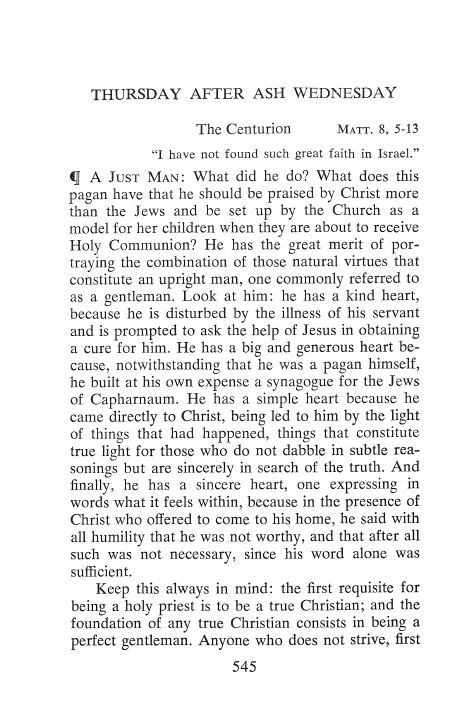
While these are not "daily meditations" Fr. Parsch provides really insightful and meaningful commentary on the Mass texts. No modernism here in the five Sunday entries I have read thus far. More than merely discussing the Gospel reading, he provides holistic commentary on the Mass texts as a whole, often providing historical context and going much deeper and on different topics than discussed in most other commentaries. I've personally been using it every Sunday and highly recommend it. For a sample, see my Facebook post where I shared pictures of his meditation for the 14th Sunday after Pentecost.

And lastly, I highly recommend the CatechismClass.com course on the Liturgical Year. With various lessons on the feast days and fast days throughout the liturgical year, it is a great resource. The lessons combined Scripture, traditional catechism passages, prayers, devotions, activities, saintly writing, and other sources in a way that other commentaries cannot do. Again, while they do not have lessons for every single day in the year - or all Sundays - they do have a wide range of lessons, covering saints for instance like St. Jeanne Jugan, who are not covered in any other work mentioned on this list.

Read more >>
Thursday, October 8, 2020
2020 Catholic Voting Principles

With only a month before election day in the United States, it's important to understand the importance of voting and the Church's teaching on how Catholics are to exercise their right to vote in democratic countries.

Here are some of the key points worth repeating on Catholics and voting:

• Catholics are obliged to participate in politics by voting.

• Legislators are elected to serve and protect the common good, human dignity, and rights of human persons.

• Voters should have a clear understanding of the principles of Catholic moral and social teaching.

• The life issues are dominant in the hierarchy of issues for the Catholic voter.

• Abortion is the dominant political issue.

• Being pro-abortion disqualifies a candidate from a Catholic vote.

• The ban against euthanasia and assisted suicide admits of no exception.

• Science must respect the inherent dignity of the human person.

• Unused and unwanted embryos must be treated with the respect afforded to other human beings.

• Ending human life cannot be justified in the name of therapeutic (i.e., medical) benefits to other persons.

• Marriage was instituted prior to the state and should be recognized by the state as something inviolate and necessary to the common good.

• Prudential judgments about law and public policy should always seek to strengthen marriage and families.

• So-called same-sex marriages cannot be recognized by the Catholic Church, and civil unions are likely to undermine marriage and damage its foundational role in society.

• Catholic health-care organizations must be free to perform their work with clear consciences.

• Abstinence and fidelity should be the foundation of sexually transmitted disease—education and prevention.

As a result, a Catholic must vote for the best candidate that will advance the common good. A Catholic may not vote for a candidate that advocates, supports, encourages, funds, promotes, or advances abortion, embryonic stem cell research, or euthanasia. 

US Presidential Race:

Where each candidate stands on the issues: https://2020election.procon.org/view.source-summary-chart.php 

President Donald Trump recently gave a talk last week to Catholics in New York. Listen to the 4-minute clip: https://www.facebook.com/1000078.../videos/2733288656941997P

President Trump's pro-life record: http://www.nrlc.org/uploads/records/trumprecord.pdf

Joe Biden, a Baptized Catholic himself, has pledged to make abortion enshrined in American law, even if Roe vs. Wade is overturned. He admitted it himself on Twitter: https://twitter.com/JoeBiden/status/1313283330486476801

Joe Biden's running mate is one of the most pro-abortion candidates to ever run: https://www.texasrighttolifepac.com/kamala-harris-pro-abortion-record/ 

The choice is clear for the US Presidential Race. A Catholic may not vote for Joe Biden without committing a grave sin. Fr. Altman has come to a similar conclusion in his recently released video: https://www.youtube.com/watch?v=3-7eoTN2vNM

Other Races:

Since there are many national, state, and local races on-going, consult a voting guide. Since abortion is the preeminent issue for Catholics - as affirmed by the United States Conference of Catholic Bishops - referencing this guide from the National Right to Life is useful: https://www.nrlvictoryfund.org/endorsements/ 

Anyone for abortion being legal or funded by taxpayer dollars is disqualified from your vote.

As a final reminder, voting is a grave obligation. Do so for the good of souls. You do not have to like the personality or the person you are voting for. But to vote for someone that will advance evil against the human person or the Church is unworthy of a vote. And to vote for such a person would be mortally sinful.

Read more >>
Wednesday, October 7, 2020
Sts. Sergius and Bacchus & Sts. Marcellus and Apuleius

Commemoration (1954 Calendar): October 7
Commemoration (1962 Calendar): October 8

In addition to the great celebration of Our Lady of the Rosary, today's liturgy includes a Commemoration of Pope St. Mark in addition to a Commemoration of Ss. Sergius and Bacchus and Ss. Marcellus and Apuleius. The 1960 Breviary moved the Commemoration of these holy martyrs to October 8th due to a rubric change made in 1960 that allows only one commemoration on days of the II class, and October 7th kept the Commemoration of St. Mark.

The following is taken from their account in the Roman Martyrology:

"In lower Syria, the holy Martyrs Sergius and Bacchus, noble Romans, who lived under the Emperor Maximian. Bacchus was scourged with thongs that tore his flesh; he died in his torments confessing the name of Jesus. Sergius, forced to wear shoes with nails piercing his feet, remained firm in the faith and was beheaded. At Rome the holy Martyrs Marcellus and Apuleius abandoned Simon the Magician, whose disciples they had been, to follow the teaching of St. Peter. After the martyrdom of the apostles they themselves obtained the same crown under the ex-consul Aurelian and were buried near Rome."

The Catholic Encyclopedia also bears witness to their lives and mentions how these saints, whose names are surely forgotten by nearly all today, were honored since ancient times:

"Their martyrdom is well authenticated by the earliest martyrologies and by the early veneration paid them, as well as by such historians as Theodoret. They were officers of troops on the frontier, Sergius being primicerius, and Bacchus secundarius. According to the legend, there were high in esteem of the Caesar Maximianus on account of their bravery, but this favour was turned into hate when they acknowledged their Christian faith. When examined under torture they were beaten so severely with thongs that Bacchus died under the blows. Sergius, though, had much more suffering to endure; among other tortures, as the legend relates, he had to run eighteen miles in shoes which were covered on the soles with sharp-pointed nails that pierced through the foot. He was finally beheaded. The burial-place of Sergius and Bacchus was pointed out in the city of Resaph; in honour of Sergius the Emperor Justinian also built churches in honour of Sergius at Constantinople and Acre; the one at Constantinople, now a mosque, is a great work of Byzantine art. In the East, Sergius and Bacchus were universally honoured. Since the seventh century they have a celebrated church in Rome. Christian art represents the two saints as soldiers in military garb with branches of palm in their hands. Their feast is observed on 7 October. The Church calendar gives the two saints Marcellus and Apuleius on the same day as Sergius and Bacchus. They are said to have been converted to Christianity by the miracles of St. Peter. According to the "Martyrologium Romanum" they suffered martyrdom soon after the deaths of Sts. Peter and Paul and were buried near Rome. Their existing Acts are not genuine and agree to a great extent with those of Sts. Nereus and Achilleus. The veneration of the two saints is very old. A mass is assigned to them in the "Sacramentarium" of Pope Gelasius.:

Collect:

May the blessed deeds of Thy holy martyrs Sergius, Bacchus, Marcellus, and Apuleius plead for us, O Lord, and may they make us ever burn with love for Thee.

Read more >>
Tuesday, October 6, 2020
What are the 3 Days of Darkness?


And they say to the mountains and the rocks: Fall upon us, and hide us from the face of him that sitteth upon the throne and from the wrath of the Lamb: For the great day of their wrath is come, and who shall be able to stand? (Revelations 6:16-17)

Blessed Anna Maria Taigi (1769–1837) is the most known mystic who described the Three Days of Darkness and describes the event in this way:

There shall come over the whole earth an intense darkness lasting three days and three nights. Nothing can be seen, and the air will be laden with pestilence which will claim mainly, but not only, the enemies of religion. It will be impossible to use any man-made lighting during this darkness, except blessed candles. He, who out of curiosity, opens his window to look out, or leaves his home, will fall dead on the spot. During these three days, people should remain in their homes, pray the Rosary and beg God for mercy. All the enemies of the Church, whether known or unknown, will perish over the whole earth during that universal darkness, with the exception of a few whom God will soon convert. The air shall be infected by demons who will appear under all sorts of hideous forms.

Marie-Julie Jahenny (1850-1941), known as the “Breton Stigmatist”, expanded upon the story of the Three Days of Darkness, saying that it will occur on a Thursday, Friday, and Saturday to strike at those outside their homes and those without a lit blessed candle of 100% pure wax. A Catholic home should keep such candles in stock for sick calls as well, should a priest need to visit a sick family member. These candles should be bought long in advance and blessed long in advance as well by a priest using the traditional blessing of candles. The English translation is as follows:

Our help is in the name of the Lord.

All: Who made heaven and earth.

P: The Lord be with you.

All: May He also be with you.

Let us pray.

Lord Jesus Christ, Son of the living God, bless + these candles at our lowly request. Endow them, Lord, by the power of the holy + cross, with a blessing from on high, you who gave them to mankind in order to dispel darkness. Let the blessing that they receive from the sign of the holy + cross be so effectual that, wherever they are lighted or placed, the princes of darkness may depart in trembling from all these places, and flee in fear, along with all their legions, and never more dare to disturb or molest those who serve you, the almighty God, who live and reign forever and ever.

All: Amen.

They are sprinkled with holy water.

While we certainly do not know the day when the end will come, we nevertheless must always be prepared by living and remaining in the state of sanctifying grace. Each of us will die one day - at any moment - and the state of our souls at that moment will determine an eventual eternity in Heaven or in Hell.

Spend some visit exploring the website of America Needs Fatima, which is also the source of the above image.

Lord, have mercy!

Read more >>
Friday, October 2, 2020
"Only Through These Hands" by Bishop Theas of Lourdes

Some years ago I got a copy of a small booklet called "Only Through These Hands: A Treatise of the Office of the Bishop in the Catholic Church" by Bishop Pierre-Marie Theas of Lourdes. The booklet was translated from French into English by Geraldine Carrigan who lived until the Feast of St. Joseph, March 19, 2000. The booklet was published by Pio Decimo Press, which is now out of business. It would be wonderful to see this back in print again.

A few days ago, I picked up the copy from my bookshelf again and read through its 32 pages. Despite its small size, "Only Through These Hands" is a succinct yet insightful explanation of the authority, importance, and role of Bishops. 

The booklet begins by quoting the Preface used during the Holy Sacrifice of the Mass for the Consecration of Bishop. That traditional Preface with its beautiful symbolism worth repeating. It states in part:

It is truly fitting and just, right and profitable unto salvation that, at all times and in all places, we should give thanks to Thee, O Holy Lord, Father Almighty, Eternal God, source of honor to all dignitaries who in their sacred orders serve Thy glory. Thanks to Thee, O Lord Who, in the privacy of familiar conversation, didst instruct Moses Thy servant, concerning, among other things of divine worship, the nature of sacerdotal garments, and Who didst order that Aaron, Thy chosen one should be clad in mystic robes during sacred functions, so that generation after generation might learn from the example of their forebears, and so that knowledge derived from Thy instruction be not wanting in any age. Among our forebears the very display of symbols would excite reverence; among us, however, the realities themselves mean more than the symbols. Whereas the garb of the ancient priesthood is merely a display for our mind, now the splendor of souls rather than of vestments makes the pontifical glory attractive; because even those things which then were pleasing to the eyes of the flesh had to be grasped by the mind as to their inner meaning. Therefore, we beseech Thee, O Lord, shower upon this Thy servant, whom Thou hast chosen for the ministry of the highest priesthood, this grace, namely, that whatever those garments signify in the lustre of gold, the beauty of jewels, and the varied skill of craftsmanship, may shine forth in their conduct and deeds. Give to thy priests the perfection of ministry, and sanctify them, decked out in ornaments of glory, with the dew of Thy heavenly ointment.

The book is divided into 8 short chapters which each describe the Office of the Bishop:

  1. According to the Gospels
  2. According to St. Paul and St. John
  3. According to St. Ignatius of Antioch
  4. According to St. Thomas Aquinas
  5. According to the Pontifical
  6. According to Leo XIII
  7. According to Pius XII
  8. In God's Eyes
Some of Bishop Theas' remarks worth repeating from the book:

"The episcopacy is not a human institution. It was not established because there was a need for good management, nor because the Bishops are delegates whom the Pope chooses to exercise his office. Rather the episcopacy has a divine origin - instituted by Christ: no one may suppress it, not even the Pope."

The mission of the Bishop is accomplished by "exercising his doctrinal authority," by "the ministry of sanctification, through which the Bishop dispenses divine life," and by "governing, whereby the Bishop instructs, commands, forbids, or permits certain actions." 

There are seven points of certain regarding the episcopacy in the early history of the Church. The first: "The Apostles possess two prerogatives which they do not transmit to Bishops: personal infallibility and universal jurisdiction." The second: "In the first century of Christianity there were Christian communities instead of dioceses. Ecclesiastical authority was exercises over persons rather than a territory."

And after discussing the teaching of St. Thomas Aquinas, Bishop Theas writes, "The Bishop is primarily a sanctifier, a fact which trends the episcopal state superior to the religious state, where one engages oneself to receive perfection, not to communicate it."

And Bishop Theas in a beautiful chapter on the insights from the Pontifical, referencing the Preface which was quoted at the beginning of the booklet states, "This sacramental formula is preceded by a text which answers an objection rather wide-spread today: Why all the elaborate vestments for a Bishop - the purple cassock, the cape, the ring, the precious stones? It is in remembrance of the Pontiffs of the Old Law, clothed by the will of God in the finest dress. But especially it is that the Bishop comprehends the symbol of the external magnificence of his ornaments. It is his soul which must be resplendent, for it is interiorly that true beauty is found - the beauty of grace."

"The responsibility of the Bishop is sublime and the charge which the Church imposes on him is very heavy. Pray for your Bishops and look on them with the faith of the Church."


A Prayer For Holy Bishops As Composed by St. John Fisher:

Lord, according to Your promise that the Gospel should be preached throughout the whole world, raise up men fit for such work. The Apostles were but soft and yielding clay till they were baked hard by the fire of the Holy Ghost.

So, good Lord, do now in like manner again with Thy Church militant; change and make the soft and slippery earth into hard stone; set in Thy Church strong and mighty pillars that may suffer and endure great labours, watching, poverty, thirst, hunger, cold and heat; which also shall not fear the threatening of princes, persecution, neither death but always persuade and think with themselves to suffer with a good will, slanders, shame, and all kinds of torments, for the glory and laud of Thy Holy Name. By this manner, good Lord, the truth of Thy Gospel shall be preached throughout all the world.

Therefore, merciful Lord, exercise Thy mercy, show it indeed upon Thy Church.

Read more >>
Wednesday, September 23, 2020
What is Better: Shared Days of Penance or Private Acts of Penance?

As mentioned in my articles on the catastrophic decline in fasting in the lives of Catholics, the notion of shared days of communal penance (e.g. abstinence on Fridays and shared days of fasting for Lent, Ember Days, and Vigils) has all but vanished. What is even more concerning than losing these traditions and connections with the Faith as it has been practised for centuries is that the Church has taught that days of communal penance are more efficacious than mere private penances. The trend to encourage private fasting and penances and reduce Church-wide fasting to only Ash Wednesday and Good Friday is deplorable.

As Dom Gueranger writes in his article on Ember Wednesday for September:

We have already spoken of the necessity of private penance for the Christian who is at all desirous to make progress in the path of salvation. But in this, as in all spiritual exercises, a private work of devotion has neither the merit nor the efficacy of one that is done in company with the Church, and in communion with her public act; for the Church, as bride of Christ, communicates an exceptional worth and power to works of penance done, in her name, in the unity of the social body.

He continues by quoting the following passage from Pope St. Leo the Great:

God has sanctioned this privilege, that what is celebrated in virtue of a public law is more sacred than that which depends on a private regulation. The exercise of self-restraint which an individual Christian practises by his own will is for the advantage of that single member; but a fast undertaken by the Church at large includes everyone in the general purification. God’s people never is so powerful as when the hearts of all the faithful join together in the unity of holy obedience, and when, in the Christian camp, one and the same preparation is made by all, and one and the same bulwark protects all...

Let us not only keep the traditional days of fasting as were known and practiced long before the 1900s but also work to restore their observance to the Universal Church. Then we can reap even greater merits.

Read more >>
Saturday, September 19, 2020
Vigil of St. Matthew

Commemoration (1954 Calendar): September 20

In addition to the Feast of St. Eustace, September 20th is also the Vigil of Saint Matthew. If this Mass is celebrated, the vestments are violet. Otherwise, the Vigil is commemorated at the Mass of St. Eustace.

Traditionally the feasts of all the apostles, which were Holy Days of Obligation in previous times, were preceded with a vigil. It has been kept in the Church from ancient times and is mentioned in the Martyrology of St. Jerome.

Today is a worthwhile day, in years when the Vigil does not fall on a Sunday, for us to fast and abstain from meat as we prepare to celebrate St. Matthew's feastday. In years when the Vigil falls on a Sunday, before the advent of the 1917 Code of Canon Law, the fast would be anticipated on Saturday, the day prior.

Luke 5: 27-32 (the Proper Last Gospel today at the Mass of St. Eustace if a second Mass for the Vigil is not offered):

At that time, Jesus saw a publican, named Levi, sitting at the receipt of custom; and He said to him, "Follow Me." And, leaving all things, he rose up, and followed Him. And Levi made Him a great feast in his own house; and there was a great company of publicans, and of others, that were at table with them. But the pharisees and scribes murmured, saying to His disciples, Why do you eat and drink with publicans and sinners? And Jesus answering, said to them, "They that are whole need not the physician: but they that are sick. I came not to call the just, but sinners, to penance."

Collect:

Grant, we beseech Thee, O almighty God, that the august solemnity of blessed Matthew, Thine apostle and Evangelist, to which we look forward, may increase both our devotion and our salvation. Through Our Lord Jesus Christ: Who liveth and reigneth with Thee in the unity of the Holy Ghost, one God.

Image Source: Tridentine Mass Society of Madison

Read more >>
Wednesday, September 9, 2020
Within the Octave of the Nativity of the Blessed Virgin Mary

We are currently in the midst of another octave - the Octave of the Nativity of the Blessed Virgin Mary, another casualty in 1955 that few people know of or spiritually celebrate anymore. This was previously a Common Octave. In 1913, with the Divino Aflatu reforms, the Octave was downgraded to a simple octave, and the Octave Day itself, September 15th, was replaced by the Feast of Our Lady of Sorrows.

By the 20th century, the Octave of the Nativity of our Blessed Mother had all but vanished as higher-ranking feasts were added to the calendar. The entire octave of the Nativity of the Blessed Virgin Mary was impeded, but The Most Holy Name of Mary was celebrated during the octave and The Seven Sorrows of the Blessed Virgin Mary was celebrated on the former octave day.

Brief History of Octaves:

By the 8th century, Rome had developed liturgical octaves not only for Easter, Pentecost, and Christmas but also for the Epiphany and the feast of the dedication of a church.

After 1568, when Pope Pius V reduced the number of octaves (since by then they had grown considerably), the number of Octaves was still plentiful.  Octaves were classified into several types. Easter and Pentecost had "specially privileged" octaves, during which no other feast whatsoever could be celebrated. Christmas, Epiphany, and Corpus Christi had "privileged" octaves, during which certain highly ranked feasts might be celebrated. The octaves of other feasts allowed even more feasts to be celebrated.

To reduce the repetition of the same liturgy for several days, Pope Leo XIII and Pope St. Pius X made further distinctions, classifying octaves into three primary types: privileged octaves, common octaves, and simple octaves. Privileged octaves were arranged in a hierarchy of first, second, and third orders. For the first half of the 20th century, octaves were ranked in the following manner, which affected holding other celebrations within their timeframes:
  • Privileged Octaves
    • Privileged Octaves of the First Order
      • Octave of Easter
      • Octave of Pentecost
    • Privileged Octaves of the Second Order
      • Octave of Epiphany
      • Octave of Corpus Christi
    • Privileged Octaves of the Third Order
      • Octave of Christmas
      • Octave of the Ascension
      • Octave of the Sacred Heart
  • Common Octaves
    • Octave of the Immaculate Conception of the BVM
    • Octave of the Solemnity of St. Joseph
    • Octave of the Nativity of St. John the Baptist
    • Octave of Saints Peter and Paul
    • Octave of All Saints
    • Octave of the Assumption of the BVM
  • Simple Octaves
    • Octave of St. Stephen
    • Octave of St. John the Apostle
    • Octave of the Holy Innocents 
    • Octave of St. Lawrence
    • Octave of the Nativity of the Blessed Virgin Mary
The Crown of Twelve Stars

All praise and thanksgiving; be to the ever-blessed Trinity, Who hath shown unto us Mary, ever-Virgin, clothed with the sun, with the moon beneath her feet, and on her head a mystic crown of twelve stars.
R. For ever and ever. Amen.

Let us praise and give thanks to God the Father, Who elected her for his daughter.
R. Amen. Pater noster.

Praise be to God the Father, Who predestined her to be the Mother of His Son.
R. Amen. Ave Maria.

Praise be to God the Father, Who preserved her from all stain in her conception.
R. Amen. Ave Maria.

Praise be to God the Father, Who on her birthday adorned her with His choicest gifts.
R. Amen. Ave Maria

Praise be to God the Father, Who gave her Joseph for her pure spouse and companion.
R. Amen. Ave Maria

Let us praise and give thanks to God the Son, Who chose her for His Mother.
R. Amen. Pater noster.

Praise be to God the Son, Who became Incarnate in her womb, and abode there nine months.
R. Amen. Ave Maria

Praise be to God the Son, Who was born of her and was nourished at her breast.
R. Amen. Ave Maria.

Praise be to God the Son, Who in His childhood willed that Mary should teach Him.
R. Amen. Ave Maria

Praise is to God the Son, Who revealed to her the mysteries of the redemption of the world.
R. Amen. Ave Maria and Gloria Patri.

Let us praise and give thanks to God the Holy Ghost who made her His spouse.
R. Amen. Pater noster.

Praise be to God the Holy Ghost, Who revealed to her first His name of Holy Ghost.
R. Amen. Ave Maria

Praise be to God the Holy Ghost, through whose operation she became at once Virgin and Mother.
R. Amen. Ave Maria

Praise be to God the Holy Ghost, through whom she became the living temple of the Most Holy Trinity.
R. Amen. Ave Maria.

Praise be to God the Holy Ghost, by whom she was exalted in Heaven high above all creatures.
R. Amen. Ave Maria and Gloria Patri.

For the Holy Catholic Church, for the propagation of the faith, for peace among Christian princes, and for the uprooting of heresies, let us say Salve Regina.

Hail Holy Queen, Mother of Mercy, Hail our Life, our Sweetness, and our Hope! To thee do we cry, poor banished children of Eve; to thee do we send up our sighs, mourning and weeping in this vale of tears. Turn, then, most gracious Advocate, thine eyes of mercy towards us; and after this our exile, show unto us the blessed Fruit of thy womb, Jesus, O clement, O loving, O sweet Virgin Mary.

V. Make me worthy to praise thee, O Holy Virgin.
R. Give me strength against thine enemies.

V. Blessed be God in his saints.
R. Amen

(100 days Indulgence)
Read more >>
Friday, September 4, 2020
Book Review - Oremus: A Treasury of Latin Prayers

I recently had the chance to review Oremus: A Treasury of Latin Prayers with English Translations (Latin and English Edition) after receiving a copy from the publisher. As a promoter of the Church's sacred language, I was happy to take a look.

The Positives:

  • Oremus features more than just standard prayers. This is not just a paperback with the Rosary prayers in Latin. The book has sections for morning prayers, evening prayers, Rosary prayers, prayers during Eucharistic Adoration, Prayers used in True Devotion by St. Louis de Montfort, the Stations of the Cross, the Divine Mercy Chaplet, Marian prayers, Liturgical Sequences, and many other various prayers.
  • The back of the book ends with a number of Psalms in both English and Latin.
  • They have kept the Gallican Psalter and the Sixto-Clementine edition of the Vulgate, which many Latinist and liturgists substantially prefer to the Nova Vulgata which was commissioned in 1907.
The Negatives:
Areas of Future Improvement:
  • When it comes to prayer books, I prefer hard copy that is durable and will last a long time. Think of the Raccolta, the Douay Rheims Bible, or other Catholic treasures that stand the passage of time. While the paperback is fine, it just does not have that traditional feel that I'd expect in a book. I don't think it would hold up if put to daily use without the spine and pages showing noticeable wear after only a few weeks.
  • I wish the prayers that carried indulgences were marked as such, especially if they referred to the Raccolta's listing.
Regardless if you choose to obtain this book, make it an effort to learn at least the basic prayers of our Faith in the Church's unifying and universal language. And after you master those, expand from there. While God of course hears us in any language, nothing can replace Latin as the unifying language - the counter to the Tower of Babel - which unites peoples from distant lands and various cultures into the same expression of the Faith. The introduction to the book did give a nice explanation of why pray in Latin before starting on the prayers.

Read more >>
Thursday, September 3, 2020
Confraternity of Our Lady of Fatima

I received a very interesting email from a kind reader regarding a new Confraternity which is promoting the message and requests of our Lady of Fatima. The message said in part:

I received information on the Confraternity of Our Lady of Fatima and think you might want to spread this on your blog.  It was started by Bishop A. Schneider and the membership requirements are things traditional Catholics already do: Confession once a month; daily rosary of 5 decades; one daily act of simple penance and the wearing of the Brown Scapular plus praying the Prayer for the Holy Father to Consecrate Russia!  Hope you will consider including this. 

The Requirements (which are already what many of us already do):

The Prayer for the Holy Father to Consecrate Russia:


O Immaculate Heart of Mary, you are the holy Mother of God and our tender Mother. 

Look upon the distress in which the Church and the whole of humanity are living because of the spread of materialism and the persecution of the Church. 

In Fatima, you warned against these errors, as you spoke about the errors of Russia. 

You are the Mediatrix of all graces. Implore your Divine Son to grant this special grace for the Pope: that he might consecrate Russia to your Immaculate Heart, so that Russia will be converted, a period of peace will be granted to the world, and your Immaculate Heart will triumph, through an authentic renewal of the Church in the splendor of the purity of the Catholic Faith, of the sacredness of Divine worship and of the holiness of the Christian life. 

O Queen of the Holy Rosary and our sweet Mother, turn your merciful eyes to us and graciously hear this our trusting prayer.        

Amen.
Read more >>
Tuesday, September 1, 2020
A Meditation on the Holy Sacrifice of the Mass

The Most Holy Sacrifice of the Mass is the self-same Sacrifice of our Lord Jesus Christ on the Cross. It is one and the same Sacrifice. It is not the Sacrifice of Jesus recreated. It is not reenacted. It is not repeated. It is the same Sacrifice that takes place out of time.

This video is a powerful and beautiful illustration of this reality. This symbolism is shown below from "The Catholic Church Alone: The One True Church of Christ" by the Catholic Education Company, New York, page 551:

  • "When the priest kisses the altar, he is kissing Christ, *faithfully,* in contradiction to the kiss of betrayal by Judas." In a sense, the priest is making atonement for the betrayal of Judas.
  • "The priest reading the Introit represents Christ being falsely accused by Annas and blasphemed."
  • "The priest going to the middle of the altar and saying the Kyrie Eleison represents Christ being brought to Caiphas and these three times denied by Peter."
  • "The priest saying the 'Dominus vobiscum' represents Christ looking at Peter and converting him."
  • "The priest saying the 'Orate Fratres' represents Christ being shown by Pilate to the people with the words 'Ecce Homo.'"
  • "The priest praying in a low voice represents Christ being mocked and spit upon."
  • "The priest blessing the bread and wine represents Christ being nailed to the cross."
  • "The priest elevating the host represents Christ being raised on the cross."
  • "The priest goes to the Epistle side and prays signifying how Jesus was led before Pilate and falsely accused."
  • "The priest goes to the Gospel-side, where he reads the Gospel, signifying how Christ was sent from Pilate to Herod, and was mocked and derided by the latter."
  • "The priest goes from the Gospel side again to the middle of the altar - this signifies how Jesus was sent back from Herod to Pilate."
  • "The priest uncovers the chalice, recalling how Christ was stripped for the scourging."
  • "The priest offers bread and wine, signifying how Jesus was bound to the pillar and scourged."
  • "The priest washes his hands, signifying how Pilate declared Jesus innocent by washing his hands."
  • "The priest covers the chalice after the Offertory recalling how Jesus was crowned with thorns."
  • "The priest breaking and separating the host represents Christ giving up His spirit."

Share this symbolism with others! Click here for a PDF put together by the Fatima Center and share!

Read more >>
Saturday, August 22, 2020
My Total Consecration to Mary: True Devotion to Mary


Last Saturday, the Feast of the Assumption of our Lady into Heaven, I at last made the total consecration to Jesus through Mary using the method of St. Louis de Montfort. As part of my preparation, I read "True Devotion," which I happily recommend to anyone looking to better understand the necessity of devotion to Mary.

Some of the parts that resonated with me as I read it are quoted below. These are just the tip of the iceberg though. I highly encourage you to read this truly significant work.
  • "It was also Pius X who granted the Apostolic Benediction to all those who would read the True Devotion; and the same Pope raised the Confraternity of Mary, Queen of Hearts, to the dignity of an Archconfraternity...on the occasion of his golden jubilee in the priesthood, he wished to be inscribed as a member of the Association of Priests of Mary." This Confraternity still exists and there are indulgences attached to it.
  • "The more we reflect, the more we realize that the mission of Christianity is to take possession of man in his entirety in order to transform him into a soul worthy of heaven. Hence, Pius XI, in speaking of Christian Education, says that its 'proper and immediate end is to cooperate with divine grace in forming the true and perfect Christian, that is to form Christ Himself in those regenerated by Baptism.' In this work of transformation, a definite part has been assigned by God to the Blessed Virgin Mary, that of leading souls to Jesus Christ, and of keeping them in His love."
  • "Let us make ourselves, and call ourselves, slaves of Jesus Christ; for that is being the slave of the holy Virgin, inasmuch as Jesus is the fruit and glory of Mary; and it is this very thing which we do perfectly by the Devotion of which we are hereafter to speak."
  • "Our Lord is our advocate and Mediator of redemption with God the Father. It is through Him that we ought to pray, in union with the whole Church, Triumphant and Militant. It is through Him that we have access to the Majesty of the Father, before Whom we ought need to appear except sustained and clothed with the merits of His Son; just as the young Jacob came before his father Isaac in the skins of the kids to receive his blessing. But have we not need of a mediator with the Mediator Himself? Is our purity great enough to unite us directly to him, and by ourselves? If He not God, in all things equal to His Father, and consequently the Holy of Holies, as worthy of respect as His Father? If t through His infinite charity He has made Himself our bail and our Mediator with God His Father, in order to appease Him, and to pay Him what we owed Him, are we, on that account, to have less respect and less fear for His Majesty and His Sanctity?" [See more]
  • "This devotion is a secure means of going to Jesus Christ, because it is the very characteristic of our Blessed Lady to conduct us surely to Jesus, just as it is the very characteristic of Jesus to conduct us surely to the Eternal Father."
  • "Spiritual persons, therefore, must not fall into the false belief that Mary can be a hindrance to them in attaining divine union; for is it possible that she who has found grace before God for the whole world in general and for each one in particular, should be a hindrance to a soul in finding the great grace of union with Him? Can it be possible that she who has been full and superabounding with graces, so united and transformed...that it has been a kind of necessity that He should be incarnate in her, should be a stumbling-block in the way of a soul's perfect union with God?"
  • "Another consideration which may bring us to embrace this practice is the great good which our neighbour receives from it. For by it we show love for our neighbour in an outstanding way, since we give him through Mary's hands all that we prize most highly - that is, the satisfactory and prayer value of all our good works, down to the least good thought and the least little suffering. We give our consent that all we have already acquired or will acquire until death should be used in accordance with our Lady's will for the conversion of sinners or the deliverance of souls from purgatory."

Already made the Total Consecration?

As a reminder, members of the Archconfraternity of Mary, Queen of Hearts, gain an indulgence of 300 days each time they renew their consecration with these words: "I am all Thine and all that I have is Thine, O most loving Jesus, through Mary, Thy most holy Mother."
Read more >>
Wednesday, August 19, 2020
The Traditional Fasting Days Kept in Rome


As a follow up to my article "A History of Holy Days of Obligation & Fasting for American Catholics," I wanted to summarize at a high level the change in fasting as seen even in the Eternal City. While the Church has always granted dispensations and allowed for discipline to vary from region to region - albeit far too much in the past few centuries - the Diocese of Rome had previously kept much stricter fasts. 

Fasting Originated in the Early Church

In the Early Church, fasting, which included abstinence as part of it, was widely observed each week on Wednesday and Friday. Some places added Saturday fasting as well, as noted by St. Francis de Sales who writes, "The early Christians selected Wednesday, Friday and Saturday as days of abstinence." One of those places that observed Saturday fasting year-round was Rome. St. Ambrose famously remarked in a letter to St. Augustine: “When I visit Rome, I fast on Saturday; when I am here [in Milan], I do not fast. On the same principle, observe the custom prevailing in whatever Church you come to, if you desire neither to give offense by your conduct, nor to find cause of offense in anothers.”

In addition to the weekly fasting, a special fast on Holy Week was also observed in the Early Church. While not as ancient as the Holy Week fast, the Advent fast likewise originated in the Early Church by at least the fourth century. The Catechism of the Liturgy describes the fast leading up to Christmas: “In a passage of St. Gregory of Tours' History of the Franks we find that St. Perpetuus, one of his predecessors in the See, had decreed in 480 AD that the faithful should fast three times a week from the feast of St. Martin (November 11th) [up] to Christmas… This period was called St. Martin's Lent and his feast was kept with the same kind of rejoicing as Carnival.” In historical records, Advent was originally called Quadragesima Sancti Martini (Forty Days Fast of St. Martin).

The Catechism of the Liturgy notes that this observance of fasting likely lasted until the 12th century. Remnants of this fast remained in the Roman Rite in the Diocese of Rome in some respect in the form of fasting two days a week during Advent until the 1900s.

The observance of a fast leading up to the Feast of Ss. Peter and Paul also originated in the Early Church under Pope St. Leo the Great around the year 461. At the time of St. Jerome, it was known as “Summer Lent,” though it was not practiced under obligation like the fast of Lent itself. While it subsequently fell out of observance in the Roman Catholic Church, the Eastern Catholic Church still observes this fast to some extent. The Roman Catholic Church though maintained the summer Ember Days, which fell during the ancient Apostles Fast, in addition to the traditional fast on the Vigil of Sts. Peter and Paul, until modern times. As a result, only a fragment of the fasting that was originally practiced persisted. 

Finally, the Lenten fast began under the Apostles themselves. The Lenten fast was kept in Rome and elsewhere. St. Augustine in the fourth century remarked, “Our fast at any other time is voluntary; but during Lent, we sin if we do not fast.” At the time of St. Gregory the Great at the beginning of the 7th century, the fast was universally established to begin on what we know as Ash Wednesday. While the name "Ash Wednesday" was not given to the day until Pope Urban II in 1099, the day was known as the “Beginning of the Fast.” 

Historical records further indicate that Lent was not a merely regional practice observed only in Rome. It was part of the universality of the Church. Lenten fasting began in England, for instance, sometime during the reign of Earconberht, the king of Kent, who was converted by the missionary work of St. Augustine of Canterbury in England. During the Middle Ages, fasting in England, and many other then-Catholic nations, was required both by Church law and civil law. Catholic missionaries brought fasting, which is an integral part of the Faith, to every land they visited.

In 604, in a letter to St. Augustine of Canterbury, Pope St. Gregory the Great announced the form that abstinence would take on fast days. This form would last for almost a thousand years: "We abstain from flesh meat and from all things that come from flesh, as milk, cheese, and eggs."  When fasting was observed, abstinence was likewise always observed.

The Minor Rogation and Ember Days

Concerning the Major Rogation, Dom Gueranger, writing in the late 1800s, mentions the ancient custom of abstinence but not fasting for the Major Rogation in Rome:
Abstinence from flesh meat has always been observed on this day at Rome; and when the Roman Liturgy was established in France by Pepin and Charlemagne, the Great Litany of April 25 was, of course, celebrated, and the abstinence kept by the faithful of that country. A Council of Aix-la-Chapelle, in 836, enjoined the additional obligation of resting from servile work on this day: the same enactment is found in the Capitularia of Charles the Bald. As regards fasting, properly so called, being contrary to the spirit of Paschal Time, it would seem never to have been observed on this day, at least not generally. Amalarius, who lived in the ninth century, asserts that it was not then practiced even in Rome.
Dom Gueranger likewise continues with an account of how fasting and abstinence were kept on the Minor Rogation Days in Rome:
Their observance is now similar in format to the Greater Litanies of April 25th, but these three days have a different origin, having been instituted in Gaul in the fifth century as days of fasting, abstinence and abstention from servile work in which all took part in an extensive penitential procession, often barefoot. The whole western Church soon adopted the Rogation days. They were introduced into England at an early period; as likewise into Spain and Germany. Rome herself sanctioned them by herself observing them; this she did in the eighth century, during the pontificate of St. Leo III. With regard to the fast which the Churches of Gaul observed during the Rogation days, Rome did not adopt that part of the institution. Fasting seemed to her to throw a gloom over the joyous forty days, which our risen Jesus grants to His disciples; she therefore enjoined only abstinence from flesh-meat during the Rogation days. 
While Rome never adopted fasting on Rogation days since these days always fall during Pascaltide, fasting can certainly be done by the Faithful. The Church did though require abstinence from meat, illustrating that even during Pascaltide it is appropriate that we perform some penance.

Like Rogation Days, Ember Days developed early in these times, taking the form that would continue for centuries. The Catholic Encyclopedia explains:
At first the Church in Rome had fasts in June, September, and December; the exact days were not fixed but were announced by the priests. The "Liber Pontificalis" ascribes to Pope Callistus (217-222) a law ordering the fast, but probably it is older. Leo the Great (440-461) considers it an Apostolic institution.
By the time of Pope Gregory I, who died in 601 AD, they were observed for all four seasons though the date of each of them could vary. In the Roman Synod of 1078 under Pope Gregory VII, they were uniformly established for the Wednesday, Friday, and Saturday after December 13th (St. Lucia), after Ash Wednesday, after Pentecost Sunday, and after September 14th (Exaltation of the Cross)

Advent Fast Drastically Wanes

The Advent Fast which began in the Early Church developed over these centuries. The fast which began in 480 began to adopt the same rigor of Lent by the end of the 6th century when the fast was extended to the whole Church and priests were instructed to offer Mass during St. Martin’s Lent, as it was then called, according to the Lenten rite. 

By the 700s, the Lenten observance was shortened in the Roman Rite to four weeks, though other Rites maintained the longer observance. By the 1100s, the fast had begun to be replaced by simple abstinence. In 1281, the Council of Salisbury held that only monks were expected to keep the fast; however, in a revival of the older practice, Pope Urban V in 1362 required abstinence for all members of the papal court during Advent.   However, the custom of fasting in Advent continued to decline.

Fasting As A Whole Rapidly Declines In the Post-Enlightenment Period

Some of the most significant changes to fsating in Rome, and elsewhere, occurred starting in the mid 1700s. On May 31, 1741, Pope Benedict XIV issued Non Ambiginius which granted permission to eat meat on fasting days while explicitly forbidden the consumption of both fish and flesh meat at the same meal on all fasting days during the year in addition to the Sundays during Lent. Beforehand, the forty days of Lent were held as days of complete abstinence from meat. The concept of partial abstinence was born even though the term would not appear until the 1917 Code of Canon Law. Yet even with these changes, Pope Benedict XIV implored the faithful to return to the devotion of earlier eras:

"The observance of Lent is the very badge of the Christian warfare. By it we prove ourselves not to be enemies of the cross of Christ. By it we avert the scourges of divine justice. By it we gain strength against the princes of darkness, for it shields us with heavenly help. Should mankind grow remiss in their observance of Lent, it would be a detriment to God's glory, a disgrace to the Catholic religion, and a danger to Christian souls. Neither can it be doubted that such negligence would become the source of misery to the world, of public calamity, and of private woe."  

The Vigils of the Apostles and various feasts were also held as fasting days for centuries, though which vigils were days of fasting changed over time. By 1893, the only fasting days kept in Rome were the forty days of Lent, the Ember Days, and the Vigils of the Purification, of Pentecost, of St. John the Baptist, of Ss. Peter and Paul, of the Assumption, of All Saints, and of Christmas. This is summarized from the Handbook to Christian and Ecclesiastical Rome   In just a few years, Rome would abrogate the fast on the Vigil of the Purification and on the Vigil of St. John the Baptist. 

Fasting in Rome in the 1900s

Fast forward to 1917. While often held as an archetype for Tradition, the 1917 Code largely took the concessions granted to America and other nations and reduced fasting practices that were widely practiced elsewhere in the world. With the promulgation of the 1917 Code of Canon Law, we see a change in the rules of fasting and abstinence for the Universal Church, including the Diocese of Rome. 

The days of obligatory fasting as listed in the 1917 Code of Canon Law were the forty days of Lent (including Ash Wednesday, Good Friday, and Holy Saturday until noon); the Ember Days; and the Vigils of Pentecost, the Assumption of the Blessed Virgin Mary, All Saints, and Christmas. Partial abstinence, the eating of meat only at the principal meal, was obligatory on all weeks of Lent (Monday through Thursday). And of course, complete abstinence was required on all Fridays, including Fridays of Lent, except when a holy day of obligation fell on a Friday outside of Lent. Saturdays in Lent were likewise days of complete abstinence.

The number of fasting vigils (not liturgically observed vigils) was reduced to four. And the requirement of fasting in Advent was also abolished, following the trend of its abolition in places like the United States. Strangely, even the Vigil of Ss. Peter and Paul, the primary patrons of Rome, ceased being a day of fasting even though the Feast of Ss. Peter and Paul remained a Holy Day of Obligation in Rome.

Per the 1983 Code of Canon Law, fasting and complete abstinence are required only on Ash Wednesday and Good Friday. The notion of "partial abstinence," introduced under Pope Benedict XIV in 1741, was also removed. By this point, the days of obligatory fast had been reduced to merely two days which are observed in Rome and elsewhere.

Conclusion

Alas, the fasting practices were drastically reduced in the 1900s, even before Vatican II. Recovering Catholic Tradition is not about setting the clock back to 1962. It must entail re-discovering customs and practices like fasting, which saw significant reductions in the decades leading up to the changes to the Liturgy.


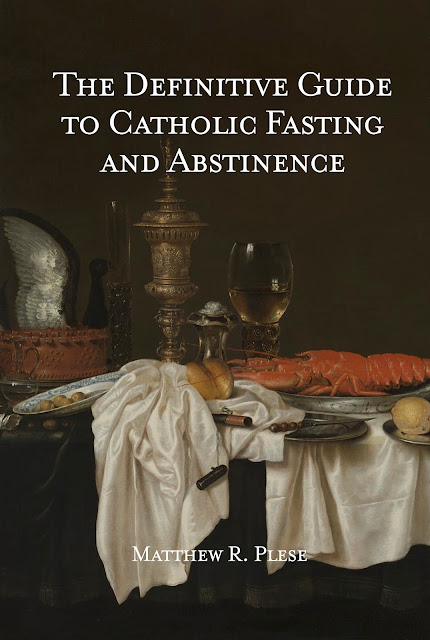
Want to learn more about the history of fasting and abstinence? Check out the Definitive Guide to Catholic Fasting and Abstinence.
Read more >>
Monday, August 17, 2020
Octave Day of Saint Lawrence

This painting is in the parish church of Montreal in southern France. Taken by Fr. Lawrence Lew, OP

Today is the Octave Day of St. Lawrence, the illustrious martyr. For a history of Octaves including the history of the Octave Day of St. Lawrence, which is a simple octave, please see Zephrinus.


Like all of the most important feasts, that of St. Lawrence was traditionally celebrated with an octave; the octave day has a proper Mass, like the octave of Ss. Peter and Paul, sharing only the Epistle and Gospel with the feast day. The introit of this Mass is taken from Psalm 16, which is also said at Matins of St. Lawrence: “Thou hast proved my heart, and visited it by night, thou hast tried me by fire: and iniquity hath not been found in me.” The words “visited (my heart) by night” refer to the Emperor’s threat to torture Lawrence for the length of the night, to which the great Levite answered, “My night hath no darkness, but in it, all things shine brightly in the light.”

Collect:

Grant us, we beseech Thee O almighty God, to extinguish the flames of our evil dispositions, as Thou didst grant blessed Lawrence to overcome the fires of his torments. Through our Lord Jesus Christ, Thy Son, Who liveth and reigneth with Thee in the unity of the Holy Ghost, God, Forever and ever.
Read more >>
Sunday, August 16, 2020
St. Roch, Patron Saint Against Sickness


August 16th is kept in some places as the Feast of St. Roch, the patron saint against sickness and epidemics. Today is also the Feast of St. Joachim, the father of the Blessed Virgin Mary. St. Roch was a citizen of Montpellier in the South of France, who devoted his life to the serving of the plague-stricken. On their behalf, God enabled His servant to work many miracles. He died in 1337 AD and has since been venerated as the special advocate of the sick.

Numerous brotherhoods have been instituted in his honor. He is usually represented in the garb of a pilgrim, often lifting his tunic to demonstrate the plague sore, or bubo, in his thigh, and accompanied by a dog carrying a loaf in its mouth. The Third Order of Saint Francis, by tradition, claims him as a member and includes his feast on its own calendar of saints, observing it on August 17.

The following is taken from CatholicTradition.org:

Born at Montpellier towards 1295, he died in 1327. His father was governor of that city and at his birth St. Roch is said to have been found miraculously marked on the breast with a red cross. Deprived of his parents when about twenty years old, he distributed his fortune among the poor, handed over to his uncle the government of Montpellier, and in the disguise of a mendicant pilgrim, set out for Italy, but stopped at Aquapendente, which was stricken by the plague, and devoted himself to the plague-stricken, curing them with the Sign of the Cross. He next visited Cesena and other neighbouring cities and then Rome. Everywhere the terrible scourge disappeared before his miraculous power. He visited Mantua, Modena, Parma, and other cities with the same results. At Piacenza, he himself was stricken with the plague. He withdrew to a hut in the neighbouring forest, where his wants were supplied by a gentleman named Gothard, who by a miracle learned the place of his retreat. After his recovery Roch returned to France. Arriving at Montpellier and refusing to disclose his identity, he was taken for a spy in the disguise of a pilgrim, and cast into prison by order of the governor, where five years later he died. The miraculous cross on his breast as well as a document found in his possession now served for his identification. He was accordingly given a public funeral, and numerous miracles attested his sanctity.

In 1414, during the Council of Constance, the plague having broken out in that city, the Fathers of the Council ordered public prayers and processions in honour of the Saint, and immediately the plague ceased. His relics, according to Wadding, were carried furtively to Venice in 1485, where they are still venerated. It is commonly held that he belonged to the Third Order of St. Francis; but it cannot be proved. Urban VIII approved the ecclesiastical office to be recited on his Feast. Paul III instituted a confraternity, under the invocation of the Saint, to have charge of the church and hospital erected during the pontificate of Alexander VI. The confraternity increased so rapidly that Paul IV raised it to an archconfraternity, with powers to aggregate similar confraternities of St. Roch. It was given a cardinal-protector, and a prelate of high rank was to be its immediate superior. Various favours have been bestowed on it by Pius IV [C. Regimini, March 7, 1561], by Gregory XIII [C. dated January 5, 1577], by Gregory XIV [C. Paternar. pont., March 7, 1591], and by other pontiffs. It still flourishes.

Collect:

O God, who are glorious in the glory of the Saints, and to all those that flee unto their protection, grantest the salutary effect of their petition; by the intercession of Thy blessed Confessor Roch, grant to Thy people, who hold forth their devotion in his festivity, that they may be delivered from the sickness of that plague which he suffered in his body for the glory of Thy name, to which may they ever be devoted.
Read more >>
Thursday, August 13, 2020
St. John Berchmans


August 13th is kept in some places as the Feast of St. John Berchmans. 

The following is taken from CatholicTradition.org:

St. John Berchmans was born the eldest son of a shoemaker in 1599 at Diest, Belgium. At a very young age he wanted to be a priest, and when thirteen he became a servant in the household of one of the cathedral canons at Malines. After his mother's death, his father and two brothers followed suit and entered religious life. In 1615 he entered the Jesuit college there, becoming a novice a year later. In 1618 he was sent to Rome for more study and was known for his diligence and piety, and his stress on perfection even in small things. That year his father was ordained and died six months later. John was so poor and humble that he  walked from Antwerp to Rome. He died at the age of 22 on August 13. Many miracles were attributed to him after his death; he was canonized in 1888 and is the patron saint of altar boys.

Although he longed to work in the mission fields of China, he did not live long enough to permit it. After completing his course work, he was asked to defend the "entire field of philosophy" in a public disputation in July, just after his exit examinations. The following month he was asked to represent the Roman College in a debate with the Greek College. Although he distinguished himself in this disputation, he had studied so assiduously that he caught a cold in mid-summer, became very ill with with an undetermined illness accompanied by a fever, although some think it now to have been dysentery, and died a week later. He was buried in the church of Saint Ignatius at Rome, but his heart was later translated to the Jesuit church at Louvain.

So many miracles were attributed to him after his death at the age of 22, that his cultus soon spread to his native Belgium, where 24,000 copies of  his portrait were published within a few years of his death. He was known for his devotion to the Blessed Sacrament and to Our Lady, to whom he composed a Chaplet in honor of her Immaculate Conception.

Collect:

Lord our God, you invite us always to give you our love, and you are pleased with a cheerful giver. Give us a youthful spirit, to be like Saint John, always eager to seek you and to do your will. We ask this through our Lord Jesus Christ, your Son, who lives and reigns with you and the Holy Spirit, one God, for ever and ever. Amen.

Taken from Supplement to the Divine Office For the Society of Jesus.

Indulged Prayer from the Raccolta:

Saint John, angelic youth, sweet-scented flower of innocence, stalwart soldier of the Company of Jesus, ardent defender of the Immaculate Conception of the Blessed Virgin, whom the all-wise Providence of God hath set forth as a light and pattern, in order that He might reveal in thee the treasures of that holiness which consisteth in the devoted and holy fulfillment of the common duties of life,  I earnestly beseech thee to make me ever constant and faithful in observing the duties of my state of life, pure in heart, fearless and strong against the enemies of my eternal salvation, and cheerfully obedient to the promptings of God's holy will.

By thy singular devotion to the loving Mother of Jesus Christ, who looked upon thee also as her dear son, obtain for me the grace of a fervent love for Jesus and Mary, together with the power of drawing many others to love them in like manner. Wherefore, dear Saint John, I choose thee as my special patron, humbly beseeching thee to make me zealous in the things that pertain to the praise of God, and to assist me by thy mighty help, to lead a life filled with good works. Finally, when the hour of death cometh, do thou, of thy loving kindness, cherish in me those motions of humble confidence, which at the moment of thy departure from this world to thy mansion in the skies, as thou didst lovingly clasp to thy breast the Image of Jesus Crucified, together with Mary's Rosary and thy Book of Rules, impelled thee to utter these sweet words: "these three things are my dearest possessions; with these I am content to die."

Pray for us, Saint John, that we may be made worthy of the promises of Christ.

Grant, we beseech Thee O Lord God, unto Thy faithful servants, to copy the pattern of innocence and faithfulness in Thy service, wherewith the angelic youth, John, did consecrate to Thee the very flower of his years. Through Christ our Lord. Amen.
Read more >>


Copyright Notice: Unless otherwise stated, all items are copyrighted under a Attribution-NonCommercial-NoDerivatives 4.0 International License. If you quote from this blog, cite a link to the post on this blog in your article.

Disclosure of Material Connection: Some of the links on this blog are “affiliate links.” This means if you click on the link and purchase the item, I will receive an affiliate commission. As an Amazon Associate, for instance, I earn a small commission from qualifying purchases made by those who click on the Amazon affiliate links included on this website. I am disclosing this in accordance with the Federal Trade Commission’s 16 CFR, Part 255: “Guides Concerning the Use of Endorsements and Testimonials in Advertising.”