Saturday, August 13, 2005
Prayer & reflection on it

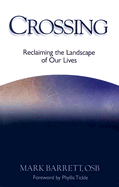
I am currently reading "Crossing: Reclaiming the Landscape of Our Lives" by Mark Barrett, OSB, which is centered on his struggle with prayer and the praying of the Liturgy of the Hours in his monastery. The Liturgy of the Hours is the prayer of the Church at different points in the day, and the author states that he does actually get bored with prayer.

Sometimes even we think "Are my prayers heard?" or "Why do I pray?" but let these thoughts go in one ear and out of the other. We believe in God and should not let doubt try to question our belief in God and the Tradition of the Church passed down through the Holy Church since the time of Christ. Prayer is not just talking with God but a dialogue between our soul and Him. Through prayer we give Our Lord thanks and praise and can ask petitions, but don't just let Mass and prayer become a habit and not an experience. Actually pray the words at Mass instead of just repeating them.

In the book the author describes our days as full of crossroads through a garden (the garden being a metaphor of our life), and only if we rely on God and think clearly about how to improve our lives through prayer can we hope to travel through life without going in circles. Make sure you see prayer as a personal dialogue with God and an opportunity to reflect on our day so far. If you, however, do not rely on God then we are nothing and surely can not find our way through a garden because it would undoubtedly seem a wilderness.

One day St. Franics saw his students reading about God and the saints in classes and was furious because it took away their prayer time and prayer time is the most important part of living with God. Prayer is the water of our soul for the seed of God's word and without water we can not hope to survive in the desert of the world around us.

I'll post a summary of the book when I complete it. I do however greatly recommend purchasing Christian Prayer, which I use to pray the Liturgy of the Hours. I love to use it.
Read more >>
Friday, August 12, 2005
Prayer to Saints


Why Pray to Saints?

A saint is a person who the Church declares possesses the beatific vision (i.e. a saint is someone who is in Heaven) and whose life is worthy of imitation on account of the virtues they possessed.

Catholics are frequently criticized for “praying to the dead” by some non-Catholics who seem to believe that by praying to the Saints we are taking something away from God. We as Catholics know that the relationship we have with the saints is entirely different than the relationship we have with God. Protestants often accuse Catholics of necromancy and idolatry because of our devotion to the saints. These claims are false.

"Therefore, confess your sins to one another and pray for one another, that you may be healed. The fervent prayer of a righteous person is very powerful." -- James 5:16.

We never pray to a saint as the end but rather ask them to pray along with us. They are intercessors for us as they are in the presence of God Himself in Heaven. These men and women in Heaven are very close to God and it makes sense that asking them to pray for us can only cause good. It is common practice to ask fellow human beings on earth to pray to God for us and our intentions. No one rightfully faults this practice. And if death is not the end of life and those who are now in Heaven see God, why should we not ask them for their intercession? 

A basic study of Church history reveals that the honoring of the saints and praying to them is of apostolic origin. The term "saint" is from the Latin word sanctus meaning "hallowed or “consecrated." The first person honored individually as a saint was Stephen, the first martyr, whose death is recorded in The Book of the Acts of the Apostles Chapters 6 and 7. For nearly four centuries, praying to St. Stephen was incredibly popular. Beginning at the end of the second century, there were special celebrations on anniversaries of the martyrs' deaths. These martyrs were witnesses of Christ. By the fourth century, sainthood was not just considered for martyrs. It was also for confessors and virgins. 

How Can the Saints Hear Our Prayers?

“And when he had opened the book, the four living creatures, and the four and twenty ancients fell down before the Lamb, having every one of them harps, and golden vials full of odours, which are the prayers of saints” (Revelations 5:8)

The Book of Revelations written by St. John the Apostle specifically mentions how the prayers of the saints are presented before God in Heaven. The saints in Heaven are very much aware of what is happening on earth because God has in His order of the world permitted them to know of prayers addressed to them. In Matthew 17:3-5, the Prophets Moses and Elijah were very much aware of what was taking place on the earth. The saints themselves are witnesses of what occurs on earth as the Book of Hebrews specifically states: ““Therefore, since we are surrounded by so great a cloud of witnesses, let us rid ourselves of every burden and sin that clings to us and persevere in running the race that lies before us” (Hebrews 12:1). And our Lord Himself in Luke 15:7-10 describes those in Heaven rejoicing over repentance on earth. How could they do so unless in the mystical order of the universe God has somehow permitted them to know and see what was happening on the earth?

Does Praying to the Saints Violate Christ’s Role as Mediator?

“For there is one God, and there is one mediator between God and men, the man Christ Jesus” (1 Tim. 2:5).

Through the hypostatic union, the fact that Jesus Christ, the Second Person of the Blessed Trinity, took on human nature, He alone can truly offer Sacrifice for mankind and stand as the sole mediator between human beings and God the Father. 

However, this does not prevent other mediators between mankind and our Lord. In the four verses immediately preceding 1 Timothy 2:5, Paul says that the Faithful should intercede for each other: “First of all, then, I urge that supplications, prayers, intercessions, and thanksgivings be made for all men, for kings and all who are in high positions, that we may lead a quiet and peaceable life, godly and respectful in every way. This is good, and pleasing to God our Savior, who desires all men to be saved and to come to the knowledge of the truth” (1 Tim. 2:1–4). St. Paul himself asks for intercession to be made for one another. If we can ask fellow Catholics on earth to pray for us to God, what would prevent us from asking fellow Catholics in Heaven to do so? The saints in Heaven are after all truly alive.

Elsewhere in Scripture St. Paul directly asks others to pray for him (Rom. 15:30–32, Eph. 6:18–20, Col. 4:3, 1 Thess. 5:25, 2 Thess. 3:1), and he assured them that he was praying for them as well (2 Thess. 1:11). If Scripture supported the notion that we should only pray to Jesus and not ask others to pray for us to God, then the Scripture would say it with such clarity. But on the contrary, the Scriptures emphasis praying for others.


Why Do Catholics Have Images or Statues of the Saints?

Catholic images include such things as statues, artistic renderings, and other works of art. Some may be concerned that this is a violation of the first commandment, but we know as Catholics that when we see a beautiful statue of the Blessed Mother or one of the saints we don’t actually worship the plaster, but we use it as a way to remind us of that individual. Just as we all display photos in our home to remind us of our loved ones, both living and dead, nobody would accuse us of worshipping or loving the photo rather than the person. Images are a way to draw us closer to God and holiness. We should take advantage of the vast array of Catholic images at our disposal and do our best to incorporate them into our homes as a vehicle for bringing ourselves and our families to the love of God.

In the Old Testament in the Book of Numbers 21:8 God commanded Moses to make the bronze serpent which we learn is a symbol of Jesus Christ (cf. John 3:14). It is only destroyed after it is worshiped (cf. 2 Kings 18:4), the making of it was not a sin. And there were images of the cherubim angels in the temple (cf. 1 Kings 6:23-31) and God blessed the temple (cf. 1 Kings 9:3). Not one line of Scripture ever condemned the creation of images or art of those in Heaven.

Imitating the Saints

The best way to learn to imitate the saints is to immerse oneself in their stories and see the courageous example of their lives. Two great examples are The Passion of the Holy Martyrs Felicity and Perpetus and Sulpitius Severus  On the Life of St. Martin.

Conclusion

Besides considering the Scriptural basis for praying to the saints, we can also look at the manifestation of miracles which attest to the truths of Catholic doctrine. Obviously, God would not bless a false doctrine with an abundance of miracles, and if there were no God, miracles could not be. So, the miracles performed by Catholics saints, and attested to by numerous witnesses of exemplary character, furnish powerful proofs of the divinity of the Catholic religion. And there are so many, we hardly know where to begin. Various authors, such as Joan Carroll Cruz have written extensively about this. Consider reading anything about St. Pio, St. Bernard of Clairvaux, St. Joseph of Cupertino, St. John Bosco, or St. Francis of Assisi. Also try to read anything about the miracles at Fatima, especially John Haffert’s Meet the Witnesses.

There are no reported miracles ever worked by Martin Luther or any protestant “reformer” or clergyman. There are no reported miracles performed and beyond the explanation of science by any religion (e.g. Protestants, Muslims, Jews, Hindus, Buddhists, et cetera) except for Catholic saints. Only the miracles alleged even to modern times by Catholic saints are without scientific proof.
Read more >>
Priests for Life Announces Lay Movement

It appears that Priests for Life has just announced a lay movement. Read about it here on the National Catholic Register.

Image Source: Photograph believed to be in the Public Domain, Title Unknown
Read more >>
Thursday, August 11, 2005
Pro-life Statistics

I just came across new poll results from CBS, which show a majority do not support abortion.

"When asked about their "personal feeling about abortion," 53 percent of respondents said all or most abortions should not be permitted and only 43 percent said all or most abortions should be permitted." (Read the article)

Any comments? What do you think this shows for America? Is it going more pro-life than before?
Read more >>
Daily Lives for Christ

I recently took several suggestions on how to live our daily lives for God and created a top ten list. They are in no particular order, but here are ten ways to live our lives with God as the center. How many do you do?

  1. Pray a morning offering and offer all of your prayers, joys, works, and sufferings of the day to Christ for His glory
  2. Pray at least the morning and evening parts of the Divine Office (Breviary)
  3. Pray the Rosary daily
  4. Forgive those that trespass against us
  5. Celebrate the seasons of the Church by doing something special for each season (Advent, Lent, Septuagesima, Chrsitmastide, Eastertide, etc)
  6. Celebrate your patron saint's feastday as well as for those in your family
  7. Read at least one chapter from Sacred Scripture daily
  8. Pray the Divine Mercy Chaplet once a day (best at 3 PM to remember Our Lord's death) as well as the Angelus at 6 AM, Noon, and 6 PM
  9. If possible visit the Blessed Sacrament in adoration or Mass
  10. At dinner light a candle and say grace before and after meals making sure to give thanks to the Lord for His goodness
Image Source: Believed to be in the Public Domain, Title Unknown
Read more >>
Wednesday, August 10, 2005
Year of the Eucharist

Last year, Pope John Paul ll declared for one year that we would celebrate the Year of the Eucharist - one full year commemorating the greatest of all the Sacraments - Christ's own body, blood, soul, and divinity which we receive in Holy Communion. For those you that have known about this special year, which ends in October, what have you done for it? Have you gone to Eucharistic Adoration or Benediction more often than normal? Have you truly contemplated the greatest and holiest of all miracles which happens at every Mass when bread and wine actually become our Lord and God?

There is still time to spend time with Our Lord. We remember that as He sat alone in the Garden of Gethsamane, when all of His friends left Him, He called out: "Will you not spend one hour with me?" And we still can do just that. You still can spend time in Adoration near you.

Recently on August 5, 2005, Francis Cardinal George of the Archdiocese of Chicago led a Eucharistic procession and Benediction in Grant Park, Illinois with thousands of people (see photos). Cardinal George said: "What needs transformation in individual lives... is anything that keeps people from being free to love God: addictions to alcohol and drugs, to sexual sin, to anger, to racism or other prejudices. These are habits of sin... Christ will change us, Christ will transform us, Christ will free us.'" (Read the whole article)

For more information on the Eucharist see my post on the Eucharist.

Image Source: Image of Archbishop Fulton J Sheen, believed to be in the Public Domain
Read more >>
Tuesday, August 9, 2005
Comment Policy

Comments are strongly encouraged on this blog.

It doesn't matter if you are a Catholic or not - I would love to hear your positions as long as they are done in a respectable manner. Your comment will however be deleted if you deliberately attack or mock Jesus Christ, other posters, or if you use inappropriate language. For example, you can discuss priests without insulting them for the actions of a few bad ones in our contemporary world. Such insults will not be tolerated.

Final decision rests with me, the author of this blog, concerning the deletion of a comment.

Unacceptable comments include but are not limited to:

  1. Posting Insulting, Derogatory, or Attacks against me or another commentor
  2. Posting heretical or blasphemous comments
  3. Posting obscene comments
  4. Advertising or Self-Promotion (email such comments to me directly)
  5. Writing a comment about something completely unrelated to the post you are commenting on
  6. Linking to a video, article, webpage, etc. that I deem anti-Catholic or inappropriate
  7. Posting a non-English Language comment.  Use of Latin within is fine, but a message entirely in another language is not acceptable.
Note: This policy is subject to change without notice.
Read more >>
Monday, August 8, 2005
Make God the center of Our Lives

World Youth Day 2005 SymbolWith World Youth Day approaching, Pope Benedict XVI prepares and is calling for God to be the most important part of our daily lives. We can live this through prayer and love of God and our neighbor.

Adoring God means recognizing his presence as creator and lord of the universe and ensuring that God is the most important part of one's life, Pope Benedict XVI said. With about 2,000 people packed into the courtyard of his summer villa south of Rome and several thousand more people gathered in the square outside the villa Aug. 7, the pope focused his address on the upcoming celebration of World Youth Day. The theme of the Aug. 16-21 celebration in Cologne, Germany, is: "We Have Come to Worship Him." Pope Benedict said an attitude of worship and adoration is the attitude that has marked the lives of saints throughout Christian history. It involves recognizing the greatness of God and the gift of salvation in Jesus with gratitude that "arises from the depths of one's heart and marks one's whole being," he said.

Source: CNS

A plenary indulgence has even been granted to those who participate at World Youth Day. A very large crowd is planned.
Read more >>
Sunday, August 7, 2005
Women in the Priesthood

This is a contemporary topic that has grown into a whole debate nowadays. Women cannot be priests because Jesus only ordained men - His disciples at the Last Supper. God is all power and knows the future, so if He knew this would clear up debate I'm sure He would have chosen a woman if women could be priests. But, since He did not, it is clear the Church holds no power to ordain women. Men and women are created differently and are not physically equal. In the same way, men and women have equally important roles in the spiritual life, but they are different roles.

However, women are in no way regarded lowly in the Catholic Church. Mother Mary is considered the highest of all saints and honored because she is the Mother of God. The Catholic Church also honors other saints that are women such as St. Joan of Arc, St. Mary Magdalene, St. Therese of Avila, St. Therese of Lisieux, and many others. The last one is even considered the most popular saint of modern times, so women are considered very important in the Catholic Church.

Women cannot be priests because it is a difference of roles in the gender. A man certainly can't be a mother, and a man can't be a nun either. Men and women have different roles as parents and also in other parts of society including religion. I don't mean to be sounding as if I think lowly of different people because of gender because that isn't true; however, I do believe men and women have different roles and the Catholic Church would love to see more nuns and religious sisters anyway.

More Information:

Read Ordinatio Sacerdotalis by Pope John Paul ll (The best thing that was written by him)

Image Source: Photograph believed to be in the Public Domain
Read more >>
Saturday, August 6, 2005
Morning Prayer

I would like to take a minute and explain the great importance of a morning offering (Lauds). In a morning offering we offer up to God our prayers, works, joys, and sufferings of the day for His glory and for His intentions.

"All that we do without offering it to God is wasted" (St. John Vianney)

I strongly recommend learning a morning offering and reciting it everday when you wake. This is not only showing that we wish to serve God that day but also that we love Him enough to put Him first at the beginning of a new day.

A Morning Offering:

O, My Jesus, through the Immaculate Heart of Mary I offer thee my prayers, works, joys, and sufferings of this day in union with the Holy Sacrifice of the Mass throughout the world. I offer them for all the intentions of your Sacred Heart: the salvation of souls, reparation of sin, and the reunion of all Christians. I offer them for the intentions of our bishops and all the apostles of prayer, and in particular those recommended by our Holy Father this month.

For those that are interested, the Liturgy of the Hours is a great way to pray each day. It is the prayer of the Church, which is prayed a specific times each day by the pope, priests, bishops, nuns, monks, and many lay people. Ebrievary offers some of the daily prayers online, but I would suggest purchasing a book instead.

"Now, throughout the day, offer up your harships and sacrifices to Jesus, uniting them with His sufferings and merits so that our works gain the merit they can never have apart from Him. It is especially beneficial to offer them to Mary to give to Jesus so that her intercession as Queen Mother of Israel renders them more pleasing.

The Morning Offering can be renewed throughout the day with simple short prayers (called "ejaculations" or "aspirations"), for ex., 'All for Thee, Jesus!'" (Source Read More Here)
Image Source: Believed to be in the Public Domain, Title Unknown
Read more >>
Feast of the Transfiguration

Transfiguration by Giovanni Gerolamo Savoldo, 16th century

Feast (1969 Calendar): August 6
Double of the II Class (1955 Calendar): August 6

Today is the celebration of the Feast of the Transfiguration, when we recall Christ's divinity showing forth on Mount Tabor. This event foreshadowed the glorious Resurrection and Ascension of Christ that would occur after His death on the Cross. This is the beginning of a 40-day before until the Feast of the Holy Cross.
Jesus took Peter, James, and his brother John, and led them up a high mountain apart by themselves. And he was transfigured before them, and his clothes became dazzling white, such as no fuller on earth could bleach them. Then Elijah appeared to them along with Moses, and they were conversing with Jesus.Then Peter said to Jesus in reply, “Rabbi, it is good that we are here! Let us make three tents: one for you, one for Moses, and one for Elijah.” He hardly knew what to say, they were so terrified. Then a cloud came, casting a shadow over them; from the cloud came a voice, “This is my beloved Son. Listen to him.” Suddenly, looking around, they no longer saw anyone but Jesus alone with them. As they were coming down from the mountain, he charged them not to relate what they had seen to anyone, except when the Son of Man had risen from the dead. So they kept the matter to themselves, questioning what rising from the dead meant. Mark 9:2-10
Yet, the greatest mystery in this was not that Christ shone forth in glory. The true mystery is in that Christ kept that light and divinity hidden all during his earthly ministry to save our souls. The 4th Reading at Matins is from a sermon by St. Leo the Great who wrote:
The Lord taketh chosen witnesses, and in their presence, revealeth His glory. That form of body which He had in common with other men, He so transfigured with light, that His Face did shine as the sun, and His raiment became exceeding white as snow. Of this metamorphosis the chief work was to remove from the hearts of the disciples the stumbling at the Cross. Before their eyes was unveiled the splendour of His hidden majesty, that the lowliness of His freely-chosen suffering might not confound their faith. But none the less was there here laid by the Providence of God a solid foundation for the hope of the Holy Church, whereby the whole body of Christ should know with what a change it is yet to be honoured. The members of that body whose Head hath already been transfigured in light may promise themselves a share in His glory.
Before the changes to the Roman Missal in 1955, the Preface for the Nativity was used in Masses today. This changed to the common preface and was included as the preface in the 1962 Missal. The Preface for the Nativity though indicates the hidden reality we contemplate today:
It is truly meet and just, right and for our salvation, that we should at all times and in all places give thanks to Thee, holy Lord, Father almighty, eternal God: for through the Mystery of the Word made flesh, new radiance from Thy glory hath so shone on the eye of the soul that the recognition of our God made visible draweth us to love what is invisible. And therefore with Angels and Archangels, with Thrones and Dominations, and with all the host of the heavenly army we sing a hymn to Thy glory, evermore saying: Sanctus... 
The Transfiguration only became a feast of general observance in the mid-15th century. When it did, the Feast of Ss. Sixtus II and Companions, which was kept on August 6th, was reduced to a Commemoration. Dom Gueranger has more of the history of how this feastday became universal in the Roman Catholic Church:

The origin of today's feast in the West is not so easy to determine. But the authors who place its introduction into our countries as late as 1457, when Callixtus III promulgated by precept a new Office enriched with indulgences, overlook the fact that the pontiff speaks of the feast as already widespread and ‘commonly called of the Saviour.’ It is true that in Rome especially the celebrity of the more ancient feast of St. Sixtus II, with its double Station at the two cemeteries which received respectively the relics of the pontiff-martyr and those of his companions, was for a long time an obstacle to the acceptance of another feast on the same day. Some churches, to avoid the difficulty, chose another day in the year to honor the mystery. As the feast of our Lady of the Snow, so that of the Transfiguration had to spread more or less privately, with various offices and masses, until the supreme authority should intervene to sanction and bring to unity the expressions of the devotion of different Churches. Callixtus III considered that the hour had come to consecrate the work of centuries; he made the solemn and definitive insertion of this feast of triumph on the universal Calendar the memorial of the victory which arrested, under the walls of Belgrade in 1456, the onward march of Mahomet II, conqueror of Byzantium, against Christendom.

Already in the ninth century, if not even earlier, martyrologies and other liturgical documents furnish proofs that the mystery was celebrated with more or less solemnity, or at least with some sort of commemoration, in divers places. In the twelfth century Peter the Venerable, under whose government Cluny took possession of Thabor, ordained that ‘in all the monasteries or churches belonging to his order, the Transfiguration should be celebrated with the same degree of solemnity as the Purification of our Lady'; and he gave for his reason, besides the dignity of the mystery, the 'custom, ancient or recent, of many churches throughout the world, which celebrate the memory of the said Transfiguration with no less honour than the Epiphany and the Ascension of our Lord.’

On the other hand at Bologna, in 1233, in the juridical instruction preliminary to the canonization of St. Dominic, the death of the saint is declared to have taken place on the feast of St. Sixtus, without mention of any other. It is true, and we believe this detail is not void of meaning, that a few years earlier, Sicardus of Cremona thus expressed himself in his Mitrale: 'We celebrate the Transfiguration of our Lord on the day of St. Sixtus.’ Is not this sufficient indication that while the feast of the latter continued to give its traditional name to the eighth of the Ides of August, it did not prevent a new and greater solemnity from taking its place beside it, preparatory to absorbing it altogether? For he adds: ‘Therefore on this same day, as the Transfiguration refers to the state in which the faithful will be after the resurrection, we consecrate the Blood of our Lord from new wine, if it is possible to obtain it, in order to signify what is said in the Gospel: I will not drink from henceforth of this fruit of the vine, until that day when I shall drink it with you new in the kingdom of My Father. But if it cannot be procured, then at least a few ripe grapes are pressed over the chalice, or else grapes are blessed and distributed to the people.’

The author of the Mitrale died in 1215; yet he was only repeating the explanation already given in the second half of the preceding century by John Beleth, Rector of the Paris University. We must admit that the very ancient benedictiouvœ found in the Sacramentaries on the day of St. Sixtus has nothing corresponding to it in the life of the great pope which could justify our referring to him. The Greeks, who have also this blessing of grapes fixed for August 6, celebrate on this day the Transfiguration alone, without any commemoration of Sixtus II. Be it as it may, the words of the Bishop of Cremona and of the Rector of Paris prove that Durandus of Mende, giving at the end of the thirteenth century the same symbolical interpretation, did but echo a tradition more ancient than his own time.

St. Pius V did not alter the ancient office of the feast, except the lessons of the first and second Nocturns, which were taken from Origen, and the three hymns for Vespers, Matins, and Lauds, which resembled somewhat in structure the corresponding hymns of the Blessed Sacrament. The hymn now used for Vespers and Matins, which we here give, is borrowed from the beautiful canticle of Prudentius on the Epiphany in his Cathemerinon.

There is a wonderful custom for blessing fruit on the Feast of the Transfiguration in the Byzantine Catholic Church, which dates back to ancient times. Those who are located near a Byzantine Catholic Church should strive to participate in such a blessing. 

Collect:
O God, Who in the glorious Transfiguration of Thine only-begotten Son didst confirm the mysteries of the faith by the witness of the fathers, and in the voice which came down from the shining cloud, didst wondrously foreshow the perfect adoption of sons: vouchsafe in Thy loving kindness, to make us coheirs with this King of glory, and to grant that we may be made partakers of that same glory. Through the same our Lord.

Prayer Source: 1962 Roman Catholic Daily Missal
Read more >>
Thursday, August 4, 2005
Minnesota Abortion-Fetal Pain Law

Minnesota is the second state in America to have the Unborn Child Pain Prevention Act, second to Arkansas. This bill also appears to have greatly helped cut down on abortions:

"The Minnesota Department of Health says there were 13,788 abortions reported in 2004, compared to 14,174 in 2003 -- a decrease of nearly three percent.

The abortion report covers 2004, the first full year the Woman's Right to Know law was in place. The law requires abortion centers to inform women of abortion risks, complications and alternatives. It also provides women with facts on fetal development throughout gestation, the facts of fetal pain and other vital information.
In 2004, a total of 15,859 pregnant women sought out information about abortion services, but more than 2,100 decided against having an abortion." (Bold emphasis mine)

Source
Read more >>
Wednesday, August 3, 2005
Contaception Bill

I just learned that Gov. Pataki of New York, an abortion supporter, plans on vetoing a bill that would make emergency contraception available over the counter. Although he is a Catholic, he plans to veto it because the bill does not have age restrictions for minors. This is definitely a good step in spreading a pro-life agenda, but I only wish that he would stop supporting abortion rights.

I have also learned that Gov. Romney of Massachusetts has vetoed the same bill. Does anyone know of the faith of this bill in any other states?

More Information:

Why is Contraception Wrong?
Read more >>
Brain-dead woman gives birth to child

After several months of waiting and praying, I just learned that Susan Torres, a brain-dead woman, has just sucessfully given birth to a healthy baby girl. This is a great moment when we know that her child has survived against many great odds. Due to Susan's melanoma, she suffered a stroke on May 7, 2005, and has been on life support. Her husband also has had to quit his job, but I'm very happy to see that the child is safe.

Yesterday on August 2, 2005, the child was born. Unfortunately, Susan Torres (the mother) died today (August 3, 2005) after her life support machines were disconnected. Please say a prayer for her soul. She was raised a protestant but converted to Catholicism in college.

September 11, 2005 Update: The baby has died.

Any donations should be sent to the following address:

The Susan M. Torres Fund
c/o Faith and Action
P.O. Box 34105
Washington, D.C. 20043-0105

Visit the Susan M. Torres Fund.
Read more >>
Monday, August 1, 2005
Stem Cell Research Update

Update. Try this link and click on "send message". Let me know if this works for those of you that couldn't get it to send before.

Original Post: We, as Catholics, believe embryonic stem cell research is intrinsically evil and never acceptable because it requires the killing of a human embryo, a life (read more). We do, however, eagerly support adult stem cell research and umbilical cord stem cell research. Besides the morality, these forms of research have already helped people; no one has ever been helped by embryonic stem cell research.

As of today, July 29th, 2005, Senate Majority Leader Bill Frist has voiced his change of position on the matter and now supports embryonic stem cell research. I urge everyone to write to their Senators and urge them not to support S. 471, which funds embryonic stem cell research. Also, ask them to support S. 658 (ban on human cloning) and S. 1373 (ban the creation of human/animal chimeras).
Read more >>
Sunday, July 31, 2005
A Prayer for the Souls in Purgatory


A prayer is a vital necessity for the Christian life. But through prayer we also can ease the sufferings of the souls in Purgatory by praying for them.
Eternal Father, I offer Thee the Most Precious Blood of Thy Divine Son, Jesus, in union with the masses said throughout the world today, for all the holy souls in purgatory, for sinners everywhere, for sinners in the universal church, those in my own home and within my family. Amen.
Say this prayer for the souls in Purgatory. Our Lord told St. Gertrude the Great that 1,000 souls would be released from Purgatory every time this is said. This prayer has now even been "extended to living sinners which would alleviate the indebtedness accrued to them during their lives."
Read more >>
Saturday, July 30, 2005
What are Indulgences?


Preface: For a listing of hundreds of prayers with indulgences and special blessings attached to them, be sure to refer to a copy of the Raccolta oftenClick here to order one.

What Are Indulgences?

Pope Paul VI said: “An indulgence is a remission before God of the temporal punishment due to sins whose guilt has already been forgiven, which the faithful Christian who is duly disposed gains under certain defined conditions through the Church’s help when, as a minister of redemption, she dispenses and applies with authority the treasury of the satisfactions won by Christ and the saints” (Indulgentiarum Doctrina 1).

An indulgence is a removal of the temporal punishment due to sin. Although you are forgiven in Confession for sins, the punishment stills remains, which would have to be achieved through purification like that accomplished in Purgatory. If an indulgence is performed and earned, then part or all of this punishment is removed. Catechists often use the story of a boy hitting a baseball through his neighbor’s window to explain indulgences. The neighbor forgives the boy for the offense – which corresponds to our forgiveness in the confessional – yet the boy must still make restitution and pay for a new window – which relates to our need for penance to remove the temporal effects of sin.

Remember, indulgences are only possible because of God’s infinite Love, most perfectly displayed upon the Cross. Without Jesus Christ, Who won all the graces we can ever receive through indulgences or otherwise, we would have no chance to be forgiven and obtain salvation. 


How Much Merit Does the Church Have to Give Away in Indulgences?

Holy Mother Church possesses an infinite treasury of merits that can be applied to souls. This treasury is composed of the merits of earlier acts of those who are now in Heaven or who are still on Earth that they did not need at the time of their act (i.e. their souls were already clean from the temporal punishment due to sin). This excess is not ‘lost’ if the person performing the indulged act does not ask God to apply the merits to someone in particular, in which case they remain in the Church’s treasury.

However, these merits are small, in fact infinitely small, in comparison to the merits won by Our Lord on the Cross. By His Sacrifice, Our Lord won for us an infinite treasure of merits which He entrusts to His Bride, the one holy Catholic Church. This treasury as such can never run out. There is no concern that the Church will run out of merits to apply to us for our indulged acts.

How Are Indulgences Classified?

While there are in general only two “kinds” of indulgences (partial and plenary), there are various terms used to classify or distinguish them. The more common ecclesiastical terms include: universal, local, perpetual, temporary, plenary, and partial.

A universal indulgence is granted anywhere in the world, while a local indulgence applies to only a specific place or area. A perpetual indulgence is one that may be gained at any time, while a temporary indulgence is only available for certain times – for example, like certain indulgences for the Holy Souls in November. A plenary indulgence is the complete remission of the temporal punishment due to sin, while a partial indulgence is the remission of only some of the temporal punishment.

Indulgences only remit (or ‘cancel out,’ in more colloquial language) a certain amount of temporal punishment, of which only God knows. If more temporal punishment remains, more indulgences or time in Purgatory (which is also biblical) is required in order to reach the perfection of Heaven.

It is important to realize that although many older holy cards and prayer books indicate a certain length of time of indulgence – for example, 300 days partial indulgence – time as we know it does not exist in Purgatory or Heaven or hell. The Church has never taught that if such a prayer was said, the person would ‘automatically’ get 300 days off their Purgatory time. Ultimately, an indulgence only reduces temporal punishment as God, in His perfect justice and mercy, deems fit. Rather, these time frames corresponded only to penitential practices as were commonly prescribed by the early Church. For example, the 300 days indulgence would correspond to 300 days of earthly fasting and penance. Since it was so misunderstood, most prayer cards no longer print these dates, referring to indulgences instead as either partial or plenary.


The Catechism of St. Pius X states the following:

124 Q. What is an Indulgence?
A. An Indulgence is the remission of the temporal punishment due on account of our sins which have been already pardoned as far as their guilt is concerned — a remission accorded by the Church outside the sacrament of Penance.

125 Q. From whom has the Church received the power to grant Indulgences?
A. The Church has received the power to grant Indulgences from Jesus Christ.

126 Q. In what way does the Church by means of Indulgences remit this temporal punishment?
A. The Church by means of Indulgences remits this temporal punishment by applying to us the superabundant merits of Jesus Christ, of the Blessed Virgin and of the Saints, which constitute what is known as the Treasure of the Church.

127 Q. Who has the power to grant Indulgences?
A. The Pope alone has the power to grant Indulgences in the whole Church, and the Bishop in his own diocese, according to the faculty given him by the Pope.

128 Q. How many kinds of Indulgences are there?
A. Indulgences are of two kinds: plenary and partial.

129 Q. What is a plenary Indulgence?
A. A plenary Indulgence is that by which the whole temporal punishment due to our sins is remitted. Hence, if one were to die after having gained such an Indulgence, he would go straight to Heaven, being, as he is, perfectly exempt from the pains of Purgatory.

130 Q. What is a partial Indulgence?
A. A partial Indulgence is that by which is remitted only a part of the temporal punishment due to our sins.

131 Q. Why does the Church grant Indulgences?
A. In granting Indulgences the Church intends to aid our incapacity to expiate all the temporal punishment in this world, by enabling us to obtain by means of works of piety and Christian charity that which in the first ages Christians gained by the rigour of Canonical penances.

132 Q. What is meant by an Indulgence of forty or a hundred days or of seven years, and the like?
A. By an Indulgence of forty or a hundred days, or of seven years and the like, is meant the remission of so much of the temporal punishment as would have been paid by penances of forty or a hundred days, or seven years, anciently prescribed in the Church.

133 Q. What value should we set on Indulgences?
A. We should set the greatest value on Indulgences because by them we satisfy the justice of God and obtain possession of Heaven sooner and more easily.

134 Q. Which are the conditions necessary to gain Indulgences?
A. The conditions necessary to gain Indulgences are: (1) The state of grace (at least at the final completion of the work), and freedom from those venial faults, the punishment of which we wish to cancel; (2) The fulfilment of all the works the Church enjoins in order to gain the Indulgence; (3) The intention to gain it.

135 Q. Can Indulgences be applied also to the souls in Purgatory?
A. Yes, Indulgences can be applied also to the souls in Purgatory, when he who grants them says that they may be so applied.

136 Q. What is a Jubilee?
A. A Jubilee, which as a rule is granted every twenty-five years, is a Plenary Indulgence to which are attached many privileges and special concessions, such as that of being able to obtain absolution from certain reserved sins and from censures, and the commutation of certain vows.

The Conditions for All Indulgences:
  1. Person must be in the state of grace by the completion of the indulgence.
  2. The person must also want to gain the indulgence.
The Additional Conditions for Plenary Indulgences:
  1. The above conditions as well as the following:
  2. One is free from all attachment from sin, even venial sins
  3. One receives the Sacraments of Penance and the Eucharist (Within 7 days of the indulgence)
  4. One prays for the intentions of the Pope (Apostles Creed, 1 Our Father, and any other prayers)
If a person does not meet the plenary criteria but meets the criteria for a partial indulgence, the individual will obtain the partial indulgence. A plenary indulgence can be gained only once a day unless the person is in danger of death.

List of Various Indulgences:
  1. Also see a listing of prayers with the ones with indulgences marked
  2. There are indulgences for reading the Bible
  3. Some Rosary Indulgences
  4. The Stations of the Cross have a plenary indulgence attached (see bottom of link's page for more information on obtaining the indulgence)
  5. New Years Day & New Years Eve Indulgences 
  6. Holy Thursday has a special indulgence for praying "Tantum Ergo"
  7. Indulgences for All Saints Day, All Souls Day, and November
  8. Indulgences for Pentecost
  9. Indulgence for the Feast of Portiuncula (August 2nd)
  10. Indulgence for the Solemnity of Christ the King
  11. "A plenary indulgence is granted to the faithful, who in the solemn liturgical action of Good Friday devoutly assist at the adoration of the Cross and kiss it" (Source)
  12. "A plenary indulgence is granted to the faithful, for the recitation of En ego, o bone et dulcissime Iesu after reception of Communion on a Friday during Lent before an image of the crucified Christ"
  13. "A plenary indulgence is granted to the faithful, who devoutly receive the Papal Blessing to the City and to the World (Urbi et Orbi), even if by radio or television"
  14. "A plenary indulgence is granted to the faithful, who spend at least three days in spiritual exercises during a retreat"
  15. "A plenary indulgence is granted to the faithful, who recite The Act of Reparation to the Sacred Heart of Jesus on the Solemnity of the Sacred Heart"
  16. "A plenary indulgence is granted to the faithful for visiting a church or altar on the day of its dedication"
  17. Plenary Indulgence at the Hour of Death 
  18. For teaching or studying Christian Doctrine
  19. Indulgence for reciting the Act of Reparation to the Sacred Heart on the Feast of the Sacred Heart
Read more >>
Thursday, July 28, 2005
The Two Pillars

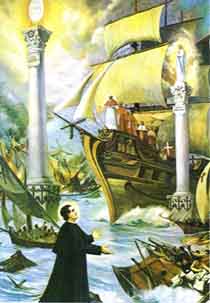
The Vision of St. John BoscoI feel compelled to write this after naming my blog "A Catholic Life" because this story is fundamental in the journey of a Christian life. Everyone will agree that there are many ways to grow in grace. "Grace is first and foremost the gift of the Spirit that sanctifies us", which includes the Spirit working through the Sacraments (CCC 2003). We, unlike the people of the Old Testament, have the greatest grace ever in our hearts at ever Mass when we receive Holy Communion.

Salvation is not possible outside of the Catholic Church (more info). Everyone is called to holiness to be with God through the One True Faith established by Christ, and as today's Gospel illustrates, we must look after ourselves and the state of our soul first and foremost. For the day of the harvest will come, and we must ask ourselves: "If that day was tomorrow, would I be ready?"

I found an article yesterday describing a vision from St. John Bosco, who envisioned the Church as a boat that could only be saved when between two pillars: The Eucharist and Devotion to Mary. This is a vital part of the Christian Life: without the Eucharist we have no hope, and without Mary we lose a powerful intercessor and a loving Mother.

In the dream the boat of the Church was lead by its Pope through the sea with many ships nearing it to attack. Suddenly the Pope falls ill but upon rises up. Then he falls a second time and he dies. The other ships erupt in joy, but a new Pope rises up in the old one's place and steers the vessel between the two pillars -the Eucharist, which the Pillar states is the "Salvation of Souls," and the other pillar is the Immaculate Heart of Mary, which says, "The help of Christians."

Image Source: Believed to be in the Public Domain, Title Unknown
Read more >>
Wednesday, July 27, 2005
Union Between Christ and His Church

I found this in the Catechism of the Catholic Church while looking for quotations concerning Mary. What do you think of this? I think it reaffirms the great importance of the Church first found in Matthew 16:18

The Church—mystery of man's union with God

772 It is in the Church that Christ fulfills and reveals his own mystery as the purpose of God's plan: "to unite all things in him." St. Paul calls the nuptial union of Christ and the Church "a great mystery." Because she is united to Christ as to her bridegroom, she becomes a mystery in her turn. Contemplating this mystery in her, Paul exclaims: "Christ in you, the hope of glory."

773 In the Church this communion of men with God, in the "love [that] never ends," is the purpose which governs everything in her that is a sacramental means, tied to this passing world. "[The Church's] structure is totally ordered to the holiness of Christ's members. And holiness is measured according to the ‘great mystery' in which the Bride responds with the gift of love to the gift of the Bridegroom." Mary goes before us all in the holiness that is the Church's mystery as "the bride without spot or wrinkle." This is why the "Marian" dimension of the Church precedes the "Petrine."

Image Source: Believed to be in the Public Domain, Title Unknown
Read more >>
Weekly Discussion Topics

I am going to take next week off from the weekly discussion topic and see how many people here would like to have this continued. I would like to see how many people like this feature. So, if you like having a weekly discussion topic just let me know by commenting below.

Thanks
Read more >>


Copyright Notice: Unless otherwise stated, all items are copyrighted under a Attribution-NonCommercial-NoDerivatives 4.0 International License. If you quote from this blog, cite a link to the post on this blog in your article.

Disclosure of Material Connection: Some of the links on this blog are “affiliate links.” This means if you click on the link and purchase the item, I will receive an affiliate commission. As an Amazon Associate, for instance, I earn a small commission from qualifying purchases made by those who click on the Amazon affiliate links included on this website. I am disclosing this in accordance with the Federal Trade Commission’s 16 CFR, Part 255: “Guides Concerning the Use of Endorsements and Testimonials in Advertising.”