Sunday, July 16, 2006
Our Lady of Mt. Carmel & The Brown Scapular


Optional Memorial (1969 Calendar): July 16
Greater Double (1955 Calendar): July 16
Commemoration (1962 Calendar): July 16

The Feast of Our Lady of Mount Carmel commemorates when Our Lady appeared to St. Simon Stock, the superior general of the Carmelites, in Cambridge, England, on Sunday, July 16, 1251. The Carmelite Order was founded in the 1100s on Mount Carmel, the same place in the Holy Land mentioned in the Bible in 1 Kings 18:16-40. It was there that the prophet Elijah took his stand against the pagan prophets of Baal and Asherah by the power of God.

St. Simon Stock had appealed to Mary through prayer to help the new Carmelite order to overcome oppression. She appeared with the Brown Scapular and said to him:
"Take, beloved son, this scapular of the order as a badge of my confraternity and for you and all Carmelites a special sign of grace; whoever dies in this garment, will not suffer everlasting fire. It is the sign of salvation, a safeguard in dangers, a pledge of peace and of the covenant"
Later that day, St. Simon Stock was called promptly by Lord Peter of Linton: "Come quickly, Father, my brother is dying in despair!" St. Simon Stock placed his large Scapular over the dying man and prayed that Mary would keep her promise. The man instantly repented of his sins and died in a state of grace. Blessed Pope Gregory X was buried wearing the Scapular, only 25 years after the vision. When his tomb was opened over 600 years later, the wool scapular remained perfectly intact and had not degraded in the least.

The Church keeps the feast of Our Lady of Mount Carmel on July 16th. And to show just how important the Scapular is, she sanctions and encourages the promises of the Scapular. The Blessed Mother promised that whoever dies clothed in the Scapular will not suffer eternal fire. This promise though requires a few conditions on our part. It is not just a piece of magic where we seek to bend the will of God to us. Catholics do not believe in magic. But we do believe in the Scapular as a Sacramental through which we can receive God’s through if we have the right dispositions.

Requirements of the Brown Scapular:
  • The Scapular must hang over the shoulders with one side hanging in the front and the other side hanging in the back
  • The Scapular must be made of 100% wool and be either square or rectangular 
  • One must be properly enrolled in the Brown Scapular. Any priest may say the prayers of enrollment in the Brown Scapular. But wearing the Scapular without the enrollment does not permit the wearer to receive the benefits of the Brown Scapular.
  • One must wear the Scapular at all times. It may of course be taken off to bathe and swim. But the Brown Scapular is not just a devotion we pull out from time to time. It must, with only certain exceptions, be worn at all times.
Sometimes confusion arises on these requirements. Please refer to the website of the Sisters of Carmel for answers to common questions concerning the Scapular.

There is also a promise called the Sabbatine Privilege that is also concerning the Brown Scapular. 

It is piously believed that the Blessed Virgin Mary gave to Pope John XXII in a vision, that She will deliver Her faithful children who have worn the Scapular devoutly from purgatory soon after their death, notably the first Saturday after death. Her words to Pope John XXII: “As a tender Mother, I will descend into purgatory on the Saturday after their death, and will deliver them into the heavenly mansions of life everlasting.”  This Sabbatine Privilege was promulgated and taught through the famous Bull Sacratissimo Uti Culmine (Sabbatine Bull) of Pope John XXII in 1322 and given definitive ratification in 1908 by the Holy See.

Requirements for the Sabbatine Privilege:
  • Wear the Brown Scapular Continuously (as mentioned above)
  • To observe chastity according to one’s state in life
  • Lastly, the daily recitation of the Little Office of the Blessed Virgin Mary or to abstain from meat on Wednesdays and Saturdays or with the permission of a priest say 5 decades of the Holy Rosary.
Such promises are serious. And God has blessed the Scapular with many miracles, as if to indicate the blessing of the Scapular and the promises attached to them.

In May of 1957, a Carmelite priest in Germany published the unusual story of how the Scapular saved a home from fire. An entire row of homes had caught fire in Westboden, Germany. The pious inhabitants of a 2-family home, seeing the fire, immediately fastened a Scapular to the main door of the house. Sparks flew over it and around it, but the house remained unharmed. Within 5 hours, 22 homes had been reduced to ashes. The one structure which had the Scapular attached to its door. The hundreds of people who came to see the place Our lady had saved are eye-witnesses to the power of the Scapular and the intercession of the Blessed Virgin Mary.

Another Scapular story that bears repeating took place in 1845. In the late summer of that year, the English ship, "king of the Ocean" found itself in the middle of a wild hurricane. As wind and sea mercilessly lashed the ship, a Protestant minister, together with his wife and children and other passengers, struggled to the deck to pray for forgiveness and mercy, as the end seemed at hand. Among the crew was a young Irishman, John McAuliffe. On seeing the urgency of the situation, the youth opened his shirt took off his Scapular, and, making The sign of the Cross with it over the raging waves tossed it into the ocean. At that very moment, the wind calmed. Only one more wave washed the deck, bringing with it the Scapular which came to rest at the boy's feet. All the while the minister; a Mr. Fisher, had been carefully observing McAuliffe's actions and the miraculous effect of those actions. Upon questioning the young man, they were told about the Holy Virgin and Her Scapular. Mr. Fisher and his family were so impressed that they were determined to enter the Catholic Church as soon as possible, and thereby enjoy the same protection of Our Lady's Scapular.

One of the most extraordinary of all Scapular incidents took place right here in the United States. It happened around the turn of the century in the town of Ashtabula, Ohio, that a man was cut in two but a train; he was wearing the Scapular. Instead of dying instantly, as would be expected he remained alive and conscious for 45 minutes -- just enough time until a priest could arrive to administer the Last Sacraments. These, and other such incidents, tell us that Our Blessed Mother will take personal care of us in the hour of our death. So great and powerful a Mother is Mary that She will never fail to keep the Scapular contract, i.e. to see that we die in God's grace.

These are just some of the many miracles attributed to the Blessed Mother. There are many, many others attributed to the Brown Scapular.


"One Day, through the Rosary and the Scapular, I will save the world” (Words of our Lady to St. Dominic)

In wearing the Scapular at all times we make silent petition for the Blessed Mother’s continual assistance. We share in all the prayers and good works of the Carmelite Scapular Confraternity throughout the world. Pope Pius XII often spoke of the Scapular. On the 700th anniversary of the appearance of Our Lady to St. Simon Stock, Pope Pius XII referred to the Scapular as “the sign of Consecration to the Immaculate Heart of Mary”. The Scapular also represents the sweet yoke of Jesus Christ, which Mary helps us to bear. And finally, the pope continued, the Scapular marks us as one of Mary’s chosen children, and becomes for us (as the Germans call it) a “Garment of Grace”. St. Claude tells us, “Of all the pious practices which have inspired the faithful to honor the Mother of God, there is none so sure as that of the Scapular.

No other devotion has been confirmed by so many and such extraordinary miracles.” As we mentioned above, during the Scapular Anniversary celebration in Rome in 1951, Pope Pius XII told a very large audience to wear the Brown Scapular as a sign of consecration to the Immaculate Heart of Mary. Our Lady asked for this consecration in the last apparition at Fatima, when She appeared as Our Lady of Mount Carmel, holding the Brown Scapular out to the whole world. It was Her last moving appeal to souls to wear Her Scapular as a sign of consecration to Her Immaculate Heart.

Are there any friends who need to know about the scapular? Share this with them. Do you need to encourage any Catholics who were never enrolled to be enrolled? Do you know any Catholics who were enrolled long ago and no longer wear the Scapular. Consider buying them a Scapular. Even if they are not overly religious, they will likely never refuse a gift.

Click here to browse various affordable Scapulars for sale.

Also, it’s important to realize that the Brown Scapular is only one of 17 different approved Scapulars. All of the other Scapulars have various requirements and promises. You would need to be enrolled in each of them as all have different prayers of enrollment.

Prayer:

O God, Who hast honored the Order of Carmel with the special title of Thy most Blessed Mother Mary, ever Virgin: mercifully grant, that we who celebrate her memory this day with solemn office, may be shielded by her protection and deserve to come to everlasting joys: Who livest and reignest.

Prayer Source: 1962 Roman Catholic Daily Missal


11. BLESSING AND INVESTITURE WITH SCAPULAR OF OUR LADY OF MOUNT CARMEL (1962 Rituale Romanum)

(Formerly reserved to the Order of Discalced Carmelites)

The person who is to receive the scapular is kneeling. The priest vested in surplice and white stole, says:

The antiphon, versicles, and the prayer "May Christ," etc., for all of which see below. Then he adds the following versicles and oration:

P: Our help is in the name of the Lord.

All: Who made heaven and earth.

P: Blessed be the name of the Lord.

All: Both now and forevermore.

P: Lord, heed my prayer.

All: And let my cry be heard by you.

P: The Lord be with you.

All: May He also be with you.

Let us pray.

Almighty God and everlasting Father, who willed that your only- begotten Son be clothed in our mortal nature, we humbly beg you in your boundless goodness to let your blessing + flow out on this garment, which our holy fathers have sanctioned to be worn by those who renounce the world, in token of innocence and lowliness. Let it please you to endow it with such blessing, + that he (she), who is to wear it, may likewise put on our Lord Jesus Christ, your Son, who lives and reigns with you, in the unity of the Holy Spirit, God, forever and ever.

All: Amen.

Then he says the prayer "We earnestly beg you," etc., see below; after which he sprinkles the habit with holy water. If only the habit is to be blessed, the blessing begins with the versicle Our help etc. (see above) and concludes with the aforementioned prayer "We earnestly beg you," etc.

As he invests the person with the habit he says: "Take, dear brother," etc. (see below); after which he adds:

Lord, hear our humble entreaties, and help this servant of yours, whom we enroll in the holy sodality of the Carmelites, to be ever constant and true to his (her) proposal, and to serve you in all holiness. Protect your servant, Lord, with the saving grace of peace; and as he (she) confides himself (herself) to the patronage of blessed Mary, ever a Virgin, let him (her) be safe from all adversaries.

Then he blesses the new member with the sign of the cross, using the prayer "May almighty God," etc., below.

He sprinkles the person with holy water; after which he adds:

By the delegated power which I enjoy, I receive you into the confraternity of the holy order of Carmelites, and enroll you as a partaker of all the spiritual benefits of this order; in the name of the Father, and of the Son, + and of the Holy Spirit.

All: Amen.
Read more >>
Little Office of the Blessed Virgin Mary

The Little Office of the Blessed Virgin Mary began as an abridged version of the Common of the Blessed Virgin in the Divine Office. In the 10th century, it became widespread as a votive office, and in the 11th century was reorganized by St. Peter Damian. By the 12th century it was used throughout Europe and obligatory for all clergy. It was also popular among the laity. The obligation was lifted by St. Pius V in 1568. At the Council of Trent, the Little Office was de-emphasized in favor of the Divine Office (The Liturgy of the Hours), the prayer of the Church.

After Trent, the Little Office became a devotional office, prayed by nonclerical religious. It was revised in 1952, with the addition of many new texts.

The traditional version of the Little Office of the Blessed Virgin Mary is available on Amazon.com.
Read more >>
Saturday, July 15, 2006
Pray for our Separated Brethren

In the past few days, a growing number of Protestants have visited my blog. First and foremost, I have nothing against the people but rather the theology of Protestant denominations.

Two of the greatest problems I have with Protestants is their belief in "Faith-alone" and "Scripture-alone". These are wrong - period. In addition to all of their Sacraments except Baptism and marriage in some cases being invalid, Martin Luther abolished the Mass, refused to believe in Purgatory, and denied the power of the saints' intercession for us, et cetera. Several Protestant comments were posted on my posts: What's wrong with Martin Luther, Gay Marriage Defeated, & Will All Catholic be saved.

Please pray that all Protestants will reunite with the Catholic Church so that we "might be one" as Our Lord prayed (John 17:21).

Image Source: Pope Pius XII
Read more >>
Daily Offering to the Sacred Heart of Jesus for the Dying


O Lord Jesus Christ, in union with that Divine intention with which Thou, whilst on earth, didst give praise to God through Thy most Sacred Heart, and which Thou dost still everywhere offer to Him in the Holy Eucharist, even to the consummation of the world, I, in imitation of the most sacred heart of the ever immaculate Virgin Mary, do most cheerfully offer Thee, during this entire day, all my thoughts and intentions, all my affections and desires, my words, and all my works, for those who are dying this day and have no one to pray for them. Amen

Read more >>
Friday, July 14, 2006
Persecuting the Church is Persecuting Jesus

Image Source: Body of Pope Benedict XV

Those people who claim to approach Christ whilst leaving his Church to one side, and even causing her harm, may one day get the same surprise as Saint Paul did when he was on his way to Damascus: I am Jesus whom you are persecuting. (Acts 9:5) And, the Venerable Bede reflects that He does not say "why are you persecuting my members, but why are you persecuting me?" For He is still affronted in his Body, which is the Church. Paul did not know until that moment that to persecute the Church was to persecute Jesus himself. When he speaks about the Church later on, he does so in words that describe her as the Body of Christ; (1 Cor 12:27) and he describes the faithful as members of Christ's Body. (1 Cor 2:27) It is not possible to love, follow or listen to Christ, without loving, following, or listening to the Church, because she is the presence, at once sacramental and mysterious, of Our Lord, who prolongs his saving mission in the world to the very end of time."

Source: In Conversation With God Vol 4 by Francis Fernandez
Read more >>
Contact your Senators: Stem Cell Research vote on Tuesday!

This coming Tuesday, July 18, 2006, the United States Senate will be voting on three very important life bills - two of which are pro-life. Cardinal William Keeler is urging the Senate to reject HR 810 while supporting the other two bills. Please email your US Senators immediately.

Most importantly, ask your United States Senators to vote against HR 810, which would use taxpayer funds to pay for embryonic stem cell research. According to today's LifeNews report, it is very likely that HR 810 will pass; however, President George W. Bush has promised to veto this bill! That is excellent. And if he does veto it, it is very unlikely that a 2/3 majority will pass the bill in the House of Representatives (1) It would be his first veto as President.

At the same time ask your Senators to vote in support of Brownback-Santorum bill to ban "fetal farming" and the Santorum-Specter bill to fund alternative methods of producing genetically controlled, pluripotent stem cells -- the same kind of stem cells we would get from cloning, but without the embryo destruction. Congress can support stem cell research without destroying life! (2)

Please contact your represenatives. You can quickly find addresses, phone numbers, and email contact information for your two senators by going to the official website of the United States Senate. Since the vote is just this coming next Tuesday, I recommend sending them an email. After you contact them, please pass this along to others through your blogs and email. We need to get the word out as soon as possible.

Myths and Facts on Embryonic Stem Cell Research:
Myth: Embryonic stem cell research is curing patients and doing a better job than the use of adult stem cells.

Fact: Embryonic stem cell research has not only yet to cure a single human patient, but it has never been tried on humans because of failures in animal testing. On the other hand, adult stem cells have already produced 70 cures or treatments for various conditions including various cancers such as breast cancer, lymphomas, leukemia, arthritis, heart damage, Parkinson’s, Sickle Cell Anemia and other disorders. (See http://www.stemcellresearch.org/facts/treatments.htm).


Myth: Embryonic stem cell research has the potential to cure Alzheimer's patients like President Ronald Reagan.

Fact: Leading researchers say stem cell research will not likely yield cures for Alzheimer's. "Alzheimer's is a more global disease, with an effect on numerous kinds of cells," Steve Stice, a stem cell researcher at the University of Georgia, told the Atlanta Journal-Constitution newspaper. "That makes it much more difficult for a cell therapy to be effective." Marilyn Albert, a Johns Hopkins University researcher, adds, "I just think everybody feels there are higher priorities for seeking effective treatments for Alzheimer's disease and for identifying preventive strategies."


Myth: An overwhelming majority of Americans want to spend federal funds on embryonic stem cell research.

Fact: The most recent poll on the subject, conducted by International Communications Research in mid-May, finds 48% of Americans oppose federal funding of stem cell research that requires destroying human embryos. Just 39% support such funding and another 12 percent had no position. The ICR survey found 57% favored funding only the research avenues that do not harm the donor. Just 24% favored funding all stem cell research, including the type that involves destroying human embryos.

(Received the Myth/Fact sheet in an email)
Read more >>
Thursday, July 13, 2006
Words of Inspiration: July 13, 2006

"Even if you give somebody a glass of water, you do it to Jesus" (Blessed Mother Teresa)

Image Source: Unknown, Believed to be in the Public Domain
Read more >>
Will All Catholics Be Saved?


No! It is not enough to be a Catholic to get to Heaven. One has to be a good Catholic. "Many Catholics will be lost, because they are only nominal, not practical, Catholics, and because they reject some doctrines of the Catholic Church, especially such as oppose their inclinations and passions. Remember, he who rejects even one doctrine proposed to our Faith by the Church will certainly be lost (James 2:10), even though he should lead a good life." (From THE PULPIT ORATOR, Volume VI.)

Our Lord said, "He who believes shall be saved" (Mark 16:16)~ But God said many other things as well:

"If you love me, keep my commandments" (John 14:15); and "If thou wilt enter into life, keep the commandments" (Matt. 19:17).

"He that blasphemeth the name of the Lord, dying let him die" (Lev. 24:16).

"Keep you my Sabbath: for it is holy unto you. He that shall profane it, shall be put to death. Everyone that shall do any work on this day shall die" (Exodus 3l:1-15).

"Know you not that the unjust shall not possess the kingdom of God? Do not err: neither idolaters, nor thieves, nor covetous, nor drunkards, nor railers, nor extortioners, shall possess the kingdom of God" (1 Cor. 6:9-10).

"A thief is better than a man that is always lying: but both of them shall inherit destruction" (Ecclus. 20:27).

"Neither fornicators nor adulterers . . . shall possess the kingdom of God" (1 Cor. 6:9). "You have heard that it was said to the Ancients, 'Thou shalt not commit adultery.' But I say to you that anyone who so much as looks with lust at a woman has already committed adultery with her in his heart." (Matt. 5:27-28). "Keep thyself chaste" (1 Tim. 5:22). "Blessed are the clean of heart for they shall see God" (Matt. 5:8).

"There is not a more wicked thing than to love money, for such a one setteth even his own soul at stake."(Ecclus. 10:10).

"If anyone lie with a man as with a woman, both have committed an abomination. Let them be put to death" (Lev. 20:13).

"Hear me, and I will show thee who they are, over whom the devil can prevail. For they who in such manner receive matrimony, as to shut out God from themselves, and from their mind, and to give themselves to their lust, as the horse and mule, which have not understanding, over them the devil has power" (Book of Tobias, 6:1&22).

And Christ's Mystical Body on earth, His Church ("He who hears you, hears Me" - Luke 10:16), says:

"Each act of marriage must be left open to conception" (Pope Pius Xl's Encyclical "Casti Connubi", December 31, 1930).

"If anyone says that the commandments of God are, even for one that is justified and constituted in grace, impossible to observe, let him be anathema" (Council of Trent, Canon 18 on Justification).

"If anyone says that a man who is justified and however perfect is not bound to observe the commandments of God and the Church, but only to believe, as though the Gospel were a bare and absolute promise of eternal life without the condition of obeying the commandments, let him be anathema" (Council of Trent, Canon 20 on Justification).

Therefore, although it is true that Catholics alone profess the true faith "without which," as St. Paul assures us, "it is impossible to please God" (Heb. 11:6); nevertheless, as St. James concludes: "Faith, without good works, is dead" (James 1:22:27).

"Sometimes people say 'It is better to be a good Protestant than a bad Catholic.' That is not true. That would mean at bottom that one could be saved without the true Faith. No, a bad Catholic remains a child of the family - although a prodigal; and however great a sinner he may be, he still has the right to mercy. Through his faith, a bad Catholic is nearer to God than a Protestant is, for he is a member of the household, whereas the Protestant is not. And how hard it is to make him become one!" (St. Peter Julian Eymard, 1811-1868).

Source: Open Letter to Non-Catholics
Read more >>
Miracle attributed to Venerable Margaret Sinclair?

Church officials are looking into reports that a deceased nun helped a premature baby from Scotland to live after doctors gave up hope for the infant’s life. The baby's family was given permission to place the relic of Venerable Margaret Sinclair in the incubator of the infant, who weighed just one pound when born. Today he is four months old and healthy.

"Pope John Paul II told me when we were discussing the cause of Margaret Sinclair to ask the people to pray for a miracle and this has been happening,” said Edinburgh Archbishop, Cardinal Keith O'Brien. He also said that we must be cautious. The doctors and nurses are being asked to send medicals statements to Church officials.

Sr. Margaret died in 1925. Pope Paul VI declared her a Servant of God in February 1978. If this is declared a miracle, she will be beatified. If declared a saint, she will be only the second canonized, Scottish saint.

Source: Catholic News Agency
Read more >>
Wednesday, July 12, 2006
The Primacy of St. Peter


 Writing on this topic, Fr. John Laux writes in "Catholic Apologetics Book IV":
The protest contention [that the powers bestowed on St. Peter by Christ in Matthew 16 were personal and not permanent] is manifestly wrong; for it is clear from the words with which Our Lord conferred the Primacy on Peter that it was not a personal privilege, such as the power of working miracles or the gift of tongues, but a permanent institution, necessary for the very existence of the Church. 
The Church which Christ founded is to endure till the end of time, and Peter, according to the promise of Christ, is to be the rock foundation of that Church, giving it unity and strength, and securing it against the gates of hell. But the foundation must last as long as the ediface lasts which is built upon it. Hence the power and authority that made Peter the Rock of the Church must remain intact for all time; his Primacy must be perpetuated in the only possible way, that is, by transmission through a continuous line of successors.
Fr. Laux continues:
The Bishops of Rome have always claimed to be the successors of St. Peter, the heirs of his Primacy. No other See in Christendom ever made such a claim. St. Peter ruled the Church of Antioch before he went to Rome, yet Antioch never disputed the right of Rome to the unique dignity of Apostolic Primacy. Ephesus and Smyrna and the other Churches of Asia Minor over which St. John, the Beloved Disciple, presided long after Peter's death never contested the claim of Rome.
This is further shown through a study of history. St. Clement of Rome, the third Successor of St. Peter, governed the Church and exercised the Primacy of the Papal Office for the first recorded time in 96 AD when he dispatched a powerful letter to the Corinthians. This fact of his intervention and jurisdiction is remarkable since the Apostle St. John was himself still alive and presiding over the Church in Ephesus. 
Jesus summoned his Twelve disciples and gave them authority over unclean spirits to drive them out and to cure every disease and every illness. The names of the Twelve Apostles are these: first, Simon called Peter, and his brother Andrew; James, the son of Zebedee, and his brother John; Philip and Bartholomew, Thomas and Matthew the tax collector; James, the son of Alphaeus, and Thaddeus; Simon the Cananean, and Judas Iscariot who betrayed Jesus. Jesus sent out these Twelve after instructing them thus,“Do not go into pagan territory or enter a Samaritan town. Go rather to the lost sheep of the house of Israel. As you go, make this proclamation: ‘The Kingdom of heaven is at hand.’”   Matthew 10:1-7
We notice St. Peter is always listed first in every list of the apostles in the Gospels - Judas Iscariot is always listed last. This is one point showing the Primacy of Peter - he is higher than all of the other disciples. Peter's name is mentioned 155 times. All of the other eleven disciples combined are listed only 130 times.

Furthermore, we see in John 21:15-19, the discourse between Peter and Jesus. In this discourse, Jesus says, "Simon, son of John, do you love me more than these [the other disciples]?" Peter says "yes". In that conversation, Peter professes his faith in Christ three times to make up for the three times he denied our Lord during His Passion. Unlike Judas, who lost his soul because he refused to ask God's mercy for his actions, Peter is forgiven because he seeks forgiveness.

In the Acts of the Apostles, Peter is the spokesmen and always speaks for the group. People would lay in the streets just wanting Peter's shadow to fall on them (Acts 5:15). We see that St. Peter was given a higher authority than the other disciples. St. Peter was the first pope - the one that Christ founded His Church upon (Matthew 16:18-20).
Read more >>
A Prayer for Priests

I received this in an email and wanted to share it:

A Prayer for Priests

Lord Jesus, you have chosen your priests from among us and sent them out to proclaim your word and to act in your name. For so great a gift to your Church, we give you praise and thanksgiving. We ask you to fill them with the fire of your love, that their ministry may reveal your presence in the Church. Since they are earthen vessels, we pray that your power shine out through their weakness. In their afflictions let them never be crushed;in their doubts never despair; in temptation never be destroyed; in persecution never abandoned. Inspire them through prayer to live each day the mystery of your dying and rising. In times of weakness send them your Spirit, and help them to praise your heavenly Father and pray for poor sinners. By the same Holy Spirit put your words on their lips and your love in their hearts, to bring good news to the poor and healing to the broken-hearted. And may the gift of Mary your mother, to the disciple whom you loved, be your gift to every priest. Grant that she who formed you in her human image, may form them in your divine image, by the power of your Spirit, to the glory of God the Father. Amen.

O Mary conceived without sin, pray for us who have recourse to you.
Read more >>
Words of Inspiration: July 12, 2006

Archbishop Fulton Sheen:

"The difference between the penitent and proud: Take the other case of those who suffer unjustly but with faith and love of God in their hearts. They may have a sadness in their hearts from pain and torture, but never remorse. They end in penitence or a making up for guilt by bearing patiently the trials of others. This is illustrated in the case of Judas and Peter. There is much similarity between the two, up to a point. Our Lord warned both of them that they would fail; He even told them that each would be a devil."

St. Padre Pio:

"The most beautiful credo is the one that bursts forth from your lips in the dark, as a sacrifice, as a suffering, as a supreme effort of an infallible will to do right; this is what dispels, like a flash of lightning, the gloom of your soul, it is what leads you to God in the fury of the storm" (CE 57).
Read more >>
Pope Benedict XVI leaves Spain

When His Holiness Pope Benedict XVI departed from Spain last Sunday, July 9, 2006, he gave this address:

Your Majesties,
Mr President (of the Government),
Distinguished Authorities,
My Brother Cardinals and Bishops,
Dear Brothers and Sisters:

1. At the conclusion of my very pleasant stay in Valencia for the Fifth World Meeting of Families, I express my deep gratitude to their Majesties the King and Queen of Spain, the National Authorities, the Generalidad of Valencia and the Mayor’s Office, as well as to the Archbishop and every one of you, for the kind hospitality and evident affection which you have shown me at every moment of my visit to this flourishing levantine land.

2. I am confident that, with the help of the Most High and the maternal protection of the Virgin Mary, this Meeting will keep echoing like a joyful song of the love, life and of faith shared by families, and help today’s world to understand that the marriage covenant, whereby man and woman establish a permanent bond, is a great good for all humanity.

3. I thank you for your presence here. You have come from all the continents of the world, at considerable sacrifice, which you have accepted and offered to the Lord. You have a special place in my heart. My heartfelt prayer is that Almighty God will bless you today and always.

Source: Vatican News
Photo Source: AP Photo/Fernando Bustamante
Read more >>
What is the New Age Movement?

The New Age movement is considered morally opposed to Christianity. Louis from A Catholic Hart posted a link to JESUS CHRIST, THE BEARER OF THE WATER OF LIFE. It is a link to 60 page document from the Pontifical Council for Interreligious Dialogue.
Read more >>
Tuesday, July 11, 2006
The Sacrament of Baptism


Baptism Is Explicitly Mentioned in Scripture

Baptism is the means by which we are made children of God and have original sin removed from our souls. While all of the Sacraments were instituted by our Lord Jesus Christ, Baptism itself is explicitly mentioned several times in Sacred Scripture:

"Jesus answered, and said to him: 'Amen, amen I say to thee, unless a man be born again, he cannot see the kingdom of God.' Nicodemus saith to him: 'How can a man be born when he is old? can he enter a second time into his mother's womb, and be born again?' Jesus answered: 'Amen, amen I say to thee, unless a man be born again of water and the Holy Ghost, he cannot enter into the kingdom of God'" (John 3:3-5).

"Going therefore, teach ye all nations; baptizing them in the name of the Father, and of the Son, and of the Holy Ghost" (Matthew 28:19).

"But Peter said to them: 'Do penance, and be baptized every one of you in the name of Jesus Christ, for the remission of your sins: and you shall receive the gift of the Holy Ghost. For the promise is to you, and to your children, and to all that are far off, whomsoever the Lord our God shall call'" (Acts 2:38-39).

Proper Matter and Form of Baptism

Our Lord Jesus Christ told His disciples the exact formula that must be used for a valid Baptism when He said: “All power is given to me in heaven and in earth. Going therefore, teach ye all nations; baptizing them in the name of the Father, and of the Son, and of the Holy Ghost. Teaching them to observe all things whatsoever I have commanded you: and behold I am with you all days, even to the consummation of the world" (Matthew 8:18-20).

It is vitally important that each and every baptized person be baptized in the Name of the Father, the Son, and the Holy Ghost. To be baptized only in the name of Jesus does not constitute an authentic baptism because it does not follow the formula established by Jesus Himself. All Sacraments must have two proper parts – form and matter. In Baptism, for example, we must be baptized with water. Secondly, baptisms must have the proper form meaning that water must be poured over the individuals head three times while saying the words: “I baptize you in the name of the Father, and of the Son, and of the Holy Spirit.”

Christ Instituted the Sacrament of Baptism

All seven Sacraments were instituted by our Lord Jesus Christ. While some may incorrectly think that St. John the Baptist instituted the Sacrament of Baptism or that the Apostles instituted the Sacrament of Extreme Unction, the Church’s clear teaching is that the Lord Jesus Christ alone instituted all Sacraments as stated in the Catechism of the Council of Trent:

“Since human justification comes from God, and since the Sacraments are the wonderful instruments of justification, it is evident that one and the same God in Christ, must be acknowledged to be the author of justification and of the Sacraments.” 
St. John the Baptist preached a "baptism of repentance" which called for those who received it to repent. It was not the Sacrament of Baptism which our Lord instituted. It was more of what we would consider a sacramental. For that reason, the Apostles baptized those who had received the Sacramental given by St. John the Baptist with the actual Sacrament of Baptism.

St. Jerome writes, “Those who were baptized with John's baptism needed to be baptized with the baptism of our Lord." Likewise, St. Augustine says, “Our sacraments are signs of present grace, whereas the sacraments of the Old Law were signs of future grace.” In Acts 19:1-5, St. Paul baptizes several people that were previously baptized in repentance by John. Why? They were baptized not only because they did not know of the Holy Ghost but also because they had not received the baptism of Christ.

How Does Baptism Work?

In Sacramental Theology, the Church teaches that the Sacraments work ex opere operato (latin meaning "from the work performed"), which was defined by the Council of Trent. The Council of Trent dogmatically defined that grace is always conferred by a Sacrament, "in virtue of the rite performed and not as a mere sign that grace has already been given, or that the sacrament stimulates the faith of the recipient and thus occasions the obtaining of grace, or that what determines the grace is the virtue of either the minister or recipient of a sacrament." 

Thus, provided there is no obstacle placed in the way (e.g. improper matter used, the wrong words were said, the minister did not have the proper intention) every Baptism properly administered confers the grace intended by the Sacrament. The reception of Baptism does not depend on the sanctity of the individual priest conferring it since it is ultimately Christ acting through all the Sacraments in the conferring of grace. 

What are the Effects of Baptism?

Baptism first and foremost clears all sin from our soul. This is why we are baptized – we want the sin of Adam (original sin) washed away. Every human person aside from the Blessed Virgin Mary was conceived with original sin. Do note, that our Lord was also conceived without original sin but He was a divine person, not a human person. And St. John the Baptist was born without original sin but he was conceived with original sin. He was cleansed with original sin when he leapt in his mother's womb, a miracle we remember as part of the Visitation of Mary to Elizabeth.

Through Baptism original sin is washed away, and at the same time, if we are baptized after having committed sins ourselves (actual sin) those sins are washed away as well along with any temporal punishments for them. If we would die immediately after Baptism, our soul would go straight to Heaven.

Most Protestants view baptism as the covering up of our sins. That is not correct. Baptism completely washes the soul clean. We receive sanctifying grace, which raises us up to a supernatural level; Baptism regenerates and saves the person. In this respect, an indelible mark is placed on the soul that initiates him into the life of the Church, and allows him to receive the other Sacraments. Even if a baptized person goes to Hell, this mark will remain for all eternity on the soul.

Through Baptism was become sharers in the Divine Nature of the Blessed Trinity. We become sons of God and tabernacles of the Most Holy. We become temples for the Holy Spirit. In Baptism we are born again as St. Peter writes of the divine sonship in Baptism as “…Being born again not of corruptible seed, but incorruptible, by the word of God who liveth and remaineth for ever” (1 Peter 1:23). In Baptism we are buried in Christ so that we might rise with Him (cf. Romans 6:3-4).

The Catechism of the Council of Trent states, “…it should be taught that by virtue of this Sacrament we are not only delivered from what are justly deemed the greatest of all evils, but [we] are also enriched with invaluable goods and blessings. Our souls are replenished with divine grace, by which we are rendered just and children of God and are made heirs to eternal salvation."

Prefiguring Images of Baptism in the Old Testament

God chose water, the humble source of life, to be the matter by which mankind would be born from above. Through the Great Flood and Noah’s Ark, the Church sees a prefiguring image of salvation through Baptism. And through “the crossing of the Red Sea” Israel was liberated from slavery just as the baptized are saved from slavery through sin. Likewise, Moses was pulled out of the waters as a baby, just as we are pulled from sin through the waters of Baptism.

Why Was Christ Baptized by St. John?

We find in Christ's Baptism a two fold purpose. He clearly did not need to receive forgiveness of sins because He is God Himself and can not sin. But He chose to undergo the ritual first for our own edification so that we might follow His example, and secondly so that He might in a sense given the waters of Baptism their power: “The Lord was baptized, not to be cleansed Himself but to cleanse the waters, so that those waters, cleansed by the flesh of Christ which knew no sin, might have the power of Baptism. Whoever comes, therefore, to the washing of Christ lays aside his sins” (St. Ambrose).

Immersion is Unnecessary

Baptism by immersion is unnecessary for Salvation. For around 12 centuries, immersion was the common form practiced in the Catholic Church. However, St. Thomas Aquinas, who lived in the 13th Century, states, “Baptism can be conferred by sprinkling and also by pouring.” Tertullian, who was born c. 160 AD, said that Baptism is a “sprinkling with any kind of water” (De Bapt., Ch. 6). The Didache (The Teaching of the Apostles) holds that baptismal water may be poured when there is not enough water for immersion. St. Thomas Aquinas also states that the three thousand converts baptized by St. Peter on the first Pentecost were most likely not baptized by immersion; there was not enough water in Jerusalem at the time. He also says that it is highly unlikely that the jailer baptized in the prison at Philippi or the Gentiles in the home of Cornelius were immersed in water.


Is Baptism Necessary for Salvation?

Yes, the Council of Trent states that Baptism is necessary for salvation. "Canon 5. If anyone says that baptism is optional, that is, not necessary for salvation, let him be anathema." (Canons On Baptism, Session VII, Council of Trent).

We also hear from Our Lord: "'Amen, amen I say to thee, unless a man be born again, he cannot see the kingdom of God" (John 3:5). He is speaking of Baptism.

What though of those who have died? We entrust them all to the Sacred Heart of our Lord Jesus Christ. God has bound salvation to the sacrament of Baptism, but He Himself is not bound by His sacraments. Pray for all departed souls, that they were able to be saved before death by a miraculous intervention of God.

Infant Baptism

The Church has always taught that the Sacrament of Baptism can and should be conferred on children. In Baptism we are “born again”; it is the start of the life that continues in the next. Since Baptism is the start of life, a child should be baptized as soon as possible that they might have a share in divine sonship. As Jesus says, “Suffer the little children to come unto me, and forbid them not; for of such is the kingdom of God.” (Mark 10:14).

In the Gospel Jesus instructs us to go forth and baptize the whole world – not just adults. St. Paul baptized whole families and it is most likely there was at least one child in those families (Acts 16:15; 1 Cor. 1:16). The Third Council of Carthage (253 AD) with St. Cyprian taught that infants should be baptized as soon as possible after birth. The Council of Milevis in 416 AD taught the necessity of baptism for infants. This same position has been reaffirmed at the Fourth Lateran Council as well as the Councils of Vienne, Florence, and Trent. See the Fifth Session of the Council of Trent for more information.

Are Non-Catholic Baptisms Valid?

The Church may accept the validity of most Protestant Baptisms, since a validly ordained minister is not required for this particular Sacrament, so long as those Baptisms used the proper matter, form, and intention. For this reason, the alleged baptisms of certain groups like the Mormons or Jehovah's Witnesses are not valid for lack of proper words and proper intention. The issue with Protestant Baptisms for other sects is whether the baptizer had the right intention. Due to many protestants having erroneous conceptions on original sin and the role of Baptism, doubt may exist on the validity of such baptisms.  Anyone seeking to convert who was baptized in a protestant denomination should consult with a priest to determine if they need to be conditionally baptized.
The Church teaches very unequivocally that for the valid conferring of the sacraments, the minister must have the intention of doing at least what the Church does. This is laid down with great emphasis by the Council of Trent (sess. VII). The opinion once defended by such theologians as Catharinus and Salmeron that there need only be the intention to perform deliberately the external rite proper to each sacrament, and that, as long as this was true, the interior dissent of the minister from the mind of the Church would not invalidate the sacrament, no longer finds adherents. The common doctrine now is that a real internal intention to act as a minister of Christ, or to do what Christ instituted the sacraments to effect, in other words, to truly baptize, absolve, etc., is required. This intention need not necessarily be of the sort called actual. That would often be practically impossible. It is enough that it be virtual. Neither habitual nor interpretative intention in the minister will suffice for the validity of the sacrament. The truth is that here and now, when the sacrament is being conferred, neither of these intentions exists, and they can therefore exercise no determining influence upon what is done. To administer the sacraments with a conditional intention, which makes their effect contingent upon a future event, is to confer them invalidly. This holds good for all the sacraments except matrimony, which, being a contract, is susceptible of such a limitation. 
Source: Catholic Encyclopedia

Baptism Classes

For anyone studying for a child's Baptism as either a parent or a godparent, see the best-selling and convenient online course by CatechismClass.com: Baptism Preparation Program (For Either Godparents or Parents) 

1962 Rite of Baptism:

To see the comparison of Sacrament Baptism in the Old and New Rites, see my post on Baptism Old vs. New Rite.  Two videos of the 1962 Rite follow:


Read more >>
Pope Benedict XVI uses the Holy Grail!

I just realized that Pope Benedict XVI used the Holy Grail when he celebrated the closing Mass of the World Meeting of Families in Valencia, Spain! Pope John Paul II also used the relic when he celebrated Mass in Valencia on Nov. 8, 1982.

According to tradition, The Holy Grail arrived in Valencia in 1437. St. Peter took the chalice from Jerusalem to Antioch centuries beforehand.

Source: Catholic News
Read more >>
Should women be Ordained as Priests?

The answer of course is "no" for theological reasons. I planned to write a post defending the Church's position, but I realize that John Paul ll already did this in Ordinatio Sacerdotalis. This apostolic letter forever closes the issue on the ordination of women:

Venerable Brothers in the Episcopate,

1. Priestly ordination, which hands on the office entrusted by Christ to his Apostles of teaching, sanctifying and governing the faithful, has in the Catholic Church from the beginning always been reserved to men alone. This tradition has also been faithfully maintained by the Oriental Churches.

When the question of the ordination of women arose in the Anglican Communion, Pope Paul VI, out of fidelity to his office of safeguarding the Apostolic Tradition, and also with a view to removing a new obstacle placed in the way of Christian unity, reminded Anglicans of the position of the Catholic Church: "She holds that it is not admissible to ordain women to the priesthood, for very fundamental reasons. These reasons include: the example recorded in the Sacred Scriptures of Christ choosing his Apostles only from among men; the constant practice of the Church, which has imitated Christ in choosing only men; and her living teaching authority which has consistently held that the exclusion of women from the priesthood is in accordance with God's plan for his Church."(1)

But since the question had also become the subject of debate among theologians and in certain Catholic circles, Paul VI directed the Congregation for the Doctrine of the Faith to set forth and expound the teaching of the Church on this matter. This was done through the Declaration Inter Insigniores, which the Supreme Pontiff approved and ordered to be published.(2)

2. The Declaration recalls and explains the fundamental reasons for this teaching, reasons expounded by Paul VI, and concludes that the Church "does not consider herself authorized to admit women to priestly ordination."(3) To these fundamental reasons the document adds other theological reasons which illustrate the appropriateness of the divine provision, and it also shows clearly that Christ's way of acting did not proceed from sociological or cultural motives peculiar to his time. As Paul VI later explained: "The real reason is that, in giving the Church her fundamental constitution, her theological anthropology-thereafter always followed by the Church's Tradition- Christ established things in this way."(4)

In the Apostolic Letter Mulieris Dignitatem, I myself wrote in this regard: "In calling only men as his Apostles, Christ acted in a completely free and sovereign manner. In doing so, he exercised the same freedom with which, in all his behavior, he emphasized the dignity and the vocation of women, without conforming to the prevailing customs and to the traditions sanctioned by the legislation of the time."(5)

In fact the Gospels and the Acts of the Apostles attest that this call was made in accordance with God's eternal plan; Christ chose those whom he willed (cf. Mk 3:13-14; Jn 6:70), and he did so in union with the Father, "through the Holy Spirit" (Acts 1:2), after having spent the night in prayer (cf. Lk 6:12). Therefore, in granting admission to the ministerial priesthood,(6) the Church has always acknowledged as a perennial norm her Lord's way of acting in choosing the twelve men whom he made the foundation of his Church (cf. Rv 21:14). These men did not in fact receive only a function which could thereafter be exercised by any member of the Church; rather they were specifically and intimately associated in the mission of the Incarnate Word himself (cf. Mt 10:1, 7-8; 28:16-20; Mk 3:13-16; 16:14-15). The Apostles did the same when they chose fellow workers(7) who would succeed them in their ministry.(8) Also included in this choice were those who, throughout the time of the Church, would carry on the Apostles' mission of representing Christ the Lord and Redeemer.(9)

3. Furthermore, the fact that the Blessed Virgin Mary, Mother of God and Mother of the Church, received neither the mission proper to the Apostles nor the ministerial priesthood clearly shows that the non-admission of women to priestly ordination cannot mean that women are of lesser dignity, nor can it be construed as discrimination against them. Rather, it is to be seen as the faithful observance of a plan to be ascribed to the wisdom of the Lord of the universe.

The presence and the role of women in the life and mission of the Church, although not linked to the ministerial priesthood, remain absolutely necessary and irreplaceable. As the Declaration Inter Insigniores points out, "the Church desires that Christian women should become fully aware of the greatness of their mission: today their role is of capital importance both for the renewal and humanization of society and for the rediscovery by believers of the true face of the Church."(10)

The New Testament and the whole history of the Church give ample evidence of the presence in the Church of women, true disciples, witnesses to Christ in the family and in society, as well as in total consecration to the service of God and of the Gospel. "By defending the dignity of women and their vocation, the Church has shown honor and gratitude for those women who-faithful to the Gospel-have shared in every age in the apostolic mission of the whole People of God. They are the holy martyrs, virgins and mothers of families, who bravely bore witness to their faith and passed on the Church's faith and tradition by bringing up their children in the spirit of the Gospel."(11)

Moreover, it is to the holiness of the faithful that the hierarchical structure of the Church is totally ordered. For this reason, the Declaration Inter Insigniores recalls: "the only better gift, which can and must be desired, is love (cf. 1 Cor 12 and 13). The greatest in the Kingdom of Heaven are not the ministers but the saints."(12)

4. Although the teaching that priestly ordination is to be reserved to men alone has been preserved by the constant and universal Tradition of the Church and firmly taught by the Magisterium in its more recent documents, at the present time in some places it is nonetheless considered still open to debate, or the Church's judgment that women are not to be admitted to ordination is considered to have a merely disciplinary force.

Wherefore, in order that all doubt may be removed regarding a matter of great importance, a matter which pertains to the Church's divine constitution itself, in virtue of my ministry of confirming the brethren (cf. Lk 22:32) I declare that the Church has no authority whatsoever to confer priestly ordination on women and that this judgment is to be definitively held by all the Church's faithful.

Invoking an abundance of divine assistance upon you, venerable brothers, and upon all the faithful, I impart my apostolic blessing.

From the Vatican, on May 22, the Solemnity of Pentecost, in the year 1994, the sixteenth of my Pontificate.

--------------------------------------------------------------------------------

NOTES

1. Paul VI, Response to the Letter of His Grace the Most Reverend Dr. F.D. Coggan, Archbishop of Canterbury, concerning the Ordination of Women to the Priesthood (November 30, 1975); AAS 68 (1976), 599.

2. Cf. Congregation for the Doctrine of the Faith, Declaration Inter Insigniores on the question of the Admission of Women to the Ministerial Priesthood (October 15, 1976): AAS 69 (1977), 98-116.

3. Ibid., 100.

4. Paul VI, Address on the Role of Women in the Plan of Salvation (January 30, 1977): Insegnamenti, XV (1977), 111. Cf. Also John Paul II Apostolic Exhortation Christifideles laici (December 30, 1988), n. 51: AAS 81 (1989), 393-521; Catechism of the Catholic Church, n. 1577.
5. Apsotolic Letter Mulieris Dignnitatem (August 15, 1988), n. 26: AAS 80 (1988), 1715.

6. Cf. Dogmatic Constitution Lumen Gentium, n. 28 Decree Presbyterorum Ordinis, n. 2b.

7. Cf. 1 Tm 3:1-13; 2 Tm 1:6; Ti 1:5-9.

8. Cf. Catechism of the Catholic Church, n. 1577.

9. Cf. Dogmatic Constitution on the Church Lumen Gentium, nn. 20,21.

10. Congregation for the Doctrine of the Faith, Declaration Inter Insigniores, n. 6: AAS 69 (1977), 115-116.

11. Apostolic Letter Mulieris Dignitatem, n. 27: AAS 80 (1988), 1719.

12. Congregation for the Doctrine of the Faith, Declaration Inter Insigniores n. 6: AAS 69 (1977), 115.

Copyright © Libreria Editrice Vaticana


The Congregation for the Doctrine of the Faith further stated that this teaching must be believed by all Catholics:

October 28, 1995

Dubium: Whether the teaching that the Church has no authority whatsoever to confer priestly ordination on women, which is presented in the Apostolic Letter Ordinatio Sacerdotalis to be held definitively, is to be understood as belonging to the deposit of faith.

Responsum: In the affirmative. 

This teaching requires definitive assent, since, founded on the written Word of God, and from the beginning constantly preserved and applied in the Tradition of the Church, it has been set forth infallibly by the ordinary and universal Magisterium (cf. Second Vatican Council, Dogmatic Constitution on the Church Lumen Gentium 25, 2). Thus, in the present circumstances, the Roman Pontiff, exercising his proper office of confirming the brethren (cf. Lk 22:32), has handed on this same teaching by a formal declaration, explicitly stating what is to be held always, everywhere, and by all, as belonging to the deposit of the faith.

The Sovereign Pontiff John Paul II, at the Audience granted to the undersigned Cardinal Prefect, approved this Reply, adopted in the ordinary session of this Congregation, and ordered it to be published.

Rome, from the offices of the Congregation for the Doctrine of the Faith, on the Feast of the Apostles SS. Simon and Jude, October 28, 1995.

Joseph Card. Ratzinger
Prefect

Tarcisio Bertone
Archbishop Emeritus of Vercelli
Read more >>
Pope Benedict XVI Goes on Vacation in July 2006

After his trip to Valencia, Spain, His Holiness Pope Benedict XVI is taking his summer vacation.

Pope Benedict XVI will spend 18 quiet days at a chalet in the Italian Alps, followed by several weeks at the official papal summer residence at Castelgandalfo near Rome. He will arrive in Les Combes, France today, Tuesday, July 11, 2006.

In Les Combes, Pope Benedict XVI is expected to spend time alone reading, meditating and going for walks in the alpine forest. His only public appearances will be an Angelus prayer on July 16 & 23 along with his arrival. Upon his arrival, a group of children will present Pope Benedict XVI with a lamb's wool jacket to keep him warm during his alpine walks.
Read more >>
St. Benedict


St. Benedict by Georges Jansoone

Memorial (1969 Calendar): July 11
Greater Double (1955 Calendar): March 21

St. Benedict is probably one of the Catholic Church's most recognized saints, who died in March, but his feast day was moved to July because during Lent feast days are optional [Note: This applies only to the modern calendar and not the Traditional Catholic Calendar]. Yet, the Church views this saint so importantly that his feast day became required to celebrate.

Saint Benedict of Narsia (c. 480 - c. 547) is called the Founder of Western Monasticism. He was born c. 480 in Narsia, Italy as part of the Roman nobility and as the twin brother of Saint Scholastica. He studied in Rome but was dismayed by the lack of discipline there. St. Benedict retreated to the mountains near Subiaco and lived as a hermit in a cave for three years. Legend even says that during this time of meditation and prayer, he was fed by a raven.

Because of his virtues, he was requested to lead an abbey of monks. So he founded the monastery at Monte Cassino. It was there that he wrote the Rule of St. Benedict, which Benedictine Monks still follow today. However, his inforced discipline and holiness was not liked by everyone.

Several monks tried to poison him. Yet as St. Benedict said the prayer of blessing and made the sign of the Cross over his meal before he ate and drank, the poison was rendered harmless. St. Benedict returned to his cave, but he attracted many followers. He would found 12 monasteries.


St. Benedict had the ability to read consciences, prophesy, and forestall attacks from the devil. He destroyed many pagan statues and altars and drove demons from groves sacred to pagans. Many people wear the St. Benedict's Crucifix today.

St. Benedict died on March 21, 547, due to a fever while in prayer at Monte Cassino, Italy. His remains are beneath the High Altar in the same tomb as his twin brother, St. Scholastica. At one point over 40,000 monasteries followed the Benedictine Rule. His Rule has been summed into three words: Ora et labora (Pray and work).

Collect:

Let the blessed Abbot Benedict intercede for us, O Lord. May his prayers win us Your help, since our own actions cannot merit it. Through Our Lord . . .

Prayer Source: 1962 Roman Catholic Daily Missal
Read more >>
Monday, July 10, 2006
Pope Benedict XVI Celebrates Mass in Valencia

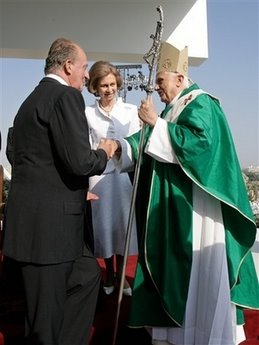
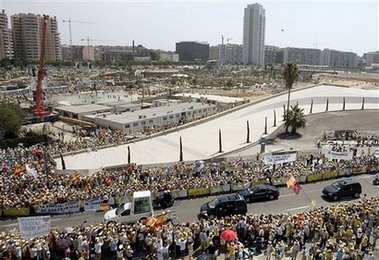
Yesterday, July 9, 2006, Pope Benedict XVI celebrated Mass in Valencia, Spain during the final day of his 26 hour trip to The World Meeting for Families. The Mass drew around 1.5 milion people including King Juan Carlos and Queen Sophia, with their three children and seven grandchildren. The Prime Minister refused to attend.

Pope Benedict XVI even used the Holy Grail when celebrating the Mass! Pope John Paul II also used the relic when he celebrated Mass in Valencia on Nov. 8, 1982. According to tradition, The Holy Grail arrived in Valencia in 1437. St. Peter took the chalice from Jerusalem to Antioch centuries beforehand.

The Holy Father also announced that the next World Meeting for Families will take place in Mexico City in 2009.

Homily:


Dear Brothers and Sisters,

In this Holy Mass which it is my great joy to celebrate, together with many of my Brothers in the Episcopate and a great number of priests, I give thanks to the Lord for all of you, the joyful throng of beloved families gathered in this place, and the many others who in distant lands are following this celebration by radio and television. I greet all of you with an affectionate embrace.

Both Esther and Paul, as we have just heard in today's readings, testify that the family is called to work for the handing on of the faith.

Esther admits: "Ever since I was born, I have heard in the tribe of my family that you, O Lord, took Israel out of all the nations" (14:5).

Paul follows the tradition of his Jewish ancestors by worshiping God with a pure conscience. He praises the sincere faith of Timothy and speaks to him about "a faith that lived first in your grandmother Lois and your mother Eunice, and now, I am sure, lives in you" (2 Timothy 1:15).

In these biblical testimonies, the family includes not only parents and children, but also grandparents and ancestors. The family thus appears to us as a community of generations and the guarantee of a patrimony of traditions.

None of us gave ourselves life or single-handedly learned how to live. All of us received from others both life itself and its basic truths, and we have been called to attain perfection in relationship and loving communion with others.

The family, founded on indissoluble marriage between a man and a woman, is the expression of this relational, filial and communal aspect of life. It is the setting where men and women are enabled to be born with dignity, and to grow and develop in an integral manner.

Once children are born, through their relationship with their parents, they begin to share in a family tradition with even older roots. Together with the gift of life, they receive a whole patrimony of experience. Parents have the right and the inalienable duty to transmit this heritage to their children: to help them find their own identity, to initiate them to the life of society, to foster the responsible exercise of their moral freedom and their ability to love on the basis of their having been loved and, above all, to enable them to encounter God.

Children experience human growth and maturity to the extent that they trustingly accept this heritage and training which they gradually make their own. They are thus enabled to make a personal synthesis between what has been passed on and what is new, a synthesis that every individual and generation is called to make.

At the origin of every man and woman, and thus in all human fatherhood and motherhood, we find God the Creator. For this reason, married couples must accept the child born to them, not simply as theirs alone, but also as a child of God, loved for his or her own sake and called to be a son or daughter of God. What is more: each generation, all parenthood and every family has its origin in God, who is Father, Son and Holy Spirit.

Esther's father had passed on to her, along with the memory of her forebears and her people, the memory of a God who is the origin of all and to whom all are called to answer. The memory of God the Father, who chose a people for himself and who acts in history for our salvation. The memory of this Father sheds light on our deepest human identity: where we come from, who we are, and how great is our dignity.

Certainly we come from our parents and we are their children, but we also come from God who has created us in his image and called us to be his children. Consequently, at the origin of every human being there is not something haphazard or chance, but a loving plan of God. This was revealed to us by Jesus Christ, the true Son of God and a perfect man. He knew whence he came and whence all of us have come: from the love of his Father and our Father.

Faith, then, is not merely a cultural heritage, but the constant working of the grace of God who calls and our human freedom, which can respond or not to his call. Even if no one can answer for another person, Christian parents are still called to give a credible witness of their Christian faith and hope. The need to ensure that God's call and the good news of Christ will reach their children with the utmost clarity and authenticity.

As the years pass, this gift of God which the parents have helped set before the eyes of the little ones will also need to be cultivated with wisdom and gentleness, in order to instill in them a capacity for discernment. Thus, with the constant witness of the their parents' conjugal love, permeated with a living faith, and with the loving accompaniment of the Christian community, children will be helped better to appropriate the gift of their faith, to discover the deepest meaning of their own lives and to respond with joy and gratitude.

The Christian family passes on the faith when parents teach their children to pray and when they pray with them (cf. Familiaris Consortio, 60); when they lead them to the sacraments and gradually introduce them to the life of the Church; when all join in reading the Bible, letting the light of faith shine on their family life and praising God as our Father.

In contemporary culture, we often see an excessive exaltation of the freedom of the individual as an autonomous subject, as if we were self-created and self-sufficient, apart from our relationship with others and our responsibilities in their regard.

Attempts are being made to organize the life of society on the basis of subjective and ephemeral desires alone, with no reference to objective, prior truths such as the dignity of each human being and his inalienable rights and duties, which every social group is called to serve.

The Church does not cease to remind us that true human freedom derives from our having been created in God's image and likeness. Christian education is consequently an education in freedom and for freedom.

"We do not do good as slaves, who are not free to act otherwise, but we do it because we are personally responsible for the world; because we love truth and goodness, because we love God himself and therefore his creatures as well. This is the true freedom to which the Holy Spirit wants to lead us (Homily for the Vigil of Pentecost, June 9, 2006).

Jesus Christ is the perfect human being, an example of filial freedom, who teaches us to share with others his own love: "As the Father has loved me, so I have loved you; abide in my love" (John 15:9).

And so the Second Vatican Council teaches that "Christian married couples and parents, following their own way, should support one another in grace all through life with faithful love, and should train their children, lovingly received from God, in Christian doctrine and evangelical virtues. Because in this way they present to all an example of unfailing and generous love, they build up the brotherhood of charity, and they stand as witnesses and co-operators of the fruitfulness of Mother Church, as a sign of and a share in that love with which Christ loved his Bride and gave himself for her" (Lumen Gentium, 41).

The joyful love with which our parents welcomed us and accompanied our first steps in this world is like a sacramental sign and prolongation of the benevolent love of God from which we have come. The experience of being welcomed and loved by God and by our parents is always the firm foundation for authentic human growth and authentic development, helping us to mature on the way towards truth and love, and to move beyond ourselves in order to enter into communion with others and with God.

To help us advance along the path of human maturity, the Church teaches us to respect and foster the marvelous reality of the indissoluble marriage between man and woman which is also the origin of the family. To recognize and assist this institution is one of the greatest services which can be rendered nowadays to the common good and to the authentic development of individuals and societies, as well as the best means of ensuring the dignity, equality and true freedom of the human person.

This being the case, I want to stress the importance and the positive role which the Church's various family associations are playing in support of marriage and the family. Consequently, "I wish to call on all Christians to collaborate cordially and courageously with all people of good will who are serving the family in accordance with their responsibility" (Familiaris Consortio, 86), so that by joining forces in a legitimate plurality of initiatives they will contribute to the promotion of the authentic good of the family in contemporary society.

Let us return for a moment to the first reading of this Mass, drawn from the Book of Esther. The Church at prayer has seen in this humble queen interceding with all her heart for her suffering people, a prefigurement of Mary, whom her Son has given to us all as our Mother; a prefigurement of the Mother who protects by her love God's family on its earthly pilgrimage. Mary is the image and model of all mothers, of their great mission to be guardians of life, of their mission to be teachers of the art of living and of the art of loving.

The Christian family -- father, mother and children -- is called, then, to do all these things not as a task imposed from without, but rather as a gift of the sacramental grace of marriage poured out upon the spouses. If they remain open to the Spirit and implore his help, he will not fail to bestow on them the love of God the Father made manifest and incarnate in Christ.

The presence of the Spirit will help spouses not to lose sight of the source and criterion of their love and self-giving, and to cooperate with him to make it visible and incarnate in every aspect of their lives.

The Spirit will also awaken in them a yearning for the definitive encounter with Christ in the house of his Father and our Father. And this is the message of hope that, from Valencia, I wish to share with all the families of the world. Amen.

Original text: English; translation issued by the Holy See.

© Copyright 2006 - Libreria Editrice Vaticana [adapted]


Photos:


REUTERS/Marcelo del Pozo (SPAIN)

AP Photo/Chris Helgren, Pool

AP Photo/Philippe Desmazes, Pool

AP Photo/Javier Barbancho
Read more >>


Copyright Notice: Unless otherwise stated, all items are copyrighted under a Attribution-NonCommercial-NoDerivatives 4.0 International License. If you quote from this blog, cite a link to the post on this blog in your article.

Disclosure of Material Connection: Some of the links on this blog are “affiliate links.” This means if you click on the link and purchase the item, I will receive an affiliate commission. As an Amazon Associate, for instance, I earn a small commission from qualifying purchases made by those who click on the Amazon affiliate links included on this website. I am disclosing this in accordance with the Federal Trade Commission’s 16 CFR, Part 255: “Guides Concerning the Use of Endorsements and Testimonials in Advertising.”