Thursday, August 10, 2006
Feast of St. Lawrence


Feast (1969 Calendar): August 10
Double of the II Class (1955 Calendar): August 10

Just a few days ago we recalled the life of Pope St. Sixtus II, who lost his life for Christ. Just three days later, as Pope St. Sixtus II foretold, St. Lawrence suffered martyrdom for the faith. 

St. Lawrence was born in Huesca, Spain in the third century. He was an archdeacon of Rome whose job was to care for the goods of the Church and distribute alms. On August 6, 258, Pope St. Sixtus II and six deacons were martyred. This left St. Lawrence as the ranking Church official in Rome. Just before then, Pope St. Sixtus II foretold St. Lawrence that he would join him in martyrdom for the faith in four days because St. Lawrence wished to die with the Pope.

St. Lawrence said: "Father, where are you going without your son? Where are you hastening, O priest, without your deacon? Never before did you offer the holy Sacrifice without assistants. In what way have I displeased you? In what way have you found me unfaithful in my office? Oh, try me again and prove to yourself whether you have chosen an unworthy minister for the service of the Church. So far you have been trusting me with distributing the Blood of the Lord." To this Pope Sixtus II replied, "I am not forsaking you, my son; a severer trial is awaiting you for your faith in Christ. The Lord is considerate toward me because I am a weak old man. But for you, a most glorious triumph is in store. Cease to weep, for already after three days you will follow me"

St. Lawrence, under the command of the pope, began to give all of the Church’s goods to the poor. While he was doing this task, a blind man named Crescentius asked him to heal his blindness by laying hands on him. St. Lawrence made the Sign of the Cross over him and his vision was restored.

Lawrence was soon arrested and in prison still healed man blind men. The guard, named Hippolytus, was so impressed by the Faith that he accept it and also died as a martyr.

On August 10, 258, Lawrence was told to bring along the treasure entrusted by the pope to his execution. After being given two days' time to collect the goods, St. Lawrence arrived with a multitude of Rome’s crippled, blind, and sick. St. Lawrence announced to the judge: "Here are the treasures of the Church!" Before he was arrested, though, he had dispersed the material wealth of the Church including many documents, which saved years of early Church history.

He was tortured, scourged, and scorched with glowing plates. In the midst of it, he prayed: "Lord Jesus Christ, God from God, have mercy on Your servant!" A solider named Romanus exclaimed: "I see before you an incomparably beautiful youth. Hasten and baptize me." Romanus had observed during this torture how an angel dried the wounds of Lawrence with a linen cloth.

As he was taken back to the judge he said, "My God I honor and Him alone I serve. Therefore I do not fear your torments; this night shall become as brightest day and as light without any darkness."

St. Lawrence was grilled to death on August 10, 258. As he died, he prayed for the conversion of Rome so that from it the Faith of Christ would spread. Following his death, idolatry began to decline throughout Rome. He also said, "Now you may turn me over, my body is roasted enough on this side." Then he said, "At last I am finished; you may now take from me and eat." He turned to God and exclaimed: "I thank You, O Lord, that I am permitted to enter Your portals." His body was buried in the cemetery of Saint Cyriaca on the road to Tivoli. The gridiron that is believed to have been his deathbed is in San Lorenzo in Lucina.

Source for information: The Church's Year of Grace by Pius Parsch.

Feast of St. Lawrence as a Holy Day of Obligation

The Feast of St. Lawrence was of such importance it was a Holy Day of Obligation for a long time. It remained a holy day in the modern-day United States until 1777 and in Ireland until 1778. The Vigil preceding the Feast of St. Lawrence was as a day of fasting in times past as well.


With the robe of joyfulness, alleluia,
Our Lord hath this day clothed His soldier, Laurence.
May Thy faithful’s joyous assemblage clap their hands
More cheerfully than they have heretofore.

Today the noble martyr offered pleasing sacrifice to God,
Today he, being grievously tested,
Endured unto the end the torment of his fire;
And shrank not from offering his limbs to punishments most grievous.

Before the ruler he is summoned,
And settlement is made upon the Church’s hidden holdings.
But he by words enticing is unmoved, and is unshaken
By the torments of the ruler’s avarice.

Valerian is laughed to scorn,
And the Levite’s liberal hand,
When he is asked for payments,
Giveth to the gathered poor.

For he was their minister of charity,
Giving them abundance from his means.
Therefore the prefect is enraged,
And a glowing bed made ready.

The torment-bearing instrument,
The gridiron of his suffering,
Roasteth his very viscera,
But he laugheth it to scorn.

The martyr sweateth in his agony,
In hopes of crown and recompense
Which is allotted those with faith,
Who struggle for the sake of Christ.

The court of heaven rejoiceth
For his warfare-waging,
For he hath prevailed this day
Against the lackeys of wickedness.

That we, then, may attain the gift of life,
By this our patron, be glad, O our choir,
Singing in the church upon his feast-day
A joyful alleluia.

Hymn from the Mass of Saint Laurence, Old Sarum Rite Missal, 1998, Saint Hilarion Press

Prayer:

Quench in us, we beseech Thee, O Lord, the flame of vice, even as Thou dist enable blessed Lawrence to overcome his fire of sufferings. Through our Lord.

Prayer Source: 1962 Roman Catholic Daily Missal
Read more >>
Pope John Paul ll on the Good Shepherd


"While Jesus was say thing these words [John 10:11], the apostles did not realize that He was referring to Himself. Not even his beloved Apostle John knew it. He understood on Calvary, at the foot of the Cross, when He saw Jesus silently giving up His life for 'His sheep'. When the time came for John and the other apostles to assume the same mission they then remembered his words. They realized that they would be able to fulfill their mission only because He had assured them that He Himself would be working among them" (L'Osservatore Romano, English edition, October 22, 2003, p. 3)
Read more >>
I re-read "Rise, Let Us be On Our Way"

Yesterday, I was in a car for most of the afternoon. I had nothing to do so I re-read "Rise, Let Us be On Our Way" by Pope John Paul ll and took a page of notes. I added more information to my review that I posted on it last summer. View my review on "Rise, Let Us be On Our Way".
Read more >>
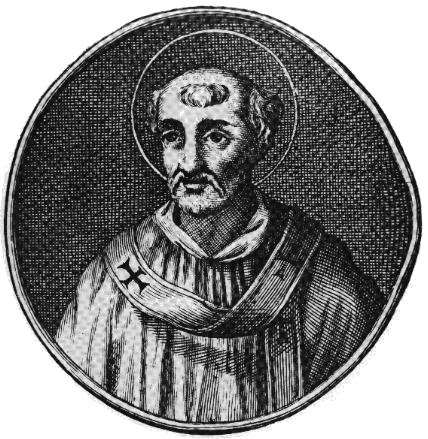
Pope St. Evaristus

Simple (1955 Calendar): October 26th

Pope St. Evaristus was the fifth Pope of the Holy Catholic Church. As stated in the "Lives of the Saints" by Rev Hoever:
St. Evaristus succeeded St. Anacletus in the See of Rome, during the reign of the Emperor Trajan, and governed the Church nine years.  He first divided Rome into several parishes, to each of which he assigned a priest.  For this reason some consider him the founder of the institution of cardinal-priests.  He also appointed several deacons to assist the Bishop.  He conferred Holy Orders three times in the month of December, when that holy function was usually performed.

In the Pontificals and in most martyrologies, St. Evaristus is honored with the title of Martyr.  Little is known of his life.  He died in 112 and was buried near St. Peter's tomb... St. Evaristus was the first to decree that altars thenceforward should be of stone and that they should be blessed.  
Traditional Matins Reading:

Evaristus was born in Greece, of a Jewish father, and was sovereign Pontiff during the reign of Trajan. He divided the titles of the churches of Rome among the priests, and ordained that seven deacons should attend the bishop when preaching. He also decreed that, according to the tradition of the apostles, matrimony should be celebrated publicly and blessed by a priest. He governed the Church nine years and three months. He held ordinations four times in the month of December, and ordained seventeen priests, two deacons, and fifteen bishops. He was crowned with martyrdom, and buried near the tomb of the prince of the apostles on the seventh of the Kalends of November.

Collect:

O Eternal Shepherd, who appointed blessed Evaristus shepherd of the whole Church, let the prayers of this martyr and supreme pontiff move You to look with favor upon Your flock and to keep it under Your continual protection. Through our Lord . . .

Prayer Source: 1962 Roman Catholic Daily Missal
Read more >>
Assumption Novena: Day Five

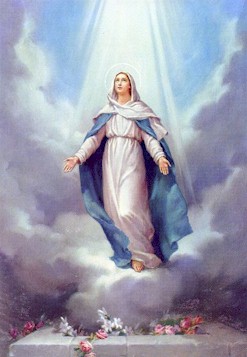
O merciful and loving Mother, may your glorious beauty fill our hearts with a distaste for earthly things and an ardent longing for the joys of Heaven. May your merciful eyes glance down upon our struggles and our weakness in this vale of tears. Hear then loving Mother, our request and plead to Jesus for us (mention your request). Crown us with the pure robe of innocence and grace here, and with immortality and glory in Heaven. Queen Assumed into Heaven, pray for us.
Read more >>
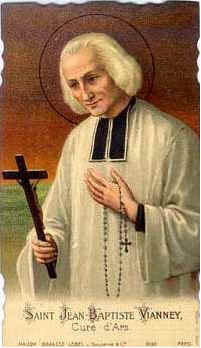
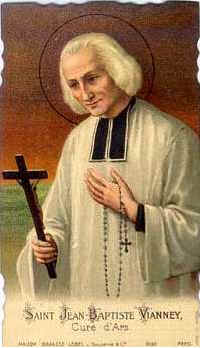
"Catechism on Frequent Communion" by St. John Vianney

My children, all beings in creation require to be fed, that they may live; for this purpose God has made trees and plants grow; it is a well-served table, to which all animals come and take the food which suits each one. But the soul also must be fed. Where, then, is its food? My brethren, the food of the soul is God. Ah! what a beautiful thought! The soul can feed on nothing but God. Only God can suffice for it; only God can fill it; only God can satiate its hunger; it absolutely requires its God! There is in all houses a place where the provisions of the family are kept; it is the store-room. The church is the home of souls; it is the house belonging to us, who are Christians. Well, in this house there is a store-room. Do you see the tabernacle? If the souls of Christians were asked, "What is that?" your souls would answer, "It is the store-room."

There is nothing so great, my children, as the Eucharist! Put all the good works in the world against one good Communion; they will be like a grain of dust beside a mountain. Make a prayer when you have the good God in your heart; the good God will not be able to refuse you anything, if you offer Him His Son, and the merits of His holy death and Passion. My children, if we understood the value of Holy Communion, we should avoid the least faults, that we might have the happiness of making it oftener. We should keep our souls always pure in the eyes of God.

My children, I suppose that you have been to confession today, and you will watch over yourselves; you will be happy in the thought that tomorrow you will have the joy of receiving the good God into your heart. Neither can you offend the good God tomorrow; your soul will be all embalmed with the precious Blood of Our Lord. Oh, beautiful life!

O my children, how beautiful will a soul be in eternity that has worthily and often received the good God! The Body of Our Lord will shine through our body, His adorable Blood through our blood; our soul will be united to the Soul of Our Lord during all eternity. There it will enjoy pure and perfect happiness. My children, when the soul of a Christian who has received Our Lord enters paradise, it augments the joy of Heaven. The Angels and the Queen of Angels come to meet it, because they recognize the Son of God in that soul. Then will that soul be rewarded for the pains and sacrifices it will have endured in its life on earth. My children, we know when a soul has worthily received the Sacrament of the Eucharist, it is so drowned in love, so penetrated and changed, that it is no longer to be recognised in its words or its actions. . . . It is humble, it is gentle, it is mortified, charitable, and modest; it is at peace with everyone. It is a soul capable of the greatest sacrifices; in short, you would not know it again.

Go, then, to Communion, my children; go to Jesus with love and confidence; go and live upon Him, in order to live for Him! Do not say that you have too much to do. Has not the Divine Saviour said, "Come to Me, all you that labour and are burdened, and I will refresh you"? Can you resist an invitation so full of love and tenderness? Do not say that you are not worthy of it. It is true, you are not worthy of it; but you are in need of it. If Our Lord had regarded our worthiness, He would never have instituted His beautiful Sacrament of love: for no one in the world is worthy of it, neither the saints, nor the angels, nor the archangels, nor the Blessed Virgin; but He had in view our needs, and we are all in need of it. Do not say that you are sinners, that you are too miserable, and for that reason you do not dare to approach it. I would as soon hear you say that you are very ill, and therefore you will not take any remedy, nor send for the physician.

All the prayers of the Mass are a preparation for Communion; and all the life of a Christian ought to be a preparation for that great action. We ought to labor to deserve to receive Our Lord every day. How humbled we ought to feel when we see others going to the holy table, and we remain motionless in our place! How happy is a guardian angel who leads a beautiful soul to the holy table! In the primitive Church they communicated every day. When Christians had grown cold, they substituted blessed bread for the Body of Our Lord; this is both a consolation and a humiliation. It is indeed blessed bread; but it is not the Body and Blood of Our Lord!

There are some who make a spiritual communion every day with blessed bread. If we are deprived of Sacramental Communion, let us replace it, as far as we can, by spiritual communion, which we can make every moment; for we ought to have always a burning desire to receive the good God. Communion is to the soul like blowing a fire that is beginning to go out, but that has still plenty of hot embers; we blow, and the fire burns again. After the reception of the Sacraments, when we feel ourselves slacken in the love of God, let us have recourse at once to spiritual communion. When we cannot come to church, let us turn towards the tabernacle: a wall cannot separate us from the good God; let us say five Patres and five Aves to make a spiritual communion. We can receive the good God only once a day; a soul on fire with love supplies for this by the desire to receive Him every moment. O man, how great thou art! fed with the Body and Blood of a God! Oh, how sweet a life is this life of union with the good God! It is Heaven upon earth; there are no more troubles, no more crosses! When you have the happiness of having received the good God, you feel a joy, a sweetness in your heart for some moments. Pure souls feel it always, and in this union consists their strength and their happiness.

Read more on St. John Vianney
Read more >>
Wednesday, August 9, 2006
St. Anthony Cathedral in Beaumont

Pope Benedict XVI has just granted minor Basilica status to St. Anthony Cathedral in Beaumont, Texas as a recognition of the church's artistic and historical significance. It will become only the fourth basilica in Texas and only about the 60th in the United States.
Becoming a basilica allows the church to add sacred images, as well as the papal coat of arms, to its art work, said Bishop Curtis Guillory of the Beaumont Catholic Diocese. It also gives the cathedral the responsibility of celebrating with greater solemnity certain church feast days such as the Feast of Saints Peter and Paul.
Source: WOAI San Antonio News

In a minor Basilica you will find the Ombrellino and the Tintinnabulum. I have only visited one basilica so far, the Basilica of the Immaculate Conception in Missouri, and they also had those two symbols.
Read more >>
Unborn Children Murdered for Cosmetics

Women from around the world are traveling to clinics in various locations that are now offering face lifts and cosmetic surgery using tissue from babies who have been killed by abortions. Pro-life advocates are strongly condemning the practice and saying the taking of human life is never warranted -- especially for such a self-serving purpose.

To obtain the cells, women in underdeveloped nations are paid up to $200 dollars to carry a baby up to the optimum eight to 12 week period when the fetuses are “harvested” for their stem cells which are then sold to exclusive cosmetic clinics.

Source: Life Site News

I am horrified! May God put an end to this heinous practice and an end to all abortions! We have awaited for this end for 33 years in the United States! Let us pray NOW for this second Dark Age to pass!

Prayer to end abortion:

Heavenly Father, in Your love for us, protect against the wickedness of the devil, those helpless little ones to whom You have given the gift of life. Touch with pity the hearts of those women pregnant in our world today who are not thinking of motherhood.

Help them to see that the child they carry is made in Your image - as well as theirs - made for eternal life. Dispel their fear and selfishness and give them true womanly hearts to love their babies and give them birth and all the needed care that a mother can give.

We ask this through Jesus Christ, Your Son, Our Lord, Who lives and reigns with You and Holy Spirit, One God, forever and ever. Amen.

St. Catherine of Sweden, patron against abortion, pray for us!
Read more >>
Assumption Novena: Day Four

O Dearest Mother Mary, God placed you at His right hand that you may dispose of the treasures of grace by a singular title – that of Mother of God. In the midst of all the Saints you stand as their Queen and ours – dearer to the Heart of God than any creature in God’s Kingdom. You pray for your children and distribute to us every grace won by our loving Savior on the Cross. With your most holy title, please intercede for us in our needs and ask Jesus to grant our request if it be for the good of our souls (mention your request). Queen Assumed into Heaven, pray for us.
Read more >>
Words of Inspiration: August 9, 2006


"Find Jesus, and you will find peace."
Read more >>
Pope St. Clement I


Double (1955 Calendar): November 23

Pope St. Clement I was the fourth pope of the Catholic Church and he was pope from 92 - 99 AD. There is evidence Pope St. Clement I was a disciple of St. Peter. According to Eusebius, St. Jerome, and Origen, St. Clement I is the man mentioned in Philippians 4:3.

According to Tradition, under the persecution of Emperor Trajan, Pope St. Clement I was forced to work in a quarry. While there, he brought many people into the faith. Finally, the Pope was sentenced to death. So, an anchor was wrapped around his feet and he was thrown into the sea and drowned.

After his death, two of his disciples prayed that they could find his remains. In an answer to their prayers, the sea retreated three miles and the two found an angel-built chapel that contained his remains in a chest of stone by an anchor. The sea retreated to reveal the chapel year each, and his remains were kept dry for seven days. Today, his remains have been moved and are kept in the Basilica of St. Clement. His feastday is November 23rd.

He is remembered for his Clementine Literature as well as a letter to the Church in Corinth, often called 1 Clement, and a second epistle, although scholars are not sure he actually wrote the second epistle.

The words of St. Clement are quoted in the Catechism of the Council of Trent in reference to the existence of Confirmation as a true Sacrament instituted by our Lord distinct from Baptism: "All should hasten without delay to be born again unto God, and afterwards to be signed by the Bishop, that is, to receive the seven-fold grace of the Holy Ghost; for, as has been handed down to us from St. Peter, and as the other Apostles taught in obedience to the command and of our Lord, he who culpably and voluntarily, and not from necessity, neglects to receive this Sacrament, cannot possibly be a perfect Christian."

Matins Reading:

Clement was a Roman by birth, son of Faustinus who dwelt in the region of Monte Coelio. He was a disciple of blessed Peter; and is mentioned by St. Paul in his Epistle to the Philippians, in these words: I entreat thee also, my sincere companion, help those women who have labored with me in the Gospel, with Clement and the rest of my fellow-labourers, who names are in the book of life. He divided Rome into seven regions, appointing a notary for each, who was to ascertain and record with the greatest care the acts and sufferings of the martyrs. He wrote many useful and learned works, such as did honour to the Christian name.

He converted many to the faith of Christ by his learning and holiness of life, and was on that account banished by the emperor Trajan to the desert of Cherson beyond the Black Sea. Here he found two thousand Christians, likewise banished by Trajan, who were employed in quarrying marble. Seeing them suffering from want of water, Clement betook himself to prayer, and then ascended a neighbouring hill, on the summit of which he saw a Lamb, pointing out with his right foot a spring of sweet water. At this source they all quenched their thirst; and many infidels were converted by the miracle, and began to revere Clement as a Saint.

On hearing this Trajan was enraged, and sent officers with orders to cast Clement into the sea with an anchor tied to his neck. After the execution of this sentence, as the Christians were praying on the shore, the sea began to recede for the distance of three miles; on approaching they found a small building of marble, in the form of a temple, wherein lay the martyr’s body in a stone coffin, and beside it the anchor with which he had been drowned. The inhabitants of the country were so astounded at the miracle, that they were led to embrace the Christian faith. The holy body was afterwards translated to Rome, under Pope Nicholas I and deposited in the church of St. Clement. A church was also built and dedicated in his honour, on that spot in the island where the miraculous fountain had sprung up. He held the pontificate nine years, six months, and six days. In two ordinations in the month of December, he made ten priests, two deacons, and fifteen bishops for divers places.

Cultural Customs on the Feast of St. Clement quoted from the Latin Mass Society:

"[Today] is the Feast of St Clement (23rd November) and traditionally children would go clementing – knocking on doors begging for apples, pear, and nuts in exchange for reciting rhymes. Indeed, it is believed that is the origin of the nursery rhyme “Oranges & Lemons”.

"Also as Pope Clement 1 is the patron saint of metalworkers and blacksmiths and celebrations on Old Clem’s Night began with a bang, quite literally. Blacksmiths filled a small hole in their anvil with gunpowder. This was then struck with a hammer, creating a shower of sparks and a loud boom. The village blacksmiths would dress up in a wig, mask and cloak to represent Saint Clement and gather in the streets, singing loudly and staggering from tavern to tavern."

Collect:

O Eternal Shepherd, who appointed blessed Clement shepherd of the whole Church, let the prayers of this martyr and supreme pontiff move You to look with favor upon Your flock and to keep it under Your continual protection. Through our Lord . . .
Read more >>
"On Envy" by St. John Vianney

Envy is a sadness which we feel on account of the good that happens to our neighbour.

Envy, my children, follows pride; whoever is envious is proud. See, envy comes to us from Hell; the devils having sinned through pride, sinned also through envy, envying our glory, our happiness. Why do we envy the happiness and the goods of others? Because we are proud; we should like to be the sole possessors of talents, riches, of the esteem and love of all the world! We hate our equals, because they are our equals; our inferiors, from the fear that they may equal us; our superiors, because they are above us. In the same way, my children, that the devil after his fall felt, and still feels, extreme anger at seeing us the heirs of the glory of the good God, so the envious man feels sadness at seeing the spiritual and temporal prosperity of his neighbour.

We walk, my children, in the footsteps of the devil; like him, we are vexed at good, and rejoice at evil. If our neighbour loses anything, if his affairs go wrong, if he is humbled, if he is unfortunate, we are joyful. . . we triumph! The devil, too, is full of joy and triumph when we fall, when he can make us fall as low as himself. What does he gain by it? Nothing. Shall we be richer, because our neighbour is poorer? Shall we be greater, because he is less? Shall we be happier, because he is more unhappy? O my children! how much we are to be pitied for being like this! Saint Cyprian said that other evils had limits, but that envy had none. In fact, my children, the envious man invents all sorts of wickedness; he has recourse to evil speaking, to calumny, to cunning, in order to blacken his neighbour; he repeats what he knows, and what he does not know he invents, he exaggerates. . . .

Through the envy of the devil, death entered into the world; and also through envy we kill our neighbour; by dint of malice, of falsehood, we make him lose his reputation, his place. . . . Good Christians, my children, do not do so; they envy no one; they love their neighbour; they rejoice at the good that happens to him, and they weep with him if any misfortune comes upon him. How happy should we be if we were good Christians. Ah! my children, let us, then, be good Christians and we shall no more envy the good fortune of our neighbour; we shall never speak evil of him; we shall enjoy a sweet peace; our soul will be calm; we shall find paradise on earth.

Read more on St. John Vianney
Read more >>
Tuesday, August 8, 2006
St. Dominic

Greater Double (1955 Calendar): August 4
Memorial (1969 Calendar): August 8

Today is the feastday of St. Dominic de Guzman, popularly known just as St. Dominic, the one that received the Rosary from Mary. Today is a wonderful day to learn why and how to pray the Rosary. St. Louis Marie Grignion de Montfort wrote: "The rosary is the most powerful weapon to touch the Heart of Jesus, Our Redeemer, who loves His Mother."

St. Dominic was born in 1175 in Castile, Spain, to the illustrious Guzman family to Blessed Joan of Aza and Felix Guzman. While pregnant, Blessed Joan of Aza dreamed that she would bear a son who would be a shining light to the Church. She also dreamed that she gave birth to a dog that broke away from her with a burning torch in its mouth by which it set fire to the world. This dog became a symbol of the Dominican order that St. Dominic would found in 1215. She also dreamed that her child had bright star on his head that enlightened the world.

At the age of seven, he went to study with his uncle, who was a priest. At the age of fourteen, St. Dominic enrolled in the University of Palencia. He began many years of studying for the priesthood. During his studies, St. Dominic immersed himself in the Holy Scriptures. And when Spain was ravaged by war and famine in 1195, he sold everything he owned to bring relief to the destitute.

St. Dominic was an Augustian and worked for clerical reform. By age 26, St. Dominic was fighting the Albigensian Heresy, which taught that there are two Gods, marriage is a sin, and denied the Trinity, incarnation and redemption. While many others had failed to stop the spread of the heresy, St. Dominic succeded. In 1208, St. Dominic knelt in the little chapel of Notre Dame de La Prouille and asked Mary, the Mother of God, to save the Church. She appeared to him with a Rosary and instructed him to pray the Rosary, teach it to all who would listen, and she said that the true faith would win out. It was during one of the famous battles in southern France against the Albigensians, when St. Dominic revived the courage of the Catholic armies to victory against overwhelming numbers; he had the Rosary in his hand the entire time.

In 1215, St. Dominic founded the Order of Preachers (Dominicans), a group of men that were to live a simple, austere life; he also created an order of nuns dedicated to the care of young girls. Soon afterwards, the Pope commissioned Dominic to establish a group of friars at the Church of St. Sixtus in Rome. By 1219, forthy men resided in the foundation in Rome.

By Lent, 1219, St. Dominic had persuaded forty-four sisters to unite in one community thankfully. St. Dominic along with three cardinals received the sisters' profession on Ash Wednesday. Tragically, during the ceremony, news reached a cardinal there that his nephew, Napoleon, had died after falling from his horse.

Dominic immediately had the corpse carried into the chapel, and celebrated Mass with the cardinals, nuns, and friars in attendance. When he finished the Mass, he stood over Napoleon's broken body and straightened his limbs. St. Dominic then blessed the corpse, and with hands raised to heaven, he shouted, "Napoleon, in the name of Our Lord Jesus Christ, arise." In the view of many reliable witnesses, the young man then arose. [Source: Mystics and Miracles by Bert Ghezzi, Loyola Press, Chicago, IL, 2002]

One of his religious daughters, Cecilia Cesarini, describes St. Dominic in the following way: "The Blessed Dominic was of medium height and of slight build. His countenance was beautiful, of fair complexion, with light auburn hair and beard and luminous eyes. A kind of radiance shone from his brow, inspiring love and reverence in all. Full of joy, he seemed ever ready to smile, unless moved to pity by the affliction of his neighbor. His hands were long and shapely; his voice strong, noble, and sonorous. He never was bald, and his corona was complete, sprinkled with a few white hairs."

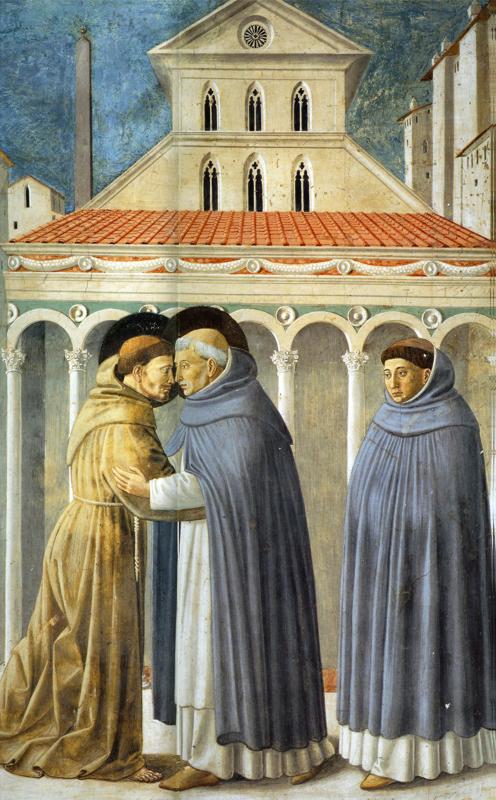
Legend says that St. Dominic received a vision of a beggar who, like Dominic, would do great things for the Faith. St. Dominic met this beggar the very next day. He embraced him and said, "You are my companion and must walk with me. If we hold together, no earthly power can withstand us." The beggar was Saint Francis of Assisi. (Above image: Vision of St. Dominic and Meeting of St. Francis and St. Dominic by Benozzo Gozzoli, 1452)

St. Dominic reportedly brought four people back from the dead during his life. He died on August 4, 1221, at Bologna, Italy. St. Dominic is the patron saint of astronomers, scientists, the Philippines, and the Dominican Republic. His remains are in the Basilica of San Domenico.

Fausto Appetente Die:
The seventh centenary approaches of the day when that light of holiness, Dominic, passed from these miseries to the seat of the Blessed. We for long have been most interested in his clients, especially since We assumed the government of the Church of Bologna, which with the greater devotion preserves his remains. We, therefore, are pleased to be able from this Apostolic See to exhort the Christian people to celebrate the memory of such a great man. In this We not only consult Our own piety but fulfil a duty of gratitude towards the father and lawgiver and towards the distinguished Order he founded.
Encyclical of Pope Benedict XV promulgated on June 29, 1921.

Prayer:

O God, Who hast vouchsafed to make Thy Church illustrious by the merits and teaching of blessed Dominic, Thy Confessor: grant that, through his intercession, she may not be deprived of temporal help, and may ever advance in spiritual increase. Through our Lord.

Prayer Source: 1962 Roman Catholic Daily Missal

Image Source (1st image): St Dominic of Guzman by Claudio, Coello Spanish painter, Madrid school (b. 1642, Madrid, d. 1693, Madrid - Oil on canvas, 240 x 160 cm Museo del Prado, Madrid
Read more >>
Pope St. Anacletus


Semidouble (1955 Calendar): July 13

Pope St. Anacletus was the third pope of the Holy Catholic Church who reigned c. 80 - c. 92 AD. Many sources (Eusebius, Irenaeus, and Augustine) also claim he was known by the name Cletus. He died as a martyr in Rome c. 92 AD, and his remains are in the St. Linus Church in the Vatican. Pope Anacletus is now recognized to be the same person as Pope Cletus, who shares his feast with Pope Marcellinus on April 26th. For this reason, a decree of the Sacred Congregation of Rites issued on February 14, 1961, ordered the July 13th feast to be completely removed from the calendar. This changed is reflected in the 1962 Missal.

In one interesting comment on why his feastday in the pre-1955 calendar is given the rank of Semidouble, Dom Gueranger insightfully remarks: "Whereas the feasts of most of the martyr Pontiffs who came after him are only of simple rite, that of Anacletus is a semidouble, because of his privilege of being the last Pope honoured by the imposition of hands of the Prince of the Apostles."

The Traditional 4th Reading at Matins on July 13th recounts his life:

Anacletus was an Athenian who governed the Church in the time of the Emperor Trajan. He ordained that a Bishop should be consecrated by three Bishops and no less, that clerks should be publicly ordained to Holy Orders by their own Bishop, and that in the Mass, after the Consecration, all should afterwards Communicate. He adorned the grave of Blessed Peter, and ordered a place for burying the Popes in. He held two ordinations in the month of December, wherein he ordained five Priests, three Deacons, and six Bishops. He sat as Pope nine years, three months, and ten days. He received the crown of his testimony, and was buried on the Vatican Hill.

Collect:

O Eternal Shepherd, who appointed blessed Anacletus, shepherd of the whole Church, let the prayers of this martyr and supreme pontiff move You to look with favor upon Your flock and to keep it under Your continual protection. Through our Lord . . .
Read more >>
Pope Linus


Semidouble (1955 Calendar): September 23

Pope St. Linus was the second pope of the Holy Catholic Church from c. 68 - c. 79 AD. St. Irenaeus says, "After the Holy Apostles founded and set the Church in order (in Rome) they gave over the exercise of the episcopal office to Linus. The same Linus is mentioned by St. Paul in his Epistle to Timothy [II Tim 4:21]. His successor was Anacletus."

Not much is known as certain concerning his life. He was reportedly converted to the faith in Rome after hearing St. Peter preach the Gospel. He renounced his noble origins and to serve Christ more perfectly. St. Peter employed Linus in preaching and administering the Sacraments. St. Linus is remembered for his zeal, learning and prudence. In one instance, St. Linus preached against idol worshiping to a group of idolaters, and following this, part of the temple crumbled causing an idol to fall to the group and break into thousands of pieces. The idolaters drove him away from the city. Per the reading at Matins in the Divine Office, he also decreed that no woman should enter a church with her head uncovered.

Following the martyrdom of St. Peter, St. Linus wrote of the martyrdom of both Sts. Peter and Paul. St. Linus then succeeded St. Peter as the Vicar of Christ, the Pope. He reportedly created fifteen bishops and eighteen priests. He also drove many demons out of possessed persons by his faith and sanctity.

His feastday is September 23rd, and many sources, although not St. Iranaeus, say he was a martyr. The Liber Pontificalis which contains most of our knowledge on the early popes, states that he died a martyr on September 23rd in Rome and was buried on the Vatican Hill. In the 7th century, an inscription was found near the confessional of St Peter that contains the name "Linus".

Prayer:

Look forgivingly on Thy flock, Eternal Shepherd, and keep it in Thy constant protection, by the intercession of blessed Linus, Thy Martyr and Sovereign Pontiff, whom Thou didst constitute Shepherd of the whole Church. Through our Lord.

Prayer Sources: 1962 Roman Catholic Daily Missal - Prayers for September 23rd
Read more >>
Assumption Novena: Day Three

O Mother, Assumed into Heaven, because you shared in all the mysteries of our Redemption here below, Jesus has crowned you not only with glory but with power. With your most glorious and powerful intercession, help us O loving Mother and present to Jesus our request (mention your request). O Queen assumed into Heaven, pray for us. Amen.

Image Source: Jesus Christ Receiving the Virgin Mary in Heaven by Jacques Stella, 17th century
Read more >>
"On Death" by St. John Vianney

A day will come, perhaps it is not far off, when we must bid adieu to life, adieu to the world, adieu to our relations, adieu to our friends. When shall we return, my children? Never. We appear upon this earth, we disappear, and we return no more; our poor body, that we take such care of, goes away into dust, and our soul, all trembling, goes to appear before the good God. When we quit this world, where we shall appear no more, when our last breath of life escapes, and we say our last adieu, we shall wish to have passed our life in solitude, in the depths of a desert, far from the world and its pleasures. We have these examples of repentance before our eyes every day, my children, and we remain always the same. We pass our life gaily, without ever troubling ourselves about eternity. By our indifference to the service of the good God, one would think we were never going to die.

See, my children, some people pass their whole life without thinking of death. It comes, and behold! they have nothing; faith, hope, and love, all are already dead within them. When death shall come upon us, of what use will three-quarters of our life have been to us? With what are we occupied the greatest part of our time? Are we thinking of the good God, of our salvation, of our soul? O my children! what folly is the world! We come into it, we go out of it, without knowing why. The good God places us in it to serve Him, to try if we will love Him and be faithful to His law; and after this short moment of trial, He promises us a recompense. Is it not just that He should reward the faithful servant and punish the wicked one? Should the Trappist, who has passed his life in lamenting and weeping over his sins, be treated the same as the bad Christian, who has lived in abundance in the midst of all the enjoyments of life? No; certainly not. We are on earth not to enjoy its pleasures, but to labor for our salvation.

Let us prepare ourselves for death; we have not a minute to lose: it will come upon us at the moment when we least expect it; it will take us by surprise. Look at the saints, my children, who were pure; they were always trembling, they pined away with fear; and we, who so often offend the good God--we have no fears. Life is given us that we may learn to die well, and we never think of it. We occupy ourselves with everything else. The idea of it often occurs to us, and we always reject it; we put it off to the last moment. O my children! this last moment, how much it is to be feared! Yet the good God does not wish us to despair; He shows us the good thief, touched with repentance, dying near Him on the cross; but he is the only one; and then see, he dies near the good God. Can we hope to be near Him at our last moment--we who have been far from Him all our life? What have we done to deserve that favour? A great deal of evil, and no good.

There was once a good Trappist Father, who was trembling all over at perceiving the approach of death. Someone said to him, "Father, of what then are you afraid?" "Of the judgment of God," he said. "Ah! if you dread the judgment--you who have done so much penance, you who love God so much, who have been so long preparing for death--what will become of me?" See, my children, to die well we must live well; to live well, we must seriously examine ourselves: every evening think over what we have done during the day; at the end of each week review what we have done during the week; at the end of each month review what we have done during the month; at the end of the year, what we have done during the year. By this means, my children, we cannot fail to correct ourselves, and to become fervent Christians in a short time. Then, when death comes, we are quite ready; we are happy to go to Heaven.

Read more on St. John Vianney
Read more >>
Monday, August 7, 2006
Commemoration of St. Sixtus II & Companions

Commemoration (1954 Calendar): August 6

Just days before the great feast of St. Lawrence on August 10, the Church commemorates today Pope Sixtus II (also spelled Xystus II) and Felicissimus and Agapitus, his deacons. They were martyred at Rome on the same day, in the year 258. Pope Sixtus' archdeacon St. Lawrence met his death three days later, as he had prophesied to the younger man.

While today is the Feast of the Transfiguration of the Lord, these three holy martyrs are commemorated in the Traditional Liturgy today. And we should not forget their powerful example of fidelity to the True Faith.

St. Sixtus II, reigned as the Vicar of Christ from August 30, 257 - August 6, 258 AD, following Pope Stephen I. Even though his reign was short, he restored relations with the African and Eastern churches following strained relations under Pope Stephen I. The issue that caused the dispute was the re-baptism of heretics. Pope St. Sixtus II believed that anyone who was baptised with a desire to be a Christian, even if the Baptism was performed by a heretic, was truly baptised into the faith; the validity of his faith was based on his own desire and actions, not the errors of the person who performed the sacrament. This view has become the dogmatic teachings of the Church. Thankfully, St. Sixtus II restored relations with the churches that disagreed with Rome. Remember, at this time all churches still remained in union with Rome - the Holy Catholic Church.

Yet, not one year after his elevation to the papacy, he was beheaded by order of Emperor Valerian I in 258. Emperor Valerian I had issued a decree shortly before the pontificate of Sixtus II forbidding Christians to gather in cemeteries and demanding them to worship pagan gods. In early August 258, Emperor Valerian ordered the execution of priests, bishops, and deacons. Pope Sixtus II was one of the first victims of the persecutions of Emperor Valerian I. Four deacons, Januarius, Vincentius, Magnus, and Stephanus, were apprehended at the same cemetery as Pope Sixtus II. Pope Sixtus II was beheaded in his chair, which was later enshrined behind his tomb. Two other deacons, Felicissimus and Agapitus, were martyred the same day as the four aforementioned deacons.

Before Pope St. Sixtus II was martyred, his deacon St. Lawrence, came to him. St. Lawrence said: "Father, where are you going without your son? Where are you hastening, O priest, without your deacon? Never before did you offer the holy Sacrifice without assistants. In what way have I displeased you? In what way have you found me unfaithful in my office? Oh, try me again and prove to yourself whether you have chosen an unworthy minister for the service of the Church. So far you have been trusting me with distributing the Blood of the Lord." 

To this Pope Sixtus II replied, "I am not forsaking you, my son; a severer trial is awaiting you for your faith in Christ. The Lord is considerate toward me because I am a weak old man. But for you a most glorious triumph is in store. Cease to weep, for already after three days you will follow me"

Collect:

O God, who has granted us the grace to celebrate the birthday of Your blessed martyrs Sixtus II, Felicissimus, and Agapitus, grant that we may also share their eternal happiness in heaven. Through our Lord . . .
Read more >>
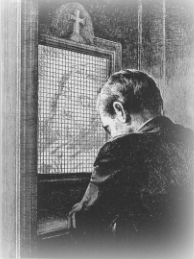
"Catechism on Confession" by St. John Vianney

My children, as soon as ever you have a little spot upon your soul, you must do like a person who has a fine globe of glass, which he keeps very carefully. If this globe has a little dust on it, he wipes it with a sponge the moment he perceives it, and there is the globe clear and brilliant. In the same way, as soon as you perceive a little stain on your soul, take some holy water with respect, do one of those good works to which the remission of venial sins is attached -an alms, a genuflection to the Blessed Sacrament, hearing a Mass. My children, it is like a person who has a slight illness; he need not go and see a doctor, he may cure himself without. If he has a headache, he need only go to bed; if he is hungry, he has only to eat. But if it is a serious illness, if it is a dangerous wound, he must have the doctor; after the doctor come the remedies. In the same way, when we have fallen into any grievous sin, we must have recourse to the doctor, that is the priest; and to the remedy, that is confession.

My children, we cannot comprehend the goodness of God towards us in instituting this great Sacrament of Penance. If we had had a favour to ask of Our Lord, we should never have thought of asking Him that. But He foresaw our frailty and our inconstancy in well-doing, and His love induced Him to do what we should not have dared to ask. If one said to those poor lost souls that have been so long in Hell, "We are going to place a priest at the gate of Hell: all those who wish to confess have only to go out, " do you think, my children, that a single one would remain? The most guilty would not be afraid of telling their sins, nor even of telling them before all the world. Oh, how soon Hell would be a desert, and how Heaven would be peopled! Well, we have the time and the means, which those poor lost souls have not. And I am quite sure that those wretched ones say in Hell, "O accursed priest! if I had never known you, I should not be so guilty!"

It is a beautiful thought, my children, that we have a Sacrament which heals the wounds of our soul! But we must receive it with good dispositions. Otherwise we make new wounds upon the old ones. What would you say of a man covered with wounds who is advised to go to the hospital to show himself to the surgeon? The surgeon cures him by giving him remedies. But, behold! this man takes his knife, gives himself great blows with it and makes himself worse than he was before. Well, that is what you often do after leaving the confessional.

My children, some people make bad confessions without taking any notice of it. These persons say, "I do not know what is the matter with me:' . . . They are tormented, and they do not know why. They have not that agility which makes one go straight to the good God; they have something heavy and weary about them which fatigues them. My children, that is because of sins that remain, often even venial sins, for which one has some affection. There are some people who, indeed, tell everything, but they have no repentance; and they go at once to Holy Communion. Thus the Blood of Our Lord is profaned! They go to the Holy Table with a sort of weariness. They say, "Yet, I accused myself of all my sins. . . I do not know what is the matter with me. " There is an unworthy Communion, and they were hardly aware of it!

My children, some people again profane the Sacraments in another manner. They have concealed mortal sins for ten years, for twenty years. They are always uneasy; their sin is always present to their mind; they are always thinking of confessing it, and always putting it off; it is a Hell. When these people feel this, they will ask to make a general confession, and they will tell their sins as if they had just committed them: they will not confess that they have hidden them during ten years -- twenty years. That is a bad confession! They ought to say, besides, that they had given up the practice of their religion, that they no longer felt the pleasure they had formerly in serving the good God.

My children, we run the risk again of profaning the Sacrament if we seize the moment when there is a noise round the confessional to tell the sins quickly which give us most pain. We quiet ourselves by saying, "I accused myself properly; so much the worse if the confessor did not hear. " So much the worse for you who acted cunningly! At other times we speak quickly, profiting by the moment when the priest is not very attentive to get over the great sins. Take a house which has been for a long time very dirty and neglected -- it is in vain to sweep out, there will always be a nasty smell. It is the same with our soul after confession; it requires tears to purify it. My children, we must ask earnestly for repentance. After confession, we must plant a thorn in our heart, and never lose sight of our sins. We must do as the angel did to Saint Francis of Assisi; he fixed in him five darts, which never came out again.

Read more on St. John Vianney
Read more >>
Assumption Novena: Day Two

Mary, Assumed into Heaven, we venerate you as the Queen of Heaven and earth. Your own Son led you to a throne of glory in Heaven next to His own. As you tasted the bitterness of pain and sorrow with Him on earth, you now enjoy eternal bliss with Him in Heaven. As our loving Queen, intercede for us in our needs (mention your request). We thank Jesus for having put a most beautiful crown upon you head, while all the Angels and Saints acclaim you as their Queen. O Queen Assumed into Heaven, pray for us. Amen.
Read more >>


Copyright Notice: Unless otherwise stated, all items are copyrighted under a Attribution-NonCommercial-NoDerivatives 4.0 International License. If you quote from this blog, cite a link to the post on this blog in your article.

Disclosure of Material Connection: Some of the links on this blog are “affiliate links.” This means if you click on the link and purchase the item, I will receive an affiliate commission. As an Amazon Associate, for instance, I earn a small commission from qualifying purchases made by those who click on the Amazon affiliate links included on this website. I am disclosing this in accordance with the Federal Trade Commission’s 16 CFR, Part 255: “Guides Concerning the Use of Endorsements and Testimonials in Advertising.”