Showing posts sorted by relevance for query Friday. Sort by date Show all posts
Friday, April 8, 2016
Friday Penance: Still Required in Eastertide


Abstinence Required In Pascaltide

Friday is the day in which we commemorate Our Lord's passion and death. As Catholics, we are still bound to abstain from meat each Friday of the entire year, not just in Lent. This is required during the season of Pascaltide. This is affirmed even in the modern 1983 Code of Canon Law - all Fridays of the entire year are days of penance (with few exceptions). There can be no doubt that Catholics must be informed that Friday abstinence is not to be confided to Lent only. Failing to observe Friday penance is a mortal sin, as affirmed by multiple pontiffs.

Abstinence on Easter Friday

How should we treat abstinence specifically on Friday in the Octave of Easter (i.e. Easter Friday)? The 1917 Code of Canon Law stipulated that the requirement to abstain from meat (i.e. Friday penance) was required each and every Friday of the year unless that particular Friday was a Holy Day of Obligation outside of Lent: 

"On [Sundays] or feasts of precept, the law of abstinence or of abstinence and fast or of fast only ceases, except during Lent, nor is the vigil anticipated; likewise it ceases on Holy [Saturday] afternoon" (1917 Code, Canon 1252 § 4). [Translation taken from THE 1917 OR PIO-BENEDICTINE CODE OF CANON LAW in English Translation by Dr. Edward Peters]

Easter Friday is not a feast of precept (i.e., a Holy Day of Obligation), and neither is any Friday in the Pascal Season between Easter Sunday and Trinity Sunday. The 1917 Code of Canon Law outlined the rules of fasting and abstinence in Canons 1250-1254. Before 1917, even Holy Days of Obligation outside of Lent required explicitly papal dispensation or else Friday abstinence would be observed even on days of precept.

The 1983 Code and the myriad of weakening dispensations offered in the 20th century has led to a continual decline in penance and devotion. Due to the errors and ambiguities in the 1983 Code, it must be rejected, and the older Code must be used. One of these issues is the unprecedented novelty of solemnities like Easter Friday breaking the immemorial tradition of Friday abstinence. The notion of day's liturgical rank abrograting abstinence has no basis in Church practice prior to 1983. 

It is essential for all Roman Catholics to continue abstaining from meat even on Easter Friday.

Conclusion

Friday abstinence is still the Catholic practice throughout Eastertide, and it is the Church's Law. Let us not be so keen to forget our Lord's sacrifice on the Cross. Pray and do penance on this and all Fridays. It is after all, on Friday that our Blessed Lord redeemed us. Let us never forget His Sacrifice on that first Good Friday.

Want to learn more about the history of fasting and abstinence? Check out the Definitive Guide to Catholic Fasting and Abstinence.
Read more >>
Friday, June 5, 2020
Rubrics for Privileged Votive Masses on First Thursdays & First Fridays

Why do many parishes celebrate a Votive Mass in honor of the Sacred Heart on Friday Fridays or the Mass of the Immaculate Heart of Mary on First Saturdays? In the pre-55 rubrics, may a priest say a votive Mass of the Sacred Heart on a First Friday when a feast of simple or higher is on that day?

NB: Privileged Votive Masses for First Saturdays only started in the early 1960s so they are not mentioned here with the pre 1955 rubrics.


The Celebration of the Mass by Rev. J O'Connell summarizes the uniqueness of these privileged Votive Masses:

The Votive Mass of the Sacred Heart for First Friday, the Votive Mass of the Immaculate Heart of Mary for First Saturday, as well as the Votive Mass of Jesus Christ Sovereign and Eternal Priest for First Thursday are Privileged Votive Masses specifically permitted by the Holy See. They are not general private Votive Masses. In detail:

1. The privileged votive Masses are certain votive Masses permitted by the Holy See, or prescribed by the rubrics, not for a grave and public cause, but for an appropriate reason approved by the Holy See, and endowed with certain liturgical privileges.

2. These Masses resemble a solemn votive Mass— they are permitted when a private votive Mass is not, and they follow the rite of a solemn  votive Mass (e.g., they have the Creed) —and so they are described as votive Masses celebrated "ad instar Missae votivae solemnis pro re gravi et simul publica causa."

3. Some of these privileged votive Masses are allowed only when they are solemn Masses, or at least sung, e.g., the Mass for the anniversary of the election or consecration of the bishop, the Mass for the Forty Hours' Prayer others may be celebrated as low Masses, e.g., the votive Mass of the Sacred Heart on the First Friday of the month.

4. Most of these privileged votive Masses are treated of in the general rubrics of the Missal; others are dealt with outside the Missal, e.g., the Masses for the Forty Hours' Prayer in the Clementine Instruction, those for the First Friday, or First Thursday of the month, in decrees of S.R.C.

5. Some privileged votive Masses are prescribed by the rubrics, or by a decree of S.R.C., or by command of the Ordinary; others are permitted by the rubrics, S.R.C., or Ordinary, and are in no way of obligation.

So, bearing these rules in mind, In 1889, to promote devotion to the Sacred Heart of Jesus, Leo XIII granted this remarkable privilege that: "in those churches or oratories where, on the first Friday of each month, special exercises of piety are, with the approval of the Ordinary of the place, carried out in the morning, the Votive Mass of the Sacred Heart may be added to these exercises, provided that on that day no feast of the Lord, or double of the first class, or privileged feria, vigil, or octave falls.

2. This votive Mass is permitted not only in churches, but also in oratories —public, semipublic, or private. The privilege is for the first Friday of the month alone. On any other day the votive Mass of the  Sacred Heart may be said only when private votive Masses are allowed, and only on the conditions which govern such Masses.

3. What the special exercises of piety in honour of the Sacred Heart are to be is not determined. Rubricists give as examples Exposition for a short time with Benediction, the recitation of the Litanies of the Sacred Heart, or of acts of reparation and consecration to the Sacred Heart, a general (or almost general) Communion in honour of the Sacred Heart. These exercises must be carried out in the morning, and be connected with the Mass so as to form morally one act with it. Though the words of the decree "Missa ... addi valeat," suggests that the devotions should precede the Mass, they generally follow it, and rubricists regard this interpretation of the privilege as permissible. (Same goes for First Thursday and First Saturday)

4. Since the consent of the Ordinary of the place is necessary to add lawfully any exercise of devotion to the Mass the decree requires this consent for the devotions in honour of the Sacred Heart. The permission may be given either to individual priests who seek it, or to an entire diocese.

5. One votive Mass only is permitted, and it may be solemn, sung, or even a low Mass. (S.R.C. 3773, 3972) If, however, for some special reason, the exercises of devotion in honour of the Sacred Heart were, with the consent of the Ordinary, repeated for an entirely different congregation, some authorities think that the votive Mass might, with its special privileges, be celebrated a second time.

6. This one votive Mass — even though only a low Mass—is given almost all the privileges of a solemn votive Mass celebrated "pro re gravi et simul publica causa." Accordingly :

(a) It is considered as a sung Mass, and so if there be another sung or Conventual Mass in the same church (oratory), on the same day, the rules of Rubricae Generales VII. 2 and Additiones, V, 4 must be observed ;

(b) The Gloria and Creed are said;

(c) Ordinarily, there will be one prayer only. However, an occurring double of the second class, (the Votive Mass is not permitted on a Duplex I. classis) or an occurring greater feria (i.e., a Friday of Advent or Lent, or a Quarter Tense Friday), must be commemorated —under a different conclusion from the prayers of the Mass" — all such solemn votive Masses pro re gravi. The oratio imperata is omitted, unless it be pro re gravi, then it is to be and under a different conclusion from the prayer of the Mass.

(d) The last Gospel will be that of S. John, except an Office which has been commemorated in the Mass (e.g., a Friday of Lent) has a proper Gospel; then this will be recited (Addit. IX);

(c) The Leonine prayers may be omitted

(f) If the Mass be sung, the festal (solemn) tone for the prayers, Preface, and Pater noster should be used by the Celebrant.

7. The Votive Mass Is Not Permitted:

(1) on any feast of the Lord — this means of the Second Divine Person, "festum Christi Domini," and not of the Triune God, which Dominus sometimes means. The votive Mass is excluded not only on feasts of our Lord that are "of the same mystery" as the Sacred Heart, but on any feast of Christ. Moreover it is excluded on the vigil and — even only a simple octave —of any feast of our Lord, or even when such a feast is commemorated, or should be commemorated but, per accidens, the commemoration is excluded. The votive Mass is, therefore, prohibited on the Feast of the Purification, which is a feast of our Lord but it is not excluded within the octave of the consecration of a church,(the Votive Mass of First Friday is of course, excluded on the feast itself - anniversary - of the Dedication of a church, for this is Duplex I. classis) nor on the octave-day, for this feast is "festum Domini," meaning the Triune God, and not festum Christi Domini.(S.R.C. 4372)
Special Cases :

(a) The first Friday of January: If the first Friday should fall on January 2, 3, or 4, the Mass of the Sacred Heart may not be said. Instead —if a votive Mass be said, and not the Mass of the day— the Mass Puer natus est nobis of December 30, must be chosen. This Mass will, in this case, however, have the privileges of a solemn votive Mass pro re gravi, and so the occurring octave-day (of S. Stephen, or S. John, or the Holy Innocents) will not be commemorated. Neither will the impeded votive Mass of the S. Heart be commemorated,48 for the Mass Puer natus est is a Mass of Christ.

(b) If, in a particular church, the first Friday should fall within the octave of the Circumcision (e.g., in a church which has this mystery as Titular, and so celebrates the feast with an octave) the votive Mass of the Sacred Heart is not permitted. Instead the Mass of the octave of the Circumcision is said, with the privileges of a solemn votive Mass," and without the commemoration of the impeded votive Mass of the Sacred Heart (for the Circumcision is a feast of Christ).

(c) If the first Friday should fall on the Friday which immediately follows the octave of the Ascension — which Friday is liturgically regarded as a feast of Christ — the votive Mass of the Sacred Heart may not be said, even though the feast of a saint be celebrated on that day. If the Mass of a saint be not said, the Mass of the day and not the votive Mass of the Sacred Heart, must be said. In this case, however, the Mass of the day will have the privileges of a solemn votive Mass, and so, e.g., the common prayers' will be omitted.

(2) The votive Mass of First Friday is excluded on a double of the first class, and, naturally, it is prohibited on Good Friday, and on All Souls' Day.

(3) The votive Mass of First Friday is also excluded on a privileged vigil. The only one on which the first Friday could occur is the vigil of the Epiphany, for a first Friday could not occur on the vigil of Christmas, nor could the vigil of Pentecost occur on a Friday.

(4) The votive Mass of First Friday is excluded within all privileged octaves, not within common octaves. The only privileged octave (of the Universal Church) which is not an octave of a feast of our Lord is the octave of Pentecost, and so the votive Mass is excluded, if the first Friday falls within this octave. Decree 3712 says that the votive Mass is excluded on privileged ferias, but the case cannot occur, for these ferias are Ash Wednesday, and Monday, Tuesday, and Wednesday of Holy Week. The votive Mass is not forbidden on other major ferias, i.e., the Fridays of Advent, Lent, Quarter Tense; nor is it prohibited if the Mass of an impeded Sunday is to be "resumed" on a first Friday.

(5) The votive Mass is also excluded in a church where there is but one priest, and where a Conventual Mass must be said, in conformity with the Office of the day. In this case, however, the Conventual Mass will have the privileges of a solemn votive Mass. The votive Mass is also excluded on a Friday which is a suppressed holiday, when there is only one Mass, and this the Missa pro populo.

To conclude, we used First Friday as the primary example but the same applies to First Saturday. And to reiterate and stress - what was just described above are privileged and solemn votives for First Friday and First Saturday and not the rules for General Private Votive Masses.
Read more >>
Thursday, December 21, 2023
Abstinence is Still Obligatory on Friday in the Octave of Christmas

As a reminder, the Friday in the Octave of Christmas is still an obligatory day of abstinence. As Catholics, we are still bound to abstain from meat each Friday in the entire year, not just in Lent. 

Abstinence Traditionally Required on the Friday in the Octave of Christmas

The 1917 Code of Canon Law stipulated that the requirement to abstain from meat (i.e. Friday penance) was required each and every Friday of the year unless that particular Friday was a Holy Day of Obligation:

"On [Sundays] or feasts of precept, the law of abstinence or of abstinence and fast or of fast only ceases, except during Lent, nor is the vigil anticipated; likewise it ceases on Holy [Saturday] afternoon" (1917 Code, Canon 1252 § 4). [Translation taken from THE 1917 OR PIO-BENEDICTINE CODE OF CANON LAW in English Translation by Dr. Edward Peters]

The 1917 Code introduced the radical notion that a Holy Day of Obligation would eo ipso overrule the requirement of Friday abstinence for any Holy Days of Obligation outside of Lent. Previously the only day that would automatically abrogate the requirement of Friday abstinence was Christmas Day (December 25th) whose exception went back only to 1216 AD. Before the time of St. Pius X, a dispensation was required by the Holy Father to dispense from Friday abstinence on any other Holy Day of Obligation.

Friday in the Octave of our Lord's Nativity is not a feast of precept (i.e., a Holy Day of Obligation). While Feastdays of the Comites used to be Holy Days of Obligation, and while even St. Thomas Becket's Day was one of obligation in England in times past, they are no longer days of obligation. The 1917 Code of Canon Law outlined the rules of fasting and abstinence in Canons 1250-1254.

Abstinence Is Even Required on the Friday in the Octave of Christmas Per the 1983 Code

The 1983 Code and the myriad of weakening dispensations offered between 1917 and the present have led to a continual decline in penance and devotion. But even these weakened post-Vatican II Code did not change Friday in the Octave of Christmas to be one that permitted meat. The National Conference of Catholic Bishops (NCCB) issued a statement on November 18, 1966, where abstinence was made obligatory on all Fridays of Lent, except Solemnities (i.e., First Class Feasts), on Ash Wednesday, and on Good Friday. Friday in the Octave of the Nativity is not a solemnity. So even the weakened Code 1251 still obliges abstinence:

Can. 1251 Abstinence from meat, or from some other food as determined by the Episcopal Conference, is to be observed on all Fridays, unless a solemnity should fall on a Friday. Abstinence and fasting are to be observed on Ash Wednesday and Good Friday.

Prayer to Infant Jesus of Prague By Venerable Father Cyril, OCD:

O Divine Infant Jesus, I have recourse to Thee. Please through Thy Blessed Mother, assist me in this necessity… mention intention… because I firmly believe that Thy Divinity can help me. I hope with confidence to obtain Thy holy grace. I love Thee with all my heart and with all the strength of my soul. 

I repent sincerely of my sins and I beg Thee, O Good Jesus, to grant me the strength to triumph over them. I resolve never more to offend Thee and I come to offer myself to Thee with the intention of enduring everything, rather than to displease Thee. Henceforth, I desire to serve Thee with fidelity and, for the love of Thee, O Divine Infant, I will love my neighbour as myself.

All powerful Infant, O Jesus, I implore Thee again, assist me in this need. Grant me the grace of possessing Thee eternally with Mary and Joseph and of adoring Thee with the angels in the Heavenly Court. 

Amen.

Want to learn more about the history of fasting and abstinence? Check out the Definitive Guide to Catholic Fasting and Abstinence.
Read more >>
Thursday, March 31, 2022
Abstinence & Fasting Is Not Automatically Dispensed on Solemnities

Last year I wrote an article entitled "Is Fasting or Abstinence Required on Holy Days of Obligation in Lent?" and unfortunately more Traditional Catholics continue to think that abstinence even on Fridays in Lent is dispensed eo ipso when a solemnity (e.g. Annunciation Day, St. Joseph's Day) falls on a Friday or when a culturally important day (e.g. St. Patrick's Day) occurs on a Friday. Let's review ecclesiastical history on this important point.

The Clear Teaching of the 1917 Code of Canon Law

The question of whether Holy Days of Obligation abrogate the requirement of Friday abstinence outside of Lent is mentioned in the 1917 Code:

"On [Sundays] or feasts of precept, the law of abstinence or of abstinence and fast or of fast only ceases, except during Lent, nor is the vigil anticipated; likewise it ceases on Holy [Saturday] afternoon" (1917 Code, Canon 1252 § 4). [Translation taken from THE 1917 OR PIO-BENEDICTINE CODE OF CANON LAW in English Translation by Dr. Edward Peters]

The 1917 Code is explicit - feasts of precepts do not remove the requirement to fast or abstain during Lent. The only way that the obligation would be removed during the season of Lent would be if a dispensation would be specifically offered by lawful Church authorities for a particular day.

Historical Evidence Confirms Even Holy Days of Obligation in Lent were not Dispensed Automatically from the Laws of Either Fast or Abstinence

In 1954, Pope Pius XII issued a decree granting bishops the permission to dispense from Friday abstinence for the Feast of St. Joseph which that year fell on a Friday. A March 26, 1954 article in the Guardian elaborates: "Bishops throughout the world have been granted the faculty to dispense their faithful from the law of abstinence on the Feast of St. Joseph, Friday, March 19. The power was granted in a decree issued by the Sacred Congregation of the Council, which said it acted at the special mandate of His Holiness Pope Pius XII. The decree was published in L'Osservatore Romano made no mention of a dispensation from the Lenten fast." 

As such, St. Joseph's Day did not permit the faithful to eat meat on Fridays in Lent unless such a specific dispensation was offered, which was very rarely done. This was also at a time when there were many other fast days in the year outside of Lent. Likewise, to those who maintain the 1917 Code's requirement to also fast all forty weekdays of Lent - which was observed since the Early Church - St. Joseph's Day remains a day of fast. Surely St. Joseph would want us to produce worthy fruits of penance during this holiest season as we prepare for the Pascal mystery. And surely the same can be said of our Lady, the Most Blessed Virgin Mary, whose we celebrate each year on March 25th.

Unfortunately, the 1983 Code of Canon Law which aligns with the many modernist changes in the Church weakly states:

"The penitential days and times in the universal Church are every Friday of the whole year and the season of Lent. Abstinence from meat, or from some other food as determined by the Episcopal Conference, is to be observed on all Fridays, unless a solemnity should fall on a Friday. Abstinence and fasting are to be observed on Ash Wednesday and Good Friday" (1983 Code, Canons 1251 - 1252). 

Dispensations From Abstinence Were Previously Required Even for Holy Days of Obligation Outside of Lent

The notion that a solemnity that is not even a Holy Day of Obligation would trump Friday abstinence in Lent is absurd and a radical departure from all of our traditions. Such a notion comes from 1983 and never beforehand. For instance, even Christmas would in and of itself not dispense Friday abstinence in the Medieval Church as Dom Gueranger writes in the Liturgical Year published in 1886:

"To encourage her children in their Christmas joy, the Church has dispensed with the law of abstinence, if this Feast fall on a Friday. This dispensation was granted by Pope Honorius III, who ascended the Papal Throne in 1216. It is true that we find it mentioned by Pope St Nicholas I, in the ninth century; but the dispensation was not universal; for the Pontiff is replying to the consultations of the Bulgarians, to whom he concedes this indulgence, in order to encourage them to celebrate these Feasts with solemnity and joy: Christmas Day, St Stephen, St John the Evangelist, the Epiphany, the Assumption of our Lady, St John the Baptist, and SS Peter and Paul. When the dispensation for Christmas Day was extended to the whole Church, these other Feasts were not mentioned."

Previously, a dispensation was required by the Holy Father even on Holy Days of Obligation that fell outside of Lent. Two examples indicating this are Pope Leo XIII's 1890 dispensation for Assumption Day and a 1907 dispensation issued for Canada for All Saints Day. All Saints Day was at that time a Holy Day of Obligation in Canada. Read How St. Pius X & the 1917 Code of Canon Law Liberalized Fasting, Abstinence, and Holy Days of Obligation for more information

The Catholic Encyclopedia on St. Pius X's Supremi disciplinæ indicates that fasting was abolished eo ipso only starting in 1911 for all Holy Days of Obligation (which were at the same time reduced to only 8): "The present Motu Proprio institutes another important change in legislation. As feasting and fasting are incompatible Pius X has abolished the obligation of fasting as well as that of abstinence for the Universal Church, should such obligation coincide with any of the eight feasts, as above." In practice, we know that the exception was Lent. Lenten abstinence and fast always remained unless explicitly dispensed from even after the weakening changes in 1911.

Year-Round Friday Abstinence on Solemnities

The principles here apply as well to high-ranking feastdays outside of Lent. In years when non-Holy Days of Obligation (e.g. The Sacred Heart, Nativity of St. John the Baptist, Ss. Peter and Paul) fall on a Friday, the practice of Friday abstinence should never be ignored. We have a responsibility of doing penance and the shared act of Friday penance is, like Sunday Mass, a cornerstone of the Catholic Faith. Even the 1983 Code calls for year-round Friday penance!

Continue Fasting and Abstaining Both In and Out of Lent

Must we be reminded of the warning of Pope Benedict XIV, who in 1741 warned: "The observance of Lent is the very badge of the Christian warfare. By it, we prove ourselves not to be enemies of the cross of Christ. By it, we avert the scourges of divine justice. By it, we gain strength against the princes of darkness, for it shields us with heavenly help. Should mankind grow remiss in their observance of Lent, it would be a detriment to God's glory, a disgrace to the Catholic religion, and a danger to Christian souls. Neither can it be doubted that such negligence would become the source of misery to the world, of public calamity, and of private woe."

There is no incompatibility between fasting and abstaining and celebrating liturgical solemnities. Even Sundays used to be required days of abstinence (but not fast). Let us fast and abstain always on St. Joseph's Day, Annunciation Day, and St. Patrick's Day each year during Lent. Our adherence to and preservation of the Traditional Catholic Faith requires this. 

Latching on to a modernist novelty from 1983 is incompatible with the Traditional Latin Mass and the Traditional Catholic Faith. And let us offer our acts of penance for the conversion of sinners to the Traditional Catholic Faith. There is no prohibition against fasting on solemnities; on the contrary, Tradition requires it.

Want to learn more about the history of fasting and abstinence? Check out the Definitive Guide to Catholic Fasting and Abstinence.
Read more >>
Wednesday, March 8, 2023
Can I Eat Meat on St. Patrick's Day on a Friday in Lent?

Lent is the most solemn of all fasting times in the Church. From Apostolic times until 1741, meat was never allowed in Lent. Even after it was permitted at some meals, Fridays and Saturdays remained mandatory days of complete abstinence in Lent into the early 1900s. Friday in particular, the most solemn of all days on account of our Lord's death on the Cross on Friday, was a mandatory day of abstinence all year round (and it still is!) Up until the 1917 Code of Canon Law, meat was not even allowed on Holy Days of Obligation which fell on a Friday outside of Lent. The Friday fast, like Sunday Mass, is integral to Catholic life. This post is based heavily on the research which is incorporated in "The Definitive Guide to Catholic Fasting and Abstinence." Read the full book for much more information relevant to this topic.

Definition of Fasting vs. Abstinence

Fasting refers to how much food we eat and, historically, when we eat it. It means taking only one meal during a calendar day. The meal should be an average-sized meal as overeating at the one meal is against the spirit of the fast. Fasting generally means that the meal is to be taken later in the day. Along with the one meal, up to two snacks (technically called either a collation or frustulum) are permitted. These are optional, not required. Added up together, they may not equal the size of the one meal. No other snacking throughout the day is permitted. 

Abstinence in this context refers to not eating meat. Meat refers to the fleshmeat of mammals or fowl. Beef, poultry, lamb, etc are all forbidden on days of abstinence. Abstinence does not currently prohibit animal byproducts like dairy (e.g. cheese, butter, milk) or eggs, but in times past they were prohibited. Fish is currently permitted along with shellfish and other cold-blooded animals like alligators. In times past, days of fast were always days of abstinence as well; however, not all days of abstinence were days of mandatory fasting.

The Church's Law in 1917

The days of obligatory fasting as listed in the 1917 Code of Canon Law were the forty days of Lent (including Ash Wednesday, Good Friday, and Holy Saturday until noon); the Ember Days; and the Vigils of Pentecost, the Assumption of the Blessed Virgin Mary, All Saints, and Christmas. Partial abstinence, the eating of meat only at the principal meal, was obligatory on all weeks of Lent (Monday through Thursday). And of course, complete abstinence was required on all Fridays, including Fridays of Lent, except when a holy day of obligation fell on a Friday outside of Lent. Saturdays in Lent were likewise days of complete abstinence.

The Church's Law in 1962

By 1962, the laws of fasting and abstinence were as follows as described in "Moral Theology" by Rev. Heribert Jone and adapted by Rev. Urban Adelman for the "laws and customs of the United States of America" copyright 1961: "Complete abstinence is to be observed on all Fridays of the year, Ash Wednesday, the Vigils of Immaculate Conception and Christmas. Partial abstinence is to be observed on Ember Wednesdays and Saturdays and on the Vigil of Pentecost. Days of fast are all the weekdays of Lent, Ember Days, and the Vigil of Pentecost." If a vigil falls on a Sunday, the law of abstinence and fasting is dispensed that year and is not transferred to the preceding day. Father Jone adds additional guidance for the Vigil of the Nativity fast: "General custom allows one who is fasting to take a double portion of food at the collation on Christmas Eve (jejunium gaudiosum)."

The Modern Church Law

The National Conference of Catholic Bishops issued a statement on November 18, 1966. Abstinence was kept obligatory on all Fridays of Lent, except Solemnities (i.e. First Class Feasts), on Ash Wednesday, and on Good Friday. Abstinence on all Fridays throughout the year was "especially recommended," and the faithful who did choose to eat meat were directed to perform an alternative penance on those Fridays outside of Lent, even though the US Bishops removed the long-establish precept of requiring Friday penance. The document stated in part: "Even though we hereby terminate the traditional law of abstinence binding under pain of sin, as the sole prescribed means of observing Friday, we ... hope that the Catholic community will ordinarily continue to abstain from meat by free choice as formerly we did in obedience to church law." And finally, fasting on all weekdays of Lent was "strongly recommended" but not made obligatory under penalty of sin.

The 1983 Code of Canon Law largely took Paul VI's apostolic constitution aside from the modification of the age at which fasting binds. Per the 1983 Code of Canon Law, the age of fast was changed to begin at 18 - previously it was 21 - and to still conclude at midnight when an individual completes his 59th birthday. Friday penance is required per these laws on all Fridays of the year except on Solemnities, a dramatic change from the previous exception being only on Holy Days of Obligation.

Per the 1983 Code of Canon Law, fasting and complete abstinence per these rules are required only on Ash Wednesday and Good Friday. The notion of "partial abstinence," introduced under Pope Benedict XIV in 1741, was also removed. By this point, the days of obligatory fast had been reduced to merely two days. And most Catholics only abstained from meat on the 7 Fridays in Lent.

Fridays in Lent

Thus, even as the fast and abstinence requirements deteriorated, Friday abstinence remained mandatory on Fridays in Lent. To intentionally violate Friday abstinence is a mortal sin - it is not a small matter. In fact, in former times, Catholic nations made the sale of meat a crime as The Definitive Guide to Catholic Fasting and Abstinence discusses in the context of 16th century England.

History of St. Patrick's Day in Lent
    
For the Irish (and for Irish Americans), St. Patrick's Day is both a cultural milestone and, traditionally, a very significant spiritual day. Sadly, this element has also been lost, which is ultimately why so many feel it necessary to seek out dispensations from Friday abstinence on the feastday of a saint who, ironically, was a fearless champion of fasting!

The first record of dispensation from Lenten fast and/or abstinence on St. Patrick's Day was early in America's history at a time when all of Lent, aside from Sundays, were days of mandatory fasting for those between the ages of 21 and 60 (health exceptions aside). With the growing number of Irish immigrants to America in the early 1800s, special attention was given to dispense from fasting when St. Patrick's Day fell on a Friday. This was done for the members of the Charitable Irish Society of Boston in 1837 and would become customary in the United States. The dispensation granted in 1837 "was granted on the proviso that all diners gave a small sum to charity." But this was in Boston, which was an epi-center of Irish Americans.

Back in Ireland, St. Patrick's Day was a Holy Day of Obligation and still, without special dispensation, a day of mandatory fasting and abstinence. Interestingly, "The Catholic's Pocket Prayer-Book," published by Henri Proost & Co. in 1924, notes that for Australia and New Zealand, all days in Lent were days of fasting "except Sundays and St. Patrick's Day." The same pocket guide lists the days of fasting and abstinence for Ireland and lists no such exception. Yet even for Australia and New Zealand, no exception for abstinence existed on St. Patrick's Day in 1924.

The Dispensations for St. Patrick's Day in 2023


As St. Patrick's Day falls on a Friday this year, dioceses have already been granting dispensations or statements declining to do so. The responses so far, illustrated in an interactive graphic via the Catholic News Agency fall into the categories of: dispensation granted, dispensation granted only in certain situations (otherwise abstinence is binding under pain of mortal sin), or no dispensation. Follow the link for more detailed information as changes are happening on a daily basis.

Conclusion: The True Celebration of a Catholic, St. Patrick's Day

Despite the changes he introduced to Lenten fasting in 1741, Pope Benedict XIV implored:

"The observance of Lent is the very badge of the Christian warfare. By it we prove ourselves not to be enemies of the cross of Christ. By it we avert the scourges of divine justice. By it we gain strength against the princes of darkness, for it shields us with heavenly help. Should mankind grow remiss in their observance of Lent, it would be a detriment to God's glory, a disgrace to the Catholic religion, and a danger to Christian souls. Neither can it be doubted that such negligence would become the source of misery to the world, of public calamity, and of private woe."

Modern Lent is no longer a 40 day fast. The days of abstinence for the average Catholic are appallingly few (it used to be roughly 1/3 of the year!) We would be violating the entire spirit of Lent by availing ourselves even of a valid dispensation from Lenten abstinence. Dom Gueranger accordingly writes:

But it will be asked: “Are there, then, no lawful dispensations?” We answer that there are; and that they are more needed now than in former ages, owing to the general weakness of our constitutions. Still, there is great danger of our deceiving ourselves. If we have strength to go through great fatigues when our own self-love is gratified by them, how is it we are too weak to observe abstinence? If a slight inconvenience deters us from doing this penance, how shall we ever make expiation for our sins? For expiation is essential painful to nature.

It must be clearly stated there is no incompatibility between fasting and abstaining and celebrating the saints. Even Sundays of Lent used to be required days of abstinence (but not fast). Let us fast and abstain always on St. Joseph's Day, Annunciation Day, and St. Patrick's Day each year during Lent. Our adherence to and preservation of the Traditional Catholic Faith requires this. Even with the fast, it is possible to honor St. Patrick’s Day with a loaf of traditional Irish soda bread. Check your local bakery or grocery store and get a loaf to have at dinner.

As Catholics, we abstain on Fridays in Lent, just as we go to Mass on Sundays. As traditional Catholics, we must maintain Friday abstinence and should encourage everyone else to do so for the honor of God and for the glory of St. Patrick. Let us offer up additional prayers and penances this year on St. Patrick's Day for the many who will mortally sin against our Lord and mock His sacrifice on the Cross by eating meat. While it may seem to be a small offense, it was the eating of a forbidden fruit that brought about original sin and the loss of paradise in the Garden of Eden. If we love God, surely we can say no to flesh meat on at least Friday in Lent. Right?
Read more >>
Wednesday, June 25, 2025
Is Abstinence Required on Civil Holidays?


For Traditional Catholics seeking to preserve the venerable customs of penance and prayer, the question naturally arises in 2025: Since July 4th falls on a Friday this year, are we still obligated to abstain from meat?

In today’s Church, the answer would be no—abstinence on Fridays outside of Lent is only “especially recommended,” not required. But for those who strive to maintain the immemorial practices of the Church, the answer lies in a deeper look at history, law, and the exceptions once granted for civil holidays like Independence Day.

Traditional Law: Friday Abstinence Is the Norm

From the earliest centuries, Friday abstinence was a universal precept. As a weekly commemoration of the Passion of Our Lord, it was required throughout the year. This obligation continued with few interruptions until modern times. Even into the 20th century, the 1917 Code of Canon Law mandated abstinence from meat on all Fridays of the year unless a Holy Day of Obligation occurred on that day outside of Lent. Before, even Fridays that were Holy Days of Olbligation still required abstinence, Christmas Day being the only exception.

Importantly, July 4th—the United States' Independence Day—has never been a Holy Day of Obligation. Thus, under traditional law, it remained a day of required abstinence whenever it fell on a Friday.

The 1931 Indult for Civil Holidays

However, a notable exception was introduced in 1931. Cardinal Fumasoni Biondi, Apostolic Delegate to the United States, communicated a special indult from Pope Pius XI allowing American bishops, ad quinquennium (for five years), to dispense from the laws of fasting and abstinence on civil holidays. As he wrote:

“The Sacred Congregation of the Council, in a letter dated 15 Oct 1931, informs me that, in view of the difficulties experienced by the faithful in observing the laws of fast and abstinence on civil holidays, His Holiness, Pius XI... granted to all the Ordinaries of the United States... the faculty to dispense their subjects from the laws in question whenever any of the civil holidays now observed occurs on a day of fast and abstinence, or of abstinence.”

This privilege, while notable, was:

  • Temporary: It lasted only five years unless renewed.
  • Discretionary: Bishops could exercise this faculty but were not required to.
  • Not self-executing: The faithful could not assume they were dispensed unless their bishop officially declared it.

Even into the 1950s and early 1960s, bishops selectively used this privilege. Some issued formal dispensations when a civil holiday fell on a Friday (e.g., the day after Thanksgiving), but others did not.

Independence Day: No Permanent Dispensation

There was never a permanent, universal dispensation from Friday abstinence for the Fourth of July.

Unlike myths surrounding the so-called “turkey indult” for the day after Thanksgiving, there is no documented perpetual exemption for meat consumption on Independence Day—even under Pope Pius XII or John XXIII. Any dispensation from Friday abstinence on July 4th had to be granted explicitly by the local bishop and typically appeared in diocesan announcements or parish bulletins.

Furthermore, by 1962—the benchmark year for many traditional Catholics—the universal law was still clear: unless July 4th was a Holy Day of Obligation (which it was not), or unless a specific diocesan dispensation was announced, the law of abstinence applied.

What Changed After Vatican II?

With Paenitemini in 1966, Paul VI allowed bishops’ conferences to substitute other forms of penance for Friday abstinence. The U.S. bishops followed suit, and Friday abstinence became “especially recommended,” but no longer binding under pain of sin outside of Lent.

This relaxation, coupled with the dramatic reduction in fasting days, has contributed to a massive weakening of Catholic penitential identity. But for those attached to the Traditional Latin Mass and the older calendar, fidelity to the traditional norms remains a vital part of living the liturgical life.

So, What Should a Traditional Catholic Do on Friday, July 4, 2025?

Unless a competent traditional priest or bishop explicitly dispenses the faithful from abstinence, the traditional law remains binding. Independence Day—though a civic holiday—is not a feast of the Church, and it has never been granted a permanent exception. Thus, traditional Catholics should abstain from meat on Friday, July 4th, 2025.

This act of penance is not a rejection of patriotism but a higher form of devotion: honoring the sacred customs of the Church above the shifting preferences of modernity.

Recovering a Lost Rhythm

Throughout the past two centuries, Catholic discipline in America has steadily waned. From a time of over 30 Holy Days of Obligation, year-round Saturday abstinence, and strict fasting regulations, we now find ourselves with a minimal observance required under current law.

But as St. Francis de Sales wisely said, “If you’re able to fast, you will do well to observe some days beyond what are ordered by the Church.”

For those who long to recover the rhythm of Catholic life, the solution lies not in waiting for mandates, but in choosing to voluntarily embrace tradition. This July 4th, let us abstain from meat, pray for our nation, and offer up our penance for the conversion of America and the restoration of Catholic order.

Want to learn more about the history of fasting and abstinence? Check out the Definitive Guide to Catholic Fasting and Abstinence.

Read more >>
Monday, July 17, 2023
Weekday Traditional Latin Mass and Eastern Rite Options In and Around Chicagoland

Photo of St. John Cantius on All Souls Day (c) A Catholic Life Blog, 2022

Traditional Latin Mass Options on the First Sunday of Each Month

The website "The Four Marks" has a great list of options of Traditional Latin Mass and Eastern Rite options in and around Chicagoland for the First Sunday of the month when the Tridentine Mass is forbidden in the Archdiocese of Chicago. After the draconian changes announced in January 2022, the number of TLM locations in the Archdiocese was significantly reduced. In addition to forbidding the TLM at several places which had offered it for many years, the TLM was forbidden at all parishes on the first Sunday of each month as well as Christmas, Easter Sunday, and Pentecost Sunday. I highly recommend using the list at The Four Marks for those dates.

Traditional Latin Mass Options for Other Sundays

The following TLM locations are available on most Sundays (except for the First Sunday of the month, Christmas Day, Easter Sunday, and Pentecost Sunday):

  • St. John Cantius Church (Chicago): 7:30 AM Low Mass, 12:30 PM High Mass
  • Saint James at Sag Bridge (Lemont): 12 PM
  • Our Lady Immaculate (Oak Park): 9 AM (unaffected by the Archdiocese's persecution as this is an SSPX chapel)
  • Our Lady of the Holy Rosary Chapel (Elgin): 10 AM (unaffected by the Archdiocese's persecution as this is an independent chapel)
Weekday Traditional Latin Mass Options

For those looking for weekday Tridentine Mass options or Eastern Rite Liturgies, there are also options in Chicago or within relatively close 40-mile driving distance:

  • St. John Cantius Church (Chicago): 8:00 AM Low Mass (Monday through Friday), 7:30 PM High Mass (Wednesday), 8:30 AM Low Mass (Saturday)
  • St. Joseph Church (Rockdale): 7:30 AM Low Mass (Monday through Friday), 5:30 PM (Thursday), 8:00 AM Low Mass (Saturday)
  • Our Lady Immaculate (Oak Park): 7:00 PM (First Fridays and certain feast days. Check the calendar before going).
  • SSPX Priory (Chicago): This is at the priory and not at the Oak Park church: 11:00 AM (Monday), 7:15 AM Low Mass (Tuesday through Thursday), 7:15 AM Low Mass (Fridays except for First Fridays and special feasts). Check the calendar before going.
Weekday Eastern Rite Liturgy Options

For all of the Sunday options, see The Four Marks, as they are unaffected by the Archdiocese. Their regular Sunday Liturgies are available on all Sundays of the month. For weekday options, these options exist in close proximity to the city of Chicago:
  • Mart Mariam Chaldean Catholic Church (Northbrook): 6:30 PM Divine Liturgy in Surath (Friday)
  • St. John the Baptist Melkite Catholic Church
  • St. Thomas Syro-Malabar Cathedral (Chicago): 8:30 AM Divine Liturgy in Malayalam (Monday through Friday), 7:00 PM Divine Liturgy in English (Monday through Friday), 8:30 AM Liturgy in Malayalam (Saturday).
  • St. Mary’s Syro-Malabar Knanaya Catholic Church (Morton Grove): Divine Liturgies all in Malayalam: 8:15 AM (Monday through Friday), 7:00 PM (Monday through Thursday), 10:00 AM (Saturday). Divine Liturgy in English: 6:00 PM (Friday)
  • St. Nicholas Ukrainian Catholic Cathedral (Chicago): 5:00 PM Vespers (Saturday), 6:00 PM Matins (Saturday)
  • SS. Volodymyr and Olha Ukrainian Catholic Church (Chicago): 8:00 AM Divine Liturgy in Ukrainian (Monday through Friday), 9:00 AM Divine Liturgy in Ukrainian (Saturday)
  • St. Joseph the Betrothed Ukrainian Catholic Church (Chicago): 9:00 AM Divine Liturgy in the Chapel (Monday - Friday), 9:00 AM Divine Liturgy in the Church (Saturday), 5:00 PM Vespers (Saturdays), 6:30 PM Vespers (Eve of Major Feasts)
  • Immaculate Conception Ukrainian Byzantine Catholic Church (Palatine): Divine Liturgies: 8:00 AM (Monday through Friday), 9:00 AM (Saturday), 7:00 PM (Weekday Holy Days)
  • St. George Byzantine Catholic Church (Aurora): 6:00 PM Divine Liturgy (Monday through Thursday), 1:00 PM Divine Liturgy (Friday)
  • Annunciation Byzantine Catholic Church (Homer Glen): 7:00 PM (Thursday and Holy Days)
  • St. Mary Byzantine Catholic Church (Whitting, IN): 5:00 PM Great Vespers (Saturday)
If you know of any other options, please leave the details in the comments section below.
Read more >>
Thursday, December 29, 2022
Abstinence Is Obligatory on Friday in the Octave of Christmas

As Catholics, we are still bound to abstain from meat each Friday of the entire year, not just in Lent. This is required during the season of Christmas - even on Friday in the Octave of Christmas.

The 1917 Code of Canon Law stipulated that the requirement to abstain from meat (i.e., Friday penance) was required each and every Friday of the year unless that particular Friday was a Holy Day of Obligation:

 "On [Sundays] or feasts of precept, the law of abstinence or of abstinence and fast or of fast only ceases, except during Lent, nor is the vigil anticipated; likewise it ceases on Holy [Saturday] afternoon" (1917 Code, Canon 1252 § 4). [Translation taken from THE 1917 OR PIO-BENEDICTINE CODE OF CANON LAW in English Translation by Dr. Edward Peters]

Friday in the Octave of Christmas is not a feast of precept (i.e., a Holy Day of Obligation), nor is any Friday in the Christmas Season. The 1917 Code of Canon Law outlined the rules of fasting and abstinence in Canons 1250-1254.

The 1983 Code and the myriad of weakening dispensations offered between 1917 and the present have led to a continual decline in penance and devotion. Due to the errors and ambiguities in the 1983 Code, it must be rejected, and the older Code must be used. One of these errors is the unprecedented novelty of solemnities like Easter Friday breaking the immemorial tradition of Friday abstinence. Yet even in the modernized 1983 Code, Friday in the Octave of Christmas is not a "Solemnity," and even by the 1983 standards, is thus still a required day of abstinence from meat.

Let us not be so keen to forget our Lord's sacrifice on the Cross. Pray and do penance on this and all Fridays.

Want to learn more about the history of fasting and abstinence? Check out the Definitive Guide to Catholic Fasting and Abstinence.
Read more >>
Monday, March 15, 2021
Is Fasting or Abstinence Required on Holy Days of Obligation in Lent?

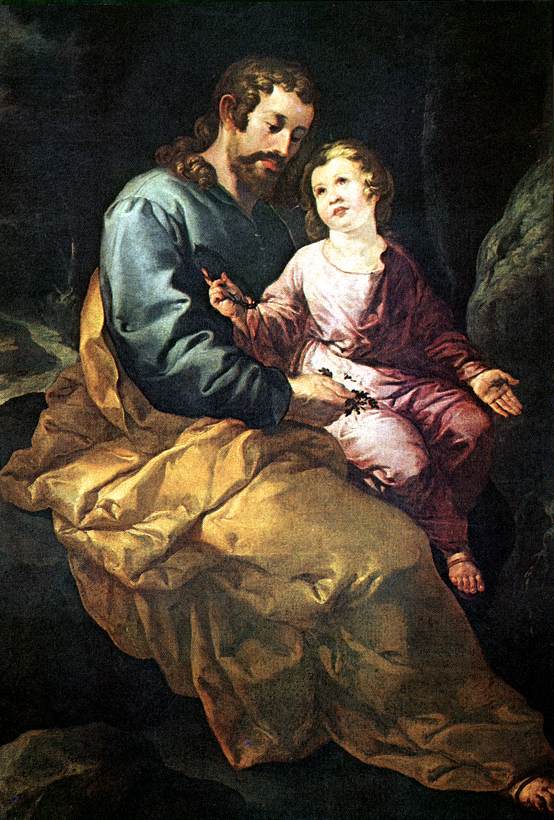
Saint Joseph and the Christ Child by Giovanni Domenico Tiepolo

St. Joseph's Day as a Holy Day of Obligation

The first catalog of Holy Days comes from the Decretals of Gregory IX in 1234, which listed 45 Holy Days. In 1642, His Holiness Pope Urban VIII issued the papal bull "Universa Per Orbem" which altered the required Holy Days of Obligation for the Universal Church to consist of 35 such days as well as the principal patrons of one's locality. St. Joseph's Day is on that list.

However, due to dispensations, differences ranged drastically as to which days were kept as holy days throughout the world. In some parts of the world, St. Joseph's Day on March 19th was a Holy Day of Obligation whereas in others it was not. For instance, St. Joseph's Day was a Holy Day of Obligation in Quebec in the late 1600s and also in the British Colonies in what is now the United States of America. It was also a holy day of Obligation in what is now Florida, among other places. But changes abounded as the number of holy days gradually weakened over the centuries. 

At America's birth, the Holy Days of Obligation, in addition to every Sunday, were as follows: the feasts of Christmas, Circumcision, Epiphany, Annunciation, Easter Monday, Ascension, Whitsun Monday, Corpus Christi, Ss. Peter and Paul, Assumption, and All Saints. St. Joseph's Day had ceased being a Holy Day of Obligation in the United States. However, it remained a holy day in some other parts of the world.

In 1911, Pope St. Pius X issued Supremi disciplinæ which drastically reduced the number of Holy Days of Obligation in the Universal Church to only 8. St. Joseph's Day did not make the list. Shortly thereafter in 1917, however, Corpus Christi and St. Joseph were added back by his successor, bringing the total to 10. The 10 currently observed on the Universal Calendar are the same as from 1917.

As for the Holy Days observed in the United States, the Catholic Encyclopedia in referencing Supremi disciplinæ noted, "Where, however, any of the above feasts has been abolished or transferred, the new legislation is not effective. In the United States consequently the Epiphany and the feast of Sts. Peter and Paul are not days of precept." The same is true of St. Joseph's Day in the changes in 1917. While the 1917 change did not add St. Joseph's Day back to the list of Holy Days of Obligation in the United States, it did elsewhere.

Presently, Indonesia, Lebanon, Malta, Spain, and the Diocese of Lugano in Switzerland keep St. Joseph's Day as a Holy Day.

St. Joseph's Day as a Day of Fast / Abstinence on Fridays in Lent

Per the 1917 Code of Canon Law is Friday abstinence still required? And would the fast of Lent still be observed? The answer is unequivocally yes.

The question of whether Holy Days of Obligation abrogate the requirement of Friday abstinence outside of Lent is mentioned in the 1917 Code:

"On [Sundays] or feasts of precept, the law of abstinence or of abstinence and fast or of fast only ceases, except during Lent, nor is the vigil anticipated; likewise it ceases on Holy [Saturday] afternoon" (1917 Code, Canon 1252 § 4). [Translation taken from THE 1917 OR PIO-BENEDICTINE CODE OF CANON LAW in English Translation by Dr. Edward Peters]

The 1917 Code is explicit - feasts of precepts do not remove the requirement to fast or abstain during Lent. The only way that the obligation would be removed during the season of Lent would be if a dispensation would be specifically offered by the lawful Church authorities for a particular day.

It must be further noted that the removal of the obligation of penance on Holy Days of Obligation outside of Lent only applies to areas that observe the day of precept. It is not based on the Roman calendar, as affirmed by the Commission on the Code in a 1924 article in American Ecclesiastical Review. Hence, when January 6th, the Feast of the Epiphany, falls on a Friday, it is still a mandatory day of abstinence in America and France and other places where it is not a Holy Day of Obligation. In contrast, Canada, Rome, and places that keep it as a Holy Day do not have to observe fasting and/or abstinence on that particular Friday. This, however, only applies to Holy Day of Obligation outside of Lent. And this change only started with the 1917 Code - beforehand, it was still a day of abstinence on Fridays regardless of it was a day of precept or not, unless a specific dispensation was issued by the Pope himself.

In 1954, Pope Pius XII issued such a decree granting bishops the permission to dispense from Friday abstinence for the Feast of St. Joseph which that year fell on a Friday. A March 26, 1954 article of the Guardian elaborates: "Bishops throughout the world have been granted the faculty to dispense their faithful from the law of abstinence on the Feast of St. Joseph, Friday, March 19. The power was granted in a decree issued by the Sacred Congregation of the Council, which said it acted at the special mandate of His Holiness Pope Pius XII. The decree was published in L'Osservatore Romano made no mention of a dispensation from the Lenten fast." 

As such, St. Joseph's Day did not permit the faithful to eat meat on Fridays in Lent unless such a specific dispensation were offered, and which was very rarely done. Likewise, to those who maintain the 1917 Code's requirement to also fast all forty weekdays of Lent - which was observed since the Early Church - St. Joseph's Day remains a day of fast. Surely St. Joseph would want us to produce worthy fruits of penance during this holiest season as we prepare for the Pascal mystery.

Unfortunately, the 1983 Code of Canon Law which aligns with the many modernist changes in the Church weakly states:

"The penitential days and times in the universal Church are every Friday of the whole year and the season of Lent. Abstinence from meat, or from some other food as determined by the Episcopal Conference, is to be observed on all Fridays, unless a solemnity should fall on a Friday. Abstinence and fasting are to be observed on Ash Wednesday and Good Friday" (1983 Code, Canons 1251 - 1252). 

Dispensations From Abstinence Were Previously Required Even for Holy Days of Obligation Outside of Lent

The notion that a solemnity that is not even a Holy Day of Obligation would trump Friday abstinence in Lent is absurd and a radical departure from all of our traditions. For instance, even Christmas would in and of itself not dispense Friday abstinence in the Medieval Church as Dom Gueranger writes in the Liturgical Year published in 1886:

"To encourage her children in their Christmas joy, the Church has dispensed with the law of abstinence, if this Feast fall on a Friday. This dispensation was granted by Pope Honorius III, who ascended the Papal Throne in 1216. It is true that we find it mentioned by Pope St Nicholas I, in the ninth century; but the dispensation was not universal; for the Pontiff is replying to the consultations of the Bulgarians, to whom he concedes this indulgence, in order to encourage them to celebrate these Feasts with solemnity and joy: Christmas Day, St Stephen, St John the Evangelist, the Epiphany, the Assumption of our Lady, St John the Baptist, and SS Peter and Paul. When the dispensation for Christmas Day was extended to the whole Church, these other Feasts were not mentioned."

Previously, a dispensation was required by the Holy Father even on Holy Days of Obligation that fell outside of Lent. Two examples indicating this are Pope Leo XIII's 1890 dispensation for Assumption Day and a 1907 dispensation issued for Canada for All Saints Day. All Saints Day was at that time a Holy Day of Obligation in Canada.

The Catholic Encyclopedia on St. Pius X's Supremi disciplinæ indicates that fasting was abolished eo ipso only starting in 1911 for all Holy Days of Obligation (which were at the same time reduced to only 8): "The present Motu Proprio institutes another important change in legislation. As feasting and fasting are incompatible Pius X has abolished the obligation of fasting as well as that of abstinence for the Universal Church, should such obligation coincide with any of the eight feasts, as above." In practice, we know that the exception was Lent - Lenten abstinence and fast always remained unless explicitly dispensed from even after the weakening changes in 1911.

Must we be reminded of the warning of Pope Benedict XIV who in 1741 warned: "The observance of Lent is the very badge of the Christian warfare. By it we prove ourselves not to be enemies of the cross of Christ. By it we avert the scourges of divine justice. By it we gain strength against the princes of darkness, for it shields us with heavenly help. Should mankind grow remiss in their observance of Lent, it would be a detriment to God's glory, a disgrace to the Catholic religion, and a danger to Christian souls. Neither can it be doubted that such negligence would become the source of misery to the world, of public calamity, and of private woe."

Let us fast and abstain this year on March 19th when so many may fail to do so, and let us offer our acts of penance for the conversion of sinners to the Traditional Catholic Faith.

Want to learn more about the history of fasting and abstinence? Check out the Definitive Guide to Catholic Fasting and Abstinence.
Read more >>
Tuesday, August 12, 2025
Is Friday Abstinence Required When Assumption Day Falls on a Friday?

Assumption by Martin Knoller

Assumption Day As A Holy Day of Obligation

The first catalog of Holy Days comes from the Decree of Gratian in c. 1150 AD, which shortly thereafter gave way to Decretals of Pope Gregory IX in 1234, which listed 45 Holy Days.

In 1642, His Holiness Pope Urban VIII issued the papal bull Universa Per Orbem which mandated the required Holy Days of Obligation for the Universal Church to consist of 34 days as well as the principal patrons of one's one locality (e.g. city and country). Those days were the Nativity of Our Lord, the Circumcision of Our Lord, the Epiphany of Our Lord, Monday within the Octave of the Resurrection, Tuesday within the Octave of the Resurrection, Ascension Thursday, Monday within the Octave of Pentecost, Tuesday within the Octave of Pentecost, Most Holy Trinity, Corpus Christi, the Finding of the Holy Cross, the Purification of the Blessed Virgin Mary, the Annunciation of the Blessed Virgin Mary, the Assumption of the Blessed Virgin Mary, the Nativity of the Blessed Virgin Mary, the Dedication of St. Michael, the Nativity of St. John the Baptist, SS. Peter and Paul, St. Andrew, St. James, St. John (the December feast day), St. Thomas, SS. Philip and James, St. Bartholomew, St. Matthew, SS. Simon and Jude, St. Matthias, St. Stephen the First Martyr (the December feast day), the Holy Innocents, St. Lawrence, St. Sylvester, St. Joseph, St. Anne, and All Saints.  

Hence, Assumption Day was a Holy Day of Obligation long before the dogma of the Assumption was dogmatically defined.

Is Friday Abstinence Required When Assumption Day (August 15) Falls on a Friday?

Since August 15 this year falls on a Friday and is a Holy Day of Obligation, a question arises on whether abstinence is obligatory this Friday. The answer, as clearly stated in the 1917 Code, is as follows:

"On [Sundays] or feasts of precept, the law of abstinence or of abstinence and fast or of fast only ceases, except during Lent, nor is the vigil anticipated; likewise it ceases on Holy [Saturday] afternoon" (1917 Code, Canon 1252 § 4). [Translation taken from THE 1917 OR PIO-BENEDICTINE CODE OF CANON LAW in English Translation by Dr. Edward Peters]

As Assumption Day falls outside of Lent, this Friday is not a day of mandatory abstinence. However, this was actually a change from the practice observed for well over 1,000 years.

Dispensations From Abstinence Were Previously Required Even for Holy Days of Obligation Outside of Lent

Even Christmas would in and of itself not dispense Friday abstinence in the Medieval Church, as Dom Gueranger writes in the Liturgical Year published in 1886:

"To encourage her children in their Christmas joy, the Church has dispensed with the law of abstinence, if this Feast fall on a Friday. This dispensation was granted by Pope Honorius III, who ascended the Papal Throne in 1216. It is true that we find it mentioned by Pope St Nicholas I, in the ninth century; but the dispensation was not universal; for the Pontiff is replying to the consultations of the Bulgarians, to whom he concedes this indulgence, in order to encourage them to celebrate these Feasts with solemnity and joy: Christmas Day, St Stephen, St John the Evangelist, the Epiphany, the Assumption of our Lady, St John the Baptist, and SS Peter and Paul. When the dispensation for Christmas Day was extended to the whole Church, these other Feasts were not mentioned."

Previously, a dispensation was required by the Holy Father even on Holy Days of Obligation that fell outside of Lent. Two examples indicating this are Pope Leo XIII's 1890 dispensation for Assumption Day and a 1907 dispensation issued for Canada for All Saints Day. All Saints Day was, at that time, a Holy Day of Obligation in Canada.

The Catholic Encyclopedia on St. Pius X's Supremi disciplinæ indicates that fasting was abolished eo ipso only starting in 1911 for all Holy Days of Obligation outside of Lent (which were at the same time reduced to only 8): "The present Motu Proprio institutes another important change in legislation. As feasting and fasting are incompatible, Pius X has abolished the obligation of fasting as well as that of abstinence for the Universal Church, should such obligation coincide with any of the eight feasts, as above." 

Thus, while eating meat this Friday is not a sin, it would be meritorious to continue to observe Friday abstinence in honor of the nearly 1,800 year-old tradition that preceded the 1917 Code. If we choose to do so, let us offer it up through our Lady's intercession for the conversion of sinners who violate the laws of the Church and do not attend Holy Mass on days of precept like Assumption Day.

Want to learn more about the history of fasting and abstinence? Check out the Definitive Guide to Catholic Fasting and Abstinence.
Read more >>
Tuesday, March 19, 2024
Is St. Joseph's Day Traditionally Still A Fasting Day?

Since St. Joseph’s Day falls during Lent, it coincides with the traditional Lenten fast which traditionally required 40 days of fasting and 46 days of abstinence from meat. Per the 1917 Code of Canon Law, Friday abstinence is still required on St. Joseph’s Day even where it is kept as a Holy Day of Obligation. And would the fast of Lent still be observed? The answer is unequivocally yes.

The question of whether Holy Days of Obligation abrogate the requirement of Friday abstinence outside of Lent is mentioned in the 1917 Code:

On [Sundays] or feasts of precept, the law of abstinence or of abstinence and fast or of fast only ceases, except during Lent, nor is the vigil anticipated; likewise it ceases on Holy [Saturday] afternoon (1917 Code, Canon 1252 § 4).[1]

The 1917 Code is explicit – feasts of precepts do not remove the requirement to fast or abstain during Lent. The only way that the obligation would be removed during the season of Lent would be if a dispensation would be specifically offered by the lawful Church authorities for a particular day.

It must be further noted that the removal of the obligation of penance on Holy Days of Obligation outside of Lent only applies to areas that observe the day of precept. It is not based on the Roman calendar, as affirmed by the Commission on the Code in a 1924 article in the American Ecclesiastical Review. Hence, when January 6th, the Feast of the Epiphany, falls on a Friday, it is still a mandatory day of abstinence in America and France and other places where it is not a Holy Day of Obligation. In contrast, Canada, Rome, and places that keep it as a Holy Day do not have to observe fasting and/or abstinence on that particular Friday. This, however, only applies to Holy Day of Obligation outside of Lent. And this change only started with the 1917 Code – beforehand, it was still a day of abstinence on Fridays regardless if it was a day of precept or not, unless a specific dispensation was issued by the Pope himself.

In 1954, Pope Pius XII issued such a decree granting bishops the permission to dispense from Friday abstinence for the Feast of St. Joseph which that year fell on a Friday. A March 26, 1954, article of The Guardian elaborates: 

“Bishops throughout the world have been granted the faculty to dispense their faithful from the law of abstinence on the Feast of St. Joseph, Friday, March 19. The power was granted in a decree issued by the Sacred Congregation of the Council, which said it acted at the special mandate of His Holiness Pope Pius XII. The decree published in L’Osservatore Romano made no mention of a dispensation from the Lenten fast.”

As such, St. Joseph’s Day did not permit the faithful to eat meat on Fridays in Lent unless such a specific dispensation were offered, which was very rarely done. Likewise, to those who maintain the 1917 Code’s requirement to also fast all forty weekdays of Lent – which was observed since the Early Church – St. Joseph’s Day remains a day of fast. Surely St. Joseph would want us to produce worthy fruits of penance during this holiest season as we prepare for the Pascal mystery.

Unfortunately, the 1983 Code of Canon Law which aligns with the many Modernist changes in the Church weakly states:

The penitential days and times in the universal Church are every Friday of the whole year and the season of Lent. Abstinence from meat, or from some other food as determined by the Episcopal Conference, is to be observed on all Fridays, unless a solemnity should fall on a Friday. Abstinence and fasting are to be observed on Ash Wednesday and Good Friday (1983 Code, Canons 1251 – 1252).

It should be noted that traditionally St. Joseph’s Tables, even when transferred to Sunday, were always meatless. For centuries, even Sundays in Lent were days of abstinence – just not fasting.

Want to learn more about the history of fasting and abstinence? Check out the Definitive Guide to Catholic Fasting and Abstinence.

Read more >>
Friday, June 7, 2024
Is Abstinence Obligatory on the Solemnity of the Sacred Heart?

As a reminder, the Feast of the Most Sacred Heart of Jesus, which always falls on a Friday, is still an obligatory day of abstinence. As Catholics, we are still bound to abstain from meat each Friday of the entire year, not just in Lent. We are still bound to abstain from meat each Friday of the entire year, not just in Lent. 

Abstinence Traditionally Required on All Fridays

The 1917 Code of Canon Law stipulated that the requirement to abstain from meat (i.e., Friday penance) was required each and every Friday of the year unless that particular Friday was a Holy Day of Obligation:

"On [Sundays] or feasts of precept, the law of abstinence or of abstinence and fast or of fast only ceases, except during Lent, nor is the vigil anticipated; likewise it ceases on Holy [Saturday] afternoon" (1917 Code, Canon 1252 § 4). [Translation taken from THE 1917 OR PIO-BENEDICTINE CODE OF CANON LAW in English Translation by Dr. Edward Peters]

The 1917 Code introduced the radical notion that a Holy Day of Obligation would eo ipso overrule the requirement of Friday abstinence for any Holy Days of Obligation outside of Lent. Previously, the only day that would automatically abrogate the requirement of Friday abstinence was Christmas Day (December 25th), the exception of which went back to 1216 AD. Before the time of St. Pius X, the Holy Father required a dispensation from Friday abstinence on any other Holy Day of Obligation. The Feast of the Sacred Heart, which was established on the Universal Calendar in 1856, is not a feast of precept (i.e., a Holy Day of Obligation).

The Solemnity of the Sacred Heart Focuses on The Need for Reparation 

Let us never forget that the purpose of the Feast of the Sacred Heart is one focused on penance and reparation. When so many use the modernist 1983 Code to excuse themselves from Friday abstinence, let us, faithful to Tradition, keep today as one of abstinence in reparation to the Sacred Heart as the collect prayer for this feastday urges:

O God, through Your mercy we possess the treasures of Your love in the Sacred Heart of Your Son, the same Sacred Heart which we wounded by our sins. May our honor, devotion, and love make reparation to Him for our faults. Through the same Jesus Christ, our Lord...

Want to learn more about the history of fasting and abstinence? Check out the Definitive Guide to Catholic Fasting and Abstinence.
Read more >>
Tuesday, March 7, 2006
Stational Churches

St. Ignatius Church, Rome, Italy (c) A Catholic Life Blog, 2016

Stations of Lent:

Ash Wednesday
Thursday after Ash Wednesday
Friday after Ash Wednesday
Saturday after Ash Wednesday

First Sunday of Lent
Monday in the First Week of Lent
Tuesday in the First Week of Lent
Wednesday in the First Week of Lent
Thursday in the First Week of Lent
Friday in the First Week of Lent
Saturday in the First Week of Lent

Second Sunday of Lent
Monday in the Second Week of Lent
Tuesday in the Second Week of Lent
Wednesday in the Second Week of Lent
Thursday in the Second Week of Lent
Friday in the Second Week of Lent
Saturday in the Second Week of Lent

Third Sunday of Lent
Monday in the Third Week of Lent
Tuesday in the Third Week of Lent
Wednesday in the Third Week of Lent
Thursday in the Third Week of Lent
Friday in the Third Week of Lent
Saturday in the Third Week of Lent

Laetare Sunday
Monday in the Fourth Week of Lent
Tuesday in the Fourth Week of Lent
Wednesday in the Fourth Week of Lent
Thursday in the Fourth Week of Lent
Friday in the Fourth Week of Lent
Saturday in the Fourth Week of Lent

Passion Sunday
Monday in the Fifth Week of Lent
Tuesday in the Fifth Week of Lent
Wednesday in the Fifth Week of Lent
Thursday in the Fifth Week of Lent
Friday in the Fifth Week of Lent
Saturday in the Fifth Week of Lent

Palm Sunday
Monday in Holy Week
Tuesday in Holy Week
Wednesday in Holy Week
Holy Thursday
Good Friday
Holy Saturday

Stations of Easter Week:

Easter Sunday: Saint Mary Major
Easter Monday: Saint Peter’s in the Vatican
Easter Tuesday: Saint Paul outside the Walls
Easter Wednesday: Saint Laurence Outside the Walls
Easter Thursday: Twelve Apostles
Easter Friday: Saint Mary of the Martyrs (the Pantheon)
Easter Saturday: Saint John in the Lateran
Low Sunday, the Octave Day of Easter: Saint Pancras on the Janiculum Hill

Stations from Ascension through Pentecost:

Ascension Thursday: Saint Peter’s in the Vatican
Saturday, the Eve of Pentecost: Saint John in the Lateran
Pentecost Sunday: Saint Peter’s in the Vatican
Pentecost Monday: Saint Peter’s in Chains
Pentecost Tuesday: Saint Anastasia
Pentecost Wednesday: Saint Mary Major
Pentecost Thursday: Saint Lawrence outside the Walls
Pentecost Friday: Twelve Apostles
Pentecost Saturday: Saint Peter’s in the Vatican

Stations of Advent:

First Sunday of Advent: Saint Mary Major (on the Esquiline Hill)
Second Sunday of Advent: Holy Cross in Jerusalem
Third Sunday of Advent: Saint Peter’s in the Vatican
Wednesday: Saint Mary Major (on the Esquiline Hill)
Friday: Twelve Apostles (near Piazza Venezia)
Saturday: Saint Peter’s in the Vatican
Fourth Sunday of Advent: Twelve Apostles (near Piazza Venezia)

Stations of the Christmas Season:

First Mass of Christmas at Midnight: Saint Mary Major (in the Chapel of the Crib)
Second Mass of Christmas at Dawn: Saint Anastasia
Third Mass of Christmas at Midnight: Saint Mary Major (on the Esquiline Hill)
December 26rd: Saint Stephen on the Celian Hill
December 27th: Saint Mary Major
December 28th: Saint Paul outside the Walls (on the Ostian Way, Metro ‘San Paolo’)
January 1st: Saint Mary in Trastevere
January 6th: Saint Peter’s in the Vatican
Read more >>


Copyright Notice: Unless otherwise stated, all items are copyrighted under a Attribution-NonCommercial-NoDerivatives 4.0 International License. If you quote from this blog, cite a link to the post on this blog in your article.

Disclosure of Material Connection: Some of the links on this blog are “affiliate links.” This means if you click on the link and purchase the item, I will receive an affiliate commission. As an Amazon Associate, for instance, I earn a small commission from qualifying purchases made by those who click on the Amazon affiliate links included on this website. I am disclosing this in accordance with the Federal Trade Commission’s 16 CFR, Part 255: “Guides Concerning the Use of Endorsements and Testimonials in Advertising.”